1,. I' ~I,
Process-Oriented Language Design
for Distributed Address Spaces
PETER RICHARD BAILEY
A thesis submitted for the degree of
Doctor of Philosophy of
The Australian National University
©
Peter Bailey 1997
Earlier versions of some parts of this thesis have appeared in:
Proceedings of the
Sixteenth Australasian Computer Science Conference
© Australian Computer Science Association 1993
Proceedings of CONP AR 94 - V APP VI
©Springer-Verlag 1994
Proceedings- of CATS'96:
Except where otherwise indicated, this thesis is my own original work.
~
Peter Bailey
Abstract
Commercial and scientific applications exist with computational and communications requirements that far exceed the most powerful computers available today. Short of radical change in technologies, it is generally recognised that the way ahead to satisfy the demand for increased computational resources is restricted to parallel computer systems. Many such parallel computers present a distributed address space programming environment which assists in achieving scalable performance.Finding safe and efficient language mechanisms for programming in the context of a distributed address space is a significant challenge for computer science. This thesis addresses several issues that arise in meeting the challenge through development of the process-oriented programming language paraML. The design choices for the language are motivated and realised as extensions to ML.
The paraML language is modelled theoretically by an untyped lambda calculus called
A,ro·
The key results of the theoretical modelling are the formal specification of computation with reference variables which have been copied from one process to another. A proof of type soundness for the polymorphic type system is given which thus guarantees that any typable program will not produce a type-error at runtime.A working version of paraML has been implemented as a proof-of-concept and used for applications. The performance metrics of the implementation are given to illustrate the scalable characteristics of the implementation. ParaML demonstrates that process-oriented mechanisms are valuable in simplifying many of the complications associated with programming in distributed address spaces.
V
----
t::7:s
Acknowledgments
Thanks ...
TO the members of my supervisory panel-Malcolm Newey, Robin Stanton and Chris Johnson: for their ad vice and encouragement.
TO Mike Bailey, Joanne Evans, James Popple, Trevor Vickers and Greg Wilson: for their comments on and helpful critical reading of various parts of various drafts.
TO the members of our weekly graduate student forum, particularly the regulars -Steve Blackburn, Stephen Fenwick, Bill Keating and Richard Walker: for their enthusiastic approach to research, constructive debates and general support.
TO Dave Hawking, Paul Mackerras, David Sitsky, Andrew Tridgell and Dave Walsh: for their first-class work in creating and supporting the computing environments with which I've worked.
TO the various members of the Department of Computer Science's academic, administrative and computing support staff - particularly Sally Begg, Kath Read and Wendy Novak.
TO Alisdair Bruce, Simon Chapple, Lyndon Clark, Murray Cole, Neil Heywood, Andy Sanwell and Gordon Smith: for their help and support during six months visiting the Edinburgh Parallel Computing Centre.
TO Andy Gordon, Thierry Le Sergent, Dave Matthews, Greg Morrisett, Benjamin Pierce and John Reppy: for their discussions and advice on matters concerning ML and concurrency.
TO the staff at The Gods Cafe - particularly Warwick, Di and Bill: without whose coffee mornings would have been so much less productive.
AND TO my family and friends - Margaret & Michael, Thomas & David, Reagan, Clare, Penelope, Charlie & Ingrid, Keiran, Kim, Nigel, Subho, Andy & Rachet Felicity, Graham & Charlotte, Quintin, Simon & Heather, Greg, Don, Gavin & Emma, and Joey: for sustaining me throughout the years.
This research was supported by an Australian Postgraduate Award PhD Scholarship.
Additional financial support was provided by a topup PhD Scholarship from the Advanced
Computational Systems Cooperative Research Centre and by a TRACS Scholarship from the Edinburgh Parallel Computing Centre.
Vll
Contents
Part I - INTRODUCTION ... 1
Chapter 1. Introduction ... 3
1.1 Motivation ... 3
1.2 Focus ... . 3
1.3 Process-oriented programming ... ... 7
1.4 Contributions of this thesis ... .... ... ... ... 8
1.5 Thesis structure ... ... ... ... ... 9
1.6 History ... .. ... .... .. ... ... .... ... ... 10
Chapter 2. Related work ... 11
2.1 Introduction ... ... ... ... 11
2.2 Meanings ... ... ... 11
2.3 Static versus dynamic invocation of processes ... ... ... 12
2.4 Styles of communication and synchronisation ... 12
2.5 Other ways of managing program partitioning ... ... ... 15
2.6 Specific comparisons ... 17
2.7 Conclusions ... ... ... ... ... ... .. ... 21
Part II - DESIGN ... 23
Chapter 3. Programming model ... 25
3.1 Introduction ... .. ... ... ... ... ... .. .. 25
3.2 Processes ... 25
3.3 Safe and efficient high performance programming facilities ... 2 9 3.4 Programming model ... 35
3.5 Abstract machine model ... ... 38
3.6 Physical machine model. ... ... ... ... ... 39
3.7 Implications for programming ... ... ... ... .45
3.8 Summary ... 46
Chapter 4. Design ... .. 4 9 4.1 Overview ... 49
4.2 Design concerns ... 4 9
lX
4.3 Core extensions ... 5 3
4.4 Derived operations ... 62
4.5 Input/ output ... 70
4.6 Machine attribute operations ... 72
4. 7 Concurrency within processes ... 7 2 4.8 Benefits and limitations ... 73
4. 9 Con cl us ion ... 7 4 Part III - THEORY ... 77
Chapter 5. Theory background ... 79
5.1 Introduction and motivation ... 79
5.2 Related work ... ... 79
5.3 Notation ... 81
5.4 Formal semantics ... 82
5.5 Summary ... ... 99
Chapter 6. Operational semantics ... 101
6.1 Introduction ... 101
6.2 Syntax ... 101
6.3 Dynamic semantics ... 103
6.4 Traces ... 115
6.5 Fairness ... 117
6.6 Summary ... 118
Chapter 7. Typing •••••••••••••••••••o•••••••••••••••••••••••••••••••o••••••••••••••••••••••••••••••••••••••••••••• 119 7.1 Static semantics ... 119
7 .2 Type soundness ... 122
7 .3 Con cl us ion ... 12 8 Part IV - PRACTICE ..•...•...•..•••... 12 9 Chapter 8. Applications ... 131
8.1 Introduction ... 131
8.2 Algorithmic skeletons ... ... 131
8.3 Object stores ... ... 135
8.4 SIMPLE ... ... 141
8.5 Conclusion ... ... 143
Chapter 9. Implementation ... 145
9.1 Introduction ... 145
9.2 ParaML runtime system design ... ... 145
9.3 ParaML runtime system implementation ... 148
9.4 ML compiler and runtime system extensions ... 154
X
l1
i'
1I
11
I
II;
II J
9 .5 Concurrency within processes ... 15 7
9.6 MPI as a communication platform ... 158
9.7 Limitations of implementation ... 160
9 .8 Conclusion ... 161
Chapter 10. Performance ... 163
10 .1 Introduction ... 16 3 10.2 Multicomputer characteristics ... ... ... ... 163
10.3 MPI performance ... ... 164
10.4 ML performance ... ... 166
10.5 ParaML runtime system ... ... 168
10.6 ParaML operations ... .. ... 169
10.7 Mandelbrot benchmark ... 180
10 .8 Optimisations ... 18 3 10.9 Conclusion ... ... 184
Part V - CONCLUSION ...•...•.•....•...•....•••... 185
Chapter 11. Future research ... 18 7 11.1 Introduction ... 187
11.2 Design ... 18 7 11.3 Theory ... 188
11.4 Practice ... .. ... 188
Chapter 12. Conclusion ... 1.91 Appendices, Glossary, References ... 19 3 Appendix A -1 ... 195
Proof of Lemma 5-6 ... ... 19 5 Proof of Lemma 5-7 ... 19 6 Proof of Lemma 5-8 ... 19 8 Proof of Lemma 5-9 ... 2 0 0 Proof of Lemma 5-10 ... 2 0 2 Appendix A -2 ... 205
Proof of Lemma 7-4 .. ... ... ... 2 0 5 Proof of Lemma 7-5 ... 2 0 6 Proof of Theorem 7 -6 ... ... ... 2 0 8 Proof of Theorem 7-7 ... ... 2 0 9 Proof of Lemma 7-10 ... ... ... ... 219
Proof of Lemma 7-11 ... ... ... ... 223
Glossary References ... 231
... 236
XI
Figures
Figure 3.1 - Processes and ports in the programming model. ... 3 7
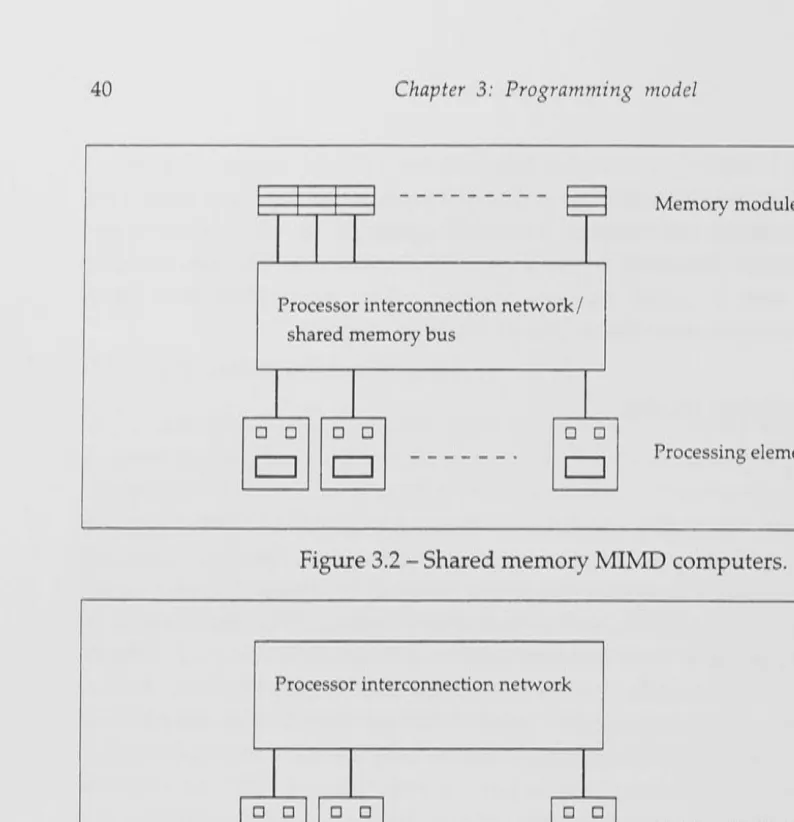
Figure 3.2 - Shared memory MIMD computers ... 40
Figure 3.3 - Distributed memory WMD computers ... 40
Figure 3.4 - The multicomputer model. ... 42
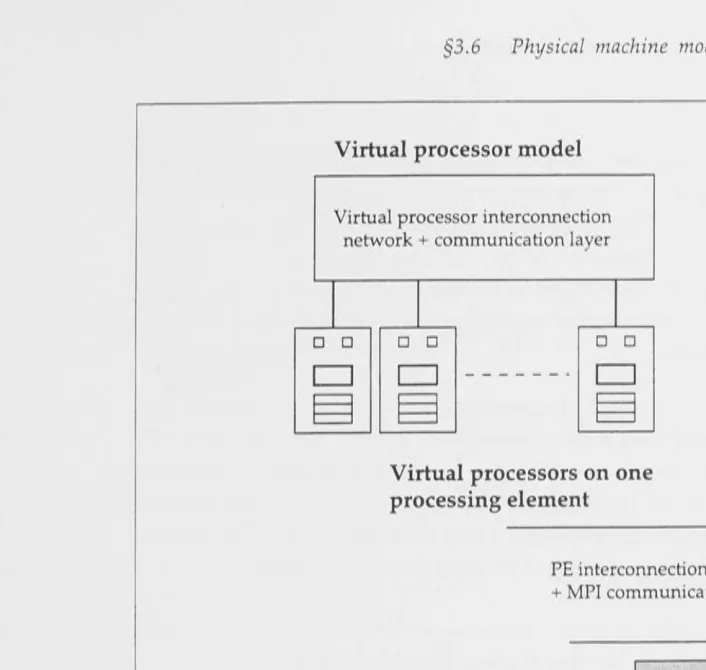
Figure 3.5 - Virtual processor model. ... 43
Figure 3.6 - Simple sharing of memory in the programming model. ... 45
Figure 4.1-A possible asynchronous message ordering; not possible in paraML .... 59
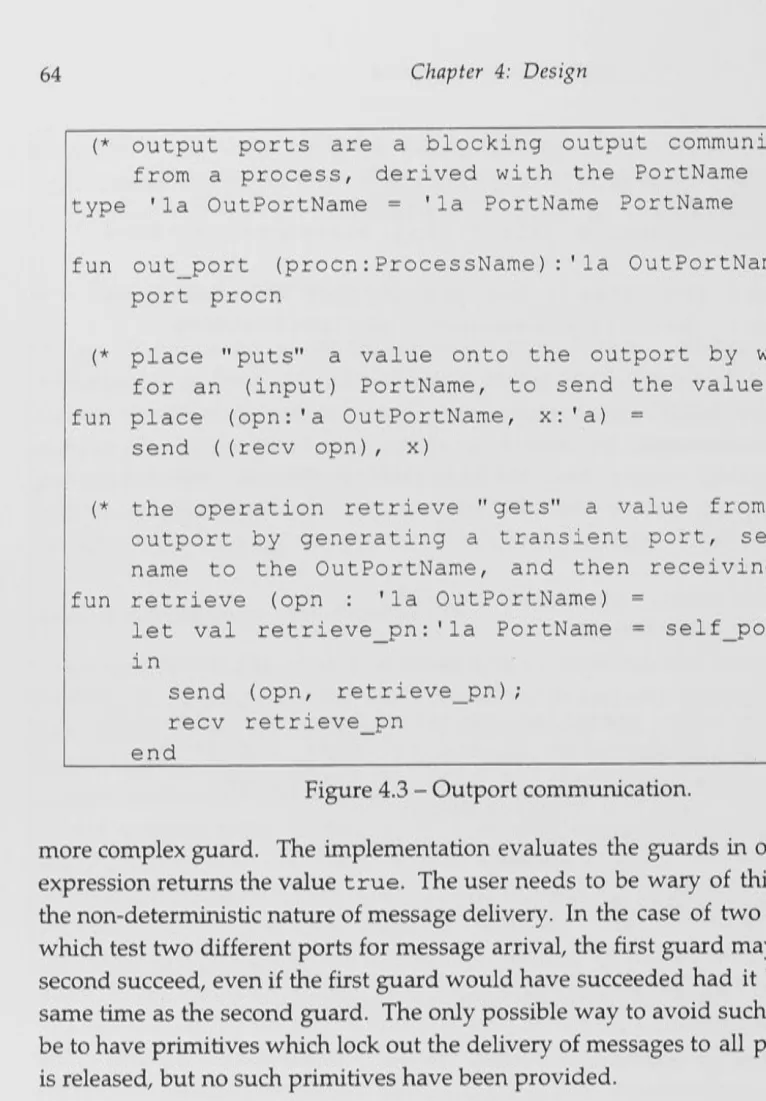
Figure 4.2 - Synchronous communication ... 6 3 Figure 4.3 - Outport communication ... 64
Figure 4.4 - Guarded choice ... 65
Figure 4.5 - Processes used for results of functions ... 65
Figure 4.6 - Process group creation and execution ... 6 6 Figure 4.7 - Basic port group creation and attribute operations ... 6 7 Figure 4.8 - Basic port group communications ... 6 7 Figure 4.9 - Scattering and gathering to port groups ... 68
Figure 4.10 - Synchronous port groups ... 68
Figure 4.11 - Reduction and scan operation interfaces ... 69
Figure 4.12 - Barrier synchronisation for groups ... 69
Figure 4.13 -Input/ output for process groups ... 71
Figure 4.14 - Machine attribute operations ... 71
Figure 5.1 - Ground terms of Aro . ... 8 2 Figure 5.2 - Basic syntactic definitions ... 82
Figure 5.3 - Grammar for expressions, exceptions and values ... 83
Figure 5.4 - Free variables in terms ... 85
Figure 5.5 - Substitution in terms ... ... 86
Figure 5.6 - Grammars for evaluation contexts ... ... 88
Figure 5.7 - Rules of reduction with E contexts in Aro ... 89
Figure 5.8 - Rules of reduction for references with R contexts in Aev··· 89
Figure 5.9 - Basic syntax for type constants and variables ... 91
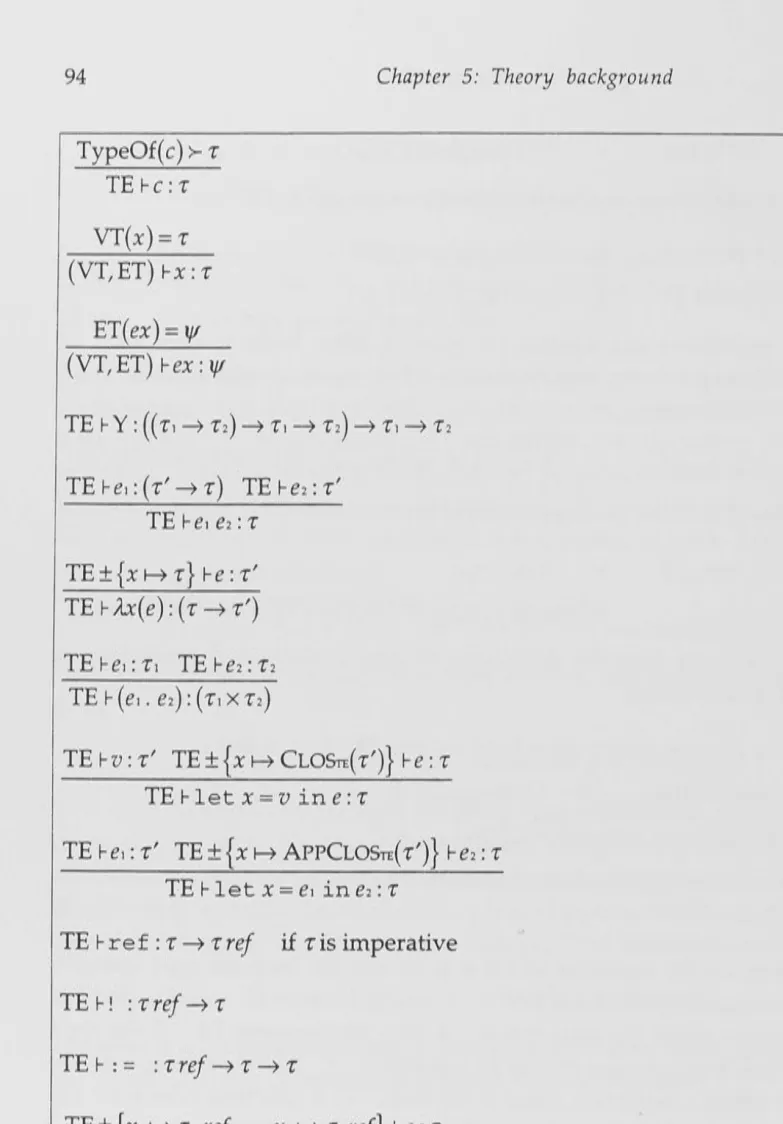
Figure 5.10 - Type rules for Aro ... 94
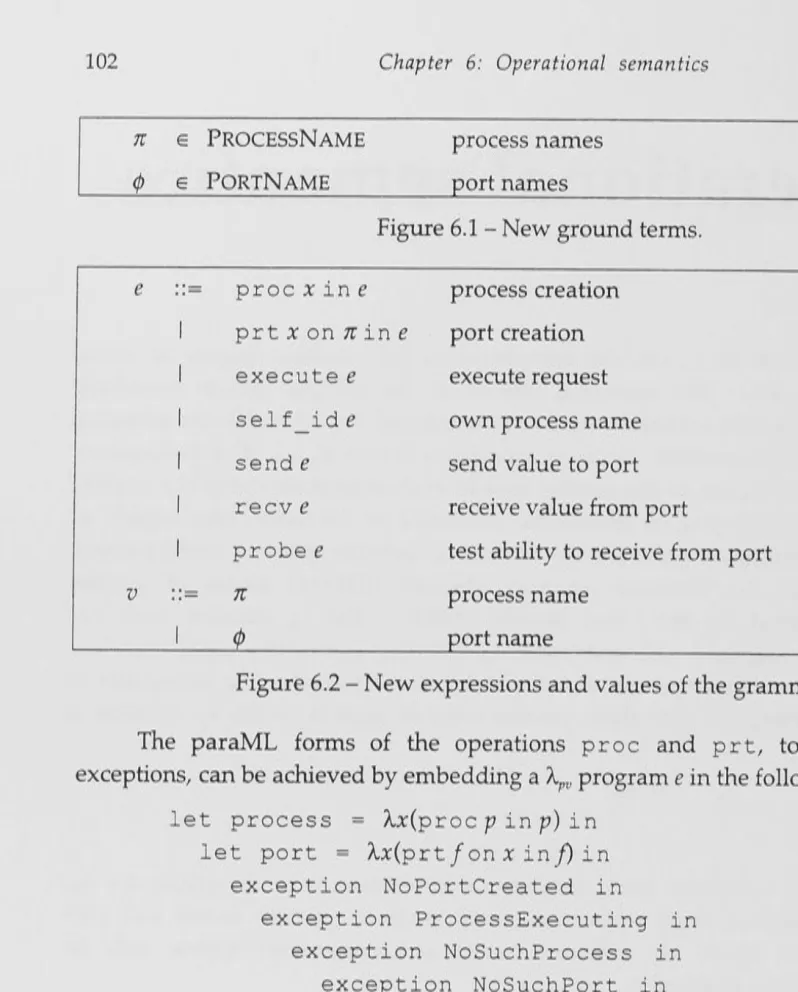
Figure 6.1- New ground terms ... ... ... ... 102
Figure 6.2 - New expressions and values of the grammar ... 102
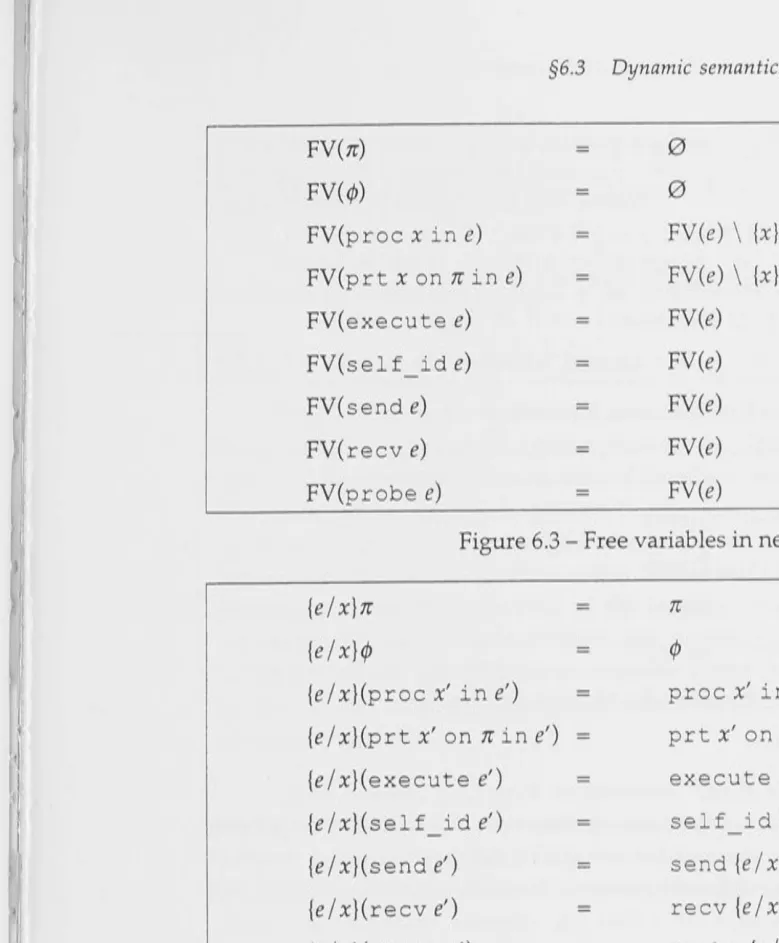
Figure 6.3 - Free variables in new terms ... ... 103
Figure 6.4- Substitution in new terms ... ... 103
Figure 6.5 - Grammars for contexts ... 104
Figure 6.6- Sequential evaluation relation ... 104
Figure 6.7 - Syntactic definitions for process configuration components ... 106
Figure 6.8 - Parallel evaluation rules for: (a) sequential evaluation; (b) exception binding; (c) proc; (d) self_id ... ... 107
Figure 6.9-Parallel evaluation rules for prt ... 108
Figure 6.10 - Parallel evaluation rules for execute ... 108
Figure 6.11 - Parallel evaluation rules for send ... 110
Figure 6.12 - Parallel evaluation rules for recv ... 110
Figure 6.13 - Parallel evaluation rules for probe ... 110
Figure 6.14- Definitions of mem and mem_gc . ... 113
Figure 7.1-New type rules for Apv ... 121
Figure 8.1- Shared memory program execution ... 137
Figure 8.2- Generic object store in shared memory ... ... 137
Figure 8.3 - Generic object store in a process-oriented system ... 138
Figure 8.4 - Object store in paraML ... 138
Figure 9.1-Programming model components ... ... ... .... ... ... ... ... ... .. ... 146
Figure 10.1-Performance for small messages under MPI ... 165
Figure 10.2-Performance for large messages under MPI. ... 165
Figure 10.3 -Performance for small messages under MPI for paraML ... 167
Figure 10.4-Performance for large messages under MPI for paraML ... 167
Figure 10.5 - Times for process operation with differing numbers of processes ... 172
Figure 10.6 - Times for port operation with differing numbers of processes ... .. .. 17 4 Figure 10.7 - Times for execute operation with differing numbers of processes ... 17 4 Figure 10.8 - Elapsed sending times for one process and different message sizes ... 176
Figure 10.9- Sending times for differing numbers of processes ... 177
Figure 10.10 - Sending times with standard deviation between runs ... 178
Figure 10.11 - Scatter plot of elapsed sending times ... 179
Figure 10.12 - Scatter plot of user sending times ... 179
Figure 10.13 -Times for Mandelbrot with differing numbers of processes ... 180
Figure 10.14 - Speed for Mandelbrot at size 64 ... 181
Figure 10.15 - Speed for Mandelbrot at size 8192 ... 182
Tables
Table 4-1 - Summary of extensions ... 61
Table 9-1 - Categories of message requests accepted by the message handling
thread ... .... ... .. .... ... ... .. ... 149
Table 10-1 - Object marshalling and unmarshalling ... 168
Table 10-2-Times in
µsecs
for function loop and process descheduling andresmeduling ... .. .... ... 16 9
Table 10-3 -Times and standard deviations in
µsecs
for self _id, probe,recv and self _port operations ... 170
Table 10-4 - Times and standard deviations in
µsecs
for naive translation ofself _po rt operation ... .. ... .. ... 171
Table 10-5 - Costs of paraML operations per process in Mandelbrot program ... 182
Part I
INTRODUCTION
11•·
1.
Introduction
1.1 Motivation
Modem computing systems look radically different from those of
thirty
years ago. Computers are now ubiquitous, and immensely more powerful. Long gone is the time when it was possible to assert that all of a country's computing requirements could be supported with a single computer. As computers have become more and more widespread, the range of problems to which they have been applied has expanded similarly. And as computers have become more powerful, the degree of complexity in the problems being attempted has increased. Indeed, there exist many problems of interest which existing sequential computers are incapable of solving in a satisfactory time.High-speed interconnection networks1 are altering the possibilities for how
computing services are provided. For instance, programs may reside on quite separate computers from the one in front of a user. These programs may execute either on the local computer after being sent across the network, or be invoked remotely with data from the user through some interface such as a Web browser. Computers connected by networks constitute a distributed computer system.
The realisation of programming environments to meet the changing nature of computer systems, particularly with respect to distributed computer systems, is a challenging task. The goal of this thesis is to show that process-oriented programming facilities provide an effective solution to some of the difficulties involved.
1.2 Focus
The three main concerns addressed by this thesis are:
• Supporting computation in the context of a distributed address space.
• Enabling partitioning and coordination of computation.
• Providing programming facilities that are both efficient and safe.
As usual in computing, many of these terms are open to different interpretations. The focus of the thesis will be better understood with clear definitions of the key terms as they are used in this thesis.
1 Short definitions of italicised words are available in the Glossary, p. 231
4 Chapter 1: Introduction
1.2.1 Distributed address spaces
The essence of distributed address spaces is that the physical computer memory is partitioned among a number of processing elements (PEs) or nodes, and there is a one-to-one mapping between address spaces and memory partitions. Each PE typically consists of one or more central processing units (CPUs), memory, and network interface components which connect that PE to other PEs. Non-local access to a PE's memory must pass through a network which connects the PEs. At some layer of programming abstraction, the distribution of the address space, and consequently memory, becomes visible. The effect of this visibility means the programmer becomes aware of a difference between local and non-local memory access.
The distributed approach is in contrast to the traditional model of computing, where even if there are multiple CPUs, any of them may access any part of memory on an equal basis and there is a single shared address space. Some modem computers use physically distributed memory for scalability purposes, but provide a shared address space so that the same mechanism is used for both local and non-local memory access.
Computer systems with distributed address spaces are becoming increasingly common. Networked computers, from multicomputers to clusters of workstations to the Internet, have progressively wider memory distribution among nodes. As networked computers become more widespread, finding good mechanisms to program with the distributed address spaces they embody becomes more critical.
For sequential algorithms, a distributed address space requires a program to draw together disparate data entities into a computation. This action can be done by a layer which emulates a shared address space from the various memory components of the distributed address space. The merits of hiding the distribution of memory in layers of abstraction below programming languages are part of an ongoing debate. This issue is not central to this thesis, and its examination is deferred until later.
The network bandwidth and latency involved with distribution over the Internet can be highly unpredictable. For reasons of simplicity, this thesis examines only distributed address spaces over networks with high bandwidth and low latency, as may be found in multicomputers.
1.2.2 Concurrency: partitioning and coordination
j,,
I ii
:,•
I
§1.2 Focus 5
Many concurrent systems assume an underlying shared address space, since the goal of such systems is
to
introduce concurrency, notto
manage issues of distribution. On other occasions, a problem is not naturally specified concurrently, but the performance of a sequential implementation is inadequate. In these instances, some partitioning of the problem is usual,to
make efficient use of a computer with a distributed address space and multiple PEs.Returning
to
the steam generation example, modelling of the turning turbines can be performed with varying degrees of precision. A very simple model will encode the rate of electricity generation by the amount of steam being delivered. However, the power station may wishto
optimise its electricity generation. If a simple model is too inaccurate, a more complex simulation would become necessary, perhaps modelling the fluid dynamics of steam in the turbine. Fluid dynamics simulations are computationally expensive, and could require the resources of high performance computers with distributed address spaces. The space through which the fluid flows might be modelled with a 3-dimensional mesh decomposition, with different mesh elements mappedto
different PEs.In both cases, there is a notion that a single program is being executed, albeit composed of different parts. This characteristic is significant, since it distinguishes systems designed
to
support partitioned programming from those which support multiple distinct programs. The latter system type is often referredto
as adistributed
system
or sometimes as acoordination system.
Many of the issues involved indistributed systems are similar
to
those described for partitioned programs in distributed address spaces. However, there is considerably stronger coupling between the program components in a partitioned program than necessarily occurs in a distributed system. This thesis investigates the challenges of partitioning and coordinating the components of a program in a distributed address space. It does not concern itself with the issues of managing and coordinating a distributed set of distinct programs, which is the domain of distributed system languages or coordination languages.Partitioning in the specification of a problem (either
to
achieve better performance or because the specification is inherently concurrent) usually requires some mechanismto
coordinate the various activities. Coordination typically occurs by the communication of some information, either directly between the two (or more) program entities or through some intermediary. Typically information is communicated by either a message passing system or some common data structure manipulation.In the power station model example, communication is required
to
carry information about rate of delivery of waterto
the power station, rate of production of steam and deliveryto
the turbine, and so on. Coordination is also required so that steam production does not occur priorto
the water being delivered from the reservoir. In the fluid dynamics example, communication occurs between neighbouring elements about the state of steam movement through the spatial element in the previous step of6 Chapter 1: Introduction
the simulation. Coordination is required to make sure that any steam which has migrated into the element during the previous step is incorporated into the calculations for the current step of the simulation.
1.2.3 Efficient programming facilities
There appears to be no limit to the desires for increased performance. One of the barriers to increased performance is access to memory. On shared memory computers, the access to memory becomes a bottleneck. Physically distributed memory offers a scalable solution to this bottleneck, and computers with multiple PEs embodying distributed address spaces will continue to be an effective means of achieving performance improvements. For example, the precision of a simulation is dependent on the resolution in the spatial decomposition. If the space can be modelled with a larger number of smaller components, then the margin for error diminishes since each component needs to make fewer assumptions about interactions with other components. Smaller spatial elements will also result in a closer match with the actual space being modelled. However, having more elements means more computation and more interactions overall, thus requiring more computing performance to solve the problem in the same time. Being able to model the fluid dynamics of the turbine more precisely may result in more cost-efficient operation.
Distributed address spaces and partitioned program specifications pose both a challenge and an opportunity for achieving high performance. The challenge arises because of the extra overheads and delays in coordinating concurrent actions in such an environment. The opportunity arises because of the potential for simultaneous or
parallel
execution of the different actions. ·Achieving maximum performance means the overheads of managing parallelism must be minimised, and thus the programming facilities must be efficient.1.2.4 Safe programming facilities
Programs may fail in a number of ways. Some of these failures may be statically detectable before the program is ever run. Other failures are impossible to detect prior to execution, and occur while the program is running. The meaning of "safe" as it is used in this thesis is firstly that programs should not fail because the language permits semantically incorrect operations (such as adding strings to integers) which can be detected statically. Similarly, the design of the language should not permit avoidable system failures (such as those arising from memory leaks or null pointer dereferencing).
If errors do arise which are undetectable prior to program execution (such as division by zero), there need to be clean mechanisms for identifying and recovering from such errors.
11~
§1.3 Process-oriented programming 7
sender should be informed and have means of performing an alternative computation. More problematically, a system-wide deadlock situation should be identified and indicated to the user, even if there is no clear recovery state. Circumstances in which an otherwise safe program might work incorrectly would be because the programmer makes a logical error in the construction of the program (such as a non-terminating computation, which is generally undetectable).
For example, matching power generation to the demand for electricity in the grid is a problem that can be optimised by "just-in-time" simulations. These simulations are used to adjust the delivery of the various requirements for power generation according to changing demand just as the demand arises. Meeting this need requires both a very efficient simulation and one which is safe. Suppose the simulation is used to drive delivery of water to the steam generator to increase turbine speed (and thus electricity generation) when demand rises. If the reservoir suddenly drops below a critical level, the simulation must detect this condition, and prevent the steam generator from continuing at the previous rate. A critical failure of this kind could be addressed in the simulation using exception-handling language facilities.
The mechanisms which expose distributed address spaces and the mechanisms which specify problem partitioning necessarily introduce new complexities to a programming language. The need for these mechanisms to be as safe and robust as any other aspect of a language is just as strong as in sequential programming.
1.3 Process-oriented programming
The basic notion of a
process
is that of an entity that contains some code to perform an action or series of actions, while maintaining information on the state of computation, including what will execute next in the code. The process encapsulates any data (or memory) required by the code for its execution. If data is not available when the process commences, it may be communicated to the process through some defined interfaces. These interfaces may be established dynamically during the course of execution of the code of the process.One of the best mechanisms to achieve high performance is by utilising the resources of
parallel
computers. For a program to make use of such parallel computers, there must be ways to partition the problem into processes that can execute simultaneously. Coordination of the processes occurs through communication. As such, processes are naturally suited to programming in a distributed address space, as each process may be mapped to a different PE and thus a different part of memory. The interconnection network would then be used for communication.8 Chapter 1: Introduction
the destinations to which information is sent. Additional measures for achieving safety tend to be language-dependent.
In
object-oriented
computing, the primary structuring unit of computation is anobject. Methods define the set of actions that may be performed by the object, and are invoked only when messages are sent to them. The term "process-oriented" is used here to capture the notion that the primary structuring unit is the process. Unlike object methods, where the semantic effect of message arrival is the invocation of some defined action, processes use ports just to receive information. The information may be used in whatever manner desired, as specified in the process code.
Process-oriented programming is useful for tackling the complications of efficient partitioned computation in distributed address spaces.
1.4
Contributions of this thesis
Supporting a process-oriented style of programming requires the development of some semantic notions for processes and ports in a programming language. The approach taken in this thesis is to extend an existing programming language, ML [MTH90].
The development of ML took place over a number of years, and represents the fusion of many efforts in building a rigorously defined, safe and high-level language. ML is based on the functional programming paradigm, but incorporates imperative features. It has a history of use in exploring new programming features: for example, concurrency, data parallelism, and distribution; as well as various developments in type systems. Several high-quality and efficient implementations of ML exist which are available for modification. ML is an excellent platform on which to develop the necessary semantic notions for processes and ports. ML is useful both as an implemented language for computation within processes and as an instance of a sound theoretical model.
The name given to the process-oriented extended ML language is paraML. ParaML' s extensions to ML are a compact set of requirements for supporting the process-oriented model within a strongly-typed programming framework. In paraML, processes provide services to create communication facilities and to execute some code. Evaluation takes place against an encapsulated data environment local to the process. Communication is performed by message passing to ports which hold queues of messages. Ports are created dynamically during execution and are local to individual processes.
A particular focus of the experiment has been to explore ways to achieve safe and efficient programming facilities. This thesis has thus developed the process-oriented extensions to ML in such a manner as to provide support for safe and
efficient computing. The ability for paraML to address four major themes specific to
high
performance computing in the context of distributed address space computersl'\
§1.5 Thesis structure 9
• Concurrency- ability to make use of multiple computing resources.
• Scalability- ability to utilise increases in the number of PEs.
• Portability- independence from particular makes of parallel computers.
• Locality - promotion of local data access through the programming model.
The design of the language also addresses a number of issues that are relevant to achieving safety, including:
• Simplicity and minimalism in language extensions.
• Type-safe communication during program execution.
• Formal modelling of the language.
• Non-determinism.
• Modularity of program components to permit composition and clean interfaces to their environment.
The extensions are formally characterised by an operational semantics complete with a proof of type soundness. Theoretical specification of computation with values that have been communicated from other memories, including mutable values, under a
copying semantics has not previously been demonstrated. The value of the paraML language is demonstrated by its use in the development of derived operations, alternative high performance programming paradigms and applications.
1.5 Thesis structure
This thesis has five parts. The motivation and thesis are introduced in Part I -Introduction (Chapters 1-2), together with an overview of related work. The process-oriented programming model is used to motivate the choice of primitives in Part II-Design (Chapters 3-4). The language is then modelled formally by an operational semantics in Part ill -Theory (Chapters 5-7). The design is demonstrated by its use as a support system for other programming models and its use in applications, as described in Part IV - Practice (Chapters 8-10). Some possibilities for future developments are discussed in Part V - Conclusion (Chapters 11-12).
It is assumed that the reader is familiar with the ML language; if not, there are a number of textbooks on programming with the language now available including ML for
the Working Programmer [Pau91] and Elements of ML Programming [Ull93]. A formal
10 Chapter 1: Introduction
1.6 History
j~
2.
Related work
2.1 Introduction
As with any experiment in language design, the choices made in developing paraML have been conditioned by its intended use. The three major concerns of the experiment (distributed address spaces, partitioned computation, and safe and efficient
high
performance) overlap with many related experiments in concurrent, parallel, and distributed language design. It is helpful to examine some of the different options available and their impact. Four languages with similar concerns to paraML are examined in detail.2.2 Meanings
The terms parallel and concurrent have frequently been used synonymously in computing. More recently, distributed computing has at times been used to imply parallel computing. The terms are also applied to computer hardware, programming languages and individual algorithms and programs. With respect to programming languages, the terms will be used as follows for this thesis:
• Concurrent means the language permits the user to specify a program as a collection of independent tasks, capable of interaction.
• Parallel means the language provides facilities to specify concurrency, and there is an expectation that when a program is executed, a subset (possibly all) of the tasks will be evaluated simultaneously. This parallel evaluation is achieved by parallelism in the hardware, usually involving several PEs.
• Distributed means the language provides facilities to specify concurrency, execution of a program's entities will exhibit parallelism, and the tasks will be executed on physically distributed (possibly heterogenous) computers. In particular, the user is made aware of the effects of distribution on program execution, including the possibility for failure in some parts of the system.
The term parallel will be used both in the manner defined above and to denote the superset of concurrent/parallel/ distributed computation where the distinguishing aspect is simultaneous execution of the tasks. The issues that paraML explores are predicated on execution of programs on a parallel computer with a distributed address space, such as a multicomputer or tightly-coupled local area network of workstations. However, it is assumed that issues such as node reliability or heterogeneity are handled transparently. These simplifications enable paraML to focus on support for safe and efficient high performance computing in the context of a distributed address space.
11
12 Chapter 2: Related work
2.3
Static versus dynamic invocation of processes
Parallel processes may be explicitly invoked either statically or dynamically. Static invocation establishes a configuration of processes executing in parallel within the boundaries of some defined start and end points. Frequently languages which allow only static invocation further restrict process creation to the start of the program.
Dynamic invocation establishes a new process operating in parallel with the invoking process. Dynamically invoked processes provide greater flexibility in accommodating algorithms which require changing computational requirements during the course of a program's execution. This is one of the reasons dynamic process creation is used in operating systems such as UNIX and in message passing systems for networks of workstations such as PVM [GBD94] and MPI-2 [MPI96]. Dynamic process invocation is adopted in paraML primarily due to the inflexibility of static process creation.
2.4
Styles of communication and synchronisation
Coordination among processes is most often achieved by some form of communication of information. There are a wide variety of ways to communicate information between processes, but these fall into basically two classes which reflect the characteristics of the underlying address space. Hennessy and Patterson remark that the shared address space form of communication is an implicit one involving loads and stores, while distributed address space communications are explicit, involving sends and receives of messages [HP94]. However, both of these can be layered on top of either shared or distributed address space computer systems.
2.4.1 Shared address space communications
Shared address spaces may be a property of the computer and/ or its operating system, or they may be emulated in software from an underlying distributed address space. The latter form is often referred to as distributed shared (virtual) memory (DSM or DSVM) [LH89]. A shared address space permits processes to communicate via some common data structure. One process updates or writes some data value which is then readable by another process. Since more than one process may be active and attempting to access the same data value at any point in time there is a need to preserve the integrity or coherency of the data. Effectively this means that mechanisms
must exist so that only one process may actually alter the data value at any time. These problems also arise in the context of multiple local caches of variables.
A wide variety of mechanisms exist to preserve data consistency. Low-level solutions include protection mechanisms by other data objects such as locks and
semaphores [Dij68] or critical regions [Bri73] which indicate when a data structure is
§2.4 Styles of communication and synchronisation 13
include M-structures [BNA91] and the M-vars of Concurrent Haskell [PFG96]. Another alternative is to provide data structures that may only be modified once, though read many times, such as I-structures [ANP89]. An alternative to coherency of individual data values is to adopt a programming model that enforces a consistent set of data structure accesses and updates. Examples of this approach include monitors [Hoa74], transactions [LS83, Mos85], and Linda [ACG86]. Many variants of these different forms exist, often designed to relax the serialisation properties of data access (that is, in order to increase the achievable level of parallelism). Non-determinism with shared variable forms of communication is primarily a result of the scheduling policies of processes in the system.
2.4.2
Distributed address space communications
The distribution of an address space typically requires that information be explicitly communicated by means of i;nessages. Since a process may have no access to any shared data with another process executing in a different part of the distributed address space, communication occurs by physically transmitting data between their local memories. In the simplest case, one process sends a message and another process
receives it. Many extensions exist, which expand the number of senders (scatter-gather)
or receivers (broadcast, multicast).
There are also choices to be made about the mechanisms used to send or receive data. For instance, should the message be buffered at the sender/ receiver, should the message be sent synchronously or asynchronously, should the destination be named as a process or as a channel/port, and so on. Many of these alternatives are addressed and supported in the recent standardisation of a message passing interface for parallel computing -11PI [11PI94, GLS95].
Message passing may also be used on top of shared memory systems in order to support particular models of interaction, such as pipelining or client-server systems. Message passing models do not promote sharing of data, but have the advantage of making data locality very straightforward. If data is required by a process then either it already has the data or the data must be obtained by it in a message from some other process, after which the data is locally available. There have been some interesting results which indicate that a message passing programming model can achieve greater data locality and thus perform as efficiently as, or better than, a shared address space programming model on a shared memory computer system [NS93L but that is not of direct concern to this thesis.
2.4.2.1 Synchronous message passing
14 Chapter 2: Related work
claimed for such systems is that the synchronous nature of message passing makes it easier to reason about programs. A number of process calculi (including CCS [Mi180] and the 1t calculus [MPW92]) exhibit synchronous communication by message passing.
2.4.2.2 Asynchronous message passing
Asynchronous message passing makes no guarantee about the synchronisation of the sender and receiver. Thus the sender may proceed past its communication operation without the receiver having completed or even initiated the matching part of the communication. An asynchronous version of the 7t calculus [HT91] exists which can be
shown
to
be equivalentto
the synchronous version. This result is not surprising given that it is clearly possible in synchronous systems with dynamic thread creation to model asynchronous communication by creating a new thread which accepts a send request and then attemptsto
complete the communication synchronously. The original thread that performed the send request is ableto
continue execution asynchronously.Asynchronous message passing is better suited to distributed systems or parallel systems with distributed address spaces due
to
the increased latencies involved inmessage transmission. Since a sending process is not delayed waiting for the receiving process
to
actually perform a receive operation, the increased latencies are immaterial to the sender. This characteristic becomes important as the number of computing resources mcreases.2.4.2.3 Buffering and blocking
The 11PI standard has made explicit the implications of synchronous and asynchronous communications by providing different modes of communication that deal with memory and control requirements. In fact, MPI does not even provide an "asynchronous" mode of communication. There are four major modes for sending that MPI defines:
• synchronous - the operation does not complete until the matching receive operation completes;
• ready - the operation does not return control to the caller until a matching receive operation commences;
• buffered - the operation returns control once the message has been buffered for transmission (or a buffer is provided
to
a matching receive operation);• standard - this mode is the generic mode, and may or may not buffer the outgoing messages according to the underlying implementation and runtime conditions. The operation is blocking in that it does not return control
to
the caller until the message has been stored for transmission or successfully delivered.(.
l ] i
§2.5 Other ways of managing program partitioning 15
which may be used to test completion of the operation. Most asynchronous communication in existing systems is equivalent to buffered mode in MPI.
2.4.2.4 Naming of the communication destination
There are many different mechanisms for specifying the destination of a communication request. The simplest is merely the identifier of another process; it is up to the program to discriminate between the contents of different messages. Frequently this model is expanded to allow meta-data to be carried with message content, including the identifier of the sender and some integer tag field.
MPI provides an additional layer of abstraction, by allowing the creation of
communicators by subsets of the processes in a system, which are a communication
layer disjoint from any other communicators. This facility permits the construction of software which isolates messages between functionally different components within a program, as in library routines.
Another form of abstraction is that of channels or ports. Sometimes channels have a notion of restriction to use by only two processes - the sender and receiver. Sometimes channels have a notion of being bidirectional, with the implication that processes may both send messages on and receive messages from channels. Channels are also referred to as sockets in UNIX terminology. Ports by contrast tend to denote a communication destination only, owned by a particular process which is privileged to read from the port. Ports are sometimes referred to as mailboxes. Other processes may send messages to the port, but may not receive messages from it. It is feasible to create groups of channels and ports in instances where multiple senders or receivers are envisaged [Kru93]. In strongly-typed languages, channels and ports tend to be typed to restrict the kind of object which may be transmitted on them. For example, an integer-typed port will allow only integer messages.
2.4.2.5 Non-determinism in communication
With most forms of message passing, it is highly likely that some non-determinism in message arrival order will occur. As soon as two processes are capable of sending messages to a single receiver, unless there is some other synchronisation that takes place, it cannot be determined in advance which message will arrive first. Message passing can be made deterministic, as Foster and Chandy point out in the design of Fortran M [CF93, FC94], by restricting the use of a channel to a single sender and single receiver. Similar problems with non-determinism arise with communications by shared variables. In practice, most parallel programs are written to cope with non-determinism.
2.5
Other ways of managing program partitioning
16 Chapter 2: Related work
manage partitioning, including algorithmic skeletons, data parallelism, futures and actors.
2.5.1 Algorithmic skeletons
Algorithmic skeletons were developed by Cole [Col89] as a means to abstract from programmer involvement in the management of parallelism. Essentially, a skeleton provides a framework to perform all the creation of computation processes and communication and synchronisation required. The user is responsible for providing a set of operations that actually perform the work for a particular application. In many ways this is analogous to a sort routine in a library, where the user provides the datatype specification and a comparison function, and the sort routine actually implements the algorithm. The other major benefit from skeletons is that they are developed with a complexity metric to enable accurate performance predictions for applications across different computational platforms. The area of skeleton-based parallel programming has seen significant research interest in recent years (for example [BD0+95, DGT +95]), including a system for ML [Bra94].
2.5.2 Data parallelism
Data parallelism takes a completely different approach to the predominantly process parallel systems discussed above. The way parallelism is incorporated is to find operations that can be applied to many data elements simultaneously. A straightforward example is adding 1 to every member of an integer array. A large percentage of scientific applications have ·many opportunities for data parallelism, which has been one of the driving forces behind the development of
High
Performance Fortran (HPF) [HPF94]. Data parallelism has been investigated by extensions to many existing languages, including C [HQ91], C++ [LG91, LRV92] and ML [HF93], as well as inspiring the development of novel languages such as NESL [BCH+93] and SETL [Lev75], which is based on set comprehensions rather than parallel arrays. The popularity of data parallel languages was also supported through custom-designed parallel computers such as the Thinking Machines CM-2 and the MasPar.2.5.3 Futures
Futures were developed by Halstead for MultiLisp [Hal85] as a way to exploit parallelism in functional programming languages. In essence, futures involve spawning a new thread of computation and binding the future result to a variable. Computation can proceed asynchronously with the variable representing the future result until such time as the actual value is required. If the future thread has completed execution,, the
r'
11,
§2.6 Specific comparisons 17
2.5.4 Actors
The actor model of programming [AH87] involves another hybrid form of communication and program partitioning. Actors are both active computation entities and also communication messages. They predate the development of the higher-order distributed object-oriented systems such as Ob liq [ Car95], but bear strong operational resemblances. The main limitation on their performance has been in the cost of initiating threads of control, since the model lends itself to a fine-grained parallel approach and programs may end up with thousands of actors.
2.6 Specific comparisons
There are numerous examples of extensions to languages and language extensions which adopt a process-oriented model, using either shared variable and/ or message passing forms of communication. These include imperative languages such as Fortran M [FC94], object-oriented languages such as Concurrent Eiffel [Car90], Modula-3 [Nel91] and Java [Sun95], and functional languages such as Concurrent Haskell [PFG96]. When combining object-oriented concepts with higher-order programming languages, object methods may accept arbitrary arguments including code represented by closures. Obliq [Car95] is a good example and in some ways the forms of communication are similar to those of a higher-order programming language with ports and dynamic process creation. However, to minimise the number of differences due to the nature of the underlying language, this section examines some specific examples of other mostly-functional languages that have been extended for parallelism (in the broad meaning of the term) with explicitly invoked processes (or their equivalent) and message passing. Exploring the reasons for their development and the ways in which they differ from paraML will help to clarify the distinctiveness of the approach taken in this thesis.
2.6.1 CML
Concurrent ML (CML) [Rep92] is perhaps the most elegant example of extensions to ML for concurrency. CML is representative of most of the concurrent extensions to ML such as Distributed Poly /ML [Mat91] and LCS [B1S94], and provides a higher-level model than the systems-level concurrency package ML-Threads [MT93]. Threads and synchronous message passing on channels with guarded choice are provided as the basic primitives. From these, Reppy developed the notion of an event, which is a synchronous operation that may be treated as a first-class abstracted value. Events can be used to construct alternative forms of concurrent operations by composing and manipulating them in different ways.
18 Chapter 2: Related work
implement efficiently under a distributed address space programming model. Reppy has explored the possible development of a version of CML for distributed systems where he suggests the use of a Linda-style tuple space [Rep94], based loosely on an earlier development of ML-Linda [SC91]. Reppy remarks that CML's programming model is not well suited for distributed programming with remote communication and that individual processes may well be best structured as concurrent programs in their own right.
The operational semantics of CML [Rep91], developed as an extension of Plotkin' s
Av
calculus [Plo75], does not actually prevent a distributed address spaceprogramming model, but neither does it address the issues that arise in a distributed address space implementation such as transmission of references in messages. Reppy provides an encoding for shared references by means of channels and threads, whereby a channel stores the current value, and messages sent to dedicated channels are processed by the thread to report or update the current value. The problem with
sending normal reference values is that a reference identifies a mutable value in a particular address space. Thus if the reference is transmitted to another process in a different address space, it is no longer clear to what the reference refers.
Krumvieda' s work on Distributed ML (DML) [Kru93] is based on CML, but incorporates asynchronous multicast transmission of messages on port groups. A number of other extensions were planned to allow DML to fully address the
requirements of distributed computation (in a similar manner to the Isis toolkit developed for Cat Cornell University [BJ87]), but none of the other projects proceeded and it is thus difficult to critique DML for these inadequacies.
Work by Matthews and Le Sergent [MLS95] and Steckler [Ste96] with Distributed Poly/ ML and LCS describes mechanisms for efficient implementation of concurrent programming in a distributed computer system. The approach taken is to
develop a DSM, using type information about mutable objects to optimise data consistency algorithms for the DSM. Static analysis of the locality of communications allows optimised implementations of the channel primitive, thereby avoiding
message-passing overheads. Since a DSM is used, a shared address space, rather than a distributed address space is implied for computation.
2.6.2 Facile
t
'I 1:
r111!
I•·
L
§2.6 Specific comparisons 19
Facile also deals with node failure, heterogenous execution environments, and type-safe communication between processes from separately-compiled programs. The latter has required Facile to make some alterations to Standard ML's structure-level syntactic constructs. These allow the user to dynamically obtain structure/ signature definitions from a structure server in the network.
The ability of a Facile programmer to specify distribution (through node creation) and concurrency (through process creation) is excellent. It is my assertion that the major weakness of the system is in the corresponding failure to distinguish concurrent communication from distributed communication. Both are handled through the synchronous channel mechanism and channels are separate entities, not owned either by a node or a process. Thus in a distributed communication three separate nodes may be involved ( one for the sender process, one for the channel, and one for the receiver process).
Transmission of values on channels is not uniform in that references are shared when communicated between two processes and a channel all on the same node, but copied otherwise. The fact that distributed communication is not syntactically distinguished from concurrent communication means that it becomes a much more difficult (perhaps impossible) task for the programmer to inspect a program (or a part of one) and understand the outcome of communication involving references. The Facile group adopts the same theoretical solution as Reppy of encoding shared references as channels and threads. Such a translation has been shown to preserve the semantics of references [BMT92]. However it is arguable whether such shared references are actually desirable for programming in the context of a distributed address space. Neither do shared references capture the notion of copying. The operational semantics for Facile [Ama94], like that for CML, does not deal with references.
2.6.3 STING
The STING system [JP92, JP94] is aimed at providing efficient and flexible runtime support for concurrency experiments with programming languages such as Scheme and ML. Written in Scheme, the system provides facilities for:
• thread creation;
• customable protocols for scheduling, migration, and load-balancing; and
• adjustable thread execution strategies and storage allocation policies.
20 Chapter 2: Related work
STING assumes a shared address space, so that on distributed address space machines the system relies on a distributed shared memory (DSM) platform. Object references are thus defined no matter where the object is actually located. Although threads are responsible for managing their own private and public heaps, garbage collection is supported across thread boundaries. STING also supports message passing via ports, using an asynchronous send and a blocking receive semantics. The designers remark on the similarity between active messages [vEC92] and communication of first-class procedures to a thread-spawning process.
The STING system provides an example of how programming languages such as Scheme and ML can be used to experiment with parallelism in ways made significantly easier by the language support for first-class procedures and functions. The designers do not commit themselves to any particular model of parallelism, seeing the system instead as a way to experiment with different models. A formal semantics for the system has not been developed; it relies instead on the semantics for Scheme. While their results are impressive on shared memory multiprocessor systems, it is not clear how these would translate to a distributed address space system that would need to support a DSM.
2.6.4 Kali Scheme
Kali Scheme [CJK95] is a distributed extension to a dialect of Scheme called Scheme 48 [KR94], which in itself provides lightweight concurrent threads with condition variables and locks for synchronisation. Scheme 48 and Standard ML are quite similar, and it is worth noting that although type checking in Scheme is performed at runtime, rather than statically, finding ways to increase the level of static type checking is an active research area [JW95]. Kali Scheme extends Scheme 48 with facilities for message passing of objects between address spaces. Address spaces are first-class objects in their own right, and may be created dynamically. By default, most objects (including closures) transmitted between address spaces are structural copies of their value in the source address space. As a consequence, successive copies of mutable objects are not considered equal.
t•·
i;
'
I
I
ll:
§2.7 Conclusions 21
Kali Scheme also provides facilities for remotely executing code and migrating thread computations by way of continuations. The system performs mostly local garbage collection (for non-proxy objects), with some asynchronous global garbage collection to deal with proxies which may be globally referenced. Kali Scheme is expected to be executed on either loosely-coupled or tightly-coupled networks of workstations, although the system does not provide facilities for dealing with failure of nodes and communication channels. It is not clear whether the system executes on heterogeneous workstation networks; however, Scheme 48 is executed by a byte-coded interpreter, and thus has the potential to support heterogenous program execution in the same manner as Java [Sun95].
As with STING, there is no formal semantics for the language at the present time. The strong point of the system is the notion of proxies, which allows users to adopt different styles of parallelism as appropriate to the application; proxies may be used to implement on-demand sharing of values across address spaces without the overheads of a DSM, and also to implement distributed data structures where values for a proxy object are different between different address spaces. The system also provides for automatically-marshalled data content in message passing forms of parallel program construction.
An interesting observation from the four systems studied above is that the ML heritage provides an impetus for a formal theoretical treatment while the Scheme heritage does not. All of the systems studied make use of the higher-order features of Scheme and ML to implement complex concurrency primitives in flexible and interesting ways.
2. 7
Conclusions
Most efforts for dealing with distributed address space programming are addressed by distributed programming languages. Partitioning of computation is addressed more generally by concurrent, parallel and distributed programming languages, but the means of coordination vary enormously. Relatively few systems attempt to combine both safety and high performance. While the Facile project has many similar concerns to the paraML experiment, its emphasis on distributed computation rather than efficient
high
performance computation and its failure to formally model copied mutable reference values makes the paraML experiment important to pursue.j
l
l': ,r
i
I
I
I
I
I 111
I
j.,
I
i
l
11
Part II
DESIGN
j''
Ii
(1,
11~
;,,i!
I
3.
Programming model
3.1 Introduction
In examining the design of extensions to ML for process-oriented programming, it is essential to consider the programming model that the language is to support, and what goals the programming model is trying to achieve. The programming model is founded on the notion of processes, and it is worthwhile considering exactly what are processes, independent of any end use. Subsequently, the ways in which processes can support the goals of safety and efficiency in a
high
performance programming context are considered. The programming model of paraML is described with respect to the evaluation, memory and communication traits that are identified with processes. These traits are also used to motivate the abstract machine and physical machine models and the associated software characteristics of these layers. Lastly some of the implications for programming under such a model are discussed.3.2 Processes
3.2.1 History
The concept of processes has been explored by many people during the history of computing. Two main uses for processes emerged almost immediately: operating system support for the management of multiple user programs, and concurrent programming specifications. The focus of concern in operating systems for supporting multiple user programs was on protection, particularly with regards to shared data. Processes were viewed as an elegant means to specify independence between different user programs. In concurrent programming, processes were seen as structuring mechanisms within a single program for disjoint, but possibly related, series of actions.
The definition of process used by Dennis and Van Hom was a "'locus of control within an instruction sequence" [DVH66], and they described both of the above uses for processes. Dijkstra's understanding of a process was similar, though he specialised it to be a sequential process where the program was a sequence of rules of behaviour [Dij68]. These definitions capture a primary property of a process: that it acts as a self-contained evaluation entity.
While parallel programming did not make an immediate impact, the expensive resources of available computers in the 1960's meant that operating systems capable of supporting multiple users at the same time became extremely important. An example of this kind of use was the Multics system [DD68, Org72], which tied the notion of a process to the concept of an address space or virtual memory. Each process executed with respect to its own address space, created independently of all other address
26 Chapter 3: Programming model
spaces. Multiplexing of the available processor computation resources to each process was performed by the "traffic controller module" which would be termed the process scheduler of the operating system kernel in current terminology. The one-to-one relationship between a process and its address space is the second property that is crucial to the nature of processes.
Concurrent Pascal developed a more restricted notion of process, being that of a data structure and the sequential program that performed an operation on the data [Bri75]. However, this definition still conforms to the notion of a restricted address space that is in one-to-one correspondence with some sequential code acting on it. Mesa developed dynamic processes for concurrency and dynamic nested monitors for synchronisation [MMS79]. The interface to invoking a process was similar to invoking a procedure, but instead the process was executed concurrently with the caller.
The multiplicity of alternative program structuring devices (beyond the basic ones of repetition, conditional action, and sequencing) led to Hoare' s development of communicating sequential processes (CSP) [Hoa78]. This proposal adopted Dijkstra's sequential processes, creation of parallelism and guarded commands [Dij75], and added inter-process communication by means of synchronous message passing. CSP is aimed directly at expressing concurrent computation, not at operating system support for multiple programs. The CSP model is basically that of a calculus for concurrency and communication. Considerable interest in the development and characterisation of models of concurrency and communication arose; notable among these are Milner' s calculus of communicating systems (CCS) [Mil80], Milner
et al's
1t calculus [MPW92],and various other process calculi [San92, Tho95]. The calculi have moved progressively towards the expression of computation itself by communication. The key to all of this work is that processes are seen to have a third major property, being the ability to communicate.
3.2.2 Issues
Throughout their history in computing, processes are considered to:
1. perform an evaluation,
2. have their own private address space or memory, and 3. communicate with other processes.
3.2.2.1 Evaluation