Prevalence of medically unexplained
symptoms in adults who are high users
of health care services: a systematic
review and meta-analysis protocol
Ferozkhan Jadhakhan,1,2 Oana C Lindner,3 Amy Blakemore, 4 Elspeth Guthrie 3
To cite: Jadhakhan F, Lindner OC, Blakemore A, et al. Prevalence of medically unexplained symptoms in adults who are high users of health care services: a systematic review and meta-analysis protocol. BMJ Open 2019;9:e027922. doi:10.1136/ bmjopen-2018-027922
►Pre-publication history and additional material is published online only. To view please visit the journal online (http:// dx. doi. org/ 10. 1136/ bmjopen- 2018- 027922).
Received 15 November 2018 Revised 27 March 2019 Accepted 11 June 2019
For numbered affiliations see end of article.
Correspondence to Dr Ferozkhan Jadhakhan; F. Jadhakhan@ bham. ac. uk © Author(s) (or their employer(s)) 2019. Re-use permitted under CC BY-NC. No commercial re-use. See rights and permissions. Published by BMJ.
AbstrACt
Introduction Medically unexplained symptoms (MUS) are common in primary-care and secondary-care settings. Persistent symptoms of MUS are associated with a variety of poor outcomes including increased disability, poor quality of life and high healthcare costs. The aim of this systematic review is to review the relevant literature to determine the prevalence of MUS in patients who are high users of healthcare and/or who accrue high healthcare costs.
Methods and analysis This review will include studies with cases that are either high users of general healthcare or are patients who accrue high healthcare costs, aged ≥18 years and where a recognised measure of MUS, either a standardised clinical interview or questionnaire, was employed. The following citation databases MEDLINE, PsycINFO, EMBASE, CINAHL, PROSPERO and the Cochrane library will be systematically searched from inception to 30 June 2018. The Cochrane library was included because of the significant proportion of non-observational studies currently published in the database. The prevalence of MUS and associated disorders along with the costs or use of healthcare associated with the presence of MUS will be estimated with 95% CI. If possible, study results will be pooled into a meta-analysis. However, if heterogeneity is high, data analysis will be presented descriptively. Ethics and dissemination Ethical approval is not required for this systematic review since only data from existing studies will be used. Results of this review will be disseminated in peer-reviewed publications and at national and international conferences.
PrOsPErO registration number CRD42018100388
IntrOduCtIOn
Medically unexplained symptoms (MUS) is a general term which refers to physical symptoms that cannot be fully explained by observable pathology or known/recognised pathological mechanisms. Such symptoms can affect any part of the body and can range from minor occasional problems to severe and persistent symptoms resulting in func-tionally impaired states. At the more severe end, the MUS spectrum includes syndromes
comprising multiple, chronic and disabling MUS.
One of the most common definitions of MUS is where a patient experiences physical symptoms ‘whereby any disease or problem with the body cannot be found that would
otherwise account for the symptoms’.1
However, there is no completely satisfactory definition for MUS, as the area is concep-tually and diagnostically challenging. The preferred, recent term is persistent physical
symptoms.2 Terms other than MUS have
often been used, such as abridged somatisa-tion disorder or multisomatoform disorder. These terms have predominantly been used for research purposes, to capture patients with moderate MUS, who may not meet the psychiatric diagnostic criteria.3
It is estimated that MUS accounts for approximately 20% of new consultations in primary care,4 5 52% of new referrals in
secondary care6 and 20%–25% of all frequent
attenders at medical clinics.7 8 Patients with
MUS are commonly referred for multiple investigations and assessments with little
strengths and limitations of this study
► To reduce bias, this review is not restricted to the English language or by publication date.
► A wide range of medical databases and study types will be used to identify potential papers for inclusion. ► A broad search strategy with a wide spectrum of
search terms, including healthcare cost/utilisation, frequent attenders, Medically unexplained symp-toms and healthcare settings, will be used. ► Study selection, data extraction and quality
as-sessment will be conducted by two reviewers independently.
► We aim to conduct a meta-analysis. However, if sufficient number of studies are not available or where there is high heterogeneity between studies, a narrative summary of the included studies will be presented in the final review.
on 3 July 2019 by guest. Protected by copyright.
http://bmjopen.bmj.com/
benefit, so are needlessly costly for healthcare systems9–11
and account for approximately 10% of the total National Health Service (NHS) expenditure for the working-age adult population in England. The annual cost attributable to MUS due to lost productivity and decreased quality of life is over £14 billion to the UK economy.12 However,
there is no satisfactory review of the available literature to support such estimations.
The overall purpose of this systematic review is to deter-mine the prevalence of MUS in patients who are high users of healthcare and/or who accrue high healthcare costs and the magnitude of healthcare or associated costs.
Aims
This systematic review will aim to:
► Determine the prevalence of MUS in adults aged ≥18 years who are high users of healthcare or ‘high-cost’ patients (those who accrue high heathcare costs). ► Determine the magnitude of the cost of use of
health-care associated with the presence of MUS among adults who are high users of healthcare.
MEthOds And dEsIgn Population
This review will include studies where cases are adults who are high users of general healthcare or have high general healthcare costs, and have MUS. We will include ‘patients who accrue high healthcare costs’, ‘high users’, ‘distressed high users or users of care’, ‘frequent attenders in primary care’, ‘frequent attenders at the emergency department’.
Existing strings from databases such as the Cochrane database will be searched for additional search terms as appropriate. All cases will be adults aged 18 years or more. In studies where a proportion of participants is less than 18 years old, the mean or median age (in years) and a description of the distribution (SD, range or IQR range) will be provided. If these are not reported, the authors may be contacted to provide raw data for these to be calculated.
In all studies, a recognised measure of the presence of MUS should have been used. This could involve using any of the following: a standardised research inter-view (eg, the Structured Clinical Interinter-view for Mental Disorders13 14 to generate a diagnosis of a somatoform
disorder according to Diagnostic and Statistical Manual of Mental Disorders (DSM)-III15, DSM-IV-R16, DSM
V17, International Classification of Diseases (ICD)-918,
ICD-1019 or other relevant diagnostic systems; a clinical
assessment leading to a clinical diagnosis of a somato-form disorder according to any of the above diagnostic systems; a validated scale for the assessment of MUS, such as the screening for somatoform disorders,20 the
Bradford somaticinventory,21 or component subscales of
validated standardised instruments for the assessment of general psychopathology or general health status, such as the Patient Health Questionnaire-15 22 or an
assess-ment which generated a recognised symptom grouping
of MUS developed for research purposes (eg, abridged somatisation disorder,23 multisomatoform disorder,24
bodily distress disorde25 and complex somatic symptom
disorder.26 Studies focusing on high use of mental health
services, or specific medical sub-specialties, for example, oncology or obstetrics, will be excluded.
study design
This systematic review will consider observational studies including:
► Cohort studies – retrospective and prospective. ► Case–control and nested case-control.
► Cross-sectional studies.
Included studies will be published in either peer-re-viewed scientific journals or Cochrane libraries. Single case studies and randomised controlled trials will be excluded.
search strategy Search
An optimal search strategy has been developed to retrieve relevant articles which focus on the following key terms: medically unexplained symptoms (and all the associated diagnoses and research terms), high cost of healthcare, high healthcare use, frequent attenders, primary care, secondary care and emergency department. A detailed search strategy in Medline can be found in online supple-mentary appendix 1. The following citation databases Medline, PsycINFO, Embase, CINAHL, PROSPERO and Cochrane library will be searched from inception tol 31 December 2018. The reference lists of any recent review articles and from any other eligible manuscript identified by the above search will be hand-searched. There will be no language restriction, if studies in a language other than English are included in the review. Internet sites such as google translate may be used to translate blocks of texts from various languages into English. Furthermore, international colleagues/students from the Universi-ties of Birmingham, Leeds and Manchester can provide support in translating non-English articles. Additionally, authors of non-English articles may be requested to assist with data translation.
Preparing for eligibility screening
Before the screening can commence, search results iden-tified by the outlined databases will be assembled into a library and organised by database using the Endnote reference management tool. Duplicates will be identified and removed at this stage.
study selection
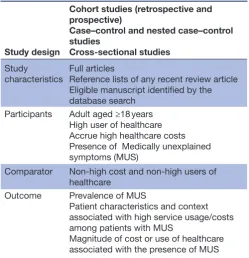
Two reviewers will independently screen and identify studies by reading titles and abstracts. Both reviewers will then select articles for full-text screening and inde-pendently apply eligibility criteria to select the appro-priate articles for the review. Any disagreement over the eligibility of any study will be resolved through discus-sion with a third reviewer. An includiscus-sion criteria checklist (table 1) has been developed based on study eligibility
on 3 July 2019 by guest. Protected by copyright.
http://bmjopen.bmj.com/
criteria to ensure that studies are interpreted and clas-sified appropriately. A Preferred Reporting Items for Systematic Reviews and Meta-Analyses (PRISMA-P) flow diagram will be provided to describe the included and excluded studies along with the reasons for exclusion. This review will be conducted according to the PRISMA-P reporting guidelines.27
Quality assessment
Two reviewers will carry out the quality assessment of each selected article independently to reduce bias. Any difference in opinion will be resolved by further discus-sion/consensus or by involving a third reviewer. Study quality will be assessed focusing on sampling strategy, validated method to establish outcome, attrition and analytical method employed. All selected articles will be judged using a modified form adapted from the Otta-wa-Newcastle Scale ,28 to assess the quality of the cohort,
case–control and cross-sectional studies. Online supple-mentary appendix 2 shows the stages and domains of this modified tool. Risk of bias will be presented in accor-dance with the Cochrane Collaboration recommenda-tions.29 Risk of bias will not be displayed as a composite
score; instead a risk of bias of ‘yes’ indicating high risk, ‘no’, low risk and ‘unclear’ will be provided to assess each domain. A narrative summary of the quality for each study will be provided in a table. A critical appraisal of the study quality describing the impact of the quality of each study on the results will be discussed. A sensi-tivity analysis will be conducted to assess the effect of including or excluding poor quality studies on the main findings.
data extraction
Two reviewers will independently screen and identify studies by reading titles and abstracts. Both reviewers will then select articles for full-text screening and inde-pendently apply eligibility criteria to select the appro-priate articles for the review. Any disagreement over the eligibility of a study will be resolved through discussions with a third reviewer. Finally, both reviewers will inde-pendently extract data. For missing data, authors will be contacted for clarification. An Excel spreadsheet will be used to manage data extraction. A data extraction form (online supplementary appendix 3) will be designed based on the Hayden et al framework.30 This form will
be developed iteratively and pilot-tested on known papers independently by two reviewers. The form will be designed to focus on population, comparator, outcome and study design.
Outcomes
The outcomes of this review will be categorised as follows: ► Primary outcome: prevalence of MUS.
► Secondary outcome: magnitude of cost or use of
healthcare associated with the presence of MUS.
data analysis and synthesis
The outcomes of interest are the prevalence of MUS and cost or use of healthcare associated with the presence of: 1. MUS in patients who accrue high healthcare costs/
high use populations alone.
2. MUS in patients who accrue high healthcare costs/ high use populations in comparison with a relevant population (eg, general patient population or low cost/low use population).
[image:3.595.40.290.63.322.2]Prevalence rates and standard errors will be extracted or calculated from the available data. If appropriate, cohort, case–control and cross-sectional studies will be grouped separately and pooled estimates of the preva-lence rates with 95% CI will be calculated using STATA V.13.1 (STATA Corp). The analysis of the magnitude of healthcare utilisation and costs will be reported based on the definition of high users or patients who accrue high healthcare costs described by the included studies. To determine the cost or use of healthcare associated with the presence of MUS, the difference between groups (eg, cost/use of healthcare associated with MUS versus other relevant mental or physical conditions) will be extracted, where possible. Standardised mean difference with accompanying 95% CI and median OR of costs or healthcare utilisation will be extracted or calculated from the data provided. For studies reporting implementation of an intervention, changes in costs and healthcare utili-sation before and after the intervention will be extracted and reported where available. Subgroup analyses of the outcome data may be performed if studies report, for example, clinical diagnosis of MUS based on ICD or DSM versus symptoms of MUS, setting (primary care, emer-gency department and secondary physical healthcare) or by age group. This will allow the prevalence of MUS,
Table 1 Review eligibility criteria checklist
Study design
Cohort studies (retrospective and prospective)
Case–control and nested case–control studies
Cross-sectional studies
Study
characteristics Full articlesReference lists of any recent review article Eligible manuscript identified by the database search
Participants Adult aged ≥18 years High user of healthcare Accrue high healthcare costs Presence of Medically unexplained symptoms (MUS)
Comparator Non-high cost and non-high users of healthcare
Outcome Prevalence of MUS
Patient characteristics and context associated with high service usage/costs among patients with MUS
Magnitude of cost or use of healthcare associated with the presence of MUS
on 3 July 2019 by guest. Protected by copyright.
http://bmjopen.bmj.com/
costs and healthcare utilisation associated with MUS to be compared across these groups. Depending on the level of heterogeneity both fixed and random effect models will be used as summary effect measures. To assess the robustness of the meta-analysis and interpretation of the pooled results, the quality criteria of the studies entered in the meta-analysis will be considered. Therefore, sepa-rate sensitivity analyses may be conducted with at least the following assumptions: representative sampling strategy, adequate response rate and studies using both valid and standardised assessment and clinical interview to ascer-tain somatoform disorders/MUS. The level of heteroge-neity across studies will be assessed using the Cochrane Q-test and the I2- statistical test with 95% CI. Publica-tion bias and small sample bias will be assessed using the inverted funnel plot technique and the Egger statistics. The Grading of Recommendations Assessment, Develop-ment and Evaluation framework will be used to assess the quality of evidence for each outcome of interest described above across studies. Furthermore, inconsistency/impre-cision, risk of bias including publication bias and appli-cability of the results based on the study population will also be rated when making judgement about the quality of evidence presented in the included studies.31 If
heter-ogeneity is high between studies, a narrative summary of the outcome of the selected studies will be presented in the final review.
Patient and public involvement statement
Patients and the public were not invited to contribute to the writing or editing of this systematic review protocol. The research question of this review was informed by the lack of relevant literature examining the prevalence of patients with MUS who are high users of healthcare or who accrue high healthcare costs.
dIsCussIOn
This systematic review will aim to identify and present an in-depth synthesis of the best available evidence describing the prevalence of MUS in patients who are high users of healthcare and/or who accrue high healthcare costs. Strength and limitations identified in the literature will be highlighted and described in the review. Strength of observational data include large sample sizes, the poten-tial to observe extended follow-up, frequency of atten-dance and healthcare cost associated with MUS likely to be representative of the population a risk. Limitations may include quality of the data extracted which may be inad-equate to allow data to be combined in a meta-analysis. To overcome this problem, a narrative summary of the findings will be presented. The search criteria, keywords and Medical Subject Headings terms were reviewed and refined with the support of an experienced librarian. The team identified the most appropriate medical database(s) based on the review question. Two reviewers will conduct data extraction and screening independently employing a data extraction form which has been reviewed and
pretested. Additionally, this review is not limited to the English language and study date, and relevant papers will be translated to English for assessment. To the best of our knowledge, no existing review addresses our research question. However, if a review addressing a similar ques-tion is published, it will be incorporated in this review and, if feasible , added to the meta-analysis.
Implications of results
This systematic review will provide a reliable estimate of the prevalence of MUS in adults aged ≥18 years who are high users of healthcare services and/or accrue high health-care costs. Furthermore, an updated and quantifiable esti-mate of the costs attributed to the presence of MUS will be presented if sufficient evidence is available. One of the main premises of delivering psychological treatments for MUS is that such interventions may reduce healthcare costs in addition to improving patient outcomes. This review will inform policy makers, clinicians and researchers of the costs related to MUS in ‘high users of healthcare’, enabling more targeted interventions to be developed. Such interventions may focus on patients with MUS but, in addition, address factors related to healthcare use, and be of sufficient inten-sity to impact on healthcare behaviour. Additionally, the systematic search and the evidence gathered may inform future policy directions by quantifying the problem more accurately than has been done before and highlighting the degree to which limited healthcare resources are being used effectively for a vulnerable and needy group of people.
Author affiliations
1School of Psychology, College of Life and Environmental Sciences, University of
Birmingham, Edgbaston, UK
2Research and Innovation, Birmingham and Solihull Mental Health NHS Foundation
Trust, The Barberry, Research and Innovation, Edgbaston, Birmingham, West Midlands, United Kingdom
3Division of Psychological and Social Medicine, Leeds Institute of Health Sciences,
School of Medicine, University of Leeds, Leeds, UK
4Division of Nursing, Social Work and Midwifery, School of Health Sciences,
Manchester Academic Health Science Centre, The University of Manchester, Manchester, UK
Contributors FJ and OCL developed the search strategy. FJ drafted the manuscript and registered the protocol. EG and AB were involved in the design of the review and provided continuous feedback on the manuscript. FJ will be first reviewer and OCL will be second reviewer. All authors read and approved the manuscript. Funding The authors have not declared a specific grant for this research from any funding agency in the public, commercial or not-for-profit sectors.
Competing interests None declared. Patient consent for publication Not required.
Provenance and peer review Not commissioned; externally peer-reviewed. Open access This is an open access article distributed in accordance with the Creative Commons Attribution Non Commercial (CC BY-NC 4.0) license, which permits others to distribute, remix, adapt, build upon this work non-commercially, and license their derivative works on different terms, provided the original work is properly cited, appropriate credit is given, any changes made indicated, and the use is non-commercial. See: http:// creativecommons. org/ licenses/ by- nc/ 4. 0/.
rEFErEnCEs
1. Fink P, Fritzsche K, Söllner W, et al. Medically Unexplained Symptoms, Somatisation and Bodily Distress: Developing Better
on 3 July 2019 by guest. Protected by copyright.
http://bmjopen.bmj.com/
Clinical Services. Cambridge: Cambridge University Press, 2011:217–35.
2. Marks EM, Hunter MS. Medically Unexplained Symptoms: an acceptable term? Br J Pain 2015;9:109–14.
3. Kleinstäuber M, Witthöft M, Steffanowski A, et al. Pharmacological interventions for somatoform disorders in adults. Cochrane Database Syst Rev 2014;7:CD010628.
4. Bridges K Goldberg D. Somatic presentation of depressive illness in primary care. JR Coll Gen Pract Occas 1987;36:9–11.
5. Knapp M, McDaid D, Parsonage M. Mental health promotion and mental illness prevention: the economic case: Personal Social Services Research Unit: London School of Economics and Political Sciences, 2011.
6. Nimnuan C, Rabe-Hesketh S, Wessely S, et al. How many functional somatic syndromes? J Psychosom Res 2001;51:549–57.
7. Fink P. The use of hospitalizations by persistent somatizing patients.
Psychol Med 1992;22:173–80.
8. Reid S, Wessely S, Crayford T, et al. Medically unexplained symptoms in frequent attenders of secondary health care: retrospective cohort study. BMJ 2001;322:767–9.
9. Reid S, Wessely S, Crayford T, et al. Frequent attenders with medically unexplained symptoms: service use and costs in secondary care. Br J Psychiatry 2002;180:248–53.
10. Kroenke K, Mangelsdorff AD. Common symptoms in ambulatory care: incidence, evaluation, therapy, and outcome. Am J Med
1989;86:262–6.
11. McGorm K, Burton C, Weller D, et al. Patients repeatedly referred to secondary care with symptoms unexplained by organic disease: prevalence, characteristics and referral pattern. Fam Pract
2010;27:479–86.
12. Bermingham SL, Cohen A, Hague J, et al. The cost of somatisation among the working-age population in England for the year 2008-2009. Ment Health Fam Med 2010;7:71–84.
13. First MB, Spitzer RL, Gibbon M, et al. Structured clinical interview for DSM-IV-TR axis disorders, research version, patient edition (SCID-I/P). New York: Biometrics Research, New York State Psychiatric Institute, 2002.
14. Spitzer RL, Williams JBW, Gibbon M, et al. User’s guide for the structured clinical interview for DSM-III-R: SCID. Arlington, VA, USA: American Psychiatric Association, 1990.
15. American Psychiatric Association. Diagnostic and Statistical Manual of Mental Disorders. 3rd ed. Washington DC: American Psychiatric Association, 1980.
16. American Psychiatric Association. Diagnostic and statistical manual of mental disorders. 4th ed. Washington DC: American Psychiatric Association, 2000.
17. American Psychiatric Association. Diagnostic and statistical manual of mental disorders. 5th ed. Arlington, VA, USA: American Psychiatric Association, 2013.
18. World Health Organisation. International Classification of Diseases. 9th ed. Atlanta, GA: Centres for Disease Control and Prevention, 1975.
19. World Health Organisation. International Statistical Classification of Diseases and Related Health Problems. 10th Revision. WHO, Geneva: (ICD-10), 1992.
20. Rief W, Hiller W, Heuser J. SOMS - Das Screening für Somatoforme Störungen (Manual zum Fragebogen) Bern. Hans Huber 1997. 21. Mumford DB, Bavington JT, Bhatnagar KS, et al. The Bradford
Somatic Inventory. A multi-ethnic inventory of somatic symptoms reported by anxious and depressed patients in Britain and the Indo-Pakistan subcontinent. Br J Psychiatry 1991;158:379–86.
22. Kroenke K, Spitzer RL, Williams JB. The PHQ-15: validity of a new measure for evaluating the severity of somatic symptoms.
Psychosom Med 2002;64:258–66.
23. Escobar JI, Waitzkin H, Silver RC, et al. Abridged somatization: a study in primary care. Psychosom Med 1998;60:466–72. 24. Kroenke K, Spitzer RL, deGruy FV, et al. Multisomatoform
disorder. An alternative to undifferentiated somatoform disorder for the somatizing patient in primary care. Arch Gen Psychiatry
1997;54:352–8.
25. Fink P, Toft T, Hansen MS, et al. Symptoms and syndromes of bodily distress: an exploratory study of 978 internal medical, neurological, and primary care patients. Psychosom Med 2007;69:30–9. 26. Dimsdale J, Creed F. DSM-V Workgroup on Somatic Symptom
Disorders. The proposed diagnosis of somatic symptom disorders in DSM-V to replace somatoform disorders in DSM-IV--a preliminary report. J Psychosom Res 2009;66:473–6.
27. Moher D, Shamseer L, Clarke M, et al. Preferred reporting items for systematic review and meta-analysis protocols (PRISMA-P) 2015 statement. Syst Rev 2015;4:1:1.
28. Hartling L, Milne A, Hamm MP, et al. Testing the Newcastle Ottawa Scale showed low reliability between individual reviewers. J Clin
Epidemiol 2013;66:982–93.
29. Higgins JPT, Altman DG, Gotzsche PC, et al. The Cochrane Collaboration's tool for assessing risk of bias in randomised trials.
BMJ 2011;343:d5928–9.
30. Hayden JA, Côté P, Bombardier C. Evaluation of the Quality of Prognosis Studies in Systematic Reviews. Ann Intern Med
2006;144:427–37.
31. Guyatt G, Oxman AD, Akl EA, et al. GRADE guidelines: 1. Introduction-GRADE evidence profiles and summary of findings tables. J Clin Epidemiol 2011;64:383–94.
on 3 July 2019 by guest. Protected by copyright.
http://bmjopen.bmj.com/