Preparation of Nano-Ag
4Bi
2O
5with Co-precipitation Method
and Study of Its Application for Oxygen Reduction Reaction
Dongmei Chen1,Pingyuan Wang2, Xun Zeng2, Yanzhi Sun2, Bixue Zhu1,*, Junqing Pan2,*
1Key Laboratory of Macrocyclic and Supramolecular Chemistry,Guizhou University,Guiyang 550025, P.R. China
2
State Key Laboratory of Chemical Resource Engineering, Beijing University of Chemical Technology, Beijing 100029, P.R. China
*
E-mail: [email protected] ; [email protected]
Received: 22 July 2016 / Accepted: 26 September 2016 / Published: 10 November 2016
Nano Ag4Bi2O5 rods were synthesized by co-precipitation method, in which mixed AgNO3- Bi(NO3)3 solution was used as Ag-Bi source and KOH solution as precipitant. The structure, morphology and composition were researched via powder X-ray diffraction (XRD), X-ray photoelectron spectroscopy (XPS) and scanning electron microscope (SEM), etc. Results show that the Ag4Bi2O5 were nanorods crystal with 20-30 nm in width and 200-300 nm in length. Electrochemical measurements indicate that the Ag4Bi2O5 has excellent performance for oxygen reduction reaction (ORR) followed a four-electron transfer pathway in alkaline electrolyte. Moreover, Ag4Bi2O5 was further tested in an assembled zinc-oxygen (Zn-O2) battery, which discharged up to 1400 h at 10 mA cm−2. So essentially, the inexpensive and available Ag4Bi2O5 electrocatalyst has superior electro-catalytic activity and good durability.
Keywords: Co-Precipitation; Ag4Bi2O5; Electrocatalysis
1. INTRODUCTION
Fuel cell is an electrochemical device which can convert chemical energy to electrical energy efficiently with environment friendlyness [1-2]. Hydrogen oxidation reaction(HOR)and oxygen reduction reaction(ORR) are usually catalyzed by noble metals such as platinum in fuel cells due to its low exchange current density [3-7]. In comparison, ORR’s low exchange current density of 10-9 A cm-2 on the cathode, while HOR’s is reach 10-3
Pt, an expensive metal that is not abundant, have been carried as the cathode catalyst [8]. To reduce the cost of catalyst, many researchers have devoted to develop a new, efficient, and non-platinum series catalysts as cathode oxygen reduction catalyst. Among these non-precious metal catalysts in the present study, including a transition metal composite oxides (spinel-type perovskite, pyrochlore type, etc) [9-12], transition metal sulfides [13-14], and other transition metals-contaning compunds in the carbon-nitrogen material (M-Nx-C) [15-18], etc.
Herein, the prepared Ag4Bi2O5 is reported as a new efficient electrocatalyst for ORR in alkaline electrolyte. The Ag4Bi2O5 nano rods with 20-30 nm in width and 200-300 nm in length was obtained by the co-precipitation method and examined by SEM and TEM. The catalyst shows superior electrochemical performances of ORR activity and durability by CV, RDE and discharge tests. This enhancement might benefit from the synergetic effects among Ag and Bi.
2. EXPERIMENT
2.1 Materials
The following reagents were used to prepare various solutions: Silver oxide (99.7%, Tianjin Fuchen Industry), and Bismuth oxide (99% Tianjin Fuchen Industry), Potassium hydroxide (95% Chengdu Huarong Chemical Co., Ltd), Nitrate (65~68% Beijing Chemical Plant), and Manganese dioxide (EMD) (Jianchen Electrolytic Manganese Industry Company), Pt/C (20 wt.%) was purchased from Shanghai River Electric Co., Ltd. All chemical reagents were analytically pure and did not get any further treatment.
2.2 Preparation of Ag4Bi2O5
A schematic diagram describing the catalyst synthesis is shown in scheme 1. The Ag4Bi2O5 was synthesized by co-precipitation method as followed: 1.16 g Ag2O and 1.17 g Bi2O3 were dissolved in 50 mL 1 mol L-1 HNO3 as Ag-Bi source. 38.38 g KOH was dissolved into deionized water to obtain 100 mL 6.5 mol L-1 KOH as precipitant. 50 mL salt solution was pumped into the base solution at 30oC at a flow rate of 3 mL min−1, with the strong agitating of 2000 rpm. In Scheme 1, it can be seen that the sample will be obtained as amorphous at the end of co-precipitation. After crystallization for 30 minutes, it turns to a mixture of amorphous and crystalline. After crystallization for 60 minutes, it turns into complete crystal. Then, the filtrate was washed with deionized water until the solution became neutral. At last, the product was dried in vacuum at 30oC for 24 hours. The reaction equation is as follows:
Scheme 1. Schematic representation of the preparation procedure for the Ag4Bi2O5
2.3 Electrochemical measurement of the Ag4Bi2O5 oxygen cathode
The rotating disk electrode (RDE, PINE AFMSRCE) tests were carried out with a three-electrode system at 25oC. The catalyst inks were prepared by adding 5 mg catalyst (Ag4Bi2O5), 32 mg conductive graphite (Timcal-ks6 Timical), 330 μL isopropanol solution (99.5%, Beijing Chemical Plant), 670 μL deionized water, and 50μL Nafion (5 wt.%, D520 DuPont). After a ultrasonic treatment under a sonication (KQ-100DB,Kunshan ultrasonic instruments Co. Ltd.) process for 30 min. 10 μL of the catalyst ink was taken by a TopPette Pipettor (0.5–10μL, Eppendorf Research) and dropped onto the glassy carbon rotating disk electrode (φ = 8 mm, Pine Instrument). The saturated calomel electrode (SCE) was used as a reference electrode, a platinum wire as the auxiliary electrode. Before the RDE voltammetry experiments for ORR, the solution was saturated by O2 or Ar gas.
To further investigate electrochemical activity and stability of the catalysts, we carried out the cyclic voltammetry (CV) measurements in ultra-high purity argon or oxygen-saturated 0.1 mol L-1 KOH solution at room temperature. Electrochemical impedance spectroscopy (EIS) spectra was tested with the frequency range from 1 to 2 × 10⁶ Hz. An electrochemical workstation (Shanghai Chen Hua, CHI760D) was used for to obtain CV and EIS.
The preparation of Ag4Bi2O5 oxygen electrode is similar to the literature [19].
The prepared oxygen electrode was used as working electrode, SCE electrode was used as reference electrode and nickel sheets were used as the auxiliary electrode. The discharge property of the assembled zinc-oxygen (Zn-O2) battery was tested by LAND cell test system (CT2001, Wuhan LAND Electronics Co., Ltd.) in 9 mol L-1 KOH electrolyte solution.
2.4 Structural and Morphological characterizations
ULVAC- PHI Quantera SXM. The thermal stability of catalysts was monitored by TG-DTA (STA 449F 3A) with a heating rate of 10oC min-1 from 20oC to 800oC in N2 atmosphere.
3. RESULTS AND DISCUSSION
[image:4.596.121.479.499.760.2]3.1 Structural characterization of the prepared samples
Figure 1. The XRD pattern and corresponding SEM pictures of Ag4Bi2O5
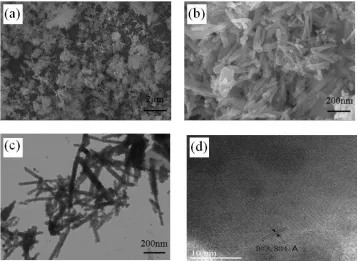
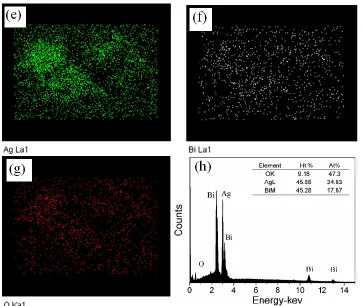
Figure 2. SEM (a, b), TEM (c), HR-TEM (d), The EDX elemental mapping images (e, f, g), and EDS spectrum of the Ag4Bi2O5 sample.
Figure 3. XPS spectra of the Ag4Bi2O5 sample(a) Ag 3d and (b) Bi 4f
[image:5.596.108.490.423.565.2]
Fig. 2a and Fig. 2b show the SEM images of the Ag4Bi2O5 sample, which indicates as- prepared catalyst is a nano rod with 20-30 nm in width and 200-300 nm in length. This SEM examination is well consistent with the calculation result of XRD, as confirmed by TEM images in Fig 2c. Fig. 2d shows the HR-TEM image of the Ag4Bi2O5 catalyst. The spacing of the lattice fringes is 0.3834 nm, corresponding well to the (211) planes of Ag4Bi2O5. EDX and EDS analysis were also performed (Fig 2e, 2f, 2g and 2h) to get the chemical composition of the catalyst. Besides the peak of oxygen, the peaks of metal elements Ag and Bi are displayed clearly. Fortunately, the atomic ratio of Ag:Bi:O was 34.83: 17.87: 47.30, conforming to the atomic ratio 4:2:5 in the Ag4Bi2O5.
The XPS spectrum of Ag4Bi2O5 sample (Fig.3) further confirms the chemical state of Ag and Bi elements. XPS spectrum of the Ag 3d signal of catalyst is showed in Fig. 3a, the band observed at 368.18 and 374.17 eV is assigned to the Ag 3d5/2 and Ag 3d3/2 of Ag(Ⅰ)2O. As seen from Fig. 3b, the typical Bi 4f7/2 and 4f5/2 at 158.63 eV and 163.92 eV can be attributed to the peaks of Bi(Ⅲ)2O3 [21].
[image:6.596.109.490.304.559.2]
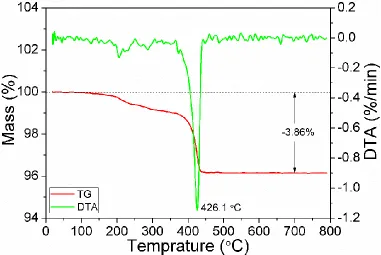
Figure 4. The TG-DTA curves of the Ag4Bi2O5 sample
The thermal gravimetric curves and temperature dependence of gas evolution are tested by TG-DTA measurements. Which are showed in Fig. 4, it can be clearly seen that an endothermic peak appears at 426.1oC, the possible reaction equation is described as follows:
Ag4Bi2O5 → 4Ag +Bi2O3 +O2↑
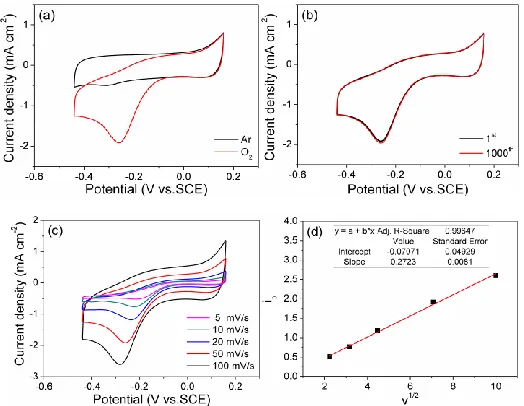
The cyclic voltammograms (CVs) of ORR on the as-prepared Ag4Bi2O5 in Ar and O2-saturated 0.1 mol L-1 KOH solution are shown in Fig. 5. It was seen that a strong peak positioned at -0.26 V (vs. SCE) in the existence of O2 ambiance, however, no significant peak at the same potential in Ar atmosphere (Fig. 5a). It was clear that the oxygen reduction reaction occurs on the surface of the catalyst. So there is an oxygen reduction reaction occurring on the surface of the catalyst. Fig. 5b shows the reduction curve of catalyst keeps almost unchanged after 1000 cycles, confirming that the catalyst is stable [19]. The catalyst has good reversibility with the oxidation peak increases synchronously with enhanced scan rate of 5 mv s-1 to 100 mv s-1 (Fig. 5c). In addition, we can see that the peak currents are linear to the square root of the scan rate, as shown in Fig. 5d.
Figure 5. (a) CV of Ag4Bi2O5 electrode at scan rate of 50 mV s-1 in a 0.1 mol L-1 KOH solutions saturated with Ar and O2, (b) CV of Ag4Bi2O5 before and after 1000 cycles, (c) CV of Ag4Bi2O5 electrode at different scan rates, and (d) The peak current as a function of the scan rate
[image:7.596.169.431.328.531.2][image:8.596.130.469.182.439.2]
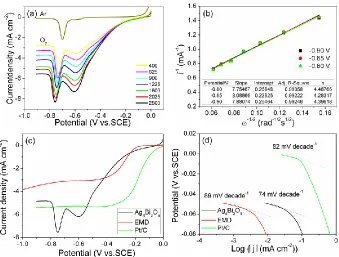
gradually decrease. The results revealed a linear relationship between the update rates and the exchange current density of oxygen on the catalyst surface. We can see that at high polarization potential, the oxygen reduction current density and speed also present linear relationship, which indicates that the oxygen reduction current density is controlled by the liquid phase diffusion of oxygen at potential from -0.6 V to -0.3 V.
Figure 6. (a) The rotating disk test for Ag4Bi2O5 catalyst at different rotating rates, (b) the K-L plots for Ag4Bi2O5 at different potentials, (c) LSV of the Ag4Bi2O5, EMD and Pt/C, and (d) Tafel slope of the Ag4Bi2O5, EMD and Pt/C.
Figure 7. EIS spectra of the Ag4Bi2O5, EMD and Pt/C samples
The impedance spectra of the Ag4Bi2O5, EMD and Pt/C are consisted of one semicircle and a slope, as shown in Fig. 7. Where inset shows the equivalent circuit of the three electrodes, R0, R1, R2 are represented as solution resistance, adsorption resistance and electrochemical reaction resistance, C1, C2 and C3 are denoted as adsorption capacitance, W refers to Warburg impedance. A nonlinear, least-square fitting calculation is done with the above equivalent circuit [24]. In table 1, for Ag4Bi2O5 electrode, the R2 and C2 value (T) are 5.14 Ω g and 7.814×10⁻⁶ F g-1, EMD electrode are 15.16 Ω g and 3.892×10⁻⁵ F g-1, and Pt/C electrode 3.043 Ω g and 1.403×10⁻⁵ F g-1. The value of R2 of the Ag4Bi2O5 electrode is smaller than that of the EMD but greater than that of Pt/C electrodes, in accordance well with the CVs and polarization curves. The value of C2 has something to do with the true reaction areas of the electrode. Therefore, for the value of double layer capacitance of Ag4Bi2O5 electrode is greater than that of the EMD and Pt/C electrodes, this means that the Ag4Bi2O5 electrode has more enormous true reaction area [25].
Table 1. The equivalent circuit fitting parameters of the Ag4Bi2O5, EMD and Pt/C samples
Name R0(Ω g) R1(Ω g) R2(Ω g) C1(F g-1) C2(F g-1) C3(F g-1) W(Ω-1) Ag4Bi2O5 4.597 63.33 5.14 2.368E-8 7.814E-6 2.147E4 3.832E3
EMD 4.446 73.67 15.16 1.915E-8 3.892E-5 6.64E4 3.973E3
[image:9.596.48.551.595.681.2]
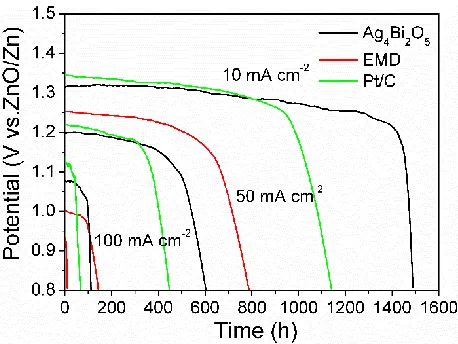
Figure 8. Discharge curves of EMD, Ag4Bi2O5 and Pt/C catalyst at different current densities.
The discharge testing for EMD, Ag4Bi2O5 and Pt/C oxygen electrode was carried out at different current densities. As shown in Fig. 8, the Ag4Bi2O5 electrode exhibits a superior oxygen electrode life of 1400h than EMD and Pt/C at the current density of 10 mA cm−2. Ag4Bi2O5 electrode exhibits similar discharge voltage and discharge time to that of Pt/C at the current density of 50 mA cm−2 while EMD presents poorly elechochemical property. Ag4Bi2O5 electrode exhibits much higher discharge voltage and longer discharge time than EMD at the current density of 100 mA cm−2.
4. CONCLUSION
NanoAg4Bi2O5 was synthesized by co-precipitation method successfully. XRD and SEM show that the sample is a nano rod with 20-30 nm in width and 200-300 nm in length. The RDE demonstrate that Ag4Bi2O5 has excellent electrocatalytic activity towards ORR in alkaline electrolyte. The discharge test indicates that Ag4Bi2O5 electrode has long discharge life at a constant current density showing ORR has good oxygen reduction activity and durability.
ACKNOWLEDGEMENTS
The authors are thankful for the State Key Program of National Natural Science of China (21236003), National Natural Science Foundation of China (21476022), BUCT Fund for Disciplines Construction and Development (XK1531), and the Fundamental Research Funds for the Central Universities (JD1515 & YS1406 ).
References
1. B. C. H. Steele, A. Heinzel, Nature, 414 (2001) 345.
2. Y. Yu, H. Li, H. Wang, X. Z. Yuan, G. Wang, and M. Pan, J. Power Sources, 205 (2012) 10. 3. P. Costamagna, S. Srinivasan, J. Power Sources,102 (2001) 242.
9. R. Ding, L. Qi, M. J. Jia, H. G. Wang, Nanoscale, 6 (2014) 1369.
10.H. C. Bo, S. A. Park, B. K. Park, H. H. Chun and Y. T. Kim, Materials Research Bulletin, 48 (2013) 3651.
11.T. Hyodo, M. Hayashi, N. Miura and N. Yamazoe, J. Electrochem. Soc. 143 (1996) L266. 12.H. Kawai, K. Yoshihara, T. Konishi, M. Saito, J. Kuwano and H. Shiroishi, Key Engineering
Materials, 421 (2010) 479.
13.A. Lewera, J. Inukai, W. P. Zhou, D. Cao, H. T. Duong, N. Alonso-Vante, A. Wieckowski, Electrochim. Acta, 52 (2007) 5759.
14.Z. Zheng, N. Li, C. Q. Wang, D. Y. Li, F. Y. Meng, Y. M. Zhu and Q. Li, J. Power Sources, 230 (2013) 10.
15..L. C. Wang, L. Zhang and J. J. Zhang, Electrochim. Acta, 56 (2011) 5488. 16.G.Wu, K. L. More, C. M. Johnston and P. Zelenay, Science, 332 (2011) 443.
17.Domínguez, C., Pérez-Alonso F. J., S. A. Al-Thabaiti, S. N. Basahel, A. O. Alyoubi, A. A. Alshehri, M. A. Pena and S. Rojas, J. Power Sources, 271 (2014) 87.
18.J. H. Lee, M. J. Park, S. J. Yoo, J. H. Jang, H. J. Kim, S. W. Nam, C. W. Yoon and J. Y. Kim, Nanoscale, 7 (2015) 10334.
19.Y. Z. Sun, M. Yang, J. Q. Pan, P. Y. Wang, W. Li, P. Y. Wan, Electrochim. Acta, 197 (2016) 68. 20.J. Q. Pan, Q. Wang, Y. Z. Sun and Z. H. Wang, Electrochim. Acta, 59 (2012) 515.
21.C. D. Wagner, A. V. Naumkin, A. Kraut-vass, J. W. Allison, C. J. Powell, J. R. Rumble, NIST X-ray Photoelectron Spectroscopy Database (Version 3.5). http://srdata.nist.gov/xps.
22.F. W. T. Goha, Z. L. Liu, X. M. Ge, Y. Zong, G. J. Du and T. S. A. Hora, Electrochim. Acta, 114 (2013) 598.
23.F. P. Hu, X. G. Zhang, F. Xiao and J. L. Zhang, Carbon, 43 (2005) 2931. 24.H. L. Gao, Z. Y. Li, X. Qin, J. Power Sources, 248(2014) 565.
25. S. W. Liu, X. Qin, RSC. Adv., 5 (2015) 15627.