PROCESSING SPEED AND VISUO-SPATIAL EXECUTIVE FUNCTION
PREDICT VISUAL WORKING MEMORY ABILITY IN OLDER ADULTS.
Louise A. Brown1, James R. Brockmole2, Alan J. Gow1,3, & Ian J. Deary1,3
1. Department of Psychology, The University of Edinburgh, Edinburgh, UK 2. Department of Psychology, University of Notre Dame, Notre Dame, IN, USA
3. Centre for Cognitive Ageing and Cognitive Epidemiology, The University of Edinburgh, Edinburgh, UK
To cite:
Brown, L.A., Brockmole, J.R., Gow, A.J., & Deary, I.J. (2012). Processing speed and
visuo-spatial executive function predict visual working memory ability in older adults.
Author Notes
This research was funded by European Research Council grant 201312 awarded to J.R.B.
who is also an Honorary Fellow at The University of Edinburgh. We thank Paula Davies and
the Lothian Birth Cohort 1936 participants for their assistance with the project. I.J.D. and
A.J.G. are members of The University of Edinburgh Centre for Cognitive Ageing and
Cognitive Epidemiology, part of the cross council Lifelong Health and Wellbeing Initiative
(G0700704/84698). Funding from the BBSRC, EPSRC, ESRC and MRC is gratefully
Abstract
Background/Study Context: Visual working memory (VWM) has been shown to be particularly age-sensitive. Determining which measures share variance with this cognitive
ability in older adults may help to elucidate the key factors underlying the effects of aging.
Methods: Predictors of VWM (measured by a modified Visual Patterns Test) were investigated in a sub-sample (N = 44, mean age = 73) of older adults from the Lothian Birth Cohort 1936 (LBC1936; Deary et al., 2007). Childhood intelligence (Moray House Test) and
contemporaneous measures of processing speed (four-choice reaction time), executive
function (verbal fluency; block design), and spatial working memory (backward spatial span),
were assessed as potential predictors.
Results: All contemporaneous measures except verbal fluency were significantly associated with VWM, and processing speed had the largest effect size (r = -.53, p < .001). In linear regression analysis, even after adjusting for childhood intelligence, processing speed and the
executive measure associated with visuo-spatial organization accounted for 35% of the
variance in VWM.
Conclusion: Processing speed may affect VWM performance in older adults via speed of encoding and/or rate of rehearsal, while executive resources specifically associated with
visuo-spatial material are also important.
Keywords: cognitive aging; working memory; speed of processing; central executive
Working memory is the limited-capacity cognitive system that allows for the simultaneous
retention and manipulation of information. As individuals age, however, working memory
performance declines (Bopp & Verhaeghen, 2005; Park, Lautenschlager, Hedden, Davidson,
Smith, et al., 2002), which can lead to difficulty performing a multitude of everyday
activities. As such, working memory tasks have become an important component of cognitive
batteries designed to investigate and characterize age-related changes in mental ability.
Unfortunately, the majority of this work has focused on either the verbal or domain-general
components of working memory, while much less research has specifically focused on the
visuo-spatial component that supports memory for objects, faces, and scenes. The evidence
that does exist in this area suggests that visuo-spatial working memory may in fact be more
age-sensitive than verbal working memory (Jenkins, Myerson, Joerding, & Hale, 2000;
Johnson, Logie, & Brockmole, 2010; Leonards, Ibanez, & Giannakopoulos, 2002; Myerson,
Hale, Rhee, & Jenkins, 1999; but see Kemps & Newson, 2006; Park et al., 2002). In
particular, working memory for abstract visual information (Smith, Park, Cherry, &
Berkovsky, 1990), such as black and white matrix (chequered) patterns (Beigneux, Plaie, &
Isingrini, 2007; Brown, McConnell, & Forbes, 2011; Bruyer & Scailquin, 1999; Logie &
Maylor, 2009), is especially age-sensitive. The purpose of the present study was to determine
the degree to which a variety of cognitive measures share variance with visual working
memory in an effort to elucidate, within the working memory architecture, the factors that
contribute to these marked age-related changes in visual working memory ability.
A standardized measure of visual working memory is the Visual Patterns Test (VPT;
Della Sala, Gray, Baddeley, & Wilson, 1997) during which participants are shown black and
white chequered patterns of increasing complexity and are asked to recall each pattern in
turn, either immediately or following a delay period (typically 10 s; Della Sala, Gray,
which more tightly restricts verbal encoding (Brown, Forbes, & McConnell, 2006), Brown
and colleagues (2011) demonstrated marked decrements (ηp2 = .29 - .35, independent of years
of education) in the performance of older adults relative to young adults. With the aim of
determining what accounts for this decrement, we examined the degree to which three
important cognitive abilities may be related to visual working memory decline: processing
speed (as measured by four-choice reaction time), executive function (as measured by verbal
fluency and block design), and spatial working memory (as measured by backward spatial
span). In addition, an important correlate of adult cognitive functioning, childhood
intelligence, was included in our assessment, because this variable is an indicator of the
pre-existing individual differences in general cognitive ability. Visual Working memory was
measured by the modified VPT, in a sample of older adults (aged 73) from the Lothian Birth
Cohort 1936 (LBC1936; see Deary, Gow, Taylor, Corley, Brett, et al., 2007), who are
well-characterized in terms of current cognitive function as well as childhood intelligence. The
rationale for selecting the domains under investigation is described below.
Childhood Intelligence
Intelligence has been shown to remain relatively stable between childhood and older
adulthood, and to be associated with achievement and health outcomes throughout the
lifespan (see Deary, Whalley, & Starr, 2009, and Deary, Penke, & Johnson, 2010, for
reviews). This suggests that pre-existing differences in cognitive ability can account for some
of the variance in ability measured later in the lifespan, thus limiting the extent of the
variance which is due to cognitive aging per se. One of the strengths of LBC1936, therefore, is the availability of a valid measure of intelligence in childhood which allows the variance in
initial cognitive ability (measured early in the lifespan) to be partialled from variance in
At age 11, as part of the Scottish Mental Survey 1947 (SMS1947), each member of
LBC1936 was administered a version of the Moray House Test No. 12 (MHT), a valid
measure of intelligence. Subsequently, at around age 70, members were administered the
MHT again, along with a large battery of other cognitive tests designed to tap a variety of
specific functions (see Deary et al., 2007). The correlation between the two administrations of
the same test, almost 60 years apart, was 0.692 (Deary, Johnson, & Starr, 2010). This means
that the data relating to numerous cognitive measures were available for use in the present
study, including intelligence in childhood and in older adulthood. In a study investigating the
stability of psychometric intelligence across the lifespan in a cohort resulting from the
Scottish Mental Survey 1932 (the Aberdeen Birth Cohort 1921; ABC1921) Deary, Whalley,
Lemmon, Crawford, and Starr (2000) showed that the greatest predictor of MHT performance
in a sample of older adults aged 79 was childhood performance, accounting for about half of
the variance. Deary, Whiteman, Starr, Whalley, and Fox (2004) later confirmed this level of
shared variance within the Lothian Birth Cohort 1921 (LBC1921), a much larger cohort than
ABC1921. Furthermore, because individual differences tend to be stable across cognitive
domains (Deary, Penke, et al., 2010) it is important to control for childhood intelligence when
assessing the influence of other variables, such as nutritional status (Deary et al., 2004) or
processing speed (Deary, Johnson, et al. ), on cognitive ability in older adulthood. In addition
to childhood intelligence, a contemporaneous measure of intelligence, also derived using the
MHT, was also available for each participant, and this allowed for the investigation of the
stability of intelligence across the lifespan (see Deary, Johnson, et al.; Gow, Johnson, Pattie,
Processing Speed
Salthouse (1991) proposed that age-related changes in ‘fluid’ cognition, such as
memory, reasoning, and spatial abilities, are due to a decrease in the speed with which
cognitive operations may be carried out (see Salthouse, 1996, for a review). Two mechanisms
may be responsible for this relationship. The limited time mechanism, in which slowed
operations (e.g., associations, elaborations, and rehearsals) cannot be completed successfully
in the available time, may exert a greater effect in more complex tasks which are dependent
upon the outcome of a number of simpler operations. The simultaneity mechanism, in which
slower processing results in a reduction in the simultaneously available information required
by dynamic systems including working memory, affects the performance of higher-order
functions such as abstraction, elaboration, and integration. Supporting evidence includes
moderate to high proportions of shared variance between measures of processing speed and a
range of cognitive tasks, including memory, and the attenuation of the effects of age when
processing speed is controlled (e.g., Finkel, Reynolds, McArdle, & Pedersen, 2007;
Salthouse, 1992, 1994b; Vaughan & Hartman, 2010; Verhaeghen and Salthouse, 1997).
Importantly, Deary, Johnson, and colleague (2010) found that, whereas processing
speed was contemporaneously associated with general cognitive ability in older adulthood,
these relationships were attenuated when childhood mental ability was taken into account.
The authors did show, however, that simpler measures, including four-choice reaction time,
exhibit a smaller relationship with childhood ability than more complex measures, such as the
Digit Symbol task from the Wechsler battery, and could therefore serve as biomarkers of
cognitive aging. Four-choice reaction time was therefore included as the measure of
Central Executive Function
While theoretical perspectives on the structure, components, and independence of
working memory vary (e.g., see Baddeley, 2000; Baddeley & Hitch, 1974; Cowan, 2001;
Kane & Engle, 2002; Logie, 1995, 2003; Lovett, Reder, & Lebiere, 1999), there is general
agreement that the system depends crucially upon the operation of capacity-limited
attentional processes (the central executive; Baddeley, 2000). A number of authors have critically implicated reduced frontal lobe/attentional resources (to which we will refer as
central executive function) in the effects of cognitive aging (e.g., Craik & Byrd, 1982;
Dempster, 1992; West, 1996; see Braver & West, 2008, for a recent review). This account of
cognitive aging is supported by neuroimaging evidence such as demonstrations of greater
age-related decline in white matter integrity in anterior brain regions (Brickman,
Zimmerman, Paul, Grieve, Tate, et al., 2006; Buckner, 2004; Head, Buckner, Shimony,
Williams, Akbudak, et al., 2004), under-recruitment of frontal brain regions in older adults
during tasks involving intentional memory encoding (Logan, Sanders, Snyder, Morris, &
Buckner, 2002), and reduced attention-related frontal activity accompanied by increased
distractor-related activity in older adults (Chao & Knight, 1997). At the behavioral level,
MacPherson, Phillips, and Della Sala (2002) provided evidence that specifically the
dorsolateral prefrontal cortex, the area believed to be responsible for executive function,
undergoes age-related decline.
Verbal fluency has been associated with central executive functioning (Lezak,
Howieson, & Loring, 2004; Stuss, Alexander, Hamer, Palumbo, Dempster, et al., 1998) and
is a frequently used measure of this ability in healthy and patient populations (Baddeley,
Emslie, Kolodny, & Duncan, 1998; Fisk & Sharp, 2004; Salthouse, Atkinson, & Berish,
2003). We used this measure to tap general central executive function. However, block
2004; Wallesch, Curio, Galazky, Jost, & Synowitz, 2001) and assesses strategy and planning
skills in the specific context of a visuo-spatial construction task. We therefore employed this
as a second measure of central executive function. It was possible for this to share more
variance with visual working memory performance than the verbal fluency measure, due to
block design’s relation to specifically visuo-spatial planning/organization.
Spatial Working Memory
From the multi-component perspective on working memory, modality-specific
subsystems are believed to control visuo-spatial and verbal storage and processing. Following
the further specification of the verbal subsystem (phonological loop) as comprising separable
storage and rehearsal processes (see Baddeley, 2000), Logie (1995, 2003) suggested that the
visuo-spatial subsystem is also comprised of separable components. A visual storage
component and a more dynamic spatial rehearsal component were both proposed to exist.
While the visual component is sensitive to decay and interference, the spatial rehearsal
mechanism actively refreshes the contents of the store and helps to retain spatio-sequential
information. Supporting evidence includes dissociations in the dual-task interference effects
during visual and spatial working memory tasks (e.g., Della Sala et al., 1999; Klauer & Zhao,
2004; Quinn & McConnell, 1996). For example, Della Sala and colleagues, used the VPT to
show that visual interference disrupts visual working memory to a greater extent than spatial
working memory, while the opposite was true for a spatial interference task.
Including a measure of spatial working memory in the current study (the corsi-type
backward spatial span task from the Weschler Memory Scale-III UK; WMS-III UK,
Weschler, 1998b) allowed for the investigation of the extent to which these two processes
shared variance. Based upon the above evidence, however, although the two tasks have the
separability of the two processes would limit the predictive power of spatial working
memory.
Methods
Participants
Members of LBC1936 were administered the MHT at age 11. Subsequently, at approximately
age 70, the cohort members were administered a battery of tests that has been described in
detail previously (Deary et al., 2007). Around three years later, a sample of the cohort’s
earliest recruited members was recruited for this study (N = 44; note that age-11 IQ was unavailable for one participant). The mean age of this sample was 10.93 years (SD = 0.27) when completing the MHT in childhood, and 68.34 (SD = 0.35) when followed up in older adulthood for LBC1936. The mean age when carrying out the VPT was 72.76 (SD = 0.32). There were 19 males and 25 females, and the mean number of years of education was 13.60
(SD = 3.32). All participants were cognitively healthy, as determined by the Mini-Mental State Examination (MMSE) which screened for dementia (Folstein, Folstein, & McHugh,
1975). The mean MMSE score was 29.52 (SD = 0.82, range = 27-30). All participants reported normal or corrected-to-normal visual acuity which was confirmed by near-perfect
performance on practice trials.
Measures
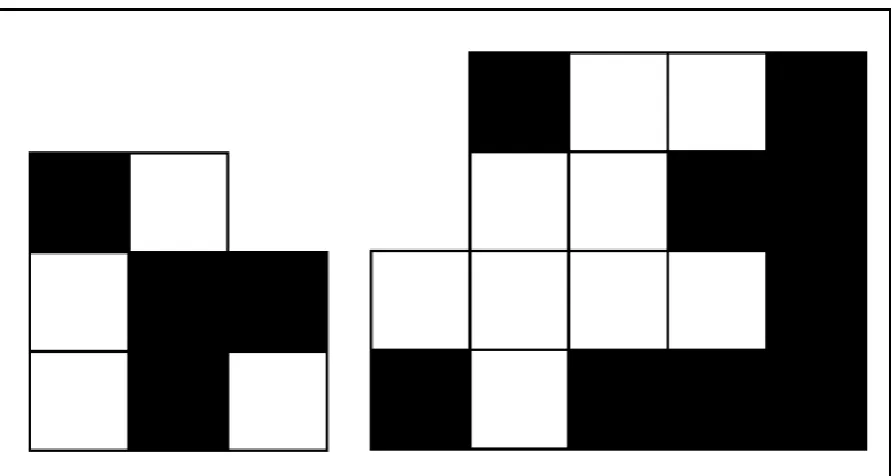
Visual working memory. Participants were administered a modified version of the VPT (see Brown et al., 2006; Della Sala et al., 1997). This task involves presenting
participants with a series of black and white chequered patterns which increase in size and
therefore complexity (see Figure 1). Participants were required to recall each pattern in turn
Each trial consisted of a fixation cross (2 s), the presentation of the pattern (3 s), a delay
(maintenance) period (10 s), and finally the word recall displayed on the computer screen, which prompted participants to respond. There were three practice trials followed by three
trials at each of the levels of complexity 4 through 9 (with level of complexity referring to the
number of black cells to be recalled). All participants were administered the same number of
trials (18). The outcome measure used was the total number of correct patterns recalled1.
Intelligence. The Moray House Test No. 12 (MHT) was administered as part of the Scottish Mental Survey 1947 and provides the measure of intelligence in childhood (age 11)
and in older adulthood (age 68). In both childhood and older adulthood the raw MHT scores
were corrected for age in days at the time of testing and converted into intelligence
quotient-type (IQ) scores with mean = 100, SD = 15.
Processing Speed. Four-choice reaction time measured information processing speed using a response box (see Deary, Der, & Ford, 2001, for details). Briefly, the box features
five keys arranged in an arc and labelled 1, 2, 0, 3, 4, and the participants rest the second and
third fingers of the left and right hand on the ‘1’, ‘2’, ‘3’, and ‘4’ keys, respectively. The task
is to press the correct button as quickly as possible in response to one of these four digits
appearing on a liquid crystal display (LCD) at the top of the box. There were 8 practice trials
and 40 test trials. Each number appeared 10 times in a randomized order. There was an
interval of between 1 and 3 s between the participant’s response and the onset of the next
stimulus. Resulting reaction time scores were taken only from the correct trials.
Central executive function. Verbal fluency provided one measure of central executive function (Lezak et al., 2004) and required participants to name as many words as possible
beginning with the letters C, F, and L, with one minute provided for each letter. Proper names
1
were not allowed and no additional score was given for repeated words. The resulting
measure was the total number of correct words. The Block Design subtest of the Wechsler
Adult Intelligence Scale-III UK (WAIS-III UK; Wechsler, 1998a) was included as a second
measure of executive function involving visuo-spatial organization, and required participants
to plan and develop strategies for constructing designs from their constituent parts (individual
blocks).
Spatial working memory. The Backward Spatial Span subtest of the WMS-III UK (Wechsler, 1998b) provided a measure of spatial working memory performance. In this task
the experimenter tapped out a sequence upon a selection of 10 cubes irregularly spaced across
a rectangular board and participants were required to tap out the sequence in the opposite
order. Sequences increased from 2 to 9 blocks in length, with two sequences at each level,
and the test terminated when the participant failed to recall correctly both sequences from a
given level.
Results
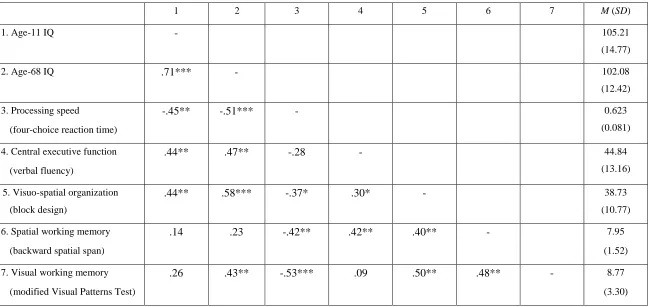
Descriptive statistics and Pearson correlations between all variables are provided in
Table 12. Age-11 and age-68 MHT IQ scores correlated highly (r = .73, p < .001). In our modest sample, age-11 IQ did not correlate significantly with visual working memory (r = .26, p = .09), but contemporaneous (age-68) IQ did so (r = .43, p < .01). Interestingly, age-11 IQ correlated significantly with all variables except visual working memory and spatial
working memory (r = .16, p = ns).
2
With the exception of verbal fluency and age-11 IQ, all measures correlated
significantly with visual working memory, in the direction that better scores were related to
better visual working memory performance. The largest correlation was with processing
speed (r = -.53, p < .001), closely followed by block design (r = .50, p < .01) and spatial working memory (r = .48, p < .01). With verbal fluency failing to correlate significantly with visual working memory, it is notable that this variable did not correlate significantly with
processing speed, the variable with which visual working memory was most highly
correlated. In fact, the highest correlation coefficients involving verbal fluency were with the
IQ measures, taken both at age 11 (r = .44, p < .01) and at age 68 (r = .47, p < .01). On the other hand, block design correlated with all variables, but the strongest relations were with
age-68 IQ (r = .58, p < .001) and visual working memory (r = .50, p < .01). Finally, spatial working memory correlated with processing speed (r = -.42, p < .01), verbal fluency (r = .42,
p < .01), and block design (r = .40, p < .01) at similar levels, but not with the two IQ measures.
Linear Regression Modelling
Stepwise linear regression analyses were carried out to discover the amount of shared
variance existing between visual working memory and the potential predictors. In the first of
two models, all variables including age-68 IQ and sex were included. The second model was
hierarchical, with age-11 IQ entered in the first block, in order to determine whether or not
childhood ability attenuates the variance in visual working memory predicted by the
significant predictors from model 1, which were entered in the second block using the
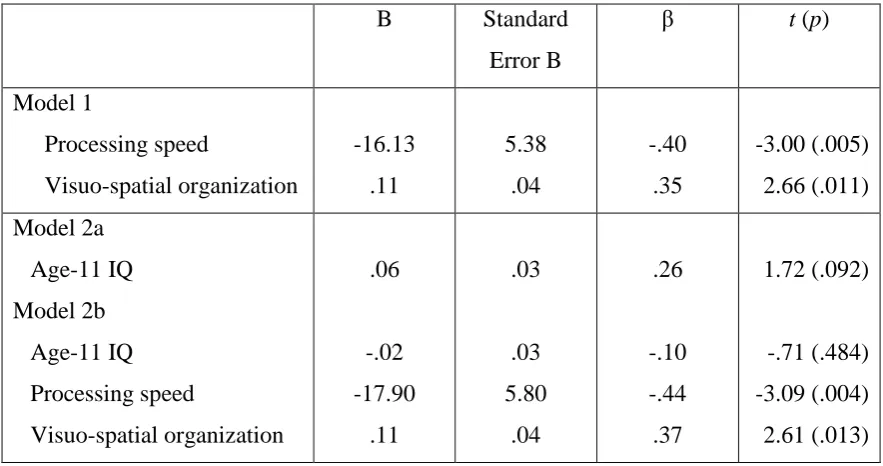
stepwise method. The models are displayed in Table 2.
speed (β = -.40, p < .01) and block design (β = .35, p = .01) served as significant predictors in the model, with processing speed predicting 16%, and block design predicting 12%, of the
variance. Within this sample and combination of predictors, all other variables were
non-significant and so were excluded from the second model. Including age-11 IQ in the second
model did not alter the pattern of results, F(3,42) = 8.46, p < .001. This model predicted 35% of the variance (R = .63, adjusted R2 = .35, SE = 2.67), with processing speed (β = -.44, p < .01) predicting 20%, and block design (β = .37, p = .01) predicting 14%, of the variance in visual working memory performance. Therefore, childhood ability did not serve as a
significant predictor (β = -.10, p = ns).
Discussion
This study was aimed at determining predictors of visual working memory performance, as
measured by a visual matrix task (modified VPT; Brown et al, 2006; Della Sala et al., 1997,
1999), in a sample of healthy older adults recruited from the Lothian Birth Cohort 1936
(LBC1936; Deary et al., 2007). Visual working memory was related to processing speed,
block design, spatial working memory, and older age IQ, but neither to verbal fluency nor
childhood IQ (measured at age 11). As the only variables retained in a regression analysis, processing speed and block design (the visuo-spatial executive measure) were the significant
predictors of visual working memory performance. An important aim of the present study,
however, was to establish whether any predictive value would remain after previous mental
ability (age-11 IQ) was adjusted for (Deary et al., 2000, 2004; Deary, Johnson, et al., 2010;
Deary, et al., 2009). After age-11 IQ was included, the pattern of results remained the same,
with processing speed predicting 20%, and block design predicting 14%, of the variance,
suggesting that, with this sample and sample size, visual working memory performance in
memory ability appears to be related to changes that have occurred with the aging process,
and most likely reflects the fluid nature of the task. It may have been possible for the measure
of childhood intelligence to be unreliable; however, there is strong stability in intelligence
across the lifespan in LBC1936, and this was one of the advantages of drawing upon this
sample (Deary, Johnson, et al., 2010; Gow et al., 2011). Furthermore, a strong positive
correlation is also evident in this subsample.
Consideration of the remaining key variables of processing speed and central executive
functionoffers insight regarding the processes affecting visual working memory performance
in older age, and age-related cognitive decline more generally. The finding that the verbal
fluency central executive measure was neither correlated with, nor predictive of, visual
working memory performance, suggests that decline in visual working memory is not simply
due to general central executive dysfunction, but may be due to more widespread
deterioration (Band, Ridderinkhof, & Segalowitz, 2002; Greenwood, 2000; Tisserand &
Jolles, 2003). On the other hand, central executive resources specifically related to the
organization of visuo-spatial material were shown to be important. As indicated by the shared
variance with block design, the deployment of central executive resources within the context
of a visuo-spatial task appears to be particularly important.
The finding that processing speed exhibited the greatest correlation with visual working
memory performance, as well as the greatest predictive value, suggests that speed of
encoding (the ability to create a stable representation; Salthouse, 1994a), and/or rate of
rehearsal are possible candidates for the source of the marked age-related deficit in visual
working memory performance. Indeed, elaborations and rehearsals are two possible
operations referred to by Salthouse (1996) that could be affected by speed of processing.
Within the visual working memory task, it is clear that slower elaboration during pattern
contribute to poorer recall. Similarly, the simultaneity mechanism offers a conceivable
explanation regarding the role of processing speed. Poorer recall could be observed when the
result of previous operations is no longer available by the time subsequent operations are
completed (i.e., rehearsing individual component parts of the stimuli in turn). Participants
with slower processing speed may therefore find themselves able to recall only part of a
pattern, or none of the pattern at all.
Inspecting the pattern of correlations with the spatial working memory measure may
offer further insight, as this task was related to processing speed and both central executive
measures. It is possible that, unlike the visual working memory task, spatial working memory
was more related to central executive function due to the requirement of participants to
manipulate the information (i.e., reverse sequence order) before providing the response.
However, visuo-spatial encoding, representation, maintenance, and elaboration are likely to
be represented by processing speed and visuo-spatial organization (block design), the two
variables that were also related to, and predictive of, visual working memory. Although
visual and spatial working memory were moderately correlated, and each appear to have
processing speed and visuo-spatial organization in common, spatial working memory did not
predict visual working memory performance. This finding supports the theory that visual and
spatial working memory are related but separable processes (Della Sala et al., 1999; Logie
1995, 2003).
At the biological level, the processing speed deficit could be related to a reduction in
white matter integrity. Deary, Bastin, Pattie, Clayden, Whalley, et al. (2006; see also Bucur,
Madden, Spaniol, Provenzale, Cabeza, et al., 2008; Kennedy & Raz, 2009; Madden, Spaniol,
Costello, Bucur, White, et al., 2008) showed that white matter integrity, believed to be crucial
for connectivity between the distributed cortical regions which underlie cognition, is related
matter integrity was related to reaction time measures of information processing as used in
the current study. Furthermore, Waiter, Fox, Murray, Starr, Staff, et al. (2008) provided
functional magnetic resonance imaging (fMRI) evidence that successful cognitive aging may
be related to the preservation of neural networks subserving such simple information
processing.
It is important to highlight the potential limitations of the current study. First, the
sample size is relatively small, and it is therefore possible that lack of power did not allow for
the detection of small effects, particularly with respect to the correlation between childhood
IQ and visual working memory, which exhibited a trend toward significance. Despite this
limitation, however, clear results have been found relating to the predictive value of the
variables under investigation. A further limitation relates to the lack of correlation with, and
predictive power of, verbal fluency. While this has been widely used and accepted as a
measure of central executive function (e.g., see Lezak et al., 2004; Stuss et al., 1998),
Tisserand and Jolles (2003) highlighted that prefrontal decline may have to be considered as
separable. That is, verbal fluency may not tap the most age-sensitive function(s) carried out
by prefrontal cortex. Furthermore, Phillips (1999) stated that verbal fluency performance
must be interpreted with caution, as poorer performance may reflect a number of factors such
as general intelligence (see also Salthouse et al., 2003). Nevertheless, central executive
function was found to relate to spatial working memory, which involved manipulation of
stimuli prior to response. As highlighted above, performance of the visual working memory
task may simply not draw upon central executive function to a large enough extent for the
shared variance to go beyond central executive processing specifically involved with
visuo-spatial material. Finally, there remains a large proportion of variance in visual working
memory performance that is unexplained in the current study. At the heart of visual working
static visual image). It is likely that this process would have accounted for a significant
proportion of the variance, yet no other measures were available to us which would have
captured this process.
In summary, neither childhood ability nor verbal fluency predicted visual working
memory in the present study, but processing speed was able to predict 20% of the variance,
while visuo-spatial organization (block design) predicted 14%. It is suggested that processing
speed affects task performance via speed of encoding and/or rate of rehearsal, and that central
executive resources specifically related to the use of visuo-spatial material are important for
visual working memory performance in older adults. As suggested by recent research,
processing speed may indeed be a biomarker of cognitive aging (Deary, Johnson, et al.,
2010).
References
Baddeley, A. D. (2000). The episodic buffer: A new component of working memory? Trends in Cognitive Sciences, 4, 417-423.
Baddeley, A., Emslie, H., Kolodny, J., & Duncan, J. (1998). Random generation and
executive control of working memory. Quarterly Journal of Experimental Psychology, 51A, 819-852.
Baddeley, A. D., & Hitch, G. J. (1974). Working memory. In G. H. Bower (Ed.), The psychology of learning and motivation Vol. 8 (pp. 47-90). New York: Academic Press. Band, G. P. H., Ridderinkhof, K. R., & Segalowitz, S. (2002). Explaining neurocognitive
aging: is one factor enough? Brain and Cognition, 49, 259-267.
Beigneux, K., Plaie, T., & Isingrini, M. (2007). Aging effects on visual and spatial
Bopp, K. L., & Verhaeghen, P. (2005). Aging and verbal memory span: A meta-analysis.
Journal of Gerontology: Psychological Sciences, 60, 223-233.
Braver, T. S., & West, R. L. (2008). Working memory, executive control, and aging. In F. I.
M. Craik & T. A. Salthouse (Editors), The Handbook of Aging and Cognition (3rd Edition), pp. 311-372. New York: Psychology Press.
Brickman, A. M., Zimmerman, M. E., Paul, R. H., Grieve, S. M., Tate, D. F., Cohen, R. A., et
al. (2006). Regional white matter and neuropsychological functioning across the adult
lifespan. Biological Psychiatry, 60, 444-453.
Brown, L. A., Forbes, D., & McConnell, J. (2006). Limiting the use of verbal coding in the
Visual Patterns Test. Quarterly Journal of Experimental Psychology, 59, 1169-1176. Brown, L. A., McConnell, J., & Forbes, D. (2011). Interference and aging effects in visual
working memory. Manuscript submitted for publication.
Bruyer, R., & Scailquin, J. C. (1999). Assessment of visuo-spatial short-term memory and
effect of aging. European Review of Applied Psychology, 49, 175-181.
Buckner, R. L. (2004). Memory and executive function in aging and AD: Multiple factors
that cause decline and reserve factors that compensate. Neuron, 44, 195-208.
Bucur, B., Madden, D. J., Spaniol, J., Provenzale, J. M., Cabeza, R., White, L. E., et al.
(2008). Age-related slowing of memory retrieval: contributions of perceptual speed
and cerebral white matter integrity. Neurobiology of Aging, 29, 1070-1079.
Carroll, J. B. (1993). Human Cognitive Abilities: A Survey of Factor-Analytic Studies. New York: Cambridge University Press.
Chao, L. L., & Knight, R. T. (1997). Prefrontal deficits in attention and inhibitory control
with aging. Cerebral Cortex, 7, 63-69.
Cowan, N. (2001). The magical number 4 in short-term memory: A reconsideration of mental
Craik, F. I. M., & Byrd, M. (1982). Aging and cognitive deficits: The role of attentional
resources. In F. I. M. Craik & S. Trehub (Eds.), Aging and cognitive processes (pp. 191-211). New York: Plenum Press.
Deary, I. J., Bastin, M. E., Pattie, A., Clayden, J. D., Whalley, L. J., Starr, J. M., et al. (2006).
White matter integrity and cognition in childhood and old age. Neurology, 66, 505-512.
Deary, I. J., Der, G., & Ford, G. (2001). Reaction times and intelligence differences: A
population-based cohort study. Intelligence, 29, 389-399.
Deary, I. J., Gow, A. J., Taylor, M. D., Corley, J., Brett, C., Wilson, V., et al. (2007). The
Lothian Birth Cohort 1936: a study to examine influences on cognitive ageing from age
11 to age 70 and beyond. BMC Geriatrics, 7; 28.
Deary, I. J., Johnson, W., & Starr, J. M. (2010). Are processing speed tasks biomarkers of
cognitive aging? Psychology and Aging, 25, 219-228.
Deary, I. J., Penke, L., & Johnson, W. (2010). The neuroscience of human intelligence
differences. Nature Reviews: Neuroscience, 11, 201-211.
Deary, I. J., Whalley, L. J., Lemmon, H., Crawford, J. R., & Starr, J. M. (2000). The stability
of individual differences in mental ability from childhood to old age: follow-up of the
1932 Scottish Mental Survey. Intelligence, 28, 49-55.
Deary, I. J., Whalley, L. J., & Starr, J. M. (2009). A lifetime of intelligence: follow-up studies of the Scottish Mental Surveys of 1932 and 1947. Washington, DC: American Psychological Association.
Deary, I. J., Whiteman, M. C., Starr, J. M., Whalley, L. J., & Fox, H. C. (2004). The impact
of childhood intelligence on later life: following up the Scottish Mental Surveys of
Della Sala, S., Gray, C., Baddeley, A., Allamano, N., & Wilson, L. (1999). Pattern span: A
tool for unwelding visuo-spatial memory. Neuropsychologia, 37, 1189-1199.
Della Sala, S., Gray, C., Baddeley, A., & Wilson, L. (1997). Visual patterns test: a test of short-term visual recall. Bury St Edmunds, UK: Thames Valley Test Company.
Dempster, F. N. (1992). The rise and fall of the inhibitory mechanism: toward unified theory
of cognitive development and aging. Developmental Review, 12, 45-75.
Finkel, D., Reynolds, C. A., McArdle, J. J., & Pedersen, N. L. (2007). Age changes in
processing speed as a leading indicator of cognitive aging. Psychology and Aging, 22, 558-568.
Fisk, J. E., & Sharp, C. A. (2004). Age-related impairment in executive functioning:
updating, inhibition, shifting, and access. Journal of Clinical and Experimental Psychology, 26, 874-890.
Folstein, M. F., Folstein, S. E., & McHugh, P. R. (1975). Mini-Mental State: a practical
method for grading the cognitive state of patients for the clinician. Journal of Psychiatric Research, 12, 189-198.
Gow, A. J., Johnson, W., Pattie, A., Brett, C. E., Roberts, B., Starr, J. M. et al. (2011).
Stability and change in intelligence from age 11 to ages 70, 79 and 87: the Lothian
Birth Cohorts of 1921 and 1936. Psychology and Aging, 26, 232-240.
Greenwood, P. M. (2000). The frontal aging hypothesis evaluated. Journal of the International Neuropsychological Society, 6, 705-726.
Head, D., Buckner, R. L., Shimony, J. S., Williams, L. E., Akbudak, E., Conturo, T. E., et al.
(2004). Differential vulnerability of anterior white matter in nondemented aging with
minimal acceleration in Dementia of the Alzheimer Type: evidence from diffusion
Jenkins, L., Myerson, J., Joerding, J. A., & Hale, S. (2000). Converging evidence that
visuospatial cognition is more age-sensitive than verbal cognition. Psychology and Aging, 15, 157-175.
Johnson, W., Logie, R. H., & Brockmole, J. R. (2010). Working memory tasks differ in factor
structure across age cohorts: Implications for dedifferentiation. Intelligence, 38, 513-528.
Kane, M. J., & Engle, R. W. (2002). The role of prefrontal cortex in working memory
capacity, executive attention, and general fluid intelligence: An individual differences
perspective. Psychonomic Bulletin & Review, 9, 637-671
Kemps, E. & Newson, R. (2006). Comparison of adult age differences in verbal and
visuo-spatial memory: The importance of ‘pure’, parallel and validated measures. Journal of Clinical and Experimental Neuropsychology, 28, 341-356.
Kennedy, K. M., & Raz, N. (2009). Aging white matter and cognition: differential effects of
regional variations in diffusion properties on memory, executive functions, and speed.
Neuropsychologia, 47, 916-927.
Klauer, K. C., & Zhao, Z. (2004). Double dissociations in visual and spatial short-term
memory. Journal of Experimental Psychology: General, 133, 355-381.
Leonards, U., Ibanez, V., Giannakopoulos, P. (2002). The role of stimulus type in age-related
changes of visual working memory. Experimental Brain Research, 146, 172-183. Lezak, M. D., Howieson, D. B., & Loring, D. W. (2004). Neuropsychological assessment (4th
Edition). Oxford, UK; Oxford University Press.
Logan, J. M., Sanders, A. L., Snyder, A. Z., Morris, J. C., & Buckner, R. L. (2002).
Under-recruitment and non-selective Under-recruitment: dissociable neural mechanisms associated
Logie, R. H. (1995). Essays in Cognitive Psychology: Visuo-spatial Working Memory. Hove,
UK: Lawrence Erlbaum Associates.
Logie, R. H. (2003). Spatial and visual working memory: A mental workspace. The Psychology of Learning and Motivation, 42, 37-78.
Logie, R. H., & Maylor, E. A. (2009). An internet study of prospective memory across
adulthood. Psychology and Aging, 24, 767-774.
Lovett, M. C., Reder, L. M., & Lebiere, C. (1999). Modelling working memory in a unified
architecture: an ACT-R perspective. In A. Miyake & P. Shah (Eds.), Models of
Working Memory (pp. 135-182). New York: Cambridge University Press.
MacPherson, S. E., Phillips, L. H., & Della Sala, S. (2002). Age, executive function, and
social decision making: a dorsolateral prefrontal theory of cognitive aging. Psychology and Aging, 17, 598-609.
Madden, D. J., Spaniol, J., Costello, M. C., Bucur, B., White, L. E., Cabeza, R., et al. (2008).
Cerebral white matter integrity mediates adult age differences in cognitive performance.
Journal of Cognitive Neuroscience, 21, 289-302.
Myerson, J., Hale, S., Rhee, S. H., & Jenkins, L. (1999). Selective interference with verbal
and spatial working memory in young and older adults. Journal of Gerontology: Psychology Sciences, 54, 161-164.
Park, D. C., Lautenschlager, G., Hedden, T., Davidson, N. S., Smith, A. D., & Smith, P. K.
(2002). Models of visuospatial and verbal memory across the adult life span.
Psychology and Aging, 17, 299-320.
Phillips, L. H. (1999). Age and individual differences in letter fluency. Developmental Neuropsychology, 15, 249-267.
Quinn, J. G., & McConnell, J. (1996). Indications of the functional distinction between the
Salthouse, T. A. (1991). Theoretical perspectives on cognitive aging. Hillside, NJ: Erlbaum. Salthouse, T. A. (1992). Influence of processing speed on adult age differences in working
memory. Acta Psychologica, 79, 155-170.
Salthouse, T. A. (1994a). The aging of working memory. Neuropsychology, 8, 535-543. Salthouse, T. A. (1994b). The nature of the influence of speed on adult age differences in
cognition. Developmental Psychology, 30, 240-259.
Salthouse, T. A. (1996). The processing-speed theory of adult age differences in cognition.
Psychological Review, 103, 403-428.
Salthouse, T. A., Atkinson, T. M., & Berish, D. E. (2003). Executive functioning as a
potential mediator of age-related decline in normal adults. Journal of Experimental Psychology: General, 132, 566-594.
Smith, A. D., Park, D. C., Cherry, K., & Berkovsky, K. (1990). Age differences in memory
for concrete and abstract pictures. Journal of Gerontology: Psychological Sciences, 45, 205-209.
Stuss, D. T., Alexander, M. P., Hamer, L., Palumbo, C., Dempster, R., Binns, M., et al.
(1998). The effects of focal anterior and posterior brain lesions on verbal fluency.
Journal of the International Neuropsychological Society, 4, 265-278.
Tisserand, D. J., & Jolles, J. (2003). On the involvement of prefrontal networks in cognitive
aging. Cortex, 39, 1107-1128.
Vaughan, L., & Hartman, M. (2010). Aging and visual short-term memory: effects of object
type and information load. Aging, Neuropsychology, & Cognition, 17, 35-54.
Verhaeghen, P., & Salthouse, T. A. (1997). Meta-analyses of age-cognition relations in
adulthood: estimates of linear and nonlinear age effects and structural models.
Waiter, G. D., Fox, H. C., Murray, A. D., Starr, J. M., Staff, R. T., Bourne, V. J., et al.
(2008). Is retaining the youthful functional anatomy underlying speed of information
processing a signature of successful cognitive ageing? An event-related fMRI study of
inspection time performance. Neuroimage, 41, 581-595.
Wallesch, C. W., Curio, N., Galazky, I., Jost, S., & Synowitz, H. (2001). The
neurospsychology of blunt head injury in the early postacute stage: effects of focal
lesions and diffuse axonal injury. Journal of Neurotrauma, 18, 11-20.
Wechsler, D. (1998a). WAIS-III UK Administration and Scoring Manual. London: Psychological Corporation.
Wechsler, D. (1998b). WMS-III Administration and Scoring Manual. London: Psychological Corporation.
West, R. L. (1996). An application of prefrontal cortex function theory to cognitive aging.
Figure 1
Table 1
Means (with standard deviations) and Pearson correlations between each variable.
1 2 3 4 5 6 7 M (SD)
1. Age-11 IQ - 105.21
(14.77)
2. Age-68 IQ .71*** - 102.08
(12.42) 3. Processing speed
(four-choice reaction time)
-.45** -.51*** - 0.623
(0.081) 4. Central executive function
(verbal fluency)
.44** .47** -.28 - 44.84
(13.16) 5. Visuo-spatial organization
(block design)
.44** .58*** -.37* .30* - 38.73
(10.77) 6. Spatial working memory
(backward spatial span)
.14 .23 -.42** .42** .40** - 7.95
(1.52) 7. Visual working memory
(modified Visual Patterns Test)
.26 .43** -.53*** .09 .50** .48** - 8.77
(3.30)
Table 2
Linear regression models predicting visual working memory performance in older adulthood.
B Standard
Error B
β t (p)