City, University of London Institutional Repository
Citation
:
Yaman, F. and Cubí Mollá, P. A fixed effects ordered choice model with flexible ‐thresholds with an application to life-satisfaction. London: City University London.
This is the published version of the paper.
This version of the publication may differ from the final published
version.
Permanent repository link:
http://openaccess.city.ac.uk/8123/Link to published version
:
Copyright and reuse:
City Research Online aims to make research
outputs of City, University of London available to a wider audience.
Copyright and Moral Rights remain with the author(s) and/or copyright
holders. URLs from City Research Online may be freely distributed and
linked to.
Department of Economics
A fixed effects ordered choice model with flexible thresholds
with an application to life-satisfaction
Patricia
Cubí
‐
Mollá
1City University London
Firat
Yaman
City University London
Department of Economics
Discussion Paper Series
No. 1
4/1
0
A …xed e¤ects ordered choice model with ‡exible thresholds with
an application to life-satisfaction
Patricia Cubí-Mollá1 F¬rat Yaman2
JEL classi…cation: C23, C25, I31
Keywords: Ordered choice, …xed e¤ects, subjective well-being, life-satisfaction
Abstract
In many contexts reported outcomes in a rating scale are modeled through the existence
of a latent variable that separates the categories through thresholds. The literature has not
been able to separate the e¤ect of a variable on the latent variable from its e¤ect on threshold
parameters. We propose a model which incorporates (1) individual …xed e¤ects on the latent
variable, (2) individual …xed e¤ects on the thresholds and (3) threshold shifts across time
de-pending on observables. Importantly, the latent variable and the threshold speci…cations can
include common variables. In order to illustrate the estimator, we apply it to a model of life
satisfaction using the GSOEP dataset. We demonstrate that important di¤erences can arise
depending on the choice of the model. Our model suggests that threshold shifts are statistically
and quantitatively important. Factors which increase reported life-satisfaction are due both
to positive e¤ects on the latent variable AND to shifting thresholds to the left, while factors
which decrease reported life satisfaction are due to negative e¤ects on the latent variable AND
to shifting thresholds to the right.
1Department of Economics, City University London. Email: [email protected]. 2
1
Introduction
Many variables and outcomes of interest in the social sciences are reported in rating scales. Some
of these separate the categories along pre-speci…ed thresholds, such as categorical grades in school
(A to E, 10 to 1, etc.), but many others do not. Surveyed individuals are often asked about their
opinion on a certain statement or political issue with answer categories ranging from “Strongly
agree” to “strongly disagree”, their self-assessed health or well-being on a range from 0 to 10, or
1 to 5, how much they value certain things in life, such as family, friends, work, etc. with answers
ranging from “very much” to “not at all”, or how they assess their pro…ciency in a certain skill or
task, such as language ‡uency with answers ranging from “very well” to “not at all”. These rating
scales are in wide use in disciplines as diverse as economics, psychology, and medicine (in rating
the severity of pain, for example).
The ordinal (non-cardinal) nature of these variables has given rise to models of ordered choice
such as the ordered probit and ordered logit models, and recent contributions have developed
consistent and/or e¢ cient (in the sense of using all sample observations with variation in the
de-pendent variable) estimators for the ordered logit, which are all based on a dichotomization of the
dependent variable and the application of Chamberlain’s (1980) conditional logit model
(Winkel-mann and Winkel(Winkel-mann (1998), Das and van Soest (1999), Hamermesh (2001), Ferrer-i-Carbonell
and Frijters (2004), Baetschmann et al. (2015)). All of these applications have assumed that the
thresholds that divide one category from the other are …xed over time (but not necessarily across
individuals). This is due to the fact that in ordered choice models the e¤ect of a variable on the
level of the latent variable cannot be separately identi…ed from the variable’s e¤ect on the level
of the thresholds. We suspect that researchers have been long aware of this, but the …rst explicit
exposition of this problem goes back to Terza (1985). If thresholds do change systematically with
observed variables, then the coe¢ cient estimates in the aforementioned papers are not e¤ects on the
locations (which might have changed themselves), and thus contain very little information, since
even the sign cannot be interpreted in its e¤ect on the latent variable.
We propose a model which can identify e¤ects of variables on the latent variable from e¤ects on
the thresholds. To our knowledge this is the …rst paper which does this in the absence of objective
measures of the latent variable (as done by Lindeboom and van Doorslaer (2004) for health) or of
explicit anchoring vignettes (such as Bago d’Uva et al. (2011)). We use the Amalgamated
Condi-tional Logit Regression (ACLR) proposed by Mukherjee et al. (2008)3 and extend it by including
dependent variables which re‡ect the survey individuals’answers to questions about their current
outcome, but also their answers relating to the previous survey period’s outcome. The latter is
NOT the lagged dependent variable. Rather it is the individual’s assessment today about her
out-come last year. We illustrate our model by applying it to the outout-come of life-satisfaction in the
German Socio-Economic Panel. The application suggests that threshold shifts are statistically and
quantitatively important. For example, about a third of the coe¢ cient on household income in a
model with …xed thresholds can in fact be attributed to a shift in thresholds.
Whether a change in the reported outcome is due to a change in the underlying latent variable
or due to a change in the threshold might at …rst seem like an arcane question, but the inference,
implications, and possibly political consequences can be widely di¤erent between the two cases.
Consider …rst a simple example: In the British higher education system a grade of at least 70 (out
of 100) is considered a “…rst class” grade. Conceivably, a …rst class graduation grade might be
considered a necessary condition for a popular and attractive employer to consider an applicant for
a job interview. Now suppose the proportion of “…rst class” grades increases over time. Since the
threshold is …xed, one would be inclined to infer that students seem to be getting “better”in some
sense, but that is so only if we interpret the latent variable as the actual grade (a number between
3Baetschmann et al. (2015) call this estimator “blow-up and cluster” (BUC) and demonstrate its strong small
0 and 100). However, the result might be due to the university becoming more generous in its
marking, so that a particular student might receive 70 marks today, but would have received less
for the same performance a few years earlier. If we interpret the latent variable as “knowledge” or
“quality of knowledge”, then the increased proportion of …rst class grades could be a re‡ection of
either more knowledgeable students, or as a laxation of marking standards. Clearly the distinction
would be of interest to educational policy-making.
Another increasingly important …eld in which the distinction between latent variable and
thresh-old changes is crucial is the measurement and study of subjective well-being and happiness.
Mea-sures of well-being are increasingly suggested as substitute or at least complementary meaMea-sures to
GDP that should be targeted by governments (see for example HM Treasury Budget (2010), OECD
(2011) or Dolan et al. (2011)). Since these measures re‡ect the entirety of the human experience, it
is argued, they have the potential to be more complete and even accurate compared to GDP which
includes only those goods which can be priced in the market (thus excluding things like the value
of clean air, social and physical safety, biodiversity etc.). A non-market goodx could in principle
be “priced”by inferring from regression coe¢ cients the amount of income that an individual would
give up to compensate for a unit-increase in x to keep her latent variable constant.4 But what
exactly should the social welfare function be? If it is the sum of all individual reported levels of
well-being(Y =PNi=1yi), we need not worry about the source of changing values ofy, since both
threshold and latent variable changes will be observationally equivalent. But if the social welfare
function is over the latent variable (Y = PNi=1yi), as it probably should be if we consider this
to be the actual emotional state of an individual, then the distinction is important. Threshold
shifts to the left (making it easier to report higher values of well-being) would increaseY, but leave
Y unchanged. We imagine a policy-maker would like to know to what extent changes in Y are
re‡ecting changes inY .
4
It is not our intention to participate in a debate about the merits of using well-being instead or along with GDP.
2
Modeling
We follow here the conventional choice of setting up the ordinal model as a latent variable model.
That is the individual i at any given point of time t has a subjective evaluation of the question
she is being asked (her health status, opinion, life-satisfaction, etc.). The question can only be
answered by picking one out of an ordered list of answers. We index the possible answer categories
byk2 f1; :::Kg. The individual’s evaluation of her underlying latent variable we denoteyit. This
evaluation translates into the reported outcomeyit, such that
yit=k , kit 1 < yit kit (1)
The latent variable is speci…ed as
yit=Xit + i+ it (2)
where the distribution of i is left unspeci…ed and is allowed to correlate withXi, and it is i.i.d.
logistic (with location 0 and scale 1) acrossiand t.
2.1 Threshold model
If kit= ki, we have all the necessary building blocks to apply Chamberlain’s conditional logit model
for a pre-speci…ed dichotomization ofy, or to apply one of the estimators based on the conditional
logit model which use all possible dichotomizations (minimum distance, ACLR). This speci…cation
of the threshold parameters is quite ‡exible, but it does impose that distances between any two
thresholds are preserved over time, or
k
it = ki;t s
and that the di¤erence of the kth threshold between two individuals is constant over time:
k
it kjt = ki kj
In this paper we decompose the thresholds into an individual- and threshold-speci…c,
time-invariant component, and a component which modi…es the thresholds linearly in parameters:
k
it= ki +Zit (3)
Thus,
k
it kjt = ki kj + (Zit Zjt)
andyit > yis does not necessarily imply yit> yis. Equations 1, 2 and 3 imply
yit=k , ki 1 < Xit Zit + i+ it ki (4)
Clearly, in this equation is not separately identi…ed from for common variables inX and Z, or
in other words, the estimate of will incur a level-bias on the order of .
2.2 The remembered outcome
In most surveys the surveyed individual is asked to rate her current outcome. However, the surveyed
individual might in addition be asked about the current outcome and about her outcome at some
point in the past. In that case we need to distinguish between the survey time, which we will
be subscripting, and thereference time, which we will be superscripting. Thus, yt
it is the reported
outcome for individualisurveyed at timetand where the evaluation refers to the time at which the
individual is surveyed. In contrastyitt 1 is the reported outcome for individualisurveyed at timet
but where the evaluation refers to theprevious time at which the individual is surveyed: it is how
the individual remembers her outcome. Assuming the individual to have an accurate recollection
of her previous outcome, and having time-invariant thresholds, a di¤erence between ytit and yitt 1
would be due to a change in the individual’s latent variable. Our threshold speci…cation also allows
this to be due to changes in the threshold parameters –provided that the thresholds of timet are
applied to all questions at survey time t. A prominent example would be the e¤ect of income or
is: the barrier that divides the rich from the non-rich always seems to be above one’s own wealth.
A third possibility would be that the individual does not accurately recall her previous state. We
assume that theremembered latent variable at survey timet is the non-random component of the
latent variable at reference time t 1 amended by an additive recall erroruit. Since the error in
the latent variable it is assumed to be identically and independently (of X) distributed, one can
interpret it as a merely transitory component that in‡uences the reported answer at the time of the
survey (the “mood” of the surveyed person). Thus, we assume that the individual does remember
her circumstances of the previous survey time (as re‡ected in theX), but not the purely transitory
aspect that contributed to her answer on that day. The recall erroruit can be interpreted as both
a false recollection and/or as a discrepancy between the points of time in a past time period (the
surveyed individual questioned about her outcome “last year” might not refer to the point of time
at which she was surveyed in the previous year). We write:
ytit 1=k , kit 1 < yi;t 1 i;t 1+uit=Xi;t 1 +uit kit
This, together with equations 2 and 3 give
yitt 1 =k , ki 1 < Xi;t 1 Zit + i+uit ki (5)
This is the equation which identi…es and separately, even ifX and Z share common variables,
since the variables inX enter with a one-period lag compared toZ.
We emphasize that this derives from the application of thresholds it rather than i;t 1 to ANY
question asked at survey timet. We think that for most cases it is reasonable to assume that people
apply their current criteria in answering a survey question, even if the question refers to an event
in the past. We make the following assumption onuit:
The recollection error uit is distributed i.i.d. and follows a logistic distribution with
lo-cation 0 and scale . It is unrelated to observables Xit and Zit, so that COV(uit; Xit) =
An important point to bear in mind is that the model with time-invariant thresholds would be
observationally equivalentwith regard to the current reported variableyttto the model with threshold
shifts. Thus we cannot base a discriminating test on the variableytt. This is a consequence of the
model with time-invariant thresholds not having a speci…cation – a “theory” – for categorical
outcomes referring to the past. We therefore also estimate an alternative model based on both the
current and the past reference period, but modify our model such that the thresholds an individual
applies are always the thresholds of the reference period (rather than the survey period). That
is, an individual reporting a value for yti 1 applies the thresholds i;t 1 in categorizing his latent
variable yi;t 1. This model cannot identify between latent variable and threshold shifts, but it
“predicts”the remembered outcomes. We can thus compare the likelihood values between this and
our model.
3
Estimation
The estimation is a very straightforward extension of the estimator in Mukherjee et al. (2008), who
call it amalgamated conditional logistic regression (ACLR) and Baetschmann et al. (2015)5who call
it “blow up and cluster”(BUC) estimator. The idea of these estimators is the following: for a given
cuto¤ valuek, dichotomize the ordinal variable, e.g. y~it = 1(yit > k). Chamberlain’s conditional
logit model is derived from the likelihood of the sequence ofy~it conditional onPTt=1i y~it. Denoting
this byPik, the ACLR and BUC combine all the possible dichotomization (with K categories, there
are K-1 possible dichotomizations) in one log likelihood and maximize it overb
max
b LL=
N
X
i=1
KX1
k=1
lnPik(X; b) (6)
Under the assumptions on it, an individual’s likelihoodPik(X; b) is given by
Pik(X; b) =
QTi
t=1exp(~yit Xit )
P
di2Di QTi
t=1exp(dit Xit )
5We are very thankful to the authors for bringing these models to our attention and for providing the Stata code
wheredit2 f0;1g,di= (di1 diTi)andDiis the set of all distinctdisuch that P
tdit=Pty~it. Our
extension to this model is the following. Suppose individualihasTipr observations onyitt (where the
superscriptpr stands for present), andTipaobservations onytit 1 (past). We stack …rst the reported
outcomes yitt for individual i and over all t, followed by yitt 1 for individual i and over all t, these
are the …rstTipr+Tipa elements of the outcome vector. The vector is then appended by the next
individual etc. until we reach the end of our sample. Since theuit are assumed to be independent
of the it, statistically we can treat the observations for yitt 1 and yitt as distinct individuals even
if in reality they are responses by the same individual. The vector for the explanatory variables
are(xit; zit)for responses referring to the present period, and(xi;t 1; zit) for responses referring
to the past period. With these modi…cations to the data, the likelihood given in 6 is maximized.
Standard errors are clustered by distinct itanduit. We will be distinguishing four di¤erent models:
ACLR is the model applied in Mukherjee et al. (2008), and Baetschmann et al. (2015). ACLR - A
(for alternative) is the ACLR model which includes the outcomesytit 1 but applies thresholds i;t 1
to this outcome. Our model is ACLR - T (for threshold) and ACLR - T with . Both models apply
thresholds of thesurvey period to any outcome (yitt and yitt 1. ACLR - T …xes the scale parameter
of the recollection error to 1, while ACLR - T with estimates this parameter jointly with the
latent variable and threshold parameters. Due to its added ‡exibility in modeling the remembered
outcome our preferred speci…cation is ACLR - T with .
4
Application: Life satisfaction over the life cycle
We illustrate the working of our model by way of an application to life satisfaction. We use the
German Socio-Economic Panel (GSOEP). This annual panel contains the question “How satis…ed
are you at present with your life as a whole?” in all waves (the …rst panel wave is 1984). For
the waves 1984-1987 the GSOEP also asked the question “How satis…ed were you a year ago with
your life?” Both questions could be answered on a scale from 0 (totally satis…ed) to 10 (totally
sam-ple selection, to observations who have non-missing values for all contemporaneous variables in all
four years (missing values might still be present in the extended model for the lagged independent
variable and forytit 1). The balancing of the panel leads to a loss of 33% of individual-year
observa-tions. However, these include both attritions and additions due to reaching the age of 16 at which
individuals are interviewed (see Haisken-DeNew and Frick (2005), p. 21).
Since equation 5 requires values on the lagged independent variables, we cannot use yitt 1 for
1984. We thus have 3 answers to the question about last year’s happiness and 4 answers to the
question about current happiness. In principle more waves could be used for the latter. However,
parameters need not stay stable over time, and we stop the sample two years before the fall of the
Berlin wall and any structural break that might have accompanied it.
We model life-satisfaction very similarly to Baetschmann et al. (2015). The explanatory
vari-ables for the latent variable equation are: the log of household income (in 2010 Euros), age squared,
a dummy for unemployment, a dummy for not being in the labor force, a dummy for living with
a partner (married or not), a dummy for being in good health (de…ned as not su¤ering from a
chronic illness and not having been hospitalized during the last year), and survey year dummies.
To emphasize the main contribution of this paper, all of those variables except the year dummies
are also included as threshold shifters.
We do not claim to have a complete model of life-satisfaction which would be outside of the
scope of this paper. However, we think that the chosen variables cover most of the determinants of
life satisfaction that have been considered in the literature (see for example Dolan et al. (2008)).
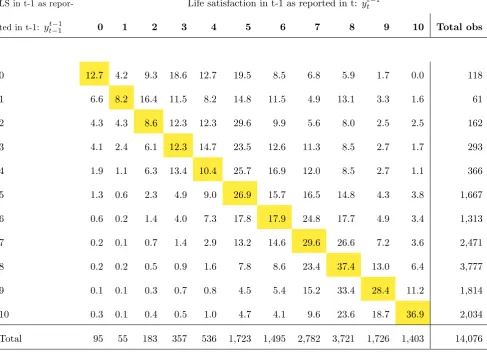
Before showing regression results, table 1 demonstrates the discrepancy in the outcome variables
ytt 11(life satisfaction referring to t-1 as reported in t-1) andytt 1(life satisfaction referring to t-1 as
reported in t). A cell entry is the percentage of those who reportytt 1, conditional on reportingytt 11
the plurality of observations record an answer consistent with the reported life satisfaction int 1
only for categories 5 (26%), 7 (30%), 8 (37%) and 10 (37%). All o¤-diagonal elements have positive
entries (exceptytt 1 = 10jytt 11 = 0), and people seem to “revise”their life-satisfaction both upwards
and downwards with a slight tendency for downwards revision: there are 5,675 observations in the
lower and 4,196 observations in the upper triangle of the table. The observations in the diagonal
cells are 4,202. This phenomenon lends strong support to the hypothesis of ‡exible thresholds
[image:13.595.52.540.301.653.2]and/or the presence of a recall error.
Table 1: Cross-tabulations, Life satisfaction in %
LS in t-1 as repor- Life satisfaction in t-1 as reported in t: ytt 1
ted in t-1: ytt 11 0 1 2 3 4 5 6 7 8 9 10 Total obs
0 12.7 4.2 9.3 18.6 12.7 19.5 8.5 6.8 5.9 1.7 0.0 118
1 6.6 8.2 16.4 11.5 8.2 14.8 11.5 4.9 13.1 3.3 1.6 61
2 4.3 4.3 8.6 12.3 12.3 29.6 9.9 5.6 8.0 2.5 2.5 162
3 4.1 2.4 6.1 12.3 14.7 23.5 12.6 11.3 8.5 2.7 1.7 293
4 1.9 1.1 6.3 13.4 10.4 25.7 16.9 12.0 8.5 2.7 1.1 366
5 1.3 0.6 2.3 4.9 9.0 26.9 15.7 16.5 14.8 4.3 3.8 1,667
6 0.6 0.2 1.4 4.0 7.3 17.8 17.9 24.8 17.7 4.9 3.4 1,313
7 0.2 0.1 0.7 1.4 2.9 13.2 14.6 29.6 26.6 7.2 3.6 2,471
8 0.2 0.2 0.5 0.9 1.6 7.8 8.6 23.4 37.4 13.0 6.4 3,777
9 0.1 0.1 0.3 0.7 0.8 4.5 5.4 15.2 33.4 28.4 11.2 1,814
10 0.3 0.1 0.4 0.5 1.0 4.7 4.1 9.6 23.6 18.7 36.9 2,034
Total 95 55 183 357 536 1,723 1,495 2,782 3,721 1,726 1,403 14,076
Source: German Socio-Economic Panel 1984-1987. LS: Life satisfaction.
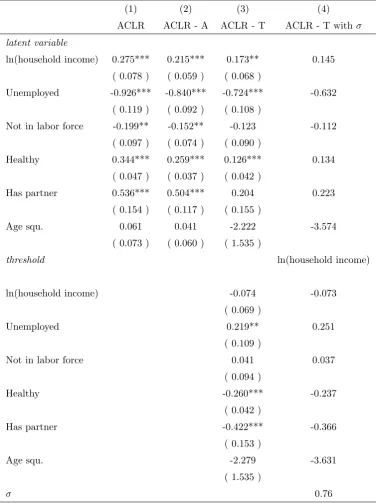
Table 2 presents results for our life-satisfaction model for the full sample, and compares it to the
ACLR estimator which is based on the current reported life-satisfaction only and to the alternative
Table 2: Life satisfaction determinants - Full sample
(1) (2) (3) (4)
ACLR ACLR - A ACLR - T ACLR - T with
latent variable
ln(household income) 0.275*** 0.215*** 0.173** 0.145
( 0.078 ) ( 0.059 ) ( 0.068 )
Unemployed -0.926*** -0.840*** -0.724*** -0.632
( 0.119 ) ( 0.092 ) ( 0.108 )
Not in labor force -0.199** -0.152** -0.123 -0.112
( 0.097 ) ( 0.074 ) ( 0.090 )
Healthy 0.344*** 0.259*** 0.126*** 0.134
( 0.047 ) ( 0.037 ) ( 0.042 )
Has partner 0.536*** 0.504*** 0.204 0.223
( 0.154 ) ( 0.117 ) ( 0.155 )
Age squ. 0.061 0.041 -2.222 -3.574
( 0.073 ) ( 0.060 ) ( 1.535 )
threshold ln(household income)
ln(household income) -0.074 -0.073
( 0.069 )
Unemployed 0.219** 0.251
( 0.109 )
Not in labor force 0.041 0.037
( 0.094 )
Healthy -0.260*** -0.237
( 0.042 )
Has partner -0.422*** -0.366
( 0.153 )
Age squ. -2.279 -3.631
( 1.535 )
0.76
Source: SOEP 1984-1987. All regressions include survey year dummies for the latent variable. For columns (1) to
(3) standard errors are clustered by individual and reported outcome (past vs. present). For column 4 standard
Not surprisingly, the results for in the ACLR model are roughly equal to in the ACLR
- T model. Minor di¤erences are due to missing values (for example inyitt 1). As expected, we see
that important factors for reported life-satisfaction are income, good health, and employment. The
results suggest that accounting for threshold shifting variables can be quite important in practice.
In our preferred model (column 4) a third of the apparent increase in life-satisfaction through
income seems to be attributable to higher income shifting the threshold of what constitutes high
levels of life-satisfaction to the left. We had admittedly expected the opposite e¤ect. However, the
results also seem to suggest that the factors which increase (decrease) reported life-satisfaction (in
the ACLR model) have this dual e¤ect: they increase (decrease) the latent variable in our model,
but also shift the thresholds to the left (right). We see this phenomenon for all our variables except
age. We don’t want to read to much into such a parsimonious model, but a possible explanation is
that the things that constitute a good life might seem to be more easily attainable to people who
have it, while they might look distant and out of reach for those who lack it. Another important
point is that the ACLR - T model performs better than the ACLR - A model in terms of the Pseudo
R2 value. In the full sample this goodness of …t measure is 13% higher for the ACLR - T than for
the ACLR - A model. We view this …nding as supporting the remembered outcome speci…cation
we have proposed in this paper.
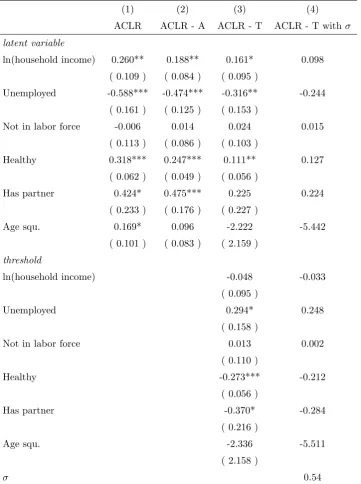
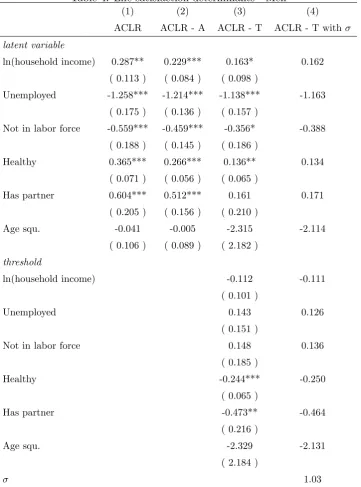
We are also interested in how income, unemployment and marital status a¤ect men and women
di¤erently and report results separated by sex in tables 3 and 4. Household income seems to
have comparable e¤ects on both men and women, though the e¤ect on the latent variable – the
emotional state –is smaller than the ACLR and ACLR - A models would suggest. An interesting
di¤erence exists with relation to employment status. Men are clearly much more negatively a¤ected
than women in their emotional state, while women seem to react to unemployment in part by
shifting out their thresholds. Not being in the labor force has no e¤ect on women, but a¤ects
men negatively. Presumably this is a life-style choice for women in that era, while for men
non-participation might re‡ect hidden unemployment or the inability to work. We also observe that
aging decreases women’s life-satisfaction strongly, but again women seem to “adapt” to this by
changing the thresholds, and by …nding it easier –for a given emotional state –to de…ne this state
as a relatively high level of life-satisfaction.
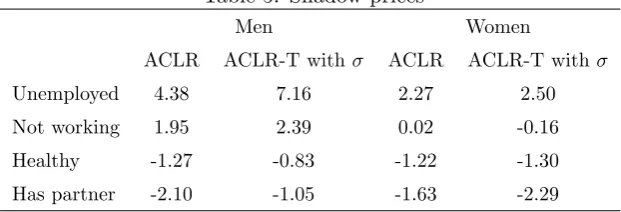
Important quantitative di¤erences also exist in the implied compensating incomes of conditions
like good or bad health or unemployment. We consider the dummy variables in our model in
table 5. The “shadow prices” in the model with ‡exible thresholds (columns 2 and 4) are based
on compensating incomes for incremental changes in the probability of switching from 0 to 1 in
the variable of interest. The shadow prices are based on changes in income to keep the latent
variable constant (rather than keeping the log odds-ratio constant). For example an increment
of 1 percentage point in the probability of getting unemployed is compensated by an increase
of 4.38% in the household income to keep the life-satisfaction of a man constant. In the ACLR
model no distinction between the e¤ect of a variable on the latent variable and the log odds-ratio
can be made. We see that for some variables the two models can imply very di¤erent shadow
prices. This is mostly clearly seen in the labor force variables, which according to our estimates
have higher shadow prices than the conventional ACLR model would imply. The not-in-labor-force
variable switches from positive to negative, though the di¤erence between the two estimates is not
statistically signi…cant. Finally, while the ACLR model suggests that having a partner is more
valuable for men than for women, this …nding is reversed in our ‡exible threshold model.
5
Conclusion
It has been a long-standing insight that in ordered-choice models there is an observational
equiv-alence between a variable’s e¤ect on the latent variable and on the threshold, and that only the
combined e¤ect is identi…ed. However, in practice the di¤erence between changes in the latent
variable and the threshold can be important for inference and policy-making. We are proposing
a model of ordered choice which accommodates the inclusion of 1) individual …xed e¤ects in the
Table 3: Life satisfaction determinants - Women
(1) (2) (3) (4)
ACLR ACLR - A ACLR - T ACLR - T with
latent variable
ln(household income) 0.260** 0.188** 0.161* 0.098
( 0.109 ) ( 0.084 ) ( 0.095 )
Unemployed -0.588*** -0.474*** -0.316** -0.244
( 0.161 ) ( 0.125 ) ( 0.153 )
Not in labor force -0.006 0.014 0.024 0.015
( 0.113 ) ( 0.086 ) ( 0.103 )
Healthy 0.318*** 0.247*** 0.111** 0.127
( 0.062 ) ( 0.049 ) ( 0.056 )
Has partner 0.424* 0.475*** 0.225 0.224
( 0.233 ) ( 0.176 ) ( 0.227 )
Age squ. 0.169* 0.096 -2.222 -5.442
( 0.101 ) ( 0.083 ) ( 2.159 )
threshold
ln(household income) -0.048 -0.033
( 0.095 )
Unemployed 0.294* 0.248
( 0.158 )
Not in labor force 0.013 0.002
( 0.110 )
Healthy -0.273*** -0.212
( 0.056 )
Has partner -0.370* -0.284
( 0.216 )
Age squ. -2.336 -5.511
( 2.158 )
0.54
Source: SOEP 1984-1987. All regressions include survey year dummies for the latent variable. For columns (1) to
(3) standard errors are clustered by individual and reported outcome (past vs. present). For column 4 standard
Table 4: Life satisfaction determinants - Men
(1) (2) (3) (4)
ACLR ACLR - A ACLR - T ACLR - T with
latent variable
ln(household income) 0.287** 0.229*** 0.163* 0.162
( 0.113 ) ( 0.084 ) ( 0.098 )
Unemployed -1.258*** -1.214*** -1.138*** -1.163
( 0.175 ) ( 0.136 ) ( 0.157 )
Not in labor force -0.559*** -0.459*** -0.356* -0.388
( 0.188 ) ( 0.145 ) ( 0.186 )
Healthy 0.365*** 0.266*** 0.136** 0.134
( 0.071 ) ( 0.056 ) ( 0.065 )
Has partner 0.604*** 0.512*** 0.161 0.171
( 0.205 ) ( 0.156 ) ( 0.210 )
Age squ. -0.041 -0.005 -2.315 -2.114
( 0.106 ) ( 0.089 ) ( 2.182 )
threshold
ln(household income) -0.112 -0.111
( 0.101 )
Unemployed 0.143 0.126
( 0.151 )
Not in labor force 0.148 0.136
( 0.185 )
Healthy -0.244*** -0.250
( 0.065 )
Has partner -0.473** -0.464
( 0.216 )
Age squ. -2.329 -2.131
( 2.184 )
1.03
Source: SOEP 1984-1987. All regressions include survey year dummies for the latent variable. For columns (1) to
(3) standard errors are clustered by individual and reported outcome (past vs. present). For column 4 standard
Table 5: Shadow prices
Men Women
ACLR ACLR-T with ACLR ACLR-T with
Unemployed 4.38 7.16 2.27 2.50
Not working 1.95 2.39 0.02 -0.16
Healthy -1.27 -0.83 -1.22 -1.30
Has partner -2.10 -1.05 -1.63 -2.29
Source: SOEP 1984-1987.
Crucially, our model can incorporate the same variables for the latent variable and the threshold
and identify their separate e¤ects. We apply our estimator to a simple model on life satisfaction
and demonstrate that variables usually included in life-satisfaction models have statistically and
quantitatively signi…cant e¤ects on the thresholds, which if omitted in the threshold speci…cation
are absorbed in the coe¢ cient of the latent variable speci…cation. Quantitatively important
di¤er-ences in the values of variables like unemployment, having a partner, health and not being in the
labor force arise between models with and without threshold shifts. Since our modeling strategy
depends on the availability of retrospective information on the dependent variable, we hope that
this paper will increase awareness for the importance of the inclusion of these variable in surveys.
References
Bago d’Uva, T. B., Lindeboom, M., O’Donnell, O., & Van Doorslaer, E. (2011). Slipping anchor?
Testing the vignettes approach to identi…cation and correction of reporting heterogeneity. Journal
of Human Resources, 46(4), 875-906.
Baetschmann, G., Staub, K.E. & Winkelmann, R. (2015). Consistent estimation of the …xed e¤ects
ordered logit model. Journal of the Royal Statistical Society: Series A (Statistics in Society),
forthcoming.
Chamberlain, G. (1980). Analysis of covariance with qualitative data. Review of Economic Studies,
Das, M. & Van Soest, A. (1999). A panel data model for subjective information on household
income growth. Journal of Economic Behavior & Organization, 40(4), 409-426.
Dolan, P., Layard, R. & Metcalfe, R. (2011) Measuring subjective wellbeing for public policy:
rec-ommendations on measures. Centre for Economic Performance special papers, CEPSP23. Centre
for Economic Performance, London School of Economics and Political Science, London, UK.
Dolan, P., Peasgood, T. & White, M. (2008). Do we really know what makes us happy? A review
of the economic literature on the factors associated with subjective well-being. Journal of economic
psychology, 29(1), 94-122.
Ferrer-i-Carbonell, A. & Frijters, P. (2004). How Important is Methodology for the estimates of
the determinants of Happiness? The Economic Journal, 114, 641-659.
Haisken-DeNew, J.P. & Frick, J.R. (2005). Desktop Companion to the German Socio-Economic
Panel, Version 8.0. Available athttp://www.diw.de/documents/dokumentenarchiv/17/38951/
dtc.354256.pdf
Hamermesh, D.S. (2001). The changing distribution of job satisfaction. Journal of Human
Re-sources, 36, 1-30.
Her Majesty’s Treasury Budget (2010). Available from: http://www.direct.gov.uk/prod_
consum_dg/groups/dg_digitalassets/@dg/@en/documents/digitalasset/dg_188581.pdf
Lindeboom M. & van Doorslaer E. (2004). Cut-point shift and index shift in self-reported health.
Journal of Health Economics, 23, 1083-1099.
Mukherjee, B., Ahn, J., Liu, I., Rathouz, P.J. & Sánchez, B.N. (2008). Fitting strati…ed
propor-tional odds models by amalgamating condipropor-tional likelihoods. Statistics in Medicine, 27, 4950-4971.
Organisation for Economic Co-Operation and Development (2011). How’s life?
Measur-ing well-beMeasur-ing. Available from: http://www.oecd-ilibrary.org/economics/how-s-life_
Terza, J.V. (1985). Ordinal probit: a generalization, Communications in Statistics - Theory and
Methods, 14, 1-11.
Winkelmann, L. & Winkelmann, R. (1998). Why are the unemployed so unhappy? Evidence from