RIT Scholar Works
Theses
Thesis/Dissertation Collections
12-1-1994
The Importance of the interface design in a foreign
language teaching program
Anne Brose
Follow this and additional works at:
http://scholarworks.rit.edu/theses
This Thesis is brought to you for free and open access by the Thesis/Dissertation Collections at RIT Scholar Works. It has been accepted for inclusion
in Theses by an authorized administrator of RIT Scholar Works. For more information, please contact
Recommended Citation
A Thesis
Submitted
to the
Faculty
ofthe
College
ofImaging
Arts
andSciences
In
Candidacy
for
the
Degree
ofMASTER
OF FINE ARTS
The Importance
ofthe
Interface Design in
aForeign
Language
Teaching
Program.
by
Anne E. Brose
Chief Advisor: Robert Keough
Date:
I
L
- ,
-
q
L{
Associate Advisor: James Ver Hague
Date:
/o,/Z/?if
Associate Advisor: Gordon Goodman
Date:
/2dfZ§y
Associate Advisor: Fred Dowaliby, Ph.D.
Date:
l
2-/.,
l:l
'f
I
I
Department Chairperson: Mariann Begland
I, Anne E. Brose, hereby grant permission to the Wallace Memorial
library at RIT to reproduce my thesis in whole or in part.
Any reproduction will not be used for commercial use or profit.
Interface Design
in
a
Foreign Language
Teaching
Program.
Who have
always encouraged meto
follow
medreams
and who
have
taught
methat
educationis
the
mostvaluableACKNOWLEDGMENTS
I
wouldlike
to thank
Robert
Keough,
James Ver Hague
andGordon Goodman
for
broadening
my
spectrumin
the
Graphic Design field
and
for
introducing
meto the
wonderful realms ofinteractive
media.Nancy
Ciolek,
who alwaysfound
the time to
give valuable advise andimportant
recommendations onmy
work.Fred
Dowaliby
who
patiently helped
me prepare an effective andrealisticresearch plan
for
the thesis
as well as understandthe
data
thatI
received asa result ofit.
Professor
Rosy
McGinn
atthe
University
ofSyracuse
andProfessor
Willard Daetsch
atIthaca
College
for
theirvaluable
information.
And
aspecialthanks
to
Kathy Rugg
Moore
andher Spanish
students atFilmore
Central
School,
whose valuable
help
and cooperation madeTABLE OF
CONTENTS
INTRODUCTION
7
DIFFERENT TEACHING
METHODOLOGIES
9
Interview
withProfessor Rosie McGinn
9
Interview
withProfessor
Willard Daetsch
1
0
Transparent Language (Computer
Program)
12
Hyper Glot 's Tense Tutor
1
3
Interview
withKathy
Moore
14
The Cortina Method
1
5
HyperGlot's LEARN TO SPEAK SPANISH
1
6
ESPANOL FACIL
(Easy Spanish)
Color Version
Black
andWhite Version
Software
usedfor
the Programs
19
20
26
30
IV.
TESTING
THE ESPANOL
FACIL PROGRAMS
The Hidden Figures Test
31
P
re-Test32
Espanol Facil
Testing
33
Post-Test
35
V.
CONCLUSIONS
37
VI.
BIBLIOGRAPHY
39
INTRODUCTION
As I
wasgrowing
up,
speaking
different languages
wascommon
in
my family.
My
siblings andI
grewup speaking
three
languages,
andI
believe
this
is
one ofthe
reasonsfor my
fascination
withthem.
However it
is
notin
knowing
the
languages,
but in
the
teaching
andlearning
ofthem that
I have
been intrigued.
Throughout
the
yearsI have discovered
that the
more you speak alanguage
the
morefluent
youbecome.
This has
alsobeen
provenin
the
teaching
methodologies availableto those
who wantto learn
a
foreign language
-practice makes perfect.
Individuals
who growup
speaking
severallanguages
have
an easier
task
learning
an additional one.They
are ableto
compare,
and arefamiliar
withthe
formation,
pronunciation and structureofeachlanguage.
The
reasonfor
this
is
thatthey
had
to
fine
tune the
differences
between the
languages
they
knew
in
the
first
place."The
problems ofdescription
are complicatedby
the
fact
that
infants
exposedto two languages
from
the
beginning
do
notlearn
bilingually." 1"The
small childfirst
learning
the language
ofthe
environmentfaces
an enormous task:Subconsciously
he
mustmake a complete structural analysis of
the
language
andslowly,
step
by
step, learn to
imitate
the
systemin
activespeaking." 2
"It
takes time
and much effortto learn
everfiner
subcontrasts, until
eventually
the
whole complex structuralmechanism of
the developed language
is
assimilated."3Once
the
individual
has learned
the
differences,
speaking
a secondlanguage
becomes
quite natural.It is in
the later
stages of anindividual's life
that
learning
asecond
language
becomes
moredifficult.
Not
usedto the
easy
translation
from
onelanguage
to the other, the
beginner
mustlearn
the
basic
structure ofthe
language,
step
by
step.And
unlesshe
practices
consistently,
whateverhe
has learned is
soonforgotten.
When
learning
a secondlanguage
the
individual
must notexpect
the
language
to
behave like
English,
because it has
different
sounds,
andthe
wordshave
different
meanings.Learning
a
language
is
a physicalactivity;
it is
something
that
needspractice.
And
sincelearning
alanguage involves
learning
sounds,
one must practice aloud.
It
is
much easierto
learn
alanguage
when oneis
surrounded
by
it
-many
individuals
goto the
country
wherethe
language
they
wantto
learn is
spoken.I
believe
this
is
the
mosteffective
way
oflearning
alanguage,
because
there
is
a constant reminder ofit. And
oneis forced
to
speakthe
language in
orderto
get
by.
Fortunately
for
the
learner,
computerbased
instructional
programs are
becoming
quitein
vogue nowadays.With
the
use of acomputer,
enoughmemory
andCD
player,
people are ableto
learn languages
ontheir own,
in fun
andamusing
ways.One
ofthe
important
aspects oflearning
on a computeris
that
it
allowsfor
constant repetition without
tiring
anyone.Computer
programs nowadays aredesigned
to
allowthe
studentto learn
attheir
leisure,
with allthe time
in
the
world.Since
computerinstructional
programs allowfor
this
leisure,
how
effective canthey be,
if the
student gets atit
whenthey
please?
How
can we makethem
comeback
sooner,
and usethe
program more?
Or is using
the
computera good enough reasonfor
the
studentto
comeback
more often.What really
stimulatesstudents
to
learn
ontheirown?Is
the
innovative design
ofhow
the
information is
presented good enough or arethere
other reasonsthat
stimulatethe
learning
process:color, graphics,
teaching
method,
etc.?
I had
seen someSpanish
computer programs andwondered
why
they
couldn'tbe
morevisually
appealing.Why
werethey
evenbeing
created and soldlike
that?
Maybe it
really
doesn't
matter.
However,
I
wasn'tstimulated,
and eventhough the
program wasin many
cases wellthought out,
I didn't
wantto
goback
to
it
very
quickly.If I
felt
this way,
how
would other studentsfeel?
It
is in
answering
these
questionsthat
I
decided
to
create acomputer
foreign language
teaching
program.Is
learning
the
language
on acomputeralone reason enoughto
study?Or is
the
design
ofthe
programthe
reasonfor
studentsto
goback
again,
DIFFERENT
TEACHING METHODOLOGIES
Interview
withProfessor
Rosie
McGinn
(French
Teacher
-University
ofSyracuse)
I had
the
opportunity
ofmeeting
Ms.
McGinn
atthe
Teaching
Tools
ofthe
90's
Conference
in
Syracuse. She
waspresenting her
interactive
French
teaching
program which wascreated withHyperCard.
Although it
wasin
an experimentalstage,
shefelt
that
her
students wouldlearn
the
language
more effectively.Her
fascinating
interactive
programincluded
Quicktimemovies and sound recording.
I did
noticethat
the
graphics werepretty
simple andthey
had
novisual stimulation.Much
ofit
wastext oriented,
andthe
few drawings
were notvery
appealing.The
program
did have
some attractivefeatures:
eachlesson had
a Quicktimemovie
that
portrayedeveryday
situations.After
listening
to
aFrench dialogue
between two
nativespeakersin
reallife
situations,
studentshad
to
work onthe
exercises createdbased
on
the
movies presentedto them. Another
attractivefeature
wasthe
recording
capabilities ofthe
program which allowed a studentto
practicehis speaking
skills.A
waveform
created afterthe
soundhad been
recorded showedthe
pitch ofthe
student's voice.If
the
curve was similar
to the
originalsound, the
studentwaslearning
to
speakthe language
well.I
questioned:Why
aren'tthe
graphics more appealing?Are
they
really important
to the
learning
process?Would
they
stimulatethe
studentinto
learning
more?Or is it
the
merefact
that the
language is
taught
onthe
computerthat
makesthe
learning
process more
interesting
and appealing?These
questions cameback
to
me over and overagain,
andthey
werethe
reasonbehind
my
designing
andcreating
the
interactive
program ofEspahol
Facil.
I
wantedto
find
out.After
this
conferenceI
visitedProfessor McGinn
atthe
University
ofSyracuse. She
said maybe we couldhelp
each othersince she agreed
that
her
program could use somehelp
in
the
graphicsdepartment.
Once
again she showed meher
program,
and as
I looked
atit in
close rangeI
could appreciateit
even more.speaking
exercises,
and since she startedcreating
the
programshe
had
been adding many
things
like clicking
on wordswherethe
student could get a
definition,
clicking
on wordsto
listen
to
the
sound
in French.
She
proceededto
show me alanguage lab
where studentscould come and use
the
program as well asdo
their
assignments.If
the
programtaught the
language
effectively,
according
to
her
finding,
she would consider nothaving
alecture
class anymore.Most
ofthe
students wouldlearn
atthe
lab.
As
a personalobservation,
I felt
the
programwastoo
text-oriented,
andgraphically
unappealing.I
questionedProfessor
McGinn
asto the
possibility
ofadding
color andbetter
pictures.She
agreed withme,
and shethought
it
wouldbe
muchbetter,
andmore stimulating.
Unfortunately,
there
was abig
concern: memory.She
concludedthat
if
she could use colorwithoutaffecting
the
sizeof
the program,
she would addit
to the
program.She believed
that
she
eventually
wouldin
orderto
makeher
program moreattractive,
especially
sinceHyperCard
2.2
wasalready
out,
a programwithmore capabilities
than the
earlierversion she usedto
createher
program with.
Interview
withProfessor Willard Daetsch
(German Teacher
-Ithaca
College)
Professor Daetsch
presentedhis
German
program atthe
Teaching
Tools
ofthe
90's
as well.He
too
had
created aHyperCard
stack,
taking
adifferent
approach:using
cartoonsto
teach
the
language. He had
acquiredthe
rights ofDik
Browne's
character
Hagar
the
Horrible
and recreated some stripsin
the
program,
translating
them
into
German. He
discovered
his
studentsenjoyed
the
cartoons as well aslearning
the
language,
andthus
used
this
cartoon software as a supplementin
some ofhis
classes.In my
visitto
Ithaca
College,
Professor
Daetsch broadened
his information
onthis
fascinating
program.The
Hagar
cartoonshe
chose always
included
a complete messagein
one strip.He
discovered
through
his
years ofteaching
that
when students arein
limited
amount of subject matter.This is
sometimesdifficult
to
do
when
teaching
the
language authentically
at aCollege
level
wherethe
students wantto take the
class.It is
their
choiceto
learn
German
in
this case,
for
their
future
usein
reallife. Therefore it
wasimportant
to
alsoteach the
language
at an adultlevel,
withoutmaking
it
boring
ortoo
basic.
He felt
that the
cartoonsfit
perfectly,
especially
in how he
dealt
withthe
different lessons.
A strip is
presented with someGerman
text
whereHagar is
talking.
If
you clicked on a certainbutton,
you would readthe
translation.
But
sometimesthe
student wantssomething
morethan
a mere
translation,
sothey
had
the
option ofclicking
on anotherbutton
wherethey
could get a grammaticalexplanation,
orclicking
on another
button
wherethey
couldlearn
sentence structure.The
programProfessor Daetsch has
createdhas been
widely
accepted andit has
evenbeen
publishedfor
salein
bookstores. He
nowhas
two
hundred
andtwenty
Dik
Brown
cartoons,
all placedin
a simpleHyperCard
stack program.The
programs aredivided in
sections:Level
ofDifficulty
Subsets,
Functional Notational
Subsets,
Grammar
Subsets,
Browse
allthe cartoons,
Go
to
Instructions
andHelp,
Go
to the
Glossary,
as well asdescriptions
ofthe
characters andthe
capability
oflistening
to the
sounds.Professor Daetsch has been involved in language
teaching
throughout
his life
andhas been closely
associated withdifferent
breakthroughs,
methodologies,
and associationsin
foreign
language
acquisitions, andis very
muchinterested in
research,
especially
that
whichdeals
withlearning
processes.He is
very
much
interested
in
what motivates students andtheir
learning
styles,
andhe believes
that:
"This
researchis important because
when availablein
sufficientquantity it
should enable usto
prepare materialsfor
students which willbe
appropriateto their
mode oflearning
andto their
other academicinterests.
I
believe
that the
directors
oflearning
centers will withincreasing frequency
find themselves
partners withteachers
in providing for
studentsvastly diverse
materialsthrough
avariety
ofmedia." 4
4 Daetsch,p.2
In
evaluating
his
programProfessor Daetsch has
expressedan
interest in
adding recording
to
its
capabilities.He
also agreeswith me
that
learning
the
language
wouldbe
easierif
studentscould compare
their
language speaking
skillsto
previous correctsound.
Graphics
were alsoimportant,
andhe believed
that
colorcould enhance
the
program as well as stimulatethe
student.Professor
Daetsch doesn't believe
that there
is
oneway
to
teach
alanguage.
He has been
successfulin
creating
andusing
his
programfor his
students,
but he
recommendedI
evaluate otherprograms
that
arecurrently
onthe
market and whichhe has found
interesting,
like Transparent Language
whichcomes with atape
sothat the
studentscanlisten. This
particular programis
highly
text
oriented.
He
also recommendedlooking
at otherinteractive
programs
that
he found graphically appealing like Hanna's House.
"Make it
fun,
explorearound."
was one of
the
recommend-dations Professor Daetsch
made whentalking
aboutthe
programI
wanted
to
create.A
final important
notehe
made was"take
the
culture
in
thought
whencreating
aSpanish language
program"because
we want allthe
usersto
feel identified
withthe
particularlanguage
they
arelearning.
Transparent Language (Computer
Program)
This
method ofteaching
aforeign language does
notbelieve
in
courses or cassette programsthat
usea"chapter
by
chapterskillbuilding
approach."Transparent Language
presentsteaching
aforeign
language
in slightly
adifferent
way.The learner
whodecides
to
usethis
program will receive storiesin four languages
and audiocassettes.
These
stories are placedin
text
format,
with noappealing
graphics, and with no
interesting
navigationtools.
The
studentslearn
by
reading
the
story
they
choose andlistening
to
it from
the
cassettes.
They
have
to
relatethe
sound ofthe
word withthe
onethey
are reading.After
afew
times
onthe
story
they
shouldbe
ableto
comprehendthe
language
better.
In
some casesthey
have
the
opportunity
to
clickontext to
viewthe
definition.
Alternatively, they
The
user scrolls and readsthe text.
In boxes below
there
are
help
buttons
in
casethey
don't
understand something.The
program
includes
an originallanguage text,
wordtranslation,
phrase
translation
, wordgrouping,
sentence or clausetranslation,
notes and comments.
Hyper
Glot 's
Tense Tutor
This
simpleblack
and whitehypercard
stackis
a programcreated
to
help
the
learner
to
masterthe
forms
ofverbtenses
in
Spanish.
In
addition,
it improves
the
user's comprehension ofspoken
language.
Unfortunately
for
the
newcomerto the
interactive
use ofSpanish
teaching
programs, this
onehas very
complicatedinstructions,
andthe
layout
ofgraphicsdoes
nothelp. One has
to
figure
out wherethe
instructions
are,
andit
wouldprobably
take the
user a couple of
hours
to
acclimateto the
program.With
the
advancein interactive
media, this
stacklooks
archaic.
Putting
asidethe
poorgraphics,
sometimesillegible
interface
and unclearinstructions,
it does have
a good verbdrill
and,
oncethe
userfigures
outhow to
usethe program, it
may
interest
them enoughto
compensatefor it's
poor graphicsattributes.
The basic layout
ofthe
programis divided
asfollows:
It has
aworking
page,
wherethe
userseesthe tense
selected.Clicking
on a"Test
Me"button
startsthe
drill. The
first
sentenceappears on a
large
field. The infinitive form
ofthe
verbthat
is
being
drilled
appears on afield
above.The
userhas
to
conjugatethe
verb
according
to the
way
the
sentenceis
written.An
asteriskindicates
the
position ofthe
verbthat
has
to
be
conjugated.Below
the
field lies
an"Answer
Field" wherethe
usertypes
in
the
conjugation of
the
missing
verbin
the
sentence.After
pressing
the
returnkey,
they
will getfeedback
indicating
whetherthey
are rightor wrong.
There is
a scorebutton,
which allowsthe
userto
verify
their
right answers.
The
sentences will repeat after a whilegiving
the
useranother chanceto
writethe
verbin its
correctform. All
sentences
in
the
programhave
been
recordedby
nativespeakers,
andthe
userhas
the
option oflistening
to them
by
clicking
onthe
"Hear
Sentence"button.
If
the
user wantsto
practiceunderstand-ding
the
spokenlanguage, they
may
activatethe
"Hide
Sentence"and
"Auto
Hear" checkboxes.After
doing
this,
the
sentence willautomatically
be
read outloud.
Interview
withKathy
Moore
(Spanish Professor
-Fillmore
Central
School)
Mrs.
Moore
has been
aSpanish
teacher
atFilmore Central
School
for nearly 15
years,
and shehas
performedextensiveresearch
in
teaching
English
as a secondlanguage. Although it is
notthe
same asSpanish,
the
principlesofteaching
anotherlanguage
apply.In her Master's
thesis
paperComputer Software
that
works withESL
studentsMrs. Moore
wrotethat
one ofthe
"most
frustrating
things that
anESL (English
as aSecond
Language)
teacher
encountersis
finding
the
best
softwarefor her
students."5
Even
though the thesis
report waswrittenin
1990,
the topic
is
still relevanttoday.
When
learning
a newlanguage
that
is
notnative
to the student,
one musttake
many
things
into
account,
like
language
art skills and culturalknowledge.
For
studentslearning
with computersit
can eitherbe
frustrating
orexciting.These
considerations shouldbe
taken
into
account whencreating
an educationalprogram,
particularly if
the
studentshave
had little
or no exposureto
computers.In
and ofitself,
alack
offamiliarity
with computers addsdifficulty
to the
teaching
process.In
such a situation students mustdeal
withtwo
learning
processes:learning
how
to
usethe computer,
andlearning
the
language itself.
However,
there
is
a positive sideto this
problem.Students
who
do learn how
to
usethe
computer moreenjoy
learning
the
language,
andtheir
attentionis focused
totally
onthe
subject.Does
this
meanthat the
student'slearning
abilitiesimprove?
Not
effort
the
student mighthave
to
makein learning.
A final
andinteresting
point madein her
thesis
paperis
that
"ESL
teachers
shouldbe
willing
to
modify
their
methodsbased
onwhat students
say
and do."And
"there
aremany
softwareprograms out
there to
choosefrom.
The
problemis
finding
the
best
ones." 5
I
informed
Mrs.
Moore
that
in
creating
aninteractive
Spanish
teaching
programI
was moreinterested
in how
wellthe
studentslearned
the
language
if
motivatedby
colorandappealing
graphics.In
orderto
find
that out,
I
wascreating
two programs,
onein black
&
white,
and onein
color andI
waslooking
for
asample of100
students
to test
both
programs.These
studentshad
to
be
olderthan
Grade School
students andthey
couldn'thave
any
priorexposure
to
a romancelanguage.
This
was quitedifficult,
sinceNew
York
State law
requiresevery
studentfrom
seventhto twelfth
gradeto take
two
years of aforeign
language,
andfinding
such a naive sample wouldbe
difficult
.Mrs. Moore
teaches
allthese
levels
atFilmore
Central
School,
and she washappy
to
provideher
classroomtime to
have
her
studentstest
both
programs.Consequently,
she suggestedI
use
five
wordsshehad
not yettaught
her
students, thus
making it
possible
to
have
the
testing
done.
There
weremany
variablesto
be
taken
into
consideration.Did
the
schoolhave
the
equipmentto
do
the testing?
If
they
had
the equipment,
did
they
have
the
memory
space andthe
softwareto
makethe
program work?After many
visitsto the school,
Mrs.
Moore
provided a week ofher
classroomtime to
have
108
ofher
studentstry
both
the
Spanish
programs.The Cortina Method
-Visit
to the
Institute in
Massachusetts
The "Cortina Institute
ofLanguages"
offers
to those
who areinterested
in
learning
alanguage
aself-teaching
coursein
Spanish,
French,
German,
Italian
orModern Greek. The
methodology
ofteaching
is "you learn
by
listening."The
course offersthe
student apackage of
8
cassettes,
acompaniontextbook,
asupplementary
conversation
book,
a guideto
better
language
study,
abilingual
dictionary,
self-correcting
exercisebook,
spoken-languagecomprehension
test
numbers one andtwo,
andfinal
exams.This
method
believes in
repetition,
sinceit's
the
basis for language
learning,
andit is
important
that the
studentlearn
correctpronunciation
from
the
start.In
the
beginning
Cortina's
Method book
an alphabet and apronunciation guide
is
provided.This
explainshow
to
pronouncethe sound,
word and phrases withEnglish
phoneticsymbols.In
the
first lesson
the
studentis
ableto
readit
aloudin its
entirety.The
lessons
are written outin
a simplestep
by
step basis
sothat the
student can
follow
them
easily.For
example:"a vocabulary
ofimportant
words ofa general character"vocabulary
that
coversthe
topic
ofthat
specificlesson,
conversationsthat
showhow
eachword
is
used.To
the
right of each sentence onecanfind
the
phoneticspelling
for
correct pronunciation.Next
to the
sentenceis
the
English
translation.
The
Cortina Method
emphasizesit's
learning
through
memorization and repetition aswell as
listening. The
studentrepeats
the
sentences outloud,
aftermemorizing
the
vocabulary
in
the
beginning
of eachlesson.
Soon he
or sheis
ableto
associatethe
word with a sound andits
translation.
At the
bottom
ofthe
pageare
footnotes
that
give a grammatical explanation ofthe
exercises."The best way
to
learn
alanguage is
by
speaking
it"stressesCortina's Method
. 6The book
providedwiththe
program consistsmostly
oftext
and some
very basic drawings. Not
much emphasisis
made onthe
association of a word with an
image. The
studenthas
to
rely
onimagination
whentranslating
the
words.HyperGlot's LEARN
TO SPEAK SPANISH
This
programis
oneofHyperGlot's
most recentachievements
in
creating
a program onaCD-ROM,
wherethey
combined
graphics, color,
sound and moviesto teach
aforeign
contain exercises on
everyday
situationsthat
anindividual
mightgo
through
in
aforeign
country.Each
lesson is divided into
severalparts:
Introduction,
vocabulary,
vocabulary
drill,
astory, the
action,
listening
skills,
exercises and communication skills.The
selflearner
is
ableto
hear
and see native speakersby
way
of Quicktime movies.It
alsointroduces
the
soundrecording
capabilities of a
computer,
allowing
the
userto
recordhis
ownvoice and compare
the
soundsto those
ofthe
program.As
one startsthe program,
a screen shows atable
ofcontents.
There
are32
chaptersin
the
program.These lessons
cover
from
arriving
to
anairport,
changing money
to
visiting
apharmacy.
The
usercan click onany
ofthe
picturesin
the
table
ofcontents which sends
him
to the
introduction
screen ofthat
lesson.
There is
a Quicktime movie whichthe
usercan click on.It is only
a
fun introduction
movieclip
with musicshowing
ascene ofthe
lesson
oneis
aboutto
learn.
Unlike Professor McGinn's
programwhere
the
movieis
relevantto the exercises, this
is just
a cutemovie.
The quality
ofit,
like
the
rest ofthe
Quicktimemovies,
is
not
very
good,
andit is in
some casesvery
slow.After playing
withthe
mouse alittle
there
is
ahidden
menubar
that
is
revealed when one clicks onthe
top
ofthe
screen.This
menu
takes
youto
specificdrills,
instead
ofgoing
screenby
screen;
it
is very poorly
designed,
andtoo
wellhidden.
The vocabulary
screen comes next andit
showsvocabulary
which
the
user can click on andlisten
to.
A
Quicktime movieshowsan
individual saying
the
word.There is
also arecording
palette embedded
into
the program, where,
aftergoing
through the
process of
learning
the vocabulary, the
usercan usefor
expressivepractice and
feedback. After
clicking
onthe
right-pointing
arrow onthe screen, the
useris
taken
to the
vocabulary
drill
screen.This
helps
the
student masterthe
newvocabulary
in
written and spokenform. In
the
next screenthere
is
astory
whichhelps
the
usercomprehend spoken
Spanish
and,
practicesaying
longer
Spanish
sentences.
The
action screenprovides a continuation ofthe
story
presented
in
the
previous screen.It
givesthe
user practicein
watching
andlistening
to
native speakers ofSpanish
at normalspeeds.
In
the
listening
skills screenthe
student practicesunderstanding
spoken and writtenSpanish,
aswell aswriting
it.
This
he
does
by
typing
in
the
correctform
ofthe
wordin
ablank
space.
The
exercise screensinclude: Fill in
the
blanks,
drag
andmatch,
wordjumble
andfun
activities whichtest the
user on whatthey
have
just
learned. Although
the
exercises arevery
creative,
the
graphic aspectsleave
alot
to
be desired.
They
arepoor,
sketchy
drawings.
However,
those
who are notgraphically
orientedwould
be fascinated
by
this
innovative
program.There is
also substantialfeedback
whichthe
user receivesif
he
orshedoes
something
that
is
not right.It is
a goodfirst
step,
since
it
combinesvisual,
listening
and oral exercisesthat
areESPANOL FACIL
This
program was createdto
evaluatehow important
graphics and color
really
arein
the
process oflearning
aforeign
language. With
the
possibility
ofbecoming
ateaching
tool
in
the
future,
the
prototype ofboth
the
black &
white and colorprogramswere created with
only five
words.These
words started withvowels,
which arevery
important in
the
Spanish language.
The
procedure employed was asfollows: Students
werepre-tested on
the
five
words,
they
werethen
given a period of15
minutes each
to
try
the
program.After
they
had
tried the
programthey
were administered a post-test onthe
five
words.The
results ofboth
werelater
comparedto
seehow effectively
they
learned
the
five
words.In preparing for
this
projectthere
weremany
possiblequestions
to
address:Would
the
userlearn
the
five
wordsfor
the
mere
fact
that the
program was on acomputer?Would
they
be
attracted
by
the
colors?Would
they
be
invited to
usethe
programagain,
and again?As
they
test the
programs wouldthey
feel
morecomfortable
using
acomputer?Would
they
feel
overwhelmed andnot want
to
usethe
computer?In analyzing
both
programsit
is
obviousthat the
colorprogram of
Espahol
Facil is
more appealing,but
wouldthis
be
enough
to
makethe
userwantto
goback? Will
the
userevennotice
the
graphics?Would
they
be
concernedwith otherfactors
like
speed,
enjoyment, etc?In reviewing
these concerns,
I
concluded
that
I
shouldbe
moreconcerned with motivationthan
in
learning.
This
is
why
I
createdtwo
prog
rams....to
be
ableto
makethe
following
comparisons:Will
they
be
more motivatedto
learn in
one
than
in
the
other?If
so,
what arethe
elementsthat
differentially
motivate
the learning?
Following
is
adescription
andillustration
ofthe
color andblack
and white programs employed.COLOR VERSION
Spanish is
avery
colorfullanguage. As
youlisten to
the
language,
you are reminded ofmovement,
dynamism,
....It
alsoconveys
many
moods-fun, happiness,
excitement,
romance.This
is why
the
beginning
ofthe
color programhas
somejazzy
music,
typically
associatedwithLatin America. The dynamic
beginning
was created
to
introduce
the
userto
a program wherethey
willhave fun.
A
senseofunity is
observed since each screen ofthe
program contains
the
sameborder,
colorfulbuttons
andblue
background. (See
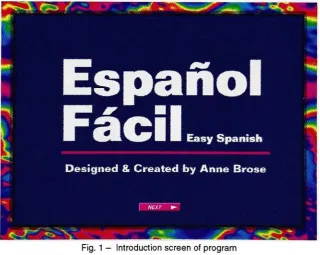
Fig.1)
In
the
menubar
the
useris
instructed,
through
audio(by
clicking
onthe
instructions
button)
, onhow
to
use
the
program.(SeeFig.
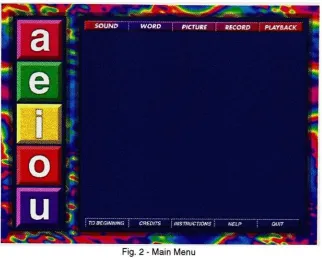
2)
Visual
associations areimportant
in
any
language.
As
children are
learning
to speak,
they
are showndifferent
objects andtold
whatthey
mean:"mom", "dad",
"bed",
"dog",
etc.Espahol Facil
was created with
the
same philosophy.Beginners
are shown atspanol
CM
%_T
I
I
Easy
Spanish
Designed &
Created
by
Anne Brose
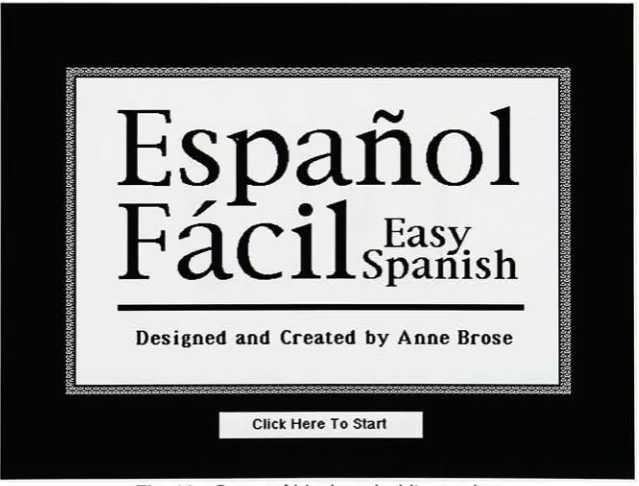
Fig. 1 - Introductionscreen of
program
letter,
andthey
are ableto
hear
the
sound ofthe
letter
by
clicking
on a
button.
(
SeeFig.3)
If
they
click onthe
"word"button
they
are [image:21.537.89.410.368.623.2]Fig. 2- Main Menu
As
the
wordis
spokenthe
user willthen
seeit visually
divided into
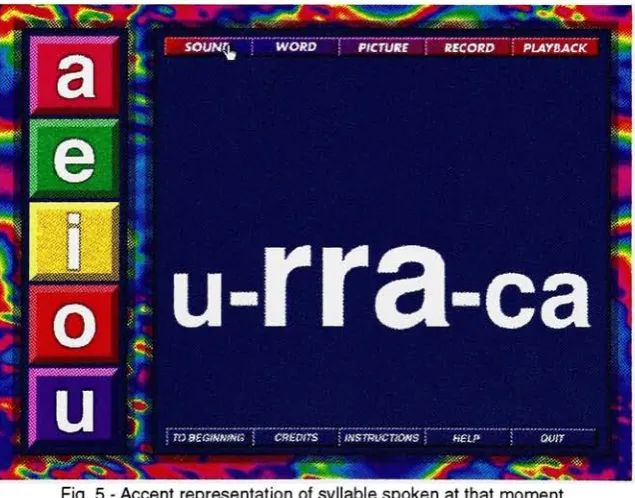
syllables.The
syllablethat
is
spoken atthe
momentis
Fig. 3- Illustrationof
"U"
vowelwhere user can listentoitspronunciation
by
clickingonthesoundbutton.
[image:22.537.91.414.55.313.2] [image:22.537.91.410.388.642.2]SOUND WORD T nc
u-rr3-c3
i m asGfmiNCil cmnirs jiKSTtwcriOfis)
'
eu F awr
Fig. 4- Breakdownof wordinsyllables
accentuated on
the
screen sothat
it is easily
identified
by
the
listener.
(See Fig.5)
ouno.. i word ptcnmt ; mcord I playback
k
10
i
u
m
1
u-rra-ca
: roasmtuKimi i cmoirs Imsnwmcws ; h$lp \ oust
*xPl.
Fig. 5-Accentrepresentationof syllable spoken atthatmoment
After
viewing
andlearning
the word, the
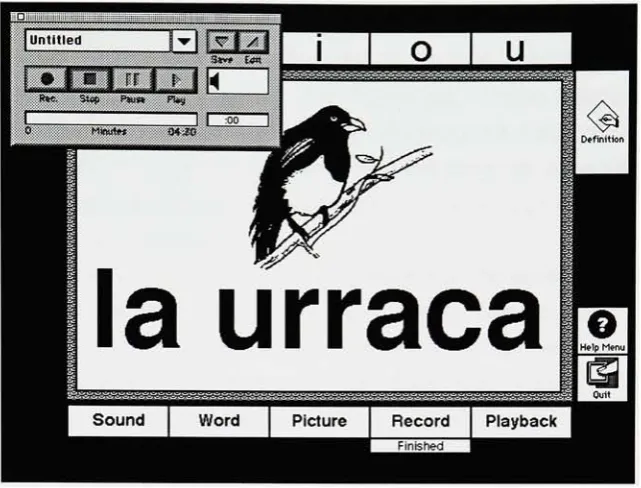
user can click on [image:23.537.91.412.56.310.2] [image:23.537.91.409.381.630.2]Fig.6- Descriptionof word withtranslationbutton
the
wordby
means of anillustration,
creating
a visual associationbetween
letter,
word,
sound and picture as shownin Fig.
6.
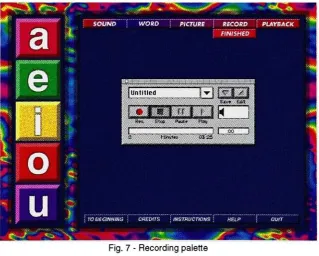
Fig. 7
-Recording
paletteIf
the
students sodesire,
they
can recordthe
Spanish
wordwith
their
voice.This is done
by
clicking
onthe
recordbutton
[image:24.537.89.410.56.303.2] [image:24.537.90.410.378.634.2]Fig. 8- Savedrecorded soundlist
on
the
menubar.A
palette,
looking
muchlike
ataperecorder's
interface,
appears.By
clicking
onthe
record redbutton
andFig. 9
-Help
menuspeaking
into
a microphone,they
can practicetheir
speaking
skills [image:25.537.89.408.57.309.2] [image:25.537.89.409.380.632.2]The
students can also savetheir
recorded sounds.These
are placed
in
alist
wherethey
can goback
to
and comparerecordings
by
clicking
onthe
name oftheir
saved sound.After
they
have finished using
the
program,
the
list is
erasedallowing
newcomers
to
savetheir
sounds.(
See Fig.8)
The
help
button
takes
the
userto
a "Help"screen,
whichexplains
in
detailed
and writtenform
the
function
of eachbutton in
the
program. (SeeFig.9)
At
first,
the
program was createdentirely
in
Spanish,
with noEnglish.
However it
wasnecessary
to
include
atranslation
of eachword
in
orderto
avoid confusion.Take
the
letter
"U"for
example.The
student would click onthe
wordbutton
which would showthem
the
word"urraca".
As
they
sawthe word,
they
saw abird.
So
they
assumed
the
definition
ofthe
word was"bird" whenin
reality
the
word "urraca"means "magpie."
I
wantedto
avoidthe
"translation" syndrome.Many
peoplewho
learn
a newlanguage, try
to
speakit
by
translating
their
English
thoughts
into
the
language. This
makesthe
conversationbetween listener
and speaker moredifficult. After
sometesting,
it
was
necessary
to
include
translations.
It
was alsonecessary
to
include
the
instructions
andthe
help
screenin
English,
sinceit
wasa
beginning
level
Spanish
program.BLACK AND WHITE
VERSION
The black
and white version ofthe
program was createdsimultaneously
withthe
color version.It
teaches the
exact samewords as
the
colorversion,
however it
was created with no colorand no sound
in
the
beginning
andin
the
introduction.
There
is
alsoa
difference
in the
layout
ofthe
buttons,
andthe
overalllook.
(SeeFig.
12)
At
the
beginning
ofthe
programthe
useris introduced
to
it
by
a simpletext
headline. There
is
nojazzy
musiclike in
the
colored
treatment.
(SeeFig.10) The
instructions
are writtenin
simpletext
andthe
userhas
to
follow
them
by
reading
as shownin Fig. 11
Although
the
graphicdifferences
aresubstantial, the
teaching
process
is
similarto the
colored one.The studentis
presented withthe
five
vowels onthe
screen.As he
or she clicks onit
they
areshown
the
vowel.They
can click onthe
soundbutton
to
listen
to
how it is
said.The
same goes withthe
word andthe
picture. (SeeFig.
14)
Unlike
the
coloredversion, the
words are notvisually broken
down into
syllables. (See Fig. 15)
Espafiol
IT
dL- 11
Spanish
Designed and Created
by
Anne BroseClickHere To Start
Fig. 10 - Cover
ofblackandwhiteversion
The
program also allowsthe
studentto
record soundsin
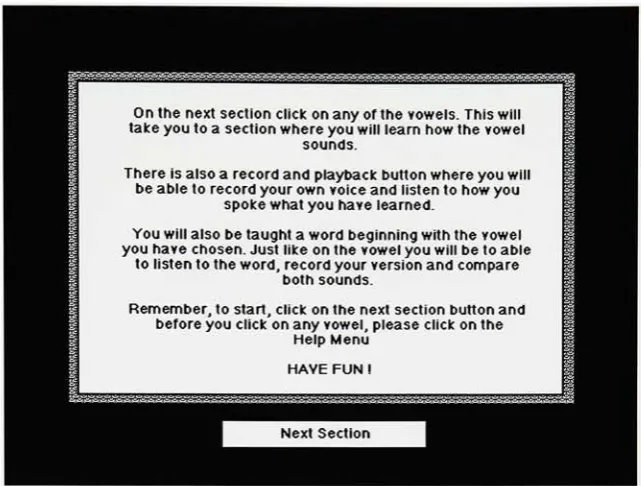
[image:27.537.88.408.376.619.2]On thenextsection clickonanyofthevowels.Thiswill
takeyoutoa section where you willlearnhowthevowel sounds.
There isalso a record and playbackbuttonwhere you will
beabletorecord your own voice andlisten to howyou spokewhat youhave learned.
Youwill alsobe taughta wordbeginningwiththevowel youhavechosen.Justlikeonthevowel you willbe toable
tolisten totheword,record your version and compare bothsounds.
Remember,tostart,click onthenext sectionbuttonand
beforeyou click onanyvowel,pleaseclick onthe
HelpMenu
HAVEFUNI
[image:28.537.87.408.51.294.2]^
1
' Next Section ,Fig. 1 1- Welcometoprogramintextform
Sounds
can alsobe
saved andreviewed,
by
clicking
on alist
wherethey
were savedto.
Fig. 1 2- Demonstrationof vowel
A
help
screenis
alsoincluded in
the
program.Its
presentation
isn't
as elaborate and specific asthe
colored version.The
content
is
the same,
presentedin
avery basic
text
format.(See Rg.16)
[image:28.537.90.412.370.626.2]Fig. 13
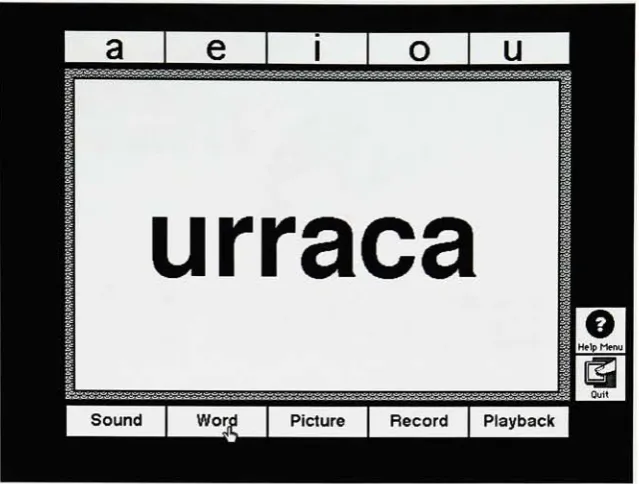
-Word startingwiththevowelchosen
by
user [image:29.537.91.410.376.619.2]Fig. 1 5
-Recording
paletteFig. 16-
Help
menu [image:30.537.88.412.370.627.2]SOFTWARE USED
FOR
THE
PROGRAMS
Both
programs were createdin HyperCard
2.2.
In
the
colored program a
MacroMind Director
movie wasincluded.
I
had
more
familiarity
withthe
scripting
in
HyperCard
2.2
than
Macromind
Director
andfelt
morecomfortablewiththe
program.I
was alsofascinated
by
the
newdevelopments
withthe program,
especially
the
recording
capabilities andimporting
pictures withoutwriting
"
scripts and or
using XCMDS.
HyperCard
2.2
did have
somedrawbacks
however,
such ascolor which makes
the
program runvery
slowly.Through
my
scripting,
even/time a user clicked on abutton,
the
screen wasredrawn.
In
orderto
giveit
that
visualclicking
effect: adarker
button
has
to
be
placed overthe
lighter
one andthen the
wholescreen
had
to
be
redrawnin
orderto
eliminatethe
darker button. (I
soon
discovered
that this
was much moreeasily
done in
MacroMind). After many
trials
andtribulations
and some simplescripting I
was ableto
makeboth
stacks work.Most
ofthe
graphicimages
were createdin
Photoshop
andthen
imported into
the
program.The illustrations
describing
eachword were
done
by
a seniorillustrator
atRIT
whose styleI really
like
andthought
was perfectfor
the
project.My
strengths wereTESTING
THE
"ESPANOL
FACIL"PROGRAMS
THE
HIDDEN FIGURES TEST
I
employed a sample of100
studentsfrom
alocal
Junior
High School
in
orderto test
whether graphics and colorcontributeto the
learning
process of aforeign
language. The
students wereadministered
the
Hidden
Figures
Test
(HFT;
Wltkin
andGoodenough,
1
981
)
whichis
abipolar
test that
enabled meto
separate
them
into
two
groupsaccording
to their
scores.The HFT
may
be
usedto
divide
atest
sampleinto
two
groups:
those
who arefield dependent
andthose
who arefield
independent.
The
test
requiresthe
subjectto
find
a simplefigure
within a complex composition.
In
the
first
12
minutesthe individual
has
to
find 16 figures.
They
arethen
given afive
minutebreak
andthey
then
have
12
more minutesto
find 16
morefigures. Those
with
high
scoresmay be
classified asfield
-independent.
They
areable
to
disembed
anobjectfrom
the
perceptualfield
andviewit for
itself. Those
withlow
scores,
field
dependents,
areless
abletoperceive objects
independent
ofthe
entire perceptualfield
andusually
viewthem
as part ofthe
whole.According
to
Herman A. Witkin
andhis
fellow
researchers,
performance on a
field dependence-independence
task
also showsthat
subjects aremarkedly different in
their
performance oforientation
tasks.
They
perceive and viewthings
differently
whendoing
different
tasks.7In
addition "an extensive
body
of researchon
interpersonal behavior has
shownthat
peoplewho arefield
independent in
perception"usually "function
moreautonomously
ofothers
than
do field-dependent
people."8
Previous
researchhas
also shownthat
"field-dependent
people,
comparedto
field-independent
ones,
show more ofthe
social
behaviors,
attributes,
andhabitual
ways ofreacting
likely
to
contribute
to
facility
in getting along
withothers..."
9
As
an exampleof
how
performance onthe
HFT
reflectsdifferences
in personality,
a
study
showedthat
students who were goodin
psychiatricnursing
were
usually
field
dependent,
whereasthose
who were goodin
surgical
nursing
wererelatively field independent. The
explanation7 Witkin &
Goodenough,
p.3631
8 Witkin &
Goodenough,
p.38given was
that
psychiatricnursing
relies more onrelations;
surgicalnursing,
however,
depends
on"cognitive restructuring
skills."
10
The
HFT
wasideal
for
my
research purposes.It divided
my
sample
into
two
groups ofindividuals
withdiffering
perceptualorientations which were
hypothetically
pertinentto the
difference in
the two
programs.In
orderto
evaluatethe
numericaldata
acquiredthrough the
testing
and arriveto
some clearconclusions,
subjects werecategorized within each of
the
black
and white and color programsas
field dependent
orfield independent based
ontheir
HFT
performance.
Thus,
for
the
purpose ofanalysis, there
werefour
groups of subjects:
1)
Color
program,
field
dependents;
2)
colorprogram,
field
independents;
3)
black
and whiteprogram,
field
dependents;
and4)
black
and whiteprogram,
field independents.
PRE-TEST
The
target
group for
the
Espahol Facil
program was:beginning
students whohad little
ornoexposure, to the
romancelanguages. The previously described
sample was then administered the
HFT.
In evaluating
the
scoresbetween
the
first
and second partsof
the
HFT
wefound
significantdifferences. The
scores werehigher for
the
second part,possibly because
the
subjectshad
become
accustomedto the
task.After
they
completedthe
HFT
they
were administered aquestionnaire and
the
Spanish
pre-test.The
questionnaire askedthem
aboutcomputers,
whetherthey
had
used one ornot,
andif
they
had
taken
any
courses on computers.The
Spanish
test
employed a
"match
the
wordin
English"format. The
studentshad
to
matchthe
English
equivalentofthe
Spanish
words.Among
the
10
wordsasked,
five
ofthem
wereincluded in
the
Espahol
Facil
program.
The
overall results ofthe
Spanish
pre-test
showed a mean
of .487 wordscorrect.
Forty-six
didn't know
any
ofthe
five
words,
Nobody
knew
allfive
andthe
vastmajority
(93.4%)
knew
one ornone of
the
five
wordsthat
they
weretested
on.This indicates
that
the
subjectsdid
notknow
the
Spanish
words employedbefore
they
were administered
their
program.The
questionnaire revealedthat,
ofthe
45
studentsin
the
black
and whiteprogram,
ninedidn't
take the
pre-testand36 had
previously
used a computer.They
alsoliked
learning
with acomputer; the
majority
saidthey
werefun
and about10
saidthey
helped
them
learn better. Two
ofthe
36
saidthey
liked
learning
withcomputers
but
alsodisliked
them
because
they
were confusing.Thirty-six
ofthis
group
also saidthat
they
had
taken
someSpanish;
three
ofthese
had in
additiontaken
someFrench
class and onehad
taken
an arabic course.Of
the
55
students whotried the
colortreatment,
12
didn't
take the pre-test,
and42
had previously
used a computer.Six
ofthe 42
students agreedthat
computers werefun
to use,
eight saidthey
madethings easier,
four
saidthey
wereinteresting
andfour
thought
computershelped
them
learn better. The 43
students alsoindicated
that
they
had
taken
someSpanish,
andthree
ofthese
43
had in
additiontaken
French.
ESPANOL
FACIL
Testing:
After
they
had
taken the HFT
andthe
Pre-Test,
studentswere assigned
to the
black
and whiteor colortreatments
using
astratified random assignment procedurewhere
the
sameHFT
scoreswere represented
in
each,
giving
an equal andfair division
between the
groups.The
testing
took
placein
the
Spanish
classroom ofthe
Filmore Central School. I had
taken
my
own personalcomputer,
and
fortunately
the
professorMrs.
Kathy
Moore had
the
samemodel at
her
home
which shegladly
loaned for
the
study.The
computers were placed
in
opposite sides ofthe
classroom.The
one with
the
color program was coveredby
the
screenfor
privacy
purposes.
A
setofheadphones
was providedto
each studentin
order
to
avoiddistractions.
The
testing
took
placefor
five
consecutivedays. There
wasa
time
limit
of15
minutes per student andthey
weretold
hand
that the
objective ofthem
trying
the
programs wasto
learn
the
five
wordsthat
werebeing
taught.
There
wereonly
two
studentsin
the
classroom atthe
sametime,
whilethe
rest ofthe
class wentto the
library
orstudyhall.Even
though there
wereonly
two
students present at atime,
they
both
seemedto
feel
self conscious of eachother,
andin many
cases
they
didn't
try
the
recording
aspect ofthe
program.After
the third
day
there
were more studentsrecording
their
voice,
especially
whenthey
thought
it
was an act ofbravery,
andthey
couldtell their
classmatethey
had done it. In
othercases,
when students
discovered
the
recording
aspect ofthe program,
they
went over and overthe
word again.Both
programs workedwithout major problems.
Students
trying
outthe
black
and white programhad
moredifficulty following
instructions,
andthey
needed much moreassistance
than the
students who usedthe
color program.They
had
to
readthe
instructions,
wherein
the
colorthey
had
arecording
telling
them
whatto
do.
The
following
anecdotes give anidea
asto
some ofthe
reactions students
had
whiletesting
the
programs:A junior
level
studentfelt
no qualms aboutrecording in
the
black
and whiteprogram,
anddid
so repeatedly.He really
enjoyedworking
onthe
program.Unfortunately
whenit
cameto
answering
the
post-testhe
was unableto
matchthe
Spanish
wordsto the
English
words.I
askedhim if he
couldtry
the
colored program.After
1 5
minutes and another post-testhe
matchedthe
wordsperfectly.
However
he did
confesshe felt
pressuredto
learn
the
five
words.
He didn't feel
the
colors or graphicshelped
better,
but he
did
say
that the
division
ofsyllableshelped him
rememberthe
words
better.
Another
studentalsotried
both
treatments,
andresponded
in
a similar way.In
many
cases students were anxiousto
try
the
program asfast
asthey
could sothat
they
could go outside withtheir
classmates.
Another
student,
whois
considered atroublemaker
said
"this is
fun"
and
didn't
wantto
quit.He
wasworking
onthe
Students
testing
the
black
and white programhad
to
be led
through the
recording
instructions,
mainly
because
the
instructions
were
in
text
form,
andit
seemedthat
they
were anxiousto
getgoing,
anddidn't
wantto take the time to
read.POST TEST
After
the
studentshad
finished
working
their
programthey
were administered a questionnaire where
they
could comment onthe
programsthey
had
eachtried.
At
the
end ofthe
questionnairewas
the
same"match
the
wordsin
English"that
I had
given outin
the
pre-test.This
would allow meto
comparethe
answers.Following
arethe
results ofthe
post-testtaken
by
the
students after
they
had
tried the
black
and white or color program.Overall,
the
mean numberof correctwords was4.1
.Fifty-four knew
five
ofthe words;
13
knew four
ofthe words; 17
knew
three
words;and
five knew
two.
In
conclusion,
65.6%
ofthe
studentswho tookeitherprogram
learned four
to
five
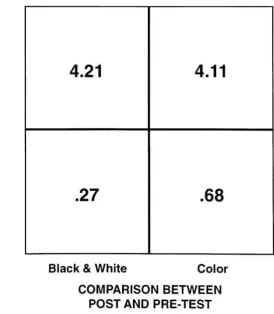
words.Post-Test
Pre-Test
4.21
4.11
.27 .68
Black & White
Color
COMPARISON BETWEEN
[image:36.537.153.428.348.663.2]POST AND
PRE-TEST
Fig. 22- Meannumber of correct words preand postfor
each program
These
results showthat there
wasimprovement
in
the
learning
process.However
there
was noindication
that
learning
the
five
words wasbetter
achievedin
eitherthe
black
and white orthe
color program.
Figure
22,
which showsthe
mean numberof correct words pre and postfor
eachprogram, demonstrates this.
The
near maximal performance onthe
post-testfor both
programs
(4.21,
4.11
out of a possiblefive
)
suggests aceiling
effect.That
is,
the test
many
nothave been difficult
enoughto
demonstrate
possibledifferences between
the
programs.Analysis
ofthe
post-test was also performedfor field-dependent
andfield
independent
within each ofthe two
programs.No
significantdifferences
were observed.The
qualitative answers ofthe
post-testmay
provide usefulinformation
asto
whatthe
studentsthought
of each program.Most
of
the
feelings
toward
both
programs were positive.Of
the
46
studentswhotested the
black
and whiteprogram, two
didn't
take
the post-test; 42
liked
the
program.The majority
saidit
needed morewords,
six saidthey
liked
the pictures,
one recommendedcolor
be
addedto
it,
four
thought
it
wasfun,
14
saidit
helped
them
learn
the
language better. A few
ofthe
studentsfelt
self conscious aboutrecording
anddidn't do
it.
As for
recommendations ontheir part,
six suggested colorbe
added,
seven said more words shouldbe
included,
four
said animation wouldbe
fun,
a couplethought better
instructions
werenecessary
and,
finally
two
saidthere
should