COMMUNICATIONS & STRATEGIES, no. 71, 3rd quarter 2008, p. 145. Jason WHALLEY & Peter CURWEN University of Strathclyde, Glasgow, UK
Abstract:This paper focuses on functional separation. After recounting the circumstances that culminated in the imposition of functional separation within the UK, the paper highlights the difficulties that have been encountered subsequent to the creation of Openreach. Functional separation developments outside the UK are then described and doubts raised as to whether the Openreach model is appropriate for other markets.
Key words: Openreach, functional separation, UK.
s regulators have sought to resolve the tensions that exist between incumbent operators and those services providers that require access to their networks, functional separation has emerged as one way to achieve the sought-after resolution. Since its adoption in the UK, a range of countries have examined the feasibility of adopting functional separation within their own markets. Some of these countries have broadly followed the UK's lead whereas others have not.
Any discussion as to whether functional separation UK-style should be adopted inevitably raises two questions: what is meant by functional separation and what has been the UK experience? A useful starting point to answer the first question is XAVIER & YPSILANTI (2004) which identifes six different separation alternatives that range from accounting and functional separation on the one hand to dividing the incumbent into several smaller versions of itself on the other. 1 Of particular relevance here are the four different models of structural separation – LoopCo, NetCo, alternative distribution companies and voluntary separation – that they propose and discuss (XAVIER & YPSILANTI, 2004: 78-91). At the heart of the LoopCo
1 The six alternatives identified by XAVIER & YPSILANTI (2004: 76) are 1) accounting, functional and corporate separation; 2) separation into regional operators; 3) separation of local from long distance services; 4) separation of local and mobile services; 5) separation of local and broadband/advanced services; and 6) separation of an incumbent into smaller vertically integrated operators.
proposal is the divestment of the local network by the incumbent, whereas in contrast the NetCo option would see all of the incumbent's network being transferred into a new company.
The pros and cons of both the LoopCo and NetCo proposals have been variously discussed, 2 with it being argued that the latter does not
satisfactorily address the problems that emerge from the integration of the network within a single company. With respect to the restructuring of BT announced in late 2000, SANDBACH (2001: 200) argued that the proposed NetCo did not satisfactorily address the local loop issue because the company would envelop both the copper and switched network. In other words, there would still be an incentive for it to favour its own services or those provided by other parts of BT.
Given the problems and uncertainties associated with both the LoopCo and NetCo proposals, it is no surprise that recent attention has focused elsewhere to resolve the tension between wholesale and retail markets. CAVE (2006), for example, identifies six alternatives encompassing accounting and structural separation, 3 and notes that the former was more
or less the modus operandi of incumbent European operators at the time of writing. BT, through the creation of Openreach, was the exception. In the terms of the six alternatives identified by Cave, Openreach falls under 'business separation with local incentives' and is thus slightly closer to the ownership separation end of the spectrum than the accounting end.
Openreach is an example of functional separation. This involves the selective separation of those parts of the network that are difficult for other operators to replicate but which they need access to in order to provide their own services (European Regulators Group, 2007: 2). This is frequently interpreted as the separation of the incumbent's wholesale and retail businesses from one another, although if the focus is solely on those parts of the incumbent's network that cannot be replicated then the scope of functional separation may be narrower than is implied by the separation of wholesale from retail (European Regulators Group, 2007: 8). Regardless of the extent to which functional separation occurs, it results in one part of the incumbent's network being run and managed separately from the rest. A key
2 See also, for example, CAVE (2002).
component of such an arrangement is that the separated part of the company is provided with local incentives that encourage it to act in the interests of all its customers, both internal and external, and not in the interests of its parent company.
Within the European Union, Commissioner Reding has commented favourably on Openreach (BUCK, 2007; REDING, 2007). In a speech to the European Regulators Group, Reding asserted that functional separation "should be added to the remedies tool box of national telecom regulators, to be available for the stubborn cases where other remedies have been tried, but have failed to deliver the desired regulatory outcome" (REDING, 2007: 3). The same speech also argued that the adoption of functional separation in the UK had contributed to the rapid rise in unbundled lines and the intensification of investment in the network (REDING, 2007: 4). At the same time, the share price of BT had also risen.
Given the alleged benefits associated with functional separation, the remainder of this paper focuses on its implementation, and in so doing it does not address its wider impact on issues such as the quality of services delivered and the willingness of the separated operator to make subsequent infrastructure investments. The following main section is contextual in nature, and offers a brief overview of the strategic review of telecommunications and the undertakings made by BT. The second main section focuses on the implementation of the undertakings, and in so doing it addresss the second of the questions noted above. The third main section details developmets in other countries, with the main issues noted there being discussed in section five. Conclusions are drawn in the final secton of the paper.
Context
regulatory framework and as providing a mechanism through which a new approach to regulation could proceed.
The review could also be regarded as being a reponse to a third set of drivers, namely, the failure of competition to develop as anticipated in the UK. Although some companies had invested in their own infrastructure, these networks lacked scale (OFCOM, 2004a: 53). The cable operators, which operated the most extensive networks geographically, collectively covered less than half of the population and their ability to compete was limited by their continued financial woes. 4 Service based competition had been possible since the late-1990s (OFCOM, 2004c: 53) but had enjoyed only limited success because, it was alleged, BT had abused its dominant position in the wholesale market to enhance its retail competitiveness (WILSDON & JONES, 2002).
The results of such anti-competitive behaiour can be seen with respect to broadband and local loop unbundling. Although many companies expressed an interest at the end of the 1990s to offer broadband services, most subsequently left the market (TURNER, 2003: 6). One consequence of this was that only a handful of companies emerged to compete against BT, whilst another was the limited uptake of local loop unbundling in the UK. 5 With this in mind, the strategic review could also be viewed as being driven by the desire to enhance competition within the broadband telecommunications market and to encourage greater adoption of local loop unbundling.
Strategic review of telecommunications
At the end of 2003 OFCOM announced its intention to hold a review of the telecommunications market during the following year (OFCOM, 2004a). The initial consultation document was wide-ranging in nature, raising issues that were subsequently clarified in the second consultation document (OFCOM, 2004b). Central to the second consultation document was the
4 In 2004 just 46% of UK homes were passed by broadband enabled cable (OFCOM, 2004c: 38). Subsequent communication market reviews have shown that in 2005 and 2006 digital cable was available to 45% of the UK population (OFCOM, 2007a: 15). For a discussion of the financial woes of cable operators see, for example, CURWEN (2004).
idntification of three regulatory options, the first of which was deregulation. OFCOM concluded, however, that this was not possible, not least because sector-specific regulation was faster and more precise than the alternatives.
The second option was a reference under the Enterprise Act 2002 to the Competition Commission. Such a reference would inevitably necessitate a wide-ranging review of the telecommunications market that could result in the eventual imposition of structural remedies. 6 The third option, the one
prefered by OFCOM, was termed 'real equality of access' and would enable those companies purchasing wholesale products from BT to do so on the same terms as BT's own retail operations. Thus, wholesale customers would have access to:
- the same or a similar set of regulated wholesale products as BT's own retail activities;
- at the same prices as BT's own retail activities; and,
- using the same or similar transactional processes as BT's own retail activities (OFCOM, 2004c: 14).
Two different types of equivalence were proposed – outcome and input – and a range of products identified where it could be applied (OFCOM, 2004b: 68). In the case of equivalence of outcome, wholesale customers receive products that are comparable to those offered to BT's own retail operations but the underlying processes would not be the same. In contrast, where equivalence of input is applied, wholesale customers receive the same products as BT's own retail operations using the same set of underlying processes (OFCOM, 2004c: 67f).
Recognising that a range of issues had been identified by many of BT's wholesale customers during the consultative process which these customers believed placed them at a competitive disadvantage relative to BT (OFCOM, 2004c: 70), there was also a behavioural dimension to equivalence. While the range of issues highlighted was broad, two areas in particular – the incentives for inappropriate behaviour and transparency – were singled out as areas where action could be taken (OFCOM, 2004c: 70f). Having said this, OFCOM did note that BT had, in the past, devoted considerable effort and resources to addressing the complaints raised by its competitors.
Undertakings in lieu of reference under the Enterprise Act 2002
In June 2005, OFCOM announced that it was launching a consultation to determine whether it should accept the undertakings offered by BT to bring an end to the strategic review (OFCOM, 2005a). Rather than trigger a reference under the Enterprise Act 2002, BT agreed to a series of legally enforceable undertakings (OFCOM, 2005a: 2). BT agreed to create an access service division that would:
- control the 'last mile' of the telecommunications network;
- be operationally independent of BT while remaining under the ownership of BT;
- be branded differently from BT;
- have its own five-member board, headed by a non-executive director of BT; and,
- incorporate 15,000 out of BT Wholesale's 28,000 employees (Odell, 2005: 23).
In addition, BT also agreed to a schedule for equivalence for legacy products as well as stating the principles on which the company's next generation network (NGN) would be developed (OFCOM, 2005a: 2ff). For its part, OFCOM stated that it would revisit issues such as leased lines and retail price controls in the near future (OFCOM, 2005a: 5).
In September 2005, OFCOM accepted the undertakings offered by BT (OFCOM, 2005b). In total, 236 undertakings were made by BT. These govern the operation of the access service division to ensure that those wholesale customers, which rely on access to deliver their own products and services, are treated no differently from BT's own retail operations (OFCOM, 2005c). At the same time as OFCOM agreed to accept the undertakings, BT rebranded its access service division as Openreach (OFCOM, 2005b).
Implementing the undertakings
February 2007 as well as correspondence between OFCOM, BT and other interested parties. 7
A useful starting point in order to understand the implementation of the undertakings are the two annual evaluations that have been published by OFCOM. The first of these, which was published in October 2006, acknowledges the effort that has been placed into meeting the undertakings by BT before identifying a range of areas where implementation has been less than satisfactory (OFCOM, 2006a). Eight areas where further action was required were identified (OFCOM, 2006a: 2). It is perhaps no surprise that the eight areas requiring further action are broad in their scope, ranging from the need to resolve boundary issues between BT Wholesale and Openreach to agreeing how Openreach's management information systems (MIS) and operational support systems (OSS) can be separated out from the rest of BT. 8
The second annual report suggests that further work is required to separate Openreach from the rest of BT and to develop, and subsequently deploy, equivalent products (OFCOM, 2007b). In addition, the report also states, somewhat vaguely, that more effort is required if the full benefits of functional separation are to be achieved (OFCOM, 2007b: 4). The report also contains a summary of a survey involving BT's wholesale customers conducted by Spectrum Value Partners on behalf of OFCOM. Although the respondents acknowledge the challenges of implementing the undertakings and the extent to which resources have been directed towards this task, they are also critical of BT. According to the feedback, a degree of mistrust continues to exist between some wholesale customers and BT. It is also the case that while deadlines have been met, this has allegedly been at a cost to innovation and service quality (OFCOM, 2007b: 65f). Furthermore, some respondents felt that through interacting with both BT Wholesale and Openreach they had experienced a 'degradation in treatment' due to their business being split between the two and becoming less important to each as a consequence.
Both annual reports highlight the difficulties of separating Openreach from the rest of BT, noting in particular the information system-based difficulties being encountered. The three information systems in question are
7 These reports, as well as the other material published by OFCOM relating to the telecommunications strategic review and the implementation of the undertakings, can be found at www.ofcom.org.uk/telecoms/btundertakings.
MIS, OSS and the equivalence management platform (EMP). Openreach is required to logically separate its OSS from the rest of BT and to physically separate them from one another by June 2010 (OFCOM, 2007b, 48). However, OFCOM and BT interpreted logical separation differently with the consequence that clarification was required OFCOM (2007d). Although this inevitably resulted in some delays, it also produced a clear timetable for the migration of users to physically separate systems.
Additional time was also sought by BT to separate the MIS between Openreach and the rest of the company. While OFCOM did agree to this request, BT was required to assist users to restrict access and define the subsequent separation process. This has largely been achieved although OFCOM does note that risks still remain with those systems that draw on BT-wide initiatives (OFCOM, 2007a: 48). The delivery of equivalence is supported through the use of the EMP, 9 the implementation of which has
been less than satisfactory since it was first introduced in early 2006. The delivery of the initial system was delayed and subsequent versions were released with reduced functionality (OTA, 2006a & 2006b). The Office of the Telecommunications Adjudicator (OTA), which was established in May 2005 to oversee the implementation of those processes necessary for other operators to access BT's local loop, has published a series of monthly updates that highlight the problems that have been experienced in the development of these processes. 10
Perhaps more importantly, concerns have been raised as to the stability of the EMP (OTA, 2007a) and the extent to which the service is unavailable (OTA, 2007b & 2007c). Both of these have caused problems for the telecommunications companies using EMP. Although these issues have been tackled to varying degrees of success, they have engendered a degree of uncertainty regarding the platform's robustness and reliability.
The correspondence published by OFCOM highlights some of the difficulties that have been encountered in the implementation of the undertakings. 11 BT has, on more than one occasion, sought more time to implement the undertakings. Although OFCOM has invariably granted these
9 The EMP is an information system that supports the delivery of the products offered by Openreach. Given the anticipated large volumes of some of these products, the system is designed to be automated to ensure that services are provided as demanded.
10 The monthly updates can be found at the OTA website, www.offta.org.uk.
requests, it is worth noting that the extensions are temporary and not open-ended. This correspondence is relatively brief, which is in contrast to the consultations surrounding the range of exemptions and variations that BT has sought since June 2006.
To bring the strategic review to a swift conclusion, it was agreed that OFCOM and BT could consider at a later date the equivalence of inputs needs of some products (OFCOM, 2006e). In June 2006, BT sought exemptions and variations in 15 different areas, with 13 requiring consultation due to their complexity (OFCOM, 2006f). As a result of this consultation, OFCOM agreed to nine of the requests. The remaining four requests required additional consultation as they involved products relying on fibre (OFCOM, 2006e).
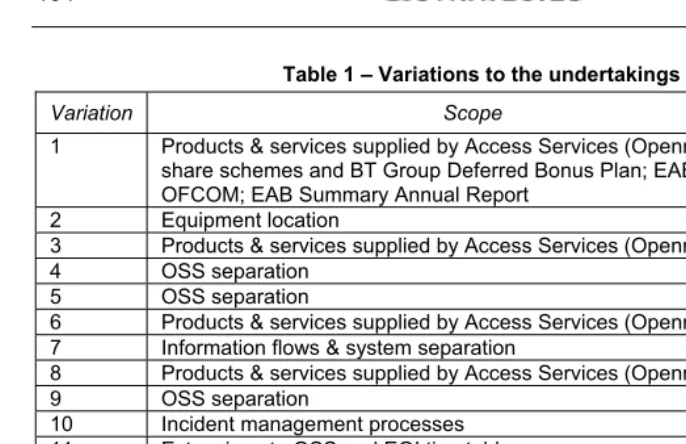
In turn, this additional consultation resulted in three out of the four requests being granted. OFCOM granted a temporary extension until December 2007 in the case of the fourth request while further consultation was undertaken (OFCOM, 2007e: 2). More exemptions were published in October 2007, and were the outcome of a consultation process that began in July of the same year (OFCOM, 2007f). The most recent variation was granted in May 2008. The granted variations are shown below in Table I (below). 12
The published correspondence, as well as the exemptions and variations consultations published by OFCOM, draw attention to boundary issues. Boundary issues arise where the distinction between Openreach and the rest of BT is blurred. One area where boundary issues have arisen was noted above, namely to ensure that the information systems that linked Openreach with the rest of BT were altered so that the two were separate from one another.
A second area where boundary issues have emerged is that of access to engineering resources. BT has sought to move engineers between Openreach and BT Wholesale as circumstances dictate (OFCOM, 2006b: 3). For example, BT requested permission from OFCOM to move engineers between the two divisions in the aftermath of the floods that swept the south of England during 2007. This was, however, a temporary measure that addressed a particular series of events.
Table 1 – Variations to the undertakings
Variation Scope Date
1 Products & services supplied by Access Services (Openreach); share schemes and BT Group Deferred Bonus Plan; EAB report to OFCOM; EAB Summary Annual Report
Mar 2006
2 Equipment location Apr 2006 3 Products & services supplied by Access Services (Openreach) Aug 2006 4 OSS separation Sept 2006 5 OSS separation Oct 2006 6 Products & services supplied by Access Services (Openreach) Dec 2006 7 Information flows & system separation Dec 2006 8 Products & services supplied by Access Services (Openreach) Apr 2007 9 OSS separation Jun 2007 10 Incident management processes Oct 2007 11 Extensions to OSS and EOI timetables Nov 2007 12 Changes to sections 2.1 (definitions), 5 (access services) and 6
(management & structure of BT Wholesale)
Dec 2007
13 Products & services supplied by Access Services (Openreach) Dec 2007 14 Provision of equivalent products and services – changes to section
3.1.1, section 3.1.2 and annex 1 of the undertakings
Dec 2007
15 Products & services supplied by Access Services, changes to section 5.46.2
May 2008
Source: www.ofcom.org.uk/telecoms/btundertakings/exemptionsandvariations, accessed 7 June 2008
The quarterly reports published by OFCOM draw attention to the need to ensure that the 'Chinese Walls' between Openreach and the rest of BT are maintained (OFCOM, 2006b & 2006d). A separate Openreach head office has been established, and some of the earlier concerns that the 'Chinese Walls' were unsatisfactory due to organisational changes within BT Wholesale have been addressed. 13 The second report on the
implementation of the undertakings notes that Openreach is reliant on other parts of BT for access to space and power within exchanges (OFCOM, 2007b: 46f). As a consequence of this it was felt that Openreach does not have adequate control over the products that it delivers.
Also highlighted by the quarterly reports are the concerns expressed by other telecommunication operators as well as by OFCOM regarding product development. The former have noted that a gap existed early on between what BT announced and what was delivered (OFCOM, 2006b: 11), while
more recently their interaction with BT has become an issue (OFCOM, 2006c: 9f; OFCOM, 2006d: 10). It was alleged that this interaction was insufficient, and that in some cases the ability of other telecommunication operators to influence product specifications was limited. To this, OFCOM (2007b) adds that the pace of product development has been slow before acknowledging that this may be due to developments elsewhere in BT. 14
Since the undertakings were agreed, the number of unbundled lines has increased from 123,000 in September 2005 to 4.76 million in June 2008 (OTA, 2005 & 2008). However, both of the undertaking evaluation reports published by OFCOM show that key performance indicator targets have been missed (OFCOM, 2006: 20; 2007b: 58ff) and that the performance of some indicators has been volatile. That said, there has been a general improvement in some indicators like 'first touch–last touch right first time' for LLU. These improvements naturally benefit those companies relying on the processes to deliver their own services.
Although the prices for LLU were settled before the undertakings were finalised, with a charge ceiling of £81.69 being agreed, 15 a recent
consultation issued by OFCOM has reopened the issue. As Openreach has failed to achieve the 10 per cent return that is permitted, BT would like to raise the charge ceilings (PARKER, 2008b: 18). 16 Unsurprisingly, those companies that use BT's local network to deliver their own services have objected, with Carphone Warehouse stating that it would be unfair to 'change the game' (PARKER, 2008a: 19). The implications of the consultation are clear: if the charge ceilings are raised, the cost to other service providers of using Openreach's products will also increase.
14 Two developments are noted, namely, the implementation of the undertakings as well as the development of the company’s 21st century network.
Developments in other countries
As it is often claimed that Openreach offers a model that other countries could adopt, it is useful to briefly recount developments elsewhere. The first sub-section below recounts developments within other EU countries while the second sub-section focuses on countries further afield.
EU countries
The Italian case is particularly interesting because of the explicit role played by the government. Initially, Telecom Italia was prepared to introduce functional separation on a voluntary basis. However, when a controlling stake was put on the market by Pirelli, it became apparent that it might be acquired by a foreign-owned operator such as AT&T and the government became alarmed at the prospect of Telecom Italia's core network falling under foreign control. In April 2007, the government accordingly tabled a proposal that would bolster the powers of the regulator, AGCOM so as to permit it to ring-fence all of the local loop connections plus 'all the elements necessary to provide broadband access'. If it cannot reach agreement with Telecom Italia over the details of functional separation, the new powers will enable it to impose its own variant of this remedy. The government inserted the new rules into an existing bill on liberalization with a view to their speedy enactment although, in the event, its attitude caused AT&T to withdraw and an Italian dominated consortium became the preferred bidders (CLARK & ZAMPANO, 2007; ZAMPANO, 2007).
In early March 2007, the Netherlands regulator, OPTA, gave consideration to a report on the applicability of Openreach to the Netherlands market prepared by consultants NERA (NERA, 2007). The report concluded that the circumstances in the Netherlands were sufficiently different from those in the UK in that cable operators provided a satisfactory alternative infrastructure such as to render any form of separation unnecessary. In addition, unlike in the UK where a reference to the Competition Commission could ultimately lead to structural separation, the regulatory system provided no mechanism to provide a realistic threat of such an outcome. NERA added that since KPN intended to upgrade both its core and access networks – unlike BT which intended to upgrade only its core network – there was a danger that functional separation would discourage KPN from investing in a Next Generation Network (GLOBAL INSIGHT, 2007a). Shortly thereafter, the OPTA Chairman effectively ruled out any attempt to introduce functional separation (SCHIFFERS, 2007).
The Polish regulator, UKE, also favours functional separation despite strong opposition from incumbent TPSA (HALABA, 2007). However, the legal position appears to be a matter of contention for now between the UKE and the government (Global Insight, 2008b).
In March 2007, under pressure from the government, Portugal Telecom made a commitment to separate ownership of its fixed-wire and cable networks and to spin-off PT Multimedia, its cable TV and media content division, before the end of 2007 (WISE, 2007). It may well be that such voluntary compliance will stand it in good stead should the issue of functional separation appear on the regulatory agenda.
September with its implementation set for the year-end (Global Insight, 2007b; HANSSON, 2007c).
Elsewhere
In New Zealand, a decision was taken by the government in 2004 to deny access to the local loop network owned by Telecom New Zealand (TNZ). However, in May 2006, the Minister for Communications suddenly reversed this decision, adding that the government would 'look at whether additional measures are warranted, such as the structural separation of TNZ's retail and lines operations' (MOLDOFSKY, 2006). In June, TNZ announced that it intended voluntarily to create a separate, independent wholesale operation which it claimed was 'the best form of separation to suit New Zealand conditions' (DigitalMediaAsia, 2007).
In November, a government select committee recommended that TNZ divide its operations into separate units for fixed-wire, retail and wholesale networks, a much more radical proposal than the accounting separation between its retail and wholesale units proposed by TNZ. TNZ responded surprisingly favourably, agreeing that it would not oppose its implementation (TeleGeography, 2006), presumably on the grounds that functional separation was much preferable to structural separation. In any event, since it had already separated operationally its retail and wholesale units in June, the remedy was already part-implemented. After lengthy consultations, the government in April 2007 reiterated its intention to impose a three-way functional split (TeleGeography, 2007a).
plan (ROSS, 2007a). One month later it submitted its final plan with a specified 'separation day' of 31 March 2008 with the Openreach equivalent to be named 'Chorus' (ROSS, 2007b). In February 2008, the government demanded that a revised plan be submitted and this was duly accepted on 31 March (TelecomWeb, 2008).
Discussion
Through focusing on functional separation in the UK and elsewhere, it is possible to make a series of observations regarding its implementation to date. The first observation that can be made is that separating Openreach from the rest of BT is not straightforward. The access service division required by the undertakings was swiftly transformed into Openreach, with its own brand, board and incentive schemes. In contrast, separating Openreach from the rest of BT in terms of processes and products has not been swiftly achieved. The separation has proved to be complex and, if the requests for extensions are anything to go by, more protracted than anticipated.
As BT has struggled to separate Openreach from the rest of the company, so other telecommunications providers have complained. These complaints reflect the fact that they rely, in some shape or form, on the products provided by Openreach. Delays in providing these products, or in their unreliable provision, place other telecommunication providers at a disadvantage vis-à-vis BT.
functional separation, namely that customers are not treated differently, will be undermined.
The European Commission has described Openreach in favourable terms. This has not, however, led (so far) to the model being widely adopted throughout the EU. Although Sweden has opted to follow the Openreach model, the Dutch regulator has decided not to introduce functional separation given the different market conditions that prevail particularly in terms of the strong inter-platform competition that exists in the Dutch telecommunications market. Although some member states are opposed in principle, many national regulators endorsed the European Regulators Group stance on functional separation without necessarily committing to its introduction in their own jurisdictions. In other words, there is a view in some member states that functional separation is unnecessary given their particular market characteristics.
Between these two extremes are to be found developments within Italy and New Zealand. Telecom Italia has established Open Access which, significantly, will not be overseen by an independent board like Openreach in the UK. In other words, Open Access shares some of the characteristics of Openreach that presumably made Openreach an attractive model for the European Commission. Likewise, developments in New Zealand do not replicate exactly the events that culminated in the creation of Openreach. Unlike BT, which sought to retain its fixed-line network, TNZ voluntarily opted to implement structural over functional separation. This offer was, however, not accepted with the consequence that functional separation was adopted in September 2007. Interestingly the version of functional separation adopted in New Zealand was broader than that implemented in the UK. Thus, a third observation is that there are several identifiable functional separation models that are shaped by local circumstances.
Conclusions
undertakings as well as for more time. If nothing else, the difficulties that have been encountered should be sufficient for any government/regulator that is considering the replication of the UK approach to functional separation to think twice.
Bibliography
ANDERSON R. (2007): "Swedish regulator calls for fixed-line sell-off", available at: www.ft.com of 14 June.
de BIJL P. & PIETZ M. (2005): "Local loop unbundling in Europe: Experience, prospects and policy chalenges", COMMUNICATIONS & STRATEGIES, no. 57, 1st Quarter, pp. 33-57.
BUCK T. (2007): "Reding targets telecoms groups", Financial Times, 28 March, available at: www.ft.com
CAVE M. (2002): "Is LoopCo the answer?", Info, Vol. 4, no. 4, pp. 25-31.
CAVE M. (2006): "Six degrees of separation – Operational separation as a remedy in European telecommunications regulation", COMMUNICATIONS & STRATEGIES, no. 64, 4th Quarter, pp. 89-103.
CLARK J. & ZAMPANO G. (2007): "Italy plans to strengthen telecoms regulator", available at: www.cellular-news.com of 24 April.
CURWEN P. (2004): "Markets vs regulators and the battle to determine market structure: evidence from the UK cable industry", Info, Vol. 6, no. 1, pp. 24-36.
DigitalMediaAsia (2007): "Telecom New Zealand to split wholesale and retail", available at: www.digitalmediaasia.com of 28 June.
European Regulators Group (2007): ERG Opinion on Functional Separation, ERG (07) 44, available at: www.erg.eu.int.
Global Insight:
- (2007a): 'Regulator set to drop plan to splinter KPN's network', available at: http://www.communicationsdirectnews.com of 7 March.
- (2007b): "TeliaSonera caves in to "functional separation, creates new infrastructure company", available at: http://www.communicationsdirectnews.com of 24 September. - (2008a): "Telecom Italia caves in to functional separation", available at: http://www.communicationsdirectnews.com of 14 February.
- (2008b): "Polish regulator should have power to split dominant telcos – Minister", available at: http://www.communicationsdirectnews.com of 15 February.
HALABA M. (2007): "Poland's TPSA opposes regulator's break-up plan", available at: www.totaltele.com of 27 September.
HANSSON M.:
- (2007a): "TeliaSonera opens up for discussion on network separation", available at: www.totaltele.com of 16 February.
- (2007b): "Talks on separation of TeliaSonera network break down", available at: www.totaltele.com of 29 March.
MOLDOFSKY L. (2006): "Telecom Corp ordered to open network to rivals", available at: http://news.ft.com of 3 May.
NERA (2007): Ofcom's Strategic Review of Telecommunications and BT's
Undertakings, London: Nera.
ODELL M. (2005): "New unit emerges from the shake-up", Financial Times, 24 June, p. 23
OECD (2001): Structural Separation in Regulated Industries, DAFFE/CLP(2001)11, Paris, France: OECD.
OFCOM:
- (2004b): The Communications Market 2004 – Telecommunications, August, London: OFCOM.
- (2004c): Strategic review of telecommunications – phase 2 consultation document, 18 November, London: OFCOM.
- (2005a): Telecommunications statement, June, London: OFCOM.
- (2005b): Ofcom accepts undertakings from Board of BT Group on operational
separation. BT access service business – Openreach – formally established today,
22 September, London: OFCOM.
- (2005c): Final statement on the strategic review of telecommunications and
undertakings in lieu of a reference under the Enterprise Act 2002 – Statement, 22
September, London: OFCOM.
- (2005d): Report on the implementation of BT undertakings – First quarterly report,
25 October, London: OFCOM.
- (2006a): Evaluating the impact of the Telecoms Review – An interim report one
year on, 18 October, November, London: OFCOM.
- (2006b): Report on the implementation of BT undertakings – Second quarterly
report, 26 January, London: OFCOM.
- (2006c): Report on the implementation of BT undertakings – Third quarterly report,
23 May, London: OFCOM.
- (2006d): Report on the implementation of BT undertakings – Fourth quarterly report,
5 September, London: OFCOM.
- (2006e): Requests from BT for specified exemptions and agreements to its
Undertakings under the Enterprise Act 2002 – Part 2, 21 December, London:
OFCOM.
- (2006f): Requests from BT for specified exemptions and agreements to its
Undertakings under the Enterprise Act 2002 – Part 1, 15 June, London: OFCOM.
- (2007a): Communications Market Review. 23 August, London: OFCOM.
- (2007b): Impact of the Telecoms Strategic Review. Evaluation, 10 December, London: OFCOM.
- (2007c): Report on the implementation of BT undertakings – Fifth quarterly report,
12 February, London: OFCOM.
- (2007d): BT OSS Separation, 21 June, London: OFCOM.
- (2007e): Requests from BT for specified exemptions and agreements to its
- (2007f): Requests from BT for specified exemptions and agreements to its
Undertakings under the Enterprise Act 2002 – Part 4, 3 October, London: OFCOM.
- (2008a): Variations to BT's Undertakings under Enterprise Act 2002 in respect of
21CN, Space and power and OSS separation, 17 June, London: OFCOM.
- (2008b) A New Pricing Framework for Openreach – Developing new charge
controls for wholesale line rental, unbundled local loops and related services, 30
May, London: OFCOM.
OTA:
- (2005): Update for September 2005, available at www.offta.org.uk
- (2006a): Telecommunications Adjudicator Update for March 2006, available at: www.offta.org.uk
- (2006b): Telecommunications Adjudicator Update for April 2006, available at: www.offta.org.uk
- (2007a): Telecommunications Adjudicator Update for January 2007, available at: www.offta.org.uk
- (2007b): Telecommunications Adjudicator Update for April 2007, available at: www.offta.org.uk
- (2007c): Telecommunications Adjudicator Update for June 2007, available at: www.offta.org.uk
- (2008): Update for June 2008, available at: www.offta.org.uk
PANNETT R. (2007): "NZ Telecom raises white flag on split terms", available at: www.totaltele.com of 20 April.
PARKER A.:
- (2008a): "Carphone hits at BT plans to raise line fees", Financial Times, 14 April, pp. 19.
- (2008b): "BT seeking increaseed landline charges", Financial Times, 16 May, p. 18.
PriMetrica (2008): "Telecom Italia to improve network access", available at: www.telegeography.com of 20 June.
REDING V. (2007): "Better Regulation for a Single Market in Telecoms", Speech/07/624, Plenary meeting of the European Regulators Grooup, Athens, 11 October.
ROSS S.:
- (2007a): "NZ Telecom submits split plan; ups network investment", available at: www.totaltele.com of 26 October.
- (2007b): "NZ Telecom submits final split plan; broadband in focus", available at: www.totaltele.com of 19 December.
SANDBACH J. (2001): "Levering open the local loop: shaping BT for broadband competition", Info, Vol. 3, no. 3, pp. 195-202.
TelecomWeb (2008): "Telecom New Zealand does the splits", available at: http://communicationsdirectnews.com of 1 April.
TeleGeography:
- (2006): "Telecom split", available at www.telegeography.com of 28 November. - (2007a): "Government sticks to Telecom NZ plan", available at: www.telegeography.com of 5 April.
- (2007b): "Telecom network split to go ahead", available at: www.telegeography.com of 26 September.
- (2007c): "Telecom will hang on to network division", available at: www.telegeography.com of 4 October.
TURNER C. (2003): "Issues in the mass market deployment of broadband", Info, Vol. 5, no. 2, pp. 3-7
WHALLEY J. & CURWEN P. (2008): "Equality of access and local loop unbundling in the UKbroadband telecommunications market", Telematics & Informatics, Vol.25, pp. 280-291.
WILSDON J. & JONES D. (2002): The Politics of Bandwidth – Network Innovation
and Regulation in Broadband Britain, London: Demos.
WISE P. (2007): "PT ready to battle Telefónica for Vivo", available at: www.ft.com of 4 March.
XAVIER P. & YPSILANTI D (2004): "Is the case for structural separation of the local loop persuasive?", Info, Vol. 6, no. 2, pp. 74-92.