Theses Thesis/Dissertation Collections
12-2009
Graduation Day
Isaac Holze
Follow this and additional works at:http://scholarworks.rit.edu/theses
This Thesis is brought to you for free and open access by the Thesis/Dissertation Collections at RIT Scholar Works. It has been accepted for inclusion in Theses by an authorized administrator of RIT Scholar Works. For more information, please [email protected].
Recommended Citation
by
Isaac Holze
December 2009
MFA
College of Imaging Arts and Sciences School of Film and Animation Rochester Institute of Technology
Rochester, New York
________________________________________________________________
Thesis Chair: Howard Lester
________________________________________________________________
Thesis Advisor: Malcolm Spaull
________________________________________________________________
Thesis/Dissertation Author Permission Statement
Title of thesis or dissertation: Graduation Day Name of author: Isaac Holze
Degree: MFA
Program: Film and Animation
College: College of Imaging Arts and Science
I understand that I must submit a print copy of my thesis or dissertation to the RIT Archives, per current RIT guidelines for the completion of my degree. I hereby grant to the Rochester Institute of Technology and its agents the non-exclusive license to archive and make accessible my thesis or dissertation in whole or in part in all forms of media in perpetuity. I retain all other ownership rights to the copyright of the thesis or
dissertation. I also retain the right to use in future works (such as articles or books) all or part of this thesis or dissertation.
Print Reproduction Permission Granted:
I, Isaac Holze, hereby grant permission to the Rochester Institute of Technology to reproduce my print thesis or dissertation in whole or in part. Any reproduction will not be for commercial use or profit.
Signature of Author:_____________________________ Date: ______________
Print Reproduction Denied:
I, ______________________, hereby deny permission to the RIT Library of the
Rochester Institute of Technology to reproduce my print thesis or dissertation in whole or in part.
Signature of Author:____________________________ Date: ________________
Inclusion in the RIT Digital Media Library Electronic Thesis & Dissertation (ETD) Archive
I, Isaac Holze, additionally grant to the Rochester Institute of Technology Digital Media Library (RIT DML) the non-exclusive license to archive and provide electronic access to my thesis or dissertation in whole or in part in all forms of media in perpetuity.
I hereby certify that, if appropriate, I have obtained and attached written permission statements from the owners of each third party copyrighted matter to be included in my thesis or dissertation. I certify that the version I submitted is the same as that approved by my committee.
Abstract
This paper covers the making of the film
Graduation Day
and the
aesthetic choices made along the way. Its focus is on the steps of the
process and the obstacles each step created.
Graduation Day
is the story of
student who has rapped his way through his final oral exam and is in danger
of not graduating. He meets with his academic advisor and, through a
rhythmic beat and speech pattern, convinces the advisor to see the fun in
rapping. He eventually “steals” the cap and gown and goes on to
The story and process of making my thesis film Graduation Day involved a long
period of writing followed by a rewarding shoot and then months of post-production
work. Taking one major step at a time motivated my decisions along the way. Keeping
my ultimate goals in mind prevented me from worrying about the potentially difficult
steps ahead.
I intended for this work to have broad comedic appeal for viewers ranging from
teens to the Baby Boomer generation. Like any filmmaker, my main goal was to create
entertainment, but I also intended to apply and utilize my aesthetic skills and techniques
developed at RIT to create visuals that captivate the attention of the viewers. Hopefully,
the visuals and story also gain acceptance in the Hip Hop community. Though any viewer
will resonate with the playfulness of the humor and appreciate the contemporary style of
this film. I plan to submit my work to film festivals, perhaps gain notoriety on the
Internet, and possibly distribute on niche Hip Hop DVDs.
I wanted a film that would be my entrance into the rap world. I immersed myself
in the musical and aesthetic culture of Hip Hop; studying everything from the mainstream
music labels and shows like BET’s 106 & Park to lesser known artists recommended by
friends or readings on websites like memphisrap.com. I realized that I wanted this to be
more than a simple music video. I believed story structure, character arcs and complex
visuals would set it apart from the standard.
The Story
he was always being called a “dork” for being smart at school and thought that if he
could be called to the principal’s office for being smart, the teasing would stop. Since his
brother Julien is a young rapper, I pitched the idea to my advisor Howard Lester that
Julien be sent to the principal’s office for rapping in class. From there, I gathered
inspiration from the film Anchors Aweigh and from discussions about the interplay of
power between administrators and students.
Actors
I first chose to have Julien play the part of the student because I knew he had the
ability to perform at a high level. Not only does he possess youth and charisma, but he
also has legitimate rapping abilities. This combination of traits would attract the attention
of any audience.
I always had Howard in mind for the role of the Principal, but further solidified
this conviction when I watched his performance in the film A Boy Named Sue. The way
his eyes read on camera amazed me. Howard had impressed me before while I was a
student in his acting/directing classes, both as an instructor and as an actor. I imagined
that the way he would be interact with Julien, not just a child but as an actor as well,
would be unmatched with any other actor I might hope to find. I asked Howard if he
would join the project and once we had established a shooting date in January, he agreed
to play the role.
In the November of 2008, I asked my friend, Ryan Lupo, if he would be interested
in helping to write the script for this film. Both Ryan’s ability as a writer and first-hand
experience as a rapper in his own right would aid in carrying the film to a level I could
not achieve on my own. After a few meetings with Howard, I had a basic story structure
and we began to write during the week before the originally scheduled shoot. The first
draft delved into philosophical debate about academia, teaching methods, and the
flexibility of the mind. I knew Ryan was interested in these topics and I my own
held-over angst toward my days spent as a high school teacher and my relationships with
administrators. After meeting with Howard again, much was cut. We both agreed that
the length of the debates detracted from the more fluid duet we intended. We took great
care to make it more playful and ease the transition of the administrator’s reaction to rap
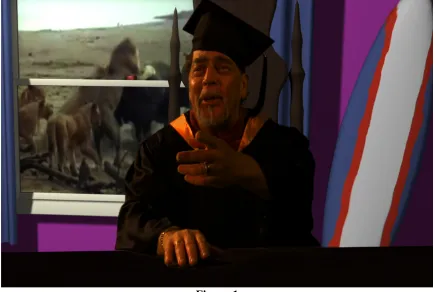
(Figure 1). The next version of the script played down the angst and was built more on
goofy word play and situational comedy. Of course, more would have to be done in
rehearsals because the story still lacked a complete structure. We scheduled the
rehearsals for Saturday and Sunday, and the shoot on the following Monday.
Original Shoot Scheduling
At the last minute, Julien could not make the trip from Mississippi to Rochester. I
made a number of calls to locate other young rappers but had no luck. We cancelled the
shoot and rehearsals. Although I was disappointed, some relief set in now that we had
more time to prepare. Ultimately, the uncertainty of what would come next outweighed
Writing - Part II
Convincing Ryan to help re-write the script, given that he had worked four full
nights already on a project that was not his, proved a little difficult. Fortunately, I asked
him to now act in the movie. Because he was more personally involved at this point, he
knew the script needed some adjustment to be appropriate for him instead of an
eleven-year-old boy. Luckily, we now had two months to work on a re-write instead of a week.
I chose Ryan as an actor based on his authentic New York rapping ability, my established
relationship with him and his reputation from earlier acting experience (Figure 2).
Rehearsals - Part 1
We began rehearsals in Howard’s office. Without the full script we realized the
rehearsals would be limited because the actors would need to improvise to the beat.
However, I was always able to get a few ideas down and add them to the script later. The
first example of this came when Ryan was to deliver his first lines but without any beat
playing. He struggled and claimed that, “it’s hard to rhyme without a beat.” This line
defined our opening struggle. Also, as Howard was always throwing out new lines to
react to Ryan at the moment, I’d write down these improvised phrases, eventually
fleshing them out into full lines.
Finding a Beat
Finding a beat presented its own difficulties. In January, when there was limited
time, I contacted a friend by the name of Dawud Gaston. He, in turn, put me in touch
had made and were available for use. We picked one, but because of overproduction and
the uninspired simplicity, it was a less than ideal match for the film. Ryan had written the
rhymes to this beat, however, for the January script. With a delayed shoot, we had a
chance to search for a more suitable beat. Eventually, I reached out to Eric Zabriskie,
someone I knew had been composing a lot of music for other students at RIT. He told
me that his drummer, Evan Wormwood, had some available. We liked one enough, but
asked if they had just the beat, which they did. I produced different tempo versions to see
which the actors liked best, and we decided on the original 120 beats per minute version.
This tempo provided a delicate contrast to Ryan’s faster rhyming style.
The beat dictated the rewrites and ultimately the pace of the performances. The
different beats provided us with different lines when writing and affected the tempo of
the performers’ delivery. Each actor absorbed the tempo and rhythm of the beat, fit it to
his own internal rhythm, and adjusted it to how the beat was affecting the other actor.
So, if we had different beats, we obviously got different performances. But if we kept the
same beat and chose different actors, I believe the rhythm and performances would be
completely different again because the actors’ internal beat would be different.
The Proposal
By the day of the proposal, we had rehearsed enough, found our beat and had a
story ready. During the proposal, the committee members primarily criticized the script,
noting that it still had remnants of the ten-year-old boy character and not enough of a
changed to an advisor’s office. Clearly we would need to update the relationship
between the two characters.
Rehearsals - Part 2
We had our most fruitful rehearsal on April 20th. We had to tackle all the
objections made during the proposal, with the main adjustment being made to the setting
of Graduation Day. The student had failed an oral exam by rapping. This decision was
made when discussing wardrobe. Howard mentioned he could wear the cap and gown to
signify the academics, and I said I only associated them with graduation day (Figure 3).
We had a final rehearsal in Howard’s office and asked the Director of
Photography, Jeremiah Franco, to join us. I wanted him to see how the acting played out
so he could visualize the action on camera.
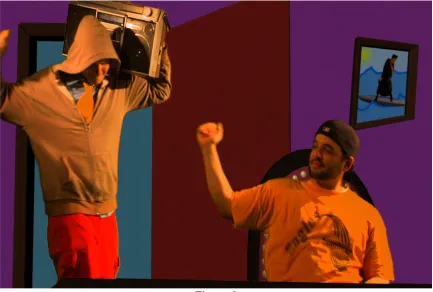
Andrew Curran agreed to play the role of “Dust Cover,” the rapper’s sidekick. I
chose him because, as he was already a close friend of Ryan’s, establishing their
relationship would be easy. Although his general appearance resembles more of a
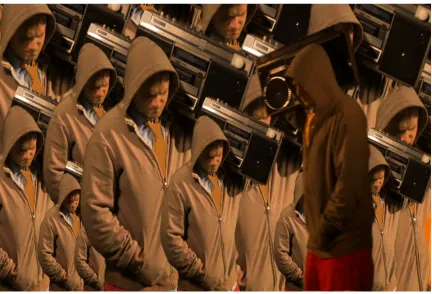
“punk” look than Hip Hop, we adapted what he normally wears (a hooded sweatshirt)
and modified it with bright pants and a dress shirt and tie combo (Figure 4). The boom
box prop would also give him something tangible to work with while acting and identify
him in the Hip Hop world.
The $100 Fish Shot
At about the halfway point of the film, the story transitions by way of a baseball
about the fish. I explained that I planned to create a CG fish and composite it into the
footage but Howard suggested that we use a real fish. An actual prop would release the
actor from having to use creative energy to produce the reality of the fish. I agreed I
would investigate the possibility and, over the weekend, found a large fish at a farmer’s
market, a cooler, and some ice. The total bill was $100, so we dubbed our now favorite
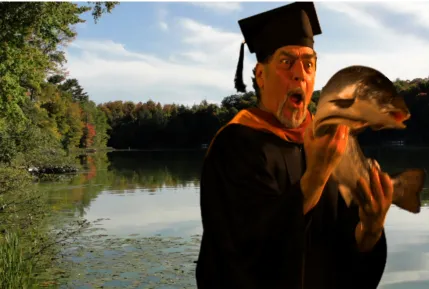
shot in the film the “Hundred Dollar Fish Shot” (Figure 5).
The Shot Planning
Jeremiah and I met to plan out shots for the film. Being able to move the camera
established a baseline for further decisions. The world should have a flexible feel and we
wanted to create a number of camera transitions between shots. The movement between
these shots should maintain a rhythm of their own and reflect the pace and tone of the
dialogue. For example, once the characters have overcome their differences, the
transitions become increasingly more fluid and agreeable (Figure 6). While earlier in the
film, the shots illustrate a stark contrast between Howard and Ryan’ characters. This
difference is reflected in the choice to shoot Howard at a slightly tilted up angle as to
make him appear more powerful. Naturally, we shot to Ryan in a slightly tilted down
angle so he appears to be in a weaker position. We had other creative ideas like
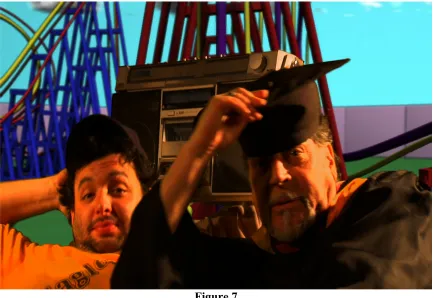
compositing the actors on to a CG roller coaster (Figure 7) and a spinning record. Within
two meetings we had everything planned for the shoot on April 27th. We also decided to
experiment with character scale throughout; an idea originally suggested at the proposal
reflecting his relatively infant understanding of Hip Hop relative to Ryan’s knowledge
(Figure 8).
The Shoot
We enlisted Ralph Mastromonaco as an assistant director to keep us on schedule.
An additional issue that occurred prior to the big shoot was simply getting the necessary
equipment in time. I arrived at the SOFA cage early and waited for our equipment to
return from the weekend shoots. By nine o’clock we had most of our equipment and the
crew was due to arrive at ten, with the actors coming to the studio at eleven. The crew
was ready early and most remarked how relaxed the set was. When the actors arrived, we
soon started shooting. The art director Regina Huynh chose Dust Cover’s clothes to
compliment Ryan’s costume and Howard’s under clothes to contrast his black robe.
Jeremiah chose lighting setups to realistically create the different settings we were going
to be “moving” through. The rest of the aesthetic choices could wait until the
backgrounds were chosen. Everything during the shoot went well, although near the end
we needed to hurry a little because we had borrowed a camera that was needed for a later
shoot. By the end the actors were exhausted, as they had worked from eleven to six with
few chances to rest. I too, was exhausted and felt by the last hour of the shoot, my
attention to my actors was not what I would have liked it to be. Luckily, our regular
rehearsals and extra time spent in pre-production aided us in meeting our deadline and
while capturing excellent performances from the actors.
After shooting I knew that I needed to step away from work and take the
opportunity to contemplate the direction of the film. After first checking the quality of the
footage, I began to reflect on the past eight months. At the time, my directing/acting
interests were my primary focus, but I knew that I would have to mentally prepare for the
long process of editing. I let the DP and actors know that I liked what I had seen, backed
up the files and set them aside for a while.
Edit
The first edit lasted roughly seven and a half minutes, while the final edit was cut
by nearly two minutes. Because the first edit of footage featured only the actors in front
of a green screen, there was some difficulty in imagining the final aesthetic of the film.
With unnecessary shots cut and many sequences already composited, the flow and pace
of the final work began to slowly emerge over the course of two months The initial idea
of editing according to lines of dialogue proved to choppy, so I adjusted the rhythm of the
edit by overlapping dialogue with the reaction of another character, eventually settling
into the final iteration.
The beat also dictated how I made editorial decisions. The length of each shot
would be completely different either with no beat or a different beat. The visuals that
eventually replaced the green screen also affected how the viewer perceived the beat.
The more movement in the background, the faster the beat and performances appeared to
My next step was to eliminate all of the green that permeated each shot,
something that prevented me from editing some of the transitions that Jeremiah and I had
originally planned. I used Adobe After Effects to process each shot. After a week of
tests, it was obvious that the plug-in “Keylight” was going to work well for eliminating
the green. “Keylight” works by picking a single onscreen color to remove. Then an alpha
matte is created which attempts to remove the green spill as well. You select a white
ceiling range (from 100 and under) to remove the highlight spill, and a black floor (from
zero up) to remove the darker greens. Generally, I had values of 20 and 80, which left
enough of a gap that I had very small numbers for screen shrink, a phenomena when the
edges of actors or props still have some green present, and screen softness or the relative
“hardness” of edges. The most difficult cases were instances when the green tablecloth
was darker than the back wall and needed a higher floor range, nearing the white ceiling
range at times. The other cases were where a green reflection was high on reflective
surfaces like the boom box and fish. The white ceiling would have to go as low as the
black floor. Not to mention the obstacle to remove all the black tracking tape we had
used for the next step of camera tracking, requiring me to key masks around the actors.
This work went quickly at first because of my enthusiasm over seeing a clean plate. On
average, I worked on four seconds of screen time per hour. Overall, removing the green
from the plate took a total of three weeks.
The disadvantage to using “Keylight” presented itself when I attempted to replace
the green spill. Typically, it was able to remove all the green noticeable in bad keying.
However, because it uses a gray to replace, you have the option of using original color to
Ryan’s main shirt and Howard’s graduate draping. Fortunately for me, the flatter look
matched the cartoon quality of the backgrounds (Figure 9).
Maya Live Camera matching
The next thing I needed to learn was how to match our live action camera work
with a 3D world camera. I had heard about Maya Live, but was unsure of how it worked
exactly. After about a week of reading the documentation and experimenting, I was sure
that I would be able to use this technique for the film. I first tested the Maya Live
function on a scene wherein “Dust Cover” enters the room. The shot would require a tilt
up with the camera as he enters a computer-generated door. Because the other scenes
would be simpler than this, I realized that if I was able to tackle this shot specifically, I
could be confident in my ability to finish the rest. While, I had cursed the black tracking
tape when I was still trying to mask out the green screen, it paid dividends for the camera
matching. I needed about five to ten locations to get a good camera match. Luckily, a
number of factors contributed to my success. It had helped to know the focal length of the
camera, the tripod height and that there were no camera movements, except for the
rotation. Once matched, I was happy to have asked Jeremiah to move the camera instead
of being locked down, as the 3D appears more realistic in comparison.
The most difficult shot was the crossover dolly shot when Ryan starts rapping.
Maya has a more difficulty when approximately the placement of the camera if it’s
moving. So. I stepped the solver through each progressive pass and manually corrected it
Placing the desk in most shots turned out to be easier than expected. However, I
would have to key it into three to four different places for some of the camera shots.
In addition, whenever Howard’s feet are visible, I used Photoshop to digitally
paint over the protective blue booties worn to keep the green screen clean on the day of
the shoot.
Backgrounds & Improvements
Inspired by the more simple animated style like that of The Simpsons, I created
backgrounds that had a “cartoony,” rather than photorealistic, appearance. I created all
the office shots first since they would have all the same structure. I also knew I wanted
to undertake the roller coaster scene before returning to Rochester as it would involve the
most work but wouldn’t require creative input from others.
I first chose an office color based on the shot where Dust Cover enters. Ryan’s
shirt is yellow and I based my decisions off a tie-died t-shirt that was yellow, orange and
red. So I made the wall orange and the door red. This looked pleasing for most shots but
there were a few wherein the orange was too similar to the yellow or to Howard’s brown
shirt in the final shot. To solve this problem, I transitioned the wall color from orange to
purple when necessary.
Each week, near the end of the quarter I’d meet with Howard, and we’d discuss
shots that needed to be corrected. The first major change was made to the editing style.
Notably, we began to have more dialogue occur off-camera and explored ways to cut in
less obvious places. The next task was to include a window behind Howard’s desk.
through that window proved to be a harder decision. We played with the idea of a riot
going on in the background so that the characters would appear to be ignoring something
extreme. Eventually, we decided to not draw too much attention and I placed standard
graduation footage initially. As the footage was of low, Youtube-like compression
quality, I intended to replace it at a later date.
Sound
Throughout the film, there are specific scenes where the audio track is less than
perfect. This occurs mostly in a few shots where the actor is in profile. Because the
boom microphone was not properly placed the recording is too low in volume, not to
mention the ambient noise of a compressor in the background. Also, the beat was being
played in the background for the actors because we did not have a thump track. Donald
O’Brien had helped me with some noise reduction, but for the most difficult piece I
reached out to Dave Sluberski to what advice he might have to offer. While I wasn’t
able to fix everything, the voices were much clearer and natural in our final version.
Screening
I screened the project on Sunday November 15, 2009. Concern over the use of
Youtube-quality background footage proved to be unfounded. The reaction for the
backgrounds garnered praise from both my respondent and the audience. They did notice
the problems with the sound, but overall, it did not seem to take away from their
In the year and half of producing this film, I have overcome many obstacles that
seemed initially seemed insurmountable. The long writing process, replacing actors,
readying for a shoot, green screen removal and camera matching provided new
challenges I had not met before. The final piece became something I am proud to have
made. The most rewarding experience was working with the actors and I intend to
Graduation Day – Appendix A
Figure 1
Figure 5
Graduation Day – Appendix B
4.27.09
(STUDENT and ADVISOR sit across from one another at a desk in the ADVISOR’s Office.
ADVISOR
…It’s Graduation Day …you failed the oral exam
…your family (listing members) is here …they’re (we’re) not going to certify you
(Student can’t speak)
ADVISOR
What’s the matter?
STUDENT
Can I have a beat?
ADVISOR
What, a beat?
(Student snaps his finger. Beat begins.)
STUDENT
It’s not like I’m just fooling around, In the silence I drown.
I need the beat to swim in the sound. Fitting the time, spitting rhymes is how we live in my town.
ADVISOR
You can’t communicate without a beat? That’s absurd.
STUDENT
Absurd is just another word of labels and definition
(My main means of expression, The way I learn my lessons)
ADVISOR
You can talk just like everyone else. Where is that beat coming from?
STUDENT
ADVISOR
The one messing with my feet.
STUDENT
Oh that’s my man, Dust Cover.
(Dust Cover enters with boombox playing beat).
ADVISOR
You have your own percussionist?
STUDENT
We’re just expressing ourselves Putting books on the shelves
Our minds running free between your bells.
ADVISOR
Well it’s really annoying. Please turn that off.
STUDENT
Nah man, you’ve got to bang that beat Keep’em tapping their feet
Run that thing on repeat!
ADVISOR
And I repeat, cut that beat. Get him out of here.
If my man DC’s got to leave I’ve got to be hitting the breeze. Music’s my main mechanism For maintaining wisdom. Yeah, I could live without it,
But is that life? Nah, I kind of doubt it.
ADVISOR
But this is not how the rest of world chooses to communicate. Your position in life will be second rate.
STUDENT
You spend your days in a rhyming haze?
STUDENT
The pictures we paint make the scenery change.
(Cut out to show they are no longer in ADVISOR’s Office. The desk and seats are gone. They are on a dance floor.)
ADVISOR
Wait… My desk is gone. It just slipped away in the song. I want my desk back
Because structure is something that your songs lack.
STUDENT
But you just solved mystery one.
The beat will always take you someplace new, Somewhere fun.
We can each speak our point of view, Just find a way to line it up in the groove.
ADVISOR
But this isn’t real And I don’t feel
The connection between your world and mine.
The return of my desk would be just fine.
STUDENT
But the beat can take you so much higher than that Just lock and load it, swing your bat.
(The advisor finds himself in a baseball field holding a bat)
ADVISOR
You think that this is fun and games But how many times do you say the names Of people who rap and talk like this Why the heck am I holding this fish?
STUDENT
You never really know what’s going on inside your mind You have to buy the ticket,
Take the ride from time to time
But in the business world, you’ll feel like a fool Look good in a tie,
That’s why you’re at our school.
STUDENT
But those business men could take a lesson From our fresher form of expression.
ADVISOR
Professionals learn a lesson?
STUDENT
With this beat they could be messin’
ADVISOR
I think they’d think that this is just crazy.
STUDENT
Your feet used to be lazy!
ADVISOR
And now I’m moving like a baby.
STUDENT
And with you bouncing like that I’ll take a crack
At working with my peers.
ADVISOR
Eliminating all of their fears.
STUDENT
Bring their eyes to tears.
ADVISOR
With this rhyme I find my mind Moving in a new direction.
STUDENT
Even in a new inflection?
ADVISOR
And now they’re digging your vibe. You could be our voice on the inside… You could switch up the system.
ADVISOR
Slow boys gonna miss him.
STUDENT
Nobody’s goin’ dis him.
ADVISOR
They couldn’t even if they could. They wouldn’t even if they should.
STUDENT
With a style so new My mind you blew
Sending my jaw to the south. Leave’em with an open mouth So A-dog, I’m peacing out.
(student walks out wearing cap and gown)
ADVISOR
Take it easy Greasy.
That’s what I’m talking about. (Beat)
(Advisor left in underwear)
ADVISOR
Graduation Day – Appendix C
Thesis Proposal
By Isaac Holze
Approved for submission: _Howard Lester________
Committee:
General Description
A college student communicates only by rapping. His advisor addresses the distractions this causes in class. The office transforms based on the dialogue, the rhythm of the beat, and contrast of perspectives. A duet develops with the student’s worldview taking over. The piece is an essay on personal expression vs. arbitrary behavioral restrictions.
Overview
Inside a cg created office, a live student sits across from his advisor. The advisor asks why the student is disrupting classes by rapping. The student can’t communicate until he summons a musical beat to start. The advisor gets annoyed by the beat and demands to know how the music appears when he talks. The student reveals his dj waiting outside. They are asked to leave but the student argues that he is needed for him to communicate.
While the student raps, the office begins to disappear. In its place are a variety of backgrounds, all relating to the dialogue and the two conflicting points of view. Examples are a dance club, an industrial kitchen with swinging pots and pans, a board meeting with a presentation, and a ball park. The advisor fights hard to pull the space back to his office and the reality he is used to.
The advisor adapts his speech to communicate his point of view but eventually enjoys the method, gets lost in the fun, and a duet begins. The student realizes the distraction, states his closing argument and excuses himself. The regular office returns and the advisor yells out that nothing was resolved about his class actions.
Run Time: Approx 5-6 minutes
Treatment
See Attachment.
Method
The principal action of the characters will be three live actors shot on a green screen. The advisor’s office will be done in 3d Maya, and the backgrounds during the rhymes will be a combination of 2D/3D elements.
Timeline
August 2008-March 2009 – Story April 2009 – Rehearsal
April 27 – Shoot on Stage A
September - Screening
Budget Estimated Actual
Sound Stage + Green Screen $450 HPX-500 camera $600 2x 5K Tungsten Arri Lights $120 Arri Softbank kit $70
Tripod $40
Dolly + Track $56
Sound $80
Crew @ $250-$400/day $1300
3 months PC workstation $1200
Maya Software $2000
Editing Software $1500
320GB HardDrive $100 $100
Food for shoot $400 $400
Festival Submission $500 $500
12 Thesis Credits Tuition $10,000 $10,000 Living Expenses @ $1200/mo $14,400 $14,400