City, University of London Institutional Repository
Citation
:
Fujiki, M.H. (1994). Pension fund valuation. (Unpublished Doctoral thesis, City
University London)
This is the accepted version of the paper.
This version of the publication may differ from the final published
version.
Permanent repository link:
http://openaccess.city.ac.uk/7545/
Link to published version
:
Copyright and reuse:
City Research Online aims to make research
outputs of City, University of London available to a wider audience.
Copyright and Moral Rights remain with the author(s) and/or copyright
holders. URLs from City Research Online may be freely distributed and
linked to.
City Research Online: http://openaccess.city.ac.uk/ [email protected]
PENSION FUND VALUATION
by
MASA-HIKO FUJIKI
Thesis submitted for the degree of
DOCTOR OF PHILOSOPHY
THE CITY UNIVERSITY, LONDON
DEPARTMENT OF ACTUARIAL SCIENCE AND STATISTICS
CONTENTS
Contents
2
Tables and Illustrations
10
Acknowledgements
14
Declaration
14
Abstract
15
Notation
16
Part I
19
Chapter 1
Introduction
19
1.1
Actuarial Approaches
19
1.2
Outline of research carried out in the thesis
21
Chapter 2
Background
23
2.1
Introduction
23
2.2
Pension Scheme
23
2.3
Valuation
24
2.4
Funding Methods
25
2.4.1
Current Unit Method
25
2.4.2
Projected Unit Method
26
2.4.3
Entry Age Method
26
2.4.4
Attained Age Method
27
2.4.5
Aggregate Method
27
2.4.6
Initial Funding
27
2.4.7
Pay-As-You-Go
27
2.4.8
Terminal Funding
28
Part
II29
Chapter 3
Analysis of Funding Method
29
3.1
Introduction
29
3.2
Global model
30
3.2.1
Notional division
30
3.2.2
Movements of fund
31
3.2.2.1
Change in an individual pot
31
3.2.2.2
X function
32
3.2.3
Insurance within the fund
33
3.2.4
Standard common pool
33
3.3
Individual model
35
3.3.1
Notation
35
3.3.2
Funding method
36
3.3.4
Definitions of P. X, R
40
3.3.4.1
P(x)
40
3.3.4.2
R(x) and X(x)
43
3.3.5
Description of the individual model
44
3.3.6
Standard fund and P, X
45
3.3.7
Surplus
48
3.3.8
Interpretation of typical funding methods
51
3.3.8.1
Current Unit Method
51
3.3.8.2
Projected Unit Method
51
3.3.8.3
Entry Age Method
53
3.3.8.4
Attained Age Method
54
3.3.8.5
Initial Funding
54
3.3.8.6
Terminal Funding
55
3.4
Individual Model and Global Model
56
3.5
Application
57
3.5.1
Withdrawals
57
3.5.2
Salary increases
58
3.5.3
Investment returns
59
3.5.4
Extra benefits
59
3.5.5
Asset value
59
3.5.5.1
Contribution
59
3.5.5.2
Investment proceeds
60
3.5.5.3
Benefits
60
3.5.6
Basis changes
60
Chapter 4
Cross Subsidy
61
4.1
Introduction
61
4.2
Benefits from a defined benefit scheme
61
4.3
Comparison of the benefits
61
4.4
Accrual method
62
4.5
Contribution method
63
4.6
Cross-subsidy
64
4.7
Misuses of the contribution method
64
4.8
Equity
65
4.9
Solutions
65
4.10
Use of X-function model
66
4.11
Conclusion
67
Part III
69
Chapter 5
Valuation and Matching
69
5.1
Introduction
69
5.2
Projection
70
5.2.1.1
Cash flows
70
5.2.1.2
Cash flow projection
71
5.2.1.3
Purpose of the projection
71
5.2.1.4
Modelling
71
5.2.1.5
Assumptions
72
5.2.1.6
Criteria for evaluation
72
5.2.1.7
Summary
73
5.2.2
Deterministic approach
74
5.2.3
Stochastic approach
75
5.3
Investment strategy
78
5.3.1
Investment strategy for pension fund valuation
78
5.3.2
Matching
80
5.3.3
Stochastic approach to asset allocation
82
5.3.4
Theoretical framework
84
5.3.5
V-Matching
89
5.3.6
Interpretation of V-matched position
91
5.3.7
S-Matching
94
5.3.8
Matching for a defined benefit pension scheme
99
5.3.9
Mismatching reserve
101
5.4
Purposes of the valuation
102
5.4.1
Funding
102
5.4.2
Security
102
5.5
Deterministic valuation
104
5.5.1
Liabilities
104
5.5.2
Assets
104
5.5.3
Future contributions/future salaries
105
5.6
Valuation and matching
106
5.6.1
General consideration
106
5.6.1.1
Solvency
106
5.6.1.2
Stability
107
5.6.2
Interpretation of valuation in practice
108
5.6.2.1
Valuation basis
108
5.6.2.1.1
Notionally matched portfolio
109
5.6.2.1.1.1
Absolute matching
111
5.6.2.1.1.2
Approximate matching
112
5.6.2.1.2
Actual portfolio
113
5.6.2.2
Market value basis
113
5.7
Stochastic valuation
115
5.7.1
Stochastic Discounting
115
5.7.2
Checking of funding level/security
116
5.7.3
Setting contribution rate
118
5.7.3.2
Integrated method
120
5.7.4
Conclusions
121
Part IV
122
Chapter 6
Introduction to Control of Pension Fund
122
6.1
Introduction
122
6.2
Control theory
123
6.2.1
Types of control systems
123
6.2.2
Analysis of control system
125
6.3
Application of control theory
126
6.3.1
Nature of pension fund and method of investigation
126
6.3.2
Item to be controlled
127
6.3.2.1
On-going solvency
127
6.3.2.2
Discontinuance solvency
128
6.3.2.3
Stability of contribution rate
129
6.3.2.4
Conclusion to section 6.3.2
130
6.4
Examples of control
131
6.4.1
Benefits
131
6.4.2
Investment strategy
132
6.4.3
Pace of funding
133
6.5
Control through valuation basis
135
6.5.1
Valuation basis
135
6.5.2
Interpretation as a control system
136
6.5.2.1
Best estimate
137
6.5.2.2
Margins in the basis
139
6.5.3
Systematic approach
140
Chapter 7
Overview of Projection Model
142
7.1
Introduction
142
7.2
Purpose and method of research
142
7.2.1
Purpose of research
142
7.2.2
Approach of research
143
7.2.3
Appraisal of results
144
7.2.4
Coverage
144
7.3
Notation
145
7.4
Model
147
7.4.1
Benefits
147
7.4.2
Membership
147
7.4.3
Investments
148
7.4.4
Economic environment model
148
7.4.5
Valuation
149
7.4.6
Input
150
7.5
Range of investigation
150
7.5.1
Area of investigation
151
7.5.1.1
Movement in real investment returns
151
7.5.1.2
Movement of dividend yield
152
7.5.1.3
Movement of withdrawal rate
153
7.5.2
Patterns of movements
153
7.5.2.1
Pattern of experience
15.4
7.5.2.2
Pattern of valuation basis
155
7.5.2.2. 1
Unchanged experience
156
7.5.2.2.2
Step (One permanent change in experience)
156
7.5.2.2.3
Ramp (Gradual change in experience)
156
7.5.2.2.4
Cyclical change in experience
157
Chapter 8
Summary of Projection Results
158
8.1
Introduction
158
8.2
Real investment return changes
159
8.2.1
Basic impact
159
8.2.1.1
Ultimate cost
159
8.2.1.2
Gap between experience and assumption
159
8.2.1.3
Valuation surplus/deficit
160
8.2.2
Unchanged experience
161
8.2.3
One permanent change in experience
161
8.2.3.1
Constant basis
162
8.2.3.2
One permanent change in basis
162
8.2.3.3
Gradual change in basis
163
8.2.3.4
Summary of 8.2.3
164
8.2.4
Gradual change in experience
164
8.2.4.1
Constant basis
165
8.2.4.2
Gradual change in basis
165
8.2.4.3
Summary of 8.2.4
166
8.2.5
Cyclical change in experience
167
8.2.5.1
Constant basis
167
8.2.5.2
Cyclical change in basis
167
8.2.5.3
Summary of 8.2.5
168
8.2.6
Conclusions to real investment return changes
169
8.3
Dividend growth changes
170
8.3.1
Basic impact
170
8.3.1.1
Ultimate cost
170
8.3.1.2
Gap between experience and assumption
171
8.3.1.3
Valuation surplus/deficit
176
8.3.2
Unchanged experience
178
8.3.3
One permanent change in experience
178
8.3.3.2
One permanent change in basis
179
8.3.3.3
Gradual change in basis
179
8.3.3.4
Summary of 8.3.3
181
8.3.4
Gradual change in experience
181
8.3.4.1
Constant basis
181
8.3.4.2
Gradual change in basis
181
8.3.4.3
Summary of 8.3.4
183
8.3.5
Cyclical change in experience
183
8.3.5.1
Constant basis
183
8.3.5.2
Cyclical change in basis
184
8.3.5.3
Summary of 8.3.5
185
8.3.6
Conclusions to dividend growth changes
185
8.4
Withdrawal rate changes
187
8.4.1
Basic impact
187
8.4.1.1
Ultimate cost
187
8.4.1.2
Gap between experience and assumption
189
8.4.1.3
Valuation surplus/deficit
191
8.4.2
Unchanged experience
194
8.4.3
One permanent change in experience
195
8.4.3.1
Constant basis
195
8.4.3.2
One permanent change in basis
195
8.4.3.3
Gradual change in basis
196
8.4.3.4
Summary of 8.4.3
197
8.4.4
Gradual change in experience
198
8.4.4.1
Constant basis
198
8.4.4.2
Gradual change in basis
199
8.4.4.3
Summary of 8.4.4
200
8.4.5
Cyclical change in experience
200
8.4.5.1
Constant basis
202
8.4.5.2
Cyclical change in basis
202
8.4.5.3
Summary of 8.4.5
203
8.4.6
Conclusions to withdrawal rate changes
203
8.5
Conclusions
205
8.5.1
Optimum funding level
205
8.5.2
Long term implications
206
8.5.3
Short term implications
206
8.5.4
Practical points
207
Part V
208
Appendix 1
Mathematical Relationship of Dividend Yield, Dividend Growth and Investment Return
211
A1.1
Introduction
211
A1.2
Notation
211
A1.3
Assumptions
211
A1.4
Investment return on the market basis
215
A1.5
Investment return on the valuation basis
218
A1.6
Setting the valuation basis
220
Appendix 2
Details of the Projection Calculations
221
A2.1
Construction of initial membership
221
A2.2
Initial valuation
221
A2.3
Main routine
221
A2.4
Valuation routine
223
A2.5
Benefit calculation routine
224
Appendix 3
Full Projection Results
225
Appendix 3.1
Real Investment Return Changes
226
A3.1.1
Unchanged experience
226
A3.1.2
One permanent change in experience
228
A3.1.2.1
Constant basis
228
A3.1.2.2
One permanent change in basis
228
A3.1.2.3
Gradual change in basis
231
A3.1.3
Gradual change in experience
236
A3.1.3.1
Constant basis
236
A3.1.3.2
Gradual change in basis
236
A3.1.4
Cyclical change in experience
243
A3.1.4.1
Constant basis
243
A3.1.4.2
Cyclical change in basis
246
Note
251
Graphs
252
Appendix 3.2
Dividend Growth Changes
263
A3.2.1
Unchanged experience
263
A3.2.2
One permanent change in experience
265
A3.2.2.1
Constant basis
265
A3.2.2.2
One permanent change in basis
265
A3.2.2.3
Gradual change in basis
268
A3.2.3
Gradual change in experience
272
A3.2.3.1
Constant basis
272
A3.2.3.2
Gradual change in basis
272
A3.2.4
Cyclical change in experience
279
A3.2.4.1
Constant basis
279
A3.2.4.2
Cyclical change in basis
282
Graphs
288
Appendix 3.3
Withdrawal rate change
299
A3.3.1
Unchanged experience
299
A3.3.2
One permanent change in experience
301
A3.3.2.1
Constant basis
301
A3.3.2.2
One permanent change in basis
301
A3.3.2.3
Gradual change in basis
365
A3.3.3
Gradual change in experience
310
A3.3.3.1
Constant basis
310
A3.3.3.2
Gradual change in basis
310
A3.3.4
Cyclical change in experience
316
A3.3.4.1
Constant basis
316
A3.3.4.2
Cyclical change in basis
320
Note
325
Graphs
326
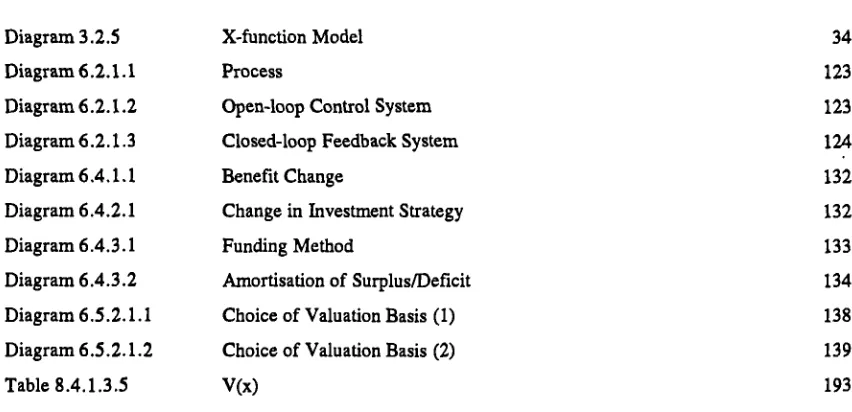
Tables and Illustrations
Diagram 3.2.5
X-function Model
34
Diagram 6.2.1.1
Process
123
Diagram 6.2.1.2
Open-loop Control System
123
Diagram 6.2.1.3
Closed-loop Feedback System
124
Diagram 6.4.1.1
Benefit Change
132
Diagram 6.4.2.1
Change in Investment Strategy
132
Diagram 6.4.3.1
Funding Method
133
Diagram 6.4.3.2
Amortisation of Surplus/Deficit
134
Diagram 6.5.2.1.1
Choice of Valuation Basis (1)
138
[image:11.595.86.512.76.282.2]Diagram 6.5.2.1.2
Choice of Valuation Basis (2)
139
Table 8.4.1.3.5
V(x)
193
The following is the graphs for all the cash flow projections described in Appendix 3. The graphs contain the
Standard Contribution rate, the adjustment to contribution rate and the Recommended Contribution rate for
each year of projection.
Appendix 3.1
Graph A3.1.1.a
e=6.5%, f=4.5% [Standard basis]
252
Graph A3.1.1.b
e=5.5%, f=3.5188%
Graph A3.1.1.c
e=7.5%, f=5.4912%
Graph A3.1.2.a
Standard basis
Graph A3.1.2.b
Immediate, e=5.5% from year 1 [Same as experience]
253
Graph A3.1.2.c
Immediate, e=5.0% from year 1
Graph A3.1.2.d
Immediate, e=6.0% from year 1
Graph A3.1.2.e
Delayed, e=5.5% from year 3 [Same as experience]
Graph A3.1.2.f
Delayed, e=5.0% from year 3
254
Graph A3.1.2.g
Delayed, e=6.0% from year 3
Graph A3.1.2.h
Averaging, Annual change, Quick(.04%pa)
Graph A3.1.2.i
Averaging, Annual change, Medium(.02%pa)
Graph A3.1 .2.j
Averaging, Annual change, Slow(.008%pa)
255
Graph A3.1.2.k
Averaging, Triennual change, Quick(.04%pa)
Graph A3.1.2.1
Averaging, Triennual change, Medium(.02%pa)
Graph A3.1.2.m
Averaging, Triennual change, Slow(.008%pa)
Graph A3.1.2.n
Change continue, Anuual change, Quick(.04%pa)
256
Graph A3.1.3.a
Standard basis
Graph A3.1.3.b
Immediate, Annual change, .02%pa[Same as experience]
Graph A3.1.3.c
Immediate, Annual change, .008%pa
Graph A3.1.3.d
Immediate, Annual change, .004%pa
257
Graph A3.1.3.f
From year 3, Annual change, .008%pa
Graph A3.1.3.g
Immediate, Triennual change, .02%pa
Graph A3.1.3.h
Immediate, Triennual change, .008%pa
258
Graph A3.1.3.i
Immediate, Decennial change, .02%pa
Graph A3.1.3.j
Immediate, Decennial change, .008%pa
Graph A3.1.3 .k
Immediate, Annual change, 5 year average
Graph A3.1.3.1
Immediate, Annual change, 10 year average
259
Graph A3.1.4.a
e=6.5% [Standard basis]
Graph A3.1.4.b
e=5.5% [Lowest value]
Graph A3.1.4.c
e=7.5% [Highest value]
Graph A3.1.4.d
Immediate, Annual change, .2%pa[Same as experience]
260
Graph A3.1.4.e
Immediate, Annual change, .1%pa
Graph A3.1.4.f
Immediate, Triennual change, .2%pa
Graph A3.1.4.g
Immediate, Triennual change, .1%pa
Graph A3.1.4.h
Immediate, Quinquennial change, .2%pa
261
Graph A3.1.4.i
Immediate, Quinquennial change, .1%pa
Graph A3.1.4.j
Immediate, Annual change, 3 year average
Graph A3.1.4.k
Immediate, Annual change, 5 year average
Graph A3.1.4.1
Immediate, Annual change, 10 year average
262
Appendix 3.2
Dividend Yield Changes
Graph A3.2.1.a
g=5.0%, d=3.8095% [Standard basis]
288
Graph A3.2.1.b
g=5.5%, d=3.3175%
Graph A3.2.1.c
g=4.5%, d=4.3062%
Graph A3.2.2.a
Standard basis
Graph A3.2.2.b
Immediate, g=5.5% from year 1 [Same as experience]
289
Graph A3.2.2.c
Immediate, g=5.75% from year 1
Graph A3.2.2.d
Immediate, g=5.25% from year 1
Graph A3.2.2.e
Delayed, g=5.5% from year 3 [Same as experience]
Graph A3.2.2.f
Delayed, g=5.75% from year 3
290
Graph A3.2.2.g
Delayed, g=5.25% from year 3
Graph A3.2.2.h
Averaging, Annual change, Quick(.027opa)
Graph A3.2.2.i
Averaging, Annual change, Medium(.01%pa)
Graph A3.2.2j
Averaging, Annual change, Slow(.004%pa)
291
Graph A3.2.2.k
Averaging, Triennual change, Quick(.02%pa)
Graph A3.2.2.1
Averaging, Triennual change, Medium(.01%pa)
Graph A3 .2.2.m
Averaging, Triennual change, Slow(.004%pa)
Graph A3.2.2.n
Change continue, Anuual change, Quick(.02%pa)
292
Graph A3.2.3.a
Standard basis
Graph A3.2.3.b
Immediate, Annual change, .01%pa[Same as experience]
Graph A3.2.3.c
Immediate, Annual change, .004%pa
Graph A3.2.3.e
Graph A3.2.3.f
Graph A3.2.3.g
Graph A3.2.3.h
Graph A3.2.3.i
Graph A3.2.3.j
Graph A3.2.3.k
Graph A3.2.3.1
Graph A3.2.4.a
Graph A3.2.4.b
Graph A3.2.4.c
Graph A3.2.4.d
Graph A3.2.4.e
Graph A3.2.4.f
Graph A3.2.4.g
Graph A3.2.4.h
Graph A3.2.4.i
Graph A3.2.4.j
Graph A3.2.4.k
Graph A3.2.4.1
From year 3, Annual change, .01%pa
From year 3, Annual change, .004%pa
Immediate, Triennual change, .01%pa
Immediate, Triennual change, .004%pa
Immediate, Decennial change, .01%pa
Immediate, Decennial change, .004%pa
Immediate, Annual change, 5 year average
Immediate, Annual change, 10 year average
g=5.0% [Standard basis]
g=5.5% [Highest value]
g=4.5% [Lowest value]
Immediate, Annual change, .1%pa[Same as experience]
Immediate, Annual change, .05%pa
Immediate, Triennual change, .1%pa
Immediate, Triennual change, .05%pa
Immediate, Quinquennial change, .1%pa
Immediate, Quinquennial change, .05%pa
Immediate, Annual change, 3 year average
Immediate, Annual change, 5 year average
Immediate, Annual change, 10 year average
Appendix 3.3
Withdrawal Rate Changes
Graph A3.3.1.a
w=5% [Standard basis]
Graph A3.3.1.b
w=10%
Graph A3.3.1.c
w=0%
Graph A3.3.2.a
Standard basis
Graph A3.3.2.b
Immediate, w=10% from year 1 [Same as experience]
Graph A3.3.2.c
Immediate, w=12.5% from year 1
Graph A3.3.2.d
Immediate, w=7.5% from year 1
Graph A3.3.2.e
Delayed, w=10% from year 3 [Same as experience]
Graph A3.3.2.f
Delayed, w=12.5% from year 3
Graph A3.3.2.g
Delayed, w=7.5% from year 3
Graph A3.3.2.h
Averaging, Annual change, Quick(.2%pa)
Graph A3.3.2.i
Averaging, Annual change, Medium(.1%pa)
Graph A3.3.2.j
Averaging, Annual change, Slow(.04%pa)
Graph A3.3.2.k
Averaging, Triennual change, Quick(.2%pa)
Graph A3.3.2.1
Averaging, Triennual change, Medium(.1%pa)
Graph A3.3.2.m
Averaging, Triennual change, Slow(.04%pa)
Graph A3.3.2.n
Change continue, Anuual change, Quick(.2%pa)
Graph A3.3.3.a
Standard basis
Graph A3.3.3.d
Graph A3.3.3.e
Graph A3.3.3.f
Graph A3.3.3.g
Graph A3.3.3.h
Graph A3.3.3.i
Graph A3.3.3.j
Graph A3.3.3.k
Graph A3.3.3.1
Graph A3.3.4.a
Graph A3.3.4.b
Graph A3.3.4.c
Graph A3.3.4.d
Graph A3.3.4.e
Graph A3.3.4.f
Graph A3.3.4.g
Graph A3.3.4.h
Graph A3.3.4.i
Graph A3.3.4.j
Graph A3.3.4.k
Graph A3.3.4.1
Immediate, Annual change, .02%pa
From year 3, Annual change, .1%pa
From year 3, Annual change, .04%pa
Immediate, Triennual change, .1%pa
Immediate, Triennual change, .04%pa
Immediate, Decennial change, .1%pa
Immediate, Decennial change, .04%pa
Immediate, Annual change, 5 year average
Inunediate, Annual change, 10 year average
w=5% [Standard basis]
w=10% [Highest value]
w=0% [Lowest value]
Immediate, Annual change, 1%pa[Same as experience]
Immediate, Annual change, .5%pa
Immediate, Triennual change, 1%pa
Immediate, Triennual change, .5%pa
Immediate, Quinquennial change, 1%pa
Immediate, Quinquennial change, .5%pa
Immediate, Annual change, 3 year average
Immediate, Annual change, 5 year average
Immediate, Annual change, 10 year average
Acknowledgements
I would like to thank Professor Steven Haberman for his extensive comments throughout the thesis,
encouragements and linguistic support.
I would also like to thank Mr. Philip Booth (City University) for his comments regarding Chapter 5, the Meiji
Mutual Life Insurance Company for its finiancial support and Tillinghast/Towers Perrin London Life Unit for
allowing me to use its facilities for typing.
Declaration
Abstract
The thesis discusses various actuarial aspects of the management of a pension fund, in particular, those related
to valuation of the pension fund. The investigation covers three main areas; the funding mechanism,
investment and matching and control of the fund.
In the part dealing with the funding mechanism, a model is introduced in order to assist analyses of the
mechanism of a pension fund. The model notionally separates the fund into individual pots and a common
pool, and notional moves of the assets between them, X-functions, are defined. Using this model, various
events in the pension fund are analysed. Particularly, the model is shown to be useful for explaining the
financial impact of withdrawals and the problem of cross-subsidy.
In the next part, investment and matching are discussed referring to a collection of papers and books written
by actuaries and economists. Two different types of matching are defined according to the definition of risk,
which are named V-matching and S-matching. Based on this discussion on matching, the meanings of the use
of a particular portfolio for valuation purposes are analysed.
Finally, various means of controlling a pension fund are discussed in the light of control theory. A particular
focus is set on the choice of the valuation basis as a means of control, and an extensive series of long term
cashflow projections are carried out to explore the optimum way to choose the valuation basis under various
scenarios of changing experience. The projections are carried out separately for three different aspects of the
experience; the real rate of investment return, the dividend growth rate and the dividend yield, and the
withdrawal rates. The results suggest that the use of averages of past experience over a long period suits best
for different circumstances, and that delayed changes in the valuation basis after the corresponding changes
in experience are useful for identifying more clearly the trend in the actual experience.
Notation
Notation used in the thesis is summarised as follows. Notation in each part is shown separately.
Part II
e:
age at which the member joined the scheme, also the time when the scheme started
x:
current age, also the current time
r:
normal retirement age
v:
= 1/(1+i)
i:
interest rate assumed in the basis
BN(s):
value of the leaving service benefit for the member at time s, or value of normal retirement
benefit for the member if s=r; This is the size of the individual pot.
SF(t):
Standard fund calculated at time t
S(x):
salary at age x
k:
constant (used as the accrual rate of benefits)
_
a.
value of unit annuity at age x
SUR(t):
surplus arising at time t on conventional basis
SUR' (t) :
rate of surplus arising at time t on conventional basis
SURa(t):
surplus arising at time t on cash accumulation basis
SURa (0 :
rate of surplus arising at time t on cash accumulation basis
B(t;s):
the total benefits to be paid to the members at time s estimated at time t on the valuation
basis
B(s):
actual total benefits paid to the members at time s
SC(t;s):
Standard contribution to be paid at time s and calculated at time t
SC(x):
Standard contribution for an individual member at age x
P(t):
the balance of the fund after deducting all the individual pots
R(t):
the required contribution at time t
X(t):
X function;
X(t) = SC(t) - R(t)
PART III
m(x,t): mean surplus of investment strategy x at time t
Part IV
The time is measured by the number of years passed from the origin. At the beginning of a scheme year, the
time is expressed by an integer. To express the timing accurately, for a particular year T, which starts from
time T and ends at time T+1, T-0, T and T +0 are defined as follows.
T-0:
The end of year T-1, but before any end year cash flows; benefit payments and dividend receipts.
T:
The end of year T-1, when the valuation takes place.
T+0: The beginning of year T after receiving contributions.
D(t):
Amount of the dividend received at time t
M(t):
Market value of the assets held at time t
C(t):
Contributions received at time t.
B(t):
Benefits paid at time t.
I(t):
the rate of return achieved during the period (t-1 ,t) on the market value basis.
MV(t): Market value (ex-dividend) of a specific asset at time t excluding dividends at time T
Div(t): Dividend receivable at time t
i(t):
Market interest rate at time t. The long term interest rate in the market
g"(t):
Market expectation of dividend growth at time t
d"(t):
Market dividend yield at time t. For the precise definition, see section A1.3.3.
p"(t):
Market expectation of long term future price inflation at time t
g'(t):
Actual dividend growth from t-1 to t
p'(t):
Actual price inflation rate from t-1 to t
e'(t):
Increase in general level of salary from t-1 to t
ss'(t):
Promotional salary increase experienced between t-1 and t
w'(t): Rate of withdrawals experienced between t-1 and t
VM(t): Assessed value placed on M(t)
VD(t): Assessed value placed on D(t)
VC(t): Assessed value placed on C(t)
c(t):
Conversion factor of the market value to the assessed value: i.e,
VM(t)
=
c(t)
*
M(t)
VD(t)
=
c(t)
*
D(t)
VC(t)
=
c(t)
*
C(t)
p(t):
pension increase rate assumption in payment and deferment for the valuation
e(t):
salary inflation rate assumption for the valuation
ss(t):
promotionary salary increase assumption for the valuation
w(t):
withdrawal rate assumption for the valuation
I'(t):
the rate of return achieved during the period (t-1,t) on the valuation basis.
VAtr(t): assessed value on an alternative basis
g"(t):
the alternative dividend growth rate assumption
dA(t):
the alternative dividend yield assumption
VSp(t): the valuation surplus arising from the change of the basis from the original one to the alternative one.
f(y):
rate of reduction in the retirement pension for a member who withdrawed at age y
1(y):
survival function at age y
dw(y): expected number of withdrawals at age y-O (with 1(x)=1)
V(y):
value of liabilities at age y exact
PART I
Chapter 1
Introduction
1.1
Actuarial approaches
Scientific activities which actuaries are engaged in may be summarised by the following definition of the
actuarial scientific method by Education Strategy Working Party of Institute of Actuaries(1990);
The actuarial scientific method is to formulate practical conclusions and advice (including analysis
of risk and long-term applications) within finance, insurance, demography and related fields through:
(a)
selecting and collecting information;
(b)
structuring, presenting and analysing information, including investigating secular
and other trends;
(c)
formulating assumptions and constructing models to process information for divers
purposes, including long-term future applications; and
(d)
monitoring and appraising emerging experience against the model and the
assumptions.
Because of its nature, research in actuarial science may share these activities. Also, the methodology of
carrying out these activities can be the subjects of research. Firstly, (a), (b) and (d) are all related to the
processing of data. The methodology of processing and analysing data can be investigated as part of statistics.
So, we shall call such an approach a 'statistical approach'. Also, the processing and analysing data itself can
be a method of actuarial research. We shall call this a 'numerical approach'. Secondly, (c) relates to
establishing and developing models, which are usually expressed mathematically. Such activities themselves
can be regarded as scientific research. We shall call this approach a 'mathematical approach'. Although these
three approaches are by no means exhaustive, these would be regarded as typical approaches of research in
actuarial science. Now, the characteristics of each approach are briefly discussed in turn.
i)
Statistical approach
of computer technology.
Numerical approach
One of the aims of this approach would be to supply that information which is useful in setting numerical
assumptions within a particular model. This could be part of actuarial practice; e.g. past salary rise experience
of a pension scheme may be investigated when the salary increase assumption is set. However, often, more
extensive research into past trends is required, e.g. long-term trends in average equity performance, and these
may be left as the subject of research.
Also, this approach may be taken to investigate the fitness of models and assumptions made in the light of
actual experience. (see (d) in the list by Education Strategy Working Party of Institute of Actuaries(1990).)
Mathematical approach
This approach begins with creation of a model. The model should express the salient features of the operation
of a particular financial or other system by a set of mathematical formulae. Through the analysis of the model,
some solutions to a particular problem may be suggested, or a theory may be developed.
The classical actuarial mathematics applied to the area of life assurance is an example. The mechanism of life
assurance is simplified to consist of the functions of receiving premiums, building up policy values, earning
interest on the funds held and paying contingent benefits on the deaths occurring. In this framework, various
commutation functions are developed on the basis of the given assumptions, and premium rates and the
associated reserves are expressed in terms of formulae which contain these commutation functions.
The funding methods for pension funds are also the products of this approach. The model simplifies the
mechanism of a real pension fund by expressing all the events in terms of investment returns, salary growth
rates, withdrawal rates and other financial and demographic elements. The funding methods are developed to
ensure the payments of benefits promised if the future events are correctly predicted.
At the same time, in order to cover the effect of the inevitable errors of predictions, methods of amortising
surpluses/deficits have been developed as part of the same model.
Developing such theories greatly assist practice because they can be a basis for consideration of a particular
practical problem.
Mortality investigations may involve all three approaches. Firstly, a statistical approach may be taken to
investigate the methods of constructing mortality tables. Secondly, establishing a theory of mortality, e.g.
Gompertz' Law, would be classified as a mathematical approach. Finally, it is obvious that the creation of
mortality tables is an example of a numerical approach. The mortality tables created would supply mortality
assumptions with respect to various actuarial models.
1.2
Outline of research carried out in the thesis
This thesis deals with the further development of theory in the field of the funding of occupational pensions,
which is one of the main areas of actuarial application.
Although purely mathematical discussions are seen in only a limited part of this thesis, the main objective is
to develop theoretical views with the aid of a mathematical model. The extraction of information from data
and the investigation of the treatment of data are not considered. Extensive cash flow projections using the
model have been made, but they have only been used to assist the theoretical understanding of the fundamental
mechanisms. Hence, according to the classification in section 1.1, this work belongs to the mathematical
approach.
In the field of pension funds, the valuation of a pension fund is central to the actuarial applications. This thesis
deals with various aspects of valuations and related topics. Therefore, the title, 'Pension Fund Valuation', has
been chosen.
The thesis consists of five parts. Part
Iconsists of two chapters, and provides an introduction to the main part
of the thesis.
In Parts II, III and IV, the main discussions are developed. They deal with different areas independently. So,
each part may be read separately. However, each part should be read in the order given to allow the reader
to follow the arguments.
All the Appendices relate to Part IV, but are placed after Part V because of the relative size of each part.
Part II deals with the mechanism of funding.
In Chapter 3, a mathematical model is created, and various aspects of funding, including funding methods,
are analysed using the model.
In Chapter
4,the problem of 'cross-subsidy' is discussed in the light of the model developed in Chapter 3.
The main aim of this part is to consider the implications of notional matching in the valuation, which is widely
applied in the UK practice.
To achieve this, it is felt necessary to develop discussions on investment strategy and matching, and a
theoretical framework of investment and matching has been developed. Based on this framework, the meaning
of notional matching in the context of a pension fund valuation is discussed. Also, a brief discussion on a
stochastic approach to valuations is made.
Part IV deals with the contol of a pension fund.
Pension funds may be established with certain objectives: stability of the contribution rate, security of the
pension rights already accrued, and so on. The purpose of managing pension funds is to control the pension
fund through applying actuarial techniques and other means in order to achieve these objectives. Chapter 6
discusses various means by which a pension fund can be controlled. The discussion is based on control theory.
To exercise controls, valuations have an important role, and controls through the choice of the valuation basis
are discussed in detail.
As an extention to this, a series of cash flow projections have been made on the basis of a mathematical model
to investigate the optimal approach for setting the valuation basis.
Chapter 7 explains the model and projections carried out. Some details are left to Appendices 1 and 2.
Chapter 8 gives an analysis of the results, and draws conclusions from the projections. Full results of the
projections are shown in Appendix 3.
Part V contains Chapter 9 which provides a conclusion to the thesis and indicates areas for future research.
Chapter 2
Background
2.1
Introduction
To begin discussions on various aspects of the valuation of a pension fund, brief summaries of valuation
processes and funding methods are given in this chapter to clarify the subject.
2.2
Pension Scheme
A pension scheme is established to provide income after retirement and protection for the family in the case
of various contingencies including death and disability.
A pension scheme may be arranged by an individual, or for a group of people. This thesis does not deal with
the individual arrangements, but only deals with collective or group arrangements.
A collective pension scheme may be related to a group of employees in the same company/group of
companies, and the scheme is referred to as an occupational pension scheme. The employers usually pay a
significant portion of the costs, and the pension arrangements may be recognised as a part of the remuneration
or employee benefits provided.
One of the important features of collective arrangements is the existence of rules specifying the contributions
to be received and the benefits to be provided; for example, a normal retirement age is set to define the
commencement of the payment of retirement income.
There are two main types of occupational pension schemes according to the differences in the rules: defined
contribution schemes and defined benefit schemes.
A defined contribution scheme requires separately recognised contributions for individual members, and the
benefits are provided out of the individual contributions accumulated with investment proceeds. Such a scheme
may be regarded as a group of individual arrangements.
There are hybrid schemes which have both aspects. The benefits may be calculated as the larger of two rules:
one being of the defined contribution type, and the other of the defined benefit type. Alternatively, a scheme
may consist of a defined contribution part and a defined benefit part.
In this thesis, only defined benefit schemes are considered.
The pension benefits provided by defined benefit schemes may be related to the salary at the time of exit from
the scheme, i.e. retirements or withdrawals. The benefits may also be related to the length of the period of
active membership in the scheme. Hence, at a particular point during the active membership, the benefits may
be separated into the benefits already accrued from the past service, i.e. past service benefits, and the benefits
expected to accrue from the future service, i.e. the future service benefits.
2.3
Valuation
The costs of providing benefits under defined benefit schemes are met by contributions, which are usually paid
into the scheme in accordance with a plan for funding. A plan for funding is made for various reasons as
follows;
-to ensure the payments of promised benefits
-to ensure that the contributions progress smoothly over time
-to monitor the progress of funding.
A plan for funding usually consists of two elements: a funding method and a method of amortisation. A
funding method specifies the Standard Fund, which is the target level of funding, and the Standard
Contribution Rate, which would be requested if the value of the assets is equal to the Standard Fund. Details
of typical funding methods are described in section 2.4.
The differences between the Standard Fund and the value of assets is planned to be removed by adjusting the
contribution rates, through the method of amortisation.
The plan for funding is applied to obtain a specific Recommended Contribution Rate. This process of
calculation is called a valuation. A valuation includes various stages;
-making assumptions on the future course of events (they are called collectively the 'valuation basis'.)
-estimating the cost of providing the promised benefits
-setting the Recommended Contribution Rate according to the funding method and the method of amortisation
chosen.
2.4
Funding methods
The The Institute of Actuaries and the Faculty of Actuaries(1988) has given standardised defmitions of
commonly used funding methods. In the following, descriptions of typical funding methods are given in line
with these definitions.
Mathematical expressions may vary according to the nature of the cash flows assumed and whether a discrete
or continuous approach is adopted. Trowbridge(1952) has given the definitions on a discrete approach in order
to classify funding methods according to the level of the fund at its stationary state. Dufresne(1986) has given
both discrete and continuous definitions for typical funding methods.
However, here, no mathematical definitions are given, but general descriptions are given. Thus, the
descriptions below are applicable to both cases, discrete and continuous.
The following represent only a selection of typical funding methods, and are not exhaustive. In particular, the
following can be modified by allowing future new entrants, or the use of a control period, but these extentions
are not described here. However, the descriptions below are not limited to consider the funding methods only
in terms of normal retirement benefits but also include withdrawal benefits.
2.4.1
Current Unit Method
The Standard Fund is the present value of benefits if all the existing members leave the service as at the
valuation date. The value of the benefits may include pension increases in deferment and in payment.
The Standard Contribution Rate is determined as follows. Firstly, the Standard Fund as at one year after the
valuation date in respect of existing members is calculated assuming withdrawal rates and salary rises.
Secondly, this Standard Fund as at one year in the future is then discounted for a year taking into account the
assumed investment return during the year. Thirdly, the present value of the Standard Contribution during the
following year is calculated as this discounted value less the Standard Fund calculated as at the valuation date.
Finally, the Standard Contribution Rate is determined in a manner that is consistent with the timing and
frequency of contribution payments, which may be singly, quarterly, monthly, continuously, or on any other
basis.
If the current value of the assets is equal to the current Standard Fund and all the assumptions are realised,
the Standard Contribution is the amount required to be paid in so as to make the assets equal to the Standard
Fund in one year's time.
The Standard Contribution Rate may be split into two elements: the value of benefits accruing during the next
12 months, and the increase in the value of the benefits already accrued arising from the salary rises during
the year.
account the difference between the value of the assets and the Standard Fund. The adjustment aims to remove
any surpluses/deficits according to a particular plan. So, if the value of assets is higher than the Standard
Fund, the adjustment is a reduction in the contribution rate, and vice versa.
2.4.2
Projected Unit Method
The Standard Fund is the present value of the past service benefits including a full allowance for future salary
increases. The value of benefits may also include pension increases in deferment and in payment.
The Standard Contribution Rate is determined to finance, in full, the cost of benefits accruing in the year
following the valuation date in accordance with the frequency of contribution payments. Again, future salary
increases are allowed for fully until the final exits from the scheme.
If the value of assets were equal to the Standard Fund at the valuation date and if the experience were to
follow the assumptions made in the following year, the contribution income at the Standard Contribution Rate
would make the value of assets one year later exactly equal to the Standard Fund as at one year after the
valuation date.
Similarly to the Current Unit Method, the Recommended Contribution Rate is determined by adjusting the
Standard Contribution Rate.
2.4.3
Entry Age Method
This method assumes an Entry Age, e, say.
The Standard Contribution Rate is calculated as the level contribution rate which is sufficient to meet all future
benefits for a new entrant aged e under the valuation basis. Full allowances for future salary increases is made
until the member's exit from the scheme.
The Standard Fund is the present value of past and future benefits for all the existing members with full
allowance for future salary increases less the present value of future contribution income at the Standard
Contribution Rate in respect of all the existing members.
If the value of assets were equal to the Standard Fund, if the Standard Contribution Rate were applied, and
if all the assumptions made were realised in the future, then the value of assets should always be equal to the
Standard Fund calculated then.
2.4.4
Attained Age Method
The Standard Fund is the same as for the Projected Unit Method.
The Standard Contribution Rate is calculated as the level contribution rate which is sufficient for all future
benefits for all the existing members. This allows fully for future salary increases, but this does not cover the
past service benefits.
Similarly to the funding methods already described above, the Recommended Contribution Rate is determined
by adjusting the Standard Contribution Rate.
If the value of assets were equal to the Standard Fund, (which is the same as that of the Projected Unit
Method), if the standard Contribution Rate were applied, and if all
the assumptions made wererealised, then
the value of assets in the future time is likely to be higher than the Standard Fund calculated because the
Standard Contribution Rate is usually higher than that for the Projected Unit Method.
2.4.5
Aggregate Method
This method does not have a Standard Fund nor a Standard Contribution Rate.
The Recommended Contribution Rate is calculated as the level contribution rate sufficient to meet all past and
future benefits for all the existing members allowing for the existing assets held.
This method can be identified as the Entry Age Method or the Attained Age Method with the surpluses/deficits
being spread over the working lifetime of existing members.
2.4.6
Initial Funding
The Standard Contribution is calculated at the entry of each new entrant as the present value of all future
benefits for the new entrant. The Standard Contributions should be sufficient to provide all the benefits in full
for the new entrant if all the assumptions are realised.
The Standard Fund is the present value of all the past and
futurebenefits for all the existing members as at
the valuation date. The difference between the Standard Fund and the value of assets held at the valuation date
may be eliminated by a one off or a series of special contributions or refunds.
2.4.7
Pay-As-You-Go
Under this method, contributions are required whenever benefits need to be paid. The amount of contributions
are equal to the benefit outgoes.
of contributions cannot be planned in advance. Thus, a Standard Fund and a Standard Contribution Rate cannot
be defined.
2.4.8
Terminal Funding
The Standard Contribution is not calculated regularly at specified valuation dates, but calculated whenever a
member leaves the active service and any benefits are vested on his/her behalf. The amount of the Standard
Contributions is equal to the present value of the newly vested benefits on the valuation basis. The Standard
Contributions should be sufficient to provide the vested benefits in full if all the assumptions are realised.
The timing of vesting is the normal retirement age for the members who retire normally However, the timing
for withdrawing members who are entitled to deferred pensions may depend on the precise definition of the
word 'vesting'. One is to take it as the normal retirement age when the pension payments start. Another may
be the time of withdrawals.
The Standard Fund is the present value of all the vested benefits, and the difference between the Standard
Fund and the value of assets held at the valuation date may be eliminated by a one off or a series of special
contributions or refunds.
PART 11•
Chapter 3
Analysis of Funding Method
3.1
Introduction
An approach for the analysis of funding methods for a pension fund is described in this chapter with some
applications.
A pension fund receives contributions and investment proceeds, and pays benefits.
If it is a money purchase scheme, the contributions are allocated to individual members. The fund is also
divisible, and investment proceeds are distributed to individual pots. The value of benefits is equal to the
amount of money in the pot. The only
exception would be the pooling for death benefits withinthe fund.
However, in the case of a defined benefit scheme, the contribution rate may be set collectively, and the fund
may not be readily divisible to individual pots. The benefits are determined by the scheme rules, and the value
may be irrelevant to the level of funding.
Here, a model based on the idea of notional divisions of the fund and contributions is introduced to examine
the work of various funding methods in a defined benefit scheme.
A model, the 'global model', is described in section 3.2. In section 3.3, a mathematical model, the 'individual
model', is independently developed in a more mathematical manner but with strict restrictions. The two
models presented are reconciled in section 3.4, to show that the individual model is a special case of the global
model. Various applications of the theory are discussed afterwards in this chapter and in Chapter 4.
It would have been more logically straightforward if the global model could be expressed mathematically.
However, this approach was avoided because of the possible complexity and the possible difficulty to apply
the model. Instead, the mathematical expressions are fully developed under restricted assumptions in order
to give the minimum means to analyse the funding method mathematically, and the applications to more
general topics are intended to be done using the global model.
3.2
Global model
A model of a pension fund is described in this section. The model assumes an individual pot for each member
and a common fund as the rest of the fund. In the following, definitions and the explanation of how the model
works are given.
3.2.1
Notional division
Each individual's pot is defined as the fund the value of which is equal to the value of benefits to be paid if
the member leaves the scheme now.
The balance of the pension fund is defined as the 'common pool'. This amount can be negative.
All the assets and cash flows are valued on the valuation basis in this model, so that the model can be used
for the analysis of the funding methods. The effect of the difference between the value of the assets and the
market value may be analysed separately outside this model.
Contributions, the values of which are recognised on the valuation basis, are divided into the following:
-individual's portion, SC
This is defined as the standard contribution rate which is calculated individually using each member's age, sex
and class according to the funding method and the valuation basis used, plus any earmarked contributions for
the member.
-the balance
This is the actual contributions made less the total of the individuals' portions. This can be negative.
Here, standard contribution rates are needed for this model, so the Aggregate method has to be excluded from
the range of applications of this model.
The sum of the individuals' contributions should be in theory equal to the standard contribution for the fund
because the standard contribution rate is calculated by taking the average of individual rates. However, there
can be differences because of the following;
-rounding
-asset values given on the valuation basis are different from market values
-the population changes while the same contribution rate is applied for the period until the next valuation
-adjustments to a simple average taking into account expected future changes in population, and so on.
to these particular liabilities.
Benefits are paid to/for individuals, and the amounts are recognised invdividually. Hence individual portions
are readily available without any notional divisions. Here, the value is recognised on the valuation basis. The
benefits paid are deducted from individual pots.
3.2.2 Movements of fund
3.2.2.1 Change in an individual pot
The size of an individual pot changes because of the following:
-accrual of benefits
As the member completes more service, more benefits will accrue according to the scheme rules. This makes
the size of the individual pot grow because its size is defined as the value of the leaving service benefit at the
time.
-investment income anticipated
The individual pot continuously grows at the rate of interest assumed for the valuation.
-payment of benefits
Here, for simplicity, all the benefits are assumed to be bought out when the members exit the scheme. After
the benefits have been bought out, the individual pot becomes 0.
It may be possible to include pensioners and deferred pensioners in the model by recognising the benefit
payments as they occur. Such an expansion of the model might give useful insights, although this route was
not taken in this research.
-salary growth
Where the scheme benefit is salary related, and when the salary is increased, the individual pot expands.
-extra benefits
Benefits may be enhanced when the member exits the scheme because of death, early retirement, etc. Or
simply, extra benefits may be granted on a discretionary basis at exit, during the service, or at entry
(allowance for past service credits).
The individual pot is increased when such extra benefits are granted, although the pot will become 0
-change of basis
When the valuation basis is changed, the value of the leaving service benefit, which is the amount of the
individual pot, is recalculated.
3.2.2.2 X function
As described in section 3.2.1 above, when contributions are paid into the fund, the contributions for
individuals are allocated to their pots, and the balance is credited to the common pool.
Similarly, investment incomes are allocated to individual pots and the common pool. Benefits are paid out of
individual pots.
Surpluses/shortfalls can arise in the individual pots because these cash flows may not keep the size of the
individual pot as defined in section 3.2.1 with changes stated in section 3.2.2.1. The surpluses/shortfalls are
met by transfers to/from the common pool, immediately. The value of the assets allocated to each individual
pot is thus kept equal to the size of the individual pot at any time.
The amount of transfer from an individual pot to the common pool is expressed as X. A negative X would
mean transfers in the opposite direction.
When contributions are paid into the individual pot, the amount allocated is dependent on the funding method
used, and may not be equal to the amount required for the growth of the individual pot,
R.
So, the excessive contributions are redirected to the common pool immediately. Where the individual
contribution is not enough, the amount necessary to fill the gap is transferred from the common pool.
Similarly, when investment incomes are allocated to the individual pot, transfers between individual pots and
the common pool occur when the growth of an individual pot is not matched by the investment proceeds
allocated to the pot. This may occur when the investment returns are not the same as assumed under the
valuation basis.
If there is a difference between the assessed values of the assets and the market values when benefits are paid
out, the cost of buying out the benefits on the valuation basis can be different from the value of the individual
pot. When the individual pot is not sufficient for the cost of benefit, the balance is supplemented by a negative
X function. When there is a surplus in the individual pot after the payment of the benefit, the surplus is
brought back to the common pool by a positive X function. So, the individual pot becomes 0 after the payment
of the benefit and the positive X function.
If the benefit is related to salaries, a growth in salary expands the individual pot. The shortfall is filled by a
negative X.
When a larger benefit value than the leaving service benefit is granted at exit, or when any extra benefit
shortfall needs to be filled by a negative X.
When the valuation basis for valuation is changed, the value of leaving service benefits may be changed.
(Neither the dividend growth assumption nor the salary growth assumption is likely to affect this.) The changes
in the sizes of the individual pots will require a positive/negative X function.
3.2.3 Insurance within the fund
There can be possibilities for several different types and levels of benefits because of different reasons for the
exit from the membership. For example, the values of death benefits, early retirement benefits, etc. may be
different from those of early leavers' benefits.
The individual standard contributions may be calculated including the allowances for the extra costs for such
higher benefits than the leaving service benefit. But in this model, the contributions corresponding to these
extra costs are not retained in the individual pot, the size of which is always the value of the leaving service
benefit at the time. Any extra contributions are transferred to the common pool as a positive X function. When
such higher level of benefits are paid, the extra costs are transfered from the common pool to the individual
pot as a negative X function to meet the balance.
This may be interpreted as an insurance arrangement within the fund; individual pots as the insured and the
common pool as the insurer.
3.2.4 Standard common pool
As mentioned in section 3.2.1 above, the model can only be applied to the funding methods with standard
contribution rates, and standard funds are always defined for such funding methods.
SC
Contribution
SC
Contribution
1
SC
The following diagram summarises the working of the model.
Case I X > 0
X
I
I
> I Common Pool I
1
1
1 <—
>
1
1
1
R
1 Individual
I
> 1 Pot
1
1
1 ‹—
Investment
Proceeds
Investment
Proceeds
Case II X = 0
1
1
I Common Pool I
SC
1
I <— Investment
Contribution
>
Proceeds
R =SC
I Individual
> I Pot
1