City, University of London Institutional Repository
Citation:
Popov, P. T. & Strigini, L. (2001). The reliability of diverse systems: a contribution using modelling of the fault creation process. Paper presented at the InternationalConference on Dependable Systems and Networks, 1 - 4 Jul 2001, Goteborg, Sweden.
This is the unspecified version of the paper.
This version of the publication may differ from the final published
version.
Permanent repository link:
http://openaccess.city.ac.uk/258/Link to published version:
Copyright and reuse: City Research Online aims to make research
outputs of City, University of London available to a wider audience.
Copyright and Moral Rights remain with the author(s) and/or copyright
holders. URLs from City Research Online may be freely distributed and
linked to.
City Research Online: http://openaccess.city.ac.uk/ [email protected]
Peter Popov (corresponding author), Lorenzo Strigini Centre for Software Reliability, City University
Northampton Square, London, EC1V 0HB, UK
phone: +44 (0)20 7477 8963, fax: +44 (0)20 7477 8585
e-mail: (ptp,strigini)@csr.city.ac.uk
Version: 25 January, 2001
CSR technical report - submitted for publication
Abstract
Design diversity is a defence against design faults causing common-mode failure in
redundant systems, but we badly lack knowledge about how much reliability it will buy in
practice, and thus about its cost-effectiveness, the situations in which it is an appropriate
solution and how it should be taken into account by assessors and safety regulators. Both
current practice and the scientific debate about design diversity depend largely on intuition.
More formal probabilistic reasoning would facilitate critical discussion and empirical
validation of any predictions: to this aim, we propose a model of the generation of faults
and failures in two separately-developed versions. We show results about: i) what degree
of reliability improvement an assessor can reliably expect from diversity; and ii) how this
reliability improvement may change with higher-quality development processes. We
The Reliability of Diverse Systems: a Contribution
using Modelling of the Fault Creation Process
Peter Popov , Lorenzo Strigini
1. Introduction
Design diversity is an intuitively attractive method for increasing the reliability of critical
systems, including critical software, subject to design error. However, its use is
controversial because we do not know how to quantitatively evaluate its advantages. So, a
system designer does not know precisely how cost-effective diversity will be, compared to
other methods for improving system dependability, and generally safety assessors and
regulators do not know how effective it has been, in a system that they are called to
evaluate.
Design diversity requires that each redundant computation channel run a separate version
(or "variant") of the software, developed by a separate team, without communication
between the teams, to avoid the propagation of any errors between the teams. Other
precautions may be added ("forced" diversity) for minimising the chance of
common-cause errors in the design process: for instance, different principles of operation for the
two channels, different design methods, notations, and computer-aided design tools.
Experimental evaluation of the advantages from design diversity is severely limited.
Real-world diverse systems usually suffer too few failures of their component versions to give
any precise indication of the gain produced by diversity; controlled experiments are limited
by cost to being inadequate replicas of an industrial development process.
Practical decisions about whether to use diversity, how to apply it in a project, and how to
assess its effect on the dependability of the resulting system, are thus based on
industry-specific traditions, on intuition and on speculation. So, design diversity remains
controversial, although its use is practically mandatory in some industries. Opponents
claim that its benefits are limited and similar benefits could be achieved, with fewer
negative effects on cost and project complexity, by better engineering of a single software
version. Supporters object that these claims are unproven and diversity is an obviously
advantageous, feasible method. Such arguments cannot be resolved rationally without an
agreement on how to estimate how much benefit diversity will bring in a given situation.
achieved by multiple-version software, Hatton [1] offers a tentative argument based on: 1)
the reliability advantage given by diversity in the Knight-Leveson experiment [2], and 2)
the fact that, if versions failed independently, increasing the reliability of the versions
would also increase the reliability gain given by diversity. Extrapolating from these facts
he concludes that the balance of evidence points to diversity as better than alternative
methods for achieving high reliability. Though useful as a "what if" projection to stimulate
debate, this way of reasoning implicitly treats the specific measures chosen for
mathematical convenience as physical invariants, without proposing any plausible,
empirically verifiable (or, rather, falsifiable) causal model that would give them this status.
We set out to improve on these previous discussions by modelling the effect of diversity
in terms of a more concrete model of the mechanisms that are believed to produce them. In
this, we follow the approach of Eckhardt and Lee [3] and Littlewood and Miller [4] (both
summarised in [5]. In the rest of the paper, we will refer to their models as the "EL" and
"LM" models, for brevity), which produced convincing arguments against beliefs in failure
independence between diverse versions, and intuition about the factors that make diversity
more effective. However, the entities in our model are closer to observable entities in
software development, and we try to predict measures of more practical interest than the
mean probability of failure1 studied in these earlier papers.
We limit our discussion to a very simple scenario, which yet has important practical
applications:
- we consider "non-forced" diversity, pursued by only enforcing strict separation
between the developments of the two versions. This is the situation in some actual
software projects, but in addition it can be seen as a worst-case analysis for the many
real systems in which "forced" and "functional” diversity are used. These are
expected to be superior to non-forced diversity, but the degree of superiority is
unknown: hence the utility of studying a limiting case;
- we consider the simplest possible diverse-redundant configuration: two versions, with
perfect adjudication (simple "OR" combination of binary outputs, giving a
"1-out-of-2", diverse system). This configuration has important practical applications, e.g. in
plant protection systems (Fig. 1).
1 The mean is taken over the population of all versions which could have been written, under the same known
Protection system
Channel 1
Channel 2
Sensed plant state variables
Plant
[image:5.595.106.489.84.293.2]Parallel (OR, 1-out-of-2) actuators for shut-down
Fig. 1 Dual-channel, 1-out-of-2 protection system: stylised view. In reality, the
two channels usually sense different state variables and may use different
actuators for shutting down the plant. We study the limiting worst case in
which this functional diversity does not apply. We argued in [8] why
functional diversity should be studied as part of a continuum of diversity
arrangement, rather than a radically different form.
In Section 2, we describe the model we use. In Section 3, we study its implications, asking
two questions:
- what amount of gain does the model predict from using diversity? This question is
relevant for assessors (e.g. in regulatory agencies for safety-critical systems) who
have to decide whether a specific diverse system is dependable enough for operation;
and to project managers in the choice of development methods;
- should we then expect the advantages procured by diversity to increase or to decrease
with increasing quality of the development process (interpreted as average reliability
of the versions)? This question concerns the evolution of development processes, and
in the short term it concerns the many software development organisations which
need to evolve their processes to face increasingly stringent dependability
requirements. Deciding this question may involve, in extreme cases, abandoning
diversity as a consequence of adopting other dependability-enhancing strategies, or,
vice-versa, adopting diversity rather than alternative improvement strategies. Many
believe that the better the versions, the higher the gain from fault tolerance, on the
In Section 3, we study the implications of this model in general. We observe that useful
qualitative conclusions can be drawn if we separate two extreme cases: that of very
high-quality software with a high chance of having no faults (discussed in Section 4), and that
of software in which very many, but low-probability faults are possible (discussed in
Section 5). Our summary and discussion of results is in Section 6.
2. Our model
2.1. Failure points and failures
Consider the demand space2, i.e., the set of all possible demands on the 2-channel system.
A demand occurs when the controlled system enters a state that requires the intervention of
the protection system. Demands differ in the details of the state of the controlled system,
and thus possibly in the input sequences that they cause to the protection system. A design
fault in a version consists in the fact that, for one or more possible demands, that version
will not respond as required (it will fail). Any such demand is a failure point in the
demand space for that version. Any set of demands on which a version will fail is called a
failure region for that version. If a failure region of one version overlaps with a failure
region of the second version, their intersection is a failure region for the system: demands
from this region will cause the two-version system to fail.
2 Called the input space in previous literature. We use the term "demand space" because we have found
1
4 2
3
5
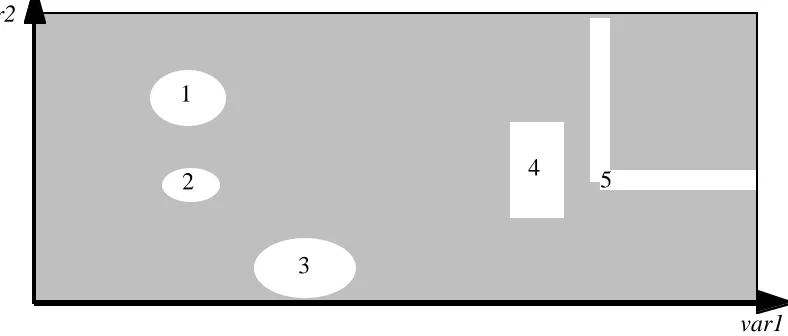
[image:7.595.106.500.111.279.2]var1 var2
Fig. 2. An example of failure regions in a two-dimensional demand space:
each demand is a single reading of two input variables, var1 and var2. Various
authors have reported the shapes of failure regions in actual programs with
multi-dimensional demand spaces [9, 10, 11]. Besides simple shapes like
those shown above, they have found intuitive shapes, including
non-connected regions like arrays of separate points or lines.
Each demand in the demand space has a certain (possibly unknown) probability of
happening during the operation of the controlled system. If we add up the probabilities of
all those demands that are failure points for both versions, we obtain the probability of
failure on demand (PFD) of the two-version protection system.
This is essentially the basis of the models used in [3] and [4] .
2.2. Faults and their introduction
We know from experience that a mistake in design will not usually affect a single point in
the demand space, but a whole set. If the mistake is made, the whole set of points becomes
a failure region; if not, the failure region will not be there.
So, our simple model considers that there is a fixed set of possible faults, each one with its
associated failure region, and each corresponding to one of the mistakes that may be
made. A mistake, here, is a mistake of the whole development process, so that a fault is left
in the delivered product: it includes a whole sequence of human errors, first in the act of
unnoticed, or to be only partially fixed3. The accidental errors in the development process
select some of these faults, at random. Some faults are more likely than others to be
chosen; some failure regions are "larger" than others, in the sense that the probability that
a demand will be in these regions is higher. Developing versions for a given application
under a regime of separate development means choosing, randomly and independently,
possible subsets of this set of possible faults4.
We thus have a collection of potential faults and associated failure regions, {F1, F2, ...,
Fn}. Each one, e.g., Fi, has a certain probability pi of being actually produced in a newly
developed version (following [3], [4] again, we can think of the process of producing a
version as sampling from a distribution of possible versions). It is also characterised by its
probability qi, of being 'hit' during operation, i.e., its contribution to the unreliability of the
system.
We assume these failure regions to be non-overlapping. So, the PFD of a version is given
by the sum of the qi values of those faults that are actually present.
So far, this model is the same as the EL and LM models, except in being
"coarser-grained": we consider whole failure regions rather than individual failure points. The
conclusions of the EL and LM models about the average PFD of a two-version system
(greater than the product of the versions' average PFDs) are easily re-derived here.
However, the average reliability is not especially interesting in practical decision-making:
we need some idea of the probability of achieving a given reliability, i.e., about probability
distributions rather than averages. Such predictions cannot be obtained from the EL and
LM models, because their parameters do not describe how likely it is that a version has a
certain set of failure points or failure regions: they only describe each failure point in
isolation. We need to add some further information to the model: we add the assumption
that the mistakes are statistically independent of each other. It is as though the design team,
faced with the possibility of inserting a fault, tossed dice to decide whether to insert it or
not.
3 The concept of a "fault" corresponding to each failure region is unnecessary for this model, and the term
"fault" itself is loaded with implicit, unrealistic assumptions (cf [12]), but we use it here as a convenient simplification. Thus, "the th fault is present in version A" is a convenient short-hand for "in version A, the i-th potential failure region is actually a failure region".
4 It may be useful to recall here that assuming "independent choice" does not imply that the versions will fail
All these additional assumptions - one-to-one mapping between faults and failure regions,
non-overlapping failure regions, and independent introduction of faults - which,
incidentally, are shared by most other models of software failure processes in the
literature - are obviously false. However, 1) we believe that they do not make a big
difference on the main useful results of the model, and will argue this thesis later; and 2) it
is much easier to check and refute empirically whether they are acceptable approximations
of reality than it was for the assumptions used in previous arguments about diversity. So,
we ask the reader to accept them and follow us in examining the implications of this
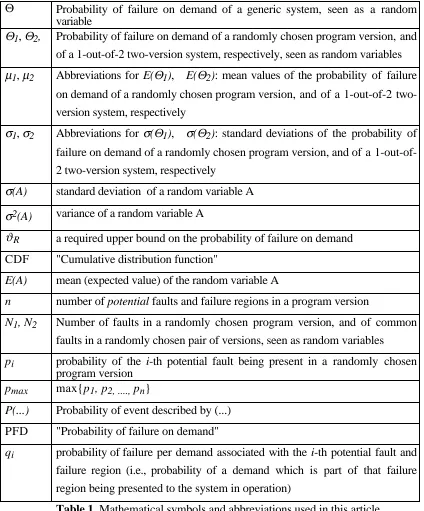
Θ Probability of failure on demand of a generic system, seen as a random variable
Θ1, Θ2, Probability of failure on demand of a randomly chosen program version, and
of a 1-out-of-2 two-version system, respectively, seen as random variables
µ1, µ2 Abbreviations for E(Θ1), E(Θ2): mean values of the probability of failure
on demand of a randomly chosen program version, and of a 1-out-of-2
two-version system, respectively
σ1, σ2 Abbreviations for σ(Θ1), σ(Θ2): standard deviations of the probability of
failure on demand of a randomly chosen program version, and of a
1-out-of-2 two-version system, respectively
σ(A) standard deviation of a random variable A
σ2(A) variance of a random variable A
ϑR a required upper bound on the probability of failure on demand
CDF "Cumulative distribution function"
E(A) mean (expected value) of the random variable A
n number of potential faults and failure regions in a program version
N1, N2 Number of faults in a randomly chosen program version, and of common
faults in a randomly chosen pair of versions, seen as random variables
pi probability of the i-th potential fault being present in a randomly chosen
program version
pmax max{p1, p2, ...., pn}
P(...) Probability of event described by (...)
PFD "Probability of failure on demand"
qi probability of failure per demand associated with the i-th potential fault and
failure region (i.e., probability of a demand which is part of that failure
[image:10.595.80.504.84.595.2]region being presented to the system in operation)
Table 1. Mathematical symbols and abbreviations used in this article
3. The PFD of one-version and of two-version systems
In this model, the PFD for a version or system is the sum of many independent random
variables, i.e., the contributions of the individual potential faults. The mean and the variance
of this sum are then equal to the sums of the means and of the variances of the individual
random variables, respectively. The i-th random variable takes the value qi with probability
probabilities become pi2 and (1-pi2 ) for a two-version system, since we consider
independent developments of the two versions. Thus:
E p qi i
i n
[Θ1]
1
=
=
∑
, E( )
p qi i i
n
[Θ2]
2
1
=
=
∑
, (1)(
)
σ(Θ1)
2 1
1
= −
=
∑
pi p qi i in
, σ(Θ2)
(
)
2 2
1
2
1
= −
=
∑
pi pi qi n
i (2)
Given n potential faults, we have a model with 2n parameters. All parameters are unknown
and unmeasurable in practice. So, direct use of these formulas is out of the question.
Despite this, we now proceed to use this model in a way that has practical value, by
selecting special cases of interest in which the study of the model is simple and does not
require detailed knowledge of all parameters. We consider two measures of reliability,
which have practical relevance in different scenarios. These are at the two ends of a
spectrum of possible scenarios:
- some programs (e.g. in some safety systems) are very simple and developed to high
standards: it is plausible that they often contain no fault. The expected value of the
number of faults is close to 0, and all the pi are close to 0. There are only two events
with non-negligible probability: having zero common faults or having one common
fault. However, even one fault (common to the two versions) may be enough to violate
the system dependability requirements. So, we are effectively interested in the
probability of the versions having no common fault.
- there are very many possible faults, and many have small qi compared to the
acceptable system PFD. We are then interested in the probability of the system PFD
not exceeding a required bound ϑR, or vice-versa in which bound will not be
exceeded with a set probability. E.g., we might ask what is the 99th percentile of the
distribution of the system PFD (i.e., an upper bound such that the system PFD has
99% probability of not exceeding it). For this scenario, we will exploit the fact that the
PFD of our systems is a sum of independent variables to approximate the distribution
of the PFD with a normal (Gauss) distribution, according to the central limit theorem.
As this is an asymptotic result, we will not know in practice how good an
approximation it is in a specific case, but this simplification is useful for studying the
3.1. Lemmas: considerations on the means and standard deviations of the PFD
We briefly study these measures, in part to be able to compare our observations with
previous studies, but more importantly to derive useful lemmas for the rest of the analysis.
3.1.1. Comparison between the mean PFDs, µ 1 and µ 2
As indicated above,
µ1 1
=
=
∑
p qi ii n
, µ2
2 1
=
=
∑
p qi ii n
(3)
We now define pmax=max{p1, p2, ...., pn}. We can thus write:
µ2 µ
2
1 1 1
1
= ≤ = =
= = =
∑
p qi i∑
p p q p∑
p q pi n
i i i
n
i i i
n
max max max (4)
Quality assurance activities strive to reduce the values of the pi parameters. The actual
values are not known. However, these parameters have intuitive meanings relating to
developers' experiences, and the typical values achieved by given software development
processes could be studied empirically. Estimating small pi parameters could be
infeasible, but to use inequality (4) we only need to estimate an upper bound.
So, if an assessor were convinced that a developer’s quality assurance activities reduce the
probability of the most common fault to, say, 10%, the assessor should also believe that a
two-version system from that developer has, on average, at least 10 times better PFD than a
single version. This may be a modest reliability gain, in particular compared with claims of
independence (for this upper-bound prediction to be equivalent to or better than
independence, we would need pmax ≤ µ1), but is an indisputable upper bound (on the
average unreliability).
3.1.2. Comparison between the standard deviations of the PFD, σ 1 and σ 2
We have seen in (2) that:
σ2 1
1
2
1
Θ
( )
=(
−)
=
∑
pi p qi n
i i (5)
σ2 2
2 1
2 2
1
Θ
( )
=(
−)
=
∑
pi p qi n
i i (6)
p2(1-p2)≤p(1-p), iff p≤ (-1+50.5)/ 2= 0.618033987
So, if we write:
( )
σ2 σ
2 2
2 2 2
1
1
= = −
=
∑
Θ pi p qi i
i n
( ) (7)
( )
σ1 σ
2 1
2 1
1
= = −
=
∑
Θ pi p qi i
i n
( ) (8)
we can also see that, if for all i, i=1,2, ..., n, it holds that pi ≤ 0.618033987, then all
summands within the square root expression for σ2 are smaller than those in the
corresponding expression for σ1 , i.e., the standard deviation - a rough indication of the
extent of variation around the average - of the PFD of a two-version system is guaranteed
to be smaller than that of a single version, provided the probabilities of individual faults are
small. We can actually derive a more informative result:
σ2
2 2 2
1
1
= −
=
∑
pi p qi ii n
( ) = p pi i pi p qi i
i n
(1 ) (1 ) 2 1
+ −
=
∑
<p p pi pi qi
i n
max(1 max) (1 ) 2 1
+ −
=
∑
= p p pi p qi n
i i
max 1 max 1
1
2 +
(
)
(
−)
=
∑
=pmax
(
1+pmax)
σ1 (9)So, if all pi are small as indicated above, we can give an upper bound for σ2 in terms of σ1
and pmax.
4. Probability of no common faults
In this section we consider a situation in which the requirement is effectively that the two
versions hare no common failure point, and ask the two questions outlined in the
4.1. Gain from diversity
Here, we compare the risks of a PFD greater than 0 in a two-version system - P(N2>0),
P(Θ2>0) - vs. that in a one-version system: P(N1>0), P(Θ1>0)5. Notice that the smaller the
ratio, the greater the advantage given by diversity. We can write:
P(Ν1=0)=Π(1-pi) , P(N2=0)=Π(1-pi2).
Therefore,
P(N2>0)
/
P(Ν1>0)=1 1
1 1
2 1
1
− ∏ −
−∏ −
=
=
( )
( )
p p
i i
n
i i
n ≤ 1 (10)
4.2. Effects of an improved process
The first question to address is what we mean by improved development process.
Changing the development process presumably implies changing all the model parameters.
A process may be better than another, e.g., from the viewpoint of average version reliability
and yet worse from some other viewpoint. We can, however, imagine at least two types of
“process improvement” whose consequences would be of practical interest:
- some specific pi values decrease: e.g., new V&V methods are introduced that make
specific fault types much less likely;
- all the pi decrease, more or less in the same proportion, e.g., because greater effort is
put into eliminating all kinds of bugs.
5 We could compare the probabilities of satisfying a requirement that there are no faults, i.e., of having a
PFD=0, in a single-version vs. in a two-version system. The advantage of diversity would be described by the ratio:
P(N2=0)
/
P(Ν1=0)=( )
( )
1
1
2 1
1 − ∏
− ∏
=
=
p p
i i
n
i i
n =Π(1+pi) ≥1,
Any change from a process to an “obviously better”, different process - i.e., a change in
which no pi increases and one or more decrease- can be described as a succession of
changes of these two types.
4.2.1. Decrease of a single parameter p i
If we derive the partial derivative of expression (10) above with respect to a generic pi, we
find that it may be positive or negative depending on the values of the parameters.
We outline a proof here for the special case of only two possible faults. (note for
reviewers: the general proof is printed here in Appendix A) We can solve the equation:
∂ ∂p
P N P N
1
2 1
0 0 0 ( ) ( )
> >
= (11)
and show that its only solution is:
(
)
(
)
p
p p p
p p
1
2 2 2
2
2 2
2 1 2 1
2 1
= + + +
− > .
Similarly, we can solve the equation
∂ ∂p
P N P N
2
2 1
0 0 0 ( ) ( )
> >
=
and show that its only solution is:
( )
(
)
p
p p p
p p
2
1 1 1
1
2 1
2 1 2 1
2 1
= + + +
− > .
Thus, the partial derivative with respect to only the greater pi can become 0. Assume that
p1 > p2 and call p1z the value of p1 for which the derivative is 0. For p1<p1z, the derivative
∂ ∂p
P N P N
1 2 1
0 0 0
( )
( )
> >
< . This implies that decreasing p1 below p1z will increase the ratio (i.e.
reduce the gain from fault tolerance).
4.2.2. Proportional decrease of all the p i parameters
In this case we represent the pi as pi = kbi and the effect of the process improvement is
analysed through the partial derivative,
∂ ∂k
P N P N
( ) ( )
2 1
0 0
> >
.
We have proven elsewhere that this partial derivative is positive, irrespective of the values
of the pi parameters and of k (note for reviewers: the proof is printed here in Appendix
B): this kind of process improvement always increases the advantage of using diversity.
4.2.3. Implications for the practitioners
The implications of the above developments are that the gain obtained from fault-tolerance
as a function of process improvement will depend on the details of how the improvement:
affects the probabilities of the various possible faults. If we assume that the improvement
affects in the same proportion every possible fault, then the gain is always guaranteed to
increase with the process quality. This view is popular and recently argued, for instance, in
[1]. In our model, however, such a relationship between the process quality and the gain
from fault-tolerance has only been proved under an assumption, which is hardly realistic,
of all faults being proportionally affected by the process improvement. In the second
extreme case, when the process improvement only affects a single fault, it becomes
possible to actually reduce the gain from the fault tolerance by improving the process,
which is at first sight counterintuitive. A similar observation on the effect of fault removal
on the reliability gain given by fault tolerance has been reported in [13].
A real process improvement will not match either of the two special cases we just studied:
only a more detailed knowledge of how it affects the various kinds of faults would allow
one to estimate the effect of diverse redundancy with the improved process. The most
important conclusion is that the gain from diverse redundancy is not a constant. So, one
cannot, after measuring the advantage obtained given a certain development process,
assume that fault tolerance will produce a comparable advantage given a different process.
5. Bounds on unreliability, under the normal approximation
We now discuss upper bounds on the PFD (unreliability) achieved in version or in
1-out-of-2, 2-version systems. We use the common informal phrase "x is a 99% confidence
bound on Θ" to mean "P(Θ ≤ x) = 0.99". In current practice, such formal statements about
development process-related) evidence is given about a software product, then the product
is suitable for use in a role in which the software is required to have a PFD lower than a
given bound. Such is the spirit, for instance, of standards that map reliability requirements
for software into "Safety Integrity Levels" (SILs), and SILs into recommended
development and V&V practices. This must mean that the assessor believes that the
evidence implies a certain confidence or probability that the software indeed satisfies the
reliability requirements. It is thus reasonable to ask what this assessor should believe
about a 2-version system produced by the same process.
5.1. Gain from diversity
The normal distribution is completely specified by its mean and variance, as given in the
previous section. The inverse function of the normal cumulative distribution function is
widely available, and it is thus easy to derive confidence statements in terms of the mean µ
and the standard deviation σ of the normal distribution, of the form: "The probability of
the PFD being less than or equal to the required bound ϑR=µ+kσ is α". For instance,
P(Θ≤µ+3σ)=0.99865003. We can answer a question like "What is a value of ϑ such that
P(Θ≤ϑ)=0.99?" by observing from the published tables that the 99% confidence level
corresponds to ϑ=µ+2.33 σ.
We therefore study the value given by our model to the expression (µ+kσ), where the
factor k>0, chosen according to the required confidence, appears as a constant parameter.
Given a required confidence and thus a required k, it is obviously desirable for the
distribution of the PFD to be such that µ+kσ to be as small as possible.
The first question is: given a certain bound on the PFD of a single-version system, Θ1,
what can we say about a corresponding bound (same confidence) for a two-version
system, Θ2? This is easily derived. Applying (4) we obtain:
µ2+kσ2≤ pmax µ1 + k pmax(1+ pmax) σ1 (11)
If we do not know the values of µ1 and σ1 , but only a certain bound (µ1+kσ1), we can
further manipulate this expression to derive a slightly looser upper bound:
µ2+kσ2 ≤ pmax µ1 + k pmax(1+pmax) σ1 <
I.e., given any confidence bound for the PFD of a one-version system, the corresponding
bound for the PFD of a two-version system is smaller by at least the ratio
pmax(1+pmax). This assures us of a small but guaranteed gain from diversity (we must
remember that we are talking about bounds; the actual gain may be much greater, but to
know it we would need to know the values of the qi and pi ). Considering these gains for a
few values of pmax we find:
pmax pmax(1+pmax)
0.5 0.866
0.1 0.332
0.01 0.100
The last line gives us a 10-fold improvement, from using diversity, in any confidence
bound on system PFD: being able to trust such a reduction factor ("β-factor" value) would
already be a practical advantage in many safety assessments. For even lower values of
pmax, clearly pmax(1+pmax) ≈ pmax .
If assessors have estimates of µ1 and σ1 rather than of a confidence bound (µ1 +kσ1),
then upper bounds on Θ2 can be tighter, with greater advantage over a single-version
system; especially so, if σ1 is small and/or comparatively low confidence is accepted: the
ratio reduces again to pmax if either σ1 tends to 0 (i.e., if the development process is very
predictable, with low variance in the reliability of its products) or if we want a 50%
confidence bound - the median of the distribution, which equals its mean. For instance, if
we know that µ1=0.01 and σ1 =0.001, and we are interested in an 84% confidence bound
(k=1), this is 0.011 for one version; for a two-version system, even with pmax as high as
0.1, our upper bound is 0.001 (an improvement by an order of magnitude) if we use our
first formula above, but a more modest 0.004 if we use the second formula.
5.2. Effects of an improved process
We do not yet have theorems about the effects of process improvement on reliability
bounds under the normal approximation. Based on numerical solutions of special cases
we conjecture that:
• the reliability gain obtained from fault-tolerance (expressed as the ratio between upper
bounds on Θ1 and Θ2) improves with forms of process improvement that reduce the
• this gain may increase or decrease with a process improvement that affects only one of
the pι parameters.
If we measure the reliability gain as the difference between the upper bounds
(µ1+kσ1) − (µ2+kσ2), we find that itimproves with any increase in any of the pι.
6. Discussion, appropriateness of the assumptions
Our results in the last two sections yield some useful indications for practical decisions.
However, these depend on the truth of the assumptions used in the modelling. All
modelling is an exercise in abstraction, trying to achieve simplicity by discarding those
aspects of reality that are indeed negligible. We now discuss the assumptions we have
used and to what extent we can expect that their departures from reality have indeed
negligible effects.
6.1. Non-independence between development errors on the same version
In reality, there is no clear evidence that the possible mistakes in the development of a
program occur (or are avoided) independently. Results from any one experiment can only
give weak evidence to support or refute this assumption. There are reasons for not
believing in independence. If we try to speculate about why there may be correlation
between the presence of different possible faults in a (randomly chosen) version, we can
produce conflicting, plausible arguments:
- there are factors that would produce some positive correlation among the occurrences
of certain mistakes in developing a program, e.g. those mistakes that are due to a
common conceptual error;
- there are factors that would tend to produce negative correlation, e.g. if schedule and
budget limits mean that extra effort can be dedicated to avoiding certain classes of
faults only at the expense of others. For instance, the random discovery of some
problems early in the project schedule might divert resources from dealing with any
other potential problem.
We do not know the weights of these contrasting factors in practice. If the probabilities of
individual mistakes are quite low and the probability of any set of them occurring together
is much lower than their individual probabilities of occurrence, the models assuming
independence should produce predictions that are not too far from reality.
then, they can be considered as one mistake, with a resulting failure region which is the
union of those associated to the two mistakes. So, solving these models for higher values
of the qi parameters (and correspondingly lower values of n) gives a first approximation to
modelling the effects of positive correlation. Studying the sensitivity of any predictions to
higher values of the qi parameters is a protection against this particular violation of the
model assumptions.
In conclusion, the possibility of non-zero correlation between the presence of different
faults in a version does not much reduce the usefulness of our model.
6.2. Possibility of failure regions that overlap in the demand space
In reality, the potential failure regions of different faults overlap in various ways. So, it is
not true that qi
i n
=
∑
≤1
1. Actually, removing this constraint seems desirable: it is a serious
artificial constraint on the parameter values for our models; but it seems that we would not
know how to substitute it and still be able to solve the models. Usually, when two faults
with overlapping failure regions are both present, the resulting failure region is the union
of the two; but other cases are possible, in which they "mask" each other over some subset
of this union. Trying to model such minute details seems useless; the general case of
interest is that if two or more faults are present, their contribution to the PFD is not
necessarily equal to the sum of their individual contributions, but may be less. In some
cases, this complication does not cause serious problems with our models, e.g., if the
probability of a version containing multiple faults with large overlaps among their failure
regions is so small that this event does not substantially affect the statistics of the PFD.
Otherwise, assuming that failure regions do not overlap is a pessimistic assumption,
usually well-accepted when we deal with safety and reliability. The model would then
assign non-zero probability to PFD values greater than 1, but these non-zero probabilities
would still be much smaller than the probabilities of reasonable values of PFD, so they can
be ignored without serious error. Two drawbacks instead apply to substantially pessimistic
predictions: we could no longer trust our estimates of the relative advantage of a
two-version system (while still trusting the estimates of the achieved PFD as upper bounds for
the actual achieved PFD); and if we used these predictions as prior probabilities for
Bayesian inference from observed behaviour of a system, pessimistic priors might
accidentally produce optimistic posteriors. So, a study of inference methods would require
In conclusion, the reality of overlap between possible failure regions does not affect the
usefulness of our model for very reliable software, and of the model's use for absolute
pessimistic prediction in general.
6.3 Unique 1-to-1 mapping between faults and failure regions
In practice, for any given failure region there will be multiple possible faults that could
introduce it, and mistakes that could cause such faults. This increases an assessor's
difficulty in choosing the pi parameters, or pmax when only pmax is needed. Presumably,
assessors will derive beliefs about these parameters from their own experience of faults
found, or mistakes detected, in circumstances considered similar to those of the project
being assessed. Let us stipulate that an assessor is indeed able to select from memory
appropriate similar situations, and properly infer the probabilities of mistakes being made
(or of faults being inserted) and not corrected. But if several possible faults would cause
the same failure region, the probability of that failure region being present could be close
to the sum of the probabilities of those faults: an assessor would be at risk of
underestimating pmax.
The other major problem is of course that if all the pi are small, then the assessors'
experience of these faults would be very limited; actually, the assessors' beliefs could be
based on kinds of faults that are relatively easy to detect and eliminate (and thus would be
noticed often) rather than on types that are more likely to remain in the finished products.
But this problem is common to all approaches depending on the assessors' judgement,
whether applied to diverse systems or non-diverse systems and whether using explicit
mathematical representations or not.
In conclusion, when 1-to-1 mappings between fault, code defects and failure regions
cannot be trusted, the only way of trusting the model's conclusions is to apply the model to
the probabilities of failure regions being present rather than of code defects.
7. Conclusions
Compared to previous discussions of the advantages of diversity, this paper offers these
elements of progress:
- our model is based on assumptions that refer more immediately to physical
phenomena (like human errors in development) rather than to abstract aggregated
sufficiently accurate to support decisions, at least about how best to achieve reliability
if not about accepting specific reliability claims;
• if this model turns out to be reasonably accurate, it can be a basis for analysing future
statistical data and especially for drawing inference on the reliability of a
design-diverse system from its behaviour in operation, i.e., to help in assessing the reliability
of a specific system;
• we discuss measures of interest in practical decision-making, rather than the average
reliability studied in previous literature.
Obviously, the results described here should be validated against empirical results. There
are the usual difficulties that practical industrial projects only develop a few versions of
any given application, so that validation of any general prediction about probability
distributions would depend on sophisticated collation of data from many projects; and that
these program versions are usually highly reliable, so that failure rates cannot be estimated
with much accuracy. Turning to published experiments, we have observed for instance that
in the Knight and Leveson experiment [2, 16, 17] diversity reduced not only the sample
mean of the PFD of the 27 program versions produced, but also –greatly- its standard
deviation. At this strictly qualitative level, our conclusions are supported. On the other
hand, the data do not fit (nor would we expect them to fit, given the few faults observed) a
normal approximation for the distribution of PFD, so that we cannot check the relationship
predicted in section 5 to hold between distributions for cases in which the normal
approximation applies. We plan to continue such checks of model predictions against
previously published data, both exploiting more published data sets and looking for more
sophisticated ways of using the data to challenge our conclusions.
Extending experimental knowledge of design diversity to the point that we can base
practical recommendations, with high confidence, on empirical knowledge alone is
infeasible. In practice, engineering decisions always need to use a combination of
empirical knowledge and analytical extrapolation. The advantage of basing the
extrapolation on rigorous mathematical reasoning is in the first place consistency: among
the intuitive predictions without strong scientific bases, we can at least weed out those that
would make our body of knowledge self-contradictory, and signal the important gaps in
this body of knowledge. The practice of assessing software, diverse or otherwise, as
compliant with quantitative reliability requirements is now a matter of mostly intuitive
judgement by dedicated, experienced assessors, in the best case, and of verifying
compliance with "software safety standards", with no proven value in reliability prediction,
in the worst case. Assessors can use our results (e.g. formulas (9), (11), (12)) for
assumptions seem to fit their existing situation, and on the parameter values that their
experience suggests or their current practice implies, they will find that either our results
lend some extra confidence in current practice, or raise questions about it and specify
some experimental tests to answer these questions.
As for decisions about whether and when diversity is worth using, our results are mostly
warnings against oversimplification. Switching to a “better” process that produces fewer
of all kinds of faults should make diversity even more useful; but for a generic
improvement the gain given by diversity may increase or decrease, possibly to the point of
making it useless.
An advantage of our results is that they depend on the effects of a development process on
the probabilities of failure regions being created in the product, rather than directly on its
effects on the failure behaviour of the products. So, the parameters we use are reasonably
close to the experience of real-world assessors. Our discussion, though, confirms the need
for more knowledge on human error in software development. Research in this area would
require software-specific experimental work taking advantage of existing knowledge in
cognitive psychology.
Desirable extensions of this work are: first, empirical checks on the assumptions made and
the accuracy of predictions; further study of the cases of "forced" and "functional"
diversity; and combining this kind of models with inference from observations during a
specific project [14]: it would seem a good idea to apply a family of prior distributions for
a product's reliability parameters that are based on this plausible physical model rather
than chosen, as is frequently the case, for computational convenience only.
Acknowledgments
The work described in this paper was funded in part by project DISPO (DIverse Software
PrOject), funded by Scottish Nuclear (later British Energy) and by project DISCS
(Diversity In Safety Critical Software), funded by the Engineering and Physical Sciences
Research Council..
References
[1] L. Hatton, "N-Version Design Versus One Good Version", IEEE Software, 14, pp.
71-76, 1997.
N-[3] D. E. Eckhardt and L. D. Lee, "A theoretical basis for the analysis of multiversion
software subject to coincident errors", IEEE Transactions on Software Engineering, SE-11,
pp. 1511-1517, 1985.
[4] B. Littlewood and D. R. Miller, "Conceptual Modelling of Coincident Failures in
Multi-Version Software", IEEE Transactions on Software Engineering, SE-15, pp.
1596-1614, 1989.
[5] B. Littlewood, P. Popov and L. Strigini, "Modelling software design diversity - a
review", ACM Computing Surveys, pp. to appear, 2001.
[6] B. Littlewood, P. Popov and L. Strigini, "N-version design Versus one Good Version",
in Proc. International Conference on Dependable Systems & Networks (FTCS-30,
DCCA-8) - Fast Abstracts, New York, USA, 2000, pp. B42-B43.
[7] P. Popov, L. Strigini and B. Littlewood, "Choosing between Fault-Tolerance and
Increased V&V for Improving Reliability", in Proc. International Conference on Parallel
and Distributed Processing Techniques and Applications (PDPTA'2000), Monte Carlo
Resort, Las Vegas, Nevada, USA, 2000,
[8] B. Littlewood, P. Popov and L. Strigini, "A note on reliability estimation of
functionally diverse systems", Reliability Engineering and System Safety, 66, pp. 93-95,
1999.
[9] P. G. Bishop and F. D. Pullen, "PODS Revisited - A Study of Software Failure
Behaviour", in Proc. 18th International Symposium on Fault-Tolerant Computing, Tokyo,
Japan, 1988, pp. 1-8.
[10] P. E. Ammann and J. C. Knight, "Data Diversity: An Approach to Software Fault
Tolerance", IEEE Transactions on Computers, C-37, pp. 418-425, 1988.
[11] L. Hatton and A. Roberts, "How accurate is scientific software?", IEEE Transactions
on Software Engineering, 20, pp. 785-797, 1994.
[12] P. Frankl, D. Hamlet, B. Littlewood and L. Strigini, "Evaluating testing methods by
delivered reliability", IEEE Transactions on Software Engineering, SE-24, pp. 586-601,
1998.
[13] K. B. Djambazov and P. Popov, "The effects of testing on the reliability of single
version and 1-out-of-2 software", in Proc. 6th Int. Symposium on Software Reliability
[14] B. Littlewood, P. Popov and L. Strigini, "Assessment of the Reliability of
Fault-Tolerant Software: a Bayesian Approach", in Proc. 19th International Conference on
Computer Safety, Reliability and Security, SAFECOMP'2000, Rotterdam, the Netherlands,
2000.
[15] P. P. Korovkin, "Inequalities", Pergamon Press, 1961.
[16] J. C. Knight and N. G. Leveson, "An Experimental Evaluation of the Assumption of
Independence in Multi-Version Programming", IEEE Transactions on Software
Engineering, SE-12, pp. 96-109, 1986.
[17] S. S. Brilliant, J. C. Knight and N. G. Leveson, "Analysis of Faults in an N-Version
Software Experiment", IEEE Transactions on Software Engineering, SE-16, pp. 238-247,
Appendix A
We analyse how the ratio between the probability of having at least one common fault in
an 1-out-of-2 system and the probability of having at least one fault in a single-version
system changes when the improvement/decay of the development process affects only a
single fault. This ratio indicates the superiority of a two-channel system over a single
channel. Small values of the ratio (approaching 0) mean a high gain from fault-tolerance,
while values of the ratio approaching 1 indicate limited gain. The process improvement is
represented by decreasing the parameters {pi}. Thus if the derivative of the ratio wrt a
particular pi is negative, this implies that the the process improvement increases the gain
produced by fault tolerance, while a positive derivative implies that the process
improvement reduces this gain.
Formally, we are interested in the following derivatives:
(
)
( )
∂ ∂
∂ ∂ p
P N
P N p
p
p
i i
i i
i i
( )
( )
2 1
2
0 0
1 1
1 1
> >
=
− −
− −
∏
∏
.(
)
( )
( )
( )
(
)
( )
( )
( )
∂ ∂ ∂ ∂ p P NP N p
p
p
p p p p p
p p p i i i i i i i j j i i i i i j j i i i i j j i ( ) ( ) 2 1 2 2 2 2 2 0 0 1 1 1 1
2 1 1 1 1 1 1
1 1 2 1 > > = − − − − = = − − − − − − − − − = = −
∏
∏
∏
∏
∏
∏
∏
∏
≠ ≠ ≠( )
( )
( )
(
)
( )
( )
( )
( )
( ) ( )
[
( ) (
)
]
( )
− − − − − + − − − − = = − + − − − − − − − − − ≠ ≠ ≠ ≠ ≠ ≠ ≠∏
∏
∏
∏
∏
∏
∏
∏
∏
∏
2 1 1 1 1 1
1 1
1 2 1 1 1 1 2 1 1
1 1
2 2
2
2 2
p p p p p p
p
p p p p p p p p
p i j j i i i j j i i i j j i i i j j i i j j i j j i j j i
i i i
i
( )
( )
( ) ( )
[
]
( )
( )
( )
( ) ( )
i j j i i j j i j j i j j ii i i
i i j j i i j j i j j i j j
p p p p p p p p
p
p p p p p
∏
∏
∏
∏
∏
∏
∏
∏
∏
= = − + − − − − − − + − − = = − + − + − − ≠ ≠ ≠ ≠ ≠ ≠ ≠ 22 2 2
2
2
1 2 1 1 1 1 2 2 1
1 1
1 2 1 1 1 1
( )
( )
( ) ( )
( )
( )
( )
≠ ≠ ≠ ≠∏
∏
∏
∏
∏
∏
− − − = = − + + − − − − − i i i i j j i j j ii i j
j i
i i
p
p
p p p p p
p
1
1 1
1 1 2 1 1 1
1 1
2
2
2
2 .
Clearly, the sign of the derivative depends on the term in the curly brackets:
( )
1+ 2 + −( )
1 2( )
1− 1 − ≠ ≠
∏
pj p p∏
pj i
i i j
j i
.
With positive derivative the gain increases while negative derivative implies the gain from
diversity decreases, which is counterintuitive and not discussed in the literature before.
Here we do not go into details of finding out under which general conditions the partial
derivatives become negative and under which they are positive. Below we demonstrate on a
special example that both signs for the partial derivative are indeed possible.
Assume that we have only two classes of faults and their respective probabilities are p1 and
p2. The partial derivatives are:
(
)
[
( )( )
]
(
)( )
(
)
[
]
( )
∂ ∂p P NP N p p p p
p p p p p p p p p p p
p p p p p p p p p p
p p p p p
1 2
1 2 1 2 1
2
1 1 2 2
2 1
2
1 1 2 2
2
1 1 2
1 1 2 1 1
2 2 2 1 2 2 1 2 2
1 2 1 2
2 2
0
0 1 2 1 1 1
2 2 1 1 1 2 2 1 1 2 1
2 2 1 2 2 1
2 2 ( ) ( ) > > ∝ + + − − − = = + + − − − = + + − − + − = = + + − + − + − − =
= + − + 1 2
( )
(
)
(
)
2 1 2 2 1 2 2 2
1 2 2 2
2 2
1 2
p − p p =p − p + p p + p −p .
We can solve the equation:
( ) (
)
p12 p p p p p
2 2
1 2 2 2
2 2
1− +2 + − =0.
The roots are:
(
)
(
)
( )
( )
(
)
( )
(
)
( )
(
)
( )
(
)
(
( )
(
)
)
p
p p p p p p
p
p p p p p p
p
p p p p
p
p p p p
p
p p p
p 1 2 2 2 2 2 2 2 2 2 2 2 2 2 2 2 2
2 2 2
2 2 2 2 2 2 2 2 2 2 2 2
2 2 2 2
2 2
2 2 2
2 2
2 4 1 4 1
2 1
2 2 1 2 1
2 1
2 2 2 2
2 1
2 1 2 2 1
2 1
2 1 2 1
2 1 = + ± + + − − = + ± + + + − − = = + ± + − = + ± + − = + ± + − .
Now it can be seen that one of the roots is positive,
(
(
)
)
( )
p
p p p
p
1
2 2 2
2 2
2 1 2 1
2 1
= + + +
− . The
second root is negative or zero and therefore is not of interest because p1 is a probability.
So, there is exactly one value p1z of p1 where the partial derivative becomes 0. One can see
that p1z>p2. Moreover, the expression of the partial derivative above is clearly
monotonically increasing with p1 (the coefficients of the terms containing p1 are positive,
so the partial derivative is negative for p1z<p1z and positive for p1z>p1z.
The implications of this analysis are as follows: when we improve the process of software
development by only affecting the probability of a single class of faults we are not
guaranteed to increase the gain from the two-channel system as seen in the case of all
process actually results in the two-channel system becoming less superior compared to a
single channel system than before the improvement of the process. Where the trend
reversals take place depends on the parameters, {pi}.
Appendix B
Clearly, the process improvement is not likely to affect only a single fault. A more
plausible assumption is that the process improvement affects the probability of all types of
faults. We analyse a special case of such a scenario - when the process improvement is in
the same proportion with respect to all faults. More formally, we model the quality of the
process by a single variable, k, and represent the probabilities of faults as:
pi =kbi
Now the effect of the process quality on the gain from the two-channel system can be seen
by taking the partial derivative of the ratio P N
P N
( )
( )
2 1
0 0
>
> with respect to k:
( )
(
)
(
)
∂ ∂
∂ ∂ k
P N
P N k
kb
kb
i i
i i
( )
( )
2 1
2
0 0
1 1
1 1
> >
=
− −
− −
∏
( )
[
]
( ) ( )[
]
( )[
( )]
( ) ( ) ∂ ∂ ∂∂ ∂ ∂ ∂ ∂ k P NP N k
kb
kb
k kb kb kb k kb
kb i i i i i i i i i i i i i i ( ) ( ) 2 1 2 2 2 2 0 0 1 1 1 1
1 1 1 1 1 1 1 1
1 1 > > = − − − − = = − − − − − − − − − − − =
∏
∏
∏
∏
∏
∏
∏
( )( )
[
( )]
(
)
( )(
)
(
)
( )(
)
= − − − − − − − − − = = − + − − − −∏
∑ ∏
∏
∑ ∏
∏
∑ ∏
∏
∏
∑
≠ ≠ ≠ ≠1 1 2 1 1 1 1
1 1
1 2 1 1 1 1 2 1
2 2 2
2
2
kb b k kb kb b kb
kb
b kb b k kb kb b kb b k
i i i i j j i i i i i j j i i i i i j j i i j j i i i i i
j i
(
)
( )( )
(
)
(
)
( )( )
[
( )]
( )(
)
+ − + − − = = − + − − − − − + − − = = − + ≠ ≠ ≠ ≠ ≠ ≠∏
∏
∏
∏
∑ ∏
∏
∏
∑ ∏
∏
∑ ∏
kb kb kbb kb b k kb kb b kb b k kb
kb
b kb b k
j j i i i j i i i i i j j i i j j i i i i i
j i i
j i i i i i j j i i 1 1 1
1 2 1 1 1 1 2 1
1 1
1 2 1
2
2 2
2
2
(
)
( )( )
( )( )
(
)
(
)
( )( )
( )( )
kb kb b kb b k
kb
b kb b x kb kb b kb b x
kb b j j i i i i i j i j i i i i i j j i i j j i i i i i j i j i i i i ≠ ≠ ≠ ≠ ≠
∏
∏
∑ ∏
∏
∑ ∏
∏
∏
∑ ∏
∏
− − − − − − − = = − + − + − − − − − = =1 1 1 1
1 1
1 2 1 1 1 1 1
1 1 2 2 2 2 2
(
)
(
)
( ) ( )( )
( ) i j j i i j j i i i i i i j j i i ikb b k kb kb b b k kb
kb
∑ ∏
∏
∏
∑
∏
∏
− + − + − − − − − ≠ ≠ ≠1 2 1 1 1 1 1
1 1
2 2
2 .
Clearly the denominator is non-negative. Therefore, we can only evaluate the numerator's