This is a repository copy of Expectations and the saving behaviour of children: analysis of the U.S. panel study of income dynamics.
White Rose Research Online URL for this paper: http://eprints.whiterose.ac.uk/74396/
Monograph:
Brown, S. and Taylor, K. (2012) Expectations and the saving behaviour of children: analysis of the U.S. panel study of income dynamics. Working Paper. Department of Economics, University of Sheffield ISSN 1749-8368
2012015
[email protected] https://eprints.whiterose.ac.uk/ Reuse
Unless indicated otherwise, fulltext items are protected by copyright with all rights reserved. The copyright exception in section 29 of the Copyright, Designs and Patents Act 1988 allows the making of a single copy solely for the purpose of non-commercial research or private study within the limits of fair dealing. The publisher or other rights-holder may allow further reproduction and re-use of this version - refer to the White Rose Research Online record for this item. Where records identify the publisher as the copyright holder, users can verify any specific terms of use on the publisher’s website.
Takedown
If you consider content in White Rose Research Online to be in breach of UK law, please notify us by
Sheffield Economic Research Paper Series
SERP Number: 2012015
ISSN 1749-8368
Sarah Brown
Karl Taylor
Expectations and the Saving Behaviour of Children: Analysis of the U.S.
Panel Study of Income Dynamics
June 2012
Department of Economics University of Sheffield 9 Mappin Street Sheffield S1 4DT
United Kingdom
Expectations and the Saving Behaviour of Children:
Analysis of the U.S. Panel Study of Income Dynamics
Sarah Brown and Karl Taylor
Department of Economics University of Sheffield
9 Mappin Street Sheffield S1 4DT
United Kingdom
Abstract: In this paper, we analyse the saving behaviour of a sample of children
drawn from the 2002 and 2007 Child Development Supplements of the U.S. Panel
Study of Income Dynamics. In particular, we focus on the influence of children’s
expectations and attitudes towards the future on the total level of children’s savings as well as on savings specifically for future education and savings for other purposes. Overall, our findings suggest that the saving behaviour of children, as measured by the level of savings, appears to be influenced by their expectations, especially expectations regarding future educational attainment and life expectancy. Specifically, the level of savings held by children is monotonically increasing in the expected level of educational attainment and children who are pessimistic about their future life expectancy are found to hold lower levels of savings, which is consistent with discounting future consumption heavily.
Key Words: Expectations; Household Finances; Intergenerational Analysis; Saving.
JEL Classification: D12; D14
Acknowledgements: We are grateful to the Institute for Social Research, University
of Michigan for supplying the Panel Study of Income Dynamics 2001 to 2007. We are especially grateful to Jennifer Roberts and Anita Ratcliffe for excellent comments and advice. The normal disclaimer applies.
2
1. Introduction and Background
In the aftermath of the recent financial crisis, there has been increasing interest in the
financial literacy of young adults and in the role of financial education in preparing
children and young adults for entry into a complex economic and financial
environment. Evidence has suggested that the financial literacy of children and young
adults is somewhat lacking. For example, Lusardi et al. (2008) find that only 27% of
young individuals in their sample drawn from the U.S. National Longitudinal Survey
of Youth were knowledgeable about basic financial concepts. Hence, it is perhaps not
surprising that a number of individuals encounter financial problems during
adulthood: Garon (2012), p. 1, comments that, in the U.S., ‘it has become painfully
clear that millions lack the savings to protect themselves against foreclosures,
unemployment, medical emergencies, and impoverished retirements.’ Hence, the
general consensus amongst academics and policy-makers is that we are not saving
enough, especially in the context of saving for retirement, yet research into how
attitudes towards saving are influenced at an early stage of the life cycle is relatively
scarce.
From a policy perspective, in the U.S., there has been evidence reported in
support of financial education programmes as a means to enhance financial outcomes.
For example, Bernheim et al. (2001) explore the effect of high school financial
curriculum mandates, which were adopted by some U.S. states, on asset accumulation
and saving during adulthood. Such mandates were found to increase exposure to
financial education. Moreover, asset accumulation and saving were found to be higher
amongst individuals who received such education. In addition, the findings indicated
a positive relationship between the amount saved during adulthood and having saved
3
require financial education at high school: for example, Cole and Shastry (2009)
report that 28 U.S. states have mandatory financial literacy programmes at high
school. However, their findings, which are based on a different data set and
instrumental variable strategy to that of Bernheim et al. (2001), indicate that some
U.S. state mandated financial literacy programmes did not influence saving
behaviour, suggesting that the role of such programmes may be less clear-cut. Despite
such evidence, there has been increasing support for formal financial education at
elementary school, see, for example, Sherraden et al., 2011, who explore a four year
elementary school based programme, ‘I Can Save’, where those children who
participated in the programme attained higher scores in a fourth grade financial
literacy test than those in the control group.1
It is apparent that children and young adults may acquire financial literacy
skills from their parents as well as from school and formal education. For example,
Mandell (2007) reports that parents are the key source of financial information for
students at high school. Such findings tie in with the recent education literature
exploring the relationship between the educational attainment of parents and their
children (see Black and Devereux, 2011, for a recent survey), where extensive
empirical evidence has supported the existence of a strong positive intergenerational
association in educational attainment, which clearly has implications for future
income and wealth generation.2 A related strand of the literature on intergenerational
aspects of economic and financial attitudes has focused on estimating the
1 There has also been recent interest amongst policy-makers in the U.K. in promoting financial literacy
amongst children and adults to enhance financial outcomes. For example, ‘Economic Well-being and Financial Capability’ forms part of the U.K. National Curriculum for schools, albeit a non-statutory component, with the aim of teaching school pupils to manage their money and finances effectively. Guidance on how to incorporate personal finance education into the curriculum is provided nationally by the Department for Education.
2
4
intergenerational elasticity of wealth between parents and their adult children. For
example, Charles and Hurst (2003) estimate this elasticity at 0.37 for the U.S. using
data from the Panel Study of Income Dynamics (PSID), whilst Arrondel (2009)
reports an estimate of 0.22 for France. Thus, the findings in the existing literature
support a sizeable intergenerational correlation of wealth.
Despite such increasing interest in financial literacy, financial outcomes and
financial education programmes, research on the saving behaviour and the financial
decision-making of children and young adults remains relatively scarce, especially in
the economics literature. Furthermore, as Elliott et al. (2011), p. 1101, comment
‘research and policy on savings often overlooks children as agents, capable of saving.’
Although, as Crossley et al. (2012) argue, children are unlikely to hold significant
financial assets or to be faced with any ‘substantive financial decisions’, it is apparent
that they may be faced with decisions on a smaller scale such as whether to save for a
toy or the latest mobile phone and such decision-making may shape their attitudes
towards finances in the future. In addition, the rising consumption of children and
young adults has started to attract the attention of researchers leading to more focus
on this increasingly important aspect of household financial decision-making
(Sherraden et al., 2011).
There is growing interest in this area from a range of disciplines including
economics, education and psychology and sociology. For example, using U.S. data,
Knowles and Postlewaite (2004) find that parents’ saving behaviour influences the
saving behaviour of their adult offspring. Similarly, Cronqvist and Siegel (2010),
using data on Swedish twins aged between 18 and 65, explore the origins of saving
behaviour. Their findings suggest that an individual’s propensity to save is influenced
5
parent to offspring transmission in saving behaviour is found to be important for
young individuals. There has also been some interest in the saving behaviour of young
children in the economic psychology literature. For example, Otto et al. (2006)
explore children’s use of saving strategies in the context of saving for a toy when
faced with income uncertainty. The results indicated that children aged between 9 and
12 are able to formally manage their money, with children aged 12 frequently making
‘bank’ deposits as a means to avoid the temptation to spend tokens on, for example,
sweets.
We contribute to the existing literature on household finances by exploring the
saving behaviour of children. In particular, we focus on the influence of children’s
expectations and attitudes towards the future on their saving behaviour. Although
individuals’ expectations play a central role in economic theory, microeconometric
evidence of their causes and effects is, somewhat surprisingly, relatively sparse. The
work that does exist is predominately focused on adults’ financial expectations,
exploring the motivation behind, for example, debt accumulation, spending, saving
and investment (see, for example, Brown et al., 2005, 2008, Das and van Soest, 1999
and Souleles, 2004). Hence, we expand this literature by analysing the influence of
the expectations of children on their saving behaviour, thereby bringing together two
relatively unexplored areas of the economics literature. Overall, our findings suggest
that the saving behaviour of children, as measured by the level of savings, appears to
be influenced by their expectations, especially in the case of expectations regarding
future educational attainment and life expectancy. Specifically, the level of savings
held by children is monotonically increasing in the expected level of educational
6
found to hold lower levels of savings, which is consistent with heavy discounting of
future consumption.
2. Data and Methodology
We analyse data drawn from the U.S. Panel Study of Income Dynamics (PSID), which
is a panel of households ongoing since 1968 conducted at the Institute for Social
Research, University of Michigan. We focus on data from the 2002 and 2007 Child
Development Supplements (CDS), which provide additional information relating to
parents in the PSID and their children, with the objective being to provide information
on early human capital formation. We match the information in the CDS with that
available in the main head of family PSID questionnaires for 2001 and 2007, which
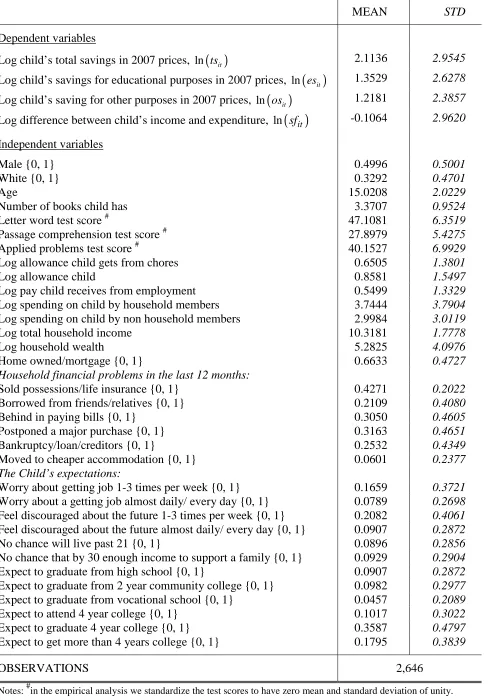
provide information on household characteristics.3 Our sample comprises 2,646
observations.
With respect to information on the saving behaviour of children, children aged
12 to 17 were asked: Do you have a savings or bank account in your name? Those
that responded that they had such an account were asked to specify how much was in
the account. The responses thus provide information relating to the stock of savings
held by the children at that point in time. The children were also asked the following:
are you saving some of this money for future schooling, like college?; how much have
you saved for future schooling?; and are you saving this money for something besides
school? Hence, we distinguish between three different types of saving in our
empirical analysis: the amount of total saving (tsit) of child i at time t; the amount
saved for educational purposes (esit) of child i at time t; and the total amount saved
for non educational purposes (osit) of child i at time t.
7
We are also able to construct a proxy for the flow of saving since information
on the total income (yit) and expenditure of the child (eit) is available, the proxy for
the flow of saving being defined as the difference between these two measures,
it it it
sf = y −e . The weekly income received by children is the sum of that received
from parental allowances or pocket money and income earned from part-time work.
With respect to the expenditure of child i at time t, eit, we focus on total expenditure
per week on: music, games, clothes, books, going out, cars, public transport, hobbies
and gifts.
As stated above, we focus on the relationship between children’s expectations
and attitudes towards the future and their saving behaviour. The CDS provides
information on expectations and attitudes relating to a range of areas, which we
exploit in order to compare the influences of expectations regarding different aspects
of the child’s life. Specifically, we analyse educational expectations as discerned from
the child’s responses to the following question: Many people do not get as much
education as they would like. How far do you think you will actually go in school? Do
you think you will: leave high school before graduation; graduate from high school;
graduate from a two-year community college; graduate from a vocational school;
attend a four-year college; graduate from a four-year college; or get more than four
years of college. We also analyse the influence of the frequency at which the child
worries that they will not get a good job when they are an adult and the frequency at
which the child feels discouraged about the future, distinguishing between: 1 to 3
times a week; and almost daily/every day. We also explore the influence of the child
believing that there is ‘no chance’ that they will have enough money to support
8
extent to which the child may discount the future, we analyse the influence of the
child believing that they will not live past the age of 21.
To analyse the relationship between expectations and children’s saving
behaviour, we treat tsit, esit, and osit as censored dependent variables in our
econometric analysis since they cannot have negative values. For total savings, tsit,
approximately 62.6% of children hold no savings. With respect to savings for future
education (esit) and for other reasons (osit), the percentages who hold no savings are
77.4% and 76.9%, respectively. Figure 1 shows the distribution of the natural
logarithm of total savings, for those children who hold savings, and also for savings
for educational purposes and for other reasons. Following Bertaut and Starr-McCluer
(2002), we employ a censored regression approach to ascertain the determinants of
( )
ln tsit , ln
( )
esit and ln( )
osit , which allows for the truncation of the dependentvariables.4 As the distributions of the dependent variables are highly skewed,
following Gropp et al. (1997), we specify logarithmic dependent variables. We denote
by
( )
*ln tsit ,
( )
*
ln esit and
( )
*
ln osit the corresponding untruncated latent variables,
which theoretically can have negative values.
We model each dependent variable via a random effects tobit specification, as
shown below for ln
( )
tsit :( )
*ln tsit =β′Xit+γExpit+ =νit θθθθ′Zit+νit (1)
( )
( )
( )
ln tsit = ln ts*it if ln ts*it >0 (2)
( )
ln tsit =0 otherwise (3)
9
where the total savings of child i at time t are given by tsit such that i=1,…,n and
t=1,…,T, Xit denotes a vector of child and household characteristics, Expit denotes
the measure of expectations and νit is the stochastic disturbance term. The structure
of the error terms is given as follows: νit = +α ηi it, where αi is an individual specific
unobservable effect, and ηit is a random error term, η ∼it IID
( )
0,σit2 .Figure 2 shows the distribution of sf , where approximately 54% of it
observations of sfit =yit−eit are negative, i.e. where weekly expenditure exceeds
weekly income indicating a gap between income and consumption behaviour, which
may be met by transfers from parents or other relatives given that children cannot
enter into formal credit arrangements. In order to explore the determinants of ln
( )
sfit ,we conduct quantile analysis given the continuous nature of the dependent variable
(see Koenker and Bassett Jr., 1978), where ln
( )
sfit =ln(
yit−eit)
if(
yit−eit)
>0;( )
( )
(
)
ln sfit = −1 ln yit−eit if
(
yit −eit)
<0, otherwise ln( )
sfit is set to zero sincethere are no values of
(
yit−eit)
between zero and unity. As stated by Brown andTaylor (2008), the advantage of quantile regression analysis over regression at the
mean (i.e. OLS) is that it provides an analysis of different parts of the conditional
distribution hence providing a fuller description of the entire distribution. This is
because when considering the effect of an explanatory variable on the dependent
variable, under quantile regression analysis, the effect is allowed to vary at different
quantiles of the conditional distribution. Thus, instead of assuming that covariates
shift only the location or the scale of the conditional distribution, quantile regression
explores the potential effects of covariates on the shape of the distribution. Hence,
10
mean, may have a statistically significant role at certain parts of the saving
distribution or may differ in terms of the magnitude of the effect, Koenker and
Hallock (2001). The quantile regression approach is given by:
( )
ln sfit =ππππθ′Xit+φθExpit+εθit, (4)
where εθit is the error term associated with the θth quantile of ln
( )
sfit and(
it it, it)
0Quantθ εθ X Exp = . The θth conditional quantile of ln
( )
sfit for a given set ofcharacteristics, Xit and expectations, Expit, is denoted by:
( )
{
ln sit it, it}
it itQuantθ f X Exp =ππππθ′X +φθExp , (5)
where ππππθ and φθ denote vectors of parameters. We explore each percentile of the
distribution in order to investigate whether the influence of expectations is uniform
across the distribution.
In terms of the explanatory variables included in the tobit and quantile
analyses, we control for characteristics of the child including: gender; ethnicity; and
age. We also control for the number of books that the child has as well as the
children’s standardized scores in the widely used Woodcock-Johnson Revised
Achievement Tests, namely, the applied problems test, the letter word identification
test and the passage comprehension test.5 In the tobit analysis, we control for the
child’s weekly allowance which is related to chores ‘like yard work or cleaning the
house’, the child’s weekly allowance which is unrelated to chores6 and the weekly pay
5 These tests have been validated extensively (see Woodcock and Johnson, 1990, for further details of
the tests). Each academic test score is standardized, i.e. normalised to have zero mean and standard deviation of unity.
6
11
received by the child for part-time work.7 In order to control for other financial
transfers received by the child, we control for total annual spending on the child by
household members as well as such expenditure by non household members. In terms
of household characteristics, we control for: annual total household income;
household wealth; and whether the house is owned outright or via a mortgage. We
also control for whether the household has done any of the following or has had any
of the following happen as a result of economic problems over the last 12 months:
sold possessions or cashed in life insurance; postponed major purchases or medical
care; borrowed money from friends or relatives; fallen behind in paying bills; filed for
or taken bankruptcy, had a creditor call or visit to demand payment, had wages
attached or garnisheed by a creditor, had a lien filed against the property as a bill
could not be paid or had the home, car or other property repossessed; or moved to
cheaper accommodation. Finally, we include state controls to allow for regional
differences in the provision of financial education in schools. Summary statistics
related to all of the variables used in our econometric analysis are presented in Table
A1 in the appendix.
3. Results
Random Effects Tobit Analysis of Saving
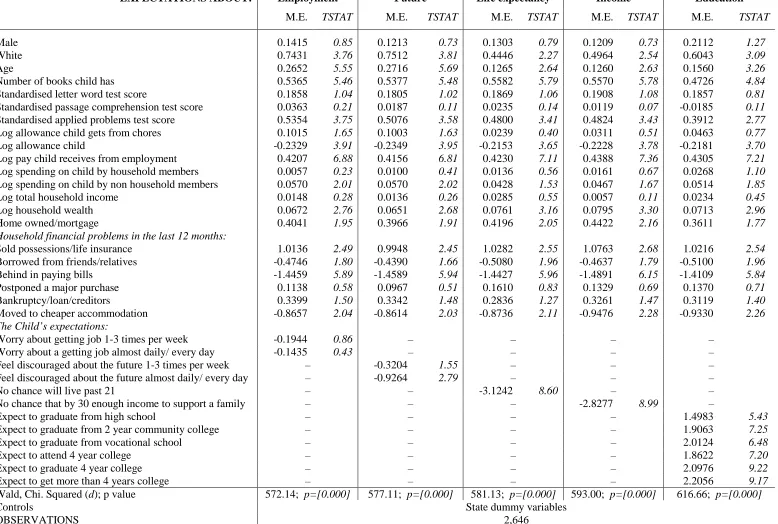
The results relating to the random effects tobit analysis of the determinants of the
level of total savings of the child are presented in Table 1, where each column
controls for a different type of expectation, namely expectations regarding
employment, the future, life expectancy, income and education. Marginal effects are
children may provide to parents such as carrying out household chores and preference shaping relates to the provision of economic education.
7 A small number of studies have explored the relationship between parental allowances and children’s
12
presented throughout and are derived from the derivative of the conditional expected
value of the truncated logged response, given the covariates, with respect to the
covariates, Z . The conditional expected value function of the truncated logged it
response, such as ln
( )
tsit from equation (1), is given by the following( )
{
ln it it}
(
' it)
' it{
(
' it)
}
E ts Z = Φ θθθθ Z //// σ θθθθ Z +σ φ θθθθ Z //// σ (and will be heavily
weighted towards zero), where φ and Φ denote the density and cumulative
distribution of the standard normal. The standard error of the regression is given by σ.
Differentiation of the expected value function with respect to Z , the kit kth covariate,
gives: ∂E
{
ln( )
tsit Zit}
/∂Zkit = Φ(
θθθθ'Zit /σ θ)
k = prob{
ln( )
tsit >0 Zit}
θk. Theprobability of having a positive outcome can be approximated by the scaling factor,
i.e. the proportion of uncensored observations of the dependent variable. The marginal
effects reported in Tables 1 and 2 are found by multiplying the estimated coefficients
through by the relevant scaling factor.
It is apparent that concerns regarding getting a job in adulthood do not appear
to influence the amount of savings held by the child. In contrast, if the child feels
discouraged about the future almost daily or every day is inversely associated with the
level of savings. Such feelings may lead to the child discounting the future heavily
with less concern for saving. In a similar vein, there is a very large and highly
statistically significant inverse effect on the level of saving if the child believes that
there is no chance that he/she will live beyond 21. Such findings are consistent with
focusing on current consumption rather than saving for the future. However, if the
child believes that there is no chance that they will earn enough income by the age of
30 to support a family is also characterised by a relatively large and statistically
13
reflects current financial difficulties or constraints faced by the child and, hence, a
low balance in their bank account. With respect to educational expectations, it is clear
that expectations about all levels of education are positively related to the level of
savings relative to expecting to leave high school before graduation. Furthermore,
with the exception of the category relating to expecting to attend a four year college, it
is apparent that the estimated effects are monotonically increasing in expectation of
attaining a higher level of education.8,9
Given that the focus of our analysis is on the role of expectations, we
comment only briefly on the results relating to the other explanatory variables, which
have consistent effects across the five specifications. Gender does not appear to
influence the amount of saving whereas age and being white are both positively
associated with the amount of saving. It is interesting to see that the applied problems
test score, which reflects aptitude in mathematics, is positively associated with the
level of savings whilst the letter-word and passage comprehension tests both have
statistically insignificant influences.
The importance of distinguishing between the sources of income of the
children is apparent with income associated with part-time work having a positive
8
It may be the case that the child’s expectations about their future educational attainment are picking up the aspirations of their parents. In the 2002 and 2007 CDS, information is provided by the primary care giver on what they hope their child will achieve, specifically they are asked: In the best of all
worlds, how much schooling would you like the child to complete? The response categories to this
question closely mirror those provided by the child (see Section 2). We have also estimated specifications including binary indicators for the parent’s aspirations about their child’s educational attainment as well as incorporating the child’s own expectations regarding their future schooling. Interestingly, for each type of saving, only the educational expectations of the child matter with the aspirations of the parent always being jointly statistically insignificant at the 5 per cent level.
9 We have also investigated whether children’s expectations still matter when we control for parental
14
influence on the amount of savings, the amount of the allowance that is unrelated to
chores having a negative influence and the amount of the allowance associated with
chores being characterised by a statistically insignificant influence. The influence of
the allowance that is unrelated to chores may be similar to a windfall effect
characterised by a large marginal propensity to consume from this additional
unearned income. For example, Imbens et al. (2001), who analyse a sample of U.S.
lottery players, find that recent winners are estimated to have lower savings rates than
individuals who won the lottery some time ago and that non-winners save more in
retirement accounts than winners.
With respect to household characteristics, household wealth is positively
related to the level of savings. Some of the controls for the existence of household
financial problems exert negative influences on the child’s level of savings, with the
exception of having sold possessions or life insurance which exerts a relatively large
positive influence. It may be the case that this positive influence reflects the fact that
the household was able to afford such purchases in the past or, alternatively, the
money raised may have been transferred to the child.
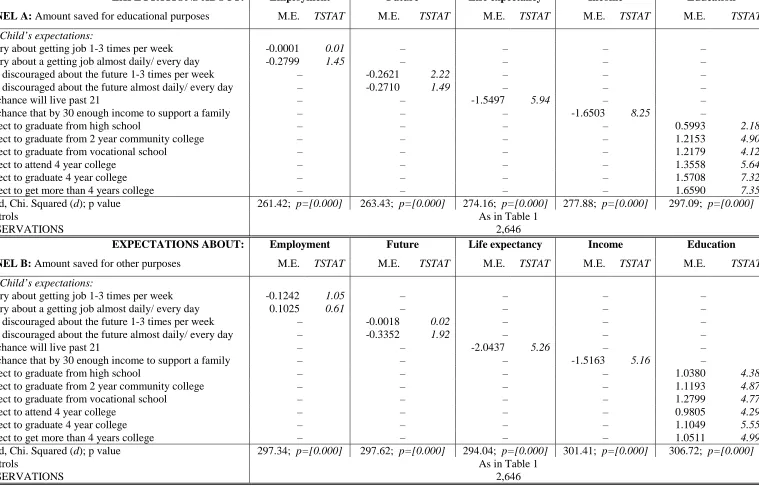
For brevity, in Table 2, where we decompose the total saving of the child into
savings for education (Panel A) and savings for other purposes (Panel B), we only
present the results related to the expectations variables. It is apparent that the pattern
of the results in Table 2 Panel A is generally in line with that presented in Table 1,
albeit with the magnitudes of the effects being somewhat larger. This is especially
apparent in the case of the inverse effect associated with the child believing that they
have no chance of living beyond the age of 21. The effects associated with
educational expectations are also heightened relative to those in Table 1, with the
15
level of educational attainment.10 In Table 2 Panel B, the results follow the same
pattern albeit with larger effects estimated in the cases of income expectations in
adulthood and educational expectations relative to those presented in Table 2 Panel
A.11
Overall, our findings suggest that the saving behaviour of children, as
measured by the level of savings, appears to be influenced by their expectations,
especially in the case of expectations regarding future educational attainment and life
expectancy. Finally, if all of the expectations variables are entered simultaneously
then only the child’s expectations about educational attainment and life expectancy
are statistically significant, where the marginal effect of the latter dominates in terms
of magnitude.
Quantile Analysis of the Difference between Income and Expenditure
Tables 3A to 3C summarise the results from the quantile analysis presenting the
effects of the five types of expectations on each percentile of the distribution of our
proxy for the flow of saving, sfit = yit−eit. Negative values for the average difference
between income and expenditure exist across the 10th to the 50th deciles, with this part
of the distribution being characterised by expenditure in excess of income.
In Table 3A, it is apparent that having concerns regarding future employment
almost every day or daily is inversely associated with the two lowest deciles of the
distribution of the gap between income and expenditure, where the extent to which
expenditure exceeds income is at its largest. Such concerns, hence, appear to lower
the extent to which the child tends to consume beyond their income, whereas concerns
10 In the 2002 and 2007 CDS, the primary care giver is asked: Other than what you told me about already, do you have money set aside for the child to attend college or other future schooling? If
included as an additional control, the natural logarithm of this variable has a positive and statistically significant association with the child’s total savings and savings towards education, having the largest influence on the latter, but is unrelated to the child’s savings for other purposes.
11
16
regarding the future more generally do not appear to influence the difference between
the children’s income and expenditure.
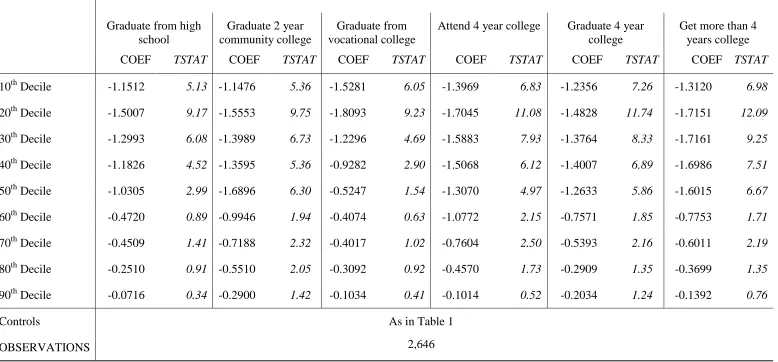
Turning to Table 3B, it is apparent that educational expectations generally
have large and highly statistically significant inverse effects across the 10th to 50th
deciles of the distribution of the gap between income and expenditure, namely, those
parts of the distribution characterised by consumption in excess of income. Beyond
the 50th decile, the effects of educational expectations generally fail to attain statistical
significance. Our findings, thus, suggest that having educational expectations
pertaining to any level of education, which exceeds leaving high school prior to
graduation, is strongly inversely associated with levels of consumption in excess of
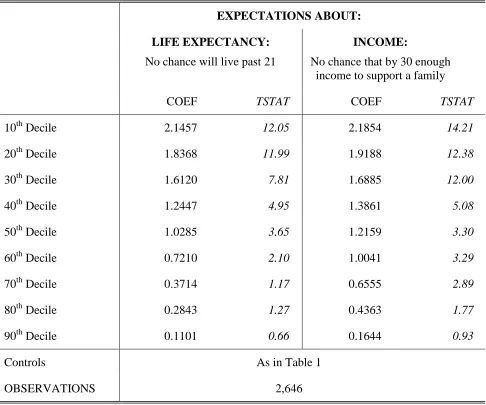
income.12 In contrast, the results summarised in Table 3C indicate that if the child
believes there is no chance that they will live past 21 has a large and highly
statistically significant influence on the 10th to 50th deciles of the distribution of our
proxy for the flow of savings suggesting that such expectations are positively related
to consumption in excess of income which accords with discounting the future
heavily. Similarly, if the child believes there is no chance that he/she will have
enough income by the age of 30 to support their family is positively associated with
the 10th to 50th deciles of the distribution of the gap between income and
consumption, which is associated with the part of distribution where consumption
exceeds income. It is also apparent that positive and statistically significant influences
are also found at the 60th and 70th deciles, although the positive influence is
monotonically decreasing in terms of magnitude moving towards the 90th decile.
Hence, the findings from the quantile analysis endorse the findings from the
tobit analysis in that children’s expectations about and attitudes towards the future,
12 We have also explored the influence of parental aspirations regarding their child’s educational
17
especially those relating to education and life expectancy, are found to be important
influences on their saving behaviour. Our empirical analysis thus provides an insight
into the factors that influence children and young adults in living either within (where
income exceeds consumption) or beyond (where consumption exceeds income) their
means at an early stage of their life.
4. Conclusion
The U.S. economy has been characterised historically by low savings rates. For
example, Garon (2012), page 4, who explores the history of savings promotion in
Europe, the U.S., Japan and other Asian countries, comments, with reference to
savings rates in OECD countries over the period 1985 to 2008, that: ‘by nearly every
measure, the United States jumps out as exceptional in its low saving and
turbocharged consumption.’ Clearly, in the U.S., the focus has historically been
placed on consumption rather than saving as a means to enhance economic growth
with heavy reliance on the expansion of credit. It is apparent, however, that
households with low or no savings but which hold debt are particularly vulnerable to
financial shocks such as redundancy or increases in the cost of living as well as to
changes in their personal lives such as having children or getting divorced. It is
important, therefore, that further research on the saving behaviour of individuals and
households is conducted in order to aid our understanding of this aspect of financial
decision-making. Given the importance of education and human capital acquisition
during childhood, it is apparent that analysing the saving behaviour of children may
be a fruitful line of enquiry. As well as contributing to the existing literature on
household finances by exploring the saving behaviour of children, our analysis also
serves to inform us about the influence of children’s expectations, which, to our
18
Overall, our findings suggest that the saving behaviour of children, as
measured by the level of savings, appears to be influenced by their expectations,
especially in the case of expectations regarding future educational attainment and life
expectancy. Specifically, the level of savings held by children is monotonically
increasing in the expected level of educational attainment and children who are
pessimistic about their future life expectancy are found to hold lower levels of
savings, which is consistent with discounting future consumption heavily. We find
that such influences are heightened in terms of magnitude in the context of the amount
of savings held specifically for the purposes of future education. Our findings thus
suggest that, as in the case of adulthood, expectations and attitudes towards the future
influence financial decision-making and serve to play an important role in the
accumulation of savings. Given that behaviour in childhood may influence that in
adulthood, our findings offer an insight into the determinants of saving behaviour at
an early stage of the life cycle and hopefully will serve to stimulate future research in
this relatively unexplored area.
References
Arrondel, L. (2009). ‘My Father was Right: The Transmission of Values between
Generations.’ Paris School of Economics Working Paper Number 2009-12.
Barnet-Verzat, C. and F.-C. Wolff (2002). ‘Motives for Pocket Money Allowance and
Family Incentives.’ Journal of Economic Psychology, 23, 339-366.
Bernheim, B. D., Garrett, D. M. and D. M. Maki (2001). ‘Education and Saving: The
Long-Term Effects of High School Financial Curriculum Mandates.’ Journal of
Public Economics, 80, 436-467.
Bertaut, C. and M. Starr-McCluer (2002). ‘Household Portfolios in the U.S.’ In
19
Black, S. E. and P. J. Devereux (2011). ‘Recent Developments in Intergenerational
Mobility.’ In The Handbook of Labor Economics, O. Ashenfelter and D. Card
(Eds.) Chapter 16, 1487-1541.
Brown, S., Garino, G., Taylor, K. and S. Wheatley Price (2005). ‘Debt and Financial
Expectations: An Individual and Household Level Analysis.’ Economic Inquiry,
43, 100-120.
Brown, S., Garino, G. and K. Taylor (2008). ‘Mortgages and Financial Expectations:
A Household Level Analysis.’ Southern Economic Journal, 74, 857-878.
Brown, S., McIntosh, S. and K. Taylor (2011). ‘Following in Your Parents Footsteps?
Empirical Analysis of Matched Parent-Offspring Test Scores.’ Oxford Bulletin
of Economics and Statistics, 73(1), 40-58.
Brown, S. and K. Taylor (2008). ‘Household Debt and Financial Assets: Evidence
from Germany, Great Britain and the USA.’ Journal of the Royal Statistical
Society, Series A, 171(3), 615-643.
Charles, K. and E. Hurst (2003). ‘The Correlation of Wealth across Generations.’
Journal of Political Economy, 111, 1155-1182.
Cole, S. and G. K. Shastry (2009). ‘Smart Money: The Effect of Education, Cognitive
Ability and Financial Literacy on Financial Market Participation.’ Harvard
Business School Working Paper 09-071.
Cronqvist, H. and S. Siegel (2010). ‘The Origins of Savings Behavior.’ Institute for
Financial Research, Stockholm, Research Report Number 73 September 2010.
Crossley, T. F., Emmerson, C. and A. Leicester (2012). ‘Raising Household Saving.’
20
Das, M. and A. van Soest (1999). ‘A Panel Data model for Subjective Information on
Household Income Growth.’ Journal of Economic Behaviour and Organisation,
40, 409-26.
Elliott, W., Choi, E. H., Destin, M. and K. H. Lim (2011). ‘The Age Old Question,
which comes first? A Simultaneous Test of Children’s Savings and Children’s
College-bound Identity.’ Children and Youth Services Review, 33, 1101-1111.
Garon, S. (2012). Beyond Our Means: Why America Spends While the World Saves.
Princeton University Press.
Gropp, R., Scholz, J.K. and M. J. White (1997). ‘Personal Bankruptcy and Credit
Supply and Demand.’ Quarterly Journal of Economics, 112, 217-251.
Imbens, G. W., Rubin, D. B. and B. I. Sacerdote (2001). ‘Estimating the Effect of
Unearned Income on Labor Earnings, Savings and Consumption: Evidence
from a Survey of Lottery Players.’ American Economic Review, 91(4), 778-794.
Koenker, R. and G. Bassett Jr. (1978). ‘Regression Quantiles.’ Econometrica, 46,
33-50.
Koenker, R. and K. Hollock (2001). ‘Quantile Regression.’ Journal of Economic
Perspectives, 15,143-56.
Knowles, J. and A. Postlewaite (2004). ‘Do Children Learn to Save from their
Parents?’ Mimeo, University of Pennsylvania.
Lusardi, A., Mitchell, O. S. and V. Curto (2008). ‘Financial Literacy among the
Young.’ University of Michigan Retirement Research Center Working Paper
WP 2008-191.
Mandell, L. (2007). ‘Financial Education in High School.’ In Lusardi, A. (Editor),
Overcoming the Saving Slump: How to increase the Effectiveness of Financial
21
Otto, A. M. C., Schots, P. A. M., Westerman, J. A. J. and P. Webley (2006).
‘Children’s Use of Saving Strategies: An Experimental Approach.’ Journal of
Economic Psychology, 27, 57-72.
Sherraden, M. S., Johnson, L. Guo, B. and W. Elliott III (2011). ‘Financial Capability
in Children: Effects of Participation in a School-Based Financial Education and
Savings Program.’ Journal of Family and Economic Issues, 32, 385-399.
Souleles, N. S. (2004). ‘Expectations, Heterogenous Forecast Errors, and
Consumption: Micro Evidence from the Michigan Consumer Sentiment
Surveys.’ Journal of Money, Credit, and Banking, 36, 39-72.
Wolff, F.-C. (2006). ‘Parental Transfers and the Labor Supply of Children.’ Journal
of Population Economics, 19, 853-877.
Woodcock, R. W. and Johnson, M. B. (1990). Woodcock-Johnson
FIGURE 1: Distribution of children’s total savings; savings for educational purposes; and savings for any other reason: Conditional on saving 0 2 4 6 8 1 0 P e rc e n t
0 5 10
log amount in 2007 prices
Natural logarithm of child's total savings
0 5 1 0 1 5 P e rc e n t
0 5 10
log amount in 2007 prices
Natural logarithm of child's savings for educational purposes
0 5 1 0 P e rc e n t
0 2 4 6 8 10
log amount in 2007 prices
FIGURE 2: Distribution of the difference between children’s income and expenditure
0
5
1
0
1
5
2
0
P
e
rc
e
n
t
-200
-100
0
100
200
TABLE 1: The determinants of the amount the child saves – random effects tobit model
EXPECTATIONS ABOUT: Employment Future Life expectancy Income Education
M.E. TSTAT M.E. TSTAT M.E. TSTAT M.E. TSTAT M.E. TSTAT
Male 0.1415 0.85 0.1213 0.73 0.1303 0.79 0.1209 0.73 0.2112 1.27
White 0.7431 3.76 0.7512 3.81 0.4446 2.27 0.4964 2.54 0.6043 3.09
Age 0.2652 5.55 0.2716 5.69 0.1265 2.64 0.1260 2.63 0.1560 3.26
Number of books child has 0.5365 5.46 0.5377 5.48 0.5582 5.79 0.5570 5.78 0.4726 4.84
Standardised letter word test score 0.1858 1.04 0.1805 1.02 0.1869 1.06 0.1908 1.08 0.1857 0.81
Standardised passage comprehension test score 0.0363 0.21 0.0187 0.11 0.0235 0.14 0.0119 0.07 -0.0185 0.11
Standardised applied problems test score 0.5354 3.75 0.5076 3.58 0.4800 3.41 0.4824 3.43 0.3912 2.77
Log allowance child gets from chores 0.1015 1.65 0.1003 1.63 0.0239 0.40 0.0311 0.51 0.0463 0.77
Log allowance child -0.2329 3.91 -0.2349 3.95 -0.2153 3.65 -0.2228 3.78 -0.2181 3.70
Log pay child receives from employment 0.4207 6.88 0.4156 6.81 0.4230 7.11 0.4388 7.36 0.4305 7.21
Log spending on child by household members 0.0057 0.23 0.0100 0.41 0.0136 0.56 0.0161 0.67 0.0268 1.10
Log spending on child by non household members 0.0570 2.01 0.0570 2.02 0.0428 1.53 0.0467 1.67 0.0514 1.85
Log total household income 0.0148 0.28 0.0136 0.26 0.0285 0.55 0.0057 0.11 0.0234 0.45
Log household wealth 0.0672 2.76 0.0651 2.68 0.0761 3.16 0.0795 3.30 0.0713 2.96
Home owned/mortgage 0.4041 1.95 0.3966 1.91 0.4196 2.05 0.4422 2.16 0.3611 1.77
Household financial problems in the last 12 months:
Sold possessions/life insurance 1.0136 2.49 0.9948 2.45 1.0282 2.55 1.0763 2.68 1.0216 2.54
Borrowed from friends/relatives -0.4746 1.80 -0.4390 1.66 -0.5080 1.96 -0.4637 1.79 -0.5100 1.96
Behind in paying bills -1.4459 5.89 -1.4589 5.94 -1.4427 5.96 -1.4891 6.15 -1.4109 5.84
Postponed a major purchase 0.1138 0.58 0.0967 0.51 0.1610 0.83 0.1329 0.69 0.1370 0.71
Bankruptcy/loan/creditors 0.3399 1.50 0.3342 1.48 0.2836 1.27 0.3261 1.47 0.3119 1.40
Moved to cheaper accommodation -0.8657 2.04 -0.8614 2.03 -0.8736 2.11 -0.9476 2.28 -0.9330 2.26
The Child’s expectations:
Worry about getting job 1-3 times per week -0.1944 0.86 – – – –
Worry about a getting job almost daily/ every day -0.1435 0.43 – – – –
Feel discouraged about the future 1-3 times per week – -0.3204 1.55 – – –
Feel discouraged about the future almost daily/ every day – -0.9264 2.79 – – –
No chance will live past 21 – – -3.1242 8.60 – –
No chance that by 30 enough income to support a family – – – -2.8277 8.99 –
Expect to graduate from high school – – – – 1.4983 5.43
Expect to graduate from 2 year community college – – – – 1.9063 7.25
Expect to graduate from vocational school – – – – 2.0124 6.48
Expect to attend 4 year college – – – – 1.8622 7.20
Expect to graduate 4 year college – – – – 2.0976 9.22
Expect to get more than 4 years college – – – – 2.2056 9.17
Wald, Chi. Squared (d); p value 572.14; p=[0.000] 577.11; p=[0.000] 581.13; p=[0.000] 593.00; p=[0.000] 616.66; p=[0.000]
Controls State dummy variables
TABLE 2: The determinants of the amount the child saves: decomposition – random effects tobit model
EXPECTATIONS ABOUT: Employment Future Life expectancy Income Education
PANEL A: Amount saved for educational purposes M.E. TSTAT M.E. TSTAT M.E. TSTAT M.E. TSTAT M.E. TSTAT The Child’s expectations:
Worry about getting job 1-3 times per week -0.0001 0.01 – – – –
Worry about a getting job almost daily/ every day -0.2799 1.45 – – – –
Feel discouraged about the future 1-3 times per week – -0.2621 2.22 – – –
Feel discouraged about the future almost daily/ every day – -0.2710 1.49 – – –
No chance will live past 21 – – -1.5497 5.94 – –
No chance that by 30 enough income to support a family – – – -1.6503 8.25 –
Expect to graduate from high school – – – – 0.5993 2.18
Expect to graduate from 2 year community college – – – – 1.2153 4.90
Expect to graduate from vocational school – – – – 1.2179 4.12
Expect to attend 4 year college – – – – 1.3558 5.64
Expect to graduate 4 year college – – – – 1.5708 7.32
Expect to get more than 4 years college – – – – 1.6590 7.35
Wald, Chi. Squared (d); p value 261.42; p=[0.000] 263.43; p=[0.000] 274.16; p=[0.000] 277.88; p=[0.000] 297.09; p=[0.000]
Controls As in Table 1
OBSERVATIONS 2,646
EXPECTATIONS ABOUT: Employment Future Life expectancy Income Education
PANEL B: Amount saved for other purposes M.E. TSTAT M.E. TSTAT M.E. TSTAT M.E. TSTAT M.E. TSTAT The Child’s expectations:
Worry about getting job 1-3 times per week -0.1242 1.05 – – – –
Worry about a getting job almost daily/ every day 0.1025 0.61 – – – –
Feel discouraged about the future 1-3 times per week – -0.0018 0.02 – – –
Feel discouraged about the future almost daily/ every day – -0.3352 1.92 – – –
No chance will live past 21 – – -2.0437 5.26 – –
No chance that by 30 enough income to support a family – – – -1.5163 5.16 –
Expect to graduate from high school – – – – 1.0380 4.38
Expect to graduate from 2 year community college – – – – 1.1193 4.87
Expect to graduate from vocational school – – – – 1.2799 4.77
Expect to attend 4 year college – – – – 0.9805 4.29
Expect to graduate 4 year college – – – – 1.1049 5.55
Expect to get more than 4 years college – – – – 1.0511 4.99
Wald, Chi. Squared (d); p value 297.34; p=[0.000] 297.62; p=[0.000] 294.04; p=[0.000] 301.41; p=[0.000] 306.72; p=[0.000]
Controls As in Table 1
TABLE 3A: The determinants of the difference between the child’s income and expenditure, the role of employment and
future expectations – quantile regression
EXPECTATIONS ABOUT:
EMPLOYMENT: worry about getting a job FUTURE: feel discouraged
1-3 times per week almost daily/ every day 1-3 times per week almost daily/ every day
COEF TSTAT COEF TSTAT COEF TSTAT COEF TSTAT
10th Decile -0.2531 2.21 -0.5419 3.29 -0.1460 1.01 -0.1307 0.62
20th Decile -0.2124 1.50 -0.4511 2.26 -0.0850 0.55 -0.2376 1.11
30th Decile -0.2529 1.68 -0.3635 1.72 -0.0157 0.11 -0.1818 0.85
40th Decile -0.2313 1.47 -0.4689 2.13 -0.2122 1.23 -0.3316 1.33
50th Decile -0.0289 0.11 -0.2930 0.79 -0.2778 1.12 -0.4380 1.23
60th Decile -0.0558 -0.22 -0.2418 0.68 -0.4299 1.95 -0.3669 1.15
70th Decile -0.1271 0.70 -0.1722 0.69 -0.3571 1.90 -0.3032 1.13
80th Decile -0.0698 0.37 -0.0514 0.20 -0.1866 1.21 -0.1118 0.50
90th Decile -0.1443 1.19 -0.0603 0.36 -0.0715 0.67 -0.0355 0.23
Controls As in Table 1
[image:28.842.65.680.105.484.2]TABLE 3B: The determinants of the difference between the child’s income and expenditure, the role of education expectations – quantile regression
EXPECTATIONS ABOUT: FUTURE EDUCATION
Graduate from high school
Graduate 2 year community college
Graduate from vocational college
Attend 4 year college Graduate 4 year college
Get more than 4 years college
COEF TSTAT COEF TSTAT COEF TSTAT COEF TSTAT COEF TSTAT COEF TSTAT
10th Decile -1.1512 5.13 -1.1476 5.36 -1.5281 6.05 -1.3969 6.83 -1.2356 7.26 -1.3120 6.98
20th Decile -1.5007 9.17 -1.5553 9.75 -1.8093 9.23 -1.7045 11.08 -1.4828 11.74 -1.7151 12.09
30th Decile -1.2993 6.08 -1.3989 6.73 -1.2296 4.69 -1.5883 7.93 -1.3764 8.33 -1.7161 9.25
40th Decile -1.1826 4.52 -1.3595 5.36 -0.9282 2.90 -1.5068 6.12 -1.4007 6.89 -1.6986 7.51
50th Decile -1.0305 2.99 -1.6896 6.30 -0.5247 1.54 -1.3070 4.97 -1.2633 5.86 -1.6015 6.67
60th Decile -0.4720 0.89 -0.9946 1.94 -0.4074 0.63 -1.0772 2.15 -0.7571 1.85 -0.7753 1.71
70th Decile -0.4509 1.41 -0.7188 2.32 -0.4017 1.02 -0.7604 2.50 -0.5393 2.16 -0.6011 2.19
80th Decile -0.2510 0.91 -0.5510 2.05 -0.3092 0.92 -0.4570 1.73 -0.2909 1.35 -0.3699 1.35
90th Decile -0.0716 0.34 -0.2900 1.42 -0.1034 0.41 -0.1014 0.52 -0.2034 1.24 -0.1392 0.76
Controls As in Table 1
TABLE 3C: The determinants of the difference between the child’s income and expenditure, the
role of expectations about life expectancy and future income – quantile regression
EXPECTATIONS ABOUT:
LIFE EXPECTANCY:
No chance will live past 21
INCOME:
No chance that by 30 enough income to support a family
COEF TSTAT COEF TSTAT
10th Decile 2.1457 12.05 2.1854 14.21
20th Decile 1.8368 11.99 1.9188 12.38
30th Decile 1.6120 7.81 1.6885 12.00
40th Decile 1.2447 4.95 1.3861 5.08
50th Decile 1.0285 3.65 1.2159 3.30
60th Decile 0.7210 2.10 1.0041 3.29
70th Decile 0.3714 1.17 0.6555 2.89
80th Decile 0.2843 1.27 0.4363 1.77
90th Decile 0.1101 0.66 0.1644 0.93
Controls As in Table 1
[image:30.595.48.534.90.495.2]TABLE A1: Summary Statistics
MEAN STD
Dependent variables
Log child’s total savings in 2007 prices, ln
( )
tsit 2.1136 2.9545Log child’s savings for educational purposes in 2007 prices, ln
( )
esit 1.3529 2.6278Log child’s saving for other purposes in 2007 prices, ln
( )
osit 1.2181 2.3857Log difference between child’s income and expenditure, ln
( )
sfit -0.1064 2.9620Independent variables
Male {0, 1} 0.4996 0.5001
White {0, 1} 0.3292 0.4701
Age 15.0208 2.0229
Number of books child has 3.3707 0.9524
Letter word test score # 47.1081 6.3519
Passage comprehension test score # 27.8979 5.4275
Applied problems test score # 40.1527 6.9929
Log allowance child gets from chores 0.6505 1.3801
Log allowance child 0.8581 1.5497
Log pay child receives from employment 0.5499 1.3329
Log spending on child by household members 3.7444 3.7904
Log spending on child by non household members 2.9984 3.0119
Log total household income 10.3181 1.7778
Log household wealth 5.2825 4.0976
Home owned/mortgage {0, 1} 0.6633 0.4727
Household financial problems in the last 12 months:
Sold possessions/life insurance {0, 1} 0.4271 0.2022
Borrowed from friends/relatives {0, 1} 0.2109 0.4080
Behind in paying bills {0, 1} 0.3050 0.4605
Postponed a major purchase {0, 1} 0.3163 0.4651
Bankruptcy/loan/creditors {0, 1} 0.2532 0.4349
Moved to cheaper accommodation {0, 1} 0.0601 0.2377
The Child’s expectations:
Worry about getting job 1-3 times per week {0, 1} 0.1659 0.3721
Worry about a getting job almost daily/ every day {0, 1} 0.0789 0.2698
Feel discouraged about the future 1-3 times per week {0, 1} 0.2082 0.4061
Feel discouraged about the future almost daily/ every day {0, 1} 0.0907 0.2872
No chance will live past 21 {0, 1} 0.0896 0.2856
No chance that by 30 enough income to support a family {0, 1} 0.0929 0.2904
Expect to graduate from high school {0, 1} 0.0907 0.2872
Expect to graduate from 2 year community college {0, 1} 0.0982 0.2977
Expect to graduate from vocational school {0, 1} 0.0457 0.2089
Expect to attend 4 year college {0, 1} 0.1017 0.3022
Expect to graduate 4 year college {0, 1} 0.3587 0.4797
Expect to get more than 4 years college {0, 1} 0.1795 0.3839
OBSERVATIONS 2,646