Commission of the european Communities
COM (82) 170 finalBrussels, 5 April 1982
Proposal for a
Council Directive
amending Council Directive No 70/220/EEC on the approximation of
the Laws of the Member States relating to measures to be taken
against air pollution by gases from positive-ignition of motor
vehicles.
(Submitted to the Council by the Commission)
•
EXPLANATORY MEMORANDUM
The Limit values applicable to emissions of carbon monoxide (CO) and
unburnt hydrocarbons (HC) were Laid down for the Community as a whole in
Council Directive 70/220/EEC of 20 March 1970 on the approximation of the
Laws of the Member States relating to measures to be taken against air pollution by gases from ~aitive ignition engines of motor ~ehicles (1).
In the context of adaptation to technical progress, these Limit values were reduced in 1974 by Directive 74/290/EEC (2) and maximum values for
nitrogen oxide (NO ) emissions were Laid down in 1976 in Directive X
77/102/EEC (3) In order to take account of more stringent requirements/
relating to the protection of public health and the environment, the Limit
values applicable to these three pollutants were then reduced in 1978 in Directive 78/665/EEC <4
>.
In order that the progress achieved through the implementation of these
measures may not be cancelled out again by increases in traffic density in highly urbanized areas of the Community, a further reduction in the
Limit values seems to be required. The Commission, in close cooperation with the experts of the national authorities and from the automobile industry, has therefore examined the feasibility of lowering the Level
of pollutant emissions. It has emerged that the present state of technical development in motor-vehicle construction would make it possible, within a
relatively short time and in relation to the Limits Laid down in Directive 78/665/EEC, to achieve a 23 % reduction in CO emissions and a 20 to
30% reduction, according to the weight category, in the combined HC
and NO emissions. This proposal for a Directive is based on those X
findings.
Establishing a combined Limit value for the permissible emissions of
HC and MO appeared to be advisable because it gives motor-vehicle X
manufacturers considerable Leeway in the choice of engine modifications to be made for the purpose of reducing such emissions. This combined
value is also justified from the standpoint of air purity, since the Latest information reveals that it is precisely the interaction between these
pollutants in the atmosphere that contributes to the formation of photo-chemical smog.
(1) OJ L 76, 6.4.1970, p. 1 (2) OJ L 159, 15.6.1974, p. 61 (3) OJ L 32, 3.2.1977, p. 32 (4) OJ L 223, 14.8.1978, p. 48
2
-The proposal also provides for the adoption of the constant-volume sampling and analysis method (CVS) at present used in the United States, Japan and
Sweden. With this method it would be possible to increase the accuracy of the measurements and standardize more effectively the metrological
faciLit1es used by the technical departments responsible for type-approval tests and by the manufacturers. Owing to the modification made to the measuring procedure, it is no longer possible to compare directly the
limit values for HC ana NO laid down in the prece ding directives with )(
those in this proposal.
At the request of the Commission, the manufacturers'associations have
assessed the repercussions of reinforcing the Community Directives in terms of construction costs and, in particular, the fuel consumption of the vehicle categories concerned. On the basis of the state of the art
required for the application of Directive 78/665/EEC, that study revealed,
on the one hand, that the need to improve the ignition and carburation systems will result in higher construction costs and, on the other hand,
that fuel consumption is likely to increase by as much as 5 %, depending
on the type of vehicle.
The Commission took these arguments into account when it was considering the preparation of this proposal for a Directive. It is not of the opinion
that the application of the provisions relating to exhaust gases would prevent the manufacturers from fulfilling the voluntary undertakings to
reduce consumption which they entered into at national level and which should, as they ind1cated to the Commission, result in a reduction of at
least 10% in the fuel consumptionof cars sold in the Community in 1985 in comparison with 1978. On the contrary, having regard to the consumption decreases already ascertained or announced, it considers that the options open to manufacturers in this field are much more extensive than those
on which these undertakings are based, so that any increase in consumption of up to 5 % resulting from the Community provisions relating to exhaust
g?~2~ c:uld ~~ offf~~ ~~rl~g the time available.
After taking into consideration all the available information, the Commission
i.; . ·-··~' .. :w:-:-.J ~:,:t '~'·,~ ,;.:1.~~-t~·.·,:s of this prcposal for a Directive on the protection of the e:1vironment and af realth justify a possible increase
in costs as well as less favourable prospects of reducing consumption to
the level indicated.
In view of the increasing use of diesel engines in cars and Light commercial vehicles (vehicles in categories ~, and N
1> it is advisable to bring the • . I ..•
•
CO, HC and NO emissions from such engines within the scope of the
X ,
Community Directives &s a sequel to the Limitation of soot emissions from diesel engines by means of the provisions of Directive 72/306/EEC (1).
Extending the scope to diesel engines requires an amendment to the
operative part of Directive 70/220/EEC. Consequently, such an amendment cannot be made through the1 procedure of the Committee on the Adaptation
of the provisions of the Annexes to Technical Progress, but must be placed before the Council for the purpose of adoption.
As in the case of previous amendments, this proposal is based on the work of the Group of Rapporteurs on Atmospheric Pollution and Energy
CGRPE) of the United Nations Economic Commission for Europe, whose
Regulation No 15 corresponds in its technical content to Directive
70/220/EEC. Such an approach has the advantage of harmonization which goes beyond the frontiers of the Community and enables the European
manufacturers to have access to a much larger market than that of the Community alone.
In view of the work in progress in that body, and of the surveys conducted
by the Commission, the Member States had adopted a common attitude within the Permanent Representatives Committee. Their representatives in Geneva won acceptance for that opinion within the GRPE and thus made it possible
for the Economic Commission for Europe to notify the 04 series of
amend-ments to Regulation 15 to the Signatory States in May 1981.
In accordance with an undertaking given at the meetings of the Council
of Ministers for the Environment held in December 1980 and June 1981, the
Commission prepared this draft on the basis of the 04 series of amendments to Regulation 15, as soon as it received the definitive texts from Geneva. As desired by the Member States, this draft corresponds as closely as
possible in its technical aspects to the 04 series of amendments. The proposed dates of application take account of the corresponding opinions
put forward by the experts from the Member States when the draft proposal
4
-was being examined by the Working Party on Motor Vehicles at its 68th
meeting on 7-9 October 1981. These dates were chosen so that the
application of the amended Community provisions would not cause difficulties for either the national authorities or the motor-vehicle manufacturers.
At this meeting the experts concurred with the Commission view that, given the moderate nature of the measures proposed and the urgent need for a decision to be taken in this connection, these measures should be dealt with outside the scope of the general approach described in the Commission's
observations on the European automobile industry in 1981 (*). This new approach will apply to all subsequent stages in the formulation of
Community rules in this area. The aims of these stages will be determined
on the basis of a detailed examination of the~onomic, environmental and social effects of the measures envisaged. This will, at the same time,
ensure greater protection of human health and of the environment and will provide a regulatory framework appropriate to the satisfactory
development of the Community automobile industry.
The global approach proposed by the Commission has been accepted by all the national administrations and professional organizations represented
~
within the Working Party on Motor Vehicles. The machinery necessary for Launching such an approach was set up in the field of pollution emissions with the creation in January 1982 of the Working Party on Air Pollution.
This Working Party has 18 months in which to examine the technical possibilities for reducing pollution emissions and to assess the
repercussions thereof, notably with regard to fuel consumption and vehicle
manufacturing and servicing costs. Its final report will enable the Commission to forward to the Council, in good time, balanced proposals
on the regulatory measures to follow those contained in this draft.
•
•
REMARKS CONCERNING THE PROPOSAL FOR A DIRECTIVE
Article 1 (1) amends Article 1 of Directive 70/220/EEC by providing that
diesel engines <'compression-ignition engines') shall henceforth fall within the scope of this Directive. Paragraph (2) substitutes the
Annexes to this Directive for the Annexes to Directive 70/220/EEC, in-cluding the various amendments. Article 2 Lays down the deadlines for
the adoption, publication and implementation of the provisions by the
authorities in the Member States. Observance of the Limit values proposed for HC and NO emissions is, on the face of it, impossible at present
X
in the case of vehicles of types other than cars. For this reason, Annex I
contains transitional provisions setting out less severe Limits for such vehicles.
By the date by which the Member States will have implemented the provisions
of Article 2 (3), the vehicles in respect of which type-approval was granted before the entry into force of this Directive may have entered
into service for the first time. To enable a manufacturing conformity
inspection to be carried out subsequently in respect of these vehicles, the transitional provisions lay down that the corresponding provisions
of Directive 70/220/EEC, as amended by Directive 78/665/EEC, shall remain
in force until that date.
OPINIONS OF THE EUROPEAN PARLIAMENT AND THE ECONOMIC AND SOCIAL COMMITTEE
Pursuant to the provisions of the second paragraph of Article 100, both of these institutions must be consulted.
PROPOSAL FOR A COUNCIL DIRECTIVE
amending Council Directive 70/220/EEC on the approxi.mation
of the laws of the Member States relating to measures to be taken against air pollution by gases from
THE COUNCIL OF THE EUROPEAN COMMUNITIES
-Having regard to the Treaty establishing the European Economic Community,
Having regard to the propos~L from the Commission,
Having regard to the Opinion of the European Parliament,
Having regard to the Opinion of the Economic and Social Committee,
Whereas the first programme of action of the European Community on the protection of the environment, approved by the Council on 22 November 1973,
called for account to be taken of the Latest scientific advances in
combating atmospheric pollution caused by gases emitted from motor vehicles,
and amended the Directives already adopted to that end ;
Whereas Council Directive 70/220/EEC(1) lays down
the Limit values for carbon monoxide and unburnt hydrocarbon emissions from such engines ; whereas these Limit values were first reduced by Council Directive 74/290/EEc( 2) and supplemented, in
accord-ance with Commission Directive 77/102/EEC(3), by
Limit values for permissible emissions of nitrogen oxides, whereas the
Limit values for these three pollutants were further lowered by Commission Directive 78/665/EEC(4);
Whereas the protection of public health and the environment necessitates
a further reduction in these limit values ; whereas advances in motor-vehicle engine design now enable such a reduction to be made ; whereas
during the period under consideration such a reduction will not jeopardize the aims of Community policy in other fields, and in particular in that
of the rational use of energy ;
(1) OJ L 76, 6.4.1970, p. 1
(~) OJ L 159, 15.6.1974, p. 61 (3) OJ L 32, 3.2.1977, p. 32 (4) OJ L 223, 14.8.1978, p. 48
2
-Wher~as, in view of the increasing use of diesel engines in cars and light commercial vehicles, it is advisable to reduce not only soot emissions, which are covered by Council Directive 72/306/EEc< 1
>,
but also the carbon monoxide, unburnt hydrocarbon and nitrogen oxide emissions from such engines ; whereas bringing such engines within the
scope of Directive 70/220/EEC involves an amendment to the operative part
of the said Directive ; whereas that amendment would affect the content of the technical Annexes; whereas the Commission has proposed to the
Coun~il that part of this Directive be adopted by way of derogation from
Arti~le 5 of Directive 70/220/EEC.
Article 1
Directive 70/220/EEC is hereby amended as follows:
1. Article 1 is replaced by the following:
"ArticLe 1
For the purposes of this Directive, 'vehicle' means any vehicle with a pos1tive ignition ~gine or with a compressian ignition engine,
intended for use on the road, with or without bodywork, having at Least four wheels, a permissible maximum mass of at Least 400 kg and a maximum design speed equal to or exceeding 50 km/h, with the exception of agricultural tractors and machinery and public works vehicles."
2. The Annexes are Directive.
replaced by the Annexes to this
Article 2
1. From 1 October 1983,the Member States shall neither,on grounds relating to air pollution by gases from an engine:
- refuse to grant EEC type-approval, or to issue the documents referred to in the last indent of Article 10 <1> of Directive 70/156/EEC, or to grant national type-approval of a type of motor vehicle, nor
prohibit the entry into service of such vehicles,
where the level of gaseous pollutants emitted from this type of motor vehicle or from such vehicles meets the requirements of Directive 70/220/EEC, as amended by this Directive.
2. From 1 October 198~ Member States:
- shall no longer issue the document provided for in the last indent of Article 10 (1) of Directive 70/156/EEC in respect of a type of motor vehicle which emits gaseous pollutants at levels which do not meet the requirements of Directive 70/220/EEC, as · amended by this Directive,
- may refuse national type-approval of a type of motor vehicle which emits gaseous pollutants at Levels which do not meet the requirements of Directive 70/220/EEC, as amended by this Directive •
3. From 1 October 1986, Member States may prohibit the entry into
service of vehicles which emit gaseous pollutants at levels which do not meet the requirements of Directive 70/220/EEC, as
amended by this Directive.
Article 3
Member States shall bring into force the necessary provisions in
order to comply with this Directive not Later than 30 September 1983
and shall forthwith inform the Commission thereof.
Article 4
This Directive is addressed to the Member States.
'
1.
2.
ANNEX I
SCOPE, DEFINITIONS, APPLICATION FOR EEC TYPE-APPROVAL, EEC TYPE-APPROVAL, SPECIFICATIONS AND TESTS, EXTENSION OF TYPE-APPROVAL, CONFORMITY OF
PRODUCTION, TRANSITIONAL PROVISIONS.
SCOPE
This Directive applies to the emission of gaseous pollutants from all motor vehicles of categories M1 and N1 1) equipped with positive ignition engines except two-stroke engines and with compression ignition engines, covered by Article 1.
DEFINITIONS
For the purpoees of this Directive:
2.1. "Vehicle type", vith reg&Td to the eatssimr-of gaseous pollutants from the engine, means a category of power-driven vehicles which do not differ
2.1.1.
2.1.2.
2.2.
2.2.1.
2.3.
in such essential respects as:
the equivalent inertia determined in relation to the reference mass as prescribed in Annex III, item 5.2., and
the engine and vehicle characteristics as defined in Annex II, items 1-6 and 8 and Annex VII ;
"Reference mass" means the mass of the vehicle in running order less the uniform mass of the driver of 75 kg and increased by a uniform mass of 100 kg;
"Mass of the vehicle in running order" means the mass defined under item 2.6. of Annex I to Directive 70/156/EEC;
"Maximum mass" means the mass defined under item 2.7 of Annex I to Djrective 70/156/EEC
•• ! ••
- 2 - Annex I
2.4. "Gaseous pollutants" means carbon monoxide, hydrocarbons (assuming
a ratio of CH1, 85
>,
and oxides of nitrogen, the Latter being expressed in nitrogen dioxide CN02> equivalent;2.5. "Engine crankcase" means the spaces in or external to an engine which are connected to the oil sump by internal or external ducts through which gases and vapours can escape;
2.6. "Cold start device" means a device which enriches the air fuel mixture of the engines temporarily. This, to assist engines start
up;
2.7. "Starting aid" means a device which assists engine start up wihtout
enrichment of the air fuel mixture of the engine, e.g., glow plu~ and glow plug and injection timing changes.
3. APPLICATION FOR EEC TYPE-APPROVAL
3.1. The application for approval of a vehicle type with regard to the
emission of gaseous pollutants from its engine shall be submitted by the vehicle manufacturer or by his appointed representative.
3.2. It shall be accompanied by the undermentioned documents in triplicate and the following particulars:
3.2.1.
3.2.2.
3.2.3.
A description of the engine type comprising all the particulars
referred to in Annex II;
dra~ings of the combustion chamber and of the piston, including the piston rings;
maximum lift of vJtves and angles of opening and closing in relation to dead centres;
3.3. A vehicle representative of the vehicle type to be approved shall be submitted for the·tests described in section 5 of this annex to the technical service responsible for type-approval tests.
4.1.
5.
5.1.
5.2.
5.2.1.
-3 - Annex I
EEC TYPE-APPROVAL
A form conforming to the model set out in Annex II shall be attached to the EEC type-approval certificate.
SPECIFICATIONS AND TESTS
General
The components liable to affect the emission of gaseous pollutants shall be so designed, constructed and assembled as to enable the vehicle, in normal use, despite the vibration to which they may be subjected, to comply with the provisions of this Directive.
Description of tests
The vehicle shall be subjected, according to its category, to tests of different types, as specified below. The tests are:
- type I, II and III if powered by a positive ignition engine, and
- type I, if powered by a compression ignition engine.
5.2.1.1. !Y~e_I_t~s! (verifying the average emission of gaseous pollutants after a cold start).
5.2.1.1.1. This test shall be carried out on all vehicles referred to in item 1, whose maximum mass does not exceed 3.5 metric tons.
5.2.1.1.2. The vehicle shall be placed on a dynamometer bench equipped with a means of load and inertia simulation. A test lasting a total of 13 minutes and comprising four cycles shall be carried out without interruption. Each cycle shall comprise 15 phases (idling,
acceleration, steady speed, deceleration) etc.). During the test the exhaust gases shall be diluted and a proportional sample collected in one or more bags. The exhaust gases of the vehicle tested must be diluted, sampled and analysed following the procedure described below; the total volume of the diluted ·exhaust must be measured.
5.2.1.1.3.
5.2.1.1.4.
- 4 - Annex I
The test shall be carried out by the procedure described in Annex Ill.
The methods used to collect and analyse the gases shall be those
prescribed. Other analysis methods may be approved if it is found that they yield equivalent results.
Subject to the provisions of items 5.2.1.1.4.2. and 5.2.1.1.5., the test shall be repeated three times. For a vehicle of a given reference
mass, the mass of the carbon monoxide and the combined mass of the hydrocarbons and of the nitrogen oxides obtained in the test shall be
less than the amounts shown in the table below.
I
R.eference mass Carbon monoxide Combined emission of
RW L1 hydrocarbons and
(kg)
Cg/test> oxides ot·nitrogen
L2 (g/test)
-RW ~
,
020 ~8 19,01 020 <::RW
<.
.,
250 67 20,5i 1 250 -<RW
-=
~ 1 470 76 221 470 C::RW ~ 1 70C 84 23,5
1 700 .c:::::.RW~ 1 930 93 25,0
1 93 0 ..::::: RW !!'S. 2 150 101 26,5
2 150 <-RW I 110 28 0
___ l.
,
5.2.1.1.4.1. Nevertheless, for each of the pollutants referred to in item 5.2.1.1.4.,
not more than one of the three results obtained may exceed by not more than 10 per cent the limit prescribed in that item for the vehicle
concerned, provided the arithmetical mean of the three results is below
the prescribed limit. Wnere the prescribed limits are exceeded for more than one pollutant (i.e. carbon monoxide and the combined mass of
hydrocarbons and nitrogen oxides) it shall be immaterial whether this occurs in the same test or in different tests (1).
..! ••
(1) If one of the three results obtained of each of the pollutants exceeds by more than 10 per cent the Limit prescribed in item 5.2.1.1.4. for the vehicle con-cerned, the test may be continued as specified in item 5.2.1.1.4.2.
I
I
'·i
r
!
-5 - Annex I
5.2.1.1.4.2. The number of tests prescribed in item 5.2.1.1.4. above may on
5.2.1.1.5.
the request of the manufacturer be increased to 10 tests provided that the arithmetic mean <xi> of the three results performed for carbon monoxide and:or for the combined emissions of hydrocarbons and of oxides of nitrogen falls between 100 and 110 per cent of the
limit. In this case, the decision, after testing, shall depend exclusively on the average results obtained from all 10 tests
<x
<
u.
The number of tests prescribed in item 5.2.1.1.4. above shall be reduced in the conditions hereinafter defined, where
v
1 is the result of the first test and V2 the result of the second test for each of the pollutants referred to in item 5.2.1.1.4.5.2.1.1.5.1. Only one test shall be performed if V1 readings of carbon monoxide as well as the combined hydrocarbon and oxides of nitrogen reading are less than or equal to 0.70 L.
5.2.1.1.5.2. Only two tests shall be made if the results of both the carbon monoxide and the combined value of hydrocarbons and oxides of nitrogen are V1 ~ 0.85 L, and if, at the same time, one of these values is V1~0.70 L. In addition, the V2 readings of both the carbon monoxide emissions and the combined emissions of hydrocarbon and oxides of nitrogen must satisfy the requirement that
es
yes
yes
6
-1 test
"'t
<0.70L
no
v,1
>-~~
no
2 tests
__
.._
----··--.. ·" --4'..
vtt - 0. 8SL
and
V,2 •
Land
1
.. 70L
no
V,
2 .,.1,10L
or
vft
:!L
and \tj2?:.L
0
3 tests
\.;'1
...,.L
and'f2.
-cL
and v,.J ~
--
·-
!.. - . - . . no
~
3
>1.1 OL
or. ~,::L
and ~3?!
L
or. ~ C!L
V.:,
-a
L
no
fl'rl• '{
2 • '{1J
/3
-cL
noT~ ·; :1c r~ase
ti.~ IIUI'ilber of tests to 10
<n = 10>
yes
yes
yes
#\n11exe I
EEC type-approval
7.1.3.
... 11 - Annex 1
.it.
Notwithstandin9 the provisions of Annex III, point 3.1.1., the technical service responsible for verifying the conformity of production may, with the consent of the manufacturer, carry out tests of types I, II and Ill on vehicles which have been driven less than 3,000 km.
8. TRANSITIONAL PROVISIONS
8.1. Concerning type-apprc•val and checking of production conformity of vehicles other th~n those of category M1 as well as of vehicles of category
M1
der.i~r.P.rl to carry more than six occupants, the limits for t~e combined emissions of hydrocarbons and oxides of nitrogen are those rPsulting from the multiplication of the valuesLz
given in the tables of items 5.2.1.1.4. and 7.1.1.1. by a factor of 1.25.8.2. for checking o'fi production conformity of vehicles which have been ~ype-aooroved befor~ the 1.10.198. as far as their emissions of
~ollutants are conc~rn~~, in accordance with the provisions of ~ir~ctive 70/2ZO/EEC a~ amended by Directive 78/665/EEC, the
1.
1.1.
1."2.
1.3.
1.6.
1.0.
1.10
1.1 1.
1.12.
1.13.
2.
ANNEX IT
f\nneA ~~
page 1
ESCEllTIAL CIIAnACTEniSTICS OP THE EUGnlE AND INFORUATIOll COlfCtnUDTG .THE COIIDUC'L' Ql.; TEiJTS
lf
Deocription of onaino
I IWtc •••••• , , ••••• , , , , • , ••••••• , ••• , •••••••••• •. •. • • • • • • • • • • • • • • • • • •
'1)' po t I I t f I a I I I t I t t I I I I I I I I I I f I t I t I I I I t f I t I I I I I I t t f I I I I • f f O I I a I I • t 8 •
llorkinG principle: ponitivc ianition/cor.Jpronaion ianition,
four stroke/two stroke ].1 ••••••••••••• • • •• • • • • • • • • • • • • •.• • • • • • • • •
Dore ••••••••••••••••••••••••••••••••••••
:.;trol:e ••••••••••••••••••••••••••••••••••
Numbor and lqyout of cylindorc nnd firinu ordor •••••••••••••••·-•••
Qylinder capacity •••••••••••••••••••••••
om3
Compresoion ratioa} •••••••••••••••••••••••••••••••••••••••••••••••
Drauinc!s Of combuot"i.on chombe"r ·and pioton CIO\·trl • o o • • o o • • • • • o • o • • • • •
Cooling system liquid/air cooling (3)
Supercharger: yes/no
AI
Description of the syotem ••••••••••••••••. . .
. .
. . .
.
.
.
.
. .
. .
.
. .
.
.
.
. . .
. . .
.
. .
.
..
. . . .
.
.
.
.
. . .
.
.
.
.
.
. . . .
. .
.
. . .
.
. . . .
. .
.
Intnb; oyatom
In t.:tl~e manifold:.
.
. .
. .
..
•..
,... .
De:-Jcription • • • • • • • • " . . . Ill • •Ai::::- f_il t er : . • • • • • • • • • •. • • • liD,]. co
. . .
. . .
. .
.
. . .
.
1'ype...
Intal:e silencer:.
. .
.
.
.
.
.
Hake. . .
.
.
. .
.
. . .
'I'ype...
Device for rccycline crn.n.k-casc gascc (description a.nd diagrwns)
Addi"tional ..:mti-pollution devices (if any, and i f not covered by a.nothor hoadinc)
I I I I • e I I I e • e e e e • • t e • I • e I I • • I e ID e • e • e e t • I I • • e I
'3.2.
3.'2'.1.
Annex II
44r
int~~cand
fuol food'Deccrlption an<l.(lj,~rOlll~ .o! inlot pipoo an" their abcoooorieo
(clu::;h-not, hun:i;inc ticvic..:o, a.cl<litionru. n.:.r into.kco, etc.)
••••••••••••••••••••••••••••••••••••••••••••••••••••••••••••••••••••
bY
·co.rburottor(o)!/ ...
llUlllbor ... •••.• • • • • • • • • • • • • • • • • • • • • • • • • • • • • • • • • • • • • • • • • •I• • • • ~" • •' • • • • • • • • • • • •
'lYre
•••••••••••••••••••••••••••••••••••••••••••••••••••••••••••••••· J\Cijustment i:.
y·
· · ~eta· ••••• , ••••••••••••• • •
V<.·nturio •••••••••••••••••
Float-chamber ·l~vel
....
,.
\leieht of float ••••••••••
or
Curve
ot
fuel delivery.plotted QGainet air flow, M<l oottinc'?:.; rol)uirocl to
l~oep to tho curvo
'ij
?.../
3.2.1.3. 5.
··"Float' needle· • .".' • .'.'.' ••••••).2ol.4.
3.2.2.
3.2.2.1.
3.2.2.1.1.
3.2.2.1.2.
.3.2.2.1.4.
.).2o2ol.5.
· Honuo.l/nutoinntio. chol~o
Y
Fead Pum'p
•
•
•
•
•
•• • •
••
• • • • • Closure ootttna·~•
•••••
Pressure
Y
••••••••••••••••••••••••• or characteristic uioaramy ..
Dy fuel injection ]) oy.atem description ·llorl<:inc principle: .. +ntol~e .ruoni!old/uirect injection
·injection l'roch:unbor/ Olfirl chrunbar
y ...
o. o • • • • • • •.• . . . ..
.
•
...
•... .
lllll::e
• ••••••••••••••••••••••••••••••••••••••••••••••••••••••••••••••
Typo • ••••••••••••••••••••••••••••••••••••••••••••••••••••••••••••••
Delivery: mm; per otrolce at a. pump opeod
ot
rproY Y
.
or, alternatively, n chnra.cteriotic diocrom1/
~cr>.librn tion· procedure:· to'b't' btmch/ onl3' inc
Yo ..
o •• o o ... .f
·.
Injection timinG • ••••••••••••••••••••••••••••••••••••••••••••••••••
Injectlon·~urvo ' .
).2.2.2.
3.2.2.).
3.2.2.3.1.
3.2.2.3.2.
3.2.2.3.4.
3.2.2.).5.
3.2.2.4.
3.2.2.f:..l.
3.2.2.5.2.
3.2.2.5.).
4.
4.1.
'4.2.
5.1.1.
5.1 .• 2.
5.·~.·?.•
5.1.4.
5.1.
5.
6.- 3
Annex II
Injector nozzle e t e t t e I I t I I t t t t t I I I t t t t · - · I I t I I I I I I I t I t I t t I I 0 t I I I I t I I
Governor
. ...
,.... .
lia.l~o . . . " • • • • "' • • • • • • • • • • • • • • • • • • • • • • • • • • • • • • • • • • • If • • • • • • • • • • • • •
2.'y pe
.
. .
. . .
. .
. .
.
.
.
. .
.
.
. . . .
...
~... .
-1
Cut-or f point 1.mdor load ml:r...
. ... .
I1e:t::cimum onooc1 vi thout load mJ.n. . -1 • • • • • • • • • • • • • • • • • • • • • • • • • • 't • • • • • • •
rene
opoocl t t • • t • • t t • t t t a. ... .
Cold :..;t,,.,rt dovico
.
.
.
. . . .
.
.
.
. .
.
... .
...
,.... .
Iblce
.
.
. . .
.
.
.
.
. .
.
.
. . .
.
. .
.
.
.
. .
.
. . .
.
. .
.
"... . ...
'
..
.
.
. .
.
.
.
.
.
.
.
. .
• • • • ., • • • • • • • • • • v • • • •.
_,... .
Qyatem description •••o•••••••••••••••••••••••"•••••••••••••••••••••
3tartine aid
.
.... .
.
.
.
. .
.
. . .
.
...
Ilake
. . .
. .
. . .
.
.
.
.
.
.
.
.
.
.
.
...
'Lype
.
.
"...
,,.
.
... .
8y stem dcscriptio11 ...•....•...•..•...•.•..•...
.
... .
Valve timing or equivalent data
IIa.ximum lift of val voa, cmcleD of openinc and closi:nc, or timing ctetn.il:1 of al ternn.tiv•:? distribution syotemr..:, in relation to to·p
d c aU c en t:c c ••••••••••••••• 4 . . . " . . . .
. . . .
.
.
. .
. . .
.
.
. . .
.
. . .
.
.
.
. .
.
. . .
. . .
. . .
.
.
. .
.
. . .
.
. .
.
. . . .
.
. .
.
.
.
.
Il.eferehce and/or sotti!ll5 rango::r .]/ · ••••••••••••••••••••••••• ·• ;, •••••Igni tio:n
Ignition system type
Hake
...
.,...
,.... .
.• .•
...
"...
• .• .• .•...
• .•...
• .• .•...
•...
~.
~·.... .
Ieni ti~m advnnce CUYV()
Y . ,
.
. • .•...
...
I.,:ni tion t:Lmin&
'5:.,/ ... · .... • • • • • • • • • • • • • • • • • • • • • • • •
Contact-point Gap
l,./
E::~haw.; t oy o t;om
.md dwoll-anglG
1/
z/
Doacription and c1io.crnmo
...
Annex II
---7.
7 .1.1.
7 .1.2.
7 .1.);
7 .2.
7 .2.1.
7 .2.2.
8
8. 2.
8. 3.
9.
9.1.
9. 2.
Additionnl informntion
on
teat conditionetlpo.rld.nt! pl uc o
•••••••••••••••••••••••••••••••••••••••••••••••••••••••••••••••
'l'y pc
...
!Jpa.:rlc-ca.~ not tina ... .
I.a..ni tion coil
• ••••••••••••••••••••••••••••••••••••••••••••••••••••••••••••••
• ••••••••••••••••••••••••••••••••••••••••••••••••••••••••••••••
Icni t.ion conticn::cr
···~···
Type •••••••••••••••••••••••••••••••••••••••••••••••••••••••••••••••
-Enrine ncrform~co (docln..rod by 1:1c.nufacturor)
Idle r.!! .. r1. ]./. .•••.••••••••••••••••••••• ~ ... .
Co.rbon mono;dtJc content by volume in tho e::hn.ust {JD.D ui th th~ engine
idlinc - per cent (nonul'"-cturer' ~1 utMdD.rd) ••••.•.•••••••••••••••••
R.
r.
L1. 0.:t ma..:~imurn PO\ rcr» ... .
Maximum power
described in Annex
...
kW <according to the method I of Directive 80/1269/EEC)
.Lub:r::ico..n.t uocd. •••••••••••••••••••••••••••••••••••••••••••••••••••••
IID.l:e
...
,....
~... .
'lype
.
...
'... .
1./
In. the cacc of 11on-convcntlonalequivalent to those referred to h~re Rhall bo 3Upplied cnc inc 8 <md by
cy ctcms, pn.rticular G
the manufacturer.
;V
Specify the tolerance .Annex III
TYPE I 'l'Ei.J 'l'
Annex III page 1
(Verifying the rweragc cmissi~w or poJ lu bantu in :1 congested urb2.n £lrec;, after 0.
cold start)
1. INTRODUCTIOIT
item 5.2.1.1. of Annex I.
2. OPERA'l'ING CYCLE ON TilE CHASSIS DYNAJI10MCTEH
2 .1. Descripti0n of t l1c cy ·lc
The.· opc'r:·.tillg cycle on thr: chasu i_s (lyne..mometer slnll be that inclice.ted
in the folJo',/_i_ng ta.ble o.nd c]epicteu in the (;raph in appendix J .• The breakdown by operations is also given in the table i~ the said appendix.
2.2. General conditions under v1hich thu cycle is carried. out
Prelimi112ry testing cycles should be~ carriccl out if neccsso.ry to
2.).1.
do tcrminc hnu bes L to CJ.r.tuatc the e.ccclcratnr o.m3 brake' controls so n.s
to aclucve n. cyr.lc: 2PTJroxim~.ting Lo thu th(:orct _cal cycle ui thin the~
pr,~scrihcd lirrd. L:J.
Usc· of the guar--hox
If tho rn:udmum ::pcr:d v1hi·~h <~an be: cJ.ttc-d.rwd in firsl~ geu.r .is below
15 km/h, tlJr: S8Go'r\d? Lltiro i".nr: fou:ct), ccars shall be ·unecl. The sccon<J, tlli.rcJ 2.11<i .Cmrth C'!l.rfl rn;_cy :dnr-; be <HJerl \Jhcn the driving
instructions rc;r~omrrg:ml n tarti ng in seconrl gr;r:.r on level ground, or \/hen firc;t gca.:r is therein ch:fined as :·L gci".r rr;s.-:rvcd fnr
cross---country driving, cr2.Hlin.:s 0r tnu.i.ng.
Vehich:s ccJuipp0cJ wi tl1 s<.::mi-aui;,)tn<'.t:i c-sluft geo.r-boxco shall be
testc,cl by llsing t:ho gc:'lrfJ nol'rn£•.lly r::m1)loyod l'or driving, and the gc:tr shift shall be nsc:d in o.<~cordt,_n,~c with the manufacturer's
instructiom.1.
Vehicles equippud \li_ th au tomdi<:-sh:i
n.
gc;.:D'-~boxos chall be tcotor1 vJ.ith tho higlwot gr·ar ('tnri.vc") uJgrtr;url. The C\c:colL:rator shD.ll buusod in sw::h ~·- vmy :l.S t·, obt:_·.in thu ntoa(l:icst a('C••lel'r>.tion pnssiblo,
enabling thr: vn.riom;; grJ·u·s to b,; C'ngag<;u in the norm<1.l orcJr.:r.
Furthermore, the: iSt-'rcr· -chango pc;:l.n t; :~ Hhr:>wn in :cppcn(liX 1 to thl s
ann(;x sh"lll n0t D.Jlply; ac,:c·lc:r<ttion ohn.ll cont.inuc throughont
the rJoriod r,-,prc~y,ntcd -by thr: straight lin0 connc.'C' ting th<J end
of r:ach pc:riod of .idling vli i;h -Gh · bq;inn.Lng of Lhc· ncxi; i'ollm.;ing
Annex III
OPERATING CYCLE ON THE CHASSIS DYNAMOMETER
-·- -.
Duration of each
No of Acceleration Speed Cumulative Gear to be used in
opcr- Operation Phase m/sec1 km/h
Operation
I
Phase time the case of aation
(sec) (sec) (sec) manual gearbox
1 Idling 1 11 11 11 6 sec PM+5 sec K1
2 Acceleration 2 1 04 0-15 4 4 15 1
3 Steady speed 3 15 8 8 23 1
4 Deceleration
I
-0·69 15-10 2I
25 15 Deceleration, 4 5
clutch disengaged -0·92 10-0 3 28 K1
6 Idling 5 21 21 49 16 sec PM+5 seoK1
7 Acceleration
I
0·83 0-15 5112
54 1
8 Gear change 6 2 56
9 Acceleration 0·94 15-32 5 61 2
10 Steady speed 7 32 24 24 85 2
11 Deceleration
l
-0·75 32-10 8)n
93 212 Deceleration, 8
clutch disengaged -0·92 10-0 3 96 Ka
13 Idling 9 21 21 117 16secPM+5secK1
14 Acceleration 0·83 0-15 5 122 1
15 Gear change 2 124
16 Acceleration 10 0·62 15-35 9 26 133 2
17 Gear change 2 135
18 Acceleration 0·52 35-50 8 143 3
19 Steady speed 11 50 12 12 155 3
20 Deceleration 12 -0·52 50-35 8 8 163 3
21 Steady speed 13 35 13 13 176 3
22 Gear change
)"
2
!12
178
23 Deceleration -086 32-10 7 185 2
24 Deceleration,
dutch disengaged -0·92 10-0 3 188 Ka
25 Idling 15 7 7 195 7 sec PM
1 PM Gearbox m neutral, clutch engaged.
'·
3.1.
3 .1.1.
3
-Annex III
Vohiclce equipped. with nn overdrive which the driver ~an nctuatc s~~ll
be t0sted with the overdrive out cf action. Tl")lerMcca
A t•.1 ll:r:tnco ,,f
!
1 km/h oh:J.ll l.lo fl.llnworJ. bu Lw .. ~n th1J inclicn.tcd speedrtnrl t}tr, thcoro'll<.:nl ll.[J'!Cd rJurl 0(~ neeolorntiun, l]Uri :"!{; nl.r~·1dy llpt:ccJ,
n.nd rJuring dPCI.'lcratir•n whc·n tho: vehicle' !3 l.n·;·J<r-e ar0 U(l<'rl. If tho
I
vehicle decelerates !:lore rapidly without thr.: uoc of the brnkes, only
the provisions of item 6.5.3. below shall apply. Speed
tolerances greater tmn those prescribed ah .. :.ll be ncccpt('d during phll.oo
chn.n~oe provided that the tolerances nrc nc.,cr oxceo<lc<l for mere thnn
0.5
oocond on :.my ono occnoion.Time tolerances of
±
0.5
ncr:cJnd. The above to lor:lllooe oho.ll npply·~Qllnlly n.t the bccinning nnd r·.t the ond of oach goar-chnnging. period)}
The speed and timo tolerMcco shall be combined na imlico.tod in
appomlix 1 t0 this nnncx.
VEHICLE AND Fm;L
T<·ot VC!}li.cle
Tho vehicle s~~ll bo presented in good mechanical condition.· It shall
have been run-in and. have .been driven a.t least 3,000 lan before the test. Tho exhaust device shall not exhibit ~ leP$ likelY to reduce the
quantity of gas collected, which quantity shall be that emerging from
the engine.
The tightness of tho admission ~stem m~ be checked. to ensure that
carburation is not affected. by a.n acoid.ontal intake of air.
Tho settings of tho engine t\nd of the vehicle's controls shall be those
pz:escri.bcd by the manufacturer. This requirement Rloo applies, in
particular, to the settings for idling (rotation speed and carbon
monoxide content of the <>Xhl\ust gases), for the cold start dovic0 and.
for the exhnust g::ts clenning system.
J} II. ohould be not·~d that tl1r: timr- of 2 oc;condo nllo111:d includes the ti.mo for r:hrJ.Tif~inp, the ~ombin.'lt.ion -~nd, j f nor:(•(l:J;!.ry, n. {!l,rtn.in :unount of latitude to
3.1.6.
Annex III
The vehicle to be tested, or an C?quivalent vehi<"le, shall be? fitted., if
necess:o.ry, Hi th a device to pc:rmit the measurement of the characteristic
parameters necessary for chassis dynamometer setting, in conformity -vri th
text of item 4.1.1.
...
The laboratory may verify that the vr?hicle conforms to the performances
stated by the: mn.nufacturor, that i t c:an be used for normal driving and,
more particularly, that i t is cnpablE; of starting vlhen cold and when hot.
A vehicle: equippe(l vii th a c:a"L11.lytic convc:rter shall be tested vlith the
catalyst fi ttocl, if the vehicle manufacturer stntes that the vohich: so
equipped and suppl Led
,.,i
th g<:>.soline having a lead content of up to0.4 g/1 is capable of complying with the provisions of this Directive
for the catalyst life: <LS d(:finod by the CP.r m.::>.nufacturer.
3.2. Fuel
4.1.2.
The appropriate reference fuel as d0.fimd ln Annex VI shall be used for testing.
TEST EQUIPMENT
Chn.ssis dynamomC?ter
The dync.mometer must 1Je carJC1.blc of simulnting road load. within one
of the following cln.ssificat.i.ons:
-Dynmnometer with .fixed load curve, i.e. a dynamometer whose physical
characteristics provide a fixed load curve ahn.pe.
-Dynamometer with adjusto.ble luad curve, i.e. a dynamometer vrith at
least two road loo.d parameters th.1.l; can be· ad just1:.>d to shcwo the
load curve.
The setting of the dyn8Jl1omcter shall not b.:: affected by tho lapse
of time. It shall not produce any vibr.:ttions perceptible to the
vehicle and likely to impo..ir tho vehicle's normal operations,
I t shall be equipped with means to simulate inertio. and load .•
These simulators shall bG connected to the front roller, in the case
of a two roller dynrunometcr.
Accuracy
It sball be po:3sil>lc to mr.:~l.t>ur<: and ruml. the indicated. loau to o.n
<J ccuracy of
±
:5
per cc-mt.In tho c;:~.so of a dy1wmome tor vd th ;~ fixed. 1oad curve tht: <~.ccuracy of
the load setting at 50 km/h shr>.ll be :!:
5
per cent. In the case of a dynamometer with ad jusk:.blo load curve tho n.ccuracy of matehingdynamometer load to ro.<td load shall be
5
per c:cn t 'd 30, 40 and50 km/h and 10 ror cent E~.t ?.0 km/h. Below this dynamometer E~.bsorption
4.2.2.
5
-Annex III
nlc totnl inortic of the ~Jtntincr pnrts (includinc the oimulatod
incrtin "thoro n.pplico.bh~) mu~t be kno"m nnd must be within ~ 20 ke
of tho incrtin clnon for th~ toot.
Tho opccd of the v0l~cl~ chn.ll
ue
mcanurc<l of the "Y;"ollor (th .... front roller in the cn.scdynnmomc:tcr). It ah,.:J 1 be mocourod with an
r;pcc:do above: 10 km/h.
Lo.'\d an,) In .... rti~t ::.; .. tt.i.nG
by the opccd of rotc>.tion
of ~ two roll~r
nccurncy of'
!
1 lon/h atDyrnr.J'JOIL' l1:r ui th fi.xcd lo:-.d curvo: ~he load aimulntor ahl\11 be RdjuuLr,rJ to r.usorh the: powr.·r oxcrtcd on tho clriv.ing \thcclo nt n st<:~.dy spoou of ~0 km/h. Thv mc:u1f; by which this lend is determined
and sot nro dc:scribc-d in r.pp(•ndix
3.
Dynamometer with adjustable load curve: the lor.d simulator shall bo.
rvl,juotvu in urrJc·r to o.b::.;orb the po\lur exerted on th0 driving whc11ls ~ L tl'k<•.uy upc•Jdo of 20, 30, 40 nnd 50 km/h. The: m0nnu by wh.i.eh thoac lend u t>.r0 dot ormincd ::>.ntl tJ<.:t r .ro d cacr.i bcJ 1n Appcmt1 ix
3.
Inorti;:..
I . ,
DynM,motcrs \-ti th cl<.:drh:nl inurtin simulation muut be demonstrated · j
to be cquiv:1lcnt to mcchD.nicnl inertia systems. Tho mon.ns by which
uqui VF\lvncc is ostnblifJhcil is described in appendix 4.
Exhaust l)aS--On.'!lpline; L'Y:Jt•_·;n
Thu cxh .. ".uot gnn-s<>.mpling oystcrn ia designed to cnnblc the measurements of
the true mass emission of pollutants by the vehicle exhaust. The system
thnt olnll 1><.: l.t:J<.:d ls the Constnnt Volume S:vnplor system. This
rr~quir1::-; th....,_t th(! V<:hielc cxh;,uot be <:ontinuouoly ililutc\l vii th r!.lnbicnt
nir ull\l•Jr ':ntd;t"oll•.rJ c:·>ll\Htiqnr.;. lrt tlv.: Cnnnt:·nt VoJ•nr.u !:;."'m}Jl.cr con<···pt
of rnr:a:rurlt,l~ nw.n:J r·miuui nnrr, t'\oiO c·l)nrU I. Lnn:: r.rn:1t bo n:LLlofic:d, Lhe
tr,tnl VvlUlll · \tf !,}11_: r:!ixt~.<rc: of <:Xll<.:u!.ll :•.n·J ui luL!(J!l :\ll' !Jll.t:Jl; be;
m0n.ourcd t·.ml tt continuou:Jly proportional orun1~lc- of thn V0lumc must be collected for cnr-.lynis. l·hos cmir:uions :-.rc tlctcrmin•!d. from th0 snmplc
concuntrations corr<:ctcd for the lJOllut:>.nt contont 0f too ntnbicnt air, n.nd totnliz0u flow 0vc·r thv tr.ut pvrLoJ.
r_rhL· flow through t}H: EJyotf.•tn UMll b•} ;;ufficie:nt to clirninc.k• Wdcr
conucrwation r.t ... 11 condl tiona 'vthich mrvr occur during n kot, na clofint.·d
4.2.5.
4.2.6.
4.2.7.
4.2.8.
4.2.10.
4.3. 4.3.1. 4.3.1.1.
Annex III
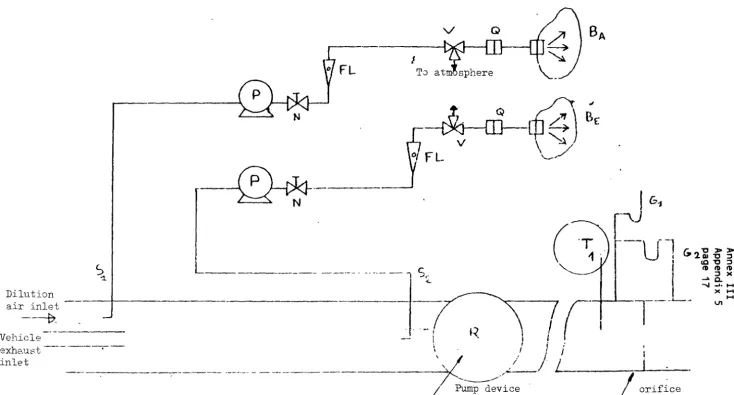
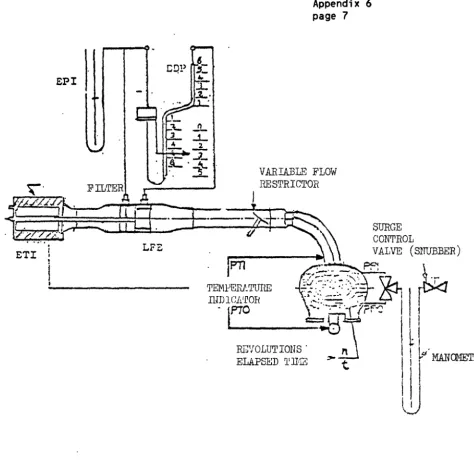
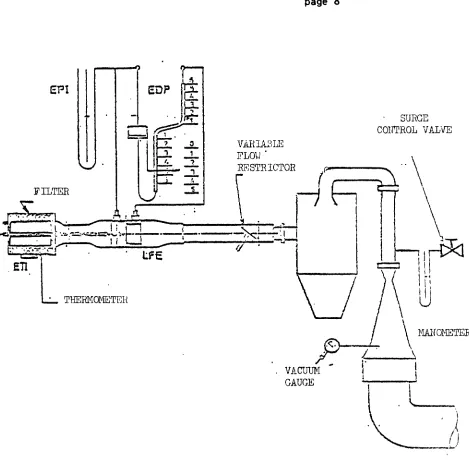
Fig. 1 gives t1. schumc-.tic uiagrrun of the ecneral concept. Appendix
5
gi vos ex<:U11ples of thruc types nf Conct:1.nt IJolumc Srunplcr nystem which satisfy the requirements set out in this Annex.Tho gas and cir mixture· shn.ll be homogeneoun ['i.t point S2 of the
s2111pling probe.
The probe shall extrnct a true sample of the diluted exhaust gases.
The system should. be fro(' of gas leaks. The design and materials shall
be such th,:->,t the systom doc~r; not influepce the pollutunt concentration
in the dilutcc1 c:xho,ur;t; gas. Shoulcl :1.11y component (heat exchanger,.
blowur de.) chc:wgc the concentration of r1.ny polhlt,,nt g:1.s in the
diluted g8,S then sc.mpling for thnt r)ollutant shall be carried. out
before that componont if tht; prohleta e2..nnot be corr0cted.
If the vr3hiclo being tested is equipped KL th an exhaust pipe comprising
several branches, the connc·cting tubes shall be connected. :-1s neCJr ns
possible to t1lo ·Jchiclc.
Static pressure vc.tridions ;1:t the tnilpipc(s) of the vehicle; shall
romnin within ± 1.25 kPa of the st2.tj.c prossu:ro vari'J.tions.measured during tho dynamometer driving cyr::l<) ivi th no connoxion to the
t2.ilpipc(s). S:--1I!pling systems cnpabl•: of maintctining the static pressure
to \oli thin ::!: 0. 25 kPa "d 11 be: used if n. written request. from [\
manufacturer to the: Adminis i.ration granti!J.g the approvr..l substantiates
tho need for the: ~losc·r tolerance. 'Jlho back-pressure shall be measured
in the exhaust pipe res nc"'r as possible tCJ its ond or in an extension
hewing the orono diameter.
The v&ious valves used to direct the uxhaust gnsos shdl be of a
quick-ad justmcnt, flUick-o,cting type.
The Gas Samples shr- 11 br1 nollcdecl in smnplo bngs of :1-dcqu:'..tc cnpaci ty.
These bags shall b(; made of suc:h mnturi~tlf.: P.H vii ll not chango tho
pollutnnt gnl:l by more: Lhn.n :!: ~) per crmt nftcr
20
mlnutc:.: of storage. Analytical cquipmenLProvisions
Pollutr.nt go.EJes flha11 bu rcn:1.ly:Jcd with tho following instruments:
Carbon monoxide (co) ~1.nd carbon <Jioxi<'lc (CO) analysis:
'Jlho cnrbon monoxide [tnd carbon dioxide o.nalysc!rs shall be of the
(
Vehicle eri'.z:.:;~st
ir:.let
__.
---1
I
L
Eixing ch2>.mberFL
F
To cas extract~r syste~
eo.nd voh.:.!::e-ru<:P.:-:;uring eq_uipmen·~
-
~-Annex III
4
Hydrocarbons (HC) analysis - spark ignition engines:
The hydroc~bons annly:-;or fJhall be of the flame ionization (FID) type crclibrCl_t,;d 1·1i Lh propn-nc: ,C:'1S oxprcsscc1 oquiVIl.lent to C<'.,rbon
atoms (C ).
Hydrocarbons (HC) an.:1.ly[·d.£: --compression ignition engines:
The b,ydrocCl.rbon::; <-.n-'1-ly::.:,~r s1n11 l.Je 0f the flame ionization typo with :Ootc·ctor, V:~lvo8, P.ipc'v/Ork, etc. lwn.turl to 190 :t l0°C (HFlll).
I t sha.ll
uo
cali brn.tc:u vli.th propane gas (;xprcssed oC]uivalont to carbon atoms ( C ) •Nitrogen oxide (NO ) P-n".lysis:
X
The nitrogen oxide analyser shall be either of the chemiluminescent (CLA) or of the non-dispensive ultra-violett resonance absorption (NDUVR) type, both with an NOx - NO converter.
Accuracy
The anCl_lyscrs shall hrwo a monsuring rnnge com:pntiblc \4i th the:
C'-Ccuracy roquired to mco.sure tho concentrations of the exhaust gas
sample :pollutants.
Mensurcmcnt errol' r.;hrcll not <)XGct,;d :t 3 peL' cent, eli sreg['Xding the true v."'\lue of th.: calibrntion gaseo.
For concontrationc of luss than 100 lJPm the moasurr::mcnt error ohall not
E.'XCO('O ± 3 1)pm. 'rl10 nrobicnt air snmplr.: ohall be measured on the Game
Ice-trnp
No gas drying device oh'1ll bo usucl before tho amdysers unless shO\m to
have no effect on the~ pollutant content of th.: gas stre2.m.
Particular requirements for compression ignition engines:
A heated snm:ple line for n continuous HC-n.ne,lysis \r:i.th the fl811lc ionization detector (HFID>v including recorder (R) is to be used. The average
conccntr.<etion of the rnuC1.SUr(~rJ hydrouarbnns shell bu r1ctcrminou by
integration. Throughout the teot, i;hr: tompcraturc; of the hen. ted s::unple
lino shall be controll.cc1 o.t 190 .:!:' l0°C. 'l'hc· heated :-:nmpling line shnll be f i ttcd with ;::,_ hc:atn<'l filtur (I!, H ) (99 per Ct:nt 0fficicnt with
pnrt.i_clo ;;;::_ 0.3 ;un to extract :~ny solid pn.rtiel(:s from tho continuous
flo'l<l of gns rc:quirud frlr ann.lysiu.
The., en.m:pling syiJt<:rn response time (from the probe to the analyser inlet)
shall be no more than
4
seconds.The BFI:D must be urwd vJi th n constant f1ov1 (heat exchanger) system to
ensure 2. rcprcscmtntivo snmplc, unless cC>m:pcmsation for varying CFV or
9
-Annex III
Ca.librt:'.ticn
-Ench nn~~scr shr.ll be cnlibrntcd na often ne nocesenr,y nnd in ~
~
co.se in tho month k·foro typu :".pprovn.l tr..~atinB' ond. e.t l<.H\st once every
six months for vorify:i.ng nonfo:rmi ty of production.
The calibro.tion m0thod th..'1.t ohnll be uocd is dcscri be:d. in t:'.ppcndix 6
for the analysers indicated in item 4.3.1.
Volumu mcnourcm<Jnt
'
'l'h,! mdltuci (If mc:t:Juring totrtl dilute oxhnuot volume inporporl'.tcd
in the Crmot."IJL VC)lurnr: Crunplcr ~Jhnll be such tlutt mc:-.auror:'lcnt is
accurate to
±
2 pLr r:cnt.Const;"~.nt Volume Snmp1er Cc.libr£~.tion
The Conotr.nt Volun•: Srmp1cr eyntem volume mensuremont d.ovico ahnll be
cd i.bro.t<.:d by n. mdhod sufHd.cnt to ensure the proscribed c.ccurn.cy
nnd a.t a frc1qul)ncy sufficient to mo.intcin such r.ccur::>.cy.
An ~xnmplo of " calibration procedure which will givo th1.1 required
nccurn.cy is given in .1.!.Jpcnd.ix 6. The mothod shall utilize n flow
metering device which is dyn,':'Jllic and uuitnblc for the high ·flovt rnto encountered in Conatnnt Volume Sampler testing. Th<: device shf'.ll be
of cc·rtif.i.cd ::-.ccuraey trn.nr~o.blc to nn approved nl'.tionnl or
intcrno.tionn.l stv.ndrxd.
Gni:H.:r.J
Pur<: Gv.sco
Tt.·J following pure gl'.sos shn.ll bo nvN.lablc, if nccoosary, for
Cl"..librntion 1.1.nd opcrC".tion:
PurHlod ni trogon (purity ..(. 1 ppm C ~ 1 ppm CO, ~ 400 ppm
co
2, ~ 0 .1 ppm HO) ;PurificcJ E:ynthC'ti c .".ir (purity ~ 1 ppm Cl ~ l ppm CO,
..:::::;: 400 ppm CO
2, ~ 0 .1
p!mJ
NO) ;oxyr;•m crmt~:nt h(:h:o•:>n J(l ruvl 21 per 0c:nt vol;
.l'.\P.'i.fi cfj. o:ey IN u. ~,yuri ty.~. 99. 5. J.o~.~r oc;mt vo 1 .()) '· · Purific.·d t\)"cJrogon (n.nd mi xtur•: containinG eyurogcn)
(purity
c_:;;
1 ppmc
4.5.2.
4.6.
I
4.6.J..
4.6.2.
4. 7. /
Annex III
Calibration and span g.·wcs
Gases having the follouing chemical compositions shall be available:
Ihxturos of:
c
3
I~ and purified synthotic nir (sec item 4.5.1.);CO fl.!ld purific:d nLtrogcn;
Co
2 and purified nitrogen; NO and purified nitrog~n(the Nllount of N02 contninocl in this cdibration gas must not exceed . .
5
per cent of the NO content);Tho true conccntro.tion of n. calibro:tion {san shall be within
±
2 per cent of the s t:;.k·d fir~urc.The concentrations specified. in appendix 6 may also be
obtained. by moo.ns of D. gns r'li vidor, d.iluting l-li th purified N
2 or with purified synthetj_c air. The n.ccurncy of 'l.h~ mixing device shall be such that tho conce:ntr"'.tions of the diluted cnlibration gases may be determined
within± 2 per cent.
Additional equipment
Temperatures
The tc.:mperaturcs inuic:n.tecl in appendix 8 shall be measured v7i th an accuracy of± l.)°C.
Pressure
The atr!.Jspheric pressuro shall 0c measurable to vri thin + 0.1 kPn. £bsolute humidity
The absolute hum.i.di ty (II) flhn.l1 be mc,nsurnblo to vri l;hin :!: 5 per cent. The cxh:o.ust gas-snmpling oystem shnll blJ vc,rified by the method
dcsnribcd in appendix '7, item 3. The maximum permissible deviation between the quantity of gas introduced and the quantity of gas measured shall
be
5 per cent.5.
PREPARING THE TEST5.1.
Ad,iustment of inertia simulators to tht? vehicle's trnnslatory in8rtiasAn inertia simulator shnll be used enabling a total inertia of the
rotating masses to be obtained proportionA.l to tho rc.:forence weight
11
-Annex !II
--·
Reference mass of vehjcle Equivalent inertias
RW I
(kg) (kg)
-RW ..:::. 7)0 680
750 ·-:· RW 1350 8(;0
""-'
8)0 <: RW
-
:::- 1020· 91010?0 -:::· ltW ...:::::
-
1250 11301?.50
<
RW .-:::_. 1470 136014'(0 ~ RW ~
..
1700 1:>90 1700 ' RW ..:::.:..-
1930 10101930 ::: RW -~ 2150 2040
?1')0::. RW
.-
2380 2~70-23UCJ <:.. RW ~
-
2610 22702610
.=.
RW 22705.2.
Setting of dyn~u~etcr5.3.2.
Tho load olw.ll bu adjusted. accordin6 to methods d.cecribed. in
item 4.1.4.
Tho method used ~d tho values obtained. (equivalent inertia.
-ch:u-C'.ctcristic ad justmcnt parnmcter) shall bo rccord.ed. in tho test report.
Conditioning of vehicle
Bcfor~ the test, tho vehicle shall be kept in a room in which tho
tempcr£~.tur<.J re:r.w.ins rola.ti voly conntn.nt bct\·lecn 20°C ttnd 30cc.
This conui tioning sh<'.ll bo carried out for nt louot six hours nnd shll.ll ·
oontinu<.: until th(; engine· oil temporn.turc nnd coolnnt, if t!ny, hnvo
rcn.che~ thu tcmpcrnturt) of th0 room to within: 2°C.
At the rcC]uoat of thw m~!.11Uf;:>.cturer, the) t<.:at ohall be c:uoricd out not lr\ter thnn 30 hours after the vchiclv hn.~ been run nt its normd terrrp<.:rn turo.
Th0 tyro precourc ah.."'..ll be ilK r.;nmc 1'.0 th~t indio."'.. ted by tho manufacturer und USt•ll for tho prr!limin.:try rond test for bro.kc· ndjuotr.·wnt.
The tyrc pr~oourc•a mi\Y bo incr,:r.l'!cd 'oy up to 50 per cent !'rom the
mn.nufnctur0r' o rocoruacndcd od ting in the c:~.so of n. two rnll dyn~.momet¢r.