R E S E A R C H
Open Access
Developing the draft descriptive system for the
child amblyopia treatment questionnaire
(CAT-Qol): a mixed methods study
Jill Carlton
Abstract
Background:Amblyopia is a visual condition that occurs in childhood. Screening programmes exist within the United Kingdom (UK) to detect amblyopia, and once detected treatment is given.
Existing patient reported outcome (PRO) measures for amblyopia do not meet current recommendations for the methods adopted during their development, or the way in which the instruments are administered. The overall aim of this study was to produce a self-complete PRO instrument for amblyopia for children aged 4–7 years that uses children’s responses in the development phase. The study comprised a number of stages. This paper reports on the refinement of the descriptive system for the draft instrument (the Child Amblyopia Treatment Questionnaire, CAT-QoL) using qualitative and quantitative methods.
Methods:The study consisted of three components. Children were asked to read, and complete the draft questionnaire as independently as possible. They were then asked about the questionnaire, and its format, in a cognitive debriefing exercise. Observations were made as to the child’s ability to read the questionnaire, particular attention was made as to which individual words participants struggled to read. Children were also asked their opinion on the design layout of the questionnaire. Finally, some children were asked to complete a ranking task to help determine the order of the levels of the items as judged by the children. Mid-rank scoring and statistical level of agreement were calculated for the ranking exercise.
Results:Thirty-two (n=32) participants completed a draft questionnaire; each of these underwent a cognitive de-briefing interview. Twenty-two (n=22) children completed the ranking exercise. Ten children did not understand the concept of ranking. The results of the qualitative phase (cognitive de-briefing interview) were used to modify the wording of items and layout of the instrument. Results of the ranking exercise were used to inform the order of the response levels for the items.
Conclusion:Responses of young children can be used in the development of PRO instruments. They are able to help inform the content, wording, and format of an instrument, ensuring good content and face validity. The results have been used to further refine the CAT-QoL, however further research is required to assess the psychometric properties of the instrument.
Keywords:Patient reported outcomes, Quality of life, Child, Paediatric, Questionnaire, Amblyopia
Correspondence:[email protected]
Health Economics and Decision (HEDS), School of Health and Related Research (ScHARR), University of Sheffield, Regent Court, 30 Regent Street, Sheffield S1 4DA, UK
Introduction
The use of patient-reported outcome (PRO) measures is in-creasing. They provide information which may be used to aid clinical decision making or resource allocation. New PRO instruments are being developed, or modified, to assess the impact of a condition or disease. With such an influx of instruments available to researchers and clinicians, it can be difficult to determine which instrument is most appropriate. The COSMIN initiative (COnsensus-based Standards for the selection of health Measurement INstruments) was de-veloped to improve the selection of health measurements. The COSMIN checklist was developed through an inter-national Delphi study, and specifically addressed the lack of agreement between terminology and definition of measument properties [1]. These included the three domains of re-liability, validity and responsiveness, all of which should be evaluated when assessing the psychometric properties of a PRO instrument. Traditionally, the psychometric assessment of PRO instruments has been reported in the literature, with little or no reference to the development of the instrument itself. However recent recommendations from the US De-partment of Health and Human Services Food and Drug Administration (FDA) are that there should be evidence from qualitative studies to demonstrate that the items of an instrument are appropriate to the target population, and ad-vocate instrument development history to be available [2]. They state that the purpose of a PRO instrument is“to cap-ture the patient experience, an instrument will not be a credible measure without evidence of its usefulness from the target population of patients”[2].
Amblyopia is a visual condition that occurs in childhood. Screening programmes exist within the United Kingdom (UK) to detect amblyopia, and once detected treatment is given. Treatment primarily consists of glasses, patch, drops, or any combination of these. There are advantages and dis-advantages to the different treatment options, and these may influence treatment choice. Due to the maturing na-ture of the visual system, treatment is more successful if completed before the age of 7 years. This falls within an im-portant time of a child’s personal, social and educational de-velopment. A systematic review of the literature showed that amblyopia and/or its treatment does affect an individ-ual’s health-related quality of life (HRQoL) [3]. The ways in which these were reported varied, both in terms of the in-struments used, and the respondent. Few of the studies identified in the review reported from the patient’s (child’s) perspective. Although proxy-reported PRO measures are used in healthcare, they do have limitations. They may con-tain items (questions) that require a parent/guardian to make a judgement on what their child is experiencing. This may not be the same as what the child is experiencing. A
parent’s judgement may be influenced by how important
they perceive the activity to be (such as school work, or interacting with friends); or how important they judge the
treatment itself. Furthermore, parental reporting can introduce potential bias based upon how the disease im-pacts upon the parent themselves [4]. Two disease-specific PRO instruments were identified in the literature review that could be used to assess the HRQoL implications of amblyopia the Amblyopia and Strabismus Questionnaire (A&SQ) and the Amblyopia Treatment Index (ATI) [5]. Both instruments were designed specifically for the ambly-opic population and have been accepted within the clinical community as being valid and reliable [6-9]. The A&SQ
and ATI were developed using a “top-down”
methodo-logical approach; that is, the content of the instrument was determined by previous literature and clinical opinion. A disadvantage of the A&SQ is that it is administered to adults, so cannot be used to assess the implications of am-blyopia and/or its treatment from the child’s perspective. Furthermore, it contains questions that relate to strabis-mus. Strabismus is an abnormal alignment of one or both eyes (also known as a squint), and has different HRQoL implications to amblyopia. The ATI is more likely to be sensitive to encapsulating the HRQoL implications of am-blyopia, as it does not address issues of strabismus (unlike the A&SQ); yet this instrument also has some potential weaknesses when considering its application to the paedi-atric population. It is a proxy-reported instrument, and was initially designed for that purpose. However, in a re-cent study the Pediatric Eye Disease Investigator Group (PEDIG) used the ATI to assess the impact of treatment in
children aged 7–13 years [10]. Parents and children both
completed the ATI and the results were compared. The psychometric properties of the two ATI versions were reported to be similar, however the authors acknowledged that the validity of the child version has yet to be formally been assessed.
No disease-specific PRO instrument is available to as-sess the implications of amblyopia treatment from the
child’s perspective that satisfies the recommendations of
identified potential themes that could be used in a paedi-atric disease-specific HRQoL instrument for amblyopia [12]. This paper reports on the refinement of the de-scriptive system for the draft questionnaire (the Child Amblyopia Treatment Questionnaire, CAT-QoL) using qualitative and quantitative methods.
Methods
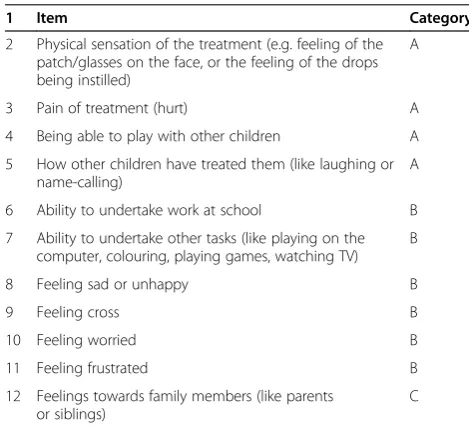
Eleven possible themes had been identified for possible in-clusion in the draft instrument following qualitative analysis of semi-structured interviews conducted with children with amblyopia [12]. These are listed in Table 1. Analysis of the interview data identified potential themes for inclusion in the CAT-QoL instrument; however, the response levels for the items (questions) had not yet been determined. The interview transcripts were re-examined and the terminology the children used when describing the impact of amblyopia and/or its treatment upon their HRQoL informed the choice of levels for the items (questions). The phrases that the children used were“a little bit”; “a bit”,“quite a bit”; “quite”;“a lot”;“really”; and“very”. The transcripts were re-examined to establish which phrases had been used by the children interviewed for each of the given items shown in Table 1. Not every phrase was used when the children discussed their feelings about each possible item, and there-fore three categories of questions (A, B and C) with differ-ent item response scales were established (Table 1). The item response scales were applied to each of the 11 items, to form an 11-item instrument that consisted of six item re-sponse levels.
Two draft versions of the questionnaire were developed. These were the same in content but differed in format. One version had the completion tick-box at the start of the item statement (version 1). The other version had the comple-tion tick-box at the end of the item statement (version 2). Seven different treatment-specific versions were created (patch; drops; glasses; patch and drops; patch and glasses; glasses and drops; glasses, patch and drops). It was neces-sary to have treatment-specific versions to word the ques-tions appropriately.
The 11-item draft questionnaires were piloted in a clinical setting at two National Health Service (NHS) sites within Sheffield, United Kingdom (UK). The pur-pose of the pilot was to refine the content, wording and format of the CAT-QoL instrument, before a multi-centre validation study. The pilot consisted of three components and involved: completing a draft question-naire; cognitive debriefing interview; and ranking exer-cise. Children were asked to read, and complete the draft questionnaire as independently as possible. The children were then asked about the questionnaire, and its format, in a cognitive debriefing exercise. Finally, some children were asked to complete a ranking task to help determine the order of the levels of the items as judged by the children. Each participant was given either Version 1 (tick-box at the end of the item statement) or Version 2 (tick-box at the start of the item statement) to complete.
Cognitive debriefing
Children were also asked to participate in a cognitive debriefing process. Cognitive debriefing is a process whereby participants are asked to explain their think-ing, or understanding of a question. The process is used in the development of questionnaires to help identify and correct problems with survey questions [13]. Within this study, participants were asked to explain what they believed the question was asking them. The results were recorded, and clarification sought where applicable. Observations were also made as to the child’s ability to read the questionnaire itself. Particular attention was made as to which individual words the participants struggled to read. Children were also asked their opinion on the design layout of the questionnaire, specifically whether the item check-box should be placed at the beginning or the end of each level re-sponse (Version 1 vs. Version 2) (Additional file 1).
Example of item check-box location
Version 1
□My patch didnothurt me. Version 2
[image:3.595.54.289.493.707.2]My patch didnothurt me… … … …□
Table 1 Potential item for the CAT-QoL instrument
1 Item Category
2 Physical sensation of the treatment (e.g. feeling of the patch/glasses on the face, or the feeling of the drops being instilled)
A
3 Pain of treatment (hurt) A
4 Being able to play with other children A
5 How other children have treated them (like laughing or name-calling)
A
6 Ability to undertake work at school B
7 Ability to undertake other tasks (like playing on the computer, colouring, playing games, watching TV)
B
8 Feeling sad or unhappy B
9 Feeling cross B
10 Feeling worried B
11 Feeling frustrated B
12 Feelings towards family members (like parents or siblings)
C
Ranking exercise to determine the order of item response levels
Qualitative analysis of the interview data identified the pos-sible item response levels to be used in the instrument. However, it was important to determine the order of the response levels for the content of the questionnaire from a child’s perspective. To achieve this, a ranking exercise was undertaken. Ranking involves participants ordering a list of statements starting from least (affected) to worst (affected). The item response levels are printed on separate cards, and participants are asked to place these in an order that they believe to be correct. Ideally, participants would rank the order of response levels for every item within a ques-tionnaire. However, it was felt that it would be too lengthy a process to ask a child to rank the order of levels for each of the 11 possible items in the draft questionnaire. Instead, one question was chosen from each of the categories (A, B
and C). The questions chosen were “hurt”, “cross” and
“upset with family”. The items “hurt” (Question 3) and
“cross” (Question 5) were chosen as it was felt that these were easy words for participants to read. There was only one Category C question (Question 9). Participants were asked to rank the order of severity from least to worst. When a card was ranked first, it was scored 1; when ranked second it was scored 2; and so on. Where cards were ranked as being equal, each tied ranking was given a value of the midpoint as the previous two marks (mid rank method) [14]. This approach ensures that the sum of the ranks is maintained.
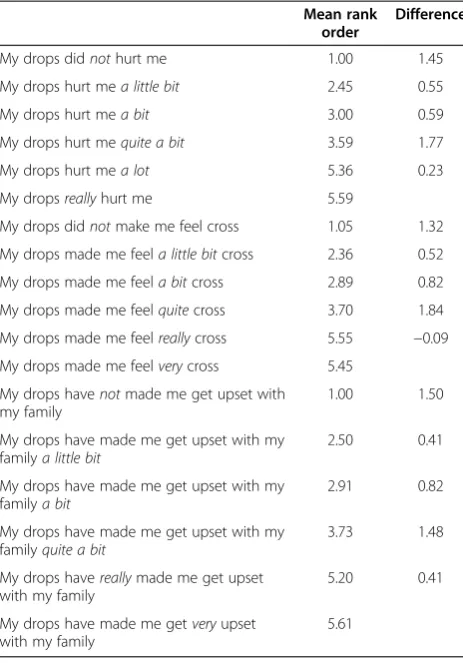
The mean rank order was calculated for each response level, for each of the category questions (A, B and C). The difference between the mean rank scores was then calculated. A small difference between the mean rank scores of the item response levels indicates that the two levels are thought of as being the same conceptually. A mean rank value of less than 0.2 was taken to mean a small difference between response levels. This approach was in line with that adopted by Stevens during the de-velopment of the Child Health Utility 9D (CHU9D) questionnaire (a generic paediatric HRQoL instrument)
[15]. The rank data was also analysed by using Kendall’s
coefficient of concordance test statistic. This is a meas-ure of agreement between variables, and is recorded as a value between 0 (no agreement) and 1 (complete
agree-ment). The Kendall’s coefficient of concordance test
statistic measured the amount of agreement between participants on how they ranked the order of the re-sponse levels for the questions used in the ranking task. Landis and Koch use categories to define levels of agree-ment (for the Kappa statistic, another statistical meas-ure of agreement) [16]. Each question was assessed in terms of the level of agreement (Poor< 0;Slight0.00–
0.20;Fair0.21–0.40;Moderate0.41–0.60;Substantial
0.61–0.80; andAlmost Perfect0.81–1.00).
The study was approved by the NHS Research Ethics Committee (REC Ref: 07/Q1201/5), and followed the te-nets of the Declaration of Helsinki. The inclusion criteria were that adopted for the semi-structured interviews, and the same recruitment technique was adopted [12]. It was not possible to identify before clinical examination poten-tial participants, and therefore purposive sampling of the eligible study population was not possible. Instead, an op-portunistic recruitment (and therefore opop-portunistic sam-pling) approach was undertaken. Full written consent was obtained from the parent/guardian before the child partic-ipated in the study.
Results
Thirty-two (n=32) participants completed a draft question-naire, and each of these underwent a cognitive de-briefing interview. All of the participants in the pilot sample were white. The majority of the participants (n=26) had mild level of amblyopia (using the PEDIG model of amblyopia classification) [17-21]. Mild amblyopia was categorised as 0≥0.30 logMAR; moderate amblyopia 0.31≥0.60 logMAR; and severe amblyopia >0.61 logMAR). Only 3 participants had a moderate level of amblyopia; the remaining 3 partici-pants did not have their vision assessed at the time of the pilot, and therefore their level of amblyopia severity could not be classified. Eleven participants completed version 1 of the questionnaire, and 19 participants were issued with version 2. Of the 32 participants, all were on some form of treatment (glasses only n=13; patch only n=1; patch and glasses n=16; glasses and drops n=2)). Of the study sample, 22 children were able to complete the ranking exercise (Table 2). Ten children did not understand the concept of the ranking exercise, and this exercise was abandoned for these participants.
Practicality of the instrument
Content validity and face validity
As part of the cognitive de-briefing process, each child was asked if there were any additional questions that should be
included. They were asked whether there was “anything
else” that they could not do because of their specific eye
treatment; and whether they had any other feelings about their eye treatment that had not been asked. One child said
that they“bumped into things”because of their patch and
glasses. Another said that their patch and glasses felt
“tickly”, and that their patch and glasses made them feel
“happy”. One child said that they “couldn’t sit far away from the whiteboard at school”because of their patch and glasses. Another child said that they felt“annoyed”due to their treatment. Some of the children needed some
assist-ance reading particular words. These included “worried”,
“frustrated”(annoyed, cross),“laughing”,“question”,“each”,
“choices”, “yesterday”, and “bothered”. Some children needed the meaning of some questions explained to them.
These questions were “feeling worried”, “upset with my
family”,“feeling frustrated”.
Ranking exercise
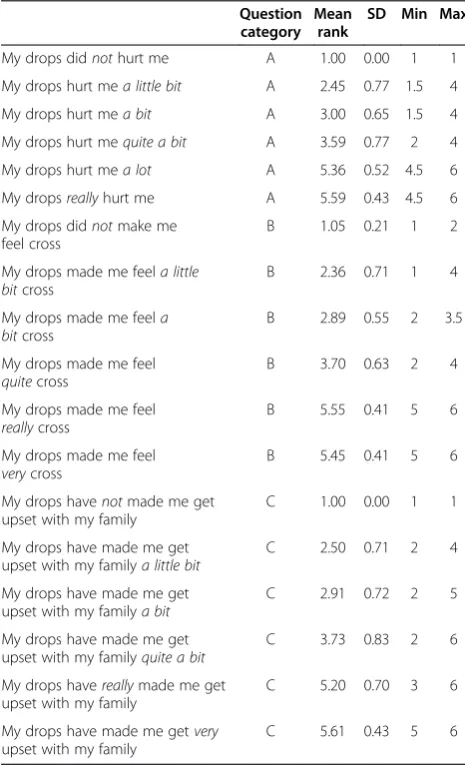
The results for the mean rank, standard deviation, mini-mum and maximini-mum position for each question are shown in Table 3. Table 4 shows the mean rank order and the difference in mean rank order between the levels. A small difference between the ranking scores in-dicates that the participants view the two levels to have
a similar meaning. In the category A question (hurt)
there is little difference between “my drops hurt me a
lot” and “my drops really hurt me” to be the same (as shown by a difference of 0.23). The results show that
within the category B question (cross),“my drops made
me feel really cross” and “my drops made me feel very cross” were valued as being the same (difference of −0.09). The negative value indicates that“very” can be
placed above“really”. Table 5 shows the Kendall
coeffi-cient for each question. The Kendall coefficoeffi-cient is“
sub-stantial”for the category A (hurt) and category C (upset
[image:5.595.56.543.100.242.2]with my family) questions, and “almost perfect”for the category B (cross) question (using Landis & Koch defini-tions [16]). This indicates that children are able to rank the order of the levels, and that statistically, the order-ing of the levels (as shown in Table 3) is“correct”.
Table 2 Study participants for pilot of draft questionnaire
N Sex Number of participants age (yrs)
5 6 7 8 9
Completed Questionnaire and Cognitive Debriefing 32 16 male, 16 female 14 8 5 4 1
Version1 11 5 male, 6 female 7 2 1 1 0
Version 2 19* 10 male, 9 female 8* 6 3 1 1
Able to self-complete 4 1 5 3 1
Questionnaire read to them 9 4 0 1 0
Questionnaire read to them due to drops 1 3 0 0 0
Ranking Exercise 22 11 male, 11 female 8 4 5 4 1
Unable to complete ranking 10 5 male, 5 female 6 4 0 0 0
* abandoned in one participant.
Table 3 Mean rank, standard deviation, minimum and maximum position for each question
Question category
Mean rank
SD Min Max
My drops didnothurt me A 1.00 0.00 1 1
My drops hurt mea little bit A 2.45 0.77 1.5 4
My drops hurt mea bit A 3.00 0.65 1.5 4
My drops hurt mequite a bit A 3.59 0.77 2 4
My drops hurt mea lot A 5.36 0.52 4.5 6
My dropsreallyhurt me A 5.59 0.43 4.5 6
My drops didnotmake me feel cross
B 1.05 0.21 1 2
My drops made me feela little bitcross
B 2.36 0.71 1 4
My drops made me feela bitcross
B 2.89 0.55 2 3.5
My drops made me feel
quitecross
B 3.70 0.63 2 4
My drops made me feel
reallycross
B 5.55 0.41 5 6
My drops made me feel
verycross
B 5.45 0.41 5 6
My drops havenotmade me get upset with my family
C 1.00 0.00 1 1
My drops have made me get upset with my familya little bit
C 2.50 0.71 2 4
My drops have made me get upset with my familya bit
C 2.91 0.72 2 5
My drops have made me get upset with my familyquite a bit
C 3.73 0.83 2 6
My drops havereallymade me get upset with my family
C 5.20 0.70 3 6
My drops have made me getvery
upset with my family
[image:5.595.304.537.350.733.2]Modifications to draft CAT-QoL instrument
A number of modifications were made to the initial ques-tionnaire driven by the results of the cognitive de-briefing and ranking exercises. The main alterations are discussed here. Firstly, the results of the ranking data analysis were used to determine both the number of levels and order of
the levels for the items. Despite there being a possibility
that participants believe“my drops hurt me a lot”and“my drops really hurt me” to be thought of as the same (as shown by a difference of 0.23), category A questions were kept as a 6-part response scale. However, all category B questions were reduced to a 5-part response scale, with the “really” level removed. Table 4 shows the mean rank order, and the difference in the mean rank order between the levels. For the“cross”question, the small difference in mean rank order indicates that children could not
distin-guish much difference between “really” cross and “very”
cross. It could be interpreted that one of these levels is re-dundant, and a decision was made to remove one from the draft instrument.“Really”was chosen as it was felt this could be considered a colloquial term. When this response option was removed, this 5 response level options remained:“did not”,“a little bit”,“a bit”,“quite”,“very”. As
“cross” was a Category B question, all other category B questions were revised so that they too had 5 response levels.
The wording of one question was modified (“upset with
my family”) due to comments during the cognitive de-briefing. Participants reported that theydidfeel upset due to their treatment, but not necessarily upset with their family. The interview transcripts were re-examined to consider this. It can be argued that“upset”should be used as an item; just as“sad”is. The items are the consequence of the treatment, and not a description of why they feel that
emotion. The question was therefore changed from “My
patch has not made me get upset with my family”to “My patch has not made me feel upset”. Once the“with my fam-ily”was removed, and the term“feel”rather than“get” ap-plied, some of the original response levels no longer made
sense (“My drops have made me feel quite a bit upset”).
And so the“a bit”was dropped, leaving“quite”. This meant the response options for the question were“did not”,“a lit-tle bit”,“a bit”,“quite”,“really”,“very”; which were the same as that of the Category B question, and therefore the Cat-egory C question was re-categorised to B. The responses options Category B questions were modified in response to the difference in mean rank order as outlined above, and therefore 5 response level options were applied.
One question was omitted in its entirety from the draft questionnaire (“feeling frustrated”). The majority of partici-pants in the cognitive de-briefing had to have the concept of “frustration” explained to them. Even after an explan-ation was given, some children still did not understand what was meant by the term. One additional question was included in the draft questionnaire (“happy”). As part of the de-briefing process, participants were asked if they felt anything else about their patch, drops and/or glasses. A number of children reported that they felt happy. The tran-scripts of the interviews with children were then re-examined, and analysed again to explore the possibility of happy as an item in the questionnaire. This had not been originally included in the draft questionnaire as it was as-sumed that“happy”was the opposite of“sad”. However, as the aim of this study was to develop an instrument by chil-dren, for chilchil-dren, the cognitive de-briefing responses were noted and this item was added.
[image:6.595.57.289.111.443.2]Other minor modifications included changing individual words to make it easier for the child to understand or read; or reducing the number of words for a given ques-tion where possible. The purpose was to make the overall
Table 4 Mean rank order and the difference in mean rank order between the levels
Mean rank order
Difference
My drops didnothurt me 1.00 1.45
My drops hurt mea little bit 2.45 0.55
My drops hurt mea bit 3.00 0.59
My drops hurt mequite a bit 3.59 1.77
My drops hurt mea lot 5.36 0.23
My dropsreallyhurt me 5.59
My drops didnotmake me feel cross 1.05 1.32
My drops made me feela little bitcross 2.36 0.52
My drops made me feela bitcross 2.89 0.82
My drops made me feelquitecross 3.70 1.84
My drops made me feelreallycross 5.55 −0.09
My drops made me feelverycross 5.45
My drops havenotmade me get upset with my family
1.00 1.50
My drops have made me get upset with my familya little bit
2.50 0.41
My drops have made me get upset with my familya bit
2.91 0.82
My drops have made me get upset with my familyquite a bit
3.73 1.48
My drops havereallymade me get upset with my family
5.20 0.41
My drops have made me getveryupset with my family
5.61
Table 5 Kendall coefficient for questions
Question Kendall coefficient
Category A (hurt) 0.795
Category B (cross) 0.836
[image:6.595.305.540.678.733.2]task easier for participants. (See Additional file 2 for modi-fied version of questionnaire, and Additional file 3 for full details of all modifications made).
Discussion
The literature on the development of the descriptive sys-tem for PRO instruments is relatively sparse. This re-search describes some of the processes undertaken to refine the draft descriptive system of the CAT-QoL instru-ment. This is in line with recommendations of the FDA for development of PRO measures [2]. The aim of the study was to further refine the draft descriptive system, prior to a multi-centre pilot and validation study, after which the final CAT-QoL instrument would be developed.
Practicalities of the instrument: task burden
Language comprehension and reading ability are import-ant factors, particularly if they are to“self-complete” the questionnaire [22]. The reading ability of the children who completed the piloting of the draft questionnaire was not assessed in this study. It is acknowledged that the degree to which a child can self-complete a ques-tionnaire is dependent upon their ability. Matza et al. advise that younger children may require assistance with reading the questionnaire, and the administration proce-dures [4].
Format of the instrument: number of items
The format of the questionnaire in terms of length, and item level scales are other issues to consider. The num-ber of items included in a PRO instrument contributes to the response burden of the task. It is acknowledged that older children can be expected to complete longer
measures [4]; with the intended target population of 4–7
year old, the draft CAT-QoL instrument could be de-scribed as having a low task burden.
Format of the instrument: response levels–frequency or severity scales?
PRO instruments can differ in their response scale options. They may be based upon severity, frequency, or the level of agreement with something (strongly agree, strongly dis-agree). The severity scale was chosen for the CAT-QoL for two reasons. Firstly, the data collected during the inter-views with the children lends itself to this approach. Chil-dren spoke of how bad something was, rather than how often it occurred. Secondly, using a frequency scale would involve the child having to accurately consider a given time period. Children’s abilities to reliably report on their health within specific time frames have been investigated. Predict-ably, older children are more accurately able to demon-strate a longer recall period [22,23]. Although a time frame
has been set for the CAT-QoL instrument (“in the last
week”), it was felt that using frequency item scale would
result in less accurately reported data. Severity scales have been used successfully in other paediatric PROs, such as the CHU9D [15].
A time frame has been set for the CAT-QoL instrument (“in the last week”). Other paediatric PROs, such as the PedsQLTM, use a time frame of in the“last few weeks”. The
CHU9D uses a time frame of “today”. Consideration was
made of the intended population (children aged 4 to 7 years), so a time frame of the“last few weeks”was deemed too long to be able to accurately recall. A time frame of
“today” was not chosen, as a potential participant may re-ceive the CAT-QoL instrument early in the day, before they have had time to undertake their amblyopia treatment and wear their patch (or glasses, etc.).
Format of the instrument: response levels–number of response scale points
The number of response scale points within a PRO instru-ment is important to consider. Matza et al. state that youn-ger children show significantly more extreme responses than older children [4]. However, children aged 8 years have been shown to accurately use a 5-part or 7-part response scale [24]. The number of response scale points in the draft version of the CAT-QoL was informed initially from the child interview data, and revised following the pilot and ranking exercise. The results of the ranking exercise dem-onstrated that young children were able to rank severity in a way that appears conceptually coherent. This is a novel approach in the development of response scales options for PRO instruments for young children.
Format of the instrument: layout
Some questionnaires, such as the PedsQL™child report use
a smiley face to illustrate the difference in response options [25]. Similarly, the Child Health and Illness Profile (CHIP) use circles of increasing size and illustrations to show the extreme responses the child can give [22]. The impact of response scale options upon reliability and reproducibility has been investigated using the TedQL instrument (a gen-eric child self-report instrument) [26]. In a study on healthy children, Creemens et al. reported that young chil-dren (aged 5–6 years) showed better reliability (agreement in responses over time, test-retest reliability) using a thermometer type response scale. The use of pictures, or circles of increasing size, was not adopted for the CAT-QoL layout for a number of reasons. It was felt children may interpret a smiley face to be how they feel on that day, rather than a reflection of how they have felt about the item. Some children also associate sad faces with negative connotations. For example, a smiley face often denotes
“happy”. A child may not answer a question on“hurt” cor-rectly, as they may respond with a“sad”face, as they
per-ceive “hurt” to be a negative concept. In this case, they
this study reported that they preferred the tick-box to be at the end of the item statement (Version 2).
Limitations of the study
This research is not without limitations. The number of participants in the pilot of the draft version of the descrip-tive system was small, and the number of those who par-ticipated in the ranking exercise of the response levels was smaller still. It could be argued that more participants should have been included during this phase of the instru-ment developinstru-ment. However, a larger number of children were involved in the prior phase (identification of poten-tial items through semi-structured interviews) [12].
Furthermore, the classification of amblyopia adopted for the study is arbitrary. There are universally agreed defini-tions of what level of visual acuity equates to mild, moder-ate, and severe amblyopia. The categorisation approach used here was that described by the PEDIG group; a col-laborative network who facilitate multi-centre clinical re-search in eye disorders that affect children. The PEDIG group have published widely in the field of amblyopia, and have conducted a number of multi-centre studies examin-ing the efficacy of amblyopia treatment [17-21]. The ma-jority of participants in this study had mild level of amblyopia, and it could be argued that more participants should have been included to reflect the full spectrum of amblyopia severity.
Conclusions
The aim of this paper was to describe the methods used to refine a disease-specific HRQoL instrument designed for
children aged 4–7 years with amblyopia. This research has
demonstrated that young children are able to ensure face validity of a PRO. Children were used at every stage of the development of the descriptive system. Interview data dir-ectly informed the items of the instrument; the response levels of the instrument; and the wording of the instru-ment. Comments given by the children during the cogni-tive de-briefing process were also used to alter the layout and format of the measure itself. This approach ensured the content validity and face validity of the instrument are high. This adheres to the recommendations of the FDA who observe that issues for PRO instruments applied to
children include“age-related vocabulary, language
compre-hension, comprehension of the health concept measured, and duration of recall”[2]. Further research is required to formally assess the draft descriptive system, and subse-quent refinement may be necessary. The draft descriptive system outlined here is not the final content of the CAT-QoL instrument. The draft descriptive system comprised of eleven items, with either five or six severity response op-tions. However, the final number of items, and the number of response level options for each item will be explored fol-lowing a multi-centre pilot and validation study. Assessment
of the psychometric properties of the final CAT-QoL instru-ment should also be conducted. Further details on the CAT-QoL instrument can be found at www.cat-qol.org.
Additional files
Additional file 1:Child Amblyopia Treatment Questionnaire (CAT-QoL).
Additional file 2:Patch Questionnaire.
Additional file 3:Table S1.Modification to draft questionnaire (from beginning to end).
Competing interests
The author declares that he has no competing interests.
Acknowledgements
This work is produced by Jill Carlton under the terms of Personal Development Award research training fellowship issued by the NIHR. The views expressed in this publication are those of the author(s) and not necessarily those of the NHS, The National Institute for Health Research or the Department of Health.
Received: 24 September 2013 Accepted: 9 October 2013 Published: 22 October 2013
References
1. Mokkink LB, Terwee CB, Patrick DL, Alonso J, Stratford PW, Knowl DL, Bouter LM, de Vet HCW:International consensus on taxonomy, terminology, and definitions of measurement properties for health-related patient-reported outcomes: results of the COSMIN study.J Clin Epidemiol2010,63:737–745. 2. US Department of Health and Human Services Food and Drug
Administration (FDA):Guidance for industry: patient-reported outcome measures: use in medicinal product development to support labelling claims; 2009 http://www.fda.gov/downloads/Drugs/Guidances/UCM193282.pdf. 3. Carlton J, Kaltenthaler E:Amblyopia and quality of life: a systematic
review.Eye2011,25:403–413.
4. Matza LS, Swansen AR, Flood EM, Secnik K, Kline LN:Assessment of health-related quality of life in children: a review of conceptual,
methodological, and regulatory issues.Value Health2004,7:79–92. 5. Carlton J, Kaltenthaler E:Health-related quality of life measures (HRQoL)
in patients with amblyopia and strabismus: a systematic review.
Br J Ophthalmol2011,95:325–330.
6. Van de Graaf ES, van der Sterre GW, Polling JR, van Kempen H, Simonsz B, Simonsz HJ:Amblyopia and strabismus questionnaire: design and initial validation.Strabismus2004,12:181–193.
7. Felius J, Beauchamp GR, Stager DR Sr, Van de Graaf ES, Simonsz HJ:The amblyopia and strabismus questionnaire: English translation, validation and subscales.Am J Ophthalmol2007,143:305–310.
8. Cole SR, Beck RW, Moke PS, Celano MP, Drews CD, Repka MX, Holmes JM, Birch EE, Kraker RT, Kip KE:Pediatric Eye Disease Investigator Group. The amblyopia treatment index.J AAPOS2001,5:250–254.
9. Holmes JM, Strauber S, Quinn GE, Cole SR, Felius J, Kulp M:Pediatric Eye Disease Investigator Group. Further validation of the amblyopia treatment index parental questionnaire.J AAPOS2008,12:581–584. 10. Felius J, Chandler DL, Holmes JM, Chu RH, Cole SR, Hill M, Huang K, Kulp
MT, Lazar EL, Matta NS, Melia M, Wallace DK:Pediatric Eye Disease Investigator Group. Evaluating the burden of amblyopia treatment from the parent and child’s perspective.J AAPOS2010,14:389–395.
11. Carlton J:Clinicians’perspectives of health related quality of life (HRQoL) implications of amblyopia: a qualitative study.Br Ir Orthopt J2011,8:18–23. 12. Carlton J:Identifying potential items for the Child Amblyopia Treatment
Questionnaire.Optom Vis Sci2013,90:867–873.
13. Beatty PC, Willis GB:Research synthesis: the practice of cognitive interviewing.Public Opin Q2007,71:287–311.
16. Landis JR, Koch GG:The measurement of observer agreement for categorical data.Biometrics1977,33:159–174.
17. Pediatric Eye Disease Investigator Group:The clinical profile of moderate amblyopia in children younger than 7 years.Arch Ophthalmol2002, 120:281–287.
18. Pediatric Eye Disease Investigator Group:A randomized trial of atropine vs. patching for treatment of moderate amblyopia in children.
Arch Ophthalmol2002,120:268–278.
19. Repka MX, Beck RW, Holmes JM, Birch EE, Chandler DL, Cotter SA, Hertle RW, Kraker RT, Moke PS, Quinn GE, Scheiman MM:Pediatric Eye Disease Investigator Group. A randomized trial of patching regimens for treatment of moderate amblyopia in children.Arch Ophthalmol2003, 121:603–611.
20. Repka MX, Wallace DK, Beck RW, Kraker RT, Birch EE, Cotter SA, Donahue S, Everett DF, Hertle RW, Holmes JM, Quinn GE, Scheiman MM, Weakley DR: Pediatric Eye Disease Investigator Group. Two-year follow-up of a 6-month randomized trial of atropine vs. patching for treatment of moderate amblyopia in children.Arch Ophthalmol2005,123:149–157. 21. Scheiman MM, Hertle RW, Beck RW, Edwards AR, Birch E, Cotter SA, Crouch
ER Jr, Cruz OA, Davitt BV, Donahue S, Holmes JM, Lyon DW, Repka MX, Sala NA, Silbert DI, Suh DW, Tamkins SM:Pediatric Eye Disease Investigator Group. Randomized trial of treatment of amblyopia in children aged 7 to 17 years.Arch Ophthalmol2005,123:437–447.
22. Rebok G, Riley A, Forrest C, Starfield B, Green B, Robertson J, Tambor E: Elementary school-aged children’s reports of their health: a cognitive interviewing study.Qual Life Res2001,10:59–70.
23. Juniper EF:Quality of life in adults and children with asthma and rhinitis.
Allergy1997,52:971–977.
24. Riley AW, Forrest CB, Rebok GW, Starfield B, Green BF, Robertson JA, Friello P:The child report form of the CHIP-Child edition: reliability and validity.
Med Care2004,42:221–231.
25. Varni JW, Seid M, Rode CA:The PedsQL: measurement model for the pediatric quality of life inventory.Med Care1999,37:126–139.
26. Creemens J, Eiser C, Blades M:Brief report: assessing the impact of rating scale type, types of items, and age on the measurement of school-age children’s self-reported quality of life.J Pediatr Psychol2007,32:132–138.
doi:10.1186/1477-7525-11-174
Cite this article as:Carlton:Developing the draft descriptive system for the child amblyopia treatment questionnaire
(CAT-Qol): a mixed methods study.Health and Quality of Life Outcomes 201311:174.
Submit your next manuscript to BioMed Central and take full advantage of:
• Convenient online submission
• Thorough peer review
• No space constraints or color figure charges
• Immediate publication on acceptance
• Inclusion in PubMed, CAS, Scopus and Google Scholar
• Research which is freely available for redistribution