Article:
Zhao, Y-B, Kim, J, Sun, X-M et al. (1 more author) (2013) On the delay effects of different
channels in Internet-based networked control systems. International Journal of Systems
Science, 44 (11). 11. 2119 - 2129. ISSN 0020-7721
https://doi.org/10.1080/00207721.2012.684904
[email protected] https://eprints.whiterose.ac.uk/ Reuse
Unless indicated otherwise, fulltext items are protected by copyright with all rights reserved. The copyright exception in section 29 of the Copyright, Designs and Patents Act 1988 allows the making of a single copy solely for the purpose of non-commercial research or private study within the limits of fair dealing. The publisher or other rights-holder may allow further reproduction and re-use of this version - refer to the White Rose Research Online record for this item. Where records identify the publisher as the copyright holder, users can verify any specific terms of use on the publisher’s website.
Takedown
If you consider content in White Rose Research Online to be in breach of UK law, please notify us by
March 16, 2012 10:18 International Journal of Systems Science PBNCSs˙Delay˙Effects˙in˙Different˙Channles-IJSS-final
International Journal of Systems Science
Vol. 00, No. 00, 00 Month 20xx, 1–18
Original Paper
On the Delay Effects of Different Channels in Internet-Based Networked
Control Systems
Yun-Bo Zhaoa,d∗, Jongrae Kima, Xi-Ming Sunb and Guo-Ping Liuc,d
aDivision of Biomedical Engineering, University of Glasgow, Glasgow, G12 8QQ, UK
bResearch Center of Information and Control, Dalian University of Technology, Dalian, 116024, China cFaculty of Advanced Technology, University of Glamorgan, Pontypridd, CF37 1DL, UK
dCTGT Centre, Harbin Institute of Technology, Harbin, 150001, China (Original received 25 September 2011; In final version 16 March 2012)
The sensor-to-controller and the controller-to-actuator delays in networked control systems are investigated for the first time with respect to their different effects on the system performance. The study starts with identifying the delay-independent and delay-dependent control laws in networked control systems, and confirms that only two delay-dependent control laws can cause different delay effects in different channels. The conditions under which the different delays in different channels can cause different effects, are then given for both delay-dependent control laws. The results are verified by numerical examples. Potentially these results can be regarded as important design principles in the practical implementation of networked control systems.
Keywords:Networked control systems; Delay effects; Delay-dependent control law; Delay-independent control law
1. Introduction
Networked control systems (NCSs), i.e., control systems that are controlled over the communica-tion network, have gained much attencommunica-tion in recent years. The communicacommunica-tion network in NCSs often refers to the data network such as the Internet but not necessarily the control-oriented network such as the Control Area Network or the DeviceNet. Unlike the latter, the Internet is not designed or optimized for the control purpose, meaning that lossless data transmission as assumed in conventional control systems is not achievable for Internet-based NCSs. Therefore, despite all the potential applications of NCSs, the communication constraints in NCSs caused by the inserted communication network, i.e., network-induced delay, data packet dropout, data rate constraint, etc. have to be carefully dealt with before NCSs can be widely applied as a reliable control strategy (Xia et al. 2007, Wang et al. 2009, Coutinho et al. 2010, Jentzen et al. 2010, Hua et al. 2011, Zhou et al. 2011, Zhang and Wang 2012).
One of the most distinct characteristics among all these communication constraints is the network-induced delay, caused by the imperfect data transmission in NCSs. This is also one of the main topics in the literature on NCSs, see Zhang and Yu (2008), Lin et al. (2009), Meng et al. (2009), Wei et al. (2009). Indeed, the delay in NCSs builds a direct bridge between the theory of NCSs and that of time delay systems, thus enabling the latter to be widely applied to NCSs without significant difficulty. Most of these works do not distinguish between the delay in
∗Corresponding author. Email: [email protected]. This work was supported by EPSRC research grant EP/G036195/1, and in part by the National Natural Science Foundation of China (NSFC) under Grants 61174058, 61004020 and 60934006.
ISSN: 0020-7721 print/ISSN 1464-5319 online c
20xx Taylor & Francis
either the sensor-to-controller or the controller-to-actuator channel, meaning that the majority of the existing models of NCSs simply assume those two delays affect the system performance in the same way. Although this assumption seems naturally true, further clarifications are necessary before regarding it as a general principle: Is it universally true that the delays in both channels are identical with respect to their effects on the system performance? This question is important since, although the answer of “yes” could confirm the correctness of existing results, the possible answer of “no” will put all these existing results in an awkward position and open the gate for a more appropriate modeling approach to NCSs.
In order to answer the above question, we first define how the system performance in terms of different delays in different channels is measured, which turns to be entirely dependent on the choice of the control laws. We then divide existing control laws in NCSs into two categories, that is, delay-independent (Wang and Yang 2007, Gao et al. 2008, Xiong and Lam 2009) and delay-dependent control laws (Liu et al. 2007, Zhao et al. 2008, 2009a,b, 2010). The difference between these two categories is that the feedback gain of the former does not depend on specific delays while the latter does. Delay-independent control laws are often seen in most existing works on NCSs due to the simplicity of its control structure, whereas the implementation of delay-dependent control laws requires particular system setups where the packet-based control approach is one of the most efficient of its kind. After categorizing the control laws the delay effects are then investigated using both qualitative and quantitative methods. Note that for ease of theoretical difficulties, we have constrained our discussions to linear systems with static state feedback. Based on the simplification, we have found meaningful results, which unfortunately suggest the necessity of a thorough reinvestigation of all the existing results aforementioned on NCSs.
The remainder of the paper is organized as follows. The problem is formulated in Section 2. Existing control laws are then categorized in Section 3. The delay effects with respect to different categories of control laws are analyzed both qualitatively and quantitatively in Section 4. The obtained results are verified by numerical examples in Section 5 and Section 6 concludes the paper.
Notations:For clarity of presentations, we list some often-used notations here and the others are defined in the context where they are. The sensor-to-controller delay, the controller-to-actuator delay and the round trip delay at time k are denoted by τsc,k, τca,k and τk := τsc,k+
τca,k, respectively. Their corresponding upper bounds are denoted by ¯τsc, ¯τca and ¯τ := ¯τsc +
¯
τca, respectively. For simplicity of notations we also use the following simplifications where
appropriate α:=τsc,k,β :=τca,k, and τ :=τk. The symbolˆis placed on the top of a parameter
to denote the estimated or predicted value of the parameter.u(t1|t2) wheret1is the current time
instant and t2 is a previous time instant is used to denote the fact that the valueu(·) at timet1 is estimated or predicted based on its previous value at time t2.
2. Problem formulation
The first difficulty in answering the raised question is how the concerned system performance can be quantitatively represented in terms of different delays in different channels. This is addressed by defining an error of the control signals involving the different delays in different channels. Based on this definition, the concerned question can then be formulated appropriately.
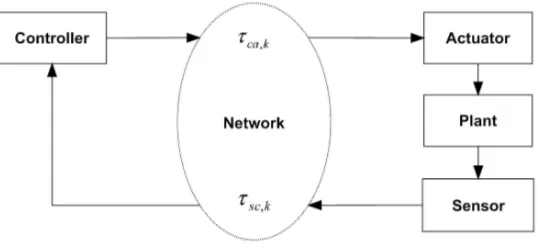
Consider the typical system setting of NCSs illustrated in Fig. 1. Two delays exist in this system setting, i.e., the sensor-to-controller delay, α, and the controller-to-actuator delay, β, respectively. We assume that the delays are upper bounded, i.e.,
March 16, 2012 10:18 International Journal of Systems Science PBNCSs˙Delay˙Effects˙in˙Different˙Channles-IJSS-final
[image:4.595.178.449.121.243.2]International Journal of Systems Science 3
Figure 1. The block diagram of a networked control system.
and consequently, 0≤τ ≤τ¯.
In order to focus mainly on the delay effects rather than the plant dynamics, the following linear nominal system model for the plant is adopted,
x(k+ 1) =Ax(k) +Bu(k) (2) where x∈Rn, u∈Rm,A∈Rn×n
and B ∈Rn×m
.
The following is an immediate observation from Fig. 1, which however is the foundation of our analysis on the different delay effects in NCSs: It is the different control laws that may cause different delay effects in NCSs. More specifically, the delay effects on the evolution of the system in (2) entirely rely on how the control signal u(k) is obtained, as only u(k) is directly affected by the delays (this will be more evident afterwards when we categorize existing control laws). This observation enables us to focus mainly on the analysis of different control laws in NCSs.
Given a control law, define the difference of the control signals between the one with sensor-to-controller delay α and controller-to-actuator delay β (denoted by uτ(k : α, β)) and the one
without any delay (denoted by u0(k)), to be
eτ(k:α, β) :=|uτ(k:α, β)−u0(k)| (3)
Since u0(k) is the control action achievable without any delay, eτ(k:α, β) can thus be
inter-preted as a measure of how different delays in different channels would affect the ability of the system to achieve this desirable control action u0(k). Based on eτ(k :α, β) we are able to give
the index to evaluate the delay effects in different channels, as follows.
Definition 2.1 Given a control law (consequently the way of calculating the control signalu(k)). The control law is said to be “different-channel-delay-independent” (DCDI) if at any specific time k, for any fixedτ and any combinations of α and β satisfying τ =α+β,
eτ(k:α, β) = constant (4)
The control law is said to be “different-channel-delay-dependent” (DCDD) otherwise. Further-more, “the degree of the DCDD dependence” is measured by eτ(k : α, β). For τ = α1+β1 = α2+β2 and α1 > α2, if
eτ(k:α1, β1)> eτ(k:α2, β2)
the sensor-to-controller delay α is said to be affecting the system performance more severely, and vice versa.
stated as: 1. Are all the control laws in NCSs DCDI? 2. If there exists a control law to be DCDD, then what is the degree of its DCDD dependence?
3. Categorizing the control laws
It is realized that the system performance defined in Definition 2.1 is entirely dependent on the choice of the control laws. The existing control laws are therefore categorized as the necessary preparation for further analysis.
3.1. Two general categories of the control laws
For simplicity of analysis, we concentrate merely on static state feedback for the system in (2). Two categories of control laws are observed, referred to as the “delay-independent” and “delay-dependent” control laws, respectively.
• Delay-independent control laws. This category of control laws can be seen in most conven-tional control methods, the general form of which can be written as follows,
u(k) =Kx(k−τ) (5a)
whereK is the constant feedback gain and plenty of methods have been proposed to design it (Wang and Yang 2007, Gao et al. 2008, Xiong and Lam 2009). Although the control signal in (5a) is still dependent on the round trip delay τ, the controller (feedback gain) is designed “independently” from the delay.
• Delay-dependent control laws. A general form of the control laws belonging to this category can be written as follows,
u(k) =Kkx(k−τ) (5b)
where the feedback gain Kk is essentially time-varying and delay-dependent. Note that a
specific delay-dependent control law may not be expressed explicitly in the form of (5b), i.e., the delay-dependent control law is defined in the “equivalent” sense: whatever the specific form of a control law is, it is delay-dependent if and only if it is not delay-independent. See for example the control law in (9a) which is defined later.
3.2. The delay-dependent control laws
The delay-dependent law given in (5b) is only of its general form. It can be implemented in practice via several different control strategies. In what follows the design framework of the packet-based control approach to NCSs is briefly introduced, which is one of the most important control strategies that can derive such a delay-dependent control law. This introduction then facilitates the categorization of the delay-dependent control laws afterwards.
3.2.1. How the delay-dependent control laws are designed: A packet-based control framework
The essential idea of packet-based control for NCSs is to take advantage of the fact that the data in NCSs is transmitted in the form of data packets via the communication network and, the packet size (denoted by Bp) is often much larger than the data size required for encoding
March 16, 2012 10:18 International Journal of Systems Science PBNCSs˙Delay˙Effects˙in˙Different˙Channles-IJSS-final
[image:6.595.110.515.125.226.2]International Journal of Systems Science 5
Figure 2. Packet-based control for networked control systems.
is held for most NCSs,
¯
τ + 1≤ ⌊Bp
Bc
⌋ (6)
where ⌊Bp
Bc⌋is the largest integer that is less than Bp Bc.
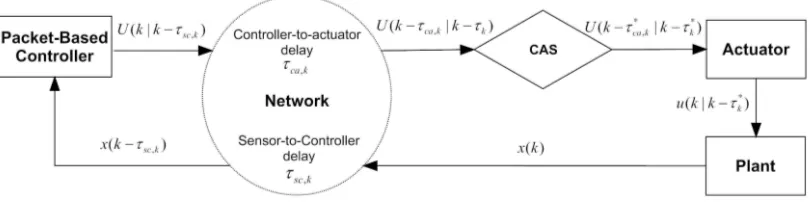
The relationship in (6) implies that a sequence of the forward control signals, or referred to as the “forward control sequence”(FCS), can be packed into one data packet and sent simulta-neously to the actuator. The FCS is designed as follows if time-synchronization is unavailable between the sensor and the controller,
UN(k|k−α) = [u(k−α|k−α). . . u(k−α+ ¯τ|k−α)] (7)
In the presence of time-synchronization between the sensor and the controller, the sensor-to-controller delay α can be known by the controller (Zhao et al. 2009a). In this case the control signals from time k−α tok−1 are clearly not necessary to be calculated as they are impossible to be used at the actuator side. The above FCS can thus be shortened as follows,
US(k|k−α) = [u(k|k−α) . . . u(k+ ¯τca|k−α)] (8)
where the control predictions in (7) and (8) are all calculated based on delayed sensing data at time k−α. Notice that in the case of (7) the requirement in (6) can be relaxed by replacing ¯τ by ¯τca. Notice also that in both (7) and (8) k refers to the time at the controller side.
By sending the FCSs simultaneously to the actuator and designing some auxiliary mecha-nisms (CAS, or control action selector) to choose from them the appropriate control signals, the communication constraints in NCSs including network-induced delay, data packet dropout and data packet disorder, can then be actively compensated for. The block diagram of a general packet-based networked control system (PBNCS) is illustrated in Fig. 2. For more details of the packet-based control approach, the reader is referred to Zhao et al. (2008, 2009a,b, 2010).
3.2.2. Categorizing the delay-dependent control laws
The above design procedure of PBNCSs provides only the control framework to compensate for the communication constraints in NCSs, whereas the design of the packet-based controller, or the FCS, can still be varied. In the early development of PBNCSs (Liu et al. 2007), the controller is designed using a model based control method. The idea is to first “estimate”, or “predict” the current system state from the delayed sensing data and then use a constant feedback gain. We refer to this design method as the “prediction-based” approach and the control law can be written as
where ˆx(k|k−τ) is the predicted state at time kbased on the state at time k−τ.
A recent development of PBNCSs gives rise to a more flexible structure of PBNCSs, where no prediction of the system state is used, resulting in the following control law with the use of the FCS in (7),
u(k) =Kτx(k−τ) (9b)
where the feedback gain Kτ is dependent on the round trip delayτ. With the use of the FCS in
(8), the control law is defined by
u(k) =Kα,βx(k−τ) (9c)
where the feedback gain Kα,β is dependent on both the sensor-to-controller delay, α and the
controller-to-actuator delay, β.
The most important feature of the control laws in (9b) and (9c) is that the feedback gains are now time-varying, i.e., we now have a set of feedback gains corresponding to different delays and at any specific time instant, a specific feedback gain is chosen from the set to reflect the current network condition. It thus brings more design freedom for the control engineers to compensate for the communication constraints in NCSs. A better system performance can therefore be expected (Zhao et al. 2009a).
Remark 3.1 Although the categorization of the delay-dependent control laws are based on the packet-based control framework, it is necessary to point this out that this categorization is widely applicable to almost all the delay-dependent control laws in NCSs. Therefore, the analysis that follows is actually in a very general sense.
4. When and how the delay effects in different channels are different
Based on the definition of the system performance index in Section 2 and the categorization of existing control laws in NCSs in Section 3, we are now able to analyze the delay effects in different channels. A qualitative analysis is firstly conducted to clarify which categories of control laws are DCDI (DCDD) and then a quantitative analysis is conducted for the DCDD control laws.
4.1. When the delay effects are different: A qualitative analysis
A qualitative analysis of the delay-independent control law in (5a) and the delay-dependent control laws in (9a)(9b)(9c) leads to the following Proposition.
Proposition 4.1
(1) The delay-independent control law in (5a) and the delay-dependent control law in (9b) are DCDI;
(2) The delay-dependent control laws in (9a) and (9c) are typically DCDD;
Proof : Notice that for any given kand τ,uτ(k:α, β) remains to be constant for both control
laws in (5a) and (9b). The first part of the Proposition is thus correct by (3) and Definition 2.1. As for the control law in (9c), uτ(k:α, β) is varying with Kα,β and is thus typically different
March 16, 2012 10:18 International Journal of Systems Science PBNCSs˙Delay˙Effects˙in˙Different˙Channles-IJSS-final
International Journal of Systems Science 7
state, that is, the model inaccuracy and the error occurred in the model prediction. The sensor-to-controller and the controller-to-actuator delays are related to these two factors in different ways (which will be more evident in the quantitative analysis in Subsection 4.2.1), meaning that these two delays typically present different delay effects for the system. Remark 4.2 As for the control law in (9a), it makes a difference in terms of the delay effects whenever a model-based controller is designed for the system. This means that besides the packet-based control approach, other model-based methods could also suffer from different delay effects for different sensor-to-control and controller-to-actuator delays, such as the approaches proposed in Montestruque (2004), Montestruque and Antsaklis (2004). On the other hand, the idea of using delay-dependent feedback gains has also been seen in other models used for NCSs, see, e.g., Zhang et al. (2005), despite the missing of the practical design support. Clearly the results obtained here and in what follows are also applicable to these models. This observation implies that the formulated problem and the obtained results are widely applicable to a large number of NCSs.
4.2. How the delay effects with (9a) and (9c) are different: A quantitative analysis
The second part of Proposition 4.1, i.e., the different delay effects caused by the control laws in (9a) and (9c), are addressed quantitatively in this section. These obtained results provide important design principles for the practical implementation of NCSs.
4.2.1. The prediction-based approach in (9a)
The design of the control law in (9a) can be various due to the different predictive methods used to obtain ˆx(k|k−τ). Examples of this variance can be seen in Liu et al. (2007) for a model-based approach and in Zhao et al. (2009a) for a receding horizon based approach. In what follows a quantitative analysis is done for the case in Liu et al. (2007), whereas other cases can be analyzed similarly.
The fundamental idea of predicting the state ˆx(k|k −τ) in Liu et al. (2007) is to use an estimated plant model at the controller side, which can give the predicted states based on delayed state information. The model used can be written as
ˆ
x(k+ 1) = ˆAxˆ(k) + ˆBuˆ(k) (10) where ˆA and ˆB are not equivalent to A and B in (2) in general due to the modeling error. Furthermore, the control signals ˆu(k) may not be the same as the real ones, u(k), since the latter is usually not fully accessible to the controller.
Notice thatkin (9a) is the time at the actuator side. The time when the FCS is calculated at the controller side is thusk−β and the FCS is calculated based on the delayed state information at timek−τ. The prediction-based approach estimates the state ˆx(k|k−τ) based on the available delayed state x(k−τ), using the following two steps.
(1) Estimate from ˆx(k−τ + 1|k−τ) to ˆx(k−β|k−τ). In this step it is assumed that the real control signals applied to the plant from u(k−τ) to u(k−β −1) are available to the controller, that is, ˆu(k−τ +i) = u(k−τ +i), i = 0,1, . . . , β+ 1. It is realized later that this assumption is difficult to be implemented in practice and a better approach is proposed to deal with this difficulty (Zhao et al. 2008). However in this paper we keep this assumption unchanged for simplicity of analysis. Based on this assumption and the predictive model in (10), the dynamics of the predictive model can be written as
ˆ
where ˆx(k−τ|k−τ) =x(k−τ). This yields
ˆ
x(k−β|k−τ) = ˆAαx(k−τ) +
α X
j=1
ˆ Aα−j ˆ
Bu(k−τ +j−1) (12)
(2) Estimate from ˆx(k−β+ 1|k−τ) to ˆx(k|k−τ). In this step the control signal is assumed to be given by ˆu(k−β+i) =u(k−β+i|k−τ) =Kxˆ(k−β+i|k−τ), as the real ones are clearly not available. Based on this assumption, the predictive model in (10) turns to be
ˆ
x(k−β+i|k−τ) = ( ˆA+ ˆBK)ˆx(k−β+i−1|k−τ), i= 1, . . . , β (13) which gives
ˆ
x(k|k−τ) =( ˆA+ ˆBK)βxˆ(k−β|k−τ) (14) As state feedback with a constant feedback gain is used in (9a), eτ(k :α, β) in (3) can thus
be evaluated equivalently by the difference between the estimated state, ˆx(k|k−τ) and the real one, x(k|k−τ) =x(k), i.e.,
e(k|k−τ) :=x(k|k−τ)−xˆ(k|k−τ) (15) By (2) x(k|k−τ) is given by
x(k|k−τ) =Aτx(k−τ) +
τ X
j=1 Aτ−j
Bu(k−τ+j−1) (16)
which is based on the state at time k−τ.
From (12), (14) and (16) e(k|k−τ) can be explicitly expressed, which in general is a function of the sensor-to-controller delay,α, (or the controller-to-actuator delay,β) given the fixed round trip delay, τ,
e(k|k−τ) = Γτ,K(α) (17)
Although it is possible to investigate the explicit expression of e(k|k−τ) in (17) directly, it is too complicated to derive any valuable results. As the main purpose of the paper is to study the effects in the presence of different delays in different channels, it is thus possible to study the effects indirectly from two different dynamics ofe(k|k−τ), based on (11) and (13). On the basis of this observation, the following result is obtained.
Proposition 4.3 With the use of the prediction-based control law in Liu et al. (2007), the sensor-to-controller delay, α, affects the system performance less than the controller-to-actuator delay, β, provided the predictive model in (10) is sufficiently precise.
Proof : In order to demonstrate the above result, the error dynamics e(k|k−τ) is analysed based on the aforementioned two steps in the prediction-based approach. From k−τ to k−β, the error dynamics is obtained for i= 1, . . . , α, as follows, based on (11) and (16),
eα(i) :=e(k−τ+i|k−τ)
March 16, 2012 10:18 International Journal of Systems Science PBNCSs˙Delay˙Effects˙in˙Different˙Channles-IJSS-final
International Journal of Systems Science 9
with e(k−τ|k−τ) = 0.
On the other hand, fromk−β+ 1 tok, the error dynamics is obtained forj= 1, . . . , β, based on (13) and (16), as follows,
eβ(j) :=e(k−β+j|k−τ)
=(A−Aˆ−BKˆ )x(k−β+j−1|k−τ) + ( ˆA+ ˆBK)e(k−β+j−1|k−τ)
+Bu(k−β+j−1) (19)
It is noticed that the erroreα(·) is purely dependent on the sensor-to-controller delay,α, and is
accumulated with the increase ofα. On the other hand, althougheβ(·) is mainly affected by the
controller-to-actuator delay, it is also affected by the sensor-to-controller delay, since its initial state, e(k−β|k−τ), is obtained in (18).
Now suppose we have an exact model of the plant, i.e., A= ˆA,B = ˆB. It immediately follows thateα(i)≡0, i= 1, . . . , α, and in particular the initial state for (19),e(k−β|k−τ) =eα(α) = 0.
Therefore, in this case the sensor-to-controller delay does not affect the system performance at all. On the other hand, it is readily seen that eβ(i)6= 0 in general and will accumulate with the
increase of β. Based on this observation, it is therefore fair to claim the statement made in this
proposition.
Remark 4.4 Proposition 4.3 implies that, under certain conditions, it can result in a better system performance to place the controller as close to the actuator as possible, if the system allows us to do so. In this sense Proposition 4.3 has its practical guidance value. However, Proposition 4.3 is based on the nominal system and it could be wrong in the presence of large model inaccuracy, measurement error, or any other type of uncertainties in the system. Indeed, as stated in the proof, the sensor-to-controller delay affects botheα(·) andeβ(·) while the
controller-to-actuator delay affects onlyeβ(·). Therefore, if the system setting allows the sensor-to-controller
delay to take effect, it is very likely that this delay could affect the system performance more severely than that of the controller-to-actuator delay. This implies that Proposition 4.3 has its rigid conditions of applicability.
4.2.2. The delay-dependent gain based approach in (9c)
Unlike the prediction-based approach in (9a) where the prediction of the current system state plays an essential role, the delay effects in the delay-dependent gain based approach in (9c) are purely dependent on the time-varying feedback gains. In order to specify eτ(k : α, β) in
(3), we consider, for given round trip delay, τ, the unit error with respect to the delay in the sensor-to-controller channel, α,
∆eα :=||Kα+1,β−1−Kα,β||||x(k−τ)||= ∆Kα||x(k−τ)|| (20)
and the unit error with respect to the delay in the controller-to-actuator channel, β,
∆eβ :=||Kα−1,β+1−Kα,β||||x(k−τ)||= ∆Kβ||x(k−τ)|| (21)
where || · ||is the norm of·, ∆Kα =||Kα+1,β−1−Kα,β||and ∆Kβ =||Kα−1,β+1−Kα,β||.
Recalling (9c), it is noticed that Kα,βx(k−τ) = u(k) is the control signal actually applied
to the plant at time k. ∆eα (∆eβ) can thus be interpreted as the difference between u(k) and
the control signal produced by increasing (decreasing) a unit delay in the sensor-to-controller channel and meanwhile decreasing (increasing) a unit delay in the controller-to-actuator channel. Therefore, to a certain extent ∆eα (∆eβ) is able to quantitatively measure the delay effects in
Table 1. The different delay effects in NCSs
Controller category Which delay more affects the performance? Implementation considerations
(5a) and (9b) No differencea N.A.
(9a) The controller-to-actuator delayb Minimize the controller-to-actuator delayc (9c) Dependent on different controller gainsd Adjust the control structure accordinglye aProposition 4.1;bProposition 4.3; cRemark 4.4;dProposition 4.5 and Remark 4.7;eRemark 4.8
delay in the sensor-to-controller (controller-to-actuator) channel affects the system performance. This fact is stated in the following Proposition.
Proposition 4.5 In the delay-dependent gain based approach in (9c), the effects of the delays in the sensor-to-controller channel and the controller-to-actuator channel are proportional to ∆Kα
and ∆Kβ, respectively.
Remark 4.6 Notice that for the control law in (9b), for any given round trip delay the feedback gain remains fixed. This implies that for any given round trip delay, τ,
Kτ =Kα+1,β−1 =Kα−1,β+1,∀α+β =τ
Therefore, in a certain sense the delay effects of the control law in (9b) can be deduced from Proposition 4.5.
Remark 4.7 It can be often seen in practice that either ∆Kα > ∆Kβ or ∆Kα < ∆Kβ is met
by almost all round trip delays with only a few exceptions. In this case we should be confident to conclude that the sensor-to-controller delay or the controller-to-actuator delay plays more essential role than its counterpart although this conclusion can not be obtained directly from Proposition 4.5. In this sense the conditions in Proposition 4.5 can be too rigid to be actually applied in practice. To deal with this issue, we define the following global gain error, Kα and
Kβ, based on the partial gain error, ∆Kα and ∆Kβ, respectively,
Kα := X
τ X
α+β=τ
∆Kα (22)
Kβ := X
τ X
α+β=τ
∆Kβ (23)
It is seen that Kα and Kβ are the sum of ∆Kα and ∆Kβ over all possible delays. Therefore,
the former can be an effective measure for the delay effects in a global sense. Proposition 4.5 can also be modified accordingly to represent this global measure.
Remark 4.8 Proposition 4.5 has its guidance value in the practical implementation of NCSs. After the feedback gains in (9c) have been designed, ∆Kα and ∆Kβ in (20) and (21), and
consequently the different delay effects, can then be determined by Proposition 4.5. The practical implementation can then be adjusted accordingly in favor of the system performance.
4.3. A Brief Summary and Discussion
We are now able to summarize the points scattered all over the paper on the different delay effects in NCSs in Table 1.
March 16, 2012 10:18 International Journal of Systems Science PBNCSs˙Delay˙Effects˙in˙Different˙Channles-IJSS-final
International Journal of Systems Science 11
As regards the practical implementing, we may therefore try to decrease as much as possible the delay which deteriorates the system performance more if the system allows us to do so. This can be served as an important design principle in the implementation of any NCSs.
5. Numerical examples
Two numerical examples are considered to verify the conclusions made in the last section, regard-ing the delay effects of the prediction-based approach (Example 5.1) and the delay-dependent gain based approach (Example 5.2), respectively. All the simulations that follows are done using MATLAB.
Example 5.1
Consider the system in (2) with the following system matrices borrowed from Liu et al. (2007),
A=
1.010 0.271 −0.488 0.482 0.100 0.240 0.002 0.3681 0.7070
, B =
5 5 3−2 5 4
As in Liu et al. (2007), the initial state is set as x0 = [0.1 0.1 0.1]T and the constant feedback
gain is given by
K=
0.5858 −0.1347−0.4543
−0.5550 0.0461 0.4721
Different from the system setting in Liu et al. (2007), it is assumed that the system states of the above system can be obtained exactly and therefore the measurement system and the observer are not necessary. The control signal is assumed to be zero before the arrival of the first FCS. In addition, in order to focus on the delay effects in different channels, the delays are all set to be time-invariant.
The simulations of the above system prove the statement made in Proposition 4.3 and Remark 4.4. Under the same round trip delay, ¯τ = 3, Fig. 3 shows that the system is stable withτca = 1
while unstable with τca = 2. This proves the result in Proposition 4.3, that is, the smaller the
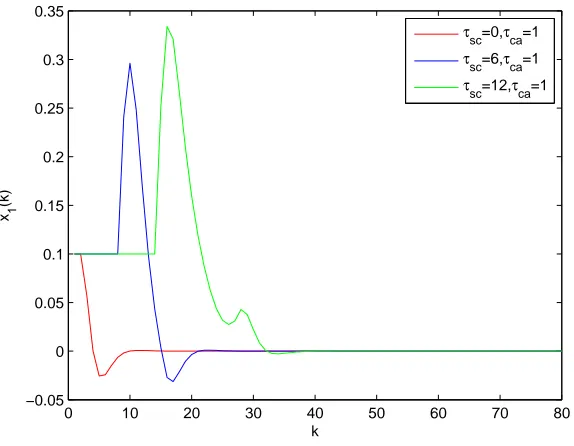
controller-to-actuator delay is, the better the system performance will be. Further examples can be seen in Figs. 4 and 5. With τca = 1 and τsc = 1 respectively, the system is stable even with
τsc = 12 (Fig. 4) while only stable for τca < 2 (Fig. 5). This clearly shows that the
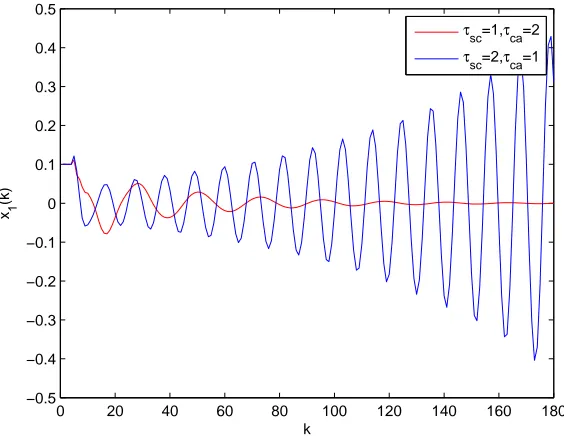
sensor-to-controller delay has a less negative effect on the system performance. In order to simulate the delay effects in the presence of the modeling error, a particular case is shown in Fig. 6, where the inaccurate system matrices are defined as ˆA= (1 +ǫ)Aand ˆB = (1−ǫ)B withǫ= 0.16. For this particular case it shows that the sensor-to-actuator delay could affect the system performance more severely. This proves the statement made in Remark 4.4. However, it is worth pointing out that with inaccurate models, the sensor-to-actuator delay could still be possible to affect the system performance more lightly. This implies that with the modeling error in presence, the delay effects in different channels are complicated and no general results exist.
0 10 20 30 40 50 −0.05 0 0.05 0.1 0.15 0.2 0.25 0.3 0.35 0.4 x 1 (k) k
τsc=1,τca=2
[image:13.595.159.446.132.357.2]τsc=2,τca=1
Figure 3. Example 1: State responses with different delays in different channels.
0 10 20 30 40 50 60 70 80
−0.05 0 0.05 0.1 0.15 0.2 0.25 0.3 0.35 x 1 (k) k
τsc=0,τ
ca=1
τsc=6,τca=1
τsc=12,τ
ca=1
Figure 4. Example 1: State responses with the same controller-to-actuator delay.
on a receding horizon approach, as proposed in Zhao et al. (2009a),
K0,0 K0,1 K0,2
=
−0.0312−0.0822 −0.1719
−0.1446 0.0568 0.2801 0.0583 −0.0172 −0.0976
−0.1591 0.0427 0.2559 0.0474 −0.0128 −0.0765
−0.1253 0.0338 0.2020
[image:13.595.159.446.408.631.2]March 16, 2012 10:18 International Journal of Systems Science PBNCSs˙Delay˙Effects˙in˙Different˙Channles-IJSS-final
International Journal of Systems Science 13
0 10 20 30 40 50
−0.05 0 0.05 0.1 0.15 0.2 0.25 0.3 0.35 0.4 x 1 (k) k
τsc=1,τca=0
τsc=1,τca=1
[image:14.595.158.446.132.356.2]τsc=1,τca=2
Figure 5. Example 1: State responses with the same sensor-to-controller delay.
0 20 40 60 80 100 120 140 160 180
−0.5 −0.4 −0.3 −0.2 −0.1 0 0.1 0.2 0.3 0.4 0.5 x 1 (k) k
τsc=1,τca=2
[image:14.595.163.445.410.630.2]τsc=2,τca=1
Figure 6. Example 1: State responses in the presence of modeling error.
K1,0 K1,1 K1,2
=
−0.1333 0.0018 0.1319
−0.0772 0.0191 0.1235 0.0085 −0.0027 −0.0147
−0.0290 0.0073 0.0455 0.0087 −0.0022 −0.0137
−0.0230 0.0059 0.0363
K2,0 K2,1 K2,2
=
−0.1629 0.0137 0.1890
−0.0256 0.0053 0.0405 0.0010 −0.0006 −0.0024
−0.0104 0.0022 0.0152 0.0030 −0.0006 −0.0045
−0.0081 0.0017 0.0120
As for the above delay-dependent gains, there is no general conclusion whether ∆Kα >∆Kβ
or ∆Kα <∆Kβ. The global gain error is then calculated by (22), which turns to beKα= 0.0763
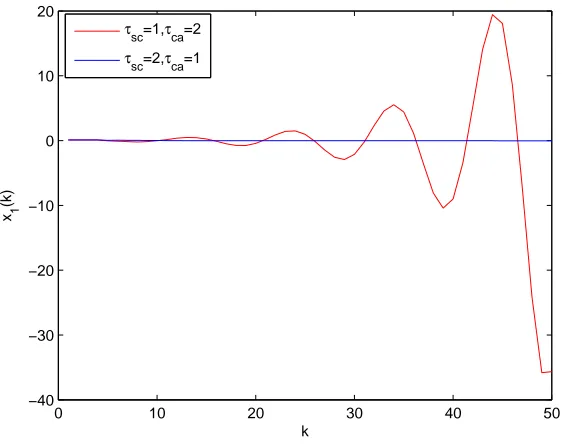
and Kβ = 0.1688. This indicates that in general the controller-to-actuator delay, β, affects the
system performance more than the sensor-to-controller delay, α. This conclusion is verified by the state responses shown in Fig. 7, where the increase of the controller-to-actuator delay rapidly destabilizes the system, showing the more important role played by the controller-to-actuator delay.
0 10 20 30 40 50
−40 −30 −20 −10 0 10 20
x 1
(k)
k
τsc=1,τca=2
[image:15.595.164.445.371.595.2]τsc=2,τca=1
Figure 7. Example 2: State responses with different delays in different channels.
6. Conclusions
March 16, 2012 10:18 International Journal of Systems Science PBNCSs˙Delay˙Effects˙in˙Different˙Channles-IJSS-final
REFERENCES 15
References
Coutinho, D.F., Fu, M., and de Souza, C.E. (2010), “Input and Output Quantized Feedback Linear Systems,”IEEE Trans. Autom. Control, 55(3), 761 –766.
Gao, H., Chen, T., and Lam, J. (2008), “A new delay system approach to network-based control,”
Automatica, 44(1), 39–52.
Hua, C.C., Zheng, Y., and Guan, X.P. (2011), “Modeling and Control for Wireless Networked Control System,”Int. J. Autom. Comput., 8(3), 357–363.
Jentzen, A., Leber, F., Schneisgen, D., Berger, A., and Siegmund, S. (2010), “An Improved Maximum Allowable Transfer Interval forLp -Stability of Networked Control Systems,”IEEE Trans. Autom. Control, 55(1), 179 –184.
Lin, C., Wang, Z., and Yang, F. (2009), “Observer-based networked control for continuous-time systems with random sensor delays,”Automatica, 45(2), 578–584.
Liu, G.P., Xia, Y., Rees, D., and Hu, W. (2007), “Networked Predictive Control of Systems with Random Network Delays in Both Forward and Feedback Channels,” IEEE Trans. Ind. Electron., 54(3), 1282–1297.
Meng, X., Lam, J., and Gao, H. (2009), “Network-based H∞ control for stochastic systems,” Int. J. Robust Nonlinear Control, 49(3), 295–312.
Montestruque, L.A. (2004), “Model-based Networked Control Systems,” University of Notre Dame.
Montestruque, L.A., and Antsaklis, P.J. (2004), “Stability of Model-Based Networked Control Systems with Time-Varying Transmission Times,”IEEE Trans. Autom. Control, 49(9), 1562– 1572.
Wang, Y.L., and Yang, G.H. (2007), “H∞ Control of Networked Control Systems with Time
Delay and Packet Disordering,” IET Control Theory Appl., 1(5), 1344–1354.
Wang, Z., Ho, D.W.C., Liu, Y., and Liu, X. (2009), “RobustH∞control for a class of nonlinear
discrete time-delay stochastic systems with missing measurements,”Automatica, 45(3), 684 – 691.
Wei, G., Wang, Z., He, X., and Shu, H. (2009), “Filtering for Networked Stochastic Time-Delay Systems With Sector Nonlinearity,” IEEE Trans. Circuits Syst. II-Express Briefs, 56(1), 71– 75.
Xia, Y., Liu, G.P., Shi, P., Rees, D., and Thomas, E.J.C. (2007), “New stability and stabilization conditions for systems with time-delay,” Int. J. Syst. Sci., 38(1), 17 – 24.
Xiong, J., and Lam, J. (2009), “Stabilization of Networked Control Systems With a Logic ZOH,”
IEEE Trans. Autom. Control, 54(2), 358–363.
Zhang, D., and Wang, X. (2012), “Static output feedback control of networked control systems with packet dropout,” Int. J. Syst. Sci., 43(4), 665–672.
Zhang, L., Shi, Y., Chen, T., and Huang, B. (2005), “A New Method for Stabilization of Net-worked Control Systems With Random Delays,” IEEE Trans. Autom. Control, 50(8), 1177– 1181.
Zhang, W.A., and Yu, L. (2008), “New approach to stabilisation of networked control systems with time-varying delays,” IET Control Theory Appl., 2(12), 1094–1104.
Zhao, Y.B., Liu, G.P., and Rees, D. (2008), “Improved Predictive Control Approach to Net-worked Control Systems,” IET Control Theory Appl., 2(8), 675–681.
Zhao, Y.B., Liu, G.P., and Rees, D. (2008), “Integrated Predictive Control and Scheduling Co-Design for Networked Control Systems,” IET Control Theory Appl., 2(1), 7–15.
Zhao, Y.B., Liu, G.P., and Rees, D. (2009a), “Design of A Packet-Based Control Framework for Networked Control Systems,”IEEE Trans. Control Syst. Technol., 17(4), 859–865.
Zhao, Y.B., Liu, G.P., and Rees, D. (2010), “Packet-Based Deadband Control for Internet-Based Networked Control Systems,”IEEE Trans. Control Syst. Technol., 18(5), 1057–1067.
March 16, 2012 10:18 International Journal of Systems Science PBNCSs˙Delay˙Effects˙in˙Different˙Channles-IJSS-final
REFERENCES 17
Appendix A. Authors’ biographical details
• Dr. Yun-Bo Zhao received the B.Sc. degree in mathematics from Shandong University, Jinan, China, in 2003, the M.Sc. degree in systems sciences from the Institute of Systems Sciences, Chinese Academy of Sciences, Beijing, China, in 2007, and the Ph.D. degree from the University of Glamorgan, Pontypridd, UK, in 2008. He has held postdoctoral positions with INRIA-Grenoble, France and the University of Glamorgan, UK, respectively. He is currently a Research Associate with the University of Glasgow, Glasgow, UK. His main research interests include systems biology, networked control systems, and Boolean networks.
• Dr. Jongrae Kim is a Lecturer in the Biomedical Engineering Division, University of Glasgow, Glasgow, UK. His main areas of research interest are robustness analysis, optimi-sation, stochastic dynamics, and parallel processing for control system design and analysis. He received the B.Eng. and M.Eng. degrees in Aerospace Engineering from the Inha Uni-versity, Incheon, Korea in 1991 and 1996, respectively. In 2002, he graduated from Texas A& M University at College Station, Texas, USA with a Ph.D. in Aerospace Engineering. He worked at the Department of Electrical & Computer Engineering in the University of California at Santa Barbara, CA, USA, as a Post-Doctoral researcher from August 2002 to December 2003. From January 2004 to September 2007, he was a Research Associate at the Department of Engineering in the University of Leicester, Leicester, UK. In October 2007, he joined the Department of Aerospace Engineering in the University of Glasgow and became part of the Biomedical Engineering Division in 2010.