City, University of London Institutional Repository
Citation
: Allbon, E. (2016). Connecting with clients - what tools work?. Australian Law
Librarian, 23(1), pp. 4-13.This is the accepted version of the paper.
This version of the publication may differ from the final published
version.
Permanent repository link:
http://openaccess.city.ac.uk/18826/Link to published version
:
Copyright and reuse:
City Research Online aims to make research
outputs of City, University of London available to a wider audience.
Copyright and Moral Rights remain with the author(s) and/or copyright
holders. URLs from City Research Online may be freely distributed and
linked to.
City Research Online: http://openaccess.city.ac.uk/ [email protected]
Connecting with clients – what tools work?
Emily Allbon
=============================================================
We know what we’re good at and how we can help our users, whether they are
students, trainees, lawyers or judges. What is challenging is how to connect with those communities; how to engage them in the materials we create, the sessions we run and the services that we are developing. This means the initial spark of interest, right through to ensuring they come back to us again and again.
Finding this angle is challenging – whichever industry you work within. You need something unique and original, a ‘story’ or ‘feel’ that shows your personality. Brand is always problematic for libraries; we are often tied in to corporate identities, whether academic or law firm. Frequently central marketing or IT departments control our online direction, making it difficult for us to generate new content.
Many academic libraries rejoiced with the emergence of the LibGuides1 product, as it offered a chance to be released from the shackles of institutional control, however there is a view that this is now so widespread that it has become bland and
omnipresent. More seriously though, there are also those questioning the reliance on standard template and bog-standard headings, with little or no impetus for students to do their own research2.
With this in mind, what tools exist that can offer us a way to connect with our community of users? As creator of an online resource for UK law students
(Lawbore3) I will share some of the ways I have found success in sparking interest in my community, presenting some insights into where the creative idea for the site came from, a focus on the different components and what its users think of the resource.
I will also focus on four tools that I have found useful for connecting with my community, both online and in my face-to-face teaching.
First however, a little background about my institution and the challenges faced by UK law students, as this has largely informed the way that I have approached my own developments.
1LibGuides, <http://springshare.com/libguides/>.
2 Alison Hicks ‘LibGuides: Pedagogy to Impress?’ on Jesse Stommel & Pete Rorabaugh Hybrid
Pedagogy: a digital journal of learning, teaching and technology (April 16th 2015)
<http://www.hybridpedagogy.com/journal/libguides-pedagogy-to-oppress/>.
City University London & the City Law School
City University London4 (founded in 1894) is a university situated (unsurprisingly) near the City of London. Our tagline is ‘Academic excellence for business and the professions’ – we have 5 Schools: Arts & Social Sciences, Mathematics, Computer Science and Engineering, Health Sciences, the Cass Business School and the City Law School. There are some 17,000 students, 35% of whom are postgraduates.
The City Law School teaches law at all levels – from the undergraduate degree, right through to the professional courses. It incorporates the institution previously known as the Inns of Court School of Law, the original provider of bar training. Our alumni include prominent British prime ministers (Tony Blair, Margaret Thatcher, Clement Attlee and H.H.Asquith) as well as many others from overseas, Mahatma Gandhi being one.
Studying law in the UK
There are generally 2 stages to legal education in the UK: the academic stage and the professional stage. The academic portion is usually a three-year undergraduate law degree (LLB) or a one-year law conversion course for graduates (GDL). Two year LLBs are also now available for graduates. The professional stage is where students have to choose which branch of the profession they wish to follow, completing the Bar Professional Training Course (BPTC) for barristers and the Legal Practice Course (LPC) for solicitors. Each of these courses last one-year if done on a full-time basis5.
Whilst at the academic stage, students will be applying for work experience to build up their CVs, usually in the form of mini-pupillages (which take place at a barristers chambers) or a vacation scheme (at a law firm). They would then apply for an apprenticeship for when their professional stage is complete: either a one-year pupillage (for barristers) or a two-year training contract (for solicitors).
This process is massively competitive, with thousands of graduates chasing
significantly fewer places. Without this apprenticeship they cannot practice law as a solicitor or barrister. Figures from 20146 show 2164 students on the BPTC course, with only 256 pupillages available via the main application route, the Pupillage Gateway7. These students will have spent in excess of £44,000 on their education,
with the GDL students accumulating another £10,000 debt on top.
4City University London <http://www.city.ac.uk/>.
5 There is a third way – the Legal Executive route, an option which makes it possible to complete the
course very flexibly and whilst already working full-time in the legal environment. Many employers will pay some or all of the fees. Becoming a Chartered Legal Executive rather than a Solicitor means you don’t have the pressure of looking for a training contract. Learn more via
<http://www.cilex.org.uk/about_cilex_lawyers/what_cilex_lawyers_do.aspx>.
6 Thomas Connelly ‘Why it’s really hard to land a job through the pupillage gateway’ on Legal Cheek
(April 8th 2014) <
http://www.legalcheek.com/2014/04/infographic-why-its-really-hard-to-land-a-job-through-the-pupillage-gateway/>.
The vast amounts of money spent by students on their legal education twinned with the terrifying competition for so few pupillage and training contract places, prompted a two-year review (2011-2013): the Legal Education and Training Review8. The final
report made recommendations for legal services education and training around quality, access and mobility as well as flexibility.
Birth of Lawbore
My role from 2000-2014 was as Law Librarian at City University London. I was very fortunate in the early days of my career to be quite autonomous: being allowed to develop new ideas and start projects without committees to go through or regular meetings and consultations. Unheard of now!
The law library occupied one floor of the main library and my office was here. As a law school we were far smaller then and students totaled below 500, which meant that I really got to know the students – they popped in with their questions, worries and sometimes just for an escape from study. It enabled me to learn about all aspects of their lives as would-be lawyers, not just the library aspect. I grew familiar with their challenges around study skills, finding work experience, mastering mooting and applying for pupillages and training contracts.
My role encompassed typical librarian functions: collection development, space management, enquiry work and some teaching, but after two years I wanted to do more to support the students, whilst developing my own skills.
The idea for Lawbore was born from a concern that many of my students were very reliant on subscription legal databases. At this time, many of these young people would not go on to work at global law firms but at charities and high street firms where such resources would not be available to them. This was 2002 and there were a few gateway-type sites with recommended links to free legal resources but these were too complex for undergraduates – every resource described in great detail and in categories that they didn’t connect with.
My very unsophisticated vision was for a site that was accessible and fun, introducing students to new resources but giving them the confidence to find some themselves too. I knew its design was important and from the start there was a real emphasis on imagery on the site. I launched Lawbore as a basic subject gateway with a few minor community elements in 2002.
Find out more about Lawbore history at: http://lawbore.net/about/
Lawbore in 2015
Our students have changed significantly in the last decade or so, and Lawbore has shifted its focus with them. The Lawbore of today has extensive features and is split
into Directory, Learnmore9, Blog10, City Hub11, along with two stand-alone sites: Research12 and Mooting13. Each element has a different focus, and harnesses different tools. A breakdown of the site & its focus follows:
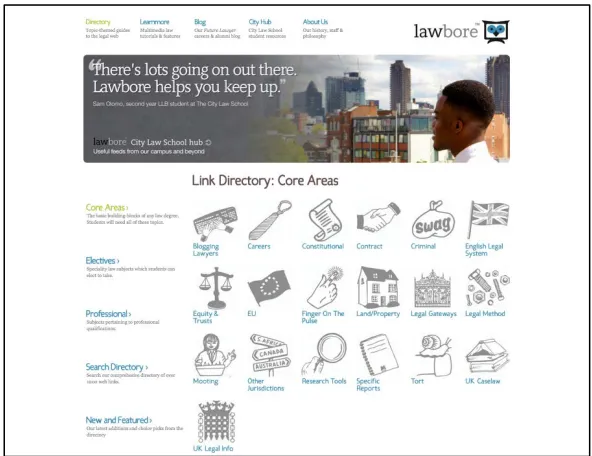
Directory: The entrance to Lawbore – this is the original part of the site: a gateway to
[image:5.595.90.386.182.410.2]free web resources organised by subject area, plus news feeds and Flickr feed of events.
Fig. 1 – Lawbore Directory
City Hub: The only part of the site wholly aimed at our own students – gives access
point to our legal databases, Twitter feed, latest books in library, news, event listings around legal London and some current awareness.
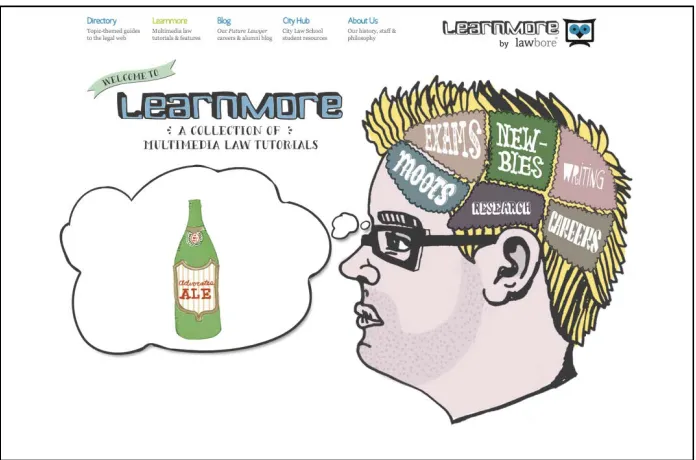
Learnmore: the skills wiki. This is the place where students go to find articles,
talking slideshows, videos and checklists on careers, mooting, legal writing, research and other skills. Resources have been written by the students or myself and are specifically compiled in a light-hearted, accessible way. The site is very visual, with custom-designed hand-drawn illustrations and lots of different media. The learning resources for Mooting are most comprehensive with lots of excerpts from real moots, illustrating both good and bad practice.
9 Learnmore, <http://learnmore.lawbore.net/>. 10 Future Lawyer, <http://blog.lawbore.net/>.
11City Hub, <http://city.lawbore.net/>.
Fig. 2 - Lawbore Learnmore
Blog: named Future Lawyer, this is focused on careers and features articles, interviews and news on people working within the law, opportunities available, reviews of events and very personal accounts of student work experience. I split the writing between myself and student volunteers and also target specific individuals to contribute when I hear of an interesting story. We interview alumni periodically, publishing written accounts or video.
Research: Still a work in progress – this is aimed to showcase the work of our PhD
and academic community. Features include news, blog posts and book reviews.
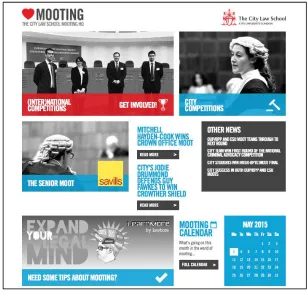
Mooting: Mooting is such a big part of our students lives, we had to make a space all
Fig. 3 - Lawbore Mooting
My role changed too; I became more involved with the Law School, serving on many committees, becoming Director of Mooting and collaborating on projects with the E-Learning Technologists and Careers team.
Achievements
The success of Lawbore has been recognised in various ways, and in many different spheres outside of libraries. Key highlights include the Learnmore part of Lawbore winning the Teaching Law with Technology Prize 2013, which was judged jointly by the Association of Law Teachers14 (ALT) and Routledge publishers. Personal awards to which my work developing Lawbore was a crucial part of the judging process included being named Wildy/BIALL Law Librarian of the Year (2012) and being chosen as a National Teaching Fellow15 by the Higher Education Academy16 (HEA) in 2013.
Why is it popular17?
Students are introduced to Lawbore from Day One of their course and use it as an access point to their online resources; this means they are visiting frequently and are
14Association of Law Teachers <http://www.lawteacher.ac.uk/>.
15National Teaching Fellowship, <https://www.heacademy.ac.uk/person/7435>.
16 Higher Education Academy, <https://www.heacademy.ac.uk/>.
17 More on this: Emily Allbon, ‘Too cool for (law) school? Using technology to engage students in
more likely to have their eyes drawn to other features whilst online. The three key aspects that emerge when students talk about why they like the resource are: the variety of different multimedia included (especially on Learnmore), the focus on the visual and the very collegiate ‘feel’ to the site. It means a lot to them that this is a resource that can directly become involved in, whether by authoring a piece, starring in a video or just taking in what their peers have to say. Here’s one of my favourite quotes from a student, proudly emailing me when he heard students from other universities discussing Lawbore at a National Law Student Forum: “...when the students knew I was representing City University they couldn't stop talking about Lawbore. Words can't describe how happy I was to see students outside our university talk about it and use it."
How do students operate in the information world?
As part of my MA in Academic Practice I carried out research18 into how students used information – for their study, career progression and in their personal life. This happened via focus groups with students – discussion covering social media tools like facebook and twitter, online communities, collaboration and digital technologies. I didn’t want this to be about Lawbore specifically but that I would use the data to inform my future development of the site.
In terms of social media they were more underwhelmed than I anticipated: many seeing it as irrelevant for study, which tallied with the view of Hrastinski and
Aghaee19 who stated “they perceive that their use [of social media] is not related with their studies”. They were certainly consumers rather than creators, one student stating, “I don’t tweet but I like to use it to search for information”. They were appreciative of universities getting involved but warned of a line to be crossed in terms of intrusion.
Law students are generally perceived to be extremely competitive and I was interested to find out how far this extended to their studies: how were they at working together and sharing materials? Selwyn20 noted this of students (not law however) in 2009: “it was noticeable that students were generally unwilling to offer extensive help
assistance to each other”. I found a real difference between cohorts, with
undergraduates less willing to share than those on the intensive one-year conversion course. The conversion students would share notes and essays via Dropbox, seeing the course as a means to an end, whereas the undergraduates were unwilling to share, believing it would lose them the edge over their peers.
Other themes that emerged were that they felt very strongly about word of mouth – speaking to those in the year above them to get insights. This reinforced my belief
18 More on this research: Emily Allbon ‘Web, Social Media and Online Communities for those
Studying for Professions: Embraced or Tolerated?’ (Paper presented at the eLmL 2014: The Sixth International Conference on Mobile, Hybrid and Online Learning, Barcelona, Spain 23rd – 27th March
2014) <http://openaccess.city.ac.uk/4067/>.
19 Stefan Hrastinski and Naghmeh M. Aghaee, ‘How are campus students using social media to
support their studies? An explorative interview study’ (2012) 17:4 Education and Information Technologies, pp.451-464.
20Neil Selwyn, ‘Faceworking: exploring students’ education-related use of Facebook’ (2009) 34:2
about the importance of involving both current students and alumni in the creation of materials on Lawbore. As librarians we can gain a great deal by involving students in the creation of our materials, seeing them as partners. Impressively they also spoke of a wide range of resources used for study outside of the classroom and about the need to be mindful of authority when doing research online.
Technologies on Lawbore
Lawbore has developed in an ad-hoc, haphazard way; organically evolving as the years pass and the nature of legal education changes. Whilst this is beneficial in some ways, it can also be a hindrance. There are so many add-ons to the main website in terms of its sub-sites that different backend systems are in place to administer them. If I were to re-design the entire site to bring it together I would no doubt use very
different technologies to do so. Here are four of my favourite tools for Lawbore and teaching:
Top 4 Tools: Twitter
I’m sure most of you use Twitter in some capacity within your work; there are so many ways to exploit it within libraries and education.
It offers great opportunities for us to broaden our networks and connect with those we might otherwise never have met. From a personal point of view I have been a Twitter user since 200821 and it got me speaking to academics, legal journalists and lawyers, as well as students all over the world. I reconnected with many alumni in this way too – approaching them to contribute to lawbore in some capacity.
Twitter allows you to get a message out internationally – making connections or opening up collaboration possibilities.
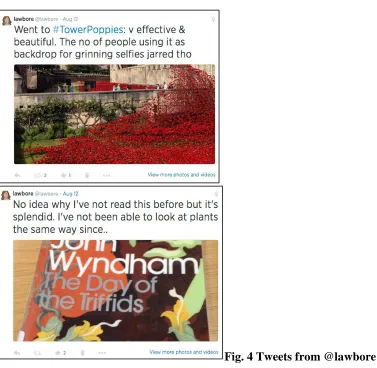
It allows you to connect with people in a much less formal way than our institution websites permit. You can develop a character – show insights into your personal life alongside work interests if you are brave enough. This helps break down a lot of barriers, and can lead to more engagement in your services – you are seen as a rounded human being.
21 Alex Aldridge, ‘The legal profession’s first tweets’ on Legal Cheek (Sep 25th 2013)
Fig. 4 Tweets from @lawbore
Obviously you can also use it effectively in your role as information gatherer and transmitter – retweeting interesting content from others to your own followers.
Fig.5 - Retweets from @lawbore
[image:10.595.93.351.482.621.2]Fig. 6-7 - Promotional retweet & humorous retweet
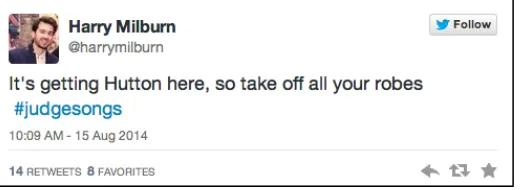
One of the best ways of using Twitter in a silly way is to get involved in hashtag challenges. These are where you start up a theme, attach a hashtag (#) to it, and then challenge others to get involved. An example of such silliness can be seen with
#judgesongs. This hashtag prompted many legal tweeters to start thinking of ways of using the name of judges within popular song titles to much hilarity. These ranged from the genius of “This is a Mance World” through to “Don’t let Leveson go down on me” and “Just another Manic Munby”22. This was a classic too!
Fig. 8 - Hashtag challenge example
What this did was bring together people from all over the legal world – lawyers, students, academics to engage in wordplay. Frivolous yes, but it captured that sense of community. I’m certain that there are ways of using this within our own practice, perhaps weekly challenges for students. I know of lecturers who ask students to try and describe cases in the 140 characters required by Twitter. Very challenging.
Top 4 Tools: Blogs
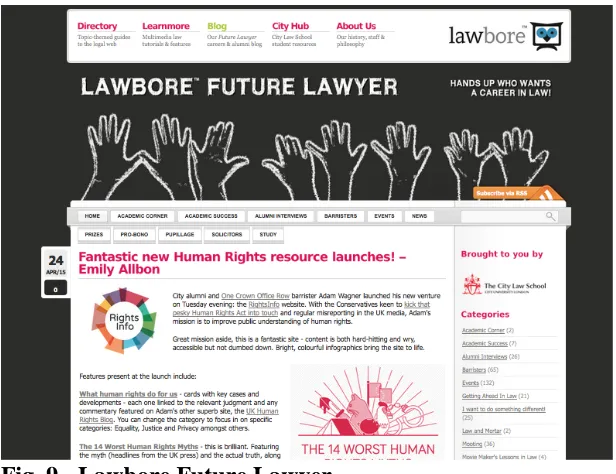
Lawbore uses 2 different blogging tools: Future Lawyer, the careers blog, uses Wordpress23 and the Mooting part of the site utilises Contao24.
22Tweets from Catherine Rowlands @cjr1968 and Anya @anyabike
[image:11.595.95.355.442.537.2]Blogs are such a flexible medium and brilliant for many of the things we mentioned above in relation to Twitter: marketing, communication in a different tone and for getting interesting content out to your users. However it offers the chance to write more substantial editorial and to engage your community with wide-ranging topics. They are easy to set up and you can use images to great effect within the blogging format. If used in tandem with Twitter, you can write the post, then promote dynamically by tweeting about it and hoping enough people retweet to spread the word.
[image:12.595.90.398.277.514.2]One of the major concerns that people have about blogs is the time factor – the requirement to write regularly or people will give up visiting. It’s important not to get too bogged down with this – remember sometimes your posts can be just be flagging up interesting news or events. Use Twitter to inspire you!
Fig. 9 - Lawbore Future Lawyer
Top 4 Tools: Talking slideshows
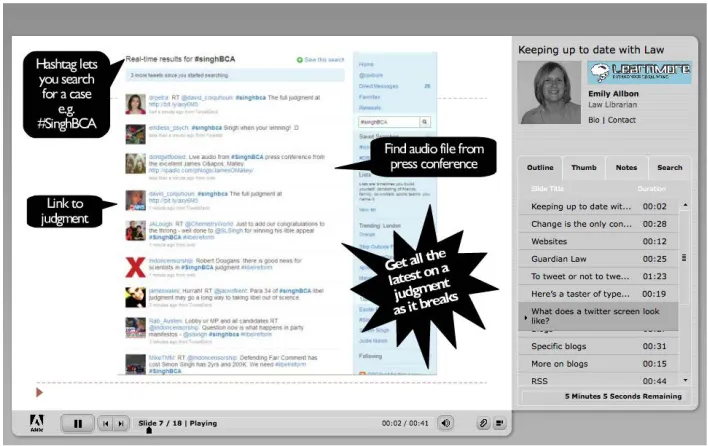
Talking slideshows are excellent medium for giving a lecture or tutorial on a discrete topic online. They’re also good for demo-ing databases and bringing alive content, which, if written, might be quite dull. Depending on the product you choose, you can also embed audio, video, quiz activities and written documents. Students like them because they can stop and start, giving them the chance to make notes. You do need to pay attention to the design however – plenty of visual interest and cut down on bullet points. The two biggest products are Adobe Presenter25 and Articulate Storyline26, both of which require costly licences. Jing27, a free product, works in a
less polished way but may do the basics of what you need around screen capture. Prezi28, of course, is another alternative.
25Adobe Presenter, <http://www.adobe.com/uk/products/presenter.html>.
26 Articulate Storyline, <https://www.articulate.com/products/storyline-why.php>. 27 Jing, <http://jing.en.softonic.com>.
Fig. 10 - Talking slideshow on Learnmore
Top 4 Tools: Sparkol Videoscribe29:
This tool offers another way of communicating with your users; great for short tutorials which catch attention. It allows you to tell a story, mimicking (albeit in a slightly less ambitious way) the superb RSA Animate30 series, showing a hand drawing on screen as you narrate. The package comes with a bank of illustrations you can utilise, or you can draw your own. Margaret Hagan31, lecturer at Stanford
University, is involved in some very interesting projects around how law can be made more interesting and accessible via design. An example of a Videoscribe I created to promote a new LLM course can be accessed via https://vimeo.com/126349587
29Sparkol Videoscribe, <http://www.sparkol.com/>.
30 RSA Animate, <https://www.thersa.org/discover/videos/rsa-animate/>.
Fig. 11 - Sparkol Videoscribe
What’s next for Lawbore?
A content refresh is scheduled for summer 2015, updating all the Talking Slideshows and creating some new ones. I’m due to work with some students on some new video content around revision tips and also some resources aimed at students just beginning their studies in law. I have several projects to finish off: one being Talking Essays, which is a small bank of essays in the core law modules. This will show the students several real essays, complete with written comments and audio feedback accessed via audio hotspots within the text. You can see how this works via a small post on
Lawbore – the Anatomy of a Law Report32, which has narration from Paul Magrath at the Incorporated Council of Law Reporting (ICLR)33 on the different sections of a
law report. A further development will focus on the learning process from the point at which an assessment is released – what steps should a student take?
Final thoughts
Despite moving out of the legal information profession, making law accessible will continue to be one of my priorities. As librarians, many of us shy away from making materials ‘fun’ believing that it somehow downgrades them. We are continually fighting for our users’ attention in a world of competing priorities, and being adventurous and trying out new technologies is one way we can have a crack at engaging them. Do look outside the library to see where you can bring your skills to new audiences: collaborating with others where you can.
Bio
Emily Allbon was Law Librarian at City University London for 14 years, before joining the City Law School as a Lecturer in 2014. Her work has been recognised both internally at City (being given the Robert Kitchin Award 2012 for her
'outstanding contribution to the University') and more widely, with highlights
including the Wildy/BIALL Law Librarian of the Year 2012, Routledge/ALT Teaching Law with Technology Prize 2013 and a National Teaching Fellowship from the HEA in 2013. Emily has spoken at conferences in many parts of the world which in recent years, includes Norway, Spain and the U.S. She spent almost 4 weeks in
August/September 2014 speaking to groups of librarians and academic lawyers in Melbourne, Brisbane, Sydney, Canberra and Adelaide (and definitely wants to come back!)
Many thanks to all those who made my trip so memorable, and who hosted me at various locations; particularly to the superb Carole Hinchcliff, who did such a
tremendous amount of organising on my behalf once she’d persuaded me to come! It would never have happened without her. Also to Karen Rowe-Nurse, Deb Bennett
32Emily Allbon & Paul Magrath,‘Anatomy of a law report’ on Learnmore
<http://learnmore.lawbore.net/index.php/Anatomy_Of_A_Law_Report>.