City, University of London Institutional Repository
Citation
: Mercea, D., Karatas, D. and Bastos, M. T. (2018). Persistent Activist
Communication in Occupy Gezi. Sociology, 52(5), pp. 915-933. doi:10.1177/0038038517695061
This is the accepted version of the paper.
This version of the publication may differ from the final published
version.
Permanent repository link:
http://openaccess.city.ac.uk/id/eprint/17187/Link to published version
: http://dx.doi.org/10.1177/0038038517695061
Copyright and reuse:
City Research Online aims to make research
outputs of City, University of London available to a wider audience.
Copyright and Moral Rights remain with the author(s) and/or copyright
holders. URLs from City Research Online may be freely distributed and
linked to.
City Research Online: http://openaccess.city.ac.uk/ [email protected]
Persistent Activist Communication in Occupy Gezi
Dan Mercea, City, University of London, UK
Duygu Karatas, University of Westminster, UK
Marco T. Bastos, City, University of London, UK
Corresponding author
Dan Mercea, Department of Sociology, City, University of London, 26-38 Whiskin Street, London, EC1R 0JD, [email protected].
Abstract
We revisit the notion of activist persistence against the backdrop of protest communication on Twitter. We take an event-based approach and examine Occupy Gezi, a series of protests that occurred in Turkey in the early summer of 2013. By cross-referencing survey data with longitudinal Twitter data and in-depth interviews, we investigate the relationship between biographical availability, relational and organisational ties, social and personal costs to persistent activism online and on-location. Contrary to expectations, we find no clear-cut relationship between those factors and sustained commitment to participation in the occupation. We show that persistent activist communication did not feed into enduring organisational structures despite the continuous online activity observed during and beyond the peak of the Gezi occupation. The article concludes with reflections on the organisational ramifications of persistent communication and its significance in a political context posing high risks to participation in dissident politics.
This article examines Twitter communication associated with high-risk protest. We shift the
analytical focus away from the prevailing interest in the use of social media for participant
mobilisation (Anduiza et al., 2014; Enjolras et al., 2012; Mercea, 2012; Tufekci and Wilson,
2012; Valenzula, 2013) to advance an enquiry into activist persistence. Activist persistence is
the sustained commitment over time to one or more activist causes by various means and
actions (Downton and Wehr, 1998:534). Rather than continuing to scrutinise activist
organisations as the breeding ground for persistence (Bunnage, 2014; Rohlinger and
Bunnange 2015), we concentrate on Occupy Gezi, an ‘episodic mass mobilisation’ (Císař,
2013) assembling ‘ordinary citizens’ (Flesher-Fominaya, 2015) that unfolded in Istanbul in
late May and June 2013.
Echoing the Occupy Movement, Occupy Gezi was an outburst of collective action in
which activist organisations did not have a steering influence on the events on the ground nor
on the Twitter hashtags associated with the protests (Demirhan, 2014:282). In a climate of
residual organisational structures underpinning collective action, we investigate the costs of
sustained commitment, the circumstances—both structural and personal—that bear on it and
its networked communication on social media. Inquiring into individual decisions to persist
or cease to be involved with an activist cause, we outline the aspects that carry particular
significance for collective action in a context, as was that of Turkey, where both participation
in street demonstrations and their networked reportage risked being met with government
repression (Demirhan, 2014:284; Budan and Watts, 2015:375).1
Gratifying to the poster, to cautious observers tweeting about protests is short-lived,
low-investment and impulsive affective communication (Halupka, 2014) which at best
complements long-standing activist campaigning (Morozov, 2011). Symbolic endorsements
of or commentary on contentious political issues on social media variably impact action on
actions on social media displays the possible motivations for people at large to enact their
collective grievances together (Mercea and Funk, 2016). Moreover, techno-social structures
erected with digital and mobile media have helped rally disparate activist groups and
individuals involved in collective action (Bennett et al., 2014; Treré, 2015).
Complementing the latter research into the mediation of activism (Neumayer and
Svensson, 2016), this investigation delves deeper into the practice of “hashtag activism”
undertaken for extensive periods of time (Bastos and Mercea, 2015). To this end, the paper
embraces the theory of activist persistence. We seek to discern the premises and implications
of a commitment to tweeting high-risk protests and take a similar methodological approach to
the foregoing study by relying on longitudinal Twitter data to select users who tweeted about
Occupy Gezi over comparatively long intervals of time. In in-depth interviews, we collected
personal accounts that may illuminate tweeting as a communicative practice distinctive for its
endurance beyond the flashpoint of street protests. Most interviews took place in Turkey and
were later translated into English. The defining aspects of Occupy Gezi are outlined in the
following section. After detailing the rationale of this project and its theoretical
underpinnings, we present four research hypotheses that are evaluated with a mixed-methods
research design.
Occupy Gezi
The Gezi protests erupted on 28 May 2013 at the site of a public park in central Istanbul that
had been slated for redevelopment by the central government. In its place, a gleaming
shopping mall would arise. The uprising was initially manned by environmental activists who
had gathered to oppose the plans citing a desire to protect public space from commercial
increasingly regarded as authoritarian (Göle, 2013:9) and forceful towards dissident protests
(Budak and Watts, 2015).
In the wake of a violent police crack-down the following day, the protest mutated into
an occupation, attracting a wide cross-section of Turkish society. Rallies in support of the
sit-in were subsequently staged sit-in 60 other urban centres (Göle, 2013). Two weeks of clashes,
inflamed rhetoric by the government chastising the protestors and experimentation by the
latter with collective organisation and self-expression on various social media outlets came to
a head on 15 June when the Gezi Park and the famous nearby Taksim Square were violently
cleared by the police.2 Subsequently, acts of dissent were staged in Istanbul and around the country, gradually winding-down by 20 June (Demirhan, 2014:295).
Turkish pollster Konda surveyed the participants in the Gezi Park occupation
(N=4393) from 6-8 June3. Respondents were predominately young (81 percent were 35 years old or younger), well-educated (54 percent held a higher education degree, 34 percent had a
high-school degree), and in paid employment (51 percent) or studying (36 percent), with far
fewer either performing housework (2 percent) or in retirement (3 percent). One in five of
those participants were members of a party, civic association or NGO, whilst 93 percent
declared themselves to be “ordinary citizens” who did not represent any group or
organisation at the protests.
A sizeable majority of demonstrators either first caught wind of the events in the Park
on social media (69 percent) or were told of them by friends (15.4 percent)4. The social media prowess of the demonstrators was put into relief by the sizeable number of surveyed
participants—85 percent—who had posted at least one message about the protests over the
course of the month up to the survey (Konda, 2014:29). Of the social media used by the
Erdogan, the incumbent prime-minister, exclaimed that “there is now a menace which is
called Twitter” (Konda, 2014:28).
We tracked the communication on Twitter from the 31st of May 2013 to December 2014. In the first month of that period we recorded 1,106,383 unique tweets about Gezi
posted by 346,598 users with the hashtags #direngeziparki, #occupygezi, #occupyturkey and
#occupytaksim.. Whilst we recognise the constrictions inherent to the study of hashtagged
communication (Tufekci, 2014)—particularly in regard to its representativeness and
completeness—our analysis focuses on a distinct subsample of steadfast posters whose
communication is discussed against the question of its significance for activist persistence.
Theoretical framework
The issue of activist persistence seems topical at a time when there is much pessimism about
political participation. Against a continuously eroding interest in institutional politics and the
avenues for participation in them—e.g. voting, party and associational membership (Dalton,
2008; van Deth, 2014)—alternative forms of political engagement have caught the attention
of scholars. Although proportionately not the most important practice to counterbalance the
ostensible decline (Dalton 2008), protest participation has seen recent prominent surges in
liberal democracies and authoritarian regimes alike (Biekart and Fowler, 2013).
Historically, a consistent finding has been that protest participation is galvanized
chiefly by social interaction through membership in activist organisations; or, alternatively,
by close contact with members of an activist organisation (McAdam, 1986). Structural
availability is the term designating one’s embedment in the social environment where
mobilisation into activism transpires and is sustained (Schussman and Soule, 2005). Whilst
the aforementioned pathways to participation may remain in place, there are indications of at
activist media usage (Enjolras et al., 2012; Anduiza et al. 2014) ultimately resulting in ‘the
mobilisation of people with lower levels of previous political involvement’ (2014:760).
Mobilisation, however, is a two-step process (Klandermans and Oegema, 1987;
Beyerlein and Hipp, 2006). First, one develops a commitment to the goals and tactics of an
activist group or movement, principally via membership in germane social networks
(Klandermans and Oegema, 1987; Crossley and Ibrahim, 2012). That commitment can
subsequently lead to participation if one is biographically available to convert beliefs into
meaningful action (Klandermans and Oegema, 1987; McAdam, 1986:67). Biographical
availability refers to the ‘absence of personal constraints that may increase the costs and risks
of protest participation, such as full-time employment, marriage and family responsibility’
(McAdam, 1986:70; Corrigal-Brown, 2011) which are less prevalent among the young and
the retired (Beyerlein and Hipp, 2006:301). In their study, however, Beyerlein and Hipp
(2006:314) claimed that biographical unavailability precludes the formation of one’s
commitment to participation rather than participation itself. In this light, the ability to sustain
one’s commitment to activism is of vital importance to protest participation.
Scholarship on activist persistence has queried both the individual circumstances that
make one available to activism and the social context which nurtures one’s commitment. As
an outcome of mobilisation, persistence is the fruit of abiding biographical and structural
availability (Downton and Wehr 1998:540). Bonds to organisational values and goals as well
as to leaders and the wider community of fellow activists contribute to one’s readiness to
remain biographically available and one’s vision for a positive contribution to the common
cause.
Activist persistence entails a considerable expenditure of time and effort. In his
landmark analysis of protest participation, McAdam (1986) distinguished participants on two
pertain to the personal disbursement of time, money and energy towards participation
(Erickson Nepstad and Smith, 1999). Risk, on the other hand, is the danger that involvement
in protest activity exacts an important financial, legal or social toll as well as potentially
bringing harm to one’s physical integrity (Erickson Nepstad and Smith 1999:25). Activist
persistence may incur at least personal costs as one strives to maintain a level of biographical
availability and commitment that puts her at odds with any competing demands from kith and
kin as well as her employer or educator (Downton and Wehr, 1998). Those costs may be
particularly substantial in high-risk activism (McAdam, 1986:67).
Participation in high cost/risk activism further pivots on one’s structural availability
and in particular one’s organisational ties (McAdam, 1986). Without ties to an organisation—
both direct through membership and indirect through proxies such as friends—potential
participants would be more likely to falter in their determination to participate in a protest. In
their assessment of the same topic, Erickson Nepstad and Smith (1999:35) additionally
argued that the longer the duration of a protest, the higher the likelihood of indirect or
relational ties—rather than organisational ties—becoming more prominent a channel for
stimulating participation.
Likewise notable is the observation that various activist organisations of late exhibit a
readiness to accept that participants in their actions will self-organise with networking
technologies such as social media (Bimber et al., 2012; Karpf, 2010). Indeed, a sizeable
contingent of protest returnees has been uncovered who have a track-record of protest
participation and only loose connections to activist organisations (Saunders et al., 2012).
Returnees may revert to social media to compensate for the relative disadvantage of an
absence of membership or indirect association with activist organisations (Mercea, 2014).
They may thus prime their participation by retrieving pertinent information on social media
social identity predicated on a sense of fellowship with other participants mobilised in
support of the same protest (Mercea, 2014:403-04). Social identity is a mutual conception of
membership within a group that ‘typically includes stereotypes of in- and out-groups’ (van
Zomeren et al., 2008:505). In the Arab Spring, a social identity that crystallized around a
shared opinion of opposition to an out-group, namely the authoritarian government,
assembled variegated collections of political protest participants (McGarthy et al., 2014). A
shared opinion is the perception that ‘people are the same because they agree with each other’
despite any differences in ascribed collective characteristics such as race, class or ethnicity
(McGarthy et al., 2014:729).
There is, nonetheless, deep-seated concern about a purported feigning of activism on
social media. The claim is that key group processes conducive to ‘solidarity, commitment and
responsibility towards fellow activists’ are compromised by an atomistic desire for visibility
and self-representation on social media (Milan, 2015:896). Yet, other authors have proposed
that involvement in online and loosely organised actions more neutrally termed “information
activism” may help sustain communication even beyond the conclusion of a protest (Soon
and Cho 2014:550). A significant investment of time into activist communication on Twitter
can, however, put a strain on relationships with family and friends, diminish performance at
work and threaten job stability (Mercea and Bastos, 2016).
Ultimately, Downton & Wehr (1998) used the metaphor of a career to describe
activist persistence. Persisters have to juggle multiple responsibilities that fall within as well
as beyond the remit of their activism. They have to manage relationships with activist peers
as well as with family and friends, striking a balance between the support and chagrin they
get from either side, all the while avoiding burnout and cultivating a social identity
articulated as opposition to an out-group. Most notably, what distinguishes persisters from
endures. As Downton and Wehr (1998:542) put it, “persisters know they are persisters,
keeping at it while others come and go”. Most importantly, however, persistence has been
expected to transpire in organisational settings. In what follows, we consider whether those
users that tweeted continuously about the Gezi Park demonstrations for their entire two-week
duration and then beyond that climactic period bore any of the traits that distinguish
persistent activists. To that end, we explored the following hypotheses:
Hypothesis 1 (H1): We expected to find a significant level of biographical availability of
age, domestic and professional responsibilities and structural availability of organisational
ties among individuals who displayed a sustained commitment to tweeting about the Gezi
protest.
Hypothesis 2 (H2): Turning to the micro-mobilisation context, we envisioned that more than
organisational membership, relational ties to other protest participants and a social identity
predicated on a sense of democratic opposition to the government would underpin tweeting
about the protest during but also in the wake of the Gezi occupation.
Hypothesis 3 (H3): Thirdly, we posited that to communicate on Twitter, persistent posters
circumvented not only apparent legal and physical risks due to the clampdown by the state,
but likewise had to overcome social and personal costs.
Hypothesis 4 (H4): Finally, we anticipated that the Twitter posters would be aware of their
persistence and the contribution it could make to the endurance of their activist cause.
Data and methods
Adopting a sequential mixed methods design (Ivankova et al., 2006), we conducted a binary
logistic regression analysis on Konda’s Gezi survey data. The method enabled for predictions
dependant variable with a set of independent variables (Menard, 2002). This was done to
ascertain the bearing that biographical and structural availability5 together with one’s
participatory experience and a social identity defined by opposition to the government had on
the odds that participants in the Gezi occupation would return to the protest site one week
after its inception. Resultant insights formed a general baseline (Ivankova et al., 2006:5) for
our analysis of H1 and H2 whilst focusing specifically on the Twitter communicators.
We next turned our attention to the Twitter data. From 2013 to 2014 we monitored a
set of four Gezi hashtags (see figure 1b) by tapping directly into the Twitter Streaming API.
The resulting datasets were marked by a skewed, long-tail distribution of contributions that is
characteristic of political communication on Twitter (Mustafaraj et al., 2011). The largest
number of unique users—almost two thirds (225,019)—only tweeted once and on a single
day; 57,967 (17 percent) tweeted on two separate days; 63,612 (18 percent) tweeted on more
than two and fewer than 5 days; 16,909 (5 percent) tweeted on between 5 and 10 days; 3,183
(1 percent) between 10 and 20 days. As to the time distribution of the tweets, a marked peak
was recorded on 15 June at the time of the violent evacuation of the demonstrators from the
Park (230,009 tweets, see Figure 1a). Further, Figure 1b reveals that the Gezi hashtags
remained in use after the June flashpoint, albeit to a more modest degree.
[Figures 1 a,b ]
The longitudinal nature of our Twitter data allowed for the identification and
operationalisation of persistent activism across this temporal series. Thereby, we selected
users who kept tweeting after the police clamp-down and continued to do so for at least 20
days during June 2013. We viewed these posters through the prism of a case study design,
with each potential interviewee adding to replication (Yin, 1994:49-50) in a case series. We
aimed to attain both literal and theoretical replication in case selection. We juxtaposed the
sufficient number of interviews with persistent communicators (literal replication) for us to
model the variability in the participants’ conditions of action (theoretical replication, Yin,
1994:49-50). Following this selection protocol, between April and September 2015 we
interviewed 24 out of 100 people contacted from our target population. Of the potential
interviewees, 20 declined to be interviewed; 9 accounts had been deleted and 3 had been
suspended by Twitter by 2015. The remainder 44 prospective interviewees did not reply to
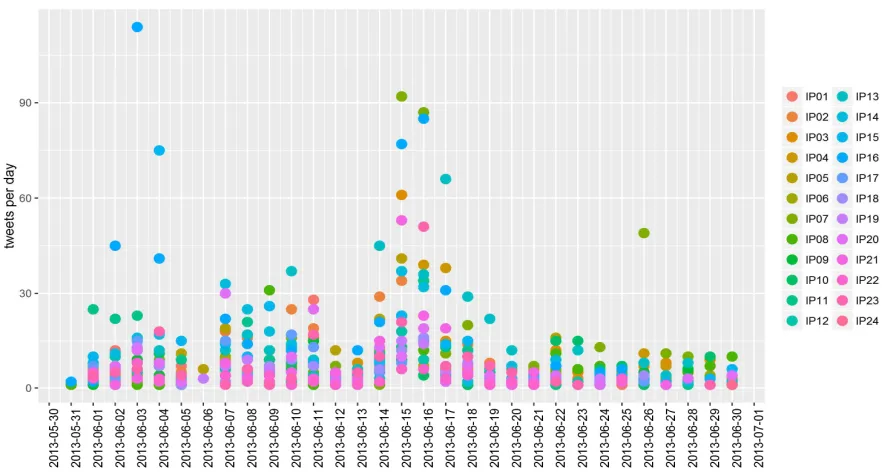
our invitations. Levels of interviewee activity on Twitter in June 2013 are plotted in Figure 2.
[Figure 2]
The conditions of action controlled for theoretical replication were the structural
availability and micro-mobilisation context as well as the biographical availability of the
interview participants. Through this approach to recruitment we were able to find and
interpret contrasting conditions among the participants. Lastly, we addressed H3 and H4 by
producing a rich account of how persistent communicators contended with their conditions of
action, enacted and interpreted their sustained commitment to the Gezi protests and its
ramifications. We tapped into these aspects with semi-structured respondent interview.
Participants in respondent interviews are recruited on the expectation that they will speak
about themselves, their own situation, the motivations and interpretations of their
circumstances (Lindlof and Taylor, 2002: 178).
We organised the qualitative data with clustered summary tables (Miles & Huberman,
1994) so as to generate an integrated and sensitized description of the aspects of interest
across all interviews. We numbered all interviews and used an alpha-numeric indicator to
designate individual interview participants (e.g. IP01 for the first interviewee). We identified,
coded and grouped together segments from all interviews germane to our research questions.
This was an iterative process that we understood as grounded thematic analysis (Cronin et al.,
interpretations thereof as well as the relationship between tweeting practices, involvement in
the Gezi Park protests and membership of activist organisations (or absence thereof).
As to the remit of our research and the robustness of the research design, our enquiry
developed from an independent measurement of sustained activist communication on Twitter
which was further contextualised and explained with survey and interview data. Explanations
of the interactions between the conditions of interest and participant actions were validated
through a pattern-matching protocol (Yin, 1994). We adjudicated between biographical and
structural availability to qualify an emergent model of persistent activist communication,
relating it back to the theory and the statistical data on persistent participation in the Gezi
occupation. In addition, the replication procedures helped minimize potential bias in
interviewee selection. All along, rather than proposing empirical generalisations, our
intention was to reconstruct the theory (Lichterman, 2002:124) of activist persistence to
account for sustained activist communication on Twitter. The next section provides a report
of our principal findings.
Research findings
Of the participants surveyed in the Gezi Park by Konda, a very sizeable contingent (87
percent of the protesters) said that they had been returning to the site of the protest following
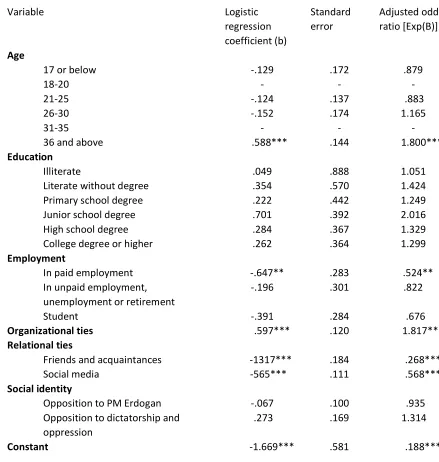
demonstrations on 28-29 May 2013. Table 1 presents the results of the logistic regression we
ran on the survey data. An inspection of the adjusted odds ratios in the figure evidences that
returnees were more likely to be found among participants, aged 36 and above and the
organisationally affiliated. Further, the odds of being a returnee were lower had one learnt of
the occupation either from friends and acquaintances or, to a lesser extent, on social media.
of a social identity appeared immaterial to an enduring commitment to participation in the
occupation.
[Table 1]
Our expectations were again confounded by the interviewees. Like the sustained commitment
showed to physical participation in the occupation, persistent protest communication on
Twitter was chiefly the province of individuals aged over thirty. The median age of the
interviewees was 38. At the time of the protests, they were in professional employment (5 in
6 interviewees) or studying (3 full-time students). They exhibited high educational
achievement—7 in 8 were university graduates; the remaining three held college and/or
high-school degrees—and lived in proximity to the demonstrations.
Seventeen interviewees were tweeting out of Istanbul; four were tweeting from other
urban centres in Turkey which had seen demonstrations in support of the Gezi occupation.
Three interviewees were tweeting from abroad. Among them there was a Turkish émigré
(IP12) and two non-native speakers posting and retweeting principally in English, one of
whom was bed-ridden at the time of the protest due to medical problems (IP23). Except for
the three individuals living outside the country, all interviewees made their way to the
protests either in Istanbul or in the other Turkish cities where these unfolded.
Notwithstanding his relocation, IP12 organised his own event in support of the Gezi
occupation. The other research participant located abroad who was physically fit attended
demonstrations regularly.
We interviewed an equal number of female and male interviewees, 11 of which were
in a relationship (6 married) whilst slightly more of them were or became single around the
time of the protests (12). One interviewee declined to disclose his relationship status. Finally,
the median number of Twitter followers for the interviewed users was 1865 (min=355,
appeared significantly less prominent in their global Twitter outreach than influential users
whose networks surpass 100k followers (Bastos and Mercea, 2015).
Confounding H1, biographical availability was less of a definitive feature than we
expected it to be for persistence either at the site of the occupation or in one’s rolling
communication about the protests on Twitter. Aside from one young female student and two
mature postgraduate students, none of the interviewees had personal situations that were
unambiguously favourable to involvement in activism. Thirteen faced especially testing
circumstances at work or at home which were aggravated by their involvement with the
occupation. For instance, a female participant was a single mother who had to juggle
child-care with free-lancing and the precariousness of short-term contracts. A single female retiree,
IP23 was convalescing following an accident; yet another was the mother of a child with
learning difficulties whose rearing had been made particularly hard by an unrelenting
experience of discrimination. Another self-employed male interviewee lost an important
contract after the protests erupted. All were, however, opinionated individuals ready to
express their political convictions on social media (see Quintillier and Theocharis 2013) and
likewise to realise them in the street protests, their health permitting.
The structural availability of the persistent communicators was probed on two levels,
namely of membership in formal organisations—chartered associations and political
parties—and informal activist groups. Two interviewees were members of the Democratic
People’s Party (DPP), a left-leaning opposition party. The DPP was represented in the
coordination body of the Gezi occupation, the Taksim Solidarity Platform. Three other
interviewees were members of the Alternative Informatics Association (AIA), an
Istanbul-based NGO advocating media literacy, freedom of expression and controls over mass
surveillance. AIA was also represented in the Gezi occupation. Of these affiliated
communications of the organisation. Painting a fuller picture of the moment, she underscored
how organisational and relational ties were intertwined with Twitter communication:
‘I was on the Taksim [Solidarity] Platform, so I was aware of the activities and the
events going on. But I saw the tents burnt on Twitter accounts of the friends in the
network of Taksim’.
The above examples were exceptions among the interviewees. There were 19 out of the 24
interviewees who were not affiliated to either formal or informal organisations or groups. If
socialisation incentivising participation seemed very marginally attributable to direct
organisational ties, relational ties had catalysed the interest in the protests of seven of the
interviewees. Double that number (14), however, first learnt of the occupation on Twitter; of
the latter, half got news of it from friends or family’s posts. For two other participants who
lived in a neighbouring area, news and the desire to make one’s way to Gezi were catalysed
by proximity to the protest site.
Thus, contrary to onsite persisters, the mobilisation of persistent activist
communicators was more likely fostered by relational rather than organisational ties. Whilst
this finding confirmed H2, tweeting was deeply woven into both the activation and the rolling
commitment of the interviewees to the Gezi protests during and more importantly following
the dismantlement of the camp site in Istanbul. The commitment shown by the unaffiliated
Twitter communicators was the product of a social identity predicated on popular opposition
to authoritarian government personified by the prime-minister Recep Tayyip Erdoğanand a countervailing promise of democratic rejuvenation unlocked by the Gezi occupation. Those who did not explicitly speak of an aggravating erosion of democracy in Turkey nevertheless
invoked a perceived extraordinary assault by the government on cardinal democratic
principles such as institutional checks and balances, freedom of expression or assembly as
All but two interviewees viewed information dissemination as their chief contribution
to the collective outcry and a sense of outrage which they expected would have been less
likely to arise in the absence of the communication on Twitter. The assertion was grounded in
personal assessments of the limited mainstream media coverage of the protests. As IP9
expounded: ‘authorities controlled the central media hubs… Twitter challenged the control of
the media hubs.’ However, IP16 spoke of an enmeshment of media sources that corroborated
the outbreak of the protests to her:
“I think it [participation] started on Twitter on which I am quite active. At the same
time, I came across some timely TV news reports from the park…but the main source
of information was indeed Twitter and some of my friends on Twitter; and not friends
but contacts on Twitter”.
Next, we ascertained the risks evaded and costs borne by the interviewees so as to remain
biographically available for activist communication on Twitter. A perception of legal and
physical threats, namely the risk of being arrested for one’s dissident views existed among all
interviewees but acted as a spur rather than a deterrent to one’s activism (cf. McAdam, 1986).
Reflecting on the hard line taken by authorities on posting about Gezi, IP15 commented:
‘…People were afraid of tweeting before Gezi. Suddenly [when Gezi happened] a freedom
environment emerged’. The intensity of the pressure felt was neverthelessd made vivid by the
confession of two participants that they overall ‘slowed down’ their tweeting after June 2013
for fear of government repression.
Financial insecurity loomed over several interviewees. Seven amongst them struggled
to keep their jobs, facing the prospect of financial hardship as they descended on the
frontlines of the protests, onsite in Gezi Park and on Twitter. Conversely, those in secure
working. In the evening, after taking off our ties, we were going to the protests… [I’d get] out
to take photos and write news from the field and tweeted them’.
The personal expenditure of time and energy dedicated to the occupation was
significant amongst them all. The main challenge for the interviewees was to square
competing work obligations with their engagement in the communication of the protests and
participation in them. There were sleepless nights devoted to posting messages or keeping a
close watch on updates from the Park; or vexed sensitivities of family or friends due to the
outlay of time to support the Gezi occupation. IP21 recalled howfriends started avoiding him
because of his political views. IP19 spoke of both a direct cost of fraught filial and intimate
relationships and an indirect social cost she paid for her politics when she unfriended contacts
on social media, an act associated with negative emotional responses such as anger and
sadness (see Bevan, Pfyl and Barclay, 2012):
“…He was sleeping, I was on Twitter, typing. It bothered my boyfriend very much.
My mother was sad because I was very angry. Gezi emotionally affected me so much
that…my eczema became really bad. When it comes to personal relationships, I
deleted a lot of friends on Facebook because [I thought] people might be embarrassed
that I had friends who are close to [the governing] AKP [party]. There were many
years of friendship [between us] … There was already a disagreement on mini skirt
vs. headscarves the summer before Gezi. That incident broke us apart somewhat. I
said that I would do anything to defend [the] headscarf but [they] did nothing when
people were picking on our mini-skirts on the internet”.
Interviewee accounts went some way towards substantiating H3. All posters paid some
financial, personal or social cost for their activist communication. However, five interviewees
spoke of favourable family relationships or workplace conditions that allowed them to
risks attendant to posting on Twitter came from a combination of the oppositional social
identity and a desire to provide an accurate public representation of Occupy Gezi. Sustaining
the tweeting of the Turkish interviewees, this cognitive outlook was bolstered by physical
participation in the occupation6. Interviewees spoke of the need to bear witness to the struggle, to chronicle the discordant experience of subjection to state repression that could
resonate with many other democratic citizens. Evocatively, relating the part she played in the
occupation, IP5 characterised herself as ‘walking media’, adding:
‘We made people get heard. The collectivity lived in the protests… sharing your food,
tea. So we communicated this spirit of solidarity to the people who could not be there.
They still had the opportunity to follow [the protests on Twitter] and feel this spirit.
The visibility of this collective spirit increased’.
We further noted that the earliest any interviewee ceased to tweet about Gezi was in late July
2013. One interviewee quoted personal reasons for discontinuing his tweeting whilst the
foreign posters cited the ebbing coverage both by activists and mainstream media as having
driven them to stop tweeting about Gezi. Five others decided to gradually decrease the
amount of tweeting about Gezi citing a marked reduction in public interest in the follow up to
the street protests. The practice was nonetheless resumed to mark the one-year anniversary of
the occupation (see Figure 1b). Two years on from the uprising, IP7 portrayed her continued
tweeting as an act of memorialisation:
“Now, for instance, we start to tweet as Remember Gezi as we are getting close to
May 31st. I don’t know if we will go out on the streets because we saw what
[violence] happened on May 1st but… we will commemorate Gezi on social
platforms”.
Indeed, nineteen of the interviewees did not stop tweeting at the end of July 2013. They
commitment to the articulation of values embodied in Gezi underlay the lasting proclivity to
post on Twitter. A milestone for Turkish democracy, the occupation was evoked for
epitomizing a democratic check on authoritarianism. Illustratively, IP17 said:
“I didn’t quit tweeting about Gezi because people can be collectively mobilized, there
are other alternatives besides the parliament. We can produce ideas and news and stand
up [together]. I mean this is the moment at which an awareness was created and Gezi
still keeps happening, I think”.
Although committed to tweeting about Gezi, none of the interviewees spoke of their
communication as having fed into an organisational project that would help perpetuate their
activist cause (Downton and Wehr, 1998; Bimber, Flanagin and Stohl, 2012). Gezi was an
expression of prefigurative politics as a laboratory for political organisation and participatory
decision-making.7 Research participants aided with the coordination of actions on location via Twitter. They endorsed the onsite participatory decision-making process in the Gezi Park
likewise partaking in it with a single exception. Interviewees nevertheless did not place
themselves directly at the heart of any organisational projects seeking to continue the legacy
of the Gezi protests. Relevant examples were the Gezi Party that was founded in October
2013, or the United June Movement established in February 2015.
Counter to H4 and our supposition that the activist communicators would make a
sustained contribution to the organisation of pro-democracy activism, their tweeting did not
feed into any organisational projects brewed during or following Gezi. Indeed, close
involvement with the occupation generated polarised effects among the interviewees. Whilst
in its aftermath, two of the research participants joined formal organisations—namely an
opposition party and a trade union—another participant spoke of an overwhelming
disillusionment with the political regime which sealed her desire to emigrate. The rest of the
In sum, Twitter was primarily a medium for the documentation and later the
memorialisation of protest which did not stand in contradiction with embodied participation.
The Twitter communicators were crowd-sourced activists that helped build the public
momentum for the Gezi occupation. In its wake, Twitter was a stage for acts of
memorialisation of the 2013 uprisings by the same activists who thereby sought to keep the
symbolic legacy of the events alive and relevant to contemporary Turkish democracy.
Discussion and conclusions
We uncovered composite modes of participation in an episodic mass mobilization that
question the distinction between communication on Twitter and other modalities of sustained
engagement in collective action. ‘Asphalt’ activism and activist communication flow into
each other enabling not only mobilisation (Castells, 2012; Mercea, 2014) but also sustained
commitment to a protest, its public communication and its cause, following the cessation of
the collective action.
The returnees to the physical occupation of Gezi were of a similar age to the
persistent activist communicators. The persistence of the two cohorts was set apart by the
prominence of a social identity predicated on opposition to authoritarianism that emerged as
instrumental to the sustained commitment of the activist communicators. The structural
availability of organisational ties was salient to the persistence of onsite participants.
Relational ties contributed to the mobilisation of the Twitter communicators but had an
inverse relationship to the return of activists on location. For the majority of the
communicators who first learnt of the protests on the micro-blogging service, more often than
not, relational ties were enmeshed with communication on Twitter. In those cases where
validation of the rousing information (e.g. that protestors’ tents had been set alight by
authorities on 30 May 2013).
Biographical availability did not appear as an unmistakable prerequisite either to
physical involvement or the persistence of activist communication. Twitter communication
was, for the largest number of the posters, a modality for conveying the values of Occupy
Gezi. In addition, it was a vehicle for remote activism for those who were physically unable
to attend the protests. Persistent communication was driven by a sense of mission to defend
democracy, to bear witness and memorialize the occupation so as to make the experience
more vivid and pressing to friends, family and ultimately the general public who may not
have been imbued with the same sentiment of moral outrage (see Jasper, 1997) and urgency.
The communicators’ commitment exacted personal and social costs but also family sympathy
and support for some. A heavy involvement thus carried social costs as well as rewards.
The persistence of activist communication was not twinned with attempts to make an
enduring organisational structure to emerge from the Gezi occupation. This finding calls into
question the organisational implications of persistent activist communication. Ad-hoc
collective bodies such as the Taksim Solidarity Platform together with intense protest
communication on social media may help momentarily arrest a march of hegemonic power
on democracy. Whilst the Gezi protests were successful in that they reversed the decision to
raze the park, it remains an open question what their memorialisation on Twitter and perhaps
elsewhere might achieve for the wider goal of organising to safeguard a robust democracy in
Turkey. In the aftermath of the occupation, the persistent activist communicators did not
embrace any of the spin-off organisational projects. Subsequent to the occupation, the same
communicators were at best agents of memorialisation.
Twitter communication was a resistance tactic which, in the vein of de Certeau (1984),
hegemonic power. To disrupt discretionary actions by the government, expose police violence
and circumvent an apparent media embargo whilst sensitizing others to the urgency to defend
democracy, the activist communicators expanded important resources of time, contending
with multiple risks whilst continuing to tweet, an activity closely entwined with their
embodied activism.
Lastly, this research is not an exhaustive study of the conditions that enable persistent
activist communication; or of the personal investment made to sustain one’s commitment. To
continue this investigation, persistent communication may be mapped onto multiplying forms
of activist participation that differentially reinforce each other (see Neumayer and Svensson,
2016). We would invite comparative research that marries an in-depth examination of activist
cultures galvanised by protest events on social media with time-series analyses of their
endurance over time in different socio-political contexts.
Acknowledgments
The authors are grateful to Eylem Yanardağoğlu for her help with data collection and to
KONDA for access to the survey data. We thank colleagues at the Symposium ‘Times are a
Changin’: Temporality, Memory and Social Movements in the Digital Age’, and the
anonymous reviewers for their valuable comments.
1 Twenty-four arrests were made in Izmir of individuals alleged to have instigated “people to rebel” on Twitter
(Demirhan, 2014:284).
2 The protests saw 4 casualties (1 policeman and 3 demonstrators) and as many as 7,822 injured individuals
(Demirhan, 2014:285).
3Using a spatial map of the park, the area was divided into ten sectors for purposive sampling by poll operators
working in two hour shifts, in a thirty-hour interval (Konda, 2014:5; similarly, see Goss, 2003).
4 Konda compared the results of the Gezi survey with its own representative omnibus survey conducted on 6-7
July 2013 (N=2629, Konda, 2014:4). The vast majority of the Turkish population (71.3 percent) first learnt of
the occupation from TV reports. Only 1 in 6 people heard of it on social media (16 percent) with a further 6.4
percent finding out from news websites and only 18 percent posting anything about the protest on social media
5 Survey items used as indicators of biographical availability described respondents’ age, education and
employment status. No items were available for relationship status or household duties. To gauge structural
availability, we relied on a dichotomous variable. Respondents were asked if they were ‘affiliated to a political
party, formation or non-governmental organization such as an association or platform’. Relational ties were
measured with the item ‘From which source did you first hear about the protests’. In addition, two items
referring to social identity quizzed participants whether they joined the occupation ‘To stand against’…‘the
statements and attitude of PM Recep Tayyip Erdoğan’ and ‘against dictatorship and oppression’. Finally, we
recoded the ordinal variable ‘How long have you been in the Park’ into a dummy variable for respondents who
had been returning to the protest site or who had not, respectively.The original response options were: ‘I stop by
everyday’; ‘I came regularly after the trees were pulled away’; ‘I stopped by several times’; ‘This is my first
time in the park’; ‘No answer’.
6The two international supporters framed their tweeting within a wider vista of opposition to neo-liberal
politics.
7 Prefigurative politics entail the reimagination and trialling of power structures and decision-making processes
on egalitarian and democratic bases by participants taking an active role in the organisation of collective action
References
Agarwal S, Barthel ML, Rost C, Borning A, Bennett WL and Johnson C N (2014) Grassroots
organizing in the digital age: Considering values and technology in Tea Party and Occupy
Wall Street. Information, Communication and Society, 17(3): 326-341.
Anduiza E, Cristancho C and Sabucedo JM (2014) Mobilization through online social
networks: The political protest of the Indignados in Spain. Information, Communication
and Society, 17(6): 750-764.
Bastos MT and Mercea D (2015) Serial Activists: Political Twitter beyond influentials and
the Twittertariat. New Media and Society, 18 (10): 2359-2378.
Bennett WL, Segerberg A and Walker S (2014) Organization in the crowd: peer production
in large-scale networked protests. Information, Communication and Society, 17(2):
232-260.
Bevan JL, Pfyl, J and Barclay B (2012) Negative emotional and cognitive responses to being
unfriended on Facebook: An exploratory study. Computers in Human Behavior, 28(4):
1458-1464.
Beyerlein K and Hipp JR (2006) A two-stage model for a two-stage process: How
biographical availability matters for social movement mobilization. Mobilization, 11(3):
299-320.
Biekart K and Fowler A (2013) Transforming activism 2010+: Exploring ways and waves.
Bimber B, Flanagin A and Stohl C (2012) Collective Action in Organization: Interaction and
Engagement in an Era of Technological Change. Cambridge: Cambridge University Press.
Budak C and Watts DJ (2015) Dissecting the spirit of Gezi: Influence vs. selection in the
Occupy Gezi Movement. Sociological Science, 2: 370:397.
Bunnage LA (2014) Social movement engagement over the long haul: Understanding activist
retention. Sociology Compass, 8(4): 433-445.
Castells M (2012) Networks of Outrage and Hope: Social Movements in the Internet Age.
Cambridge: Polity.
Císař O (2013) A typology of extra-parliamentary political activism in post-communist
settings: The case of the Czech Republic. In Jacobsson, K and Saxonber, S. (Eds.) Beyond
NGO-ization: The Development of Social Movements in Central and Eastern Europe.
Farnham: Ashgate: 139-169.
Corrigal-Brown C (2011) Patterns of protest: Trajectories of participation in social
movements. Stanford, CA: Stanford University Press.
Cronin A, Alexander VD, Fielding J, Moran-Elli J and Thomas H (2008) The analytic
integration of qualitative data sources. In Alasuutari A, Bickman L and Brannen J (eds)
The Sage Handbook of Social Research Methods. London: Sage, 572-584
Crossley N and Ibrahim J (2012) Critical mass, social networks and collective action:
Exploring student political worlds. Sociology, 46(4):596-612.
Dalton, RJ (2008) Citizenship norms and the expansion of political participation. Political
Studies, 56(1): 76–98.
de Certeau M (1984) The Practice of Everyday Life. Berkley: University of California Press.
Demirhan K (2014) Social media effects on the Gezi Park movement in Turkey: Politics
the Political Power of Social Media, Heidelberg, New York, Dordrecht: Springer: 281–
314.
Downton J and Wehr P (1998) Persistent pacifism: How activist commitment is developed
and sustained. Journal of Peace Research, 35(5): 531-550.
Enjolras B, Steen-Johnsen K and Wollebaek D (2012) Social media and mobilization to
offline demonstrations: Transcending participatory divides? New Media and Society,
15(6): 890-908.
Erickson Nepstad S and Smith C (1999) Rethinking recruitment to high-risk/cost activism:
The case of Nicaragua Exchange. Mobilization, 4(1): 25-40.
Flesher Fominaya C (2015) Debunking spontaneity: Spain’s 15M/Indignados as autonomous
movement. Social Movement Studies, 14(2): 142-163.
Göle N (2013) Gezi-Anatomy of a Public Square Movement. Insight Turkey, 15(3): 7-14.
Goss KA (2003) Rethinking the political participation paradigm. Women and Politics, 25(4),
83-118.
Halupka M (2014) Clicktivism: A systematic heuristic. Policy and the Internet, 6(2):
115-132.
Ivankova NV, Creswell JW and Stick SL (2006) Using mixed-methods sequential
explanatory design: From theory to practice. Field Methods, 18(1):3-20.
Jasper JM (1997) The Art of Moral Protest: Culture, Biography and Creativity in Social
Movements. Chicago and London: The University of Chicago Press.
Karpf D (2010) Online political mobilization from the advocacy group’s perspective:
Klandermans B and Oegema D (1987) Potentials, networks, motivations, and barriers: steps
towards participation in social movements. American Sociological Review, 52(4):
519-531.
Konda (2014) Gezi Report: Public Perception of the ‘Gezi Protests’. Who Were the People at
Gezi Park? Retrieved 15/06/2015, from
http://konda.com.tr/en/raporlar/KONDA_Gezi_Report.pdf.
Lichterman P (2002) Seeing Structure Happen: Theory-Driven Participant Observation. In
Klandermans B and Staggenborg S (eds.) Methods of Social Movement Research.
Minneapolis: University of Minesotta Press: 118-145.
Lindlof TR and Taylor BC (2002) 2nd edn. Qualitative Communication Research Methods. Thousand Oaks, London, New Delhi: Sage.
McAdam D (1986) Recruitment to high-risk activism: the case of Freedom Summer. The
American Journal of Sociology, 92(1): 64-90.
McGarthy C, Thomas EF, Lala G, Smith, LGE and Bliuc AM (2014) New technologies, new
identities, and the growth of mass opposition in the Arab Spring. Political Psychology,
35(6): 725-740.
Maeckelbergh M (2011) Doing is believing: Prefiguration as strategic practice in the
Alterglobalization movement. Social Movement Studies, 10(1): 1-20.
Margetts H, John P, Hale SA and Yasseri T (2016) Political Turbulence: How Social Media
Shape Collective Action. Princeton, NJ: Princeton University Press.
Mercea D (2012) Digital prefigurative participation: the entwinement of online
communication and offline participation in protest events. New Media and Society, 14(1):
153-169.
Mercea D (2014) Towards a conceptualization of casual protest participation: Parsing a case
from the Save Rosia Montana campaign. East European Politics and Societies, 28 (2), 386
– 410.
Mercea D and Bastos MT (2016) Being a serial transnational activism. Journal of
Computer-Mediated Communication, 21(2): 140-155.
Mercea D and Funk A (2016) The social media overture of the pan-European Stop-ACTA
protest: An empirical examination of participatory coordination in connective action.
Convergence, 22(3):287-312.
Milan S (2015) From social movements to cloud protesting: the evolution of collective
identity. Information, Communication and Society, 18(8): 887-900.
Miles MB and Huberman AM (1994) Qualitative Data Analysis (2nd ed.), Thousand Oaks:
Sage.
Morozov E (2011) The Net Delusion. London, New York: Allen Lane.
Mustafaraj E, Finn S, Whitlock C and Metaxas PT (2011) Vocal minority versus silent
majority: Discovering the opinions of the long tail. IEEE Third International Conference
on Privacy, Security, Risk and Trust, Boston, MA: IEEE,
10.1109/PASSAT/SocialCom.2011.188.
Neumayer C, Svensson J (2016) Activism and radical politics in the digital age: Towards a
typology. Convergence, 22(2): 131-146.
Quintelier E and Theocharis Y (2013) Online political engagement, Facebook and personality
Rohlinger DA and Bunnage LA (2015) Connecting people to politics over time? Internet
communication technology and retention in Moveon.org and the Florida Tea Party
Movement. Information, Communication and Society, 18(5): 539-552.
Saunders C, Grasso M, Olcese C, Rainsford EE and Rootes C (2012) Explaining differential
protest participation: novices, returners, repeaters and stalwarts. Mobilization, 17(3):
263-280.
Schussman A and Soule SA (2005) Process and protest: accounting for individual protest
participation. Social Forces, 84(2): 1083-108.
Soon C and Cho H (2014) OMG! Offline-based movement organizations and network
mobilization: a case study of political bloggers in Singapore. Information, Communication
& Society, 17(5): 537-559.
Treré E (2015) Reclaiming, proclaiming and maintaining collective identity in the
#YoSoy132 movement in MexicoAn examination of digital frontstage and backstage
activism through social media and instant messaging platforms. Information,
Communication & Society, 18(8): 901-915.
Tufekci Z and Wilson C (2012) Social media and the decision to participate in political
protest: observations from Tahir Square. Journal of Communication, 62(2): 363-379.
Tufekci, Z (2014) Big questions for social media big data: Representativeness, validity and
other methodological pitfalls. In ICWSM ‘14: Proceedings of the 8th International AAAI
Conference on Weblogs and Social Media, Ann Arbor, United States: The AAAI Press: 505–
514.
Valenzula S (2013) Unpacking the use of social media for protest behavior. American
Behavioral Scientist, 57(7): 920-942.
Yin RK (1994) 2nd edn. Case Study Research Design and Methods, London: Sage.
Van Zomeren M, Postmes T and Spears R (2008) Toward an integrative social identity model
of collective action: A quantitative research synthesis of three socio-psychological
perspectives. Psychological Bulletin, 134(4): 504-535.
Author Biographies
Dan Mercea is Senior Lecturer in the Department of Sociology at City, University of London.
He holds a PhD in Communication Studies from the Department of Sociology, University
of York. He is the author of Civic Participation in Contentious Politics, Basingstoke:
Palgrave (2016).
Duygu Karatas is Doctoral Candidate in the Department of Journalism and Mass
Communication, University of Westminster, London, UK.
Marco T. Bastos is Lecturer in Media and Communication at City, University of London and
an affiliate of Duke University’s Network Analysis Center. This research was conducted
Figure 1a: Hashtagged Gezi tweets in the period 31 May-30 June 2013
[image:32.595.76.498.508.711.2]
Table 1: Predictors of participant return to the site of the Gezi occupation (N=4361 cases in the final model)
Variable Logistic
regression coefficient (b) Standard error Adjusted odds ratio [Exp(B)] Age
17 or below 18-20 21-25 26-30 31-35
36 and above
-.129 - -.124 -.152 - .588*** .172 - .137 .174 - .144 .879 - .883 1.165 - 1.800*** Education Illiterate
Literate without degree Primary school degree Junior school degree High school degree College degree or higher
.049 .354 .222 .701 .284 .262 .888 .570 .442 .392 .367 .364 1.051 1.424 1.249 2.016 1.329 1.299 Employment
In paid employment In unpaid employment, unemployment or retirement Student -.647** -.196 -.391 .283 .301 .284 .524** .822 .676
Organizational ties .597*** .120 1.817***
Relational ties
Friends and acquaintances Social media -1317*** -565*** .184 .111 .268*** .568*** Social identity
Opposition to PM Erdogan Opposition to dictatorship and oppression -.067 .273 .100 .169 .935 1.314
Constant -1.669*** .581 .188***