City, University of London Institutional Repository
Citation:
Constable, P. A., Ring, M., Gaigg, S. B. & Bowler, D. M. (2017). Problem Solving Styles in Autism Spectrum Disorder and the development of higher cognitive functions. Autism, doi: 10.1177/1362361317691044This is the accepted version of the paper.
This version of the publication may differ from the final published
version.
Permanent repository link:
http://openaccess.city.ac.uk/16177/Link to published version:
http://dx.doi.org/10.1177/1362361317691044Copyright and reuse: City Research Online aims to make research
outputs of City, University of London available to a wider audience.
Copyright and Moral Rights remain with the author(s) and/or copyright
holders. URLs from City Research Online may be freely distributed and
linked to.
Problem Solving Styles in Autism Spectrum Disorder and the development of
1
higher cognitive functions
2
Paul A Constable1,2 Melanie Ring2 Sebastian B Gaigg2 Dermot M Bowler2
3
4
1 Department of Optometry and Vision Science, Flinders University, GPO Box 2100,
5
Adelaide 5001, South Australia, Australia
6
7
2 Autism Research Group, Department of Psychology, City University London,
8
Northampton Square, EC1V 0HB United Kingdom
9
10
Contact Details Corresponding author
11
Dr Paul Constable
12
Flinders University
13
Department of Optometry and Vision Science
14
GPO Box 2100
15
Adelaide 5001
16
South Australia
17
Australia
18
Ph +61 8 7221 8400
19
Fax +61 8 7221 8399
20
21
Abstract
23
The Vygotsky Blocks Test (VBT) assesses problem-solving styles within a theoretical
24
framework for the development of higher mental processes devised by Vygotsky
25
(Daniels et al., 2007). Because both the theory and the associated test situate
26
cognitive development within the child's social and linguistic context, they address
27
conceptual issues around the developmental relation between language and thought
28
that are pertinent to development in autism. Our aim was to document the performance
29
of adults with Autism Spectrum Disorder (ASD) on the VBT, and our results showed
30
that they made more errors than the typically developing (TD) participants and that
31
these errors correlated with performance IQ. The ASD group also required more cues
32
than the TD group to discern the conceptual structure of the blocks, a pattern that
33
correlated with ADOS Communication and Imagination/Creativity sub-scales. When
34
asked to categorize the blocks in new ways, the ASD participants developed fewer
35
principles on which to base new categorizations, which in contrast to the TD group,
36
correlated with verbal IQ and with the Imagination/Creativity sub-scale of the ADOS.
37
These results are in line with a number of existing findings in the ASD literature and
38
confirm that conceptualization in ASD seems to rely more on non-verbal and less on
39
imaginative processes than in TD individuals. The findings represent first steps to the
40
possibility of outlining a testable account of psychological development in ASD that
41
integrates verbal, non-verbal and social factors into the transition from elementary to
42
higher-level processes.
43
Introduction
45
Autism Spectrum Disorder (ASD) comprises a diverse set of neurodevelopmental
46
disorders currently diagnosed on the basis of difficulties in social communication and
47
interaction and by the presence of significantly restricted and repetitive behaviours with
48
an onset in early neurodevelopmental period and often leading to significant difficulties
49
in adaptation (DSM-5: American Psychiatric Association, 2013). For many decades,
50
attempts to provide a comprehensive psychological account of ASD have hinged
51
around several domains of functioning ranging from attention through perception and
52
memory to more complex processes such as 'Theory of Mind', emotional relatedness,
53
Weak Central Coherence (WCC) and Executive Function (EF; see Boucher 2008;
54
Bowler 2007 for reviews). Some researchers such as Mottron and colleagues (Dawson
55
et al., 2007; Soulières et al., 2011) have used the fact that individuals with ASD
56
perform better on tasks such as the Ravens Progressive Matrices, which measure fluid
57
intelligence, than on vocabulary or language-based measures of intelligence
58
(crystallised intelligence) to argue for more domain general differences between
59
autistic and non-autistic cognition. Specifically, these authors argue that ASD is
60
characterized by a ‘different’ pattern of intelligence that serves adaptive function more
61
through ‘lower-level’ perceptual rather than ‘higher-level’ conceptual processes. Other
62
scientists have attempted to further refine or supplant such domain-general accounts
63
by proposing putative neuropsychological mechanisms thought to underlie the
64
behaviour patterns that gave rise to the earlier more domain-specific accounts. For
65
example, Pellicano and Burr (2012) have suggested that individuals with ASD
experience difficulty in the construction or application of Bayesian priors -
67
representations that result from earlier perceptual inferences - to on-going behaviour.
68
This results in hypo-priors, which influence current perceptual processes in
autism-69
specific ways. A similar approach is that of van de Cruys et al., (2014) who argue for
70
impaired predictive coding which results in people with ASD being highly inflexible in
71
the way they handle on-going violations of expectations that are based on
72
representations built up on the basis of prior experience. Moving from a cognitive to a
73
neural level of analysis, researchers have attempted to account for these phenomena
74
in terms of both increased (Simmons et al., 2007) and reduced (Davis and
Plaisted-75
Grant, 2015) neural noise. Although these different approaches show considerable
76
overlap in the way they attempt to explain the entire clinical picture of autism, scientists
77
have yet to develop a comprehensive theoretical framework that convincingly
78
integrates the social and non-social elements of the clinical picture of ASD in a manner
79
that furthers our understanding of this set of conditions.
80
81
For almost a century, however, one particular theoretical framework - the socio-cultural
82
theory of Vygotsky (Towsey, 2009, Yasnitsky and Ferrari 2008) - has attempted to
83
provide a socially-grounded, unified account of typical individuals' development of
84
abstract representations - the so-called higher mental processes (Ursino et al., 2014)
85
based on their concrete experience. The advantage of this framework is that it has
86
been applied to the disruptions observed in intellectual deficiency (Bexkens et al.,
87
2014; Danielsson et al., 2012), and psychopathological conditions such as
schizophrenia (Tseng et al., 2015), and more recently in neurodevelopmental disorders
89
such as autism (Wallace and Stevenson, 2014). Vygotsky's theory distinguishes
90
between elementary mental processes such as sensation, attention, perception and
91
memory, and higher mental processes, which result at least partly from social
92
interaction with others and which enable a more elaborate use of the elementary
93
mental processes (Daniels et al., 2007; Hobson, 1993). A key factor in the
94
development of higher from elementary mental processes is the internalization by the
95
child of social interactions that take place during problem solving. Vygotsky argued that
96
this internalization occurs by means of inner speech (Day, 2014;
Alderson-97
Day and Fernyhough, 2014; Vygotsky, 1987) which we now know does not become
98
fully functional in typical individuals until the age of 6 or 7 years (Flavell et al., 1997).
99
By proposing a mechanism that links social interaction with the ability to develop higher
100
mental processes out of lower ones through the mechanism of social interaction and
101
inner speech, a Vygotskian approach has potential for providing the foundations of a
102
theory that integrates the disparate elements that constitute our current understanding
103
of the behavioural profile of ASD (Wallace et al., 2009). Although the role of inner
104
speech in the higher mental processes of individuals with ASD has attracted some
105
research interest (see, for example, Williams et al., 2012), there has been no
106
investigation of lower mental processes from a Vygotskyan perspective or of the
107
developmental mechanisms underlying the transition between the two, despite
108
considerable research efforts driven by the theoretical perspectives outlined earlier.
109
One way in which the tenets of Vygotskian socio-cultural theory have been
111
operationalized and tested was by means of a procedure we refer to here as the
112
Vygotsky Blocks Test (VBT; Vygotsky 1987), which was based on a test originally
113
developed by Saharov (1930), which in turn was based on the ideas of Ach (1921).
114
The first part of the VBT presents the individual with a structured task to explore
115
convergent thinking - the capacity to arrive at the predetermined 'correct' solution to a
116
problem (Guilford, 1967) and which is tapped by most standard verbal psychometric
117
tests of crystallized intelligence. In this part of the test, the participant sees a set of
118
wooden blocks that vary according to colour, height, shape and width, with an
119
exemplar of one of the four subsets of blocks, designated by a nonsense word. The
120
task is to discover the underlying concept that defines that particular set of blocks by
121
means of a series of guesses. Cues are permitted for the first two subsets of the blocks
122
and in addition to the overall number of cues provided; a record is made of
123
perseverative and non-perseverative errors. Several predictions about the performance
124
of individuals with ASD on the VBT can be derived from existing psychological
125
research into autism. The VBT's requirement for the participant to alter strategy based
126
on changing feedback resembles the Wisconsin Card Sorting Test (WCST; Axelrod et
127
al., 1996) on which people with ASD are known to have difficulties (Landry and Al-Taie,
128
2016), showing a characteristic perseverative pattern of responding (Liss et al., 2003;
129
Memari et al., 2013). We would therefore predict greater perseverative errors in ASD
130
compared to TD participants. The VBT also taxes memory by requiring participants to
131
recall which dimensions they have volunteered as guesses to discover the concepts of
the different sets and also to remember the feedback associated with these guesses.
133
Memory difficulties in people with ASD are more likely on tasks with a strong recall
134
rather than recognition component or which involve complex manipulation of
135
remembered material in the absence of physical support such as a log of previous
136
guesses (see Boucher and Bowler, 2008; Bowler, 2007). On this basis, we would
137
therefore also expect greater perseverative errors in ASD compared to TD participants.
138
Finally, based on the suggestion of a ‘different’ intelligence in ASD that favours the
139
contribution of fluid rather than a crystallized intelligence to task performance (e.g.,
140
Dawson et al., 2007), we would expect that performance by individuals with ASD on
141
this part of the task would be correlated more strongly with measures of fluid than
142
crystallized intelligence as operationalised in terms of participants’ non-verbal and
143
verbal IQ respectively.
144
145
The second part of the VBT is unstructured, and allows the participant to utilize
146
divergent thinking - the ability to arrive at novel, non-predetermined solutions through
147
the generation and manipulation of new ideas (Guilford, 1967) - to form their own
148
groupings of the blocks based upon the blocks' physical properties. Existing research
149
on categorization in ASD has reported few difficulties when tasks require categorization
150
along a single perceptual dimension or when perceptual prototypes have to be
151
extracted (Molesworth et al., 2005, 2008; Vladusich et al., 2010). In contrast, when
152
verbal labels are needed in order to solve the categorization task or when
language-153
based categories need to be organized hierarchically; those with ASD begin to show
subtle difficulties (Gastgeb et al., 2006), being less likely than typical individuals to use
155
categorical information to aid performance in verbal free recall tasks (Bowler et al.,
156
1997, 2009, 2010; Gaigg et al., 2008). Impaired generativity, creativity and symbolic
157
play have long been known to be features of autism (D’Cruz et al., 2013; Dichter et al.,
158
2009; Hobson et al., 2009, 2013; Takeyuchi et al., 2014; but see Kasirer and Mashal,
159
2014), which can also be associated with difficulties with executive function especially
160
planning and cognitive flexibility (see Kenworthy et al., 2008, 2009). Taken together,
161
these observations lead us to predict that individuals with ASD would show diminished
162
performance compared to a matched typically developing group on the divergent part
163
of the VBT. Both from the wider perspective of Vygotskian theory, which sees the
164
internalization of social interaction and mediation by inner speech as the main drivers
165
of development of higher mental processes and from the perspective of existing
166
research on executive functions, memory and concept formation in autism, we predict
167
that adults with ASD will show diminished performance on the VBT and that the
168
patterning of this diminished performance may provide pointers to further studies to
169
help refine a more integrated account of the psychological development of individuals
170
with ASD.
171
172
Methods
173
Participants
174
Forty-seven individuals participated in the study, who either had a diagnosis of ASD or
175
were TD individuals. The ASD group N=23, (21 male, 2 female, Mage = 40.35 years,
age range: 26-66 years) and the TD group N=24, (22 male, 2 female, Mage = 38.71
177
years, age range: 22-65 years) were matched on gender, chronological age, verbal
178
(VIQ), performance (PIQ) and full-scale intelligence quotient (FIQ; see Table 1) as
179
measured by the third or fourth edition of the Wechsler Adult Intelligence Scale
(WAIS-180
IIIUK or WAIS-IVUK; The Psychological Corporation, 2000, 2008). Due to the release of
181
the WAIS-IV at the time of recruiting participants for this experiment, different
182
participants completed either the WAIS-IIIUK or WAIS-IVUK. The ASD participants were
183
diagnosed by experienced clinicians through the National Health Service and a review
184
of their available medical records confirmed they all met DSM-IV-TR criteria for ASD
185
(American Psychiatric Association, 2000). For 17 ASD participants, it was possible to
186
administer the Autism Diagnostic Observational Schedule (ADOS; Lord et al., 1989),
187
which further confirmed difficulties in reciprocal social and communication behaviours
188
that constitute the hallmark clinical features of the disorder. Due to time constraints on
189
the day of testing, the ADOS was not administered to the remaining six ASD
190
participants; however, since available records clearly confirmed their diagnosis, all
191
participants were retained for analysis in this group. It is worth noting, that re-running
192
all the analyses presented below excluding ASD participants that did not take part in
193
the ADOS did not change any of the results reported.
194
195
All participants completed the adult Autism-Spectrum Quotient (AQ) (Baron-Cohen et
196
al., 2001) to further corroborate the ASD diagnosis and to exclude TD participants who
197
reported difficulties that may be commensurate with ASD such as an AQ >26
Cohen et al., 2001; Woodbury-Smith et al., 2005). All participants were native English
199
speakers and were recruited from a database of individuals with whom the Autism
200
Research Group at City University London is in regular contact and through
201
advertisements within the university. TD individuals were only included if they did not
202
report taking any drugs or psychotropic medication and did not have an own or family
203
history of a psychiatric or neurodevelopmental disorder including ASD. All participants
204
in the study were reimbursed for their time and transport costs. Permission from the
205
City University London Psychology Research Ethics Committee was obtained with all
206
participants giving their informed consent before taking part in the study, which
207
adhered to the tenets of the declaration of Helsinki. See Table 1 for the participants’
208
details.
209
210
TD (22m, 2f) ASD (21m, 2f)
M S.D M S.D t(34) p Cohen's d
Age
(years)
38.71 12.4 40.35 12.3 0.46 .65 0.13
VIQa 117 13.7 110 19.3 1.45 .15 0.42
PIQb 111 16.4 109 19.5 0.42 .68 0.12
FIQc 115 16.4 111 19.2 0.80 .43 0.25
AQd 14.38 6.4 35.6 6.2 11.62 .00 3.39
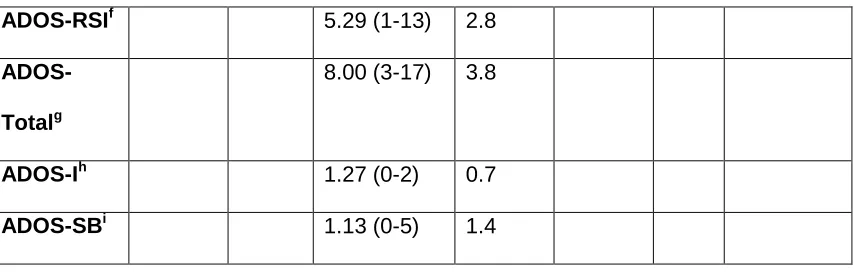
ADOS-RSIf 5.29 (1-13) 2.8
ADOS-Totalg
8.00 (3-17) 3.8
ADOS-Ih 1.27 (0-2) 0.7
ADOS-SBi 1.13 (0-5) 1.4
[image:12.595.85.512.139.275.2]211
Table 1.
212
Participant characteristics for Autism Spectrum Disorder (ASD) and typically
213
developing (TD) individuals.
214
215
Note. aVerbal IQ (WAIS-IIIUK or WAIS-IVUK). bPerformance IQ (WAIS-IIIUK or
WAIS-216
IVUK). cFull-scale IQ (WAIS-IIIUK or WAIS-IVUK). dAQ- Autism-Spectrum Quotient.
217
eADOS- Communication subscale. fADOS- Reciprocal Social Interaction subscale.
218
gADOS Total score- Communication and Reciprocal Social Interaction. hADOS-
219
Imagination/ Creativity subscale. iADOS- Stereotyped Behaviors and Restricted
220
Interests. ADOS scores range in brackets.
221
222
223
Materials
224
Materials for the VBT were the twenty-two wooden blocks from the Modified Vygotsky
225
Concept Formation Test (Hanfmann and Kasanin, 1942; Stoelting, IL, USA) using the
226
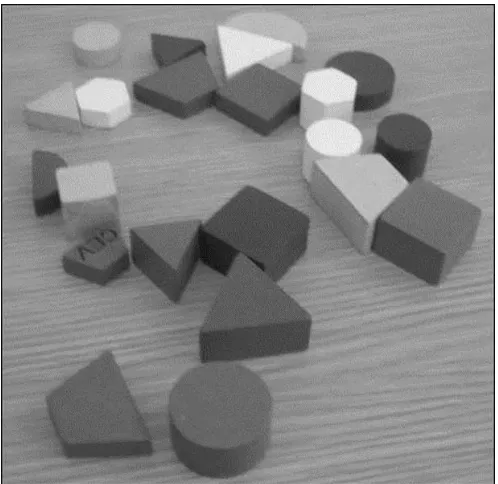
modified scoring sheet of Wang (1984). The blocks differed on a number of dimensions
including their color (blue, yellow, orange, green and white), shape (square, triangle,
228
circle, semicircle, trapezoid and hexagon), height (low or tall) and width (narrow or
229
wide). In addition, the blocks were divided into four groups according to nonsense
230
words (CEV, LAG, BIK and MUR) that were printed on one face and formed the four
231
sets in task one. The words corresponded to the volume of the blocks with the CEV
232
group formed by six narrow and low blocks LAG by five tall and wide blocks, BIK by six
233
low and wide blocks and MUR by five narrow and tall blocks. Figure 1 shows the
234
Vygotsky blocks with one CEV block turned over.
235
236
[image:13.595.193.442.368.610.2]237
Figure 1. The twenty-two blocks that form the VBT. Each block can be grouped
238
according to colour, shape, height, width, number of sides, volume, curve or the ability
239
to roll. The ‘CEV’ block is over-turned for the start of the first set of the convergent
thinking task. The participant would be asked- ‘which of the other blocks might have
241
the word CEV written underneath also?’
242
243
Procedure
244
As noted above, the VBT has two parts that investigate convergent and divergent
245
thinking strategies respectively. The words written on one face were relevant for the
246
first convergent thinking part of the VBT (Task 1). In the second, divergent thinking part
247
(Task 2), the instructor (PC or MR) gave verbal instructions and noted down the
248
participants’ selection of the blocks for both tasks.
249
250
Task 1 (Convergent thinking) with four sets (CEV, BIK, MUR and LAG): The jumbled
251
blocks were placed in front of the participant on a table with the word face down. The
252
first set started with the small blue triangle with “CEV” written on it. “CEV” was read
253
aloud to the participant and they were asked to choose another block that might have
254
“CEV” also written on the underside. If the participant chose a block that belonged to
255
the ‘CEV’ group, it was turned over and placed adjacent to the starting ‘CEV’ block to
256
form the group. If the participant pointed to a block that did not belong to the ‘CEV’
257
group, they were told that their choice was not correct but to try again.
258
259
For Task 1 an incorrect choice in the first two sets (CEV and LAG) scored one general
260
error point. If the participant made three consecutive general errors, then a cue was
261
given with the instructor turning over a block that belonged to the set being tested. A
perseverative error occurred if the participant selected three consecutive blocks that
263
shared one or more common attributes (one perseverative error per common attribute).
264
For example, a perseverative error would occur if a participant chose three triangular
265
shaped blocks in a row. The set ended when all of the blocks in the group were
266
selected, if participants committed fifteen general errors for set 1 (i.e., exhausting five
267
cues for the six CEV blocks) or if they committed twelve general errors for set 2 (i.e.,
268
exhausting the four cues for the five LAG blocks). For the remaining two sets, BIK (6
269
blocks) and MUR (5 blocks) no cues were given and these sets were terminated if the
270
participant made five consecutive incorrect choices, yielding a maximum error score of
271
twenty-five for the BIK and twenty for the MUR set. For these two sets a perseverative
272
error occurred if the participant selected three or five blocks with identical attributes
273
respectively. The total numbers of general and perseverative errors for each set as well
274
as the total number of cues required for the first two sets (CEV and LAG) were
275
recorded for analysis (see Table 2).
276
277
Task 2 (divergent thinking): The instructor placed all of the blocks face down and then
278
sorted the blocks by their colour into separate groups. The instructor then told the
279
participant, ‘look I have made some groups based on colour, how many other ways can
280
you group these blocks together?’ The blocks were then randomly jumbled again face
281
down and the participant began to group the blocks according to a Principle they
282
defined for each group such as height or shape.
283
The maximum number of Principles by which the blocks could be grouped was seven
285
excluding the demonstration set of color. The Principles were: Shape, Width, Height,
286
Number of Sides, Volume, Roll and Curve. Participants scored a point for each correct
287
Principle as well as a point for the number of Sub-Groups formed according to each
288
principle (Number of Sub-Groups, Table 3). For example, for the Principle of Shape
289
there were six possible Sub-Groups: triangle, square, trapezoid, circle, semi-circle or
290
hexagon. The participant scored a point for each correct Sub-Group of the shapes and
291
one point for the overall Principle giving a maximum possible score of seven for the
292
Principle of Shape. However, the participant needed to define a minimum number of
293
Sub-Groups in order for the Principle to be credited. For example, a minimum of four
294
Sub-Groups were required for the principle of Shape. If the participant only identified
295
triangles and squares (two Sub-Groups), then the principle of Shape was not scored
296
and only two points for the identified Sub-Groups were counted. There was no time
297
limit for this task but the task finished when the participant could not generate any more
298
Sub-Groups or had attempted to form two consecutive groupings that did not follow
299
one of the seven Principles (e.g. making a pattern out of the blocks). Hanfmann and
300
Kasanin, (1942) and Wang (1984) also proposed calculating a weighted score based
301
on a hierarchical organization of the Principles. When this model was applied to the
302
data, the results were not markedly different from the results reported here.
303
304
Statistical Methods
The results were analyzed using independent samples t-tests, repeated measures
306
ANOVAs, Spearman’s rho correlations and Chi-Squared tests. If the Sphericity
307
assumption was violated Greenhouse Geisser Correction (GGC) was used (SPSS, ver.
308
22). The significance level chosen was at p < .05 for all tests. Cohen’s d and partial eta
309
squared are reported as measures of effect size as appropriate. Results are expressed
310
as mean (M) ± standard deviation (S.D.) unless otherwise specified.
311
312
Results
313
Convergent thinking
314
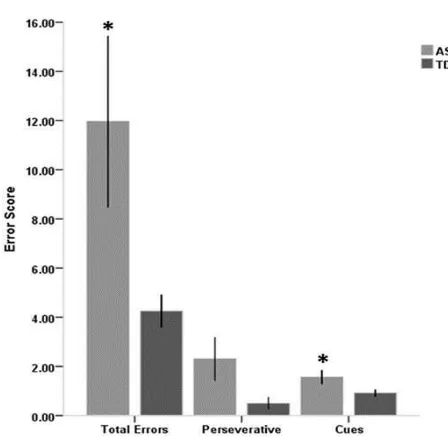
Summary error scores for both groups are presented in Table 2 and Figure 1 as
315
general errors (incorrect choice), perseverative errors (repeatedly choosing a block
316
based on one characteristic) and the numbers of cues given for the CEV and LAG sets.
317
General and perseverative errors were analyzed using a 4 (Set [CEV, LAG, BIK,
318
MUR]) x 2 (Group [ASD, TD]) repeated measures ANOVA. For general errors there
319
was a significant main effect of Group, F(1,45) = 5.38, p = .03, ηp2 = .11, with more
320
errors for the ASD (M = 11.96, SD = 6.71) compared to the TD group (M = 4.25, SD =
321
3.29). There was also a significant main effect of set, F(2.03, 91.35) = 11.49, p < .001,
322
ηp2 = .20, GGC, with significantly more mistakes in the first compared to second and
323
third set (pmax = .005, Cohen’s dmin = 0.52). A significant Set x Group interaction, F(2.03,
324
91.35) = 3.10, p = .049, ηp2 = .06, GGC, showed that this was only true for the TD
325
group with more mistakes in the first compared to the remaining three sets (pmax = .009,
326
Cohen’s dmin = 0.69). In contrast, the ASD group made more errors in the first and
fourth compared to the second set (pmax = .02, Cohen’s dmin = 0.71) but showed a
328
similar level of errors in the first, third and fourth set (pmin = .61, Cohen’s dmax = 0.35). A
329
direct comparison of the two groups showed significantly more errors for the ASD
330
compared to the TD group for the second and fourth set (pmax = .02, Cohen’s dmin =
331
0.73).
332
333
The ASD participants made more perseverative errors (M = 2.30, SD = 4.19) than the
334
TD group (M = 0.50, SD = 1.22), indicating a trend towards more errors in the ASD
335
group, F(1,45) = 3.86, p = .056, ηp2 = .08, (but see below for analysis of covariance).
336
There was no main effect of Set, F(2.52,113.44) = 1.75, p = .17, ηp2 = .04, GGC, but a
337
significant Set x Group interaction, F(2.52,113.44) = 3.74, p = .02, ηp2 = .08, GGC, with
338
a decrease in perseverative errors for the TD but an increase for the ASD participants
339
across the four sets. Importantly, the ASD participants made more perseverative errors
340
in the final set (MUR) compared to the TD participants suggesting that the ASD group
341
maintained the same restricted approach to each of the sets (p = .01, Cohen’s d =
342
0.78).
343
344
The ASD participants required more cues (M = 1.57, SD = 1.38) compared to the TD
345
participants (0.92 ± 0.72), F(1,45) = 4.16, p =.047, ηp2 = .09, and more cues were
346
required in the first ‘CEV’ set compared to the second ‘LAG’ set in Task 1 for the ASD
347
participants, F(1,45) = 59.29, p = .000, ηp2 = .57. However, there was no overall Set x
Group interaction, F(1,45) = 0.04, p = .84, ηp2 = .00, for the ASD and TD groups (see
349
Table 2).
350
351
[image:19.595.181.405.214.433.2]352
Figure 2 Results of the Convergent thinking task (Mean ± SEM) with a significantly
353
higher number of cues (p = .03) and cues (p = .047) required by the ASD group in task
354
1. (ASD: Autism Spectrum Disorder, TD: Typically Developing, * = p < .05).
355
356
TD (n=24)
M (S.D.)
ASD (n=23)
M (S.D.)
p
Convergent Thinking
General Errors
[image:19.595.99.486.548.681.2]357
Table 2. Group results for TD and ASD individuals for the Vygotsky Block Test. Four
358
sets of convergent thinking task (CEV, LAG, LAG, MUR- no cues were presented in
359
the last two sets) and the divergent thinking task for the seven test principles of Height,
360
Width, Volume, Shape, Number of Sides, Curve and Roll. The number of Principles,
361
and Divergent sub-groups formed for the principles are shown. The Total Weighted
362
Principle (TWP) score is the number of principles identified multiplied by the weighting
363
LAG 0.21 (0.66) 1.26 (1.86)
BIK 0.67 (2.10) 2.70 (5.70)
MUR 0.29 (0.75) 3.74 (6.70)
Total General Errors 4.25 (3.29) 11.96 (16.71) 0.030
Perseverative Errors
CEV 0.42 (1.18) 0.30 (0.76)
LAG 0.00 (0.00) 0.26 (0.69)
BIK 0.08 (0.41) 0.57 (1.75)
MUR 0.00 (0.00) 1.13 (2.07)
Total Perseverative Errors 0.50 (1.22) 2.30 (4.19) 0.056
Cues
CEV 0.92 (0.72) 1.22 (0.95)
LAG 0.00 (0.00) 0.35 (0.65)
of their level of concreteness. (ASD: Autism Spectrum Disorder; TD: Typically
364
Developing; M: Mean; S.D.: Standard Deviation).
365
366
Divergent thinking
367
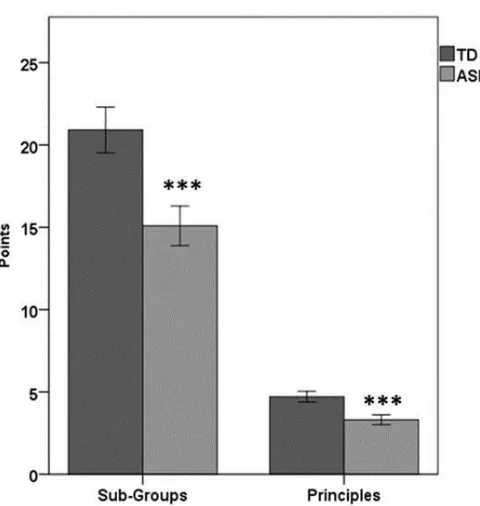
The number of divergent thinking Principles and divergent Sub-Grouping points are
368
shown in Table 3 and Figure 3 with the ASD participants demonstrating inferior
369
performance with this task. The ASD participants identified fewer governing Principles
370
by which the blocks could be sorted (ASD: M = 3.30, SD = 1.43; TD: M= 4.71, SD =
371
1.60: t(45) = 3.17, p < .004, Cohen’s d = 0.93). Similarly, the ASD group identified
372
fewer of the Sub-Groups in the divergent task that defined the principle (ASD: 15.09 ±
373
5.78; TD: 20.92 ± 6.81: t(45) = 3.16, p < .005, Cohen’s d = 0.93). These findings
374
indicate the extent of the ASD participants' difficulties with identifying concepts by
375
which the blocks could be grouped based on their physical properties.
376
378
Figure 3 Results of the Divergent thinking task (Mean ± SEM) with a significantly
379
higher number of Categorizing Principles (p = .003) and Sub-Groups (p = .003)
380
identified overall, by the TD group in both parts supporting a more flexible cognitive
381
style in generating new concepts in task 2. (ASD: Autism Spectrum Disorder, TD:
382
Typically Developing, ** = p <.01).
383
384
Divergent Thinking
TD (n=24)
M (S.D)
ASD (n=23)
M (S.D)
p
Number of Principles 4.71 (1.60) 3.30 (1.43) 0.003
Number of Sub-Groups 20.92 (6.80) 15.09 (5.78) 0.003
Table 3. Group results for TD and ASD individuals for the Vygotsky Block Test for the
386
divergent thinking task. The number of principles (maximum score 7), number of sub
387
groups and number of participants (ASD or TD) identifying each of the principle
388
categories. (ASD: Autism Spectrum Disorder, TD: Typically Developing).
389
390
Types of Principle
391
The seven categories of Principle in the divergent thinking task showed some
392
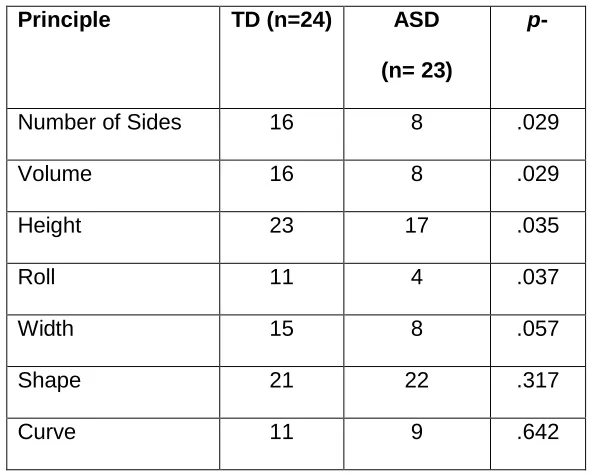
differences between groups for the Principles of Number of Sides (χ2 = 4.77, p < .03);
393
Volume (χ2 = 4.77, p < .03); Height (χ2 = 4.45, p < .04) and Roll (χ2 = 4.37, p < .04) but
394
not for the principles of Width (χ2 = 3.61, p = .06); Shape (χ2 = 1.00, p = .32) and Curve
395
(χ2
= 0.22, p = .64; see Table 4).
396
397
Principle TD (n=24) ASD
(n= 23)
p-
Number of Sides 16 8 .029
Volume 16 8 .029
Height 23 17 .035
Roll 11 4 .037
Width 15 8 .057
Shape 21 22 .317
Table 4. The number of participant s in each group correctly identifying the principles
398
by which the blocks could be categorized. The ASD participants had greatest difficulty
399
with forming principles based on Number of Sides, Volume, Height and Roll whilst both
400
groups were equivalent at identifying the principles of Width, Shape and Curve.
401
(Pearson’s Chi Squared p=value). (ASD: Autism Spectrum Disorder, TD: Typically
402
Developing).
403
404
Correlations between VBT performance and other measures.
405
A series of separate Spearman ‘rho' (rs) correlations for the TD and ASD groups
406
between VBT performance measures and PIQ, VIQ, and the Communication and
407
Imagination/Creativity sub-scales of the ADOS are reported in Tables 5a (TD
408
participants) and 5b (ASD participants). No significant correlations with age were found
409
for all participants with the VBT measures (p >.15). However, there was a negative
410
correlation with the TD participants and their age (rs = -.42, p <.05) indicating that the
411
older TD participants identified fewer principles. As predicted, for the ASD participants,
412
PIQ negatively correlated with the number of general errors (rs = -.46, p < .03) and the
413
number of perseverative errors for the convergent thinking task (rs = -.52, p < .02),
414
suggesting that they relied heavily on their fluid intelligence during this structured part
415
of the VBT. When PIQ was included as a covariate in the between-group analyses of
416
the CEV and LAG cue sets of Task 1 reported earlier, the interaction between Group
417
and Set for general errors became non-significant, F(2.14, 94.42) = 2.27, p = .053, ηp2
418
= 0.06, GGC, and the between-group difference in perseverative errors fell just on the
cusp of significance, F(1,44) = 4.07, p = .05, ηp2 = 0.09, reflecting the protective effect
420
of higher PIQ against perseverative responding in ASD vis-à-vis the comparison group.
421
Turning to the divergent thinking part of the VBT, here VIQ in the ASD group correlated
422
with the number of Principles and the number of Sub-Groups the participants
423
generated (rs =.54, p < .01 and rs = .59, p < .01 respectively), suggesting that they
424
relied more on verbal ability when engaging in divergent thinking. In the comparison
425
group, none of the associations between task performance and verbal or non-verbal IQ
426
was reliable. Including VIQ and PIQ as covariates in the analysis of Task 2 did not
427
change the overall pattern of results apart from yielding a significant group difference in
428
perseveration for the final stimulus set in the sequence, (MUR), which survived
429
partialling out of PIQ (F (1,45) = 7.14, p < .02, ηp2 = 0.14).
430
431
Turning to correlations with clinical symptoms, the Communication scale of the ADOS
432
correlated with the number of cues (rs = .53, p < .04) participants with ASD required on
433
the convergent thinking part of the VBT, indicating that the more communicatively
434
impaired individuals with ASD required greater task support in terms of more cues to
435
complete the task successfully. A significant positive correlation between the
436
Imagination/Creativity sub-scale of the ADOS and VBT perseverative errors (rs = .62, p
437
< .02) indicates that the ASD individuals who had less imaginative capacity made more
438
perseverative errors on the VBT. The significant negative correlations between the
439
ADOS Imagination/Creativity sub-scale and the number of Principles on the divergent
440
thinking part of the VBT (rs = -.68, p < .01); and number of Sub-Groups identified for the
Principles (rs = -.72, p < .003) (Table 5b) suggests that more imaginatively impaired
442
individuals performed less well on this aspect of the VBT.
443
444
(a) TD participants
445
Task 1
(Convergent)
Task 2
(Divergent)
General Perseverative Cues Principles Sub-Groups
Age .19 .21 .22 -.42*
VIQ
(n=24)
.04 -.28 -.17 .09 .17
PIQ
(n=24)
-.27 -.31 -.28 .26 .29
446
(b) ASD participants
447
Task 1 (Convergent)
Task 2 (Divergent)
General Perseverative Cues Principles Sub-Groups
-.51 -.37 -.33 -.07
VIQ (n=23) -.24 -.39 -.19 .54** .59**
PIQ (n=23) -.46* -.52* -.37 .24 .54**
Communication
ADOS (n=17)
Imagination
[image:27.595.71.541.140.232.2].50 .62* .54* -.68* -.72**
Table 5 Spearman’s ‘rho’ correlations between verbal and performance IQ and ADOS
448
sub-scores for communication and imagination for TD participants (a) and ASD
449
participants (b) for the Vygotsky Block Test (VBT). No IQ measures correlated with the
450
VBT for the TD participants. For the ASD group significant negative correlations were
451
present across divergent thinking categories with the imaginative ADOS sub-scale
452
scores. (* = p < .05; ** = p <.01).
453
454
Discussion
455
The primary aims of the present study were to document the performance of adults
456
with ASD on the VBT with a view to taking the first steps towards systematic
457
investigations of autistic individuals' development of the higher mental processes out of
458
elementary mental processes both within the framework of Vygotskyan theory and of
459
wider theories of autistic cognitive dysfunction. As discussed in the Introduction,
460
Vygotskyan theory sees the higher mental processes arising out of internalized social
461
interactions and mediated by inner dialogue. Our broad prediction was that the
462
performance of adults with ASD on the VBT, because of their particular behavioural
463
profile of social impairment and ‘different’ intelligence, would differ from that of typically
464
developed adults. We also made more specific predictions based on existing research
465
on autistic populations in areas tapped by the VBT, such as concept formation and
perseverative behaviour. Accordingly, we discuss its results in terms of their relation to
467
existing executive dysfunction-based accounts of the difficulties experienced by
468
individuals with ASD when developing new concepts. We also highlight ways in which
469
observations based on the VBT might offer pointers to future research into underlying
470
psychological processes in ASD, particularly into the role of fluid, non-verbal
471
intelligence as a possible compensatory contributor to overall performance (Mottron
472
2004) and in particular to diminished inner dialogue (Wallace et al., 2009). Finally, we
473
raise the question of how the present pattern of findings might be integrated into more
474
recent accounts of autistic cognitive dysfunction.
475
476
The findings of the convergent thinking task (Task 1) are broadly consistent with the
477
existing literature on errors and perseveration on executive functioning tests by ASD
478
individuals (Landry and Al-Taie, 2016; Liss et al., 2001; Sokhadze et al., 2010). The
479
fact that the overall ASD-related higher rate of perseverative errors was reduced when
480
PIQ was controlled suggests that variability resulting from individual differences in fluid
481
intelligence may have contributed to increased perseveration on this task. This finding
482
suggests that our ASD sample may have used their non-verbal skills to overcome a
483
tendency to perseverate on the convergent part of the VBT. Taken together with our
484
finding that the group difference for the last stimulus set (MUR) survived partialling out
485
of PIQ, these findings suggest that there may be limits to the effectiveness of
486
compensatory strategies mediated by non-verbal IQ and that perseveration may only
487
become problematic for the ASD participants after prolonged testing. A recent study
using the WCST in matched Japanese adults with ASD and TD participants also found
489
that Milner type perseverative error scores correlated negatively with VIQ and FIQ in
490
the ASD participants but not the TD group. That study reported no other correlations
491
with AQ or IQ measures on other WCST measures suggesting that a higher VIQ
492
protects against perseverative errors (Yasuda et al., (2014).
493
494
Our finding that the ASD participants required a greater number of attempts to form
495
sets of blocks based on Volume and required more cues in order to complete the first
496
two sets successfully in Task 1 are also in line with research showing shallower
497
learning curves in ASD (Bowler et al., 2009), as well as with current theories that posit
498
a greater need for task support to achieve successful task completion by individuals
499
with ASD (Bowler et al., 2004). Precisely how these aspects of conceptual abstraction
500
in ASD are interrelated is a matter of conjecture and further investigations are required
501
into how a cognitive processing system biased towards features tapped by non-verbal
502
IQ measures and away from verbal measures leads both to perseveration and to a
503
greater reliance on task support.
504
505
Increased perseveration may also result from less inhibition during the task (Cepeda
506
and Munakata, 2007), which would prevent the ASD participants from developing new
507
grouping structures (D’Cruz et al., 2013; Mosconi et al., 2009). The convergent thinking
508
task is based on classifying according to the physical dimension of Volume, which may
509
be more obscure than the features of Colour or Shape to identify One explanation may
be that performance on the VBT may rely on reduced ability to inhibit or ignore the
511
more prominent Colour or Shape of the blocks in preference for Volume (Faja et al.,
512
2016).
513
514
Over-reliance by the ASD by comparison with the TD participants on processes tapped
515
by the PIQ measure coupled with their having less recourse to VIQ-related processing
516
constitutes the first over-arching theme running through the results of the present study.
517
Superior non-verbal over verbal intelligence is characteristic of a sub-set of the ASD
518
population (Ghaziuddin and Mountain-Kimchi, 2004; Siegel et al., 1996) and
519
researchers have argued that ASD individuals may exhibit a 'different' intelligence that
520
may be underestimated by verbally loaded measures of intelligence (Mottron 2004;
521
Nader et al., 2016). Mottron and colleagues have also argued that this 'different'
522
intelligence results from a preference for lower-level perceptual over higher-level
523
conceptual processing (Mottron et al., 2006), which on the VBT, may have resulted in
524
slower identification of Sets on the Convergent task and poorer identification of
525
Principles on the Divergent task, which in Vygotskian terms involves transition from the
526
elementary to higher mental processes.
527
528
The tendency for higher error rates and a greater need for cues on the convergent part
529
of the VBT to correlate with PIQ rather than VIQ in the ASD participants has two
530
implications. As well as indicating a different set of cognitive processes underlying task
531
performance, it may also be a consequence of diminished recruitment of inner speech
to enable completion of that part of the VBT with as few errors as possible. This
533
dependence on inner speech constitutes the second overarching theme of the present
534
results, and is evident in the findings of the convergent part of the VBT (Task 2), which
535
explored the individuals' ability to develop their own, higher level concepts based on
536
the lower-level physical properties of the blocks. Here, the ASD group was worse than
537
the comparison participants in their ability to develop principles and formulate sub
538
categories based on the seven principles inherent in the blocks.
539
540
Our demonstration of the ASD group's diminished capability to see as many alternative
541
ways of classifying the blocks according to the divergent thinking Principles and
542
divergent Sub-Grouping points shown in Table 3 coupled with the strong correlation
543
between this capability and both VIQ and the Imagination sub-scale of the ADOS, both
544
confirms earlier findings showing diminished imagination in individuals with ASD (Craig
545
and Baron-Cohen,1999; Craig et al., 2001; Woodard and van Reet, 2011)and is
546
consistent with work that shows their limited engagement with inner speech, which
547
Vygotsky saw as crucial to the development of novel conceptual structures and for the
548
transition from elementary to higher mental processes (Vygotsky, 1987). Atypical inner
549
speech self-dialogue has been shown in ASD by several researchers (Biro and Russell,
550
2001; Russell-Smith et al., 2014; Wallace et al., 2009). Russell-Smith et al's (2014)
551
findings indicate that children with ASD perform no differently on a card sorting task
552
either when they performed the task whilst repeating a word verbally (inner speech
553
suppression) or when they performed the task without suppression. In contrast, the
neurotypical children’s performance was worse when using verbal suppression and
555
Williams et al., (2012) reported a similar fall in performance on the Tower of London
556
task with neurotypical adults when they used articulatory suppression but performance
557
was unaffected in the ASD participants suggesting that the ASD group failed to engage
558
in inner dialogue. Of interest in the present context, Williams et al., (2012) found no
559
difference in overall Tower of London performance between the ASD and TD groups,
560
suggesting that the former relied on non-verbal processes to solve the task
561
successfully in a manner analogous to performance on the convergent part of the VBT.
562
One study in a large non-clinical ASD sample found a correlation with autistic traits and
563
an ability to produce novel and creative responses to interpretations of figures,
564
although there was no association between divergent thinking fluency and autistic traits
565
(Best et al., 2015). The VBT may therefore provide a method for further examining
566
divergent thinking patterns in ASD and non-clinical individuals with autistic traits.
567
568
Some limitations of this preliminary study were sample size with the attendant
569
possibility of Type II errors as well as a large variance in the performance by the ASD
570
group resulting in some measures failing to demonstrate clearly significant effects. A
571
further weakness was that no post-hoc analysis of the strategies employed by the
572
participants to complete the VBT was performed. Such an analysis might have offered
573
a greater insight into the thought processes exploited by the participants in Tasks 1
574
and 2. Also, a lack of full ADOS scores for all of the ASD participants at the time of the
study limited the strength of the associations between ADOS sub-scores and
576
performance on the VBT.
577
578
To conclude, the findings of the present preliminary study provide an insight into
579
possible differences in the ways individuals on the autism spectrum process
580
information on a complex task that unfolds over time. It highlights how increased
581
reliance on non-verbal factors together with diminished reliance on language and inner
582
dialogue may interact to produce the clinical picture that characterizes ASD. Future
583
research should be aimed at investigating the various ways in which people on the
584
autism spectrum utilize verbal and non-verbal capacities to construct more abstract
585
conceptual structures on the basis of sensory experience. By exploring the
586
determinants of individual and group differences in the evolution of abstraction over
587
time, such an approach would be useful not only in understanding cognitive processing
588
in ASD, but also in other psychopathological and neurodevelopmental conditions with a
589
view to developing a more general theory of the development of human cognition and
590
its modulation by linguistically mediated social and cultural factors. This was one of the
591
original reasons for developing the VBT (Vygotsky, 1987) and now finds echoes in the
592
Research Domain Criteria (RDoC; Cuthbert and Insel, 2013) approach to studying
593
atypical psychological functioning and psychiatric disorder.
594
Acknowledgements
596
The authors thank the participants for their time in taking part in this study and Eve
597
Lyons for help in recruitment and performing a pilot study on children.
598
599
Funding Acknowledgement
600
This work was support by a College of Optometrists UK post-doctoral research
601
fellowship (PC). MR was supported by a PhD studentship from City University London.
602
References
604
605
Ach N (1921) Ueber die Begriffshildung. Bamberg, Buchner. Cited by: Hanfmann E and
606
Kasanin J (1942) Conceptual Thinking in Schizophrenia. In: Nervous and Mental
607
Diseases Monographs, Vol. 67. Richmond USA: William Byrd Press, pp.6.
608
609
Alderson-Day B (2014) Verbal problem-solving difficulties in autism spectrum disorders
610
and atypical language development Autism Research 7(6): 720-730.
611
612
Alderson-Day B, Fernyhough C (2014) More than one voice: Investigating the
613
phenomenological properties of inner speech requires a variety of methods.
614
Consciousness and Cognition 24: 113-114.
615
616
American Psychiatric Association (2000) Diagnostic and statistical manual of mental
617
disorders-DSM-IV-TR (4th ed., text revision). Washington, DC.
618
619
Axelrod BN, Goldman RS, Heaton RK, Curtiss G, Thompson LL, Chelune GJ, Kay GG
620
(1996) Discriminability of the Wisconsin Card Sorting Test using the
621
standardization sample. Journal of Clinical and Experimental Neuropsychology
622
18(3): 338-342.
623
Baron-Cohen S, Wheelwright S, Skinner R et al. (2001) The Autism-Spectrum quotient
625
(AQ): Evidence from Asperger syndrome/high-functioning autism, males and
626
females, scientists and mathematicians. Journal of Autism and Developmental
627
Disorders 31(1): 5-17.
628
629
Best C, Arora S, Porter F, Doherty M (2015) The Relationship Between Subthreshold
630
Autistic Traits, Ambiguous Figure Perception and Divergent Thinking. Journal of
631
Autism and Developmental Disorders 45(12): 4064-4073.
632
633
Bexkens A, Ruzzano L, Collot d' Escury-Koenigs AML, Van der Molen MW, Huizenga
634
HM (2014) Inhibition deficits in individuals with intellectual disability: a
meta-635
regression analysis. Journal of Intellectual Disability Research 58(1): 3-16.
636
637
Biro S and Russell J (2001) The execution of arbitrary procedures by children with
638
autism. Development and Psychopathology 13(1): 97-110.
639
640
Boucher J (2008) The Autistic Spectrum. London: Sage Press.
641
642
Boucher J and Bowler DM (2008). Memory in Autism. New York: Cambridge University
643
Press.
645
Bowler DM (2007) Autism spectrum disorders: Psychological theory and research.
646
Chichester: John Wiley and Sons Ltd, pp.145-152.
647
648
Bowler DM, Gaigg SB and Gardiner JM (2008) Subjective organisation in the free
649
recall of adults with Asperger’s syndrome. Journal of Autism and Developmental
650
Disorders 38: 104-113.
651
652
Bowler DM, Gaigg SB, Lind S (2011) Memory in autism: Binding, self and brain. In
653
Roth I and Rezaie P (eds) Researching the autism spectrum: Contemporary
654
perspectives. Cambridge: Cambridge University Press, pp.316-346.
655
656
Bowler DM, Gardiner JM and Berthollier N (2004) Source memory in adolescents and
657
adults with Asperger’s syndrome. Journal of Autism and Developmental Disorders
658
34(5): 533-542.
659
660
Bowler DM, Limoges E, Mottron L (2009) Different verbal learning strategies in autism
661
spectrum disorders: evidence from the Rey Auditory Verbal Learning Test. Journal
662
of Autism and Developmental Disorders 39: 910-915.
663
Bowler DM, Matthews NJ, Gardiner JM (1997) Asperger`s syndrome and memory:
665
Similarity to autism but not amnesia. Neuropsychologia 35(1): 65-70.
666
667
Cepeda NJ and Munakata Y (2007) Why do children perseverate when they seem to
668
know better: graded working memory or directed inhibition? Psychonomic Bulletin
669
and Review 14: 1058-1065.
670
671
Craig J and Baron-Cohen S (1999) Creativity and imagination in autism and Asperger
672
syndrome. Journal of Autism and Developmental Disorders 29(4): 319-326.
673
674
Craig J, Baron-Cohen S, Scott F (2001) Drawing ability in autism: a window into the
675
imagination. The Israel Journal of Psychiatry and related sciences 38(3-4):
242-676
253.
677
Cuthbert BN and Insel TR (2013) Toward the future of psychiatric diagnosis: the seven
678
pillars of RDoC. BMC Medicine 11:126.
679
680
Daniels H, Cole M, Wertsch JV (2007) The Cambridge Companion to Vygotsky.
681
Cambridge: Cambridge University Press.
682
Danielsson H, Henry L, Messer D, Ronnberg J (2012) Strengths and weaknesses in
684
executive functioning in children with intellectual disability. Research in
685
Developmental Disabilities 33(2): 600-607.
686
687
Davis G and Plaisted-Grant K. (2015). Low endogenous neural noise in autism.
688
Autism, 19, 351-362.
689
690
Dawson M, Soulières I, Gernsbacher MA, Mottron L (2007). The level and nature of
691
autistic intelligence. Psychological Science, 18, 657-662.
692
693
Dichter GS, Lam KSL, Turner-Brown LM, Holtzclaw TN, Bodfish JW (2009)
694
Generativity abilities predict communication deficits but not repetitive behaviors in
695
Autism Spectrum Disorders. Journal of Autism and Developmental Disorders
696
39(9): 1298-1304.
697
698
D'Cruz AM, Ragozzino ME, Mosconi MW et al. (2013) Reduced behavioral flexibility in
699
autism spectrum disorders. Neuropsychology 27(2): 152-160.
700
701
Faja S, Dawson G, Sullivan K, Meltzoff AN, Estes A, Bernier R (2016) Executive
702
function predicts the development of play skills for verbal preschoolers with autism
703
spectrum disorders. Autism Research doi: 10.1002/aur.1608
704
Flavell JH, Green FL, Flavell ER, Grossman JB (1997) The development of children's
706
knowledge about inner speech. Child Development 68(1): 39-47.
707
708
Gaigg SB, Gardiner JM, Bowler DM (2008) Free recall in autism spectrum disorder:
709
The role of relational and item-specific encoding. Neuropsychologia 46(4):
986-710
992.
711
712
Gastgeb HZ, Strauss MS, Minshew NJ (2006) Do individuals with autism process
713
categories differently? The effect of typicality and development. Child
714
Development 77(6): 1717-1729.
715
716
Ghaziuddin M and Mountain-Kimchi K (2004) Defining the intellectual profile of
717
Asperger Syndrome: comparison with high-functioning autism. Journal of Autism
718
and Developmental Disorders 34(3): 279-284.
719
720
Guilford JP, Dunham JL, Hoepfner R (1967) Roles of intellectual abilities in the learning
721
of concepts. Proceedings of the National Academy of Sciences 58(4): 1812-1817.
722
723
Hanfmann E and Kasanin J (1942) Conceptual Thinking in Schizophrenia. In: Nervous
724
and Mental Diseases Monographs, Vol. 67, Richmond USA: William Byrd Press,
725
pp.22-57.