R E S E A R C H A R T I C L E
Open Access
Cost-effectiveness analysis of timely dialysis
referral after renal transplant failure in Spain
Guillermo Villa
1,2*, Emilio Sánchez-Álvarez
3, Jesús Cuervo
1, Lucía Fernández-Ortiz
1, Pablo Rebollo
1and Francisco Ortega
2,3Abstract
Background:A cost-effectiveness analysis of timely dialysis referral after renal transplant failure was undertaken from the perspective of the Public Administration. The current Spanish situation, where all the patients undergoing graft function loss are referred back to dialysis in a late manner, was compared to an ideal scenario where all the patients are timely referred.
Methods:A Markov model was developed in which six health states were defined: hemodialysis, peritoneal dialysis, kidney transplantation, late referral hemodialysis, late referral peritoneal dialysis and death. The model carried out a simulation of the progression of renal disease for a hypothetical cohort of 1,000 patients aged 40, who were observed in a lifetime temporal horizon of 45 years. In depth sensitivity analyses were performed in order to ensure the robustness of the results obtained.
Results:Considering a discount rate of 3 %, timely referral showed an incremental cost of 211€, compared to late referral. This cost increase was however a consequence of the incremental survival observed. The incremental effectiveness was 0.0087 quality-adjusted life years (QALY). When comparing both scenarios, an incremental cost-effectiveness ratio of 24,390€/QALY was obtained, meaning that timely dialysis referral might be an efficient alternative if a willingness-to-pay threshold of 45,000€/QALY is considered. This result proved to be independent of the proportion of late referral patients observed. The acceptance probability of timely referral was 61.90 %, while late referral was acceptable in 38.10 % of the simulations. If we however restrict the analysis to those situations not involving any loss of effectiveness, the acceptance probability of timely referral was 70.10 %, increasing twofold that of late referral (29.90 %).
Conclusions:Timely dialysis referral after graft function loss might be an efficient alternative in Spain, improving both patients’survival rates and health-related quality of life at an affordable cost. Spanish Public Health authorities might therefore promote the inclusion of specific recommendations for this group of patients within the existing clinical guidelines.
Keywords:Chronic kidney disease, Cost-effectiveness analysis, Timely dialysis referral, Graft function loss, Kidney transplantation, Late dialysis referral, Markov models, Renal replacement therapy, Transplant failure
* Correspondence:[email protected]
1BAP LA-SER Outcomes, LA-SER Group, Azcárraga, 12 A, 33010 Oviedo,
Asturias, Spain
2Department of Medicine, Universidad de Oviedo, Oviedo, Spain
Full list of author information is available at the end of the article
Background
Kidney transplantation is the treatment of choice for Chronic Kidney Disease (CKD) [1]. In the last decades, the progressive improvement of immunosuppressant drugs has led to an increase in the survival of renal grafts. It has been shown that the one-year survival rate of a renal graft is above 90%. The five-year survival rate is neverthe-less around 70% and survival after ten years is below 50% [2]. Every year, therefore, many patients experience graft function loss, being referred back to dialysis. In a recent study carried out by Villa et al., it is estimated that around 4% of the Spanish patients in kidney transplantation would be referred back to dialysis every year, adding up to almost 1,000 patients in 2010 [3].
Despite the existence of a number of clinical practice guidelines, both at the national and the international levels, there is no consensus on the right timing for dia-lysis referral after graft function loss. Both the reticence of clinicians to assume transplant failure and the reluc-tance of patients to restart dialysis might be among the causes of late dialysis referral. Moreover, kidney trans-plantation management and research have traditionally focused on immunosuppressant therapy and on the management of complications, rather than on the condi-tion of patients restarting dialysis.
Following the international recommendations, there are two situations in which patients should start Renal Replacement Therapy (RRT) [4-6]: (1) Glomerular Filtra-tion Rate (GFR) below 15 ml/min/1.73 m2 (i.e. Stage 5 of CKD) and presence of uremic complications; and (2) GFR below 6 ml/min/1.73 m2, even in the absence of symptoms. In the case of elder patients or in the pres-ence of comorbidities, it is however recommended an early RRT start, even though GFR is above 15 ml/min/ 1.73 m2and there is absence of symptoms. Recent stud-ies propose however that dialysis initiation is justified at GFR levels from 5 to 9 ml/min/1.73 m2if accompanied by symptoms [7].
Arias et al. found that patients experiencing graft func-tion loss presented GFR of 9 ml/min/1.73 m2at the time of hemodialysis restart, with 78 % of the patients show-ing GFR of less than 10 ml/min/1.73 m2 [8]. Likewise, Gill et al. found GFR of 8.4 ml/min/1.73 m2for a similar group of patients [9]. In both cases, GFR was below the current recommendations. Late dialysis referral usually
involves a non-scheduled (non-programmed,
non-planned or urgent) dialysis restart, what has important clinical [10,11] and economic [3,12] implications, such as higher undernourishment, worse anemic control, higher morbidity and mortality rates, and consequently larger costs. Furthermore, patients undergoing graft function loss show higher recombinant human erythro-poietin (rHuEPO) [13] and intravenous iron (IV) [14] needs, experience higher hospitalization rates due to access
complications [7] and face increased morbidity and mortal-ity risks [8,15-20]. Because of that, a timely dialysis restart would be advisable for these patients as soon as they reach Stage 5 of CKD.
This article studies the health outcomes and the eco-nomic implications of late dialysis referral after graft function loss. A cost-effectiveness analysis of timely dia-lysis referral after renal transplant failure is undertaken for the first time in Spain. The current Spanish situation is compared to an ideal scenario in which all the patients undergoing graft function loss are referred back to dialy-sis in a timely manner.
Methods
A Markov chain model was programmed using Stata 10 data analysis software. Markov models are useful to rep-resent random processes which evolve over time. They are suited to modeling the progression of chronic dis-eases. A specific disease is described as a chain of differ-ent health states, and movemdiffer-ents between those states over discrete time periods (“cycles”) occur with a given probability (“transition probability”). Estimates of health outcomes and costs are attached to each state in the model. By running the model over a large number of cycles (“temporal horizon”), the long-term health out-comes and costs associated with the disease are com-puted (see [21] for a detailed introduction to Markov modeling).
In our particular case, six health states were defined: HD: hemodialysis; PD: peritoneal dialysis; Tx: kidney transplantation; LRHD: late referral hemodialysis; LRPD: late referral peritoneal dialysis; and D: death. The model carried out a simulation of the progression of renal dis-ease for a hypothetical cohort of 1,000 patients aged 40, the most frequent age for RRT initiation according to expert judgment, who were observed in a lifetime tem-poral horizon of 45 years. The model parameters and their supporting references are presented in Table 1.
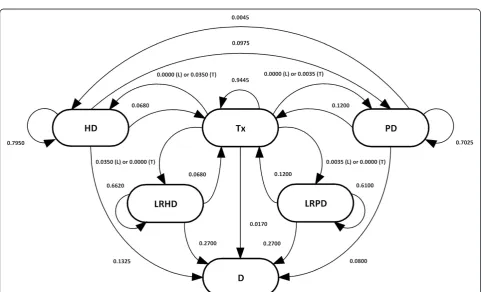
Transition probabilities determine the likelihood of pa-tient flows between the health states defined from cycle (a year) to cycle (Figure 1). Transition probabilities were based on a recent study [3], with the exception of age-dependent mortality probabilities, which were computed using data from the Spanish Society of Nephrology (SEN, Spanish acronym) registry [22] and assuming that late re-ferral patients had a one-year survival rate of 73% [23]. All the model transitions were half-cycle corrected [24].
Based on the opinion of an expert panel of three clini-cians, two alternative scenarios were considered:
Table 1 Model parameters
Global HD PD Tx LRHD LRPD D References
Direct medical costs: first-year 2,545€ 1,819€ 36,772€ 6,627€ 3,748€ 0€ Villa et al. (2011) [12] and this study
Direct medical costs: prevalence 31,912€ 24,996€ 6,030€ 31,912€ 24,996€ 0€ Villa et al. (2011) [12] and this study
Health utilities 0.69 0.69 0.81 0.53 0.53 0.00 Villa et al. (2012) [3] and Laupacis et al. (1996) [25]
Transition probabilities from/to HD, PD, LRHD, LRPD, Tx
See Figure1 Villa et al. (2011) [3]
Age-dependent transition probabilities to D
SEN (2008) [22], Kaplan et al. (2002) [23] and this study
Starting cohort (patients) 1,000 Arbitrary
Starting age (years) 40 Expert panel opinion
Time horizon (years) 45 Expert panel opinion
WTPT (€/QALY) 45,000 De Cock et al. (2007) [26]
Discount rate 3 % López-Bastida et al. (2010) [27]
HD: hemodialysis. PD: peritoneal dialysis. Tx: kidney transplantation. LRHD: late referral hemodialysis. LRPD: late referral peritoneal dialysis. D: death.
WTPT: willingness-to-pay treshold. QALY: quality-adjusted life year.
[image:3.595.57.540.407.699.2]Tx to LRPD: 0.0035). Scenario L represents the current Spanish situation, according to the expert panel opinion.
▪ Scenario T. All the patients are referred back to dialysis in a timely manner after graft function loss (transition probabilities: Tx to HD: 0.0350; Tx to PD: 0.0035; Tx to LRHD: 0.0000; Tx to LRPD: 0.0000). Scenario T represents an ideal situation.
Following a Public Administration perspective, direct medical costs (in January 2012€), including the costs of the vascular (HD) or peritoneal (PD) accesses; access complications; delivery of training; treatment session; kidney transplantation; drug consumption; equipment depreciation and maintenance; Nephrology Service gen-eral expenses; utilities; and external services, were con-sidered. HD, PD and Tx transition and prevalence costs were collected from a recent study. Transition (inci-dence or first-year) costs include the costs of the vascu-lar access (HD), the costs of the peritoneal access and training (PD), and the costs of transplantation surgery (Tx).
LRHD and LRPD costs were based on that same methodology [12], but taking into account some consid-erations. It was considered that LRHD patients required a higher (Δ97%) number of days of hospitalization due to access complications than HD patients did [7]. It was further considered that, during the first year, LRHD and LRPD patients showed higher (Δ69 %) rHuEPO [13] and higher (Δ47%) IV [14] needs than HD and PD patients did. Moreover, both LRHD and LRPD patients were con-sidered as non-scheduled (i.e. they start dialysis in a
non-planned, non-programmed or urgent form).
Per-patient annual transition costs were: 2,545 € (HD)
< 6,627€(LRHD) and 1,819€(PD) < 3,748€(LRPD). Effectiveness was expressed in terms of quality-adjusted life years (QALY). QALY were defined as the survival rate in a cycle times the health utility associated with a given health state. Health utilities were assigned values on a scale from 0 (the worst health state or death) to 1 (the optimal or perfect health state). Utilities were obtained from the existing literature [3,25]. Regarding LRHD and LRPD utilities, we considered the average (first year) post-transplant “good dialysis state” utility reported by Laupacis et al. [25]. This study has been cited by a number of relevant studies for similar pur-poses [28-31]. This estimate presents however some lim-itations. First, patients (and not the society) were asked to evaluate hypothetical health states using the time trade-off method. Second, health states evaluated were not based on generic quality of life instruments.
Both costs and health utilities were applied a 3% dis-count rate [27]. As for the cost-effectiveness compari-sons, the incremental cost-effectiveness ratio (ICER) was computed and a willingness-to-pay threshold (WTPT) of 45,000€/QALY [26] was assumed.
[image:4.595.57.536.502.726.2]For the purpose of contrasting the robustness of the results, univariate and probabilistic (Monte Carlo simu-lation) sensitivity analyses were carried out. In the uni-variate case, each single model parameter was changed (a 10% increase or decrease) at a time and a new ICER was computed. In the probabilistic case, 1,000 new ICER were computed by changing all the model parameters simultaneously. Beta distributions were assumed for the
Table 2 Results: Scenario L vs Scenario T
Scenario L Scenario T Comparative
Deterministic analysis
Per-patient annual cost 5,793€ 6,217€ 425€
Per-patient annual cost (discount rate 3 %) 4,564€ 4,775€ 211€
Per-patient annual QALY 0.2250 0.243 0.0176
Per-patient annual QALY (discount rate 3 %) 0.1594 0.1682 0.0087
ICER 24,135€
ICER (discount rate: 3 %) 24,390€
Probabilistic analysis (3 % discount rate)
Per-patient annual cost (95 % confidence interval) 4,591€(3,926€; 5,422€) 4,771€(4,073€; 5,630€) 180€(−898€; 1,305€)
Per-patient annual QALY (95 % confidence interval) 0.1594 (0.1372; 0.1815) 0.1682 (0.1446; 0.1947) 0.0088 (−0.0245; 0.0431)
Dominant 20.20 % 27.80 % 7.60 %
Efficient (higher effectiveness) 3.20 % 27.60 % 24.40 %
Efficient (lower cost) 14.70 % 6.50 % −8.20 %
Acceptable 38.10 % 61.90 % 23.80 %
Acceptable (without loss of effectiveness) 29.90 % 70.10 % 40.20 %
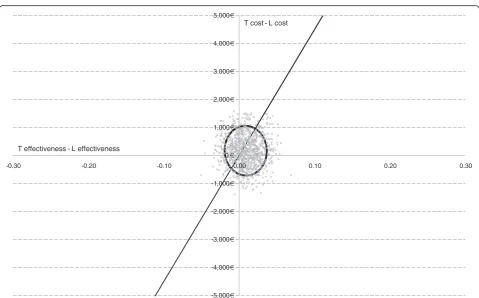
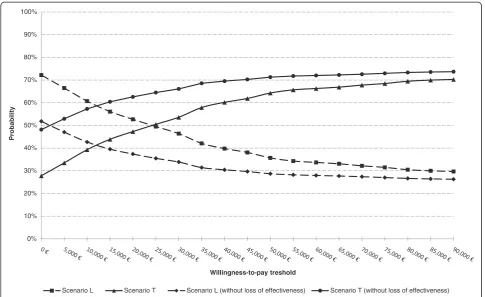
transition probabilities, normal distributions were assumed for the health utilities, log-normal distributions were assumed for the costs and a uniform distribution was assumed for the discount rate [32]. Due to data un-availability and when required, standard deviations were assumed to be a 10% of the mean values. The cost-effectiveness plane and the confidence ellipse (95% con-fidence level) were developed. The probabilities of accepting the two scenarios proposed as a function of the WTPT (acceptability curves) were also computed.
Results
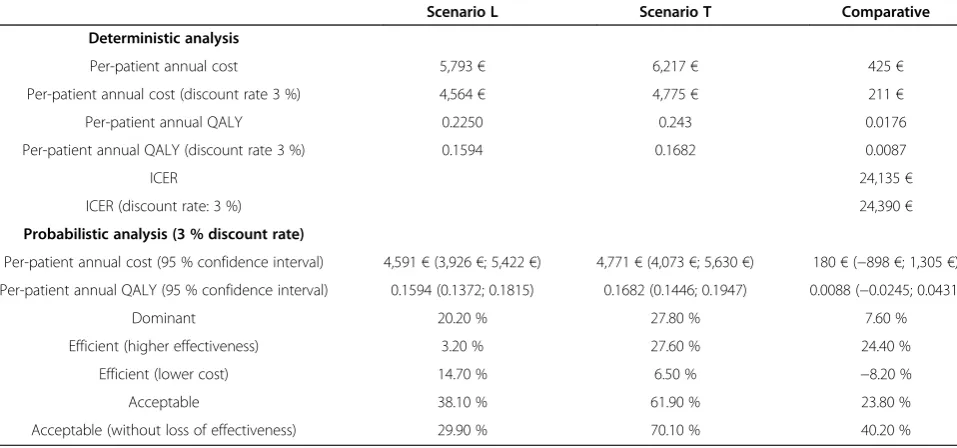
Cost-effectiveness results are shown in Table 2. Per-patient annual costs and QALY are presented for both scenarios, as well as comparative measures between them.
Considering a discount rate of 3%, Scenario T showed an incremental average (per-patient and year) cost of 211 €, compared to Scenario L. This average cost in-crease was however due to the incremental average
sur-vival observed in Scenario T. The incremental
effectiveness was 0.0087 QALY. When comparing both
scenarios, an ICER of 24,390 €/QALY was obtained,
meaning that Scenario T is an efficient alternative if we consider a WTPT of 45,000€/QALY.
The univariate sensitivity analysis showed that model results were robust. The ICER did not change signifi-cantly when alternative discount rates of 0% (24,135
€/QALY) or 5% (24,405€/QALY) were considered. Only three model parameters caused absolute value changes in the ICER exceeding a 10% threshold: HD and LRHD prevalence costs, and HD utilities (Figure 2). A
max-imum ICER of 29,869 €/QALY, yet below the WTPT,
was obtained by increasing the prevalence cost of HD in a 10%. Finally, a 10% increase in the utility of LRHD patients caused a 6.01% increase in the ICER, meaning that the influence of this parameter on the results is limited.
In this study, two extreme situations were considered in which either all the patients were referred back to dia-lysis in a late manner (Scenario L) or all of them were timely referred (Scenario T). A univariate sensitivity ana-lysis was conducted on the proportion of patients who were referred back to dialysis in a late manner. As expected, it was concluded that the higher the propor-tion of late referral patients considered, the lower the ICER obtained. The ICER was furthermore below the WTPT for any proportion of late referral patients, ran-ging from 24,428 €/QALY (proportion of late referral patients equal to 0.01) to 24,390 €/QALY (Scenario L). Timely dialysis referral was therefore an efficient alterna-tive for any proportion of late referral patients observed.
The probabilistic sensitivity analysis (Table 2, Figure 3) showed that, given a WTPT of 45,000€/QALY, Scenario
T was a dominant alternative in 27.80%, efficient with higher effectiveness in 27.60% and efficient with lower costs in 6.50% of the simulations. In contrast, Scenario L was a dominant alternative in 20.20%, efficient with lower cost in 14.70% and efficient with higher effective-ness in 3.20% of the simulations. The acceptance prob-ability of Scenario T was 61.90%, while Scenario L was acceptable in 38.10% of the simulations. If we however restrict the analysis to those situations not involving any loss of effectiveness (i.e. situations of dominance and efficiency with higher effectiveness), the acceptance probability of Scenario T was 70.10%, doubling that of Scenario L (29.90%). Figure 4 shows the acceptability curves of the two scenarios considered for any WTPT ranging from 0€/QALY to 90,000€/QALY.
Discussion
This study presented a cost-effectiveness analysis of timely dialysis referral after renal transplant failure in Spain from the perspective of the Public Administration. Late dialysis referral after graft function loss usually involves a non-scheduled dialysis restart that has import-ant clinical and economic implications, such as higher undernourishment, worse anemic control, higher mor-bidity and mortality rates, and consequently larger costs incurred. The health outcomes and the economic resources associated with late dialysis referral after graft function loss were discussed and quantified.
A Markov chain model was developed and the current Spanish situation, where the great majority of patients are referred back to dialysis in a late manner, was com-pared to an ideal scenario in which all the patients undergoing graft function loss were timely referred. In depth sensitivity analyses were performed in order to en-sure the robustness of the results obtained.
LRHD and LRPD patients presented lower survival rates and health utilities, and higher transition and prevalence costs than HD and PD patients did. Assum-ing a WTPT of 45,000 €/QALY, timely dialysis referral might be an efficient alternative when compared to the current Spanish situation. This result proved to be inde-pendent of the proportion of late referral patients con-sidered, since the ICER was below the WTPT for any proportion of late referral patients.
18,910 €
29,869 €
27,803 €
20,976 €
27,668 €
21,806 €
0 € 5,000 € 10,000 € 15,000 € 20,000 € 25,000 € 30,000 € 35,000 € 40,000 € 45,000 €
HD prevalence cost (-10%)
HD prevalence cost (+10%)
LRHD prevalence cost (-10%)
LRHD prevalence cost (+10%)
HD utility (-10%)
[image:6.595.57.541.90.368.2]HD utility (+10%)
Figure 2Incremental cost-effectiveness ratio for univariate parameter changes (Tornado).HD: hemodialysis. LRHD: late referral hemodialysis.
-5,000 € -4,000 € -3,000 € -2,000 € -1,000 € 0 € 1,000 € 2,000 € 3,000 € 4,000 € 5,000 €
-0.30 -0.20 -0.10 0.00 0.10 0.20 0.30
T effectiveness - L effectiveness
T cost - L cost
[image:6.595.58.538.415.713.2]twofold that one of the current Spanish scenario. Based on these results, nephrologists might inform patients on the increased morbidity and mortality risks associated with late dialysis referral.
A limitation of this study is that costs and outcomes in our model are mainly based on single punctual esti-mates gathered from the existing literature, due to un-availability of micro-data in our country. We were therefore unable to attach confidence intervals to the vast majority of model parameters and had to assume a dispersion of 10% of the central value for all the model parameters. We suspect that the ICER dispersion might be overestimated in our model and therefore the results of the probabilistic sensitivity analysis should be taken with caution.
It is worth noting that late referral patients are also expected to incur higher loss of labor productivity costs due to morbidity and mortality than timely referral patients do. A second limitation of this study is that a Public Administration perspective was adopted rather than including indirect costs (societal perspective), since reliable estimates of the unemployment and retirement rates for late referral patients are not available in Spain and further research would be required. In an explora-tory analysis, we quantified loss of labor productivity costs due to mortality in 29,345€per death and year for RRT patients under 67 years old [12,33], resulting in an
ICER of−146€/QALY when included in the model. The inclusion of loss of labor productivity costs due to mor-bidity is expected to reduce the ICER obtained, further validating the timely referral approach proposed.
Conclusions
Timely dialysis referral after graft function loss might be an efficient alternative in Spain, improving both patients’ survival rates and health-related quality of life at an affordable cost. Spanish Public Health authorities might promote the inclusion of specific recommendations for this group of patients within the existing clinical guide-lines, also monitoring their proper implementation and outcomes.
Abbreviations
CKD: Chronic kidney disease; D: Death; GFR: Glomerular filtration rate; HD: Hemodialysis; ICER: Incremental cost-effectiveness ratio; IV: Intravenous iron; LRHD: Late referral hemodialysis; LRPD: Late referral peritoneal dialysis; PD: Peritoneal dialysis; QALY: Quality-adjusted life year; rHuEPO: recombinant human erythropoietin; RRT: Renal replacement therapy; SEN (Spanish acronym): Sociedad Española de Nefrología; Tx: Kidney transplantation; WTPT: Willingness-to-pay threshold.
Competing interests
The authors declare that they have no competing interests.
Authors’contributions
GV has contributed to the conception and design of the study. He has managed the acquisition, analysis and interpretation of data, and has been also involved in drafting the manuscript. JC and LFO have participated in the 0%
10% 20% 30% 40% 50% 60% 70% 80% 90% 100%
Pr
o
b
ab
ility
Willingness-to-pay treshold
[image:7.595.56.542.88.385.2]Scenario L Scenario T Scenario L (without loss of effectiveness) Scenario T (without loss of effectiveness)
design of the study and in the acquisition and interpretation of data. They have been also involved in critically revising the manuscript. ESA, PR, FO have contributed to the conception of the study and have participated in the interpretation of data. They have been also involved in critically revising the manuscript. Finally, all the authors have given final approval of the version to be published.
Author details
1BAP LA-SER Outcomes, LA-SER Group, Azcárraga, 12 A, 33010 Oviedo,
Asturias, Spain.2Department of Medicine, Universidad de Oviedo, Oviedo, Spain.3Department of Nephrology, Hospital Universitario Central de Asturias, Oviedo, Spain.
Received: 7 December 2011 Accepted: 6 August 2012 Published: 16 August 2012
References
1. Suthanthiran M, Strom TB:Renal Transplantation.N Eng J Med1994, 331:365–376.
2. Cecka JM:The OPTN/UNOS renal transplant registry. InClinical transplants. Edited by Cecka JM, Terasaki PI. Los Angeles: UCLA Tissue Typing Laboratory; 2005:1–16.
3. Villa G, Fernández-Ortiz L, Cuervo J, Rebollo P, Selgas R, González T, Arrieta J: Cost-effectiveness analysis of the Spanish renal replacement therapy program.Perit Dial Int2012,32(2):192–199.
4. Churchill DN, Blake PG, Jindal KK, Toffelmire EB, Goldstein MB:Clinical practice guidelines for initiation of dialysis. Canadian Society of Nephrology.J Am Soc Nephrol1999,10(Suppl 13):289–291.
5. Dombros N, Dratwa M, Feriani M, Gokal R, Heimbürger O, Krediet R, Plum J, Rodrigues A, Selgas R, Struijk D, Verger C:EBPG Expert Group on Peritoneal Dialysis: European best practice guidelines for peritoneal dialysis. The initiation of dialysis.Nephrol Dial Transplant2005,20(Suppl 9):3–7. 6. Hemodialysis Adequacy 2006 Work Group:NFK-DOQI clinical practice
guidelines for hemodialysis adequacy, update 2006.Am J Kidney Dis2006, 48(Suppl 1):2–90.
7. Rosansky S, Glassock RJ, Clark WF:Early start of dialysis: A critical review. Clin J Am Soc Nephrol2011,6:1222–1228.
8. Arias M, Escallada R, de Francisco AL, Rodrigo E, Fernández-Fresnedo G, Setién MA, Piñera C, Ruiz JC, Herráez I, Cotorruelo J:Return to dialysis after renal transplantation. Which would be the best way?Kidney Int Suppl 2002,80:85–88.
9. Gill JS, Abichandani R, Khan S, Kausz AT, Pereira BJ:Opportunities to improve the care of patients with kidney transplant failure.Kidney Int 2002,61:2193–2200.
10. Górriz JL, Sancho A, Pallardó LM, Amoedo ML, Martín M, Sanz P, Barril G, Selgas R, Salgueira M, Palma A, de la Torre M, Ferreras I:Significado pronóstico de la diálisis programada en pacientes que inician tratamiento sustitutivo renal.Nefrologia2002,22:49–59.
11. Lorenzo V, Martín M, Rufino M, Hernández D, Torres A, Ayus JC:Predialysis nephrologic care and a functioning arteriovenous fistula at entry are associated with better survival in incident hemodialysis patientes: An observational cohort study.Am J Kidney Dis2004,43:999–1007. 12. Villa G, Rodríguez-Carmona A, Fernández-Ortiz L, Cuervo J, Rebollo P, Otero
A, Arrieta J:Cost analysis of the Spanish renal replacement therapy programme.Nephrol Dial Transplant2011,26(11):3709–3714. 13. Almond MK, Tailor D, Marsh FP, Raftery MJ, Cunningham J:Increased
erythropoietin requirements in patients with failed renal transplants returning to a dialysis programme.Nephrol Dial Transplant1994,9:270–273. 14. Solid CA, Foley RN, Gill JS, Gilbertson DT, Collins AJ:Epoetin use and
Kidney Disease Outcomes Quality Initiative hemoglobin targets in patients returning to dialysis with failed renal transplants.Kidney Int2007, 71:425–430.
15. Caldés-Ruisánchez S, Marcén-Letosa R, Amezquita-Orjuela Y, Fernández-Lucas M, Rivera-Gorrin M, Galeano-Álvarez C, Fernández-Rodríguez A, Teruel-Briones JL, Quereda-Rodríguez-Navarro C:Inicio de diálisis tras trasplante renal. ¿Se empieza en peor situación que los enfermos renales de novo? Nefrologia2011,31(1):51–57.
16. Cubero JJ, Fernández-Fresnedo G, Luna E, Hernández-Gallego R, Arias M: Impacto de la enfermedad renal avanzada del trasplantado renal y su vuelta a diálisis.Nefrologia2009,29(Suppl 1):3–6.
17. Beltrán S, Gavela B, Kanter J, Sancho A, Ávila A, Górriz JL, Crespo JF, Pallardó LM:Beginning hemodialysis: Do patients with a failed renal transplant start in worse condition?Transplant Proc2009,41:2129–2131.
18. Fernández-Fresnedo G, Ruiz JC, Gómez-Alamillo C, De-Francisco ALM, Arias M:Survival after dialysis initiation: A comparison of transplant patients after graft loss versus nontransplant patients.Transplant Proc2008, 40:2889–2890.
19. Sleiman J, Garrigue V, Vetromile F, Mourad G:Return to dialysis after renal allograft loss: Is dialysis treatment initiated too late?Transplant Proc2007, 39(8):2597–2598.
20. Cattran DC, Fenton SS:Contemporary management of renal failure: Outcome of the failed allograft recipient.Kidney Int1993,43(41):36–39. 21. Briggs A, Sculpher M:An introduction to Markov modelling for economic
evaluation.Pharmacoeconomics1998,13:397–409.
22. Sociedad Española de Nefrología, Registro Español de Enfermos Renales: Diálisis y transplante 2007. Informe preliminar. http://www.senefro.org/ modules/webstructure/files/informe_preliminar_reer_2007_sen_2008.pdf? check_idfile=3558.
23. Kaplan B, Meier-Kriesche HU:Death after graft loss: An important late study endpoint in kidney transplantation.Am J Transplant2002,2:970–974. 24. Naimark DM, Bott M, Krahn M:The half-cycle correction explained: Two
alternative pedagogical approaches.Med Decis Making2008,28:706–712. 25. Laupacis A, Keown P, Pus N, Krueger J, Ferguson B, Wong C, Muirhead N:A study of the quality of life and cost-utility of renal transplantation.Kidney Int1996,50:235–242.
26. De Cock E, Miravitlles M, González-Juanatey JR, Azanza-Perea JR:Valor umbral del coste por año de vida ganado para recomendar la adopción de tecnologías sanitarias en España: evidencias procedentes de una revisión de la literatura.PharmacoEconomics - Spanish Research Articles 2007,4(3):97–107.
27. López-Bastida J, Oliva J, Antoñanzas F, García-Altés A, Gisbert R, Mar J, Puig-Junoy J:Propuesta de guía para la evaluación económica aplicada a las tecnologías sanitarias.Gac Sanit2010,24(2):154–170.
28. Luan FL, Kommareddi M, Ojo AO:Universal prophylaxis is cost effective in cytomegalovirus serology-positive kidney transplant patients.
Transplantation2011,91(8):237–244.
30. Howard K, Salkeld G, White S, McDonald S, Chadban S, Craig JC, Cass A:The cost-effectiveness of increasing kidney transplantation and home-based dialysis.Nephrology2009,14:123–132.
29. Blumberg EA, Hauser IA, Stanisic S, Mueller E, Berenson K, Gahlemann CG, Humar A, Jardine AG:Prolonged prophylaxis with valganciclovir is cost effective in reducing posttransplant cytomegalovirus disease within the United States.Transplantation2010,90:1420–1426.
31. Tilden DP, Chapman J, Davey PJ, Solly ML, Crowley S:A decision analytic economic evaluation of valaciclovir prophylaxis for the prevention of cytomegalovirus infection and disease in renal transplantation.Clin Transplant2004,18:312–320.
32. Briggs A, Claxton K, Sculpher M:Decision modelling for health economic evaluation. Oxford: Oxford University Press; 2006.
33. Oliva J:La valoración de los costes indirectos en la evaluación sanitaria. Med Clin (Barc)2000,114(Suppl 3):15–21.
doi:10.1186/1472-6963-12-257