Proc. IODP | Volume 302 doi:10.2204/iodp.proc.302.104.2006 Backman, J., Moran, K., McInroy, D.B., Mayer, L.A., and the Expedition 302 Scientists
Proceedings of the Integrated Ocean Drilling Program, Volume 302
Operations
Mobilization of Vidar Viking, Aberdeen, Scotland
The Vidar Viking came under contract on 22 July 2004, when mo-bilization began in Aberdeen, Scotland. Momo-bilization in Aberdeen included two major installations: a moonpool and a full coring/ drilling spread. By 26 July, all equipment for the Vidar Viking had arrived, including information technology equipment bound for the Oden. The derrick was load-tested and certified. The Vidar Vi-king took on a full complement of fuel at Aberdeen.Test Coring Site: Witch Ground, North Sea
The Vidar Viking set sail for Landskrona, Sweden, on 28 July 2004. While the ship was en route, a first test of the drilling equipment was conducted in the Witch Ground area of the North Sea, ~8 h steam from Aberdeen. A test borehole was drilled in 152 m water depth to a depth of 37 meters below seafloor (mbsf) using the British Geological Survey’s (BGS’s) advanced piston corer (APC) and extended core barrel. Cores were obtained with both systems. The APC recovered >4 m in all runs (maximum = 4.5 m). The Vi-dar Viking left the test coring site at 1900 h on 30 July and pro-ceeded to Landskrona.Meanwhile, mobilization of the Oden proceeded at Gothenburg, Sweden, which included loading the laboratory equipment. On the evening of 31 July, the Oden set sail for Tromsø, Norway.
Mobilization of Vidar Viking, Landskrona, Sweden
The Vidar Viking reached Landskrona on the morning of 1 August 2004. The stern notch, a 100 ton section required by the Vidar Vi-king when worVi-king in ice, and the helideck were installed. The re-maining containers were loaded onto the deck, including the core and European Consortium for Ocean Research Drilling Science Operator curation containers sent from Bremen, Germany. Other mobilization work continued until the morning of 3 August, when the Vidar Viking departed for Tromsø.Mobilization of Vidar Viking and Oden,
Tromsø, Norway
The Oden arrived in Tromsø on the evening of 5 August 2004. The Vidar Viking arrived on the morning of 7 August. Two helicopters,
Sites M0001–M0004
1Expedition 302 Scientists
2Chapter contents
Operations . . . 1
Lithostratigraphy. . . 5
Micropaleontology . . . 9
Stratigraphic correlation . . . 23
Timescale and sedimentation rates . . . 25
Petrophysics . . . 27
Geochemistry . . . 31
Microbiology . . . 37
Paleomagnetism . . . 37
References . . . 38
Figures . . . 43
Tables. . . 116
1Expedition 302 Scientists, 2006. Sites M0001– M0004. In Backman, J., Moran, K., McInroy, D.B., Mayer, L.A., and the Expedition 302 Scientists.
Proc. IODP, 302:College Station TX (Integrated Ocean Drilling Program Management
International, Inc.). doi:10.2204/ iodp.proc.302.104.2006
Proc. IODP | Volume 302 2 required for ice reconnaissance missions, landed on
the Oden and were secured.
Rendezvous of three Expedition 302 ships
Expedition 302 officially began when the Oden left Tromsø, Norway, at 2350 h on 7 August 2004. The Vidar Viking remained in Tromsø for the next 12 h to wait for dynamic positioning spare parts to arrive. The Oden transited to 81°56′N, 44°59′E to meet the other two ships in the Arctic Coring Expedition fleet for Expedition 302, the Sovetskiy Soyuz and the Vidar Viking, at the edge of the polar ice pack on 10 Au-gust. The fleet entered the ice together with the Sovetskiy Soyuz leading, the Oden following, and the Vidar Viking bringing up the rear.Transit to first site
During the transit to the operational area, ice recon-naissance and personnel transfer flights began on 12 August 2004. The fleet made unprecedented head-way of 8–10 kt in sea ice.
The fleet arrived on site at 2350 h on 13 August and began preparations for drilling and operations for maintaining position in sea ice.
Preparations for drilling began with clearing ice from the moonpool. Once this was done, a steel skirt was deployed through and below the moonpool to pro-tect the drill string from ice impact below the hull. Once the ice protection skirt was in place, the drill floor and iron roughneck were installed. The drill floor was ready for operations by 0900 h on 15 Au-gust.
During this time, the fleet’s ability to maintain sta-tion was tested by posista-tioning the Sovetskiy Soyuz and the Oden upstream of the Vidar Viking. The ini-tial stationkeeping tests were successful, and the Fleet Manager gave approval to start drilling opera-tions at 1100 h on 15 August.
Site operations
Cores were recovered in five holes (Holes M0002A, M0003A, M0004A, M0004B, and M0004C) (Table T1). Hole M0001A was abandoned after the bottom-hole assembly (BHA) was lost. Logging was at-tempted in two holes and data were collected in Hole M0004B.
Table T2 documents the allocation of time, broken down into (1) waiting for better ice conditions, (2) operational breakdown, and (3) drilling operations. Waiting for better ice conditions was labeled “W.” If waiting on ice conditions required pulling pipe and subsequent preparations to begin drilling operations, these times were included in the W category because
that time delay was caused by the “waiting for ice” situation. “Breakdown time” is defined as opera-tional time consumed as a result of equipment or mechanical failure. The loss of a BHA, for example, regardless if caused by human error or mechanical failure, necessitated a drill string trip. If the trip time was caused by equipment failure, it was considered as breakdown time “B.”
Site M0001 (SP 2720 on Line AWI 91090)
Site M0001 (shotpoint [SP] 2720 on Line AWI 91090) was reached at 1100 h on 15 August 2004. Later that day during drill string deployment, the high-pres-sure mud valve on the top drive was damaged. The valve was removed, the rest of the drill string was run, and then the broken valve was replaced. Pipe trips were slowed or stopped intermittently to allow overheated hydraulic fluid in the new drill rig to cool.
By 16 August, the drill string was deployed to the seafloor and the first piston corer was deployed at 0600 h. After pumping for 30 min, pressure was not obtained and the piston corer was retrieved without having fired. Damaged seals on the piston corer were replaced. Ice conditions were marginal, and at 0900 h operations were stopped and the drill string was lifted from the seabed. Ice conditions improved by 1400 h, and operations continued. The piston corer was deployed again, and no pressure developed in the drill string. Upon retrieval, the piston corer had not fired. It was suspected that the piston corer had not latched into the BHA. The extended core barrel was then deployed but was not recovered, which in-dicated that the BHA was lost. At 2000 h, the drill string was tripped to the surface and the BHA and extended core barrel losses were confirmed.
Beginning early on 17 August, a new BHA was as-sembled and lowering of the drill string began. When >800 m was deployed, the high-pressure mud valve on the swivel was damaged during pipe han-dling. The drill string was tripped to the surface be-cause the operator did not want to risk leaving the drill string hanging in the water column for an un-specified period of time. After completing the pipe trip, the damage was assessed and the Oden’s chief engineer was tasked with manufacturing a new valve using materials from a spare pup joint. As an interim solution, a conventional valve assembly was in-stalled, which restricted operations so that no piston core could be deployed.
Proc. IODP | Volume 302 3
Expedition 302 Scientists Sites M0001–M0004
Swedish Air Force C-130 airdrop of two new valve parts and one conventional valve assembly.
Site M0002 (SP 2560 on Line AWI-91090)
Based on a strategy developed by the ice manage-ment team, the drill string was lowered while drift-ing onto the location of Site M0002. By 2200 h on 18 August 2004, this strategy put the Vidar Viking within 190 m of the proposed site. The final posi-tioning was done by icebreaking this short distance to Hole M0002A. Once on location at 0820 h, three more drill pipes were added and coring started. Be-cause the mud valve was not yet repaired, the ex-tended core barrel was deployed instead of the APC. A first attempt at coring was unsuccessful, but after adding more pipe and drilling another core run, some core was retrieved. The first core on deck ar-rived at 1335 h at a water depth of 1209 m. Drilling operations continued throughout the afternoon. The newly fabricated mud valve from the Oden arrived late in the afternoon, and preparations were made for its installation during a wireline trip. The tempo-rary valve was replaced before more drill pipe was added for the next core run. By midnight on 19 Au-gust, a depth of 31 mbsf had been reached.
Drilling and extended core barrel coring continued until 23 August (Table T1) when the Fleet Manager ordered the drill pipe to be pulled to 40 mbsf because ice conditions had deteriorated. Permission to con-tinue drilling operations was given midday, and op-erations continued until 2100 h when the ice condi-tions forced the termination of Hole M0002A at a depth of 271.69 m.
The drill string was tripped to the drill deck during the morning of 24 August. After waiting for ice con-ditions to change in the afternoon, a transit began at 1930 h to a position from which the Vidar Viking could drift onto location while tripping in the drill string.
While we waited for improved ice conditions and operations set up for the next site continued, an air gun seismic survey was run from the Oden to tie Site M0002 to the next site (Site M0003).
Site M0003 (SP 2521 on Line AWI-91090)
The Vidar Viking reached the ice-drift position at 2100 h and awaited ice reconnaissance results. The iron roughneck, which had been removed to repair oil leaks, was installed after repairs; the ice protector skirt was lowered; and the drill floor was prepared. At 2300 h, the BHA and drill collars were run. At 0240 h on 25 August 2004, after 400 m of pipe had been de-ployed, the housing of the iron roughneck cracked and had to be removed for major repairs. Operations
resumed at 1400 h using power tongs. The seafloor was reached at ~2300 h, and at 0110 h on 26 August, the first APC core was recovered from Hole M0003A (Table T1).
A second APC core with a shattered liner was recov-ered. The third APC core became stuck in the BHA. While trying to release the corer, the wireline parted at the mechanical termination, and it was necessary to pull the string. Hole M0003A was terminated at 0440 h.
The ice management team conducted ice reconnais-sance surveys, reviewed options, and recommended that the fleet move to a location farther west, where a longer-term prediction of relatively good ice could be made. Once the site was selected, the ice team predicted an upstream ice position for the Vidar Vi-king to start to drift onto the new location. The fleet steamed to the updrift ice position, arriving at 0630 h on 27 August. During this time, wireline termina-tion repair, APC service, and iron roughneck testing and refitting took place.
Site M0004 (SP 3006 [Holes M0004A and M0004B]
and 3004 [Hole M0004C] on Line AWI-91090)
At 0755 h on 27 August 2004 during the pipe trip to the seafloor, the high-pressure mud valve was dam-aged again. The valve was removed, and the remain-ing strremain-ing was run to 1150 m depth while the valve was repaired. At 1800 h, the Vidar Viking was on lo-cation (Hole M0004A). Once on station, the repaired mud valve was installed and the drill string was run to the seabed. At 2230 h, drilling operations in Hole M0004A commenced and the hole was advanced by washing ahead to 17 mbsf (Table T1) before a piston corer was deployed.Shortly after midnight on 28 August 2004, the APC became stuck in the BHA but was freed after ~1 h. Once on deck, the plastic liner in the core barrel was found to be shattered and 3.5 m of the core was stuck in the barrel. In light of these problems with the APC—in particular, the risk of junking the hole again—it was decided to switch to extended core bar-rel coring. Two extended core barbar-rel cores were re-covered to a depth of 30.5 mbsf followed by washing to 265 mbsf using the insert bit. This decision to wash ahead was made in order to recover sediment deeper than that recovered in Hole M0002A. By 2240 h, a depth of 265 mbsf was reached.
Proc. IODP | Volume 302 4
were tried to improve the advance rate. At times, the hole was advanced by washing ahead in an attempt to make faster progress but this strategy was ulti-mately abandoned after it was found that the wash-ing rate was almost the same as the corwash-ing rate. On 31 August from 0200 to 0500 h, for two coring runs in a row no core was recovered. The extended core barrel shoe was switched to a coring shoe for a third attempt at recovery. This coring run cleared a block-age in the bit as evidenced by a large drop in pump pressure. Following this core (with good recovery) and after clearing the blocked bit, core recovery and advancement improved over the next 12 h until basement was reached in Core 302-M0004A-35X. Basement penetration was difficult (8 m penetration in 12 h with low core recovery), and a decision was made at 0900 on 1 September to stop coring at a to-tal depth of 428 mbsf and conduct logging in Hole M0004A.
The logging tools were moved to the rig floor, and the tool string (Formation MicroScanner–Accelerator Porosity Sonde–Natural Gamma Ray Spectroscopy Tool–Scintillation Gamma Ray Tool [FMS-APS-NGT-SGT]) and wireline rig-up proceeded simultaneously. The run into hole commenced at 2130 h. This was done at low speed in order to allow the tools to warm up. Communication with the tool was initially established, and it was lowered to the end of the drill pipe. A computer malfunction caused a communica-tion loss to the tools. The problem was corrected by 0200 h. The tool was powered up, and attempts were made to get the tool to pass through the BHA into the open hole. All efforts failed at the same depth (~1366 meters below rig floor [mbrf]); so, while at rest at this depth, the calipers were opened on the FMS to check whether it was free or lodged. The cali-pers had some movement, which indicated that the tool string was free.
The landing ring for the core barrel is the narrowest section of the whole pipe string (95 mm) and lies ~6 m above the bit. All the logging tools had been checked through a landing ring dockside in Aber-deen, but there was no hole calibration ring on board that could be used as a second check. Sequen-tially, four more logging attempts were made. Each time, it was assumed that the logging tools were too large in diameter and the string diameter was further reduced by removing the larger diameter compo-nents. The APS bowspring was removed first, fol-lowed by the knuckle joint. Finally, only the narrow-est velocity-density string was deployed, which failed to clear the bit at the same depth as the previ-ous runs. After the fifth attempt failed, the logging time allocated had been consumed and attempts to log Hole M0004A ended at 1045 h on 2 September.
After the logging gear was cleared away and the drill string was lifted out of the seabed, preparations were made to start a second hole (Hole M0004B) at the site. During preparations, the inner barrel was de-ployed but did not latch. After an improvised down-hole hammer was deployed and worked for 2 h, a short length of core (~10 cm of mudstone), which had been partially blocking the BHA, was recovered. By 2030 h on 2 September, the Vidar Viking was at the new position for the next hole (Hole M0004B). Coring in Hole M0004B started at a depth of 10 mbsf using the extended core barrel because the APC was deemed too risky. After retrieving the first sample, the hole was washed to 20 mbsf for an in situ tem-perature measurement. The BGS temtem-perature probe was lowered to the base of the hole, pushed into the sediment, and programmed to record the ture every 5 s. The probe was left to record tempera-ture for 40 min, after which it was retrieved. Plans to wash to a depth of 215 mbsf, core to 230 mbsf, and then wash to 250 mbsf and log were stymied by problems with drilling pressure lines/gauges freezing at –10°C. Because of these problems and the limited time left, the hole was only advanced to a depth of 220 mbsf. Temperature measurements were made at 60 and 100 mbsf.
At 0000 h on 4 September, the pipe was pulled to 65 mbsf to prepare for logging. Rigging of the wireline and tool string occurred concurrently, and rig-up of both was completed by 0415 h. The tool string com-prised the FMS-Borehole Compensated Sonic (BHC)-NGT-SGT; the choice of tools was such that it could be run as a straight-through tool string without the need for articulation and eccentralization subs. The logging string was run slowly to the bit to warm the tools before powering them up. The logging string passed through the bit at 0530 h, and the first pass was completed at 0610 h. Logging operations were completed at 0710 h. Rig-down of the logging tool and wireline was completed by 0905 h, and prepara-tions began for a third hole (Hole M0004C).
Proc. IODP | Volume 302 5
Expedition 302 Scientists Sites M0001–M0004
Because of the risk of getting stuck again, coring con-tinued using the extended core barrel with a modi-fied Adara shoe to complete two more temperature measurements to a depth of 37 mbsf. Drilling opera-tions ended at 1500 h. The drill string was retrieved by 0500 h on 6 September.
The Oden came alongside the Vidar Viking to transfer 400 tons of fuel, and all three ships carried out re-quired maintenance before the return transit. A seis-mic survey was attempted from the Oden but was abandoned because of difficult ice conditions. The operational phase of the expedition ended, and the return transit began.
Transit from Expedition 302 coring sites to
Tromsø, Norway
The convoy left the study area at 1930 h on 6 Sep-tember 2004 and headed toward the North Pole. Progress was slow in the first half of the day but im-proved later, and the fleet arrived at the Pole at ~2230 h. The convoy departed at 0100 h on 7 Sep-tember and made good progress toward Tromsø in almost continuous open water. The Oden arrived in Tromsø at 2300 h on Tuesday 13 September.
The Vidar Viking parted company with the Oden at the ice edge in the early hours of 11 September and headed due south. A crew change and demobiliza-tion were effected in Tanager, Norway, on 16 and 17 September. The Vidar Viking then sailed for Landsk-rona in Sweden, where the helideck was removed, together with the core and curation containers and the deep freeze samples. BGS/Seacore personnel con-tinued the reconstruction of the deck, while vessel and shipyard personnel removed the moonpool and other expedition-linked items.
On 22 September, the Vidar Viking sailed for Aber-deen, Scotland, to complete the demobilization. Upon arrival in Aberdeen at 0800 h on 24 Septem-ber, the remainder of the expedition equipment was demobilized and the vessel was cleared for her next charter by 2200 h that day. Formal end of charter, following tank cleaning and reinstatement and off-hire recertification, was completed on 25 September.
Lithostratigraphy
Sediments recovered from Expedition 302 Sites M0002, M0003, and M0004 span 0 to 427.6 mbsf and range in age from Holocene to Late Cretaceous. There is no lithologic description for Site M0001, as this site was abandoned after recovering a single core catcher. The suite of sites are treated as a single strati-graphic section based on correlative seismic signa-tures, logging and physical properties,
chemostratig-raphies, lithostratigchemostratig-raphies, and biostratigraphies of these closely spaced sites.
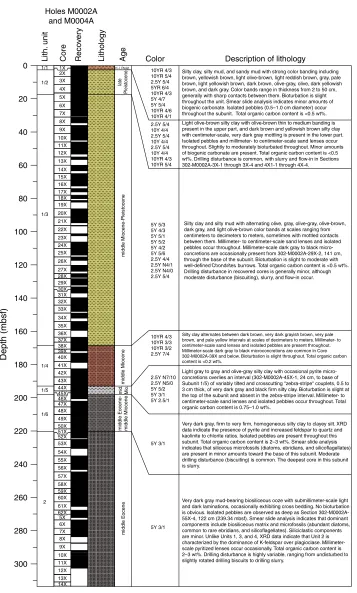
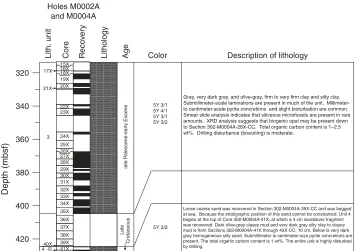
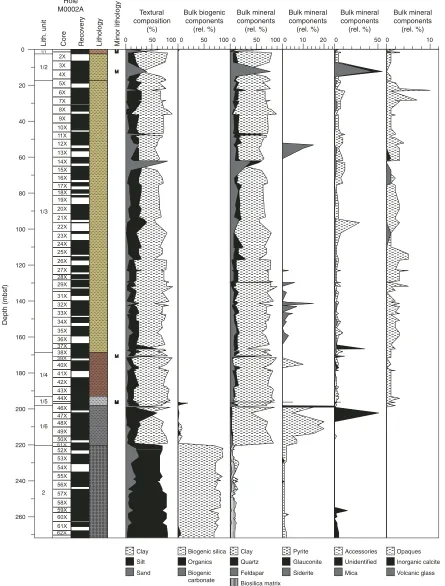
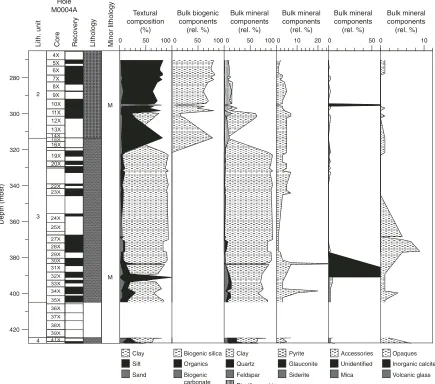
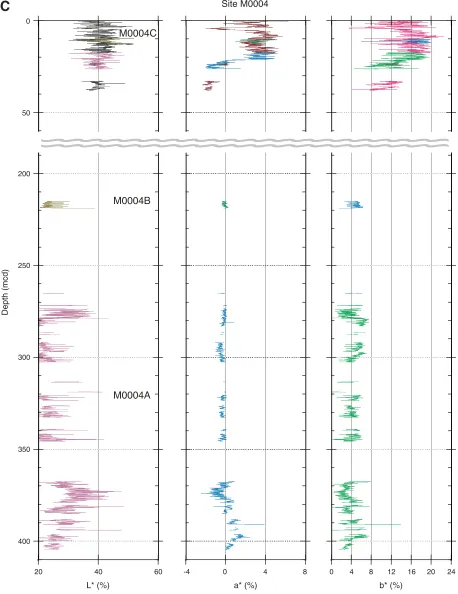
Four lithologic units (Table T3) are defined on the basis of color, texture, and compositional variations identified from visual core description and smear slide analysis (Figs. F1,F2), as well as X-ray diffrac-tion (XRD) (Fig. F3) and total organic carbon (TOC) content analyses (Fig. F40). A first-order observation of downcore compositional variations, which helped define the lithostratigraphic units, is a shift from sili-ciclastic-dominated (Unit 1) to biogenic-dominated (Unit 2) and back to siliciclastic-dominated (Unit 3) lithologies. Unit 4 was distinguished from Unit 3 based on an abrupt coarsening of the sediment tex-ture following an interval of poor core recovery. Sec-ond-order observations of a textural and composi-tional nature, including variation in the amount of sand, biogenic carbonate and silica, pyrite, TOC, and a downcore shift in sediment color from generally brown to olive, back to brown, and then to gray and black, enabled further differentiation of subunits within Unit 1.
Lithostratigraphic Unit 1
Intervals: Sections 302-M0002A-1X-1, 0 cm, through 51X-1, 150 cm; 302-M0003A-1H-1, 0 cm, through 3H-CC, 5 cm; M0004A-1H-1, 0 cm, through 3X-2, 128 cm; 302-M0004B-1X-1, 0 cm, through 1X-2, 85 cm; 302-M0004B-3X-1, 0 cm, through 3X-CC, 25 cm; and 302-M0004C-1H-1, 0 cm, through 9X-CC, 25 cm
Depths: Hole M0002A: 0–220.24 mbsf, Hole M0003A: 0–15 mbsf, Hole M0004A: 17.0– 28.28 mbsf, Hole M0004B: 10.0–12.29 and 215.0–219.0 mbsf, and Hole M0004C: 0– 36.66 mbsf
Age: Holocene to middle Eocene
Proc. IODP | Volume 302 6
Unit 1 ranges in color primarily from brown to olive and back to brown above 192.94 mbsf (Section 302-M0002A-44X-1, 95 cm) and is gray to very dark gray or black below this level. Color banding of variable thicknesses (centimeters to meters) is common throughout the upper 196.2 mbsf (Section 302-M0002A-45X-1, 24 cm). These color bands generally have horizontal sharp to gradational (mottled) con-tacts. From 196.2 to 198.13 mbsf (Section 302-M0002A-46X-1, 113 cm), color banding is quite dif-ferent from the overlying sediments. This interval is characterized by variably tilted, black to gray cou-plets, often with sharp basal contacts, which trun-cate underlying couplets. From 198.13 mbsf to the base of Unit 1, color banding is absent.
The abrupt downcore color shift to darker (grayer) li-thologies at 192.94 mbsf is associated with a gradual increase in microconcretions and pyrite content and decrease in millimeter- to centimeter-scale sandy lenses (absent below Section 302-M0002A-46X-1, 58.5 cm; 197.59 mbsf). Dark gray to black millime-ter- to gravel-size concretions first occur at 131.09 mbsf (Section 302-M0002A-29X-2, 141 cm). Distinct millimeter- and centimeter-size metallic yellow py-rite concretions and burrow infillings then appear from Section 302-M0002A-44X-2, 27 cm, through 44X-4, 12 cm (195.93 mbsf). Concretions are absent in Unit 1 below this depth. However, disseminated pyrite is a significant bulk mineral component of Unit 1 downcore from 198.13 mbsf (Section 302-M0002A-46X-1, 113 cm) according to smear slide and XRD data (Figs. F2A,F3). Unit 1 is divided into six subunits reflecting these changes in texture, com-position, and color.
Subunit 1/1
Intervals: Sections 302-M0002A-1X-1, 0 cm, through 2X-1, 108 cm; 302-M0003A-1H-1, 0 cm, through 1H-1, 110 cm; and 302-M0004C-1H-1, 0 cm, through 2H-1, 129 cm Depths: Hole M0002A: 0–2.58 mbsf, Hole M0003A:
0–1.1 mbsf, and Hole M0004C: 0–2.59 mbsf Age: Holocene to late Pleistocene
Lithology: silty clay, silty mud, and sandy mud Subunit 1/1 comprises silty clay, silty mud, and sandy mud with strong color banding including brown (10YR 4/3), yellowish brown (10YR 5/4), light olive-brown (2.5Y 5/4), light reddish brown (5YR 6/ 4), gray (2.5Y 6N 6/0), pale brown (10YR 6/3), light yellowish brown (2.5Y 6/4), dark brown (10YR 4/3), olive-gray (5Y 4/7), olive (5Y 5/4), dark yellowish brown (10YR 4/6), and dark gray (10YR 4/1). Color bands range in thickness from 2 to 50 cm, generally with sharp contacts between them. Bioturbation is slight throughout the unit. Smear slide analyses
indi-cate minor amounts of biogenic carbonate. Isolated pebbles (0.5–1.0 cm in diameter) occur throughout the subunit. TOC content is <0.5 wt%.
Subunit 1/2
Intervals: Sections 302-M0002A-2X-1, 108 cm, through 5X-1, 88 cm; 302-M0003A-1H-1, 110 cm, through 3H-CC, 15 cm; 302-M0004A-1H-1, 0 cm, through 2X-1, 118 cm; 302-M0004B-1X-1, 0 cm, through 1X-2, 85 cm; and 302-M0004C-2H-1, 129 cm, through 6X-1, 2 cm
Depths: Hole M0002A: 2.58–17.38 mbsf, Hole M0003A: 1.1–15.0 mbsf, Hole M0004A: 17.0– 21.68 mbsf, Hole M0004B: 10.0–12.29 mbsf, and Hole M0004C: 5.29–23.59 mbsf
Age: late Pleistocene Lithology: silty clay
The main lithologic distinction between Subunits 1/ 1 and 1/2 is textural. The major lithology of Subunit 1/2 is silty clay and therefore contains less sand than Subunit 1/1, which includes lithologies of silty clay, silty mud, and sandy mud. Light olive-brown (2.5Y 5/4) silty clay with olive-brown (2.5Y 4/4) thin to medium banding is present in the upper part of Sub-unit 1/2, and dark brown (10YR 4/3) and yellowish brown (10YR 5/4) silty clay with centimeter-scale, very dark gray mottling is present in the lower part of Subunit 1/2. Isolated pebbles and millimeter- to centimeter-scale sand lenses are present throughout. A 7 cm interval of yellow (10YR 7/6) clay with a sharp upper and gradational basal contact is present in interval 302-M0003A-1H-3, 107–114 cm. Light ol-ive-brown (2.5Y 5/4) silty mud is present in minor amounts in interval 302-M0004C-4H-1, 74–68 cm. This subunit is slightly to moderately bioturbated throughout. A Thalassinoides burrow is present in in-terval 302-M0003A-1H-3, 10–20 cm, and several Chondrites burrows are present in Core 302-M0004C-3H. Minor amounts of biogenic carbonate are present in Subunit 1/2. TOC content of Subunit 1/2 is <0.5 wt%. Drilling disturbance is common, with slurry and flow-in in Sections 302-M0002A-3X-1 through 3X-4 and 4X1-1 through 4X-4.
Subunit 1/3
Intervals: Sections 302-M0002A-5X-1, 88 cm, through 38X-3, 45 cm; 302-M0004A-2X-1, 118 cm, through 3X-2, 128 cm; and 302-M0004C-6X-1, 2 cm, through 9X-CC, 25 cm Depths: Hole M0002A: 17.38–168.53 mbsf, Hole M0004A: 21.38–28.28 mbsf, and Hole M0004C: 23.59– 36.66 mbsf
Proc. IODP | Volume 302 7
Expedition 302 Scientists Sites M0001–M0004
Lithology: silty clay and silty mud
The lithostratigraphic distinction between Subunit 1/3 and overlying Subunit 1/2 is primarily based on downcore sediment coarsening, a brown to olive color transition, and an absence of biogenic carbon-ate.
Silty clay and silty mud with alternating olive (5Y 5/ 3, 5Y 4/3, and 5Y 5/6), gray (5Y 5/1), olive-gray (5Y 5/2 and 5Y 4/2), olive-brown (2.5Y 4/4), dark gray (2.5Y N4/1, 2.5Y N4/0, and 5Y 4/1) and light olive-brown (2.5Y 5/4) color bands are found at scales ranging from decimeters to meters, sometimes with mottled contacts between them. Some intervals are characterized by thin centimeter-scale color band-ing. Short intervals of gray (5Y 5/1) to olive-brown (2.5Y 4/4) sandy mud occur in intervals 302-M0002A-32X-2, 11–18 cm, 32X-3, 26–32 cm, and 302-M0004C-6X-2, 46–47 cm. Millimeter- to centi-meter-scale sand lenses and isolated pebbles occur throughout. Millimeter-scale dark gray to black mi-croconcretions are occasionally present from Section 302-M0002A-29X-2, 141 cm, through the base of the subunit. An interval of firm sediment occurs from Section 302-M0002A-30X-1, 0 cm, through 31X-CC. Bioturbation is slight to moderate with well-defined Chondrites burrows in Cores 302-M0002A-17X, 20X, 21X, 32X, and 35X. TOC content is <0.5 wt%. Drill-ing disturbance in recovered cores is generally mi-nor, although moderate disturbance (biscuiting), slurry, and flow-in occur in discontinuous intervals in Cores 302-M0002A-6X through 12X, within parts of Cores 302-M0002A-16X, 27X, and 32X, and within parts of Cores 302-M0004C-8X through 9X.
Subunit 1/4
Interval: Sections 302-M0002A-38X-3, 45 cm, through 44X-1, 95 cm
Depth: 168.53–192.94 mbsf Age: middle Miocene Lithology: silty clay
The lithostratigraphic distinction between Subunit 1/4 and overlying Subunit 1/3 is based on a down-core color change from olive back to brown (Fig. F4; somewhat similar to Subunit 1/2), in addition to a slight downcore sediment coarsening, increase in the presence of gray and black microconcretions, and decrease in TOC content.
Subunit 1/4 lithology comprises silty clay, which al-ternates between dark brown (10YR 4/3 and 10YR 3/ 3), very dark grayish brown (10YR 3/2), very pale brown (10YR 7/3), and pale yellow (2.5Y 7/4) inter-vals at scales of decimeters to meters. Millimeter- to centimeter-scale sand lenses (e.g., interval 302-M0002A-38X-4, 100–101 cm) and isolated pebbles
are present throughout this subunit. Millimeter-scale dark gray to black microconcretions are common in Core 302-M0002A-39X and below. Bioturbation is slight throughout Subunit 1/4 and includes a Chon-drites burrow in Section 302-M0002A-42X-3. The brown sediments of Subunit 1/4 between ~170 and ~193 mbsf are barren of all palynomorphs. TOC con-tent is <0.2 wt%.
Subunit 1/5
Interval: Sections 302-M0002A-44X-1, 95 cm, through 46X-1, 113 cm
Depth: 192.94–198.13 mbsf Age: middle to early Miocene Lithology: silty clay
The lithostratigraphy of Subunit 1/5 is distinguished from overlying Subunit 1/4 in several ways, includ-ing a downcore shift in general sediment color from brown to gray and black, a change to an unusual cy-clic color banding pattern that resembles “zebra stripes,” a downcore shift from gray/black microcon-cretions to metallic yellow pyrite microconmicrocon-cretions, and an increase in TOC content. The contact be-tween Subunits 1/4 and 1/5 at 192.94 cm is sharp (Fig. F5).
The top of Subunit 1/5 is characterized by light gray (2.5Y N7/0), gray (2.5Y N5/0), and olive-gray (5Y 5/ 2) silty clay. This interval is slightly bioturbated and contains metallic yellow millimeter- to centimeter-scale pyrite microconcretions. The majority of this subunit is dominated by tilted color bands, or cou-plets, 0.5 to 3 cm thick, of very dark gray (5Y 3/1) and black (5Y 2.5/1) firm silty clay. The top of this zebra-stripe interval begins at Section 302-M0002A-45X-1, 24 cm, and continues to the base of the sub-unit. A 0.5 cm thick layer of dark brown (10YR 4/3), hard silty clay (interval 302-M0002A-45X-1, 27.5–28 cm) is present close to the top of the zebra-stripe in-terval. Packages of couplets within the zebra-stripe interval are tilted, and bases of many of these sedi-ment packages are sharp and truncate (crosscut) the underlying layers as the tilting direction changes (Fig. F6). Within individual tilted packages, upper layers also appear to crosscut underlying layers, but some gradational contacts exist as well. The thick-ness of the couplets and the angle of tilt increases upsection. Bioturbation is absent in the zebra-stripe interval. Millimeter- to centimeter-scale sand lenses and isolated pebbles occur throughout Subunit 1/5. TOC content of Subunit 1/5 is 0.75–1.0 wt%.
Subunit 1/6
Proc. IODP | Volume 302 8
Depths: Hole M0002A: 198.13–220.24 mbsf and Hole M0004B: 215.0–219 mbsf
Age: middle Miocene to middle Eocene Lithology: silty clay and clayey silt
The lithostratigraphy of Subunit 1/6 is distinguished from overlying Subunit 1/5 by a downcore change to very dark gray (5Y 3/1), firm to very firm, homoge-neous silty clay to clayey silt. Smear slide and XRD data indicate that an abrupt increase in pyrite de-fines the boundary between Subunits 1/5 and 1/6. XRD data further indicate that a downcore increase in the ratio of kaolinite to chlorite and a decrease in quartz also mark this subunit boundary (Fig. F3). Black millimeter-scale mottling is present in Sections 302-M0002A-46X-3, 36 cm, and 48X-2, 34 cm. A piece of hard very dark grayish brown (10YR 3/2) material, possibly coal, is present in interval 302-M0002A-46X-2, 51–53 cm. Isolated pebbles are present throughout this subunit. Smear slide analyses indicate that siliceous microfossils (diatoms, ebridians, and silicoflagellates) are present in minor amounts toward the base of this Subunit. TOC con-tent of Subunit 1/6 is 2–3 wt%. Moderate drilling disturbance (biscuiting) is common in Core 302-M0002A-48X through Section 50X-1, 29 cm. Slurry occurs below this level to the base of the unit.
Lithostratigraphic Unit 2
Intervals: Sections 302-M0002A-51X-1, 150 cm, through 62X-CC, 11 cm; and 302-M0004A-4X-1, 0 cm, through 15X-1, 26 cm
Depths: Hole M0002A: 220.24–267.71 mbsf and Hole M0004A: 265.0–313.61 mbsf
Age: middle Eocene
Lithology: mud-bearing biosiliceous ooze
Unit 2 (220.24–313.61 mbsf) is dominated by very dark gray (5Y 3/1) mud-bearing biosiliceous ooze. Submillimeter-scale light and dark laminations occur throughout Unit 2, occasionally exhibiting cross bedding that is visible in both undisturbed intervals and within coherent biscuits (e.g., intervals 302-M0002A-60X-3, 60–98 cm, and 302-M0004A-6X-4, 34–38 cm). No bioturbation is visible throughout the unit. Isolated pebbles are observed as deep as Section 302-M0002A-55X-4, 122 cm (239.34 mbsf). Smear slide analyses indicate that dominant components include biosiliceous matrix and microfossils (abun-dant diatoms, common to rare ebridians, and silico-flagellates). Siliciclastic components are minor. Un-like Units 1, 3, and 4, XRD data indicate that Unit 2 is characterized by the dominance of K-feldspar over plagioclase (Fig. F3). Millimeter-scale pyritized lenses occur in Sections 302-M0002A-52X-2, 5 and 10 cm. TOC content in Unit 2 is generally between 2 and 3 wt%. Within recovered sections, drilling disturbance
is highly variable, ranging from undisturbed to slightly rotated drilling biscuits to drilling slurry.
Lithostratigraphic Unit 3
Interval: Sections 302-M0004A-15X-1, 26 cm, through 35X-CC, 18 cm
Depth: 313.61–404.79 mbsf
Age: early Eocene to late Paleocene Lithology: clay and silty clay
The primary distinction between Units 2 and 3 is the major lithology of mud-bearing biosiliceous ooze (Unit 2) in contrast to clay (Unit 3). In several ways, Unit 3 resembles Subunit 1/6; both are dark gray fine-grained siliciclastic-dominated transitional li-thologies that contain pyrite and minor amounts of biogenic silica toward their contacts with Unit 2. Smear slide analyses indicate that siliceous microfos-sils are present in rare amounts in Sections 302-M0004A-15X-CC, 18X-CC, and 19X-CC. XRD analy-sis suggests that biogenic opal may be present down to Section 302-M0004A-26X-CC. Geochemical analyses indicate that the fine-grained sediment in the upper part of Unit 3 (to ~350 mbsf) is largely au-thigenic (silica altered to crystoballite), with only mi-nor terrigenous input. These distinct geochemical changes in Unit 3 are described further in “Geochemistry.”
The top of Unit 3 comprises gray (5Y 3/1) to very dark gray (5Y 4/1) firm to very firm clay. From Core 302-M0004A-31X through Core 34X, the sediment coarsens slightly and is dominated by a gray (5Y 3/1) to dark olive-gray (5Y 3/2) silty clay. A 3 cm interval of yellowish brown (10YR 5/4) sandy mud is present in interval 302-M0004A-32X-CC, 6–9 cm, and Sec-tion 33X-1 is a very disturbed, dark olive-gray (5Y 3/ 2) silty mud. Dark olive-gray (5Y 3/2) clay is again present from Core 302-M0004A-35X to the base of the unit. Smear slide analyses indicate that the dom-inant components in the terrigenous clay and silty clay are, in increasing order, feldspar, pyrite, quartz, and clay minerals. Accessory minerals include minor amounts of zircon.
Proc. IODP | Volume 302 9
Expedition 302 Scientists Sites M0001–M0004
Lithostratigraphic Unit 4
Interval: Sections 302-M0004A-41X-1, 0 cm, through 42X-CC, 17 cm
Depth: 424.50–427.63 mbsf Age: Late Cretaceous
Lithology: clayey mud, silty clay, and silty sand
Loose coarse sand was recovered in Section 302-M0004A-39X-CC and was bagged at sea. Because the stratigraphic position of this sand cannot be con-strained, Unit 4 begins at the top of Core 302-M0004A-41X, where a 4 cm sandstone fragment was recovered. Dark olive-gray (5Y 3/2) clayey mud and very dark gray (5Y 3/1) silty clay to clayey mud are the dominant lithologies in Unit 4, occurring from Sections 302-M0004A-41X through 42X-CC, 10 cm. Very dark gray (5Y 3/1) homogeneous silty sand oc-curs in the deepest 7 cm of the unit. Smear slide analysis indicates that Unit 4 is dominated by quartz, feldspar, and clay minerals. Submillimeter to centimeter-size pyrite concretions are present in Sec-tions 302-M0004A-41X-1 and 42X-1. Centimeter-size gravel is present at the base of 42X-1, but this may be a product of core disturbance. The TOC con-tent of Unit 4 is 1 wt%. The entire unit is highly dis-turbed by drilling.
Summary
Fine-grained siliciclastic sediments (clays to silty muds), ranging in age from Holocene to Late Creta-ceous (0–428 mbsf), are the dominant lithogenic ma-terial recovered in the suite of Expedition 302 sites. This is interrupted in the middle Eocene by dark gray laminated mud-bearing biosiliceous ooze (~220 to ~313 mbsf; Unit 2). This ooze is also characterized by elevated amounts of TOC and algal-derived organic carbon (see “Organic geochemistry”). Dark, or-ganic-rich and biosiliceous laminated units are indic-ative of high productivity but relindic-atively low oxygen bottom waters.
The largely fine grained texture of the siliclastic sedi-ments is indicative of predominantly low energy ma-rine environments throughout most of the Ceno-zoic. However, the fine-grained zebra-stripe interval within Subunit 1/5 is an exception. Cores within Subunit 1/5 (302-M0002A-44X, 45X, and 46X) give ample evidence of rapid changes in depositional en-vironment with distinct breaks in layering, crosscut-ting, and cyclic changes in color. Seismic reflection data taken near the sites (Fig. F7B) indicate an inter-val of high-frequency, anastomosing reflections (see
Jakobsson et al., this volume), equivalent to this
ze-bra-stripe interval. Both the character of the bed forms and their apparent seismic signature suggest a dynamic sedimentary environment during part of
the middle Miocene(?). This “cut and fill” character may indicate migrating sediment waves (Hall, 1979). Currents that could create such an energetic envi-ronment include strong baroclinic or boundary cur-rents (Aagard and Carmack, 1994), tidal-driven tur-bulence on top of and around the ridge, and the oscillation of internal waves on a surface with a high density gradient.
Sand lenses are observed as deep as 198 mbsf (bot-tom of Subunit 1/5, early Miocene). Isolated pebbles are present throughout Unit 1, with the deepest one observed, visually, in Unit 2 (302-M0002A-55X-4, 122 cm; 239.34 mbsf; middle Eocene). The sand lenses and isolated pebbles are interpreted as ice-rafted debris, suggesting that at least seasonal ice has been present in the central Arctic since the middle Miocene and perhaps as early as the middle Eocene. Lithologic unit changes do not necessarily coincide with hiatuses interpreted on the basis of biostratigra-phy. However, a major hiatus is likely within Core 302-M0002A-46X near the Subunit 1/5 and 1/6 boundary. Although color is used as a factor in defin-ing lithologic units, color changes do not always co-incide with mineralogical and textural changes, sug-gesting a strong diagenetic influence on color banding in these sediments.
Micropaleontology
During Integrated Ocean Drilling Program (IODP) Expedition 302, four closely spaced sites (Sites M0001–M0004) were drilled along a single seismic profile, and cores from the various holes could be confidently spliced and correlated. The different se-quences are treated as a single succession. Among the holes, only Holes M0002A and M0004A reached significant depths; the others captured parts of the Pleistocene. Hole M0002A penetrated into the mid-dle Miocene and upper midmid-dle Eocene, with a marked hiatus separating these units. Hole M0004A continued from where Hole M0002A ended, recov-ered portions of the underlying middle and lower Eocene and the Paleocene/Eocene transition, and bottomed in lower Campanian basement at ~410 mbsf.
Onboard micropaleontology included the analysis of calcareous nannofossils, diatoms, silicoflagellates, ebridians, radiolarians, calcareous and agglutinated benthic foraminifers, planktonic foraminifers, ostra-codes, organic-walled dinoflagellate cysts (dino-cysts), other palynomorphs, and fish remains. Only core catcher samples were analyzed during the off-shore phase.
Proc. IODP | Volume 302 10
reported from the Holocene in Hole M0001A. Sili-ceous microfossils, notably diatoms, silicoflagellates, and ebridians, are most abundant and well preserved in the middle Eocene interval. Calcareous planktonic and benthic foraminifers and ostracodes are rare in the Pleistocene and absent in older parts. Aggluti-nated benthic foraminifers are generally scarce but are locally abundant and well preserved in the Cam-panian and the Paleocene to lower Eocene intervals. Organic-walled dinoflagellate cysts (dinocysts) are patchy in the Quaternary–Neogene but are abundant and well preserved in the Paleogene and Cretaceous intervals. Other palynomorphs, notably pollen and spores, and remains of aquatic algae (chlorophytes) are common in most intervals. An acme of the re-mains of the hydropterid fern Azolla marks the basal middle Eocene.
Preliminary age-depth relationships are based on di-nocyst, ebridian, and silicoflagellate datums and the Azolla event. Dinocysts represent the only group that by and large is present throughout the entire Ceno-zoic section. Paleogene dinocyst events have been calibrated to magnetostratigraphy by Eldrett et al. (2004) from Hole 913B in the Norwegian-Greenland Sea. Additional age information is derived from sili-coflagellates and ebridians in the middle Eocene and a few benthic foraminifer events in the older Paleo-gene.
During Expedition 302, cores ranging in age from the Campanian (basement) to the Holocene were re-covered. Major hiatuses occur between the Campa-nian and the Paleocene, the middle Eocene and early Miocene, and within the Pliocene.
Paleoenvironments ranged between marginal marine neritic settings in the Campanian through earliest Eocene to an enclosed marginal basin setting marked by episodic brackish to possible freshwater condi-tions in the middle Eocene, as indicated by the Azolla event. The upper part of the Miocene through the Pleistocene is characterized by deep marine con-ditions. The palynological assemblage in Samples 302-M0002A-44X-CC and 45X-CC resembles that of a coastal, restricted marine, brackish setting. Rework-ing of Cretaceous through late Eocene elements is common in this interval. The Oligocene elements may be reworked as well, tentatively placing this suc-cession in the Miocene. Non-fossil-bearing strata, provisionally assigned to the Miocene, overlie this interval. Paleoenvironmental information is not available for this interval (Samples 302-M0002A-38X-CC through 43X-CC).
Calcareous nannofossils
During the offshore phase of IODP Expedition 302, 124 smear slides made with the core catcher
sedi-ments from each of the four sites were studied for calcareous nannofossils. All of the studied samples were barren, except for one sample from Hole M0001A. Although calcareous nannofossils are poorly represented in high-latitude sediments (Perch-Nielsen, 1985a), this result was striking. Stud-ies carried out in recent years on several piston cores from the Arctic Ocean (e.g., Gard, 1993; Jakobsson et al., 2000, 2001) have shown that calcareous nanno-fossils are present in low abundances only in short intervals during the present and the last interglacial periods. Expedition 302 recovered a long Cretaceous to Cenozoic stratigraphic record, and so it was a sur-prise not to find calcareous nannofossils, a fossil group that normally is well represented in marine sediments.
After the cores were split at the IODP Bremen Core Repository (BCR), the upper 19 m of Hole M0004C and the top 3 m of Hole M0002A were sampled at varying intervals downcore, using a strategy based largely on visual observations of core coloration. Al-though many of the samples subsequently proved to be barren, a surprising large number did contain poor–moderate–well-preserved calcareous nannofos-sil assemblages. Moreover, a few of the samples from Hole M0004C equate to 18 mbsf. Although some of these nannofossils are undoubtedly reworked from Mesozoic–Cenozoic sediments and transported over long distances to the core sites (Gard and Crux, 1994), others may have been produced in situ.
Hole M0001A
Four samples from Section 302-M0001A-1H-CC (col-lected at depths of 10, 12, 14, and 26 cm) were ana-lyzed for calcareous nannofossils. Only the sample collected in a brown interval at 14 cm contains an impoverished assemblage of calcareous nannofossils. The following forms have been determined: Cocco-lithus pelagicus (small form), Calcidiscus leptoporus, and a species of Gephyrocapsa. All of them are rare. This assemblage has been previously recorded in Ho-locene sediments from the Arctic Ocean (Gard, 1993).
Hole M0002A
cocco-Proc. IODP | Volume 302 11
Expedition 302 Scientists Sites M0001–M0004
liths, and a few specimens of C. pelagicus, C. lepto-porus, and thoracospheres were found. Some cocco-liths were found in deeper samples from Cores 1X and 2X but were poorly preserved and very rare.
Hole M0003A
Three core catcher samples (1H-CC, 3 cm, 2H-CC, 16 cm, and 3H-CC, 24 cm) were analyzed on board for calcareous nannofossils, but all were barren. Fifteen samples were analyzed onshore, most of which were barren, but with a gephyrocapsid specimen in Sec-tion 1H-1, 11 cm, two reworked coccoliths in SecSec-tion 1H-1, 12 cm, and a coccolith of C. pelagicus in sec-tion 1H-2, 59 cm.
Holes M0004A, M0004B, and M0004C
Thirty-two core catcher samples from Hole M0004A (Table T6), two from Hole M0004B (302-M0004B-3X-CC, 2 cm, and 13 cm), and four samples from Hole M0004C (302-M0004C-1H-CC through 4H-CC and 6X-2, 149 cm) were analyzed on board for calcareous nannofossils, but all samples were barren.
Samples taken from the opened cores of Hole M0004C yielded significant numbers of coccoliths. The top 35 cm of Section 302-M0004C-1H-1 con-tained good to moderately preserved specimens of E. huxleyi, small to medium Gephyrocapsa spp., and C. pelagicus, as well as a few C. leptoporus and Syra-cosphaera species. Unidentified coccoliths were also present. Below this, most of the samples were either barren or contained rare and poorly preserved cocco-liths of small to medium Gephyrocapsa spp., C. pelagi-cus, and C. leptoporus. In Section 302-M0004C-1H-2, 2 cm, there were many small and medium Gephyro-capsa spp. as well as a few E. huxleyi, whereas another sample at 4H-3, 3 cm, comprised a few specimens of moderately preserved small to medium Gephyrocapsa species. It should be pointed out that samples from the same core depth but from different horizontal lo-cations often yielded dissimilar results.
Nannofossil stratigraphy
The findings in Hole M0004C suggest that coccoli-thophorids were living in the Arctic prior to the last interglacial. However, their rare presence in the lower core sections does not allow us at this time to assign an age or zone with any confidence. On the other hand, the “dominance” of E. huxleyi in the up-permost part of the first section indicates that the sediments represent the Holocene, prior to which (i.e., before the beginning of the E. huxleyi acme) there is a “dominance” of small to medium Gephyro-capsa species. The presence of large specimens (>4 µm) of E. huxleyi, reportedly indicative of the last
glacial period at lower latitudes (Colmenero-Hidalgo et al., 2002), occur in the Arctic sediments presum-ably during the warmer Holocene. The presence of large specimens (9–15 µm) of C. pelagicus indicates that temperate waters infiltrated the Arctic region during the Holocene (Young et al., 2003).
Diatoms
Hole M0001A
Samples 1H-CC, 18 and 25 cm, were studied, but dia-toms were not observed in these samples.
Hole M0002A
A total of 87 samples (about one sample per section) in interval 1X-1, 3 cm, through 47X-2, 37 cm, were prepared, but these were barren of diatoms and other siliceous microfossils (silicoflagellates, ebridians, and archaeomonads), apart from Sample 46X-CC, 6 cm, which yielded rare diatoms (Table T7). Samples 47X-2, 50 cm, to 49X-3, 31 cm, contained few diatoms but generally abundant ebridians. Samples 51X-1, 25 cm, to 62X-3, 50 cm, contained a diverse siliceous as-semblage with abundant diatoms, common to abun-dant ebridians, and few to common silicoflagellates. Sediments of this interval are dominated by diatoms. Based on qualitative analysis of smear slides and some quantitative counts, the diatoms in the biosili-ceous interval can be divided into different assem-blages. Given the sparsity of published information on middle Eocene diatoms in northern high lati-tudes, most of the species recorded in these samples have been identified only to generic level. Diatoms in the ebridian-dominated interval 47X-2, 50 cm, to 49X-3, 31 cm, are dominated by Pyxilla spp. The dia-tom assemblage in interval 51X-1, 25 cm, to 53X-3, 100 cm, is mainly composed of species of Hemiaulus and Huttonia. In interval 53X-4, 38 cm, to 57X-3, 60 cm, the assemblage is composed of species of Gonio-thecium, Eunotogramma, Hemiaulus, and Huttonia. We have specifically sampled some of the white layers of the laminated interval. One of these samples (57X-4, 50 cm) is a pure diatomite composed mainly of spe-cies of Eunotogramma. The other three samples (58X-2, 69 cm, 58X-3, 5 cm, and 59X-3, 79 cm) are com-posed mainly of species of Hemiaulus. The diatom assemblage in interval 60X-1, 39 cm, to 62X-3, 50 cm, is composed of species of Eunotogramma, Trinac-ria, and Odontotropis. Within this diatom-dominated interval there is one sample (61X-2, 20 cm) that is dominated by ebridians.
Proc. IODP | Volume 302 12
1978; Fenner, 1985), Ocean Drilling Program (ODP) Leg 151 from the middle Eocene to the late Oli-gocene in the Norwegian-Greenland Sea (Scherer and Koç, 1996), Core Fl-422 from the Alpha Ridge of the central Arctic Ocean assigned to early to middle Eocene by Dell´Agnese and Clark (1994), the Eocene of the Urals (Strelnikova, 1974), and to the early Eocene Moler/Für Formation of Denmark (Homann, 1991). Because of the sparsity of sediments of this age and consequently a poorly established high-lati-tude northern hemisphere Eocene diatom biostratig-raphy, it is not possible to provide a more detailed age assessment to the interval 47X-2 to 62X-3 in Hole M0002A other than middle Eocene. However, the present material yielded significant changes in the presence and abundance of species that may po-tentially be useful for the establishment of a diatom biostratigraphy for the Arctic Ocean. Counts of spe-cies in Samples 51X-2, 117–118 cm, through 62X-CC show some significant changes in the species compo-sition of this interval (Table T7; Fig. F8).
There are three peaks in the abundance of Hemiaulus sp. 1 between interval 51X-2, 117–118 cm, and 62X-CC, namely in Samples 62X-CC through 61X-62X-CC, 59X-CC, and the interval from 57X-CC through 55X-CC. Similar changes are also recognized in the patterns of Hemiaulus danicus, Hemiaulus incisus, Hemiaulus kittonii, and Hemiaulus spp. indet., which have abundance maxima in Samples 54X-CC and 51X-2, 117–118 cm. Pseudopyxilla spp. are abundant from Sample 62X-CC through 59X-CC, whereas Cy-matosira spp. show a maximum abundance in the upper part of Sample 59X-CC. Goniothecium is abun-dantly present in all samples that yielded diatoms. Among representatives of this genus, Goniothecium loricatum has two peaks (i.e., from Samples 60X-CC through 57X-CC and from 54X-CC through 52X-CC). Goniothecium odontella var. danica also has two peaks, in Samples 60X-CC and 52X-CC. Abundant occurrences of Costopyxis trochlea were also recog-nized. This species was formerly known as “Trocho-sira trochlea” from middle Eocene sediments in high and low latitudes (Dzinoridze et al., 1978; Fenner, 1985; Scherer and Koç, 1996).
The Eocene Chaetoceros resting spore assemblages are of low diversity, represented only by two species, resting spore sp. 1 and Syndendrium diadema? Resting spore sp. 1 is common only in Sample 52X-CC.
Paleoenvironment
The diatom species of Hole M0002A are all marine. The presence of abundant diatoms (and other biosili-ceous organisms) indicates extremely productive surface ocean conditions in the interval 51X-1 through 62X-CC. Presence of laminations with pure
diatom assemblages in the light layers throughout the interval is a further confirmation of the ex-tremely productive nature of the surface waters. A large number of the observed species, such as Pseudotriceratium radiosoreticulatum, which occurs from Samples 48X-CC through 57X-CC, is especially common in neritic environments (Fenner, 1985). Diatom resting spore assemblages, including Pteroth-eca aculeifera, resting spore sp. 1, and S. diadema?, are common in Sample 52X-CC. Their presence may in-dicate proximity to the shelf edge, as only neritic planktonic diatoms form resting spores in the mod-ern oceans. The abundance of resting spores also suggests a highly productive environment.
Hole M0003A
Three core catcher samples (1H-CC, 22 cm, 2H-CC, 14 cm, and 3H-CC, 1 cm), in addition to Samples 1H-1, 12 cm, 1H-2, 59 cm, 3H-3, 12 cm, 3H-3, 70 cm, and 3H-3, 85 cm, were investigated for diatoms. All of these samples were barren.
Hole M0004A
Proc. IODP | Volume 302 13
Expedition 302 Scientists Sites M0001–M0004
Counting of species in nine samples between Sec-tions 4X-1 and 12X-CC showed the presence of abundant well-preserved resting spores in this inter-val (Table T8). In these samples, representatives of 24 genera, comprising 26 species and 12 unidentified species, including two unknown resting spore spe-cies, were observed. Samples 15X-CC and 18X-CC included rare and poorly preserved small-sized dia-tom valves of Goniothecium spp., Hemiaulus spp., P. picus, and P. aculeifera. In addition, a few well-pre-served large-size diatom valves in the >45 µm frac-tion, including Odontotropis carinata, Stephanopyxis spp., and Trinacria cornuta, were recognized. The abundance of Hemiaulus sp. 1 (>70%) and Pseudopyx-illa spp. (>20%) and absence of Anaulus spp. and Cy-matosira spp. resemble diatom assemblages in the lower part of the diatomaceous sediments in Hole M0002A.
Few age-diagnostic taxa are recorded in Hole M0004A. Sample 6X-CC contained rare but well-pre-served Brightwellia hyperborea, which is an age-diag-nostic taxon from the middle Eocene of the North Atlantic Ocean (Fenner, 1985). Samples 11X-4, 5 cm, and 11X-4, 40 cm, contained few P. oligocaenica var. oligocaenica indicating an early Eocene age for these samples (Fenner, 1985). Species recorded in Hole M0004A show some similarities to those reported from DSDP Leg 38, Site 338 (Schrader and Fenner, 1976; Dzinoridze et al., 1978), and from ODP Leg 151, from the middle Eocene to the late Oligocene in the Norwegian-Greenland Sea (Scherer and Koç, 1996), Core Fl-422 from the Alpha Ridge of the cen-tral Arctic Ocean assigned to early to middle Eocene by Dell´Agnese and Clark (1994), Eocene of the Urals (Strelnikova, 1974), and early Eocene Moler/Für For-mation of Denmark (Homann, 1991).
Paleoenvironment
All diatoms observed in Hole M0004A are marine species. Most species occurring abundantly at this site, like Hemiaulus spp., Goniothecium spp., and Stephanopyxis spp., indicate a neritic environment (Fig. F10). Resting spore assemblages (notably P. ac-uleifera and Pseudopyxilla sp.) are abundant and also indicate a nearshore, coastal setting. The abundance of biosiliceous organisms together with diatom rest-ing spores may suggest a highly productive environ-ment, possibly associated with active upwelling in the interval 4X-1, 10 cm, through 15X-1, 10 cm.
Correlation of Holes M0002A and M0004A
Diatom assemblages of Hole M0002A in interval 60X-1, 39 cm, through 62X-3, 50 cm, and Hole M0004A in interval 4X-1, 10 cm, through 6X-3, 70 cm, are very similar. Both are composed of species ofEunotogramma, Trinacria, and Odontotropis. Further-more, even though both intervals are primarily dom-inated by diatoms, there is a short interval in both holes where ebridians dominate over diatoms and where the two holes overlap. These are Sample 302-M0002A-61X-2, 60 cm, and interval 302-M0004A-5X-1, 15 cm, through 5X-2, 30 cm.
Hole M0004B
Two core catcher samples, 1H-CC, 2 cm, and 3X-CC were investigated. The former sample was barren. The latter contained poorly preserved, small-size dia-tom valves, including Pyxilla spp. and some frag-ments, and few but well-preserved large-size diatom valves in the >45 µm fraction, including Pseudotricer-atium radiosoreticulatum, Paralia crenulata, Actinopty-chus spp., Stephanopyxis spp., Hemiaulus spp., and Pseudopyxilla spp. This assemblage is not age diag-nostic. The occurrence of Pseudotriceratium radiosore-ticulatum indicates neritic conditions (Fenner, 1985).
Hole M0004C
A total of 24 samples including the seven core catcher samples, 1H-CC, 2H-CC, 3H-CC, 4H-CC, 6X-2, bottom, 8X-CC, and 9X-CC were studied but did not contain diatoms.
Diatom and paleoenvironment summary, Holes
M0002A and M0004A
The biosiliceous sediments in Cores 302-M0002A-47X through 62X as well as 302-M0004A-4X through 15X indicate productive surface ocean con-ditions in the Arctic during the early Eocene through the middle Eocene. The start and end of this biosili-ceous interval is dominated by ebridians, possibly in-dicating a nearshore environment with moderate productivity, whereas the middle part of the interval, which is dominated by diatoms, indicates highly productive surface waters with neritic to pelagic con-ditions (Figs. F10, F11). The recovered diverse dia-tom assemblages show high temporal variability in their composition, indicating significant climate var-iability within the recovered time interval.
Silicoflagellates and ebridians
Proc. IODP | Volume 302 14
Below 33.9 mbsf, a total of 104 cores were recovered from Holes M0002A (59 cores), M0004A (42 cores), and M0004B (3 cores). Here, we briefly discuss the silicoflagellate and ebridian biostratigraphy, after splicing Holes M0002A and M0004A and inserting data from Hole M0004B (Core 302-M0004B-3X).
Holes M0002A and M0004B
In Hole M0002A, silicoflagellates and ebridians were absent in all samples between Samples 302-M0002A-1X-CC and 46X-CC. Samples 302-M0002A-47X-CC through 62X-CC, 9–11 cm, yielded well-preserved, abundant, and highly diversified (~40 taxa) silico-flagellate and ebridian assemblages, permitting pre-liminary age assignments (Table T9).
Both the silicoflagellate and ebridian assemblages are similar to those reported in Core Fl-422 from the Al-pha Ridge in the Arctic Ocean (Ling, 1985), a core whose age was considered to be early Paleogene. All 18 taxa illustrated by Ling (1985) are present in Sam-ples 302-M0002A-47X-CC through 62X-CC, 9–11 cm, in addition to at least a dozen more taxa in Hole M0002A. The two most critical taxa for biostratigra-phy (Corbisema hexacantha and Dictyocha frenguellii, see below) were not reported by Ling (1985).
Using samples from the same Alpha Ridge core, Bukry (1984) gave an age range of late middle Eocene to late Eocene. Based on his photomicro-graphs, six taxa occur in the present cores (Samples 302-M0002A-47X-CC through 62X-CC, 9–11 cm) from the Lomonosov Ridge, although the taxonomic nomenclature of a few taxa differs from ours. More recently, Dell’Agnese and Clark (1994) provided an age estimate of early to middle Eocene for Alpha Ridge Core Fl-422. There are thus three possible ages for Core Fl-422: early Paleogene, early to middle Eocene, and late middle to late Eocene.
Samples 302-M0002A-47X-CC (207.35 mbsf) and 48X-CC (210.64 mbsf) belong to the silicoflagellate C. hexacantha Zone, which ranges from the middle Eocene to the late Eocene. In terms of calcareous nannofossil zonation, this represents the upper part of Zone NP15 to Zones NP19/NP20. An age of ~44.1 Ma is estimated between Samples 302-M0002A-48X-CC and 49X-302-M0002A-48X-CC, where the first occurrence (FO) da-tum of C. hexacantha occurs. Note that abundant C. hexacantha occurred in Sample 302-M0002A-48X-CC (362 specimens) followed by rare occurrences of this taxon in Sample 48X-2, 139–151 cm, and Core 47X-CC.
Samples 302-M0002A-49X-CC through 62X-CC, 9– 11 cm, belong to the silicoflagellate Corbisema spi-nosa and Naviculopsis robusta Zones. The zonal ranges of these species correspond to the middle part of
nannofossil Zones NP15 (middle Eocene) to NP12 (lower Eocene). Age information from dinoflagellate cysts (see “Palynology, organic-walled
dinoflagel-late cysts”) combined with silicoflagellate data
con-strains the age of Cores 302-M0002A-49X through 62X to the middle Eocene. The following is a prelim-inary discussion of silicoflagellate age determina-tions for Hole M0002A.
Sample 302-M0002A-47X-CC contains moderately preserved and abundant C. hexacantha and D. fren-guellii, which are the most age-diagnostic taxa. Less diagnostic taxa with long stratigraphic ranges in-clude Dictyocha crux parvus, Dictyocha lockerii, Dicty-ocha deflandrei, Corbisema hastata hastata, Corbisema hastata globulata, Corbisema apiculata, Distephanus quinquengellus, Distephanus quinarius, Ammodichium rectangulare, and Pseudoammodochium dictyoides. Sample 302-M0002A-48X-CC contains the key spe-cies C. hexacantha, C. hastata globulata, C. hastata hastata, Corbisema sp. aff. toxeuma, and P. dictyoides. Based on the material from Leg 151 Site 913 from the Greenland Basin, Locker (1996) provided the FO and last occurrence (LO) of C. hexacantha as 44.1 and 37.4 Ma, respectively. The range of D. frenguellii in the C. hexacantha Zone was discussed by Perch-Nielsen (1985b). Thus, Samples 302-M0002A-47X-CC and 48X-302-M0002A-47X-CC are assigned to the C. hexacantha Zone of the middle to upper Eocene.
Proc. IODP | Volume 302 15
Expedition 302 Scientists Sites M0001–M0004
present in Samples 302-M0002A-49X-CC, 2–4 cm, and 52X-CC. This concurs with an age assignment of Cores 302-M0002A-49X through 62X that correlates to Zone NP15. A single specimen of Corbisema lamel-lifera, which occurs in the C. hexacantha Zone, was found in Sample 302-M0002A-62X-CC, 9–11 cm. Single specimens of Naviculopsis foliacea tumida, Nav-iculopsis constricta, and NavNav-iculopsis punctilia were present in Sample 302-M0002A-50X-CC, 8–10 cm. A single specimen of N. robusta, which is characteristic of the N. foliacea Zone, was present in Sample 302-M0002A-62X-CC, 9–11 cm, in the >45 µm fraction. Small (14–20 µm equatorial diameter) silicoflagellate taxa reported by Ling (1985) from the Alpha Ridge were observed in several samples below Core 302-M0002A-52X-CC to the bottom of the hole (Table T9). These taxa include Dictyocha curta and Dictyocha sp. cf. rotundata. The silicoflagellate Dictyocha sp. cf. carentis incerta (diameter of basal ring = 17–24 µm) il-lustrated by Ling (1985) also was continuously present between Samples 302-M0002A-52X-1, 0–2 cm, and 62X-CC, 9–11 cm, except in Samples 52X-CC and 53X-52X-CC. Samples 302-M0002A-61X-52X-CC, 0–1 cm, and 62X-CC, 9–11 cm, yielded eight and six specimens, respectively. These small, rare taxa sug-gest a similarity between Alpha Ridge Core Fl-422 and Samples 302-M0002A-52X-1, 0–2 cm, through 62X-CC, 9–11 cm, and an age of early to middle Eocene for both cores.
Distephanus speculum speculum was present sporadi-cally between Cores 302-M0002A-49X and 57X. To-day, this taxon is a typical temperate to cold-water form. Distephanus antiqua was present continuously from Cores 302-M0002A-49X through 57X, except in Section 56X-CC.
A single specimen of Mesocena apiculata inflata was present at the top of Sample 302-M0002A-57X-CC (<45 µm fraction), which ranges from the N. foliacea Zone of the lower to the middle Eocene to the C. api-culata Zone of the Oligocene. Abundant and well-preserved specimens of the undescribed species Dic-tyocha sp. A and DicDic-tyocha sp. B were found through-out Samples 302-M0002A-49X-CC through 59X-CC and 60X-1, 0–2 cm. In particular, high numbers of Dictyocha sp. B were recorded from Samples 302-M0002A-54X-CC through 55X-CC and Dictyocha sp. A in Samples 53X-CC through 51X-CC.
Paleoenvironment
Abundant Corbisema in the >45 µm fraction and ebridians in the <45 µm fraction of Sample 302-M0002A-62X-CC suggest the following paleoenvi-ronmental conditions favorable to these groups: warm waters, nearshore habitats, and high produc-tivity.
Hole M0004A
Cores 4X (265.03 mbsf) through 18X (318.96 mbsf) yielded silicoflagellates and ebridians with variable abundance and states of preservation. No silicoflag-ellates and ebridians were found below Core 18X. The silicoflagellate assemblages from this site are similar to those at Site M0002 but differ lower in the section. These cores are assigned to the C. spinosa and N. robusta Zones, analogous to cores from Hole M0002A (Cores 302-M0002A-49X through 62X).
C. glezerae was consistently present in the lower sec-tion of this hole except in Cores 302-M0004A-6X, 9X, and 10X. According to Perch-Nielsen (1985b), this taxon ranges from the Corbisema hastata Zone to the N. constricta Zone. However, observations from this site and Site M0002 suggest that the range of C. glezerae extends to the top of the C. spinosa Zone in the Arctic Ocean.
Well-preserved specimens of C. ovalis were found in Samples 4X-CC, 15X-CC, and 18X-CC. In contrast to C. glezerae, C. ovalis was known to be present only in the C. hexacantha Zone (Perch-Nielsen 1985b), but this taxon was found in Cores 56X, 61X, and 62X; therefore, the range of C. ovalis can be extended into the C. spinosa Zone in the Arctic Ocean.
About two dozen specimens of Mesocena were found in Section 7X-CC and Cores 10X through 12X (Table T10). As the size of Mesocena is large (~90–110 µm), scanning the >45 µm size fraction at 100× magnifica-tion readily provides common specimens in addimagnifica-tion to those observed in the standard census at 400× magnification. The following taxa also were encoun-tered: M. apiculata inflata (with and without spines), Mesocena apiculata apiculata, and Mesocena occidenta-lis. Their ranges suggest a middle Eocene age. One exception is the presence (two specimens) of M. api-culata apiapi-culata, which ranges from the upper Eocene to the middle Miocene (Perch-Nielsen, 1985b). The Arctic range of this taxon is hereby extended into the C. spinosa Zone of the lower to middle Eocene. The genus Mesocena is present approximately at the maximum abundance of the spores of the freshwater fern Azolla, which has an age of 49.2 Ma (see
“Pa-lynology, organic-walled dinoflagellate cysts”).
Paleoenvironment
Proc. IODP | Volume 302 16
Silicoflagellate and paleoenvironment
summary, Holes M0002A, M0004A, and
M0004B
Based on the assemblages in Cores 302-M0002A-47X through 62X as well as 302-M0004A-4X through 18X, paleoclimatic conditions for the early Eocene through the middle Eocene were warm relative to those in the Arctic today. The presence of sporadic and rare (<1% of population) presences of Distepha-nus (cold-water hexagonal forms) and quadrate forms of the genus Dictyocha (e.g., Dictyocha crux crux; temperate water) may also have paleoclimatic significance.
The relatively high diversity of well-preserved dis-tinctive silicoflagellate and ebridian assemblages ap-pears to indicate that the Eocene environment in the central Arctic ranged from coastal neritic to hemipe-lagic (Fig. F12). It is possible that brackish water con-ditions existed with intrusions of pelagic waters indi-cated by the sporadic presence of radiolarians.
Radiolarians
Samples taken at Sites M0001–M0004 were barren of radiolarians except Samples 302-M0002A-49X-CC, 50X-CC, and 52X-CC. By treating samples for 20 s in an ultrasonic bath and resieving at 45 µm, the coarse residue was sufficiently concentrated to identify ap-proximately a dozen specimens in four slides made from Sample 302-M0002A-49X-CC and fewer than six specimens in two slides from Sample 302-M0002A-50X-CC. A single unidentifiable specimen was seen in the fine fraction (<45 µm) in Sample 302-M0002A-52X-CC during the silicoflagellate cen-sus. The presence of Calocyclas talwanii and Botryo-strobis joides indicates an age of middle to late Eocene (C. talwanii to Artostrobus quadriporus Zones) (Table T11), based on the work of Bjørklund (1976).
Work on modern radiolarians indicates that many of the species can live at depths below the pycnocline, but they do not generally tolerate salinities less than ~20 ppt (Bjørklund and Swanberg, 1987; Boltovskoy et al., 2003). Thus, the trace amount of radiolarians in Eocene samples, combined with the results from the dinocysts, silicoflagellates, ebridians, and dia-toms, suggests a relatively brief incursion of pelagic waters may have occurred, perhaps at depths below the upper brackish waters of the Arctic Ocean.
Planktonic and benthic foraminifers
and ostracodes
Hole M0001A
Shipboard analyses of foraminifers at Site M0001 were conducted using five core catcher samples from Section 1H-CC. Foraminifers from Samples 1H-CC, 0–2 cm, and 1H-CC, 14–16 cm, contained the
plank-tonic species Neogloboquadrina pachyderma (sinistral) and several ostracode species. Sample 1H-CC, 26–28 cm, contained the agglutinated species Cyclammina pusilla and unidentified fragments of other species. Two additional Samples (CC, 10–12 cm, and 1H-CC, 20–22 cm) contained C. pusilla and other agglu-tinated species.
Hole M0002A
Shipboard analyses of benthic foraminifers at Site M0002 were conducted using core catcher samples. Benthic foraminifers from Hole M0002A range in age from Miocene to Holocene and consist of both cal-careous and agglutinated taxa. Calcal-careous benthic foraminifers were found only in Sample 1X-CC, where they were rare. The agglutinated benthic fora-miniferal record recovered from Hole M0002A can be subdivided into the following four informal strati-graphic assemblage zones:
• Zone 1: Samples 1X-CC through 10X-CC con-tained rare to common abundances of aggluti-nated foraminifers domiaggluti-nated by C. pusilla, with lesser numbers of Recurvoides, Alveolophragmum, and Trochammina spp. intermittently present. The preservation state varies from fair to excellent. A reworked specimen of Haplophragmoides from either the Paleocene or Eocene was found in Sam-ple 4X-CC.
• Zone 2: Samples 12X-CC through 34-X-CC con-tained no agglutinated foraminifers except very occasional fragments of unidentified genera.
• Zone 3: Samples 35X-CC through 42X-CC con-tained few to common agglutinated foraminifers including C. pusilla, Cyclammina aff. cancellata, Recurvoides, and Trochammina.
• Zone 4: Samples 44X-CC through 62X-CC were barren of benthic foraminifers.