Running Head: NOSTALGIA
Nostalgia: Content, Triggers, Functions
Tim Wildschut Constantine Sedikides University of Southampton
Jamie Arndt University of Missouri
Abstract
Nostalgia: Content, Triggers, Functions
Approximately three millennia ago, Homer composed his epic poem The Odyssey and with it created one of the most gripping literary accounts of nostalgia. The poem revolves around the adventures of Odysseus who, after emerging victoriously from the Trojan War, embarks on a quest to return to his homeland, the island of Ithaca, and reunite with his faithful wife, Penelope. This quest was to last ten years, seven of which were spent in the possessive arms of the
seductive sea-nymph Calypso. In an attempt to persuade Calypso to set him free, Odysseus confides to her: “Full well I acknowledge Prudent Penelope cannot compare with your stature of beauty, for she is only a mortal, and you are immortal and ageless. Nevertheless it is she whom I daily desire and pine for. Therefore I long for my home and to see the day of returning.” (Homer,
The Odyssey, trans. 1921, Book V, pp. 78-79). The Greek words for return and suffering are
“nostos” and “algos,” respectively. The literal meaning of nostalgia, then, is the suffering caused by the yearning to return to one’s place of origin.
A Brief History of Nostalgia
The term “nostalgia” was actually introduced by the Swiss physician Johannes Hofer (1688/1934) to refer to the adverse psychological and physiological symptoms displayed by Swiss mercenaries who plied their trade on foreign shores. Hofer conceptualized nostalgia as a medical or neurological disease. Symptoms were thought to include persistent thinking of home, bouts of weeping, anxiety, irregular heartbeat, anorexia, insomnia, and even smothering
plains of Europe. Finally, not content with either explanation, some military physicians proposed that nostalgia was largely confined to the Swiss due to the unremitting clanging of cowbells in the Alps, which inflicted damage upon the eardrum and brain (Davis, 1979). This view of nostalgia as a neurological affliction persisted throughout the 17th and 18th century.
By the early 19th century, definitions of nostalgia had shifted. Nostalgia was no longer regarded as a neurological disorder but, instead, came to be considered a form of melancholia or depression (Rosen, 1975; McCann, 1941). Nostalgia remained relegated to the realm of
psychological disorders for much of the 20th century. Scholars in the psychodynamic tradition described nostalgia as an “immigrant psychosis” (Frost, 1938, p. 801), a “mentally repressive compulsive disorder” (Fodor, 1950, p. 25), and “a regressive manifestation closely related to the issue of loss, grief, incomplete mourning, and, finally, depression” (Castelnuovo-Tedesco, 1998, p. 110).
In part, this gloomy perspective can be attributed to the fact that nostalgia has long been equated with homesickness. It was only in the latter part of the 20th century that nostalgia acquired a separate conceptual status. Davis (1979), for instance, showed that college students associated words like “warm,” “old times,” “childhood,” and “yearning” more frequently with nostalgia than with homesickness, suggesting that students could discriminate between these two concepts. Current dictionary definitions of homesickness and nostalgia also reflect their
distinctness. The New Oxford Dictionary of English (1998) defines “homesick” as “experiencing a longing for one’s home during a period of absence from it” and “nostalgia” as “a sentimental longing for the past.”
There is now a sizeable literature on homesickness, which concentrates on the
styles (e.g., of music, motion pictures, and automobiles) that were popular during an individual’s youth influence the individual’s lifelong preferences. Although we do not mean to suggest that such findings are uninteresting or unimportant, we do believe that a broader perspective is required if one is fully to investigate and, ultimately, understand nostalgia and its postulated significance to the self (Davis, 1979), interpersonal relationships (Batcho, 1998), memory (Cavanaugh, 1989), and affect (Kaplan, 1987).
Given that we found ourselves in largely uncharted territory, we perceived a need to address three fundamental questions about nostalgia. First, what is the content of nostalgic experiences (content question)? Second, what are the triggers of nostalgia (trigger question)? Third, what, if any, are the psychological functions of nostalgia (function question)? We addressed these questions in 7 methodologically diverse studies. Studies 1 and 2 examined the content question. Studies 3 and 4 examined the trigger question. Finally, Studies 5, 6, and 7 examined the function question.
Studies 1 and 2: Content of Nostalgic Experiences
Studies 1 and 2 sought to answer four questions about the content of nostalgic experiences. These related to: the salience of the self in nostalgic experiences; the objects of nostalgia; the manner in which positive and negative affective states are juxtaposed in nostalgic experiences; and the affective signature of nostalgia.
Salience of the Self in Nostalgic Experience
We take as our point of departure the idea that nostalgia refers to a personally
experienced past. From the outset, then, we distinguish the case of personal nostalgia from other proposed forms of nostalgia such as organizational (Gabriel, 1993) or historical (Stern, 1992) nostalgia. We suggest that nostalgia is a prima facie self-relevant emotion in the sense that the self is a salient protagonist in the nostalgic experience (Sedikides, Wildschut, & Baden, 2004).
Objects of Nostalgia
self and close others, such as family members, friends, and romantic partners (Holak & Havlena, 1992). Although we expect close others to figure prominently in nostalgic experiences, other types of personal experience may also provide a fertile soil for nostalgia. Likely candidates include momentous events, such as anniversaries and births, and experiences involving specific settings, such as one’s hometown.
Redemption versus Contamination in Nostalgic Experience
Nostalgia pertains to a personally experienced past, but not all past experience evokes nostalgia. How can we delineate more precisely the domain of nostalgic experiences? One possibility relates to the manner in which affective states are juxtaposed in these experiences. Davis (1977) noted that, in those cases where the nostalgic experience contains negative
elements, these “hurts, annoyances, disappointments, and irritations […] are filtered forgivingly through an ‘it was all for the best’ attitude” (p. 418). Relevant to this point, McAdams and colleagues (McAdams, 2001; McAdams, Reynolds, Lewis, Patten, & Bowman, 2001) identified two narrative patterns or strategies that people use to give their life stories meaning and
coherence. In a redemption sequence, the narrative progresses from a negative life scene to a positive or triumphant one. By contrast, in a contamination sequence the narrative moves from an affectively positive life scene to an affectively negative one. McAdams et al. (2001) found that psychological well-being was positively correlated with redemption sequences in life
narratives and negatively associated with contamination sequences. We propose, in keeping with Davis, that nostalgic experiences are more typically characterized by redemption than by
contamination sequences.
Affective Signature of Nostalgia
What is the affective signature of nostalgia? We distinguish three perspectives bearing on this question. These perspectives emphasize the positive, negative, and bittersweet affective correlates of nostalgia, respectively.
Davis (1979) defined nostalgia as a “positively toned evocation of a lived past” (p. 18) and argued that, “… the nostalgic … experience is infused with imputations of past beauty, pleasure, joy, satisfaction, goodness, happiness, love …. Nostalgic feeling is almost never infused with those sentiments we commonly think of as negative—for example, unhappiness, frustration, despair, hate, shame, and abuse” (p. 14). The point of view that nostalgia is
associated with positive affect is shared by Batcho (1995), Gabriel (1993), Holak and Havlena (1998), and Kaplan (1987).
Negative Affect
Other theorists, however, highlight the negative side of nostalgia. Ortony, Clore, and Collins (1988), for instance, view nostalgia as part of the negative subset of well-being emotions. Specifically, they categorize nostalgia under the distress and loss emotions. The affective
signature of nostalgia is considered to be sadness or mourning about the past. Best and Nelson (1985), Hertz (1990), and Peters (1985) also endorse the view that nostalgia involves the wounding realization that some desirable aspect of one’s past is irredeemably lost.
Mixed Affect
Still, a third category of theorists emphasize the affectively mixed or bittersweet nature of nostalgia. Johnson-Laird and Oatley (1989) define nostalgia as positive emotion with tones of loss. They view nostalgia as a complex emotion, characterized by high-level cognitive appraisal and propositional content. In their opinion, nostalgia is a happiness-related emotion, yet, at the same time, it is thought to invoke sadness due to the realization that some desirable aspects of the past are out of reach. A similar view is endorsed by Werman (1977), who proposed that nostalgia involves “wistful pleasure, a joy tinged with sadness” (p. 393).
Study 1
Study 1 is a content analysis of autobiographical narratives published in the periodical
are free of systematic bias (e.g., due to selective encoding and/or retrieval). On the other hand, the subjectivity of autobiographical narratives can be construed as an asset. These narratives offer a window into the individual’s personal view of their everyday experiences and feelings. As such, narratives complement experimental methods that often involve studying behavior in a controlled laboratory environment (Baumeister, Wotman, & Stillwell, 1993). Indeed,
autobiographical narratives have proved to be a valuable source of information regarding a wide range emotional states, including inspiration (Thrash & Elliot, 2003, 2004); anger (Baumeister, Stillwell, & Wotman, 1990); unrequited love (Baumeister, Wotman, & Stillwell, 1993); shame and guilt (Tangney, 1991); and hurt feelings (Leary, Springer, Negel, Ansell, & Evans, 1998).
Method
Sample
Forty-two autobiographical narratives were retrieved from issues 24—27 of Nostalgia, which appeared throughout 1998 and 1999. Instructions to the authors were brief and read: “True personal experience, reflective, insightful.” The narratives were between 1,000—1,500 words in length. No author submitted more than one story. Twenty-nine authors were female, 13 male. No information regarding author age was available, but in some cases age could be estimated based on the content of narratives and photographs of the authors. One of the youngest authors was in his early 20s, whereas one of the oldest authors was in his late 80s and described an experience from 1931.
Coding
Two trained judges with experience in qualitative data analysis independently coded the autobiographical narratives. Coding items were selected a priori and refined following inspection of a random sample of 10 narratives. These items will be described in the Results section
together with the findings.
Results
Content of Nostalgic Experience
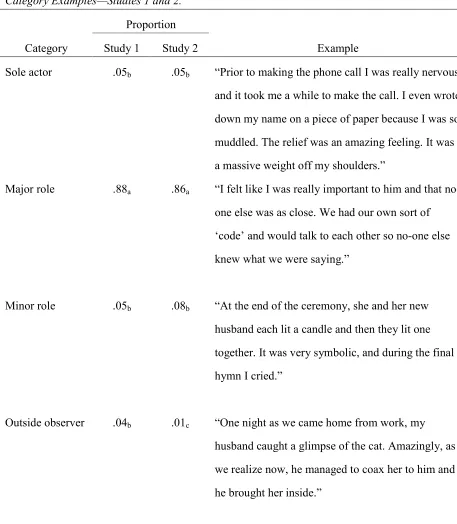
Salience of the self. Table 1 lists the 4 categories used to code salience of the self, the proportion of narratives coded into each category, and a brief example for each category. Paired comparisons (Table 1) revealed that the self figured more frequently in a “major role” than in any of the three other roles (i.e., “sole actor,” “minor role,” or “outside observer”). Frequencies for these other roles did not differ significantly. The finding that the self was a salient protagonist in almost all narratives is consistent with the idea that nostalgia is a self-relevant emotion. The finding that the self rarely figured as either an “outside observer” or as “sole actor” reinforces the idea that nostalgia has important social facets.
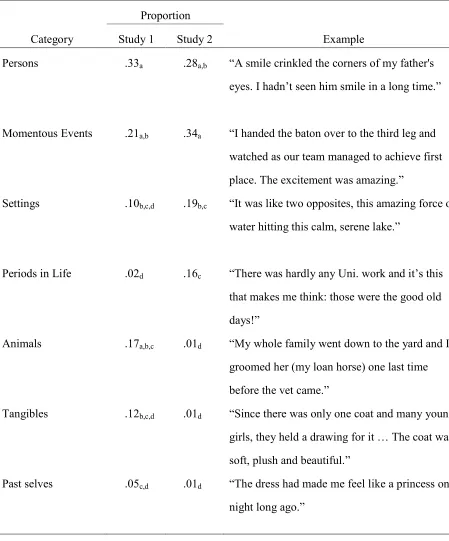
Object of nostalgia. Table 2 lists the 7 categories used to code objects of nostalgia, the proportion of narratives coded into each category, and a brief example for each category. The most common objects of nostalgia were “persons” (33%). Paired comparisons (Table 2) revealed that “persons” were more frequently the object of nostalgia than all other objects except
“momentous events” and, somewhat surprisingly, “animals.” “Momentous events” were more frequently the object of nostalgia than “past selves” and “periods in life,” and “animals” were more frequently the object of nostalgia than “periods in life” only.
Redemption versus contamination. Redemption and contamination sequences were
treated as mutually exclusive and judges made a single judgment as to whether a given narrative was characterized by a redemption sequence (i.e., negative progresses to positive), a
contamination sequence (i.e., positive progresses to negative), or neither. Table 3 presents the proportion of narratives coded into each category and a brief example for each category. Paired comparisons (Table 3) revealed that redemption sequences (67%) were significantly more prevalent than contamination sequences (29%).
feelings (“attentive,” “interested,” “alert,” “nervous,” “jittery”) were omitted from our final analysis, because they proved difficult to code reliably. The average Spearman-Brown corrected inter-rater correlation across the final 15 feelings was .68 (range = .35—.95). We created
composite measures of positive (α = .81) and negative (α = .84) affect by first averaging across judges and then averaging across positive and negative feelings, respectively. A paired
comparison indicated that the narratives were richer in expressions of positive (M = 3.12) than negative (M = 1.25) affect, F(1, 41) = 147.62, p < .001.
Discussion
This initial study of nostalgia paints a picture of a positively toned and self-relevant emotion that is often associated with the recall of experiences involving interactions with important others or of momentous life events. Although most narratives contained negative as well as positive elements, these elements were often juxtaposed so as to form a redemption sequence—a narrative pattern that progresses from a negative to a positive or triumphant life scene. This finding may explain why, despite the descriptions of disappointments and losses that they contained, the overall affective signature of the nostalgic narratives was predominantly— albeit not purely—positive. Shakespeare (1609/1996) captured sublimely this intricate pattern of relationships between nostalgia, redemption, and affect in his Sonnet #30:
When to the sessions of sweet silent thought I summon up remembrance of things past, I sigh the lack of many a thing I sought,
And with old woes new wail my dear time's waste; …
But if the while I think on thee, dear friend, All losses are restor’d and sorrows end. (p. 47)
Study 2
(1) We used a sample that differed from the Study 1 sample is several respects. Whereas the Study 1 sample consisted of US nationals who submitted their narratives to the periodical
Nostalgia, the Study 2 sample consisted of British nationals whose narratives were solicited. Furthermore, whereas in Study 1 we used a community sample characterized by a wide age range, in Study 2 we used an undergraduate sample characterized by a much narrower age range. The use of such diverse samples allows us to assess the generality of our findings. (2) We gave participants more detailed instructions. Whereas authors in Study 1 were instructed to write about “true personal experience,” Study 2 participants were asked specifically to write about a nostalgic experience, thus sharpening the focus of our inquiry. Furthermore, in Study 2 we asked participants to write specifically about the feelings they experienced due to remembering the nostalgic event. This allowed us to examine more directly than in Study 1 the affective signature of nostalgia. (3) We used multiple converging methodologies. Whereas Study 1 relied
exclusively on content analysis, in Study 2 we also administered a series of self-report measures which were intended to supplement the content analysis.
The second objective of Study 2 was to assess the frequency with which nostalgia is typically experienced. Is nostalgia an esoteric experience or is it something that most persons experience on a regular basis? Although Boym (2002) argues, in her recent literary and cultural treatise of nostalgia, that it is an emotion experienced by almost all adults, there is little empirical evidence to speak to this claim.
The third objective of Study 2 was to conduct a preliminary investigation of the triggers and functions of nostalgia. We therefore solicited participants’ descriptions of circumstances that evoke nostalgia and of nostalgia’s desirable and undesirable features.
Method
Participants and Procedure
partitions and completed the materials anonymously at their own pace. Debriefing concluded the testing session.
Materials
Nostalgic narrative. Materials were presented in a single printed booklet. Instructions on the cover sheet read as follows:
Please think of a past event in your life that has personal meaning for you. This should be an event that you think about in a nostalgic way. Specifically, please try to think of an important part of your past (e.g., event or episode) that makes you feel most nostalgic. Please bring this nostalgic experience to mind and think it through. Take a few minutes to think about your nostalgic experience.
Participants were instructed to write about the nostalgic experience “in all its vivid detail” and were encouraged to “be as detailed, thorough, and descriptive” as possible. The narratives were coded by the same two judges and using the same coding scheme as in Study 1.
Affective signature of nostalgia. After completing the narratives, written instructions prompted participants to “articulate as well as you can the emotions and feelings that you are experiencing right now, due to remembering this nostalgic experience.” Once participants completed the description of their emotions and feelings, they were asked to complete the PANAS. Participants were instructed to indicate how they felt as a result of having remembered the nostalgic experience by rating the PANAS items on a 5-point scale (1 = not at all, 5 =
extremely).
Triggers of nostalgia. On the next page of the booklet, participants received written instructions prompting them to give a detailed description of the circumstances that trigger nostalgia. Development of coding categories was aided by descriptions of triggers collected in a pilot sample (N = 18). These coding categories will be described in the Results section together with the findings.
order). After completing this task, participants were instructed to review their lists and rate the desirability of each feature on a 7-point scale (-3 = not at all desirable, 3 = extremely desirable).
Frequency of nostalgia. Finally, participants indicated how often they brought to mind
nostalgic experiences by checking one of the following 7 options: “at least once a day”; “three to four times a week”; “approximately twice a week”; “approximately once a week”; “once or twice a month”; “once every couple of months”; and “once or twice a year.”
Results
Given that there were no significant gender differences on any of the dependent measures, we omitted this variable from the analyses reported below. Inter-rater reliability, as assessed by Cohen’s kappa, ranged from .75—.82. Judges resolved remaining disagreements through discussion.
Content of Nostalgic Experience
Salience of the self. To facilitate a comparison with Study 1 findings, results for coded salience of the self are presented in the right-most column of Table 1. As in Study 1, the self was a central character in almost all narratives and was rarely isolated (i.e., figured as “sole actor” or “outside observer”). Paired comparisons (Table 1) revealed that the self figured more frequently in a “major role” than in any of the three other roles (i.e., “sole actor,” “minor role,” or “outside observer”). The self figured less frequently as “outside observer” than in a “minor role” or as “sole actor.”
Redemption versus contamination. Results pertaining to the prevalence of redemption and contamination sequences are presented in the right-most column of Table 3. As in Study 1, redemption sequences (76%) were significantly more prevalent than contamination sequences (15%).
Affective signature: Coded affect. After participants completed the narrative, they were instructed to describe how writing about the nostalgic experience made them feel. Judges rated the extent to which participants expressed the 20 PANAS feelings (1 = not at all, 5 = extremely). The average Spearman-Brown corrected inter-rater correlation was .87 (range = .47-.97). We created composite measures of coded positive (α = .86) and negative (α = .82) affect by first averaging across judges and then averaging across the positive and negative feelings,
respectively. Participants expressed significantly more positive (M = 2.37) than negative (M = 1.37) affect, F(1, 171) = 196.56, p < .001.
Affective signature: Self-reported affect. After participants described how writing about the nostalgic event made them feel, they completed the 20-item PANAS. Reliability alphas for self-report measures of positive and negative affect were .89 and .85, respectively. Participants reported more positive (M = 3.06) than negative (M = 1.53) affect, F(1, 171) = 294.61, p < .001. Scale means suggest that, although positive affect exceeds negative affect by a wide margin, nostalgia gives rise to gentle contentment rather than exuberant exaltation. This corroborates the results for coded affect described above and obtained in Study 1.1
Ambivalence. We drew on the attitude-ambivalence literature (see Eagly & Chaiken, 1993, for a review) to assess the degree to which participants reported ambivalent affect after completing the nostalgic narrative. We calculated ambivalence based on the self-report measures because we believe these provide the most direct reading of participants’ affective responses. Following Kaplan (1972), ambivalence was defined as
A = PA + NA - |PA - NA|.
0 indicating the absence of ambivalence. The mean for A was 0.90 (SD = 0.94), indicating that nostalgia evoked only mild affective ambivalence. In light of these findings, Werman’s (1977) characterization of nostalgia as “a joy tinged with sadness” (p. 393) seems particularly fitting.2
Frequency of Nostalgia
Sixteen percent of participants indicated that they experienced nostalgia “at least once a day”; 26% that they experienced nostalgia “three or four times a week” (mode); 19% that they experienced it “approximately twice a week” (median); and 18% that they experienced it “approximately once a week”. Thus, 79% of participants indicated that they experienced nostalgia once a week or more. A further 17% of participants indicated that they experienced nostalgia “once or twice a month” and only 4% indicated that they experienced nostalgia less frequently than that (2% each for “once every couple of months” and “once or twice a year”). For the vast majority of participants, then, nostalgia is a common experience.
Triggers of Nostalgia: Preliminary Findings
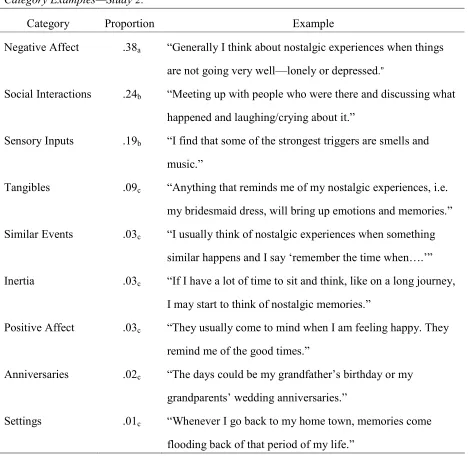
Participants provided detailed descriptions of the circumstances under which they wax nostalgic. The coding categories, a brief description of the categories, and the proportion of descriptions coded into each category are presented in Table 4. The most common trigger of nostalgia was negative affect (38%). Paired comparisons (Table 4) revealed that negative affect was reported more frequently than any other trigger of nostalgia. Two other common triggers— sensory inputs and social interaction—did not differ significantly from each other but were both significantly more prevalent than all less common triggers.
Given the relative prominence of negative affect as a trigger of nostalgia, we examined more closely descriptions coded into this category. We made a distinction between discrete negative affective states (e.g., “lonely,” “scared”) and generalized affective states often referred to as negative mood (e.g., “sad,” “depressed”). In contrast to more discrete affective states, which “arise from appraisals of specific actual or contemplated states of the world”
Some participants mentioned both discrete and generalized negative affective states (e.g., “If I ever feel lonely or sad, I tend to think of my friends or family who I haven’t seen for a long time”), therefore the two categories were not treated as being mutually exclusive. Of those who listed negative affect as a trigger of nostalgia, 78% referred to negative mood and 58% referred to discrete negative affective states. Within the latter category, 59% of participants referred to loneliness, making it by far the most frequently mentioned discrete affective state.
Functions of Nostalgia: Preliminary Findings
Participants listed as many desirable and undesirable features of nostalgia as possible and then rated the desirability or undesirability of each feature. Participants listed significantly more desirable (M = 5.60) than undesirable (M = 4.16) features, F(1, 171) = 34.33, p < .001. To compare the rated desirability of the desirable features to the rated undesirability of the undesirable features, we folded the desirability scale by reversing the sign of negative ratings (e.g., -3 became +3). Desirable features were rated as being more desirable (M = 2.46) than undesirable features were rated as being undesirable (M = 2.02), F(1, 156) = 59.91, p < .001.3 Thus, not only did participants list more desirable than undesirable features, but the desirable features were also regarded as being of greater consequence.
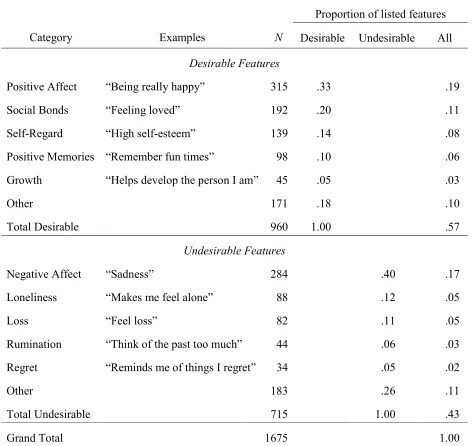
Next, we examined which desirable and undesirable features of nostalgia were mentioned most frequently. A research assistant transcribed all 1675 features listed and then sorted
and “self-regard.” Sixty-seven percent of all desirable features were captured by these broad categories. Additional desirable features of nostalgia related to its perceived capacity to conserve positive memories and to promote personal growth.
Although participants listed fewer undesirable than desirable features of nostalgia, almost all participants (95%) could think of at least one undesirable feature. Most prominent by far was “negative affect.” Furthermore, the number of desirable and undesirable features listed were positively correlated, r(172) = .27, p < .01. These findings suggest that, rather than evaluating nostalgia in predominantly positive or negative terms, participants showed considerable nuance—acknowledging simultaneously desirable and undesirable features of nostalgia. They also underscore a vital point: nostalgia, despite its predominantly positive affective signature, is not a purely hedonic experience.
Discussion
Study 2 findings corroborated the preliminary description of nostalgia that emerged from Study 1. In both studies, nostalgia was associated with memories in which the self figured prominently and that typically related to interactions with important others or to momentous events. Nostalgic narratives often contained descriptions of disappointments and losses but, in the vast majority of cases, these negative life scenes were redeemed or mitigated by subsequent successes or triumphs over adversity. And although nostalgic narratives did not always tell happy stories (Table 3), they evoked considerably more positive than negative affect, with little trace of ambivalence. This between-study consistency is particularly noteworthy bearing in mind that (1) the two studies used samples that differed in terms of nationality, age range, and recruitment method; (2) participants in Study 2 but not those in Study 1 were requested explicitly to write about nostalgic experiences; and (3) results for self-report measures of affect collected in Study 2 converged with results from the content analysis of narratives in both studies.
three or four times a week. These findings show that nostalgia is not an esoteric phenomenon but, rather, a strand in the fabric of everyday life.
Study 2 also provided insight into the triggers of nostalgia. Chief among these was negative affect. The high frequency with which this trigger was listed is consistent with Davis’s (1979) notion that nostalgia “occurs in the context of present fears, discontents, anxieties, and uncertainties” (p. 34) and suggests that participants may retrieve nostalgic memories in an attempt to counteract negative affect. Consistent with the latter idea, Josephson, Singer, and Salovey (1996) found that participants in a sad-mood condition who retrieved positive autobiographical memories frequently described this as an attempt at mood repair. Other common triggers were social interaction (e.g., conversations with friends) and sensory input (e.g., smells). The role of social interaction underscores the interpersonal aspects of nostalgia. Not only are important others often the object of nostalgia, frequently they are also a trigger of nostalgia. In the words of one astute participant, nostalgia often arises from “being in the presence of the people concerned.” Such social sharing of nostalgic episodes may help to maintain their accessibility (Walker, Skowronski, & Thompson, 2003). In addition, the role of sensory input is consistent with findings that tastes and odors can trigger vivid, affect-laden memories (i.e. the “Proust phenomenon”; Chu & Downes, 2000).
Finally, Study 2 offered initial insights into the functions of nostalgia. Chief among the perceived benefits of nostalgia were its capacity to generate positive affect, bolster social bonds, and increase positive self regard.
Studies 3 and 4: Triggers of Nostalgia
Although there exists, to the best of our knowledge, no research on the link between negative affect and nostalgia, a sizeable literature on the link between affect and self-relevant cognitions has emerged. This literature generally supports the idea that negative affect is associated with negative self-relevant cognitions, including the retrieval of negative
autobiographical memories (i.e., mood congruency; for reviews, see: Sedikides, 1992; Sedikides & Green, 2001; Rusting, 1998). There is, however, some evidence to suggest that negative affect can also increase the retrieval and accessibility of positive autobiographical memories under certain circumstances (i.e., mood incongruency).
Research documenting a link between negative affect and retrieval of positive
autobiographical memories has typically involved asking participants to write brief accounts of events that happened when they were in high school. The dependent variable in these studies was the valence (positive vs. negative) of the autobiographical narratives as rated by participants, independent judges, or both. Results indicated that negative affect can increase retrieval of positive autobiographical memories but only when self-esteem is high (Smith & Petty, 1995), when persons acknowledge rather than attempt to repress the negative affect (McFarland & Buehler, 1997), when persons are unaware of the relevance of their moods to the experiment (Parrott & Sabini, 1990), or when persons both believe that they will be successful in their efforts to regulate negative moods and engage in positive reappraisal of the mood-inducing event
(Rusting & DeHart, 2000). Research documenting a link between negative affect and accessibility of positive autobiographical narratives has involved cued recall tasks. Memory accessibility was operationalized as the time elapsed between cue (e.g., “a time in your life when you were particularly happy”) and recall of the event. Results revealed that negative affect can increase the accessibility of positive autobiographical memories but only for persons who are inclined to repress rather than acknowledge negative affect (Boden & Baumeister, 1997), or for non-dysphoric persons (Joormann & Siemer, 2004).
negative affect. Still, there are also some important distinctions. Past research has focused almost exclusively on the valence of autobiographical memories. Findings from Studies 1 and 2
indicate, however, that it would be an oversimplification to regard nostalgic memories as either entirely positive or negative. Nostalgic narratives often contained both negative and positive ingredients (usually in that order; see the redemption vs. contamination findings of Studies 1 and 2). Furthermore, although Study 2 participants listed more desirable than undesirable features of nostalgia, almost all participants could think of some undesirable features.
Another important distinction is that previous research was concerned with
autobiographical memory for a narrowly delineated period of life (e.g., one’s high-school years) or domain of skills (e.g., social skills). We recognize that, when research is concerned with the valence of autobiographical memory, it is reasonable to define clearly a specific period of life to which the autobiographical memory should pertain to facilitate between-condition comparisons and eliminate potential sources of error variance. When the focus is on nostalgia, however, this methodological practice seems unnecessarily constraining. In Studies 3 and 4, we therefore focused on the relation between negative affect and feelings of nostalgia for a broad range of aspects of one’s past.
Study 3
We found in Study 2 that a majority of participants who listed negative affect as a trigger of nostalgia described diffuse affective states often referred to as negative mood (e.g., “down,” “sad,” “depressed”). This provides one rationale for exploring first the effect of negative mood on nostalgia. There is also a strong theoretical rationale. Research has uncovered a wealth of evidence that people respond to negative mood with a wide array of mood-regulation strategies (Larsen & Prizmic, 2004). Confirmation of the postulated effect of negative mood on nostalgia would raise the interesting possibility that nostalgia can serve to counteract negative mood.
triggered by both negative and positive mood states (i.e., deviations from neutral in either direction). In this case, participants in either a negative or positive mood state should experience more nostalgia than neutral mood participants.
Method
Participants and Design
Participants were 62 female undergraduate volunteers enrolled at the University of Southampton. They were randomly assigned to either the negative, neutral, or positive mood condition.
Materials and Procedure
Participants received a booklet containing the mood manipulation and dependent measures. In the negative mood condition, they read a news story based on the tsunami that struck coastal regions in Asia and Africa in December, 2004. In the neutral mood condition, participants read a news story based on the January, 2005 landing of the Huygens probe on Titan, one of Saturn’s moons. In the positive mood condition, participants read a news story based on the November, 2004 birth of a polar bear in the Detroit Zoo (we substituted “London Zoo” for “Detroit Zoo”). Participants in all conditions were then instructed to write down 3 to 5 keywords that captured their “emotional response to this event” and to think about how the event made them feel. After approximately 2 minutes, participants then proceeded to complete measures of positive and negative affect, and of nostalgia.
Manipulation check. The manipulation check comprised 12 items, 6 each to assess
positive (e.g., “happy,” “content”) and negative (e.g., “sad,” “depressed”) affect. The items were rated on a 5-point scale (1 = not at all, 5 = very much). Reliability alphas were .96 and .94 for measures of positive and negative affect, respectively.
Nostalgia. We administered two measures of nostalgia. Participants first completed
did,” “my childhood toys,” “the way people were,” “feelings I had,” “my school,” “having someone to depend on,” “holidays I went on,” “the way society was,” my pets,” “not knowing sad or evil things,” “past TV shows, movies,” and “my family house.” 5 Batcho (1995, 1998) provided preliminary evidence for the validity of the NI. Nonetheless, we were concerned that certain properties of the NI could bias our findings. For instance, by instructing participants to rate the extent to which they “miss” aspects of their past, the NI focuses attention on just a single facet of what we consider to be a multifaceted emotion. For this reason, we constructed an additional measure of nostalgia comprising 3 items that were rated on a 6-point scale (1=
strongly disagree, 6 = strongly agree). The items were: “Right now, I am feeling quite
nostalgic,” “Right now, I am having nostalgic thoughts,” and “I feel nostalgic at the moment” (α = .95). The use of convergent operations of nostalgia can provide valuable information regarding the construct validity of our measures.
Results
Manipulation Check
The mood manipulation was successful. There was a significant effect for the mood manipulation on negative affect, F(2, 59) = 76.95, p < .001. Relevant means are presented in Table 6. Post-hoc tests (Tukey’s HSD) revealed that participants in the negative mood condition experienced significantly more negative affect than those in the neutral and positive mood conditions. The neutral and positive mood conditions did not differ significantly.6 There was also a significant effect for the mood manipulation on positive affect, F(2, 59) = 35.40, p < .001.
Nostalgia
There was a significant effect for the mood manipulation on the average NI score, F(2, 57) = 12.53, p < .001. Relevant means are presented in Table 6. Consistent with the postulated link between negative affect and nostalgia, post-hoc tests (Tukey’s HSD) revealed that
participants in the negative mood condition scored higher on the NI than those in the neutral and positive mood conditions. The neutral and positive mood conditions did not differ significantly. Although the NI forms an internally consistent measure, given the uncharted domain of this research, we wanted to explore the mood effect in greater detail. We therefore tested for each NI item a contrast between the negative mood condition and the neutral and positive mood conditions pooled. Fourteen out of 18 comparisons revealed higher ratings in the negative mood condition. Of these 14 comparisons, 8 were statistically significant (alpha = .05/18 = .0028). Negative mood increased significantly the ratings of the following items: “my family,”
“someone I loved,” “my friends,” “the way people were,” “having someone to depend on,” “my family house,” “the way society was,” and “things I did.” These item-level results should be interpreted with caution, but they do suggest that negative mood increased in particular feelings of nostalgia associated with social aspects of participants’ past.
Analysis of the second measure of nostalgia also revealed a significant effect for the mood manipulation, F(2, 59) = 7.23, p < .01.In agreement with NI results, post-hoc tests revealed that participants in the negative mood condition felt significantly more nostalgic than those in the neutral and positive mood conditions (Table 6). The neutral and positive mood conditions did not differ significantly. Evidence for the convergent validity of the two nostalgia measures was provided by their average within-cell correlation, which was substantial, r(62) = .55, p < .001.
Discussion
negative mood states, there was no significant difference between the neutral and positive mood condition on either nostalgia measure. These findings lend credence to the descriptions of triggers provided by participants in Study 2 and raise the interesting possibility that nostalgia serves to counteract negative mood.
There are, however, at least two limitations to the present study. First, we think it is important to look beyond global negative mood and focus on the role of discrete affective states to achieve a more detailed understanding of the link between negative affect and nostalgia. On this point, we find ourselves in agreement with other investigators who have emphasized the unique influences of discrete affective states on outcomes such as persuasion (Tiedens & Linton, 2001), intergroup hostility (Mackie, Devos, & Smith, 2000), and stereotyping (Bodenhausen et al., 1994). Second, our mood manipulation may have produced variation not only in mood but also in participants’ thoughts and motivations (Forgas & Ciarrochi, 2002). Such threats to construct validity are particularly relevant when, as in the present study, a novel rather than well-established manipulation is used. To corroborate the preliminary evidence for a causal link between negative affect and nostalgia, it is therefore desirable to use an alternative manipulation in a related experiment. We seek to address these two issues in Study 4.
Study 4
information. Confirmation of the postulated effect of loneliness on nostalgia would raise the interesting possibility that nostalgia can serve to redress deficiencies in belongingness.
The second objective of Study 4 was to provide a conceptual replication of Study 3 using an alternative manipulation of negative affect. Thus, we manipulated loneliness by offering participants false feedback from a personality test that allegedly assessed their level of loneliness.
Method
Participants and Design
Participants were 43 University of Southampton undergraduate students (40 females; 3 males) who received course credit. They were randomly assigned to one of two conditions (high vs. low loneliness).
Materials and Procedure
Experimental session ranged in size from 1—10 persons. Participants completed, first, a questionnaire labeled “Southampton Loneliness Scale.” Participants indicated whether they agreed or disagreed with each of 15 statements drawn from the UCLA Loneliness Scale (Russell, Peplau, & Cutrona, 1980). Statements administered to participants in the high loneliness
condition were phrased so as to elicit agreement. This was achieved by prefacing each statement with the words “I sometimes,” as in “I sometimes feel isolated from others.” Statements
administered to participants in the low loneliness condition were phrased so as to elicit
The University of Southampton Loneliness scale has been administered to a large number of University students over the last five years. Based on the responses of over twelve hundred students, we have developed a way of scoring your answers. This allows us to provide you with valid and detailed feedback regarding your level of loneliness.
Participants in the high loneliness condition were informed that they were in the 62nd percentile of the loneliness distribution and that, compared to other University of Southampton students, they were therefore “above average on loneliness.” Participants in the low loneliness condition were informed that they were in the 12th percentile of the loneliness distribution and that,
compared to other University of Southampton students, they were “very low on loneliness.” Next we asked participants to explain their loneliness score on a separate sheet of paper. This
instruction was aimed at strengthening the loneliness manipulation.
Next, participants completed the manipulation check and a measure of nostalgia. The manipulation check consisted of three items (α = .91) designed to assess state loneliness (e.g., “Right now, I feel a bit lonely”). The items were rated on a 5-point scale (1 = strongly disagree; 5 = strongly agree). Nostalgia was measured with the 18-item NI (α = .83).
Results and Discussion
Manipulation Check
As intended, participants in the high-loneliness condition (M = 2.90) reported higher levels of loneliness than those in the low-loneliness condition (M = 1.28), F(1, 41) = 54.91, p < .001.
Nostalgia
Consistent with a causal effect of loneliness on nostalgia, the average rating across all NI items was higher in the high-loneliness (M = 3.01) than in the low-loneliness (M = 2.56)
significant. High loneliness increased significantly the ratings of the following items: “my family,” “the way people were,” “having someone to depend on,” and “not having to worry.”
Replicating conceptually Study 3, the present findings provide further corroborating evidence for a causal link between negative affect and nostalgia. These findings extend Study 3 findings in two important ways. First, whereas before we focused on the link between global negative mood and nostalgia, we now provide evidence for a link between a discrete negative affective state—loneliness—and nostalgia. This constitutes a critical first step beyond a singular focus on global negative mood and toward a more differentiated understanding of the discrete affective antecedents of nostalgia. Second, whereas before we manipulated negative mood by presenting participants with one of two factually-based news stories, in the present study we manipulated loneliness by providing participants with false feedback from a personality test. The use of such different yet converging manipulations in related studies is crucial, because it
contributes toward establishing the construct validity of said studies.
Why might negative mood and loneliness elicit feelings of nostalgia? Studies 3 and 4 raised the interesting possibility that nostalgia may serve to counteract negative mood and loneliness. They did not, however, test these ideas directly. In Studies 5—7, we made the functional utility of nostalgia the central focus of our investigation.
Studies 5, 6, and 7: Functions of Nostalgia
In the search for functions of nostalgia, Study 2 provides valuable leads. Recall that participants in this study listed as many desirable and undesirable features of nostalgia as they could. Most desirable features of nostalgia referred to its perceived capacity to generate positive affect, increase positive self-regard, and bolster social bonds. It is these functional aspects of nostalgia that constitute the focus of Studies 5, 6, and 7. We do not mean to suggest that this set of functions exhausts all possibilities or that other possible functions of nostalgia are
Social Bonds
Individuals have a fundamental need to belong (Baumeister & Leary, 1995). This is illustrated, for instance, by findings that persons form social bonds with relative ease (Festinger, Schachter, & Back, 1950) and are reluctant to break social bonds (Vaughan, 1986). However, life transitions (e.g., graduating from college, finding new employment) inevitably lead to changes in social settings. The deterioration or even dissolution of valued social bonds that often accompanies such transitions can make people feel adrift and isolated (Colson, 1971). In
addition, social bonds can be threatened by more momentary interpersonal rejections (Williams, 1997). We propose that by re-igniting meaningful relationships nostalgia bolsters social bonds and renders accessible positive relational knowledge structures (i.e., working models of self and others in the context of relationships; Baldwin, Keelan, Fehr, Enns, & Koh-Rangarajoo, 1996). In nostalgic reverie, “… the mind is ‘peopled’” (Hertz, 1990, p. 195). Important figures from one’s past are brought to life and become part of one’s present (Cavanaugh, 1989). As such, nostalgia may even play a role in coping with bereavement (Mills & Coleman, 1994).
Self-Regard
People are motivated to establish and maintain a positive self-concept (Sedikides, Gaertner, & Toguchi, 2003; Sedikides & Strube, 1997). We propose that nostalgia offers a way to protect and increase self-regard by affirming valued aspects of the self that “reinforce one’s overall self-adequacy” (Steele, Spencer, & Lynch 1993, p. 885). Nostalgia can bestow “an endearing luster” on the self and cast “marginal, fugitive, and eccentric facets of earlier selves in a positive light” (Davis, 1979, pp. 41-46). Furthermore, nostalgic reverie can serve to affirm one’s positive qualities as a friend, family member, or member of other important groups (Kleiner, 1977).
Positive Affect
Taylor, 1997), and gives rise to thought patterns that are flexible, creative, integrative, and efficient (Isen, 2004). We propose that nostalgia serves as a store of positive affect. Kaplan (1987) characterized nostalgia as a “joyous” experience that gives rise to “an expansive state of mind” and “a feeling of elation” (p. 465). Similarly positive characterizations have been offered by Batcho (1995, 1998), Chaplin (2000), Davis (1977, 1979), Gabriel (1993), and Holak and Havlena (1998). The findings of Studies 1 and 2 further attest to the predominantly positive affective tone of nostalgia.
Study 5
Study 5 is a preliminary investigation of three functions of nostalgia. Participants were instructed to think about either a nostalgic or ordinary event from their past and then completed brief 2-item measures of social bonding, self-regard, and positive and negative affect. Items were drawn from representative desirable and undesirable features of nostalgia listed by Study 2 participants (Table 5). Negative affect was assessed because Study 2 identified it as the most undesirable feature of nostalgia. This suggests the possibility that nostalgia increases both positive and negative affect.
Method
Participants and Design
Participants were 52 University of Southampton undergraduate volunteers (45 females; 7 males). They were randomly assigned to one of two conditions (nostalgia vs. control).
Materials and Procedure
feel. Subsequently, they completed the manipulation check and the remaining dependent measures.
Manipulation check. Participants rated on a 6-point scale (1 = strongly disagree; 6 =
strongly agree) 2 items designed as a check on the nostalgia manipulation. The items were:
“Right now, I am feeling quite nostalgic” and “Right now, I’m having nostalgic feelings” (α = .96).
Functions. Participants rated on a 5-point scale (1 = not at all; 5 = extremely) the extent to which thinking about the nostalgic or ordinary event made them feel “loved,” and “protected” (to measure social bonding); “significant,” and “high esteem” (to measure positive self-regard); “happy,” and “content” (to measure positive affect); and “sad” and “blue” (to measure negative affect). All reliability alphas exceeded .75.
Results
Manipulation Check
Analysis of the manipulation check revealed that, as intended, participants in the
nostalgia condition (M = 4.52) felt more nostalgic than those in the control condition (M = 2.81),
F(1, 50) = 21.69, p < .001.
Functions
Relative to participants in the control condition, those in the nostalgia condition scored higher on measures of social bonding (M = 3.79 vs. 2.65), F(1, 50) = 12.88, p < .001, positive self-regard (M = 3.81 vs. 2.81), F(1, 50) = 15.63, p < .001, and positive affect (M = 4.21 vs. 3.27), F(1, 50) = 8.05, p < .01. These results provide evidence for the three postulated functions of nostalgia. There was no significant difference between the nostalgia (M = 1.58) and control (M = 1.37) conditions for negative affect, F(1, 50) = 0.79, p < .38. The latter result is important in light of the Study 2 finding that participants considered negative affect to be the most
Discussion
These findings advance in two important ways our understanding of nostalgia and its functions. First, they demonstrate the feasibility of manipulating in-the-moment feelings of nostalgia. Second, they provide vital preliminary support for the idea that nostalgia bolsters social bonds, increases self-regard, and generates positive affect.
There are, however, at least two limitations to the present study. The first limitation concerns the construct validity of our brief, 2-item measures. Although confirmation of the predicted nostalgia effects on measures of social bonding, self-regard, and positive affect can be regarded as evidence for the construct validity of said measures (Cronbach & Meehl, 1955), it is desirable to replicate these results with well-established and validated measures of the focal outcome variables. This was the first objective of Study 6.
The second limitation concerns the manipulation of nostalgia. It is likely that this single manipulation underrepresented or failed to capture entirely the experience of nostalgia. For instance, the instruction to think for “a few moments” about the nostalgic (or ordinary)
experience may not have elicited the deeper reflection that can accompany feelings of nostalgia. Furthermore, we did not provide participants with a definition of nostalgia. The reason for not doing so was that we did not want to constrain or steer participants’ personal conceptualizations of nostalgia. It is, however, important to rule out the possibility that the present findings stem from an idiosyncratic conceptualization of nostalgia specific to our sample. The second objective of Study 6, then, was to use instructions that were designed to immerse participants more deeply in the nostalgic experience and included a dictionary definition of nostalgia. This use of
alternative instructions in related experiments allows us to establish the generalizability of our findings across procedures. This is particularly important when, as in the present case, there is no established body of research to inform our experimental manipulations.
Study 6
Method
Participants were 54 University of Southampton undergraduates (46 females, 8 males) who received course credit. They were randomly assigned to one of two conditions (nostalgia vs. control).
Materials and Procedure
On arrival at the laboratory, participants were seated in separate cubicles. In the nostalgia condition, participants received the following instructions:
According to the Oxford Dictionary, ‘nostalgia’ is defined as a ‘sentimental longing for the past.’ Please think of a nostalgic event in your life—a nostalgic event that has personal meaning for you. Specifically, try to think of a past event that makes you feel most nostalgic. Bring this experience to mind. Immerse yourself in the nostalgic experience. How does it make you feel? Then, write about this experience in the space below. Describe the experience and how it makes you feel nostalgic.
In the control condition, instructions read:
Please think of an ordinary event in your life that took place in the last week. Try to bring this event to mind and think it through as though you were an observer of the event, rather than directly involved. Imagine the event as though you were an historian
recording factual details (e.g., I got on the number 37 bus). Then, please write about this everyday event in the space below. Write a purely factual and detailed account (e.g., like in a court of law, avoiding emotionally expressive words).
Participants were given 6 minutes to complete their narratives. They then responded to a manipulation check (identical to Study 5; α = .86) and filled out validated measures of social bonding, positive self-regard, and positive and negative affect.
Social bonding. We administered the Revised Experiences in Close Relationships Scale
consisted of 18 items that were rated on a 7-point scale (1 = “strongly disagree”; 7 = “strongly agree”).
Positiveself-regard. We administered the Rosenberg Self-Esteem Scale (RSE;
Rosenberg, 1965) to measure self-regard (α = .88). Items were rated on a 6-point scale (1 =
strong disagreement; 6 = strong agreement).
Positive and negative affect. We administered the 20-item version of the PANAS to
measure positive (α = .88) and negative affect (α = .82). Items were rated on a 5-point scale (1 =
not at all; 5 = extremely).
Results
Manipulation Check
The manipulation check revealed that, as intended, participants in the nostalgia condition (M = 4.80) felt more nostalgic than those in the control condition (M = 2.92), F(1, 52) = 65.21, p
< .001.
Functions
Results revealed a successful conceptual replication of Study 5 findings. Consistent with the postulated capacity of nostalgia to bolster social bonds and render accessible positive
relational knowledge structures, participants in the nostalgia condition evinced a more secure attachment style than those in the control condition. Relative to controls, participants in the nostalgia condition reported lower levels of attachment anxiety (M = 2.40 vs. 2.90), F(1, 52) = 4.34, p < .05, and lower levels of attachment avoidance (M = 2.35 vs. 2.87), F(1, 52) = 3.14, p < .08.
Consistent with the postulated capacity of nostalgia to increase self-regard, participants in the nostalgia condition (M = 5.08) reported significantly higher self-esteem than those in the control condition (M = 4.62), F(1, 52) = 5.71, p < .05.
Consistent with the postulated capacity of nostalgia to generate positive affect,
and control condition (M = 1.37) did not differ significantly on negative affect, F(1, 52) = 1.32, p
< .26.
Discussion
By demonstrating that Study 5 results generalize across different measures and
manipulations, the present findings offer vital reinforcement for the idea that nostalgia bolsters social bonds, increases self-regard, and generates positive affect. There is, however, at least one remaining issue that should be addressed. This relates to the evenness with which the ECR-R, the RSE, and the PANAS assess the postulated functions of social bonding, self-regard, and positive affect, respectively.
In particular, we were concerned that the ECR-R, because it relates exclusively to interactions with romantic partners, may not have captured strength of social bonds to the same extent as the RSE captured self-regard or the PANAS captured positive (and negative) affect. To address this issue, Study 7 investigated the effect of nostalgia on three domains of interpersonal competence in everyday social interactions. If nostalgia bolsters social bonds and renders accessible positive relational knowledge structures, it should increase people’s perceived ability to form, maintain, and develop successfully not only romantic relationships but interpersonal relationships in general. A secondary objective of Study 7 was to provide a strong test of gender differences. With the exception of Study 1, the high female-to-male ratio in our participant pool (≈ 8:1) was reflected in our samples, rendering tests of gender differences either meaningless or underpowered. In Study 7, we succeeded in recruiting approximately equal numbers of female and male participants through campus-wide advertisements.
Study 7
Method
Participants and Design
Procedure and Materials
Participants received a booklet containing instructions relevant to the manipulation of nostalgia, a manipulation check, and an assessment of three domains of interpersonal
competence. The manipulation of nostalgia was identical to the manipulation used in Study 5. The manipulation check was identical to the one used in the two preceding studies (α = .96).
Interpersonal competence. We administered the Initiation, Disclosure, and Emotional
Support subscales from the Interpersonal Competence Questionnaire (ICQ; Buhrmeister, Furman, Wittenberg, & Reis, 1988) to assess perceived competence in, respectively, initiating interactions and relationships (“Going to parties or gatherings where you don’t know people well in order to start up new relationships”), self-disclosing personal information (“Telling a close companion how much you appreciate and care for him or her”), and providing emotional support to others (e.g., “Helping a close companion get to the heart of a problem he or she is
experiencing”). These three domains of interpersonal competence were assessed with 8 items each (alphas > .92). Ratings were made on a 5-point scale (1 = disagree; 5 = agree).
Results and Discussion
Initial analyses revealed no significant or marginal effects involving gender. Therefore gender was not included as independent variable in the final analyses reported below.
Denominator degrees of freedom vary due to missing values.
Manipulation Check
As intended, participants in the nostalgia condition (M = 3.90) felt more nostalgic than those in the control condition (M = 2.79), F(1, 118) = 19.39, p < .001.
Interpersonal Competence
corroborating evidence for the idea that nostalgia bolsters social bonds and, importantly, show that this effect generalizes beyond the realm of romantic relationships and across gender.
General Discussion
Although the term “nostalgia” was not coined until the late 17th century (Hofer,
1688/1934), references to its meaning can be traced back as far as the writings of Shakespeare, Caesar, Hippocrates, and Homer. Indeed, it is surprising that nostalgia has long been neglected in psychological scholarship. Granted, there has been speculation, mostly from a psychodynamic perspective, about the nature of nostalgia but rarely have these ideas been tested empirically. To find our bearings in this novel territory, we sought to address three basic questions pertaining, respectively, to the content, triggers, and functions of nostalgia.
Summary of Findings
The Content Question
Furthermore, nostalgic narratives were richer in expressions of positive than negative affect (Study 1), and participants reported experiencing more positive than negative affect after recalling a nostalgic event (Study 2).
The Trigger Question
Our second basic question related to the triggers of nostalgia and was addressed directly in Studies 3 and 4. Study 3 provided strong evidence for a causal link between negative mood and nostalgia. Following a mood manipulation, participants completed two measures of
nostalgia: the NI (Batcho, 1995) and a 3-item measure designed to assess in-the-moment feelings of nostalgia. Participants in the negative mood condition scored significantly higher on both measures of nostalgia than participants in the neutral and positive mood conditions. The latter two conditions did not differ significantly on either measure. Study 4 made two additional contributions. First, it examined the role of a discrete affective state—loneliness—in order to achieve a more detailed understanding of the link between negative affect and nostalgia. The second contribution of Study 4 was that our manipulation of loneliness, which involved giving participants false feedback from a personality test, departed considerably from the mood
manipulation used in Study 3, which involved presenting participants with one of three factually-based news stories. Relative to participants in the low loneliness condition, those in the high loneliness condition scored higher on the NI. This finding constitutes a critical first step beyond a singular focus on global negative mood and toward a more differentiated understanding of the discrete affective triggers of nostalgia. Finally, the particular significance attached by
participants in both studies to social aspects of their past is consistent with, and reinforces, the earlier finding that friends, family, and loved ones are important objects of nostalgia.
The Function Question
that, relative to participants in the control condition, those in the nostalgia condition scored higher on brief measures of social bonding, positive self-regard, and positive affect. There was no significant difference between the nostalgia and control condition for negative affect. Study 6 replicated these findings with a more immerse manipulation of nostalgia and validated measures of social bonding, positive self-regard, and affect. Relative to participants in the control
condition, those in the nostalgia condition reported less attachment anxiety and avoidance, higher self-esteem, and more positive affect. As before, there was no significant difference for negative affect. Study 7 revealed that the capacity of nostalgia to bolster social bonds is not limited to the domain of romantic relationships. Relative to participants in the control condition, those in the nostalgia condition reported greater confidence in their ability to initiate interactions and relationships, disclose personal information, and provide emotional support to others.
Broader Implications
Emotions
Emotion theorists are unanimous in labeling nostalgia an emotion (Frijda, 1986; Johnson-Laird & Oatley, 1989; Kemper, 1987; Ortony, Clore, & Collins, 1988). We subscribe in
particular to Johnson-Laird and Oatley’s view that nostalgia is a happiness-related emotion (Sedikides, Wildschut, Arndt, & Routledge, 2006). To be sure, there is compelling evidence that nostalgia is in a league with other positive emotions such as love (Izard, 1977), pride (Lewis, 1993), and joy (Ellsworth & Smith, 1988). Our findings indicate that, like love, nostalgia bolsters social bonds; that, like pride, nostalgia increases positive self-regard; and that, like joy, nostalgia generates positive affect. The classification of nostalgia as a happiness-related or positive
Stone, Cox, Valdimarsdottir, Jandorf, & Neale (1987) used an experience-sampling methodology to examine the relation between daily mood and immunological changes. They found increased immunocompetence on days with high positive mood relative to days with low positive mood. Future research should harness the experience-sampling methodology to provide a window on the daily experience of nostalgia and its links to both psychological and physical well-being.
The Self
People are motivated to protect and enhance the positivity of the self-concept (Sedikides & Gregg, 2003; Sedikides & Strube, 1997). Self-protection and self-enhancement mechanisms are typically activated when circumstances or events are perceived as self-threatening (Campbell & Sedikides, 1999; Sedikides, Green, & Pinter, 2004). Prior work on compensatory self-inflation (Baumeister & Jones, 1974; Greenberg & Pyszczynski, 1985) and self-affirmation (Steele, 1988) has revealed that, when people encounter self-threats, rather than countering directly the specific threat, they have the option of eliminating its effects by affirming essential, positive aspects of the self. We propose that nostalgia constitutes a benign mechanism through which people affirm valued aspects of the self. This suggests an interesting direction for future research. Given that efforts to protect and enhance the self often have undesirable consequences, such as reduced receptivity to critical feedback (Kumashiro & Sedikides, 2005), can nostalgia be used as a resource for responding to self-threats in a more open and constructive manner? Consistent with this possibility, recent evidence indicates that nostalgia attenuates the effect of mortality
salience—a particularly potent self-threat (Pyszczynksi, Greenberg, Solomon, Arndt, & Schimel, 2004)—on death-thought accessibility (Routledge, Arndt, Sedikides, & Wildschut, 2006).
Relationships
avenue to enhancing in-the-moment attachment security. The implications are far-reaching and manifold. Attachment security is associated with a host of desirable outcomes. For instance, research has shown that momentary or primed attachment security give rise to greater compassion (Mikulincer et al., 2001) and altruism (Mikulincer, Shaver, Gillath, & Nitzberg, 2004). Can nostalgia, by virtue of its effect on attachment security, produce similar desirable outcomes?
Limitations
Before generalizing from the findings, one must keep in mind that the samples consisted predominantly of college-age, British females. The question whether age-related changes in motivation have a bearing on nostalgia presents one suitable avenue for future research. The interaction between gender and culture in shaping nostalgia is another issue that deserves careful scrutiny.
It seems plausible that British college students do not identify strongly with narrowly prescribed gender roles. Where we succeeded in recruiting sufficient male participants to perform a meaningful test of gender differences (Studies 2 and 7), no such differences were found. In cultural contexts that place a stronger emphasis on traditional gender roles, however, differences between females and males may well arise. In general, gender differences are shaped by culture (Hyde, 2003) and so it would be unwarranted to generalize our findings for gender to very different cultural settings.
Nostalgia as Compared to Other Past-Oriented Subjective States
Before closing, we should address one final issue. Johnson-Laird and Oatley (1989) assign nostalgia to the category of complex emotions, which, unlike basic emotions, arise from high-level cognitive processing and possess propositional content. This raises the question of how nostalgia differs from other processes—denoted with such words as “recall,” “recollection,” “reminiscence,” and “remembrance”—which also involve the cognitively demanding task of reconstructing the past. Davis (1977) proposed that “to merely remember the places of one’s youth is not the same as to feel nostalgia for them. Neither for that matter, does active
reminiscence—however happy, benign or tortured its content—necessarily capture the subjective state characteristic of nostalgic feeling” (p. 418). We concur, but ultimately this is an issue that should be settled empirically. Our point of departure is that nostalgia shares with other past-oriented subjective states the involvement of high-level cognitive processing but can be distinguished from them, for instance in terms of its unique affective signature and its psychological functions (Castelnuovo-Tedesco, 1980; Cavanaugh, 1989).
Conclusion