Accepted Manuscript
Effects of co-inoculation and sequential inoculation of Tetragenococcus halo-philus and Zygosaccharomyces rouxii on soy sauce fermentation
Putu Virgina Partha Devanthi, Robert Linforth, Helen Onyeaka, Konstantinos Gkatzionis
PII: S0308-8146(17)31247-5
DOI: http://dx.doi.org/10.1016/j.foodchem.2017.07.094
Reference: FOCH 21478
To appear in: Food Chemistry Received Date: 21 April 2017 Revised Date: 28 June 2017 Accepted Date: 18 July 2017
Please cite this article as: Virgina Partha Devanthi, P., Linforth, R., Onyeaka, H., Gkatzionis, K., Effects of co-inoculation and sequential co-inoculation of Tetragenococcus halophilus and Zygosaccharomyces rouxii on soy sauce fermentation, Food Chemistry (2017), doi: http://dx.doi.org/10.1016/j.foodchem.2017.07.094
Effects of co-inoculation and sequential inoculation of
Tetragenococcus halophilus
and
Zygosaccharomyces rouxii
on soy sauce fermentation
Putu Virgina Partha Devanthia, Robert Linforthb, Helen Onyeakaa, Konstantinos Gkatzionisa*
a
School of Chemical Engineering, University of Birmingham, Edgbaston, Birmingham B15
2TT United Kingdom
b
Division of Food Sciences, University of Nottingham, Sutton Bonington, Leicestershire LE12
5RD, United Kingdom
Abstract
The use of Tetragenococcus halophilus and Zygosaccharomyces rouxii as starter cultures is
essential for desirable volatiles production during moromi stage of soy sauce fermentation. In
this study, the effect of simultaneous and sequential inoculation of cultures in moromi
fermentation models, with respect to viability, physicochemical changes, and volatiles
formation (using SPME-GC/MS) was investigated. Interestingly, an antagonism was
observed as T. halophilus only proliferated (3 log increase) in the presence of Z. rouxii, while
Z. rouxii growth was suppressed by 4 log in concurrence with pH increase to 7.31. Final
content of reducing sugars, ethanol, acetic acid, and amino nitrogen did not differ
significantly (p < 0.05) between co-inoculation and sequential inoculation. However, Z.
rouxii promoted alcohols formation and produced a more complex aroma profile under
*
Corresponding author. Tel.: +441214158329
suppression. According to Principal Component Analysis (PCA), the inoculation sequence
(co-inoculation and sequential) has impacts on volatile compound profiles during moromi
fermentation.
Keywords: soy sauce, Tetragenococcus halophilus, Zygosaccharomyces rouxii, co-
1. Introduction
Soy sauce is a fermented condiment originating from China, which is popular around the
world due to its intense umami taste and distinct aroma. Two types of soy sauce can be
distinguished based on the raw materials: The Chinese-type produced using predominantly
soybeans and wheat, and the Japanese-type made using equal amounts of soybeans and wheat
(Wanakhachornkrai & Lertsiri, 2003). The Chinese-type dominates Asian regions such as
China, Indonesia, Malaysia, Philippines, Singapore, Thailand while the Japanese-type is more
popular in Japan and western countries (Zhu & Tramper, 2013).
Soy sauce production involves a 2-step fermentation process, koji and moromi. In
Japanese-type, koji is prepared by growing koji mould, such as Aspergillus oryzae, on an equal amount
of cooked soybean and wheat flour mixture, followed by moromi fermentation by mixing the
resulting koji with brine solution containing 18‒22% NaCl (Yong & Wood, 1977). Moromi
stage is mainly driven by halotolerant lactic acid bacteria (LAB) and yeast that grow
spontaneously during conventional brewing. However, in recent years, the amount of NaCl in
the final product has been reduced to approximately 8‒11%, driven by industry and the
World Health Organization (WHO) recommendation on reducing dietary intake of sodium
salt. Studies focusing on salt reduction during moromi fermentation have demonstrated that
despite a reduced salt concentration, sensory quality and safety of the final product could be
preserved with the use of either mixed culture of lactic acid bacteria and yeast (Singracha,
Niamsiri, Visessanguan, Lertsiri, & Assavanig, 2017) or mixed culture of indigenous yeast
isolated from different stages during traditional moromi fermentation (Song, Jeong, & Baik,
2015).
Moromi stage is very crucial since key volatile compounds, taste active amino acids and
(Harada et al., 2016; Zhao, Schieber, & Gänzle, 2016; Zhu & Tramper, 2013). Lactic acid
bacterium Tetragenococcus halophilus and yeast Zygosaccharomyces rouxii compose the
core microbial complex which drives the moromi fermentation, regardless of soy sauce origin
and production procedure (Harada et al., 2016; Singracha et al., 2017) and therefore the
sequence of proliferation of microbial species and their equilibria are paramount to the
quality of the final product.
There are abundant secondary metabolites produced by T. halophilus and Z. rouxii via lactic
acid and alcoholic fermentation, respectively, which are responsible for the flavour of the
final product (Lee, Lee, Choi, Hurh, & Kim, 2013; Tanaka, Watanabe, & Mogi, 2012).
Important aroma compounds in soy sauce, such as acetic acid, formic acid, benzaldehyde,
methyl acetate, ethyl 2-hydroxypropanoate, 2-hydroxy-3-methyl-2-cyclopenten-1-one, and
4-hydroxy-3-methoxybenzaldehyde are produced by T. halophilus (Lee et al., 2013). Moreover,
Z. rouxii plays an important role in the formation of ethanol, higher alcohols (isobutyl
alcohol, isoamyl alcohol, 2-phenylethanol) (Jansen, Veurink, Euverink, & Dijkhuizen, 2003;
Van Der Sluis, Tramper, & Wijffels, 2001), 4-hydroxy-2,5-dimethyl-3(2H)-furanone
(HDMF) (Hauck, Brühlmann, & Schwab, 2003; Hecquet, Sancelme, Bolte, & Demuynck,
1996), and 4-hydroxy-2(or 5)-ethyl-5(or 2)-methyl-3(2H)-furanone (HEMF) (Sasaki, 1996)
during moromi stage, which are essential for the characteristic flavour in the final product.
Studies showed that despite salt reduction, production of essential volatiles, such as ethanol,
2-methyl-1-propanol, HDMF, and maltol, was significantly higher than traditional moromi
when a combination of T. halophilus and Z. rouxii was used (Singracha et al., 2017).
Since the activity of T. halophilus and Z. rouxii contributes to the aroma profiles of soy
sauce, the utilisation of both cultures in the manufacturing process is important. T.
halophilus, Z. rouxii, and co-culture of both were reported to cause physicochemical changes
Harada et al., 2016; Lee et al., 2013). Metabolomics analysis demonstrated different aroma
profiles of moromi according to the types of microorganism added (Harada et al., 2016). T.
halophilus TS71 and Z. rouxii A22 were also reported to enhance the aroma profile of
moromi under a reduced-salt environment (Singracha et al., 2017). However, these studies
did not investigate the impact of inoculation sequence of T. halophilus and Z. rouxii.
Sequential growth of Z. rouxii occurs naturally during spontaneous fermentation of moromi
because of lactic acid and acetic acid production by T. halophilus that reduces the pH. As the
pH drops to <5.0, Z. rouxii starts to grow and begins the alcoholic fermentation (Yong &
Wood, 1976; Van Der Sluis et al., 2001b; Röling et al., 1994). The inoculation method is
important for production of desirable volatile compounds allowing full complexity to be
achieved. In this study the effect of simultaneous and sequential inoculation of Z. rouxii as
the pH drops to 5.0 was investigated for the first time in moromi models, with respect to
microbial interactions, physicochemical changes, and formation of volatile compounds.
Principal component analysis (PCA) was used to evaluate the influence of inoculum type
(single culture or mixed culture) as well as the inoculation method on the volatile compound
profile of soy sauce.
2. Materials and Methods
2.1 Materials
Soy flour, wheat flour, and sodium chloride (NaCl, extra pure) were purchased from Real
Foods (Edinburgh, UK), Gilchesters Organics (Stamfordham, UK), and Acros Organics
(Fairfield, NJ), respectively. Aspergillus oryzae 126842 was purchased from Centre for
Agriculture and Biosciences International (Wallingford, UK). Tetragenococcus halophilus
9477 and Zygosaccharomyces rouxii 1682 were purchased from National Collection of
Cultures (Norwich, UK), respectively. Microbiological growth media used were Czapex Dox
agar (CDA; Oxoid Ltd., Basingstoke, UK), brain heart infusion agar (BHI; Oxoid Ltd), de
Man, Rogosa, and Sharpe broth (MRS broth; Oxoid Ltd.), yeast malt agar (YM agar,
Sigma-Aldrich, Gillingham, Dorset, UK), yeast malt broth (YM broth, Sigma-Aldrich). Bacteria and
yeast growth were controlled using chloramphenicol (Oxoid Ltd.) and natamycin
(Sigma-Aldrich), respectively. 1-octen-3-ol (purity 98%) was purchased from Sigma Aldrich.
2.2 Culture preparation
Aspergillus oryzae was maintained on CDA at 25 °C. The spore suspension of A. oryzae was
prepared according to the method described by Chou and Ling (1998) with slight
modification. Spores were obtained by growing A. oryzae on CDA at 25 °C for 7 days. NaCl
solution (0.85%, w/v) solution containing 0.01% of Tween 80 (Sigma-Aldrich) was added
into the agar slant bottle followed by vigorous mixing to collect the spores. The number of
spores were counted using an improved Neubauer haemocytometer and adjusted to 106
spores/mL. Tetragenococcus halophilus was maintained on BHI with 10% (w/v) NaCl and
incubated at 37 C. T. halophilus was grown in MRS broth with 7% NaCl for 36 h and the
cell concentration was adjusted to a final concentration of 106 cells/mL. Zygosaccharomyces
rouxii was maintained on YM agar with 5% (w/v) NaCl and incubated at 25 C. The
inoculum was prepared by growing Z. rouxii in YM broth containing 5% (w/v) NaCl in a 30
C shaker incubator for 24 h and cell concentration was adjusted to 106 cells/mL.
2.3 Koji fermentation
Koji was prepared using the modified method of Su et al. (2005). Soy flour and wheat flour
were sterilised at 121 °C for 15 min in an LTE Series 300 autoclave (LTE Scientific Ltd,
Oldham, UK). Soy flour moisture was maintained by mixing 100 g of soy flour with 120 mL
mixed thoroughly with the wheat flour (1:1 w/w). The mixture was inoculated with A. oryzae
spores to a final concentration of 105 spores/g substrate Chou & Ling (1998). The inoculated
substrates were transferred into sterile Petri dishes (d: 140 mm) and incubated at 30 °C for 3
days.
2.4 Study of T. halophilus and Z. rouxii growth in moromi fermentation
Koji was transferred aseptically into flasks. Brine solution (10% w/v NaCl) was added to the
koji with ratio 3:1 (brine:koji) to create mash (Wan, Wu, Wang, Wang, & Hou, 2013; Wu,
Kan, Siow, & Palniandy, 2010). The relatively low salt concentration allows faster
fermentation (Muramatsu, Sano, Uzuka, & Company, 1993; Van Der Sluis et al., 2001) and
reflects the reduction of salt in the soy sauce industry.
Five types of soy moromi were prepared as follows: (i) uninoculated as control, (ii)
inoculated with T. halophilus, (iii) inoculated with Z. rouxii, (iv) co-inoculated with T.
halophilus and Z. rouxii, and (v) inoculated with T. halophilus, followed by sequential
inoculation of Z. rouxii when the pH dropped to 5.0 (SevenCompact S220 pH meter; Mettler
Toledo, Switzerland). After inoculation, the mash was homogenised with a vortex and
incubated at 30 °C for 30 days. Samples were taken at Day 0, 5, 10, 15, 20, 25, and 30. T.
halophilus was grown on BHI agar supplemented with 7% (w/v) NaCl and natamycin while
the cell count of Z. rouxii was done on YM agar with the addition of 5% (w/v) NaCl, and 100
mg/L chloramphenicol.
2.5 Physicochemical analysis
Before analysis, soy mash samples were treated at 100 °C for 2 min, to prevent assay
interference by enzymes produced during moromi fermentation. Then samples were
transferred to microtubes and kept at ‒20 C until analysis. Total reducing sugar (D-glucose
and D-fructose), total lactic acid (L-lactic acid and D-lactic acid), acetic acid, primary amino
nitrogen, and ethanol were analysed using an enzymatic assay kit (Megazyme, International
Ireland Ltd., Bray, Ireland) according to the manufacturer’s instructions. Changes in pH were
monitored using a pH meter (SevenCompact S220; Mettler Toledo, Germany).
2.6 Flavour analysis (SPME/GC-MS)
An automated headspace solid-phase microextraction method (SPME) followed by GC-MS
analysis was used for evaluating the in vitro production of microbial volatile organic
compounds. Soy sauce mash samples (1.5 g) were transferred into 20-mL headspace vials
(22.5 mm 75.5 mm; Grace Alltech, UK) and the vials were sealed with magnetic cap (20
mm diameter, 5 mm centre, PTFE/silicone liner). Samples were allowed to equilibrate at 22
C for 30 min before analysis. Three replicates were prepared for all samples.
The volatiles extraction was performed using a 1-cm Stableflex fibre coated with 50/30 μm
divinylbenzene-Carboxen on polydimethylsiloxane bonded to a flexible fused silica core
(Supelco, Bellefonte, PA). It was conditioned for 90 min at 300 C in the injection port. The
fibre was pushed out of the housing and inserted into the vials through the centre of the vial
cap. The penetration depth was fixed at 22 mm. The extraction was carried out by exposing
the fibre to the headspace for 10 min at 40 C. For all analyses, desorption time was set to 10
min at 230 C.
Chromatography was carried out using a Trace GC Ultra gas chromatograph (Thermo
Electron Corporation, Hemel Hempstead, UK) equipped with a polar column ZB-Wax (30 m
0.25 mm I.D.; film thickness: 1 μm) from Phenomenex (Torrance, CA). Mass spectrometry
Hempstead, UK). The GC-MS was set according to a previous study (Gkatzionis, Linforth, &
Dodd, 2009): The temperature of the injection port was 230 C. Helium was employed as the
carrier gas, at a constant pressure of 17 psi. The oven temperature program was as follows: an
initial temperature of 40 C was maintained for 2 min, increasing at a rate of 8 C /min to a
final temperature of 220 C. The transfer line from the gas chromatograph to the mass
spectrometer was held at 250 C. The mass spectrometer was operated in positive ionization
electron impact mode (EI+) at 70 eV. The detector was operated in scan mode (2 scans/s)
scanning from m/z 20 to 250. Source temperature was 200 C.
Compounds were identified by comparing their retention times and mass spectra with those
of standards, or their retention indices (RI) with those published in databases and their mass
spectra with the National Institute of Standards and Technology (NIST) mass spectral library
using XCalibur Software (Thermo Electron Corporation). The signal intensity for each
compound was expressed relative to the signal observed when the headspace above a 0.1
g/mL 1-octen-3-ol solution was sampled.
2.7 Statistical analysis
Microbial cell enumeration, physicochemical tests, and volatile compounds analysis were
conducted in triplicate and repeated in two independent experiments. The results were
presented as means standard deviation. Significant differences among means were tested by
one-way analysis of variance (ANOVA) using IBM SPSS Statistics Software version 21 at p
< 0.05 and Tukey’s test was applied for comparison of means. Principal component analysis
(PCA) was performed using XLSTATTM version 2015.6.01.24027 (Addinsoft, Paris, France)
to reduce the dimensionality of the dataset and show the differences in volatile compounds
among the soy sauce samples. Observations/variables was chosen as data format and
3. Results and Discussion
3.1 The effect of T. halophilus and Z. rouxii interaction on growth during moromi
fermentation
An antagonistic relationship between T. halophilus and Z. rouxii was evident in mixed culture
fermentation regardless of the inoculation sequence. Z. rouxii viable cell counts markedly
decreased to less than 2 log CFU/mL by the end of fermentation period while counts in single
culture remained >6 log CFU/mL (Figure 1C and 1D). On the other hand, T. halophilus
growth was stimulated in co-inoculation and sequential inoculation, to final counts of 8.62
log CFU/mL (Figure 1C) and 8.47 log CFU/mL (Figure 1D) respectively, compared to
growth in single culture, which was constant (6.67 log CFU/mL; Figure 1A).
A different pattern was observed for T. halophilus growth between co-inoculation and
sequential inoculation. T. halophilus in co-inoculation reached its stationary phase (9 log
CFU/mL) at Day 15, while in sequential inoculation its stationary phase was reached at Day
25 (Figure 1C and 1D). These results indicate that delaying Z. rouxii inoculation could slow
down the growth of T. halophilus.
Marked increase in T. halophilus growth in mixed culture could possibly be due to
metabolites production by Z. rouxii, such as pyruvate, amino acids, and vitamins, which are
essential for bacterial growth (Sudun, Wulijideligen, Arakawa, Miyamoto, & Miyamoto,
2013). Moreover, the dynamics of T. halophilus and Z. rouxii viable cells were apparently
influenced by soy mash pH values during moromi fermentation. Initially, the pH values of all
moromi samples were similar (5.5). When the pH was constantly low (5.0) throughout the
fermentation period, the viable cell counts of T. halophilus and Z. rouxii in single culture
remained constant (Figure 1A and 1B). The final pH values of moromi inoculated with pure
of moromi increased (>6.0), T. halophilus growth was enhanced in parallel with Z. rouxii
growth declining (Figure 1C and 1D). The increase in pH could stimulate T. halophilus
growth since the optimal pH for its growth is around 7.0 (Justéet al., 2008; Wilred F. M.
Röling & Van Verseveld, 1997). On the other hand, since the optimal pH range for Z. rouxii
is 3.5‒5.0, the pH increase in moromi could inhibit Z. rouxii growth (Membré, Kubaczka, &
Chéné, 1999). Moreover, Z. rouxii cannot maintain its salt tolerance when the extracellular
pH goes above 5.5, due to loss of the proton gradient across the plasma membrane (Watanabe
& Tamai, 1992). In addition, the growth retardation of Z. rouxii might also be influenced by
the inoculum size and ratio in the mixed culture. According to the finding of Kedia, Wang,
Patel, and Pandiella (2007), in a mixed culture with Lactobacillus reuteri (LAB), yeast
growth was inhibited at LAB:yeast ratio of 1:1 and 2:1, but enhanced at the ratio of 1:2.
3.2 Physicochemical changes in moromi fermentation
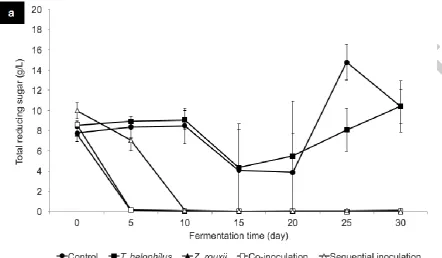
The reducing sugar content in all models containing Z. rouxii decreased to undetectable levels
5 days after inoculation (Figure 2A). This reducing sugar depletion was due to sugar
utilisation by yeast for propagation as well as ethanol conversion. Since A. oryzae in the
moromi model was heat-inactivated before fermentation started, the mould could no longer
perform starch hydrolysis resulting in lower availability of reducing sugar for Z. rouxii.
In contrast, the amount of reducing sugar in control and single culture of T. halophilus
remained high throughout the incubation period. By the end of fermentation, 10.39 g/L and
10.42 g/L of reducing sugar were found in control and single culture of T. halophilus,
respectively, which were relatively higher than the initial amount. Such increases could result
from the hydrolysing activity of amylase produced by A. oryzae, which remains active during
sugar in sample treated with T. halophilus also indicates limited ability of T. halophilus in
utilizing D-glucose and D-fructose.
The changing reducing sugar content was associated with the ethanol production during
moromi fermentation (Figure 2B). Ethanol was monitored since it is one of the main alcohols
produced by Z. rouxii during brine fermentation via sugars conversion (Van Der Sluis,
Tramper & Wijffels, 2001). Reducing sugar depletion in all Z. rouxii-containing samples
occurred in parallel with maximum ethanol production 5 days after Z. rouxii was inoculated.
As expected, ethanol was not detected in the sample treated with single culture of T.
halophilus and control (Figure 2b), since the reducing sugar content remained stable. Once
sugar in all Z. rouxii-containing samples was exhausted, ethanol content dropped to below
detection level.
As expected, T. halophilus was found to play a major role in both lactic acid and acetic acid
production (Figure 2C and 2D). Surprisingly, even though T. halophilus growth was
enhanced, production of both acids was suppressed when Z. rouxii was present. In single
culture, T. halophilus was able to produce lactic acid and acetic acid to a maximum level of
0.58 g/L and 0.26 g/L, respectively, which were the highest among all samples.
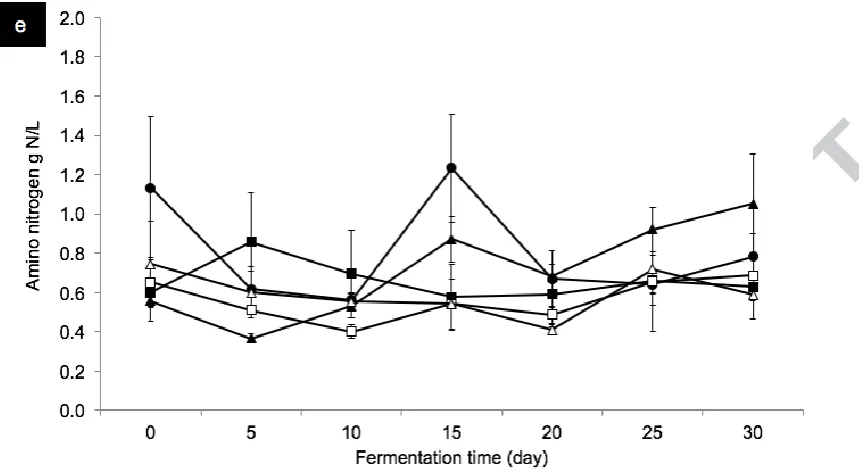
The amino nitrogen contents in all soy sauce samples were generally constant with some
fluctuation throughout the fermentation process. Amino nitrogen changes might be due to the
metabolic activity of T. halophilus or Maillard reaction (Cui et al., 2014), which is
responsible for deep brown colour formation in soy sauce. This reaction involves
condensation of carbonyls, such as reducing sugars and aldehydes, with compounds
possessing a free amino group (Lertsiri, Maungma, Assavanig, & Bhumiratana, 2001;
3.3 The effect of co-inoculation and sequential inoculation of T. halophilus and Z. rouxii
on formation ofvolatile compounds
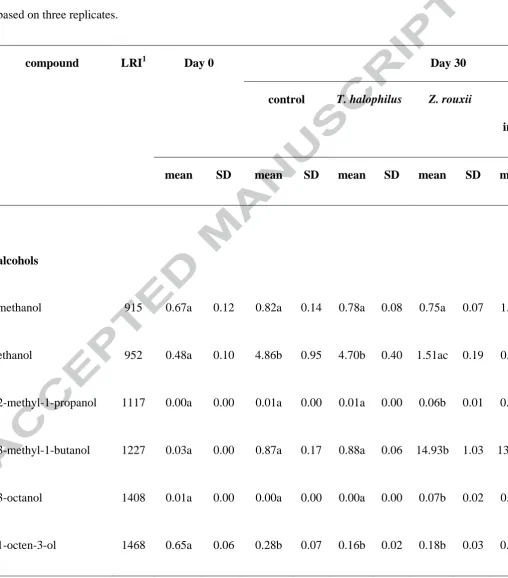
A total of 23 major volatile compounds was identified in the moromi samples, including eight
alcohols, three acids, five aldehydes, two esters, two pyrazines, one furan, and two ketones
(Table 1). Alcohols were found to be the most abundant compounds detected in all soy sauce
samples which is in agreement with previous studies conducted under high (Feng et al., 2015)
and low salt concentration (Singracha et al., 2017).
Higher amount of total alcoholic compounds was detected in the moromi treated with Z.
rouxii either as single or mixed cultures, suggesting that Z. rouxii was mainly responsible for
the alcohols formation. Fusel alcohols such as phenylethyl alcohol (floral, sweet),
3-methyl-1-butanol (malty, rancid, and pungent), and 2-methyl-1-propanol (bitter) were found to be the
major alcohol components of the final moromi. Song et al. (2015a) also reported high
production of the above fusel alcohols in reduced-salt moromi by adding indigenous yeast
isolated from different stages during traditional moromi fermentation. These fusel alcohols
could have been generated from their corresponding amino acids by Z. rouxii through the
Ehrlich pathway (Jansen et al., 2003). Extracellular amino acids present during moromi
fermentation can undergo deamination or transamination through the Ehrlich pathway,
producing -keto acids. The -keto acids serve as the main key intermediates in the
formation of fusel alcohols. Fusel alcohols are formed through decarboxylation and
subsequent reduction of the corresponding -keto acids (Van Der Sluis et al., 2001).
Combination of Z. rouxii and T. halophilus significantly increased 3-octanol (mushroom-like)
production compared with the single cultures. Ethanol was obtained in significantly lower
inoculation. Ethanol is generally produced by Z. rouxii from glucose through the glycolytic
pathway and anaerobic fermentation (Benitez & Codon, 2004).
Other alcohols such as 2-furanmethanol (sugar burnt) and methanol were detected in all
samples before fermentation started. All samples contained 1-octen-3-ol (mushroom-like),
but its amount decreased due to microbial activity during fermentation. Although most
alcohols in soy sauce are originated from sugars and amino acids metabolism, small amounts
of alcohols are also produced by yeast through metabolism of related aldehyde compounds
(Sun, Jiang, & Zhao, 2010).
Aldehydes (furfural, benzaldehyde, 2-methylpropanal, 3-methylpropanal, 3-methylbutanal,
and 2-methylbutanal) were the second main group of aroma compounds found in the soy
mash. They were present in soy mash from the beginning of fermentation. However, their
amount decreased significantly due to the activity of Z. rouxii, especially in mixed culture.
The decrease might be due to aldehyde conversion to its corresponding alcohol (Song et al.,
2015a). This hypothesis is supported by the fact that the amount of alcohols obtained in the
samples treated with Z. rouxii is higher than control and single culture of T. halophilus. These
aldehydes are responsible for soy sauce malty and nutty aroma (Feng et al., 2015).
Acetic acid was found to be the major volatile in single culture of T. halophilus. Its amount
was significantly (p < 0.05) higher compared to other samples, since T. halophilus is known
to produce acetic acid (Justé et al., 2012; Tanasupawat, Thongsanit, Okada, & Komagata,
2002). Acetic acid can give sour odour to the final product. Production of 3-methylbutanoic
acid was favoured in single cultures of T. halophilus and Z. rouxii. It has been reported to be
the major aroma compound in Chinese soy sauce and it is responsible for strong pungent,
sweaty, and cheese-like odour notes (Sun et al., 2010). This branched-chain acid might be
pathway (Lee et al., 2013). The presence of mixed culture seemed to suppress the production
of 3-methylbutanoic acid.
Acetate esters comprising isoamyl acetate (banana aroma) and 2-phenylethyl acetate (honey,
rosy) were detected in soy sauce samples fermented with Z. rouxii. Mixed cultures
significantly enhanced the production of isoamyl acetate (p < 0.05). The production of
2-phenylethyl acetate was higher in samples treated with Z. rouxii either alone or in mixed
cultures. Interestingly, sequential inoculation produces significantly higher amounts of
2-phenylethyl acetate than co-inoculation. Higher esters production in the presence of yeast
could happen, since yeast is capable of esterifying alcohols with fatty acids (Van Der Sluis et
al., 2001). Fatty acids can be produced through fungal lipase activity on the lipid contained in
the soybean (Chung, 1999).
Pyrazines were detected in all samples and they might be produced through Maillard reaction
between saccharide and amino residues (Sun et al., 2010). Trimethylpyrazine (burnt) and
2,5-dimethyl pyrazine (roasted nuts) were found in all samples, although 2,5-2,5-dimethylpyrazine
was significantly higher in the mixed culture samples. The main furan compound detected
was 2-pentylfuran and its levels were similar among samples. It is known as a singlet
oxidation compound produced from linoleic acid (Lee et al., 2013).
Acetone seemed to be the major ketone found in all samples, which is in agreement with the
findings of Lee et al. (2013), and Wanakhachornkrai and Lertsiri (2003). The formation of
acetone is related to metabolism of microorganisms, especially yeast, via lipid oxidation (Lee
et al., 2013; Song, Jeong, & Baik, 2015b). However, its amount was significantly higher at
Day 0, suggesting that the acetone might have originated from koji. According to Feng et al.
(2013), acetone found in koji could be derived from raw materials used in the koji making.
fermentation. Acetoin contributing to buttery odour was detected in all samples and its
amount did not significantly vary. Therefore, acetoin might be derived from koji fermentation
(Lee et al., 2013).
3.4 Principal component analysis
PCA was performed in order to understand the relationship between formation of volatile
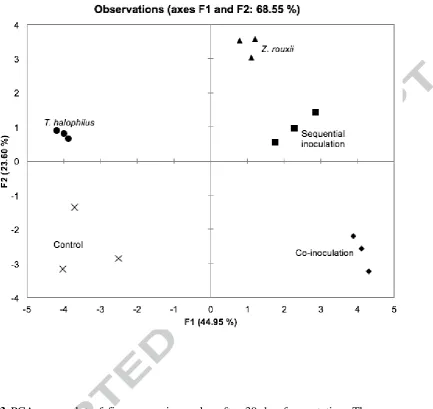
compounds, microbial species, and their order of inoculation. According to the PCA score
plot (Figure 3), all moromi samples were clearly differentiated, indicating that the microbial
species and their order of inoculation contributed to different aroma profiles in each sample.
Single culture of Z. rouxii, co-inoculation, and sequential inoculation were positioned in
positive PC1 region. On the other hand, control and single culture of T. halophilus were
located in the negative PC1, suggesting that T. halophilus alone is not sufficient to develop
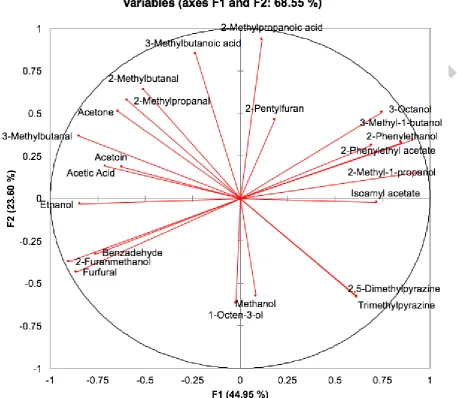
complex aroma profiles. The PCA loading plot (Figure 4) shows this separation to be driven
by a group of compounds dominated by alcohols (3-octanol, 3-methyl-1-butanol,
2-phenylethanol, 2-methyl-1-propanol, 2-phenylethyl acetate, isoamyl acetate,
trimethylpyrazine and 2,5-dimethylpyrazine) while aldehydes are positioned on the left side
of the plot (PC1; 44.95%). This is in agreement with the observed physicochemical changes
discussed in Section 3.2, where higher amount of alcohols were detected in all moromi
containing Z. rouxii.
Interestingly, sequential inoculation was distinguished from co-inoculation on PC2 (23.60%).
Co-inoculation was distinguished by pyrazines and random groups of compounds. However,
sequential inoculation accounted for significantly higher numbers of volatile compounds (13
out of 21) indicating production of more complex flavor profiles. PCA results demonstrated
that simultaneous or subsequent inoculation of Z. rouxii matters to the development of
4. Conclusion
The inoculation sequence demonstrated the antagonistic relationship between T. halophilus
and Z. rouxii, which also affected the physicochemical and volatile profile changes during
reduced-salt moromi fermentation. Although the antagonistic interaction occurred in both
co-inoculation and sequential co-inoculation, it resulted in different physicochemical changes,
which seemed to favour the aroma profiles in the case of sequential inoculation. Since the
microbial proliferation and activity is very important to the development of moromi,
understanding microbial interactions can assist strategies for controlling microbial release and
activity (e.g., encapsulation) or modulation of the inoculation time. Furthermore, varying the
inoculum size and ratio between T. halophilus and Z. rouxii should also be investigated, in
order to fully explore the interaction between the two microbes.
5. Acknowledgement
The authors are grateful to Indonesia Endowment Funds for Education (LPDP), Ministry of
Finance for funding this work as part of a doctorate program.
6. References
Benitez, T., & Codon, A. (2004). Ethanol-tolerance and production by yeast, In Arora, D.K.
(Eds.), Handbook of fungal biotechnology (pp. 249-252). New York: Marcel Dekker
Inc.
Chou, C. C., & Ling, M. Y. (1998). Biochemical changes in soy sauce prepared with
extruded and traditional raw materials. Food Research International, 31(6), 487–492.
Chung, H. Y. (1999). Volatile components in fermented soybean (Glycine max) curds.
Cui, R. Y., Zheng, J., Wu, C. De, & Zhou, R. Q. (2014). Effect of different halophilic
microbial fermentation patterns on the volatile compound profiles and sensory properties
of soy sauce moromi. European Food Research and Technology, 239, 321–331.
Feng, Y., Cui, C., Zhao, H., Gao, X., Zhao, M., & Sun, W. (2013). Effect of koji fermentation
on generation of volatile compounds in soy sauce production. International Journal of
Food Science and Technology, 48(3), 609–619.
Feng, Y., Su, G., Zhao, H., Cai, Y., Cui, C., Sun-Waterhouse, D., & Zhao, M. (2015).
Characterisation of aroma profiles of commercial soy sauce by odour activity value and
omission test. Food Chemistry, 167, 220–228.
Gkatzionis, K., Linforth, R. S. T., & Dodd, C. E. R. (2009). Volatile profile of Stilton
cheeses: Differences between zones within a cheese and dairies. Food Chemistry,
113(2), 506–512.
Harada, R., Yuzuki, M., Ito, K., Shiga, K., Bamba, T., & Fukusaki, E. (2016). Influence of
yeast and lactic acid bacterium on the constituent profile of soy sauce during
fermentation. Journal of Bioscience and Bioengineering, 123(2), 203–208.
Hauck, T., Brühlmann, F., & Schwab, W. (2003). Formation of
4-Hydroxy-2,5-Dimethyl-3[2H]-Furanone by Zygosaccharomyces rouxii : Identification of an Intermediate.
Applied and Environmental Microbiology, 69(7), 3911–3918.
Hecquet, L., Sancelme, M., Bolte, J., & Demuynck, C. (1996). Biosynthesis of
4-hydroxy-2,5-dimethyl-3(2H)-furanone by Zygosaccharomyces rouxii. Journal of Agricultural
and Food Chemistry, 44(5), 1357–1360.
Jansen, M., Veurink, J. H., Euverink, G. J. W., & Dijkhuizen, L. (2003). Growth of the
temperature on growth and fusel alcohol production from branched-chain amino acids.
FEMS Yeast Research, 3, 313–318.
Justé, A., Lievens, B., Frans, I., Marsh, T. L., Klingeberg, M., Michiels, C. W., & Willems,
K. A. (2008). Genetic and physiological diversity of Tetragenococcus halophilus strains
isolated from sugar- and salt-rich environments. Microbiology, 154(9), 2600–2610.
Justé, A., Van Trappen, S., Verreth, C., Cleenwerck, I., De Vos, P., Lievens, B., & Willems,
K. A. (2012). Characterization of Tetragenococcus strains from sugar thick juice reveals
a novel species, Tetragenococcus osmophilus sp. nov., and divides Tetragenococcus
halophilus into two subspecies, T. halophilus subsp. halophilus subsp. nov. and t.
halophilus subs. International Journal of Systematic and Evolutionary Microbiology, 62,
129–137.
Kedia, G., Wang, R., Patel, H., & Pandiella, S. S. (2007). Use of mixed cultures for the
fermentation of cereal-based substrates with potential probiotic properties. Process
Biochemistry, 42(1), 65–70.
Lee, K. E., Lee, S. M., Choi, Y. H., Hurh, B. S., & Kim, Y.-S. (2013). Comparative volatile
profiles in soy sauce according to inoculated microorganisms. Bioscience,
Biotechnology, and Biochemistry, 77(11), 2192–2200.
Lertsiri, S., Maungma, R., Assavanig, A., & Bhumiratana, A. (2001). Roles of the Maillard
Reaction in Browning During Moromi Process of Thai Soy Sauce. Journal of Food
Processing Preservation, 25, 149–162.
Martins, S. I. F. S., Jongen, W. M. F., & Van Boekel, M. A. J. S. (2000). A review of
Maillard reaction in food and implications to kinetic modelling. Trends in Food Science
Membré, J. M., Kubaczka, M., & Chéné, C. (1999). Combined effects of pH and sugar on
growth rate of Zygosaccharomyces rouxii, a bakery product spoilage yeast. Applied and
Environmental Microbiology, 65(11), 4921–4925.
Muramatsu, S., Sano, Y., Uzuka, Y., & Company, T. S. (1993). Rapid Fermentation of Soy
Sauce. ACS Symposium Series, 528, 200–210.
Röling, W. F. M., Timotius, K. H., Prasetyo, A. B., Stouthamer, A. H., & Van Verseveld, H.
W. (1994). Changes in microflora and biochemical composition during the Baceman
stage of traditional Indonesian kecap (soy sauce) production. Journal of Fermentation
and Bioengineering, 77(1), 62–70.
Röling, W. F. M., & van Verseveld, H. W. (1997). Growth, maintenance and fermentation
pattern of the salt-tolerant lactic acid bacterium Tetragenococcus halophila in anaerobic
glucose limited retention cultures. Antonie van Leeuwenhoek, 72(3), 239–243.
Sasaki, M. (1996). Influence of sodium chloride on the levels of flavor compounds produced
by shoyu yeast. Journal of Agricultural and Food Chemistry, 44, 3273–3275.
Sasaki, M., Nunomura, N., & Matsudo, T. (1991). Biosynthesis of 4-hydroxy-2(or
5)-ethyl-5(or 2)-methyl-3[ 2H ]-furanone by yeasts. Journal of Agricultural and Food Chemistry,
39(5), 934–938.
Singracha, P., Niamsiri, N., Visessanguan, W., Lertsiri, S., & Assavanig, A. (2017).
Application of lactic acid bacteria and yeasts as starter cultures for reduced-salt soy
sauce (moromi) fermentation. LWT - Food Science and Technology, 78, 181–188.
Song, Y.-R., Jeong, D.-Y., & Baik, S.-H. (2015a). Effects of indigenous yeasts on
physicochemical and microbial properties of Korean soy sauce prepared by low-salt
Song, Y.-R., Jeong, D.-Y., & Baik, S.-H. (2015b). Monitoring of yeast communities and
volatile flavor changes during traditional Korean Soy Sauce fermentation. Journal of
Food Science, 80(9), M2005–M2014.
Su, N. W., Wang, M. L., Kwok, K. F., & Lee, M. H. (2005). Effects of temperature and
sodium chloride concentration on the activities of proteases and amylases in soy sauce
koji. Journal of Agricultural and Food Chemistry, 53, 1521–1525.
Sudun, Wulijideligen, Arakawa, K., Miyamoto, M., & Miyamoto, T. (2013). Interaction
between lactic acid bacteria and yeasts in airag, an alcoholic fermented milk. Animal
Science Journal, 84, 66–74.
Sun, S. Y., Jiang, W. G., & Zhao, Y. P. (2010). Profile of volatile compounds in 12 Chinese
soy sauces produced by a high-salt-diluted state fermentation. Journal of the Institute of
Brewing, 116, 316–328.
Tanaka, Y., Watanabe, J., & Mogi, Y. (2012). Monitoring of the microbial communities
involved in the soy sauce manufacturing process by PCR-denaturing gradient gel
electrophoresis. Food Microbiology, 31(1), 100–106.
Tanasupawat, S., Thongsanit, J., Okada, S., & Komagata, K. (2002). Lactic acid bacteria
isolated from soy sauce mash in Thailand. The Journal of General and Applied
Microbiology, 48(4), 201–209.
Van Der Sluis, C., Tramper, J., & Wijffels, R. H. (2001). Enhancing and accelerating flavour
formation by salt-tolerant yeasts in Japanese soy-sauce processes. Trends in Food
Science and Technology, 12(9), 322–327.
Wan, S., Wu, Y., Wang, C., Wang, C., & Hou, L. (2013). The development of soy sauce from
Wanakhachornkrai, P., & Lertsiri, S. (2003). Comparison of determination method for
volatile compounds in Thai soy sauce. Food Chemistry, 83, 619–629.
Wu, T. Y., Kan, M. S., Siow, L. F., & Palniandy, L. K. (2010). Effect of temperature on
moromi fermentation of soy sauce with intermittent aeration. African Journal of
Biotechnology,
Yong, F. M., & Wood, B. J. B. (1976). Microbial succession in experimental soy sauce
fermentations. Journal of Food Technology, 11, 525–536.
Yong, F. M., & Wood, B. J. B. (1977). Biochemical changes in experimental soy sauce
moromi. International Journal of Food Science & Technology, 12, 263–273.
Zhao, C. J., Schieber, A., & Gänzle, M. G. (2016). Formation of taste-active amino acids,
amino acid derivatives and peptides in food fermentations - A review. Food Research
International, 89, 39–47.
Zhu, Y., & Tramper, J. (2013). Koji - where East meets West in fermentation. Biotechnology
Fig. 1. Changes in pH and growth (cfu) of T. halophilus and Z. rouxii growth during moromi
fermentation with pure culture of T. halophilus (a), pure culture of Z. rouxii (b),
Fig. 2 The changes of total reducing sugar (a), ethanol (b), L/D-lactic acid (c), acetic acid (d),
and amino nitrogen (e) during 30-day period of moromi fermentation at 30C with different
[image:29.595.98.528.76.311.2]
Fig. 3 PCA score plot of five moromi samples after 30-day fermentation. The scores are
based on three replicates of each sample. The identical symbols represent triplicate
[image:30.595.97.531.75.484.2]
Fig. 4 PCA loading plot of the aroma compounds detected in moromi after 30-day
fermentation with either single culture of T. halophilus and Z. rouxii, co-inoculation, and
[image:31.595.74.532.89.487.2]
Table 1. Aroma compounds found in moromi before and after 30 days of fermentation with
different combinations of microorganisms. The values are relative to the peak area observed
when the headspace above a 0.1 g/mL 1-octen-3-ol solution was analysed. Each value is
based on three replicates.
compound LRI1 Day 0 Day 30
control T. halophilus Z. rouxii
co-inoculation
sequential
inoculation
mean SD mean SD mean SD mean SD mean SD mean SD
alcohols
methanol 915 0.67a 0.12 0.82a 0.14 0.78a 0.08 0.75a 0.07 1.01a 0.07 0.55a 0.06
ethanol 952 0.48a 0.10 4.86b 0.95 4.70b 0.40 1.51ac 0.19 0.29a 0.03 3.51bc 0.37
2-methyl-1-propanol 1117 0.00a 0.00 0.01a 0.00 0.01a 0.00 0.06b 0.01 0.08b 0.00 0.07b 0.02
3-methyl-1-butanol 1227 0.03a 0.00 0.87a 0.17 0.88a 0.06 14.93b 1.03 13.35b 0.49 11.68b 2.05
3-octanol 1408 0.01a 0.00 0.00a 0.00 0.00a 0.00 0.07b 0.02 0.04c 0.01 0.04c 0.00
2-phenylethanol 1961 0.06a 0.05 0.06a 0.04 0.07a 0.06 19.50b 1.96 16.45b 1.85 10.38c 0.59
2-furanmethanol 1693 0.26a 0.03 0.23a 0.03 0.25a 0.03 0.01b 0.00 0.04b 0.00 0.02b 0.00
acids
acetic acid 1486 0.12a 0.09 0.02a 0.04 14.34b 0.64 0.39a 0.31 0.09a 0.09 0.10a 0.12
2-methylpropanoic
acid 1599 0.01a 0.01 0.00a 0.00 0.17a 0.01 0.42b 0.01 0.04a 0.02 0.16a 0.05
3-methylbutanoic acid 1700 0.05a 0.06 0.04a 0.04 2.03b 0.11 1.71b 0.14 0.14a 0.06 1.18ab 0.34
aldehydes
2-methylpropanal 825 0.31a 0.06 0.06bc 0.03 0.09b 0.01 0.11b 0.01 0.00c 0.00 0.00c 0.00
2-methylbutanal 930 0.18a 0.05 0.02b 0.01 0.03b 0.00 0.05b 0.01 0.00b 0.00 0.01b 0.00
3-methylbutanal 934 0.14a 0.02 0.06b 0.03 0.07b 0.01 0.05b 0.00 0.00c 0.00 0.02c 0.01
furfural 1502 1.11a 0.18 0.23b 0.04 0.14b 0.01 0.01b 0.00 0.01b 0.00 0.01b 0.00
esters
isoamyl acetate 1140 0.00a 0.00 0.01a 0.00 0.03a 0.00 0.05a 0.01 0.27b 0.03 0.45b 0.16
2-phenylethyl acetate 1860 0.01a 0.00 0.00a 0.00 0.00a 0.00 0.17b 0.03 0.15b 0.04 0.43c 0.02
pyrazines
2,5-dimethylpyrazine 1353 0.03a 0.00 0.06a 0.01 0.17a 0.02 0.05a 0.01 2.00b 0.38 0.10ac 0.00
trimethylpyrazine 1434 0.05a 0.01 0.05a 0.01 0.05a 0.01 0.05a 0.01 0.15a 0.02 0.05a 0.00
furan
2-pentylfuran 1251 0.07a 0.02 0.05a 0.04 0.08a 0.01 0.08a 0.01 0.07a 0.02 0.08a 0.03
ketones
acetoin 1321 0.15a 0.02 0.16a 0.02 1.23a 0.09 0.14a 0.01 0.00a 0.00 0.01a 0.00
1
LRI: linear retention indices of the compounds relative to an alkane series.
Highlights
T. halophilus and Z. rouxii interaction was driven by antagonism.
Z. rouxii growth was inhibited by T. halophilus proliferation.
Z. rouxii under suppression resulted in more complex volatile profiles.