DSC SUBMISSION TO THE UNIVERSITY OF
SOUTHAMPTON
Intelligent Nonlinear Learning Machines
by Dr. S. Chen
School of Electronics and Computer Science University of Southampton
Acknowledgments
I am indebted to many people, who have enhanced my understanding of the subject of this submission during my 18-year career. First of all, I would like to thank Professor Peter D. Roberts of the City University, my PhD supervisor, who taught me how to do research and how to write research papers. My particular gratitude is due to Professor Stephen A. Billings of the University of Sheffield, who introduced me to the important topic of nonlinear system identification and has been inspirational in shaping my views concerning the various aspects of intelligent nonlinear systems. Professor Peter M. Grant, Professor Bernard Mulgrew and Professor Steve McLaughlin of the University of Edinburgh have enhanced my understanding regarding adaptive systems and signal processing. I would like to thank them for the enlightenment gained during my stay at Edinburgh. My special thanks are due to Professor Chris J. Harris and Professor Lajos Hanzo. Without their encouragements, support and help, this submission would not have been completed. I would also like to express my gratitude to the School of Electronics and Computer Science for creating a scholarly environment I have enjoyed over the past six years.
I am particularly grateful to many of my academic colleagues and students for their support as well as valuable contributions. Special thanks are due to all my co-authors cited in the submission, particularly to Dr. Xia Hong of the University of Reading and Professor Jun Wu of the Zhejiang University, China.
Finally, I would like to dedicate this submission to my beloved parents as a modest token of my appre-ciation of their unabating support and to my son, Alan, for making the life sparkling and for helping me to appreciate any intellectual gift one was born with.
Sheng Chen
BRIEF CURRICULUM VITAE OF DR. S. CHEN
OFFICE ADDRESS
School of Electronics and Computer Science University of Southampton
Highfield, Southampton SO17 1BJ, UK Tel.: 023 8059 6660, Fax: 023 8059 4508
E-mail: [email protected], http://www.ecs.soton.ac.uk/∼sqc/
EDUCATION AND QUALIFICATIONS
January 1978 – January 1982: East China Petroleum Institute, BSc in Control Engineering, First Class Honors
October 1983 – October 1986: City University, London, PhD in Control Engineering
WORK EXPERIENCE AND EMPLOYMENT
1 October 1986 – 30 April 1989: Postdoctoral research associate, Department of Control Engineering, University of Sheffield, UK
1 May 1989 – 31 October 1993: Research fellow, Department of Electrical Engineering, University of Edinburgh, UK
1 November 1993 – 31 August 1996: Senior lecturer, Department of Electrical and Electronic Engineering, University of Portsmouth, UK
1 September 1996 – 31 August 1999: Reader, Department of Electrical and Electronic Engineering, Univer-sity of Portsmouth, UK
1 September 1999 – present: Reader, School of Electronics and Computer Science, University of Southamp-ton, UK
AWARDS AND DISTINCTIONS
British Council Scholarship for overseas PhD students, 1984
IEE Marconi Premium awarded for the paper “Orthogonal least squares algorithm for training multi-output radial basis function networks”, 1994
2004
The best paper award for the paper “Orthogonal least square with boosting for regression”, presented at 5th International Conference on Intelligent Data Engineering and Automated Learning, 2004
INTERNATIONAL SCHOLARSHIP
I have served as PhD examiner for the Universities of Reading, Edinburgh and Leeds, UK; the laboratoire des signaux et syst`emes, CNRS-Sup´elec, France.
I have served as MPhil examiner for Nanyang Technological University, Singapore; City University of Hong Kong, Hong Kong, China.
I have served as IPC member for the IEEE International Conference on Mechatronics and Machine Vi-sion in Practice, 2001 to 2005; TPC member for the IEEE International Conference on Communications, Advanced Wireless Communications Systems Symposium, 2002; TPC member for the International Con-ference on Wireless Networks, 2002 to 2004; TPC member for the International ConCon-ference on Intelligent Data Engineering and Automated Learning, 2004, 2005; and IPC member for the International Conference on Natural Computation, 2005.
I have been a regular reviewer for ten IEEE Transactions, three IEE Proceedings, and many other major in-ternational journals; as well as a regular reviewer for some major IEEE Inin-ternational Conferences, including ICC, GLOBECOM, CDC and ACC, and many other major international conferences.
I have served as international advisory committee member for the following Journal: Advanced Electronic Communications – Research & Education; Executive committee member of the Chinese Automation and Computer Society in UK.
RESEARCH
During my 18-year career I have authored and co-authored 12 book chapters, 115 journal papers and
91 conference papers. More than half of my research papers have been published after I joined the University of Southampton in 1999. Many of my publications are IEEE publications and hence can be
found in Portable Data Format (PDF) on the IEEE Xplore database. I have over 50 journal papers in the IEEE Xplore database. My full publications can also be found at the Publications Database of the School of ECS:
http://eprints.ecs.soton.ac.uk/
and the journal papers relevant to the subject of this submission are enclosed in printed format.
Many of my journal papers are highly cited. I have 6 journal papers, each having an ISI citation index of over 100, and my classical paper “Orthogonal least squares learning algorithm for radial basis function networks,” published in the IEEE Transactions on Neural Networks in 1991, received an ISI citation index of over 430 by the end of November 2004. In February 2004, my name was included in the list of the most highly cited researchers within the engineering category in the database of the world’s most highly cited researchers, compiled by ISI.
THE SUBMISSION
The various topics covered by this submission will be organised around the eight broad subject areas covered in my peer-reviewed journal papers [1]-[103], listed in the reference section of this submission. As indicated in the title, the main theme behind this submission is the research of intelligent nonlinear learning systems.
The papers constituting this submission were co-authored by the following students, research assistants and academic colleagues.
Supervised Undergraduate and PhD Students: N.N. Ahmad, M.Y. Alias, L.C. Anderson, R.J. Backhouse,
E.S. Chng, T.B. Cook, S. Galt, Z. He, H.B. Jamaluddin, W. Luo, A.K. Samingan, J. Wigger, A. Wolfgang, Y. Wu, Z.R. Yang.
Supervised Visitors and Research Assistants: K. Alkadhimi, P.E. An, J. Chu, M.J. Korenberg, G. Li, S.
Urwin-Wright, J. Wu, K.Y. Zhao.
Academic Co-authors: S.A. Billings, M. Brown, C.F.N. Cowan, G.J. Gibson, P.M. Grant, S. Gunn, L.
Hanzo, C.J. Harris, X. Hong, R.H. Istepannian, Y. Liu, B. Luk, S. McLaughlin, B. Mulgrew, D. Sander, P.M. Sharkey, J.F. Whidborne.
Contents
Acknowledgments 1
1 The Motivation and Background 8
2 Regression 10
2.1 Orthogonal Least Squares Combined with Regularisation . . . 12
2.2 Orthogonal Least Squares Combined with Optimal Experimental Design . . . 13
2.3 Orthogonal Least Squares with Leave-One-Out Test Score and Local Regularisation . . . 15
2.4 Orthogonal Least Squares Combined with Basis Pursuit and D-optimality . . . 16
2.5 Efficient Backward Elimination Methods . . . 16
2.6 Robust and Efficient Neurofuzzy Rule Base Knowledge Extraction and Estimation . . . 17
2.7 Nonlinear System Modelling and Prediction . . . 18
2.7.1 Dynamic System Identification and Prediction . . . 18
2.7.2 Postprocessing Designed for Image Compression . . . 19
2.7.3 Terrain Prediction for Legged Robots . . . 21
3 Classification 21 3.1 Robust Training of Heteroscedastic Probabilistic Neural Networks . . . 22
3.2 Kernel Classifier Construction with Fisher Ratio of Class Separability Measure . . . 22
3.3 Stochastic Least Error Rate Training for Classifiers . . . 23
4 Probability Density Function Estimation 24 4.1 A Novel Sparse Density Construction Method . . . 25
5 Minimum Bit Error Rate Linear Receivers for Communication Systems 26 5.1 Minimum Bit Error Rate Linear Equalisation . . . 27
5.1.1 Asymptotic Minimum Bit Error Rate Equaliser . . . 27
5.1.2 Stochastic Least Bit Error Rate Equaliser . . . 28
5.3 Multiantenna Aided Minimum Bit Error Rate Multiuser Detection . . . 30
6 Symbol-Decision Based Nonlinear Receivers for Communication Systems 31 6.1 Single-User Nonlinear Channel Equalisation . . . 32
6.2 Nonlinear Receivers in the Presence of Co-channel Interference . . . 34
6.3 CDMA Nonlinear Multiuser Detection . . . 35
6.4 Multiantenna Aided Space-Time Nonlinear Receivers . . . 36
6.5 Importance Sampling Simulation for Performance Evaluation . . . 37
6.6 Efficient Reduced-Complexity Implementation of Optimal Nonlinear Receivers . . . 38
7 Blind Equalisation 39 7.1 Low-Complexity Blind Equalisation . . . 40
7.2 Optimal Blind Channel Identification with Higher-Order Cumulant Fitting . . . 42
7.3 Blind Joint Maximum Likelihood Channel Estimation and Data Detection . . . 43
8 Optimising Controller Integrity for Finite-Precision Implementations 44 8.1 Closed-Loop Stability Margin Maximisation for Fixed-Point Implementation . . . 45
8.1.1 Optimal Finite-Precision Controller Design Based onl 1-Norm Stability Measure . . 46
8.1.2 An Improvedl1-Norm Stability Measure for FWL Controller Design . . . 46
8.1.3 Optimal Finite-Precision Controller Realisations in Delta-Operator Domain . . . 47
8.1.4 Sparse Realisations Based on the Improvedl 1-Norm Stability Measure . . . 48
8.2 Optimal Controller Realisations for Floating-Point Implementation . . . 49
8.3 Unified Framework for Finite-Precision Controller Design . . . 50
8.4 Roundoff Noise Minimisation for Fixed-Point Implementation . . . 51
9 Evolutionary Computation and Optimisation 52 9.1 Establish Efficient Walking Gaits for Legged Robots Using Genetic Algorithms . . . 52
9.2 Evolutionary Computation for Global Optimisation Applications . . . 54
9.2.1 Optimising Higher-Order Cumulant Criterion for Blind Channel Identification . . . 54
9.2.3 Digital IIR Filter Design . . . 55
9.2.4 Optimising Stability Bounds for Finite-Precision Controller Realisations . . . 55
10 Conclusions and Future Research 56 10.1 Computational Intelligence and Machine Learning . . . 56
10.2 Adaptive Receiver Design For Future Communications Systems . . . 57
10.3 Finite-Precision Digital Controller Design . . . 57
DSC SUBMISSION TO THE UNIVERSITY OF SOUTHAMPTON
Intelligent Nonlinear Learning Machines
by
Dr. S. Chen
1
The Motivation and Background
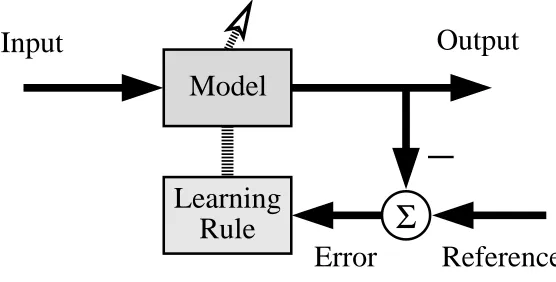
Learning is fundamental to all walks of science and engineering. Fig. 1 depicts a generic learning model or machine. Such a learning machine takes an input provided by the environment and produces an output. The purpose of the learning algorithm is to adjust the model so that the model output matches a reference as close as possible in some statistic sense. In so-called supervised learning, the environment also provides the reference in the form of a desired output or target for the model. By contrast, in unsupervised learning, the environment does not provide a desired output for the learning machine. The learning machine must somehow construct a reference itself, often based on some statistical information regarding the underlying data generating mechanism. The classical learning machine deals with situations, where the model is linear and the learning rule is also “linear”. For a linear model, the model output is linear with respect to both the model inputs and model parameters. The linear learning machine typically adopts a quadratic cost function of the modelling error for adjusting the model parameters, and the gradient of this cost function of a linear model is proportional to the product of the error signal and model input. This is the basic characteristic of linear learning that defines a linear learning machine. Linear learning has been studied widely and issues concerning a linear learning system are well understood.
Σ
−
Model
Learning
Rule
Reference
Error
[image:9.595.161.439.528.669.2]Input
Output
Figure 1: Schematic of Generic Learning Machine.
• The model output is nonlinear with respect to the model input.
• The learning rule that is used to adjust the model parameters is nonlinear.
That is, a nonlinear model and/or a nonlinear learning rule constitute a nonlinear learning system. Note that a nonlinear model by definition must be nonlinear in the model input but it can be either linear in the model parameters or nonlinear in the model parameters. A purely linear-in-the-parameters nonlinear model has an obvious advantage, since linear learning methods can be adopted, but it may require a much larger model dimension, compared to a nonlinear-in-the-parameters representation. Interestingly, a nonlinear learning machine may consist of a linear model with a nonlinear learning rule. A nonlinear learning rule accrues, for example, by adopting a more complicated and relevant cost function than the quadratic function of the model error. Essentially, for a nonlinear learning machine, the gradient of the cost function with respect to the model parameters is no longer proportional to the product of the error signal and the model input. This has some serious implications for the learning process.
For most applications, a nonlinear learning machine offers significant performance improvements over a linear one, as a nonlinear approach is capable of approximating or modelling the underlying data gener-ating mechanism much better. Compared to the linear learning approach, however, the nonlinear learning approach presents some major difficulties. The main challenges are:
1. The curse of dimensionality. A nonlinear model can easily become excessively large. A huge model not only has little practical use but also leads to over-fitting. An over-fitted model simply fits into the noise that is present in the training data. This prevents the model from discovering the underlying data generating mechanism and leads to poor generalisation performance.
2. The complexity of learning process. A nonlinear learning process is often associated with high computational requirements, and typically nonlinear learning problems are numerically ill-posed. The slow convergence rate of a nonlinear learning process is also a major consideration. Moreover, care must be exercised to avoid a nonlinear learning system for being trapped at some bad local solution.
To overcome or alleviate these difficulties, a successful nonlinear learning machine must be an intelligent one.
First of all, a nonlinear learning machine must be intelligent and hence capable of determining the correct model structure and arriving at a parsimonious representation. The objective of modelling from data is not that a model can explain the training data well. Rather, a model should possesses good generalisation performance. That is, it should capture the underlying dynamics that generate the training data instead of simply fitting into the training data. A model should also be easy to interpret and extract knowledge from, since a model is used to aid the understanding of the underlying data generating mechanism. All these depend crucially on the ability of the learning process to derive an appropriate sparse model.
to meet time constraints. The cost functions associated with nonlinear learning are often multi-modal and typically highly complex. To be successful, a learning algorithm must be robust and able to find a global optimal solution or at least avoid bad local solutions.
Proposing a range of intelligent nonlinear learning machines to meet the above-mentioned challenges and to successfully apply them in various key practical applications has been the motivation of my research and constitutes the focus of this submission. The novel contributions of my research efforts spanning the past decade or so are outlined in this submission with reference to the journal papers [1]-[103]. The submission is organised in eight broad subject areas, and all these research areas can be unified within the nonlinear learning machine framework of Fig. 1. The eight topics covered in this submission may be grouped into the four parts.
Part 1 of the submission is composed of three chapters, each covering an important topic of machine learning. Specifically, Chapter 2 contains my novel contributions to data regression modelling, Chapter 3 outlines my work on classification, and Chapter 4 summarises my recent research in probability density function estimation. Regression and classification are supervised learning problems, while probability den-sity function estimation is an unsupervised one.
Part 2 focuses specifically on the applications of intelligent nonlinear learning to communication sys-tems, and consists of three chapters. Chapter 5 presents my original contributions to the minimum bit error rate (MBER) design of linear receivers, while Chapter 6 summarises my novel research on nonlinear re-ceiver design. These two topics belong to the class of supervised learning, as training is assumed. My work on blind equalisation, which can be classified as unsupervised learning, is summarised in Chapter 7.
Chapter 8 forms Part 3 of the submission, which contains my recent contributions to finite-precision dig-ital controller design. This problem is an interesting and challenging nonlinear learning problem, requiring intelligent approaches to tackling it. Referring to Fig. 1, for this problem, the model is a closed-loop control system consisting of a linear plant model and a linear controller, the reference is the designed closed-loop performance if the controller is implemented in infinite precision or at a sufficiently high precision, and the
output is the actual closed-loop performance given an actual finite-precision controller. Learning or
opti-misation aims to find some optimal finite-precision realizations of the controller, which minimises some measure of the difference between the desired closed-loop performance and the actual closed-loop perfor-mance (as well as maintaining the closed-loop stability margin).
Evolutionary computation methods have found wide applications in intelligent nonlinear learning, owing to their ability to find globally optimal solutions. Part 4 of the submission consists of a single chapter, Chapter 9, which collects my research on the applications of evolutionary computation and optimisation methods to various nonlinear learning problems.
2
Regression
regression modelling. Most of these advances were achieved after I joined the University of Southampton in 1999, and these new contributions provide significant enhancements to my previous research in this area.
Since the late 1980s, I have been working on nonlinear regression modelling, and before joining the University of Southampton I developed a range of tools or algorithms [19]-[39]. The most successful one of these nonlinear modelling toolkits has been the orthogonal least squares (OLS) algorithm for forward selection regression [26],[34]. The basic principle of the OLS algorithm is simple but remarkably effective. From a large pool of the candidate regressors, the algorithm selects significant and relevant regressors one by one to form the final model, and the selection procedure is terminated when some prescribed modelling accuracy is achieved, yielding a parsimonious subset model that contains only significant regressors. This selection is carried out by incrementally minimising the mean square error over the training data set. Math-ematically, the model regressors form a set of bases that span the model space. By a simple and efficient orthogonalisation, these original model bases are transferred into the orthogonal bases. Each orthogonal base corresponds to an original model regressor. This allows the subset model selection to be carried out efficiently in the new orthogonal space. Since its derivation, the OLS algorithm has become very popular among nonlinear data modelling practitioners, owing to its ability to efficiently construct parsimonious mod-els that generalise well. It has become a standard nonlinear modelling toolkit and finds wide applications in many diverse fields of science and engineering. The paper [26] has received an ISI citation index 432 and the paper [34] has received an ISI citation index 171 by the end of November, 2004.
My recent works [1]-[18] involve enhancing the OLS algorithm with a range of advanced techniques for aiding intelligent modelling. The main novel contributions are summarized as follows.
1. Combining the OLS algorithm with regularisation techniques. By introducing regularisation in the or-thogonal modelling space and choosing the regularisation penalty as thel2-norm of the model weights
in the orthogonal space, the computational efficiency of the OLS forward selection procedure is pre-served. The combined approach offers an enhanced generalisation performance with sparser repre-sentations. Furthermore, regularisation also helps in deciding when to terminate the model selection procedure. An alternative regularisation method called the basis pursuit, which employs the regulari-sation penalty as thel1-norm of the model weights, has also been combined with the OLS algorithm.
2. Combining the OLS algorithm with optimal experimental design criteria. An optimal experimental design aims to optimise both the parameter efficiency and model robustness. By combining the OLS algorithm with an optimal experimental design, such as the D-optimality design, an enhanced model construction algorithm is obtained. With an appropriate choice of the composite cost function, the model construction becomes automatic, and the user does not have to specify any additional criterion to terminate the model selection procedure. Regularisation can also be incorporated naturally with this combined algorithm to further enforce the model sparsity.
decide the model size. Coupled with the advanced regularisation techniques, this approach results in a state-of-the-art toolkit for sparse regression modelling.
4. Intelligent knowledge discovery and rule extraction from data. The OLS decomposition has been extended to the neurofuzzy rule-based model construction. Specifically, a locally regularised OLS algorithm, combined with a D-optimality experimental design for the subspace based rule selection, has been developed for the fuzzy rule regularisation and subspace information extraction. This pro-vides a powerful construction algorithm for extracting the relevant and significant rules from a large dictionary and offers a state-of-the-art technique for discovering knowledge from data.
Below are my new contributions in regression given in detail with reference to the corresponding journal papers.
2.1 Orthogonal Least Squares Combined with Regularisation
Regularisation is one of the principal techniques for improving the generalisation properties of a learning machine. For the large class of linear-in-the-weights nonlinear models, such as the kernel-based model or more generally the radial basis function (RBF) network, a useful regularisation technique is based on anl2
-norm penalty cost of the model weights, as this can be naturally incorporated into the classic quadratic least squares cost function associated with the learning problem. From the viewpoint of the Bayesian learning framework, this choice of regularisation is equivalent to choosing a Gaussian distribution as a prior for the model weights. Classically, regularisation is applied to large full-size models for the purpose of alleviating over-fitting and hence improving the model’s generalisation properties. The beauty of the Bayesian learning is to “let the data speak” – the Bayesian procedure learns not only the model parameters but also the regular-isation parameters or equivalently the hyperparameters of the prior distribution. The latter is usually carried out via an iterative evidence procedure. Updating the regularisation parameters is based on the inverse of the combined cost function Hessian matrix, which is non-trivial and often becomes numerically ill-conditioned. Moreover, for a complex large model, some of the eigenvalues of this Hessian matrix may even become numerically negative, causing severe learning difficulties.
Many nonlinear models, such as the RBF network or kernel-based model, exploit the advantages of lin-ear llin-earning. This is achieved however only after some nonlinlin-ear parameters of the model, such as the kernel width, have been fixed or learnt by some other means, typically based on a cross validation. The choice of the RBF width for example has a critical influence on the generalisation capability of a RBF network. It is also plausible that using a different kernel width will require a different (optimal) regularisation parameter. The journal paper [2] proposed a novel model construction algorithm by combining a genetic algorithm (GA) optimisation with the regularised OLS learning. This novel approach can be viewed as forming a two-layered learning hierarchy. At the lower layer, with the given RBF width and regularisation parame-ter, the regularised OLS algorithm constructs a parsimonious subset model from the training data set. The upper layer involves choosing the optimal RBF width and regularisation parameter jointly by optimising the model’s generalisation capability using an additional validation data set. As the model’s generalisa-tion capability is a highly complex funcgeneralisa-tion of both the RBF width and regularisageneralisa-tion parameter, the GA is used to arrive at a globally optimal solution. This construction approach attains a significantly enhanced performance at the cost of some additional computational complexity involving the GA optimisation.
In many applications of regularisation, such as those considered in [1],[2], a single common regularisa-tion parameter is employed for every model weight. This corresponds to choosing a same prior distriburegularisa-tion for every model weight. For many learning machines, such as kernel models, each regressor is modelled on a data point. Each data (regressor) has different importance or relevance, and this should be reflected in its prior distribution. This is the motivation behind using the multiple-regularisers or local regularisation, in which each model weight is associated with an individual regularisation parameter. Local regularisation has a remarkable property of enforcing model sparsity. During the iterative optimisation, many of the regular-isation parameters are driven to very large values and this in turn forces the corresponding model weights to take very small near-zero values. Thus, the model regressors associated with these near-zero weights can be pruned out from the final model. My novel research on this advanced regularisation technique is sum-marised in the journal paper [3]. In the submission [3], a locally regularised OLS algorithm is developed for constructing sparse multi-output regression models. This algorithm combines the advantages of both the OLS model selection, which has the ability to select only the significant regressors to explain the training data, and the local regularisation, which enforces the sparsity of the models. The end result is an efficient construction algorithm that is capable of producing parsimonious regression models with excellent general-isation performance. As local regulargeneral-isation is introduced in the orthogonal model space, the efficiency of the subset selection procedure is ensured. Moreover, it has been shown in [3] that the decision concerning when to terminate the model selection procedure is greatly assisted by the local regularisation.
2.2 Orthogonal Least Squares Combined with Optimal Experimental Design
design criteria based on different aspects of experimental design. The D-optimality criterion is the most ef-fective in optimising the parameter efficiency and model robustness via the maximisation of the determinant of the design matrix. The traditional nonlinear model structure determination based on optimal experimental designs is however inefficient and computationally prohibitive, incurring the curse of dimensionality. The journal papers [4]-[6] of the submission summarise my novel research on applying optimal experimental designs to aid efficient parsimonious regression modelling.
To appreciate the benefits of incorporating an optimal experimental design in the subset model construc-tion, it is informative to point out that there are two key questions to be answered for any model construction process, namely which regressors to select and when to terminate the selection. The OLS algorithm is very effective in selecting significant regressors based on the training performance. The number of regressors that the model should have cannot be quantified based on the same training performance, since typically this training performance is continuously improved as more model terms are added, which eventually leads to over-fitting or a poor generalisation performance. Although the local regularisation can help to alleviate this difficulty, ideally the modeller requires some additional criterion to decide when to stop the selection procedure and ultimately to generate a parsimonious model that generalises well. Let us consider the usual information based criteria. An information based criterion is typically a composite cost function consist-ing of the mean square error over the trainconsist-ing data set and some model complexity penalty term. Such an information criterion is at least locally convex, and there exists an “optimal” model size at which the composite cost function reaches a minimum value. While the information based criteria provide the infor-mation concerning when to terminate the model selection, they do not tell the modeller which model terms should be selected. That is, the use of an information based criterion in forward regression only affects the termination point of the model selection, but does not penalise the regressor that would cause poor model performance (e.g. too large a variance of the parameter estimate or ill-posedness of the regression matrix), if it is selected. Optimal experimental design criteria offer better solutions as they are directly linked to the model’s efficiency and the robustness of parameter estimate.
2.3 Orthogonal Least Squares with Leave-One-Out Test Score and Local Regularisation
The ultimate goodness of a model is characterised by its generalisation performance, yet the achievable training performance has been the main driving force in model construction, namely in deciding which regressors to select. Cross validation is an approach commonly employed to ensure an adequate model’s generalisation capability. In a typical cross validation application, the model is constructed based on a training data set and the constructed model is evaluated using a separate validation data set. The performance over the validation set can be seen as an indicator of the model’s generalisation performance. The optimal model can thus be determined as the one that minimises this generalisation mean square error over the validation set. It should be obvious that in this approach the model’s generalisation capability is only used as a measure of the model complexity, but is not involved in the selection of the model regressors. This underlying “problem” will remain, so long as the basic criterion for the model construction procedure is the training performance. Even in the locally regularised OLS algorithm combined with the D-optimality experimental design, which takes into account the model’s generalisation ability in selecting regressors, the main component in the model construction criterion is the training performance. Arguably, a better and more natural approach is directly using a measure of the model’s generalisation capability in the model selection procedure rather than only using it as a measure of the model complexity. This is the main motivation behind the work presented in [7],[8].
A commonly used cross validation technique is the delete-one cross validation. The idea is illustrated by the problem of choosing the best model from theKcandidates using anN-sample training data set. For each candidate, each data point in the training set is sequentially set aside in turn, the model is estimated using the remainingN−1data points, and the prediction error is derived using the only data point that was removed from training. The leave-one-out (LOO) test score of the model is the mean square error averaged over all theN prediction errors. To select the best model from theK candidates, the same modelling procedure is applied to each of theK candidates, and the model candidate with the minimum LOO test statistic is selected. For the linear-in-the-parameters models, there is an elegant way of generating the LOO test score, without actually sequentially splitting the training data set and repeatedly estimating the associated models. However, the traditional nonlinear model structure determination based on the delete-one cross validation is computationally prohibitive. The journal papers [7],[8] in the submission developed an efficient way for sparse regression modelling using the LOO test score. The method proposed in [7],[8] uses the locally regularised OLS algorithm as the basic toolkit for model construction, except that the regressor selection is based on incrementally minimising the LOO test score, rather than the original regularised training mean square error. Significant advantages of this novel model construction algorithm are:
• The model construction is based on directly optimising the model’s generalisation capability, without resorting to use a separate validation data set. Moreover, owing to the orthogonal decomposition, the computation of the LOO test statistic becomes efficient. This ensures the computational efficiency of the model construction procedure.
In summary, combining the LOO test score with the locally regularised OLS learning yields a truly automatic and efficient algorithm capable of producing very sparse models with excellent generalisation performance, using a single training data set only. The comparative study given in [7] clearly demonstrates that this method compares favourably with the other existing state-of-the-art sparse regression modelling techniques.
2.4 Orthogonal Least Squares Combined with Basis Pursuit and D-optimality
The regularisation adopted in Sections 2.1 to 2.3 is based on thel2-norm of the model weights. This penalty
function can be “merged” naturally into the main quadratic cost function, and the learning problem remains to be a quadratic optimisation problem, which admits efficient solutions. Moreover, efficient methods ex-ist to optimise the regularisation parameters. An alternative regularisation technique is known as the basis pursuit or least-angle regression, which is based on thel1-norm of the model weights. A Bayesian
interpre-tation for the basis pursuit method is that it adopts an exponential prior for the model parameters (compare this with a Gaussian prior for thel2-norm regularisation). The basis pursuit technique is not particularly
computationally efficient, because it effectively changes a quadratic optimisation problem having a sim-ple solution into a more sophisticated problem for which generally comsim-plex non-quadratic optimisation is required. Furthermore, optimising the regularisation parameters becomes a highly complex problem for which no simple solution exists. An important advantage of the basis pursuit is that it may result in a much sparser model by forcing more parameters to zero than the model derived from thel2-norm regularisation.
Thel2-norm method is good at producing small but non-zero parameter values. Normally, the basis pursuit
method is applied to train the large-size full model by forcing many weights to be zero and hence pruning out the corresponding model terms to derive a sparse solution. This process is generally associated with a high computational complexity.
The paper [9] developed an efficient model construction method that simultaneously optimises the model’s approximation capability, sparsity and robustness by incorporating the basis pursuit regularisation into the combined OLS algorithm and D-optimality design. The cost function for the subset model selection includes a D-optimality criterion that maximises the determinant of the design matrix of the subset model to ensure the model robustness and to allow the model selection procedure to be automatically terminated at a sparse solution. The model weights derived in each forward regression step are initially estimated via the OLS algorithm, and they are then tuned with the aid of a gradient-descent learning algorithm based on the basis pursuit that minimises thel1-norm of the model’s weight vector. Since both the parameter tuning
procedure based on the basis pursuit and the regressor selection based on the D-optimality design are inte-grated with the orthogonal forward regression (OFR), the inherent computational efficiency associated with the original OLS algorithm is maintained. A simple heuristic method of choosing the basis pursuit regu-larisation parameters is also proposed. This OFR algorithm using both the basis pursuit and D-optimality design provides a powerful additional tool in the toolkit of intelligent nonlinear modelling.
2.5 Efficient Backward Elimination Methods
signif-icant regressors from a large set of candidates one by one to add to the subset model. This approach is computationally more efficient and in particular the forward regression based on the OLS algorithm has proved to be very successful in parsimonious modelling. In contrast, a completely backward elimination procedure eliminates regressors from a full model that contains many regressors, which is a more difficult and computationally complex task, particularly when the full model is very large. Integrating forward se-lection and backward elimination offers a better model construction method than a purely forward sese-lection one, at the cost of an increased complexity. Alternatively, backward elimination can be employed as a postprocessing procedure, and this can be used to form the hybrid approaches to prune the models that are identified via other approaches. A model constructed via forward regression can gain extra sparsity using backward elimination. This is because forward selection is basically a greedy algorithm, and a regressor selected in a forward manner may become insignificant at a later stage and can then be removed. Adopting backward elimination as a postprocessing tool is computationally affordable.
Conventional backward elimination removes model regressors one at a time based on the least deteriora-tion in the model fit, i.e. based on the training performance. It is highly desired to incorporate some measure of model generalisation capability into this backward elimination procedure. The journal paper [10] derived three efficient backward elimination methods: 1) backward elimination based on the A-optimality design,
2) backward elimination based on the D-optimality design, and 3) backward elimination based on the basis
pursuit. The A-optimality experimental design aims to minimise the covariance of the parameter estimate, which is proportional to the trace of the inverse of the design matrix. The similarity of the three methods is that each is based on the balance between the model fit and one of the three alternative generalisation mea-sures. Such a balance also ensures that the backward elimination processes can be automatically terminated. The A-optimality and D-optimality based pruning processes require some orthogonalisation operation be-tween the pruned model and the deleted regressor. The pruning formula of the l1-norm basis pursuit is
shown to be extremely simple, without the need for an orthogonalisation process.
2.6 Robust and Efficient Neurofuzzy Rule Base Knowledge Extraction and Estimation
The paper [11] developed a novel robust neurofuzzy construction algorithm for modelling observed data sets in the form of a set of fuzzy rules. Based on the Takagi-Sugeno inference mechanism, a one to one mapping between a fuzzy rule base and a model matrix feature subspace is established. This link enables the rule based knowledge to be extracted from the matrix subspace to enhance the model transparency. In order to achieve the best possible model robustness and sparsity, an extended Gram-Schmidt orthogonal sub-space decomposition has been introduced and combined with the two effective and complementary robust modelling approaches of the regularisation and the D-optimality experimental design. The model rule bases are decomposed into the orthogonal subspaces (compare this with the orthogonal bases in the conventional orthogonal decomposition), so as to enhance the model transparency with the capability of interpreting the derived rule base energy level and hence enabling the selection of the significant and relevant subspaces or rule bases. With an appropriately chosen weighting for the D-optimality cost function, the entire neurofuzzy model construction procedure becomes automatic. Thus, with the important extension from an orthogonal decomposition to an orthogonal subspace decomposition, the major contribution of [11] is to extend the locally regularised OLS algorithm with the D-optimality design for the conventional data modelling to the fuzzy rule regularisation and subspace based information extraction. This neurofuzzy model construction algorithm provides a powerful tool for extracting the relevant and significant rules from a large rule set and offers a state-of-the-art technique for discovering knowledge from data.
2.7 Nonlinear System Modelling and Prediction
This section collects some of my recent publications related to three different applications of nonlinear data regression. Specifically, Subsection 2.7.1 deals with nonlinear dynamic system identification and prediction
[12]-[14], a novel postprocessing technique designed for image compression [15],[16] is presented in
Sub-section 2.7.2, and SubSub-section 2.7.3 summarises an application of neural networks to the terrain prediction for employment by legged robots [17],[18].
2.7.1 Dynamic System Identification and Prediction
of [12] offers a simple but effective means of identifying nonlinear dynamic systems using a RBF model.
The RBF network has enjoyed considerable success in applications to nonlinear system identification and time-series prediction. Most of the successful results, however, were obtained when the RBF network is applied to stationary systems or signals. The performance of the RBF model applied to non-stationary systems and signals is less satisfactory. This is because the standard RBF network, like many feedforward neural network models, does not characterise the associated temporal variability sufficiently well. Since the real-world systems and signals are often not only highly nonlinear but also highly non-stationary, it is desirable to develop the models which can handle the signals that exhibit both of these characteristics. This is what motivated the work in [13] to develop a novel gradient RBF (GRBF) network for nonlinear and non-stationary time series prediction. For the non-non-stationary time series involving variations of local mean and trend, the series can be made stationary by applying a suitable differential operation on the signal. This is the principle behind the linear auto-regressive integrated moving average model used to predict non-stationary signals. By incorporating a similar mechanism into the RBF network, the resultant model structure has a better predictive performance for non-stationary homogeneous time series. In addition to using the first-order difference of the signal as the input vector of the network, the response of each RBF node is also modified with a first-order local model term which can be interpreted as a local one-step predictor. The OLS algorithm is modified accordingly to provide an efficient construction algorithm for identifying the parsimonious GRBF network models having an excellent predictive performance for nonlinear and non-stationary time series.
The book chapter contribution [14] provides a comprehensive treatment of methods and techniques designed for nonlinear dynamic system identification. A general principle of system identification is that the model should not be more complex than required for capturing the underlying system dynamics. This concept, known as the parsimonious principle, is particularly relevant in nonlinear model building, because the size of a nonlinear model can become, to a great extent, excessively large. An overly complicated model may simply conform to the noise in the training data, resulting in over-fitting. An over-fitted model does not capture the underlying system structure sufficiently well and can, in fact, perform poorly on new data. This consideration is the main motivation and central theme of my research reported in [14]. Conventional nonlinear models as well as various neural network models are reviewed. A substantive array of system identification techniques is discussed in the context of both the nonthe-parameters and linear-in-the-parameters models, with emphasis on determining the model structure. Model validation methods are also provided, and the concept of (nonlinear) identifiability as well as the novel idea of local model fitting are introduced. The work [14] offers a comprehensive reference for researchers and practitioners engaged in nonlinear dynamic system identification.
2.7.2 Postprocessing Designed for Image Compression
postenhancement may be used for improving the quality of the reconstructed image, without increasing the coding bit rate. Existing postprocessing methods can be divided into two categories: those employing fil-tering to smooth the blocking artifacts in reconstructed images and those formulating postprocessing as an image-recovery problem. Since filtering also causes unwanted over-smoothing on image edges, the class of filtering methods is not appropriate for applications, which require genuinely good image quality with minimum distortions. The second class of methods rely heavily on the accuracy of a priori image models used and on the optimisation algorithms adopted. These methods often involve adaptive filtering to avoid excessive smoothing. In addition, existing postprocessing methods are specifically designed for block-based coding methods using fixed coding block sizes, such as those in transform coding (TC) and vector quan-tisation (VC), where blocking artifacts constitute serious sources of distortions. These adaptive filtering techniques are unable to improve the quality of predictive coding, where blocking artifacts do not exist and blurred edges are the main coding distortions. These methods are also impractical to use for quadtee (QT) coding, which has variable block sizes.
The motivation of my related research [15],[16] was to create a postprocessing technique, which is able to correct the coding distortions of all major coding schemes, and the journal papers [15],[16] developed a generic postprocessing technique. The key of this postprocessing method is the ability to recover the quanti-sation distortion image, defined as the difference between the original and decoded images. It can be shown that the main coding impairments are due to edge distortions, including blurred edges and spurious edges. Spurious edges are caused by blocking artifacts. This suggests that the basic task of postprocessing is to correct these edge distortions. The novel distortion-recovery model developed in [15],[16] consists of a vi-sual feature extractor to extract edge information from the decoded image, and a mapping to map the vivi-sual features of the decoded image onto the quantisation distortion image. Specifically, visually important edge features are computed as multi-scale first-order derivatives of the decoded image. Interestingly, this gradient extractor imitates certain characteristics of visual cortex. As the exact relationship between the gradient fea-tures of the decoded image and the quantisation distortion image is unknown, an artificial neural network, referred to as the neural network visual model (NNVM), is trained to learn this relationship. The advantages of the proposed postprocessing technique have been demonstrated in a range of experiments involving four coding systems, namely TC, VC, QT coding and predictive coding schemes. The experimental results ob-tained confirm that the NNVM achieves significant improvements in the quality of the reconstructed images, in terms of both the objective distortion measure used and subjective viewing assessment. More specifically, the experiments were conducted on eight test images in conjunction with the aforementioned four coding schemes, each having two different coding bit rates. The average coding peak signal to noise ratio (PSNR) over these experimental conditions was approximately 30 dB without postprocessing. It is well-known that the higher the PSNR is the more difficult for a postenhancement technique to achieve postprocessing gain. The experimental conditions were designed specifically to create high PSNR conditions, so as to test the proposed postprocessing method under “unfavourable” situations. Even under such a high average PSNR condition, the proposed postprocessing technique achieved an average PSNR gain of over 1 dB1, which is much better than other existing postprocessing methods can achieve.
1Due to a limited length, not all the experimental results could be presented in the journal papers [15],[16]. More detailed
2.7.3 Terrain Prediction for Legged Robots
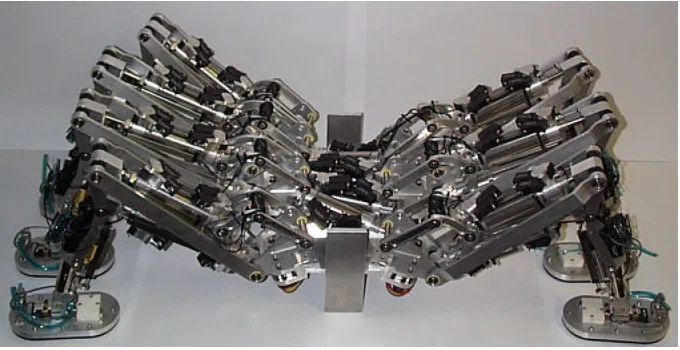
Roughly half of the land surface of the earth is inaccessible to conventional wheeled or tracked vehicles. Legged robots present significant advantages over wheeled or tracked mechanisms because of their ability to move in very rough and unstructured terrains and to step over obstacles. However, without efficient walking strategies these advantages cannot be realized. The walking gait algorithm is a decision based process re-garding which leg should be lifted or placed to provide time-space coordination of the motion of the various legs of the robot. It is the most crucial process in the control of legged robot motion. A terrain mapping system, which can accurately predict unknown terrain, is capable of aiding the walking gait algorithm to provide smooth and efficient walking motion of legged robots in unstructured environments. The work re-ported in [17],[18] applied an artificial neural network as terrain predictor to aid the navigation of legged robots across rough terrains. In the experiments involving an eight-leg robot called Robug IV roaming in a range of terrain environments, this neural network terrain predictor was demonstrated to provide signif-icantly improved prediction accuracy over an existing terrain mapping system previously implemented on Robug IV.
3
Classification
Classification is another basic learning problem in machine learning. It has many similarities with regres-sion, but also has some important differences. Notably, the desired output in a classification problem only takes a finite number of discrete values. For example, in two-class classification problems, the desired output or class label is binary. The construction of a classifier is often linked to probability distribution estimation. This is because, if the conditional probability density functions of the classes are known, the optimal Bayesian classifier can readily be formulated. For regression, the least squares or mean square error is the principal criterion in deriving appropriate learning mechanisms. The ultimate objective of classifica-tion is to maintain a high classificaclassifica-tion accuracy or a low error rate, and this should be the basic criterion for deriving learning rules in classification applications. My research in the field of classification is both research and application oriented, and the four journal papers [40]-[43], which provide a summary of my recent contributions to this field, were selected for inclusion in the submission. My novel contributions in the research field of classification can be summarised as follows.
1. Deriving a robust maximum likelihood learning method for heteroscedastic probabilistic neural
net-works by incorporating a statistical bootstrap technique known as the Jack-knife into the expectation-maximisation (EM) algorithm.
2. Developing an efficient sparse kernel classifier construction technique based on an orthogonal
for-ward selection (OFS) procedure that chooses significant and relevant kernel terms by incrementally maximising the Fisher ratio of class separability measure.
3. Developing a stochastic gradient based sample-by-sample learning technique, called the least error
These novel contributions in classification are now described below in more detail with reference to the corresponding journal papers.
3.1 Robust Training of Heteroscedastic Probabilistic Neural Networks
The key to applying the optimal Bayes strategy for pattern classification is the estimation of the conditional probability density functions (PDFs) of the classes, and a classical PDF estimate is the Parzen window estimator. The probabilistic neural networks (PNNs) implement the Parzen window estimator using mixtures of Gaussian kernels. Traditionally, a common variance is used for every Gaussian basis function, and this is termed as the homoscedastic PNNs. The expectation-maximisation (EM) algorithm is typically applied to provide an optimal maximum likelihood (ML) training algorithm for PNNs. If each Gaussian basis function is allowed to have a different variance, a much more parsimonious PNN can be used to adequately approximate the underlying conditional PDFs of the training data but the associated learning problem is much more difficult. Indeed, when extending the EM training algorithm to this class of heteroscedastic PNNs, often numerical difficulties occur. The journal paper [40] analysed the root of this numerical problem, and incorporated a robust statistical technique, referred to as the Jack-knife, into the EM algorithm to derive a robust and effective ML training method for heteroscedastic PNNs.
The Jack-knife constitutes a simple yet effective statistical bootstrap method that is widely used in robust statistical analysis for bias reduction and interval estimation. Basically, the Jack-knife procedure partitions a sample space into several subsets and observes the influence of each subset on the estimation process. The Jack-knife estimator is very effective in reducing the bias of the estimate. Another desired property of the Jack-knife technique is that it can remove the effect of a few outliers within a data space, giving rise to a robust estimate. Note that the effect of a few outliers is the main source that may cause the EM algorithm to collapse when training heteroscedastic PNNs, as analysed mathematically as well as demonstrated numeri-cally in [40]. Thus, this numerical difficulty can be overcome by incorporating the Jack-knife technique in the EM algorithm, which represents the main contribution of [40]. The resultant robust ML training algo-rithm for heteroscedastic PNNs is then applied in [40] to the real data involving success or failure prediction of UK private construction companies, and the results obtained clearly demonstrate the effectiveness of this robust ML learning method.
3.2 Kernel Classifier Construction with Fisher Ratio of Class Separability Measure
the ability to produce much sparser classifiers with similarly good generalisation performance as that of the SVM method. The RVM method however is computationally much more demanding than the SVM method and the resultant learning problem is often inherently ill-posed. Forward selection, which selects significant kernel terms one by one to form a sparse classifier, has clear computational advantages. In my early work
[26], by formulating the classifier construction as regression modelling, the orthogonal least squares (OLS)
algorithm was applied to select a parsimonious radial basis function (RBF) classifier in an efficient orthog-onal forward selection (OFS) procedure. The least squares cost used by the OLS algorithm for selecting kernel terms is, however, not the most relevant one in the context of the classification objective. What is really needed here is to find a suitable criterion for selecting significant kernel terms, which is directly linked to the classification objective.
The degree of class separation is directly linked to the test error rate, and the Fisher ratio class separa-bility measure thus offers a suitable criterion for selecting significant kernel terms. This was first suggested in:
K.Z. Mao, “RBF neural network center selection based on Fisher ratio class separability measure,” IEEE
Trans. Neural Networks, Vol.13, pp.1211-1217, Sept. 2002.
My contribution [41],[42] involves refining the OFS procedure based on the Fisher ratio class separability measure in a generic classifier design algorithm, applying it to some typical problems and demonstrating its computational advantages over the other state-of-the-art kernel-based classifier design methods. By for-mulating the kernel classifier design as regression modelling, orthogonal decomposition can be applied to orthogonalise the “regression matrix”, and the Fisher ratio class separability measure can be efficiently com-puted for each orthogonal base candidate. At each stage of the OFS procedure, a candidate base, namely a candidate kernel term, is selected if it produces the maximum value of the Fisher ratio among the can-didates that have not yet been selected. The orthogonalisation process and the computation of the kernel weights remain identical to those employed by the original OLS algorithm used in regression. This OFS procedure is inherently well-conditioned and efficient. The applications reported in [41],[42] show that it has the same excellent generalisation performance and a similar level of sparsity as the RVM method, but it is computationally much simpler than the RVM method. Thus, this OFS algorithm based on the Fisher ratio class separability measure provides a viable alternative for constructing truly sparse kernel classifiers that generalise well.
3.3 Stochastic Least Error Rate Training for Classifiers
Kernel-based classifier construction algorithms, such as the support vector machine (SVM) method and the orthogonal forward selection (OFS) algorithm with the Fisher ratio class separability measure, have been shown to be capable of approximating the optimal Bayesian performance. All these training algorithms are however block-data based and cannot be implemented in a truly sample-by-sample adaptive manner. In many applications involving nonlinear (e.g. neural network) classifiers, adaptive training or sample-by-sample adaptation is required to meet real-time computational constraints. Application examples include neural network equalizers and multiuser detectors in communication systems. Typically, the adaptive train-ing of neural network classifiers is usually carried out ustrain-ing some stochastic gradient algorithm, such as the well-known least mean square (LMS) algorithm, based on the minimum MSE (MMSE) criterion. A somewhat undesirable situation exists that, on one hand, the performance of a classifier is evaluated using the probability of error while, on the other hand, a different MSE criterion is used during the learning stage.
The journal paper [43] developed a truly sample-by-sample adaptive training method based on directly minimising the classifier’s approximate error rate for two-class classification problems, and applied the re-sultant stochastic least error rate (LER) algorithm to nonlinear equalisers for binary signalling. The deriva-tion of this LER algorithm is based on a reasonable assumpderiva-tion that the underlying pattern space is a finite-state machine contaminated by additive Gaussian white noise. Thus, the distribution of the pattern space is a multi-variate Gaussian mixture. By virtually linearising the output of a nonlinear classifier in the vicinity of the states of the pattern space, the probability density function (PDF) of the classifier’s output can be accurately approximated as a mixture of Gaussians. Given the PDF, the probability of error of a classifier can be explicitly formulated, and the MER classifier is defined as the one that minimises this probability of error, which can be obtained for example using a gradient based optimisation method initialising the search from a suitably chosen initial solution. Since the states of the pattern space are generally unknown, the PDF of the classifier’s output is also unknown. However, this PDF can be estimated using the Parzen win-dow estimate based on a block of training data. The Parzen winwin-dow based method estimates an unknown PDF by placing a symmetric unimodal kernel function on each data sample and combining these kernels to form a PDF estimate. This method is known to produce a remarkably accurate PDF estimate. For the case of sample-by-sample adaptation, a single sample based PDF “estimate” is used and, conceptually, from this one-sample PDF estimate, a one-sample or instantaneous “error probability” is derived. Using the in-stantaneous gradient of this error probability naturally gives rise to a stochastic gradient algorithm referred to as the LER algorithm. The results involving nonlinear equalisation reported in [43] have demonstrated that a small RBF network trained by the LER algorithm can closely approximate the optimal Bayesian per-formance, and the work in [43] also confirms that the same RBF network trained by the LMS algorithm converges well in terms of the MSE, but may produce a poor error rate performance.
4
Probability Density Function Estimation
estimation, namely parametric and nonparametric methods. In the parametric approach, the unknown den-sity is assumed to belong to a parametric set satisfying certain conditions and denden-sity estimation becomes a problem of typically estimating these parameters using the maximum likelihood principle. The nonparamet-ric approach does not have the limitation of assuming that the unknown density belongs to a particular form from a parametric set. A well-known nonparametric density estimation technique is the classical Parzen window based PDF estimate, which is remarkably simple and accurate. The particular problem associated with the Parzen window method however is the high computational cost required for calculating the PDF value of an observation which has a complexity proportional to the sample size, as the Parzen window based PDF estimate employs the full data sample set in defining a density estimate for subsequent observations. In today’s data rich environment, this can be a serious problem in practical applications.
Recently, the SVM method has been proposed as a promising tool for sparse kernel density estimation. The motivation of the SVM density estimation technique comes from the claim that the SVM method can effectively perform function approximations in high-dimensional spaces from finite data sets with sparse representations. Currently, the machine learning community is actively engaged in the investigation of the SVM density estimation method and a range of other related techniques, such as the data reduction method reported in:
M. Girolami and C. He, “Probability density estimation from optimally condensed data samples,” IEEE
Trans. Pattern Analysis and Machine Intelligence, Vol.25, No.10, pp.1253–1264, 2003.
These SVM-type methods can be interpreted as search techniques starting from the full data sample set with each data sample used as a candidate kernel centre, and learning is used to gradually discard (zero out) many of the kernel weights, leaving only the most significant non-zero weights for the support vectors. This leads to a sparse representation of the kernel density estimate. My novel research in sparse density estimation
[44] adopts an alternative forward selection approach. The motivation of adopting this alternative approach
arises from my research in regression and classification. In the context of regression and classification, it is known that a properly designed forward selection algorithm can provide sparser representations than the SVM method with equally good generalisation performance, as it was shown in Chapters 2 and 3 of this submission.
4.1 A Novel Sparse Density Construction Method
parsi-monious representations of kernel density estimates achieving an excellent test performance. As discussed in Section 2.3, the orthogonal least squares (OLS) with leave-one-out (LOO) test statistic and local regulari-sation is particularly effective in obtaining very sparse models with excellent generaliregulari-sation capability. This construction algorithm was therefore chosen in [44] for sparse kernel density construction.
The work in [44] represents a significant contribution to the important topic of PDF estimation. The advantages of this novel density construction method can be summarised as follows:
• The proposed algorithm incrementally minimises the leave-one-out test score, which is a measure of generalisation capability. Thus, the resultant density construction technique is based on directly optimising the model’s generalisation performance. A local regularisation method is naturally incor-porated into the density construction process to enhance the achievable sparsity.
• This method is simple to implement and computationally efficient, owning to the application of an orthogonal forward regression. Moreover, the density construction process is entirely automatic, and except for the kernel width the algorithm contains no parameters that require tuning. This is in contrast to the SVM based methods, which have to carefully choose some of the algorithmic parameters to ensure a successful density construction. The method formulates density estimation as a regression, where many data modelling practitioners feel more at home.
The experimental results reported in [44] have demonstrated the ability of this novel algorithm to effectively construct a very sparse kernel density estimate having a comparable accuracy to that of the full sample set based optimised Parzen window estimate. The results also show that the proposed algorithm compares favourably with the SVM based methods in terms of both the achievable test accuracy and sparsity, when constructing kernel density estimates.
5
Minimum Bit Error Rate Linear Receivers for Communication Systems
This trained receiver strategy is in contrast to the blind receiver strategy covered in Chapter 7, where the receiver does not have access to a training sequence and must adapt the receiver parameters based on the received signal only, using unsupervised learning.
Traditionally, the Wiener or minimum mean square error (MMSE) solution is regarded as the optimal solution for the generic linear receiver. This thinking has its roots in adaptive filtering, and a range of well-documented adaptive filtering techniques have found applications in adaptive communication receiver design. In particular, a stochastic gradient based learning algorithm, the least mean square (LMS) algo-rithm, offers a truly adaptive low-complexity means of realising the MMSE linear receiver solution. The ultimate objective of a communication receiver however is to minimise the error probability in detecting the transmitted data symbols or the bit error rate (BER). Thus, a linear receiver can be considered as a linear classifier with certain real-time computational constraints. My publications [45]-[56] are instrumen-tal in rediscovering the minimum BER (MBER) principle and reviinstrumen-talising active research in developing a rich set of adaptive MBER techniques for a variety of communication systems. My novel contributions are summarised as follows:
• Derived the generic linear MBER design that is applicable for all the major state-of-the-art communi-cation systems, and demonstrate its superior performance in comparison to the MMSE solution.
• Developed a stochastic adaptive algorithm for approximating the exact linear MBER solution, which has a similarly low complexity as the LMS algorithm, and therefore makes the MBER design practi-cally applicable.
My detailed work in this novel research area is outlined below with reference to the relevant journal papers.
5.1 Minimum Bit Error Rate Linear Equalisation
Equalisation plays a vital role in combating distortion and interference in communication links and high-density data storage systems. A linear equaliser may be viewed as the inverse of the channel having a linear distortion. This leads to the zero-forcing solution that completely eliminates the intersymbol interference (ISI). The zero-forcing equaliser however can cause serious noise enhancement, resulting in severe degra-dation in detection accuracy. The MMSE solution is traditionally viewed as offering a trade-off between the two conflicting requirements of eliminating ISI and not enhancing noise, and the linear MMSE design is the most widely used receiver design in practice. My journal papers [45],[46] showed that the MMSE equalisation solution does not necessarily achieve the MBER performance and is therefore sub-optimal. The MBER equalisation solution designed for binary signalling, namely for binary phase shift keying (BPSK), is derived in [45], and the extension to minimum symbol error rate (MSER) equalisation is given in [46] for the general multilevel modulation scheme.
5.1.1 Asymptotic Minimum Bit Error Rate Equaliser