UNIVERSITI TEKNIKAL MALAYSIA MELAKA
PUYUH FARM ENVIRONMENT CONTROL AND ALERT
SYSTEM USING MICROCONTROLLER AND GSM
MODULE
This report is submitted in accordance with the requirement of Universiti Teknikal Malaysia Melaka (UTeM) for the Bachelor of Electronic Engineering
Technology (Industrial Electronics) with Honours
By
MOHD SHAHRIL BIN MAADIS B071310934
910312045455
UNIVERSITI TEKNIKAL MALAYSIA MELAKA
BORANG PENGESAHAN STATUS LAPORAN PROJEK SARJANA MUDA
TAJUK: PUYUH FARM ENVIRONMENT CONTROL AND ALERT SYSTEM USING MICROCONTROLLER AND GSM MODULE
SESI PENGAJIAN: 2016/17 Semester 1 Saya MOHD SHAHRIL BIN MAADIS
mengaku membenarkan Laporan PSM ini disimpan di Perpustakaan Universiti Teknikal Malaysia Melaka (UTeM) dengan syarat-syarat kegunaan seperti berikut: 1. Laporan PSM adalah hak milik Universiti Teknikal Malaysia Melaka dan penulis. 2. Perpustakaan Universiti Teknikal Malaysia Melaka dibenarkan membuat salinan
untuk tujuan pengajian sahaja dengan izin penulis.
3. Perpustakaan dibenarkan membuat salinan laporan PSM ini sebagai bahan pertukaran antara institusi pengajian tinggi.
4. **Sila tandakan ( )
SULIT
TERHAD
TIDAK TERHAD
(Mengandungi maklumat yang berdarjah keselamatan atau kepentingan Malaysia sebagaimana yang termaktub dalam AKTA RAHSIA RASMI 1972)
(Mengandungi maklumat TERHAD yang telah ditentukan oleh organisasi/badan di mana penyelidikan dijalankan)
______________________________ Alamat Tetap:
Jalan Benteng,
77400, Sungai Rambai Melaka Tarikh: ________________________ Disahkan oleh: __________________________ Cop Rasmi: Tarikh: _______________________
** Jika Laporan PSM ini SULIT atau TERHAD, sila lampirkan surat daripada pihak berkuasa/organisasi
berkenaan dengan menyatakan sekali sebab dan tempoh laporan PSM ini perlu dikelaskan sebagai SULIT
i
DECLARATION
I declare that this thesis entitled Development of “Puyuh Farm Environment Control and Alert System Using Microcontroller and GSM Module” is the result of my own research except as cited in the references. The thesis has not been accepted for any degree and is not concurrently submitted in candidature of any other degree.
Signature:
ii
APPROVAL
This report is submitted to the Faculty of Engineering Technology of UTeM as a partial fulfilment of the requirements for the degree of Bachelor of Engineering Technology (Industrial Electronic) (Hons.). The member of the supervisory is as follow:
Signature:
iii
ABSTRACT
iv
ABSTRAK
Suhu yang luar biasa di Malaysia hari ini memberi kesan pelaksanaan puyuh. Oleh
itu, terdapat satu tan permintaan daripada perniagaan grill untuk mengekalkan
keadaan semula jadi yang besar dengan memperkenalkan kehangatan mengawal
rangka kerja, sebagai contoh, rangka kerja penyejukan penyejatan semasa yang boleh
mengawal suhu di dalam rumah ayam. Walau apa pun, terdapat isu dalam pendekatan
untuk menyelaras agregat wilayah penyejukan kusyen kepada had kipas menguras
diperkenalkan supaya produktiviti penyejukan didambakan dicapai. Selain itu, ia
memerlukan penjagaan yang tinggi dalam menjaga garis air bersih tanpa sebarang
pertumbuhan hijau dibangunkan yang dengan menggunakan langkah yang berbeza
bergantung kepada jenis penyejukan penyejatan dan penentuan pengeluar, termasuk
pembersihan atau menukar saluran. Dalam perspektif ini, kehangatan yang mengawal
rangka kerja berdasarkan PIC yang boleh mengawal kipas dan lampu dan isyarat
akan dihasilkan. Rangka kerja ini kehangatan mengawal akan bekerja dengan, sekali
mengawal kehangatan beralih ON, DC kipas dan lampu AC juga akan beralih ON.
Pada ketika itu, apabila sensor suhu mengesan suhu di dalam rumah ayam adalah
lebih tinggi daripada skop yang paling besar suhu, kipas DC dan buzzer akan
dihidupkan. Sesuatu yang lain, apabila suhu di bawah suhu asas jangka, isyarat dan
satu cahaya akan bertukar ON. Usaha ini tambahan tidak akan dikenakan bayaran
ukuran yang besar kerana setiap salah satu segmen yang berpatutan. Tujuan dokumen
ini adalah untuk melaporkan siasatan dan prestasi hasil prototaip membina-up yang
v
DEDICATION
vi
ACKNOWLEDGEMENT
vii
TABLE OF CONTENTS
Chapter Page
DECLARATION ... i
APPROVAL ... ii
ABSTRACT ... iii
ABSTRAK ... iv
DEDICATION ... v
ACKNOWLEDGEMENT ... vi
TABLE OF CONTENTS ... vii
LIST OF TABLES ... ix
LIST OF FIGURES ... x
LIST OF ABBREVIATIONS, SYMBOLS, AND NOMENCLATURE ... xi
CHAPTER 1 ... 1
INTRODUCTION ... 1
1.0 Project Background... 1
1.1 Project Objective... 1
1.2 Problem Statement ... 2
1.3 Project Scope ... 2
1.4 Report Outline... 2
1.5 Conclusion ... 3
CHAPTER 2 ... 4
LITERATURE RIVIEW ... 4
2.1 Quail Farm ... 4
2.2 Temperature of Quail ... 5
2.3 Humidity Control System ... 9
2.4 Ammonia Intensity Control System ... 11
2.5 Ventilation System ... 12
2.6 An Integrated Approach for Automatic Farm Monitoring System... 13
CHAPTER 3 ... 15
METHODOLOGY ... 15
3.0 Introduction ... 15
3.1 Hardware Design ... 15
3.2 Block Diagram ... 15
3.3 System Flow ... 17
3.4 Associate of Components ... 21
3.5 Software Design ... 25
3.6 Working Experience ... 26
3.6 Conclusion ... 27
CHAPTER 4 ... 28
RESULT AND DISCUSSION ... 28
4.0 Expectation Result ... 28
4.1 Analysis Data ... 28
4.2 DISCUSSION ... 33
ix
LIST OF TABLES
Table Page
Table 2.1: Characteristic of Closed Poultry House………7
Table 2.2: Chicken Performance at Different Temperature………..8
Table 2.3: Specification of Temperature……….………..9
Table 3.1: Specification of Arduino Mega………22
Table 3.2: Parameters of DHT11 Temperature and Humidity Sensor Module…....24
Table 4.1: Condition, Temperature and Response of the System………....29
Table 4.2: Result Analysis Based on Temperatures………....30
Table 4.3: Time for maintain to Normal Temperature………...….31
x
LIST OF FIGURES
Figure Page
Figure 2.1: Closed Loop Poultry House………...5
Figure 2.2: Quails………..6
Figure 2.3: System Flow in the Closed Poultry Houses………..11
Figure 2.4: The System of Ammonia Detectors………..12
Figure 2.5: Flowcharts of Automatic Farm Monitoring Systems………14
Figure 3.1: The Block Diagram of System………..16
Figure 3.2: Flowchart of the Projects………...18
Figure 3.3: Flowchart of the Systems………..20
Figure 3.4: Board Arduino Mega (Programmable Integrated Circuit)………21
Figure 3.5: DHT11 Temperature and Humidity Sensor Module………23
Figure 3.6: MQ137 Ammonia sensors………24
Figure 3.7: Arduino Compilers………...25
xi
LIST OF ABBREVIATIONS, SYMBOLS, AND
NOMENCLATURE
PIC – Programmable Integrated Circuit ْ C – Degree Celcius
% - Percentage
Ppm – Part Per Million CPR - Chlorophenol Red
GSM -Global System for Mobile LCD – Liquid Crystal Display
IDE -Integrated Development Environment PC – Personal Computer
USB – Universal Serial Bus PWM – Pulse Width Modulation
UART – Universal Asynchronous Receiver/Transmitter DC – Direct Current
AC – Alternate Current
1
CHAPTER 1
INTRODUCTION
1.0 Project Background
The project here is about quail farm environment control and alert system using microcontroller and GSM module. Nowadays, hot weather makes a negative effect on quail’s nourishment and breeding. For a tunnel ventilated poultry house, the common comfort range of the temperature is within 34ºC until 38ºC compared with the temperature in the open poultry house which is within 35ºC to 40ºC. The issue now is about global warming el-nino also having a significant impact on the quail. Other than that, climate change is also a result of ammonia gas that accumulates inside the poultry house has resulted from the bird droppings. Because of that, the temperature controlling system based on PIC for Poultry House application is needed to control the temperature in a poultry house automatically. The purpose of this document is to report investigation and performance results of the builder-up prototype dealing with temperature, humidity and ammonia control of poultry house.
1.1 Project Objective
The main objectives of this project can be described as follows.
i. To design a quail farm environment control system based on the microcontroller prototype.
2
1.2 Problem Statement
Quail need good ventilation. Closed poultry house without good ventilation will cause the quail ammonia poisoning. High ammonia is produced from the bird excretes. When the ammonia level is so high, the temperature in the poultry house also increase. After the temperature in the poultry house increase, it is causes the quail sweating. From that, it is make the humidity in poultry house also increase. Other than that, quail are very sensitive to cold temperatures and quail also need an environment that is not damp. The environment of poultry house give effect to the quail grows up. The breeders who have been long engaged in a breeding quail have a difficulty to detect the ammonia by their bare nose. The quail dropping should be cleaned if the ammonia level is too high. Installing an environment controlling systems in the poultry house can help prevent the problem of the quails.
1.3 Project Scope
The scope of the project is limited to the electrical part and the construction of the miniature prototype for the controlling system. As for the electrical part, this project will focus on how to design an ammonia controlling system apart from the temperature and humidity based on the microcontroller application. The system needs to be operated by controlling the fans and lamps. The project will be designed in such a way, that microcontroller application will be able to control the turning ON or OFF of the lamps and fans that used 240VAC, based on the signal received from the sensors. Then, for the prototype part, a prototype of the poultry house will be designed taking into account similarity with the actual environment.
1.4 Report Outline
This report is outlined as follows:
3 Chapter 2 describes the literature review of recent records, circuits and problem statement with regard to the project.
Chapter 3 provides description about the methodology in order to implement this project from the start until the end. The methodology is illustrated using the flow chart and each of the contents of the flow chart is described in this part. Besides, the circuit design that uses Proteus 8 Professional will be also explained in chapter this chapter.
1.5 Conclusion
4
CHAPTER 2
LITERATURE RIVIEW
This section will examine about the historical backdrop of the quail cultivating, the hypothesis of the circuit furthermore the general point of view. The viewpoint and technique that has been utilized will be clarified and will be connected with our venture. In this section, thoughts will be executed on how the frameworks functions.
2.1 Quail Farm
A quail is a little fledgling that occupies forest and woodland zones far and wide. There are more than 15 types of quail with each of the quails are found in various parts of the world and all have somewhat extraordinary appearances relying upon how they have adjusted to their surroundings. Quails are generally lone fowls and invest their free energy either claim or with another combine. Moreover, quails tend to breed in more open territories, for example, farmland and lay their eggs in the homes that they have constructed. quails egg sizes can have a tendency to vary somewhere around 1 and 12 eggs relying upon the types of quail and the child quail chicks bring forth out of their eggs in under a month.
5 The arrangement of lodging to be utilized relies on upon the sort and size of the quail endeavour. Depending of the size of generation, there are three fundamental lodging frameworks accessible for quail cultivating that is aviary, the floor and the pen frameworks. Aviary framework are normally used to raise and keep the colourful quail, either in or out of the entryways. Floor frameworks are utilized by little to medium scale endeavour and ordinarily used existing houses or rooms. Whichever frameworks or mix of frameworks is utilized, lodging environment assumes an imperative part and can extraordinarily impact the level execution of the quail undertaking.
2.2 Temperature of Quail
Temperature is critical for the quail since they are exceedingly suspicious to chills and draft. The zone of warm impartiality enemy sustained quails is between 35 to 37ْ C and one day old, narrowing to 33ْ C at one week and 31ْ C at two weeks of age individually.
[image:18.595.130.507.272.512.2]The temperature sensor measured the amount of heat and energy generated by an object or a system. It allows the project to sense or detect any physical change of the temperature, producing either analogue or digital output. There are many different types of sensor that can be used in this project, all of these have different characteristic
6 depending on the actual application that can be use. Basically, a temperature sensor consists of two basic physical types.
• Contact Temperature Sensor Types = these types are required to be in physical contact with the object being sensed and use of monitor conduction changes in temperature. They can be used to detect solids, liquids or gases over a wide range of temperatures.
• Non-contact Temperature Sensor Types = these type uses convection and radiation to monitor changes in temperature. Usually solids, liquids or gases used as a monitor for temperatures.
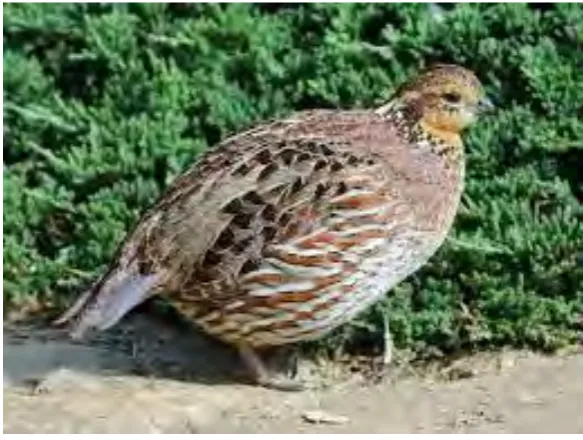
[image:19.595.172.464.272.492.2]The conduct if the quail is the great sign whether the temperature under the introvert is too high or too low. On the off chance that the quail assembles around the introvert, the temperature is too low. On the off chance that they are scattered around the edge of the ranch, the temperature is too high. On the off chance that they move to the other side pen, there is presumably a draft. At the point when the temperature is correct, the quail will be equitably spread and seem dynamic and substance.
7 According to Mohd. Azri Azman et al, 2008, the rising of temperature in a poultry house are due to the hot weather, ammonia gas and carbon dioxide that come from the chicken manure. Brian Fairchild, 2011 proves that poultry house contained some gas that can increase the temperature.
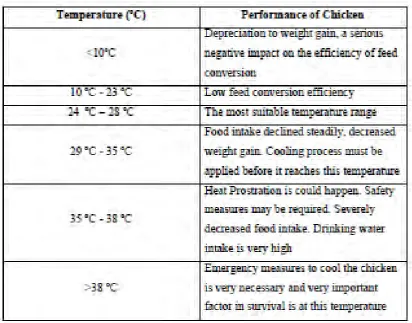
[image:20.595.116.523.229.458.2]Besides, in order to decide the suitable normal temperature range in a poultry house, it is need to know and understood what the effect on the chicken’s performance is if temperature in the poultry house is reach a certain value. Because of that, the guide of the performance of chickens at different temperatures is referred as shown in the below table.
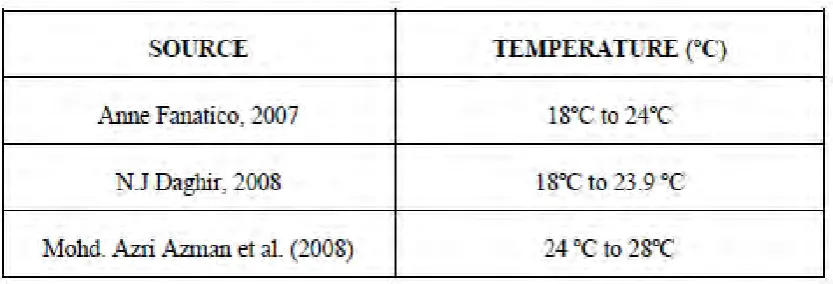
8 The other literature review about the suitable temperature chosen for this heat controlling system is from the studies of Anne Fanatico, 2007 said that the body temperature of an adult chicken is between 40.6ºC to 41.7 ºC (105ºF and 107ºF). Based on this temperature, Anne Fanatico 2007 recommended that the temperature range for a poultry house is between 18ºC to 24ºC (65ºF to 75ºF), which allows the chickens to maintain their body temperature. If the temperature is above 24ºC or 75ºF, heat must be lost in some way. Furthermore, it also explained that chickens have no sweat glands, and since eating can increasing their body temperature, chicken reduce their feed intake during hot weather and therefore, gains will be less. Besides, chicken begins panting at 85ºF (29.4ºC) to help dissipate heat, and drink more to avoid dehydration. A combination of high temperature and high humidity is a problem, because panting does not cool them under this condition.
[image:21.595.116.529.126.449.2]Then, according to N.J Daghir, 2008, it is mentioned that the thermo-neutral zone temperature for an adult chicken is around 18ºC to 23.9 ºC and when the
9 temperature of a chicken is in their thermo-neutral zone, the energy from the feed is used directed to help in growing, immune system development and reproduction. However, if the temperature of the chickens is below the thermo-neutral zone, energy from the feed is used as to generate the heat and not for the growth and development. Besides, Mohd. Azri Azman et al, 2008 mentioned that the range of temperature for a poultry house is about 24 ºC -28ºC. The table 2 below shows the summarization of temperature for a poultry house.
Based on the above table, it is showed that there are three suggested range of temperature of a poultry house are given. Based on this information, the range of temperature that will be used for this project is based on Mohd Azri Azman et al, 2008 suggestion. This is because, it is noticed that this project will be applied in Malaysia, because of that, this temperature is chosen.
2.3 Humidity Control System
[image:22.595.116.533.284.426.2]As indicated by H Ueda, Y Okamoto and H Noda, 2013, a humidity control framework incorporates three dehumidifiers. Each of the dehumidifiers on the other hand switches between first cluster operation in which air whose dampness has been caught up in a first adsorption part is provided to a room and air warmed in a warmth exchanger is depleted to outside the room during a time adsorption segment and second clump operation in which air whose dampness has been adsorbed in the second adsorption segment is provided to the room and air warmed in the warmth exchanger is depleted to outside the room through the primary adsorption segment. The
10 framework additionally incorporates a controller permitting the exchanging of the dehumidifiers to be performed at various timings and a chamber gathering air to be provided from the dehumidifiers to the room.
Humidity affects the rate of feather development as well as the incidence of respiratory diseases in the growing chick [5]. Low humidity often associated with Low humidity is often associated with reduced feather growth and poor plumage covering, while high humidity affects the respiration rate, particularly when the temperature is also high. When the quail is exposed to both high temperature and high humidity, it becomes unable to pant fast enough to dissipate its body heat and death frequently occurs. Therefore the humidity of the quail farm must be in the range between 60 and 70%.
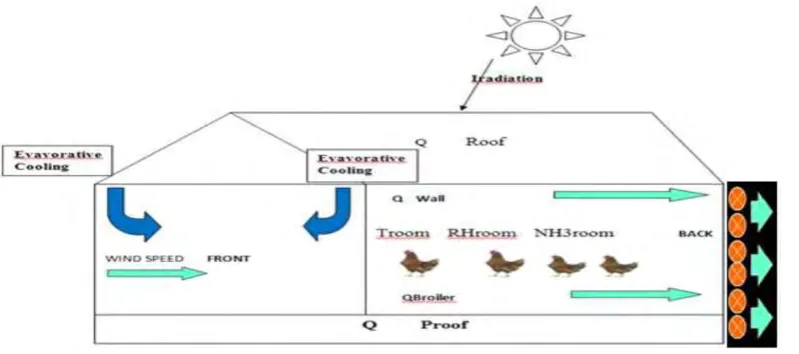
11 requirements be, to predict the temperature and relative clamminess are planned in a logical model poultry house under the law of essentialness equality as takes after.
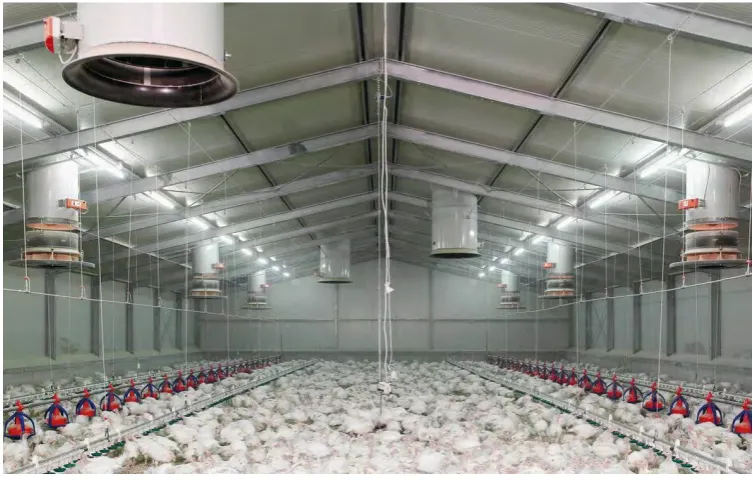
The figure 1 illustrate the concept modelling of poultry house. It is show the flow system wind in the poultry house. The wind will come in from the front and out at the back side. The fans which act as the output and blow out the ammonia in the poultry house.
2.4 Ammonia Intensity Control System
[image:24.595.123.523.148.325.2]In light of the Yu Huang, Shiquan Tao Journal of Sensor Technology, 2011, ammonia sensors have extensive variety of uses for mechanical method control furthermore for environ-mental observing. An optical fibre alkali sensor test has been delivered by using a bowed optical fibre having double poly (methyl methacrylate) (PMMA)/chlorophenol red coatings as a transducer. This sensor test was striven for checking take after noticing salts in gas tests using air as test cross section. The reaction of noticing salts with CPR causes a shading change of the reagent, which was distinguished by using fibre optic evanes-penny wave absorption spectrometry as a recognizing signal. By grasping a double layer covering structure, the sensor test has snappier response appeared differently in relation to a sensor using an extensively recognized distinguishing reagent-immobilized polymer covering structure. The