This is a repository copy of Decision uncertainty in multi-attribute stated preference studies.
White Rose Research Online URL for this paper: http://eprints.whiterose.ac.uk/92100/
Version: Accepted Version
Article:
Dekker, T, Hess, S, Brouwer, R et al. (1 more author) (2016) Decision uncertainty in
multi-attribute stated preference studies. Resource and Energy Economics, 43. pp. 57-73. ISSN 0928-7655
https://doi.org/10.1016/j.reseneeco.2015.11.002
© 2015, Elsevier. Licensed under the Creative Commons Attribution-NonCommercial-NoDerivatives 4.0 International http://creativecommons.org/licenses/by-nc-nd/4.0/
Reuse
Unless indicated otherwise, fulltext items are protected by copyright with all rights reserved. The copyright exception in section 29 of the Copyright, Designs and Patents Act 1988 allows the making of a single copy solely for the purpose of non-commercial research or private study within the limits of fair dealing. The publisher or other rights-holder may allow further reproduction and re-use of this version - refer to the White Rose Research Online record for this item. Where records identify the publisher as the copyright holder, users can verify any specific terms of use on the publisher’s website.
Takedown
If you consider content in White Rose Research Online to be in breach of UK law, please notify us by
Decision uncertainty in multi-attribute stated
1
preference studies
2
3
Abstract
4
Econometric modelling of decision uncertainty has received extensive attention in the
5
contingent valuation literature, but these methods are not directly transferable to the
6
realm of multi-attribute stated preference studies. In this paper, an integrated choice and
7
latent variable model tracing the impact of decision uncertainty on the valuation of flood
8
risks reductions in the Netherlands is developed. The proposed model structure is not
9
subject to the potential endogeneity bias and measurement error issues associated with
10
most applied methods. The driving factors of decision uncertainty are identified through
11
stated choices and a set of self-reported decision uncertainty follow-up questions. The
12
model simultaneously accounts for the impact of decision uncertainty on individual choices
13
and welfare estimates. In the presented case study, uncertain respondents are found to
14
make more random choices and select the opt out option more often.
Willingness-to-15
pay for flood risk reductions increases after accounting for these behavioural responses to
16
decision uncertainty.
17
Keywords: Decision uncertainty, Stated choice, Latent variable, Scale heterogeneity,
18
Flood risk, Bayesian analysis
19
JEL codes: C15, C51, D12, D80, Q51, Q54
20
Cite and published as:
21
Dekker, T., Hess, S., Brouwer, R. and Hofkes, M. ”Decision uncertainty in in multi-attribute
22
stated preference studies”. Resource and Energy Economics, accepted for publication on 09 Nov
23
2015. dx.doi.org/10.1016/j.reseneeco.2015.11.002
24
Previous version presented as:
25
Dekker, T., Hess, S., Brouwer, R. and Hofkes, M. (2013) ”Implicitly or explicitly uncertain?
26
An integrated choice and latent variable model to address decision certainty in stated choice
27
experiments” International Choice Modelling Conference, Syndey, July 2013.
1. Introduction
29
Interest in the impact of decision uncertainty on welfare estimates obtained from stated
30
preference (SP) surveys dates back to the period in which the contingent valuation method
31
(CVM) was the most widely applied non-market valuation method [see 41, 44, 2, for
32
overviews]. The capability of respondents to order alternatives in a choice set or to
33
express their willingness-to-pay according to their preferences depends on the extent to
34
which they are familiar with the presented trade-offs and the degree of experience they
35
have in making such trade-offs. A bias in welfare estimates may arise when the underlying
36
econometric model does not account for any form of decision uncertainty respondents
37
experience throughout the decision process.
38
Within the CVM literature, specifically the dichotomous choice (DC) response
for-39
mat, various survey formats and econometric approaches have been developed to
ac-40
count for the impact of decision uncertainty on willingness-to-pay (WTP) estimates [e.g.
41
32, 36, 48, 11, 30]. The implementation of these econometric methods in the context of
42
multi-attribute stated preference (MASP) studies is not straightforward. Several MASP
43
studies have measured decision uncertainty by positioning a follow-up question directly
44
after each choice task [e.g. 34, 12, 5, 26, 27, 39]. The treatment of self-reported
deci-45
sion uncertainty has, however, been limited from a methodological perspective. Firstly,
46
some papers [e.g. 39] assume decision uncertainty is a result of utility differences across
47
the alternatives in the choice set without recognising decision uncertainty itself may
in-48
fluence response patterns and consequently the estimated utility functions and welfare
49
implications. Secondly, other work has used the self-reported decision certainty responses
50
as an explanatory variable in the choice model [e.g. 34, 5] putting the analyst at risk of
51
endogeneity bias as well as measurement error (see Section 2.2).
52
Integrated Choice and Latent Variable (ICLV) models [e.g. 6] offer an intuitive
solu-53
tion to these two problems. ICLV models treat decision uncertainty as a latent construct
simultaneously affecting choice and the response to the follow-up question. Correlation
55
between the implicit representation of decision uncertainty in the choice model and its
56
explicit representation in the follow-up question is introduced by making the utility
func-57
tion and the measurement equation (which explains the reported degree of (un)certainty)
58
a function of the same latent variable ‘decision uncertainty’. Directional effects are
there-59
fore no longer pre-imposed in the ICLV model; endogeneity and measurement error issues
60
are circumvented by treating the follow-up responses as a dependent variable; and the
61
welfare implications of decision uncertainty can be traced through the impact of decision
62
uncertainty on the choice model.
63
In this paper, we explore whether the conceptual benefits of ICLV models outweigh the
64
increase in computational costs relative to the criticized approach of using self-reported
65
decision uncertainty as an explanatory variable in the utility function. Comparisons are
66
conducted at the level of welfare estimates given that measures of model fit are hard
67
to compare between traditional choice models and ICLV models. Our results reveal
re-68
spondents with a higher level of (latent) decision uncertainty tend to make more random
69
decisions, and they adopt a simplifying choice heuristic making them more likely to select
70
the status quo (i.e. opt out) option. This particular choice heuristic causes choice models
71
not accounting for decision uncertainty to underestimate welfare effects. Models
treat-72
ing self-reported decision uncertainty directly as an exogenous variable, however, provide
73
comparable welfare estimates to the more complex ICLV model. The advantage of the
74
ICLV model is that in addition to tracing the impact of decision uncertainty on choice
75
and welfare estimates, it also explains the driving factors of decision uncertainty across
76
respondents.
77
Our MASP study is conducted in the context of flood risk exposure in the Netherlands
78
in the face of climate change. The public nature of Dutch flood risk policy and absence of
79
private flood risk insurance causes most people to be unfamiliar with trade-offs regarding
their own flood risk exposure. This is a natural application to test our model of decision
81
uncertainty. Many alternative applications are likely to exist in the context of resource
82
and energy economics. MASP surveys in the context of e.g. wind turbines [31] and water
83
quality improvements [43, 37], as published in this journal, could all be facing unfamiliar
84
respondents adopting choice heuristics to deal with decision uncertainty.
85
2. Decision uncertainty in stated choice surveys
86
2.1. Definition
87
We define decision uncertainty as the combination of preference uncertainty and choice
88
uncertainty. Preference uncertainty is the degree of uncertainty respondents experience in
89
assigning a level of utility to an alternative. Preference uncertainty can arise as a result of
90
i) unfamiliarity with the good itself, ii) ambiguity or difficulty in interpreting particular
91
attributes and iii) the need to infer missing product information. Choice uncertainty
92
arises in the process of comparing the available alternatives and evaluating the decision in
93
light of the institutional setting. In practice, all the researcher observes is achoice subject
94
to both preference and choice uncertainty. Disentangling the two sources of uncertainty
95
is difficult (if not impossible), hence the focus of this paper is on the more generic notion
96
of decision uncertainty.
97
2.2. Measurement and modelling of decision uncertainty in stated choice surveys
98
The standard approach to measure decision uncertainty in the MASP studies is to include
99
a self-reported decision uncertainty follow-up question directly after each choice task [e.g
100
34, 12, 5, 25, 9]. Fenichel et al. [22] and Balcombe and Fraser [4] are exceptions in that
101
they present a ‘do not know’ option to respondents in addition to a status quo option. The
102
limited variability in methods measuring decision uncertainty in MASP studies highlights
the field is not yet as developed as its DC-CVM counterpart.1
104
Lundhede et al. [34] use the follow-up questions to evaluate three recoding approaches
105
rooted in DC-CVM studies to account for the impact of decision uncertainty on welfare
106
estimates. In applying these recoding approaches arbitrary assumptions need to be made
107
in order to define the most likely choice if the respondent would have chosen differently.
108
In other words, it remains unclear which alternative should be considered as second best
109
and used as the basis for recoding.2
110
To circumvent the recoding issue, self-reported decision uncertainty is usually directly
111
incorporated as an explanatory variable in the choice model [e.g.34,5,9]. Along the lines
112
of Arentze et al. [3], Caussade et al. [13] and DeShazo and Fermo [21], the above papers
113
explain variations in the variance (scale) of the utility function as a result of self-reported
114
decision uncertainty. This approach is consistent with Li and Mattsson [32]’s hypothesis
115
that uncertain respondents make more random decisions.
116
The self-reported decision uncertainty responses are likely to be associated with
mea-117
surement error, an issue Lundhede et al. [34] control for using an Instrumental Variable
118
(IV) approach. The IV-approach also circumvents possible endogeneity issues. Namely,
119
when the alternatives in the choice task are close to each other in terms of their utility
120
levels, then the choice task is likely to be perceived as complex and respondents will
re-121
port this in the follow-up questions. Using the self-reported decision uncertainty as an
122
explanatory factor in the utility function is likely to introduce correlation between the
123
error term of the utility function and the explanatory variables.
124
Manski [36] and Scarpa et al. [42] introduce an alternative perspective on decision
125
1
Kobayashi et al. [30] discuss the strengths and weaknesses of alternative econometric models and response formats accounting for decision uncertainty applied throughout the DC-CVM literature. The direct elicitation of choice probabilities, interpreted as a measure of decision uncertainty due to incomplete future scenarios, as proposed by Manski [36] and implemented by Blass et al. [7] is not included in the respective overview. The method has also not (yet) been implemented in the MASP literature.
2
uncertainty arising in MASP studies. Respondents in MASP studies tend to be more
126
unfamiliar with the presented hypothetical alternatives than with the status quo option,
127
which is actually experienced by respondents. Scarpa et al. [42] recommend the inclusion
128
of a common error component to deal with this type of uncertainty. In the remainder of
129
this paper, we focus on the econometric treatment of the self-reported decision uncertainty
130
follow-up responses whilst including the recommended error component.
131
2.3. The need for a simultaneous modelling approach
132
Two alternative sequential econometric modelling approaches exist in the context of
self-133
reported decision uncertainty. First, the IV-approach discussed in the previous section
134
finds explanatory variables for self-reported decision uncertainty and subsequently
in-135
cludes the measurement equation in the choice model. Second, Brouwer et al. [12] and
136
Olsen et al. [39] reverse the process by first estimating a choice model without controlling
137
for decision uncertainty. Expected utility differences are then directly implemented to
ex-138
plain the decision uncertainty responses. Although in line with the order of presentation
139
in the actual survey, the latter approach does not allow us to trace the impact of decision
140
uncertainty on the choice model and corresponding welfare measures.
141
The above discussion illustrates our critique on current approaches. A model taking
142
a one-directional view on decision uncertainty is incomplete. It should take into account
143
the impact of decision uncertainty on both the response to the choice task and the
self-144
reported decision uncertainty question. We therefore propose an Integrated Choice and
145
Latent Variable (ICLV) model in Section 3 which treats decision uncertainty as a latent
146
variable. Latent decision uncertainty simultaneously affects the choice model and the
147
decision uncertainty responses without imposing a directional effect. In making a decision,
148
respondents experience a degree of decision (un)certainty, which is implicitly reflected in
149
their decision (e.g. more random decisions) and explicitly in answering the self-reported
decision uncertainty follow-up question. Accordingly, the ICLV model provides a more
151
natural representation to the problem at hand.
152
Like in the IV-approach, the ICLV model uses a set of control variables to explain the
153
(latent) decision uncertainty. The use of such a structural equation avoids measurement
154
error by recognizing self-reported decision uncertainty responses are an imperfect measure
155
of underlying latent decision uncertainty. Similarly, endogeneity issues are avoided by the
156
inclusion of appropriate instrumental variables.
157
2.4. Two hypotheses
158
Given our interest in the impact of decision uncertainty on choice and related welfare
159
measures we form two specific working hypotheses tracing the impact of decision
uncer-160
tainty on the utility function. First, we maintain the Li and Mattsson [32] hypothesis
161
that uncertain respondents tend to have higher variance in the error term of their utility
162
function. Accordingly, their choices will have lower informational content. This
hypothe-163
sis predicts an increase (decrease) in the variance (scale) of utility as respondents become
164
more uncertain. This hypothesis is operationalised by introducing heteroscedasticity in
165
the error term across choice tasks [3, 13,21].
166
Alternative hypotheses exist arguing uncertain respondents adopt simplifying choice
167
heuristics affecting the structural part of the utility function. For example, Loomes et al.
168
[33] develop a model in which uncertain respondents are more likely to pick the status
169
quo alternative than is the case for certain respondents. This heuristic finds empirical
170
support in Balcombe and Fraser [4] and Swait and Adamowicz [46] and embodies our
171
second hypothesis. The hypotheses are tested jointly in the ICLV model.
172
3. The ICLV model
173
In this section, we provide a formal description of the ICLV model and its components, i.e.
174
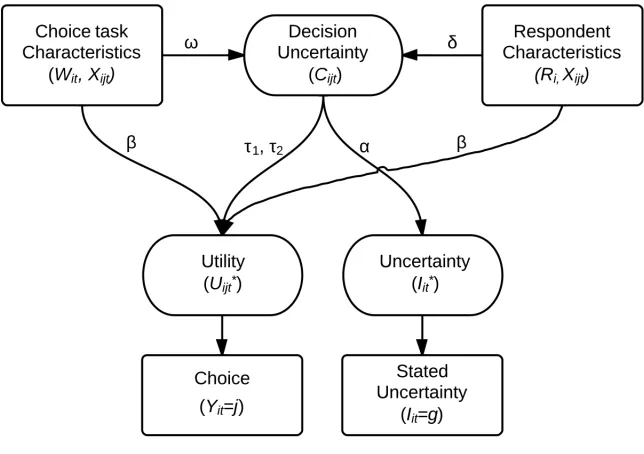
the structural equation, the choice model and the measurement model, [c.f. 6]. Figure 1
Figure 1: The ICLV model
provides a graphical representation. Rectangles represent directly observable variables and
176
ellipses latent constructs. The structural equation describes latent decision uncertainty
177
as a function of respondent and choice task characteristics. The choice model explains
178
the observed choices conditional on the level of latent decision uncertainty as well as
179
respondent and choice task characteristics. Note that the researcher only observes a
180
choice, while we use the latent notion of utility to explain choice behaviour. Similarly,
181
the measurement model explains ‘stated uncertainty’ which is measured on an ordinal
182
scale. Like any ordered probit (or logit) model, we map these responses on a continuous
183
uncertainty scale and use latent decision uncertainty as the only explanatory variable.3
184
3
Choice task and respondent characteristics have a direct impact on individual preferences U∗
ijt, and
possibly indirect through latent decision uncertainty Cit. We do, however, not believe they also bear a
direct relation with uncertaintyI∗
it. If that were the case there would be a structural mismatch between
Cit andIit∗ and the way we measure decision uncertainty. Violations of this assumption would possibly
3.1. The structural equation
185
Equation (1) denotes latent decision uncertainty Cit for respondent i in choice task t 186
as a linear function of respondent characteristics Ri and a set of choice task specific 187
characteristics Wit. Let δ and ω denote the marginal effects associated with respectively 188
Ri and Wit. For example, differences in gender and education may result in different 189
degrees of decision (un)certainty, while some choice tasks are more difficult than others,
190
because the alternatives in the choice set are more comparable to each other.
191
Cit =δRi+ωWit+ρi+εit (1)
Since δRi is unlikely to capture all respondent specific variation in decision uncertainty 192
across respondents, a respondent specific term ρi is included in the structural equation. 193
The latter is added in the form of a normally distributed random parameter with zero
194
mean and variance σ2
ρ.
4. Finally, ε
it represents an i.i.d. standard normally distributed 195
error term capturing remaining (unexplained) variations in latent decision uncertainty.
196
In accordance with the Bolduc et al. [8] normalisation the variance of εit is restricted to 197
unity. Cit remains unobserved and takes the form of a continuous variable where higher 198
values represent higher degrees of decision uncertainty.
199
A critical factor to include in the structural equation is a summary of choice task
200
complexity. Shannon [45]’s entropy measure H(Jit) = −Pj∈JitPijtln(Pijt) provides a
201
natural candidate reaching its maximum when all alternatives in the choice set have the
202
same choice probabilityPijt. Its dependence on choice probabilities, however, complicates 203
4
Recent applications of latent variable models in the choice modelling literature (e.g. Abou-Zeid et al. [1], Daly et al. [17], Daziano and Bolduc [18], Hess and Beharry-Borg [28], Yanez et al. [49]) have focused on underlying attitudes at the level of the respondent, and have used attitudinal questions at the level of the respondent as an indicator of these latent attitudes. Note that these responses have been captured only once per respondent. In contrast, we obtain a degree of self-reported decision uncertainty aftereach
operationalising the proposed ICLV model due to endogeneity. One option is to adopt
204
an iterative approach where at intermediate parameter values choice probabilities and
205
entropy are iteratively updated until the likelihood stabilises. It is not clear whether
206
such an iterative approach generates consistent parameter estimates. An easy and often
207
available alternative, adopted in this paper, is to estimate a basic choice model on a
208
different sub-sample (or pre-test sample) of the survey. The obtained choice probabilities
209
then enable researchers to approximate the entropy measure. Other options are to replace
210
entropy by alternative measures of complexity not depending on choice probabilities [e.g.
211
21].
212
3.2. The choice model
213
Respondents are assumed to select the alternative generating the highest level of (latent)
214
utility. The utility function Uijt = Vijt+ǫijt is specified in the standard linear-additive 215
form. Vijt represents the deterministic part of the utility function and ǫijt the stochastic 216
term. It is assumed thatǫijt follows a Type I Extreme Value distribution withvar(ǫijt) = 217
π2 6λ2
it. The inverse relation between the scale λit and variance of utility becomes directly
218
clear from this expression. In estimation, we rescale the stochastic and deterministic
219
part of the utility function by λit such that ǫ∗ijt follows an i.i.d distribution with variance 220
var(ǫ∗
ijt) = π
2
6 . Equation (2) describes the rescaled utility function U ∗
ijt. 221
U∗
ijt=V
∗
ijt+ǫ
∗
ijt =λitVijt+λitǫijt
= exp(τ1Cit)·((τ2Cit+β1+ζi)ASCijt+βiXijt) +ǫ∗ijt (2)
The second line of Equation (2) describes the implemented utility function which
embod-222
ies the two working hypotheses and Scarpa et al. [42]’s error component. First, the scale
223
certain respondents are expected to display a higher decisional variance, i.e. a lower scale.
225
Accordingly, τ1 is hypothesize to be negative.5 Second, τ2Cit represents the alternative 226
decision heuristic that uncertain respondents are more likely to select the status quo (or
227
opt out) option. We model this by interacting Cit with the alternative specific constant 228
(ASC). Here, ASCijthas a value of one when the alternative is not the status quo. Hence, 229
τ2 is hypothesized to take a negative value. β1 measures the average utility associated
230
with the ASC unrelated to decision uncertainty. Third, the interaction between ζi and 231
the ASC captures the additional variance associated with the hypothetical alternatives.
232
ζi takes the form of a normally distributed error component with zero mean and variance 233
σ2
ζ. Like in Scarpa et al. [42] the error component is introduced at the panel level. 234
The remaining part of the deterministic utility function comprises a set of exogenous
235
variables Xijt describing the attribute levels of each alternative and possibly other socio-236
economic characteristics. The vector βi measures the marginal utility associated with 237
each of these variables, where the subscript i denotes that marginal utility may vary
238
across respondents. Heterogeneity in preferences is described by means of a random
239
parameter specification using the mixing density f(βi|θ), where θ represents the set of 240
hyper-parameters. Conditional on the individual specific parameters and Cit, the choice 241
probability of respondenti selecting alternative j from choice set Jit in choice task t, i.e. 242
Yit =j, is described by: 243
P(Yit =j|Xit, Cit, βi, τ1, τ2) =
exp(exp(τ1Cit) ((τ2Cit+β1i)ASCijt+βiXijt))
PJit
k=1exp(exp(τ1Cit) ((τ2Cit+β1i)ASCikt+βiXikt))
(3)
5
Given thatCitfollows a normal distribution with variance 1, the scale of utility follows a log-normal
distribution with expected value expτ1(δRi+ωWit) +τ
2 1
2
. For normalisation purposes −τ12
2 is added
to the specification ofλit, i.eλit= exp(τ1Cit−τ
2 1
2). As such, the expected value ofλitreduces to unity
3.3. The measurement model
244
Latent decision uncertainty is measured by the choice task specific follow-up questionIit. 245
The translation of the follow-up question is: ‘How certain are you of your choice?’, where
246
the response format comprised a rating scale with five levels: ‘very certain’, ‘certain’,
247
‘neither certain nor uncertain’, ‘uncertain’ and ‘very uncertain’, respectively coded as
248
[0,1,2,3,4]. Daly et al. [17] put forward the use of an ordered logit model as an appropriate
249
specification of the measurement model given the ordered nature of Iit. We prefer to use 250
an ordered probit specification to facilitate estimation in a Bayesian framework.6
251
Let Iit+ represent a mapping of Iit on a continuous scale, such that a respondent 252
selects Iit = g if Iit+ falls between thresholds ψg−1 and ψg.7 Given that there are five 253
response categories to Iit, only four threshold parameters can be identified. We impose 254
ψg > ψg−1 and respectively set ψ0 = −∞ and ψ5 = ∞. Equation (4) then links latent
255
decision uncertainty Cit to the responses, where for normalisation purposes we impose 256
α= 1. νitrepresents a zero mean i.i.d. normally distributed stochastic term with variance 257
restricted to unity to comply with the ordered probit specification. Accordingly, Equation
258
(5) describes the probability that the respondent will indicate the degree of decision
259
uncertaintyg, whereφdenotes the standard normal density function and Φ its cumulative
260
density equivalent.
261
Iit+ =αCit+νit (4)
P(Iit =g|Cit) =
Z ψg
ψg−1
φ Iit+−αCit
dIit+ = Φ (ψg −αCit)−Φ (ψg−1−αCit) (5)
6
Effectively, in estimation we use a re-parameterised version of the ordered probit model similar to Nandram and Chen [38] reducing autocorrelation in the Gibbs Sampler.
7
3.4. Joint likelihood function and complexity of estimation
262
When the two sets of dependent variables, namely the observed choicesY and self-reported
263
decision uncertainty I, are analysed separately, the researcher estimates a discrete choice
264
model and an ordered probit model. The ICLV simultaneously estimates these two models,
265
and links them through the latent factor decision uncertainty. The conditional expressions
266
P(Yit=j|Cit) andP(Iit =g|Cit) in the joint likelihood function in Equation (6) therefore 267
refer to the choice probabilities and the probability of the choice task specific follow-up
268
responses. h(Cit|·) describes the structural equation linking the two models. The latent 269
nature ofCitin combination with the parameters (βi,ρi; captured in (6) by ∆i) controlling 270
for unobserved heterogeneity across respondents requires integration at two levels.
271
L(Y, I) =
n
Y
i=1
Z
∆i
T
Y
t=1
Z
Cit
P(Yit =j|Cit)P(Iit =g|Cit)h(Cit|δ, ω, ρi)dCitq(∆i|θ∆)d∆i (6)
Hess and Train [29] note that ICLV models are computationally intensive when using
fre-272
quentist estimation approaches. Therefore, we estimate the model using Bayesian
meth-273
ods and work around the integrals by evaluating a set of conditional densities using the
274
principles of data augmentation [47].8
Relative to existing sequential approaches to
deci-275
sion uncertainty, the ICLV model introduces additional estimation complexity, but allows
276
to trace the impact of decision uncertainty on the choice model without imposing
direc-277
tional relationships between choices and self-reported decision uncertainty as discussed in
278
Section2.3.
279
8
4. The Case Study
280
4.1. Valuation of flood risks in the Netherlands
281
The case study is based on a Dutch MASP survey concerning flood risk valuation in the
282
face of climate change. An online survey was conducted in the provinces of North- and
283
South-Holland between February and March 2010. The cities of Amsterdam, The Hague
284
and Rotterdam are situated in these densely populated provinces. The Dutch government
285
and regional water boards attempt to maintain a flood probability of once every 10,000
286
years in the study area. Without additional investments, flood probabilities are expected
287
to increase to once every 4,000 years by 2040 due to climate change [35]. Even though
288
most of the Dutch are aware that they live below sea level, they are not accustomed to
289
making trade-offs regarding their personal flood safety. Water boards and other public
290
institutions are primarily responsible for providing and monitoring flood safety levels.
291
Decision uncertainty is therefore likely to play a role in this case study.
292
4.2. The stated choice experiment
293
The choice experiment elicits the extent to which respondents are willing to increase their
294
annual (tax) contributions to the water board in order to reduce the probability of a
295
coastal flood and the associated consequences. A detailed description of the survey is
296
provided in Dekker [19]. The choice experiment is distinctively different from Botzen and
297
van den Bergh [10] who present flood risk reductions in the context of a public-private
298
partnership where respondents can insure themselves against flood risks as a result of
299
climate change. Flood risk insurance is, however, currently not (yet) available in the
300
Netherlands. Accordingly, our positioning of flood risk valuation in the context of a pure
301
public good is more in line with the current institutional setting.
302
In this paper, we focus on the only subsample (one of five) in which respondents
303
were presented with a decision uncertainty follow-up question after each choice task.
Respondents were presented with ten choice tasks each. The first and tenth choice task
305
were identical, where the first task served as an introductory question and the final choice
306
task was included as a test for consistency. In the analysis, we focus on choice tasks 2-9,
307
resulting in a balanced panel of eight choice tasks per respondent and a total of 1,792
308
observations from a sample of 224 respondents.
309
In each choice task, two different flood policy scenarios and a status quo option were
310
presented to the respondent. Each policy scenario is characterised by four attributes: (i)
311
reductions in flood probability; (ii) compensation of material damage to each household
312
after a coastal flood has occurred; (iii) available time for local authorities to organise and
313
completely evacuate the area under threat; and (iv) an increase in annual tax to the water
314
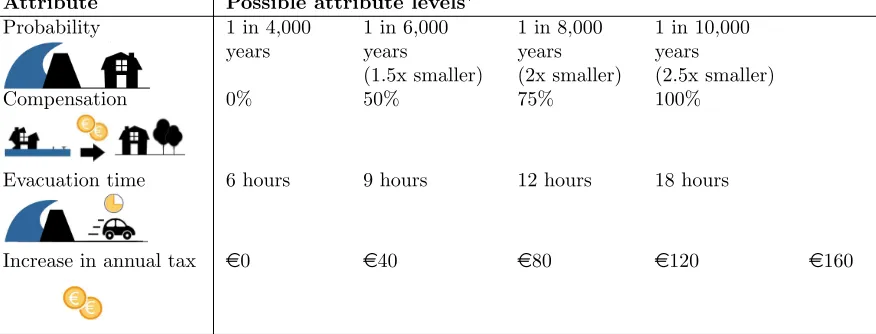
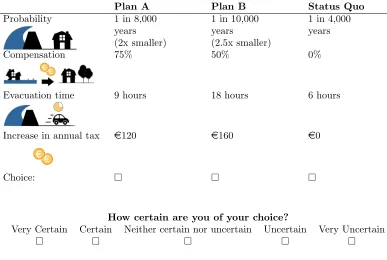
board per household. Table1shows the potential levels of each attribute and defines the
315
status quo (i.e. opt out) option. An example of a choice card, including the follow-up
316
question is presented in Table A.5.
317
The experimental design for the sample used here is based on a d-efficient design for a
318
linear attributes only MNL model, including an ASC. Local non-zero priors in the design
319
were derived from an earlier pre-test sample on which alternative functional forms were
320
tested. The design was generated in Ngene [16] and consists of 24 choice cards blocked
321
into three groups of eight cards. Each respondent was randomly presented with one of
322
these blocks. Positions of the cards within each block were systematically rotated to
323
prevent ordering effects [see also 20].
324
5. Results
325
We present results from five alternative model specifications. The first model presents a
326
random parameters logit model where the choices in the SC are analysed without
con-327
trolling for decision uncertainty. Model 2 treats the self-reported decision uncertainty
328
Table 1: Attributes, attribute levels and definition of the Status Quo option
Attribute Possible attribute levels∗
Probability 1 in 4,000 1 in 6,000 1 in 8,000 1 in 10,000
years years years years
(1.5x smaller) (2x smaller) (2.5x smaller)
Compensation 0% 50% 75% 100%
Evacuation time 6 hours 9 hours 12 hours 18 hours
Increase in annual tax e0 e40 e80 e120 e160
∗ The Status Quo option takes the most left (lowest) levels on all policy attributes
choice model. Accordingly, Model 2 might be subject to endogeneity and measurement
330
error. Model 3 corrects for these issues by running a sequential IV-model. First a
ran-331
dom effects ordered probit model is estimated to obtain parameter estimates for δ and
332
ω and thereby derive expected values for ˆI+
it. Then a choice model is estimated using 333
ˆ I+
it = ˆCit as a control variable. Model 4 presents the Full Information Maximum Likeli-334
hood (FIML) equivalent of Model 3. That is, the conditional posterior for the augmented
335
variable Iit+ not only takes into account the boundaries set by the threshold parameters
336
in the ordered probit model (as in Model 3), but also the subsequent impact of ˆI+
it= ˆCit 337
on the choice model. Model 5 presents the results of the developed ICLV model. The
338
difference between Models 4 and 5 is that the latter treatsIit+ and Cit as separate entities. 339
Effectively, the estimated thresholds parameters associated with the self-reported decision
340
uncertainty questions no longer constrain the location of Cit and thereby alter Model 4 341
from a sequential into a simultaneous model structure. This subtle change accommodates
342
the critiques mentioned in Section2.3. All models include a separate error-component
ac-343
counting for potential scale difference between the scale of the status quo and hypothetical
344
alternatives [42].
5.1. Choice models and simple IV-estimation
346
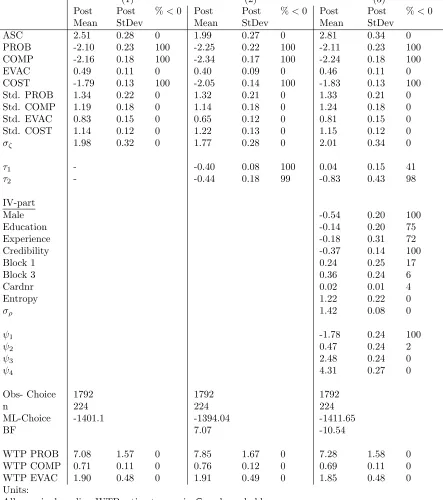
Table 2 presents the results for the first three model specifications. Model 1 can be
347
characterised as an attributes only choice model where the probability, compensation and
348
cost attribute follow a lognormal distribution to ensure a strictly positive (negative for
349
cost) impact on utility. The evacuation attribute follows a normal distribution in order to
350
allow the model to converge. The specification of the choice model does not vary across
351
models 1-5 apart from the interaction of decision uncertainty with respectively the ASC
352
and scale parameter.
353
The parameter and welfare estimates for Model 1 confirm expectations. Respondents
354
experience a positive utility from reductions in flood probability, additional compensation,
355
and increases in available evacuation time, while they are less likely to select a policy
356
alternative with higher costs. The marginal WTP estimates reveal households are willing
357
to pay e7.08 per year to reduce flood probabilities by 1,000 years, i.e. from 1/4,000 to
358
1/5,000 year. Similarly, an additional percentage of compensation is worth e0.71 per
359
household per year and an extra hour of evacuation time e1.90.9 σζ confirms that the
360
hypothetical alternatives are associated with additional error variance.
361
As expected, both τ1 and τ2 have a negative coefficient in Model 2. The former
high-362
lights uncertain respondents exhibit a higher decisional variance. The latter confirms
363
uncertain respondents have a higher tendency to select the status quo alternative.
Treat-364
ing the follow-up responses as an exogenous explanatory variable in the choice model
365
translates into a decisive improvement in model fit as highlighted by the Bayes Factor of
366
7.07 relative to Model 1.10
Median WTP estimates for Model 2 are all higher compared
367
9
During each iteration of the Gibbs Sampler, the median WTP for an attribute was calculated and stored using the augmented preference parameters across individuals.
10
Table 2: Results choice models and basic IV-estimation
(1) (2) (3)
Post Post %<0 Post Post %<0 Post Post %<0
Mean StDev Mean StDev Mean StDev
ASC 2.51 0.28 0 1.99 0.27 0 2.81 0.34 0
PROB -2.10 0.23 100 -2.25 0.22 100 -2.11 0.23 100
COMP -2.16 0.18 100 -2.34 0.17 100 -2.24 0.18 100
EVAC 0.49 0.11 0 0.40 0.09 0 0.46 0.11 0
COST -1.79 0.13 100 -2.05 0.14 100 -1.83 0.13 100
Std. PROB 1.34 0.22 0 1.32 0.21 0 1.33 0.21 0
Std. COMP 1.19 0.18 0 1.14 0.18 0 1.24 0.18 0
Std. EVAC 0.83 0.15 0 0.65 0.12 0 0.81 0.15 0
Std. COST 1.14 0.12 0 1.22 0.13 0 1.15 0.12 0
σζ 1.98 0.32 0 1.77 0.28 0 2.01 0.34 0
τ1 - -0.40 0.08 100 0.04 0.15 41
τ2 - -0.44 0.18 99 -0.83 0.43 98
IV-part
Male -0.54 0.20 100
Education -0.14 0.20 75
Experience -0.18 0.31 72
Credibility -0.37 0.14 100
Block 1 0.24 0.25 17
Block 3 0.36 0.24 6
Cardnr 0.02 0.01 4
Entropy 1.22 0.22 0
σρ 1.42 0.08 0
ψ1 -1.78 0.24 100
ψ2 0.47 0.24 2
ψ3 2.48 0.24 0
ψ4 4.31 0.27 0
Obs- Choice 1792 1792 1792
n 224 224 224
ML-Choice -1401.1 -1394.04 -1411.65
BF 7.07 -10.54
WTP PROB 7.08 1.57 0 7.85 1.67 0 7.28 1.58 0
WTP COMP 0.71 0.11 0 0.76 0.12 0 0.69 0.11 0
WTP EVAC 1.90 0.48 0 1.91 0.49 0 1.85 0.48 0
Units:
All marginal median WTP estimates are ineper household per year
Probability - Increase in the denominator of probability by 1,000 years, i.e. from 1/4,000 to 1/5,000 Compensation - Additional percentage of compensation
to Model 1, particularly for the probability attribute. The size of the posterior standard
368
errors on the WTP estimates, however, indicate there are no significant differences in
369
welfare estimates between Models 1 and 2. The increase in median WTP estimates can
370
be related to the choice heuristic associated with τ2. Without controlling for the impact
371
of decision uncertainty, Model 1 increases the relative importance of the cost attribute to
372
accommodate for the fact that uncertain respondents select the status quo more often.
373
The sequential IV-estimation procedure presented by Model 3 experiences difficulties
374
in linking expected decision uncertainty to observed choice behaviour. τ1 on the one
375
hand changes sign and is no longer statistically different from zero. τ2 on the other hand
376
suggests respondents are even more likely to select the status option due to decision
377
uncertainty. Note, however, that the posterior standard errors on the τ parameters have
378
also increased substantially. It is therefore not surprising that Model 3 reveals a lower
379
marginal likelihood than Models 1 and 2. We attribute this to the fact that Model 3 does
380
not account for the heterogeneity in decision uncertainty represented by ρi given that we 381
used a mean-based approach. Based on Model 3, we might conclude that the direct use
382
of self-reported decision uncertainty in Model 2 results in an overestimation of median
383
WTP. Namely, we only observe a negligible, increase in median WTP estimates relative
384
to Model 1. The instability of theτ parameter estimates in Model 3, however, justifies a
385
closer examination of decision uncertainty in the context of a sequential FIML approach
386
and the proposed ICLV model.
387
5.2. Explanatory variables in the IV-approach and structural equation
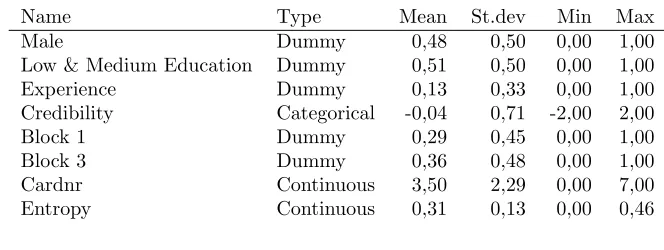
388
The explanatory variables included in the IV-part of Model 3 (and in the remaining
389
models) are summarised in Table 3. They represent the driving factors of self-reported
390
decision uncertainty. Tables 2and4point out that males are less uncertain than females,
391
while education does not seem to have an influence on decision uncertainty; a finding
confirmed by both Olsen et al. [39] and Brouwer et al. [12]. Respondents who stated
393
that the proposed policy scenarios are credible tend to reflect lower levels of decision
394
uncertainty, a finding also reported in Brouwer et al. [12]. The results, however, do not
395
confirm that respondent that have previously experienced a flood exhibit lower levels of
396
decision uncertainty.11
Four variables are related to choice task characteristics.
397
The dummy variables Block 1 and Block 3 indicate that splitting up the design into
398
three blocks resulted in Block 2 being slightly easier for respondents compared to the
399
two other blocks. Indeed, correlating the blocks with the entropy measure revealed that
400
Block 2 contained two relatively easy choice tasks. Decision uncertainty is increasing in
401
the length of the stated choice survey as reflected by Cardnr. By altering the order of
402
appearance of choice cards across respondents, this effect is most likely related to fatigue
403
or boredom effects. Finally, Entropy summarises choice task complexity using Shannon
404
[45]’s entropy measure (see Section 3.1). The results confirm that decision uncertainty is
405
increasing in the complexity of the choice task.
[image:21.612.130.462.442.567.2]406
Table 3: Overview of explanatory variables in the structural equation
Name Type Mean St.dev Min Max
Male Dummy 0,48 0,50 0,00 1,00
Low & Medium Education Dummy 0,51 0,50 0,00 1,00
Experience Dummy 0,13 0,33 0,00 1,00
Credibility Categorical -0,04 0,71 -2,00 2,00
Block 1 Dummy 0,29 0,45 0,00 1,00
Block 3 Dummy 0,36 0,48 0,00 1,00
Cardnr Continuous 3,50 2,29 0,00 7,00
Entropy Continuous 0,31 0,13 0,00 0,46
11
5.3. FIML and ICLV models
407
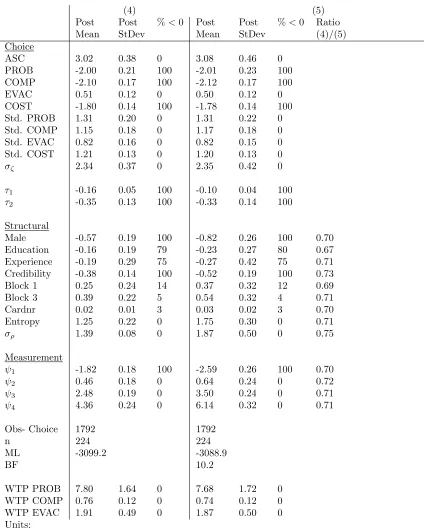
Table4shows large consistencies between the IV-parts in Models 3 and 4. The direct
con-408
nection between the ordered probit model and the choice model in Model 4 enables better
409
identification of theτ parameters, which again take the expected negative value. Decision
410
uncertainty therefore has an impact on individual choice behaviour through making more
411
random choices and by adopting alternative decision heuristics. The obtained marginal
412
WTP estimates from Model 4 show close resemblance with those obtained from the
cri-413
tiqued Model 2. In other words, there might not be too much bias in directly including
414
the self-reported decision uncertainty responses in the choice model. Moving from the
415
sequential FIML model (Model 4) to the proposed ICLV model (Model 5) shows that the
416
parameters of the choice model stay fairly constant. The τ parameters lead to the same
417
conclusion that decision uncertainty has an impact on individual choice behaviour, even
418
though τ1 shows a slight drop relative to Model 4. The main difference between the two
419
models arises in the parameters for the structural and measurement equation. The final
420
column in Table 4reveals estimates for Model 4 are about a factor 0.7 smaller than those
421
for Model 5. The scaling is a direct consequence of the fact that additional variance is
422
added around latent decision uncertainty in the ICLV model. In fact, when neglecting
423
the influence of the choice model the variance of the ordered probit model increases to
424
two, explaining why the parameters in the ICLV model are about a factor√2≈ 1
0.7 larger
425
than those in the FIML model.
426
The ICLV model has a decisively better fit than the FIML likelihood approach. We
427
explain this by noting that the sequential FIML puts most emphasis on explicit decision
428
uncertainty represented in the self-reported decision uncertainty measures. Part of the
429
224 respondents did not change their self-reported decision uncertainty over the choice
430
sequence, while a different pattern may be revealed by the implicit representation of
deci-431
sion uncertainty in the choice model. By using both implicit and explicit representations
Table 4: Results FIML and ICLV model
(4) (5)
Post Post %<0 Post Post %<0 Ratio
Mean StDev Mean StDev (4)/(5)
Choice
ASC 3.02 0.38 0 3.08 0.46 0
PROB -2.00 0.21 100 -2.01 0.23 100
COMP -2.10 0.17 100 -2.12 0.17 100
EVAC 0.51 0.12 0 0.50 0.12 0
COST -1.80 0.14 100 -1.78 0.14 100
Std. PROB 1.31 0.20 0 1.31 0.22 0
Std. COMP 1.15 0.18 0 1.17 0.18 0
Std. EVAC 0.82 0.16 0 0.82 0.15 0
Std. COST 1.21 0.13 0 1.20 0.13 0
σζ 2.34 0.37 0 2.35 0.42 0
τ1 -0.16 0.05 100 -0.10 0.04 100
τ2 -0.35 0.13 100 -0.33 0.14 100
Structural
Male -0.57 0.19 100 -0.82 0.26 100 0.70
Education -0.16 0.19 79 -0.23 0.27 80 0.67
Experience -0.19 0.29 75 -0.27 0.42 75 0.71
Credibility -0.38 0.14 100 -0.52 0.19 100 0.73
Block 1 0.25 0.24 14 0.37 0.32 12 0.69
Block 3 0.39 0.22 5 0.54 0.32 4 0.71
Cardnr 0.02 0.01 3 0.03 0.02 3 0.70
Entropy 1.25 0.22 0 1.75 0.30 0 0.71
σρ 1.39 0.08 0 1.87 0.50 0 0.75
Measurement
ψ1 -1.82 0.18 100 -2.59 0.26 100 0.70
ψ2 0.46 0.18 0 0.64 0.24 0 0.72
ψ3 2.48 0.19 0 3.50 0.24 0 0.71
ψ4 4.36 0.24 0 6.14 0.32 0 0.71
Obs- Choice 1792 1792
n 224 224
ML -3099.2 -3088.9
BF 10.2
WTP PROB 7.80 1.64 0 7.68 1.72 0
WTP COMP 0.76 0.12 0 0.74 0.12 0
WTP EVAC 1.91 0.49 0 1.87 0.50 0
Units:
All marginal median WTP estimates are ineper household per year
Probability - Increase in the denominator of probability by 1,000 years, i.e. from 1/4,000 to 1/5,000 Compensation - Additional percentage of compensation
of decision uncertainty, the ICLV model can work around such inconsistencies between
433
Cit and Iit+ and improve model fit. 434
Overall, the ICLV model illustrates that there exists a correlation between the implicit
435
and explicit representation of decision uncertainty in respectively choice behaviour and
436
self-reported decision uncertainty. Clearly, there is not a one to one relation between
437
the two and possibly a (non-modelled) causal relation exists. As such, the self-reported
438
decision uncertainty variable cannot be used as a direct (and exogenous) explanatory
439
variable in the choice model from a theoretical perspective. Remarkably, however, is that
440
in the current case study the latter naive approach and more advanced FIML and ICLV
441
models result in a comparable increase in median WTP estimates. The scale-free median
442
WTP estimates highlight the potential for underestimation of welfare effects when not
443
controlling for decision uncertainty. It should be noted that these effects are not very
444
strong given the size of the posterior standard deviations, but concern is warranted for
445
future research.
446
6. Conclusions
447
In this paper, we propose an Integrated Choice and Latent Variable (ICLV) model to
448
account for decision uncertainty in multi-attribute stated preference (MASP) studies.
449
Decision uncertainty is treated as a latent variable, which simultaneously affects stated
450
choices and responses to a set of follow-up decision uncertainty questions. The ICLV
451
model thereby works around potential endogeneity and measurement error issues likely
452
to arise when using the follow-up responses as a direct measure of decision uncertainty.
453
The proposed ICLV model provides a more intuitive approach to treating decision
un-454
certainty compared to existing methods in the MASP literature. The frequently adopted
455
assumption of a one-directional impact in sequential models hampers the modelling of the
456
complex relation between the implicit and explicit representation of decision uncertainty.
That is, the degree of decision uncertainty present in the actual choice process might
458
not always correspond with the stated level of decision uncertainty. The simultaneous
459
modelling approach accounts for the correlation between the decision uncertainty
respon-460
dents implicitly reveal while making choices and the explicit degree of decision uncertainty
461
stated in the follow-up questions, but does not assume they are identical.
462
The ICLV model is applied to a MASP experiment on flood risk valuation in the
463
Netherlands. Two complementary hypotheses are embedded in the ICLV model. The
464
first hypothesis represents the conjecture that uncertain respondents make more random
465
decisions reducing the informational content of their responses. The second hypothesis
466
controls for uncertain respondents adopting an alternative decision heuristic to simplify
467
the choice task. The decision heuristic adopted here accounts for uncertain respondents
468
being more likely to select the status quo (or opt out) option. Evidence for both
hy-469
potheses is found in the form of significant interactions of latent decision uncertainty
470
with respectively the scale of the utility function, and the alternative specific constant,
471
whilst including an error-component accounting for potential scale difference between the
472
hypothetical and status quo alternatives.
473
The finding that WTP estimates increase when controlling for decision uncertainty can
474
be related to the second hypothesis. When the model does not control for the adoption
475
of an alternative choice heuristic, other model parameters correct for such behavioural
476
patterns and become biased. In our case, the respondents either need to become more
477
cost sensitive or assign a lower importance to the non-cost policy attributes. Both effects
478
translate into lower WTP estimates for the policy attributes which are actually caused by
479
uncertain respondents having a higher tendency to select the status quo option. The first
480
hypothesis also translates into an increase in marginal WTP estimates, but the magnitude
481
of the change is smaller. In general, the observed differences in WTP estimates relative to
482
the base model are of minor size, a finding confirmed by Lundhede et al. [34]. Our findings
are, however, at stake with conclusions from the contingent valuation (CV) literature,
484
where WTP estimates tend to decrease after controlling for decision uncertainty [e.g.11].
485
The controversy might be related to the recoding approaches applied in the CV literature,
486
where uncertain ‘yes’ responses are frequently recoded as ‘no’ responses [15].12
487
Recoding approaches find their origin in real world behaviour, where uncertain
respon-488
dents might be inclined to say ‘yes’ in stated preference studies, but in real-world decision
489
would revert to ‘no’.13
The equivalent type of reverting behaviour between stated- and
490
real-world behaviour in MASP contexts is less clear. One of the recoding approach put
491
forward by Lundhede et al. [34], i.e. recode uncertain responses into the status quo
op-492
tion, is the only and probably most realistic approach available yet. Additional research
493
on this topic, in combination with the use of alternative response formats to identify
de-494
cision uncertainty in MASP studies [e.g.4,22,36] is required. MASP studies on decision
495
uncertainty are not as developed as their CVM counterparts in this regard.
496
The approach taken in non-recoding studies, including ours, is slightly different. We
497
are interested in the trade-offs that people are willing to make after taking away the
498
impact of decision uncertainty on their choices. These preferences might not correspond
499
with the choices that would be made in the real-world when individuals might still be
500
suffering from decision uncertainty. Instead the inferred preferences get closer to the
501
utilities and welfare effects experienced by individuals when the uncertainty disappears
502
(e.g. when a project is actually implemented). As a result, potential discrepancies between
503
the welfare estimates from non-recoding methods and those of recoding approaches are
504
best attributed to a (negative) welfare effect of decision uncertainty. The latter relates
505
to welfare effects perceived at the moment of decision making. Either way, recoding and
506
12
Shaikh et al. [44] show that the directional impact on WTP is not necessarily consistent across recoding approaches. Moreover, Brouwer [11] finds a decrease in WTP without using recoding approaches.
13
modelling approaches do suggest that not accounting for decision uncertainty at all is
507
likely to introduce some form of bias in the welfare estimates. The size and direction of
508
this effect needs to be determined empirically.
509
Despite its conceptual advantages, the ICLV model comes with additional
computa-510
tional costs. Comparable median WTP estimates are obtained when using more naive
511
modelling approaches, such as the direct use of self-reported decision uncertainty in the
512
discrete choice model. By being restricted to a single case study, the generalisability of
513
this similarity in results is limited and can only be confirmed by applying the same model
514
structure to alternative datasets.
515
Researchers should question whether the additional effort of setting up a complex
516
ICLV model is justified. When the prime interest is in obtaining unbiased welfare
esti-517
mates, naive approaches may be sufficient. These simple approaches also do not depend
518
on imperfect measures of choice task complexity, such as the Shannon [45] entropy
mea-519
sure applied in this paper. The joint modelling framework, however, also opens the road
520
for improved welfare estimates, and a renewed focus on the driving factors of decision
521
uncertainty. For example, we find that decision uncertainty decreases when respondents
522
are presented with easier choice tasks. This is not a call for easier choice tasks, but it
523
highlights the delicate balance between designing choice tasks with small utility
differ-524
ences, to accurately identify the impact of specific policy attributes, and the opposite
525
effect it has on decision uncertainty. Moreover, the random parameter in the structural
526
model indicates that significant heterogeneity in decision uncertainty across respondents
527
remains unexplained. Partially, this could be related to the simplistic format of the
follow-528
up question, but finding better drivers of decision uncertainty can also help in improving
529
the formatting and wording of the stated choice experiment. The implications of
deci-530
sion uncertainty can thus already be reduced in the design stage rather than correcting
531
for it during the data analysis. One possible line of future research is to provide a split
sample with alternative information treatments to see whether survey descriptions (i.e.
533
information) affects decision uncertainty.
534
Additional lines of future research include the potential use of the iterative estimation
535
approach to derive Shannon [45]’s entropy measure , i.e. approximate utility differences
536
between alternatives and choice probabilities in the choice task, in the absence of pilot
537
data, or alternative data sources. Moreover, we have solely focused on the interaction
538
between decision uncertainty and the generic scale parameter. We have done so since our
539
empirical study focused on future scenarios, including the status quo. In future research
540
it might be explored whether interactions with the included error component are more
541
apporpriate, particularly when the status quo is well-known to the respondents, but the
542
hypothetical alternatives are relatively unfamiliar.
543
The results of this study have no direct implications for Dutch flood risk policies.
544
Currently, flood risk policies are evaluated in the context of social cost benefit analysis
545
where benefits are quantified using a prevented global damage method, also known as
546
the HIS schade en slachtoffer module (version 2.1) . Non-market values, such as derived
547
through our MASP study, are not included in those procedures. In the context of climate
548
change, Dutch policy makers are, however, looking for alternative ways to quantify policy
549
benefits and for public-private partnerships in sharing responsibilities for flood risks [e.g.
550
10]. Non-market valuation methods have an important role in this process. The fact that
551
respondents lack experience with making decision regarding (future) flood risk exposure
552
should, however, be taken into account when using MASP studies for these purposes.
553
Similar concerns regarding the impact of decision uncertainty on welfare estimates should
554
be taken into account when applying MASP studies to any non-market valuation study,
555
including those in the field of energy and resource economics.
Acknowledgements
557
This research was funded by the Dutch National Research Program ‘Climate Changes
558
Spatial Planning’ (www.klimaatvoorruimte.nl). The authors would like to thank two
559
anonymous reviewers for helping to improve the paper.
560
References
561
[1] Abou-Zeid, M., Ben-Akiva, M., Bierlaire, M., Choudhury, C., and Hess, S. (2011).
562
Applied Transport Economics - A management and policy perspective, chapter Attitudes
563
and value of time heterogeneity, pages 525–548. De Boeck Publishing.
564
[2] Akter, S., Bennett, J., and Akhter, S. (2008). Preference uncertainty in contingent
565
valuation. Ecological Economics, 67(3):345 – 351.
566
[3] Arentze, T., Borgers, A., Timmermans, H., and DelMistro, R. (2003). Transport
567
stated choice responses: effects of task complexity, presentation format and literacy.
568
Transportation Research Part E: Logistics and Transportation Review, 39(3):229 – 244.
569
[4] Balcombe, K. and Fraser, I. (2011). A general treatment of don’t know responses from
570
choice experiments. European Review of Agricultural Economics, 38(2):171–191.
571
[5] Beck, M. J., Rose, J. M., and Hensher, D. A. (2013). Consistently inconsistent: The
572
role of certainty, acceptability and scale in choice. Transportation Research Part E:
573
Logistics and Transportation Review, 56:81 – 93.
574
[6] Ben-Akiva, M., Walker, J., Bernardino, A. T., Gopinath, D. A., Morikawa, T., and
575
Polydoropoulou, A. (1999). Integration of choice and latent variable models.
Mas-576
sachusetts Institute of Technology, Cambridge, Ma.
577
[7] Blass, A. A., Lach, S., and Manski, C. F. (2010). Using elicited choice probabilities to
578
estimate random utility models: Preferences for electricity reliability*. International
579
Economic Review, 51(2):421–440.
580
[8] Bolduc, D., Ben-Akiva, M., Walker, J., and Michaud, A. (2005). Integrated Land-Use
581
and Transportation Models: Behavioural Foundations, chapter Hybrid Choice Models
582
with Logit Kernel: Applicability to Large Scale Models, pages 275–302. Elsevier.
[9] Borger, T. (2015). Are fast responses more random? testing the effect of response
584
time on scale in an online choice experiment. Environmental and Resource Economics,
585
pages 1–25.
586
[10] Botzen, W. J. and van den Bergh, J. C. J. M. (2012). Monetary valuation of insurance
587
against flood risk under climate change*. International Economic Review, 53(3):1005–
588
1026.
589
[11] Brouwer, R. (2011). A mixed approach to payment certainty calibration in discrete
590
choice welfare estimation. Applied Economics, 43(17):2129–2142.
591
[12] Brouwer, R., Dekker, T., Rolfe, J., and Windle, J. (2010). Choice certainty and
592
consistency in repeated choice experiments. Environmental and Resource Economics,
593
46(1):93–109.
594
[13] Caussade, S., de Dios Ortuzar, J., Rizzi, L. I., and Hensher, D. A. (2005). Assessing
595
the influence of design dimensions on stated choice experiment estimates.
Transporta-596
tion Research Part B: Methodological, 39(7):621 – 640.
597
[14] Champ, P. and Bishop, R. (2001). Donation payment mechanisms and contingent
598
valuation: An empirical study of hypothetical bias. Environmental and Resource
Eco-599
nomics, 19(4):383–402.
600
[15] Champ, P. A., Bishop, R. C., Brown, T. C., and McCollum, D. W. (1997). Using
601
donation mechanisms to value nonuse benefits from public goods. Journal of
Environ-602
mental Economics and Management, 33(2):151 – 162.
603
[16] ChoiceMetrics (2010). Ngene 1.1.1 - USER MANUAL & REFERENCE GUIDE.
604
[17] Daly, A., Hess, S., Patruni, B., Potoglou, D., and Rohr, C. (2012). Using ordered
605
attitudinal indicators in a latent variable choice model: a study of the impact of security
606
on rail travel behaviour. Transportation, 39(2):267–297.
607
[18] Daziano, R. A. and Bolduc, D. (2013). Incorporating pro-environmental preferences
608
towards green automobile technologies through a bayesian hybrid choice model.
Trans-609
portmetrica A: Transport Science, 9(1):74–106.
610
[19] Dekker, T. (2012). Preference uncertainty in stated choice experiments. PhD thesis,
611
VU University Amsterdam.
[20] Dekker, T., Koster, P., and Brouwer, R. (2014). Changing with the tide:
Semipara-613
metric estimation of preference dynamics. Land Economics, 90(4):717–745.
614
[21] DeShazo, J. and Fermo, G. (2002). Designing choice sets for stated preference
meth-615
ods: The effects of complexity on choice consistency. Journal of Environmental
Eco-616
nomics and Management, 44(1):123 – 143.
617
[22] Fenichel, E. P., Lupi, F., Hoehn, J. P., and Kaplowitz, M. D. (2009). Split-sample
618
tests of no opinion responses in an attribute-based choice model. Land Economics,
619
85(2):348–362.
620
[23] Fiebig, D. G., Keane, M. P., Louviere, J., and Wasi, N. (2010). The generalized
621
multinomial logit model: Accounting for scale and coefficient heterogeneity. Marketing
622
Science, 29(3):393–421.
623
[24] Greene, W. and Hensher, D. (2010). Does scale heterogeneity across individuals
624
matter? an empirical assessment of alternative logit models.Transportation, 37(3):413–
625
428.
626
[25] Greiner, R., Bliemer, M., and Ballweg, J. (2014). Design considerations of a choice
627
experiment to estimate likely participation by north australian pastoralists in
contrac-628
tual biodiversity conservation. Journal of Choice Modelling, 10(0):34 – 45.
629
[26] Hensher, D. and Rose, J. M. (2012). The influence of alternative acceptability,
at-630
tribute thresholds and choice response certainty on automobile purchase preferences.
631
Journal of Transport Economics and Policy, 46(3):451–468.
632
[27] Hensher, D. A., Rose, J. M., and Beck, M. J. (2012). Are there specific design
633
elements of choice experiments and types of people that influence choice response
cer-634
tainty? Journal of Choice Modelling, 5(1):77 – 97.
635
[28] Hess, S. and Beharry-Borg, N. (2012). Accounting for latent attitudes in
willingness-636
to-pay studies: The case of coastal water quality improvements in tobago.
Environ-637
mental and Resource Economics, 52(1):109–131.
638
[29] Hess, S. and Train, K. E. (2011). Recovery of inter- and intra-personal heterogeneity
639
using mixed logit models. Transportation Research Part B: Methodological, 45(7):973
640
– 990.
[30] Kobayashi, M., Moeltner, K., and Rollins, K. (2012). Latent thresholds analysis
642
of choice data under value uncertainty. American Journal of Agricultural Economics,
643
94(1):189–208.
644
[31] Landry, C. E., Allen, T., Cherry, T., and Whitehead, J. C. (2012). Wind turbines
645
and coastal recreation demand. Resource and Energy Economics, 34(1):93 – 111.
646
[32] Li, C.-Z. and Mattsson, L. (1995). Discrete choice under preference uncertainty:
647
An improved structural model for contingent valuation. Journal of Environmental
648
Economics and Management, 28(2):256 – 269.
649
[33] Loomes, G., Orr, S., and Sugden, R. (2009). Taste uncertainty and status quo effects
650
in consumer choice. Journal of Risk and Uncertainty, 39(2):113–135.
651
[34] Lundhede, T. H., Olsen, S. B., Jacobsen, J. B., and Thorsen, B. J. (2009). Handling
652
respondent uncertainty in choice experiments: Evaluating recoding approaches against
653
explicit modelling of uncertainty. Journal of Choice Modelling, 2(2):118 – 147.
654
[35] Maaskant, B., Jonkman, S. N., and Bouwer, L. M. (2009). Future risk of
flood-655
ing: an analysis of changes in potential loss of life in south holland (the netherlands).
656
Environmental Science & Policy, 12(2):157 – 169.
657
[36] Manski, C. (1999). Analysis of choice expectations in incomplete scenarios. Journal
658
of Risk and Uncertainty, 19(1-3):49–66.
659
[37] Meyerhoff, J. and Glenk, K. (2015). Learning how to chooseeffects of instructional
660
choice sets in discrete choice experiments. Resource and Energy Economics, 41(0):122
661
– 142.
662
[38] Nandram, B. and Chen, M.-H. (1996). Reparameterizing the generalized linear model
663
to accelerate gibbs sampler convergence. Journal of Statistical Computation and
Sim-664
ulation, 54(1-3):129–144.
665
[39] Olsen, S., Lundhede, T., Jacobsen, J., and Thorsen, B. (2011). Tough and easy
666
choices: Testing the influence of utility difference on stated certainty-in-choice in choice
667
experiments. Environmental and Resource Economics, 49(4):491–510.
668
[40] Poe, G., Clark, J., Rondeau, D., and Schulze, W. (2002). Provision point mechanisms
669
and field validity tests of contingent valuation.Environmental and Resource Economics,
670
23(1):105–131.