This is a repository copy of
Reverse engineering model structures for soil and ecosystem
respiration: the potential of gene expression programming
.
White Rose Research Online URL for this paper:
http://eprints.whiterose.ac.uk/120841/
Version: Accepted Version
Article:
Ilie, Iulia, Dittrich, Peter, Carvalhais, Nuno et al. (8 more authors) (2017) Reverse
engineering model structures for soil and ecosystem respiration: the potential of gene
expression programming. Geoscientific Model Development. gmd-2016-242. ISSN
1991-959X
https://doi.org/10.5194/gmd-2016-242
[email protected] https://eprints.whiterose.ac.uk/ Reuse
Items deposited in White Rose Research Online are protected by copyright, with all rights reserved unless indicated otherwise. They may be downloaded and/or printed for private study, or other acts as permitted by national copyright laws. The publisher or other rights holders may allow further reproduction and re-use of the full text version. This is indicated by the licence information on the White Rose Research Online record for the item.
Takedown
If you consider content in White Rose Research Online to be in breach of UK law, please notify us by
Reverse engineering model structures for soil and ecosystem
respiration: the potential of gene expression programming
Iulia Ilie
1, Peter Dittrich
2,3, Nuno Carvalhais
1,4, Martin Jung
1, Andreas Heinemeyer
5,
Mirco Migliavacca
1, James I.L. Morison
8, Sebastian Sippel
1, Jens-Arne Subke
6, Matthew Wilkinson
8,
and Miguel D. Mahecha
1,3,71Max Planck Institute for Biogeochemistry, Department Biogeochemical Integration, Hans-Knoell-Str. 10, 07745 Jena,
Germany
2Bio Systems Analysis Group, Institute of Computer Science, Jena Centre for Bioinformatics and Friedrich Schiller
University, 07745 Jena, Germany
3Michael Stifel Center Jena for Data-Driven and Simulation Science, 07745 Jena, Germany
4CENSE, Departamento de Ciências e Engenharia do Ambiente, Faculdade de Ciências e Tecnologia, Universidade NOVA de
Lisboa, Caparica, Portugal.
5
Department of Environment, Stockholm Environment Institute, University of York, York YO105NG, UK
6
Biological and Environmental Sciences, School of Natural Sciences, University of Stirling, Stirling, UK
7
German Centre for Integrative Biodiversity Research (iDiv), Deutscher Platz 5e, 04103 Leipzig, Germany
8
Forest Research, Alice Holt Lodge, Farnham, Surrey, GU10 4LH, UK
Correspondence to:Miguel D. Mahecha ([email protected])
Abstract.
Accurate model representation of land-atmosphere carbon fluxes is essential for climate projections. However, the exact
re-sponses of carbon cycle processes to climatic drivers often remain uncertain. Presently, knowledge derived from experiments,
complemented with a steadily evolving body of mechanistic theory provides the main basis for developing such models. The
strongly increasing availability of measurements may facilitate new ways of identifying suitable model structures using
ma-5
chine learning. Here, we explore the potential of gene expression programming (GEP) to derive relevant model formulations
based solely on the signals present in data by automatically applying various mathematical transformations to potential
predic-tors and repeatedly evolving the resulting model structures. In contrast to most other machine learning regression techniques,
the GEP approach generates “readable" models that allow for prediction and possibly for interpretation. Our study is based on
two cases: artificially generated data and real observations. Simulations based on artificial data show that GEP is successful in
10
identifying prescribed functions with the prediction capacity of the models comparable to four state-of-the-art machine
learn-ing methods (Random Forests, Support Vector Machines, Artificial Neural Networks, and Kernel Ridge Regressions). Based
on real observations we explore the responses of the different components of terrestrial respiration at an oak forest in south-east
England. We find that the GEP retrieved models are often better in prediction than some established respiration models. Based
on their structures, we find previously unconsidered exponential dependencies of respiration on seasonal ecosystem carbon
15
assimilation and water dynamics. We noticed that the GEP models are only partly portable across respiration components; the
tool for uncovering new model structures for terrestrial ecology in the data rich era, complementing more traditional modelling
approaches.
Highlights
– We explore if the process of model building for describing ecosystemCO2fluxes can be, to a large extent, automated .
– We show that Gene Expression Programming combined with parameter optimization can be a useful algorithm to
auto-5
matically derive models from ecological time series.
– We propose alternative models for the influence of key environmental variables on various respiratory fluxesCO2in an
oak forest.
– Conventional ecosystem response functions can be revised by new models identified with gene expression programming.
1 Introduction
10
One prerequisite to understand and anticipate the global consequences of anthropogenic climate change is an accurate
quanti-tative description of the terrestrial carbon cycle (Bonan, 2008; Heimann and Reichstein, 2008; Luo et al., 2015). However, the
description of the mechanisms underlying the total terrestrial efflux ofCO2(Peng et al., 2014a), often referred to as “terrestrial
ecosystem respiration" (Reco), varies across the scientific literature and existing global models. This is partly becauseRecodoes
not originate from a single process but is the sum of fluxes from different autotrophic and heterotrophic respiration processes
15
that operate across different temporal and spatial scales and compartments (e.g. soil depths). Hence, it is experimentally very
difficult to disentangle the main abiotic and biotic factors driving respiratory processes at the ecosystem level (Trumbore, 2006)
and to derive suitable models for the individual respiration processes. In the remaining manuscript we use the term “model" as
an equivalent of “response functions" i.e. some analytic description of how environmental drivers influence ecosystem fluxes.
Traditionally, respiration models have been based on some theoretical considerations but largely remain empirical in nature
20
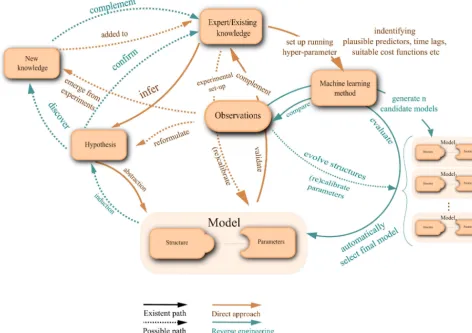
(e.g. Reichstein and Beer, 2008; Gilmanov et al., 2010; Hoffmann et al., 2015). Conventional model building (Fig. 1) is
primar-ily hypothesis driven and capitalizes both on some understanding of the system and reported scaled experiments (Migliavacca
et al., 2012; Richardson et al., 2008). Gupta et al. (2012) describe this common paradigm of model development as a four
step approach involving a) observational,b) conceptual,c) mathematical and,d) computational phases (see also e.g. Bennett
et al., 2010; Williams et al., 2009). During the observational phase, the system under scrutiny is monitored and observations are
25
assembled, ideally representing process responses to hypothesized driving variables. Based on these observations, a conceptual
model is proposed, which is subsequently guiding the formulations of mathematical representations of the system states and
dependencies. The mathematical description then provides the basis for computational models that are used for simulations
(Williams et al., 2009). This conventional approach to model development is also characteristic of different kinds of ecological
model building, including the development of biogeochemical models (Williams et al., 2009).
We explore the possibility of reverse engineering offering an automated alternative to model development for predicting
terrestrial carbon fluxes (Fig. 1). In reverse engineering, the work flow is fundamentally different (Bongard and Lipson, 2007):
a) database set-up phase,b) computational phase,c) mathematical phase and ad) conceptual phase (Gupta et al., 2012). The
5
rationale behind reordering the key phases is firstly to minimize the human influence and perception biases that might shape
the formulation of new hypotheses, and secondly to increase the chance for novel model structures to automatically emerge
from the available data and that would not be so obvious from a direct analysis. Reverse engineering is aiming at identifying
some mathematical representation of a system that is to a large degree independent from a priori conceptualizations; in the
current case, the respiratory response of terrestrial ecosystems to environmental drivers. Reverse engineering leaves the model
10
construction up to an algorithm and is therefore a way to empirically learn from observations with minimal user input.
Of course, expert knowledge still has a large influence on the modelling process, as only a certain set of variables can be
measured and even a smaller subset is indeed available for model development, which includes the restriction to a certain
plausible number of time lags, and hence full objectivity of automatic model development cannot be truly achieved.
Further-more, expert knowledge comes into play when the algorithm is set for running, by tuning the set of parameters according to
15
the problem needed to be solved and as well during the observation collection and during the final decision on whether the
solution returned by the algorithm actually makes sense at all and whether it can be further used. Nevertheless, we believe
that by shifting the moment when the analyst make the decision regarding the selected model, a larger degree of objectivity in
modelling is achieved.
Reverse engineering is close to machine learning based regression techniques, where various candidate model formulations
20
and specifications are explored in order to minimize the prediction error. The fundamental difference from typical model
building is that reverse engineering typically provides a symbolic regression, that is, the resulting structures are ideally directly
readable as mathematical functions (i.e. response functions) and can be interpreted. The readable character of the returned
solutions allows to consider the applicability of the derived structures in other system domains (Ashworth et al., 2012).
Here, we focus on the “Gene Expression Programming" (GEP, Ferreira, 2001) reverse engineering approach. GEP is an
25
evolutionary algorithm that constructs mathematical response functions. In its essence, GEP basically converges to a solution
after rejecting a large number of potential regression models over a certain amount of evolutionary steps. Due to its structural
design, GEP can be applied in a wide range of empirical modelling problems (Peng et al., 2014b; Khatibi et al., 2013; Traore
and Guven, 2013), including (soil) hydrology (Fernando et al., 2009; Hashmi and Shamseldin, 2014). To the best of our
knowledge the potential of GEP has not yet been explored for modelling biogeochemical fluxes in terrestrial ecosystems.
30
We seek to understand as well whether automating model development can provide new insights in understanding the
dynamics of terrestrial respiration processes. We base our study on data from a long-term monitoring experiment of Reco
components i.e. above ground respiration, root respiration, mycorrhiza respiration, soil autotrophic, and soil heterotrophic
respiration. The monitoring was done separately but in a time-synchronized way over two years and is described in detail by
Heinemeyer et al. (2012).
The fundamental question addressed in this paper is whether regression models can be constructed more objectively by
leaving the task of proposing a final regression model to an algorithm rather than directly to an analyst. The need for human
intuition during the actual process of constructing a regression model becomes reduced, and the input of expert knowledge
shifts towards identifying input variables, parameters, a suitable cost function and model plausibility.
With the current study we investigate as well if automatically derived model structures differ substantially from models
5
conventionally used in the study ofRecoand its components or, if they are consistent with established theory. The separation
of Recointo its components also allowed us to test the portability of individual model structures across different respiration
components. In this sense, we investigate whether a generic “respiration" response can be derived, or if specific formulations
for a range of respiration components are required.
1.1 Study structure
10
First, we introduce the GEP methodology and explore its performance for symbolic regression type of problems using an
artificial experiment under varying degrees of noise contamination designed to resemble Reco. Second, we apply GEP to
model the various respiration observations provided by Heinemeyer et al. (2012).
The observational record provided by Heinemeyer et al. (2012) is exceptional, because measurements of soil or ecosystem
respiration that are typically only integrated, are here continuously and regularly measured, and the components measured offer
15
a perfect test case for the GEP methodology.
For both the artificial experiment and real world observations, we systematically confront the prediction error of GEP with
other state-of-the-art machine learning regression approaches. In addition, we adjust the modelling approach such that the
objective function (or fitness function) accounts not only for absolute or relative error, but also reduces structure in the residuals.
The discussion focuses on the comparison of the various GEP derived models, their equifinality, and performance compared to
20
widely used literature models.
2 Method
We rely on the GEP method (Ferreira, 2001) which automatically constructs model structures based on a set of given
observa-tions. As the models we want to obtain are mathematical structures, their construction can be achieved by solving a symbolic
regression (Kotanchek et al., 2013) type of problem. That is, we are not only interested in determining an optimal set of
pa-25
rameters for a known regression, but here, we want to discover the symbolic form of the regression itself by identifying the
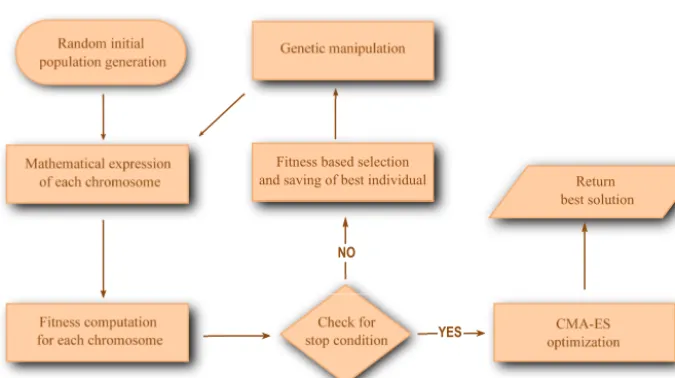
most important predictors and their functional transformations. The general GEP approach in solving symbolic regressions is
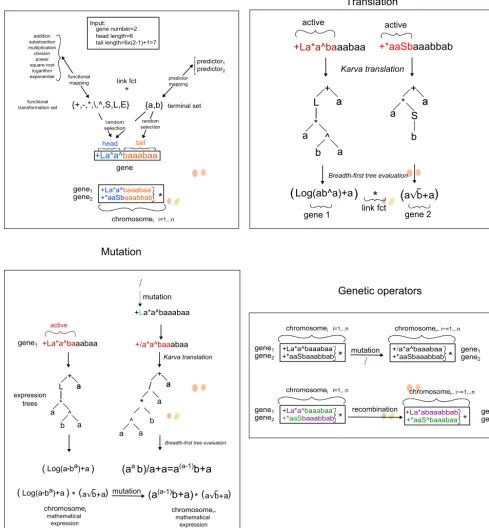
presented in the following section and is illustrated in Fig. 2.
2.1 Gene Expression Programming, GEP
The process of finding the most suitable model structure based on signal present in data in GEP starts with an initial
gen-30
as “chromosomes". The chromosomes are composed of a fixed number of “genes" that are connected by a binary
math-ematical operator. Each gene is encoded in a string with a fixed length that contains specific characters that map to
ei-ther a set of possible predictors, e.g.A={a, b} →Am={x1, x2}or a set of their possible functional transformations, e.g.
F={+,−, L, E} →Fm={addition,substraction,logarithm,exponential}, (see Fig. 3, A).
The choice of input functions used for applying mathematical transformations on the predictors depends on the type of
5
problem we try to solve with GEP. When the problem is a symbolic regression type of problem, as here, most often a set
of primitive functions is proposed; such as addition, multiplication, exponential and so on. More complex functions could
increase model complexity too much and risk over fitting. However if there are already known functional transformations of
certain predictors that could be part of the final desired solution, the user can define a new function and introduce it in the set
of input functions.
10
All genes are made up of a “ gene head", containing a combination of characters mapping to both predictors and functional
transformations and a “ gene tail", with characters that map only to predictors. The gene length is given bygl=hl+tl, where tl= (fmax−1)×hl+ 1, withglas gene length,hlhead length,tltail length andfmaxas the maximum parity of a functional
transformation.
As in biology evolution, regardless of the actual length, the GEP genes have active sections of variable length called “open
15
reading frames" (ORF) that can encode various expression trees which can be evaluated into mathematical expressions
(Fer-reira, 2006). The lengths of the ORFs are determined only after the encoded expression trees are translated using an internal
reading language (see Fig. Fig. 3, B). Ferreira (2001) argues that, the power of GEP lies in its use of fixed length linear strings
for representing expression trees (ET) of varied shapes and sizes that simplifies the evolutionary process, and helps reach a
final solution faster.
20
The total number of chromosomes generated over each evolution step make up the GEP population. The evolution steps are
also known as “generations". The maximum number of generations allowed to run until reaching a solution is often used as a
stopping criterion.
One of the crucial components of model developing within an evolutionary algorithm is the selection process. In GEP,
the chromosomes can be translated into mathematical expressions that can be evaluated, and a distance between the current
25
structure based predictions and the original target is computed. The measures are known as “fitness values" and are assigned
to all the chromosomes in the population at each generation by means of a predefined fitness function. The evolution of the
final solution with GEP is done based on optimizing the fitness function values after each generation, usually by minimizing
prediction error, but more complex criteria can be taken into account as well.
Once all the fitness values have been computed and assigned, the chromosomes in a generation are sorted from best to worst
30
fit.
If no stop criteria has been met, preparations for the reproduction of new chromosomes for the next generation are made.
The chromosome with the best fitness value is reproduced unchanged in the first position of the new generation. For filling
the remaining n-1 positions, chromosomes are selected from the entire population for the new generation with a tournament
procedure, n-1 times.
In tournament selection, 2 chromosomes are randomly selected from the entire population and the individual with the better
fitness value goes through.
For insuring that novel material is introduced in the pool of possible model structures, n-1 newly selected chromosomes are
subject to genetic operators, such as: mutation, recombination, transposition and inversion as presented in Fig. 3, D, that can
fully change the encoded mathematical expressions (see Fig. 3, C).
5
Once the population of chromosomes is ready for the new generation, the evolution procedure is repeated until a stop
criterion is reached, such as best fitness achieved, maximum number of unimproved generations is reached, time limit, etc.
The hyper-parameter needed for a GEP run, i.e the set of all parameters that need to be fixed before a GEP run is performed,
has either components with recommended default values, especially for the genetic operator rates considered when applying
the available genetic operators (Ferreira, 2006), or has components for which the values have been established empirically after
10
experience in working with the GEP approach. The latter typically depend on the requirements of the problem looked to solve.
Such is the case for setting the length the gene head, or the number of genes in a chromosome that can be lower if the interest
is in obtaining more compact solutions, with larger values possibly leading to a fast expansion of solution length which can
easily over-fit the initial target. When the lengths of the chromosomes are kept too low, the structures in the population can
convergence too soon to a unique solution that might lack the ability to capture meaningful signals present in the training data,
15
due to low diversity of the encoded expression trees.
Another important component of the hyper-parameter to fix is the mutation rate which is one of the genetic variation
opera-tors. When the mutation rate is too large, it can become disruptive and lead to loss of information acquired along the previous
evolutionary time steps, reducing the general convergence of the GEP run. Conversely, if the rate is too low, relevant structures
may not be constructed in the given time limit.
20
The current implementation of the GEP approach does not contain an explicit population diversity management component
which could increase the confidence that a certain solution did not just appear by chance, but that it was actually selected
over a larger pool of possible model structure types. In order to reduce stochastic bias and avoid getting stuck in local optima
that would produce over-fitted results, we chose the practical approach of multi-start (multiple runs with the same settings) as
proposed by Ferreira (2006).
25
The version of the GEP method presented in this paper was implemented by the first author in the C++ language and is freely
available upon request. All the experiments reported in this work were executed on a cluster running SuSE SLES 11 SP1 and
StorNEXT (global file system running on the IO nodes) and that contains 868 CPU cores, 14.5 TB RAM, 1.2 PB file space.
The large performance capacity of the cluster allowed for multiple parallel runs and speed in reaching the final solutions.
2.2 Fitness measure
30
In our study, the fitness measure is reported in terms of the Nash–Sutcliffe modelling efficiency (MEF) coefficient (Nash and
models (Mitchell et al., 2009; Migliavacca et al., 2015). The MEF is computed as
MEF= 1−
n
P
i=1
(oi−pi)2 n
P
i=1
(oi−o¯)2
(1)
whereoi is the observed value at step iandpi is the predicted value at stepi ando¯is the mean of observed values. MEF
values range between−∞and 1, where an MEF value of 1 corresponds to the case where the predicted and observed values are identical. A negative MEF value means that the predictions are worse than the mean of the observations in recreating the
5
observed signal. MEF=0 indicates that the models prediction are as good as a prediction byo¯.
During the GEP learning process, however we use the (1-MEF) measure as we want to minimize the fitness function values.
Although the MEF metric offers a straightforward interpretation, it does not take the number of parameters of the models
into account. In real-world applications, it might be desirable to derive models with fewer parameters if those are not (much)
worse in terms of prediction capacity than models with higher number of free terms. Thus, we include in our cost (fitness)
10
function a normalized term related to number of parameters (ratio of current number of parameters to maximum number of
possible parameters given the GEP run settings).
Moreover, any systematic pattern in the model residuals needs to be reduced as the latter should ideally only represent
uncorrelated noise. To meet this criterion, we complement the fitness function with a term related to the information content
(entropy) in the residual time series. Entropy values would be maximized for data without structure (i.e. white noise), and
15
lower entropy values would be obtained for structured data, e.g. correlated stochastic or deterministic processes (Rosso et al.,
2007) . The information content in a time series is typically quantified by the Shannon Entropy (SE, C. E. Shannon (1948)) ,
i.e. a term of the form
SE(X) = −
N
X
i=1
piln [pi] . (2)
Here,X={pi;i= 1, . . . , N}denotes a probability distribution withPNi=1pi= 1andNpossible states. 20
In short, the calculation of an entropy as a measure for randomness from a time series (e.g. Shannon’s entropy) requires
to determine a probability distribution that underlies the time series (or dynamical system), which is usually done by a
par-titioning step (also called phase space reconstruction in other contexts). This is a fundamental step in the methodology, and
various methods have been used to arrive at this probability distribution, for instance frequency or histogram-based measures,
procedures based on amplitude statistics, or symbolic dynamics (see e.g Kowalski et al. (2011) for an overview).
25
As our aim is to minimize structure in the residuals, the temporal order becomes important. In recent years, the
Bandt-Pompe approach has become popular, because it directly takes time sequences into account: The technique hence divides the
time series into ordinal sequences (i.e. ordinal patterns, or symbolic sequences), and then computes entropy measures directly
from the probability distribution of these ordinal patterns (Bandt and Pompe, 2002).
This approach has a number of advantages, namely that it is robust to noise (no sensitivity to numeric outliers) and to trends
30
parameter that has to be specified is the embedding dimension, i.e. window length), and allows to disentangle various possible
states of the system that are then encoded in the probability distribution (see e.g. Zanin et al. (2012) for a review of the method
and applications).
The single parameter that needs specification is the window length. This parameter is fixed tondemb= 4throughout the
entire manuscript following previous work on ecosystem gross primary productivity dynamics by Sippel et al. (2016).
The final normalized form of the fitness function further used in our work is:
5
CEM= r
(1−MEF)2+ ( P
Pmax
)2+ (1−SE)2 (3)
Pmax=ng×l (4)
where, CEM stands from here on for "complexity corrected efficiency in modelling",Pis the number of parameters present in
a model structure,Pmaxis the maximum number of parameters possible for each individual from a GEP run set-up,ngis the 10
number of genes in a chromosome andlis the length of a gene.
For assessing the effect of adding the entropy component for the residuals in the CEM fitness function, we introduce as well
a fitness measure containing elements regarding only the MEF and the number of parameters.
MEF+NP= r
(1−MEF)2+ ( P
Pmax
)2 (5)
For all experiments reported in this paper, the optimization is done by minimizing the CEM fitness function values. The best
15
value that can be reached for all presented fitness functions is 0.
2.3 Parameter optimization
The GEP algorithm does not have a specific treatment of constants in the building of model formulations but mutations can
change both the model structure and constants. However, the scaling of constant values (model parameters) might be a decisive
factor in adequately determining the fitness of a formulation. Without this, a model structure might be discarded regardless of
20
potentially being a very powerful candidate. Furthermore, model parameters are often very informative regarding a system’s
sensitivity to some modifications of the drivers. These aspects have led to the addition of a final parameter optimization step at
the end of each GEP run.
In order to obtain an optimal set of parameters for the GEP extracted model structures, an approach that would be applicable
in a large set of generated search spaces was necessary. Here we use the “Covariance Matrix Adaptation Evolution Strategy"
25
(CMA-ES, Hansen et al. (2003)) for optimization. The CMA-ES is a stochastic optimization algorithm that seeks to minimize a
fitness function by estimating and adapting a covariance matrix according to a sampling from a multivariate normal distribution
(Beyer and Schwefel, 2002; Auger and Hansen, 2005). According to Hansen (2006), one of the main arguments in favour of
the CMA-ES approach is that it has shown good results even in the case of ill-posed problems (Kabanikhin, 2008), which may
The CMA-ES version used for the final step of optimization is the Hansen Python implementation found at https://pypi.
python.org/pypi/cma.
3 Experimental design
5
For exploring the possibility of using GEP in developing relevant model structures for describing the terrestrial carbon fluxes,
two case studies were designed: Firstly, an experiment based on artificially generated data to better understand and present the
general properties and capacities of GEP. Secondly, we explored the use of GEP on real measurements of various respiratory
flux components monitored continuously over two years in an oak forest (Heinemeyer et al., 2011).
3.1 Artificial experiments
10
These experiments were designed to explore whether our implementation of the GEP method is suitable for symbolic regression
type of problems, and how robust/vulnerable it is across various signal to noise ratios. We explored a set of functions with
increasing levels of non-linearity to generate data points.
f(x1) = 2x1+ 1 (6)
f(x1) =x21+ 3x1+ 5 (7)
15
f(x1) =ex1+ 1 (8)
f(x1) =e−x1−x1 (9)
f(x1) =x21−4 sin(x1) (10)
f(x1) =x31+ 6x21+ 11x1−6 (11)
f(x1, x2) =x2x1 (12)
20
f(x1, x2) =x2x1−3 cos(x1) (13)
f(x1, x2) = 2x21+ 3x22 (14)
f(x1, x2, x3) = 2x21+ 3x22+ 2 sin(x3) (15)
2000 data points were randomly generated withx1∈[1,20];x2∈[1,5];x3∈[1,100]and all the functional transformations were done based on the same initial set of 2000 data points. Out of the 2000 data points, 1000 data points were used for
25
training, while 1000 data points were reserved for validation. The GEP settings used for each of the 20 runs are given in Table
1. If a returned structure was identical to the originally prescribed function or if(1−MEF)≤10−5at validation, the retrieval
of the original structure was considered to be a success. For allowing the approaches to do an automatic feature selection, all 3
variables,x1, x2, x3, were used for learning and validation for all 10 functions in the benchmark set.
For investigating the capacity of GEP to reconstruct a simple model used in the ecology field as well, we introduced as well
30
air temperature of10o
Cat a reference temperature of15o
CThe formulation we used for the “Q10" model is:
Reco= 2(0.1Tair−1.5) (16)
withRecoas ecosystem respiration flux andTair, the air temperature. Again, we generated 2000 data points for both predictor
and target and we used half for training 100 runs and half for validation. The modelling capacity of the best structure in terms
5
of fitness value at validation is reported.
In order to investigate the response of the GEP approach to noise contaminated data, we simulated Gaussian noise that scales
with signal amplitude as often observed in the case of terrestrial ecosystem (Lasslop et al., 2012) and soil respiration (Lavoie
et al., 2015)fluxes. The signal-to-noise ratio (SNR, measured as ratios of standard deviations) was varied between 10 and 1 in
six steps.
10
For each of these functions and SNR levels, we sampled 100 validation data points 10 times. 20 GEP runs were performed
on the 1000 training data points and the GEP model structure with the highest mean MEF value over the 10 validation sets was
chosen.
As the choice of fitness function was crucial for the construction of structures in a GEP type of approach, we also investigated
in one experiment the effects of minimizing the CEM values (eq. 3) as opposed to using only MEF (eq. 1) or MEF+NP (eq. 5)
15
as fitness function.
3.1.1 Alternative Machine Learning Methods
The prediction performance of the best GEP derived models based on the data in section 3.1 was compared with the prediction
performance of four commonly used state-of-the-art machine learning methods (MLM), i.e Artificial Neural Networks, ANN,
(Yegnanarayana, 2009), Support vector Machines, SVM (Hearst, 1998), Random Forests, RF (Breiman, 2001) and Kernel
20
Ridge Regressions, KRR (Hoerl and Kennard, 1970).
The toolboxes and settings used for generating the predictions by the ANN and KRR methods are described by Tramontana
et al. (2016) and found in the “simple R" regression toolbox (Lazaro-Gredilla et al., 2014). The predictions of the SVM were
obtained by using the “LIBSVM" library (Chang and Lin, 2011) from the “SimpleR" regression toolbox where the
regulariza-tion term, the insensitivity tube (tolerated error) and a kernel length scale were automatically adjusted during each run. Lastly,
25
the RF predictions were obtained after running the MATLAB statistics toolbox implementation with default settings. The
hyper-parameters of all MLM were estimated to avoid over-fitting during each run as presented in section S6 of Tramontana
et al. (2016).
All the present machine learning approaches have been applied on the same training data sets as those used for building the
GEP models, and their predicted values were compared with the validation sets used for determining the best GEP solution.
30
3.2 Measured ecosystemCO2fluxes
In the second experiment we assessed the possibility to reverse engineer model structuresRecoand its components based only
respiration fluxes measured in an 80 year old deciduous oak plantation in the Alice Holt forest in SE England as described in
(Heinemeyer et al., 2012; Wilkinson et al., 2012).
3.2.1 Alice Holt in-situ data
5
The Alice Holt data set contains observations ofRecoand the total influx ofCO2to the ecosystem as mediated via photosyn-thesis (gross primary production,GP P), and various soil respiration components.
RecoandGP P were estimated from eddy covariance measurements of the forest netCO2exchange (NEE, Eq. 17) and were obtained from a micro-meteorological measurement tower at the same site that reports half hourly integrals of NEE with the
eddy covariance (EC) methodology (Moncrieff et al., 1997). The Reichstein et al. (2005) procedure was used for gap-filling and
10
separation of NEE intoGP P andReco. Given thatRsoilis a fraction ofReco, above ground respiration can be calculated as
the difference betweenRecoandRsoil. For an in-depth description of other site conditions and measurements see Heinemeyer
et al. (2012).
A multiplexed chamber system was used for separately measuring soil respiration (Rsoil ) and its components, using a
continuous sampling method at fixed locations during two years at an hourly resolution. In order to partition theRsoilflux 15
into its components, mesh-bags that are not penetrable by roots, but allow for mycorrhizal hyphae development were installed.
Deep steel collars were applied to stop both root and mycorrhizae in-growth. As a result, root respiration (Rroot) is given
by the difference ofRsoiland the respiration recorded in the mesh bag chambers, mycorrhiza respiration (Rmyc) is given by
subtracting the steel collar flux from the mesh bag chamber flux, and the soil heterotrophic respiration (Rsoilh) is given by the
CO2efflux at the steel collar chambers. Lastly, soil autotrophic respiration (Rsoila) is estimated as the sum ofRmycandRroot 20
(Eq. 19 and 20) .
The above ground respiration (Rabove) was given as well and was estimated by difference (Eq. 18). Additionally, direct
measurements of soil moisture (SW C), air temperature, surface temperature, and soil temperature taken at 2, 10 and 20 cm depth are present in the dataset.
Reco= NEE +GP P (17)
25
Rabove=Reco−Rsoil (18)
Rsoila=Rroot+Rmyc (19)
Rsoil=Rsoila+Rsoilh (20)
The computation ofRaboveas difference betweenRecoandRsoilmight be highly uncertain because of the different
tech-niques used to compute the two respiration components, the completely different footprints, and the typical high flux
under-30
estimation and low flux overestimation ofRecofrom EC (Wehr et al., 2016). The limitations of the separation ofRecointo its
components and the uncertainty of the estimates are further discussed by Heinemeyer et al. (2011), Heinemeyer et al. (2012)
3.2.2 Data processing
We used the following candidate driver variables: soil volumetric moisture measurements, air temperature (from
micro-meteorological station), and temperatures at different soil depths, andGP P. A number of recent studies have shown a tight linkage betweenGP P andRsoil, reflecting dynamics of respiratory substrate supply to roots and mycorrhizal fungi from re-5
cently assimilated C in plants. (Moyano et al., 2008; Mahecha et al., 2010; Migliavacca et al., 2011, amongst others). We use
GP P obtained from EC measurements at the site, but acknowledge the conceptual problem thatRecoandGP P were derived
from the same observations of NEE. In order to minimize the potential spurious correlation betweenRecoandGP P as well
as redundancy of possibleGP P influence with the meteorological drivers, we considered low-frequency variability ofGP P
only (i.e. low-pass filtered modes ofGP P which corresponds to variability beyond a 60 days periodicity only, see Mahecha
10
et al., 2010). “Singular Spectrum Analysis" (SSA, Broomhead and King (1986)) as described and implemented by Buttlar et al.
(2014) was used to obtain a smoothGP P signal. The seasonal cycle was extracted with the SSA method as the assumption is thatGP P affects mainly the seasonality of the respiration while the variability at the high frequency is assumed to be more related to meteorological drivers (e.g. temperature, Mahecha et al., 2010). The SSA method is a tool used mainly in time series
analysis with the purpose of decomposing a time series signal into its independent sum components, such as trends, seasonality
15
and high frequency components based on a singular value decomposition of trajectory matrices computed after embedding the
time series (Buttlar et al., 2014).
To reduce the skewness and the search space that the GEP evolution would have to cover in order to construct valuable
solutions (Keene, 1995), we log-transformed the seven target respiration data sets (see Figure 1 in supplemental material) and
applied a back-transformation when reporting the respective model structures. Manning (1998) and Newman (1993) show that
20
when regressions are built based on log transformed targets, the back-transformation of the regressions to non-transformed
target needs to include a bias correction that refers to the residuals of the log models.
As such, if the log model islogy=αx+ǫ, the back transformation toyshould not simply bey=e(αx), but should include a correction of the bias induced byǫ, and depending on the distribution of the residuals, the back-transformation can be:
y=e(αx+0.5σ2
ǫ), when the residuals are log normal distributed;
25
y=e(αx)E(eǫ), where E is the mean of the sample, when the residuals show heteroscedasticity, as was the case for most
of the residuals computed for the GEP models as seen in Fig. 2 of suppl.;
y=e(αx)if no bias correction is desired, or a naive approach.
The time series used for the candidate drivers observations remain unchanged.
3.2.3 GEP set-up
30
For each combination of respiration target and possible drivers, 50 subsets of 500 target time steps each, were randomly selected
used for cross-validation and the model with the lowest average validation CEM value is finally selected for each respiration
type. For all runs the observations are given as records of daily mean values.
We were particularly interested in determining the general character of each extracted model with respect to the different
respiration fractions. We therefore re-optimized the parameters of all extracted model structures when applying one extracted
5
model as the candidate function for a different respiration term. For example, the model formulation extracted for Reco is
re-calibrated for all the other types of respiration, creating six parameter sets (one for each respiratory flux) per equation. To
cross-validate parameter sets, we computed performances for each train–validation data set pair and report averaged MEF
values.
As in the artificial example, we compared the returned GEP solutions predictions performance with that of other common
10
MLM such as SVN, KRR, ANNs, and RF. All methods were used for generating 50 subsets of 113 prediction values, after
training on the 50 subsets of 500 time steps of observations presented in the start of section 3.2.3. Then, a mean MEF value
was computed for all methods for all respiration components and the best mean MEF values were reported and compared with
those of the GEP extracted models. The comparison is done in terms of MEF as number of model parameters were not available
and CEM could not be computed.
15
3.2.4 GEP in the context of other known ecological models: Real observational data
A comparison was done between the GEP built models and some common literature respiration models with different structures
and driving variables that were also optimized using CMA-ES. The optimization was performed for each respiration dataset
and its candidate drivers and parameters (Table 2). The structures and prediction performances of the GEP models were then
compared with those of the optimized literature models.
20
4 Results
4.1 Artificial experiments
In the first artificial experiment the GEP approach is used to verify if it can reconstruct prescribed functions. Following the
training of the 20 independent GEP runs, the initial functions were successfully reconstructed for all 10 equations defined in
section 3.1.
25
For theQ10model artificial test, the following structure was finally selected:
Reco= 0.35×2.5(0.01Tair) (21)
with a validation MEF value>0.99.
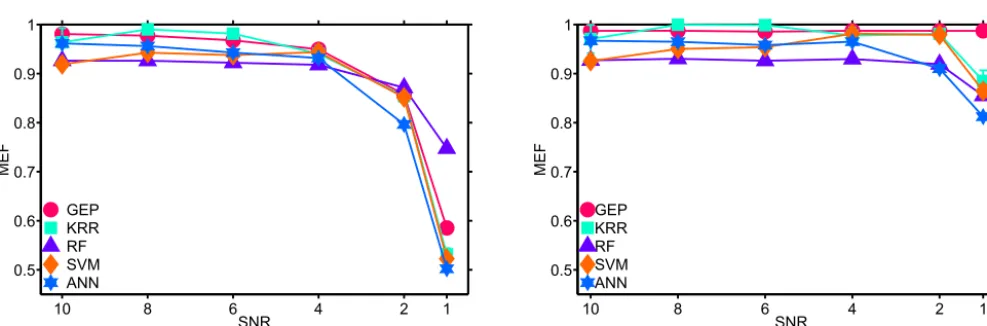
MEF values for the GEP extracted models and for the predictions generated by ANN, RF, KRR and SVM are illustrated
in Fig. 4. These MEF values were obtained through cross validation against independent, yet equally noise contaminated data
pattern of decreasing MEFs with increasing noise contamination. This was expected, as none of the methods should fit the
noise added to the signal.
5
Figure 4,B, shows MEF values equivalent to Fig. 4,A, but applied to noise-free data points of the validation set, in order to
compare GEP outputs to the “true" structure underlying the artificial data set. In this set-up, the MEF values remained relatively
constant across SNR values above 2. When SNR level was set to 1, predictions for all investigated machine learning methods,
except for GEP predictions, show decreased fitness, with MEF values decreasing to a minimum of 0.8.
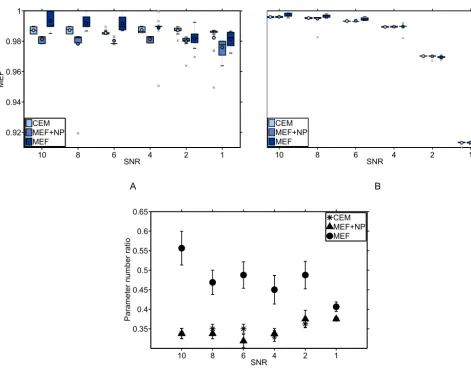
In order to verify the effects of changing the fitness function from MEF to CEM, we compare the distributions of MEF values
10
for all runs for all studied SNR. Figure 5 exemplifies outputs for equation 15; panel a shows a drop of prediction capacity of
the GEP models with noise increase for all types of fitness functions when compared with noise-infused data. This contrasts
the reduced MEF assessed against original data, where a slight drop in MEF with noise increase for the MEF optimization
structures was seen, and where the CEM optimized structures show stability in MEF with noise. The new CEM leads to a
reduced number of returned parameters compared to MEF (Fig.5c), as well.
15
4.2 Measured ecosystemCO2fluxes
Applying GEP on the Alice Holt data set yielded a series of model structures for each respiration type. The returned model
structures after bias-corrected back-transformation are illustrated in equations 22-28.
R
eco= 1
.
2 log (
T
−10)
0.8×
e
(GP PsT−10
)
(22)
R
above= 1
.
1
SW C
0.3×
e
(0.1GP Ps)(23)
20
R
soil= 0
.
04
e
(1.1T−0.104+1.6SW C)(24)
R
root= 1
.
1
e
0.9GP Ps−6.8
T
−10
(25)
R
myc= 0
.
001
T
1.2−10
×
e
(1.6T−10)SW C
(26)
R
soila
= 0
.
01
e
(0.8T0.6
−10+2.6SW C)
(27)
R
soilh
= 0
.
8
e
0.6GP Ps−2.4
T
−10
(28)
25
where, GP Psis gross primary production that has been smoothed using the SSA method with a 60 day window ;T−10 is soil temperature measured at 10 cm depth; andSW Cis volumetric soil water content. The corresponding cross-validation MEF values are given in Table 3, indicating a range of capacities for GEP models to represent different respiration types.
Whilst GEP-derived models may differ between respiration types, there are a number of equivalent models for different
RrootandRsoilhwere described by similar (but not identical) models. Overall, the most common selected drivers wereT−10,
SW CandGP P.
5
The highest performance in terms of MEF value was recorded forRsoilaand forRsoil, that is 0.82 and 0.81 respectively. The lowest capacity of process representation, with an MEF value of 0.28, was recorded forRabove(Table 3), possibly because this
specific component would need to include active versus inactive periods determined by dormancy and leaf fall (i.e. seasonality
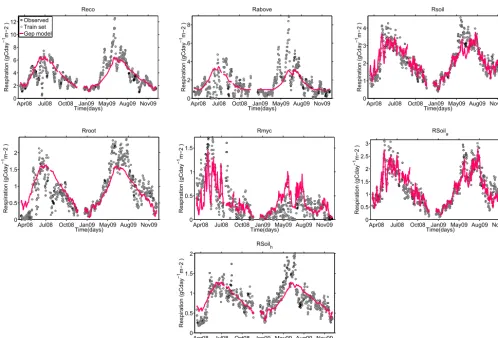
in this deciduous forest). A comparison of the predicted values and observed fluxes for all types of respiration can be seen in
Figures 6 and 8. Figures 7 and 9 show the effects of the three different types of bias correction on the global signal
reconstruc-10
tion and prediction capacity with MEF values computed in a cross-validation manner. For all respiration types, exceptRsoil
and , doing the second type of bias correction, with a smear term improved the prediction capacity. Although forRsoilit seems
that doing no bias correction gives a higher MEF value, we chose to keep the model including the smear term.
In order to explore the capacity of the GEP models generated for theRecocomponents to recreate the larger, across
compart-mental summed fluxes, we summed the predictions of the models and compared them with the original fluxes (Fig. 10).Based
15
on a modelling performance comparison of the models defined as sum models of the initial GEP models trained on the
compo-nent fluxes with the original GEP models trained on the summed fluxes, we found no significant differences after performing
Student’s t-test (h=0, p=0.5). However, we found that the total number of parameters is much larger for the sum models. This
can be a result of the GEP approach eliminating the “low impact ” drivers due to complexity pressure. We can see as well that
the sensitivity of the sum fluxes to certain drivers can strongly manifest itself only in certain components which is why the
20
drivers only get selected in the models built for those specific components.
The residuals depict some remaining patterns (Fig. 11 and Fig. 3 of suppl.) and the null hypothesis of normal distribution
was rejected for all seven respiration component residuals at 5%significance level with the one-sample Kolmogorov-Smirnov
test. Hence, we might expect additional information that could be extracted from the residuals. In order to check whether the
remaining structure was missed in the first training routine because of imposing a multiplicative form in the models by
log-25
transforming the target data, we performed GEP runs on the residuals and combined the models. The improvement in overall
modelling performance is minimal, yet model structures become overly complex. The capacity of the GEP approach to retrieve
new information from the residuals is illustrated in Fig. 13 in comparison with that of the other MLM presented in section 3.1.1.
When correlation values were computed between the candidate drivers and the residuals, no significant linear correlations were
found (Fig. 5 and 6 of suppl.).
30
4.2.1 Model transferability
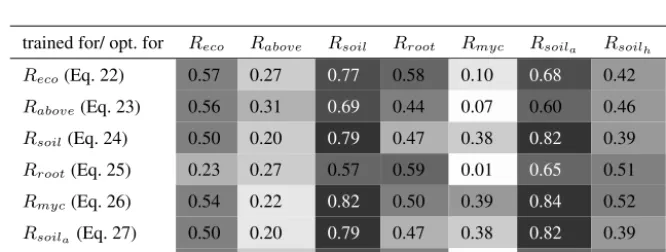
We investigated the capacity of each extracted model structure (equations 22-28) to represent a component ofReconot seen
in the training procedure. This was done by means of new CMA-ES optimization steps. The new prediction performances are
illustrated in Tab. 4.
After optimization, none of the structures show an overall best MEF for all the Reco components (i.e. we clearly cannot
others. This is the case for theRmyc model (eq. 26). It can also be seen that after the individual model optimizations, the 5
structures forRecoand that forRsoilahave similar prediction capacities.
The prediction capacity of the GEP generated models in the context of other commonly utilized MLMs was assessed as well.
KRR, ANN, SVM and, RF were used for generating 113 predicted data points as described in section 3.2 (Fig. 12). The
predic-tion performance of GEP, KRR, ANN, SVM and, RF are shown in Fig. 13. Panel a contains the average MEF values computed
for all MLM methods predicted values when compared to the original observations forReco, Rabove, Rsoil, Rroot, Rmyc, Rsoila, Rsoilh.
10
For all other cases, the performance is in the same range for all methods, but the GEP derived models having the lowest mean
MEF values. Panel b shows that when all MLM were trained on the residuals obtained from comparing the GEP outputs with
the observations, the GEP approach has the lowest capacity of capturing new relevant signals and is strongly outperformed by
the rest of the MLM, indicating that amount of information retrievable by GEP with the current fitness and settings is limited
and captured already in the first run.
15
4.2.2 Comparing with literature models
Lastly, the GEP generated models were compared with some of the most commonly used literature models for describing
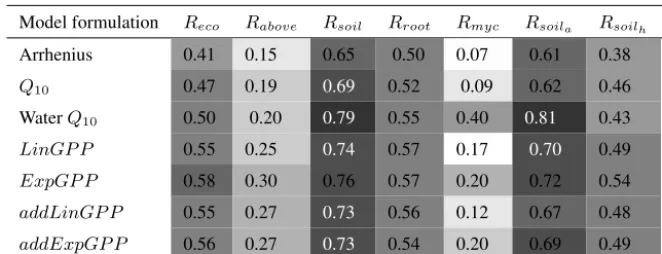
respiration. The resulting MEF values obtained after individual parameter optimization using the CMA-ES procedure for each
literature model are given in Tab. 5. The literature model structure that performed best overall in terms of prediction capacity
measured as MEF is theW aterQ10model (Fig. 14). Figure 14 shows as well that certain types of respiration are easier to
20
represent by all models, including the models GEP generated, whilst other types of respiration are poorly predicted by all
models. Nevertheless, for all respiration types, the highest MEF values are generally recorded by the GEP models.
As the studied literature models performed best in modellingRsoil, we focus on contrasting GEP model results to literature
model outcomes for this ecosystem respiration component. Of all models included, the GEP model andQ10model including
SW C dependency captured seasonal variability best, but no model satisfactorily represented short-termCO2flux variations
25
(Fig. 15, panel a). All models show the largest range of residuals for the months May to July in 2008, and June/July in 2009
(Fig. 15, panel b), with the two best-performing models (GEP andW aterQ10) having the narrowest range of absolute residuals. Monthly mean average errors (MAE) indicate as well a systematic underestimation of soilCO2efflux in the first year (Fig. 4
of suppl.).
5 Discussion
30
5.1 On the GEP method
In this work, the primary reason for the artificial experiments was obtaining a better understanding of the capacity of GEP to
solve symbolic regression types of problems. We put an emphasis on GEP performance in the presence of noise. This aspect
was important, given that monitoring data from terrestrial ecosystemCO2effluxes are typically contaminated by sometimes
substantially large random uncertainties and measurement noise. In the case of NEE flux measurements, Lasslop et al. (2008)
and Richardson et al. (2008) show that the measurement error typically scales with the magnitude of the flux, leading us to
simulate that type of situation by adding noise that scales with signal to an already known function, equation 15. The results
show that all the studied methods are stable to presence of noise in the training set. These results increase our confidence
in the predictions generated by studied machine learning methods; in particular GEP derived modes can tolerate SNRs of 1.
Considering that the SNR in the Reco observations (if noise is only considered as random error) is probably larger than 4 10
which is where the curve starts decreasing in Fig. 4, the noise presence in the data should not influence the automated model
construction process and the real signals should be accurately captured when data uncertainties follow the pattern described
here. On the other hand, forRsoiland otherCO2fluxes measured with other techniques the magnitude and the distribution of the uncertainty can be different (Ryan and Law, 2005; Pérez-Priego et al., 2015), and we cannot state what the response of the
present MLM is in the presence of different types of uncertainties and measurement noise.
15
Our findings illustrate that the selection of CEM over MEF as a fitness function for optimization has a minor effect on the
global mean MEF (Fig. 5). We also notice that due to applying constraints on the presence of structure in the residuals and the
length of the parameter vector, the final mean number of parameters is lower when CEM is chosen.
5.1.1 Limitations
One of the critical aspects in our work is that GEP, as implemented here, can only represent and derive “n→1" type of
20
response functions. We are not able to generate model structures that encode e.g. system-intrinsic dynamics like feedback
loops, which are expected from our current understanding of biogeochemical cycles in terrestrial ecosystems (Ehrenfeld et al.,
2005; Friedlingstein et al., 2006). Hence, we believe GEP is suitable to e.g. understand and describe the sensitivities and
non-linear responses to changes in hydro-meteorological drivers, but fails to represent more complex carbon or soil water dynamics.
Pools and pool transfers cannot be introduced currently in the input, unless the inflow/outflow equations are known and can be
25
included in the set of functions that can participate in the evolution.
Lagged responses can only be detected if the number of lags from a driver is correctly included in the input, which already
implies sufficient knowledge of their existence and behaviour. Whilst in the current implementation of the GEP algorithm,
shifts in conditions and responses cannot be encoded or detected; these could be addressed with the inclusion of a conditional
operator in the set of functions encoded in the GEP evolution individuals.
30
Nevertheless, it would be fair to mention that the same limitations can affect the results of the other MLM and empirical
models presented in this paper. A clear advantage ANN, RF and SVM have though over the GEP symbolic regression
construc-tion, is the fact that when the target variable presents a skewed distribuconstruc-tion, log-transforming of the target data is recommended
for regression type of methods, such as GEP Keene (1995), whereas there is no effect on the prediction capacity of the other
MLM as far as we are aware. Moreover, such a log-transformation needs a back-transformations that might induce a bias if
the right correction is not performed Manning (1998). For these reasons, in cases where less steps in obtaining predictions are
5
desired and no mathematical expression of the models needed to obtain the predictions are needed, non-GEP approaches might
5.2 The value of GEP for modelling ecosystem respiration fluxes
We automatically generated a series of model structures to describe terrestrialCO2respiration fluxes (equations 22-28) with
the GEP approach. Most of these structures (5 out of 7) were of rather low complexity, requiring only 4 free parameters and
10
allowing for further interpretation. The most complex structure is found for theRmyc representation, which is in line with
previous findings (Shi et al., 2012).
Interestingly, the models derived for Reco andRsoilare structurally very similar. That is also the case ofRroot and
het-erotrophic respiration, where the difference lies in the set of parameters and the added presence of an intercept in the
for-mulation of theRsoilh model. This finding suggests a consistency in the response of theRsoil components to their drivers,
15
considering that the separation of theRsoilinto its components might still lack accuracy (e.g. Hanson et al., 2000; Kuzyakov,
2006; Subke et al., 2006; Heinemeyer et al., 2011).
When we compared the GEP-derived models with the community established semi-empirical models from a structural point
of view, we found that they shared some key features for temperature dependencies ofCO2fluxes, which are typically captured
by exponential relationships, but reveal some previously unconsidered dynamics as well.
20
A major difference was in the response of the respiration components toSW C, where the GEP models often choseSW C
as one of the drivers. Moreover, the GEP models often contained an exponential dependency, i.e. there are only certain parts
of the signal that are strongly sensitive to varyingSW C. We believe that the exponential dependency of terrestrial ecosystem
respiration components toSW Cis a very intuitive pattern that has not yet been reported in the literature, and requires further exploration.
25
Another difference we found was the strongly seasonal response of the respiration components toGP P, possibly as a proxy to light and vegetation availability which were not included in the set of candidate predictors.
Considering that GEP identified plausible models, that are very different structurally from previously reported semi-empirical
models, still yielding equivalent or better modelling performance, the validity of the conventional semi-empirical models can
be questioned. Nevertheless, we do believe that there is need for more in-depth analysis for determining whether the GEP
30
described processes make actual biological sense and the selected drivers and their interactions represent true processes and
responses.
5.3 Data quality
During our study, it was apparent that the highest MEF values were obtained for all the studied methods in the case of the
respiration types that had direct measured observations and were not derived. It might be the case that when fluxes are obtained
from derivations, the measurement error will also increase, and the partition of clear signal existing in the observations is not
5.4 High frequency variability
5
All GEP generated models underestimated the high respiration fluxes (Fig. 8) and typically did not capture the fast
re-sponses.This phenomenon was in some cases a systematic pattern, and sometimes affected only certain times of the year.
Similarly, semi-empirical models struggled to adequately simulateCO2flux peaks and in some cases monthly flux averages
(Fig. 15).
A more in-depth comparison of all the GEP and conventional respiration models, based on a time-scale dependent assessment
10
of model-data mismatch (Mahecha et al., 2010) could help to further elucidate the problem and clarify some of the strengths
and weaknesses of the different modelling approaches, especially when seasonal mismatches appear. Nevertheless, a detailed
time-scale dependent assessment is beyond the scope of this study, and for such an analysis, the current time series are simply
too short.
The question is whether the GEP method lacks the ability to build models that correctly represent the processes and their fast
15
dynamic responses, or whether the candidate drivers and the observations used for their representation are simply not sufficient
for generating representative models. In the end, the response ofRsoilandRecoto external drivers might be too complex to
describe solely with the currently available measurements and with the selected drivers.
We believe that the consistent underestimation of fast responses was partly due to surface moisture affecting litter
decompo-sition and fungal activity, as soil moisture was only monitored over the average 8 cm surface, with the top few centimetres most
20
likely presenting the highest activity and partly due to some potential processes/drivers like lags betweenGP Pand respiration (Hölttä et al., 2011) or phenology (Migliavacca et al., 2015) that were not specifically included in the learning process.
Another explanation for missing some of the (high flux) variability could be in our choice of fitness function. As we decided
to penalize during the learning process for structures with many parameters, it is likely that some structures were eliminated
early-on during this process, even though they may be well-suited for describing a given process from a modelling efficiency
25
point of view. However, this is a case of trade-off between a good fit and structural simplicity, and in our approach, we decided
that simplicity of structure, i.e. the possibility of interpretation is a very important asset.
We explored as well the possibility of the underestimation of the carbon flux variability being caused by the log-transformations
applied to the observations. It could have been the case that the log-transformations excluded interesting components of the
model structures by forcing the method to build multiplicative models. Nevertheless, when the GEP was run again on the
30
residuals, without log-transforming, no new meaningful information was retrieved, indicating that multiplicative models were
sufficient for reconstructing theRecocomponents present in this study.
5.5 Equifinality
Table 4 shows that when optimizing the parameters for all structures, the prediction performance becomes similar, which leads
to the question of equifinality of dynamical systems, where different models that try to capture their structure, might have
5
A critical question for the applicability of any ecosystem model is whether the model structure is more important than the
parametrisation of a given “best" model. For this question to be addressed, however, we need a larger sample of ecosystem
types representative for different types of responses where we can explore the importance of the obtained structures and their
parameter sets.
10
5.6 GEP models in the context of other machine learning methods
The comparison of GEP generated models and machine-learning methods showed a narrow range of predicted fluxes (Fig.
13). The analysis of training all the MLM on the GEP residual output showed that the GEP approach is not able to retrieve
any new meaningful structural components, but that the remaining MLM are much better at reconstructing the signal left in
the residuals. This indicates that although the GEP is actually a reliable MLM when it comes reconstructing the underlying
15
Recofluxes and is not prone to over-fitting, it could be that the current set-up of the GEP is not sufficient for an exhaustive
description of those fluxes, or that might be overly strict on complexity of models compared to other MLM. The GEP approach
has, nevertheless, the benefit of producing mathematical model structures that can be the basis for future interpretation.
6 Conclusions and Outlook
Overall, our results suggest that the GEP approach is a potentially powerful tool of reverse engineering, particularly helpful for
20
building ecological models when there is a minimum of a priori system understanding. We exemplified this conceptually using
artificial data, but also show that GEP always yields as good or better results compared to conventionally used models in the
case of ecosystem respiration. Based on data from a long-term monitoring site of different respiratory fluxes, and using GEP
as a reverse engineering tool, we found new structures for modellingRecocomponents. The GEP derived models outperform
conventionally used models and generally differ by the way temperature andGP P, but alsoSW Care interpreted, indicating
25
that conventional respiration models might have to be revised. At the same time, we found that when the GEP derived models
are mutually compared, there are sufficient structural particularities for each terrestrial respiration type as to not allow for the
formulation of a generalRecolaw. More research is needed on a larger set of sites to identify widely usable models and for
their interpretation. A particular matter of concern is the apparent equifinality of selected model structures, indicating that many
response functions are yielding predictions of almost similar quality. A study of multiple sites would enable an investigation
of whether specific ecosystem types result in similar model structures, or whether response functions apply across contrasting
ecosystem types.
The current study has also revealed methodological aspects that could be improved. In particular, we found the inclusion
5
of a parameter optimization step very helpful to further test the transferability of model structures. But this approach could
be potentially integrated into the GEP evolution. More specifically, we think that the next development of GEP could include
the parameter optimization as an intermediate step before selection during each evolution generation (Ilie et al.). In this way, a
model structure could be chosen according to not only the current state of parameters but also on its potential and convergence
to a global solution might be achieved faster.
Code and data availability
All code and data used to produce the results of this paper can be provided upon request by contacting Iulia Ilie or Miguel D.
Mahecha.
Acknowledgements
We thank Markus Reichstein for all the useful comments and suggestions.
15
This work was supported by the International Max-Planck Research School for global Biogeochemical Cycles
(IMPRS-gBGC), Jena, by the European Union’s H2020 research and innovation programme project BACI; grant agreement 640176 and
References
Ashworth, J., Wurtmann, E. J., and Baliga, N. S.: Reverse engineering systems models of regulation: Discovery, prediction and mechanisms,
20
Current Opinion in Biotechnology, 23, 598–603, doi:10.1016/j.copbio.2011.12.005, http://www.ncbi.nlm.nih.gov/pubmed/22209016,
2012.
Auger, A. and Hansen, N.: A restart CMA evolution strategy with increasing population size, 2005 IEEE Congress on Evolutionary
Compu-tation, 2, 1769–1776, doi:10.1109/CEC.2005.1554902, http://ieeexplore.ieee.org/lpdocs/epic03/wrapper.htm?arnumber=1554902, 2005.
Bandt, C. and Pompe, B.: Permutation entropy: a natural complexity measure for time series., Physical review letters, 88, 174 102,
25
doi:10.1103/PhysRevLett.88.174102, http://www.ncbi.nlm.nih.gov/pubmed/12005759, 2002.
Bennett, N. D., Croke, B. F., Jakeman, A. J., Newham, L. T. H., and Norton, J. P.: Performance evaluation of environmental models, 2010
International Congress on Environmental Modelling and Software Modelling for Environment’s Sake, pp. 1–9, http://www.iemss.org/
iemss2010/papers/S20/S.20.01.Performanceassessmentofenvironmentalmodels-ANTHONYJAKEMAN.pdf, 2010.
Beyer, H.-g. and Schwefel, H.-p.: Evolution Strategies, Natrual Computing, pp. 3–52, 2002.
30
Bonan, G. B.: Forests and climate change: forcings, feedbacks, and the climate benefits of forests., Science (New York, N.Y.), 320, 1444–
1449, doi:10.1126/science.1155121, http://science.sciencemag.org/content/320/5882/1444.abstract, 2008.
Bongard, J. and Lipson, H.: Automated reverse engineering of nonlinear dynamical systems., Proceedings of the National Academy of
Sciences of the United States of America, 104, 9943–9948, doi:10.1073/pnas.0609476104, 2007.
Breiman, L.: Random forests, Machine Learning, 45, 5–32, doi:10.1023/A:1010933404324, http://link.springer.com/article/10.1023/A:
35
1010933404324, 2001.
Broomhead, D. and King, G. P.: Extracting qualitative dynamics from experimental data, Physica D: Nonlinear Phenomena, 20, 217–236,
doi:10.1016/0167-2789(86)90031-X, http://linkinghub.elsevier.com/retrieve/pii/016727898690031X, 1986.
Buttlar, J. V., Zscheischler, J., and Mahecha, M. D.: An extended approach for spatiotemporal gapfilling: Dealing with large and systematic
gaps in geoscientific datasets, Nonlinear Processes in Geophysics, 21, 203–215, doi:10.5194/npg-21-203-2014, 2014.
C. E. Shannon: A Mathematical Theory of Communication, The Bell System Technical Journal, Vol. 27, 379–423, 1948.
5
Chang, C.-C. and Lin, C.-J.: Libsvm, ACM Transactions on Intelligent Systems and Technology, 2, 1–27, doi:10.1145/1961189.1961199,
http://dl.acm.org/citation.cfm?doid=1961189.1961199, 2011.
Coello, C. a. and Montes, E. M.: Constraint-handling in genetic algorithms through the use of dominance-based tournament selection,
Advanced Engineering Informatics, 16, 193–203, doi:10.1016/S1474-0346(02)00011-3, http://www.sciencedirect.com/science/article/pii/
S1474034602000113, 2002.
10
Ehrenfeld, J. G., Ravit, B., and Elgersma, K.: Feedback in the plant-soil system, Annual Review of Environment and Resources, 30, 75–115,
doi:10.1146/annurev.energy.30.050504.144212, http://www.annualreviews.org/doi/10.1146/annurev.energy.30.050504.144212, 2005.
Fernando, D., Shamseldin, a. Y., and Abrahart, R. J.: Using gene expression programming to develop a combined runoff estimate model from
conventional rainfall-runoff model outputs, in: IMACS / MODSIM Congress, July, pp. 748–754, 2009.
Ferreira, C.: Gene expression programming: a new adaptive algorithm, in: The 6th Online World Conference on Soft Computing in Industrial
15
Applications, 2001.
Ferreira, C.: Gene expression programming: mathematical modeling by an artificial intelligence, vol. 21, Springer-Verlag Berlin Heidelberg,