Walking contested ground: navigating
settler-colonial place through drawing and
printmaking
by
Antonia Aitken
Bachelor of Visual Arts (Honours)
Australian National University
Submitted in partial fulfilment of the requirements for the
Doctor of Philosophy
Statements and Declarations
Statement of originality
This thesis contains no material, which has been accepted for a degree or diploma by the University or any other institution. To the best of my knowledge and belief, it incorporates no material previously published or written by another person except where due acknowledgement is made in the text.
Statement of authority of access to copying
This thesis may be made available for loan and limited copying and communication in accordance with the Copyright Act 1968.
Statement of Ethical Conduct
The research associated with this thesis abides by the international and Australian codes on human and animal experimentation, the guidelines by the Australian Government’s Office of the Gene Technology Regulator and the rulings of the Safety, Ethics and Institutional Biosafety Committees of the University.
Abstract
This project considers how the slow, rhythmic and repetitive movements inherent in the embodied actions of walking, printmaking and drawing generate sensitive responses to place. This project aims to acknowledge the complexity within place relationships that bear witness to the imprint of settler-colonialism. The project addresses the growing need to consider how we come to terms with the discomfort of contradictory sets of experiences that are part of walking in contested lands.
Walking enables a slowed-down and embodied attentiveness to navigate relationships with place. Perceptions of linear time dissolve to reveal a complex merging and co-mingling of observations, memories and imaginings. This methodology develops a sense of a simultaneously moving internal and external passage; an entangled or knotted time which is reflected in the conceptual, visual and material explorations within this project.
lutruwita / Tasmania is a place with vibrant and resistant Aboriginal culture. It has a strong and diverse community made up of interconnected narratives; people who are finding and testing new ways to voice the stories of this place. I relocated from Canberra to Hobart in 2014 to undertake this project and began my relationship by enacting a daily ritual of stepping out my front door and into relation with my immediate environment. Over four years I have walked a web of connection between my place of dwelling and a number of key locations in and around the Hobart region.
This research is situated within the interdisciplinary fields of walking-based practice and critical place inquiry. Led by place philosophers, Indigenous scholars, artists and sociologists, research and pedagogies from these fields re-emphasise the importance of embodied knowledge, notions of motility, porosity and heterogeneity in our conceptualisations of place. These ideas counter dominant colonising ideas of fixity, impermeable boundaries and monologue.
Arriving in Hobart to undertake the project, I was met by an unfamiliar sense of place panic, described by philosopher Edward S. Casey as a feeling of estrangement or displacement commonly associated with separation from one place and the experience of a new and unfamiliar place. This experience directed the project towards a deeper investigation of philosophical concepts of place, home-place attachment, and desires for lost intimacy with land. This discussion has been supported by the writings of contemporary Australian philosopher Val Plumwood, writer Ross Gibson, and anthropologist Deborah Bird-Rose. By investigating the work of artists Marlene Creates, Richard Long, James Tylor, Simryn Gill and Julie Gough, the project further explores the ways in which our personal and cultural desires, losses and longings inherently shape our conceptualisations of and relationships with place.
Acknowledgements
As a reflection of my recognition of the deep history and continuing culture of this island lutruwita / Tasmania, I would like to acknowledge the Muwinina People, the traditional custodians of the land in which this research project took place.
lutruwita / Tasmanian has provided an incredible place in which to gather and feed my research. Over a four-year period I have met and walked with many people, engaged in much discussion around my art, research and teaching practice. There are many people I would like to thank.
To my supervisors, Dr Jan Hogan and Dr Martin Walch, thank you for guiding and supporting me through the research process and for sharing your wealth of knowledge within our intersecting fields.
To my peers, colleagues and students at the School of Creative Arts and the Riawunna Centre for Aboriginal Education, you have created a rich and engaging place to learn and share my research. I would especially like to thank my friends and peers, Annalise Rees, Ruth Hadlow, Kerry Ford and Lea de Courcy Brown, for sharing your invaluable skills in writing, making and editing, and Jodi Haynes and Janice Ross for your trust and openness as I work with the murina team.
Table of Contents
Abstract 3
Acknowledgements 5
Introduction 8
1. Chapter One | Balancing on a complex ground 15
Place beginnings 16
To be in place and of place 19
Place panic 22
Where we are 24
Carrying places 28
2. Chapter Two | Shelter and Holdfast 36
Walking loops and creating desire lines 36
Knocklofty: the place I walk 38
Shelter – the nest-house – desire for lost intimacy 41
Nesting the body: the work of James Tylor and Marlena Creates 45
James Tylor: Un-resettling 46
Marlene Creates: Sleeping places 49
Image cluster: dislodged attachment & enfolding matrix 54
3. Chapter Three | breathing, stepping, thinking 73
Walking internal and external passages 73
Walking and drawing practice: repeating process and passage 73
Knotted time 79
Walking breathing drawings: repeating process and passage 80
Richard Long: walking lines and circles 86
4. Chapter 4 | Walking contested ground 91
Walking production and pleasure zones 91
Findings 101
Walking as a methodology towards decolonisation 101
Bibliography 109
List of Figures 113
Appendix A: List of Exhibited Works for Examination Submission 115
Introduction
For the body’s action, corporeal journeying, is a matter of kinesis, not of phora. Kinetic action means not just change of position, literal transportation, but an implantation that changes the very matter in which it moves, opening up the soil with the soles of its fast-moving feet. The matter is not just marked, much less represented; it is altered in its very identity. Not just physically extended, it is dynamically charged with bodily motion (Casey 1993, p. 104).
The place I walk is an ancient continent imprinted with geological markers of epochal climatic shifts, of sea rises and falls, and the evolution of unique and remarkable life-supporting ecosystems. Human tracks have crisscrossed this place for millennia. The foot-worn pathways are an intimate sign of a complex web of interconnected relations; impressions shaped by the cadence, speed and weight of moving bodies in direct relation with the ground.
My early childhood was spent in the red desert sands of central Australia, a place simmering with the stories, myths and legends of a deep and continuing Aboriginal culture – knowledge that is still sung, visualised and imagined into being as part of daily practice. I grew up with an awareness of, and shame associated with, the blistering imprint of ongoing settler-colonialism in which my ancestors were complicit, and to which I bear witness. It is these interwoven experiences, cultural narratives and complex foundations that underpin this creative research inquiry.
My walking body moves in a rhythmic synchronicity of breath, step and thought. It enables a mode of being in, and of moving through, place, with a slowed-down and heightened sensory attentiveness. As the porosity of my body is revealed through movement and repetition, perceptions of linear time dissolve to expose a complex shifting and merging of observation, memory and imagining.
There is a growing awareness among artists, academia, and the community more broadly, of the need to pursue methodologies that can undo colonial systems of power and lead us towards consensual and reciprocal dialogue with place (Simpson 2017, Rose 2004, Tuck & McKenzie 2015, Plumwood 2002). Mobility is coming to be regarded as an important concept which offers an alternative to the notions of fixity, impermeable boundaries and monologue that are foundational to the colonial ideology. Motile engagements blur the boundaries between places, by enabling us to recognise the significant and necessary interconnections between places. In doing so, those of us with arrival and settler narratives can shift our models of home-place attachment to consider models of fluid entanglement.
***
In early 2013, I spent ten days in Queenstown, a gold and copper mining town on Tasmania’s West Coast. Along with six local, national and international artists I was invited for a short, but intensive, period to reflect on the place using the language of printmaking. With walking as my primary method and medium for interpretation, I made a series of creative works that were informed by my daily field walks. This visit to Tasmania and the artwork that came from it had a significant impact on my practice and became the impetus to relocate from Canberra to Tasmania in early 2014 to undertake a PhD. Before arriving in Tasmania to commence this project, I had proposed to respond to Queenstown in relation to other mine sites in Australia and North America that were already informing my practice. I was going to look at vestiges of industrial colonisation and how this form of appropriation of land has shaped our perceptions of place.
The process of relocating my place of dwelling raised a series of unanticipated and fundamental questions. Notably, how do we identify with, conceptualise and understand notions of place? And how do we contemplate these notions within the complex and contested ground of contemporary Australia, where trespass and invasion are an often uncomfortable part of the discussion?
I decided that I needed to reconsider the sites for my inquiry. Instead of travelling out to a place quite separate from my place of dwelling, I decided to develop a project that began with a step from the front door and in to my immediate environment of Hobart. With walking as my methodology for encountering place, and drawing and printmaking as my core mediums for interpretation, the project’s creative outcomes document the beginning of this place relationship and the conceptual questions this place has raised.
Two key places have informed the research. The first is Bruny Island, where I walked in the early stages of the project. Standing on Lighthouse Bay on Cape Bruny, I experienced a profound realisation of the devastating impact of colonial occupation of Tasmania, resulting in a deeply sad sense of absence in the land. A holdfast from the giant kelp
(Macrocystis pyrifera) found whilst walking there became a key visual and conceptual form within the project. This strange, sinuous anchor has been used to explore notions of entangled relations; it serves as a metaphor for fluid attachments with place. Supported by the ideas presented in Tim Ingold’s sociological study, The Life of Lines (2015), I have come to understand that the success of our relation or entanglement in contemporary Australia will be measured by our capacity to hold on in a way that also moves with the changeable environment in which we are embedded.
Bachelard’s (2014) notion of the image cluster also became an important way to describe the conceptual merging of the holdfast and the shelter. Together, they communicate my shifting feelings throughout the project of attachment and displacement. The iterative processes of printmaking and drawing have been used to reveal and conceal these two forms within complex matrices. Through reproduction, translation and transformation of the images through various drawing, printmaking, photography and 3D-fabrication techniques, I have been able to create works that describe my growing understanding of a knotted sense of time and enfolding relation with place. The printmaking matrix mimics the matrix of place and my slow entanglement with it.
***
deceptions of progress on our wellbeing. Speed informs underlying structures in the West, which have both enabled and been used to justify rapid environmental degradation and cultural domination to feed the needs of hyper-consumerism (Tuck & McKenzie 2015, Plumwood 2002). Environmental and Indigenous scholars are calling for alternative philosophies and methodologies that can challenge the colonial and capitalist mentalities which drive many of the ecological crises that are destroying our life-supporting systems (Simpson 2017).
In Place in Research (Tuck & McKenzie 2015), Unangax scholar Eve Tuck and Canadian environmentalist and educational theorist Marcia Makenzie lay out potential approaches and methodologies for what they term critical place inquiry. Advocating for mobile action in response to critical place issues within the contexts of settler colonisation, globalisation and environmental degradation, their ideas link closely with the aims and methodologies of my own creative research project. Drawing on the research of creative researchers, walking is discussed as an embodied, participatory mode of wayfinding that is being utilised as an important pedagogical and research approach, particularly for coming to know more about place (Tuck & McKenzie 2015). Mobility is also discussed as a key concept and methodology towards an ethics of decolonisation in the work of key Australian non-Indigenous place-based theorists, Deborah Bird Rose (2004), Val Plumwood (1993, 2002) and Ross Gibson (1992, 2013), all of whom have been central to my thinking.
Through the slow, repetitive and deliberate embodied action of walking daily in Knocklofty, I found myself in the deeply pleasurable experience of what I have come to articulate as knotted or non-linear entanglements of time. This embodied sensation of time has made me acutely aware of how linear time, as one example of a dominant Western structure, shapes my everyday thinking, making and interactions with place. Reinforced by Deborah Bird Rose’s theories, I have come to see that a successive arrangement of moments upon a timeline can close down dialogue between past and present. As a key aim of my project, opening up dialogue with our past in the present, through acknowledgement of our shared histories, is an essential step towards a future of respectful and ethical intercultural dialogue between Indigenous and non-Indigenous Australia.
exploration and research within these intersecting fields of walking and place-based theory. As clearly expressed by both Indigenous and non-Indigenous scholars, decolonisation is only possible with the consensual relationships that come from genuine attempts to enter dialogue (Simpson 2017). Dialogue is only possible if the aim is not to resolve, but to learn to live with the experience and complex feelings of dis-location and discomfort which are an implicit part of walking in stolen land (Tuck & McKenzie 2015).
***
This exegesis interweaves my methodologies with the theoretical threads that have come from a direct engagement with place. The reader will be led along tracks in southern Tasmania which have become familiar through a ritualised looping, and into the terrain of my creative works. The reader will find these creative works nestled among the ideas and work of other artists and theorists whose written and creative work has been critical to this research inquiry. The artists I have chosen to write about engage with questions of attachment, loss and longing through place-based practices. Their interdisciplinary approaches critically engage with the materiality of their chosen mediums and employ the use of ritual, repetition, performance and documentation. I have come to their work largely through direct and intimate engagement in the gallery.
The tone and structure of the exegesis is directly informed by the process of walking itself – the way I can simultaneously wander physical pathways in place, whilst wandering entanglements of thought. The use of a narrative voice is influenced by a number of key writers, including Ross Gibson (2012), Kim Mahood (2017), Saskia Beudel (2013) and Leanne Betasamosake Simpson (2013, 2017), who embed their subjective experience in rigorous research and narratives of place. I regard these communicative models as importantly speaking to the multiplicity and complexity of our embedded relations with our social and cultural matrices.
Chapter Two, Shelter and Holdfast, places the reader in Knocklofty Reserve, the place where I have enacted a walking methodology. Introducing the notions of nests and image clusters as theorised by Bachelard, I look at ideas of longing for lost intimacy with land. These ideas are further contextualised in relation to work by artists James Tylor and Marlene Creates and lead to a discussion of my major series of print works, holdfast iterations.
Chapter Three, breathing, stepping, thinking, explores the use of repetition and looping gestures that are central to walking and to my iterative making process. These actions enable me to simultaneously walk the tracks of my mind while in place and, in a sense, walk two scapes — the land and the body. I explore this in relation to my walking breathing drawings and my aims to shift linear time concepts.
Chapter Four, Walking contested ground, looks at notions of trespass and the complex process of learning to read the land when there are no longer Aboriginal protocols to guide us. This is contextualised by the work of artist Julie Gough and writer Saskia Beduel.
1.
Chapter One | Balancing on a complex ground
Recalling a Bruny Island walk, part one, February 2016
Conscious of a familiar anxiety seeping in concerning how to begin to communicate with, make in and speak of this place, I do all I feel comfortable to do – walk, observe and listen.
Step by step, breath by breath, I begin to be here.
I am walking alone at Cape Bruny in October 2014, along a wild stretch of sandy beach, now known as Lighthouse Bay. This is my first time on Bruny Island, an island on the eastern edge of Southern Tasmania. I have come with two other artists to spend a week reflecting, walking and making. We are staying in the disused lighthouse keeper’s residence.
The sky is thick with cloud, occasionally breaking to let the sun
illuminate patches of sand and dolerite rock. The clouds are a Payne’s grey, with a touch of Prussian blue and Sumi ink – a colour I have come to know well since moving to Tasmania. The wind is bitter, cutting through my layers of clothing and stinging my warm skin. There is a Southerly storm brewing and due to roll in later in the day. I feel the exhilaration of knowing I will be experiencing the environment in its extreme.
As I walk along the beach, I spot middens in the dunes and pieces of ochre on the sand. This leads my mind to thinking of the generations of Nununi women who have walked this beach and dived the cold, deep rolling oceans around this island for abalone, scallops and crayfish. I look up at the steep dunes along the beach and imagine families sitting nestled in behind, protected from the Southerly winds and sharing the day’s catch.
For the first time since beginning to walk in Tasmania, I am awoken to an awareness that I am moving in an ancient place with a long and embedded history of Aboriginal presence.
Following this string of thought as I walk, I find myself thinking about the layers of European settler-colonial presence: the whalers, sealers and explorers who dropped their anchors in the island’s protected bays more than two hundred years ago for food, water and timber; and the British colonial transport and merchant vessels that followed –
travelling the channel between Bruny and the larger island to service the growing Hobart colony.
permanently anchored in the deep estuary, now known as the River Derwent, in 1803. These Europeans claimed their discoveries by naming them and recording their presence with the written word.
By the time Hobart was being built, the Nununi were very familiar with these encounters – Bruny Island having been visited as early as 1642.
These complex encounter narratives are inextricably bound with violence. The waves of European colonisation in this part of Southern Tasmania are accompanied by the suffering, displacement and
dispossession of the Aboriginal clans. This place bears witness to incomprehensible cruelty and brutality. The trauma that lies in the land is deep and painful.
As the waves crash and the kelp gathers and rolls with the tide, I feel an immense sadness. I am acknowledging the absences and shadow spaces of where I am.
Place beginnings
As a young child listening and playing in the red sands of Central Australia, I grew up interweaving the myths and legends of multiple cultures and I unquestioningly understood that this land was occupied by a rich array of creation characters that roamed the land, linking language groups and ancestral lands; their physical manifestations could be found in geological forms, plants, animals and sky. Among these dreaming characters were the Yipirinya Caterpillar, Rainbow Serpent, Giant Devil Dingo, and Turramulli the Giant Quinkin who devoured Kangaroos whole and was the fiercest of the bush spirits of Northern Australia. These stories were made vivid by illustrations in children’s books by authors and artists such as Lardil man, Dick Roughsey (Goobalathaldin) from Mornington Island in the south-eastern Gulf of Carpentaria, and Pamela Lofts, who illustrated and compiled a series of dreamtime stories told by Indigenous storytellers from across Northern Australia in the early 1980s.
These childhood stories guided me through the bush with their moral tales of good and evil, mixed with creation magic. As a young child, I was convinced that these creatures – especially the Rainbow Serpent with its power to create rain and water holes and Turramulli the Giant Quinkin – truly inhabited the luminous red rocky outcrops beyond our campfire. These stories seemed to heighten my awareness of the power and the danger of the bush, while also providing me with a strong sense of protection.
***
I was born into a family with a strong sense of social justice and involvement in human rights advocacy – an introduction that began as a baby on my mother’s hip at the hand-back of Uluru in 1985. I was made aware that the land that my European ancestors colonised had been cared for, shaped and molded by over 500 nations of Aboriginal and Torres Strait Islander peoples since time immemorial; nations who intimately understood and cared for the complex ecosystems of which they were part.
I grew up knowing that I was on Aboriginal Land. I was welcome if I acknowledged and respected the appropriate protocols; where these were not known, I knew that I must walk with gentle and responsible footprints. I also moved with the understanding that I was walking amongst an ancient Aboriginal cosmology, whether I was fully cognisant of it or not, and the childhood Dreamtime stories played a role in giving me this sense.
I am the descendent of a nineteenth-century European migrant narrative – the ‘free settler’ kind. It is a story like so many others, in which my family hoped for a new start. Taking generous land grants, they fulfilled their desire to prosper financially and spiritually within the new colony. With land holdings in Queensland, Tasmania and Victoria, they were undoubtedly responsible for the displacement of Aboriginal people from their land.
walking, listening and collaborating with Aboriginal people in my adult life, in my work as an artist. These are moments that have greatly informed my thinking and desire to embed myself more intimately with where I walk.
***
Standing on Cape Bruny, at the very uncertain beginning of this project, unsure of my direction and overwhelmed by the history, scale and unfamiliarity of the terrain, I am aware that I carry these important and formative place relationships. I am reassured at that moment by the knowledge and understanding I hold from these foundational experiences and I know these will assist me to navigate, to make connections, and eventually form a new place relationship with Tasmania.
My research began to take shape through the familiar process of walking and a set of core questions: How do I create dialogue with, and in, this place – a place that comprises a complex interweaving of narrative, loss and longing? What is it to be in place, to be of place? What is it to feel displaced or without place? And how do I articulate enmeshment with place when I experience simultaneous, but seemingly contradictory, feelings of attachment and displacement, and longing for both motility and fixity?
These are challenging philosophical questions that many of us, in contemporary Australia, face and attempt to address as we walk and interpret this land through our art and writing. In the process, many of us have the hope of building responsible and responsive dialogue and deeper attachment to where we are. The uneasy state of contradictory sensations that I explore in this chapter can be deeply confronting. This unease is bound up with coming to terms with the reality of settler-colonial conquest as an ongoing process. Deborah Bird Rose frames this in her key text, Report from a Wild Country: Ethics of Decolonisation:
Our generations alive today may be the first wave of settlers to try to grasp the enormity of conquest, and to understand it as a continuous process. In consequence, many of us really search to understand how we may inscribe back into the world a moral presence for ourselves (Rose 2004, p. 6).
matrix of conquest in Australia, we need to look at conceptualisations of place and how these have been manifested to meet the needs of the colonial project.
To be in place and of place
Place theory is an important support for this inquiry. The pervasiveness and overuse of notions such as ‘sense of place’ in contemporary Australia prompted me to look at the origins of the word and concept. The work of environmental philosopher Val Plumwood, anthropologist Deborah Bird Rose and, more recently, writer and academic Ross Gibson has allowed me to come to understand that notions of place are appropriated and adapted to feed our individual and cultural desires and longings. In re-approaching place philosophy through contemporary Western place theorists – such as philosophers Edward S. Casey and Jeff Malpas who work within the tradition of phenomenology, and key Indigenous educators and scholars Eve Tuck and Leanne Betasamosake Simpson who work within critical place and decolonisation theory – I have come to understand the idea of embeddedness in place and the notion that who we are has much to do with where we are. All these thinkers and their theoretical approaches importantly advocate for experiential and relational understandings of emplacement and an understanding that place is dynamic. It is both bounded and porous and always in relation or interplay with other places. These conceptions help break down the body/place and self/other dichotomies. If we are able to understand ourselves as embedded and entangled with place, we ultimately feel part of it and therefore responsible for it. This puts us, as Malpas suggests, ‘into genuine proximity to the human, to ourselves as well as others, and so into proximity to the real ground of ethical obligation, ethical responsibility and ethical responsiveness’ (2013, p. 18). It is in this idea that the motivation for my project lies.
I am drawing on the theory and place understanding of Edward S. Casey to better understand our uses of the term ‘place’. Casey is part of a phenomenological movement to re-establish the role and importance of place within Western thinking. Contemporary Western thought, Casey argues, continues to see space and time as pre-existing and ‘universal in scope, and place as merely particular’, derivatives or apportionings of space (1999, p. 13).
that continual failings in our understanding of the core concepts are enabling destructive distortions and misuse of them. Malpas suggests that Greek thought considers place, (topos or chora), to be the more elemental notion. The ‘sui generis’ concept of space emerged through the illumination of spatial elements within place thinking and also through the impact of the concept of void (kenon) (2013, p. 3). Malpas acknowledges that the concept of space acquired a ‘clearer and more defined character in Renaissance and Modern thought, resulting in place becoming a more obscure and less significant notion’ (2013, p. 3). The last three centuries have seen the concept of place actively neglected and suppressed, due to the pervasiveness of social and natural sciences and an increased interest and focus on time and space. Geography is one such discipline and its conception of the world has contributed to fundamental changes in the spatial relationship of human beings to their environments. Most notably, we see a separation of body from place, body from land. Ross Gibson discusses this mentality as applied to the Australian context in his book, South of West: Postcolonialism and the Narrative Construction of Australia (1992):
It had come to pass, therefore, that the modern mentality had a relationship with the land while a non-modern mentality might be said to be in and of the land (Gibson 1992, p. 6).
The result of this mentality in much contemporary thought, suggests Malpas, is that ‘place often appears either as a subjective overlay on the reality of materialised spatiality (place is space plus human value or ‘meaning’) or else as merely arbitrarily designated position within a spatial field’ (2013, p. 3). Casey extends on this when he writes:
The idea of transformation from ‘sheer physical terrain’ and the making of ‘existential space’ – which is to say, place – out of a ‘blank environment’ entails that to begin with there is some empty and innocent spatial spread, waiting as it were, for cultural configurations to render it placeful (Casey 1999, p. 14).
Reflecting on the settler mentality further, Gibson writes:
The settlers brought with them an attitude about the otherness of ‘empty’ space. They arrived on the coastline and looked inland. Behind them, distantly, was safety and truth, because behind them was the world that their civilization had ranged over and written over (Gibson 1992, p. 9).
Casey and Malpas follow in the tradition of ancient and post-modern Western thinkers, from Archytas and Aristotle to Heidegger and Bachelard, in considering place as ‘the first of all things’ (Casey 1999, p. 16). Phenomenological approaches suggest places have their own ‘essential structures and modes of experience’, which we can sense if we are open to them and attentive to our direct embodied experience. We are not merely in a place, but of a place, and our perceptual bodies reflect the places we inhabit (p. 19).
Care must be taken not to simply overlay this Western thinking onto Indigenous ontologies. It is significant, however, that many of the core understandings presented by Casey and Malpas align closely with an Aboriginal conception of Country. Place or Country itself is prior or central to being – ‘this ground itself is a coherent collocation of pregiven places – pregiven at once in his experience and in the Dreaming that sanctions this experience’ (Casey 1999, p. 15). Place or Country is seen not merely as the product of ‘space’ having been inscribed with the particularities of history and culture. The environment is not an empty medium, culturalised and made into ‘Country’ through human use and the practice and reproduction of social actions. Place and Country have always been.
Sympathetic to this Indigenous concept of land, Casey speaks here of the matrix of place:
Place ushers us into what already is: namely the environing subsoil of our embodiment, the bedrock of our being-in-the-world. If imagination projects us out beyond ourselves while memory takes us back behind ourselves, place subtends and enfolds us, lying perpetually under and around us (1993, p. xvii).
As Casey suggests, if we understand place as subtending and enfolding us, we experience ourselves as already embedded or part of place. Whether we are linked to the ancestral spirits that have guided the oldest living culture since time immemorial, or we are linked to a story of arrival by way of a settler-colonial or migrant narrative, we are entangled in relations with others and with place and therefore responsible for it. American psychiatrist Harold Kaplan powerfully states:
I become an agent and not a power instrument, when I understand that my existence is entangled with others’ lives and is, therefore, responsible’ (cited in Rose 2004, p. 13).
Place panic
‘Place’, Casey writes, has the ‘power to direct and stabilise us, to memorialise and identify us, to tell us who and what we are in terms of where we are (as well as where we are not)’ (1993, p. xi). One of the ways I have found it possible to contemplate the power of place and our embeddedness with certain places has been to contemplate what it might be to have no place, or what it is to experience displacement. This questioning has been triggered by my own movement from Canberra to Tasmania to undertake this project, and experiencing a form of place separation, which resulted in great anxiety about where I was and where I was not.
Casey suggests that, ‘Even when we are displaced, we continue to count upon some reliable place, if not our present precarious perch then a place-to-come or a place-that-was’ (1993, p. ix). Casey explores the notion of ‘place panic’, a state we find ourselves in if confronted by the possibility of being without place – there being no place to be or to go. This feeling of estrangement, when we are out of place, Casey links to the Greek term atopos, literally meaning ‘no place’.
environmental disaster), and comments that we can experience symptoms of depression, disorientation, desolation in this state. Each of these feelings can encompass a sense of intolerable emptiness (1993, p. x).
The separation from place, and subsequent sense of emptiness, provides the impulse behind our continual instinctive drive to re-find place. Casey suggests that from our first experience of separation anxiety before two years of age, we continue to suffer throughout life from a series of place separations (1993). For many of us, who no longer reside in the place we first felt connected (the place of our birth and childhood memories), we have a continual desire to return to this place physically, in memory or imagination.
When I arrived in Tasmania to undertake a project considering my connection to land and to ask questions about how I might enact ethical dialogue with where I find myself, I instantly felt without place or in a form of ‘place panic’. I had located my practice so strongly in Canberra, where I had spent all of my adult life and where I had developed my visual language. Being confronted by an unknown environment, climate, studio space, walking routes and relationships, left me feeling panicked about how to even begin a relationship, let alone have a dialogue, with this unfamiliar location.
I found myself longing in a way that I had not before for the blue Brindabella mountains, the granite outcrops of the Scabby Range, the dry sclerophyll forest and familiar weather patterns of Canberra. I organised regular trips back to spend time in the bush, around familiar people and in familiar studios. I organised to have a residency at the Australian National University, where I had done my undergraduate degree nearly ten years before, in order to print from the plates that held the information from past place relationships.
I think about this now and realise that I was searching for the familiar: connection, stability and security in my past, while I began searching for a new and appropriate methodology and visual language to begin my project in Tasmania. Having to re-establish roots and establish new connections in order to function and begin to interpret where I am has further enabled me to empathise with the very embodied sensation of place separation and, perhaps, as Casey describes, a form of ‘place panic’.
during the early stages of the project, I was also reading about Tasmania’s settler-colonial history and talking with a Tasmanian Aboriginal friend about the devastating effects of displacement from ancestral lands and the resulting loss in cultural and spiritual practices and language. Considering my own sense of embodied separation in relation to the dispossession and displacement experienced by Aboriginal people, I felt overwhelming sadness. I tried to imagine the sense of loss, desperation and fear felt when forcibly removed from Country through the dispersal and assimilation policies of colonial settlement, or the intergenerational pain felt by communities now, who are rebuilding their culture and, in many cases, are still unable to access their Country.
I also began to sense the enormity of the separation and isolation experienced by early convicts and settlers who arrived in this strange and foreign land, often against their will and with no prospect of return to their homelands. My thoughts turned to the experiences of refugees today, fleeing persecution and arriving here to hostility. And as I write this, I am watching in the media the unfolding mass displacement of Syrians, fleeing persecution, walking across great tracts of land and across borders to seek asylum, as their homes are reduced to piles of rubble.
My position, as a contemporary settler Australian, privileged and fortunate, does not compare to the scale of loss and separation of these experiences. I cannot easily imagine the experience of involuntary place separation. However, what I have come to recognise is that separation is an experience familiar to all of us, and that displacement is part of the narratives that lie within the matrix of this very place. My own experience is a valuable part of beginning to consider and empathise with the lived experiences of many people with whom my life and art is entangled.
Where we are
Floating in a state of uncertainty about where ‘home’ is and holding seemingly contradictory feelings of fluidity and fixity is how I would describe the contemporary settler descendant state. This is articulated beautifully by Australian artist Fiona Hall when she says:
The place I come from is, I think, located somewhere on the ebb tide of the world at large, a place in a culture in a continual state of flux, drifting without an anchor (Hall 2010, p. 20).
This sentiment is explored further in Ross Gibson’s 2013 essay, ‘Motility’, on the work of Australian artist, Simryn Gill. Malaysian-born, Gill’s interdisciplinary art practice, amongst other things, performs a subtle interrogation and critique of the narrow place-focused debates in Australia from the position of a migrant experience. Gill’s work explores what it is to straddle two cultures and experience place narratives that alienate and deny the fluidity and multiplicity within our society.
Gill’s work brings a revelation to the place-anchored debates about Australian experience. She suggests, implicitly and enigmatically rather than explicitly or simply, that to be Australian might have less to do with being in a place than it has to do with being in temporal patterns of movement, being in rhythms of gleaming realisation, being in glimpsed insights and occluding befuddlements, in a continual process of reorientation, action and reaction. Gill helps us sense how being Australian might actually mean being untethered or placeless (Gibson 2013, p. 260).
From the nation’s British settler-colonial origins, whereby land was appropriated and established as new and improved replicas of the societies left behind (Banivanua-Mar & Edmonds 2010), the preoccupation with land acquisition and ownership has been central to our society’s approach to seeking rootedness, belonging and ‘sense of place’. This, I would argue, is still central to much of our current thinking. Without critically questioning, we can easily find ourselves associating our sense of place linked with a desire to identify with, own and apprehend a ‘bounded plot(s) of country’ (Gibson 2013, p. 259). Artists like Gill are challenging these notions through examining their own cultural place separation or dis-placement, not from the position of a victim of colonisation or globalisation, but as a situation that enables them to search out new ways of moving through place – sometimes tenuously and longingly anchored and at other times floating completely unattached.
framework’ (2002, p. 229). Plumwood discusses the main differences between productivist and human-centred paradigms, in which human labour validates claims to own the land, as opposed to forms of communal and communicative or ‘two-way’ and ‘two-place’ frameworks, in which you belong to the land as much as it belongs to you. Fundamentally, the human-centred or Lockean position, she suggests, validates ‘capitalist and colonial models of appropriation and ownership’ – a system that is one-way and monological (p. 229). Land is viewed as a resource for human use; its agency and independence are denied. These commodity models, Plumwood powerfully states, reflect ‘back to us only the echo of our own desires’ (p. 230).
Our conditioned desire for, and assertion of, the importance of ‘home-places’ or ‘native plots of place’ presents a continual dilemma for those of us with settler or migrant narratives – ‘stories not of arising but of arriving’, as Ross Gibson identifies them (2013, p. 261). We find ourselves unable to claim a deep ancestral or spiritual linkage to this land. Attachment to the idea of home-places can ultimately inhibit our ability to form connection to place by preventing us from feeling legitimate in our claims to a connection to where we are, and from recognising the importance and strength found in concepts of fluidity and multiplicity in our place relationships.
Not thinking through multiplicity can be dangerous, as we can see in the heightened nationalist claims to place, by those who identify with a native-born entitlement to a home-place in non-Aboriginal ways. This assertion of Australian ‘home-place pride’ has resulted in racist aggression and assimilationist attitudes towards recent migrants and people seeking asylum, despite the promoters of such attitudes having their own ‘arrival’ narratives. While not denying the importance of developing individual attachment to places, Plumwood also speaks of the problematic personal, quasi-religious feelings and rituals that individuals develop (and, I would add, appropriate) in order to answer their uneasiness in feeling without a home-place (2002, pp. 231-232). Deborah Bird Rose raises the point that a lack of place connection, so common in New World settler societies, can mean that we ‘escape feedback from the place’ and therefore continue to perform actions counter to responsibility, resulting in further colonising behaviours (2004, p. 5).
Lie of the Land (1996), writer Paul Carter’s suggests, that we should challenge ourselves ‘to learn to dissolve the emotionally-catatonic and historically-destructive opposition between mobility and stability – with its confrontationalist vocabulary of special places and inviolable boundaries’ (1996, p. 5). He, like many, advocates for a shift towards notions of movement and multiplicity in our relationships to land, in which we would move from a model of preferencing special or home-place attachments to looking at how places are porous and intimately linked with other places as part of a complex web of relation.
This idea of porosity and relation is explicit in Jeff Malpas’ interpretation of place:
No place exists except in relation to other places, and every place contains other places that are related within it. The distinctive character of places is thus something that emerges through the interplay of places rather than their absolute separation (which is impossible) (Malpas 2013, p. 4).
With this relational thinking comes the idea of heterogeneity within place – ‘places contain difference within them, as well as being differentiated from other places’ (Malpas 2013, p. 4).
In the Australian context, Gibson suggests that, in our quest for ‘placedness’ in ‘native plots of place’, we continually deny the fluidity and relational dynamics that pre-exist within this land. Fluidity is an inherent aspect of Australian Aboriginal culture – an aspect that ‘has proven so complex and all-encompassing that it has persistently flummoxed many presumptions of settler Australia’ (Gibson 2013, p. 259). Aboriginal people have thrived in some of the most extreme environments through a deep and evolved understanding of the complex ecosystems of which they are a part, and which are part of a web or rhizome-like system of linkages to other communities and essential life sustaining resources.
Fluidity is an inherent aspect of a growing migrant nation. Our rich and vibrant society is a mass of entangled narratives from every part of the world. Gibson suggests that it is pointless to reiterate the idea and goal of ‘settlement’ as a truthful image or aspiration for our settler-colonial and globalised nation (2013, p. 260).
the enhancement of survival; our physical and cultural appetite is dependent on moving between multiple places and multiple relationships.
We want a sense of connection, rootedness or stability, and yet these ideas are contradictory to aspects of our very human being. Those of us who are part of the mass global movement of the past four hundred years are losing connection to those ‘native plots of place’, while also finding ourselves in the midst of the contested grounds of settler colonisation. Here, we find the need for a renewed sense of fluidity in our thinking about place relationships.
Carrying places
This questioning of the inherent need to identify with place led me, in the early stages of the project, to think about the mnemonic devices we carry with us when we move to a new place – the journals, photographs, drawings and objects we gather and carry with us as catalysts to an internalised and embodied memory of place. These things have the power to re-connect us to our old place relationships as we encounter the new. These triggers for sensation and closeness to where we have come from are an important part of building a new place relationship: they create a connecting and dialogical string or line between these points or places, giving meaning and offering continuity from one to the other. I found it was in these items that I could feel more stable whilst getting my bearings, floating in an uneasy state of the unknown and between-ness.
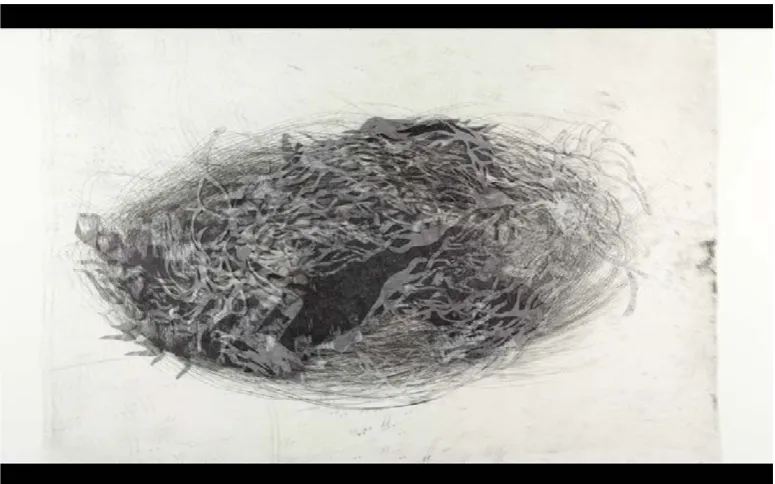
The first set of work I developed for the project came directly from this idea of multiplicity, fluidity and a consequent search to situate or place myself within my new surroundings. This series of works I have called Carrying places (Figs. 1 and 2).
When I moved to Tasmania, I brought with me accumulations of loose sketches, and rolls and rolls of artist proofs – woodcuts, etchings and monotypes. These prints and sketches held the marks that formed images and memories of past place encounters and relationships, and I held onto them tightly in an attempt to ground myself in my new state of flux.
drawing, and many of these moments were bound up in deeply felt relationships with specific places and people. Unsure why or what I was aiming to achieve, and feeling like I should be out there discovering and encountering my new environment, I somewhat reluctantly followed my instincts to engage with this intimate process of working with my archive. I found this exercise highly addictive and, after several hours of fine cutting and rearranging, I would be in a deeply relaxed state. From being in a state of potential ‘place panic’, the selecting and reworking of these images brought a sense of purpose and also invited a new language and making process into my practice. I had never revisited and reworked images before, having an approach to making whereby I would develop a drawing or print in a single session (sometimes several months long) only to print it once or a half a dozen times and then move on. Rarely would I rework a print or drawing, instead choosing to move on to the next work.
Fig. 1 Antonia Aitken, Carrying places 3, 2014–2015, collaged prints, 39 x 59 cm
This invitation for the past works to interact or assist in the building of a new image by layering and reconfiguring coincided with a shift in my thinking about place relationships. As I have explored in this chapter, I have always had a confused sense of wanting to feel placed.
now bear witness. I have also always felt conflicted by the seemingly contradictory desire to embed myself in the land and yet always to be on the move. These are aspects of myself that I am learning are both innately part of being born here in this very place and time. As I have discussed, it is possible to be both embedded without a ‘native plot of place’, and also be in fluid movement, as this acknowledges the porous and relational aspects of place.
This shift in thinking was facilitated by beginning to walk the land where I was. I walked through the streets of Hobart, on my way to University or to simply orientate myself with the city. I also began daily walks from my place of dwelling into Knocklofty Reserve, and I walked on Bruny Island. As I moved across the terrain and as I read new material, I found myself thinking more and more about the complex interweaving of lives and narratives that crisscrossed where I was. The ghosts of past and present relations were evident in the well-worn tracks and desire lines that have woven corridors of passage across the city, along the rivulets that join the mountain to the sea. I also began to think about boundaries and borders and realised that my movements between inside and outside, urban and bush, private and public had begun blurring. I realised that each of these drawn and physical demarcations that I found on maps and in person could be shifted by simply walking over, through and around them, dissolving them as I went.
Fig. 2 Antonia Aitken, Carrying places 1 & 2, 2014–2015, collaged prints, each approx. 59 x 39 cm
***
In his essay, ‘Making to Place: In the Artist’s Words, Refracted’ (2013), Brian Massumi eloquently discusses the procedural practices of Simryn Gill. As previously discussed in this chapter, Gill’s work operates in opposition to much place-based discussion in Australia. She is less preoccupied with grounding and emplacing herself within the complex matrix of this land than with floating in the gap between place relationships – a quality Massumi attributes to her migrant situation.
an unknown history of use and place relation; rubbed back to life through the printing process.
[image:32.595.141.472.499.733.2]Fig. 4 Simryn Gill, Pressing in, 2016 (in-process shots).
When first shown in her exhibition titled ‘Sweet Chariot’ at Griffith University Art Gallery in 2016, the prints were positioned with a series of photographs taken by Gill whilst aboard a fishing boat in the Strait of Malacca (Larsson, 2016). Presented in relation to the prints, these black and white photographs situate the artist and viewer floating out at sea. Gill never explicitly articulates the meanings of her work; rather, she leaves the viewer to build their own meaning through association. For me, these floating objects haunt the viewer with a peculiar sense of longing. Floating without anchors, placed in unconnected grounds, these once-connected forms suggest the idea of fluid attachment and a strange attempt to examine and perhaps re-locate the displaced.
***
[image:33.595.111.499.175.417.2]In order to better communicate a sense of shifting and blurring of time and place, I developed Carrying places into an animation. Through a series of slow merging slides the collage pieces shift and move around the frame, appearing and disappearing in nest-like formations.
Fig. 7 Antonia Aitken, Carrying places, 2018, HD Video, dimensions variable.
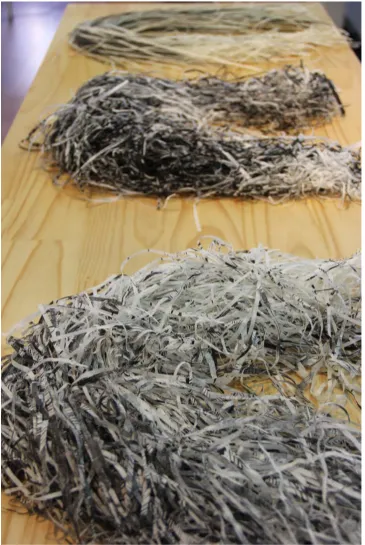
This exploration of a merging of places also led to a series of shredded paper works titled Shredded places. Made as an act of catharsis, they were a letting go of my attachment to the mnemonic devices I had so carefully carried with me to Hobart. I took individual prints representative of different places and hand cut them into fine shreds. The final forms no longer depict the places they are made, but rather hold the places in the entanglements of printed marks.
Carrying places and Shredded places are both early experiments that document my slow and tentative footsteps into Tasmania and are part of an important process of moving beyond ‘place panic’. They are, in a way, my first attempts to explore ideas of fluid attachment, something Gill’s work so beautifully contemplates.
Recalling a Bruny Island walk, part two
As I walk back along the beach, I think of the Aboriginal women now with their fighting voices and their open hearts. Women who are
reclaiming cultural practices, standing strong for justice and generously prepared to share their care and love for country despite these histories.
I notice a dark red-brown form. A twisted root ball. Hundreds of
intertwining strands or threads bound together in a form that looks like a human heart or lung.
This strange sinuous organism is the first thing I draw on Bruny Island and has since become the central form in my material and conceptual explorations for the project. Working in the way I am familiar, I choose not to know what it is or what it belongs to for a long time. I choose to remain ignorant to its classification and place within a larger ecology or its culturally bound meaning – I just allow myself to draw, touch and experience this form. Later, as people see the drawings and paper cuts, I learn it belongs to the giant kelp and that it is in fact the holdfast, or the root-like anchor or connection point of the significant Southern Ocean sea giant.
I sit with this knowledge for some time before I do anything with it. I know that the kelp has important cultural significance for the Tasmanian Aboriginal people. I am also aware that it is under great environmental threat due to warming seas caused by climate change.
This form begins to have a profound impact on my thinking and making approach.
The twisting, twirling, entangling roots begin speaking to my ideas of fluid and entangled relationships. Working in an intuitive and gentle observational manner I keep making iterations of the form – ink
drawings on paper, collages, paper cuts and woodcuts. I am never quite sure where I am going – the process itself is fraught with uncertainty and follows speculative hunches.
2.
Chapter Two | Shelter and Holdfast
The holdfast binds the giant kelp (Macrocystis pyrifera) to rock, by sending root-like (haptera) lines of connection. The holdfast can provide essential sanctuary for close to one hundred species of invertebrates living in and on the holdfast at any time. They take shelter from the harsh Southern Ocean environment in between and inside the holdfasts tunnels and chambers – chambers created by a small isopod crustacean (Limnoria) who consumes the kelp tissue. Once dislodged from its rock substrate, the holdfast becomes a floating life raft, drifting with the ocean currents, until eventually beaching upon a shore. (About Antarctica: Kelp 2016).
I returned to Hobart after my walk on Bruny Island with a much stronger sense of Tasmania’s encounter histories. This was facilitated by my direct engagement with this contested site and supported by my reading of a number of written histories exploring the complex early intercultural negotiations and conflicts that fuelled the Black War. Community of Thieves (1992) by Casandra Pybus is one of these accounts; it came about through her discovery of direct family connections to Bruny Island.
The initial drawings of the holdfast that I developed on Cape Bruny began to inform a series of visual experiments in drawing, printmaking and my newly learned skills in 3D-fabrication. The holdfast spoke to notions of entanglements, attachment and fluid relations. I was able to link the form to key questions that I was considering in regard to how we situate ourselves within the violent encounter narratives in which we are intimately entangled, and how we dissolve counterproductive notions of fixity within the fluid dynamics that are at the core of this place. As I was exploring the holdfast in my studio, I also began the familiar process of daily walks out my front door and into my immediate surrounds to orientate myself and ease my heightened sense of place panic. These two simultaneous actions or ways of finding meaning and connection established the methodology of the project.
Walking loops and creating desire lines
response, I am moving into relation with the place. It is a way of engaging in an intimate and tactile dialogue with the environment, including with its non-human inhabitants. These daily walks allow me to be simultaneously quiet and to open my mind through slow movement along looped pathways. The action of walking out the front door and into my surrounding environment on a daily basis acts as a process of orientation; a physical mapping. I am spinning a web of contact between my domestic dwelling and the world beyond.
The daily walk is one of ritual and pattern, often taking thirty minutes to two hours. It requires little preparation or provision: a bottle of water, a piece of fruit, a camera, sound recorder or drawing book. Most often I do not require a physical map, as the walk is short enough (within a six-kilometre radius of the house) to confidently navigate through mind-mapping the physical markers as I walk. These looped walks are gentle meanders with the sole purpose of observation and letting the body familiarise itself with the terrain through embodied sensation. It is a wayfinding exercise, led by curiosity and impromptu directional decisions as I move. Tim Ingold writes that wayfinding, as opposed to map reading, can be understood as:
a skilled performance in which the traveler, whose powers of perception and action have been fine-tuned through previous experience, ‘feels his way’ towards his goal, continually adjusting his movements in response to an ongoing perceptual monitoring of his surroundings (Ingold 2000, p. 220).
of daily communal life, to process my thinking, and to contemplate and generate new ideas.
Knocklofty: the place I walk
The first ridge of fringing bush that I came across, to the North-West of my Swan Street house, is a place now known as Knocklofty Reserve. It is a hill that rises steeply from the River Derwent flats. Knocklofty is a corridor to kunanyi and the beginning of a stretch of mountainous terrain that reaches hundreds of kilometres into the South-West of Tasmania. The area has an ancient geological history. Scatterings of fossilised plants and shellfish are reminders of a time when the area was a flourishing lake with a bed of sand and silt (Cook 2012).
This land is part of nipaluna country.1 Before Hobart was established, this hill was once an
ideal hillside for grazing native animals and an important hunting ground for the Muwinina people (Evans and Evans 2015). The location provides extended views of surrounding country – East to the river, South-West to kunanyi / Mount Wellington, and North to the Midlands, and with rock shelters to escape the wild Westerly weather.
We no longer know this place’s Indigenous ancestral name. Its current name means ‘lofty hill’, and originates from the Gaelic word cnoc, meaning hill, and lofty, meaning high. It was named by a Scottish settler and is a common example of early European colonial describing and overwriting practices, which often failed to acknowledge existing Aboriginal place names, let alone learn or record these names.
Walking with a friend and fellow student (a Punnilerpanner woman from North-West Tasmania) on kunanyi / Mount Wellington during the early stages of my project, I was made starkly aware of the absence, not only of a name for this place, but of living descendants of the Muwinina people, the land’s original custodians.
Extract from ‘two women walk’, 2015
We walk the Mountain with caution. With respect for its power. We ask its permission to enter and thank it when we leave. We thank it for having us and for keeping us safe.
This mountain holds deep presences and absences. Brightness and darkness.
Clearings and hollows. Sounds and silences.
The conversation meanders, skips, jumps, as we traverse the rocky scree fields.
Our bodies rub against the rough scrub and with hands out we feel our way through the high open bog lands.
We eat some bush food. A ripe ‘bush tomato’. ‘Tart’ we describe it, pulling our lips tight.
I ask about the Aboriginal oral histories of this place. What stories remain of its spiritual and cultural meanings? She is not sure and tells me quietly that there are no living descendants of the Muwinina people to share this knowledge.
We walk in silence for a moment, held by this absence.
of proclamations placing the colony under martial law and calling for Aborigines to be expelled by force from the settled districts’ (Lehman 2013, para. 13)1.
Owned and sold by a number of people from 1827, Knocklofty remained in private hands until in the early 1940s, when the Hobart City Council purchased much of the area for a leisure reserve under the ‘protected areas’ classification (Evans and Evans 2015, p. 9). Sixty years later, the bush is vigorously growing back under the care of the Council and members of Knocklofty Bush Care. The group, made up of enthusiastic locals, meets weekly to pull out gorse and other weeds, with the purpose of regenerating and caring for its diverse ecology.
People in the surrounding suburbs talk of their fondness for this area of bush. Many remember playing as children in the rock shelters, quarries and frog ponds, just as I engaged with my own nearby reserve. Today, it is a place busy with meandering bushwalkers, sweaty trail runners, and daily dog walkers. It is also home to some itinerant dwellers.
The long history of this place, and the way that it has been used, is pressed and scarred into the land, making it a complex terrain. These layers of relation have gradually been exposed as I have walked. Knocklofty has become somewhere for me to explore entanglements of image and thought, weaving and knotting these threads together by the action of moving through its networks of pathways. It has become an important place to explore broader questions of what a walking-based methodology might be, and how this methodology could address some of the philosophical and political questions about how we encounter these layered and contested places. Knocklofty has not so much been a place to be explicitly described or represented through my work, but instead a thinking place, part of a network of places that weave together my growing understanding of Tasmania, my research inquiry and my making practice. I have, however, over the years drawn on particular occurrences and visual forms found in Knocklofty. Perhaps the most significant of these is the ‘shelter’.
Shelter – the nest-house – desire for lost intimacy
Walking Journal extract, 23.3.15, Knocklofty Reserve
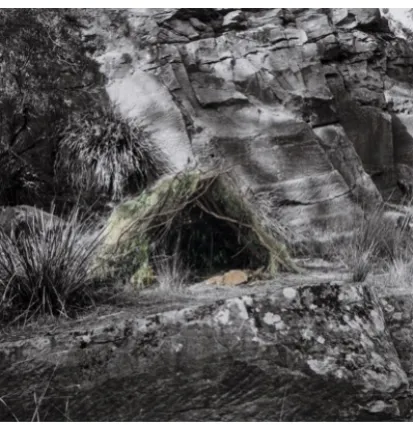
I found another dwelling today, beautifully nestled into the end of a fallen tree with rocks to create a protective foundation and sticks balanced on top to create the shelter. It is a strange feeling when I find these dwellings – like I am walking into someone’s bedroom.
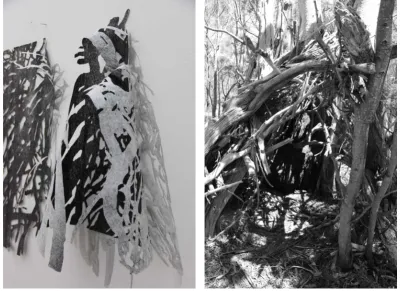
Fig. 10Antonia Aitken, Knocklofty shelter, digital photographs, documented 2015, dimensions variable.
Whilst walking in Knocklofty, I came across a number of makeshift shelters, temporary dwellings constructed from the land and formed in reference to the body they shield. They were put together through a process of gathering, layering, interlacing and balancing vegetation into forms. Some were evidently in use, others more playful constructions. Some were carefully and complexly constructed using existing tree trunks and rock walls, some had A-frame rooves, soft plant bedding and multiple entrances. I documented them through drawing and digital photography. These forms have led me to contemplate our human instinct to nestle and shelter the body within the land, to gather the bush around the body like a bird – in a sense, returning the body to something simpler and hand-constructed, and closer to the non-human world.