First European Survey on Language
Competences
June 2012 2
Table of Contents
Background to the Survey ... 3Conducting the Survey ... 3
Findings: language proficiency ... 5
Overall Performance ... 5
Performance by educational system ... 6
Performance by language ... 8
Creating a European indicator for languages ... 9
Findings: the contextual questionnaires ...11
Challenges for language learning in Europe ...13
References...14
The full report is available at:
June 2012 3
Background to the Survey
This Executive Summary presents a brief overview of the European Survey on Language Competences (ESLC) and its most important findings. The full analysis is presented in two documents: First European Survey on Language Competences: Final Report and First European Survey on Language Competences: Technical Report.
The ESLC was established to provide participating countries with comparative data on foreign language competence and insights into good practice in language learning; ‘not only … a survey of language competences but a survey that should be able to provide information about language learning, teaching methods and curricula’1. The ESLC is also intended to enable the establishment of a European language competence indicator to measure progress towards the 2002 Barcelona European Council Conclusions2, which called for ‘action to improve the mastery of basic skills, in particular by teaching at least two foreign languages from a very early age’3. It is the first survey of its kind.
In 2005 the European Commission outlined a detailed strategic approach for the ESLC. The contract for the survey was awarded in 2008 to the SurveyLang Consortium, a group of eight expert organisations in the fields of language assessment, questionnaire design, sampling, translation processes and psychometrics. The main study was carried out in spring 2011.
An Advisory Board comprising representatives of all EU Member States and the Council of Europe provided strong support for the European Commission throughout the process of developing and implementing the survey.
Conducting the Survey
Fourteen European countries took part in the survey: Belgium, Bulgaria, Croatia, Estonia, France, Greece, Malta, Netherlands, Poland, Portugal, Slovenia, Spain, Sweden and UK-England. Belgium’s three linguistic communities participated separately to give a total of 16 educational systems. The survey for England was conducted a few months later and is reported in an appendix to the main ESLC report.
The ESLC collected information about the foreign language proficiency of European pupils in the last year of lower secondary education (ISCED2) or the second year of upper secondary education (ISCED3). Note that in some educational systems these levels are considered to be primary education. Only pupils who had had instruction in the foreign language for at least one whole school year were eligible. The level chosen reflected the organisation of language learning in different countries, e.g. the age at which pupils begin to learn a second foreign language.
June 2012 4 The survey was completed to international education survey standards similar to surveys such as PISA, PIRLS and TIMSS.
The language tests covered three language skills: Listening, Reading and Writing (Speaking was considered logistically difficult for this first round). Each pupil was assessed in two of these three skills. Each pupil received a test at an appropriate level on the basis of a routing procedure. This targeted approach favoured the collection of more valid responses.
The ESLC was administered in both paper and computer-based formats.
The results of the survey are reported in terms of the levels of the Common European Framework of Reference for Languages: teaching, learning and assessment (CEFR)4. The CEFR has been widely adopted in Europe and beyond as a framework for language education, and also for developing a shared understanding of levels of language competence. It defines six levels of functional competence from A1 (the lowest level) to C2. The ESLC focused on levels A1 to B2. It was also necessary to define a pre-A1 level in order to identify an A1 threshold.
The terms "basic user" and "independent user" are adopted to designate the broad A and B levels, as well as denotations for each of the five levels, as shown in Table 1.
Table 1: Overview of ESLC and CEFR levels
Much effort was devoted to making the language tests comparable over the five tested languages in terms of the skills measured and interpretation in terms of Common European Framework levels. Examples of the language test tasks are included in the ESLC Final Report.
ESLC level CEFR level Definition
Independent user
Advanced independent user
B2 An independent language user who can express herself clearly and effectively
Independent
user B1
An independent language user who can deal with straightforward, familiar matters
Basic user
Advanced
basic user A2
A basic user who can use simple language to communicate on everyday topics
Basic user A1 A basic user who can use very simple language, with support
June 2012 5 Additional information collected for validation of standards included a multilingual study comparing samples of writing, and a section in the questionnaire where pupils were asked to self-assess their language skills on 16 Common European Framework can-do statements.
Questionnaires were administered to the pupils tested and to the foreign language teachers and principals in their institutions. In addition, system-wide information was collected through the National Research Coordinators.
Findings: language proficiency
Overall Performance
Language competences provided by educational systems still need to be significantly improved
The ESLC results show an overall low level of competences in both first and second foreign languages tested. The level of independent user (B1+B2) is achieved by only 42% of tested students in the first foreign language and by only 25% in the second foreign language. Moreover, a large number of pupils did not even achieve the level of a basic user: 14% for the first and 20% for the second foreign language.
Table 2: Percentage of pupils achieving each CEFR level in first and second foreign language (global average across educational systems)
Tested language Pre-A1 A1 A2 B1 B2
First foreign
language 14 28 16 19 23
Second foreign
language 20 38 17 14 11
June 2012 6
Table 3: Percentage of pupils achieving each CEFR level in first and second foreign language, by skill (average across educational systems)
First foreign language Second foreign language
Level Reading Listening Writing Reading Listening Writing B2 - Advanced
independent user 27 30 13 15 14 5
B1 - Independent
user 14 15 27 12 13 17
A2 - Advanced
basic user 12 13 24 13 16 21
A1 - Basic user 33 25 25 41 37 36
Pre-A1 - Beginner 14 17 11 19 20 21
Higher achievement in the first foreign language is not unexpected, given the generally earlier onset and greater amount of study. In the majority of participating countries or language communities the first foreign language is compulsory, but not the second one. In addition, in most educational systems, the first foreign language is English and the exposure to this language through internet and other traditional and new media is higher. A key finding of the ESLC is that these factors contribute to relatively better results in English than other languages. Actually, even in educational systems where English is the second foreign language, the performance in English tends to be higher than in the other language tested. Further evidence of the particular status of English comes from the pupils' questionnaire responses, their reported perception of its usefulness, and their degree of exposure to it and use of it through traditional and new media.
Performance by educational system
There is a wide range of ability across countries in Europe
The proportion of pupils reaching each level varies greatly among educational systems, for all languages (both first and second foreign language) and skills.
The Survey shows that for the first foreign language, the proportion of students reaching the level of independent user varies from 82% in Malta and Sweden (English) to only 14% in France (English) and 9% in England (French).
June 2012 7 The final report contains detailed results by educational system, first and second foreign language, and skill.
Many educational systems show high levels of achievement. However, for the first foreign language there are six educational systems in which at least 20% of pupils do not achieve the level of basic user (A1) in one or more skills. For the second foreign language the same is true of nine educational systems, although it is important to note that much shorter duration of study may be a factor here.
The wide range of achievement is not observed solely at educational system level – for example, Sweden performs very well in the first foreign language (English) but much less so in the second foreign language (Spanish). Differences should be evaluated carefully, taking into account the range of factors which make simple comparison of performance difficult: the grade pupils are in, their average age, the number of years the language has been studied - all can vary across the educational systems.
Tables 4 and 5 show for first and second foreign language the results by educational system, grouped by broad basic (A) and independent (B) user levels.
Table 4: First foreign language - percentage of pupils achieving broad levels by skill and educational system
Educational
system Language Reading Listening Writing
Pre
-A1 A B
Pre
-A1 A B
Pre
-A1 A B
Bulgaria English 23 43 34 23 37 40 15 52 32
Croatia English 16 44 40 12 32 56 5 49 45
Estonia English 7 33 60 10 27 63 3 37 60
Flemish Community of
Belgium French 12 63 24 17 62 20 19 59 22
France English 28 59 13 41 46 14 24 61 16
French Community of
Belgium English 10 59 31 18 55 27 6 65 29
German Community of
Belgium French 10 52 38 11 49 40 8 51 41
Greece English 15 40 45 19 35 46 7 41 53
Malta English 4 17 79 3 11 86 0 17 83
Netherlands English 4 36 60 3 21 77 0 39 60
Poland English 27 49 24 27 45 28 19 59 23
Portugal English 20 53 26 23 39 38 18 55 27
Slovenia English 12 42 47 5 28 67 1 51 48
Spain English 18 53 29 32 44 24 15 58 27
Sweden English 1 18 81 1 9 91 0 24 75
June 2012 8
Table 5: Second foreign language - percentage of pupils achieving broad levels by skill and educational system
Educational
system Language Reading Listening Writing
Pre
-A1 A B -A1 Pre A B -A1 Pre A B
Bulgaria German 24 51 25 25 52 22 24 60 16
Croatia German 29 57 13 23 61 16 20 69 11
Estonia German 17 56 27 15 60 24 10 68 22
Flemish Community of
Belgium English 2 18 80 1 12 87 0 27 72
France Spanish 18 68 14 19 71 10 24 68 8
French Community of
Belgium German 14 62 24 13 59 28 4 66 29
German Community of
Belgium English 3 44 53 4 32 64 0 43 57
Greece French 35 54 10 37 52 11 49 35 16
Malta Italian 16 50 34 17 37 46 31 46 23
Netherlands German 3 43 54 1 39 60 1 68 31
Poland German 41 53 6 45 50 5 45 48 7
Portugal French 20 66 14 25 64 11 32 60 8
Slovenia German 21 57 23 12 60 28 9 72 19
Spain French 5 54 41 20 61 19 7 67 26
Sweden Spanish 24 69 7 37 60 3 45 52 2
UK England German 36 58 6 28 66 6 26 68 6
Performance by language
English is the language pupils are most likely to master
The results from the ESLC confirm thatEnglish is the most widely adopted first foreign language learned by European pupils and it is also the one perceived as the most useful and, for the majority of tested pupils, the most easy to learn.
June 2012 9 In terms of levels of achievement per language, the independent user levels B1 and B2 in any skill are achieved in English by about 50% of tested pupils; in Italian by about 35%; in German and French by a little over 20%, and in Spanish by about 10%. It should be borne in mind that the languages were tested in different groups of educational systems, some of them small (one system for Italian, two for Spanish). Figure 1 shows the performance by language averaged across skills on the basis of the scores attained by all pupils tested in the language, either as a first or second foreign language.
Figure 1: Percentage of pupils achieving each level by language (average across skills)
Creating a European indicator for languages
June 2012 10
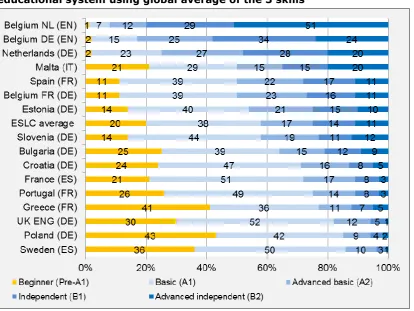
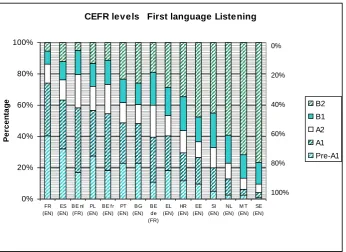
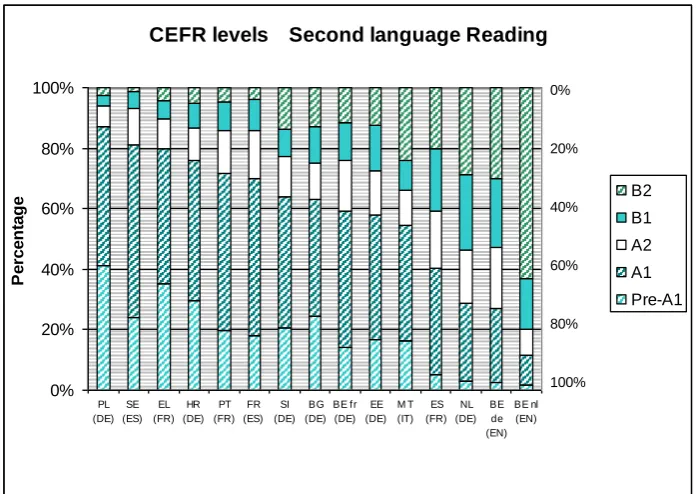
Figure 2: First foreign language. Percentage of pupils at each level by educational system using global average of the 3 skills
[image:10.595.88.503.453.764.2]June 2012 11 The educational systems are shown ordered from lower to higher, on the principle that a higher ranking indicates a larger proportion of pupils achieving the independent user levels (B1 and B2), and a smaller proportion achieving the levels of basic user (A1) or beginner (pre-A1).
Figure 2 and 3 illustrate the relative performance of educational systems using this simple proxy of global performance. They are not intended as an adequate summary of the ESLC results. The next round of ESLC should include speaking skills and should provide a basis for a more elaborate indicator.
Findings: the contextual questionnaires
The contextual information collected through the questionnaires seeks to ‘facilitate a more productive comparison of language policies, and language teaching methods between Member States, with a view to identifying and sharing good practice’5 . Thus it focuses on those contextual factors which can be modified through targeted educational policies, such as the age at which foreign language education starts, or the training of teachers. The ESLC maps out differences within and between educational systems regarding three broad policy areas, and evaluates which of these relate to differences in language proficiency. Other factors which are largely beyond the control of policy such as general demographic, social, economic and linguistic contexts are not explicitly discussed in the final report, although data on socio-economic status are collected and are available for analysis by educational systems.
Generally pupils report a rather early start to foreign language learning (before or during primary education) and most commonly they learn two foreign languages. However, considerable differences are still found across educational systems in the exact onset of foreign language learning, the current teaching time and the number of languages offered and learned.
The results of the ESLC show that an earlier onset is related to higher proficiency in the foreign language tested, as is learning a larger number of foreign languages and of ancient languages.
Policy also aspires to create a language-friendly living and learning environment, where different languages are heard and seen, where speakers of all languages feel welcome and language learning is encouraged6. Clear differences between educational systems are seen in the informal language learning opportunities available to pupils (such as pupils' perception of their parents’ knowledge of the foreign language tested, individual trips abroad, the use of dubbing or subtitles in the media, and the pupils’ exposure to the language through traditional and new media).
June 2012 12 Differences are found in schools’ degree of language specialization, the availability of ICT facilities, the number of guest teachers from abroad and provisions for pupils with an immigrant background. However, exchange visits for pupils, and participation in school language projects display a relatively low take-up and most aspects concerning classroom practice display relatively less variation across educational systems (such as the use of ICT for foreign language learning and teaching, the relative emphasis teachers place on particular skills or competences, emphasis on similarities between languages, and pupils’ attitudes to their foreign language study, its usefulness and difficulty). Only the amount of foreign language spoken in lessons shows clear differences across educational systems.
Pupils who find learning the language useful tend to achieve higher levels of foreign language proficiency and pupils who find learning the language difficult lower levels of foreign language proficiency. Also a greater use of the foreign language in lessons by both teachers and pupils shows a positive relation with language proficiency. Overall, differences in language specialization, hosting staff from other language communities, and provisions for immigrant pupils show no clear relationship with foreign language proficiency.
Improving the quality of initial teacher education and ensuring that all practising teachers take part in continuous professional development has been identified as a key factor in securing the quality of school education in general. Overall, most language teachers are well qualified, are educated to a high level, have full certification and are specialised in teaching languages. Also relatively little variation was found between educational systems concerning in-school teaching placements and teaching experience even though differences exist in the number of different languages teachers have taught. Generally, across educational systems only a small proportion of teachers have participated in exchange visits, despite the availability of funding for such visits in a number of educational systems. We did find considerable differences between educational systems in teacher shortages and in the use of and received training in the CEFR, and, to a lesser extent, in a language portfolio; the actual use of a portfolio appears rather low. Concerning continuous professional development, despite clear differences found in the organisation of in-service training (such as financial incentives, when teachers can participate in training and the mode of training), reported participation in and focus of in-service training display less variation across educational systems.
June 2012 13
Challenges for language learning in Europe
The results from the Survey highlight challenges which need to be tackled by the Member States and the EU in order to improve language competences in Europe:
1. Language competences still need to be significantly improved, and educational systems must step up their efforts to prepare all pupils for further education and the labour market. The exchange of good practice within the Open Method of Coordination will constitute one of the main tools in pursuing the Barcelona objective of teaching and mastering at least two foreign languages from a very early age.
2. Language policies should address the creation of language-friendly living and learning environments inside as well as outside schools and other educational institutions. Language policies should promote informal learning opportunities outside school, and consider the exposure to language through traditional and new media, including the effects of using dubbing or subtitles in television and cinemas. Overall, language policy should support that people in general, and young people in particular, feel capable of language learning and see it as useful.
3. The wide range of ability among Member States in language competences indicates the rich potential for peer learning in language policy and learning. The Survey points out those educational systems can make a positive difference with an early onset of foreign language learning, increase the number of foreign languages learnt and promote methods enabling pupils and teachers to use foreign languages for meaningful communication in lessons.
4. The importance of the English language as a basic skill and as a tool for employability and professional development requires concrete actions to further improve competences in this language.
June 2012 14
References
1 Communication from the Commission to the Council of 13 April 2007 entitled
‘Framework for the European survey on language competences’ [COM (2007) 184 final – Not published in the Official Journal]
2 Barcelona European Council 15 and 16 March 2002: Presidency conclusions. Barcelona.
3 Commission Communication of 1 August 2005 - The European Indicator of Language Competence [COM(2005) 356 final - Not published in the Official Journal]
4 Common European Framework of Reference for Languages: Learning, Teaching, Assessment. Cambridge: Cambridge University Press
5 Communication from the Commission to the European Parliament and the Council: The European Indicator of Language Competence. COM(2005) 356 final. 5. Brussels.
6 Language Teaching: In the spotlight. Retrieved from
Final Report
The following abbreviations are in used in this report.
Abbreviations In full
CB Computer-based
CCO Core Curriculum/Entitlement Option
CEFR Common European Framework of Reference
CLIL Content and Language Integrated Learning
CS Compulsory Subject
DDR Deutsche Demokratische Republik (German Democratic Republic)
EC European Commission
ESLC European Survey on Language Competences
FL Foreign Language
FLL Foreign Language Learning
ICT Information and Communication Technologies
ISCED International Standard Classification of Education
NA Not applicable
NQ National Questionnaire
NRC National Research Coordinator
OECD Organisation for Economic Co-operation and Development
PB Paper-based
PISA Programme for International Student Assessment
PQ Principal Questionnaire
SQ Student Questionnaire
TL Target Language
Special thanks
SurveyLang would also like to thank the following people, institutions and boards for their contribution to the European Survey on Language Competences:
The European Commission, their experts and the Advisory Board of the
European Indicator of Language Competence have provided invaluable, constructive feedback throughout the project and have contributed to key decisions on technical issues.
National Research Coordinators had a fundamental role in the ESLC. This
project would simply not have been possible without their dedication and efforts.
The SurveyLang Program Board, consisting of one member of each project
partner, have met regularly throughout the project to review the project’s progress and have taken key decisions on work processes and technical issues. Michael Milanovic, the CEO of Cambridge ESOL, and Jan Wiegers, a Director at Cito, have shared the role of Chair of this group.
SurveyLang would like to offer special thanks to Norman Verhelst, Project
1
Table of Contents
Chapter 1: Introduction ... 4
1.1 Key features of the ESLC ... 6
1.2 This report ... 8
1.3 References ... 9
Chapter 2: Population description ... 10
2.1 Introduction ... 11
2.2 ISCED levels, international grades and age in the population ... 11
2.3 Organisational structure of the educational systems ... 13
2.4 Organisation of foreign language learning ... 14
2.5 Population features and outcomes of the ESLC ... 18
Chapter 3: The language tests ... 19
3.1 Overview ... 20
3.2 The link to the CEFR ... 20
3.3 Illustration of CEFR levels: Writing ... 23
3.4 Illustration of CEFR levels: Reading and Listening ... 24
3.5 The student questionnaire can-do statements ... 26
3.6 References ... 32
Chapter 4: Language tests: results ... 33
4.1 Overview ... 34
4.2 Global CEFR levels achieved... 34
4.3 Performance in first and second target language, by educational system ... 36
4.4 Performance in each language and skill, by educational system ... 41
4.5 References ... 48
Chapter 5: The context of foreign language teaching... 49
5.1 Introduction ... 50
5.2 Basis for life-long learning of foreign languages ... 51
5.3 Language friendly living environment ... 53
5.4 Language friendly schools ... 54
5.5 Teacher initial and in-service training ... 61
5.6 Main findings ... 66
5.7 References ... 69
Chapter 6: Relation of context factors with foreign language proficiency ... 71
6.1 Introduction ... 72
6.2 The effect of a basis for lifelong learning of foreign languages ... 73
6.3 The effect of a language friendly living environment ... 76
6.4 The effect of language friendly schools ... 78
2
6.6 Main findings ... 88
6.7 References ... 89
Conclusions ... 90
7.1 Findings: language proficiency ... 91
7.2 Findings: the contextual questionnaires ... 95
7.3 References ... 97
Appendices ... 98
8.1 Can do statements ... 99
8.2 The language tests ... 101
8.3 The context of foreign language teaching ... 153
8.4 Managing and implementing the ESLC ... 227
8.5 Data tables ... 230
3
Reader’s guide to abbreviations and codes used in this
report
The following educational system and language codes are used throughout this report.
Participating educational system
Educational system code
Questionnaire language(s)
Language code
Flemish Community of Belgium
BE nl Dutch Nl
French Community
of Belgium BE fr French Fr
German Community of Belgium
BE de German/French de, fr
Bulgaria BG Bulgarian Bg
Croatia HR Croatian Hr
England UK-ENG English En
Estonia EE Estonian; Russian et, er
France FR French Fr
Greece EL Greek El
Malta MT English En
Netherlands NL Dutch Nl
Poland PL Polish Pl
Portugal PT Portuguese Pt
Slovenia SI Slovene Sl
Spain ES
Spanish, Basque, Catalan, Galician, Valencian
es, Spanish-Basque Catalan, Galician,
Spanish-Valencian
4
5
1 Introduction
The European Survey on Language Competences (ESLC), the first survey of its kind, is designed to collect information about the foreign language proficiency of students in the last year of lower secondary education (ISCED2) or the second year of upper secondary education (ISCED3) (UNESCO 1997) in participating countries or country communities (referred to herein as educational systems). The intention was ‘not only to undertake a survey of language competences but a survey that should be able to provide information about language learning, teaching methods and curricula.” (European Commission 2007a). As the European Commission (2005) states, ‘it is important for Member States to be able to contextualise the data‘, and thus the language tests should ‘be complemented by questionnaires to teachers and pupils to gather contextual information’.
The ESLC is a collaborative effort among the 16 participating educational systems and SurveyLang partners to measure the language proficiency of approximately 54,000 students across Europe, to assist the European Commission in establishing a European Indicator of Language Competence to monitor progress against the Barcelona European Council Conclusions (2002). These conclusions called for ‘action to improve the mastery of basic skills, in particular by teaching at least two foreign languages from a very early age’ and also for the ‘establishment of a linguistic competence indicator’ (European
Commission 2005). As the Commission states, the decision to launch the ESLC ‘arose
from the current lack of data on actual language skills of people in the European Union and the need for a reliable system to measure the progress achieved’. The ESLC was therefore initiated by the Commission with the aim that: ‘the results collected will enable the establishment of a European Indicator of Language Competence and will provide reliable information on language learning and on the language competences of young people’ (European Commission 2007a) as well as providing ‘strategic information to policy makers, teachers and learners in all surveyed countries’ through the collection of contextual information in the background questionnaires (European Commission 2007b).
Each educational system tested students in two languages the most widely taught of the five most widely taught official languages of the EU: English, French, German, Italian and Spanish. This effectively meant that there were two separate samples within each educational system, one for the first test language, and one for the second. Each sampled student was therefore tested in one language only.
The ESLC sets out to assess students’ ability to use language purposefully, in order to understand spoken or written texts, or to express themselves in writing. Their observed language proficiency is described in terms of the levels of the Common European Framework of Reference (Council of Europe 2001), to enable comparison across participating educational systems. The data collected by the ESLC will allow participating educational systems to be aware of their students’ relative strengths and weaknesses across the tested language skills, and to share good practice with other participating educational systems.
6
addition, system-wide information was collected through the National Research Coordinators. The context questionnaires provide information on a range of policies of the European Commission aimed at improving foreign language competences.
The ESLC data adds significantly to the knowledge base that was previously available at European level or from official national statistics. The data should prove a valuable resource for researchers, policy makers, educators, parents and students and will enable them to review progress towards achieving the Barcelona European Council Conclusions of learning two foreign languages from an early age.
SurveyLang recognises the contribution of all of its partners and National Research Coordinators (NRCs) in the delivery of the survey. The ESLC is methodologically complex and its implementation has required a considerable collaborative effort by the participating educational systems with SurveyLang. The in-country administration of the survey was the responsibility of the representatives of each educational system (National Research Coordinators). Implementing the ESLC depended not only on this collaboration but also on pooling the expertise of SurveyLang partners to develop and exploit innovative methodologies, test instruments and technologies.
1.1
Key features of the ESLC
Key features of the ESLC are outlined in brief below.
Sample size: Approximately 53,000 students enrolled in schools in 16 participating educational systems were assessed in the ESLC Main Study 2011.
Tested education level: Students were tested at the last year of lower secondary education (ISCED2) or the second year of upper secondary education (ISCED3) in participating educational systems.
Tests and questionnaires: The language tests covered three language skills: Listening, Reading and Writing in five test languages: English, French, German, Italian and Spanish. Each student was assessed in two out of these three skills in one test language and also completed a contextual questionnaire. Students were tested at one of three overlapping levels on the basis of a routing test. The language tests measure achievement of levels A1 to B2 of the Common European Framework of Reference (CEFR) (Council of Europe, 2001). The pre-A1 level which is also reported indicates failure to achieve A1. Language teachers and school principals at sampled schools also completed a contextual questionnaire.
Testing mode: The ESLC was administered in both paper and computer-based formats. The Teacher and Principal Questionnaires were administered through an internet based system.
7
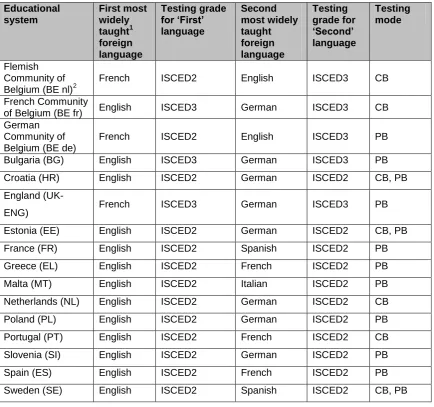
[image:24.595.70.505.185.592.2]Summary of tested languages, levels and testing mode across participating educational systems: The table below provide a summary of the tested languages, levels and testing mode of each educational system. Further details on the tested languages and levels can be found in Chapter 4 on sampling in the ESLC Technical Report.
Table 1: Educational system testing design summary
Educational system
First most widely taught1 foreign language
Testing grade for ‘First’ language
Second most widely taught foreign language
Testing grade for ‘Second’ language
Testing mode
Flemish Community of Belgium (BE nl)2
French ISCED2 English ISCED3 CB
French Community
of Belgium (BE fr) English ISCED3 German ISCED3 CB
German Community of Belgium (BE de)
French ISCED2 English ISCED3 PB
Bulgaria (BG) English ISCED3 German ISCED3 PB
Croatia (HR) English ISCED2 German ISCED2 CB, PB
England
(UK-ENG) French ISCED3 German ISCED3 PB
Estonia (EE) English ISCED2 German ISCED2 CB, PB
France (FR) English ISCED2 Spanish ISCED2 PB
Greece (EL) English ISCED2 French ISCED2 PB
Malta (MT) English ISCED2 Italian ISCED2 PB
Netherlands (NL) English ISCED2 German ISCED2 CB
Poland (PL) English ISCED2 German ISCED2 PB
Portugal (PT) English ISCED2 French ISCED2 CB
Slovenia (SI) English ISCED2 German ISCED2 PB
Spain (ES) English ISCED2 French ISCED2 PB
Sweden (SE) English ISCED2 Spanish ISCED2 CB, PB
Outcomes – the ESLC delivers the following outcomes:
A profile of the language proficiency of sampled students. Contextual
indicators providing a broad range of information on the context of foreign language teaching policies and foreign language learning at student, teacher and school level
1
Note, this refers only to the first and second most widely taught languages out of English, French, German, Italian and Spanish. For several educational systems, their first or second most widely taught language is not one of these languages.
2
8
Information on the relationship between language proficiency and the
contextual indicators
A resource and knowledge base for policy analysis and research.
1.2
This report
This Final Report is concerned with the results of the ESLC. Technical aspects of the ESLC are addressed separately in the ESLC Technical Report.
Note that England completed the survey later and results are provided in a separate appendix to this Report. For clarity, no results in the Final Report include England.
This report includes the following sections:
Chapter 2 describes the tested population: the students, the organisational
structure of the education systems and of language teaching,
Chapter 3 describes the approach to constructing language tests and linking
to the CEFR levels. It illustrates the test tasks for Writing, Reading and Listening and provides examples of Writing production; it also discusses the results of students’ self-ratings on 16 CEFR-related can-do statements.
Chapter 4 presents results, globally, by first and second target languages,
and by tested language, for each skill.
Chapter 5 presents the descriptive results of the Student and Teacher and
Principal Questionnaires, showing each educational system’s status on each estimated index.
Chapter 6 presents the results of the regression analyses which explore the
relation between questionnaire indices and performance on the language tests.
Chapter 7 offers a brief summary and discussion of the most significant
outcomes.
Policy-relevant findings can be found in chapters 4 to 6, and are summarised in chapter 7.
The data underlying the major graphs in this report together with standard errors are
provided in the EXCEL file ESLC Appendix all tables chapters 4-5-6.xls , available with
9
1.3
References
Council of Europe (2001) Common European Framework of Reference for Languages:
Learning, Teaching, Assessment. Cambridge: Cambridge University Press
European Commission (2005) Commission Communication of 1 August 2005 - The
European Indicator of Language Competence [COM(2005) 356 final - Not
published in the Official Journal], retrieved 18 January 2012, from
http://europa.eu/legislation_summaries/education_training_youth/lifelong_learning /c11083_en.htm
European Commission (2007a) Communication from the Commission to the Council of 13
April 2007 entitled “Framework for the European survey on language
competences” [COM (2007) 184 final – Not published in the Official Journal]
European Commission (2007b) Terms of Reference: Tender no. 21 “European Survey on
Language Competences”. Contracting Authority: European Commission
UNESCO (1997) International Standard Classification of Education, 1997 United Nations
Educational Scientific and Cultural Organization
10
11
2 Population description
2.1
Introduction
In this chapter the different populations in the ESLC (2010-2011) are described. The populations differ by educational system and target language. The research-population for each target language in an educational system consists of students in the last year of lower secondary education (ISCED2) or the second year of upper secondary education
(ISCED3)3. In addition, students in the research-population are attending educational
institutions located within the educational system and studying the specific language to be tested for a defined minimum period of one academic year prior to the testing year. The sampling chapter (chapter 4) of the ESLC Technical Report has further details about the testing grades for each educational system.
The decision to test one or both target languages in some educational systems at ISCED3 has been taken when the target language is not taught at ISCED2 in an educational system, or has been taught for too short a period for students to have completed one academic year’s study prior to testing.
In each educational system two target languages were tested: the two most widely taught foreign languages in the educational system from the five most widely taught foreign languages in Europe (English, French, German, Italian and Spanish).
2.2
ISCED levels, international grades and age in the population
2.2.1 Survey design
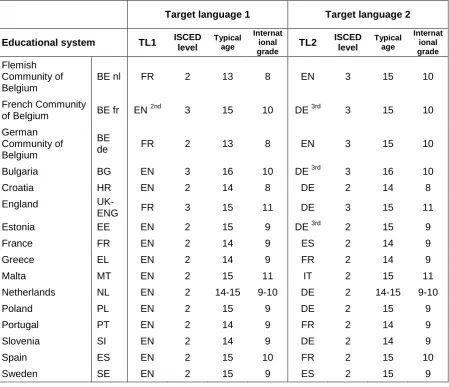
Table 2 shows the target languages per educational system, the ISCED level and international grade (where international grade 1 is the first grade of compulsory ISCED1) in which the students were placed at the time of the test and the student’s typical age at the time of the test (2010-2011).
In three educational systems students were not tested in the first and second most widely taught foreign languages as these were not among the five most widely taught languages in Europe that were included in the ESLC. In these educational systems, the languages tested are the first and third (Bulgaria and Estonia) or second and third (the French Community of Belgium).
In the majority of educational systems, students were tested at the end of ISCED2, except for the Flemish and German Communities of Belgium (second target language), the French Community of Belgium, Bulgaria and England where students were tested in ISCED3.
3 For a description of ISCED levels see: OECD (1999). Classifying Educational Programmes — Manual for ISCED-97.
12
In general, the typical age of the students tested was 14 or 15, but in Bulgaria the typical age was 16 and in the Flemish and German Communities of Belgium the typical age of the first target language population was 13.
[image:29.595.72.522.269.656.2]For the majority of the students, the international grade in which they were enrolled at the time of the test was either grade 9 or grade 10. In the Netherlands, the grade in which the students were enrolled depended on the school type they were in; for both school types the testing grade was the last grade of ISCED2. In the Flemish and German Communities of Belgium the testing grade differed for the different populations; grade 8 for the first target language and grade 10 for the second target language. In Croatia, students were tested in grade 8 in both target languages.
Table 2: Survey Design
Target language 1 Target language 2
Educational system TL1 ISCED
level
Typical age
Internat ional grade
TL2 ISCED
level
Typical age
Internat ional grade
Flemish Community of Belgium
BE nl FR 2 13 8 EN 3 15 10
French Community
of Belgium BE fr EN
2nd
3 15 10 DE 3rd 3 15 10
German Community of Belgium
BE
de FR 2 13 8 EN 3 15 10
Bulgaria BG EN 3 16 10 DE 3rd 3 16 10
Croatia HR EN 2 14 8 DE 2 14 8
England
UK-ENG FR 3 15 11 DE 3 15 11
Estonia EE EN 2 15 9 DE 3rd 2 15 9
France FR EN 2 14 9 ES 2 14 9
Greece EL EN 2 14 9 FR 2 14 9
Malta MT EN 2 15 11 IT 2 15 11
Netherlands NL EN 2 14-15 9-10 DE 2 14-15 9-10
Poland PL EN 2 15 9 DE 2 15 9
Portugal PT EN 2 14 9 FR 2 14 9
Slovenia SI EN 2 14 9 DE 2 14 9
Spain ES EN 2 15 10 FR 2 15 10
13
2.3
Organisational structure of the educational systems
2.3.1 Starting age of compulsory education
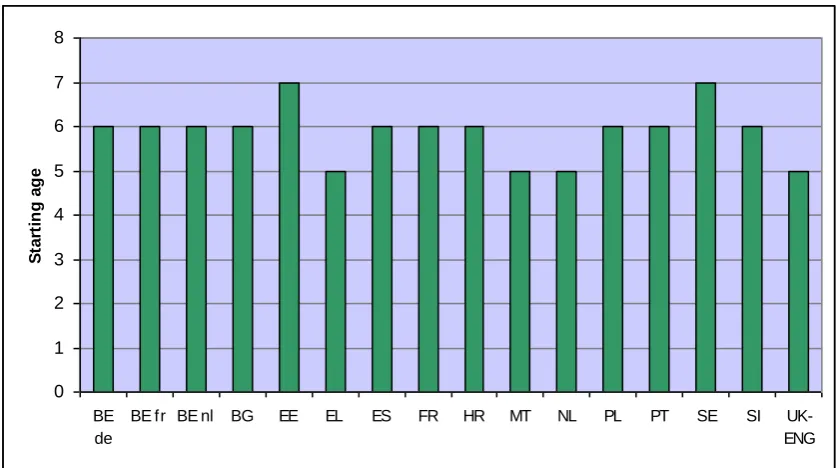
[image:30.595.76.495.272.506.2]Figure 1 represents the starting age of compulsory education per educational system as reported in the national questionnaire. The figure shows that in 10 of the 16 educational systems compulsory education starts at the age of 6. In four educational systems, compulsory education starts at the age of 5 (England, Greece, Malta and the Netherlands) and in two educational systems compulsory education starts at the age of 7 (Estonia and Sweden).
Figure 1: Starting age (onset) of compulsory education
0 1 2 3 4 5 6 7 8
BE de
BE fr BE nl BG EE EL ES FR HR MT NL PL PT SE SI
UK-ENG
S
ta
rt
in
g
a
g
e
2.3.2 Duration of ISCED levels 1 and 2
14
Figure 2: Duration of ISCED levels 1 and 2 in number of grades
0 1 2 3 4 5 6 7 8 9 10 11 12
BE de
BE fr BE nl BG EE EL ES FR HR MT NL PL PT SE SI
UK-ENG
In
te
rn
a
ti
o
n
a
l
g
ra
d
e
2.4
Organisation of foreign language learning
2.4.1 Compulsory foreign language learning
15
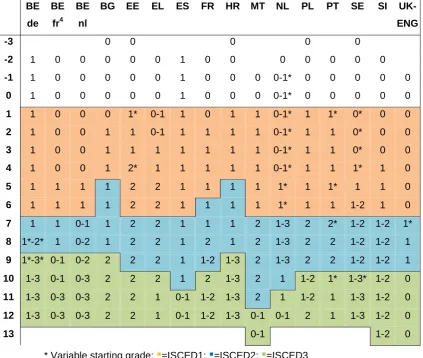
Table 3: Number of Languages Compulsory for All Students by International Grade
BE
de BE
fr4 BE
nl
BG EE EL ES FR HR MT NL PL PT SE SI
UK-ENG
-3 0 0 0 0 0
-2 1 0 0 0 0 0 1 0 0 0 0 0 0 0
-1 1 0 0 0 0 0 1 0 0 0 0-1* 0 0 0 0 0
0 1 0 0 0 0 0 1 0 0 0 0-1* 0 0 0 0 0
1 1 0 0 0 1* 0-1 1 0 1 1 0-1* 1 1* 0* 0 0
2 1 0 0 1 1 0-1 1 1 1 1 0-1* 1 1 0* 0 0
3 1 0 0 1 1 1 1 1 1 1 0-1* 1 1 0* 0 0
4 1 0 0 1 2* 1 1 1 1 1 0-1* 1 1 1* 1 0
5 1 1 1 1 2 2 1 1 1 1 1* 1 1* 1 1 0
6 1 1 1 1 2 2 1 1 1 1 1* 1 1 1-2 1 0
7 1 1 0-1 1 2 2 1 1 1 2 1-3 2 2* 1-2 1-2 1*
8 1*-2* 1 0-2 1 2 2 1 2 1 2 1-3 2 2 1-2 1-2 1
9 1*-3* 0-1 0-2 2 2 2 1 1-2 1-3 2 1-3 2 2 1-2 1-2 1
10 1-3 0-1 0-3 2 2 2 1 2 1-3 2 1 1-2 1* 1-3* 1-2 0
11 1-3 0-3 0-3 2 2 1 0-1 1-2 1-3 2 1 1-2 1 1-3 1-2 0
12 1-3 0-3 0-3 2 2 1 0-1 1-2 1-3 0-1 0-1 2 1 1-3 1-2 0
13 0-1 1-2 0
* Variable starting grade;
▪
=ISCED1;▪
=ISCED2;▪
=ISCED3As Table 3 shows, there is some variance in the number of languages that are compulsory for all students.
Table 4 shows whether foreign language learning (FLL) is a compulsory subject or a core curriculum/entitlement option in the curriculum as specified by the central (or highest level) authorities. Foreign languages are a core curriculum option or entitlement option when “schools (according to the centrally determined curriculum) must offer at least one foreign language among the set of optional subjects. According to the same centrally determined curriculum, each pupil must choose at least one subject (which does not have to be a language) from this set of subjects.” (Eurydice, Key Data on Teaching Languages at School in Europe 2008:113).
4
16
Table 4: FLL is a Compulsory Subject (CS) or a Core Curriculum/Entitlement Option (CCO)
in the curriculum*
Education
al system ISCED1
General ISCED2
Vocational ISCED2
General ISCED3
Vocational ISCED3 CS CCO CS CCO CS CCO CS CCO CS CCO
BE de 2 0 2 0 NA NA 2 0 2 0
BE fr 2 0 2 0 NA NA 2 0 1 0
BE nl 2 0 1 0 NA NA 2 0 1 0
BG 2 0 2 1 NA NA 2 1 2 1
EE 2 0 2 0 NA NA 2 0 2 0
EL 2 0 2 0 NA NA 2 2 2 0
ES 2 0 2 2 NA NA 2 2 1 1
FR 2 0 2 0 NA NA 2 1 2 0
HR 2 2 2 2 NA NA 2 2 2 1
MT 2 0 2 2 NA NA 0 1 2 1
NL 2 0 2 2 2 2 2 2 1 1
PL 2 0 2 0 NA NA 2 0 2 0
PT 2 0 2 0 2 0 2 0 2 0
SE 2 0 2 0 NA NA 2 0 2 0
SI 2 0 2 2 NA NA 2 2 2 0
UK-ENG 0 2 2 0 NA NA 0 2 0 2
* As specified by the central (or highest level) authorities. NA=Not applicable (No vocational ISCED2); 0=For none; 1=Only for students in certain types of study; 2=For all (or almost all) students.
In general, foreign language learning is a compulsory subject for all (or almost all) students in ISCED levels 1, 2 and 3. Exceptions are:
ISCED1 in England, where foreign language learning is a core
curriculum/entitlement option for all (or almost all) students
ISCED1 in Slovenia, where foreign language learning is a core
curriculum/entitlement option for some students
general ISCED2 in the Flemish Community of Belgium, where foreign language
learning is only compulsory for students in certain types of study
general and vocational ISCED3 in England, where foreign language learning is a
core curriculum/entitlement option for all (or almost all) students
general ISCED3 in Malta, where foreign language learning is a core
curriculum/entitlement option for students in certain types of study
vocational ISCED3 in the Flemish and French Communities of Belgium, Spain
and the Netherlands, where foreign language learning is compulsory for students in certain types of study.
Specific languages that are mandatory in the foreign language curriculum for all (or almost all) students are:
English in ISCED1 and ISCED2 in Greece, ISCED1, ISCED2 and ISCED3
17
French in ISCED1, ISCED2 and ISCED3 (general and vocational) in the German
Community of Belgium and in ISCED1 in the Flemish Community of Belgium.
Educational systems where no specific languages are mandatory for all (or almost all) students in ISCED1 or ISCED2 are: the French Community of Belgium, Bulgaria, Croatia, England, Estonia, France, Poland, Portugal, Spain and Slovenia. In the six other participating educational systems the first target language is mandatory in at least ISCED1 or ISCED2. In the German Community of Belgium the second target language (English) is mandatory for all (or almost all) students in ISCED3. This is relevant information as in the German Community of Belgium the second target language population was tested in ISCED3.
2.4.2 Teaching time for foreign languages
Table 5 shows recommendations for the minimum annual teaching time in hours for foreign languages as a compulsory subject during ISCED1 and during general ISCED2 (on average across grades). As shown in the table, most central (or highest level) authorities of educational systems give recommendations for the minimum annual teaching time for foreign languages as a compulsory subject. For ISCED1 most educational systems recommend between 30 and 80 hours on average per year. In general ISCED2 the differences between educational systems are larger. For ISCED1 and ISCED2, the minimum recommended teaching time is least for the French Community of Belgium and most for Malta.
18
Table 5: Minimum Annual Teaching Time (hours=60 minutes) Recommended by the Central
(or Highest Level) Authorities for Foreign Languages as a Compulsory Subject (on Average
across Grades)
BE de BE fr BE nl BG EE EL ES FR
ISCED1 * <30 * 30-80 30-80 30-80 30-80 30-80
General
ISCED2 * 30-80 * 30-80 130-180 80-130 80-130
130-180
HR MT NL PL PT SE** SI
UK-ENG
ISCED1 30-80 80-130 * 30-80 30-80 30-80 30-80 *
General
ISCED2 30-80 >180 * 80-130 130-180 30-80 130-180 *
* No recommendations. ** No separate recommendations for ISCED1 and general ISCED2.
2.5
Population features and outcomes of the ESLC
When comparing the foreign language results of educational systems we have to keep in mind that the populations differ in aspects such as:
the number of years that students have had compulsory education at the time of
testing (based on the starting age of compulsory education and the typical age of test)
whether the target language is compulsory for all (or almost all) students in the
ISCED level in which students were tested
how many foreign languages are compulsory for students in the testing grade.
19
20
3 The language tests
3.1
Overview
As specified in the Communication from the Commission to the Council “Framework for the European Survey on Language Competences” (13 April 2007), test performance in the ESLC is to be interpreted with reference to the proficiency levels defined in the Common European Framework of Reference for languages (CEFR).
This chapter briefly summarises the processes of test development and of standard setting to show how the ESLC language tests set out to measure the language ability of students in a way that relates validly to the CEFR. Much fuller treatment of these work areas is provided in the Technical Report (chapters 2 and 11)
It considers the status of the CEFR levels: where do they come from? What kind of reality do they relate to? Are they understood the same way in different countries?
Sections 0 and 3.4 make reference to the language test tasks to illustrate how students’ proficiency progresses across the CEFR levels. For the skill of Writing we can illustrate students’ proficiency directly through samples of actual written performance. For the indirectly observed skills of Reading and Listening we can illustrate through a sample of the tasks developed for the ESLC.
Finally, Section 3.5 offers a lateral view on language learning achievements: a study of the can-do statements included in the Student Questionnaire. The 16 CEFR-related statements reflect students’ self-ratings of their own abilities in Reading, Writing, Speaking and Listening. These statements were not, for reasons which are explained, used as evidence in finalising standards; but we believe that they do enrich the picture of language proficiency given by the ESLC, and indicate areas where further empirical research could contribute to our understanding.
3.2
The link to the CEFR
3.2.1 The CEFR and the nature of its levels
21
Where do the levels come from? They formalise conceptual levels with which English Language Teaching (schools, teachers and publishers) had operated for some years – with familiar labels such as ‘intermediate’ or ‘advanced’. As Brian North, a co-author of the CEFR says: ‘The CEFR levels did not suddenly appear from nowhere.’ (North 2006). The 1977 Ludwighaven Symposium was the first discussion of a possible set of “Council of Europe levels”. This was illustrated with reference to Cambridge Proficiency and the First Certificate exams (now associated with C2 and B2), and to the Council of Europe-sponsored Threshold and Waystage learning objectives (now associated with B1 and A2).
So the levels can be seen to reflect an existing reality inhering in large populations of language learners. These learners progress through a series of stages in their learning career, each stage supported by appropriate courses, coursebooks and tests, which spring up as needed around each language. The levels reflect a progression of steps sufficiently accessible as learning targets but sufficiently distinct as learning achievements - they have developed in an organic way in response to need (Taylor and Jones 2006), (Jones 2005).
But: there is clearly also a conventional element to the levels. Each educational context, and each widely-learned language, may have developed well-embedded understandings of levels, and accreditation systems with well-embedded standards. Thus we may expect that particular contexts or particular languages may refer the CEFR level descriptors to different realities, and thus interpret them differently.
A common understanding of levels is clearly a goal worth pursuing, for purposes within education and beyond it. There are currently no ways of enforcing such an understanding, and this would be undesirable, even if possible. More likely is a gradual convergence of use across countries and languages, informed by authoritative points of reference. These will arise from studies with an explicitly multilingual focus. As the most significant and carefully-designed such study yet, the ESLC can contribute to this process of convergence.
3.2.2 Constructing tests linked to the CEFR
To link tests in five languages to the CEFR the first requirement is that these tests be comparable with each other and relate validly to the CEFR. As described more fully in Chapter 2 of the ESLC Technical Report, the language tests developed for the ESLC set out to reflect the CEFR’s action-oriented, functional model of language use, while ensuring relevance for 15-year-olds in a school setting. The socio-cognitive model adopted is based on the CEFR’s model of language use and learning, and identifies two
dimensions – the social dimension of language in use, and the cognitive dimension of
language as a developing set of competences, skills and knowledge. These were used to define testable abilities at each proficiency level. In order that the resulting test construct should be implemented comparably across languages, these abilities were mapped to specific task types, drawing chiefly on task types used successfully by the consortium’s language partners in their exams.
22
procedures including cross-language vetting of all tasks to achieve a shared understanding of the construct and how the tasks should measure it.
The final set of tasks was narrowed down in three stages: trialling, pretesting and the Field Trial, such that only one third of the developed material was used in the Main Study.
These design and implementation procedures, more fully described in the Technical Report (Chapter 2) not only allow us some confidence that the tests constructed for each language and skill relate validly to the CEFR, but also that the difficulty of the tasks should be broadly comparable across languages. This was one source of evidence for setting standards (see below and Chapter 11 of the ESLC Technical Report).
3.2.3 Setting standards
Setting standards for the ESLC in CEFR terms is a complex enterprise. It requires human judgment informed by evidence, and given the need to defend the comparability of standards across five languages, a process of reconciliation of evidence.
Standard setting was the focus of a conference in September 2011. This was a major event with over 70 participants. Five panels of judges worked separately per language, the size of the panels varying from 21 for English to 8 for Italian. Participants included NRCs or their nominees, SurveyLang language partners and experts invited by them, and representatives of the European Commission, including a member of the expert committee for the project.
The procedures adopted at the conference largely reflect approaches described in the Manual for relating examinations to the Common European Framework, (Council of Europe 2008). Reading and Listening required a task-based approach, informed by evidence on the difficulty of tasks estimated from Main Study data. For Writing, judgments focused on examples of performance, again taken from the Main Study.
Standard setting was preceded by a separate multilingual alignment study for Writing, conducted by email, which used in the final analysis the judgments of 80 participants, many of whom also took part in the standard setting conference.
Following the standard setting conference a careful process of reconciliation was conducted by SurveyLang experts, to ensure maximum convergence across languages, where convergence could reasonably be sought. The multilingual alignment study for Writing provided useful evidence here, as did the language test tasks themselves, and the whole test construction and validation process, which aimed at ensuring their broad comparability across languages.
23
3.3
Illustration of CEFR levels: Writing
The Main Study used 8 Writing tasks: 2 at each of the 4 levels A1-B2. Students were tested at one of 3 overlapping test levels: A1-A2, A2-B1 or B1-B2. Students taking the lowest level test responded to 3 tasks: 2 A1 tasks and 1 A2 task, or vice-versa. Students at the middle test level responded to 2 tasks, at A2 and B1, while students at the high level responded to 2 tasks, at B1 and B2.
As described in greater detail in Chapter 1 of the ESLC Technical Report, Writing
performances were marked on two criteria, language and communication.
Communication addresses the question: how completely does the response
address the task? - i.e. how successfully is the task fulfilled, in terms of communicating the content or information required. Specific points to address: How many of the content points are dealt with clearly? How well are the points expanded? Is the style appropriate given the purpose and addressee?
Language addresses the question: how adequate to the task is the vocabulary,
linguistic organisation and accuracy? Specific aspects of language to consider include: coherence, vocabulary, cohesion, accuracy.
In this report 4 of the 8 writing tasks – one at each CEFR level - are used to illustrate the progression from A1 to B2. In this chapter we include just one illustration, for an A1 task in English (Figure 3). Appendix 8.2.2 presents all 4 tasks for each of the 5 languages, enabling the reader to judge the comparability of the tasks across languages.
Figure 3 Example A1 English writing task: “holiday photo”
EN - Holiday photo
You are on holiday. Send an email to an English friend with this photo of your holiday.
Tell your friend about: • the hotel
• the weather
• what the people are doing Write 20–30 words.
24
Figure 4 Example performances for English A1 task “holiday photo”
Task Achieves A1 Pre-A1
A1
Holiday
photo
"Hi! I living in Hotel Bellevue and this is nice, We have swimming pool and a nice resturant. The weather is very good, its sunny and very hot. And the people play vollyball and they are nice.
Good bye!"
They play voleyball. The namn of the hotel is Belleevue. Have a greates tree.
The performances used here as examples have been selected using statistical information on the ability of the student, as well as a subjective judgment of their overall representativeness of the level. They represent clear achievement or clear failure, rather than borderline performance. In this report no explanation is offered of why a given example achieves or fails, as the purpose is simply to illustrate. However, such explanation of criteria for success was important in the ESLC where exemplars were used for training and standardisation of markers.
3.4
Illustration of CEFR levels: Reading and Listening
Levels of performance for Reading and Listening cannot be illustrated as directly as in the case of Writing. Instead of evaluating students’ productions directly we must look at the test tasks themselves and think of the score on each task which would demonstrate achievement of a CEFR level. This is a significantly more abstract task.
Figure 5 below illustrates with an English Reading task at A1 level. All of the publicly released Main Study tasks are presented in Appendix 8.2.3.1.
Figure 5 Example task (English Reading type 2-A1)
You will read a notice about a cat. For the next 4 questions, answer A, B or C.
Leo is lost. He’s my little cat. He’s white with black paws. He’s small and very sweet. He has brown eyes. He wears a grey collar. He didn’t come home on Monday and it’s Thursday today. That’s a long time for a little cat!
Leo often sits on top of the houses near here between Smith’s baker’s shop and King Street. If you find him in your garden or under your car, please telephone me immediately. Please note – Leo doesn’t like it when people pick him up, and he doesn’t like milk.
Thank you for your help! Sophie Martin
25
1 What colour is Leo? 3 Where does Leo like to go?
A white and grey A in gardens
B brown and grey B under cars
C black and white C on houses
2 Sophie saw Leo 4 If you find Leo
A yesterday. A phone Sophie.
B a few days ago. B give him some milk.
C a week ago. C tell the baker.
Figure 6 shows graphically for all the tasks used in English Reading the performance level (i.e. the score) needed to demonstrate achievement of a CEFR level. The task illustrated above is the third up from the bottom: 2-A1. All the publicly released tasks are indicated with a bullet ● in the graphic. Appendix 8.2.3.2 presents similar graphics for all five languages and the two skills of Reading and Listening.
Figure 6 Scores demonstrating CEFR levels: Example of English reading
Reading - English
Type 3 - A1
Type 1 - A1 Type 2 - A1 ●
Type 5 - A2 Type 2 - A2
Type 4 - A2 ● Type 3 - A2
Type 6 - B1 Type 5 - B1 ●
Type 7 - B1
Type 7 - B2 ●
A1 A2
A2
B1 B1
B2 B2
Type 6 - B2 A1
Type 8 - B2
-2 -1 0 1 2 3 4 5
< easiest ___________________ hardest >