Rochester Institute of Technology
RIT Scholar Works
Theses
Thesis/Dissertation Collections
2004
Embedded Security Improvements to IPv6
Mark Merlino
Follow this and additional works at:
http://scholarworks.rit.edu/theses
This Thesis is brought to you for free and open access by the Thesis/Dissertation Collections at RIT Scholar Works. It has been accepted for inclusion in Theses by an authorized administrator of RIT Scholar Works. For more information, please [email protected].
Recommended Citation
Embedded
Security
Improvements
to
IPv6
By
Mark
Merlino
Thesis
submittedin
partialfulfillment
ofthe
requirementsfor the
degree
ofMaster
ofScience in Information
Technology
Rochester
Institute
ofTechnology
B. Thomas Golisano
College
of
Computing
andInformation
Sciences
Rochester Institute of Technology
B. Thomas Golisano College
of
Computing and Information Sciences
Master of Science in Information Technology
Thesis Approval Form
Student Name:
Mark Merlino
Thesis Title:
Embedded Security Improvements to Ipv6
Thesis Committee
Name
Signature
Date
Prof. Sharon Mason
Chair
Evelyn Rozanski. Ph.D
Committee Member
Thesis Reproduction Permission Form
Rochester Institute of Technology
B.
Thomas Golisano College
of
Computing and Information Sciences
Master of Science in Information Technology
Embedded Security Improvements to IPv6
I, Mark Merlino, hereby grant permission to
the
Wallace Library of the Rochester
Institute of Technology to reproduce my thesis in whole or in part. Any
reproduction must not be for commercial use or profit.
Table
ofContents
Introduction 2
Networks 4
NetworkCommunications 7
Network Transmission Methods 14
Mediums 16
Electromagnetic Signals 21
Portal Devices 22
Internets 27
InternetService Providers 28
Domains 30
Communication Architectures 32
OSI Model 37
TCP/IP 40
Internet Protocol 42
Internet Protocol Version6 51
IntrusionsandDetections 63
Viruses 82
Security
Controls 90Certificate
Authority
93IP
Security
Architecture 98Human Interaction 104
Hackers 108
Coding
Ethics 110Spreading
ofViruses IllProfits form Virus Propagation 117
RoleofGovernment Agencies 120
VendorSupportofIPv6 126
Conclusion 131
Acronyms 134
Endnotes 136
Bibliography
140AddendumA Figures 141
Introduction
Today'sbusinessesandhomeconsumershave spent vast amounts ofmoneyandfinancial
resources on e-business commerce and enterprise solutions. Thesesolutionsandtheir
associated applications aredesignedtoacquire andbuildcustomerassociationsthatallow
businessto grow,frombothcorporate and personal consumer perspectives. E-business
andtheInformation
Technology
industry
havegrowndramatically
overthelasttwodecades allowingbusinessestoexpandintothecyber-tech world oftheInternet. Ina
short period of
time,
this technologicaldevelopment haspermittedcomputercommunicationsthroughvastnetworksusedforentertainment,
business,
andservices.Forthesenetworksto operate,specific standardsthatallow communicationto takeplace
arenecessary. Thesestandardshave changed
dramatically
asthe typeofinformationthatis transmittedhas changed.Communications
involving
merelyvoice anddataare nolongersufficient.
Today,
communication systemsthatinclude imageand video areessential. Thistype ofinformation sharinghascreated newtechnologies thatallowdata
transfertosupportmany hardwareand softwaredistributedsystems.
TCP/IP isaprotocolthatispartof a communication standardthatdefinesthe
groundworkfortheInternet. Thereare other communicationstandards, butalmost all
computer and software vendors nowutilizetheTCP/IPprotocol as part of an overall
networkthathandlescommunicationsbetweencomputers.Thesestandards permitbasic
services such aselectronicmail,file
transfer,
and remotelogincapabilities across largenumbersofclient/serversystems
to,
ultimately,provide end users withthecommunicate and share datawithvirtuallyanyone connectedtoacomputer network. As
muchasthisprotocol providesincreasedcommunicationcapabilities,ithasadownside.
Rangesofinherentproblemshave surfaced~ fromthesystem
being
fragiletoexternalthreatsarisingfromunauthorized use ofthisprotocoltoaccessbusinessandpersonal
computers. The originalconcept oftheInternetwas an
information-sharing
medium.Thedevelopmentofthismediumwas sharedamongafewparties, thegovernmentand
selected universities. Itwas essentiallyarchitectedto transmitdata. Thecomplexities
seenwithtoday'sInternetevolvedfromtheseoriginal concepts.
They
alsoincorporateupdatesthataddresscriticalproblemsthatdevelopedthroughInternetusage.
Thebiggestconcernfortoday'suserissecurity.BecausetheInternetwas notdesigned
withsecurity inmind,itcontainsmanyopeningsfor intrusions. As development
continued,changeswere madetoaddressthese concerns,buttherapid growthofInternet
usage prevented wholesalefixes from
taking
place inatimeframe thatwarranted secureimplementation.
Instead,
somethingnew neededtobe devisedthatwouldaddresssecurityalongwith otheroutstanding issuessuchasbandwidth andaddressing. This
solutionwas anew architected versionofthe
Internet,
knownasIPv6. Thisversionistoreplace
IPv4,
whichis currently inuse.OneofIPv6'
s mainintentions istoaddress
security issues
by incorporating
embeddedsecuritythatcan solvemanyofthecommonprivacyandencryptionproblemstowhichthecurrentIPv4is subject. Thegoal ofthis
thesisistoexploretheaspects ofthisnewarchitectureinrelationtothe old,andto
determinewhetheror notInternet securityissuescanbeminimized or eveneliminated
Networks
Computer
interoperability
isthemannerinwhich computers worktogetherasanetworked system.Forcomputerstowork
together,
they
needtoshareresourcesconnectedtogetherwith software andhardwarecomponentsthatmakeupanetwork. The
guidelinesthat thesenetworksfollowareknownas standards (expectedperformanceof
all networkedelements) and protocols(interactionoftheseelements).Network
architectures canbedesigned in manyways
depending
upon client needs.Afterestablishingclientrequirements, then the typeofnetwork canbe
determined,
fromsoftwareoperatingsystemsto thesoftware programs neededtoallow communication
betweenthehardwarecomponentsofthesystem. The Internetutilizesthesecomponents
inthesame network model. Internetcommunication accessis basedupontheTCP/IP
protocolandisreadilyused
by
manycomputersystems astheirstandardnetworkingprotocol. Becauseofthe
flexibility
oftheTCP/IPprotocol,other protocols such asApple's File
Protocol,
MicrosoftNetBIOS,
andNovell IPXcanstillbeused.As indicatedearlier,networkscanbeconstructedin many differentfashions
depending
uponthearchitectural requirementsofthesystem. Examplesofdifferentnetworked systems are
shownbelow:
LAN's
-Asmall numbertomany individualcomputer clients connectedtoa
centralized computer(server).Theserver canbeequipped with specific software
thatis sharedamongindividualclients as well as specializedapplicationsthat
monitorand manageadditional programs.
Ethernet- These
systems are computersinterconnected
by
cablingthatrunfromcomputer. Moreoftenthan not,Ethernetcards arelocatedwithinthecomputer
expansion slots and are connected attheinterfacepoint wherethecableconnector
snaps intoplace. Thesecablesmaybeattachedtoahub (made forthevarious
media
types)
that,
depending
uponsignaling architecture,canaccommodateuptoagigabit signaltransmissionrate.
Token-Ring
- Thisnetwork configuration connectsthecomputers andperipherals
toseparatewiring hubs. One disadvantageof a
Token-Ring
configurationisthat,
ifpower or connectionis
lost,
thedevicewillbe disconnected fromthesystem.Structured
Wiring
- Thistype ofwiringsystemprovidesastandardizedsystem
forwiringa
building
toaccommodate alltypesof networks.Cabling
canbelocatedinpanelslocatedina centralizedareaforaccessthatexpands outto
specificnetwork connections inwalljacksasdesigned.
Peer-to-Peer- This
typeofnetworkdoesnot containadedicated server,but
insteadsharestheprocesses ofthenetworkedclients.File serverprograms can
stillbe loadedandutilized,but
they
are resident on one ofthenetworkedcomputersand utilizetheresourcesdictated
by
theuserusingthatparticularcomputer.Thistypeofnetwork makesit easyforotherstoshare resources and
canbe economically satisfying ifthesystem remainsrelativelysmall.
Enterprise- These
systems provide an overall management systemthatutilizes
software programs called agentstogatherinformationinaformat knownas a
MIB. This information istransferred toadditionalprograms,which can
comprehendtheinformationon overall system performance and create
conditionsthatexceed specified
limits;
inventory
existingsystemsby
gatheringstatisticsondata
transfer,
performdatabackups,
and alerttheappropriate systemNetwork
Communications
The
telegraph,
using MorseCodeas it'smeans ofsendingcommunications,key- punchterminals,
andBaudot'steletypewritercode arethebeginningsto today'sASCIIcode. Itis widelyaccepted,butnotnecessarilyuniversalin it'sacceptance as anetwork code.
IBMdevelopedand still usestheirowncode,EBCDICincurrentmainframes and
computers.Withincreasedcomputeravailabilityand subsequentusage, it became
apparentthat
they
neededtoworktogetheras synchronized units.Continueddevelopment began spawningnewtechnologiessuch astheInternet. Originalintentions
ofthe
Internet,
firstproposedby
theARPAandlater developedby
theDARPAl,
weredesignedas a
testing
methodforsendingpackets ofinformationover networks.AstheARPAnetwork, orARPANETcontinuedto
develop,
modificationsallowedforincreasedusage,andexpandedfrompredominantmilitaryusetocommercialvenues such as
universities. Thisworkledto thedevelopmentofanearlyprotocol, thenetworkcontrol
program,andlater became TCP/IP
2. Quickly
itwas evidentthat thenetwork could nothandletheamount ofnetworktrafficit beganreceiving. Itwas also apparentthat
Network Administrators becamereluctanttosharetheirnetwork resourcesbecause of
concerns about security.
Clearly,
commontechnologies,
or standards neededtobeintroducedtoallow communicationbetween differentnetworks.The early 1970's
showedhownew communication
functionality
couldbeconnected,regardless oftheoperatingsystemplatform. The
ITU-T,
alongwiththeISO,
ARPA,
andDARPA,
developedthe initialconceptsof networking. Thesestandards would allowanycomputer
version oftheTCP/IPprotocol and madeitavailable as publicsoftware. Becausethis
software was notproprietary,both public and private sectors adopteditquickly.
Many
oftoday'sversions oftheTCP/IPprotocolhavetheiroriginsfromthe
Berkeley University
release, as itsoonbecamethestandardfor datacommunicationsprotocols.
RapiddevelopmentoftheInternetforcedthedevelopmentoforganizationstomonitor
expansion and maintain control.Theseorganizations, or
bodies,
such astheIETFestablish guidelines3thatprotocolsfollowregarding implementationas well asstandards
for fiitureresearch.The IETFis composed of an openinternational communityof
network
designers,
operators, vendors, andresearchers concernedwiththeevolution oftheInternetarchitecture andthesmooth operation ofthe Internet. The IETFis broken
down into workinggroups and managed
by
Area Directorsthatare membersoftheInternet
Engineering Steering
Group. The Area Directorsthatprovidearchitecturaloversightis knownastheLAB. The LABalsooversees appealswhenthereare registered
complaints. The IANAisthe central coordinatorfortheassignment ofuniqueparameter
valuesfor Internetprotocols. The IANA ischartered
by
theISOCtoact astheclearinghousetoassignand coordinatetheuse of numerousInternetprotocol parameters.
WithintheLETF working group are specific areas and chartersthatarefollowed. There
are 8 areasthatformthisgroup:
Applications,
General, Internet,
OperationsandManagement,
Routing,
Security, Sub-IP,
andTransport. Eachoftheseareasisresponsiblefora specific aspect oftheInternet.Forexample, theOperationsand
Management working group areahouses(orholds orcontains)additionalsub-areas.
These areas areassignedtospecific groups who will overseethem.V6ops isone such
area. Thecharter 4
The globaldeploymentofLPv6isunderway,creatinganLPv4/LPv6 Internet
consistingof
LPv4-only,
LPv6-only
andLPv4/LPv6networks andnodes. ThisdeploymentmustbeproperlyhandledtoavoidthedivisionoftheInternet into
separateIPv4 andIPv6networks while ensuringglobaladdressingand
connectivityforallIPv4andIPv6nodes. Thev6opsdevelops guidelinesforthe
operation of a sharedLPv4/LPv6 Internetand provides guidancefornetwork
operators onhowto
deploy
IPv6into existingLPv4-only
networks,as well asintonew networkinstallations.
Thev6opsworking groupwill:
1. Solicitinput fromnetwork operators and usersto
identify
operationalorsecurity issueswiththeLPv4/LPv6
Internet,
anddetermine solutions orworkaroundsto thoseissues. This includes
identifying
standards workthatisneededinotherLETFWGsorareas andworkingwiththosegroups/areastobegin
appropriate work.Theseissueswillbe documented in InformationalorBCP
RFC's,
orin Internet-Drafts. Forexample,importantpieces oftheInternetinfrastructuresuch as
DNS,
SMTPandSLPhavespecific operationalissueswhenthey
operateina sharedLPv4/LPv6network.Thev6opsWGwillcooperate withtherelevantareas andWGstodocumentthose
issues,
andfindprotocol oroperationalsolutionsto thoseproblems.
2. Provide feedbackto theIPv6 WG regardingportions oftheIPv6specifications
that cause, or are
likely
to cause,operational orsecurity concerns,and work with3. Publish InformationalRFC'sthat
help
applicationdevelopers (withinandoutsidethe
LETF)
understandhowtodevelop
LPversion-independentapplications. This working groupwill work withtheApplicationsarea, among
others, to ensurethat thesedocumentsanswerthereal-world concerns of
applicationdevelopers. Thisincludes
helping
toidentify
IPv4dependencies inexisting LETFapplication protocols andworkingwith other areas and/or groups
withintheLETFtoresolvethem.
4. Publish Informational orBCPRFC'sthat
identify
potentialsecurityrisksintheoperation of sharedLPv4/LPv6networks, anddocumentoperational practicesto
eliminate or mitigatethoserisks. Thiswork willbe done incooperationwiththe
Security
areaand other relevantareasorworkinggroups.5. Publish InformationalorBCP RFC'sthat
identify
and analyze solutionsfordeploying
IPv6withincommonnetworkenvironments, such as ISP Networks(including
Core, HFC/Cable,
DSL &Dial-up
networks),EnterpriseNetworks,
UnmanagedNetworks(Home/Small
Office),
andCellular Networks. Thesedocumentsshould serve as useful guidestonetwork operators and users
regarding howto
deploy
IPv6withintheirexisting IPv4networks, as well as innew networkinstallations.
6.
Identify
openoperational orsecurityissueswiththedeployment
scenariosInformationalRFC's.
They
will worktofindworkarounds or solutionstobasic,
IP-leveloperational orsecurityissuesthatcanbe solvedusing widelyapplicable
transition mechanisms,such as
dual-stack,
tunneling
ortranslation.Ifthesatisfactoryresolution of an operational orsecurityissuerequiresthe
standardization of anew,widely-applicabletransitionmechanismthatdoesnot
properlyfit intoanyotherLETF WGorarea, thev6opsWGwillstandardizea
transitionmechanismtomeetthatneed.
7. Assume responsibilityforadvancingthebasicIPv6transitionmechanism
RFC's alongthestandardstrack,iftheirapplicabilitytocommondeployment
scenariosisdemonstrated in:
Transition Mechanisms(RFC
2893)
SET (RFC
2765)
NAT-PT(RFC
2766)
6to4 (RFC 3056 &
3068)
This includes updatingthese mechanisms,asneeded, toresolve problems.In
somecases, thesemechanisms maybedeprecated(i.e. movedto
Historic),
ifthey
arenotfoundtobeapplicableto the deploymentsolutionsdescribed in
(5)
orifseriousflawsare encounteredthatleadustorecommend againsttheiruse.IPv6
operationalanddeployment issueswith specific protocols ortechnologies(such
as
Applications,
TransportProtocols,
Routing
Protocols,
DNSorSub-IPthose areas/groups,asneeded,and cooperate withthose areas/groups in
developing
andreviewingsolutionstoLPv6operationalanddeploymentproblems5.
Asof
August,
2003 thisgrouphadonlyoneRFC,
3574. RFC'sare papersdesignedasinformationtobeused
by
theInternetcommunity.They
are notinthemselvesastandard,butare used as a referencein
helping
todevelop
Internetstandards.Thisorganizationhas becomevitalas otherorganizationsutilizingtheTCP/LPprotocol
began
developing
theirown networks. The NSF established anetworkthatwas managedjointly by
MCI,
Sprintlink,
andLBM. Withthiscooperative effort cametheformationofANS,
whichdevelopedaccessto theInternetby
using NAP. Thisallowed connectiontomultiple networksin both public and private sectors. Sincetheinitial designofthe
Internetdidnot anticipatethepopularityandwidespreadusagethat occurred,ANS
becamevital. Itwas alsoimportant because it begantoaddresstheproblem of electronic
security
intrusions,
which werenot anticipated withtheinitial design.AsthepopularityoftheInternetgrew,sodidthepotentialforunwanted accesstocomputer
systems.Fora myriadofreasons,intrudersbegan
discovering
waystoexploit software andthenetworksthattiethem together.
Controlling
specific computers allowedintruderstomasktheirtrueidentitiesandlaunchattacksthroughdonorcomputers,causingdamage
by
changing dataordestroying
componentssuch ashard drives.Having
thelatestanti-virus software andoperatingsystempatchescanminimizethese risks,butwill not
totally
eliminatethem. Thesefixes
dohelp
in
detection,
butthey
onlymasktheroot cause ofsecuritydesigndeficiencies.
AchangeintheTCP/LPprotocol continuesto evolve,manyoftheinherentrisks associated withitcanbe
removed.
Stillthatdoesnot alleviateissuessurroundingcurrent networked systems. Intoday's
environmentthemajorityof attacksonsystems comefromarelativelysmall numberofsoftware
vulnerabilities. Attackerscanbegenerallycountedonto take the easiest,most exploitedroute,
using verysophisticatedtools tocompromise a system.
Often, they
searchtheInternetforNetwork Transmission Methods
Networktransmissionrefersto the
technology
and linesthatcarrythedata information.Digitalservices such asISDNandDSLuseexistingtelephonenetworks.Othercommon
examplesincludecoaxial cablemodems,whichtransmitandreceivedataoverlocal TV
cables, twistedpair
(including
shielded),andfiberoptic.Thesetypesofdatatransmissionlinesusedevices such as
hubs,
switches, repeaters,bridges,
and routerstodirectandprovidedifferent levels ofdata
handling
overthenetwork.Essentially,
thisallowsapplications onpersonalcomputersto engage,
transfer,
anddelivervoice,fax,
anddatainformationtoother personal computers. Each device hasa specific rolein
delivering
theinformationtoits desiredlocationwhilemaintainingthe
integrity
ofthe original message.These
devices,
alsoknownasportaldevices,
areusedas pointsina networktomonitoranddetect
incoming
breaches,
butalso posepotentiallinksthatcanbe vulnerabletosecurity intrusions.
Exploring
eachcomponent, themediumsthatcarrytheinformation,
andtheinformation itself (electromagnetic signals)thatmakeupa network can expose
securityvulnerabilitiesthatexist withineach component ofthenetwork.
Datacommunicationsmediathattravel thesedifferentmediums canbecategorizedinthe
formof guidedorunguided.Guidedmediacarryelectromagnetic signalsalong hardware
such as coaxial cables, twistedpair, and opticalfiber. Unguidedmedia dealswith(or
encompasses)wireless communications. The qualityofdatatransmissionsis
dependent
uponthemediumused andthecharacteristics oftheelectromagnetic signal.Both
transmissionshavecharacteristicsthatcanimpactthe transmissionquality.Inguided
electromagnetic signal.Forunguidedmedia, the signalstrengthismorecriticalthan the
transmitting
medium. Therearebasic factorsthatarekey
todetermining
correcttransmissionsystems:
Bandwidth
-generallythegreaterthe
bandwidth,
thegreaterthesignalqualityImpairments
-canlimitsignaldistance
Interference
-overlappingsignals can impactor
destroy
signalsReceivers
Mediums
Thephysical aspect oftwistedpair mediums consists oftwoinsulatedcopper wires
twisted togetherina spiral. Thesearethenbundledtogether
by
thehundredsintoashielded cable.
They
haveatwistedcharacteristicbecauseittends toreduceinterferencebetweenothertwistedpairs contained withinthecable.
Today,
twistedpairisthemostcommon medium usedforboth analoganddigitaltransmissions.Itisusedextensively in
telephoneand office networks as well as private residencesthatare connectedto thelocal
telephone exchanges. Theoriginal conceptofthe twistedpairwastosupportvoicetraffic
using analogsignals,butwiththeadventofthe modem,digital signalingcanbe
transmittedalongthesewires.Digital signalingiscommoninofficesthatuselocal-area
networksto supportcomputer systems.Dataratescanvarywithtwistedpairwiringwith
commontransferrates ofapproximately 10 Mbpstohigh-endrates ofapproximately 100
Mbpsforveryshortdistances. Therearemany factorsthatcandeterminerates from
geographicdistancesto thenumberofdevices connectedto thenetwork.
Twistedpairwiring has limitationsthatneedtobeconsidered. Distancesof5kilometers
ormorerequire amplifiersforanalogsignals anddistancesof2 kilometersor more
require repeatersfor digitalsignals. Interferenceand noise can alsoimpactsignal strength
andclarity.Thisimpedancecanbeovercomewithshieldingof metallicbraidor
sheathingthatsurroundsthewire.Becausetwistedpairwiringisavailable in different
shieldedandunshieldedcategories, designneedstobetakenintoconsiderationto
thoroughly
understandthenetwork requirements andtypesof peripheralsthatwillbeCoaxialcables are constructed
differently
than twistedpair and allow agreater numberoffrequencies
tobetransmitted.Both analoganddigitalsignals canbetransmittedathigherfrequencies
anddatatransferratesthan typical twistedpair wiring.Essentially,
coaxialcableisa single copperinnerwire surrounded
by
a conductor and shielded with an outerlayer forprotection. Thisouterprotection,orshielding, offers greaterinterference
protectionthanis offered
by
twistedpair wiring. Coaxial cablingoffers alarge varietyofapplications,fromtelevisionandtelephone systemstonetworked computersystems. The
advantages of coaxial cables includetheabilitytoprovidehigh-speeddatatransfertoa
largenumber ofdevicesover shorterdistancessuch aslocal
building
complexes.Forlonger distancescoaxial cables are similarto twistedpairinthat
they
require amplifiersforanalogsignals and repeatersfor digitalsignals.Bothtwistedpairand coaxial cables
arelimitedonly
by
theinherentphysical characteristicsthey
possess.Opticalfiber technology, as opposedto twistedpair and coaxialcabling has created a
networking breakthrough incommunicationsystems. Itscharacteristics permitlong-range
communicationswiththeassociatedbenefitsof greatercapacity froma reduced cost
base. Opticalfibersconsist of athin, flexiblemedium(fibersthataremade fromvarious
gassesandplasticmaterials)that transmitsanopticalimpulse.Thesefibers are
constructed
by
creatingacore(twomediumsthathave differentrefractioncharacteristics)surrounded
by
claddingand a protectiveouterjacket. Opticalcablingcontainsmany independentfibers ina single package withfarsuperior performance
The advantages offiberoptic overtwistedpair and coaxial mediums rangefrom:
Capacity
-Increased
bandwidth,
allowingdatarates of2 Gbpsovermanykilometers havebeenachieved as comparedto100's ofMbpsoveradistanceof
upto2 kilometersforcoaxial cable and afewMbpsover adistanceofuptoa
singlekilometerfortwistedpair.
SizeandCost
-Considerably
smallerinsize,itcantranslateinto greatlyreducedstructural requirementscreating cost savings
during
installation. Optical fiberdoesnot require asmanyrepeaterswithinthenetwork.
Interference
-Fiberopticisnotimpacted
by
electromagneticfields sointerferenceandnoisearegreatlyreduced.
Security
- Fiberopticprovidesa muchhigher degreeofsecurity because it is
difficulttointercepttransmissionswithoutdetectioninthe typicalconstructs used
inpoint-to-pointmediums.
Asnetworked systems continueto evolve, fiberoptictechnologieswillbecomemore
prevalent.
They
areincreasingly
being
usedinthe telephoneindustry
dueto thebenefitsofincreased bandwidth capacityand greater routedistances. Thegreaterbandwidth
allowsforgreatercapacity tohandletheincreaseddemandforvoice,
data, image,
andvideotransfer. Thegreaterdistancemeanslocalizednetworked systemsdonot needthe
addedrepeatersseenintwistedpairand coaxialsystems.
Finally,
theincreased securityoffiberoptic cablingfaroutweighsthevulnerabilities exhibited
by
twistedpair andOthertechnologiessuch as wireless
(radio,
microwave,andsatellite)do exist,butthey
present acompletelydifferent set ofsecurityissues.Forthepurposesofthis
discussion,
thefocuswillbeon guided mediums such astwisted pair,coaxialandfiberopticcabling,
Electromagnetic
Signals
Allformsofdata transmission, either
by
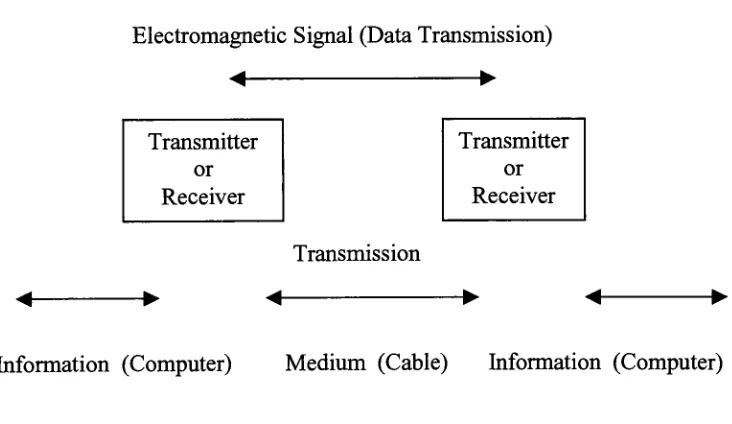
voice, dataor video useelectromagnetic signalsthataretransmittedovertheircorrespondingmedium. Theinformation iscreated
by
asource such as a computerterminal. Theinformationisconvertedintoan electromagnetic
signal, andthencarried over atransmission medium, such asfiber opticcable,fromthe
transmitter to thereceiver. Thereceiverthenretrievestheelectromagneticsignaland
[image:24.519.91.457.276.488.2]reproducesit intotheoriginal(orapproximate) form inwhichtheinformationwas sent
(Figure 1).
Electromagnetic Signal (Data
Transmission)
A ?
Transmitter
or
Receiver
Transmitter
or
Receiver
Transmission
Information
(Computer)
Medium(Cable)
Information(Computer)
Figure 1 - ExampleofData Transmission
Electromagneticsignals (either analogor
digital)
canbe lookedatfromtwodifferentperspectives. The firstsuchperspective,time-domain, is afunctionoftime.Ananalog
Thewave oftheanalogsignalis madeupofthreecomponents:
Amplitude
-strength ofthesignal
Frequency
-rate at whichthesignal repeats itself.Therange offrequenciesis
knownasthespectrum ofthesignal.
Phase
-positionintimewithina single period of a signal
Thereare nobreaksinananalogsignal whereas adigitalsignal maintains aconstantlevel
fora period oftime thenchangestoanotherconstantlevel fora periodoftime.The
secondsuchperspectiveis adigitalsignalthatisrepresented
by
electromagneticpulsesrepresented
by
twobinary
digits,
0and1. Thewavelengthisthedistanceof a single cycleandthebandwidthof asignalisthewidth ofthespectrum.This information iscritical
becausethereisadirect relationship betweentheamount of
information,
andcapacityofasignalandits bandwidth.
Essentially,
the greaterthebandwidth,
thegreatertheamountofinformationthatcanbetransmitted.Thereis onedownsidetoconsider with
bandwidth;
thegreateritis,
thegreatertheassociated cost.Mediumstransferinformationatdifferentrates and,
depending
upon whichmediumisbeing
utilized,willdictatebandwidthallocationandinformationtransfer. Mostbusinessnetworkshaveassociated
coststhatprohibit unlimitedspending.Thiscandictate howa specific networkwillbeset
up. Itwillalsodictate bandwidthsize anddatatransfer. Limitedbandwidthswilllimit
signalstrength,which canpotentiallycreatedistortions ornoise. These
distortions,
orPortal
Devices
Portaldevicessuch as
bridges,
routers, gateways,and repeaters connectlocalareanetworkstogetherand extendthedistancecapabilities ofthenetwork.Eachofthese
components offersdifferent degrees ofdata
handling
capabilities within anetwork.Bridges aredevicesthatconnectnetworks, filterdatapackets, and movethemforwardin
thenetwork. Bridgesoperate withintheData Link LayeroftheOSI Model.
They
canreadthespecific physical addressesofdevicesonthenetworkandfiltertheinformation
before moving itforwardtoanother network segment.Because
they
operate attheDataLink Layeror,more specifically,attheMAC sub-layer,
they
can clean anincoming
signal, amplifyitand passitontothenextsegment as a cleansignal
(eliminating
signalnoise). This
filtering
capabilityallowsbridgestoscan and reducetrafficbetweensegments,generatinga greaterdegree ofsecurity
by
selectingthespecificdatasignals, orpackets, thatneedtobe sent. Specificapplications of network architecturesrequire
differenttypesofbridges. The
following
are examples ofthesebridges:Translating
Bridges-Thesebridges linktosimilarMAClayerprotocols.Incases
where physical addressing issimilar,bridgescanbe developedtolinkbetween
MAC layerprotocolsthatare notidentical. Anexampleofthiswouldbe abridge
connectinganEthernetnetworktoaToken
Ring
network.Learning
Transparent Bridge- Hasthecapabilitiesto
identify
each networksegmentand creates addresstables thatoriginatefromthatspecific network
LocalBridges
-Thesearebridgesthathavealocalarea networkconnectedon
each side. Ifabridge
links
a network over a widearea,it isreferredtoasaremotebridge. Eachofthesebridges hasvaryingcapabilities asfaras
transmitting
databandwidth. Remote bridgesgenerallyoperatewithlowerbandwidthcapabilities
thanlocal bridges.
Routerscan provide greater control ofdataflowtoanetworkas
they
becomemorecomplex.Routers operate attheNetworklayer oftheOSImodel. Itworks
by
openingthedatapacketdeliveredattheMAClayeranddeterminestherouting destination
by
theinformation supplied. Thisadditionalworksupplied
by
therouter requiresmoreprocessor
time,
memory,andnetworkconnections.Typicalrouters can supportmanyprotocols simultaneously,butthiscanleadtoincreaseduse of multiplethirdpartyrouters
onthenetwork.
Routerswork
by forwarding
adatapacketto theappropriatenetworkdestinationdetermined
by
the tableofinformationthatwas created whenthe informationwasreceived.Therearetwo typesoftables thatare created
by
the router,static anddynamic.The statictableisupdatedmanuallyasthenetworkismodified whilethedynamictable
updates automaticallyas routers communicate viatheRIP. Thiscommunicationbecomes
importantas networks continueto
develop
withincreaseddatatransfer speeds.Asroutertechnology
develops,
theabilitytoanalyzedatatransferonmultiple network paths canprovide added
functionality
fornetworkloadbalancing
anddata backups. Thissecuritycontrols neededtocircumventdata intrusions.
Security
preventionmaybeassimple asapplyingpasswordprotectionthatrestricts accesstoaparticularnetwork,
workstation, orserver, ormaybeas elaborate asusingfilterstolimitaccess tospecific
routers subnets.
Gateways operate at alllevelsoftheOSImodel.
They
can providecontent conversionsbetweenmultiple environments and applications. Gatewayscontainboth hardwareand
software components and providebothconversionandrouting dutiesandcan supportfull
examination ofdatapackettransfer. Inotherwords,
they
canbeusedinsituationstoconnect a networkthatcontainsdifferentplatforms and requiresdatatranslationorother
application support.Examples may include connecting PC basedworkstationstoa
mainframe computerorconnectionofdifferentmailbasedsystemsthatare allowedto
communicatewithone another.Therearedifferenttypesof gatewaysthat,
depending
uponthesystemarchitecture, canbeused.
Repeaters amplifytheelectronic signalfromone networksegmenttoanother.
They
areconnectedtosimilar segmentsthat transmitsimilardatasignals. Repeatersoperate atthe
Physical LayeroftheOSI Modeland are notimpacted
by
high-levelprotocollayers.Fromabasicperspective, thepurpose of a repeateristoextendthephysicallengthof a
networksegment. Thisremains oneoftheprimary
benefits,
butthereare potentialissuessuch as:
Repeaters don'tfilterout signalnoise, so noiseis amplified and sent withthe
signal. Becausethisproblemexists,there isgenerallyalimitonthenumber of
As signals are generated overlarge
distances,
timedelayscanoccurwhichcangeneratetimeouterrors
-keeping
repeaters frombeing
usedforremote links.Internets
Asmentionedearlier, DARPA's programhelped introduceand
develop
theInternet,
aswe are accustomedto today. RFC 760
8,
publishedinJanuary, 1980,
was one oftheearlier specificationsthathelped definetheInternet. Itwasbaseduponfive earlier
versions oftheARPA Internet ProtocolSpecification.This specificationdescribesthe
Internet Protocolas aninterconnectedsystem of packet-switchedcomputer
communications networks.
Essentially,
theInternetisa conglomerate oflocalareanetworks connectedtogether
by
whatis knownas multiple45-622 Mbpsbackbonecircuitsthatare provided
by
afew dozencarriers acrossthecontinentalUnitedStates.Thissystemisconsiderably larger ifconsidered(or looked at) froma worldwide
perspective.Therearefourmajor accesspoints inthecontinentalUnitedStates along
withmultipleMetropolitan AreaExchangeswherethesecircuits connect. Fromthese
points arehundredsofother carriersthatinterconnectathundredsof pointsalongthese
routes. Eachofthese carriershasredundant connectionstopoints withintheUnited
Statesandpointsaroundtheworld. Asthesecarriers continueto expand,network
Internet Service
Providers
Carriers,
orInternetServiceProviders,
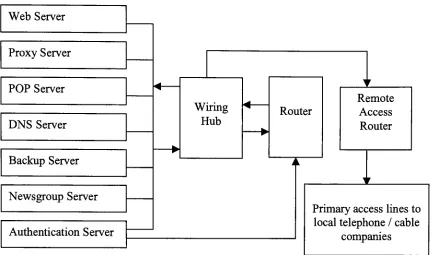
usedigital lines such astelephonelines froma localtelephonecompanyor cablelines leased from localcable companiestoconnectto thebackbonecircuits. Thisis a convenient andrelatively inexpensivewaytoreachthe'
end users. Therearecurrentlyother vendorsthatare
laying
milesuponmiles offiber opticcabling, which at some pointwillreplacethecurrent mediumsbeing
used. Untilthat point,
however,
existing ISP'swill continuetoutilizepresent resourcesuntilthecost differentials forcea change.ISP's are comprised oftelecommunicationscorporationssuchastelephoneand cable
corporations,and othersthatare specializedintheInternetbusiness.
They
competewith eachothertoprovidetheend usersInternetaccess.They
providehigh-speedconnectionsWebServer
Proxy
ServerPOPServer M
Wiring
Hub -*
Router
v
fe
Remote
Access
Router
^
w DNS Server
w
Backup
ServerW
i\
ir
Newsgroup
ServerPrimary
access linestolocaltelephone/cable
companies
[image:32.519.46.479.77.332.2]Authentication Server
Figure 2 - ExampleofHow
Domains
The structure oftheInternet'snamingconvention,orLPaddressing,canbecumbersome
tobothremember and use. Businessorganizationshave adoptedtheuse of acronymsto
identify
LPaddresses.Theseacronyms represent a networkdeviceand canbe easiertorememberthananLPaddress. Forthisconceptto work,aframeworkneedstobe
developedtomapthesenamesto theirassociatedLP addresses.
Originally,
thisframeworkwas organized
by
theSRI Network Information Center. 9They
managedthespecified names inafilecalledHost.txtthatlistedthenames ofthenetworks and
gatewaysalongwiththeirassociatedLPaddresses. Thisprocess workedadequately inthe
beginning
ofInternetusage,butas itgrew,being
abletoadministerthisfile becameahuge
(challenging,
overwhelmingtask)
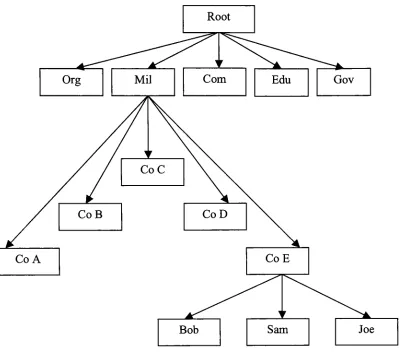
job requiring largeresources.Todealwiththisproblemadequately,asystemknownastheDNSwasdevised. This system uses a
hierarchicalschemetocontrolthenamingconventions. Theadvantage ofthissystem is
thatitallowsadministratorstheabilitytomanage networkdevices at a specificlevelof
thehierarchy. For
instance,
adomainmighthaveasubdomain as part ofitstree,
allowingFigure3 - Example
of aDNSStructure
Theexamplein Figure 3 is arepresentationof ahierarchicalstructureofaDNSthatmay
existsomewhereintheInternet. TheRoot isthehighest-leveldomainlevelofthe tree
represented
by
ORG (organizationsnot otherwiseidentifiedby
otherdomains),
MLL(military
organizations),EDU (educationalinstitutions),
GOV(government),
ARPA(arpanet),
COM (commercialenterprises),andCon (countriesusingtheISOstandard).Eachoftheserootdomainshave subdomainlevelsofthe treewhich representdifferent
[image:34.519.50.452.40.392.2]Nameservershavetheresponsibilityofcontrollingspecific zones ormultiple zonesand,
forthemostpart,containingtheirowndatabasestructure.Nameserversinteractwith
other name servers
by
sendingqueriesbackandforthviaTCP,
whichatthemomentprovidesthegreatestreliabilityand efficiency. Thenext subdomainlevelinthe tree
shows
Company
EwithBob, Sam,
andJoe representingspecific domainswithinthecompanystructure.This levelofthedomainisthelowestlevelofthedomainstructure
andis knownastheleafnodebecausethereare nodependenciesassociated withthe
domains. TheDNS namingconvention requires each nametobeuniquewithinthe
specifichierarchical
level,
butcanuse repetitivenamesin different layers. AmajoradvantageoftheDNS systemsisthatitgivestheadministratortheabilitytoset
permissions and specific rightstospecificdomainsasneeded. The abilitytomanage
thesedomains helps increase security
by
settingaccess rights andlocking
downendusersand
by
controllingincoming
andoutgoingnetworktraffic.Otheradvantages ofDNS is itsabilitytosupport mailapplications aswellascontaining informationaboutlocal
Communication
Architectures
Communicationarchitectures allow a wide range of computermakes, models, and
operatingsystemstocommunicate across a network ormanynetworks.Architecture
standards arebasedupontheverysimple requirementthatsystems needto transferdata.
Essentially, they
are manufacturer's conceptsfornetworkingtheirdevicestogether.Froma simplisticviewpoint, a communicationnetworkconsists of atleasttwo
communications centers
(computers)
and a mediumtoconnectthem.Thesecomputersand medium connectionshaveassociatedtasksforwhich
they
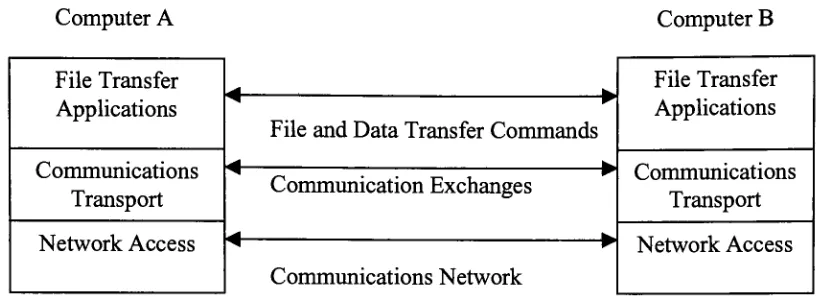
areresponsible.Forexample,Computer Awillinitiatea commandto thenetwork
indicating
aneedtoopen acommunicationlinktoComputer B. FilemanagementapplicationsonComputer A
ascertainthatComputer B isreadytoaccept adatatransferand needstobepreparedfor
file storage afterit has beenreceived. Once bothsystems agreeontransmissionanddata
integrity,
filetransfer takesplace.This illustratesthatmany steps(orfunctions)
needtotakeplaceforasuccessfulexchange ofdata. Theseindividualprocesses canbe
implementedas a single command,or canbe broken down intodifferentcommands and
implemented
independently
fromeach other. Inthis example, these tasks canbe brokendownintothreetasks,whichare structured modules. Thesemodulesimplement
communicationsfunctionsand are referredtoas a protocol architecture asdepicted in
ComputerA ComputerB
File Transfer
Applications
^ k.
File Transfer
Applications
File andDataTransfer Commands
Communications
Transport
Communications
Transport
CommunicationExchanges
Network Access Network Access
[image:37.519.57.468.52.202.2]CommunicationsNetwork
Figure 4 - Protocol Architecture
Thethree-layermodel isorganized as follows:networkaccess,transport,and application.
Theselayersare somewhatindependentwithfeaturesets particulartoeach.
Thenetwork accesslayer focusesontheexchangeofdatabetweenthecomputer and
network. Characteristicsofthislayerinclude providingnetworkaddressesandmay
includespecialized services such as priorities.Thetransportlayerverifiesthat thedata
arrives inthesame orderitwas sent.Theapplicationlayercontainsthesoftware needed
tosupportanyapplicationsinvolved inthe
transfer,
such asfiletransfer. Theselayersillustrate hownetworktasks canbe brokenapartintoindividual
tasks,
independent fromeach other.Theadvantages ofthis typeofdatastructure arethatvendors utilizedifferent
data
formatting
and exchangearchitectures, allowingcommunicationfromvendortovendor withoutcreatingspecial purpose softwaretocommunicate. Commonstandards
promotethebenefitsfroma vendor'sperspective, thatimplementationoftheirsoftware
willbewidelyaccepted,andfromtheconsumer'sperspective, that
they
will notbeinterconnected. Examples
of vendor architectures include Digital Network Architecture(DEC),
AdvanceNet(Hewlett
Packard),
Distributed Systems Architecture(Honeywell),
Internet Packet
Exchange
(NovellNetware),
andXerox Network Systems (XNS).Today's standardizednetworkarchitectures, orprotocols, such as
TCP/LP,
OSIorSNASystems Network
Architecture,
toname afew,
weredevelopedtopermitallowmanufacturerstoattachcommunicationsdevicesof all makesand modelsto thenetwork
without
having
toredesignthenetwork eachtime. Thesemodels intheirearlystages,however,
didnot provide forreliable communications. Therewere noacknowledgmentsasdatapacketstraveledfrompointto point;norwerethere acknowledgementsfromend
toendtransmissions. Therewas no error controlfeature for
data,
onlyaheaderchecksum. IftheICMPdetectedanerror, itwouldberecorded,buttherewere no re
transmissions. ItbecameclearearlyonthatIPv4was not architected withsecurityas a
priority. Itwasonlyafteritsvulnerabilities were exposedthatmodifications became
neededtoprotecttheenduser. In
September, 1981,
RFC 79110 waspublished andbecamewhatisnowknownasIPv4. This specificationreplacedRFC
760,
whichdescribestheInternet's basicoperationsas follows:
1. TheInternetprotocolimplementstwobasicfunctions: addressingand
fragmentation.The Internetmodules usethe addresses carriedintheInternet
headertotransmitInternetdatagramstoward theirdestinations. Theselection of a
path fortransmissioniscalled routing. The Internetmodules usefieldsinthe
Internet headertofragmentand reassembleInternetdatagramswhennecessary for
transmissionthrough"smallpacket"
2. Themodel of operationisthatanInternetmodule residesineachhost engagedin
Internetcommunication andineachgatewaythatinterconnectsnetworks. These
modules share common rulesfor
interpreting
addressfieldsandforfragmenting
andassemblingInternetdatagrams.Inaddition, thesemodules
(especially
ingateways)haveproceduresformaking routing decisionsandforotherfunctions.
3. The Internetprotocoltreats eachInternetdatagramas anindependent entity
unrelatedtoanyotherInternetdatagram. Thereare no connectionsorlogical
circuits(virtualorotherwise).
4. The Internet Protocolusesfour
key
mechanismsin providing itsservice: TypeofService,
TimetoLive, Options,
andHeaderChecksum (thesemechanismsaredescribedlater).
With Internetspecifications
becoming
standardized,virtuallyall computervendorstoday
supportTCP/LPastheInternetbasedprotocoltobeused. OSIandSNAare other
examples ofimportantarchitecturesupportingcommunications
functions,
butarenotaspredominant
today
asthey
once were. Allprotocol modelshaveacorrespondingfunction withinitslayering
structuresimilarto theother models. Forexample, TCPoperates attheOSIlayer
4,
andLPoperates attheOSI layer 3. Thesecommon protocols allowtasksfromoneprotocoltocommunicatewith another protocolseamlesslyto theend user.
Fromthesebasicmodels, otherprotocolshaveevolvedthatsupplyother
functionality
suchas
SMTP,
usedforelectronicmail,FTP,
to transferfiles,
andSNMP,
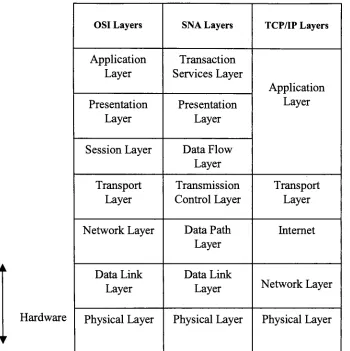
fornetworkmanagement activities. Figure 5illustratesahigh-levelcomparisonbetweenarchitecture
Hardware
OSI Layers SNALayers TCP/IP Layers
Application
Layer
Transaction
ServicesLayer
Application
Layer Presentation
Layer
Presentation
Layer
Session Layer Data Flow
Layer
Transport
Layer
Transmission
Control Layer
Transport
Layer
Network Layer Data Path
Layer
Internet
Data Link
Layer
Data Link
Layer Network Layer
[image:40.519.62.412.60.411.2]Physical Layer Physical Layer Physical Layer OS
OSI Model
The OSImodel was developed
by
theISOas a modelforprotocolarchitecture standardsandforother protocolstouse as a guide for development.Itis madeupofsevenlayers
thatprovidedifferent
functionality
at eachlayer.ThebasicintentoftheOSImodelwasforother
developing
protocols todevelop
theirfunctionality
usingthelayeredconcept,withthehopethatproprietaryimplementationsof specific protocolswouldeventually be
replaced. As manyfunctionalprotocolshave been developedandhave consistentlyused
theOSIarchitecturalmodel, theconceptdidnot meetitsanticipatedgrowthand was
insteadreplaced
by
TCP/LP. Thereare a numberofreasonsforthis,including
thecomplexityoftheseven-layerapproach,butthemostpredominantreasonwas,most
likely,
timing. The TCP/LParchitecturewastestedat a stable point whenbusinessneededanarchitecturethatwould addresstheneed ofoperatingacrossmultiple networks. OSI
was stillin its developmentstages. Evenso, theOSImodeldid havemerit and was used
extensively.
The OSImodel,asmentioned, isa seven-layered communicationsprotocol,
internetworkedtogethertocommon communicationdevices. Thedevelopmentofideas
behindtheOSImodelfollowedafew basicconcepts:
Eachlayerperforms itsownfunction.
Layersshouldbedevelopedwiththeintentoffutureprotocolstandardization.
Boundaries areclearlyidentifiedbetween layers.
Develop
enoughlayerssothatspecificdatatransferfunctionscanbedistinct,
andThe OSIlayersare:
Application
-enables accessto the OSIarchitecture structure andprovides
informational servicesfunctionality. Other functionsofthislayer includefile
transfer thatcanhandleservices such as electronic mail and
directory
look-ups.Presentation
-dealswiththesyntax ofthedatatransmission
by
performingrepeatabletasks.Anexample mightbeaspecified,agreeduponencodingservice
amongcomputers ondifferentnetworks.Thepresentationlayerverifies and
correctsthe
incoming
andoutgoing data.Session- provides a structurebetweensystemsthatallowconnectionsand
terminations.
Transport
-enablesreliabledatatransport
by
monitoring data flowandprovidingerrorrecovery
by
makingsurethedataarrives correctly.Data may be dividedamongnetworkstoimprovetransportefficiency.
Network
-responsiblefor controllingtheoperation ofthesubnet
by
establishing,maintaining, and
terminating
connectionsData Link
-sends data framesofinformationacross thenetwork. Thislayeralso
checks fortransmissionerrors
by
creating andrecognizing dataframeboundaries. The data linklayerwill solveissuesthatoccurifdatais
lost,
damaged,
orduplicated.Physical
-responsibleforthebasictransmissionofdataoverthenetwork
medium.
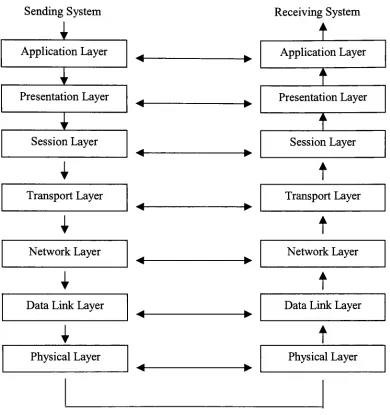
Figure6depicts how datatransferoccurs intheOSImodel
by
eachdefinedserviceprovidingaservicetothelayeraboveit. This hierarchicalapproach allows eachlayerto
Sending
System1
Receiving
Systemt
ApplicationLayer Application Layer
IT
a
Presentation Layer Presentation Layer
V
A
Session Layer Session Layer
1
t
Transport Layer TransportLayer
1
t
Network Layer Network Layer
1
t
Data Link Layer Data Link Layer
1
t
Physical Layer Physical Layer
[image:43.519.69.459.50.465.2]Data Transmission Path
TCP/IP
TCPpackages and preparesdatafortransfer.LPisresponsiblefor establishingthe
frameworkneededforgettingthedatatransferred successfullyacrossthenetwork. It
allowstheexchange ofinformation between differenttypesof networksthatattachtoan
LPgateway.
Together,
TCP/LPisa protocol suitethatorganizes softwarecommunicationstoshare resources across networks. ItistheInternet basedstandard andtheframework
formanyother communication protocols.Withinthis protocol, data ispassedthrough
multiplelayersoftheprotocol architecturethatare identifiedtoa
device,
operatingsystem,or specifictask. Thisprocess has beenstandardized
by
theLAB. WithintheLABare committees thatissue RFC'sandSTD's. Theadvantages of
having
acommonprotocol aretoallow computerswithdifferent operatingsystemstocommunicate.This
advantage alsohasadownside
by
providingpotentialopeningsfor security intrusionstotakeplace.Theselayers oftheprotocolhave different functions in data handling. The
current model oftheTCP/LPprotocol suite canbe groupedinto fiveseparatelayers.
These layersprovidedifferenttasks thatallowthe transferofdatafromonehostto
another. Theselayers canbe broken downas follows:
Application Layer
-physicalinterface betweenadevicesuch as a computer and
thenetwork.This layer definesthe transmission medium, typeof signals used,
rateatwhichdatais
transferred,
andanyother characteristics associated withmovingtheinformationthrough thenetwork.
Transport Layer
-focusesonthedataexchangebetweenperipherals andthe
InternetLayer
-thesearetheprocedures orrouting functionsthatallowdatato
betransmittedacross multiple networks.
NetworkAccess Layer- deals
withtheexchange ofdata
(accessing
androuting)betweencomputers andthenetworktowhich
they
are attached.Physical Layer- deals
withthephysicalinterfacesbetweendatasenders and
receivers such as computers andthe transmissionmedium. Theconcerns ofthis
layersurround mediumcharacteristics, signalcharacteristics,datatransfer rates,
Internet Protocol
LPisa connectionless servicethatpermits networktrafficbetween
hosts,
usinga32-bitaddress schemeto
identify
thehostcomputer and associated network. LPdoes nothavethecapabilityto
identify
andreplytodatatransmissionerrors. Its designwasmeanttobetransparent toorindependentof thenetwork.
If,
forexample, adatagramtransmissionpassesthrougha router and violates an established aspect such assize, thebufferswill
overflow and removetheremainingdatagrams.Unlessahigher-levelprotocolsuch as
TCPrecoversthistypeof
information,
datagramscanbelost, duplicated,
or arriveinnospecific order.ThedesignofLPallowsfor easyinstallationand provides a robust
protocol,butas
indicated,
no errorrecoveryordataflowanalysis.Theseresponsibilitiesreside attheTCPlayer.
Whena computeris hooked upto theInternetthroughan
ISP,
an address isassignedthatidentifiesthatparticular computerto theworld.All devicesthatare connectedtoa
networkrequireanLPaddressthatconformstotheInternet Protocol namingconvention
Internet Connection
|
^
T
Router kW Hub w
h,
1f
Router ^^ Hub p
^
1 T
Router ^w Hub ^
PC
PC
PC
PC
PC
PC
PC
PC
PC
Printer
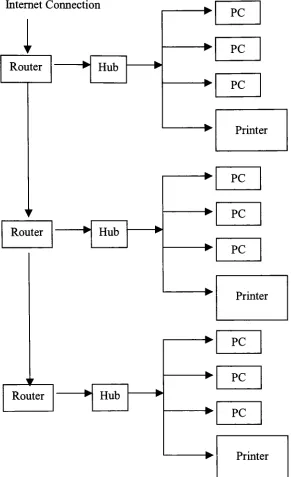
Figure7- Example ofMultiple Devices ConnectedtoaNetwork
Requiring
anLP [image:47.519.110.401.30.507.2]This namingconvention was devisedtoallow administratorstheabilitytocontrol
networks withintheirLANs. Thecurrentaddressingscheme withintheIPv4protocol
uses an address with32-bits. Whentraffic is initiatedthroughthenetwork
by
adevicesuch as acomputer,itpasses through the transport
layer,
typically
TPCorUDP. Theaddressis broken intotwo parts,onethatidentifiesthesubnetworkandthe otherthat
identifiesthe node onthesubnet.Thedatatrafficis identified
by
aprotocolLD. Afterthereceiving devicehasacknowledgedit is readytoreceivethedatatraffic, it ispassedto
thenetwork
layer,
whichtakes care ofthenetworkaddresses, orLP addresses. LPaddresses are usedtodeterminewherethe trafficistoberoutedintheInternetand are
identified
by
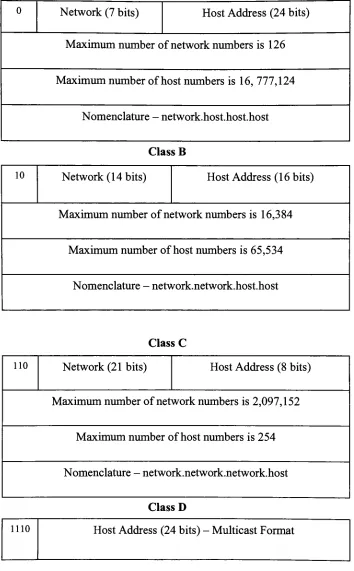
formatsknownasClasses. There arefourClasses:A, B, C,
andD(Figure8). Thefirstportions,or
bits,
oftheaddressindicatenetworkidentificationaddresses andtheremainderofthe classindicatesthenumberofhoststhatcanbeidentified inthe
network. Eachclass signifiesadifferentnetworkaddressingschemesthatwouldbe
ClassA
Network (7
bits)
Host Address (24bits)
Maximumnumber of network numbers is 126
Maximumnumber ofhostnumbersis
16,
777,124Nomenclature
-network.host.host.host
ClassB
10 Network(14
bits)
Host Address(16bits)
Maximumnumber ofnetwork numbersis 16,384
Maximumnumberofhostnumbersis 65,534
Nomenclature
-network.network.host.host
Class C
110 Network(21
bits)
Host Address (8bits)
Maximumnumber of networknumbers is 2,097,152
Maximumnumber ofhostnumbers is 254
Nomenclature
-network.network.network.host
[image:49.519.85.439.48.619.2]Class D
Depending
upon networkrequirements, other variations oftheseclassescanbechosen.These arespecificallygearedtowards Internetusage. Ifa networkisnotgoingtobe
accessingthe
Internet,
thenchoosinga class willdependuponconsiderations such asratio of networks tohostmachines andfuturegrowth of
both,
networks andhostmachines.
Thedatasent
by
thehostcomputerthatisroutedthroughanetworkis knownas anLPdatagramorPDU. Thesedataunits canbe
divided,
orfragmented intosmaller, moremanageable units
by
afragmentationprocessthatis supportedintheLPprotocol.This isneededbecausenodedeviceswouldberequiredtosolve incompatible PDUsizes
between devicesotherwise.Figure9shows howanLP
datagram,
orPDU,
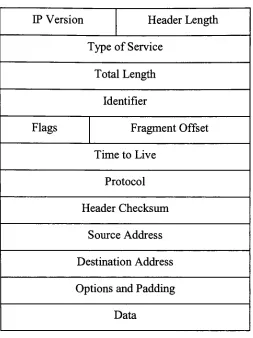
canbe brokenLPVersion Header Length
TypeofService
Total Length
Identifier
Flags Fragment Offset
TimetoLive
Protocol
HeaderChecksum
Source Address
Destination Address
Optionsand
Padding
Data
Figure9- IPv4 Datagram
IPv4 Datagramfielddescriptions:
LP Version
-identifiestheversionofLPinuse. Thisis containedinmost
protocolswiththecurrentversionat4orcommonlyreferredtoasIPv4. Thenext
generationis identifiedas
6,
orIPv6.HeaderLength- thisfield
contains4bitsthatindicatethelengthofthe
datagram
header.
[image:51.519.142.395.49.387.2]some vendorsdonotusetheTOSfieldintheirimplementationsof
LP,
butincreased
capabilities oftheInternet maypromoteincreasedusage.Total Length
-thisisthe totallengthofthedatagrammeasuredinoctetsand
includesthelengthoftheheaderand associateddata (determined
by
subtractingtheheaderlengthfromthe totallengthofthefield).
Identifier- controlsdatagramfragmentationandrepairalongwithFlagsand
Fragment Offset. Thisfield identifies fragmentsinadatagram.
Flags
-thisfielddetermineswhetherthedatagramcanbe fragmented.
Fragment Offset
-contains avaluethatspecifies a position of afragmentwithin
theoriginaldatagram.
Time-to-Live
-measures amount oftime adatagram is inthenetwork
by
addingavalueto theparameter wheneveradatagrampassesthroughanLPnode suchas a
router.
Protocol
-identifies thenextlayerprotocolthatwill receivethedatagram.
Header Checksum
-detects anyerrors thatmay haveoccurredinthe
header,
butwillstillrequire ahigher-levelprotocoltoperformerrorchecksonuserdata if
required.
Source Address
-containstheInternetsource addressinthedatagram.
DestinationAddress
-contains theInternetdestinationaddress inthedatagram.
Options
-notusedinall
datagrams,
butcanbeusedforspecific applications suchasnetwork managementanddiagnostics.
Padding
-ensuresthat thedatagramheaderisaligned correctly.
LPdatagrams
identify
hownetworkinformation is brokendownandevaluatedatitslowest
level,
butalso hasspecific servicesthatitcanperformfordifferentvendorproducts.
Depending
uponthenetworkarchitecture, someLP services willnotbeutilized.Wheninformation isreceived at arouter,LPverifiestheheadertodeterminethe type of
networktraffic itwillbeprocessing.
If,
forexample, theinformationisadatagram,
therouter will passtheinformationontotheheadercheck,whichwillcheckforheader
length,
LPversionnumbers,messagelength,
validheaderchecksum,andtimeinthenetwork
(making
surethisvalueisnot at zero). Iftheinformation isaccepted,itwillbepassedto thenextLP
device;
iftheinformationisnotaccepted,itwillbe discarded.LP alsohas differentways itcan routeinformationsuch as:
Sourcerouting,which allowstheupper-layerprotocoltodetermine howthe
routerswilldirectthedatagrams.
Looking
attheaddressesinthesourceroutingfieldtodeterminethenextLP destinationaccomplishesthis. Iftherequired
datagramfieldsindicatethat therouting list has beencompleted, then the
destination LPaddressisused. Iftherouting list hasnotbeencompleted, then the
pointerincrements LPaddresses
by
oneto thenextaddressintheroute.Route recordingis another examplewhereLPusesthenext addressinthedata
fieldtodeterminethenextstepthedatagramwilltake. Thedifference here isthat
thereceiving LP devicewill addits LPaddresstotheroute. Thishappensafterthe
receiving LP devicechecksfield lengthstodetermine iftherecording list is full.If
themoduleis
full,
itwillforwardthedatagramwithoutinserting
an addressto thenext octetopening,wheretheaddressis insertedandthedatagram ismoved
Time stampingthedatagramas itpassesthroughLP devicesisanother serviceof
LP. Thisallows for
tracking
thedataroute asitpassesthroughthenetworkandshowstheamount oftime ittakes toprocess data betweeneachLP device. The
Internet Protocol Version 6
The Internethasgrown sorapidlythatit has forcedchangeinthewaytheoriginalIPv4
protocol wasdesigned. Fromahistoricalperspective,Arpanetwasdesignedas apacket
switchingnetworkthatcontainedfournodes.Itwas designedat areducedscalebecause
theoriginal concept was for itsuseinresearch,designandeducationalarenas.As
visibilityoftheInternetgainedmomentum, organizations otherthangovernmentand
educationtooknotice.The LETF began
looking
at proposalsthatwoulddefinethesize oftheaddress space requiredfortheconfiguration.Withtheunderstandingthat the Earth's
population would growsubstantially, andthebeliefthatanyone who wantstoaccessthe
Internetshouldbeabletodoso, technologicalprogressbecame imminent. After
taking
intoaccountthatuserswill,most
likely,
be accessingmultiple computers (not onlytheones on our
desktops,
butthosethatareincorporated intooureverydaylives),
itbecameevidentthatanewversionoftheInternet Protocolwouldbeneededtocomprehendthe
addeddemand.
Essentially,
themajordifference between IPv4 andIPv6 n falls intothefollowing
areas:1. Expanded
Addressing
Capabilities: IPv6 increasestheLPaddress size from32bitsto 128
bits,
tosupport morelevelsofaddressinghierarchy,
a much greaternumberof addressablenodes,and simpler auto-configuration of addresses. The
scalabilityof multicastroutingis improved
by
addinga"scope"fieldtomulticastaddresses.Anda newtypeof address called an"anycastaddress"
is
defined,
used2. HeaderFormatSimplification: SomeIPv4headerfieldshave been droppedor
madeoptional,toreducethecommon-caseprocessingcost of packet
handling
andtolimitthebandwidthcost oftheIPv6header.
3. Improved Supportfor Extensions andOptions: Changes intheway LP header
options are encoded allowsformore efficient
forwarding,
lessstringentlimits onthelengthofoptions,and greater
flexibility
forintroducing
new options inthefuture.
4. Flow
Labeling
Capability: Anewcapability isaddedtoenablethelabeling
ofpackets
belonging
toparticulartraffic "flows"forwhichthesenderrequestsspecial
handling,
such as non-defaultqualityofservice or "real-time"service.5. Authenticationand
Privacy
Capabilities: Extensionstosupportauthentication,data
integrity,
and(optional)
data confidentialityarespecifiedfor IPv6.Initialconceptsofthedesign began in
1991,
andby
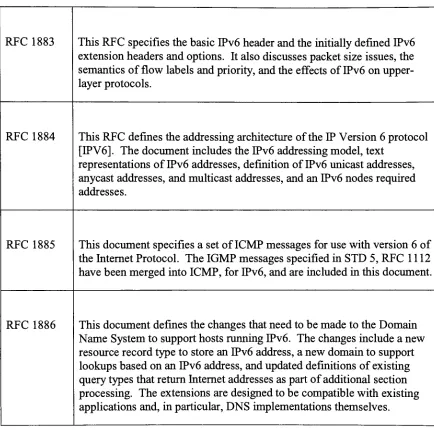
1995fourRFC's (Figure10)
wereintroduced. These RFC's
(1883-1886)
12weretobecomethenew version oftheInternet,
classifiedas
IPv6,
andwillincorporatenewfeatures thatcomprehendincreasedusageandeliminate specific problemsthathaveevolvedin IPv4. Ipv6will address specific
issuessuchasaddress space,inefficientoperations,and network architecturetechniques
that incorporategreater
functionality
andimprovedsecurity.Many
ofthecharacteristicsoftheIPv4protocolwillberetainedforthe time
being,
because oftheirdependencies
onother related protocolsthathave been developedextensivelytosupportexisting
transmissions suchasvideo,
data,
and voice.Considering
thatIPv4uses32-bitaddressspaces, thenewconfigurationwould allowforsignificantexpansiontosupportthe
numericalvalue,therearemanypossible addressesthatcouldbeused,but partitioningof
thisaddress spaceinto similarIPv4classes
(A, B, C,
D)
has increasedspacelimitations,
especiallyintheclassC space whichhasthehighestnumber of networks associated with
it. Itspossibletoincrease subnettingmore classes intoclass
C,
butthatwas not a viableoptionfortheLETFboard becauseclass networkshave fixed boundariesbetween
identificationof network and nodes.Whena network numberis assigned,allthehost
addressesforthatnetwork are assignedto thatnetwork.Forexample,ifa networkneeded
500addresses, itwould notbeabletouse class Caddressesbecause itcontainsonly 25