Abnormality Counts!
MSc Thesis (Afstudeerscriptie)
written by Aleks Knoks
(born September 2nd, 1986 in Riga, Latvia)
under the supervision of Prof. Dr. Frank Veltman, and submitted to the Board of Examiners in partial fulllment of the requirements for the
degree of
MSc in Logic
at the Universiteit van Amsterdam.
Date of the public defense: Members of the Thesis Committee:
September 19th, 2012 Dr. Reinhard Blutner
Prof. Dr. Bendedikt Löwe Dr. Sonja Smets
Abstract
Defeasible inheritance networks provide a fruitful environment for modeling default reasoning. In this paper we aim to enhance their expressive power with the idea of abnormality minimisation, which plays a crucial role in circumscription. We implement it in two alternative network-based frame-works. The rst is in line with the received way of modeling default reasoning by means of inheritance nets, that is to say, it is path-based or direct. The second relies on a set of non-monotonic inference rules. In both we are able to say that an object is abnormal with respect to a certain default statement, and, consequently, single out the conclusion sets that imply the least number of abnormalities. We consider some cases indicating that exactly these sets are the intuitively correct ones.
Contents
Setting the Stage 1
1 A Path-Based Approach 7
2 Non-Monotonic Inference Rules: the Basic System 15
3 Non-Monotonic Inference Rules: Adding Abnormality 24
Conclusion 33
Acknowledgement 35
Appendix A: Proofs 36
Appendix B: Simonet's Inference Rules 42
Setting the Stage
Default reasoning is best characterised as making sensible guesses in the context of incomplete information. It is hardly possible to overestimate its importance, for it is an essential part of our everyday reasoning patterns; and it is only natural that it has long since become an area of intensive research in the eld of articial intelligence. When we reason by default we proceed by means of the so-called `default rules' (or simply `defaults'), which are essentially statements of the form `x-s usually are [not]y-s'. The
statement `Birds usually are able to y' serves as the standard example. If the only information we know about some object x is that it is a bird,
we would readily assume that x is able to y on the basis of this default.
However, in case later we would come to know thatxis in fact an ostrich, this
assumption would have to be retracted. This simple example alone makes it plain that any formalism attempting to model default reasoning has to rely on a non-monotonic consequence relation.
The rst formalism of such kind default logic was proposed by Raymond Reiter in 1980 (see [11]), but it was soon followed by many other alternative frameworks. The more successful ones fall under three categories: (i) the approaches that model defaults as conditionals of a special kind,1 (ii) the ones that rely on the idea of circumscription, and (iii) those that formalise defaults by means of the so-called `defeasible inheritance networks'. Now, the two frameworks that will be developed in this paper combine the positive features of the approaches falling under the latter two categories. Therefore, something more has to be said about them.
Circumscription was introduced in (McCarthy, [9]), and it is, essentially, an attempt to formalise the common sense assumption that things are just as we expect them to be, unless there are some special circumstances. In [10] it is applied specically to defaults. Although the formalism John McCarthy presents is complex, the motivating idea is fairly simple: to use circumscrip-tion in order to single out those models in which objects behave just like the defaults describe. This is carried out as `minimisation of abnormality'. McCarthy introduces a special predicateab, standing for abnormality, and
suggests a peculiar formalisation for default statements. For instance, the above `Birds usually are able to y' would be translated as∀x(Bird x∧ ¬ab aspectf x → AbleT oF ly x). What this formula says is that any object, which is a bird and is known not to be abnormal (= is known to be normal) in a certain respect, is also able to y. The minimisation part means focusing only on those models (of some given set of defaults) that are minimal for the predicate ab. Intuitively, a model M is minimal for ab if as few as possible
elements belonging to the domain of M satisfy ab. In other words,
mal models are the ones containing the least number of abnormal objects. Further, the notion of a minimal model is used to dene an appropriate con-sequence relation. Basically, it is the standard model theoretic entailment, but restricted to the minimal models. In general, McCarthy's approach gives intuitive results in the simple cases, but it has two serious drawbacks, which become evident as soon as it is applied to more complex theories. First, it is not at all pleasing computationally. Second, it requires one to state explicitly all the exceptions to every default rule in the theory at hand. Consider the following set of statements:
`Birds usually are able to y',
`Ostriches usually are not able to y', `Ostriches are birds',
`Ostriches usually are fast runners', and `Feathers is an ostrich'.
Unfortunately, it will not entail `Feathers is not able to y' until it is sup-plemented by a statement explicitly specifying that ostriches are abnormal with respect to ying. This problem becomes even graver as the number of defaults in a theory grows. However, it does not even occur in the family of approaches we consider next.
First and foremost, defeasible inheritance nets are associates with the works of David Touretzky, Richard Thomason, and John Horty (see [6], [7], [16], [17], and [18]). The forerunners of these nets `inheritance sys-tems' or `hierarchies', as they are usually called were and still are used for representing and accessing taxonomic information. Although inheritance networks go far beyond a mere representational mechanism they are best thought of as sets of hypotheses provided to some agent or reasoning mech-anism , much of the standard terminology used to describe them and, in fact, also the general way of thinking about them comes exactly from the work on the systems. Here (Touretzky, [17]) is the most notable source. Following the theoretical literature, we will describe inheritance networks as nite collections of nodes and positive and negative IS-A links, which we will write as(x, z,+)and (x, z,−). The interpretation of (x, z,+) and (x, z,−) depends on x. If it is a general term, their intended meanings are `x-s
usu-ally arez-s' and `x-s usually are notz-s', respectively. Thus, in this case the
links are nothing else but default statements. In casex is an individual or a
concrete object, however,(x, z,+) should be read as `x is a z' and (x, z,−) as `x is not a z'. A simple example will clarify this better than anything.
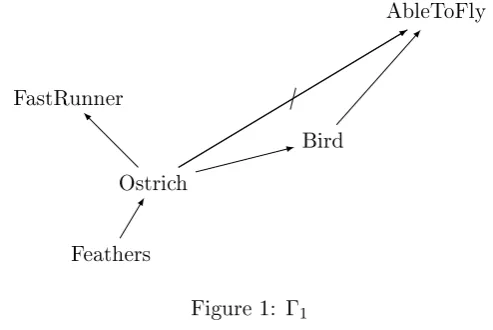
We can rewrite the theory considered above as:
Ostrich
AbleToFly
Bird FastRunner
[image:5.595.172.419.129.294.2]Feathers
Figure 1: Γ1
(Ostrich, Bird,+),2
(Ostrich, F astRunner,+), (F eathers, Ostrich,+),
Figure 1 contains a graphical representation of these links, and it surely seems to eectively reveal the structure of the information they encode. The picture also illustrates the graphical notation we will use throughout this paper: ordinary arrows for the positive IS-A links and arrows with crossbars for the negative ones.
The primary goal of any network-based account is to link inheritance net-works to their corresponding conclusion sets. Intuitively, the conclusion set of a network is the set of all and only those statements that an ideal reasoner would arrive at on the basis of the information specied by the network. In the case ofΓ1 such a set would certainly have to contain statements that are
similar to `Feathers is not able to y', `Feathers is a fast runner', etc. Just like the links of a net, statements that are allowed to enter a conclusion set can be of two kinds: positive, written asisa(x, z,+), and negative, written as isa(x, z,−). The intended meaning of the positive ones is `it is natural to suppose that x is a z (/x-s are z-s)'; and that of the negative ones is
`it is natural to suppose that x is not a z (/x-s are not z-s)'. In analogy
n P
[image:6.595.249.343.125.225.2]Q R
Figure 2: Γ2, the Nixon Diamond
the conclusion set from it (them).3 These expansions are sets of paths; and paths are nothing but special sequences of links. For instance, the sequence consisting of (F eathers, Ostrich,+) and (Ostrich, AbleT oF ly,−), written as(F eathers, Ostrich, AbleT oF ly,−), is a path. Note that any link by itself is a path. (Horty, [6]) suggests viewing paths as arguments supporting state-ments that can enter a conclusion set, and we will follow him in that. Thus, we will say that the path (F eathers, Ostrich, AbleT oF ly,−) supports the statement isa(F eathers, Ostrich,−). Henceforth, any approach that relies on paths when determining conclusion sets will be referred to as path-based. Every path-based approach can be distinguished by two things: (i) the exact notion of expansion it relies on, and(ii)the method it uses in order to construct expansions from a given inheritance net. A more formal treatment of this issue will have to wait until the next section. Here we will conne ourselves to an informal introduction of two representative approaches. The rst one goes back to (Touretzky, [17]) and is known as the `credulous ap-proach'. It denes expansions as maximal consistent sets of argument paths. Any single set of this kind, i.e., any credulous expansions, is taken to be one possible and internally consistent `line of reasoning' on the basis of the infor-mation contained in the inheritance net at hand. A simple, but illustrative example will make this clear. Consider the network Γ2 depicted in Figure
2. Its interpretation is n = Nixon, R = Republican, Q = Quaker, P =
pacist. Now, this inheritance net has two credulous expansions. The rst one consists of the paths(n, R,+),(n, Q,+), and (n, Q, P,+). The second also contains (n, R,+) and (n, Q,+), but the place of (n, Q, P,+) is taken by (n, R, P,−). Thus, on this approach, given Γ2, the reasoner is justied
to infer (i) isa(n, R,+), (ii) isa(n, Q,+), and (iii) either isa(n, P,+) or
isa(n, P,−), but certainly not both.
a Co
SoThr RuN
Cough NasCon
[image:7.595.213.381.127.292.2]NormTemp
Figure 3: Γ3
The second approach is an elaboration on the rst. It was rst proposed in (Simonet, [14]), and we will refer to it as the `skeptical approach' here.4 According to it, the real expansion of a network is acquired after intersecting all of its credulous expansions. The rationale behind this is that the ultimate skeptical expansion should contain only those argument paths which are not exposed to the peril of counter-arguments. Γ2 would have only one skeptical
expansion, and it would contain neither(n, Q, P,+)nor(n, R, P,−). There-fore, on this approach, the reasoner would have to remain skeptical with respect to Nixon's being or not being a pacist.
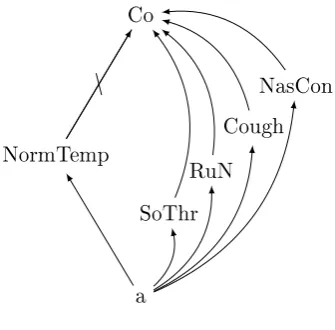
Each of the two approach has its own advantages, but some cases indicate that both (as well as others not presented here) are substantially lacking. In order to see this consider the network Γ3 that is shown in Figure 3. Its
interpretation isa=Alice,SoT hr=a person with a sore throat,RuN =a person with a running nose, Cough=a person with a cough, N asCon= a person with a nasal congestion, N ormT erm= a person with normal body temperature, andCo=a person who has a cold. Γ3 seems to be a perfectly
reasonable representation of a real-life situation. Sore throat, running nose, cough, nasal congestion, and fever are the usual symptoms of the infection known as the `common cold'. That is to say, each of these nuisances most often is caused exactly by cold. Often enough, though, people do not develop all of the symptoms. In the particular situation we model, the individual called Alice has all the symptoms of cold but fever. Now, I argue that, despite her normal temperature, in this case it is natural to suppose that Alice has a cold.
However, let us have a look at what the above approaches say con-cerning Γ3. On the credulous one, it has two equally signicant
sions. One of them contains the paths (a, SoT hr, Co,+), (a, RuN, Co,+), (a, Cough, Co,+), and(a, N asCon, Co,+); and thus supportsisa(a, Co,+). The other contains (a, N ormT emp, Co,−) and supports isa(a, Co,−). Of course, the rst expansion is the intuitively correct one, and we must grant it that the credulous approach is able to identify it. Nevertheless, it does not provide any means for comparing dierent expansions, and, therefore, justi-es the reasoner to inferisa(a, Co,−)as much as it justies the inference of
isa(a, Co,+). The skeptical approach fairs worse. For, analogously to the Nixon case, it invites the reasoner to remain skeptical about Alice's having or not having a cold. In general, on this approach, any number of argument paths can be outweighed by a single argument to the opposite. Apparently, this undercuts all of its chances to give an intuitively desirable conclusion in such cases asΓ3.
Let us reconsider the two credulous expansions ofΓ3. Of course, the
num-ber of argument paths they contain is what makes them dier, but there is also something more. To see what it is we have to recall McCarthy's ab-normality predicate. Intuitively, if the reasoner chooses the expansion that supportsisa(a, Co,+), it also has to conclude that Alice must be abnormal with respect to the default rule `People with normal body temperature usu-ally do not have a cold'. That is to say, her temperature is normal, but she still has a cold. If, on the other, the reasoner chooses the other expansion, it has to infer that Alice is abnormal with respect to a whole bunch of defaults. Now, clearly, were we to use McCarthy's notions here, we would say that the rst expansion is the one that minimises (= circumscribes) abnormality. Of course, the abnormality predicate and anything alike circumscription are to-tally absent from the network-based accounts, but that is exactly what we want to change.
It is important to note that the approaches that rely on inheritance net-works have some very nice features when compared to most of the other formalisms that model default reasoning. We mention only some. First, the network-based approaches do not require explicitly listing the exceptions to default rules from the very start. Second, they are pleasing from the per-spective of complexity theory. Third, they are quite handy for articulating a variety of dierent intuitions about default reasoning. Fourth, the inher-itance networks themselves provide a nice way of visualising complicated patterns of interaction among defaults. Given all this, augmenting some appropriate network-based account with the ideas from the circumscription approach cannot but seem a very appealing endeavour. For the result would have both all these features and a lot more expressive power. Besides, it would be based on good intuitions, just as the idea of abnormality minimi-sation is.
introduc-tory section we turn to developing a path-based framework along the lines of the two approaches we have already introduced. We take special care to dene all the basic concepts of the system and then extend it in order to be able to deal with cases akin to Γ3. In the two subsequent sections we
devise an alternative framework that falls within the tradition pioneered by Erik Sandewall in [13]. Unlike the rst approach, it operates on statements, rather than paths; and at its heart lies a set of non-monotonic inference rules. In section (2) we develop the basics: after noting that neither of the two existing approaches based on non-monotonic rules Sandewall's and that of (Simonet, [15]) are satisfactory, we present our own set of rules, state some results characterising the system, and show that it corresponds to the (basic) path-based approach presented in section (1). In section (3) we extend the newly developed framework so as to make it able to minimise abnormality. This all is followed by a short concluding section in which we also suggest directions for future research. The paper is accompanied by two appendices: appendix A contains the most important proofs, while in ap-pendix B we discuss the problems with the sets of non-monotonic inference rules put forward in (Simonet, [15]).
1 A Path-Based Approach
We begin this section with a formal presentation of a fairly standard path-based approach. Contentwise it incorporates both path-path-based approaches informally introduced above. The only non-standard thing about it is our denition of consistency for inheritance nets. As soon as at the basic concepts are in place, we proceed to extend the system. We introduce a new kind of paths, adjust a number of concepts, and dene the notion of minimal expansion, i.e., expansion that circumscribes abnormality. In the end of the section we return to Γ3.
An inheritance network Γis dened as a nite collection of positive and negative links between nodes. (x, y,+) stands for a positive and (x, y,−) for a negative link from some node x to another node y. s is used as a
variable ranging over the signs + and −, while −s denotes the opposite
sign of s. A positive path from x1 to xn through x2, . . . xn−1, denoted by
(x1, σ, xn,+) or (x1, x2, . . . , xn−1, xn,+), is dened as a sequence of direct links (x1, x2,+),(x2, x3,+), . . .,(xn−1, xn,+). A negative path from x1 to
such pairing counts as a context, we will be interested only in those where the second element is somehow acquired from the rst. On the intuitive level, when we say that some reasoning agent's epistemic context is hΓ,Φi,
we mean that this agent has receivedΓ as his initial information, and that, after some reasoning aboutΓ, it has arrived at the set of arguments Φ.
Eventually we want to able to link any network to the total set (sets) of arguments an ideal reasoner might accept on its basis. Now, contexts can be though of as steps by means of which this linking is actually carried out. Here is a sketch of the way it works. For any given net Γ, we begin from a context representing the starting position of the reasoning agent, that is to say, from hΓ,Γi. In the rst step we identify some argument π that
is acceptable in this context, immediately change the actual context of the agent to hΓ,Γ∪ {π}i, and proceed to the second step. In the second step
we nd another argument that is acceptable in hΓ,Γ∪ {π}i, add it to the
context, and move to the third step. This is repeated until a context hΓ,Φi
is reached such that, for any argument τ that is acceptable in hΓ,Φi, we
already have τ ∈Φ. In fact, we are most interested in exactly such Φ-s Of course, we still have to specify when exactly a path is acceptable in a context. This is done with the help of a special relation of inheritability. Following a more or less established tradition, we use the symbol |∼ for it.
Thus, hΓ,Φi|∼ π would read as `the path π is inheritable in the context
hΓ,Φi'. Inheritability itself will emerge as a combination of the three
fol-lowing notions: constructibility, preclusion, and conict. Jointly they specify the conditions for an argument path to be acceptable in a given context. We introduce each one of them in turn.
Intuitively, a path is constructible in a certain epistemic context in case it can somehow be pieced together from the paths ofΦ and links ofΓ. The formal denition runs as follows.
Denition 1 (Constructibility). A path(x, σ, y, z, s) is constructible in the contexthΓ,Φi i (x, σ, y,+)∈Φ and(y, z, s)∈Γ.
B P
F
[image:11.595.227.364.125.204.2]t
Figure 4: Γ4, the Tweety Triangle
Denition 2 (O-path preclusion). A path(x, σ, y, z, s) is precluded in the context hΓ,Φi i there is a node v such that (i) either v = x or there is a
path of the form(x, ρ, v, ρ0, y,+)∈Φ, and(ii) (v, z,−s)∈Γ.
Let us consider the network Γ4 depicted in Figure 4 to see preclusion
at work. Here t = Tweety, P = penguins, B = birds, and F = ying
things. Suppose that some agent has already drawn the conclusion that Tweety is a bird. Thus his present epistemic context ishΓ4,Φ0i, whereΦ0 =
Γ4∪{(t, P, B,+)}. Note that in this context(t, P, B, F,+)and(t, P, F,−)are
both constructible. However, since they support contradictory statements (`Tweety ies' and `Tweety does not y', respectively), we cannot accept both. Intuitively, though, (t, P, F,−) provides a more specic argument than (t, P, B, F,+) and should therefore be given preference. In fact, the above denition of preclusion achieves exactly that. Φ0 contains the path (t, P, B,+)andΓ4contains the link(P, F,−), which is enough for the longer
path to be precluded.
Now, let us return to the network Γ2 presented in the introductory
sec-tion and consider hΓ2,Γ2i as an epistemic context. Just like in the Tweety
case, here we have two constructible argument paths supporting opposite conclusions: (n, Q, P,+) and(n, R, P,−). However, preclusion will not help resolving the contradiction here, for neither of the two paths is more specic than the other. Instead it will be done by the concept of conict, which will allow the reasoner to accept at most one path in this and similar cases. Denition 3 (Conict). A path (x, σ, y, s) conicts with any path of the form (x, ρ, y,−s). A path π is conicted in the context hΓ,Φii Φcontains a path that conicts withπ.
Note that the denition of conict does not apply to the above situ-ation. However, the situations changes after one of the argument paths gets accepted. Suppose that the agent has decided to accept (n, R, P,−) and, thus, changed its epistemic context to hΓ2,Φ0i, where Φ0 = Γ2 ∪
Now we have everything we need to dene inheritability. Denition 4 (Basic Defeasible Inheritability). .
Case 1: π is a direct link. Then hΓ,Φi|∼π i π∈Γ. Case 2: π is a compound path. Then hΓ,Φi|∼π i
1. π is constructible in hΓ,Φi,
2. π is not conicted in hΓ,Φi,
3. π is not precluded in hΓ,Φi.
With the inheritability relation at our disposal, we can nally state our denitions for expansions. We let the credulous expansions that corre-spond to expansions of (Touretzky, [17]) be exactly the xed points of the inheritability relation. This eectively captures just those path sets that contain neither too few, nor too many arguments.
Denition 5 (Credulous expansion). The path set Φis a credulous expan-sion of the net Γ iΦ ={π :hΓ,Φi|∼π}.5
Notice that a net can have more than one credulous expansions. Thus the aboveΓ2 has two: Γ2∪ {(n, Q, P,+)} andΓ2∪ {(n, R, P,−)}. Much unlike
this, any network will be allowed to have at most one skeptical expansion. This notion corresponds to the idea of expansion presented in (Simonet, [14]) and is dened as follows:
Denition 6 (Skeptical expansion). The intersection of all credulous expan-sions ofΓ is called skeptical expansion of Γ.
Recall that the ultimate aim of any network-based account is to map inheritance networks to their corresponding conclusion sets. Thus, we still have to make the last step, i.e., to specify how to translate expansions into sets of IS-A statements. The word `support' has already been used a few times, but we relied on its intuitive meaning. Now it is time to dene it more precisely: we say that a path (x, σ, y, s) supports the statementisa(x, y, s). The extension of relation of support to path sets and IS-A statements is straightforward: a set of paths Φ is said to support a statement set (or theory) ∆i ∆ is the set of IS-A statements supported by the paths inΦ. Obviously, credulous expansions support credulous theories, while the single skeptical expansion supports the single skeptical theory.
A B
A B
C
F E
A
B C D
[image:13.595.166.458.123.231.2]G
Figure 5: Examples of inconsistent networks
generalised path. The latter is a link sequence like a normal path, except that it can contain negative links anywhere. Formally, we say that a generalised path is a sequence of direct links (x1, x2, s), (x2, x3, s), . . ., (xn−1, xn, s). Then a network is said to be acyclic if it does not contain a generalised path (x1, σ, xn, s) with x1 = xn. The other two notions we need are those of network and expansion consistency. Usually the denition of network consistency goes along the lines of `a network is consistent if there are no two links of the form (x, y,+) and (x, y,−) in it'. Now, our denition of consistency is a generalisation of the standard one:
Denition 7 (Network consistency). A network Γ is consistent if Γ does not contain two links of the form(xi, y,+)and(xj, y,−) such that(i)either
xi =xj, or (ii) there is a positive path of the form (x1, x2, σ, xn, x1,+) inΓ
with 1≤i≤j ≤n.
Some illustrative examples of inconsistent networks are given in Figure 5. The main reason for adopting this more stringent denition results from the intuition about positive cycles. Now, a positive cycle i.e., a positive path of the form(x1, x2, σ, xn, x1,+) is akin to a description of an if and only if
relation betweenx1,x2, etc. (cf. (Wang et al., [20])). Intuitively, if some two
nodesxi andxj are connected by a positive cycle, all the information that is specied aboutxi is just as well stated aboutxj, and vice versa. Given this, it only seems natural to extend the usual prohibition on the links of the form (x, y,+)and(x, y,−) in the way our denition does. By the way, a number of notorious examples of cyclic nets nets that have no expansions (see, for instance, (Horty, [6][p. 15])) come out inconsistent on this denition.
In contrast to consistency for nets, our notion of consistency for expan-sions is standard. Thus we say that an expansion is consistent, if it does not contain two paths of the form (x, σ, y, s) and (x, ρ, y,−s). Now, having all the concepts in place, we can state the promised results. Both are due to (Touretzky, [17]).
Proposition 2. An expansion Φ of a net Γ is consistent iΓ is.6
Recall that, ultimately, we are aiming at a system that would allow us to say explicitly that a certain object (or kind) is abnormal with respect to a certain default statement. In its present state, though, our path-based framework can hardly do that, for it can only tell what IS-A statements one can derive on the basis of a given network. If we want to be able to say something about abnormalities, our system has to be extended.
Let us return to the net Γ4 (the Tweety Triangle) presented above. In
principle, on its basis, we would want to be able to derive not only the standard IS-A statements `It is natural to suppose that Tweety is a Bird', etc. , but also the following one:
Tweety is abnormal with respect to [the default] `Birds usually Fly'.
Thus, we certainly have to allow for a new kind of statements that can enter conclusion sets. We shall write them as abnorm(x, y, z, s). Here the intended meaning should be obvious: `xis abnormal with respect to(y, z, s)'. The above statement, for instance, would be written as abnorm(t, B, F,+) in this new notation.
Now, recall that in path-based approaches theories associated with nets are arrived at via expansions. Let ∆ be the theory of Γ4 and Φ its only
credulous expansion.7 Since we want ∆ to contain abnorm(t, B, F,+), we must have something in Φ that would support it. Since abnorm(t, B, F,+) diers from the standard IS-A-statements, the argument supporting it should also dier from the standard paths ofΦ. Of course, there is more than one way to make this work, but re-dening at least some of the basic concepts is unavoidable. I choose to modify our concept of path, by adding a brand new kind to it. As the reader will see, this will also prompt us to expand other notions. Most importantly, the relations of inheritability and support. We have dened positive and negative paths as special sequences of links. After our next denition a path no longer needs to be such sequence. Denition 8 (Abnormality path). An abnormality path (or a path speci-fying abnormality)π is a pairing of (i) the symbol a and (ii) some positive or negative path π0, whereπ0 must be compound.
Intuitively, the abnormality pathha,(x, σ, y, z, s)iencapsulates the
infor-mation that the object (or kind) x is abnormal with respect to the default
statement (y, z, s). The symbol a serves as a marker here, which we need
to be able to distinguish between the paths specifying abnormality and the 6Although Touretzky uses a dierent that is to say, standard notion of network consistency, this result readily translates to our system. The reason is simple: ours is a more restrictive notion.
standard ones. All the other information we can read o from the second element of the pairing. We add the condition that it has to be compound to exclude nonsensical expressions. Indeed, a statement saying thatx is
ab-normal with respect to the default statement `x is a y' implies that `x is a y' is no default at all. Henceforth, if I say that π is a path without other
specications, π can be a positive, a negative, or an abnormality path. If I
say that π is a compound path, π is either positive or negative, but not an
abnormality path.
Our next step is dening a new inheritability relation. It is a straight-forward extension of the basic relation already dened:
Denition 9 (Extended Defeasible Inheritability). . Case 1: π is a direct link. Then hΓ,Φi|≈π i π∈Γ. Case 2: π is a compound path. Then hΓ,Φi|≈π i
1. π is constructible in hΓ,Φi,
2. π is not conicted in hΓ,Φi,
3. π is not precluded in hΓ,Φi.
Case 3: π is an abnormality path ha, π0i. Then hΓ,Φi|≈π i
1. π0 is constructible in hΓ,Φi,
2. π0 is either conicted or precluded in hΓ,Φi,
Thus exactly the paths that are constructible, but still not acceptable in the given context will form the second element of an abnormality pairing. This seems to be both the most natural and the most straightforward way of identifying precisely those cases when one default statement is overrun by another. If some path (x, τ, y, z, s) is constructible, but conicted in a given context hΓ,Φi, this context must already contain an argument to the
opposite, i.e., some other path (x, σ, z,−s). In such a case we are fully justied to infer that in hΓ,Φi the object (or kind) that is represented by
x has to be abnormal with respect to the default (y, z, s). Analogously, if (x, τ, y, z, s) is constructible, but precluded inhΓ,Φi, we can be sure thatx
is abnormal with respect to(y, z, s).
Our next stop are expansions. Here only some minor adjustments are required:
Denition 10 (Extended credulous expansion). The path set Φ is an ex-tended credulous expansion of the netΓ i Φ ={π:hΓ,Φi|≈π}.
Now it only remains to extend the notion of support so that it also applies to the paths specifying abnormality. Henceforth a path of the form
ha,(x, σ, y, z,+)iis said to support a statement of the formabnorm(x, y, z,+); and a path of the formha,(x, σ, y, z,−)iis said to supportabnorm(x, y, z,−). To use Γ4 as an example again, the abnormality path ha,(t, P, B, F,+)i
would support the statement we began with, namely, abnorm(t, B, F,+). The next two propositions relate the expanded system to its more basic counterpart. The proofs are simple enough to be left out.
Proposition 3. To any credulous expansion Φ of a net Γ corresponds an extended credulous expansion Φ0 such that Φ ⊆ Φ0, and vice versa: to any extended credulous expansion Φ0 of Γ corresponds a credulous expansion Φ of Γ such that Φ⊆Γ.8
Proposition 4. Let Φ and Φ0 be the skeptical expansion and the extended skeptical expansion of a given networkΓ. ThenΦ⊆Φ0.
Now, when our path-based approach has been supplemented with abnor-mality paths together with all the appropriate adjustments, we can single out the expansions that minimise abnormality. That is to say, the expan-sions that contain as few abnormality paths as possible. To this end we rst dene a function:
#abnorm(Φ) =|{π∈Φ :π =ha, π0i}|
The output of#abnormis the number of abnormality paths a given path
setΦcontains. In fact, this is all we need to dene the notion of a minimal expansion, i.e., the expansion that actually minimises abnormality.
Denition 12 (Minimal expansion). The minimal expansion of a network Γ is an extended credulous expansion Φ of Γ such that, for no extended credulous expansionΦ0, we have #abnorm(Φ0)<#abnorm(Φ).
Notice that, on this denition, any network will have a minimal expan-sion, unless, of course, it has no expansions at all. Besides, some networks will have more than one minimal expansion. The Nixon Diamond may serve as an example. Both of its extended credulous expansions qualify as minimal. Now, let us return to the inheritance netΓ3we considered in the introduction
to see whether the notion does the job it should. On the present approach, Γ3 has two (extended credulous) expansions Φ and Φ0. Here is how they
look:
Φ = Γ3∪ {(a, SoT hr, Co,+),(a, RuN, Co,+),(a, Cough, Co,+),
(a, N asCon, Co,+),ha,(a, N ormT emp, Co,−)i}
Φ0 = Γ3∪ {(a, N ormT emp, Co,−),ha,(a, SoT hr, Co,+)i,
ha,(a, RuN, Co,+)i,ha,(a, Cough, Co,+)i,ha,(a, N asCon, Co,+)i}
Since Φ and Φ0 are the only expansions of Γ3 and #abnorm(Φ) <
#abnorm(Φ0), Φ satises the above denition. Note that it is the credu-lous expansion we identied as the intuitively correct one for Γ3, with the
only dierence that it also contains an abnormality path. The two non-trivial statements that enter the theoryΦsupports isa(a, Co,+)andabnorm(a, N ormT emp, Co,−) are also just what we wanted to be able to derive on the basis ofΓ3. Thus, at least in this case, minimal expansion gives the
correct result. Our conjecture (and a working hypothesis) is this: if ∆ is a theory supported by a minimal expansion of some given net Γ, then ∆ is exactly its consequence set.
Now, in spite of the fact that our path-based approach seems to produce the desired results, we leave it here. Our reasons for choosing to develop yet another alternative theory, instead of being content with this one alone, have to do with the set-up of path-based frameworks as such. First, path-based approaches are very remote from ordinary logic, which makes them quite inconvenient when it comes to extensions. Second, path-based approaches do poorly as soon as we have to deal with nets that contain cycles, which are indispensible for representing certain situations (see (Wang et al., [20][pp. 156-7])). For instance, even the simplest cyclic net consisting of two links (A, B,+) and(B, A,+)has an innite expansion. Given this, it seems only reasonable to avoid being overly focused on path-based theories.
2 Non-Monotonic Inference Rules: the Basic
Sys-tem
In this section we develop an approach to default reasoning using the frame-work that was pioneered by Erik Sandewall in [13]. It is a netframe-work-, but not a path-based approach. Still it has most of the advantages of the path-based theories, and also some of its own. In particular, it is much better for dealing with nets that contain cycles and also easier and more natural to extend in the way we want, i.e., to make it able to express facts about abnormality. We begin by introducing Sandewall's language. Then we outline his framework and argue that it is not satisfactory as it stands. After we develop a new notion of preclusion and extend the original language. Then we present a set of non-monotonic inference rules the core of the approach , comment on it, and discuss an illustrative example. We conclude the section by stating some results that characterise the system and relate it to the path-based approach developed above.
sets of statements. Sandewall allows for statements that are either atoms or negations of atoms, and every atom has to be of one of the following forms:
isax(x, y, s),
isa(x, y, s),
precl(x, y, z, s).9
We have already encountered the IS-A statements. Therefore we know that the intended meaning of isa(x, y, s) is `it is natural to suppose that
x is [not] a y (/x-s are [not] y-s)'. Now, statements of the isa-form play
roughly the same role in Sandewall's framework as paths play in path-based approaches. Theisax-statements, on the other hand, are more like links. In
fact, any statement of the formisax(x, y, s)has the same meaning as(x, y, s). Thus, if x is an individual object, isax(x, y, s) is a rst-order statement of the form `x is [not] ay'; ifxis a kind, it is a default statement. Finally, the
meaning of theprecl-statements is close to the notion of preclusion discussed
above, just as the name suggests. We will readprecl(x, y, z, s)as `the default (y, z, s) is precluded forx'.
The purpose of the non-monotonic inference rules is to determine the extension (or extensions)10 of a given inheritance network. Extensions are special sets of statements that are analogous to credulous expansions in our path-based approach. Sandewall's rules have the following general form: If
D1 is in the set and D2 is not, then infer D3. D1, D2, and D3 stand for
sets of statements. Note also that the part of the rule that is related toD2
may be left out. Extensions of a given inheritance net are determined by constructing a sequence of increasing sets of statements,E0,E1,. . .,Ei,. . ., where:
E0 is the initial set of statementsisax(x, y, s) standing for the links in
the net, and
each Ei+1 is acquired from Ei by instantiating one of the inference rules,D1 has to be a subset ofEi,D2 disjoint fromEi, and thenEi+1
is set to beEi∪D3.
This process is continued to its (possibly innite) limit. Such a limit E
is an extension, if it satises two conditions: (i) E is consistent, i.e., it does
not contain two statements of the formp and¬pfor some p, and(ii)E is a
xed point for the given set of rules, i.e., for any rule applicable toE,D3 is
a subset ofE. We should add that applying the rules in dierent order may
9In fact, Sandewall also allows for statements of the formcntr(x, y, z, s), but we will not use them. The purpose they served can just as well be served by theisa-statements.
result in several dierent extensions. Notice that our notion of consistency for extensions diers from the notions of consistency for expansions. Thus, an extension could, at least in principle, contain two statements of the form
isax(x, y,+) and isax(x, y,−) (or isa(x, y,+) and isa(x, y,−)). However, this cannot happen as long as one deals with consistent inheritance nets, and, as a matter of fact, we restrict our attention to nets of such kind in what follows.
Unfortunately, the set of six inference rules originally proposed in (Sande-wall, [13]) turned out not to be awless. Most importantly, it gives counter-intuitive results on some fairly simple examples that are well-known in the literature. (Simonet, [15]) the only serious follow-up to Sandewall's frame-work contains a detailed discussion of the problematic cases along with a proposal for revision of the rules. However, Geneviève Simonet goes be-yond a mere revision in this paper. She also presents an alternative set (or rather sets) of non-monotonic inference rules drawing their motivation directly from some path-based approaches. Her basic idea is to take a cer-tain credulous path-based theory (which is very much alike the approach we presented in the previous section), carry it over to Sandewall's setting, and give a correspondence proof between the two.11 Unfortunately, the way she implemented this idea is not satisfactory. First, just like the Sandewall rules, those of Simonet produce counter-intuitive results. Second and even more importantly, in some concrete cases the results given by the rules dier from those suggested by the underlying path-based approach, which cannot but cast doubts on Simonet's correspondence proof. The discussion of the issues with [15] is left for theB appendix of the present paper. Here I at once turn
to developing my own set of non-monotonic inference rules.
Let us rst step back and compare the language of the Sandewall frame-work henceforth, the isa-framework and that of our path-based
ap-proach. The latter, just as any other path-based approach, is very sen-sitive with respect to distinguishing paths. Thus, despite the fact that (a, σ, B, σ0, D,+)and(a, σ, C, σ0, D,+)dier in one node only, they already count as dierent paths. The language of the isa-framework, on the other
hand, is much less sensitive. (x, σ, y,+)andisa(x, y,+)may both carry the information thatxis a y, but there is a big dierence. The path(x, σ, y,+) species what links (defaults) ascribingytoxdepends on, whileisa(x, y,+) gives no such information. In fact, in the isa-framework we are simply not
able to say anything like `x inherits from y via z'. In order to see why we
may want to be able to say such things, we have to recall our denition of preclusion.
Denition 2 (O-path preclusion). A path(x, σ, y, z, s) is precluded in the context hΓ,Φi i there is a node v such that (i) either v = x or there is a
path of the form(x, ρ, v, ρ0, y,+)∈Φ, and(ii) (v, z,−s)∈Γ.
The cases when a path of the form (x, ρ, v, ρ0, y,+) is in Φ are the ones we are most interested in. Notice that here we have to have a path in Φ that runs through a certain node. Now, if we want to be able to transfer this notion of preclusion to the isa-framework, we better nd way of capturing
this in its language. We will do just that, but in a roundabout way. We will rst dene a dierent notion of preclusion that is easier to implement in the isa-framework and prove that it is equivalent to the standard o-path
preclusion.
The new denition of preclusion will rely on the notion of an intermedi-ary.12 Of course, we use the terminology of the path-based accounts here: Denition 13 (Intermediary). The node v is an intermediary to the path
(x1, . . . , xn, s) in the path set Φ if v = xi for some 1 ≤ i < n, or else Φ contains a path of the form (x1, . . . , xk, y1, . . . , yl, xm,+) where 1 ≤ k <
m < n andv=yj for some1≤j≤l. See Figure 6.
With the intermediaries in place we can easily dene preclusion. I have chosen to call iti-preclusion, `i' standing for intermediaries.
Denition 14 (i-preclusion). A path (x1, σ, xn−1, xn, s) is precluded in the context hΓ,Φi i there is a node v such that (i) v is an intermediary to the
path (x1, σ, xn−1,+) in the path setΦ, and(ii) (v, xn,−s)∈Γ.
Our next lemma shows that the two denitions of preclusion are equiva-lent.
Lemma 1 (Preclusion lemma). A path π is o-path precluded i it is i
-precluded.
Proof. ⇒ Suppose that some path π = (x1, σ, xn−1, xn, s) is o-path pre-cluded in the contexthΓ,Φi. Thus there must be a path of the form(x1, ρ, v,
ρ0, xn−1,+)inΦand a link of the form(v, xn,−s)inΓ. A minute reection reveals that v satises the condition of being an intermediary to π in the
path setΦ. Since we also have(v, xn,−s)∈Γ,π isi-precluded.
⇐ Suppose that π = (x1, σ, xn−1, xn, s) is i-precluded in the context
hΓ,Φi. Thus there is a nodevsuch thatvis an intermediary to(x1, σ, xn−1,+)
and (v, xn,−s) ∈ Γ. Now either v is a node of (x1, σ, xn−1,+) itself or Φ
contains a path of the form(x1, ρ, v, ρ0, xn−1,+). In both cases π is o-path
precluded.
y=yj
y1
xk
x1
yl
xm
xn
xk+1
[image:21.595.261.340.259.523.2]xm−1
Now we extend Sandewall's original language by allowing for atomic propositions of the following form: interm(x, y, z, s). One could think of
interm(x, y, z, s) as saying that node y is an intermediary to any path of
polarity s that begins with x and ends with z. However, since there are
no paths in the isa-framework, this cannot be entirely precise. A correct
though somewhat cumbersome reading of interm(x, y, z, s) would go along the lines of `In case y and z justify inferring opposite statements about x, y must be given priority'. Be it as it may, interm-statements will tell us
eectively when defaults turn out precluded. It is nally time to state the inference rules.
Set R of inference rules
1. Ifisax(x, y, s) is inE
then addisa(x, y, s) andinterm(x, x, y, s)to E.
2. If isa(x, y,+), isax(y, z, s), interm(x, v, y,+), and isax(v, z,−s) are inE,
then addprecl(x, y, z, s) to E.
3. Ifisa(x, y,+)and isax(y, z, s) are inE,
andprecl(x, y, z, s) and isa(x, z,−s) are not inE,
then addisa(x, z, s),¬precl(x, y, z, s), and interm(x, y, z, s) to E.
4. Ifinterm(x, y, z,+)and interm(x, z, w, s)are in E,
then addinterm(x, y, w, s)to E.
Now each rule requires a little comment. The main aim of the rst rule is to translate theisax-statements into the corresponding statements of the isa-form. Intuitively, if we know isax(x, y, s), isa(x, y, s) is the least we should be able to derive. This rule is carried over from (Sandewall, [13]) with the only dierence that we add the statementinterm(x, x, y, s)toE as
well. We need it (just as any otherinterm-statement) to be able to deal with
preclusion, in case it might occur: if x and y will justify inferring opposite
statements about x for instance, via two defaults(x, w,+) and (y, w,−) ,interm(x, x, y, s) will tell us that x should be given priority.
The second rule is the one that takes care of preclusion. Since we do it by means of the interm-statements, it is quite unlike the rules that
ac-count for preclusion in both (Sandewall, [13]) and (Simonet, [15]). Still it has the advantage of being simpler. Let us consider a concrete situation when this rule can be applied: suppose we haveisa(a, B,+),isax(B, C,+),
interm(a, D, B,+), and isax(D, C,−) in our set. Notice what kind of situ-ation these statements describe. We know that it is natural to suppose that
a D and that D-s have priority over B-s in case both justify inference of
opposite statements abouta, which is just whatinterm(a, D, B,+)tells us. Moreover, it turns out we are dealing with a case of exactly such kind, for we have `D-s usually are not C-s' as well. Now, in order to actually prioritise
(D, C,−) over (B, C,+) for a, we preclude (B, C,+) for it. That is to say, we addprecl(a, B, C,+) to the statement set.
The third rule accounts for adding new statements of theisa-form to the
would-be extension. I would say that it even reads well (at least, when we instantiateswith either + or -): If it is natural to suppose thatxis ay and
there is a default(y, z,+), and neither is(y, z,+)precluded, nor is it natural to suppose that x is not a z, then we conclude that `x is a z' is a natural
supposition to make. Now for the other two statements that are added to
E here. In light of what has been said above, addition of interm(x, y, z, s) should feel only natural. Clearly, we concludeisa(x, z, s)viayhere, and want
to indicate that, as long as x is concerned, y should be given priority over z. The inclusion of ¬precl(x, y, z, s) is a delicate matter. In short, it is our (and also Sandewall's) way of enforcing a certain order on rule application. By adding¬precl(x, y, z, s) here, we arrange invalidation of those would-be extensions in which the rules fromR are instantiated in an incorrect order.
That is to say, when rst isa(x, z, s) is derived via (y, z, s), and only then
precl(z, y, z, s) is inferred. The way it actually works will become clear as soon as we will have considered a concrete example. To a great extent, the third rule is a rule of Simonet. The only adjustment I have made is that we addinterm(x, y, z, s) instead of¬isa(x, z,−s).
Finally, the fourth rule is meant to add those interm-statements that
cannot be added to the statement set by either rule (1) or rule (3), but should nevertheless be there. It is important to see in what kind of situ-ations it is applied. The second positive condition for its instantiation
interm(x, z, w, s) will always be added to the set by means of rule (3). For the sake of simplicity, suppose that it happened in the previous step, i.e., that isa(x, w, s) and interm(x, z, w, s) have just been added to the set on the basis ofisa(x, z,+) and isax(z, w, s). Notice thatinterm(x, z, w, s) tells us that z must be given priority overw, and that, at this point, there
is nothing else we know about w's relation to other nodes. However, the
derivation of isa(x, z,+) (and, thus, also of isa(x, w, s)) must have relied on other defaults (x, x1,+), (x1, x2,+), . . ., (xn, z,+) ,13 and in this situationx,x1,x2,. . .,xn should all be given priority overw. Now, in fact, (4) does exactly that for us. Intuitively, what it says is this: whichever node has priority overzshould have priority overwas well. Thus, in a sense, rule
(4) enforces transitivity on the relation described byinterm-statements.
We now turn to an example in order to clarify the functions of our four rules. Let us considerΓ4 the Tweety Triangle again. Clearly,E0 here
must be{isax(t, P,+),isax(P, B,+),isax(B, F,+),isax(P, F,−)}. This is
how we construct its extension:
- rule (1) onisax(t, P,+):
E1=E0∪ {isa(t, P,+), interm(t, t, P,+)}
- rule (3) onisa(t, P,+)and isax(P, B,+): E2 =
E1∪ {isa(t, B,+),¬precl(t, P, B,+),interm(t, P, B,+)}
- rule (4) oninterm(t, t, P,+) andinterm(t, P, B,+):
E3=E2∪ {interm(t, t, B,+)}
- rule (2) onisa(t, B,+),isax(B, F,+),interm(t, P, B,+),isax(P, F,−):
E4=E3∪ {precl(t, B, F,−)}
Notice that now our would-be extension containsprecl(t, B, F,−), which says that the default(B, F,+)is precluded for t. As soons as we recall the
negative conditions for instantiating rule (3), we see that the presence of this statement eectively blocks its application onisa(t, B,+) andisa(B, F,−). We need another ve steps, however, to arrive at the full extension ofΓ4:
E=E4∪ {isa(t, F,−),¬precl(t, B, F,−),
interm(t, P, F,−),interm(t, t, F,−),isa(P, F,−),interm(P, P, F,−),
isa(P, B,+),interm(P, P, B,+),precl(P, B, F,+)}
It is plain that E is consistent and it is not dicult to verify that it is a
xed point. We can still apply inference rules on it, but none of them will make it grow larger. Hence,E is an extension ofΓ4.
At this point the reader may wonder what would have happened if in the fourth step, instead of applying rule (2), we would rst have applied rule (3). In short, this would result in a statement set that will not and that we do not want to grow into an extension of Γ4. But let us see what
actually happens. After instantiating (3) we would have acquired a set of statements E40 = E3 ∪ {isa(t, F,+),¬precl(t, B, F,+), interm(t, B, F,+)}.
Now, no matter in which order we apply the rules afterwards, at one point we still have to apply the second one (preclusion) onisa(t, B,+),isax(B, F,+),
interm(t, P, B,+), and isax(P, F,−). For these statements are present in the set and rule (2) has no negative conditions. Instantiating (2) would make us add precl(t, B, F,+) to E40 (or any of its possible supersets) and
immediately render it inconsistent. Notice that inconsistency results due to the presence of ¬precl(t, B, F,+), which was added to the set along with
Recall that the ultimate purpose of any network-based account is to map any net Γ to its corresponding conclusion set (or sets). In our path-based account we rst constructed expansions (sets of paths) from nets, and then mapped them into sets of IS-A statements by means of the relation of support. Now, since extensions are sets of statements already, there is no need for anything akin to support. We can get the conclusion sets by simply taking subsets of extensions. That is to say, ifE is an extension of Γ, then
{ϕ∈E:ϕ=isa(x, y, s)}must be its conclusion set.
Now, after all the constituent parts of our isa-system have been
pre-sented, we can state some results characterising it. We begin by relating it to the (basic) path-based account developed in the previous section. As it turns out, any extension E of a given net Γ has a corresponding credulous expansion Φof Γ, and vice versa. We say that an extension E corresponds
to an expansion Φ if the conclusion set acquired from E is exactly the set
of IS-A statements supported by Φ. The rst direction extensions to expansions will emerge as a corollary of our rst (more general) theorem. We will, however, also need the following lemma.
Lemma 2 (Ordering lemma). Any extensions E of Γ can be obtained with the following decreasing order of priority on the choice of instantiation of rules from R: (1) the rst rule; (2) the fourth rule; (3) the second rule; (4)
the third rule.
Proof. See the appendix. Now comes the theorem:
Theorem 1. For any consistent statement setEthat is obtained by the setR
of inference rules from a consistent inheritance netΓ(with priority ordering as specied in the Ordering lemma) there is a corresponding consistent path setΦ such that:
(i) for any π∈Φ, hΓ,Φi|∼π, and
(ii) for anyisa-statement,isa(x, z, s)∈Ei for some pathσ= (x, σ0, z, s),
σ∈Φ.
Proof. See the appendix.
Together the theorem and the lemma give us the desired result:
Corollary 1. For any extension E of a consistent inheritance network Γ there is a corresponding credulous expansionΦofΓsuch thatisa(x, z, s)∈E
i for some pathσ = (x, σ0, z, s), σ∈Φ, for anyisa-statement.
Theorem 2. For any expansion Φ of a consistent network Γ there exists a corresponding extension E such that, for any path π= (x, π0, z, s),π ∈Φ i
isa(x, z, s)∈E.
Proof. See the appendix.
In [12] Erik Sandewall proved some general results for systems of non-monotonic inference rules. These results are directly applicable to ourisa
-framework. Thus, we have the two following propositions:
Proposition 5. Let E andE0 be two extensions of a networkΓ, for which
E⊆E0. Then E=E0
Proposition 6. Every union of distinct extensions of the same network Γ is inconsistent.
This concludes exposition of the basic isa-framework.
3 Non-Monotonic Inference Rules: Adding
Abnor-mality
The main aim of this section is to extend theisa-approach presented above so
that we could circumscribe abnormality in it. We begin by extending theisa
-language. Immediately afterwards we reformulate the inference rules of R;
each change is accompanied by a detailed commentary. After we introduce the problem of decoupling and show how to deal with it in our approach. Then we dene the notion of a minimal extension extension that minimises abnormality , relate the extendedisa-system to its basic counterpart, and
consider some important examples. In the end of the section we discuss some of the ideas introduced in (Touretzky et al., [18]), and examine our system from their perspective.
Our rst step is to enrich the isa-language. Eventually we want to be
able to compare distinct extensions of the same net by the number of abnor-malities each of them implies. Thus, a change that would allow extensions to contain statements expressing abnormalities is only natural here. We have already introduced statements of theabnorm-form when extending our
path-based approach in the rst section, and they will do just as well for our
isa-framework. Recall that the intended meaning of abnorm(x, y, z, s) is `x
is abnormal with respect to(y, z, s)'.
Having the abnorm-statements at our disposal, we can reformulate the
non-monotonic inference rules. Our changes are of two kinds: (i) we make some slight adjustments toR, and (ii) we add new inference rules. Here is how our four rules look like after the adjustments (the changes are underlined):
1. Ifisax(x, y, s) is inE
then addisa(x, y, s) andinterm(x, x, y, s)to E.
2. If isa(x, y,+), isax(y, z, s), interm(x, v, y,+), and isax(v, z,−s) are inE,
then addprecl(x, y, z, s) and abnorm(x, y, z, s)to E.
3. Ifisa(x, y,+)and isax(y, z, s) are inE,
andprecl(x, y, z, s) and isa(x, z,−s) are not inE,
then addisa(x, z, s),¬abnorm(x, y, z, s), and interm(x, y, z, s) to E
4. Ifinterm(x, y, z,+)and interm(x, z, w, s)are in E,
then addinterm(x, y, w, s)to E.
Notice that rules (1) and (2) are left unchanged. A minute reection should convince the reader that there was nothing to change about them. For one simply translates the isax-statements into those of the isa-form, while
the sole concern of the other are intermediaries. The single change made in rule (2) is that now, after it is applied, we do not add aprecl-statement only,
but also one of theabnorm-form. The motivation here should be apparent:
if we conclude that a certain default is precluded for some object, this object has to be abnormal with respect to it.
The adjustment made to the third rule is this. Previously, after applying it, a negation of aprecl-formula was added to the would-be extensions; now
we add a negation of an abnorm-formula instead. Recall that in the basic
system the only statements that could get negated were the precl-ones and
also that they served a concrete aim, i.e., to invalidate certain unwanted would-be extensions. Now, in the extended system negations will be put to the same use. However, there will also be more types of extensions we will want to invalidate, and for each type we will use a dierent negation (i.e., a negation of a dierent kind of atom). This will help us eectively distinguish between the various types of unwanted extensions. Negations of theabnorm
-statements will do just what¬precl-formulae did in our basic system, while
the latter will henceforth have a slightly dierent function. Independently of any purposes negations may serve, having ¬abnorm(x, y, z, s) added to the would-be extensions after an instantiation of rule (3) is only natural. Forx
has to be normal (= not abnormal) with respect to(y, z, s) if we are to be justied to inferisa(x, z, s) on its basis.
This much for the changes in the existing rules. We still need a new rule, if we want the extensions to contain all the abnorm-formulae they should.
The second rule adds anabnorm-statement in cases of preclusion, but those
B
a
C D
E
B
a a0
C D
[image:28.595.163.429.123.275.2]E
Figure 7: Decoupling,Γ5 andΓ6
5. Ifisa(x, y,+),isax(y, z, s), and isa(x, z,−s)are inE,
andprecl(x, y, z, s) is not inE,
then addabnorm(x, y, z, s),¬precl(x, y, z, s), and¬isa(x, z, s)to E.
Notice that the conditions for instantiating this rule are nothing but a description of a Nixon Diamond-like situation. Let us suppose thatsstands
for +for the sake of simplicity. Now, we have a statement saying that it is natural to suppose that x is a y and a default (y, z, s) which is known not to be precluded for x. However, there also is another statement specifying
that, in fact, it is natural to suppose that x is not a z. Clearly, in such a
situationxmust be abnormal with respect to(y, z, s). The other two negated statements ¬precl(x, y, z, s) and ¬isa(x, z, s) are added for technical purposes. The aim of the rst is to invalidate those would-be extensions where this new rule is instantiated before a statement of the precl-form is
derived by rule (2). The reason for adding ¬isa(x, z, s) as well can only be made clear after we discuss decoupling.
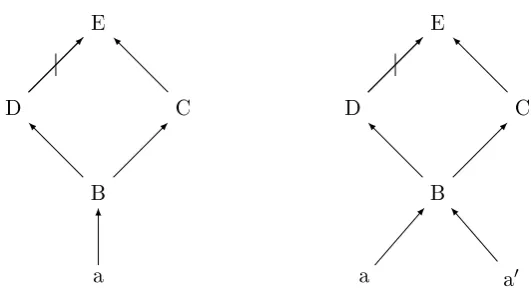
The problem of decoupling is well-known in the literature on inheritance networks and is best made clear by means of a concrete example. Consider the netΓ5 depicted in Figure 7. In total, it has four extensions, but two of
them are somewhat problematic. In particular, the extension E0 contains,
among others, the following two statements: isa(a, E,+) and isa(B, E,−). Apparently, the shape of the network itself suggests us that everything that we can conclude aboutamust depend on the only piece of factual information
we are given, i.e., that a is a B. The problem here is this: in spite of this
fact, one of the conclusion sets associated with Γ5 contains both `B-s are
usually notE-s' and `ais anE'. It denitely seems that in case all we know
aboutais that it is aB and `B-s are usually notE-s', we would not conclude
that a is an E. The other net depicted in Figure 7 Γ6 illustrates a
let us call itE00, contains both the statementisa(a, E,+)and the statement
isa(a0, E,−). What is odd here is that the net gives us exactly the same factual information aboutaand a0, but we are still allowed to conclude that
one is an E, while the other is not.
The name of the problem `decoupling' comes from the path-based approaches. There it is even easy to dene in a formal fashion. Thus, we could say that a path (x, y, σ, z, s) is decoupled in a path set Φ in case (y, σ, z, s) ∈/ Φ (cf. (Horty, [6][pp. 4243])). Now, it may seem to be easy to transfer this denition from paths to the isa-statements. For instance,
along some such lines as: an isa-statement isa(x, z, s) is decoupled in an extensionE if E contains isax(x, y,+), but not isa(y, z, s). We should not forget, however, that theisa-language is somewhat more limited than that
of paths. In particular, there is no way to specify that the inference of
isa(x, z, s) (in the denition) has to depend onisa(x, y,+).14 It might still be possible to devise a proper denition of a decoupled isa-statement, but
my intention is to deal with the problem without it. Returning to rule (5), I can say that one of the reasons for adding a formula of the ¬isa(x, z, s) -form to the would-be extension is to tag the Nixon Diamond-like situations, which are the only ones subject to decoupling. The other reason for having them is to invalidate those extensions in which decoupling actually occurs. The invalidation itself, though, is executed via the following sixth rule of inference:
6. Ifisax(x, y,+),isa(x, z, s), and¬isa(y, z, s)are in E,
then add¬isax(x, y,+) to E.
Notice that this rule is purely destructive: if it is applied, the would-be extension is immediately rendered inconsistent. Here it is important to see what shape do these would-be extensions have: ¬isa(y, z, s)does not only in-dicate a Nixon Diamond, but also implies the presence ofisa(y, z,−s)(recall rule (5)). Thus, what we have here are the three statements isax(x, y,+),
isa(x, z, s), andisa(y, z,−s) in a Nixon Diamond-like situation, and I claim that this can only be a case of decoupling. Now, as soon as we add rule (6) to R0, the counter-intuitive extensions of the two networks discussed above
Γ5 and Γ6 simply disappear. We leave out the exposition of the way
it actually happens.
Now, when all the inference rules are in their place, it is time we show that nothing has been lost in the process of expanding the system, i.e., that the extended system is as powerful as the basic one. Note that we will not be able to link extensions acquired byRto extensions obtained byR0, because
Still we can show that all the important formulae derivable by R are also
derivable by R0.
Proposition 7. For any atomic formula p, if there is an extension E
ac-quired by the rule setR from an inheritance networkΓsuch thatp∈E, then
there is an extensionE0 acquired by the rule set R0 fromΓ such thatp∈E0.
Proof. A straightforward induction on the construction ofE.
Henceforth, we will be concerned only with the expanded system. If I talk of extensions with no further specications, it is the extensions of the expanded system I have in mind. Likewise, `the set of rules' will mean
R0 rather than R in the remainder of the paper, unless explicitly specied
otherwise.
Recall our aim: it is to devise a system that is able to distinguish be-tween dierent extensions by means of the number of abnormalities they imply. Now, the rule set R0 works in such a way that every extension
al-ready contains statements expressing abnormalities. Thus, for any given net Γ, we only have to count the number ofabnorm-statements in its extensions
and single out the one for which this number is the least. Formally, it is done exactly as we did it for our path-based framework. For each extension
E, let the function#abnorm(E)be dened thus:
#abnorm(E) =|{ϕ∈E:ϕ=abnorm(x, y, z, s)}|
Now with the help of #abnorm we can at once dene the notion of a
minimal extension, i.e., the extension in which abnormality is minimised. Denition 15 (Minimal extension). The minimal extension of a network Γ is an extension E of Γ such that, for no extension E0 of Γ, we have #abnorm(E0)<#abnorm(E).
This denition is analogous to that of a minimal expansion. Thus, every net mustl have a minimal extension, and there are nets with several. Here let us turn to two illustrative examples to see minimal extensions at work. We are already familiar with the rst one.
Recall the inheritance networkΓ3 from the introduction. On the present
approach, it has two extensions,E andE0. If we leave out all the statements
serving technical purposes negations and the interm-statements and
also the trivial ones i.e.,isax(x, z, s) andisa(x, z, s)such that (x, z, s) is a link ofΓ3 , the two extensions look as follows:
E={isa(a, Co,−),abnorm(a, SoT hr, Co,+),abnorm(a, RuN, Co,+),
abnorm(a, Cough, Co,+),abnorm(a, N asCon, Co,+)};
R
P
n
Q F
[image:31.595.230.367.125.269.2]A
Figure 8: Γ7, the Zombie Path
Clearly, #abnorm(E) = 4 and #abnorm(E0) = 1. Given that E and E0 are the only extensions of Γ3, we see immediately that E0 satises the
condition for being its minimal extension. Again, the minimal extensions also corresponds to the intuitively correct one.
Our second example is provided by networkΓ7 that is depicted in Figure
8. Its standard interpretation isn= Nixon,R =Republican, Q= Quaker,
P = pacist, F = football fan, A = anti-military. It is well known in the literature as an example of a network that contains a `zombie'. The notion of zombie has been rst suggested by Makinson and Schlechta in [8]. In their parlance a zombie is a path that is dead, but can still kill other paths. Using our path-based approach, we could explicate it as follows. Suppose we are interested in the skeptical expansion of Γ7. Recall that it
is acquired after intersecting all the credulous expansions of the given net. Now, in spite of the conict between (n, R, P,−) and (n, Q, P,+) in the lower diamond, one of the credulous expansions, call it Φ, must contain (n, Q, P, A,+). However, exactly because of this conict (n, Q, P, A,+) is `dead', for there is no way it could be part of the skeptical expansion. Still it prevents us from adding(n, R, F, A,−)toΦand, thus, `kills'(n, R, F, A,−)'s chances of being included in the skeptical expansion of Γ7.
Be it as it may, in our isa-framework Γ7 has three extensions. Again, I
focus only on the statements that are relevant:
E={isa(R, A,−),isa(Q, A,+),isa(n, F,+),isa(n, P,+),
isa(n, A,+),abnorm(n, R, P,−),abnorm(n, F, A,−)}
E0={isa(R, A,−),isa(Q, A,+),isa(n, F,+),isa(n, P,+),
isa(n, A,−),abnorm(n, R, P,−),abnorm(n, P, A,+)}
isa(n, A,−),abnorm(n, Q, P,+)}
Since #abnorm(E00) < #abnorm(E) = #abnorm(E0), and E, E0, E00
are the only extensions ofΓ7, we can conclude that E00 is the minimal one.
Here evaluating the intuitiveness of extensions is somewhat more dicult, butE00still seems to represent a more appealing line of reasoning on the basis
ofΓ7 than eitherE or E0. For resolving the opposition betweenisa(n, P,+)
and isa(n, P,−) in the lower diamond in favour of the latter (as it is done inE00) eectively solves the problem in the upper diamond as well. Besides,
in such a way that no additional assumptions about abnormality of n are
needed. Thus, exactlyE00 seems to the preferable extension.
In the remainder of the section I will discuss some interesting features of minimal extensions. As it turns out, when a net has a unique minimal extension, it can exhibit eects similar to those of some defeater-defeaters discussed in [18] by Touretzky, Thomason, and Horty. The reader not inter-ested in this subject matter may at once proceed to the conclusion, for the material presented in the next few pages is supplementary. It does, though, provide some more examples.
The discussion in [18] aims to classify various kinds of argument (= argu-ment path) defeat, and special attention is devoted to what is called defeat of defeaters, i.e., situations in which an argument that defeats another is de-feated itself. The authors recognise two kinds of defeat: defeat by preclusion and defeat by conict. Although both are, as their names suggest, closely related to the notions of preclusion and conict, respectively, the idea of de-feat is somewhat broader and more informal. For instance, in our path-based approach a path can be conicted only with respect to an epistemic context, but we can talk of paths being defeated by conict in expansions, extensions, and inheritance networks as such. The intuitive meaning of the two kinds of defeat is just what one would expect: a path is defeated by preclusion in case it is precluded in the expansion of a given net; a path is defeated by conict in case it is absent from the expansion due to being in conict with some other path.
Of course, the notion of defeat is relational. Thus, whenever there is a defeated path, there must just as well be another one its `defeater'. If some pathπis defeated by preclusion, the path σ responsible for precluding
it will be called the precludor of π.15 Similarly, if a path π is defeated by
conict, the path defeating it will be called the conictor ofπ. Just like the
authors of [18], we are most interested in defeater-defeaters, or second order defeat. The intuition behind it is this: it may be possible that the ability of a path to act as a defeater is itself defeated by some other path. Given the two types of defeaters we recognise precludors and conictors , four kinds of defeater-defeaters are in principle possible:
E RE
c
G
E RE
c
[image:33.595.145.452.125.204.2]G
Figure 9: Γ8 and a graphic depiction ofE(Γ8)
- precludor-precludor; - precludor-conictor; - conictor-precludor; - conictor-conictor.16
In [18] these four combinations are evaluated from the perspective of a certain skeptical approach initially introduced in (Horty et al., [7]). The rst two are rejected on intuitive grounds, at least some cases of the fourth are accepted, while the third is only mentioned. My discussion of the defeater-defeaters will be based on concrete examples. That is to say, I will present an inheritance network that could, in principle, allow for a certain kind of defeater-defeat, introduce the statement set that ourisa-framework predicts
for the given net, and then judge whether the eect of second order defeat is present.
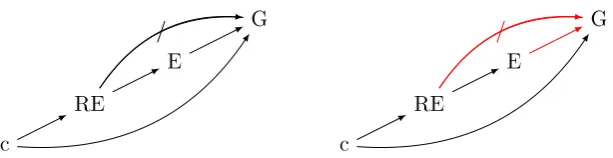
Let us begin with precludor-precludors. Consider the network depicted in Figure 9, on the left. Its interpretation is this: c = Clyde, RE = royal elephant,E = elephant, and G=grey. Notice that, on our denition, the
path(c, RE, E, G,+)must be precluded by(c, RE, G,−). However, the path (c, RE, G,−) is itself precluded by the direct link (c, G,+). Now, (c, G,+) would be a precludor-precludor in case it would cancel the preclusion of the path(c, RE, E, G,+). But let us have a look at what ourisa-approach
pre-dicts for Γ8. Despite the fact that it operates on sets of statements, the
network is simple enough for us to be able to present a certain visual ap-proximation of its minimal (and also sole) extension E. We focus only on two kinds of statements: the isa- and the abnorm- ones. Besides, only on
those which begin withc. Now, theisa-statements are depicted as standard
paths, while the abnorm- ones are depicted as paths that end in red links.
The approximation itself is presented in Figure 9 to the right of Γ8. The