
Learning and Knowledge
in Social Networks
MSc Thesis
(Afstudeerscriptie)
written byRobert M. Carrington
(born February 15th, 1989 in Oakland, California, USA)
under the supervision of Dr Alexandru Baltag, and submitted to the Board of Examiners in partial fulfillment of the requirements for the degree of
MSc in Logic
at theUniversiteit van Amsterdam.
Date of the public defense: Members of the Thesis Committee:
August 20, 2013 Dr Alexandru Baltag
Abstract
For most purposes, the information an agent can readily access is just as im-portant as the agent’s knowledge. This thesis explores several approaches to reasoning about the information agents in a network can access. The first sec-tion introduces a modality for informasec-tion from immediate connecsec-tions, and axiomatizes the resulting epistemic logic (EAL). I also introduce and axiomatize iterated version of the logic (IAL), which considers information along multiple edges of access. I prove both of these logics complete for epistemic models equipped with an edge relation. I define and axiomatize two additional logics for access without completeness – a version with restricted access (RAL) and one extending the existing framework of epistemic friendship logic with iterated access modalities (IFL).
Contents
1 Introduction 8
2 Background 11
2.1 The Notion of Access in Context . . . 11
2.2 Epistemic Logic . . . 13
2.3 Dynamic Epistemic Logic . . . 16
3 Epistemic Access Logic 19 3.1 IntroducingEAL . . . 19
3.2 A Database Example . . . 22
3.3 Axiomatization of EAL. . . 23
3.4 Completeness of EAL . . . 25
4 Iterated Access Logic 33 4.1 IntroducingIAL . . . 33
4.2 A Second Database Example . . . 34
4.3 Axiomatization of IAL . . . 36
4.4 Completeness of IAL . . . 36
4.5 A Classroom Example . . . 41
5 Restricted Access Logic 43 5.1 IntroducingRAL . . . 43
5.2 Axioms for RAL . . . 45
6 Iterated Friendship Logic 47 6.1 Epistemic Friendship logic . . . 47
6.2 Iterated Friendship Logic . . . 49
6.3 Axiomatization of IFL . . . 51
7 Controlling Information Access 52 7.1 Decidability of Model Checking inLCGC . . . 55
8 Conclusions and Further Work 57
Acknowledgements
I would like to thank Alexandru Baltag for indulging lots of meandering discus-sions on network-related topics. One of those winding roads lead to this thesis, so I am very grateful. Thanks also for your guidance though countless technical conundrums.
I would additionally like to thank my fellow Msc Logic students, especially those who worked through the hot summer alongside me. It was humbling to be surrounded by such precise and tenacious intellects. I look forward to seeing where the this eccentric little group ends up down the line. Stay in touch.
I would also like to thank Tanja Kassenar for countless administrative acts of benevolence. With any luck, the e-mail sending you this thesis will be the last of the pestering you get from me.
A special thanks to Jessica Olsen for telling me about the MSc Logic program over a game of pool three years ago. I never would have ended up here if we hadn’t crossed paths in Tacoma that summer.
Chapter 1
Introduction
“Here lies a man who was able to surround himself with men far cleverer than himself.” - grave of Andrew Carnegie, billionaire in-dustrialist
For most purposes, the set of information an agent has ready access to is more important that the subset she knows independently. If we think about the daily tasks we perform, the knowledge we are operating on extends far beyond our own heads. We rely on various sources – friends, computers, books – to provide us with the knowledge we need. Relying solely on what we know as individuals, it would be impossible for us to function as we normally do. The reason this does not matter is that information we have ready access to functions in virtually the same way as what we already know. It is ready to be used whenever we need it. If we take this point to heart, then the most significant fact about an agent’s situation is the information an agent has ready access to rather than the subset the agent already knows.
Furthermore, theessential facts about a situation might be about this kind of access to information. Consider a motivating example: Two children sit down for a test knowing the same things individually, but one child has the good fortune to be seated next to a clever friend. This child is in a position to score very well on the test, being able to peek at the answers of his friends. The other child is not as lucky, and stands to do poorly. The facts about individual knowers do not capture the important aspect of the situation, since the two children know the same things. The fact thatdoes explain one child’s superior position is a fact about access to information, namely that there is a clever friend sitting close by. Note also that this access cannot be recast into some kind of personal knowledge. The first child is cheating off of another student, answering his test based on someone else’s information. It is not his knowledge set, nor his neighbors knowledge set, which explains the access. Rather it is the connection between them. Access to information is an important and moreover a distinct concept in representing social situations.
ϕ, but he is friends with Brad so he could find out” or “Brad is the only friend who knewϕ, so Aaron must have learnedϕfrom him.”
The structure of the thesis is as follows:
1. In the remainder of this first chapter, I place this thesis within the context of recent philosophical and technical research. I also introduce epistemic logic and dynamic operators, which will be used throughout.
2. The second chapter introduces the central object of study: epis-temic network models. These models are epistemic models aug-mented with an edge relation between agents. I define a logic called Epistemic Access Logic (EAL) for describing both what agents know and have access to via their network neighbors. I provide an ax-iomatization forEALand show completeness for epistemic network models.
3. In the third chapter, I consider a language with modalities for the information of agents beyond immediate neighbors. This version is referred to as Iterated Access Logic (IAL). This logic can also be extended with a dynamic modality [READ], which corresponds to the action of all agents reading the information available from other agents. I show thatIAL and DIAL are also complete for epistemic network models.
4. In the fourth chapter I provide a logic for restricted information access (RAL). Access to information can, in this framework, be de-scribed on the level of individual issues. I present an axiomatization of RALfor which completeness is an open question.
5. The fifth chapter introduces an expanded version of Epistemic Friendship Logic (EFL), studied in studied in [3]. This version IFL
expands the language by incorporating iterated modalities for knowl-edge and friendship.
6. The sixth chapter explores a different aspect of access – the power of individual agents to control information flow in a network. This logic,LCGCbuilds on a quite different framework from [1], but could be integrated with the previous logics in the future.
7. The final chapter is dedicated to conclusions and promising di-rections of further research.
version of the underlying model, rather than the model itself. Since static models can only capture an agent’s knowledge at a particular moment, dynamic modalities are essential for representing changes in what agents know. Both of these advances are highly relevant in the setting social networks, where we will be dealing with any number of agents all communicating with one another.
This thesis can also be seen as falling within the field of social epistemology. Instead of analyzing conditions within the mind of a single knower, social epis-temologists look beyond the individual to examine how an agent’s knowledge depends upon the larger community. Although the beginning of this study is difficult to isolate, major reference points for this field include Philip Kitcher’s investigation into the scientific community inThe Advancement of Science and Alvin Goldman’s examination of social procedures more generally inKnowledge in a Social World.
Chapter 2
Background
2.1
The Notion of Access in Context
Work in several areas has advanced the idea that the information we have ready access to is at least as important as the knowledge in our minds. Although this thesis does not assume the truth of any particular theory, it has certainly taken inspiration from and been influenced by these ideas.
The strongest interpretation of this sentiment comes from philosophy of mind, where many hold that the knowledge we have ready access toqualifies as being part of our mind. This is referred to as the extended mind thesis, after a 1998 paper published by Andy Clark and David Chalmers [9]. Supporters of this view hold that if the mind is understood as a set of functions – the capacity for thinking, remembering, calculating – then we have to include all the objects involved in those functions and not just the ones that happen to be inside our skulls. Memory is taken as a prime example. Phone number were, in years past, memorized by most people since they had to be dialled by hand. Nowadays with the advancement of technology, most people have those num-bers stored and dialled automatically through their phones. If our cellphones are performing the same job that our neurons did previously, they should count as part of our minds just as much as our neurons do. For contributing to a mental function, Clark and Chalmers require that the object is (1) constantly and immediately available and (2) automatically endorsed. That is, trusted or relied upon just as readily as our own brain. The present work does not assume the same requirements, or assume that the external mind hypothesis is true at all. The arguments are mentioned here for a much more modest purpose than the original. This thesis is simply relying on the fact that information outside one’s head can be just as indispensable as the information inside of it.
2.2
Epistemic Logic
We arrive at epistemic logic by interpreting the semantics of modal logic to represent the space of possibilities from one or more agents’ perspectives. The syntax is similar to standard modal logic, except that the ♦and modalities are replaced by a single Ka modality. Kaϕ is meant to be read as “Agent a knowsϕ.”
Definition(Syntax ofLEL)
ϕ := p| ¬ϕ|ϕ ∨ ϕ|Kaϕ
wherep∈Prop, anda∈ A.
Now that we have the formulas of the language LEL, we provide the model
they will be interpreted upon.
DefinitionAnepistemic model Mbased on a set of agentsAis a triple: (S,(∼a)a∈A, V)
whereS6=∅is a set of states, for eachi∈ A,∼iis a binary equivalence relation
onS, andV : Prop→ P(S) is a valuation.
Each accessibility relation ∼a connects worlds that the agent is unable to
dis-tinguish from the actual world. If ϕis true in all the worlds accessible via∼a,
then agent aknows that ϕholds in the actual world.
Definition(Semantics ofLEL):
M, w |=piffw∈V(p)
M, w |=¬ϕiffM, w 2ϕ
M, w |=ϕ∨ψiffM, w |=ϕor M, w |=ψ
M, w |=Kaϕiff for all v such that w∼av we have thatM, v |=ϕ
There are numerous proposals for the axioms for knowledge, each with their advantages and disadvantages. The set of axioms known as S5 however has become the default in epistemic logic, and it is what we shall use here.
S5 Axiomatization
(MP) Fromϕandϕ→ψ, deriveψ.
(N) FromϕderiveKaϕ.
(Prop) All validities of propositional logic
(T)Kaϕ→ϕ
(4)Kaϕ→KaKaϕ
(5)¬Kaϕ→Ka¬Kaϕ
Common Knowledge We can expand the language to include a new modal-ity,C, meant to capture the notion of common knowledge, i.e. formulas that are taken as mutually assumed by all agents. Common knowledge can be described in natural language as that knowledge which “everyone knows, and everyone knows that everyone knows, and everyone knows that everyone knows that ev-eryone knows, ... ” and so on ad infinitum. Whereϕis any formula ofLEL, we
add:
Cϕ
Truth for formulas of this form is defined by:
M, w |=Cϕiffv|=ϕfor every v and every finite chain of the form
w=wo∼a1w1∼a2 w2...∼anwn=t, witha1, ..., an∈A
If we letEϕabbreviateKa1ϕ∧Ka2ϕ∧...∧Kanϕfor all ai∈ A, we can see that this definition implies:
M, s|=Cϕ⇔s satisfies all the sentencesϕ, Eϕ, EEϕ, EEEϕ...
So we have a modality corresponding to the notion of common knowledge given above. We can also define a restricted version of common knowledge. For any subgroup of agents G, we add formulas of the form:
CGϕ
The semantics forCGϕwill be the same as above, except we only quantify over finite chainsw=wo∼a1 w1∼a2w2...∼anwn=t, witha1, ..., an∈G.
Distributed Knowledge We can also expand the languageLELto include
the modality, D. For every formulaϕofLEL, we add a formula:
Dϕ
which can be read as “It is distributed knowledge thatϕ.” The truth of these new sentences in the language is defined as follows:
M, w|=Dϕiffv|=ϕfor everyv such thatw∼av for alla∈ A
Just as with common knowledge, we can also define this modality for sub-groups. We add formulas of the form:
DGϕ
Truth for these formulas will be defined in the same manner as theDG op-erators, except we only require ϕbe satisfied at every v such thatw∼a v for
2.3
Dynamic Epistemic Logic
The definitions so far have allowed us to capture knowledge in a static state. An accessibility relation links the states the respective agent cannot distinguish from reality. However, to capture changes in what the agent knows, we incorporate an idea from Propositional Dynamic Logic (PDL). In PDL, “dynamic modalities” are formalized by the notion
[α]ϕ
This formula can be read as: “If the actionα is performed on the current world, then the sentence ϕwill become true after.” In PDL the semantics for this modality are quite close to traditional modal logic – we check satisfaction by examining all worlds accessible via the relation corresponding toα.
Now, however, we instead apply the same idea of dynamics tomodelsinstead of worlds. This time, we define a function that maps epistemic models to another, and such functionsupdatesoractionson models. Then we reinterpret the above formula as: “If the actionαis performed on the currentmodel, then the sentence
ϕ will become true after.” We interpret this “if” as a material conditional, so [α]ϕis true of a model whenαcannot be performed.1
The family of logics formed by adding such dynamic modalities to an epis-temic logic are known as Dynamic Episepis-temic Logics.
Updates in Dynamic Epistemic Logic
We now formally introduce the idea of an update. The first component of an update α is a function that maps the initial model S to a new model Sα, meant to represent the model after a change has occurred. The second compo-nent is a binary “transition” relation, which links each state in the initial model to one or more states in the new model. The transition relation is meant to con-nect each state in the old model to the state or states which are identical in the new model. Here “identical” means that they represent the same state of affairs.
DefinitionAnepistemic update αconsists of:
1. A map S7→Sα from an initial model S= (S,(∼a)a∈A, V) to a new model
Sα= (S0,(∼0
a)a∈A, V0).
2. A binary transition relation −→ αS ⊆S×S0, pairing each world in the old model with one or more worlds in the new model.
In updates which inform all agents equally, the state space in the new model will just be the same set as in the original and the transition relation will map every state to its copy. In updates with private communication the set of states must be multiplied to be allow for the different perspectives, and the transition relation becomes more complicated.
1An actionαcan also be non-deterministic, so that multiple states can result from applying
With the above definitions, we can formally define what it means for dy-namic formulas to be true. Intuitively, a state satisfies a formula beginning with a dynamic modality if the corresponding state in the updated model sat-isfies the formula with the dynamic modality removed.
Definition(Truth for Dynamic Modalities)
s|=S[α]ϕifft|=Sαϕfor allt∈Sα such thats−→ α
S t.
Before continuing, we give a concrete example of an epistemic update. This update has been referred to as the “Tell All You Know” modality.2 Although we will not be using this modality in this thesis directly, other modalities used in this thesis are closely related.
Definition For a given state s, let s(a) := {t ∈ S|(s, t) ∈ (∼a)}. Then the
“Tell All You Know” update !amaps any modelS= (S,(∼a)a∈A, V) to a new model S!a= (S0,(∼0
a)a∈A, V0) given by:
S0 :=S∩s(a)
s∼0atiffs∼at, for all s, t∈S0
V0(p) :=V(p)∩S0
The transition relation −→!a relates any state s∈S satisfyingϕ to the same
state in the modelS!a.
Reduction Laws for “Tell All You Know”
We can add the following axiom schema to our previous ones to get a com-plete axiomatization for the new dynamic logic. Given any formula ϕ, these axioms allow us to push any occurring dynamic modalities deeper into the for-mula until they reach the atomic propositions and disappear. This results in a static formula equivalent to our original dynamic one.
[!a]p⇐⇒p
[!a]¬ϕ⇐⇒ ¬[!a]ϕ
[!a](φ∧ψ)⇐⇒[!a]ϕ∧[!a]ψ
[!a]Kbϕ⇐⇒D{a,b}[!a]ϕ [!a]DGϕ⇐⇒DG∪{a}[!a]ϕ
Chapter 3
Epistemic Access Logic
We now expand the epistemic logic introduced in the last section by adding communication graphs to our models. We can represent the knowledge of mul-tiple agents as before, but by adding a directed graph we are able to represent one agent having access to the information of another. We can imagine that each agent’s knowledge is stored on a database, where the agent can then look up whatever information he needs. An agenta’s database is private, but others may have a’s password and be able to access the information a has. We as-sumeahas no way of knowing who can read his information or what they have learned. Only the agent accessing knows these facts. Thus information flow is entirely “one-way” in this framework: the agent with access gains information from the other agent without giving any information away.
However, it is important to keep in mind that this is a static logic. Formulas of this language describe what is true at a moment, i.e. in a single model. We will later model communication explicitly via a dynamic modality, but for now we can only stipulate that what we are representing is available information.
3.1
Introducing
EAL
We now introduce the language of Epistemic Access Logic (EAL). The syntax for EAL is focused on capturing not just what an agent knows but what an agentcould know if she pooled information with surrounding agents. Hence, in addition to the Ki modalities for knowledge, we introduce a modality Ki0 for available information. Since we assume agents are able to independently pull information from connected neighbors in the communication graph, we can in-terpretKi0ϕin English as: “Agentahas potential knowledge ofϕ.” We also add sentences of the form “aEb” to express that agentahas the ability to access or
enter agentb’s store of information.
Definition(Syntax ofLEAL)
ϕ := p| ¬ϕ|ϕ ∨ ϕ|Kaϕ|Ka0ϕ|aEb
for¬Ka0¬ϕ.
Abbreviations
We also introduce the new abbreviationavc, which we read as “c is at least as connected as a.” This abbreviation is meant to capture an intuitive idea of c having access to all the resources that a does. We define a v c as the abbreviation:
avc⇔ ^ b∈A
(aEb→cEb)
”
We can similarly define the abbreviation a 6vb. Such formulas intuitively mean thatbis not more connected thana. We definea6vbas the abbreviation:
a6vb⇔ ¬ ^ b∈A
(aEb→cEb)
.
Finally, we can define the strict notion ofa@b, i.e. “b is more connected thana,” via these first two abbreviations. Leta@bbe defined by:
a@b⇔avb∧b6va
.
Semantics
We now introduce the models that formulas of EAL will be interpreted on. They are essentially multi-agent epistemic models with a communication graph added: a set of agentsAfor the nodes and a set of edgesE.
Anepistemic network model Mfor a set of agentsAis a tuple:
(W,(∼a)a∈A, E, V)
whereW 6=∅is a set of states, for eachi∈ A,∼iis a binary equivalence relation
on W, E is a function E : W → P(A × A) which returns the set of edges for a given world. We also impose the following condition on the edge function E: If (a, b)∈E(w) and w∼a w0, then also (a, b)∈E(w0). This condition ensures
that agents know who they do and do not have access to. V : Prop→ P(W) is a valuation on proposition variables.
Thus far in our models we have epistemic relations representing what each agent knows, but no portion of the model corresponding to the information available to an agent. We define the additional set of relations ∼hai for all
a∈ Aas follows:
s∼hais0 iffs∼bs0 for allbsuch that (a, b)∈E(s)
Definition(Truth forLEAL):
M, w |=piffw∈V(p)
M, w |=¬ϕiffM, w 2ϕ
M, w |=ϕ∨ψiffM, w |=ϕor M, w |=ψ
M, w |=aEbiff (a, b)∈E(w)
M, w |=Kaϕiff for all v such that w∼av we have thatM, w |=ϕ
3.2
A Database Example
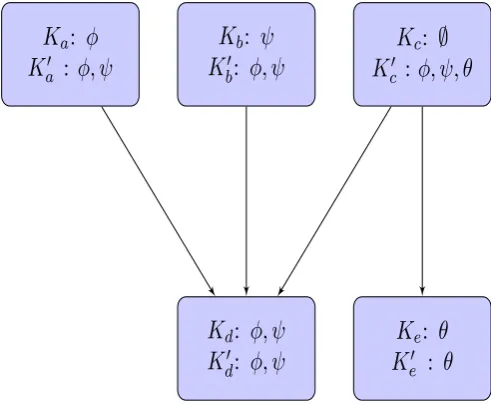
In this example, each agent has a computer storing all of his or her information. Some agents also have the password to access the information on another agent’s computer. We assume that access is secret, so that only the agent with the access knows this fact. Access is also not generally symmetric – I can know your password without you knowing mine. In the case given below, agents a
andbhave access to the computer of a third agent,d. Agentchas access tod’s computer, but also to the computer of agente. Agentdandein turn have access to no other computers, and do not even know whether others are accessing their computers.
First, compare agentsaandb. On the basis of knowledge alone, the agents seem to be in quite different positions. The set of formulas known byais disjoint from that of b. However, since they both have access to d’s more extensive information, they have the same potential knowledge. That is,avbandbva. From this perspective, they are in a very similar positions epistemologically.
Now compare these agents to agentc. On the basis of knowledge, agent c
is in a far worse position than either a or b: he actually knows nothing. On the other hand, if we look at potential knowledge c is in a superior position. Having access to bothdande,c has more potential knowledge than any other agent in this scenario. Since any information accessible by the first two agents is also accessible by c, avc and b vc. Agent eis, from this perspective, in the best epistemological position without knowing more than anyone else (or, in fact, knowing anything at all).
K
d:
φ, ψ
K
d0:
φ, ψ
K
b:
ψ
K
b0:
φ, ψ
K
a:
φ
K
a0:
φ, ψ
K
c:
∅
K
c0:
φ, ψ, θ
K
e:
θ
[image:24.595.174.420.423.625.2]K
e0:
θ
Figure 3.1: Agents are here represented as blocks labelled with the formulas the agent knows and potentially knows. Arrows represent access, with each arrow running from the accessing agent to the one being accessed.
knowledge the two agents are at quite a disadvantage. Neither one has access to another agent’s computer, so their potential knowledge is identical to their current knowledge.
This example is meant to show how many crucial points in a scenario can depend upon the notion of potential knowledge. Describing the scene in terms of what agents know does not capture all the relevant facts. Agents who know none of the same facts, and thus seem to be in quite different epistemologi-cal positions, can actually have the same accessible knowledge. Agents who are completely ignorant can nonetheless have access to more information than anyone else.
3.3
Axiomatization of
EAL
Modus ponens and necessitation forKa are the only inference rules forEAL. In the context of the axioms below, necessitation forKa0 follows from necessitation forKa.
(MP) Fromϕandϕ→ψ, deriveψ.
(N) FromϕderiveKaϕ.
The axioms for EAL are the validities of propositional logic, S5 axioms for
Ka andKa0, along with four axioms serving to connect Ka, Ka0 and the
formu-las regarding access.
(Prop) All validities of propositional logic
(K)Ka(ϕ→ψ)→(Kaϕ→Kaψ)
(T)Kaϕ→ϕ
(4)Kaϕ→KaKaϕ
(5)¬Kaϕ→Ka¬Kaϕ
These axioms are standard knowledge axioms for Ka. They ensuring thatKa
distributes over conditionals, that Kaϕimplies the truth ofϕand that agents
have positive introspection and negative introspection of Ka.
(K0)Ka0(ϕ→ψ)→(Ka0ϕ→Ka0ψ)
(T0)Ka0ϕ→ϕ
(40)Ka0ϕ→Ka0Ka0ϕ
(50)¬Ka0ϕ→Ka0¬Ka0ϕ
These axioms are standard knowledge axioms forKa0. Just as with the previous
five, they ensuring thatK0
truth ofϕ and that agents have positive introspection and negative introspec-tion ofKa0.
(E1)aEa
The axiom (E1) ensures that agents can access their own knowledge. This ensures that the set of formulas known by any agent in the model forms a sub-set of the formulas the agent potentially knows.
(E2) (aEb∧Kbϕ)→Ka0ϕ
The axiom (E2) states that if a has access to b’s information, then anything
b knows is potentially known by a. In other words, (E2) guarantees that your potential knowledge contains the knowledge of those you have access to.
(E3)aEb→KaaEb
The axiom (E3) states that each agent knows the agents they have access to. Note that this does not imply that agents know who has access to themselves.
(E4) V
b∈A\a
(¬aEb)→(Ka0ϕ→Kaϕ)
Axiom (E4) specifies that if an agent has no other connections, then what he potentially knows is the same as what he knows.
(E5)avc→(Ka0 vKc0)
3.4
Completeness of
EAL
Proposition: EAL is sound and complete for the class of epistemic network models
To show thatEAL is complete for epistemic network models, we shall use in-termediary models called “network pseudo-models.” These models will contain extra relations so that we can interpret formulas containingKa0 operators in the
same way we interpretKa operators. The strategy, in broad stroke, is to then connect satisfiability in these pseudo-models with satisfiability in epistemic net-work models. We prove that for every pseudo-model there exists an epistemic network model satisfying the same formulas, and furthermore one in whichKa0
must have the semantic definition given earlier. We now introduce the notions needed for the proof.
Definition We say that a formula ϕ is consistent if its negation ¬ϕ cannot be proven in EAL. Otherwise we say thatϕisinconsistent.
DefinitionA formulaϕissatisfiable if there is a network model and a states
such that (M, s)|=EALϕ. The formulaϕis then said to be satisfiable inM.
Definition A (network) pseudo-model for a set of A of n agents is an epis-temic network model of 2nagents:
M= (S,(∼a)a∈A,(∼hai)a∈A, E, V) such that∼a,∼hai are equivalence relations for alla.
DefinitionWhereM is a network pseudo-model, we say that (M, s) pseudo-satisfies a formulaϕif the pair (M, s) satisfiesϕin the normal way except that (M, s)|=Ka0ϕiff (M, s0)|=ϕfor alls0 such that (s, s0)∈∼hai. A pseudo-model
Mvalidates a formula ϕif (M, s)|=ϕfor every statesofM.
DefinitionA pseudo-model of EAL is a pseudo-model which validates all the axioms of EAL.
Proposition: Every epistemic network model is a pseudo-model of EAL.
Note that every epistemic network model is trivially a pseudo-model, given how we have defined ∼hai for network models. So we just need to show that every network model validates the axioms of EAL. Take an arbitrary modelM
and statesofM. First off,∼a and∼haiare equivalence relations by definition of a network model. Therefore they will each validate their respective axioms
K, T,4,5 andK0, T0,40,50. Then we prove that (M, s) satisfies the remaining axioms individually.
(E1)aEa
(E2) (aEb∧Kbϕ)→Ka0ϕ
Assume (M, s)|= (aEb∧Kbϕ). Then (M, t)|=ϕfor alltsuch that (s, t)∈∼b.
However, by definition (s, t)∈∼haiiff (s, t)∈∼aand (s, t)∈∼bfor allbsuch that
(a, b)∈E(s). SinceM, s)|=aEb, (a, b)∈E(s) and so (s, t)∈∼b→(s, t)∈∼hai. Then (M, t)|=ϕfor alltsuch that (s, t)∈∼hai.So (M, s0)|=Ka0ϕ.
(E3)aEb→KaaEb
Assume (M, s) |=aEb. Then by our definition of a network model, we have that for every worlds0 such thats∼as0, (a, b)∈E(s0). So (M, s)|=KaaEb.
(E4)V
b∈A\a(¬aEb)→(Ka0ϕ→Kaϕ)
Assume (M, s) |= V
b∈A\a(¬aEb). So then if (M, s) |= K
0
aϕ, we have that M, t |= ϕ for all t such that (s, t) ∈∼hai. But by definition (s, t) ∈∼hai iff (s, t)∈∼a and (s, t)∈∼b for allb such that (a, b)∈E(s). By our first
assump-tion there are no such bexceptahimself so∼hai=∼a. So (M, s)|=Kaϕ.
(E5)avc→(Ka0ϕ→Kc0ϕ)
Assume (M, s)|=avc. Then we have that V
b∈A
(aEb→cEb). We can take an
arbitrary pair (s, s0)∈∼hci. By how∼hciis defined for network models, we have that (s, s0)∈∼b for all b such thatcEb. But then by our first assumption, we
must have that (s, s0)∈∼b for all b such thataEb. So (s, s0)∈∼hai. Thus we have that (M, s)|= (Ka0ϕ→Kc0ϕ).
Definition A formula ϕ is pseudo-satisfiable if there is a network model M
and a state s of M such that (M, s) |=ϕ. The formula ϕis then said to be pseudo-satisfiable in M.
In order to prove completeness forEALit suffices to prove the following propo-sitions:
(1) Ifϕis consistent, thenϕis pseudo-satisfiable. (2) Ifϕis pseudo-satisfiable, thenϕis satisfiable.
Proof of (1): If ϕ is consistent, thenϕ is pseudo-satisfiable.
We will use the canonical model construction to show that every consistent set of formulas is pseudo-satisfiable.
Definition: A set of formulas Φ is maximal consistent if Φ is consistent and any set of formulas properly containing Φ is inconsistent. If Φ is a maximal consistent set of formulas then we say it is anM CS.
Proof: Let φ0, φ1, ... be an enumeration of the formulas of L. Define Φ+ as
the union of the chain of consistent sets:
Φ0= Φ
Φn+1=
(
Φn∪ {φn} if this is consistent
Φn∪ {¬φn} otherwise
This set Φ+is clearly a superset of Φ. Each Φn+1 is consistent, since if adding the new formulaφnwould lead to inconsistency then¬φis by definition already
provable from Φnand can be added without affecting consistency. Furthermore,
since we assumedφ0, φ1...was a complete enumeration, Φ+ must contain either
φor¬φfor every formulaφ. Thus Φ+is an MCS, since for anyφ6∈Φ+we have
that ¬φ∈Φ+. Any strict superset of Φ+ will contain bothφand¬φfor some
φand thus be inconsistent.
Definition: We define the canonical network pseudo-model for a set of agents
Ato beMc= (W ,c (∼ba)a∈A,(∼b{a})a∈A,E,b Vb), where:
c
W ={Φ|Φ is an MCS}
Φ∼baΦ0 iff for allψ, (Kaψ∈Φ)→(ψ∈Φ0)
Φ∼bhaiΦ0 iff for allψ, (Ka0ψ∈Φ)→(ψ∈Φ0)
b
E(Φ) ={(a, b)|aEb∈Φ}
b
V(p) ={Φ|p∈Φ}
Truth Lemma: (Mc,Φ)|=ϕiffϕ∈Φ.
Proof: By induction onϕ. The base case follows from the definition ofV. The boolean cases follow from the properties of MCSs. Formulas for accessibility (of the form aEb) follow immediately from the definition ofEb(Φ).
So first assume (Mc,Φ)|=hKaiϕ. Then we have that there exists a Φ0 such
that Φ∼baΦ0 and (Mc,Φ)|=ϕ. But thenϕ∈Φ0 and so hKaiϕ∈Φ.
For the opposite direction, assumehKaiϕ ∈Φ. Then by the same equiva-lences as above, it suffices to find an MCS Φ0 such that Φ∼baΦ0 andϕ∈Φ0. We
have this fact by the Existence lemma.
The case ofKa0 is similar. Assume (Mc,Φ) |=hKa0iϕ. Then we have that
there exists a Φ0 such that Φ∼baΦ0 and (Mc,Φ)|=ϕ. But then ϕ∈Φ0 and so
hKa0iϕ∈Φ.
For the other direction, assumehKa0iϕ∈ Φ. It suffices to find an MCS Φ0 such that Φ∼bhaiΦ0 andϕ∈Φ0, which we know by the Existence lemma.
Corollary: EAL is sound and complete for the canonical pseudo-model.
Proof: Suppose Σ is a consistent set of formulas fromLEAL. By Lindenbaum’s
(Mc,Σ+)|= Σ.
Before proving (2), we will need a lemma which utilizes further definitions.
Definition Let M be a network pseudo model and let s be a state of M. We define the LEAL-type of (M, s) to be the set of formulas ϕ ∈ LEAL such
that (M, s)|=ϕ.
Definition Let M = (S,∼1, ...,∼n,∼h1i, ...,∼hni, E, V) be a network pseudo model withs, t∈S. We call a sequencehv1, i1, v2, i2, ..., ik−1, vkiwherek≥1 a
path from s to t if:
(1)v1=s
(2)vk=t
(3)v1, ..., vk are states
(4)i1, ..., ik−1 are generalized agents from the set{1, ..., n,h1i, ...,hni}.
(5) (vj, vj+1)∈∼ij for 1≤j < k.
DefinitionThereduction of a pathhv1, i1, v2, i2, ..., ik−1, vkiis the path formed
by replacing each maximal consistent subsequencehvq, iq, vq+1, iq+1, ..., ir−1, vri
where iq =iq+1=...=ir−1byhvq, iq, vri. A reduction of a path is a path, by
transitivity of every∼i. A path isreduced if it equals its reduction.
Definition M is tree-like if whenever s and t are states of M, then there is at most one reduced path fromsto tinM.
Lemma(Unravelling for pseudo models): LetM1= (W,(∼a)a∈A,(∼hai)a∈A, E, V) be a pseudo model ofEAL. Then there is an pseudo modelM2ofnagents such
that:
(1)M2 is tree-like and
(2)M1 andM2 have the sameLEAL-types
Proof: Fix a particularw∈W. Then let M2= (
−→
W ,(−∼→a)a∈A, E,
− →
V), where:
(i)−W→is the set of all finite sequenceshw, R1, w1, R2, ..., R2, wnisuch
that wR1w1R2...Rnwn where eachRi ∈ {∼a |a∈ A} ∪ {∼hai |a∈
A}.
(ii) For −→s1,−→s2 ∈
−→
W, define ∼0
a such that−→s1 ∼0a −→s2 if there exists v
such that −→s1;Ra0;v = −→s2, where ; denotes sequence concatenation.
Then−∼→a is defined to be the reflexive, symmetric, transitive closure
of∼0
a.
(iii)Eis the same set of edges fromM1.
(iv)−→V(p) ={(w1, w2, ..., wn)∈ −→
W |wn∈V(p)}
We first show thatM2is tree-like. Essentially, we use the fact that for each
state−→t there is at most one state−→s such that−→s−→∼a − →
t.
Define aprimitive path P to be a sequence hv1, i1, v2, i2, ..., ik−1, vki where
(1)v1=s
(2)vk=t
(3)v1, ..., vk are states
(4)i1, ..., ik−1 are generalized agents from the set{1, ..., n,h1i, ...,hni}, and
(5) (vj, vj+1)∈∼0ij or (vj+1, vj)∈∼ 0
ij for 1≤j < k.
We say that P is an a-primitive path if ij = a for 1 ≤ j < k. We say that P is nonredundant if there is no j such that vj = vj+2 and ij = ij+2.
Intu-itively, P is nonredundant if there is no part of the path going along an edge and then immediately back again. Note that there is at most one nonredundant primitive path from −→s to −→t, since for each there is at most one sequence −→s0
such that −→s +−→s0 = −→t. Furthermore, note that (−→s ,−→t)∈ −→∼a iff there is an
i-primitive path from−→s to −→t .
Take arbitrary states−→s and −→t. Let P = h−→v1, i1, ..., ik−1,−→vki and P0 = h−→v01, i01, ..., i0k−1,
− →v0
kibe reduced paths from stot. Then since (vj, vj+1)∈Ki0j for 1≤j < k, there must be a reduced i-primitive path fromvj tovj+1. LetPb
denote the path obtained by substituting in this nonredundant primitive path for each (vj, vj+1) inP. Since each of the primitive paths are nonredundant, the
resulting pathPb is also nonredundant. We have also thatP is the reduction of b
P. Similarly, letPb0 also be a nonredundant path from−→s to
− →
t. By uniqueness of nonredundant primitive paths, we know thatPb =Pb0, which means that the
reductions of Pb andPb0 are the same as well. SoP =P0, and soM2 must be
tree-like.
To show thatM2 satisfies the same formulas asM1, we can show thatM2
is a bounded morphic image of M1. For if we let f :
−→
W →W be defined by
f(w, w1, ..., wn) =wn, we can see thatf is surjective, has the back and forth
properties, and maps any−→s to a state inM1satisfying the same propositional
variables.
Proof of (2): If ϕis pseudo-satisfiable, thenϕ is satisfiable.
Assume that ϕ ∈ LEAL is pseudo-satisfiable. By unravelling, we can assume
without loss of generality that there is a tree-like pseudo-network modelMand a state s such that (M, s)|=ϕ. Let M be (S,(∼a)a∈A,(∼hai)a∈A, E, V). We define∼afora∈ A, by: (s, t)∈∼aiff there exists a finite chainv1...vk such that:
(i)v1=s
(ii)vk =t
(iii)vj∼avj+1 or vj∼hbjivj+1 for some∼bj such that (bj, a)∈E(vj)
LetM= (S,(∼a)a∈A, E, V). Note thatM andM have the same state space
S, edge relationE and valuation function V. To complete the proof it suffices to show the truth of three claims.
Claim I: ∼a is an equivalence relation for each a∈ A
Claim III: For every pseudo-model M there exists a network model M such that: (M, s)|=ϕ⇔(M , s)|=ϕ
Proof of I: We first note that the condition holds for any b such that (b, a)∈ E(s). That is, we can show thats∼hbit and (b, a)∈E(s) implies (b, a)∈E(t). Taking axioms P1 (Kaϕ→ Ka0ϕ) and P3 (aEb→ KaaEb) together, we have that that bEa → Kb0bEa. Then by the definition of ∼hbi in the canonical pseudo-model, we have exactly the above fact: s∼hbit and (b, a)∈E(s) implies (b, a)∈E(t).
From our definition of pseudo-models, we also already have thats∼at and
(a, b) ∈ E(s) implies (a, b) ∈ E(t). These two conditions together guarantee that E(s) =E(t) for any (s, t)∈∼a, since we have that (vj, vv+1)∈ ∼a or∼hbi and in either case E(vj) = E(vj+1). Thus, each (vj, vj+1)∈∼a is taken from
a fixed set of equivalence relations. Furthermore∼a includesall paths formed
from elements of these equivalence relations. So for any (s, t)∈∼a we also have
the the returning pathttos, since these equivalence relations must contain for each edge (vj, vj+1) the returning edge (vj+1, vj). These equivalence relations
will also have to contain reflexive edges (vj, vj) for all relevant states, which means∼a will also be reflexive. Finally,∼a is transitive since we can compose
any two paths. Therefore∼a is itself an equivalence relation.
Proof of II: We must prove thats ∼a t and (a, c)∈E(s) together imply that
(a, c)∈E(t). We prove this inductively, on the length of the path froms tot. Assume that the condition holds up to statevj. Then (vj, vj+1) is either in∼a
or in∼hbifor some bs.t. (a, b)∈E(vj). In the first case, we have by definition of a pseudo-model that:
vj∼avj+1∧(a, c)∈E(vj)→(a, c)∈E(vj+1)
So in this case condition (ii) holds. Now consider the second case, when (vj, vj+1)∈∼hbi for someb such that b∈ E(vj). Note that by axioms E2 and
E3 we can derive as a theorem:
bEa→(aEc→Kb0aEc)
So then for anybsuch that (b, a)∈E(vj), we have that (M, vj)|=bEaand thus:
vj∼hbivj+1∧(a, c)∈E(vj)→(a, c)∈E(vj+1)
which means that in this case too we have that condition (ii) holds. This completes the induction, thus (ii) holds for any pair (s, t)∈∼a. Therefore (ii)
holds in general andMis an network model.
Proof of III: And now we can show, by induction on the structure of formulas in LEAL, that:
(3) (M, s)|=ψiff (M, s)|=ψ
the same valuation function V. The case where ψ is a Boolean combination of formulas for which the analog of (3) holds is also immediate. Since M and
Malso have the same edge relation the case whenψis of the form aEbis also immediate. Now consider the case where we have aψof the formKaγ.
(⇒) (Contrapositive) Assume first that (M, s) 6|= Kaγ. Thus, there is a statet ∈S such that (s, t)∈ ∼a and (M, t)6|=γ.Since ∼a ⊆ ∼a,(s, t)∈ ∼a.
So (M, t)6|=γ,and thus (M, s)6|=Kaγ.
(⇐) Assume now that (M, s) |= Kaγ. To show that (M, s) |= Kaγ we must show that (M, t)|=γwhenever (s, t)∈ ∼a. Assume that (s, t)∈ ∼a. By
definition of ∼a there exists a finite chainv1, ..., vk∈S such that:
(1)v1= s
(2)vk = t
(3)vj∼avj+1 or vj∼hbjivj+1 for somebj such that (bj, a)∈E(vj)
We now show, by induction on j, (where 1 ≤ j < k) that (M, vj) |= Kaγ.
The casej= 1 is by assumption. Assume inductively onj that (M, vj)|=Kaγ
(where 1 ≤ j < k−1). We need to show that (M, vj+1) |= Kaγ. Since
(M, vj) |= Kaγ, it follows by positive introspection that (M, vj) |= KaKaγ.
We know that either (vj, vj+1) ∈ ∼a or (vj, vj+1) ∈∼hai or (vj, vj+1) ∈ ∼hbi for some b such that (b, a)∈E(w). In the first case, since (M, vj)|=KaKaγ, it follows that (M, vj+1)|=Kaγ,as desired. In the second case, we have that
(vj, vj+1)∈ ∼hbifor somebsuch that (b, a)∈E(w). So by assumption we have that (M, s)|=Kaγ and since (b, a)∈E(w), we have also that (M, s)|=bEa. Then as an instance of Axiom E2 we have that (Kaγ∧bEa)→Kb0(Kaγ). So we have thatM, s|=Kb0(Kaγ) and by Axiom T’ for K’ we get thatM, s|=Kaγ.
This completes the induction. It follows that (M, t)|=Kaγ. Therefore by axiom (T) we have that (M, t)|=γ.So by inductive assumption, (M, t)|=γ.
Now consider the case whenψis of the formK0γ.
(⇒) (Contrapositive) Assume (M, s)6|=Ka0γ. So there exists a statetsuch that (s, t) ∈∼hai and (M, s) 6|= γ, and thus by inductive assumption (M, s) 6|= γ. Note that for all bsuch that (a, b)∈E(s), we have by definition of∼hai that:
∼hai⊆∼b. So then (s, t)∈T{∼b|(M, s)|=aEb}. And thus (M, s)6|=Ka0γ.
(⇐) Assume (M, s) |= Ka0γ. To show that (M, s) |= Ka0γ, we must show that for every t such thats∼hai t, (M, s)|=γ. So we take such an arbitrary statetsuch thats∼btfor allbsuch that (a, b)∈E(s). Then for each∼b inM
such that (a, b)∈E(s), there exists a reduced path inM(based on our initial definition forM):
Pb=hs=v1b, R1b, v2b, R2b, ..., vkb=ti
with each Rib ∈ {∼i and ∼hii |i ∈ A} and vjbRcjbv(j+1)b for somecjb such that (cjb, b)∈E(s).
However, by uniqueness of reduced paths, these paths from s to t must all be identical. So there exists a unique reduced path:
with Rib ∈ {∼i and ∼hii |i∈ A}, vjRcjvj+1 and (cj, b)∈E(s) for allb such that (a, b)∈E(s). So this gives us that (M, vj)|= V
b∈A
(aEb ⇒cjEb) for each
j. Thus by Axiom E4N we have:
(∗) (M, vj)|=Ka0γ→Kc0jγfor allj
Subclaim: (M, vj)|=Ka0γ for allj.
Proof: Induction on j. Forj = 1, the statement is true by initial assumption since v1 = s and (M, s) |=Ka0γ. For the induction step, suppose (M, vj)|= Ka0γ. Then, by axiom 4: (M, vj)|=Ka0Ka0γ. By (∗) with axiom E4 we have:
(M, vj)|=Ka0γ→Kc0jK 0
aγ
and taken withvjRcjvj+1 we have that:
(M, vj+1)|=Ka0γ
This completes the proof of the subclaim.
Apply the subclaim to j = k to get (M, t) |= Ka0γ. Then by axiom T0 we
Chapter 4
Iterated Access Logic
In the previous chapter we introduced a modality for the information an agent has access to via her immediate network connections. In this chapter we expand the language with modalities for capturing all the knowledge reachable by a fixed number of edges n. The operators will be of the form “Kan,” and will express
the combined knowledge of aand any agent within n edges ofa. The agent’s own knowledge will be recovered asK0
a, and the information previously picked
out asKa0 will now be described asK1
a. In this logic, then-th level of potential
knowledge corresponds to what could be known after anrounds of information travelling from each agent to those who access the agent. This can be thought of as the “degrees of separation” between the agent and an agent with the knowledge in question. Just as in the previous logic, we use the term aEb to express that agentahas direct access tob’s information.
4.1
Introducing
IAL
Definition(Syntax of Iterated Access Logic)
ϕ := p| ¬ϕ|ϕ ∨ ϕ|Kn aϕ|aEb
As in the last chapter, we use “hKn
aiϕ” to abbreviate ¬Kan¬ϕ. In addition
to this syntax, we recursively define abbreviations to capture connection via paths longer than a single edge. Intuitively, aEnc holds if there is a directed path fromato cof length at mostn:
aE0c:=>fora=c,⊥ fora6=c
aEn+1c:= W
b∈A
(aEb∧bEnc)
The formulas of this language,LIAL, are interpreted on the same network
mod-els as were used in interpretingLEAL. However, just as we needed to define an
additional relation for our potential knowledge modality Ka0, we now need to define relations corresponding to the each Kn
a. So we additionally define, for
each relation∼a, all the relations∼na to represent the information available to awithinnedges. For a fixedk, the relation∼k
knowl-edge of agentaand those agents connected to her by a path of length at mostk:
(s, t)∈∼n
a iff (s, t)∈ ∼b for allb such that (a, b)∈En(s)
Finally, we also generalize the idea of access-dominance for this context, us-ing “a vn b” to abbreviate (V
c∈A
aEc → bEb). Intuitively, a vn b means that
every agent a is connected to within n edges is also connected to b within n
edges. We continue to use “avb” for the case of av1b.An important
conse-quence of the semantics below is that (avn b)→(avn+1b) forn≥1. However
one can even see this on an intuitive level: assuming I can reach all the same people you can innsteps, I can follow any further step you take.
We now define truth for formulas ofLIAL. The semantics is essentially the
same as in the previous logic except that the new relations are utilized in defin-ing truth for formulas of the formKn
aϕ.
Definition(Semantics ofLIAL):
M, w |=piffw∈V(p)
M, w |=¬ϕiffM, w 2ϕ
M, w |=ϕ∨ψiffM, w |=ϕor M, w |=ψ
M, w |=aEbiff (a, b)∈E
M, w |=Kn
aϕiff for all v such that w ∼na v we have thatM, w |=ϕ
4.2
A Second Database Example
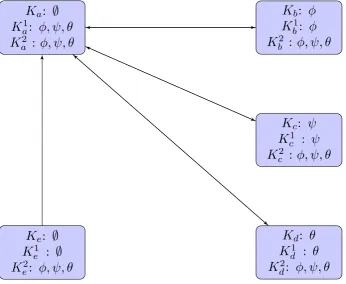
To illustrate how these new modalities can be applied, we consider a particular model. As in the previous example, each agent in this scenario has a computer. Some agents can secretly access the computers of other agents, illustrated by directed arrows.
In the scenario, the agents to the right – b, c,and d – are the only agents with information. However, as with the last example, this does not imply that these agents have more information available to them. Althoughapossesses no knowledge of her own,ahas more accessible information than any of the agents supplying the information in the first place. We have thatbva,cva,dva, andeva.
Interestingly, however, agentadoes increase the information that the agent
b, c,and din an extended sense. While “sharing” information withadoes not result in any information directly from a, it is still beneficial because agents
b, c,andeare able to gain information from each other afterahas acquired it. Agentaserves as a middleman for information between these three agents.
computer that contains no information, but accessing this computer allows e
to learn anything agent a learns in his role as a kind of “hub” for the other agents on the right. Hacking any of the agents on the right would not get e
secondary-access to all of the formulas in this way.
K
a:
∅
K
a1:
φ, ψ, θ
K
a2:
φ, ψ, θ
K
b:
φ
K
b1:
φ
K
b2:
φ, ψ, θ
K
c:
ψ
K
c1:
ψ
K
c2:
φ, ψ, θ
K
d:
θ
K
d1:
θ
K
d2:
φ, ψ, θ
K
e:
∅
K
e1:
∅
[image:37.595.116.463.186.470.2]K
e2:
φ, ψ, θ
4.3
Axiomatization of
IAL
(MP) `IALϕ,(ϕ→ψ)⇒ `IALψ
(N)`IALϕ⇒ `IAL Kaϕ
(Prop) All validities of propositional logic
(KN) Kan(ϕ→ψ)→(Kanϕ→Kanϕ)
(TN)Kn aϕ→ϕ
(4N)Kn
aϕ→KanKanϕ
(5N)¬Kn
aϕ→Kan¬Kanϕ
(E1N) aEa
(E2N) (aEb∧Kn
b)→Kan+1ϕ
(E3N) aEb→KaaEb
(E4N) V
b∈A
(aEnb→cEmb)→(Kanϕ→Kamϕ)
4.4
Completeness of
IAL
Proposition: IALis sound and complete for epistemic network frames.
Proof: Much of the completeness proof of IAL resembles the completeness proof of EAL. As before, we define pseudo-models which have extra relations to pseudo-satisfy potential knowledge formulas from LIAL directly, as if they were just additional agents in the model. However, this time our pseudo-models will have additional relations ∼n
a for every n and a (instead of just one
addi-tional relation per agent). We can then again build a canonical pseudo-model, taking states to be maximally consistent sets of formulas fromLIAL. The canon-ical valuation and canoncanon-ical relations formed from each Kan operator give us
a structure which can pseudo-satisfy any consistent formula of LIAL. We then prove there exists an epistemic network model satisfying the same formulas.
Definition We say that a formula ϕ is consistent if its negation ¬ϕ cannot be proven in IAL. Otherwise we say thatϕisinconsistent.
DefinitionA formulaϕissatisfiable if there is a network model and a states
such that (M, s)|=IALϕ. The formulaϕis then said to be satisfiable inM.
DefinitionA network pseudo-model for a set ofAof kagents is an epistemic network model of countably many agents, where n≥0:
M= (S,(∼n
for which∼n
a are equivalence relations for allaand alln.
DefinitionWhereM is a network pseudo-model, we say that (M, s) pseudo-satisfies a formulaϕif the pair (M, s) satisfiesϕin the normal way except that (M, s)|=Kn
aϕiff (M, s0)|=ϕfor all s0 such that (s, s0)∈∼na. A pseudo-model Mvalidates a formula ϕif (M, s)|=ϕfor every statesofM.
Definition A pseudo-model of IAL is a pseudo-model which validates all the axioms of IAL.
Proposition: Every model is a pseudo-model of IAL.
Proof: Compare with proof of validity of pseudo-models in EAL.
DefinitionA formulaϕis pseudo-satisfiable if there is a network pseudo-model
Mand a statesofMsuch that (M, s)|=ϕ. The formulaϕis then said to be pseudo-satisfiable in M.
In order to prove completeness for IALit suffices to prove the following propo-sitions:
(1) Ifϕis consistent, thenϕis pseudo-satisfiable. (2) Ifϕis pseudo-satisfiable, thenϕis satisfiable.
Proof of (1): If ϕis consistent, thenϕis pseudo-satisfiable.
We will use the canonical model construction to show that every consistent set of formulas is pseudo-satisfiable.
Definition: A set of formulas Φ is maximal consistent if Φ is consistent and any set of formulas properly containing Φ is inconsistent. If Φ is a maximal consistent set of formulas then we say it is anM CS.
Lindenbaum Lemma: For any consistent set Φ of formulas fromLIAL, there is an MCS Φ+such that Φ⊆Φ+.
Proof: Compare with proof from EAL
Definition: We define the canonical network pseudo-model for a set of agents
Ato beMc= (W ,c (∼ba)a∈A,(∼b{a})a∈A,E,b Vb), where:
c
W ={Φ|Φ is an MCS}
Φ∼bnaΦ0 iff for allψ, (Kanψ∈Φ)→(ψ∈Φ0)
b
E(Φ) ={(a, b)|aEb∈Φ}
b
Proposition: The canonical network pseudo-model is a pseudo-model of IAL.
Proof: Compare with proof from EAL
Existence Lemma: For any state Φ, if hKn
aiϕ ∈ Φ then there is a state
Φ0∈Wc such that Φ∼b
n aΦ0.
SupposehKn
aiϕ∈Φ. Then we can construct a state Φ0 such that Φ∼b
n aΦ0 and ϕ∈Φ. Let Φ0− be {ϕ} ∪ {ψ|Kn
aψ ∈Φ}. Then Φ0 is consistent. Assume for
contradiction that this is not the case. Then there would beψ1, ..., ψnsuch that
`IAL Kan(ψ1∧...∧ψn)→ ¬ϕ. And so we have`IALKan(ψ1∧...∧ψn)→Kan¬ϕ.
By propositional calculus we get `EAL Kan(ψ1∧...∧ψn) → Kan¬ϕ. So now, Kanψ1∧...∧ψn∈Φ. But this is impossible since Φ is an MCS containinghKaniϕ.
So Φ0−must be consistent. Let Φ0be any MCS extending Φ0−. By construction,
ϕ∈Φ0. For all formulasψ,Kanψ∈Φ impliesψ∈Φ0. So by definition Φ∼b
n aΦ0.
Truth Lemma: (Mc,Φ)|=ϕiffϕ∈Φ.
Proof: By induction on ϕ. The base case follows from the definition of V. The boolean cases follow from the properties of MCSs. Formulas for accessibil-ity (of the form aEb) follow immediately from the definition ofEb(Φ). The only
cases left to consider ar of the formKn aϕ.
So first assume (Mc,Φ)|=hKaniϕ. Then we have that there exists a Φ0 such
that Φ∼bnaΦ0 and (Mc,Φ)|=ϕ. But thenϕ∈Φ0 and sohKaniϕ∈Φ.
For the opposite direction, assumehKn
aiϕ∈Φ. Then by the same
equiva-lences as above, it suffices to find an MCS Φ0 such that Φ
b
∼naΦ0 and ϕ ∈ Φ0.
We have exactly this fact by the Existence lemma.
Corollary: IAL is sound and complete for the canonical pseudo-model.
Proof: Suppose Σ is a consistent set of formulas from LIAL. By Lindenbaum’s
Lemma there is an MCS Σ+ extending Σ. By the Truth Lemma we have that
(Mc,Σ+)|= Σ.
We now have to show that pseudo-satisfiability implies satisfaction in an epis-temic network model. For any given formulaϕ, we know there exists a pseudo-modelM= (W,(∼n
a)a∈A, E, V) satisfying it. We can use unravelling as in the previous proof of completeness, however we must specify the state space as:
−→
W is the set of all finite sequences hw, R1, w1, R2, ..., R2, wni such
thatwR1w1R2...Rnwn where eachRi ∈ {∼na |a∈ A}.
Then by unravelling we can assume without loss of generality that M is tree-like. We now define an epistemic network model M which satisfies the same formulas that Mpseudo-satisfies. Define that (s, t)∈∼a iff there exists a
finite chain of statesv1, ..., vk such that:
(i)v1=s
(ii)vk =t
(iii) vj∼nj
Then let M= (W,(∼a)a∈A, E, V). To finish the proof, it suffices to show the truth of three claims:
Claim I: Each ∼a is an equivalence relation.
Claim II: Each ∼a satisfies the condition thats∼a t and (a, b)∈E(s) implies (a, b)∈E(t).
Claim III: For each pseudo-model M there exists a network model M such that (M, s)≡(M, s).
Proof of Claim I and II: Follows by induction on j, since for each step we have the axiombEa→Kb(bEa). Then as in the last proof, we are taking the
intersection of several equivalence relations, giving us again an equivalence re-lation.
Proof of III: Need to show that for every pseudo-model M there exists a network model Msuch that:
(M, s)|=ϕ⇔(M , s)|=ϕ
By induction on structure ofϕ. If ϕ is a Boolean formula, this is trivial. Similarly ifϕis of the formaEb. Now consider ifϕis of the formKn
aψ.
(⇒) (Contrapositive) Assume (M, s) 6|= Kanψ. So there exists a state t such
that (s, t)∈∼n
a and (M, s)6|=ψ, and thus by inductive assumption (M, s)6|=ψ.
Note that for all b such that (a, b)∈En(s), we have by definition of∼n a that: ∼n
a⊆∼b. So then (s, t)∈T{∼b|(M, s)|=aEnb}. And thus (M, s)6|=Kanψ.
(⇐) Assume (M, s)|=Kn
aψ. To show that (M, s)|=Kanψ, we must show that
for every tsuch thats∼n
a t, (M, s)|=ψ. So we take such an arbitrary statet,
and by definition of ∼n
a we have thats∼b t for allb such that (a, b)∈En(s).
Then for each∼b inMsuch that (a, b)∈En(s), there exists a reduced path in M(based on our initial definition forM):
Pb =hs=v1b,∼
m1b c1b , v2b,∼
m2b
c2b , ..., vkb=ti withvjb ∼mjb
cjb v(j+1)b for somecjb such that (cjb, b)∈E
mjb(s).
However, by uniqueness of reduced paths, these paths from s to t must all be identical. So there exists a unique reduced path:
P =hs=v1,∼c1m1, v2, ...,∼m2c2 , ..., vk=ti
withvj∼mj
cj vj+1and (cj, b)∈E
mj(s) for allbsuch that (a, b)∈En(s). So this gives us that (M, vj)|= V
b∈A
(aEnb⇒cjEmjb) for eachj.
Thus by Axiom E4N we have:
(∗) (M, s)|=Kn aψ→K
mj
Subclaim: (M, vj)|=Kanψfor allj.
Proof: Induction onj. For j= 1, the statement is true by initial assumption since v1 = s and (M, s) |=Kanψ. For the induction step, suppose (M, vj)|= Kn
aψ. Then, by axiom 4: (M, vj)|=KanKanψ. By (∗) with axiom E4N we have:
(M, vj)|=Kanψ→KcnjKanψ
and taken withvj ∼ mj
cj vj+1 we have that:
(M, vj+1)|=Kanψ
This completes the proof of the subclaim.
Apply the subclaim to j = k to get (M, t) |= Kn
aψ. Then by axiom T we
have (M, t) |= ψ. By inductive assumption (M, t) |= ψ as well, which com-pletes the proof.
All-Read Update
Our basic update is the action whereupon every agent in the network incorpo-rates the information of her neighbors. We will refer to this update as “all-read” update, and denote the corresponding dynamic modality by [READ]. This can be imagined to be the passing of one round of inquiry, in which all agents first gather all the information they can find and then add it to their own databases. An idealizing assumption is that these actions occur strictly in this order, so that no agent is searching for information while another updates. We can imag-ine that agents can only search for information during the day, and update their own databases in the evenings.
Since we assume agents read all the information they have access to, the
READ update is deterministic. For a given epistemic network model, there is only one possible resulting model. We assume agents know this, and know when
READhas occurred. So then ignorance of agents in the resulting model always comes from ignorance in the original model, and we will have the same state space. Each possible world in the original model is mapped to a unique world in the resulting model.
Definition(READUpdate)
The update READ maps any model S = (S,(∼a)a∈A, V) to a new model
SREAD= (S0,(∼0
a)a∈A, V0) given by:
S0:=S
For alla∈ A:s∼0a tiffs∼atands∼bt for allb∈ Asuch that (a, b)∈E
The transition relation −→READ relates any state s ∈ S satisfying ϕ to the
same state in the modelSREAD.
This action naturally connects to the static modalitiesKn
a, since updating with
[READ] makes each formula ϕ potentially known in the sense of Kn
aϕ to be
known in the sense of Kn−1
a ϕ. We add the following reduction laws to the
ax-ioms forIALto arrive at a full axiomatization forDIAL:
Reduction Laws for [READ]
[READ]p⇐⇒p
[READ]¬ϕ⇐⇒ ¬[READ]ϕ
[READ](φ∧ψ)⇐⇒[READ]ϕ∧[READ]ψ
[READ]Kanϕ⇐⇒Kan+1[READ]ϕ
[READ]aEb⇐⇒aEb
4.5
A Classroom Example
As an example, we can consider the test day scenario mentioned in the intro-duction. Below we depict a group of students sitting for a test, along with what they know and have access to. We assume students can read the answers off of the person sitting in front or horizontal to them, but not behind. We assume all the relevant information in this scenario regards the test questions, so that agents write all they know on their answer sheet.
To ensure that information change occurs in a synchronized manner, we also assume a teacher is watching over these students. Each time the teacher turns away, the students all read their neighbors answers. They are then able to write down these answers on their own paper. This dynamic corresponds to the
READupdate introduced in the previous section, so we are able to model this interaction in the diagram below.
The first thing to note is that accessible information can change without a change in actual knowledge. Agent d has the same knowledge afterREAD
as before, but e has new information which is now available to d. Secondly, an agent’s knowledge can change without a change in accessible information. Agent b learns ψ from a, but there is no new information on the computers
b has access to. Knowledge and accessible information can both change after
READ, as with agente. Agent elearns ψfrom c, butc in the meantime also learns. Finally, knowledge and accessible information can remain completely unchanged, as with agent a. Agent a has no outward-directed edges, so she does not have access to anyone else’s information.
information. Among the (reduced) directed paths from one agent to another along edges of access, there will be some longest path of length n. Regardless of the information given originally, repetitions ofREADafterntimes will have no effect on the model.
Ka: ψ
K1
a: ψ
Kb: ϕ
K1
b :ϕ, ψ
Kc: ψ
K1
c :ϕ, ψ
Kd: ψ
K1
d: ψ
Ke: ∅
K1
e: ψ
[READ]
Ka: ψ
K1
a: ψ
Kb: ϕ, ψ
K1
b :ϕ, ψ
Kc: ϕ, ψ
K1
c :ϕ, ψ
Kd: ψ
K1
d :ϕ, ψ
Ke: ψ
K1
[image:44.595.113.468.181.462.2]e :ϕ, ψ
Chapter 5
Restricted Access Logic
In the next two chapters, we explore less developed logics for which completeness has not been proven.
In the previous chapters, we have assumed that access between agents implies
full access to the information of another or or none at all. We have this kind of access when we have a password to someone else’s computer, or when we can peek at their answer sheet, but it is not typically the case. Most often, we only have access to a small portion of someone else’s information. When relying on a friend or colleague, we cannot not ask for everything she knows or download everything contained on her computer. We typically only communicate about a limited set of issues which are especially useful to us. We can get closer to this picture by defining a more nuanced syntax and semantics which distinguishes access to knowledge on a formula-by-formula basis.
5.1
Introducing
RAL
On the syntax side, we can replace the access relation P with a function that returns the relevant issues for any given pair. This set of issues can be thought of as the queries that the first agent is to the second, so we refer to the new models as “interrogative.”
Definition(Syntax for Restricted Access Logic)
ϕ := p| ¬ϕ|ϕ ∨ ϕ|Ka0ϕ|Qabϕ
where a, b are agents in A. The new terms qab and a(b)−c are added for the sake of completeness. Each formula of the formqab will serve as the canon-ical witness for the existence of a formula ϕ such that Qabϕ. In other words,
wheneverQabϕwe have that Qabqab as well. Similarly, a−c will serve as the
canonical witness for the existence of a formulaϕsuch thatacan accessϕfrom some agent b while c cannot. These formulas will be explained in more detail further on.
As mentioned above, the models for formulas of LRAL will replace the
lack of access as access to the empty set, so that this function fully replaces the edge sets used in previous models.
Definition An interrogative network model based on a set of agents A is a quadruple:
(S,(∼a)a∈A, Q, V)
where as beforeS6=∅is a set of states, for eachi∈ A,∼iis a binary equivalence
relation on W, and V : Prop → P(W) is a valuation. The Q function, the new component, gives the accessible information from each For a given state,
Q:W →(A × A → P(LEN L)) returns the function assigning a set of issues to
each pair of agents for that state.
To capture the accessible information for agents in this more restricted framework, we also define supplementary relations for “what b knows in re-gards toϕ.” This will be denoted bys∼ϕb t, and will be defined by:
(s∼ϕb t)⇐⇒(s|=Kbϕ∧t|=Kbϕ)
∨(s|=Kb¬ϕ∧t|=Kb¬ϕ)
∨(s|=¬Kbϕ ∧ s|=¬Kb¬ϕ ∧ t|=¬Kbϕ ∧ t|=¬Kb¬ϕ)
Intuitively, this definition covers the three possible cases when a pair of states would be indistinguishable forb(restricted to a particular issue). Either
bknowsϕin both states, orbknows¬ϕin both states, orb is ignorant in both states. We can now use these relations, which represent an agent’s knowledge on a particular issue, to define a relation for accessible information. Intuitively, we combinea’s information with the knowledge that other agents have aboutϕ
determined byQ. Let∼0a be formally defined as:
(w, v)∈∼0
a iff (w, v)∈∼a ∩ {T∼ ϕ
b |ϕ∈Qw(a, b)}.
Using these new relations, we define the semantics ofLRAL as:
Definition(Semantics ofLRAL):
M, w |=piffw∈V(p)
M, w |=¬ϕiffM, w 2ϕ
M, w |=ϕ∨ψiffM, w |=ϕor M, w |=ψ
M, w |=Qabϕiffϕ∈Qw(a, b)
M, w |=Ka0ϕiff for all v such that w ∼0
a v we have thatM, w |=ϕ
5.2
Axioms for RAL
It is possible to capture most of the axioms of EALwithin the syntax of RAL, giving us a set of familiar axioms.
(Q1) (Qabϕ∧Kbϕ)→(Ka0Kbϕ)
(Q2) (Qabϕ∧Kb¬ϕ)→(Ka0Kb¬ϕ)
(Q3) (Qabϕ∧ ¬Kbϕ∧ ¬Kb¬ϕ)→Ka0(¬Kbϕ∧ ¬Kb¬ϕ)
Axioms (Q1)-(Q3) serve to connect an agenta’s knowledge to that of a connec-tionb, in each of the three knowledge conditions forb. These three axioms take over the role of (E2) inEAL
(Q4)Qabϕ→KaQabϕ
Axiom (Q4) ensures that all agents know what formulas ϕ they are able to ask of every other agent. This is comparable to axiom (E3) from(EAL), which ensured that agents knew their outgoing edges.
(K)Ka(ϕ→ψ)→(Kaϕ→Kaϕ)
(T) Kaϕ→ϕ
(4)Kaϕ→ϕ
(5)¬Kaϕ→Ka¬Kaϕ
These axioms are standard knowledge axioms for Ka. They ensuring thatKa
distributes over conditionals, that Kaϕimplies the truth ofϕand that agents have positive introspection and negative introspection of Ka.
(K’) Ka0(ϕ→ψ)→(Ka0ϕ→Ka0ϕ)
(T’)Ka0ϕ→ϕ
(4’)Ka0ϕ→ϕ
(5’)¬Ka0ϕ→Ka0¬Ka0ϕ
These axioms are standard knowledge axioms for Ka0. They ensuring thatKa0
distributes over conditionals, thatKaϕ0 implies the truth ofϕand that agents
have positive introspection and negative introspection of Ka0. (P1)Kaϕ→Ka0ϕ
For Future Work: A Complete Axiomatization of RAL
expressing “a has no access to b” in this syntax without involving existential quantifiers. However, Skolemization offers a method for expressing just what we need. We can add to our interrogative models the functionsqab anda−c, and specify these functions to return the witnesses we need for eliminating ex-istential quantifiers. The function qab will return, for a given state, a formula such thatQab(ϕ) if such a formula exists. The function a−cwill return, for a given state, a formulaϕsuch thatahas access to andcdoes not. Then we can mimic the rest of theEALaxioms by writing:
(S1) Qabϕ→Qab(qab)
(S2) (avc)→(Qabϕ→Qcbϕ)
(S3) (a6vc)→ ¬ W
b∈A
(Qab(a−c)∧ ¬Qcb(a−c))
(Q5) V
b∈A
(¬Qabqab)→(Ka0ϕ→Kaϕ)
However, having a replica of every axiom of the complete logic EAL, does not make this proof system complete. So the whether there is a complete set ofRAL
![Figure 4.2: Diagram of a the classroom model M[ before and after update withREAD]. Students are represented by blocks, each labelled with the correspond-ing information the student knows and has access to.](https://thumb-us.123doks.com/thumbv2/123dok_us/8384531.321488/44.595.113.468.181.462/diagram-classroom-withread-students-represented-labelled-correspond-information.webp)
