Idiosyncratic Concepts in the Music of
Henry Threadgill's Zooid
An Applied Investigation into Compositional and
Improvisational Techniques
Gareth Keany Hill
BMus (Hons), MPhil (Music) Australian National University
Submitted in partial fulfilment of the degree of Doctor of Philosophy.
DECLARATION
This exegesis contains the results of research carried out at the University of
Tasmania, Conservatorium of Music between 2014 and 2017. It contains no material that, to my knowledge, has been accepted for a degree or diploma by the University or any other institution, except by way of background information that is duly
acknowledged in the exegesis. I declare that this exegesis is my own work and contains no material previously published or written by another person except where clear acknowledgement or reference has been made in the text. This exegesis may be made available for loan and limited copying in accordance with the Copyright Act 1968.
The research associated with this exegesis abides by the international and Australian codes of human and animal experimentation, the guidelines by the Australian
Government’s Office of the Gene Technology Regulator and the rulings of the Safety, Ethics and Institutional Biosafety Committees of the University. Ethics committee approval has been obtained for this research: H0015038
Acknowledgements
I would like to take this opportunity to thank the many people that have helped with this project.
For their patience and unwavering support, I thank my supervisors Dr Glen Hodges and Dr Nick Haywood. This study has benefitted enormously from their guidance and understanding.
I also thank the musicians who kindly agreed to participate in interviews, providing invaluable information for this research. Brandon Ross, Jose Davila, Christopher Hoffman and Liberty Ellman all gave thoughtful and illuminating accounts of their experiences performing with Threadgill. Additionally, Ellman was responsible for the excellent mastering of the Slow Code album included here.
The musicians of Slow Code, Jack Beeche, Dan Mamrot and Aaron McCoullough, all gave considerable time and effort to this project. I am forever grateful for their
creativity, musicianship and friendship. Additionally, I thank Niko Schäuble for the use of his studio, Pughouse Studios, and his meticulous work engineering and mixing the Slow Code album.
Table of Contents
List of Figures ... vi
Abstract ... viii
Introduction ... 1
Henry Threadgill Biography ... 6
Chapter 1 – Literature Survey ... 15
General Music Analysis ... 18
Jazz Improvisation ... 24
Musical Practice Research ... 31
Henry Threadgill ... 34
Biography ... 34
Interviews/Articles ... 36
Musical Discourse ... 37
Scores ... 40
Music Analysis ... 41
Chapter 2 – Methodology ... 44
Selection of Recorded Works ... 45
Transcription ... 45
Interviews ... 47
Analysis ... 48
Creative Application ... 53
Chapter 3 – Analysis ... 59
Form Modification ... 64
Harmony ... 76
Counterpoint ... 105
Chapter 4 – Creative Works ... 128
Mixed Business ... 131
Tribulation ... 138
How Did You Get This Number ... 142
Who Wore It Better ... 146
2,2,3,4,-6 ... 150
Boreanaz ... 154
Termeil ... 158
Windows 95 ... 161
Conclusion ... 167
Appendix 1 – Transcriptions ... 171
Appendix 1.1: After Some Time transcriptions ... 172
Appendix 1.2: Polymorph transcriptions ... 204
Appedix 1.3: To Undertake My Corners Open transcriptions ... 247
Appendix 2 – List of Recordings ... 291
Discography ... 294
List of Figures
Figure 1 - Diacritical markings ... 47
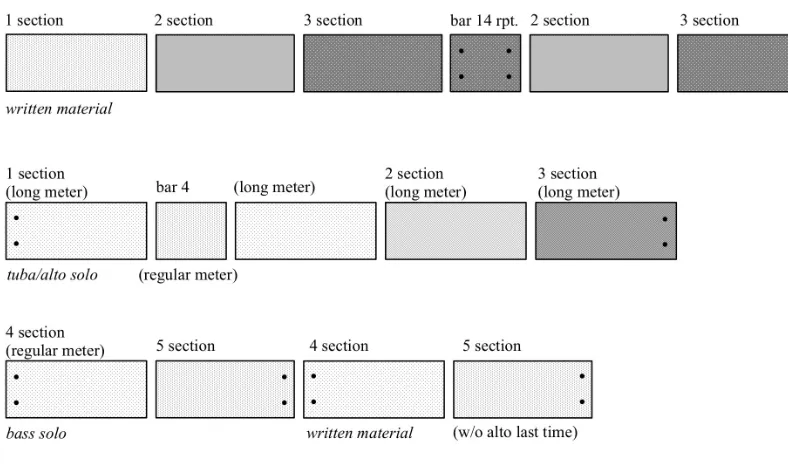
Figure 2 - After Some Time form ... 71
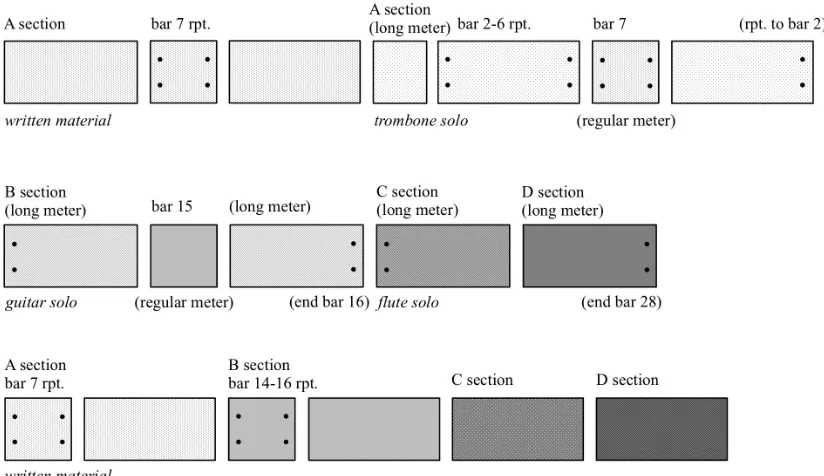
Figure 3 - Polymorph form ... 72
Figure 4 - To Undertake My Corners Open form ... 73
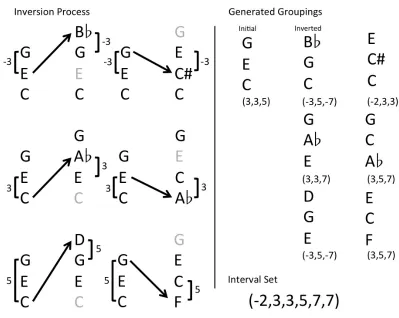
Figure 5 - Representation of Brandon Ross's explanation of Threadgill's interval generation process ... 79
Figure 6 - Author's depiction of Hoffman's cello part to After Some Time, bar 1-2 .... 82
Figure 7 - Harmony notation ... 82
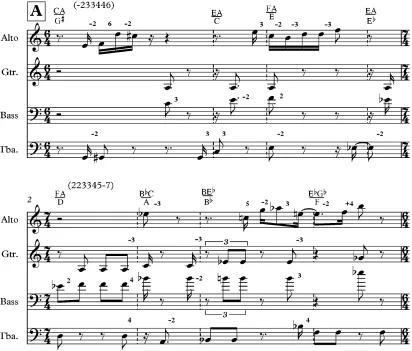
Figure 8 - After Some Time, bar 1: harmony and interval set/master cell comparison 86 Figure 9 - Polymorph bar 1-2: harmony and interval set/master cell comparison ... 87
Figure 10 - To Undertake My Corners Open bar 7-8: harmony and interval set/master cell comparison ... 88
Figure 11 - See The Blackbird Now bar 1: harmony and master cell comparison ... 90
Figure 12 - See The Blackbird Now bar 2: harmony and master cell comparison ... 91
Figure 13 - After Some Time bar 1-2: intervallic analysis ... 92
Figure 14 - After Some Time bar 1-2: accompany part and harmony relationship ... 93
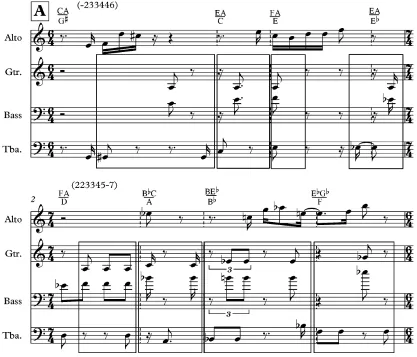
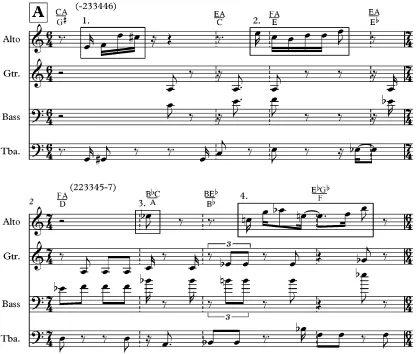
Figure 15 - After Some Time: A section unconnected motifs 1 - 4 ... 97
Figure 16 - After Some Time: alto saxophone, bar 8 related motifs 1 - 3 ... 98
Figure 17 - After Some Time: alto saxophone, bar 8 - 16 related motifs 1 - 10 ... 99
Figure 18 - Polymorph: 1 section bar 1-3, restricted intervallic movement ... 100
Figure 19 - Polymorph: alto saxophone melody, repeated interval use ... 102
Figure 20 - To Undertake My Corners Open, bar 1 - 6: trombone melody, unrelated motifs 1 - 4 ... 105
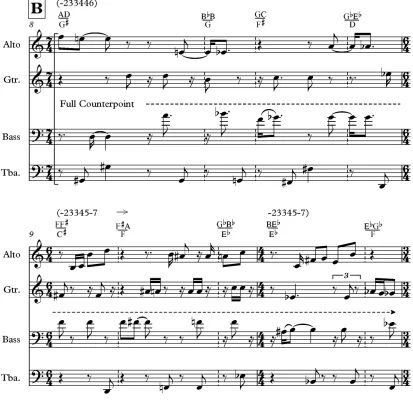
Figure 22 - After Some Time, bar 8 - 10: full counterpoint ... 108
Figure 23 - Polymorph, bar 1: counterpoint entries ... 109
Figure 24 - Polymorph, bar 2 - 3: guitar, bass guitar and tuba rhythmic relationship ... 110
Figure 25 - Polymorph: section 4 repeats, bass and tuba ... 112
Figure 26 - Polymorph written material, bar 15 - 16: bass guitar and tuba unison ... 113
Figure 27 - To Undertake My Corners Open, bar 1 - 9: melodic focus ... 114
Figure 28 - To Undertake My Corners Open, bar 14 - 20: melodic focus ... 116
Figure 29 - To Undertake My Corners Open, bar 27 - 30: melodic focus ... 117
Figure 30 - After Some Time, bar 10: alto solo, improvised counterpoint ... 119
Figure 31 - After Some Time, bar 24: guitar solo, improvised counterpoint ... 121
Figure 32 - Polymorph, bar 24 - 25: tuba solo, improvised counterpoint ... 122
Figure 33 - Polymorph, bass guitar solo bar 138-139; written material bar 21-22: guitar and tuba comparison ... 123
Figure 34 - To Undertake My Corners Open, bar 93 - 94: flute solo, improvised counterpoint ... 124
Abstract
The purpose of this research is to investigate the music of Henry Threadgill’s Zooid, focusing on compositional and improvisational techniques, and how these function in an ensemble setting. Discoveries from this research will be used to advance the author’s creative practice; a folio of original compositions and performance recordings exploring Threadgill’s ideas will be included in this project.
Henry Threadgill has stated in recent interviews that he has developed an interval-based harmonic system and a modular approach to form in his current ensemble, Zooid. These innovations result in a dynamic and original sound, absent of traditional harmonic movement and obvious structure. The processes behind this music have not been extensively explored; little research has been performed on this original musical system, while Threadgill’s interviews have provided little clarification of his
approach. This research seeks to illuminate this highly acclaimed composer’s ground-breaking music. Amongst other awards, Threadgill’s recent Zooid album In For A Penny In For A Pound received the 2016 Pulitzer Prize for composition.
Introduction
Henry Threadgill’s Zooid takes the stage. Drummer Elliot Kavee, then Threadgill
carrying multiple flutes and alto saxophone, are quickly followed by guitarist Liberty
Ellman, Jose Davila on tuba and Christopher Hoffman on cello. Once settled,
Threadgill turns and, facing away from the audience, quietly counts off the first song.
The music arrives all at once, tuba, cello and guitar working around each other, the
drums providing a driving and pulsating counterpoint. It is not clear where we are, is
this a solo? A melody? After some time remnants of structure appear: a low cello note
is followed by a common rhythmic gesture. Then the flute enters. This is Zooid.
(Author’s reflection on Zooid in performance)
Henry Threadgill has been described as “one of the most intriguing composers of our time” (Adler 2011, 24), “one of the great original, iconoclastic voices in American music” (Fischlin 2011), and “one of the most thrillingly elusive composers in and around the jazz idiom” (Chinen 2009). After a career spanning more than forty years and numerous ensembles, Threadgill has formed the ensemble Zooid. Threadgill’s music composed for this ensemble is at once confronting and beguiling. Little of this music is immediately apparent; Zooid’s approach to melody, solos and overall form are so unusual that on first listening these elements are not evident. Howard Mandel describes it as “richly textured group interplay, organized pieces rife with virtuosity and passion—but few familiar touchstones such as obvious melody, chord
there is a sense of intensity and coherence within the group; the musicians pivot quickly to new material and are capable of creating sudden and unexpected endings. The ensemble name could reference the close rapport between the musicians of the group, with the Oxford Dictionary listing “Zooid” as a biological term defined as “individuals which make up a colonial organism and typically have different forms and functions.” The mysterious nature of Zooid’s music has prompted this research project.
Zooid currently consists of Threadgill on flute, bass flute and alto saxophone, guitarist Liberty Ellman, cellist Christopher Hoffman, Jose Davila on trombone and tuba, and drummer Elliot Kavee. However, the recordings discussed in this study feature a previous iteration of the ensemble, with bass guitarist Stomu Takeishi replacing Hoffman.
advance the author’s creative practice into new areas.
This project aims to determine what compositional process and techniques can be identified in Threadgill’s music for Zooid and how can these be applied to the author’s creative practice.
A process of transcription and analysis will be used to identify musical concepts in use in Zooid. These will be further explored in the creation of new compositions and a series of live and studio performances. Performances will be undertaken with Slow Code, an ensemble formed in 2013 with the purpose of developing new improvised music. This ensemble will be the vehicle to develop and explore concepts and techniques discovered in research with the aim of creating a body of work informed by the practice of Zooid. Slow Code consists of Melbourne-based musicians Jack Beeche, Dan Mamrot, Aaron McCoullough and the author, Gareth Hill.1
A selection of recordings from Zooid’s commercial output will be analysed, determining the inner workings of the ensemble and revealing idiomatic compositional and improvisational concepts that can be used to inform the
researcher’s musical practice. Aspects including harmonic concepts, melodic devices, arranging, instrumentation, as well as contexts for improvisation will provide impetus for the generation of original compositions. While a potent and vital element of this music, the role of the drums as well as the overall rhythmic approach of the ensemble has not been included in this project. Rhythmic concepts present in this music are worthy of further research but were deemed to be beyond the scope of this study. This
project represents an original and significant contribution to knowledge as the first performance-based study of Henry Threadgill’s music for Zooid, a composer currently with severely limited analytical research in the literature.2
As this project is performance-based, its primary objective is to inform and develop the author’s musical practice through research. While this will be actively pursued through methods discussed later, this process cannot be entirely formalised; prolonged exposure to any specific music will undoubtedly affect one’s practice, if only
subconsciously. While the assimilation sought in this research is by choice, Threadgill describes his own period of prolonged exposure, in this case to country music.
I discovered something when I was really young. I had to give myself a whuppin.' I didn't like country and western music, but I found myself in the army stationed in Kansas where there was nothin' but country music … Every station on the radio, day and night, every bar, every jukebox … I can dislike something, but I've got to give it a chance. I can't close the door completely. Otherwise I shut out something that may be valuable for my own music … Because I had been limiting myself, look what I was missing. I had to kill my limitations. (Ouellette 1998)
As previously stated, the author did not immediately understand or fully appreciate the music that Zooid performs. Put bluntly, this music was difficult listening. At the same time, there was a strong attraction; the ensemble had an intense rhythmic drive and the music’s mysterious nature was uniquely fascinating. After multiple listenings, small and tantalising aspects of organisation were revealed in the form of repeated figures or intriguing melodies. While there will be a formal evaluation of the
influence this music has had on the author’s creative practice, the informal understanding through familiarity should also be acknowledged.
In parallel to informal influences, formal impacts to the researcher’s creative practice will be evaluated through the creation and performance of a portfolio of new
compositions informed by the idiomatic concepts identified in research. The
performance and rehearsal of these works will be essential, allowing the assimilation of concepts into performance practice and the opportunity for alternative insights.
The experience the author has had learning to listen to this music may be one of the reasons Threadgill has not enjoyed wider notoriety. Despite his significant and varied body of work, Threadgill has not received the same kind of mainstream recognition that some of his contemporaries enjoy. Iverson suggests this may have been because of his constant pursuit of musical innovation,
Threadgill could have won more hearts in the general jazz populace if he had continuously performed his most charismatic tunes. Of course, this is the last thing that Threadgill wanted to do. ‘I figured out a long time ago that going back for me is always a mistake.’ (Iverson 2011a)
Henry Threadgill Biography
Henry Threadgill was born on 15 February 1944 in Bronzeville, a suburb of Chicago (Lewis 2009). From a young age, he was exposed to the variety of music the city attracted at the time. Early musical experiences came from the radio; Chicago radio broadcasts were wide-ranging, including blues, jazz, classical and country, as well as music catering to the large Polish and Serbian communities living there (Appelbaum 2013). His father ran gambling houses, which Threadgill would visit as a child. To occupy his time, a young Threadgill was given money for the jukebox, “It would be all jazz on the jukebox, because my father loved jazz” (Lewis 2009, 73). This musical exposure continued when Threadgill spent weekends at his father’s house where they would “just play records. Duke, Gene Ammons, Count Basie, Modern Jazz Quartet” (Lewis 2009, 73). His parents had divorced when he was three years old and
Threadgill spent most of his time living with his mother and extended family. The family would visit the Maxwell Street Markets on weekends, where he had the opportunity to hear the many blues musicians that played in the open air markets, including Muddy Waters and Howlin’ Wolf (Lewis 2009, Mazor 2008).
I used to live at McKie’s. I saw everybody. All you would do is take your horn. They would say, just sit over there, young blood, and don’t even think about no drink … just sit over there and get you a Coca-Cola or something. (Lewis 2009, 73)
While Threadgill participated in jam sessions on 63rd street, he was also working in blues, polka and mariachi bands, as well as performing for sanctified church services. Liberty Ellman states that the musical climate of Chicago influenced Threadgill’s creative approach, in particular his rhythmic sensibility.
And so with Henry … he was in marching bands, he came up in Chicago where there was a lot of blues. Chicago was like the main spot where a lot of bands would come. You know, not just New York but then they would go there. So he got to see everybody, John Coltrane and Miles and all the people. A lot of church music. So it was all those things, you know. And so his super funky thing comes from the marching band experience and parade music … and that I think informs his rhythm so much. (interview 11 July 2015)
After high school, Threadgill attended Woodrow Wilson Junior College, whose students at the time included Joseph Jarman, Roscoe Mitchell and Anthony Braxton, musicians that would go on to be important parts of the Chicago music scene and receive international success (Lewis 2009). Richard Wang, who lectured in music at the college, introduced Threadgill and his other students to contemporary 20th century classical composers, such as Paul Hindemith and Arnold Schoenberg, and encouraged them to explore the musical possibilities of both classical composition and the
and played at our school, we had a music club at college … and we invited him with a group to come in” (Appelbaum 2013). Threadgill’s fellow students, Jarman and Mitchell were involved in Abrams’ Experimental Band, an ensemble focussed on exploring new compositional ideas, and invited Threadgill to participate in rehearsals. However, in 1965 Threadgill quit both the Experimental Band and his studies at Wilson to focus on playing primarily for church services. It was at one of these services Threadgill describes being encouraged to take up the alto saxophone.
There was this church that I was playing at. Morris was the minister … I think he asked me to play His Eye Is On The Sparrow, something like that … So I played it and it just fell flat. There was like, the people were like “mmm.” It was very polite, the response, and the minister told me “Henry, you know, under the pulpit I’ve had this saxophone and I don’t know what it is, but I don’t think it’s as big as the one you’ve got … why don’t you get it fixed up, and I’ll pay for it.” So I took it and got it overhauled … I came back with it and he asked me, “You know, I want you to play that piece again.” When I went up and played it … there was a big difference in the response that was going on in the church. So, I remember I had this realisation right then: that the tenor is a blues horn, and … the alto is a church horn. (Appelbaum 2013)
enlist was primarily to avoid seeing combat; unfortunately this would not be the case.
After a period of working for the army band, Threadgill was asked to produce an arrangement of patriotic American songs.
The conductor of the orchestra…they were going away and they had given me a commission to write a medley of these American [songs], Oh Beautiful … Rock Of Ages … and, I wrote it and it was very, I guess it must have come across like Stravinsky or something. (Appelbaum 2013)
The medley was performed at an inauguration in Kansas City, attended by the
cardinal, the governor, the mayor and the head of the fifth army. At some point during the performance, the cardinal vocally objected to the performance.
“Blasphemy!” That’s what he said ... [then] the governor looked at the mayor, and the mayor looked back at him, and then he looked over … at the generals … and looked down at the conductor because the cardinal, he had made it clear that he was like, this is blasphemy, what’s going on right here … Then they pointed to me, I was on the sidelines, I wasn’t even in the orchestra playing … [the] first sergeant said “Threadgill did it.” (Appelbaum 2013)
space to workshop new music composed by its members, held concerts for member ensembles and set up a music education program. It was also responsible for
Threadgill’s early discharge; Abrams sent documents explaining that Threadgill had a teaching position with the AACM, allowing Threadgill to move back to Chicago and begin teaching and performing with the association (Lewis 2009).
The atmosphere around the AACM was fertile for the creation of challenging and progressive music. The association was governed according to the will of its members and creative autonomy was valued above all. George Lewis explains,
The AACM provides a successful example of collective working-class self-help and self-determination; encouragement of difference in viewpoint, aesthetics, ideology, spirituality, and methodologies; and the promulgation of new cooperative, rather than competitive, relationships between artists. (Lewis 2009, x-xi)
For Threadgill, the AACM appears to have opened up the possibilities of incorporating multiple musical influences.
The players [of the AACM] were all composers, and they were all looking for and developing their writing skills and compositional language. So you would find out what other people were constantly doing, which enhanced what you were doing … Somebody could tell you about listening to this person play music from some other country, or avail you of information to go hear concerts by the Chicago Symphony or the Chicago Chamber Players or anything of that nature … In that circle there was a broad resource of
It was while back in Chicago performing with Abrams and others from the AACM, Threadgill began to gain a profile as a musician, initially with a collectively led trio called Air. The trio, founded in the early 1970s with bassist Fred Hopkins and drummer Steve McCall, was initially formed to provide music for a theatre
production, specifically using Scott Joplin rags (Baumgartner , Shteamer 2010a). The challenges involved in transferring Joplin’s densely harmonic piano music to a trio of saxophone, bass and drums, proved to be a fruitful opportunity with Air going on to record an album, Air Lore, of similarly adapted material. Hopkins reflects on the inception of the trio.
Henry got commissioned to write the music and perform for this play, The Hotel: 99 Rooms, with Don Saunders, the director. In fact, not that long ago we performed one of his pieces at the Public Theatre. So we got together and we performed this music. And what happened was this special thing … After we performed for about … God, I forgot how long we worked at that time - but several months. And after the play was over, we said, “Wow, we can’t just drop this now,” because we had gotten so close musically - and as friends also. So we decided to get together and form a band. (Panken 2011)
The limited instrumentation of Air would cause Threadgill to develop different ways for the ensemble to function, including the drums. “I studied what Ahmad Jamal was doing with drums … how the drums were tuned, how the drums wouldn't just keep time, they would play melody” (Sandow). Additionally, the trio found new ways to incorporate composition and improvisation, and also bring an orchestral approach to the group, highlighting the elements of wind, strings and percussion (Davis 1990).
New York in 1975, would expand this idea (AACM New York Chapter 2016). The Sextett incorporated winds, Olu Dara (later Rasul Siddik, then Ted Daniel) on trumpet, Craig Harris (later Ray Anderson, then Frank Lacy, then Bill Lowe) on trombone and Threadgill on saxophones, clarinet and bass flute; strings, Deirdre Murray on cello (originally Brian Smith on piccolo bass) and Fred Hopkins on bass; and percussion, John Betsch (later Reggie Nicholson) and Pheeroan akLaff (later Newman Baker). The spelling of Sextett with two t’s was in reference to the sections of the ensemble, as he saw the percussionists as playing one part. Threadgill explains,
I was really trying to straighten people our because they kept making this thing about “sextet” and “septet,” so I thought, “Let me make a distinction.” So when you see Sextett, [mock-serious] “He means a kind of special sextet, because he’s not using traditional spelling.” (Shteamer 2010a)
The Sextett received wide critical acclaim during the late 1980s, with Threadgill winning the award for best composer in the Down Beat polls of 1988, 89 and 90 (AACM New York Chapter 2016). The varied instrumentation of the group allowed Threadgill to create rich sonic landscapes, evoking sombre moods with striking harmonies as well as energetic dance feels.
One thing I’ve been working toward is a larger orchestral sound that gets away from the traditional big-band sound. I had a very large palette in the Sextett. Just with the drums alone, I had twelve pitches; two floor toms, upper toms, snare drum, floor bass drum and concert bass drum. I had two percussionists, that’s six tones apiece. (Mandel 1999, 71)
Curtis Fowlkes on trombone (later Mark Taylor on french horn), Brandon Ross and Masujaa on guitars, Edwin Rodriguez and Marcus Rojas on tubas, and Gene Lake on drums, the oddly constructed group would combine influences of “avant-garde jazz, funk, salsa, and East European marches” (Baumgartner), while continuing his explorations into double instrumentation, this time with guitar and tuba.
With "Very, Very Circus" I'm looking for a whole different type of texture, something similar to what Miles Davis was doing when he "went electric" and recorded "Bitches Brew", or what Ornette did when he formed the group "Prime Time". But I've also combined the tuba, one of the earliest instruments in jazz and the forerunner of the bass, with the electric guitar, a comparatively recent instrument. So in "Very, Very Circus" I've got a new ensemble that can look both forward and backward and pay its respects to various traditions while building upon them. This is what I hope my music has always done and will always continue to do. (AACM New York Chapter 2016)
In addition to these groups, he has led numerous other unusually populated ensembles such as X-75 featuring four woodwinds, four double basses and one vocalist; the Situation Society Dance Band, a 19-piece ensemble including vocals, a string section, saxophones, brass and rhythm section; and Make A Move, featuring accordion, harmonium, vibraphone and marimba at times (Baumgartner , Pareles 1986).
Chapter 1 – Literature Survey
As with other lesser-known artists, it is unsurprising that the literature around
Threadgill’s music is limited. While there certainly is material concerning his life and career, little formal investigation has been carried out regarding Threadgill’s concepts and approach to music. Threadgill discusses his musical concepts and approach in multiple interviews but no attempts are made to explore any underlying processes. While these interviews are revealing and provide insight into Threadgill as an artist and person as well as invaluable self-descriptions of his musical process, analysis that could illuminate his music does not occur. The primary aim of this research project is to further the author’s musical practice through investigation of Threadgill’s music. The consequent secondary outcome is to address the lack of formal analysis and provide some insight into the workings of an innovative musician.
Prior to Zooid, Threadgill has created a substantial body of work consisting of highly original music. From the leaderless trio of Air featuring free improvisation and rearrangements of Scott Joplin rags, to the New Orleans inspired polyphony of the Situation Society Dance Band and the quasi-fusion sound of Make A Move, he has consistently drawn influence from multiple musical traditions, employed challenging instrumentation defying traditional jazz band configuration and effectively melded the competing elements of composition and improvisation. This can be seen in this
description of another ensemble, the Henry Threadgill Sextett.
to cloak his melodies in a trancelike, euphoric, mysterious layer of sound. Threadgill is an expert in the imperceptible blending of composition and improvisation. This allows him to seamlessly unite the legacy of free jazz with New Orleans dirges and funeral marches, with Ellington and Mingus … His oblique, well-conceived juxtapositions of different musical styles are not nostalgic meditations on jazz history, but rather raw attacks on clichés—a powerful, sophisticated, forward-thinking celebration of the past. (Berendt and Huesmann 2009)
This highly complementary tone is often repeated in the literature concerning Threadgill; he is regularly referred to as an advanced and talented performer, composer and ensemble leader, a sentiment frequently echoed by musicians the author discussed this project with. Given this level of respect in the jazz community it is incongruous Threadgill remains an understudied figure in academic literature. While the scope of this research project is confined to the recent music of Zooid to allow thorough investigation, it is hoped that this study may generate further
investigation of Threadgill’s previous work. An examination of the progression of his musical output seems fertile ground for further research.
The first three sections of this literature review detail material related to the broader aspects of this project. The first section, General Music Analysis, discusses sources outside of the jazz tradition. The second section concerns Jazz Improvisation, including jazz analysis and the processes of jazz performance. The third section is titled Musical Practice Research, including studies that have sought to assess compositional and performance practices through formal investigation.
General Music Analysis
While Threadgill’s work could be considered part of the jazz tradition (and his work has been categorised as such), it appears he is uneasy with the term “jazz.” Threadgill explains, “I never did consider my music jazz…jazz is part of my vocabulary, but I don’t do jazz specifically” (Birnbaum 1995, 17). Currently, Threadgill does not describe his music as “jazz,” preferring instead to use the term “creative improvised music” (Shteamer 2010b). For him, the term has been subverted; diffuse from the intent of the creatively forward music he produces.
There's confusion about what jazz means now … There's a basketball team named Jazz, perfume named jazz, festival named jazz—there's not one person on there that's improvising … and then people make films, documentaries, Ken Burns for one. He and the people that were his consultants, they give a picture of what they say jazz is and then exclude generations of people, whole schools and generations of people are excluded from it … So that's why I say that word has really lost its meaning. (Shteamer 2010b)
In addition to this, Threadgill has actively sought out music from a wide range of genres. Growing up in Chicago, “I was listening to as much Serbian music and country and western music and classical music as I was listening to jazz and blues” (Chinen 2009). In particular, Threadgill appears to have been strongly influenced by classical music. In Lewis’s A Power Stronger than Itself, Threadgill mentions meeting with two of the foremost atonal classical composers as a young man.
why I liked it. I positioned myself and grabbed his hand and told him how many pieces of his that I liked. He just looked at me for a long time, very earnestly. You gotta remember that I knew that he was the one that taught William Grant Still, so I knew that he was okay. (Lewis 2009, 75)
Moreover, Threadgill was exposed to classical composition techniques through the AACM (Lewis 2009) and at various classical music institutions.
I went to all the music schools—universities, colleges, conservatories—all around this country … I was constantly studying at these places, taking every course in music they had to offer. That was my approach; I was never
interested in a degree, I was interested in the catalogue. (Mandel 1999, 68)
Well, the language … is such that we move from one series of intervals to another series of intervals throughout a piece of music … They control the voice leading and everything: The harmony, the voice leading, the melodic line, everything is moving not necessarily with every one of those intervals being used, but that pool of intervals, and improvisation is coming from there also. (Shteamer 2010b)
Determining any direct influences in a compositional approach is difficult, but Persichetti and Forte’s concepts may be useful in the analysis of Threadgill’s music. The implications of these concepts will be discussed further in Chapter 2.
As previously mentioned, Threadgill has expressed a connection to the music of Edgard Varese. While this project does not seek to provide analysis of the musical and extra-musical influences included in Threadgill’s works, it is worth mentioning the parallels between Varese and Threadgill. An article published by Varese and his pupil Chou Wen-chung (1966) details Varese’s vision for electronic instruments and the musical possibilities they could allow. He also addresses criticisms of his
experimental electronic music as being antithetical to musical tradition.
My fight for the liberation of sound and for my right to make music with any sound and all sounds has sometimes been construed as a desire to disparage and even to discard the great music of the past … No matter how original, how different a composer may seem, he has only grafted a little bit of himself on the old plant … It does not matter if at first it seems to some people more like a cactus than a rose. (Varese and Wen-chung 1966, 14-15)
discussing his musical system, he suggests his methods build on rather than destroy previous concepts.
There is a system and there is no system, it’s a natural language … The regular language is still there. I haven’t done anything to get rid of anything-I don’t believe in that. Anything that’s been very, very good you don’t get rid of it. You’d have to be crazy to get rid of what works. You’re supposed to find a way to condense it, re-evaluate it, give it a new look and keep its essence so you can come in with new information. (Mandel 2010, 48)
Similarly, musical form is of great concern for both Varese and Threadgill. They share a similarly organic approach to form. Varese states that any work should dictate its own form, “Form is a result-the result of a process. Each of my works discovers its own form. I could never have fitted them into any of the historical containers”
(Varese and Wen-chung 1966, 16). While Threadgill appears to treat form as a shifting variable, using the process of rearrangement in rehearsal to search for new configurations.
I come to rehearsal with much material that is written out, but that's only a starting point. Everything is written out, but it also doesn’t mean a thing. The music is totally modular because what is here can be here or what is here can be there because this is what we discover in discovery. (Iverson 2011b)
More so, Threadgill directly credits Varese for inspiring his current concept with Zooid.
about those steps, I never saw what I’m doing in his music, but everything I’m doing comes from that one thing he was doing, which was all he wanted to do with it. I went, I’ll be damned, I’ve been sitting here five years and it’s right in my face. I’ve been going one-two, when there’s one-two-three-four. (Mandel 2010, 48)
The connection between Threadgill and Varese is compelling: a fascinating insight into the influence between two great musicians. Similarly, Threadgill has mentioned numerous other classical composers in reference to his work such as Elliot Carter, Stravinsky and Bartok (Mandel 2010, Shteamer 2010b). While beyond the scope of this project, it is strongly suggested that Threadgill’s relationship to classical composition is worthy of additional investigation.
documents a British tour of a Braxton-led ensemble. Given the idiosyncrasy of Braxton’s sound world, the research presented by Radano and Heffley both seek to understand his music on its own terms, drawing extensively from Braxton’s literary output and employing diagrammatic analysis in a style similar to Braxton’s graphic notation system. In particular, Heffley has attempted to incorporate a Braxton-inspired structure to his work by devising diagrams that detail the internal logic and relationships between his various chapters.
Visuals--diagrams, drawings, schemata--and numbers (and alphanumeric and geometric visuals of numbers and their relationships) figure large in both Braxton’s music and his explanations of it. My use of both here is offered as a conceptual touchstone through the potentially overwhelming convolutions of them to come. My circles [within Heffley’s structure diagram] covey the way I’ve tried to spiral through my material and tie the end of the book up with its beginning, just as Braxton’s latest fruits are the issue of the same kind of seeds they contain. (1996, 17)
Jazz Improvisation
In the last twenty years there has been a significant growth in jazz research. A shift in perception and changes in attitude from academia have allowed further recognition of its importance. A number of authors have contributed to this development with works treating jazz as a subject distinct from other music research. Ingrid Monson mentions early efforts in jazz analysis relied heavily on classical music theory, uncovering features common to the two genres while leaving other unique aspects unappreciated or worse, devalued.
The same standards [of Western composition], however, were also used to disparage aspects of the jazz tradition and allowed scholars to overlook those aspects of improvisation for which there are no analogs. (1996, 4)
A number of authors have attempted to address this issue, tailoring analysis to the needs of jazz as an art form to and of itself.
Ekkehard Jost presents an early example of this approach in his study of a selection of prominent free jazz practitioners, Free Jazz (1981). Covering the music of a number of free jazz practitioners, Jost argues that these musicians rejected the conventions of mainstream jazz and developed new unique musical systems.
Consequently, Jost proposes that the variety of musical styles exhibited by these practitioners requires a different approach to analysis. Analysis in Free Jazz is
tailored to best suit the musical style of each musician, employing a range of different techniques including graphic notation, score excerpts and form analysis. Jost’s effort to illuminate the individual innovations of these musicians presents an attempt to value their music on its own terms, an attitude directly relevant to the study of Threadgill’s idiosyncratic approach. Drawing from this early study, Lynnette
Westendorf provides a continuation of Jost’s approach in her dissertation “Analysing Free Jazz” (1994), reiterating the need for a tailored approach to this music. The analytical methods employed by these authors will be further discussed in Chapter 2.
Widely accepted as one of the most comprehensive works on jazz, Paul F. Berliner’s
Thinking in Jazz (1994) is the culmination of extensive interviews with jazz
practitioners and transcription of musical examples into a sizeable discussion of the numerous cultural, developmental, practical and conceptual aspects present in jazz music. As a synthesis of ethnomusicology and musical analysis, Berliner’s
practitioner-centric approach was a departure from previous jazz research. For
Berliner, the reputation of institutional scholarship among the jazz community was of outsiders looking in and judgement from afar. In agreement with Monson, he states that jazz in research had often been viewed through the lens of western music theory without a thorough understanding of musical processes unique to style. Consequently, “understanding how the artists themselves viewed the issue … was of central
importance” (1994, 5).
Monson’s Saying Something (1996) and David Hodson’s Interaction and
Improvisation (2007). Both authors recognised a similar deficit in previous research, earlier efforts had been concerned with the analysis of soloists only, single lines out of context of the ensemble they were performed in. Monson addresses this through a multidisciplinary approach, combining linguistic theory with ethnomusicological and music analysis approaches similar to Berliner. The title of the work echoes this linguistic approach; Saying Something refers to the musical act of transcending musical elements in jazz performance to achieve communication with other band members and the audience. Monson states that within this communicative process, “interacting musical roles are simultaneously interacting human personalities” (1996, 7). Thus, verbal communication traits and interactive patterns are analogous with, and can be applied to interaction within jazz ensembles. The result is a development in describing the complex interactions between jazz musicians, informed by concepts and processes described by the musicians themselves.
Monson’s multidisciplinary research uncovers numerous interactive events occurring between soloist and rhythm section in the extensive transcriptions of recorded
performances. In response, Hodson’s research takes interactive analysis to its next logical conclusion; that interaction occurs between all members of a jazz ensemble, not only between a soloist and members of the rhythm section. Hodson uses
transcription and other graphic representations to discuss interactive techniques employed in jazz performance. While these observations are sometimes more
efficacy in this project.
In attempting to study jazz music with respect to and utilising the perspectives of its practitioners, Berliner, Monson and Hodson all have produced analytical works of great substance and depth. While some aspects may prove to be superfluous to the aims of this practice-based research project (in particular, a linguistic approach), a methodological process that includes musician interviews to inform transcription and analysis methodology is likely to generate appropriate concepts for new creative works. The application of these approaches will be discussed further in Chapter 2.
The use of transcription in the analysis of improvised music is not without its complications. The act requires the researcher to make judgements regarding the representation of ambiguous pitch and rhythm or even whether sounds should be included at all (especially in the case of “ghost notes,” sounds played with very little or no pitch). This is further compounded in the process of analysis, where decisions regarding an improviser’s intent are sometimes necessary. Contrasting the approach for analysis of pre-composed scores, this issue is discussed by Bruno Nettl and Melinda Russell.
For compositions, we believe that all components are equally and definitely intended by the [composer] … In improvisation, one must face the likelihood that some of the material maybe precisely intended while other passages are thrown in without specific thought. (1998, 13)
suggest that mistakes are frequently present in jazz improvisation. In the author’s performance experience mistakes are a normal part of improvising which may even be exploited creatively to add to a performance. The presence of mistakes in
improvisation means analysis must be approached differently to that of a score. Derek Bailey, in his survey of improvisation in music around the world, Improvisation: Its Nature and Practice in Music (1993), expresses a similar, if more forward, sentiment.
The real indictment of transcription is that in most cases it is used to reduce a performance to a condition in which it can be examined as if it were
composition. When the object of examination is improvisation, transcription, whatever its accuracy, serves only as a misrepresentation. (Bailey 1993, 15)
Bailey’s statement is correct in one respect; transcription can never fully capture the intricacies of a performance. However, the same could be said of a score
misrepresenting a classical music performance; without the performer’s interpretation, classical music would not be nearly as interesting (or audible). Perhaps a more
accurate assessment of transcription would be as a form of limited representation. Of these limitation, Berliner explains, “there may be elements of creativity that are destined to remain mysterious, but it is possible to talk effectively about many aspects of [jazz improvisation] that previously had eluded articulation by scholars” (1994, 8). Transcription is not a perfect tool but it appears to be the most appropriate method for this research project. Consequently, awareness of transcription’s limitations must be taken into account in any analysis. Aptly, Hodson describes his use of transcription as “heuristic” (2007, 1), a limited method of exploring the complexities of jazz
Noting similar limitations, Travis A. Jackson avoids the use of transcription and challenges the idea that recordings alone can provide sufficient information for
research in his study of the New York jazz scene, Blowin’ the Blues Away (2012). For Jackson, the process of recording involves decisions that alter the ultimate sound of a performance.
Microphone selection and placement, recording media, room construction, frequency equalization, dynamic range compression, and countless other choices affect what we hear on a recording. A change in any one of them can appreciably alter the final product. Each of these constitutes a human decision, whether a producer’s, engineer’s, or performer’s, oriented toward getting a specific kind of sound, doing something in one way rather than in others. (Jackson 2012, 8-9)
The implication here is that recordings represent a select part of a musician’s output, filtered through the electronic and commercial confines of the recording environment. Jackson suggests that a more holistic approach to jazz research may allow a deeper understanding. Jackson’s study included a period of attending performances,
interviewing musicians and witnessing recording sessions, allowing insight into how musicians themselves perceive their music and process, and exposure to multiple performances of individual artists. Similar to Berliner’s numerous musician
My analysis of [recording sessions] is informed not only by the sounds made accessible by recording, but also by the knowledge of the interactive contexts and constraints of recording as well as the long-term interactions of the performers. In other words, my analysis is the result of knowledge not only of sound, but also of a musical event that was recorded and the frames
surrounding it. (Jackson 2012, 158)
This long-term immersive research has led Jackson to focus on musical aspects that are not readily notated, forgoing transcription by instead “presenting each
performance discussed as a narrative incorporating various performative and
contextual parameters, I am privileging the social in musical events, in hopes that that strategy allows me better to preserve their dynamism” (2012, 157).
Musical Practice Research
As the interest in jazz research has increased, so too has research dealing with musical practice development. As in this project, musical practice research differs from other research by focussing on furthering creative practice within academic research. The literature included here reference creative practice development as a primary aim of research and engage with the ramifications of this to varying degrees.
Produced in the mid 1980s, Michael Montgomery’s “Studies in Jazz Style for the Jazz Bassist” (1984), presents an early example of musical practice research. Noting that the “jazz idiom … is often neglected by the classically-oriented performer” (1984, 1), Montgomery proposes producing of a number of etudes each reflecting the approach of a different subgenre or prominent bassist, as a way to familiarise non-jazz bass players to the style. Despite its pedagogical focus and limited engagement with creative practice development, the creation of a number of etudes in a research context sets a precedent for the current project.
A more recent example of creative practice research is Scott Cook’s dissertation titled “Referential Sets, Referential Tonics, and the Analysis of Contemporary Jazz” (2012). The impetus for Cook’s research arose in his experiences in performance. The
difficulties posed by harmonic progressions found in compositions from the post-bop era onwards were not conducive to satisfying improvising. “In essence, I was
continuously reorienting myself to new keys or tonal areas … the result was often not musical to my mind, and would, at times, distract from my enjoyment of the
theory,” a performance-focused theory designed to provide a practical understanding of complex harmony to assist improvisation. He has developed a referential set theory for analysing the melody and harmony of modern jazz compositions combining “elements of traditional jazz theory with techniques reminiscent of those used in the analysis of nineteenth-century chromaticism” (2012, 75). This work contains a compelling theoretical model, potentially useful for the improvising musician. However, Cook does not fully explore the process of practical application, only briefly mentioning the effect this study has had on his performing in the conclusion.
Kristin Isaacson’s dissertation, “Yardbird Cello: Adapting the Language of Charlie Parker to Cello through Solo Transcription and Analysis” (2007), presents a more performance-centric approach. Examining recorded solos of Charlie Parker, Isaacson explores the process involved in performing Parker’s solos on cello. Much of this study focuses on the technical issues involved in replicating Parker’s intricate phrases, discussing the way bowing and fingering on the cello can accommodate this
challenging material. While one chapter is dedicated to explaining the process of learning and absorbing Parker’s style on the cello, Isaacson stops short of providing evidence of how this process has changed her performance practice, either in the form of creative reflection or new works.
Research was carried out through a series of performances with a newly formed ensemble over two years. Two recordings were produced, one at both the beginning and end of the research period, forming the material for analysis. An examination of these recordings, through self-reflection and interviews with the ensemble members, gave rise to theories regarding the conditions for successful ensemble improvisation.
Haywood’s aim was not to thoroughly investigate the harmonic, melodic or rhythmic aspects, but to evaluate the performances as successful creative works. The perceived quality of performance and connection between players were valuable metrics, providing a qualitative focus to the research. Without resorting to notated transcriptions, Haywood and the other participants’ reflections on performances provided appropriate material for analysis. In an approach similar to Jackson, this method gives weight to musical aspects less apparent in a transcribed score through a focus on the viewpoints of the participating musicians. While the current research project does not have a primary focus on ensemble interaction, the analytical
techniques displayed by Haywood are convincing and will be investigated further in Chapter 2.
In addition to these approaches, a number of postgraduate theses focus on the analysis of musical style in relation to jazz improvisation. Glen Hodges’ “The
Analysis of Jazz Improvisational Language and its use in Generating New
compositional and performance outputs. In all cases direct links were made between analysis and the generation of composition, satisfying the research based practice aspect of these works. A similar approach will be sought in the current project.
Henry Threadgill
Threadgill’s status as a prolific yet underexposed musician is reflected directly in the literature on his life and music. A Grove Music Online entry on Threadgill (Mandel and Kernfeld) is brief and outdated, mentioning his work only up until the mid 1990s. As previously mentioned, this deficiency is considered significant for a prolific and influential musician and composer, a situation this project seeks to address. Of the few works concerning Threadgill most can be considered largely biographical pieces, dealing primarily with his life and career. These works are included under the
following headings: Biography, listings in encyclopaedias or as part of larger historically focussed texts; Interviews/Articles, writings that included insight from Threadgill into his music; and Musical Discourse, literature that discusses
Threadgill’s music from a critical standpoint. Finally the remaining two sections, Scores and Music Analysis, focus respectively on Threadgill’s unpublished
manuscripts used in this project and the limited number of publications that deal with Threadgill’s work from an analytical perspective.
Biography
detailing his life and career, while biographical information is also included in various other publications. Focussed largely on background and career as a musician, these works rarely discuss Threadgill’s music or process, if at all.
Oxford Music Online includes two articles about Threadgill. The previously
mentioned entry is not up to date, covering his career up until the 1990s (Mandel and Kernfeld). The other, by Michael Baumgartner, and is more comprehensive, listing his major ensembles up to and including Zooid . Three websites feature larger biographical pieces. The AACM New York Chapter website features an unattributed biography that again ends in the 1990s (AACM New York Chapter 2016), while critic Greg Sandow has included a more free ranging biographical account on his website, originally included in a press kit for Columbia Records (Sandow). Additionally, Threadgill’s website contains a revealing biography detailing his life and
achievements to date and is presumably approved by Threadgill himself (Santoro).
Mandel provides more relevant material in his discussion of jazz music in the last two decades of the 20th Century, Future Jazz (1999). A subchapter, dedicated to
Threadgill, is largely made up of quotes describing his childhood growing up in Chicago, his early attraction to music and subsequent music career. These quotes give insight into Threadgill’s background and development as a musician, but little more.
prominent experimental musicians of the time, detailing the cultural and musical context of Threadgill’s early career.
George E. Lewis gives a significant and comprehensive history of the AACM in A Power Stronger than Itself (2009). Concerned with chronicling the AACM from an insider viewpoint, Lewis (a longstanding member of the organisation) conducted extensive interviews with numerous members of the association. The organisation’s focus on promoting individual creativity fostered many highly regarded musicians, including Roscoe Mitchell, Lester Bowie and Anthony Braxton, all artists with highly original approaches. Significantly, multiple sections of the text deal with Threadgill’s life and music. This comprehensive resource is a valuable addition to literature concerning Threadgill and highlights the crucible of the AACM that he arose in.
Interviews/Articles
In contrast to the lack of coverage in more formal literature, Threadgill has been a relatively popular subject for articles and interviews in journals, magazines and more recently, on blogs and other websites. While these sources do not venture into musical analysis, they often include Threadgill’s reflections on his music.
In contrast, articles and interviews in music-focussed periodicals (such as Down Beat,
Jazztimes and The Wire), in other publications and websites contain pertinent self-reflections. Journalists David Adler (2011), Larry Appelbaum (2013), Larry Birnbaum (1995), Nate Chinen (2009, 2011), Seth Colter Walls (2016), Daniel Fischlin (2011), Glen Hall (2011), Ethan Iverson (2011b, c, d), Howard Mandel (2010, 2016b), Frank Oteri (2010), Dan Ouellette (1998), Ted Panken (1996), Gene Santoro (1987) and Hank Shteamer (2010b) have all incited Threadgill to elaborate on his musical practice and philosophy. These sources provide an excellent basis from which to form an initial understanding of his music with Zooid and to inform an appropriate analytical method.
Musical Discourse
The literature included here is mostly confined to commentator or critics’ writings on Threadgill’s music. Given this context, the level of enquiry is confined to verbal observations about his work, commonly regarding the instrumentation of Threadgill’s various ensembles and his range of compositional styles. Stuart Nicholson discusses instrumentation in Jazz: The 1980s Resurgence (1995).
While Todd Jenkins notes musical influences present in Threadgill’s compositions, “The leader’s persistent interest in martial music takes a powder in favour of Arabic, Indian, Latin, and even classical seasonings” (2004, 357). Similar observations are echoed in other sources including Francis Davis’ Outcats (1990), Ted Gioia’s The History of Jazz (1997), and Joachim-Ernst Berendt and Gunther Huesmann’s The Jazz Book (2009).
Gary Giddins offers a discussion of Threadgill in two compilations of published articles (1998, 2004). One article critiques Threadgill’s recordings up to and including the Very Very Circus ensemble, where an intriguing view of the music of the Henry Threadgill Sextett is given.
These records represent Threadgill’s first major attempt to create a music in which soloists never depart for more than a few measures from the ensemble – a music that aspire to collective tumult in which the composer’s hand is
always apparent. (1998, 518)
Beyond this, there is little else of relevance to this project within these volumes.
The Penguin Guide to Jazz on CD (Cook and Morton 2004) offers reviews of four Threadgill recordings from a variety of ensembles including Very Very Circus, Make A Move and Zooid. An apt description appears in the Threadgill’s section preamble, “Describing an artist as ‘uncategorizable’ is both a feeble shorthand and a truism, but in the case of Henry Threadgill it’s also an inevitable recourse, because the
Popped The Two Lips, describing some tracks as “confused stylistically” while awarding it “sceptical” rating overall (2004, 1572). Steve Graybow is kinder to this album in his article “Jazz Notes: The Art of Composition” (2001). In discussing the sound of Zooid he mentions,
If it seems that Threadgill’s new material would be jarring, dissonant, or hard on the ears, nothing could be further from the truth. The music is, not
surprisingly, bereft of many of the things immediately taken for granted in standard composition, such as identifiable themes and recurring motifs. It is not, however, without melodic fluidity. Much of the music floats upon deliberate tempos, with the musicians pushing, probing, and exploring each other’s angular lines, moving the compositions into uncharted and unexpected territory. In fact, the overall effect is so deliberate and often lulling that the listener might not realize just how “out there” the music is. (Graybow 2001, 44)
Hank Shteamer’s liner notes to the box set of recordings titled The Complete Novus & Columbia Recordings of Henry Threadgill & Air (2010a), describe and evaluate each of the many tracks included on the eight CD set. Spanning 1978 to ‘96, the box set contains a substantial amount of Threadgill’s recorded output from this period. Shteamer’s liner notes provide an account of every track, highlighting the range of musical influences, compositional techniques and individuality present in these recordings. Perhaps written as a listening guide, the liner notes generally describe the overall structure of each track, noting solos, melodies and other features. In doing this, Shteamer has produced an extensive picture of this period of Threadgill’s career, one considerably larger than the other texts listed here.
series of entries on his blog Do The Math (2011b, c, d). A final accompanying entry contains Iverson’s appraisal of Threadgill’s music, discussing four Sextett recordings and one from Zooid (2011a). Given Iverson’s background as a pianist his critique differs from those mentioned previously, focussing on more performance-centric features. Iverson discusses key centres, harmonic structures and orchestration as well as more emotive reflections of each track. His account of the Zooid track, Polymorph, provides an interesting viewpoint of Threadgill’s relationship to the blues.
Threadgill’s natural blues sensibility keeps him grounded in something real. The conclusion of “Polymorph” is thrilling because the magician’s cape swirls out of the frame just enough for us to perceive that real blues in an
unadulterated form. (2011a)
While none of the authors here approach Threadgill’s music from a wholly analytical perspective, their assessments are valuable. The few texts included here that discuss Zooid, confirm and expand upon this author’s own initial evaluations of this music. Of the remaining, while they provide excellent background information the works that do not cover Zooid will not be used further.
Scores
using the part) noting the various arrangements and modifications Threadgill has developed for the piece. This information will be used during analysis in Chapter 3.
Music Analysis
At the time of writing, there are only three publications that deal with analysis of Threadgill’s recent music with Zooid, each to varying degrees. As previously mentioned, the dearth of material concerning Threadgill generally and regarding analysis of his music specifically is concerning given his prolific and creative output. This literature provides an important base from which to approach this project.
Published on his blog Dfan Says, Dan Schmidt provides a number of entries detailing his investigation of the Zooid composition, To Undertake My Corners Open (2012, 2014a, b). The three entries appear to be a “work in progress,” with Schmidt explaining the various stages of his research into this composition, ranging from initial hearing to transcription analysis. Schmidt focuses on identifying formal structure within this work, detailing various sections discovered in transcription. By comparing harmonic relationships within the transcribed score, he identifies related pre-composed and improvised solo sections within the piece. This is achieved through analysis of the guitar and bass accompaniment, identifying repeating harmonic
patterns generated between the two. While limited to structural analysis, this is significant work. It indicates there is pre-conceived harmonic progression that can be identified in this music, something not easily determined from initial hearings.
“Henry Threadgill’s Zooid: An Examination of Form and Process” (2015). Taylor gives a wide-ranging study of various musical features, identifying eight
characteristics of Threadgill’s Zooid music including approach to form, meter, phrasing and harmonic process. In particular, his explanation of Threadgill’s harmonic process is illuminating and gives substance to the intervallic approach discussed in multiple interviews. Taylor continues this intervallic focus in his analysis of Threadgill’s solo on the Zooid track, See The Blackbird Now. His analysis is concerned with developing an understanding of the effect the intervallic system has on improvisation in the ensemble by comparing the intervals used in Threadgill’s solo to the intervallic information contained in Threadgill’s handwritten score. Beyond this, Taylor has included a number of transcribed interviews with Threadgill’s band members, further explaining the processes in Zooid.
The remaining analytical text is an academic paper from Richard Savery titled “The Improvisation Techniques of Henry Threadgill” (2014). Savery examines a number of different aspects of Threadgill’s composing, discussing a number of ensembles, including Air, the Sextett and Zooid. He echoes Taylor’s explanation of Threadgill’s harmonic process, though given the format, with far less brevity and without
reference to any transcribed material or score. As Savery admits, his paper does not thoroughly investigate Threadgill’s approach having “only touched on some of his ideas” (2014, 6).
current research project approaches this music from a different perspective,
Chapter 2 – Methodology
While this project focuses on understanding the musical approach of Henry
Threadgill’s Zooid, its broader aim is development of the author’s creative practice. Consequently, this study is not designed to produce a comprehensive picture of the musical practice of Threadgill, but instead focuses on uncovering concepts relevant to the researcher’s musical practice. The true value of research findings will be in their application. The project’s research methods are designed to promote the genesis and growth of creative activity. There are five activities that contribute to this goal: Selection of Recorded Works, Transcription, Interviews, Analysis and Creative Application.
Initially, four of Threadgill’s recorded works will be selected based on relevant musical features evident in preliminary examination. These works will then be transcribed in preparation for further analysis and inclusion in the written component of this project. Interviews will be conducted with musicians associated with
Threadgill, namely Liberty Ellman, Christopher Hoffman, Jose Davila and Brandon Ross. Subsequent analysis of the transcribed works will be informed by the
Selection of Recorded Works
The selection of material appropriate for analysis is an important part of this project. This project was initially conceived encompassing the entirety of Threadgill’s
recorded material, selecting a number of pieces from various ensembles he has led or participated in, and in doing so, determine a stylistic progression. While this broad scope remains worthy of further investigation (it is worth reiterating the near non-existence of research into Threadgill’s music), early research into Threadgill’s music for Zooid uncovered considerable complexities and unusual approaches to improvised music, prompting a tighter focus.
The selected Zooid recordings for this project take into account three main factors: the perception of structural elements (repeated figures, defined sections), melodic and rhythmic content, and resonation with the author’s aesthetic approach. Initial engagement with the music of Zooid proved difficult; it is often densely populated, without apparent delineations of composed melody and improvised soloing, and a consistent meter is rarely apparent. For the author, repeated listening was required for certain works to reveal structural organisation. Comprehension and emotional
connection to a recording, with reference to one or more of the above factors, finally determined its inclusion in this project.
Transcription
to the recording, there is considerable time spent converting recorded sounds into scored music producing an intimate familiarity with the minutiae of performance. Emeritus Professor Patrick Dorian describes this process, highlighting the benefits of creating a transcription.
Transcription is one of the most challenging yet beneficial exercises that aspiring and accomplished jazz artists undertake. Meticulous transcription becomes a lesson in total ear training … Listening to the entire solo many times is usually not sufficient for learning the solo. There is too much detailed information to absorb in terms of pitches, rhythms, phrases, nuances, etc. (1996)
As discussed in the previous chapter, the use of transcription in jazz and improvised music is burdened with issues regarding the representation of a largely aural style within the notation of Western classical music. Nettl and Russel (1998), Bailey (1993), Berliner (1994), Hodson (2007) and others have presented views of the advantages and limitations of the practice. In essence, the major concerns with transcription of jazz and other improvised performances is the tendency to treat the transcribed score as a pre-composed work (Bailey 1993). While the act of
A thorough model for transcription is presented in Berliner’s Thinking in Jazz (1994). Ranging from small excerpts of individual solos to full ensemble scores, Berliner’s work reflects his exhaustive investigation into the practice of jazz performance. The current study will produce transcriptions of three Threadgill works in a similar style to Berliner’s full ensemble scores to aid in the investigation of form, melody, harmony, ensemble interaction and other musical features in Threadgill’s Zooid, while excerpts of these transcriptions will be included within Chapter 3 to allow continuity with the written analysis.
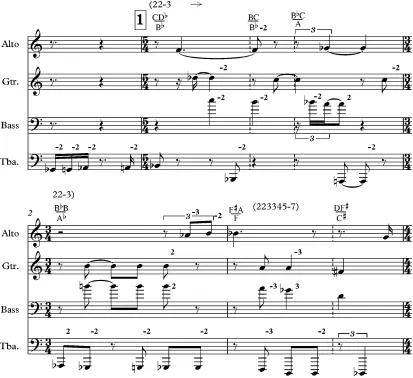
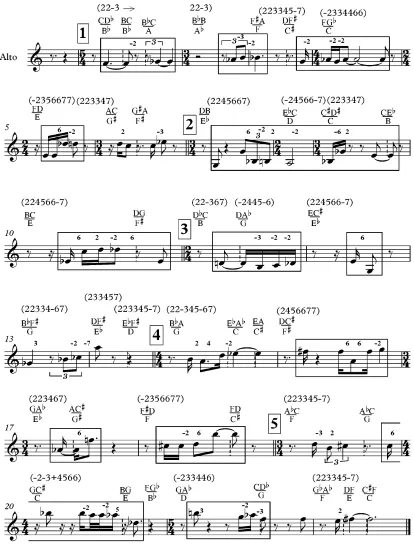
The full scores are annotated with additional descriptions and harmonic information (as discussed in the following chapter and in Appendix 1). Additionally, a number of diacritical markings are included to represent various instrumental techniques as well as techniques specific to the fretted instruments, guitar and bass guitar. These are shown in Figure 1.
Figure 1 - Diacritical markings
Interviews