STANDARD
Thesis by Christopher J. White
In Partial Fulfillment of the Requirements for the degree of
Doctor of Philosophy
CALIFORNIA INSTITUTE OF TECHNOLOGY
Pasadena, California 2005
© 2005
ACKNOWLEDGEMENTS
The author thanks Ali Hajimiri for his continuous support and guidance during the course of this project. Richard Bramley was very generous in discussing zero-field electron magnetic resonance and sharing details of his earlier spectrometer designs. James White oversaw the machining of the loop-gap resonator pieces at MIT Central Machine Shop. Thanks to Philip Feng from Roukes Group at Caltech for annealing the magnesium oxide crystals. Thanks also to William Bridges, David Rutledge, Daniel Weitekamp, Sander Weinreb, Yu-Chong Tai, and Michael Roukes for serving on the thesis committee and offering many helpful criticisms. The author acknowledges the support of an Intel Fellowship during one year of the project.
ABSTRACT
TABLE OF CONTENTS
Acknowledgements ...iii
Abstract ...iv
Table of Contents... v
List of Figures ...vii
Chapter 1: Introduction... 1
1.1 Summary... 1
1.2 Example Applications ... 2
1.3 High-Accuracy, Low-Power Frequency Standards... 4
1.4 Precision Crystal Oscillators... 6
1.5 Miniaturized Rubidium Frequency Standards... 7
1.6 Solid-State Atomic Frequency Standard ... 8
1.7 Organization ... 10
Bibliography ... 11
Chapter 2: Paramagnetic Resonance Signals... 14
2.1 Introduction ... 14
2.2 Transition Metal Paramagnetic Resonance in Solids... 15
2.3 Zero-Field Electron Spin Resonance of Vanadium in MgO... 16
2.4 Hamiltonian for V++ in a Cubic Lattice ... 17
2.5 Magnetic Resonance at Zero-Field ... 18
2.6 Selection Rules for Parallel and Perpendicular Polarizations... 23
2.7 Magnetic Susceptibility... 25
2.8 Electrical Resonator Containing Paramagnetic Sample... 27
2.9 Numerical Calculation of Eigenvalues and Transition Intensities... 29
2.10 Comparison to Measurement ... 32
Bibliography ... 37
Chapter 3: Dipolar Broadening at Zero-Field... 39
3.1 Introduction ... 39
3.2 Dipolar Broadening of Dilute Paramagnetic Ions at High-Field ... 40
3.3 Dipolar Broadening at Zero-Field... 42
3.4 Comparison to Measurement ... 44
Bibliography ... 47
Chapter 4: Prototype Design ... 48
4.1 Introduction ... 48
4.2 Tunable Loop-Gap Resonator Design ... 52
4.3 Loop-Gap Resonator Manufacturing... 55
4.4 Frequency Discriminator... 57
4.5 Automatic Frequency Control... 63
4.6 Modulation Waveforms and Modulation Driver... 64
4.7 Helmholtz Coil Design and Magnetic Field Homogeneity... 65
4.9 Grounding and Shielding ... 68
4.10 Sample Preparation and Heat Treatment ... 68
Bibliography ... 71
Appendix... 73
Chapter 5: Sensitivity ... 78
5.1 Introduction ... 78
5.2 Resonator Noise... 79
5.3 Receiver Noise Figure... 84
5.4 Oscillator Phase Noise ... 85
5.5 Prototype Sensitivity ... 90
Bibliography ... 91
Chapter 6: Frequency Stability... 92
6.1 Frequency Stability of Passive Atomic Frequency Standards ... 92
6.2 Measurement of Frequency Stability... 97
6.3 Solid-State Atomic Frequency Standard ... 100
6.4 Frequency Stability – Thermal Noise Limit ... 102
Bibliography ... 103
LIST OF FIGURES
Number Page
1.1. SARSAT Emergency Radiolocation Beacon... 3
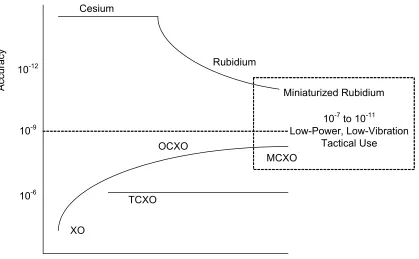
1.2. Historical Trends in the Performance of Frequency Standards... 5
2.1 Numerically Calculated Zeeman Shift for V++/MgO... 22
2.2 Transition Intensities for Parallel and Perpendicular Polarizations... 24
2.3 Calculated Spectrum for Mn++ in Magnesium Oxide... 30
2.4 Example Calculated Spectrum for Mn++ and V++ in Magnesium Oxide... 31
2.5 Measured Spectrum for Mn++ and V++ in Magnesium Oxide…… ... 32
3.1 Numerically Calculated V++/MgO Spectrum Showing Zeeman Shift at 1 Gauss.... 42
3.2 Measured V++/MgO Spectrum at 50 Gauss Zeeman Field... 45
4.1 Zero-Field Electron Magnetic Resonance Spectrometer... 49
4.2 Shielded Loop-Gap Resonator: Perspective, Side and Top View... 50
4.3 Audio Modulation Waveform and Lock-In Multiplier Waveform... 51
4.4 Mechanical Dimensions of Loop-Gap Resonator... 53
4.5 Side View of Mechanically Tunable Loop-Gap Resonator... 54
4.6 Frequency Discriminator... 57
4.7 Power Variations at Mixer Input Because of Loop-Gap Resonator Mismatch... 58
4.8 Measured Loop-Gap Resonator Transmission at 3 Frequencies... 59
4.9 Measured Loop-Gap Resonator Reflection at 3 Frequencies... 60
4.10 Voltage Standing Wave Ratio without Series Matching Capacitor... 61
4.11 Power Variations at Mixer Input Port with Improved Resonator Matching... 62
4.12 Frequency Discriminator with Automatic Frequency Control... 63
4.13 Magnetic Field Modulation... 64
4.14 Helmholtz Coil Axial Magnetic Field Variation... 66
4.15 Measured Voltage-Controlled Oscillator Phase Noise... 67
4.16 V++/Mn++/MgO Spectrum in Samples as Grown... 69
5.1 Noise Sources in the Frequency Discriminator... 79
5.2 Tunable Loop-Gap Resonator Side View... 80
5.3 Lorentz Force Between Helmholtz Coils... 83
5.4 Background Pickup Signal During Spectrometer Sweep... 84
6.1 Passive Atomic Frequency Standard... 92
6.2 Atomic Resonance Signal Showing Instantaneous and Mean Frequency... 96
6.3 Direct Frequency Counter Measurement of Allan Variance... 97
6.4 Solid-State Atomic Frequency Standard... 100
C h a p t e r 1
INTRODUCTION
1.1 Summary
Frequency standards are important in nearly all electronic systems, and are widely used in cellular telephones, wireless networks, satellite broadcasting, fiber-optic communication, global positioning systems (GPS), and a variety of instrumentation applications such as frequency synthesizers. Two classes of frequency standards exist; crystal oscillators and atomic clocks, which differ widely on their accuracy, size, cost, and power requirements [1]. Historically, the mainstream applications of crystal oscillators and atomic clocks have been very different. Most atomics clocks are used in laboratories for making highly precise measurements, or maintaining the basic standard of time. On the other hand, crystal oscillators are ubiquitous in consumer electronics, may cost only a few cents, are very small, and very low-power.
[19,20,21,22,23]. New solutions are needed to realize low-cost, portable frequency sources with improved accuracy.
1.2 Example Applications
Many developments in frequency standards have been motivated by the requirements of new communications systems or better navigation, which is likewise true of efforts to develop robust, miniature, low-power frequency standards which also have high-accuracy [24]. Two systems which illustrate the needs for improved frequency control are military spread-spectrum communications and commercial emergency radiolocation beacons [25,26]. The spread-spectrum example describes the need for a frequency reference with high-accuracy and low-vibration sensitivity. The radiolocation beacon example demonstrates the need for a frequency reference with good stability over temperature, low-power consumption, and low-cost.
Spread Spectrum Communications
Emergency Radiolocation
A second example related to navigation is a type of Doppler radiolocation system. Emergency radiolocation beacons allow a user to relay an emergency distress signal via satellite to a search and rescue ground terminal. The location of the distress beacon is detected by tracking the Doppler shift of the beacon signal seen by the satellite flying overhead (Figure 1.1):
Low-Earth Orbit Satellite
Emergency Radio-Location
Beacon
EARTH
406 MHz
[image:11.612.154.529.273.606.2]Ground Station
Figure 1.1 SARSAT Emergency Radiolocation Beacon
account for the rotation of the earth, allows for a determination of the latitude and longitude in a single pass. This leads to a requirement on the rate of frequency drift during changes in ambient temperature of less than 10-9 per minute [26], which cannot generally be met by temperature-compensated crystal oscillators. The specifications for radiolocation beacons are modest as far as the absolute accuracy of the frequency reference, because the radiolocation system is designed to measure the gradient of the Doppler shift. However, low-power operation is greatly desired to extend the battery life of the distress beacon.
1.3 High-Accuracy, Low-Power, Low-Cost Frequency Standards
The preceding examples emphasize the need to develop high-accuracy frequency sources which are also portable and low-cost. The two types of commercially available atomic frequency standards are passive rubidium standards and cesium beam standards. Cesium standards offer the best long-term stability, and accuracy on the order to 10-12, but are also
the most bulky, power hungry, and expensive. Passive rubidium frequency standards are the smallest and lowest-cost atomic standards, and compete with very high-precision oven controlled standards in some applications. In all cases, the challenge is to evaluate the performance of the frequency standard in a variable environment [27,28]. For example, if a crystal oscillator has an acceleration sensitivity of 10-8 / g, then turning over the crystal unity causes the frequency to change by 10-8, which may then be the limiting factor for the practical accuracy. Atomic clocks can have very high-accuracy, buy may also have excessive sensitivity to vibrations. Warm-up time is another important problem for both technologies, which prevents greater use of precision frequency control in battery powered systems [30].
Year
Accuracy
10-9
TCXO
10-6
10-12
OCXO
Miniaturized Rubidium
10-7 to 10-11
Low-Power, Low-Vibration Tactical Use
Quartz – has the features of low-power and portability, but not enough accuracy
Classic Atomic Clock – have extremely good stability but not the size, weight, cost, power, robustness for portable use
MCXO Cesium
Rubidium
[image:13.612.120.539.84.343.2]XO
Figure 1.2: Historical Trends in the Performance of Frequency Standards
Technology developments take the form of improvements in the accuracy of crystal oscillators, and manufacturing innovations to miniaturize passive rubidium standards, with performance converging in the range of 10-7 to 10-10 frequency accuracy. Again, the performance evaluation has to account for environmental effects, aging, and vibration, for practical use [27,28]. The solid-state atomic frequency standard addresses the need for a robust, low-cost, low-power frequency reference with some of the absolute accuracy and long-term stability characteristics of atomic clocks.
1.4 Precision Crystal Oscillators
In a crystal oscillator, the resonant frequency depends primarily on the precise cut, mass, and dimensions of the crystal resonator. There are various, common techniques for stabilizing frequency over temperature, such as temperature-compensated crystal oscillators (TCXOs), digitally-compensated crystal oscillators (DCXOs), time-compensated clock oscillators (TCCOs), and oven-controlled crystal oscillators (OCXOs). The operating principle, however, is the same in all cases; i.e., the initial frequency is set by the mechanical dimensions of the piezoelectric resonator, and the resonant frequency is stabilized over environmental variations using techniques temperature compensation or temperature regulation.
Power Consumption
Very good stability over temperature can be achieved for oven-controlled crystal oscillators, in the range of 10-9 for single oven designs and up to 10-10 for double oven standards, but power consumption between 0.5 W and 5W is a major shortcoming for portable applications. A microcomputer compensated crystal oscillator (MCXO) uses a look-up table and A/D converter to exactly compensate the temperature vs. frequency characteristics of the crystal resonator. However, hysteresis in the quartz resonator frequency under temperature cycling limits the temperature stability of MCXO’s to less than 2 x 10⁻⁸ [13]. A different technique is direct heating of the quartz crystal for low-power temperature regulation [20,21,22]. A serious shortcoming of this technique results from thermal stress across the crystal resonator, which shifts the resonant frequency.
Aging
significant logistics cost for re-calibrating the oscillator [25]. For comparison, a rubidium frequency standard may have aging on the order of 10-10 per year, which is why atomic clocks must be used to obtain the highest accuracy and long-term stability. However, the low aging rate does not mean than atomic clocks are less sensitivity to vibration than crystal oscillators.
1.5 Miniaturized Rubidium Atomic Frequency Standards
Atomic clocks derive a frequency from the quantum mechanical transitions of an ensemble of atoms or ions in the gas phase. Examples range from primary standards such as the cesium beam atomic clock, to smaller clocks such as rubidium standards. Usually, a technique is devised to interrogate the frequency of the magnetic dipole transitions between the hyperfine states of a particular atom or ion vapor, although a standard based on an optical (i.e., electric dipole) transition has been recently implemented [29]. Rubidium standards can be implemented using optical pumping or coherent population trapping to interrogate the hyperfine splitting of the rubidium ions. Regardless of the implementation, the desired frequency is derived from the atomic spectrum of a gas of atoms or ions, rather than from the mechanical dimensions and mass of a piezoelectric resonator. Further details of conventional, miniature atomic clocks may be found in the following references [2-12]. Most recent miniaturized designs use coherent population trapping rather than the traditional optical pumping technique using a rubidium lamp and filter [6,7,8,9,11].
Batch Production
is a difficult problem. Other interesting techniques are to fuse hollow-core pyrex fibers [10]. The frequency stability reported for one design is 5 × 10⁻¹⁰ at 1 second integration,
and an aging rate of 2 × 10⁻⁸ per day [2].
1.6 Solid-State Atomic Frequency Standard
This thesis describes a new class of frequency reference. The frequency source uses the same operating principle as a passive atomic frequency standard; however, the device is entirely solid-state, removing many cost and reliability issues associated with gas-phase atomic clocks. The basis for the solid-state atomic frequency standard is the zero-field electron magnetic resonance of certain transition metal ions doped into dielectric crystals. As Chapters 2 and 3 will describe, the divalent vanadium ion in magnesium oxide has a narrow magnetic resonance spectrum at room temperature. The features of the zero-field magnetic resonance spectra are discussed in detail. Magnesium oxide is a common ceramic, and may be manufactured at very low cost. An important feature of the solid-state atomic frequency standard is that the reference frequency is accuracy defined by the materials system, rather than depending acutely on the manufacturing tolerances as is the case for crystal oscillators.
resonance. The resulting frequency modulation of the electrical resonator is demodulated using a frequency discriminator circuit, and detected using a lock-in amplifier to measure the atomic resonance.
1.7 Organization
BIBLIOGRAPHY, CHAPTER 1
[1] L. L. Lewis, “An introduction to frequency standards,” Proceedings of the IEEE, vol. 79, no. 7, pp. 927-935, July 1991.
[2] S. Knappe et al., “A microfabricated atomic clock,” Applied Physics Letters, 85, pp. 1460, 2004.
[3] L. Liew et al., “Microfabricated alkali atom vapor cells,” Applied Physics Letters, 84, pp. 2694, 2004.
[4] H. C. Nathanson and I. Liberman, United States Patent 6,570,459, “Physics Package Apparatus for an Atomic Clock,” Northrop Grumman Corporation, Los Angeles, CA, May 27, 2003.
[5] J. Kitching et al., “Miniature vapor-cell atomic-frequency references,” Applied Physics Letters, 81, pp. 553, 2002.
[6] J. Kitching, “Compact atomic clock based on coherent population trapping,”
Electronics Letters, vol. 37, no. 24, pp. 1449-1451, November 2001.
[7] J. Vanier et al., “The coherent population trapping passive frequency standard [Rb example],” IEEE Trans. on Instrumentation and Measurement, vol. 52, no. 2, pp. 258-262, April 2003.
[8] J. Vanier et al., “Atomic Clocks Based on Coherent Population Trapping: Basic Theoretical Models and Frequency Stability,” Proc. IEEE International
Frequency Control Symposium, pp. 2-15, 2003.
[9] M. Zhu, “High Contrast Signal in Coherent Population Trapping Based Atomic Frequency Standard Application,” Proc. IEEE International Frequency Control Symposium, pp. 16-21, 2003.
[10] S. Knappe et al., “Atomic Vapor Cells for Miniature Frequency References,”
Proc. IEEE International Frequency Control Symposium, pp. 31-32, 2003.
[12] J. Kitching, S. Knappe and L. Holberg, “Performance of Small Scale Frequency References,” Proc. IEEE International Frequency Control Symposium, pp. 442-446, 2002.
[13] J. Kusters and J. Vig, “Hysteresis in Quartz Resonators – A Review,” IEEE Trans. on Ultrasonics, Ferroelectrics, and Frequency Control, vol. 38, no.3, pp.281-289, May 1991.
[14] F. Walls and J. Vig, “Fundamental Limits on the Frequency Stabilities of Crystal Oscillators,” IEEE Trans. on Ultrasonics, Ferroelectrics, and Frequency Control, vol. 42, no. 4, pp. 576-589, July 1995.
[15] R. Filler and J. Vig, “Long-Term Aging in Oscillators,” IEEE Trans. on Ultrasonics, Ferroelectrics, and Frequency Control, vol. 40, no. 4, pp.387-394, July 1993.
[16] Y. Yong and J. Vig, “Modeling Resonator Frequency Fluctuations Induced by Absorbing and Desorbing Surface Molecules,” IEEE Trans. on Ultrasonics, Ferroelectrics, and Frequency Control, vol. 37, no. 6, pp. 543-550, November 1990.
[17] Y. Yong and J. Vig, “Resonator Surface Contamination – A Cause of Frequency Fluctuations?,” IEEE Trans. on Ultrasonics, Ferroelectrics, and Frequency Control, vol. 36, no. 4, pp. 452-458, July 1989.
[18] R. Filler and J. Vig, “Resonators for the Microcomputer Compensated Crystal Oscillators,” Proc. 43rd Ann. Symposium on Frequency Control, pp. 1-15, 1989. [19] M. Bloch et al., “Low Power Timekeeping,” Proc. 43rd Ann. Symposium on
Frequency Control, pp. 34-36, 1989.
[20] Garland et al., United States Patent 3,431,392, “Internally Heated Crystal Devices,” Hughes Company, Culver City, CA, March 4, 1969.
[21] I. Abramson and A. Dikidzhi, “Improvement of Characteristics of Quartz Resonator-Thermostate with Direct Heating Piezoelement,” IEEE Frequency Control Symposium, pp. 499-504, 1992.
[22] I. Abramson, “Internal Heated Quartz Resonator with Low Sensitivity to an Acceleration,” IEEE International Frequency Control Symposium, pp. 838-842, 1995.
[24] V. E. Bottom, “A History of the Quartz Crystal Industry in the USA,” Proc. 35th Ann. Freq. Control. Symposium, pp. 3-12, May 1981.
[25] J. R. Vig, “Military Applications of High Accuracy Frequency Standards and Clocks,” IEEE Transactions on Ultrasonics, Ferroelectrics, and Frequency Control, vol. 40, no. 5, pp. 522-527, September 1993.
[26] Specification for COSPAS-SARSAT 406 MHz Distress Beacons, C/S T.001, Issue 3 – Revision 5, October 2003.
[27] IEEE Standard 1193TM-2003, IEEE Guide for Measurement of Environmental Sensitivities of Standard Frequency Generators, March 2004.
[28] MIL-PRF-55310D, General Specification for Crystal Controlled Oscillator, March 1998.
[29] S. A. Diddams et al., “An Optical Clock Based on a Single Trapped 199Hg+ Ion,” Science, vol. 293, pp. 825-828, August 2001.
[30] T. J. Lynch and J. R. Vaccaro, “Ultrafast Warm-Up Rubidium References,”