HEALTH PSYCHOLOGY | RESEARCH ARTICLE
The use and evaluation of a theory-informed,
multi-component intervention to reduce sedentary
behaviour in the workplace
Teneale McGuckin1*, Rebecca Sealey2 and Fiona Barnett1
Abstract:
Occupational sedentary behaviour is a growing health concern which
accounts for almost half of overall sedentary behaviour. Multi-component
interven-tions are effective for reducing occupational sedentary behaviour. The aim of the
study was to evaluate the effectiveness of a theory-informed, personalised
interven-tion for the reducinterven-tion of occupainterven-tional sedentary behaviour of office workers.
Full-time office-based workers were asked to complete an online survey to explore their
perception of sedentary behaviour. Following this, pre-intervention activity patterns
were collected for 5 days via an ActivPAL and a self-report workbook. The
partici-pants met with the investigator to discuss the key themes identified from the online
survey, individual ActivPAL and self-report data. Participants set goals for the 6-week
intervention, signed a commitment contract with stage of change and self-efficacy
explored. During the final intervention week, participants wore an ActivPAL and were
invited to participate in a follow-up interview. Twenty-seven office-based workers
reduced occupational sitting time by an average of 45.2 ± 60.7 min per workday.
Self-efficacy increased post intervention (pre: 69 ± 21%; post: 82 ± 16%). The
follow-up interviews indicated that the intervention increased awareness of occfollow-upational
sedentary behaviour and provided insight into the key behaviour change strategies
utilised in the intervention.
Subjects: Health Psychology; Work & Organizational Psychology; Health & Society
Keywords: sitting time; occupational; intervention *Corresponding author: Teneale
McGuckin, Sport & Exercise Science, James Cook University, Townsville, Australia
E-mail: [email protected] Reviewing editor:
Peter Walla, University of Newcastle, Australia
Additional information is available at the end of the article
ABOUT THE AUTHORS
Teneale McGuckin is currently a PhD candidate under the supervision of associate professor Rebecca Sealey and associate professor Fiona Barnett who both have research expertise in healthy lifestyle interventions. Teneale’s project surrounds the reduction of sitting time in the workplace with a specific interest in theory-informed behaviour change strategies. This project supports the wider views of the importance of reducing sedentary behaviour especially in the workplace.
PUBLIC INTEREST STATEMENT
There is growing concern for the increased level of sitting time in the workplace. The use of workplace interventions to reduce sitting time can increase awareness of the problematic behaviour and increase self-belief that the behaviour can be modified. Additionally, the levels of sitting time for office-based workers can be reduced by 45 min during work hours using simplistic and cost-effective strategies such as goal setting, committing to the behaviour change, and including regular prompts or reminders to reduce sitting time. The findings of the research suggest that simplistic strategies can be incorporated in other predominantly sedentary workplaces. Received: 10 August 2017
Accepted: 26 November 2017
1. Introduction
Occupational sedentary behaviour is considered to be an emerging public health concern (Chu et al., 2016; Dunstan et al., 2013). The workplace is an ideal setting to reduce sedentary behaviour (Bennie et al., 2015; Chu et al., 2016; Das et al., 2016) as occupational sedentary behaviour contributes to a large proportion (49%) of overall sitting time (Parry & Straker, 2013). Prolonged sitting is associated with many detrimental health outcomes (Katzmarzyk, Church, Craig, & Bouchard, 2009; Katzmarzyk & Lee, 2012) however emerging evidence suggests that some of these health concerns may be at-tenuated by reducing sedentary behaviour. For example, desk-based workers decreased their post-prandial blood glucose excursion following 3 h of standing with additional energy expenditure compared to sitting (Buckley, Mellor, Morris, & Joseph, 2014). As a result of positive health outcomes associated with interrupting and reducing sedentary behaviour, Buckley et al. (2015) suggest indi-viduals who are employed in predominantly desk-based occupations should work towards achieving 2 h per day of standing or moving during work hours gradually progressing to 4 h per day during work hours.
To address the increasing risk of occupational sedentary behaviour, a variety of interventions and strategies have been investigated with varying results. A recent review (Chu et al., 2016) suggests that a multi-component intervention including some behavioural and educational and environmen-tal components are the most effective when addressing workplace sedentary behaviour. Behavioural and educational strategies include motivational interviewing, goal setting, self-monitoring behav-iour, providing information about the consequences of the behavbehav-iour, and prompts or cues (Chu et al., 2016; Gardner, Smith, Lorencatto, Hamer, & Biddle, 2016). The most effective environ-mental change is to introduce sit-to-stand workstations or other movement-based changes such as a treadmill desk (Chu et al., 2016). Although environmental changes produce significant reductions in sedentary time (Alkhajah et al., 2012), there is a cost associated with installing sit-to-stand sta-tions (Neuhaus, Healy, Dunstan, Owen, & Eakin, 2014a) and therefore it may not be feasible for workplaces to retrofit their work environments. Furthermore, Biddle and Bennie (2017) suggested that further research is needed to explore alternative options to reduce sedentary behaviour. Additionally, it has been suggested that a larger number of behaviour change strategies (7 ± 5 strat-egies) are associated with successful behaviour change (Gardner et al., 2016).
The majority of the existing literature surrounding sedentary behaviour does not explicitly map the theoretical frameworks to the development and implementation of the intervention strategies (Gardner et al., 2016; Prapavessis, Gaston, & DeJesus, 2015; Rhodes, Mark, & Temmel, 2012). Presumably previous research has referred to behaviour change theoretical frameworks for exam-ple, environmental changes such as sit-to-stand workstations or activity-permissive workstations are likely to be considered as being related to the perceived behavioural control constructs of the Theory of Planned Behaviour (TPB) and Social Cognitive Theory (SCT) whereby participants have per-ceived control over their sitting time in the workplace. Therefore, while not explicitly outlined within most studies, the strategies can be assumed to have been developed as a result of prior theory-based planning. There is however limited evaluation of the strategies or intervention outcomes in terms of their overarching frameworks. This may be particularly useful as theoretical frameworks can be used to explain the likely processes and mechanisms of a desired behaviour change (Gardner, Whittington, McAteer, Eccles, & Michie, 2010). Planning prior to implementing behaviour change in-terventions should consider the following components: capability, opportunity and motivation (Michie, van Stralen, & West, 2011). Modifications to one or more of the components can lead to potential behaviour change (Michie et al., 2011). To explain the components further, capability re-lates to the ability to modify behaviour, opportunity rere-lates to external factors which can make the behaviour change possible, and motivation refers to the internal factors which can influence behav-iour change (Michie et al., 2011).
Some emerging literature has begun to include theoretical frameworks in the planning and evalu-ation stages of sedentary behaviour interventions (Hadgraft et al., 2017; Neuhaus et al., 2014b). The TPB has recently been utilised in sedentary behaviour research (Umstattd Meyer, Wu, &
Walsh, 2016). The premise of the TPB involves attitude, subjective norms and perceived behavioural control which can influence an individual’s intentions to change behaviour (Ajzen, 1991). Prapavessis et al. (2015) suggest that the TPB is relevant to the intentions of sedentary behaviour linking atti-tudes to the perceived cost or benefits of sitting, subjective norms by the expectations of others in regards to sitting, and perceived behavioural control as the control over time spent sitting. Additionally, the SCT has been used as the framework for a sedentary behaviour intervention (Hadgraft et al., 2017). The SCT proposes that behaviour is a purposeful action and is under the con-trol of an individual where self-reflection and self-regulation occurs (Buckworth, Dishman, O’Connor, & Tomporowski, 2013). The SCT involves developing skills through mastery modelling, strengthening a person’s self-efficacy and enhancing motivation through goal setting (Bandura, 1988). Hadgraft et al. (2017) suggested that future interventions should consider perceived behavioural control strate-gies such as brainstorming sessions for participants to identify opportunities to reduce sitting time or installing sit-to-stand workstations and self-efficacy strategies such as goal setting or problem solving when developing workplace interventions to reduce sedentary behaviour.
The Transtheoretical Model (TM) (Prochaska & DiClemente, 1982) is another appropriate frame-work to explore sedentary behaviour (Marcus & Simkin, 1994) as intervention strategies can be tai-lored to the relevant stage of change (Prochaska, DiClemente, & Norcross, 1992). The stages of behaviour change include precontemplation, contemplation, preparation, action and maintenance (Prochaska, Norcross, & DiClemente, 2013). To progress through the stages a variety of processes can be applied such as consciousness raising, dramatic relief, self-evaluation, environmental re-evaluation, self-liberation, social liberation, counter-conditioning, stimulus control, contingency management and helping relationships (Prochaska & Velicer, 1997). The most prominently used processes in the action and maintenance stages include self-liberation, contingency management, helping relationships, counter conditioning and stimulus control (Prochaska et al., 1992). Additionally, for successful behaviour change to occur an individual needs to have self-confidence that they can successfully perform the desired behaviour change (Bandura, 1988). As the TM has been successfully used for various health promotion interventions (Clarke & Eves, 1997; Keller, Herda, Ridder, & Basler, 2001; Marcus & Simkin, 1994; Spencer, Adams, Malone, Roy, & Yost, 2006), the framework is likely to be appropriate for inclusion in sedentary behaviour change interventions.
Office workers have been reported to sit for 82% of their working hours (Parry & Straker, 2013) which provides an ideal workplace setting for intervention. Additionally, office workers have sug-gested that interventions need to include education, provide a supportive environment to change behaviour and encompass a variety of strategies to ensure each worker can have an individually tailored behaviour change process (McGuckin, Sealey, & Barnett, 2017). Some theory-based inter-ventions which included multiple behaviour change strategies such as tailored goal setting and the provision of information regarding the target behaviour have resulted in reduced sedentary behav-iour in older adults (Fitzsimons et al., 2013; Gardiner, Eakin, Healy, & Owen, 2011). Michie et al. (2013) suggest that further research is needed to link behaviour change strategies to specific theoretical frameworks to explore the likely mechanisms behind behaviour change. Therefore, the aims of the present study were to evaluate the effectiveness of a theory-informed, personalised intervention for the reduction of occupational sedentary behaviour of office workers. It was hypothesised that sed-entary behaviour change based on theoretical frameworks would result in reduced occupational sedentary behaviour.
2. Methods
2.1. Participant recruitment
Participants were recruited from James Cook University via email invitation. The inclusion criteria for participation in the project included (a) employed full-time (b) working in an office-based environ-ment (c) not performing any face-to-face teaching duties during the study period. There were no restrictions on gender, age, or position as long as the above criteria were met. Participants who met the aforementioned criteria were provided with an information sheet and informed consent form.
2.2. Procedures
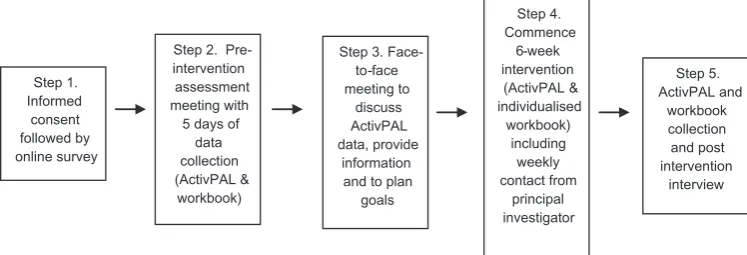
The study was a pre-post design and was implemented between September and December 2016. Ethics was approved by the institutional ethics committee. Figure 1 provides an overview of the study design.
Step 1. Initial data collection
After the return of the informed consent form, participants were asked to complete an online survey to ascertain demographic information such as age, gender, height and body mass, their perception of daily occupational sitting time, and their perception of sitting and their health. The participants were asked “do you think there is a relationship between sitting and your health” which required a “yes” or “no” response followed by an open-ended section for further comments adapted from Gilson, Burton, van Uffelen, and Brown (2011) previously used by McGuckin et al. (2017) to explore perceptions of sitting behaviour.
Step 2. Pre-intervention data collection
An initial face-to-face meeting was held between each individual and the principal investigator. During the meeting, each participant was provided with an ActivPAL (PAL Technologies Ltd, Glasgow, Scotland). The ActivPAL is one of the most widely used objective activity monitoring devices to as-sess sedentary behaviour (Kim & Welk, 2015). The ActivPAL is a lightweight activity device which attaches to the thigh via adhesives as per the manufacturers recommendations, and records activity patterns such as sitting, standing, stepping or walking based on acceleration and inclination data. Participants were instructed how to wear the ActivPAL during work hours with multiple adhesion options provided. Participants were asked to remove the ActivPAL at the end of the work day and leave it on their desk for the following day. The ActivPAL has previously been used in multiple seden-tary behaviour interventions (Stephens et al., 2014; Swartz et al., 2014; Urda, Lynn, Gorman, & Larouere, 2016).
A workbook was also provided to each participant during the pre-intervention data collection stage. The workbook had a separate page for each day of data collection and provided space for participants to indicate their sitting and non-sitting time every 30 min. Participants were also asked to provide details of the time they started wearing their ActivPAL and the time of removal. The use of log books provides an economical and easily disseminated tool for data collection (Hardy et al., 2013).
All participants were asked to wear the ActivPAL and record their self-report data in the workbook for 5 days (pre-intervention) period.
Step 3. Planning for the intervention and implementation of key behaviour change strategies
[image:4.609.180.554.615.742.2]After the completion of the pre-intervention data collection, a second face-to-face meeting between each individual and the principal investigator took place. This was an individualised consultation similar to those conducted by Fitzsimons et al. (2013). During this consultation, participants were
Figure 1. Study design.
Step 5. ActivPAL and
workbook collection and post intervention
interview Step 4.
Commence 6-week intervention (ActivPAL & individualised
workbook) including
weekly contact from
principal investigator Step 3.
Face-to-face meeting to
discuss ActivPAL data, provide
information and to plan
goals Step 2.
Pre-intervention assessment meeting with 5 days of
data collection (ActivPAL &
workbook) Step 1.
Informed consent followed by online survey
provided with a sample of their pre-intervention data collection (i.e. one day of their ActivPAL data compared to their self-reported workbook data), a generic information sheet about sedentary behaviour, and another information sheet including information surrounding the three main themes for the relationship between sitting and health, as identified from the online survey. From this, participants were asked to develop six weekly goals focusing on strategies to reduce occupational sedentary behaviour for their individualised intervention as previously conducted by Lewis et al. (2016). The goals were incremental such that all participants set one goal for week one and would complete six goals by the end of the 6-week intervention (i.e. week two would include week one goal plus week two goal and so forth). If participants were unsure of what goals to set, example goals were suggested with a clear message that they may not be appropriate for every participant and that careful consideration should occur before the inclusion of a suggested goal. The goals were evaluated by the participant and principal investigator during discussions for achievability within their current work environment. Six participants had access prior to or were likely to acquire a sit-to-stand station during the intervention phase and therefore their goals included how and when to use the sit-to-stand station as they have high levels of sitting time at pre-intervention (354.7 min/day).
In addition to the goals, participants were asked to sign a self-contract adapted from Kotecki (2014) which indicated that they would achieve their goals during the intervention period. Commitment has previously been included as a strategy in the consultation process of Fitzsimons et al. (2013). Participants were asked to state their self-efficacy to complete their goals as a percentage as adapted from McAuley (1993). To identify stage of change, participants were asked the following questions “do you think prolonged sedentary behaviour is a problem for you at the moment?” (why/ why not), and “when do you intend to change your sedentary behaviour?” (Prochaska et al., 2013).
Following the consultation and before the commencement of the goal-based sedentary behaviour intervention, participants were provided with another self-report activity workbook for the next six weeks with specific reference to their goals. The workbook consisted of (1) the individual’s goal/s, (2) the work day broken into 30 min intervals to record sitting, and non-sitting time and (3) an evalua-tion of whether their goal was achieved for each day, previously utilised as a behavioural strategy by Lewis et al. (2016).
Step 4. The intervention
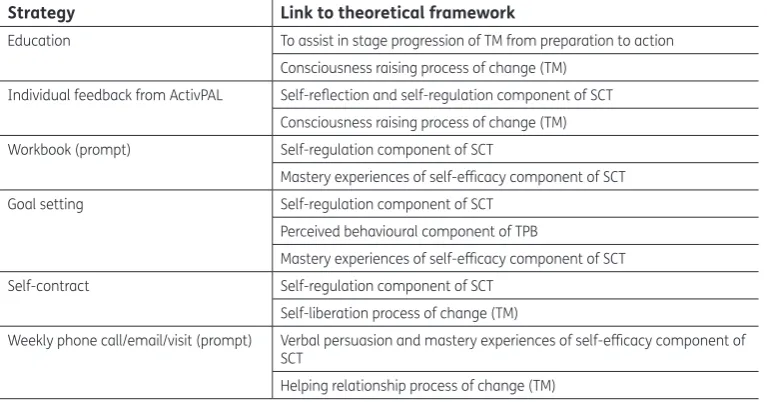
During the intervention period, participants received a weekly phone call, email or personal visit to ask if they were achieving their goals and if not, what were the difficulties in achieving these goals. Support was offered if the participant felt they were unsure if their goals were achievable due to changed circumstances and modifications were made to the goals if needed. During the final week of the 6-week intervention in addition to completing their workbook, participants again wore the ActivPAL for five working days. The strategies used throughout the intervention are described in rela-tion to the relevant theoretical framework in Table 1.
The intervention addressed capability, opportunity and motivation components for changing be-haviour (Michie et al., 2011) by providing the knowledge and skills via education, feedback and goal setting to change behaviour (capability), prompts to address external factors (opportunity), and self-monitoring, and commitment to address internal factors (motivation).
Step 5. Follow up interviews
After the completion of the intervention participants were invited to take part in an interview. The interview included questions surrounding their motivations to participate in the project and to complete their goals, self-efficacy for the continuation of behaviour change, whether goals were achieved or not, which goals were the most effective or least effective for behaviour change, feasibility of using the workbook, usefulness of interactions with the principal investigator, the usefulness of receiving information at the commencement of the intervention, and their overall perception of the
intervention in regards to reducing sedentary behaviour in the workplace. The workbook and ActivPAL were collected during this final meeting.
2.3. Statistical analysis
The open-ended responses from the online survey, the individual weekly goals, and the post-inter-vention interviews were transcribed verbatim and were thematically analysed according to Braun and Clarke (2006). Thematic analysis consisted of six phases: (1) familiarisation with the data; (2) create initial coding; (3) identify themes; (4) review themes; (5) define and name themes and (6) produce the results.
All pre- and post- intervention data were analysed using SPSS version 22 (SPSS Inc. Chicago, IL, USA). Paired samples t-tests were used to analyse ActivPAL and reported sitting time and self-efficacy with statistical significance set at p < 0.05; with 95% confidence intervals (CI) and effect sizes (ES) also presented. A Pearson’s correlation was used to analyse ActivPAL and self-reported post-intervention data.
3. Results
3.1. Participants
[image:6.609.180.564.116.317.2]Forty-nine participants provided informed consent and were eligible to participate in the intervention and completed the survey. The average age of participants was 45 ± 10 years with a body mass index of 27.4 ± 4.9 kg/m2 which is classified as overweight [44] (American College of Sports Medicine, 2014). Thirty-eight participants completed the intervention (78% completion rate) however only 27 participants (4 males, 23 females; 55% of original sample group) had sufficient data to be included in the analysis. Eleven participants (all female) withdrew or were excluded from the intervention, six prior to the study, and five during the intervention phase. Several reasons were provided for withdrawing from the intervention. Two participants suggested they were unable to commence the intervention due to a change or increase in workloads. One participant had received a lower limb injury, two participants had to travel for work during the intervention period, which would significantly interrupt their goals, two withdrew from the intervention without explanation, one participant resigned from their job, and three participants did not respond to the principal investigator during data collection and were therefore excluded from the study. Data sets from 11 participants were unable to be included as there were ActivPAL monitoring errors or insufficient data. While the ActivPAL
Table 1. Link between intervention strategies and theoretical framework
Notes: SCT—social cognitive theory, TM—transtheoretical model, TPB—theory of planned behaviour.
Strategy Link to theoretical framework
Education To assist in stage progression of TM from preparation to action Consciousness raising process of change (TM)
Individual feedback from ActivPAL Self-reflection and self-regulation component of SCT Consciousness raising process of change (TM) Workbook (prompt) Self-regulation component of SCT
Mastery experiences of self-efficacy component of SCT Goal setting Self-regulation component of SCT
Perceived behavioural component of TPB
Mastery experiences of self-efficacy component of SCT Self-contract Self-regulation component of SCT
Self-liberation process of change (TM)
Weekly phone call/email/visit (prompt) Verbal persuasion and mastery experiences of self-efficacy component of SCT
Helping relationship process of change (TM)
is reported to last for periods of 7 days or longer (PAL Technologies Ltd, 2010), some data were not collected due to low batteries and therefore only three work days were included in the analysis.
3.2. Pre-intervention survey
The pre-intervention survey indicated that the group average estimate of sitting time was 6.5 ± 1.6 h per work day. The majority (n = 44) of participants associated sitting with negative health outcomes with one participant indicating that there was no relationship due to being physically active outside of work, although the participant mentioned that an active job would increase health benefits. Key themes identified from the survey responses included musculoskeletal complaints, weight gain and fatigue. Musculoskeletal complaints were characterised by responses such as “I regularly feel a stiff-ness in my neck and I know that is from sitting in front of the computer for hours”. Weight gain characterised by responses such as “I have gained weight and find it very difficult to reduce this since working in this role. I have low energy levels and don’t think the inactivity helps this”. Additionally, fatigue was characterised by responses such as “I feel that the long hours of sitting leave me feeling tired and drained”. The themes identified from the initial survey formed the basis for the specific information to participants during their individualised consultation. For example, in-formation was provided highlighting the link between increased computer and keyboard use and the prevalence of musculoskeletal disorders (Cho, Hwang, & Cherng, 2012; Gerr, Marcus, & Monteilh, 2004).
3.3. Goals
The most prominent theme for goal setting was purposeful walking (n = 20) for example, “during the work day I will walk around the building to get to the tearoom” (participant goal). Participants also incorporated colleagues into their goals (n = 17) for example, “during the work day I will stand while speaking with [colleague]” (participant goal). Similarly, walking further to amenities was often incor-porated (n = 16) for example, “during the work day I will walk to the bathroom on [a different level]” (participant goal). Standing for the duration of a phone call (n = 16) was also used, for example, “during the work day I will stand for the duration of each phone call” (participant goal).
3.4. Pre-intervention stage of change
As a result of already changing their sedentary behaviour patterns, five participants indicated that they were already in the action stage. Two participants suggested changes would be unlikely to oc-cur until they retire but were willing to attempt to reduce their sedentary behaviour in the workplace (preparation). The remaining 20 participants acknowledged that sedentary behaviour was problem-atic placing them in the preparation stage and were ready to move into action.
3.5. Pre- and post- intervention self-efficacy
There was a significant difference (p = 0.002) between pre-intervention self-efficacy (69 ± 21%; range 30–100%) and post-intervention self-efficacy (82 ± 16%; range 50–100%; CI = 5.3–19.9; ES = 0.68). All participants reported that they intended to continue with their behaviour change.
3.6. Intervention
Twenty-seven participants provided three days of ActivPAL data from the 5-day sampling period. The data were calculated as a daily average over a 3-day data collection period. There was a signifi-cant difference (p = 0.001) between 3-day pre-intervention sitting time (341.6 ± 57.9 min) and post-intervention sitting time (296.4 ± 71.5 min) with a mean difference of 45.2 ± 60.7 min (CI = 21.2–69.3; ES = 0.74).
As larger amounts of standing are likely to occur with access to a sit-to-stand station, the paired samples t-test was also run excluding six participants with sit-to-stand stations. There remained a significant difference (p = 0.004) between pre-intervention 3-day daily average sitting time (337.9 ± 62.4 min) and post-intervention 3-day daily average sitting time (312.9 ± 62.6 min) with a mean difference of 25.0 ± 35.4 min (CI = 8.9–41.1; ES = 0.71).
Ten of the 27 participants who completed the intervention provided complete self-report work-book data. There was no statistical significance (p = 0.118) between pre-intervention (380.1 ± 42.0 min) and post-intervention self-report workbook data (347.3 ± 58.9 min) with a mean difference of 32.8 ± 60.0 min (CI = −10.2–75.7; ES = 0.55). The correlation between the ActivPAL post-intervention data and workbook post-intervention data (n = 10) is 0.438 (p = 0.205).
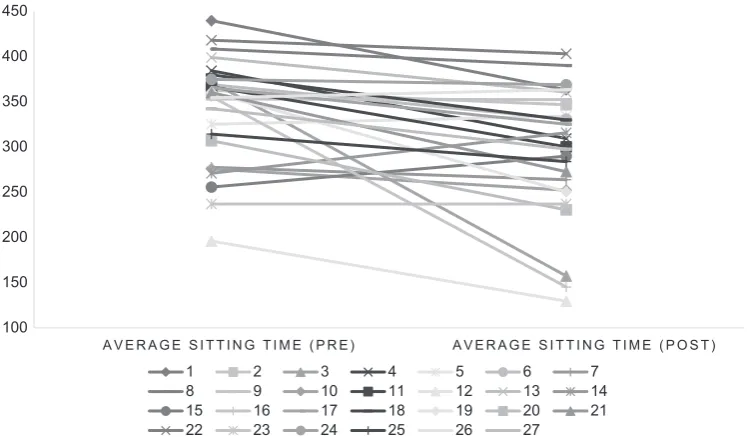
Figure 2 indicates the pre- and post-intervention ActivPAL data for each individual participant. Four participants increased their sedentary time at post assessment (participants 5, 14, 15, 26), and two participants remained the same (participants 9, 23). Table 2 represents the participants who achieved the recommendations of 2 h or 4 h of standing per work day on one or more of the evalu-ated days. Of the five participants who met or exceeded the 4 h recommendation, two had sit-to-stand workstations installed.
3.7. Post-intervention interviews
3.7.1. Decision to participate in the current project
The most prominent theme for taking part in the project was that participants were aware of their sitting behaviour and wanted to change their current behaviour (n = 11), followed by interest in the project or being involved in the data collection process (n = 7). This was characterised by responses such as:
Theme—awareness:
I was very aware that I had become probably the most sedentary in my life and having previously been quite active, so I needed to have a little bit of a wake-up call. (Participant 13)
I thought that I was sitting a little bit too much at work and I wanted to look at methods of changing that. (Participant 24)
I felt like I was really feeling the effects of being sedentary at work and I wanted to see if I could do something about it. (Participant 10)
Theme—interest:
I thought it would be an interesting experiment to undertake. (Participant 26)
Figure 2. Pre- and post-intervention 3-day ActivPAL data for sitting time (min) for each individual participant.
100 150 200 250 300 350 400 450
A V E R A G E S I T T I N G T I M E ( P R E ) A V E R A G E S I T T I N G T I M E ( P O S T )
1 2 3 4 5 6 7
8 9 10 11 12 13 14
15 16 17 18 19 20 21
22 23 24 25 26 27
I like to be involved in the research that our staff do. (Participant 22)
3.7.2. Motivation to complete goals
A variety of responses were provided for the motivations behind achieving goals. The two most prominent themes were wanting to improve health (n = 8), and having the self-determination to complete the goals (n = 5). This was characterised by responses such as:
Theme—health:
My motivation I guess was to get moving and improve my health. (Participant 26)
Healthy lifestyle and to feel better and not as tired. (Participant 21)
Theme—determination to complete project:
To actually just finish it and see the difference between the beginning and the end. (Participant 7)
Because I set them I knew that I had to reach them and I’m very determined. I don’t like to lose. (Participant 14)
3.7.3. Goal achievement
The majority of participants (n = 23) indicated that they achieved their goals or achieved some of their goals. This was characterised by responses such as:
Theme—goal achievement:
Yes, nearly every day I think there’s only one day where I forgot to go down and fill up my water bottle, I just went to the kitchen. (Participant 16)
Probably 65%, standing for lunch is really challenging because I knew that [colleagues were in the office space] and had lunch together. (Participant 12)
3.7.4. Most effective goals
Individual goals were set during the consultation period. As a collective group, there were some themes which indicated that walking further or up/down stairs to attend amenities (n = 7), standing when the phone rang and/or standing for the duration of the phone call (n = 8), walking further to fill a water bottle (n = 5), walking during a break (n = 4) and walking to visit colleagues or to a specific area (n = 5) were the most effective goals. This was characterised by responses such as:
Theme—walking based goals:
Probably just walking to a different floor to go to the toilet or fill a water bottle. (Participant 2)
Walking at lunch definitely … I think it helps you sort of get you mind back into what you’re doing. (Participant 15)
Table 2. Participants who met the recommendations of 2 h and 4 h of standing/moving pre- and post-intervention on one or more days during the ActivPAL data collection period
Recommendation Pre-intervention participant
number Post-intervention participant number
2 h of standing during the work day 15 20 4 h of standing during the work day 2 5
Going longer distance to the bathroom … visiting colleagues were the most useful. (Participant 12)
Theme—phone based goals:
The [goals] linked to the phone for sure, it’s much easier to stand up and talk. (Participant 22)
Standing up each time I sent an email and [answered the] phone because I didn’t realise how often I did those things. (Participant 23)
3.7.5. Least effective goals
There were some goals which were perceived as the least effective behaviour change goals for par-ticipants. These included standing while on the phone (n = 6), and walking during the day (n = 7). This was characterised by responses such as:
Theme—phone based goals:
Standing with the phone was a little challenging, because I monitor two phones. I have to move across the desk, which was probably easier but I actually had to remember to stand up and walk across the desk rather than just roll over. (Participant 7)
Standing when the phone rings extremely difficult to do it was only because it’s not a natural reaction … For me I knew someone was ringing about a purpose I needed to be organised so there were a couple times where if the phone rings my reaction is more about getting myself ready for the phone call rather than standing up. (Participant 8)
Theme—walking based goals:
When it was disgustingly hot and I didn’t go for a walk, but I did a couple of laps around the building just to get me up away from my desk and have a break. (Participant 19)
The [goal] that I chose to walk to [another building] each time I got a [request specific to role] wasn’t effective because for some reason, things went well and I didn’t get to walk to the [building]. (Participant 23)
3.7.6. Contact with principal investigator
Participants were asked to reflect on their thoughts regarding receiving regular communication with the principal investigator. Participants (n = 17) identified that receiving a weekly phone call, email or visit was a good reminder of the project and their goals, and to keep them on track. This was char-acterised by responses such as:
Theme—accountability and prompt:
Yes, it truly did prompt me and helped me remember … (Participant 27)
It just reinforces to us that we need to be on track. (Participant 16)
I think it’s good to have that reminder especially in the early stages as of once you get past the first week I would think you are okay. (Participant 22)
It was (not) so much that I was doing anything wrong but to keep on track and to keep motivated with it, the end is in sight. (Participant 26)
I found that helpful because it made me think I am accountable for this and am I on track. (Participant 6)
Conversely, some participants (n = 6) indicated that they did not need to be contacted as they would continue with their goals in a self-directed manner. This was characterised by responses such as:
Theme—internal motivation:
I don’t think it would have influenced me because I’m committed to do it, so I do it. (Participant 11)
Not so much, but probably just to make sure that if you are having issues with the
intervention that you’ve chosen that you think about something else along the way so that would probably be the only thing but I’m fairly self-sufficient so emails were fine for me. (Participant 13)
3.7.7. Information/education
Participants were provided with information based on the key health outcomes determined from the initial online survey, and a sample of their baseline ActivPAL data. Participants were asked to reflect on their experience regarding receiving information. Participants found the information interesting (n = 7), they thought the ActivPAL data were particularly useful (n = 7), and that the information was read at the beginning of the intervention but was not referred to later (n = 7). This was characterised by responses such as:
Theme—interesting:
[The information] was really interesting … (Participant 10)
Theme—individualised ActivPAL data was useful:
Those red lines [on the ActivPAL graph] that is very good to see and actually I thought that could improve…it’s quite good to see it usually visually. (Participant 21)
I did find [the ActivPAL data] very interesting … I thought that I was probably walking around a lot more… so it was a little bit of an eye open up to realise I was so inactive … (Participant 27)
Theme—useful but not revisited:
I read it after the discussion I sat it on my desk and I’ve walked away and not read it since. (Participant 11)
I did refer to it when you came to me, but I don’t know, I don’t recall going back to it during the time. (Participant 6)
3.7.8. Workbook
Participants were asked about the feasibility of using a workbook to record their sitting and standing behaviours. Sixteen participants suggested that completing the workbook was difficult or monoto-nous. This was characterised by responses such as:
Theme—difficult or monotonous:
To be honest that was the hardest part because you’re wanting to be accurate but at the same time as you’re doing it [thinking] “I think I did this”. (Participant 26)
The workbook is hard … I had to set reminders on my phone about the workbook and people would get annoyed. (Participant 24)
Although the workbook was perceived as a difficult task, 22 participants suggested that the work-book was a helpful reminder or prompt to complete their goals.
Theme—reminder or prompt:
It was a reminder that if I hadn’t stood up for an hour then I had to write down 30 min of not doing anything, it was like, I should probably get up! So yeah it was good in prompting me to actually get up and go to the toilet or kitchen. (Participant 7)
Yeah particularly if I did [the workbook] at the end of the day because it gave me more time to think about what I need to do or do better tomorrow. (Participant 6)
I’d have it right in front of me so I it would remind me to get up and try and do something so it did help. (Participant 27)
Yep it was a reminder that if it’s not written down then it didn’t happen. (Participant 22)
3.7.9. Overall perception of the intervention in regards to reducing sedentary behaviour in the workplace
Participants (n = 12) indicated that the intervention has increased their awareness of their occupa-tional sedentary behaviour. This was characterised by responses such as:
Theme—awareness:
It’s made me more conscious of it like knowing what you told me at the beginning, knowing I’m at work for seven hours I’m sitting for six of those hours and trying to get that to at least half and half … was always in the back of my mind somewhere so I’m conscious of that and that was an interesting figure to put on it. (Participant 10)
It was good for awareness of the consciousness of being a bit more active and that you can be more active around the place and standing meetings we had a few times where I’ve run into people and they say let’s go sit down for a bit but I would say no let’s just keep standing. (Participant 8)
It’s made me think about it that bit more … even this week where I’m not doing [the intervention] I’ve still got those habits going on my own. (Participant 19)
4. Discussion
The aim of the current study was to evaluate the effectiveness of a theory-informed intervention for the reduction of sedentary behaviour of office workers. As a result of individualised consultations which included goal setting, the provision of information, self-commitment and self-monitoring, there was a reduction in sedentary behaviour. Irrespective of the inclusion of sit-to-stand desks in the goal setting process, a significant reduction in occupational sedentary behaviour occurred. The simplistic strategies have resulted in similar findings to those of Swartz et al. (2014) who observed a reduction in occupational sedentary behaviour as a result of prompt-based behaviour change. These findings may be the initial steps to changing behaviour which Buckley et al. (2015) suggests could be the early stages of achieving the recommendations of standing or moving for 2–4 h per work day. This is evidenced by the increased number of participants reaching the minimum of 2 h of standing or moving during the work day on one or more of the analysed days after the intervention. As three participants met the 4 h recommendation on one or more of the analysed days without access to a sit-to-stand station, it is possible for this cohort of office workers to meet the guidelines. Overall, the participants indicated that the intervention raised their awareness of their occupational sedentary behaviour.
Goal setting was a large focus of the intervention as previous literature has shown promising re-sults (Fitzsimons et al., 2013; Green, Sigurdsson, & Wilder, 2016; Lewis et al., 2016). Goals provide a strong sense of purpose and direction (Bandura, 1988), and relate to efficacy where high self-efficacy is associated with commitment to achieving set goals (Locke, 1996). To reinforce the partici-pants’ commitment, they signed a self-contract which has previously been included as a behaviour change strategy in sedentary behaviour research (Fitzsimons et al., 2013). This aspect may enhance the self-liberation process of change which is particularly useful when transitioning between the preparation and action stages (Prochaska et al., 1992). The majority of goals were prompt based and surrounded purposeful standing or walking such as going for a walk at morning tea, standing or walking when interacting with colleagues instead of sending an email, walking further to amenities and standing for the duration of a phone call. Participants in the current study identified walking further or up/down stairs to attend amenities, standing when the phone rang and/or standing for the duration of the phone call, and walking further to fill water bottle, and walking during a break or visiting a colleague as the most effective goals within their work environments. Coincidentally, standing when the phone rang or while on the phone, and walking during the day were considered to be the least effective for participants. This suggests that goals and specific strategies need to be individually tailored (Marcus et al., 1998, 2007), match the level of willingness to change behaviour (Prochaska & DiClemente, 1983), and involve the participant in the development of individual goals to enhance perceived control (Bandura, 1997). The goals incorporated in the current study can be widely implemented to other work environments to match the desired outcomes of an individual worker. Similarly, other prompt-based strategies such as wrist watches that vibrate (Swartz et al., 2014) or computer-based software that inhibit computer work (Cooley, Pedersen & Mainsbridge, 2014) could offer low-cost solutions to occupational sedentary behaviour.
As a result of all participants completing at least one day of the desired behaviour change, it can be suggested that all participants moved to or remained in the action stage of the TM (Prochaska & DiClemente, 1982). The key processes of change incorporated in the current study were conscious-ness raising, helping relationships and self-liberation. As providing health related information is con-sidered to be a promising behaviour change strategy (Gardner et al., 2016), consciousness raising was incorporated into the intervention. This was done by providing ActivPAL data and specific cohort information based on the online survey responses to the participants at the beginning of the inter-vention to increase knowledge and awareness (Prochaska, Velicer, DiClemente, & Fava, 1988), how-ever it appeared that the ActivPAL data (individual data) were more useful than the cohort information. Consciousness raising may have commenced before the provision of early information as the participants indicated that their most prominent reason for participating in the project was an awareness of their sedentary behaviour. The principal investigator acted in a supportive role by dis-cussing the progress of the goals on a regular basis, as the participants were provided an opportu-nity to express their thoughts and re-evaluate goals it is likely that this may be considered a helping relationship (Prochaska et al., 1988). The participants acknowledged that the regular contact was a useful reminder and kept them on track although some participants recognised that they could complete their goals independently and did not require regular contact. This highlights that an inter-vention targeting behaviour change should be individually tailored (Marcus et al., 1998, 2007) and multi-component (Chu et al., 2016) to address personal preferences (Gilson et al., 2011; McGuckin et al., 2017). Additionally, at the commencement of the intervention, three participants had access to a sit-to-stand station and an another three acquired a station as a result of the initial consultation whereby they asked their managers to purchase a station or borrow one that wasn’t being used. This could also be seen as another instance of a helping relationship to assist and support occupational behaviour change (Prochaska et al., 1988). As the participants were involved with the design and implementation of their own goals, self-liberation may occur (Prochaska et al., 1988) which may in-crease perceived control of their own behaviour change (Ajzen, 2012) although these aspects were not directly assessed.
In regards to the TPB, it is likely that the participants intended to change their behaviour (Ajzen, 2012) as a result of volunteering for the study and by indicating a timeframe for when they perceive the changes in behaviour to occur. The participants made a decision to participate in the study sug-gesting they may have already been motivated to decrease their sedentary behaviour. While not assessed, the author’s postulate the participants may have perceived their significant work col-leagues would support their decision to participate otherwise they may not have volunteered for the study (Prapavessis et al., 2015). Although there are some preliminary suggestions based on the cur-rent work, further research is required to explore the TPB in the field of sedentary behaviour (Prapavessis et al., 2015).
As a result of completing the six-week intervention, participants were able to reduce their occupa-tional sedentary behaviour and increase their self-efficacy to sustain their behaviour change. Setting goals has been linked to increased beliefs in an individual’s capabilities (Bandura, 1988). While not assessed, the positive behaviour change is indicative that the participants may have had successful personal mastery experiences by achieving their goals, which increased their self-efficacy levels (Bandura, 1997). The participants acknowledged that they intend to continue with their behaviour change and increased self-efficacy is crucial for persisting with a desired behaviour change espe-cially when facing obstacles (Bandura, 1997).
The use of self-reporting for occupational sedentary behaviour was not an effective monitoring tool as only 10 participants provided complete data sets. Almost half of the participant group also indicated that completing the workbook was difficult. This may be due to the arduous timeframes for reporting (Hardy et al., 2013) however this timeframe was chosen as previous literature has sug-gested sedentary behaviour should be interrupted every 20–30 min (Atlas & Deyo, 2001; Dunstan, Howard, Healy, & Owen, 2012). Although no statistical significance between pre- and post-data was found, the use of self-reporting was successfully incorporated as a specific behaviour change strat-egy (Gardner et al., 2016) which involves consciousness raising by having direct feedback available (Prochaska et al., 1992). In the current study, participants perceived the workbook as an effective prompting tool to monitor their behaviour and to plan or change their behaviour during the interven-tion period. Therefore, future studies may wish to use a self-monitoring strategy to prompt behav-iour change however consideration is needed in regards to the time commitment associated with completing the workbook.
This study offers interesting insights into the use of theory-informed strategies for reducing oc-cupational sedentary behaviour however there are some limitations. These include that the findings may not be representative of other workplaces and the predominantly female participant sample. Additionally, the recruitment processes for the study was voluntary which may lead to a potential bias towards individuals who are already conscious of their health and prepared to change their behaviour. As changing behaviour is long-term, future research could investigate if the participants who successfully changed their behaviour have progressed to the maintenance stage of the TM (Prochaska & DiClemente, 1982) and explore the reasons for withdrawals from the behaviour change intervention such as real or perceived barriers.
5. Conclusion
A theory-informed intervention including individualised consultations with the key behaviour strate-gies of goal setting, the provision of information, self-commitment and self-monitoring, resulted in a reduction in occupational sedentary behaviour for office workers, increased awareness of seden-tary behaviours and an increase in self-efficacy to change sedenseden-tary behaviour patterns. The reduc-tions were irrespective of the inclusion of sit-to-stand workstareduc-tions and suggest that simplistic strategies can be incorporated into an intervention if they are individually tailored. The potential bias towards the inclusion of health conscious individuals may be a limitation when interpreting the re-sults. Further evaluation of the strategies is needed to explore if successful behaviour change can be achieved long-term.
Declarations
Ethics approval and consent to participate.
Ethics approval for this study was granted by the James Cook University Ethics Committee (H6654). All participants provided written informed consent.
Acknowledgements
The authors would like to thank the study participants. Funding
The authors received no direct funding for this research. Competing Interests
The authors declare no competing interest. Author details
Teneale McGuckin1
E-mail: [email protected] Rebecca Sealey2
E-mail: [email protected] Fiona Barnett1
E-mail: [email protected]
ORCID ID: http://orcid.org/0000-0002-7927-6098
1 Sport & Exercise Science, James Cook University, Townsville, Australia.
2 College of Healthcare Sciences, James Cook University, Townsville, Australia.
Citation information
Cite this article as: The use and evaluation of a theory-informed, multi-component intervention to reduce sedentary behaviour in the workplace, Teneale McGuckin, Rebecca Sealey & Fiona Barnett, Cogent Psychology (2017), 4: 1411038.
References
Ajzen, I. (1991). The theory of planned behavior. Organizational Behavior and Human Decision Processes,50(2), 179–211.
doi:10.1016/0749-5978(91)90020-T
American College of Sports Medicine. (2014). ACSM’s health-related physical fitness assessment manual. Baltimore, MD: Lippincott, Williams & Wilkins.
Ajzen, I. (2012). The theory of planned behaviour. In P.A.M Van Lange, A. W. Kruglanski, & E. T. Higgins (Eds.), Handbook of theories of social psychology: Volume 1 (pp. 438–459). London: SAGE Publications Ltd.
https://doi.org/10.4135/9781446249215
Alkhajah, T. A., Reeves, M. M., Eakin, E. G., Winkler, E. A. H., Owen, N., & Healy, G. N. (2012). Sit-stand workstations: A pilot intervention to reduce office sitting time. American Journal of Preventive Medicine,43(3), 298–303. doi:10.1016/j.amepre.2012.05.027
Atlas, S. J., & Deyo, R. A. (2001). Evaluating and managing acute low back pain in the primary care setting. Journal of General Internal Medicine,16(2), 120–131.
doi:10.1046/j.1525-1497.2001.91141.x
Bandura, A. (1988). Organisational applications of social cognitive theory. Australian Journal of Management,13(2), 275–302. doi:10.1177/031289628801300210
Bandura, A. (1997). Self-efficacy the exercise of control (pp. 1–115). New York, NY: W.H. Freeman and Company. Bennie, J. A., Pedisic, Z., Timperio, A., Crawford, D., Dunstan, D.,
Bauman, A., … Salmon, J. (2015). Total and domain-specific sitting time among employees in desk-based work settings in Australia. Australian and New Zealand Journal of Public Health,39(3), 237–242.
doi:10.1111/1753-6405.12293
Biddle, S. J. H., & Bennie, J. (2017). Editorial for special issue: Advances in sedentary behaviour research and translation. AIMS Public Health,4(1), 33–37. doi:10.3934/ publichealth.2017.1.33
Braun, V., & Clarke, V. (2006). Using thematic analysis in psychology. Qualitative Research in Psychology,3(2), 77– 101. doi:10.1191/1478088706qp063oa
Buckley, J. P., Hedge, A., Yates, T., Copeland, R. J., Loosemore, M., Hamer, M., … Dunstan, D. W. (2015). The sedentary office: An expert statement on the growing case for change towards better health and productivity. British Journal of Sports Medicine,49(21), 1357–1362.
doi:10.1136/bjsports-2015-094618
Buckley, J. P., Mellor, D. D., Morris, M., & Joseph, F. (2014). Standing-based office work shows encouraging signs of attenuating post-prandial glycaemic excursion.
Occupational and Environmental Medicine,71(2), 109–111.
doi:10.1136/oemed-2013-101823
Buckworth, J., Dishman, R. K., O’Connor, P. J., & Tomporowski, P. D. (2013). Exercise psychology (pp. 349–351). Champaign, IL: Human Kinetics, Inc..
Cho, C. Y., Hwang, Y. S., & Cherng, R. J. (2012). Musculoskeletal symptoms and associated risk factors among office workers with high workload computer use. Journal of Manipulative and Physiological Therapeutics,35(7), 534– 540. doi:10.1016/j.jmpt.2012.07.004
Chu, A. H. Y., Ng, S. H. X., Tan, C. S., Win, A. M., Koh, D., & Müller-Riemenschneider, F. A. (2016). Systematic review and meta-analysis of workplace intervention strategies to reduce sedentary time in white-collar workers. Obesity Reviews,17(5), 467–481. doi:10.1111/obr.12388
Clarke, P., & Eves, F. (1997). Applying the transtheoretical model to the study of exercise on prescription. Journal of Health Psychology,2(2), 195–207.
doi:10.1177/135910539700200216
Cooley, D., Pedersen, S., & Mainsbridge, C. (2014). Assessment of the impact of a workplace intervention to reduce prolonged occupational sitting time. Qualitative Health Research,24(1), 90–101. doi:10.1177/1049732313513503
Das, B. M., Mailey, E., Murray, K., Phillips, S. M., Torres, C., & King, A. C. (2016). From sedentary to active: Shifting the movement paradigm in workplaces. Work,54(2), 481– 487. doi:10.3233/WOR-162330
Dunstan, D. W., Howard, B., Healy, G. N., & Owen, N. (2012). Too much sitting - A health hazard. Diabetes Research and Clinical Practice,97(3), 368–376. doi:10.1016/j. diabres.2012.05.020
Dunstan, D. W., Wiesner, G., Eakin, E. G., Neuhaus, M., Owen, N., & LaMontagne, A. D. (2013). Reducing office workers’ sitting time: Rationale and study design for the stand up Victoria cluster randomized trial. BMC Public Health,13(1), 1–14. doi:10.1186/1471-2458-13-1057
Fitzsimons, C. F., Kirk, A., Baker, G., Michie, F., Kane, C., & Mutrie, N. (2013). Using an individualised consultation and activPAL™ feedback to reduce sedentary time in older Scottish adults: Results of a feasibility and pilot study.
Preventive Medicine,57(5), 718–720. doi:10.1016/j. ypmed.2013.07.017
Gardiner, P. A., Eakin, E. G., Healy, G. N., & Owen, N. (2011). Feasibility of reducing older adults’ sedentary time.
American Journal of Preventive Medicine,41, 174–177. doi:10.1016/j.amepre.2011.03.020
Gardner, B., Smith, L., Lorencatto, F., Hamer, M., & Biddle, S. J. H. (2016). How to reduce sitting time? A review of behaviour change strategies used in sedentary behaviour reduction interventions among adults. Health Psychology Review, 10(1), 89–112. doi:10.1080/17437199.2015.1082146
Gardner, B., Whittington, C., McAteer, J., Eccles, M. P., & Michie, S. (2010). Using theory to synthesise evidence from behaviour change interventions: The example of audit and feedback. Social Science & Medicine,70(10), 1618– 1625. doi:10.1016/j.socscimed.2010.01.039
Gerr, F., Marcus, M., & Monteilh, C. (2004). Epidemiology of musculoskeletal disorders among computer users: Lesson learned from the role of posture and keyboard use.
Journal of Electromyography and Kinesiology,14(1), 25–31. doi:10.1016/j.jelekin.2003.09.014
Gilson, N. D., Burton, N. W., van Uffelen, J. G. Z., & Brown, W. J. (2011). Occupational sitting time: Employees’ perceptions of health risks and intervention strategies. Health Promotion Journal of Australia,22(1), 38–43. Green, N., Sigurdsson, S., & Wilder, D. A. (2016). Decreasing
bouts of prolonged sitting among office workers. Journal of Applied Behavior Analysis,49(3), 1–6. doi:10.1002/jaba.309
Hadgraft, N. T., Winkler, E. A. H., Healy, G. N., Lynch, B. M., Neuhaus, M., Eakin, E. G., … Fjeldsoe, B. S. (2017). Intervening to reduce workplace sitting: Mediating role of social-cognitive constructs during a cluster randomised controlled trial. International Journal of Behavioral Nutrition and Physical Activity,14(1), 1–9. doi:10.1186/ s12966-017-0483-1
Hardy, L. L., Hills, A. P., Timperio, A., Cliff, D., Lubans, D., Morgan, P. J., … Brown, H. (2013). A hitchhiker's guide to assessing sedentary behaviour among young people: Deciding what method to use. Journal of Science and Medicine in Sport, 16(1), 28–35. doi:10.1016/j.jsams.2012.05.010
Katzmarzyk, P. T., & Lee, I. M. (2012). Sedentary behaviour and life expectancy in the USA: A cause-deleted life table analysis. British Medical Journal,2(4), 1–6. doi:10.1136/ bmjopen-2012-000828
Katzmarzyk, P. T., Church, T. S., Craig, C. L., & Bouchard, C. (2009). Sitting time and mortality from all causes, cardiovascular disease, and cancer. Medicine & Science in Sports & Exercise,41(5), 998–1005. doi:10.1249/ MSS.0b013e3181930355
Keller, S., Herda, C., Ridder, K., & Basler, H. D. (2001). Readiness to adopt adequate postural habits: An application of the transtheoretical model in the context of back pain. Patient Education and Counseling,42(2), 175–184. doi:10.1016/ S0738-3991(00)00103-8
Kim, Y., & Welk, G. J. (2015). Criterion validity of competing accelerometry-based activity monitoring devices.
Medicine & Science in Sports & Exercise,47(11), 2456– 2463. doi:10.1249/MSS.0000000000000691
Kotecki, J. E. (2014). Physical activity and health: An interactive approach (4th ed.). Burlington, VT: Jones & Bartlett Learning. Lewis, L. K., Rowlands, A. V., Gardiner, P. A., Standage, M.,
English, C., & Olds, T. (2016). Small Steps: Preliminary effectiveness and feasibility of an incremental goal-setting intervention to reduce sitting time in older adults.
Maturitas,85, 64–70. doi:10.1016/j.maturitas.2015.12.014
Locke, E. A. (1996). Motivation through conscious goal setting.
Applied & Preventive Psychology,5(2), 117–124.
doi:10.1016/S0962-1849(96)80005-9
Marcus, B. H., & Simkin, L. R. (1994). The transtheoretical model: Applications to exercise behavior. Medicine and Science in Sports and Exercise,26(11), 1400–1404.
doi:10.1249/00005768-199411000-00016
Marcus, B. H., Bock, B. C., Pinto, B. M., Forsyth, L. H., Roberts, M. B., & Traficante, R. M. (1998). Efficacy of an individualized, motivationally-tailored physical activity intervention.
Annals of Behavioral Medicine,20(3), 174–180.
doi:10.1007/BF02884958
Marcus, B. H., Napolitano, M. A., Lewis, B. A., Whiteley, J. A., Albrecht, A., Parisi, A., … Papandonatos, G. D. (2007). Telephone versus print delivery of an individualized motivationally tailored physical activity intervention: Project STRIDE. Health Psychology,26(4), 401–409.
doi:10.1037/0278-6133.26.4.401
McAuley, E. (1993). Self-efficacy and the maintenance of exercise participation in older adults. Journal of Behavioral Medicine,16(1), 103–113. doi:10.1007/BF00844757
McGuckin, T., Sealey, R., & Barnett, F. (2017). Planning for sedentary behaviour interventions: Office workers’ survey and focus group responses. Perspectives in Public Health, Eprint. doi:10.1177/1757913917698003
Michie, S., Richardson, M., Johnston, M., Abraham, C., Francis, J., Hardeman, W., … Wood, C. E. (2013). The behavior change technique taxonomy (v1) of 93 hierarchically clustered techniques: Building an international consensus for the reporting of behavior change interventions. Annals of Behavioral Medicine,46(1), 81–95.
doi:10.1007/s12160-013-9486-6
Michie, S., van Stralen, M. M., & West, R. (2011). The behaviour change wheel: A new method for characterising and designing behaviour change interventions.
Implementation Science,6(1), 42–54.
doi:10.1186/1748-5908-6-42
Neuhaus, M., Healy, G. N., Dunstan, D. W., Owen, N., & Eakin, E. G. (2014a). Workplace sitting and height-adjustable workstations: A randomized control trial. American Journal of Preventive Medicine,46(1), 30–40. doi:10.1016/j.amepre.2013.09.009
Neuhaus, M., Healy, G. N., Fjeldsoe, B. S., Lawlor, S., Owen, N., Dunstan, D. W., … Eakin, E. G. (2014b). Iterative development of stand up Australia: A multi-component intervention to reduce workplace sitting. International Journal of Behavioral Nutrition and Physical Activity,11(1), 1–11. doi:10.1186/1479-5868-11-21
PAL Technologies Ltd. (2010). ActivPAL3TM operating guide (PA LaP3manual.2031.40525.1.3.docx) (pp. 1–19). Glasgow: PAL Technologies Ltd.
Parry, S., & Straker, L. (2013). The contribution of office work to sedentary behaviour associated risk. Public Health, 13(296), 1–10. doi:10.1186/1471-2458-13-296
Prapavessis, H., Gaston, A., & DeJesus, S. (2015). The theory of planned behaviour as a model for understanding sedentary behaviour. Psychology of Sport and Exercise,19, 23–32. doi:10.1016/j.psychsport.2015.02.001
Prochaska, J. O., & DiClemente, C. C. (1982). Transtheoretical therapy: Toward a more integrative model of change.
Psychotherapy: Theory, Research & Practice,19(3), 276– 288. doi:10.1037/h0088437
Prochaska, J. O., & DiClemente, C. C. (1983). Stages and processes of self-change of smoking: toward an integrative model of change. Journal of Consulting and Clinical Psychology,51(3), 390–395.
doi:10.1037/0022-006X.51.3.390
Prochaska, J. O., DiClemente, C. C., & Norcross, J. C. (1992). In search of how people change: Applications to addictive behaviors. American Psychologist,47(9), 1102–1114.
doi:10.1037/0003-066X.47.9.1102
Prochaska, J. O., Norcross, J. C., & DiClemente, C. C. (2013). Applying the stages of change. Psychotherapy in Australia, 19(2), 10–15.
Prochaska, J. O., & Velicer, W. F. (1997). The transtheoretical model of health behavior change. American Journal of Health Promotion,12(1), 38–48.
https://doi.org/10.4278/0890-1171-12.1.38
Prochaska, J. O., Velicer, W. F., DiClemente, C. C., & Fava, J. (1988). Measuring processes of change: Applications to the cessation of smoking. Journal of Consulting and Clinical Psychology,56(4), 520–528.
doi:10.1037//0022-006X.56.4.520
Rhodes, R. E., Mark, R. S., & Temmel, C. P. (2012). Adult sedentary behaviour a systematic review. American Journal of Preventive Medicine,42(3), e3–e28. doi:10.1016/j.amepre.2011.10.020
Spencer, L., Adams, T. B., Malone, S., Roy, L., & Yost, E. (2006). Applying the transtheoretical model to exercise: A systematic and comprehensive review of the literature.
Health Promotion Practice,7(4), 428–443.
doi:10.1177/1524839905278900
Stephens, S. K., Winkler, E. A. H., Trost, S. G., Dunstan, D. W., Eakin, E. G., Chastin, S. F. M., & Healy, G. N. (2014). Intervening to reduce workplace sitting time: How and when do changes to sitting time occur? British Journal of
Sports Medicine,48(13), 1037–1042.
doi:10.1136/bjsports-2014-093524
Swartz, A. M., Rote, A. E., Welch, W. A., Maeda, H., Hart, T. L., Cho, Y. I., & Strath, S. J. (2014). Prompts to disrupt sitting time and increase physical activity at work, 2011-2012.
Preventing Chronic Disease,11, 1–8.
doi:10.5888/pcd11.130318
Umstattd Meyer, M., Wu, C., & Walsh, S. M. (2016). Theoretical antecedents of standing at work: An experience
sampling approach using the theory of planned behavior. AIMS Public Health,3(4), 682–701. doi:10.3934/publichealth.2016.4.682
Urda, J. L., Lynn, J. S., Gorman, A., & Larouere, B. (2016). Effects of a minimal workplace intervention to reduce sedentary behaviors and improve perceived wellness in middle-aged women office workers. Journal of Physical Activity & Health,13(8), 838–844.
doi:10.1123/jpah.2015-0385
© 2017 The Author(s). This open access article is distributed under a Creative Commons Attribution (CC-BY) 4.0 license. You are free to:
Share — copy and redistribute the material in any medium or format
Adapt — remix, transform, and build upon the material for any purpose, even commercially. The licensor cannot revoke these freedoms as long as you follow the license terms. Under the following terms:
Attribution — You must give appropriate credit, provide a link to the license, and indicate if changes were made. You may do so in any reasonable manner, but not in any way that suggests the licensor endorses you or your use. No additional restrictions
You may not apply legal terms or technological measures that legally restrict others from doing anything the license permits.
Cogent Psychology (ISSN: 2331-1908) is published by Cogent OA, part of Taylor & Francis Group. Publishing with Cogent OA ensures:
• Immediate, universal access to your article on publication
• High visibility and discoverability via the Cogent OA website as well as Taylor & Francis Online • Download and citation statistics for your article
• Rapid online publication
• Input from, and dialog with, expert editors and editorial boards • Retention of full copyright of your article
• Guaranteed legacy preservation of your article
• Discounts and waivers for authors in developing regions
Submit your manuscript to a Cogent OA journal at www.CogentOA.com