Advance Access publication 2019 January 28
Truly eccentric – I. Revisiting eight single-eccentric planetary systems
Robert A. Wittenmyer ,
1‹Jake T. Clark,
1Jinglin Zhao,
2Jonathan Horner,
1Songhu Wang
3,4and Daniel Johns
51Centre for Astrophysics, University of Southern Queensland, USQ Toowoomba, QLD 4350, Australia 2UNSW School of Physics, Sydney, NSW 2052, Australia
3Department of Astronomy, Yale University, 52 Hillhouse Avenue, New Haven, CT 06511, USA 451 Pegassi Fellow
5Department of Physical Sciences, Kutztown University, Kutztown, PA 19530, USA
Accepted 2019 January 23. Received 2019 January 22; in original form 2018 November 13
A B S T R A C T
We examine eight known single-eccentric planetary systems in light of recently released large data archives and new analysis techniques. For four of these systems (HD 7449, HD 65216, HD 89744, HD 92788) we find evidence for additional long-period companions. HD 65216c is a Jupiter analogue, with a period of 14.7 yr, e= 0.18, and m sin iof 2MJup, while the remaining candidate companions move on as-yet-incomplete orbits. Our results highlight the importance of revisiting the analysis of known exoplanetary systems when new data become available, particularly given the possibility that poorly sampled data might previously have led to the detection of a ‘false-positive’ single-eccentric planet, when the system in question actually contains two (or more) planets on near-circular orbits.
Key words: techniques: radial velocities – planets and satellites: detection – stars: individ-ual: HD 7449 – stars: individindivid-ual: HD 65216 – stars: individindivid-ual: HD 89744 – stars: individindivid-ual: HD 92788.
1 I N T R O D U C T I O N
In the past thirty years, the discovery of planets orbiting other stars has moved from being an unfulfilled dream to an apparently routine process. The first planets discovered orbiting Sun-like stars were discovered using the radial velocity (RV) technique (e.g. Campbell,
Walker & Yang1988; Latham et al.1989; Mayor & Queloz1995;
Butler & Marcy 1996), which dominated the discovery of new
planets for the first two decades of the Exoplanet Era, and still plays a vital role in our ongoing search for alien worlds (e.g. Bonfils et al.
2013; Fischer et al.2016; Butler et al.2017).
The RV technique enables astronomers to probe a unique region of the exoplanetary discovery phase space. While it is most sensitive to massive planets moving on short-period orbits, if observations of a given star are continued over a long enough period, the technique can be used to find Jupiter- and Saturn-analogues: massive planets moving on orbits with periods measured in decades, rather than
days (e.g. Zechmeister et al.2013; Wittenmyer et al.2014; Endl
et al.2016; Santos et al.2016). Doing this requires observations
covering most, if not all, of a complete orbital period of the planet in question.
For this reason, legacy RV surveys such as the Anglo-Australian
Planet Search (e.g. Carter et al.2003; Jones et al.2010; Tinney
et al.2011; Wittenmyer et al.2017a) offer a unique window to the
E-mail:[email protected]
true diversity of exoplanetary systems, and currently represent a significant resource for understanding the degree to which the Solar
system is unique (e.g. Wittenmyer et al.2011; Fressin et al.2013;
Wittenmyer et al.2016; Bryan et al.2018).
Although such surveys deliver long-period coverage of their target stars, the data they yield is typically only sparsely sampled, with just a few observational epochs per year, particularly in the
latter stages of a survey’s lifetime (Wittenmyer et al.2013b). While
such observations are more than adequate to identify the presence of planets moving on long-period orbits, the analysis of such data is fraught with unusual challenges related to the sparsely sampled nature of the data.
Of particular interest is the question of the multiplicity in planetary systems discovered using sparse RV data. With limited data, it can be possible to miss the presence of additional planets, by focusing too heavily on a single, dominant signal. At the same time, it is possible to find ‘planets’ that do not actually exist, by identifying periodicities in the data that either vanish with the acquisition of more observations, or turn out to be the result of other astrophysical
phenomena (such as stellar activity, e.g. Robertson et al. 2014;
Robertson, Roy & Mahadevan2015; Rajpaul, Aigrain & Roberts
2016; D´ıaz et al.2018; Hatzes et al.2018).
Science is the pursuit of truth. In that spirit, it remains critically important to revise our understanding of the architectures of planetary systems as new data become available. There is a vast body of literature concerning the analysis of RV data for planetary signals in the midst of the confounding effects of sparse sampling and stellar
2019 The Author(s)
noise. Of particular relevance is work that has reanalysed data on known planetary systems to confirm, clarify, or refute the published
planetary parameters (e.g. Dawson & Fabrycky2010; Jenkins &
Tuomi2014; K¨urster et al.2015; Trifonov et al.2017). One
well-known problem is the degeneracy between a single-eccentric planet and two circular planets in 2:1 period commensurability (e.g.
Anglada-Escud´e, L´opez-Morales & Chambers2010; Wittenmyer
et al.2013a; Boisvert, Nelson & Steffen2018). In a companion
paper (Wittenmyer et al.2019), we examine this idea is some detail,
using simulated data to study the variety of ‘false-positive’ single planets moving on eccentric orbits that can be mistakenly identified as a result of poorly sampled observations of such a deceptive couplet. We find that the such ‘false-positives’ typically occupy a
‘danger-zone’, with orbital eccentricities between∼0.21 and∼0.46
accounting for 95 per cent of all cases of mistaken identity for a pair of planets in, or close to, mutual 2:1 mean-motion resonance.
Following this logic, Wittenmyer et al. (2013a) investigated 82
known single-eccentric (e>0.3) planetary systems, and explored
the possibility that the observed RV data could be better fit with two planets in nearly circular orbits. They found a subset of nine systems for which a two-planet solution reasonably fit the data and satisfied dynamical stability tests. In this work, we revisit those systems in light of newly available data and new analysis techniques.
This paper is organized as follows: Section 2 describes the RV data used here and our analysis approach. Section 3 gives the results of the updated orbital solutions and discusses the new planets in further detail. Finally, we give our conclusions in Section 4.
2 DATA A N D A N A LY S I S T E C H N I Q U E S
In this section, we describe the provenance of the various data sets used in our analysis. We also detail the techniques used to identify and fit Keplerian orbits to the RV data, as well as techniques to test the veracity of the derived signals.
2.1 Radial velocity data
The RV data were obtained largely from the public releases of the Lick and Keck planet search programs (Fischer, Marcy & Spronck
2014; Butler et al.2017), and the ESO archive of publicly available
HARPS spectra. The Keck data archive was recently corrected for several small but noticeable systematic effects by Tal-Or et al.
(2019), and here we use their corrected velocities for HD 3651,
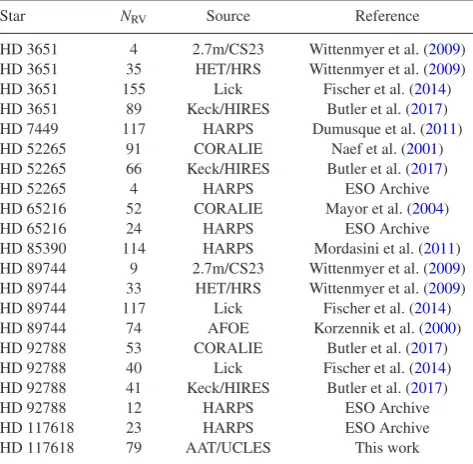
HD 52265, and HD 92788. Table 2 summarizes the origin and
properties of the data used herein. No fresh observational data were
available for the ninth system noted in Wittenmyer et al. (2013a),
GJ 649, and hence that system was not investigated in this work.
Table1gives a brief summary of the stellar properties for the eight
stars considered here.
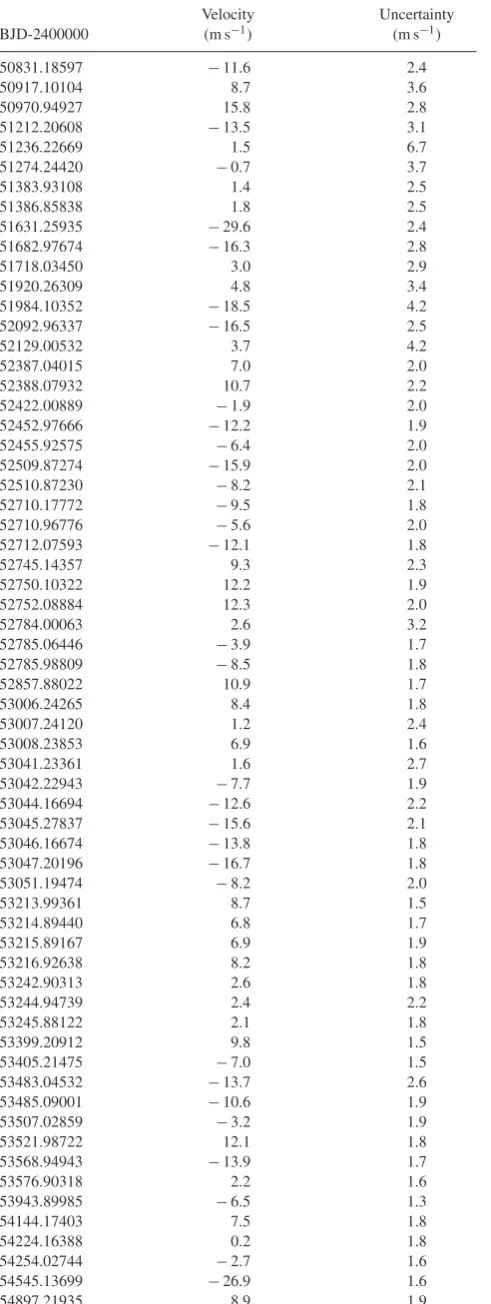
For HD 117618, we included previously unpublished data from the 3.9 m Anglo-Australian Telescope; the complete set of 79 AAT
velocities is now given in Table 3. The HARPS fibre feed was
upgraded on JD 2457161 (Lo Curto et al.2015), and hence we treat
[image:2.595.307.546.72.186.2]all data after that point as coming from a separate instrument with its own velocity offset as a free parameter in the fitting process. For all data sets, where there were multiple observations in a single night, we binned them together using the weighted mean value of the velocities in each night. We adopted the quadrature sum of the rms about the mean and the mean internal uncertainty as the error bar of each binned point.
Table 1. Summary of stellar parameters.
Star Teff logg Mass Reference
K cgs M
[image:2.595.307.544.224.456.2]HD 3651 5221 4.45 0.799 Valenti & Fischer (2005) HD 7449 6024 4.51 1.053 Sousa et al. (2008) HD 52265 6136 4.36 1.204 Sousa et al. (2008) HD 65216 5612 4.44 0.874 Sousa et al. (2008) HD 85390 5186 4.41 0.758 Sousa et al. (2008) HD 89744 6291 4.07 1.860 Valenti & Fischer (2005) HD 92788 5744 4.39 1.032 Sousa et al. (2008) HD 117618 5990 4.41 1.077 Sousa et al. (2008)
Table 2. Summary of RV data.
Star NRV Source Reference
HD 3651 4 2.7m/CS23 Wittenmyer et al. (2009) HD 3651 35 HET/HRS Wittenmyer et al. (2009) HD 3651 155 Lick Fischer et al. (2014) HD 3651 89 Keck/HIRES Butler et al. (2017) HD 7449 117 HARPS Dumusque et al. (2011) HD 52265 91 CORALIE Naef et al. (2001) HD 52265 66 Keck/HIRES Butler et al. (2017)
HD 52265 4 HARPS ESO Archive
HD 65216 52 CORALIE Mayor et al. (2004)
HD 65216 24 HARPS ESO Archive
HD 85390 114 HARPS Mordasini et al. (2011) HD 89744 9 2.7m/CS23 Wittenmyer et al. (2009) HD 89744 33 HET/HRS Wittenmyer et al. (2009) HD 89744 117 Lick Fischer et al. (2014) HD 89744 74 AFOE Korzennik et al. (2000) HD 92788 53 CORALIE Butler et al. (2017) HD 92788 40 Lick Fischer et al. (2014) HD 92788 41 Keck/HIRES Butler et al. (2017)
HD 92788 12 HARPS ESO Archive
HD 117618 23 HARPS ESO Archive
HD 117618 79 AAT/UCLES This work
2.2 Orbit fitting
To fit the RV data, we obtained Bayesian posterior distributions of each planetary system’s orbital parameters using the Markov Chain Monte Carlo (MCMC) code Exoplanet Mcmc Parallel tEmpering
Radial velOcity fitteR1(
ASTROEMPEROR, Jenkins & Pena, in
prepa-ration). As described in Wittenmyer et al. (2017b),ASTROEMPEROR
utilizes parallel tempering methods (Gregory2005) backed by an
affine invariant MCMC engine, deployed by the PYTHON EMCEE
package (Foreman-Mackey et al.2013). Using an affine invariant
algorithm such asEMCEEallows the MCMC analysis to perform
equally well under all linear transformations consequently being insensitive to covariances among the orbital-fitting parameters
(Foreman-Mackey et al.2013).
A model selection is performed automatically by EMPEROR,
whereby an arbitrary posterior comparison and threshold Bayes
factor of 5 and 150, respectively, is required for ak+ 1 planet
model to be better favoured than the previouskplanet model. The
ASTROEMPERORcode also automatically determines which of the orbital parameters, such as period and amplitude, are statistically significantly different from zero, with the Bayesian information
1https://github.com/ReddTea/astroEMPEROR
Table 3. AAT radial velocities for HD 117618.
BJD-2400000
Velocity (m s−1)
Uncertainty (m s−1)
50831.18597 −11.6 2.4
50917.10104 8.7 3.6
50970.94927 15.8 2.8
51212.20608 −13.5 3.1
51236.22669 1.5 6.7
51274.24420 −0.7 3.7
51383.93108 1.4 2.5
51386.85838 1.8 2.5
51631.25935 −29.6 2.4
51682.97674 −16.3 2.8
51718.03450 3.0 2.9
51920.26309 4.8 3.4
51984.10352 −18.5 4.2
52092.96337 −16.5 2.5
52129.00532 3.7 4.2
52387.04015 7.0 2.0
52388.07932 10.7 2.2
52422.00889 −1.9 2.0
52452.97666 −12.2 1.9
52455.92575 −6.4 2.0
52509.87274 −15.9 2.0
52510.87230 −8.2 2.1
52710.17772 −9.5 1.8
52710.96776 −5.6 2.0
52712.07593 −12.1 1.8
52745.14357 9.3 2.3
52750.10322 12.2 1.9
52752.08884 12.3 2.0
52784.00063 2.6 3.2
52785.06446 −3.9 1.7
52785.98809 −8.5 1.8
52857.88022 10.9 1.7
53006.24265 8.4 1.8
53007.24120 1.2 2.4
53008.23853 6.9 1.6
53041.23361 1.6 2.7
53042.22943 −7.7 1.9
53044.16694 −12.6 2.2
53045.27837 −15.6 2.1
53046.16674 −13.8 1.8
53047.20196 −16.7 1.8
53051.19474 −8.2 2.0
53213.99361 8.7 1.5
53214.89440 6.8 1.7
53215.89167 6.9 1.9
53216.92638 8.2 1.8
53242.90313 2.6 1.8
53244.94739 2.4 2.2
53245.88122 2.1 1.8
53399.20912 9.8 1.5
53405.21475 −7.0 1.5
53483.04532 −13.7 2.6
53485.09001 −10.6 1.9
53507.02859 −3.2 1.9
53521.98722 12.1 1.8
53568.94943 −13.9 1.7
53576.90318 2.2 1.6
53943.89985 −6.5 1.3
54144.17403 7.5 1.8
54224.16388 0.2 1.8
54254.02744 −2.7 1.6
54545.13699 −26.9 1.6
54897.21935 8.9 1.9
Table 3 –continued
BJD-2400000
Velocity (m s−1)
Uncertainty (m s−1)
54904.21631 −20.0 3.0
55313.10475 −0.3 1.6
55376.93190 0.1 1.7
55402.89522 −8.6 1.9
55665.16559 21.8 1.7
55964.26158 −3.9 1.6
56049.09986 15.3 2.0
56139.90461 −6.2 1.9
56379.15229 −22.6 2.5
56465.95754 17.9 2.5
56712.25065 −11.4 2.2
56749.13034 11.1 1.9
56767.03333 10.8 2.8
56794.95676 6.9 1.9
57054.25204 5.6 1.7
57095.19944 −7.0 3.1
criterion (BIC), Akaike information criterion (AIC), and maximum a posteriori probability (MAP) estimate values calculated for each planetary signal. Flat priors are applied to all parameters except for the eccentricity and jitter priors that are folded Gaussian and Jeffries,
respectively. The Bayesian phase-space forASTROEMPERORcan be
bounded by the following parameters:√ecosω,√esinω,√Kcosφ,
√
Ksinφ, andPwheree,ω,K,φ, andPare the orbital eccentricity,
argument of periastron, semi-amplitude, mean anomaly phase, and the orbital period. The mean anomaly phase is somewhat unique to ASTROEMPERORand is related to the mean anomalyM,P, and
epoch timetby:
φ=M−2π t
P
and is related by time at periastronT0by:
φ= −2π T0
P .
If boundaries are not defined,ASTROEMPERORwill then search
that parameter space in an unbounded manner.ASTROEMPERORwas
run with the majority of parameters being unbound except for the
orbital period of each planetary signal Pi. A candidate planet’s
orbital period was bounded between the Systemic’sPi−σPi and
Pi+σPi values. A caveat to the single boundary was HD 7449c,
which is explained further in Section 3.2. For our analysis, the ‘burn-in’ Markov-chains were 7 million iterations long (7 temperatures, 200 walkers, and 5000 steps) with another 14 million chains exploring the parameter space thereafter (10 000 steps instead of 5000).
We checked the consistency of our fits by next using theSystemic
Consoleversion 2.2000 (Meschiari et al.2009), fitting Keplerian
signals using a traditional ‘pre-whitening’ approach, whereby signals were identified and removed as successive peaks in the Generalized Lomb–Scargle periodogram (Zechmeister & K¨urster
2009). The results fromSystemicwere entirely consistent with those
fromASTROEMPEROR.
3 R E S U LT S
Our reanalysis of the eight systems considered here revealed three unconstrained long-period companions, as well as a new Jupiter analogue, HD 65216c, which is a giant planet moving on a
Table 4. Results fromastroEMPERORfits.
Planet Period Eccentricity ω φ K m sini a
d deg deg m s−1 MJup au
HD 3651b 62.250±0.004 0.645±0.02 243± 3 140±3 16.6± 0.6 0.228±0.011 0.295±0.029 HD 7449b 1255.5±5.1 0.92±0.03 69.9± 5.7 267.6±1.2 21.9± 2.6 0.508±0.111 2.38±0.04
HD 7449c 15441±1059 0.0 (fixed) 50± 16∗ 87±16 144± 31 19.2±4.2 12.7±0.6
HD 52265b 119.27±0.02 0.27±0.02 242± 3 18±3 42.97± 0.70 1.21±0.05 0.520±0.009 HD 65216b 577.6±1.328 0.27±0.02 212± 3 238±3 35.70± 1.28 1.295±0.062 1.301±0.020
HD 65216c 5370±20 0.17±0.04 123± 10 167±9 26.0± 1.2 2.03±0.11 5.75±0.09
HD 85390b 799.52±2.41 0.50±0.05 250± 8 76±6 3.8± 0.3 0.099±0.010 1.373±0.035
HD 89744b 256.78±0.02 0.677±0.003 193.7± 0.4 275.46±0.24 269.66± 1.45 8.35±0.18 0.917±0.009
HD 89744c 6974±2161 0.29±0.12 174± 26 65±32 45.1± 38.5 5.36±4.57 8.3±1.8
HD 92788b 325.72±0.03 0.351±0.004 277.6± 0.6 78.2±0.4 108.5± 0.6 3.78±0.18 0.971±0.023
HD 92788c 9857±926 0.18±0.08 262± 27 150±27 32.2± 5.7 3.64±0.69 9.43±0.63
HD 117618b 25.80±0.004 0.15±0.07 289± 64 278±50 10.90± 0.68 0.174±0.014 0.180±0.005
like orbit at 5.75±0.10 au. We also identify an activity-induced
signal in HD 85390, which mimics a Saturn analogue in the RV
curve (P∼18 yr,K∼3 m s−1). Table4gives our best-fitting solutions
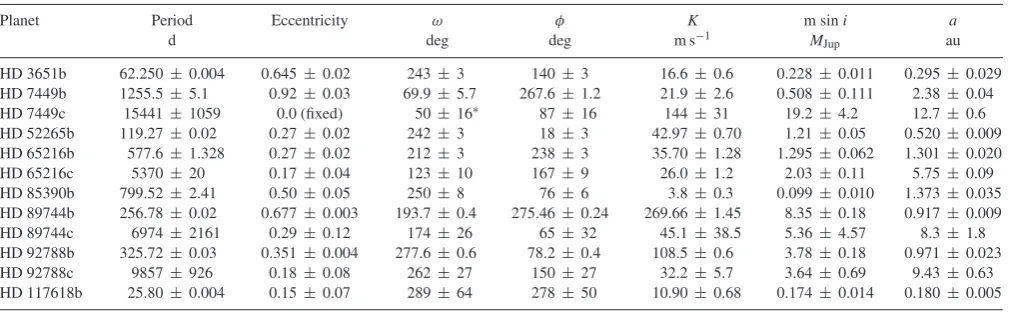
fromASTROEMPEROR, and Table5shows the fitted offsets and jitter
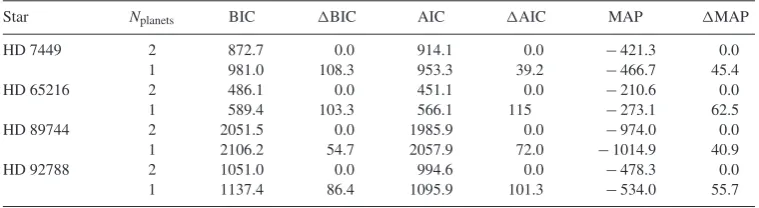
values for each data set. Data and model fits are shown in Figs1–6
for those systems in which we find evidence for new companions,
and Table6gives the BIC, AIC, and MAP values for the multiplanet
ASTROEMPERORfits.
3.1 HD 3651
While this system can be fit with two circular planets in a 2:1 configuration, doing so does not significantly improve the rms or goodness of fit, and does not justify the additional complexity. We
obtained a total rms of 6.54 m s−1about the one-planet fit using four
data sets. There is no evidence for any further incipient signals after removing the single-eccentric planet orbit.
3.2 HD 7449
We find a long-period trend with significant curvature, to which we fit a circular Keplerian orbit as the period is too long to meaningfully suggest any eccentricity. HD 7449c’s eccentricity was bounded by ASTROEMPERORhaving to explore√ecosωand√esinωbetween
0 and 10−6. One ofASTROEMPEROR’s shortfalls is the
eccentricity-periastron boundary entanglement, having to bound both√ecosω
and√esinω. Due to this entanglement, ASTROEMPEROR gave a
result forωwhich is irrelevant for a circular orbit and has been
disregarded in Table4. A thorough discussion of the nature of the
outer companion is given in Dumusque et al. (2011), with the added
leverage of seven years of CORALIE data which unfortunately remain unpublished. Our results support the presence of a brown
dwarf with minimum mass of 31MJupin a poorly constrained orbit of
at least∼42 yr. The high-eccentricity planet reported by Dumusque
et al. (2011) is then recovered, with a total rms of 4.21 m s−1around
the two-planet solution. Attempts to fit two circular planets in its stead failed to give convincing results; while Wittenmyer et al. (2013a) suggested a second planet atP∼615 d, the current data do not support that configuration. Examination of 8.8 yr (259 epochs) of All-Sky Automated Survey (ASAS) photometry (Pojmanski
2002) shows no periodicities of significance. The ASASV-band
photometry has a mean value of 7.493 ± 0.014 mag. We note
that the orbit of HD 7449b has a gap in phase coverage near the RV peak, and that its shape is quite similar to that of the recently discovered highly eccentric planet HD 76920b (Wittenmyer et al.
2017b). In that work, as in this one, the authors noted that the
system’s best-fittingeandωcould not be reproduced by the
double-circular degeneracy (e.g. Boisvert et al.2018). For HD 7449b, we
encourage further observations timed to capture in detail the next RV maximum, which will occur from 2020 May to 2020 July. We note that the HD 7449 system was thoroughly investigated by
Rodigas et al. (2016), who imaged the outer companion and used
RV constraints to determine that this star is orbited by a mid-M dwarf.
3.3 HD 52265
In addition to the CORALIE data of Naef et al. (2001), we now
include 66 epochs from Keck (Butler et al. 2017) and four new
epochs from HARPS (binned from 15 individual velocities). As for HD 3651, this system can be fit with two circular planets in the 2:1 configuration, but the single-eccentric solution remains preferred,
with a total rms of 10.1 m s−1. Our fit is consistent with the discovery
work (Naef et al.2001), except that we obtain a slightly smaller
eccentricity (e=0.26±0.02 here compared toe=0.35±0.03).
There is no evidence for any residual signals.
3.4 HD 65216
This system was originally reported to host a single-eccentric planet
withP = 613 d ande= 0.41 (Mayor et al.2004). Wittenmyer
et al. (2013a) speculated that the system may be decomposed into
two circular planets at 572 and 152 d. Our fit now excludes the possibility of an inner planet, strongly favouring instead a Jupiter
analogue withP=14.8 yr ate=0.17. We also find the shorter period
for HD 65216b proposed by Wittenmyer et al. (2013a) is preferred.
The new two-planet fit (Fig. 2) also reduces the eccentricity of
the inner planet to e = 0.29± 0.03, similar to the case of the
HD 159868 system (Wittenmyer et al.2012). It is possible for the
signal of a long-period, low-amplitude planet to be mimicked by a stellar magnetic activity cycle, which for solar-type stars targeted
by RV surveys has a typical duration ∼5–15 yr and amplitudes
of up to∼10 m s−1(Isaacson & Fischer2010; Lovis et al.2011;
Yee et al.2018). With a large and well-constrained velocity
semi-amplitude of Kc = 25.8± 1.3 m s−1, we are confident that the
signal seen for HD 65216 is due to an orbiting planet and not a stellar magnetic cycle. A check of 9.0 yr of ASAS photometry
for HD 65216 (Pojmanski2003) shows no significant periodicities,
with a mean of 7.960±0.012 mag. Furthermore, examination of
the HARPS line bisector inverse span (BIS) yields no significant
Ta b le 5 . Jitter and O ff set v alues for astr oEMPER OR fits. Star J0 O0 J1 O1 J2 O2 J3 O3 ms − 1 ms − 1 ms − 1 ms − 1 ms − 1 ms − 1 ms − 1 ms − 1 HD3651 4.30 ± 0.73 a 1.29 ± 0.79 a 1.55 ± 0.49 b − 10.02 ± 2.37 b 3.00 ± 0.23 c 0.92 ± 0.29 c 6.97 ± 0.37 d 0.42 ± 0.52 d HD7449 8.73 ± 0.52 e 85.51 ± 19.12 e 4.08 ± 0.50 e ∗ − 9.96 ± 21.48 e ∗ HD5226 7.38 ± 1.13 f 0.91 ± 0.99 f 3.44 ± 1.65 e − 21.99 ± 2.23 e 4.09 ± 0.38 c − 1.69 ± 0.82 c HD65216 2.84 ± 0.87 f − 24.39 ± 1.95 f 0.27 ± 0.35 e − 15.40 ± 3.13 e HD85390 0.73 ± 0.27 e − 3.54 ± 0.23 e 0.06 ± 0.30 e ∗ − 8.11 ± 0.33 e ∗ HD89744 11.54 ± 1.56 g − 5.40 ± 43.13 g 10.18 ± 0.86 a − 93.88 ± 43.22 a 8.88 ± 1.32 b 65.80 ± 43.15 b 12.66 ± 0.74 d − 48.20 ± 43.11 d HD92788 6.37 ± 0.54 f 35.18 ± 8.37 f 1.40 ± 0.51 e − 30.94 ± 8.31 e 3.57 ± 0.39 c 13.67 ± 8.31 c 10.23 ± 0.95 d 12.50 ± 8.39 d HD117618 5.46 ± 0.45 h − 2.87 ± 1.02 h 1.57 ± 0.80 e 1.42 ± 1.34 e 6.55 ± 0.84 e ∗ − 6.87 ± 2.80 e ∗ aHET/HRS b2.7m/CS23 cK eck/HIRES dLick eHARPS fCORALIE gAFOE hAA T/UCLES
correlation with the RVs, as determined by a Pearson’s correlation test.
3.5 HD 85390
In the discovery work, Mordasini et al. (2011) noted an
uncon-strained long-period companion in addition to the 788 d planet
HD 85390b. Wittenmyer et al. (2013a) proposed a solution featuring
two circular planets, at periods of 822 and 3700 d, which improved the fit to the extant HARPS velocities. We now find that the long-period variation can be fit with a Keplerian orbit with a long-period of
18.3 yr and an amplitude of 3.4±0.4 m s−1. However, noting the
small amplitude and fearing a stellar magnetic cycle, we checked the full width at half-maximum (FWHM) of the CCF as reported in the
HARPS data headers. Fig.3shows the residual RV (after removing
the securely detected 790 d planet) as a function of the CCF FWHM. There is a clear correlation, with a Pearson correlation coefficient
of 0.6074, significant at more than 99.9 per cent.2We thus conclude
that the long-period signal is activity-induced. This result highlights the need for vigilance as long-period, low-amplitude signals emerge
from RV surveys (Endl et al.2016). The parameters for HD 85390b
are given in Table4with a ‘planetary’ signal fit and removed to
account for the long-period variation (Fig.4). The parameters of
HD 85390b are consistent with Mordasini et al. (2011), and we find
no evidence for further companions.
3.6 HD 89744
We fit four data sets for this system. Much as for HD 7449b, we find that the high eccentricity of HD 89744b is solidly supported, and no near-circular double solutions make sense. However, we find a long-period companion whose orbit appears to have turned over
(Fig.5). Adding this signal reduces the rms from 23.8 to 16.4 m s−1.
The outer companion is about five Jupiter masses and has an orbital period of about 19 yr. The amplitude and period of the outer body are much larger than would be expected for an activity-induced velocity variation. The only publicly available photometry is from
Hipparcos(van Leeuwen2007), and no periodicities are evident in
the three-year time series.
3.7 HD 92788
We have four data sets for HD 92788, from CORALIE, HARPS, Lick, and Keck. As for HD 7449 and HD 89744, we find an unconstrained long-period signal that can be fit as a planet with
2.9MJup, though of course the period and mass remain poorly
constrained due to an insufficient baseline of observations. Analysis
of 7.7 yr of ASAS photometry (Pojmanski2003) with a mean of
7.316±0.019 yields no significant periodicities. The fits are plotted
in Fig.6.
3.8 HD 117618
As with HD 3651 and HD 52265, this system shows no indication of additional planets, and the additional unpublished AAT observations
(Table3) continue to support the moderately eccentric single-planet
system obtained by Tinney et al. (2005), now achieving a total rms
of 6.16 m s−1.
2Pearson R Calculator. (2019 Jan 17) Retrieved fromhttps://www.socscist atistics.com/pvalues/pearsondistribution.aspx
Figure 1. Left: Data and model fit for HD 7449b, with the long-period signal removed. Right: Data and model fit for the two bodies in the HD 7449 system. The outer body hasP42 yr and its eccentricity is fixed at zero. The green data are those taken after the HARPS fibre upgrade in 2015.
Figure 2. Left: Phase-folded data and model fit for HD 65216b, with the outer planet removed. Centre: Data and model fit for the outer planet HD 65216c. The signal of the inner planet has been removed. Right: Data and model fit for both planets. The colours have the same meaning as in Fig.1.
Figure 3. Residual RV for HD 85390 (after removing the signal of HD 85390b) as a function of the HARPS CCF FWHM. The clear correlation leads us to conclude that the residual velocity signal is activity-induced and not due to a long-period planet.
4 D I S C U S S I O N A N D C O N C L U S I O N S
In this work, we set out to test the hypothesis put forward in
Wittenmyer et al. (2013a) that some moderately eccentric
single-planet systems may be better fit with two low-eccentricity single-planets. We gathered newly available RV data from the Lick and Keck
major data releases (Fischer et al.2014; Butler et al.2017), as well
as updated HARPS velocities from the ESO Archive.
We find four long-period candidate companions in systems where an eccentric planet is present. If confirmed, these bodies could be responsible for eccentricity excitation via the Lidov–Kozai
mechanism (Kozai 1962; Lidov 1962). In particular, HD 7449b
and HD 89744b are highly eccentric planets (e>0.67) which we
confirm to be genuinely eccentric singles. The presence of distant massive companions driving Kozai oscillations would explain the origin of the large eccentricities, though we note that the conditions required for such oscillations are stringent, e.g. the perturbing body
must be inclined ati39◦with respect to the orbital plane of the
planet(s).
In Wittenmyer et al. (2019), we found that ‘deceptive couplets’
– two near-resonant planets moving on near-circular orbits – would most often masquerade as a single planet with orbital eccentricity
of approximatelye=0.31± 0.12 in sparsely sampled data. We
also found that such systems were highly unlikely to imitate single
planets with orbital eccentricities greater thane∼0.5. In light of
those results, it is interesting to note that the orbital parameters of the most eccentric of the systems studied in this work remain robust in light of the new data considered.
Eccentricity and multiplicity are two of the most important factors to understand exoplanetary dynamical history. The precise distributions of them, however, are hard to measure.
On one hand, eccentricity is one of the most poorly constrained orbital parameters, for two primary reasons: (1). Precise mea-surements of eccentricity require intense phase coverage, which is very expensive, and thus not valued by the most RV surveys. (2). Eccentricity is very sensitive to correlated noise, which is
[image:6.595.53.275.399.609.2]Figure 4. Left: Phase-folded data and model fit for HD 85390b, with the secondary signal removed. Centre: Data and model fit for the activity-induced variations, which have been modelled by a Keplerian orbit. The signal of the inner planet has been removed. Right: Data and model fit for both signals. The colours have the same meaning as in Fig.1.
Figure 5. Left: Phase-folded fit for HD 89744b. Right: Data and model fit for the outer body HD 89744c. The signal of the inner planet has been removed. Orange: AFOE, blue: Lick, green: HJS, red: HET.
Figure 6. Left: Phase-folded fit for HD 92788b. Right: Data and model fit for the outer body HD 92788c. The signal of the inner planet has been removed. Orange: HARPS, blue: CORALIE, green: Lick, red: Keck.
Table 6. astroEMPERORfit properties for candidate multiple systems.
Star Nplanets BIC BIC AIC AIC MAP MAP
HD 7449 2 872.7 0.0 914.1 0.0 −421.3 0.0
1 981.0 108.3 953.3 39.2 −466.7 45.4
HD 65216 2 486.1 0.0 451.1 0.0 −210.6 0.0
1 589.4 103.3 566.1 115 −273.1 62.5
HD 89744 2 2051.5 0.0 1985.9 0.0 −974.0 0.0
1 2106.2 54.7 2057.9 72.0 −1014.9 40.9
HD 92788 2 1051.0 0.0 994.6 0.0 −478.3 0.0
1 1137.4 86.4 1095.9 101.3 −534.0 55.7
[image:7.595.74.523.409.560.2] [image:7.595.108.488.617.721.2]very common in RV data. The moderate eccentricity (e=0.2) for
GJ 876d (Rivera et al.2010), a super-Earth with period of about 2 d,
is a long-standing puzzle in the field. A recent analysis confirmed its circular orbit, and proved the previously reported eccentricity is
most likely caused by the correlated noise (Millholland et al.2018).
It has previously been noted that Keplerian fits to RV data tend to
be biased againste∼0 (Shen & Turner2008; O’Toole et al.2009).
At the same time, it remains hugely challenging to precisely determine the number of planets in systems monitored by RV planet search programs. In addition to degeneracies such as that described in this work, there is a clear floor below which planets could exist, but remain undetected. As new technology and new instrumentation comes online, that floor can be suppressed, revealing previously hidden planets.
Given the challenges involved in discovering them, and searching for additional planets within, the true multiplicity of exoplanetary systems remains even more controversial. To give but one example – most systems that contain hot Jupiters appear to only host a single,
isolated planet (Steffen et al.2012; Wang et al.2017; Wang X. et al.
2018; Wang et al.2018a), which many have suggested could be the
result of the migration required to move such a planet in to the brink of its host star’s atmosphere. Though this is clearly plausible, the apparent isolated nature of hot Jupiters could also be the result of
detection bias (Becker et al.2015; Millholland, Wang & Laughlin
2016). In general, however, one fact remains true: the closer we
look, the more planets are found.
The challenges involved in finding hidden worlds are particularly apparent for those systems studied by RV surveys, where there is a clear and well-established degeneracy between eccentricity and multiplicity, especially for planets close to or in mean motion resonance. They can easily confound each other (Trifonov et al.
2017). In this light, our work is extremely important to
deter-mine the true configuration of exoplanetary systems. Our results suggest that a subgroup of warm Jupiters may be delivered by
the Kozai–Lidov mechanism (Wu & Murray2003). We also did
not detect any additional companion for a circular warm Jupiter
system (HD 117618). It can be explained as the result ofin situ
formation (Batygin, Bodenheimer & Laughlin2016). Additional
RV follow-up is urgently needed to search for additional close-in low-mass companions in the system, which is the natural prediction
fromin situformation. The possibility of such close-in low-mass
companions in systems containing cool giant planets was explored
by Wittenmyer et al. (2009), who monitored 22 systems but found
no interior planets to a limit of about 10–15 Mearth.
Interestingly, for the remaining four eccentric cold Jupiters ex-amined here (HD 7449b, HD 65216b, HD 89744b, and HD 92788b), we found evidence for long-term substellar companions with
mini-mum masses in the range 2–19MJup. Although a massive perturber
can produce moderate eccentricity (Anderson & Lai2017), the
existence of extremely high eccentricity (e.g. e = 0.92 for HD
7449) suggests that planet–planet scattering did occur. But it is still unclear which channel is the dominant mechanism for producing
short-period gas giants (see Dawson & Johnson2018for review,
and see also Wang et al.2018b,2019), because we do not have
the 3D orbital configuration. The ongoingGaiamission will shed
new light on distinguishing planet–planet interaction (Ford & Rasio
2008) and the Lidov–Kozai mechanism (Wu & Murray2003) by
providing 3D orbital information.
In sum, our results highlight the importance of revisiting the analysis of confirmed exoplanetary systems once additional data becomes available. They also reinforce the critical need for legacy exoplanet surveys (such as AAPS) to continue, where possible,
obtaining data on their target stars or for new RV surveys (such as MINERVA-Australis, Wittenmyer et al.2018; Addison et al.2019) to include such stars in their observing schedules, as targets for occasional observational follow-up.
AC K N OW L E D G E M E N T S
SW thanks the Heising-Simons Foundation for their generous support. DJ acknowledges support from the National Science Foundation under Grant No. 1559487 and 1559505. JC’s research is supported by an Australian Government Research Training Program (RTP) Scholarship. We acknowledge the traditional owners of the land on which the AAT stands, the Gamilaraay people, and pay our respects to elders past, present, and emerging. This work used publicly available HARPS spectra from the ESO Archive, with the following program IDs: 192.C-0852(A), 183.C-0972(A), 072.C-0488(E), 097.C-0090(A), 091.C-0936(A), 198.C-0836(A), 089.D-0302(A), 60.A-9036(A), 073.D-0578(A), 60.A-9700(G).
R E F E R E N C E S
Addison B., et al., 2019, PASP preprint (arXiv:1901.11231) Anderson K. R., Lai D., 2017,MNRAS, 472, 3692
Anglada-Escud´e G., L´opez-Morales M., Chambers J. E., 2010,ApJ, 709, 168
Batygin K., Bodenheimer P. H., Laughlin G. P., 2016,ApJ, 829, 114 Becker J. C., Vanderburg A., Adams F. C., Rappaport S. A., Schwengeler
H. M., 2015,ApJ, 812, L18
Boisvert J. H., Nelson B. E., Steffen J. H., 2018,MNRAS, 480, 2846 Bonfils X. et al., 2013,A&A, 549, A109
Bryan M. L., Knutson H. A., Lee E. J., Fulton B. J., Batygin K., Ngo H., Meshkat T., 2018,AJ, 157, 52
Butler R. P., Marcy G. W., 1996,ApJ, 464, L153 Butler R. P. et al., 2017,AJ, 153, 208
Campbell B., Walker G. A. H., Yang S., 1988,ApJ, 331, 902
Carter B. D., Butler R. P., Tinney C. G., Jones H. R. A., Marcy G. W., McCarthy C., Fischer D. A., Penny A. J., 2003,ApJ, 593, L43 Dawson R. I., Fabrycky D. C., 2010,ApJ, 722, 937
Dawson R. I., Johnson J. A., 2018,ARA&A, 56, 175 D´ıaz M. R. et al., 2018,AJ, 155, 126
Dumusque X. et al., 2011,A&A, 535, A55 Endl M. et al., 2016,ApJ, 818, 34
Fischer D. A., Marcy G. W., Spronck J. F. P., 2014,ApJS, 210, 5 Fischer D. A. et al., 2016,PASP, 128, 066001
Ford E. B., Rasio F. A., 2008,ApJ, 686, 621
Foreman-Mackey D., Hogg D. W., Lang D., Goodman J., 2013,PASP, 125, 306
Fressin F. et al., 2013,ApJ, 766, 81 Gregory P. C., 2005,ApJ, 631, 1198 Hatzes A. P. et al., 2018,AJ, 155, 120 Isaacson H., Fischer D., 2010,ApJ, 725, 875 Jenkins J. S., Tuomi M., 2014,ApJ, 794, 110 Jones H. R. A. et al., 2010,MNRAS, 403, 1703
Korzennik S. G., Brown T. M., Fischer D. A., Nisenson P., Noyes R. W., 2000,ApJ, 533, L147
Kozai Y., 1962,AJ, 67, 591
K¨urster M., Trifonov T., Reffert S., Kostogryz N. M., Rodler F., 2015,A&A, 577, A103
Latham D. W., Mazeh T., Stefanik R. P., Mayor M., Burki G., 1989,Nature, 339, 38
Lidov M. L., 1962,Planet. Space Sci., 9, 719 Lo Curto G. et al., 2015, The Messenger, 162, 9
Lovis C., Dumusque X., Santos N. C. et al., 2011, preprint
(arXiv:1107.5325)
Mayor M., Queloz D., 1995,Nature, 378, 355
Mayor M., Udry S., Naef D., Pepe F., Queloz D., Santos N. C., Burnet M., 2004,A&A, 415, 391
Meschiari S., Wolf A. S., Rivera E., Laughlin G., Vogt S., Butler P., 2009, PASP, 121, 1016
Millholland S., Wang S., Laughlin G., 2016,ApJ, 823, L7 Millholland S. et al., 2018,AJ, 155, 106
Mordasini C. et al., 2011,A&A, 526, A111
Naef D., Mayor M., Pepe F., Queloz D., Santos N. C., Udry S., Burnet M., 2001,A&A, 375, 205
O’Toole S. J., Tinney C. G., Jones H. R. A., Butler R. P., Marcy G. W., Carter B., Bailey J., 2009,MNRAS, 392, 641
Pojmanski G., 2002, Acta Astron., 52, 397 Pojmanski G., 2003, Acta Astron., 53, 341
Rajpaul V., Aigrain S., Roberts S., 2016,MNRAS, 456, L6
Rivera E. J., Laughlin G., Butler R. P., Vogt S. S., Haghighipour N., Meschiari S., 2010,ApJ, 719, 890
Robertson P., Mahadevan S., Endl M., Roy A., 2014,Science, 345, 440 Robertson P., Roy A., Mahadevan S., 2015,ApJ, 805, L22
Rodigas T. J. et al., 2016, ApJ, 818, 106 Santos N. C. et al. 2016,A&A, 592, A13 Shen Y., Turner E. L., 2008,ApJ, 685, 553 Sousa S. G. et al., 2008, A&A, 487, 373
Steffen J. H. et al., 2012,Proc. Natl. Acad. Sci., 109, 7982
Tal-Or L., Trifonov T., Zucker S., Mazeh T., Zechmeister M., 2019,MNRAS, 484, L8
Tinney C. G., Butler R. P., Marcy G. W., Jones H. R. A., Penny A. J., McCarthy C., Carter B. D., Fischer D. A., 2005,ApJ, 623, 1171 Tinney C. G., Wittenmyer R. A., Butler R. P., Jones H. R. A., O’Toole S. J.,
Bailey J. A., Carter B. D., Horner J., 2011,ApJ, 732, 31 Trifonov T. et al., 2017, A&A, 602, L8
Valenti J. A., Fischer D. A., 2005,ApJS, 159, 141
van Leeuwen F., 2007,A&A, 474, 653
Wang S., Addison B., Fischer D. A., Brewer J. M., Isaacson H., Howard A. W., Laughlin G., 2018,AJ, 155, 70
Wang S. et al., 2018c,AJ, 156, 181 Wang S. et al., 2019,AJ, 157, 51 Wang Y.-H. et al., 2017,AJ, 154, 49 Wang X.-Y. et al., 2018,PASP, 130, 064401
Wittenmyer R. A, Horner J., Carter B. D et al., 2018, preprint (arXiv:
1806.09282)
Wittenmyer R. A., Endl M., Cochran W. D., Levison H. F., Henry G. W., 2009,ApJS, 182, 97
Wittenmyer R. A., Tinney C. G., Butler R. P., O’Toole S. J., Jones H. R. A., Carter B. D., Bailey J., Horner J., 2011,ApJ, 738, 81
Wittenmyer R. A. et al., 2012,ApJ, 753, 169 Wittenmyer R. A. et al., 2013a,ApJS, 208, 2 Wittenmyer R. A. et al., 2013b,PASP, 125, 351 Wittenmyer R. A. et al., 2014,ApJ, 783, 103 Wittenmyer R. A. et al., 2016,ApJ, 819, 28 Wittenmyer R. A. et al., 2017a,AJ, 153, 167 Wittenmyer R. A. et al., 2017b,AJ, 154, 274
Wittenmyer R. A., Bergmann C., Horner J., Clark J., Kane S. R., 2019, MNRAS, preprint (arXiv:1901.08472)
Wu Y., Murray N., 2003,ApJ, 589, 605 Yee S. W. et al., 2018,AJ, 155, 255
Zechmeister M., K¨urster M., 2009,A&A, 496, 577 Zechmeister M. et al., 2013,A&A, 552, A78
This paper has been typeset from a TEX/LATEX file prepared by the author.