Numerical modeling of gas
fl
ow in coal pores for methane drainage
Adel Taheri
a,*, Farhang Sereshki
a, Faramarz Doulati Ardejani
b, Ali Mirzaghorbanali
c aSchool of Mining, Petroleum&Geophysics Engineering, Shahrood University of Technology, Shahrood, IranbSchool of Mining, College of Engineering, University of Tehran, Iran
cSchool of Civil, Mining and Environmental Engineering, University of Wollongong, NSW, Australia
a r t i c l e i n f o
Article history: Received 5 June 2016 Accepted 11 October 2016 Available online 14 October 2016
Keywords: Coal mining Methane drainage Gasflow
Numerical simulation
a b s t r a c t
The sudden explosion of methane during underground coal mining is a major dilemma. To mitigate its occurrence and reduce the extent of methane diffusion, gas drainage operations are carried out before mining. This paper investigates methane gasflow in a coal block in order to calculate the pressure of gas and its molecule velocity for methane gas drainage operation. A coal piece surrounded by cleats was used for geometrical modeling and numerical simulation. Movements offluid and gas molecules in a porous medium were successfully simulated. The numerical solution is based on COMSOL Multiphysics software. The validity of the numerical simulation was assessed using an analytical model with satisfactory results. ©2017 Central Mining Institute in Katowice. Production and hosting by Elsevier B.V. This is an open access article under the CC BY-NC-ND license (http://creativecommons.org/licenses/by-nc-nd/4.0/).
1. Introduction
Coal bed methane is one of the major causes of underground coal mine explosions. Despite the negativefinancial and environ-mental impacts of coal bed gas, it is still considered as a fuel source (MacDonald, 1990). Coal gasification is a sequence of thermo-chemical transformations taking place at high temperature be-tween the organic part of coal matter and gasifying agents, such as oxygen, steam, air and carbon dioxide (Cempa-Balewicz, Laczny, Smolinski, & Iwaszenko, 2013). Methane is present within the natural pores of coal and micro pores of coal matrix, some of this methane is absorbed by coal molecules and bonded to them (Holditch, 1989). Coal seam gas content increases with depth and mining intensity in underground coal mines, and is a primary factor in mining safety and efficiency. Coal is a complex porous medium that consists of primary pores andfissures that result from tectonic movement, therefore, it has a large amount of free space and multiple pore surfaces. Coal seam gas exists in an adsorbed and free state. Only free gas canflow to a working face or be extracted (Wang, Wu, &Zhang, 2015). The amount of free state methane depends on many factors. These include:
The structure and permeability of the overburden strata, Methane desorption rate from the unexploited gassy coal seams,
which are distressed as a consequence of earlier mining,
The spatial location of these unexploited coal seams in relation to the water level in aflooded mine (Krause&Pokryszka, 2013).
If underground coal seams are pressurized, coal molecules will be trapped within the seams. If there is a pressure drop (due to mining, construction of a front or gas drainage drilling), coal mol-ecules will start to move towards the low pressure area. As coal has high potential for absorbing methane, coal seams will accumulate a considerable amount of gas. For example, 450 gm of coal has an absorbing surface of 46,500 m2(Sereshki, Aziz,&Porter, 2003). Although coal is of a porous nature with low permeability, its pore structure is far more complex than ordinary layers of other rocks (Soeder, 1991). Natural fractures and coal permeability create a route for gas and water toflow into coal seams from the cleats. Cleats in a coal seam are natural systematic fractures similar to those of sedimentary rocks (Kendall&Briggs, 1993). Cleat systems are among the features of gas reservoirs that influence the eco-nomic viability of gas drainage from coal seams. This affects the success or failure of such projects, and is influential in the progress of gas drainage operations (Dhir, Dern,&Mavor, 1991). Cleats are considered an indicator of permeability in coal that follows Darcy's law for water and gas. There are two sets of cleats, face and butt cleats which are orthogonal to each other (Gray, 1987). Face cleats usually have planar and smooth fractures and form the main part of the fracture system. The permeability of coal bed methane is 3e10 times greater in the direction of the face cleat, when compared to other directions (Mcculloch, Duel,&Jeran). In coal seams, there is a two-phase flow of gas into the well bore. In thefirst phase, the *Corresponding author.
E-mail address:[email protected](A. Taheri).
Contents lists available atScienceDirect
Journal of Sustainable Mining
j o u r n a l h o m e p a g e : h t t p : / / w w w . e l s e v i e r . c o m / l o c a t e / j s m
http://dx.doi.org/10.1016/j.jsm.2016.10.001
each coal matrix block. The methane that diffuses through the micro pores and cleats will eventually reach the main fractures. These joints allow diffused methane to enter the wellbore. The COMSOL Multiphysics software was incorporated to simulate this phenomenon, which is the subject of the paper.
2. Materials and methods
A simulation of the process of gasflow from micro pores inside coal towards cleats was developed. In this simulation, the method of mass and energy transfer was applied. Firstly, general equations for mass transfer in a porous space were defined. Subsequently, the method of Probability Density Function (PDF) was adopted for the process of methane gas diffusion in coal (Society of Composite energy, 2014). This method is based on solving the equation for the movement of a mixture in a closed medium where the com-bination of mass and energy remains constant (Janoszek, Laczny, Stanczyk, Smolinski, & Wiatowski, 2013). Other assumptions applied in model development include:
1. Methane gasflow inside the cleats is laminar and follows Dar-cy's law,
2. Temperature remains constant in the coal environment during the gas extraction process,
3. Cleats are straight and without any twists, 4. There are no coal particles in these cleats,
5. No matrix shrinkage occurs due to methane drainage, 6. Permeability is postulated to follow Klinkenberg's law,
The continuity function for the gas phase of afluid is extended as (Table 1defines parameters used in these equations):
1 r v vr rPa
ZPa v
!þRT M
qm
Vbaþ
RT M
qai
Vba¼∅a
v vt Pa Zpa (1)
According to Darcy's law, the equation for theflow in a fracture
Langmuir's equation:
VE¼
V∞P
PþPL
(5)
The total concentration of the gas in a coal matrix per unit of volume is obtained using the following relationship:
C¼ PM∅i ZRT þ
V∞P
PþPL
(6)
By introducing the value of C from Equation(4), the following governing equation for numerical simulation is obtained (Janoszek et al., 2013):
1 r v vr rD v vr PM∅i
ZpRT
þ
V∞P
PþPL
¼ v
vt
PM∅i
ZpRT
þ
V∞P
PþPl
(7)
3. Results and discussion
As with every numerical simulation, the model characteristics including interface thickness, mesh size and diffusion coefficient were determined (Akhlaghi Amir, & Hamouda, 2013). For this purpose, the pores in which the gas diffuses were plotted in the coal block. It was assumed that there were six gas pores in each 100 200 mm coal block. The geometry and other relevant required data were introduced to the software as shown inFig. 1.
Pores containing methane gas and the rectangular coal blocks have the characteristics as shown inFig. 2. Also, the material pa-rameters used in the numerical simulation are listed inTable 2.
[image:2.595.38.548.645.743.2]The Finite Element method with interfacial adaptive mesh refinement was employed to solve the governing equation (Akhlaghi Amir,&Hamouda, 2014). Since the software is based on
Table 1
Relevant parameters used for model development.
Symbol Description Symbol Description
C Gas concentration in coal matrix (kg/m3) t Time (s)
D Diffusion coefficient (cm2/sec) T Temperature (K)
K Permeability md VE Equilibrium isotherm (kg/m3)
M Molecular weight (kg/kmol3) V
∞ Langmuir volume constant (kg/m3)
P Pressure psi (kPa) Z Gas compressibility factor
PL Langmuir pressure constant (psi, kPa) М Viscosity cp
Q Volumetricflow rate(std m3/s) Р Density (kg/m3)
qm Massflow rate (kg/s) Ф Porosity
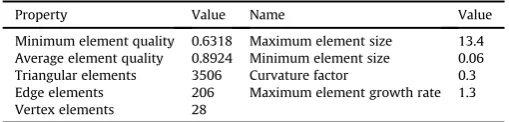
the Finite Element Method (FEM), the meshing process was con-ducted as shown inFig. 3andTable 3.
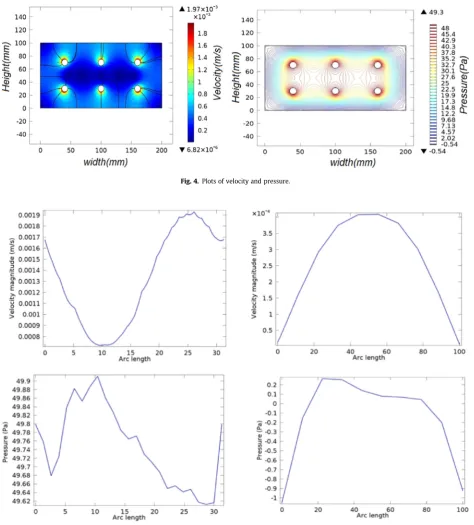
After implementing the model and solving any problems, the software produced the results as given inFig. 4. The output of the model contains diagrams of velocity and pressure in various parts. It is inferred from Fig. 4 that the velocity of gas in cleats is 0.0007 m/s while the speed of gas emission in pores is 0.002 m/s. It is noted that the gas pressure in joints decreased by about 20e25 times from emission. In addition, there is a maximum gas pressure in the internal space of the coal block where outburst may happen if gas drainage is not carried out prior to mining. The model spec-ifies gas molecules and suggests the minimum distance for gas molecules to reach joints and free spaces. This indicates that hy-draulic fracturing may become necessary in order to drain gas properly before mining commences.
3.1. Model validation
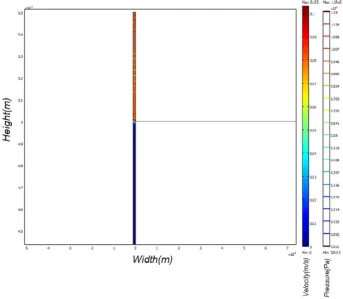
[image:3.595.52.286.67.237.2] [image:3.595.320.553.69.233.2]In this paper, diagrams of velocity and pressure are plotted for a pore and also a joint located in the border of a coal block (Fig. 5), where there is reasonable agreement between the velocity and pressure graphs. For model validation, the analytical model devel-oped by the American Society of Composite Energy (2014) was incorporated to validate the numerical simulation.Fig. 6shows the movement of gas molecules within the joint as calculated by the analytical model. The average speed of the gas molecules was calculated as 0.005 m/s (Society of Composite Energy, 2014). This figure is in line with the results of the numerical simulation. It is noted that the proposed analytical model used in this study for model verification possesses limited capabilities in simulating complex geological structures such as those encountered in coal mines. However, considering the fact that the aforesaid analytical Fig. 1.The model geometry and input parameters applied for numerical simulation.
Fig. 2.Material characteristics used for numerical simulation.
Table 2
Material parameters used for model.
Name Value Unit
Permeability 3.751011 m2
Porosity 0.03 e
Density 1370 kg/m3
[image:3.595.68.538.274.440.2]Dynamic viscosity 10e4 Pas
Fig. 3.Finite element mesh for numerical simulation.
Table 3
Mesh properties used for model.
Property Value Name Value
Minimum element quality 0.6318 Maximum element size 13.4 Average element quality 0.8924 Minimum element size 0.06
Triangular elements 3506 Curvature factor 0.3
Edge elements 206 Maximum element growth rate 1.3
[image:3.595.310.565.496.557.2] [image:3.595.42.292.496.550.2]model is based on proven physical and mathematical concepts, it still can be applied to evaluate the results of numerical simulations.
4. Conclusions and recommendations
A complex numerical model for gas drainage operations was developed in this study. The following main conclusions were drawn from this investigation:
The velocity of coal bed methane in a coal sample is around 0.0007 m/s for the given input parameters. Thisfigure varies based on the porosity of coal and the number of joints,
Gas velocity is inversely proportional with the possibility of immediate gas emission,
The amount of output pressure of coal bed methane in a coal sample indicates that if a coal pore's pressure is 345 kPa (regardless of air pressure), the pressure will drop to 13.8 kPa at the time of gas emissions in joints with the given input parameters.
[image:4.595.57.532.62.588.2]This study can be extended to consider the following aspects that were not studied as part of this investigation:
[image:4.595.59.527.68.238.2]Fig. 4.Plots of velocity and pressure.
Input parameters may affect the results of a numerical simula-tion. In this study, input parameters were selected to suit the Tabas coal mine in Eastern Iran. It is recommended that a comprehensive sensitivity analysis on input parameters such as permeability, porosity, density and dynamic velocity to evaluate their effects on results of numerical simulation be carried out, Extension of this study to further assess the capabilities of the
proposed numerical model against collected experimental data. Currently, this is being carried out at the School of Mines, Shahrood University of Technology and will be released upon completion of the study.
Acknowledgements
We would like to thank Professor Naj Aziz affiliated to the School of Civil, Mining and Environmental Engineering, University of Wollongong, Australia for his productive guidance and comments.
References
Akhlaghi Amiri, H. A., & Hamouda, A. A. (2013). Evaluation of level set and phase
field methods in modeling two phaseflow with viscosity contrast through dual-permeability porous medium.International Journal of Multiphase Flow, 52, 22e34.
Akhlaghi Amiri, H. A., & Hamouda, A. A. (2014). Pore-scale modeling of non-isothermal two phaseflow in 2D porous Media: Influences of viscosity, capil-larity, wettability and heterogeneity.International Journal of Multiphase Flow, 61, 14e27.
Cempa-Balewicz, M., Laczny, M., Smolinski, A., & Iwaszenko, S. (2013). Equilibrium model of steam gasification of coal.Journal of Sustainable Mining, 12(2), 21e28.
Dhir, R., Dern, R. R., & Mavor, M. J. (1991).Economic and reserve evaluation of coal bed methane reservoirs. Texas, USA: Society of petroleum engineers, Paper No. 22024.
Gray, I. (1987).The physical process of gas storage in movement in coal seams. Society of Petroleum Engineers&Reservoir Engineers.
Harpalani, S., & Schraufnagel, R. A. (1990). Shrinkage of coal matrix with release of gas and its impact on permeability of coal.Journal of Fuel, 69, 551e556.
Harpalani, S., Zhao, X., & Farmer, I. W. (1992). .Mechanics of gasflow in coal -A laboratory investigation.International Journal of Rock Mechanics and Mining Sciences&Geomechanics, 29(2), A94.
Holditch, S. A. (1989). Enhanced recovery of coal bed methane through hydraulic fracturing. InSPE annual technical conference and exhibition. Houston, Texas: Pub: Society of Petroleum Engineers.
Janoszek, T., Laczny, M. J., Stanczyk, K., Smolinski, A., & Wiatowski, M. (2013). Modeling of gasflow in the underground coal gasification process and its in-teractions with the rock environment. Journal of Sustainable Mining, 12(2), 8e20.
Kendall, P. F., & Briggs, H. (1993). The formation of rock joints and the cleats of coal.
Royal Society of Edinburgh, 53, 164e187.
Krause, E., & Pokryszka, Z. (2013). Investigations on methane of closed coal mines.
Journal of Sustainable Mining, 12(2), 40e45.
MacDonald, G. J. (1990).The future of methane as an energy resource(Vol. 15). Annual Review of Energy. Virginia, USA.
Mcculloch C. M., Duel M., Jeran P. W.., Cleats in Bituminous Coal Bed, Reports of Investigations No. 7910, US Bureau of Mines.
Sereshki, F., Aziz, N., & Porter, I. (2003). Impact of coal permeability on gas sorption and coal volume change. InProceedings of the 7th annual environ-mental engineering research event conference, Marysville, Victoria, Australia
(pp. 333e342).
Society of Composite Energy. (2014).Mathematical modeling of methaneflow in coal matrix using COMSOL. Retrieved June 4, 2016, fromhttp://www.ems.psu.edu/ ~elsworth/courses/EGEE520/2009Deliverables/reports/Hemant__Spring09_EGEE_ 520_Modelling_Methane.pdf.
Soeder, D. J. (1991).The effects of overburden stress on coal bed methane production. Tec book, Geology in Coal Resources Utilization.
Solano, W. A., Mastalerza, M., & Schimmelmann, A. (2007). Cleats and their relation to geologic lineaments and coal bed methane potential in Pennsylvanian coals in Indiana.International Journal of Coal Geology, 72, 187e208.
[image:5.595.130.474.67.366.2]Wang, J., Wu, R., & Zhang, P. (2015). Characteristics and applications of gas desorption with excavation disturbances in coal mining.International Journal of Coal Science&Technology, 2, 30e37.