Quantifying pCO
2
in biological ocean
acidification experiments: A comparison of
four methods
Sue-Ann Watson1*, Katharina E. Fabricius2, Philip L. Munday1
1 Australian Research Council Centre of Excellence for Coral Reef Studies, James Cook University,
Townsville, Queensland, Australia, 2 Australian Institute of Marine Science, Townsville, Queensland, Australia
Abstract
Quantifying the amount of carbon dioxide (CO2) in seawater is an essential component of ocean acidification research; however, equipment for measuring CO2directly can be costly and involve complex, bulky apparatus. Consequently, other parameters of the carbonate system, such as pH and total alkalinity (AT), are often measured and used to calculate the partial pressure of CO2(pCO2) in seawater, especially in biological CO2-manipulation stud-ies, including large ecological experiments and those conducted at field sites. Here we compare four methods of pCO2determination that have been used in biological ocean acidi-fication experiments: 1) Versatile INstrument for the Determination of Total inorganic carbon and titration Alkalinity (VINDTA) measurement of dissolved inorganic carbon (CT) and AT, 2) spectrophotometric measurement of pHTand AT, 3) electrode measurement of pHNBSand AT, and 4) the direct measurement of CO2using a portable CO2equilibrator with a non-dis-persive infrared (NDIR) gas analyser. In this study, we found these four methods can pro-duce very similar pCO2estimates, and the three methods often suited to field-based application (spectrophotometric pHT, electrode pHNBSand CO2equilibrator) produced esti-mated measurement uncertainties of 3.5–4.6% for pCO2. Importantly, we are not advocat-ing the replacement of established methods to measure seawater carbonate chemistry, particularly for high-accuracy quantification of carbonate parameters in seawater such as open ocean chemistry, for real-time measures of ocean change, nor for the measurement of small changes in seawater pCO2. However, for biological CO2-manipulation experiments measuring differences of over 100μatm pCO2among treatments, we find the four methods described here can produce similar results with careful use.
Introduction
Since the beginning of the Industrial Revolution, the oceans have absorbed about a third of all anthropogenic carbon dioxide (CO2) emissions released into the atmosphere [1,2]. In seawa-ter, CO2reacts to form carbonic acid (H2CO3) which dissociates into hydrogen (H+) and
a1111111111 a1111111111 a1111111111 a1111111111 a1111111111 OPEN ACCESS
Citation: Watson S-A, Fabricius KE, Munday PL (2017) Quantifying pCO2in biological ocean
acidification experiments: A comparison of four methods. PLoS ONE 12(9): e0185469.https://doi. org/10.1371/journal.pone.0185469
Editor: Frank Melzner, Helmholtz-Zentrum fur Ozeanforschung Kiel, GERMANY
Received: September 22, 2016
Accepted: September 13, 2017
Published: September 28, 2017
Copyright:©2017 Watson et al. This is an open access article distributed under the terms of the
Creative Commons Attribution License, which permits unrestricted use, distribution, and reproduction in any medium, provided the original author and source are credited.
Data Availability Statement: All relevant data are within the paper and its Supporting Information file.
bicarbonate ions (HCO3-). This process, known as ocean acidification, results in increased concentrations of CO2(aq), H+and HCO3-, and reductions in carbonate ion (CO32-) concentra-tion and the saturaconcentra-tion state of seawater with respect to calcite and aragonite. As a result of ocean acidification, surface oceans are now approximately 0.1 pH units lower and 30% more acidic than 250 years ago [3]. Ocean chemistry is changing faster than any time during the last 65 million years [4], and possibly the last 300 million years [5]. Under current CO2emissions rates (Representative Concentration Pathways, RCP 8.5 scenario), atmospheric CO2levels are projected to exceed 900 ppm by the end of this century [6] and seawater pH projected to decline a further 0.14–0.43 units [3].
In the surface ocean,pCO2is rising at the same rate as atmospheric CO2[7]. Recent models suggest seasonalpCO2cycles will be amplified as atmospheric CO2levels rise, which means thatpCO2in the surface ocean may be considerably higher than in the atmosphere for many months each year and open ocean regions could exceed 1000μatmpCO2before the end of the century [8]. Coastal waters exhibit particularly large seasonal and diel variation in pH and
pCO2(e.g. [9,10]), and consequently, anthropogenic amplification of thepCO2cycle in coastal waters is likely to be even more pronounced [11].
SeawaterpCO2can be assessed: 1) by direct measurement of CO2in a gas volume equili-brated with seawater using gas analysers equipped with non-dispersive infrared (NDIR) sen-sors, or 2) indirectly by measuring two parameters of the seawater carbonate chemistry system and then calculatingpCO2. Direct NDIR measurement of CO2is often conducted using equili-brators that are specifically designed for the continuous measurement of CO2, such as on ships (e.g. [12]), or modified to measure CO2in a small volume of air in a closed loop that is equili-brated with CO2in water. Commonly, seawaterpCO2is calculated using any pair of carbonate chemistry parameters. Frequently used parameters include pH, total alkalinity (AT), and dis-solved inorganic carbon (CT).
[image:2.612.37.571.602.694.2]Measurements of seawater carbonate chemistry parameters vary in 1) measurement time, 2) accuracy, 3) cost, and 4) the time lag to obtain results (e.g. zero if results are obtained imme-diately, or potentially months later in the case of water sample batch processing;Table 1). For example, pH is commonly measured immediatelyin situorin vitrousing a relatively low-cost pH meter and electrode, or spectrophotometricallyin vitroafter addition of a pH indicator dye. ATand CTare measuredin vitro, usually from mercuric chloride poisoned water samples, and generally require more complex, customised, bulky and costly laboratory equipment such as an automatic titrator or Versatile INstrument for the Determination of Total inorganic car-bon and titration Alkalinity (VINDTA), respectively; although it is possible to perform titra-tions manually with a lower-cost pH meter and electrode (or pH indicator), and burette. Systems such as VINDTA are complicated but very precise, while other methods that are easier to use may not reach the same accuracy.
Table 1. Summary table of methods used in this study. Sample measurement time refers to measurements made during this study, with the upper end of
the time range allowing for machine warm-up.
Method Time lag to obtain results Approx. sample
measurement time
Approx. cost of equipment (USD in 2016)
VINDTA CT Often long as samples are usually batch processed, often
after the experiment
10–60 min $75,000
Spectrophotometric pHT
Shortly after real-time 10–45 min $3,000–10,000
Electrode pHNBS Real-time 1–3 min $1,000
NDIR CO2equilibrator Shortly after real-time (corresponding to equilibration time) 30–60 min $4,000
https://doi.org/10.1371/journal.pone.0185469.t001
Choosing appropriate measurement techniques to achieve the required precision and accu-racy for carbonate chemistry parameters should be the primary consideration; however, the number and frequency of measurements required for a study is also an important consider-ation in measurement technique choice, and will relate to the number of treatment levels and replicates within the experimental design. For biological ocean acidification experiments, mea-surement accuracy will vary depending on the research question addressed and targetpCO2 treatment levels employed, and accuracies of±50μatmpCO2are likely commonly suitable for biological CO2-manipulation experiments measuring differences of more than 100μatmpCO2 among treatments. Furthermore, the measurement of some carbonate chemistry parameters requires sophisticated equipment, which is not always accessible, particularly at remote field sites. Many biological ocean acidification studies are now conducted in more remote locations such as field research stations, and submarine CO2vents and seeps (e.g. [13–16]), and include large, highly-replicated ecological studies. In such field based environments where access to specialist chemical oceanography equipment is limited, researchers need to repeatedly monitor seawater carbonate conditions during their experiments, often with multiple treatments and upwards of 50 or more replicates running simultaneously that require monitoring on a daily or more frequent basis. Field researchers therefore need techniques that can provide reliable, cost-effective, real-time estimates ofpCO2to maintain their experiments.
Here we assess a range of methods commonly available to determine seawater carbonate chemistry in biological ocean acidification experiments. We consider four parameters that are commonly measured to constrain the CO2system in seawater: AT, CT, pH, andpCO2[17], and we compare four different methods to determine thepCO2of seawater: 1) CTand AT, 2) spectrophotometric pHTand AT, 3) electrode pHNBSand AT, and 4) a portable CO2 equilibra-tor with a NDIR gas analyser to measure CO2directlyin situ. We assess measurement time, accuracy, costs and the time lag to obtain results for the four methods. We focus particularly onpCO2determination firstly, because quantifyingpCO2is particularly important in design-ing biological manipulation experiments relevant to emissions trajectories such as the Inter-governmental Panel on Climate Change’s Representative Carbon Pathways (IPCC RCPs) and secondly, becausepCO2is very sensitive to small changes in other carbonate parameters mak-ing it a useful measure for this comparative approach. We also expand on the CO2equilibrator technique by describing a simple method for the direct,in situmeasurement of CO2in seawa-ter using a portable CO2equilibrator coupled to a NDIR gas analyser.
Materials and methods
Experimental system and seawater manipulation
This study was conducted at Lizard Island, Great Barrier Reef, Australia (S 14˚ 41’, E 145˚ 28’) at the Australian Museum’s Lizard Island Research Station flow-through aquarium facility. Water from the ocean was pumped into an environmentally-controlled room where seawater flowed into a 60 L header tank fitted with a powerhead to circulate the water. Seawater from the header tank was gravity-fed into a 32 L (38L x 28W x 30H cm) experimental tank at 1.5 L.min-1.
The CO2dosing system was set at a series of different pHNBSlevels throughout the experi-ment. A range of seawater pHNBSvalues (8.2 to 7.6) were used, corresponding to ambient and elevatedpCO2of<400 to>1400μatm, and measurements of seawater chemistry were taken in the experimental tank simultaneously using the four methods described below. Briefly, air equilibrated with seawater from the experimental tank passed across a NDIR CO2gas analyser until CO2levels had stabilised (c. 1 hr). Once CO2readings were stable, data on CO2, pHNBS and temperature were recorded. Water samples were taken for immediate spectrophotometric analysis of pHT, and preserved for later analysis of CTand AT. Full details are described below.
Quantification of carbonate chemistry parameters
1) Determination of seawater dissolved inorganic carbon (CT) and total alkalinity (AT). Water samples taken from the experimental tank at the time of measurement were
immediately poisoned with a saturated solution of mercuric chloride (at 0.05% of the sample volume) and later analysedin vitrofor CTand ATat the Australian Institute of Marine Sciences (AIMS) on a Versatile INstrument for the Determination of Total inorganic carbon and titra-tion Alkalinity (VINDTA 3C, MARIANDA, Kiel, Germany). The VINDTA 3C was configured with a UIC Coulometer (model 5015) and UIC Anode Reagent and Cathode Reagent (UIC Inc., Joliet, Illinois, U.S.A.) for CTanalysis and a Metrohm Titrino titrator (model 702, Metrohm, Switzerland) with 0.1M HCl (fortified with NaCl to the ionic strength of seawater) added in 150μl steps for ATanalysis, calculated by Gran titration. The VINDTA was calibrated with certified reference material (CRM) consisting of sterilized natural seawater of known CT and ATpreserved with mercuric chloride (Prof. A.G. Dickson, Scripps Institution of Oceanog-raphy, U.S.A., batch number 126, one-point calibration). CRMs and samples were water-jac-keted at 24˚C and sample results were adjusted for salinity of the sample compared with the CRM. Since the VINDTA samples a fixed volume and the CRM is certified in mass units (μmol.kg-1), a small adjustment for the difference in the salinity of the sample compared with the salinity of the CRM at 24˚C was required. Consequently, the raw VINDTA output of CT and ATwas multiplied by seawater density at the CRM salinity, and divided by seawater den-sity at the sample salinity. This adjustment reduced the raw VINDTA output of CTand ATby approximately 2–3μmol.kg-1to produce the final CTand ATmeasures.
ATdata were used as the second parameter in carbonate chemistry calculations for each of the four methods. Carbonate chemistry parameters derived from CTand ATwere used to com-pare carbonate chemistry parameters determined from the other three methods. Reported measurement uncertainty for CTand ATusing state-of-the-art methods with reference materi-als is 2–3 and 2–3μmol.kg-1, respectively [17].
2) Spectrophotometric determination of seawater pHT. Seawater pH on the total
hydro-gen ion concentration scale (total scale, pHT) was measuredin vitrousing a spectrophotometer following standard operating procedures (SOP 6b; [19]). The SOP was adapted for field use by using a compact, single-beam spectrophotometer (Spectronic 20 Genesys) and a spectrophoto-metric cell made of optical glass with a 10 mm path-length. This more compact system allowed transportation to the field site. Seawater pH determination was performed using the indicator dye meta/m-cresol purple (mCP) (m-cresol purple sodium salt 99%, non-purified, Acros Organic).
maintained to within±0.1˚C of 25.0˚C and confirmed with a temperature probe (C26, Comark, Norwich, U.K.) before and after each spectrophotometric measurement. A highly accurate thermometer (Traceable1Digital Thermometer 4000, Control Company, Texas, U.S. A.) was used to confirm the temperature probe reading was correct to within 0.1˚C. During measurement, temperature was maintained within0.1˚C and any change in the non-absorb-ing wavelength at 730 nm was maintained within0.001. These additional controls were employed to ensure maximum measurement quality at the field site. Additionally, spectropho-tometer accuracy and stability were confirmed by replicate analysis of certified reference material (CRM) consisting of Tris buffer in synthetic seawater (Prof. A.G. Dickson, Scripps Institution of Oceanography, U.S.A., batch number 26, one-point calibration). Reported mea-surement uncertainty for pH using techniques with reference materials, other than state-of-the-art methods, is 0.01–0.03 pH units [17].
3) Electrode measurement of seawater pHNBS. Seawater pH on the US National Bureau
of Standards (NBS, an organisation now known as The National Institute of Standards and Technology) scale (pHNBS) was determinedin situwith a portable, hand-held pH meter (SevenGo Pro pH/Ion, Mettler Toledo) and glass electrode (InLab1413 S8, Mettler Toledo) calibrated with certified reference materials (CRMs) for NBS consisting of pHNBS4 and 7 buffer solutions (Mettler Toledo, two-point calibration). Reported measurement uncertainty for pH using techniques with reference materials, other than state-of-the-art methods, is 0.01– 0.03 pH units [17].
4) Measurement of seawater CO2with a non-dispersive infrared (NDIR) gas analyser.
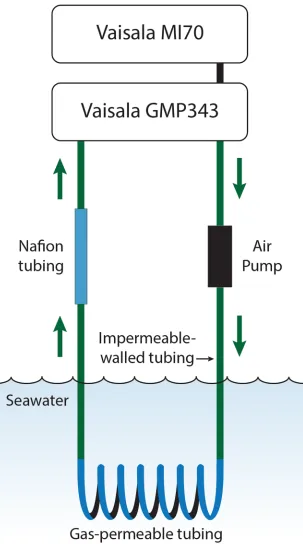
Seawater CO2was measuredin situwith a portable CO2equilibrator with a high-resolution non-dispersive infrared (NDIR) gas analyser. This method for the direct measurement of CO2 in seawater using a NDIR sensor, described in more detail below, is taken from Hari et al. [20]; see also Munday et al. [21]. The portable CO2equilibrator consisted of a NDIR CO2sensor (CARBOCAP1Carbon Dioxide Probe GMP-343, Vaisala, Helsinki, Finland, calibrated by Vaisala using certified reference materials (CRMs, six-point calibration) two months prior to the study) and data logger (Measurement Indicator MI70, Vaisala, Helsinki, Finland), air pump, gas-tight tubing, gas-permeable tubing and dehumidifying tubing (Fig 1). The NDIR CO2sensor range was pre-programmed from 0 to 5000 ppm CO2and the environmental set-tings on the data logger were set to 80.0% relative humidity, 1010.0 hPa ambient pressure and 21.0% oxygen. CO2data from the sensor were compared directly with estimatedpCO2from the three other methods. The CO2sensor was connected to the data logger that also served as a data display and interface, allowing visualisation of real-time as well as recorded CO2data. Both the CO2sensor and display interface were enclosed in a water-resistant plastic container.
Fig 1. Diagram of the portable NDIR CO2equilibrator. The portable CO2equilibrator consists of a
commercially available non-dispersive infrared (NDIR) CO2gas analyser and data logger display interface,
in-line air pump, impermeable-walled tubing and a section of gas-permeable membrane that is submerged in water. Air is pumped in a closed loop around the system and equilibrates with CO2in seawater.
CO2data from the sensor were generated every 2 seconds and mean values recorded every minute by the data logger. Values were logged until CO2readings stabilised. The graph plot on the MI70 was used to visualise data to ensure an equilibrium state was reached (stable plateau of the graph,S1 Fig). The seawater CO2value was recorded when the system was at equilib-rium. Data files stored on the data logger were downloaded using the software MI70 Link (ver-sion 1.06, Vaisala, 2002). Reported accuracy of the GMP-343 sensor configuration used is
±13 ppm at 400 ppm CO2,±25 ppm at 1000 ppm CO2, and±33 ppm CO2at 1400 ppm CO2.
Carbonate chemistry calculations
Carbonate chemistry parameters were calculated in CO2SYS [22] using the constants K1, K2 from Mehrbachet al. 1973 refit by Dickson & Millero 1987, and Dickson forK(HSO4-). The pHNBSscale was used for calculations in CO2SYS using pHNBSelectrode data and the pHT scale was used for calculations using data from spectrophotometric pHT. For each of the four methods, raw data are presented, and have not been adjusted for any offset compared with expected values from certified reference materials (CRMs). Seawater temperature was mea-sured with a temperature probe (C26, Comark, Norwich, U.K.). Temperature during the experiment in this open system was 26.9±0.7˚C (mean±s.d.). Salinity data were obtained from moorings around Lizard Island, which form part of the Australian National Mooring Network Integrated Marine Observing System (IMOS) operated by the Australian Institute of Marine Science [23]. During the study, salinity was 35.4±0.0 (mean±s.d.) and ATwas 2291.8±5.6μmol.kg-1(mean±s.d.). Levels of total P and Si in seawater were below detection limits (total phosphorus<3.2μmol.kg-1SW as P, silica<8.1μmol.kg-1SW), and thus set to 0 for calculations in CO2SYS.
Data analysis
Estimates ofpCO2were compared among methods using generalised linear models (GLM) with the statistical software R [24]. A Gaussian distribution was used to assess the relationship betweenpCO2estimates derived from the three different methods against those derived from CTand AT, while the log-link function and quasipoisson distribution were used to compare estimated aragonite saturation state against the estimatedpCO2values. Estimated measure-ment uncertainties were calculated for each method by determining the relative difference in each carbonate chemistry parameter from values derived from CTand ATas a reference. The root mean square error (RMSE) (= root mean square deviation, RMSD) [25] was then deter-mined for each method forpCO2, the saturation state of seawater with respect to aragonite (Oar) and [H+] (Table 2). Absolute differences were also calculated by taking the mean of the deviations (as positive numbers) for each measurement and are reported in the text forpCO2, Oarand pH.
Results and discussion
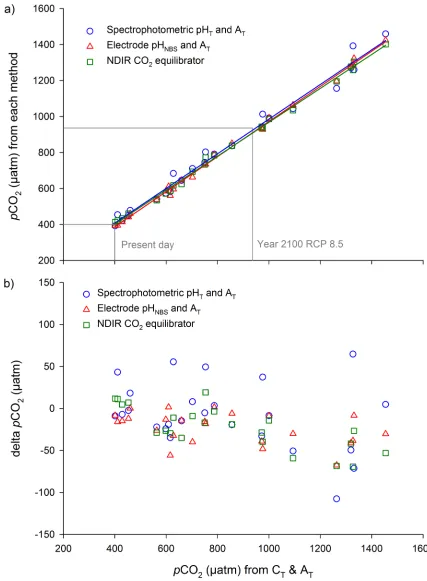
[image:7.612.33.581.647.698.2]All four methods: 1) CT, 2) spectrophotometric pHT, 3) electrode pHNBS, and 4) the CO2 equil-ibrator, were compared across thepCO2range tested in this study: 370 to 1460μatm (Fig 2).
Table 2. Estimated measurement uncertainties associated with each method determined from CTand AT-derived reference values.
Parameter Spectrophotometric pHTand ATuncertainty (%) Electrode pHNBSand ATuncertainty (%) NDIR CO2equilibrator uncertainty (%)
pCO2 4.6 3.6 3.5
Ωar 3.3 2.7 2.7
[H+] 3.9 3.1 3.0
Fig 2. Seawater pCO2calculated from CTand AT, compared with three other methods: 1) spectrophotometric pHT
and AT(n = 25), 2) electrode pHNBSand AT(n = 25), and 3) the direct measurement of seawater CO2with a NDIR CO2
equilibrator (n = 23); a) for pCO2data and b) for the difference in pCO2compared to pCO2derived from CTand AT
(delta pCO2).
Estimated measurement uncertainties forpCO2from spectrophotometric pHT, electrode pHNBSand the CO2equilibrator were4.6% (Table 2). Overall, there was no effect of method onpCO2data when compared withpCO2data derived from CTand AT(GLM analysis after exclusion of the non-significant interaction terms betweenpCO2and method: F2,69= 2.60, p = 0.082,Fig 2).
A comparison of the four methods (CT, spectrophotometric pHT, electrode pHNBSand CO2 equilibrator), showed there was no difference in their estimates ofpCO2and aragonite satura-tion (GLM analysis after exclusion of the non-significant interacsatura-tion terms betweenpCO2and method: F3,160= 0.148, p = 0.931,Fig 3). Each of the four methods is discussed in more detail below.
1) Determination of seawater dissolved inorganic carbon (C
T) and total
alkalinity (A
T)
[image:9.612.160.570.363.663.2]The combination of CTand ATis currently the preferred method for the characterisation of open ocean carbonate chemistry, and certified reference materials (CRMs) (sterilized natural seawater) for CTand ATare readily available [17] to ensure the accuracy and reliability of CT and ATdetermination. In this study, measurement standard deviations of CTand ATwere within 3 and 2μmol.kg-1of CRMs, respectively, determined from repeat analysis of CRMs, run in conjunction with study samples. The sample processing time (approx. 23 min per sam-ple) for CTand ATon the VINDTA allowed 7–8 samples to be processed per standard working
Fig 3. Relationship of seawater pCO2and aragonite saturation state (Ωar) determined by four different methods:
1) CTand AT(n = 25), 2) spectrophotometric pHTand AT(n = 45), 3) electrode pHNBSand AT(n = 49), and 4) the
direct measurement of seawater CO2with a NDIR CO2equilibrator (n = 46).
day after appropriate machine warm-up (c. 2 hr) and control with CRMs, or 16–20 samples during an extended 11–12 hr shift.
In addition to the ease of availability of CRMs, the advantage of using CTas a carbonate chemistry parameter is that water samples can be poisoned and analysed later at a convenient time. The disadvantages of CT, however, are that 1) access to equipment to measure CT(such as a VINDTA) can be limited and may be costly, 2) the often long time lag to obtain results with no immediate data for field or lab CO2perturbation experiments, and 3) the requirement to take and store many water samples. Additionally, water samples collected for CT measure-ment must be air-tight as CTvalues are affected by gas exchange. The disadvantages of pre-served water samples include the fact they are heavy and freight can therefore be costly, that hazardous chemicals (mercuric chloride) are required to fix the samples, and that the shipment of seawater as corrosive and dangerous goods is controlled nationally and restricted interna-tionally through customs. Hazardous chemicals also require specialist facilities for use (e.g. appropriate protective equipment) and proper disposal.
The advantages and disadvantages of ATare the same as those for CT, except that access to titration equipment, such as an automatic titrator or manual titration equipment, is more readily available and less costly, and ATmeasurement is not prone to gas exchange. As such, ATis routinely used as a second parameter in combination with other techniques.
2) Spectrophotometric determination of seawater pH
TSeawater pH measured with a spectrophotometer using a procedure adapted from SOP 6b [19] for field station use produced values within a range of -0.0048 to 0.0087 (0.0012±0.0045 mean±s.d.) pHTunits of certified Tris buffer in synthetic seawater. An accuracy within 0.01 pHTunits of certified Tris buffer was achieved with the field system set-up used here, and rep-licate measures of the same seawater sample were within 0.005 pHTunits.
Seawater chemistry calculated with spectrophotometric pHTand ATproducedpCO2 esti-mates close to those calculated from CTand AT, with an average difference of 30.5±26.1μatm (mean±s.d.). The estimated measurement uncertainty ofpCO2using the spectrophotometric pHTand ATtechnique was 4.6% (Table 2). Spectrophotometric pHTvalues were on average within 0.014±0.010 (mean±s.d.) of pHTvalues calculated from CTand AT, andOarcalculated from pHTand ATwas on average within 0.06±0.05 ofOarvalues calculated from CTand AT.
The advantage of the spectrophotometric pHTmethod is that it produces pH values on the total scale (pHT). Measurement of pH on the total scale is preferred [17] given the ionic strength of seawater. However, the disadvantages are that certified reference materials (CRMs) for spectrophotometric pHT(certified Tris buffer) are often limited [17], spectrophotometers may need custom modifications for seawater pHTmeasurement and are unlikely to be avail-able ‘off the shelf’ (SOP 6b; [19]), and dye impurities can affect measurement accuracy [26]. Other disadvantages are that spectrophometers can be large and bulky compared with pH elec-trodes and portable NDIR CO2sensors, and traditional spectrophotometers may not be suit-able for transport to field stations. Smaller spectrophotometers have, however, recently become available and may be better suited to field use than traditional spectrophotometers.
Sampling processing time was around 2–3 min per sample; however, if sample temperature or absorbance at the non-absorbing wavelength changed, then the sample was re-run until the quality control criteria were met. Consequently, a custom-manufactured chiller unit with precision temperature control could be useful for spectrophotometric pHTmeasurement for tropical ocean acidification experiments. Variation in carbonate chemistry data from spectro-photometric pHTwas likely due to the challenges of maintaining constant temperature (lower then ambient in the tropics) during sample analysis, even in a temperature controlled room. A more recent study describes a formula to usem-cresol purple over a range of temperatures [26] which may circumvent the requirement to measure the samples at 25.0˚C.
3) Electrode measurement of seawater pH
NBSElectrode pHNBSmeasurement producedpCO2estimates with an average difference of 23.5±18.1μatm (mean±s.d.) compared withpCO2estimates derived from CTand AT. The estimated measurement uncertainty ofpCO2using the electrode pHNBSand ATtechnique was 3.6% (Table 2). Electrode pHNBSvalues were on average within 0.011±0.008 (mean±s.d.) of pHNBSvalues calculated from CTand AT, andOarcalculated from pHNBSand ATwas on aver-age within 0.05±0.04 ofOarvalues calculated from CTand AT.
There are some advantages of electrode pHNBSmeasurement. Electrodes produced the most rapid measurement of seawater chemistry of all techniques assessed in this study, stabilis-ing initially in a few minutes or less, and then typically in one minute or less for subsequent measures. Measurements can be taken over a range of seawater temperatures (although in much cooler waters, electrodes can take longer to stabilise), and 2 or 3 point (or more) calibra-tions are possible using readily available reference materials. Thus using an electrode to mea-sure pH can allow the meamea-surement of many tanks (e.g. 50+) per day, which can be useful for large ecological experiments with many replicates and field-based studies. With careful trode calibration with certified reference materials (CRMs) and further cross-checks of elec-trode pHNBSmeasures against pHNBScalculated from NDIR CO2in combination with approximate expected or actual AT, we found that it is possible to achieve pH accuracy compa-rable to estimated measurement uncertainties reported from non-state-of-the-art techniques that use reference materials (0.01–0.03 pH units) [17]. The benefit of recording immediate car-bonate chemistry data for multiple tanks, and thus enhanced tank data resolution, is significant because any tank differences can be detected rapidly during the experiment and appropriate action taken during the experiment or in the analyses.
The disadvantages of pHNBSelectrodes is that the uncertainty in measuring can be up to 0.05 pHNBSunits for seawater measurements [17]. However, with careful use our results indi-cate that improved accuracy within0.02 pHNBSunits can be achieved. In general, and to achieve the greatest measurement certainty, we recommend electrode pHNBSmeasurements are validated by cross-checking data with another method, such as one of the three other meth-ods evaluated here, to ensure accurate results. This is important because undetected, the poten-tial uncertainty (of up to 0.05 pH units) [18] from pHNBSelectrodes may create uncertainty in estimatedpCO2of around 50–150μatm over the 375–1250μatmpCO2range often used in biological ocean acidification studies.
4) Measurement of seawater CO
2with a non-dispersive infrared (NDIR)
gas analyser
CO2equilibrator was 3.5% (Table 2).Oarcalculated from equilibrator CO2values and ATwas on average within 0.05±0.03 (mean±s.d.) ofOarvalues calculated from CTand AT.
The ability to measurepCO2directly in seawater is particularly beneficial, firstly because
pCO2is the key experimental target condition in many biological ocean acidification perturba-tion experiments, and secondly, because directpCO2measurement allows for appropriate
pCO2dosing in manipulation experiments when analysis of other carbonate chemistry param-eters, such as AT, is not immediately available. RecordingpCO2directly could also save some of the time and cost required to process other seawater carbonate chemistry parameters (e.g. pH, ATor CT, and the associated equipment) ifpCO2is the principal carbonate chemistry parameter of interest in a study. Improved confidence in seawater carbonate chemistry can be achieved if ATis confirmed as a common unchanging value in experiments.
The CO2equilibrator itself too has several advantages. It is simple, portable, relatively low cost and reasonably rugged. Conveniently, CO2data are available in close to real-time. The closed-loop takes some time to equilibrate which makes the time lag to obtain results longer than electrode pHNBS, but on a par with spectrophotometric pHT. The time taken to reach equilibrium with a 12.2 m length of gas-permeable tubing was up to approximately 1 hour for each measurement (S1 Fig). Faster equilibrium times can be achieved if the starting CO2level is closer to the final CO2, or if a longer length of gas-permeable tubing and/or shorter length of impermeable tubing or smaller diameter tube was used to reduce total system:permeable tub-ing air volume ratio. Potentially separate coils could be used and connected in turn to one NDIR CO2sensor close to stabilisation time to accelerate the process of obtaining measure-ments from multiple tanks.
The CO2equilibrator described here can be used in small bodies of waterc. 10–20 litres in volume, and smaller versions can be easily made for even smaller water bodies (<5–10 litres). Alternatively, the equilibrator can be modified to use a ‘shower head’ device to spray seawater into a closed loop of air for use with small volumes of water and to reduce equilibration time. This shower head method is, however, more bulky in size than the membrane coil and conse-quently less portable for field use. Notably, the CO2equilibrator tested here provides a portable system that is light-weight and compact suitable for measurement in field laboratory situa-tions, and is not intended to be compared to underway CO2measuring systems such as that described by Bandstra et al. [27].
In summary, the CO2equilibrator tested here is a simple, small, lightweight, relatively low cost device that provides a method for the direct measurement of CO2in water and is suitable for laboratory and field-based experimental studies. It is robust enough for use at field loca-tions where pH may be the only other parameter of seawater carbonate chemistry that is immediately measurable. The CO2equilibrator can thus provide cost-effective, near real-time estimates ofin-situseawaterpCO2for biological experiments, providing a major advantage to biological perturbation experiments where achieving a desiredpCO2is key.
Evaluation
In combination with ATas the second carbonate chemistry parameter, all four methods pro-duced very similarpCO2estimates, and the three field methods 1) spectrophotometric pHT, 2) electrode pHNBS, and 3) NDIR CO2equilibrator, performed comparably to CTwith careful use. In this study, electrode pHNBSand the CO2equilibrator gave consistently close results to CT-derivedpCO2values, and had the smallest ranges. Spectrophotometric pHTproduced
When choosing a technique to use, consideration should be given to the required precision and accuracy, and the number and frequency of measures required. For example, rapid meth-ods such as electrode pHNBScan provide the scope to measure many tanks requiring daily or more frequent assessment, whereas lower frequency techniques including methods that require water samples may be more suitable for experiments with fewer replicates. Due consid-eration should be given to the potential uncertainty inherent in all techniques, which can be larger for some methods, such as pHNBS, without careful use. Consequently, the use of refer-ence materials, and cross-validation wherever possible, is strongly recommended for all meth-ods used.
Although sample measurement time is not necessarily long for CTand AT(i.e. 10–25 min once the system is calibrated and running), the limited availability of instruments to measure these at field sites often means such water samples are batch processed at a later time, often after the end of the experiment. The time lag to obtain results therefore becomes an important consideration. Spectrophotometric pHT, electrode pHNBSand the CO2equilibrator provide data in real-time or near real-time (Table 1).
Other considerations in method choice include the availability of equipment and reference materials, and cost. For example, some techniques require sophisticated equipment, such as a thermostated spectrophotometer cell (e.g. SOP 6b; [19]) or VINDTA, which may not be avail-able ‘off-the-shelf’ and require further custom manufacturing. Certified reference materials for techniques such as spectrophotometric pHTmay also be difficult to acquire [17]; certified Tris buffers (from Prof. A.G. Dickson, Scripps Institution of Oceanography, U.S.A.), for example, are often in short supply. One option may be to collaborate with research groups who have access to the required equipment to ensure that carbonate chemistry quality is not
compromised.
Conclusions and recommendations
Our results indicate that the portable CO2equilibrator used in conjunction with one of the other methods described here (CT, spectrophotometric pHT, or electrode pHNBS) provides a suitable combination for estimating and maintainingpCO2levels in biological ocean acidifica-tion experiments. The other three methods (CT, spectrophotometric pHT, or electrode pHNBS) all require a second carbonate chemistry parameter in order to determinepCO2, and all four methods require a second carbonate chemistry parameter to calculate other parameters of the seawater carbonate chemistry system. ATis well suited for this purpose, and the measurement or calculation of ATis also useful to characterise the seawater used in the experiment. For per-turbation experiments that manipulate CT(such as CO2injection), where ATremains con-stant, limited numbers of ATsamples can be taken and analysed later (e.g. after the
experiment). During the experiment, a NDIR sensor coupled with a CO2equilibrator can be used to ensure seawaterpCO2in manipulation experiments is correct.
For all techniques, we recommend the used of certified reference materials (CRMs) to ensure high quality control for seawater carbonate chemistry and we recommend cross-check-ing measurements with another technique to further ensure quality control wherever possible. For example, cross-checking electrode pHNBSmeasures against pHNBScalculated from NDIR CO2in combination with expected ATcan reduce uncertainty associated with electrode pHNBS measures whilst still allowing for high frequency sampling, such as in studies with high tank replication.
perturbation experiments measuring differences of over 100μatmpCO2among treatments, we find the four methods described here can be adequate and with careful use they can all pro-duce similar results. Although methods such as the portable CO2equilibrator and pHNBS elec-trodes do not replace standard methods, such as CTand spectrophotometric pHT, for high-accuracy quantification of carbonate parameters in seawater; they can, provide a cost-effective means to determinepCO2in large ecological experiments investigating the effects of ocean acidification on marine organisms providing options for greater tank and temporal resolution.
In summary, we show that all four combinations of methods tested here 1) CTand AT, 2) spectrophotometric pHTand AT, 3) electrode pHNBSand AT, and 4) the NDIR CO2 equilibra-tor, can achievepCO2values accurate enough for biological ocean acidification manipulation experiments with careful use. In addition, we find the portable NDIR CO2equilibrator tested provides a cost-effective system for near real-time measures of CO2. For all methods, we rec-ommend the used of certified reference materials (CRMs) and cross-checking data with another method to ensure quality control in biological ocean acidification experiments.
Supporting information
S1 Fig. CO2measurements recorded by the portable CO2equilibrator over time from the start of a test period until equilibrium is reached (boxed area). Stabilisation time was 1
hour. This time period is a conservative estimate since equilibration time is shorter if thepCO2 difference between two samples is less.
(PDF)
Acknowledgments
We thank the Australian Museum’s Lizard Island Research Station for logistical assistance, Geoffrey G.K. Endo and Gabrielle M. Miller for help with the construction and testing of CO2 equilibrator prototypes, Blake L. Spady for assistance with water sample collection, Stephen G. Boyle for processing the CTand ATsamples, and Andrew G. Dickson for comments that greatly improved the manuscript.
Author Contributions
Conceptualization: Sue-Ann Watson, Katharina E. Fabricius, Philip L. Munday.
Data curation: Sue-Ann Watson.
Formal analysis: Sue-Ann Watson, Katharina E. Fabricius.
Funding acquisition: Sue-Ann Watson, Philip L. Munday.
Investigation: Sue-Ann Watson.
Methodology: Sue-Ann Watson, Philip L. Munday.
Project administration: Sue-Ann Watson.
Resources: Katharina E. Fabricius, Philip L. Munday.
Validation: Sue-Ann Watson.
Visualization: Sue-Ann Watson, Katharina E. Fabricius.
Writing – original draft: Sue-Ann Watson.
References
1. Sabine CL, Feely RA, Gruber N, Key RM, Lee K, Bullister JL, et al. The oceanic sink for anthropogenic CO2. Science. 2004; 305(5682):367–71.https://doi.org/10.1126/science.1097403PMID:15256665 2. Zeebe RE, Zachos JC, Caldeira K, Tyrrell T. Oceans—Carbon emissions and acidification. Science.
2008; 321(5885):51–2. PMID:18599765
3. Hoegh-Guldberg O, Cai R, Poloczanska ES, Brewer PG, Sundby S, Hilmi K, et al. The Ocean. In: Bar-ros VR, Field CB, Dokken DJ, Mastrandrea MD, Mach KJ, Bilir TE, et al., editors. Climate Change 2014: Impacts, Adaptation, and Vulnerability Part B: Regional Aspects Contribution of Working Group II to the Fifth Assessment Report of the Intergovernmental Panel on Climate Change. Cambridge, United King-dom and New York, NY, USA: Cambridge University Press; 2014. p. 1655–731.
4. Ridgwell A, Schmidt DN. Past constraints on the vulnerability of marine calcifiers to massive carbon dioxide release. Nature Geoscience. 2010; 3(3):196–200.https://doi.org/10.1038/ngeo755 5. Honisch B, Ridgwell A, Schmidt DN, Thomas E, Gibbs SJ, Sluijs A, et al. The Geological Record of
Ocean Acidification. Science. 2012; 335(6072):1058–63.https://doi.org/10.1126/science.1208277
PMID:22383840
6. Collins M, Knutti R, Arblaster J, Dufresne J-L, Fichefet T, Friedlingstein P, et al. Long-term Climate Change: Projections, Commitments and Irreversibility. Climate Change 2013: The Physical Science Basis Contribution of Working Group I to the Fifth Assessment Report of the Intergovernmental Panel on Climate Change: Cambridge University Press, Cambridge, United Kingdom and New York, NY, USA.; 2013. p. 1029–136.
7. Doney SC. The growing human footprint on coastal and open-ocean biogeochemistry. Science. 2010; 328(5985):1512–6.https://doi.org/10.1126/science.1185198PMID:20558706
8. McNeil BI, Sasse TP. Future ocean hypercapnia driven by anthropogenic amplification of the natural CO2cycle. Nature. 2016; 529(7586):383–6.https://doi.org/10.1038/nature16156PMID:26791726 9. Hofmann GE, Smith JE, Johnson KS, Send U, Levin LA, Micheli F, et al. High-Frequency Dynamics of
Ocean pH: A Multi-Ecosystem Comparison. Plos One. 2011; 6(12):e28983.https://doi.org/10.1371/ journal.pone.0028983PMID:22205986
10. Hinga KR. Co-occurrence of dinoflagellate blooms and high pH in marine enclosures. Mar Ecol Prog Ser. 1992; 86(2):181–7.https://doi.org/10.3354/meps086181
11. Shaw EC, McNeil BI, Tilbrook B, Matear R, Bates ML. Anthropogenic changes to seawater buffer capacity combined with natural reef metabolism induce extreme future coral reef CO2conditions. Global
Change Biol. 2013; 19:1632–41.https://doi.org/10.1111/gcb.12154PMID:23505026
12. Pierrot D, Neill C, Sullivan K, Castle R, Wanninkhof R, Luger H, et al. Recommendations for autono-mous underway pCO2measuring systems and data-reduction routines. Deep-Sea Research Part
Ii-Topical Studies in Oceanography. 2009; 56(8–10):512–22.https://doi.org/10.1016/j.dsr2.2008.12.005 13. Fabricius KE, Langdon C, Uthicke S, Humphrey C, Noonan S, De’ath G, et al. Losers and winners in
coral reefs acclimatized to elevated carbon dioxide concentrations. Nature Climate Change. 2011; 1 (3):165–9.https://doi.org/10.1038/nclimate1122
14. Munday PL, Cheal AJ, Dixson DL, Rummer JL, Fabricius KE. Behavioural impairment in reef fishes caused by ocean acidification at CO2seeps. Nature Climate Change. 2014; 4(6):487–92.https://doi. org/10.1038/nclimate2195
15. Watson S-A, Lefevre S, McCormick MI, Domenici P, Nilsson GE, Munday PL. Marine mollusc predator-escape behaviour altered by near-future carbon dioxide levels. Proceedings of the Royal Society B: Bio-logical Sciences. 2014; 281(1774):20132377.https://doi.org/10.1098/rspb.2013.2377PMID:24225456 16. Nagelkerken I, Russell BD, Gillanders BM, Connell SD. Ocean acidification alters fish populations
indi-rectly through habitat modification. Nature Climate Change. 2016; 6:89–93.https://doi.org/10.1038/ nclimate2757
17. Dickson AG. The carbon dioxide system in seawater: equilibrium chemistry and measurements. In: Rie-besell U, Fabry VJ, Hansson L, Gattuso J-P, editors. Guide to best practices for ocean acidification research and data reporting. Luxembourg: Publications Office of the European Union; 2010. p. 17–52.
18. Gattuso JP, Gao K, Lee K, Rost B, Schulz KG. Approaches and tools to manipulate the carbonate chemistry. In: Riebesell U, Fabry VJ, Hansson L, Gattuso JP, editors. Guide to best practices for ocean acidification research and data reporting. Luxembourg: European Union; 2010. p. 41–52.
19. Dickson AG, Sabine CL, Christian JR. Guide to Best Practices for Ocean CO2Measurements. PICES
Special Publication 3; 2007. 191 pp.
21. Munday PL, Watson S-A, Chung WS, Marshall NJ, Nilsson GE. Response to ’The importance of accu-rate CO2dosing and measurement in ocean acidification studies’. J Exp Biol. 2014; 217(10):1828–9. https://doi.org/10.1242/jeb.105890PMID:24829330
22. Pierrot D, Lewis E, Wallace DWR. MS Excel Program Developed for CO2 System Calculations. Oak Ridge, Tennessee, U.S.A.: ORNL/CDIAC-105a. Carbon Dioxide Information Analysis Center, Oak Ridge National Laboratory, U.S.A. Department of Energy; 2006.
23. AIMS. Australian Institute of Marine Science. Data generated 12th January 2016 using Lizard Island Weather and Oceanographic Observations. Integrated Marine Observing System (IMOS) Data Centre, AIMS. Viewed 12th January 2016.http://weather.aims.gov.au/#/station/11662016.
24. R Development Core Team. R: A language and environment for statistical computing. R Foundation for Statistical Computing. Vienna, Austria. URLhttp://www.R-project.org/2017.
25. Chai T, Draxler RR. Root mean square error (RMSE) or mean absolute error (MAE)?—Arguments against avoiding RMSE in the literature. Geoscientific Model Development. 2014; 7(3):1247–50.https:// doi.org/10.5194/gmd-7-1247-2014
26. Liu XW, Patsavas MC, Byrne RH. Purification and Characterization of meta-Cresol Purple for Spectro-photometric Seawater pH Measurements. Environ Sci Technol. 2011; 45(11):4862–8.https://doi.org/ 10.1021/es200665dPMID:21563773
27. Bandstra L, Hales B, Takahashi T. High-frequency measurements of total CO2: Method development
and first oceanographic observations. Mar Chem. 2006; 100(1–2):24–38.https://doi.org/10.1016/j. marchem.2005.10.009