SYSTEMATIC MAP
Absence of evidence for the conservation
outcomes of systematic conservation planning
around the globe: a systematic map
Emma J. McIntosh
1*, Sarah Chapman
2, Stephen G. Kearney
2, Brooke Williams
2, Glenn Althor
2,
Jessica P. R. Thorn
3, Robert L. Pressey
4, Madeleine C. McKinnon
5and Richard Grenyer
1Abstract
Background: Systematic conservation planning is a discipline concerned with the prioritisation of resources for bio-diversity conservation and is often used in the design or assessment of terrestrial and marine protected area networks. Despite being an evidence-based discipline, to date there has been no comprehensive review of the outcomes of systematic conservation plans and assessments of the relative effectiveness of applications in different contexts. To address this fundamental gap in knowledge, our primary research question was: what is the extent, distribution and robustness of evidence on conservation outcomes of systematic conservation planning around the globe?
Methods: A systematic mapping exercise was undertaken using standardised search terms across 29 sources, includ-ing publication databases, online repositories and a wide range of grey literature sources. The review team screened articles recursively, first by title only, then abstract and finally by full-text, using inclusion criteria related to systematic conservation plans conducted at sub-global scales and reported on since 1983. We sought studies that reported out-comes relating to natural, human, social, financial or institutional outout-comes and which employed robust evaluation study designs. The following information was extracted from included studies: bibliographic details, background infor-mation including location of study and broad objectives of the plan, study design, reported outcomes and context. Results: Of the approximately 10,000 unique articles returned through our searches, 1209 were included for full-text screening and 43 studies reported outcomes of conservation planning interventions. However, only three studies involved the use of evaluation study designs which are suitably rigorous for inclusion, according to best-practice guidelines. The three included studies were undertaken in the Gulf of California (Mexico), Réunion Island, and The Nature Conservancy’s landholdings across the USA. The studies varied widely in context, purpose and outcomes. Study designs were non-experimental or qualitative, and involved use of spatial landholdings over time, stakeholder surveys and modelling of alternative planning scenarios.
Conclusion: Rigorous evaluations of systematic conservation plans are currently not published in academic journals or made publicly available elsewhere. Despite frequent claims relating to positive implications and outcomes of these planning activities, we show that evaluations are probably rarely conducted. This finding does not imply systematic conservation planning is not effective but highlights a significant gap in our understanding of how, when and why it may or may not be effective. Our results also corroborate claims that the literature on systematic conservation planning is dominated by methodological studies, rather than those that focus on implementation and outcomes, and support the case that this is a problematic imbalance in the literature. We emphasise the need for academics and practitioners to publish the outcomes of systematic conservation planning exercises and to consider employing
© The Author(s) 2018. This article is distributed under the terms of the Creative Commons Attribution 4.0 International License (http://creat iveco mmons .org/licen ses/by/4.0/), which permits unrestricted use, distribution, and reproduction in any medium, provided you give appropriate credit to the original author(s) and the source, provide a link to the Creative Commons license, and indicate if changes were made. The Creative Commons Public Domain Dedication waiver (http://creat iveco mmons .org/ publi cdoma in/zero/1.0/) applies to the data made available in this article, unless otherwise stated.
Open Access
*Correspondence: [email protected]
1 School of Geography and the Environment, University of Oxford, Oxford,
UK
Background
Conservation planning is “the process of making informed conservation decisions” [1]. It is particularly important given the scale and complexity of policy and institutional agendas when it comes to spatially allocat-ing resources. An approach to conservation plannallocat-ing that has received widespread interest for its evidence-based approach amongst academics [2, 3], conservation organi-sations [4, 5] and government departments [6–8] alike, is the discipline of systematic conservation planning [9].
Systematic conservation planning emerged in the 1980s and 1990s as a response to the tendency of con-servation decisions to be made in an ad hoc manner. The majority of terrestrial protected areas were designated in places that were steeply sloped or otherwise unsuit-able for agriculture, rather than where biodiversity was highest and most in need of protection [10, 11]. System-atic conservation planning built on ranking approaches, popular before the early 1980s, by incorporating quanti-fiable objectives and enabling assessments of trade-offs between competing conservation and cost-effectiveness considerations [12].
Ecological principles such as representation and persis-tence are central to systematic conservation planning [2]. Terminology has changed over time (for political expedi-ency; Pressey, in prep) since the CAR (comprehensive-ness, adequacy, representativeness) principles that first drove the discipline. Here, representation refers to the extent to which a set of reserves samples the full biodi-versity of a region (combining both the original uses of comprehensiveness and representativeness). Persistence (originally framed in terms of adequacy) means the long-term survival of species or other elements of biodiversity, including diverse natural processes at a variety of scales [13], often approached through connectivity of multiple species and habitats across landscapes and seascapes.
Systematic conservation planning proposes a struc-tured, consultative process for choosing between, locat-ing, configurlocat-ing, and implementing conservation actions, often involving input from policy makers, land managers and resource users. Conservation objectives are speci-fied quantitatively, in one of two ways [14]. First, and most commonly, objectives are expressed as threshold amounts of natural features relative to a baseline. An example is to cover at least 20% of each vegetation type,
with no explicit added benefit for amounts over 20%. Sec-ond, objectives can be defined as continuous functions that accrue benefit up to 100% coverage of features. The outputs are optimal or near-optimal sets of spatially-bounded conservation actions [15, 16] (Fig. 1).
During the planning process, spatial conservation pri-oritisations (also called conservation assessments) are conducted, often using decision support software such as Marxan [17], Marxan-with-Zones [18], Zonation [19], and C-Plan [20] (Fig. 1) to sort through the vast number of potential spatial configurations. While often equated with systematic conservation planning, prioritisations are analytical exercises making up only a subset of the overall process [16].
Rigorous evidence is central to systematic conservation planning. This generally includes spatial data for biodi-versity or environmental surrogates [13] and socio-eco-nomic cost predictors such as land acquisition costs or willingness of landowners to support proposed conserva-tion activities [21]. Plans often also include assessments of vulnerability to future climatic regimes [22] and analy-ses of scheduling conservation actions over time [23].
The discipline of systematic conservation planning has had a major influence on conservation planning practices globally. It is used extensively by environ-mental organisations and government agencies alike [1]. Thousands of academic publications focus on the discipline, a trend that appears to be increasing [2,
24]. Marxan alone had over 6700 users from 184
coun-tries between 2011 and 2016 [25]. Efforts are currently underway to centralise records about where systematic conservation plans have been developed [26], as the number of total plans is currently unknown.
This type of planning is resource intensive and can cost millions of dollars over several years [27]. Despite the influence of the discipline and the importance of evidence when developing plans, there is very little rig-orous evidence about whether systematic conservation planning is effective at improving biodiversity conser-vation outcomes [28]. A compilation of such studies is therefore much needed.
This study outlines the results of a systematic map-ping exercise to comprehensively assess the published literature on the effectiveness of systematic conservation planning [15]. Systematic maps are typically precursors
robust evaluation methodologies when reporting project outcomes. Adequate reporting of outcomes will in turn enable transparency and accountability between institutions and funding bodies as well as improving the science and practice of conservation planning.
to systematic reviews, and involve collating, describing and assessing the quality of studies assessing a particu-lar intervention [29]. To our knowledge, this is the first systematic map of a planning intervention in the environ-mental sciences, and it introduces a new set of challenges in evidence availability and interpretation. Interest in this topic is not new and this study follows a preliminary pro-tocol for a systematic review lodged with the Collabora-tion for Environmental Evidence in 2008 [30].
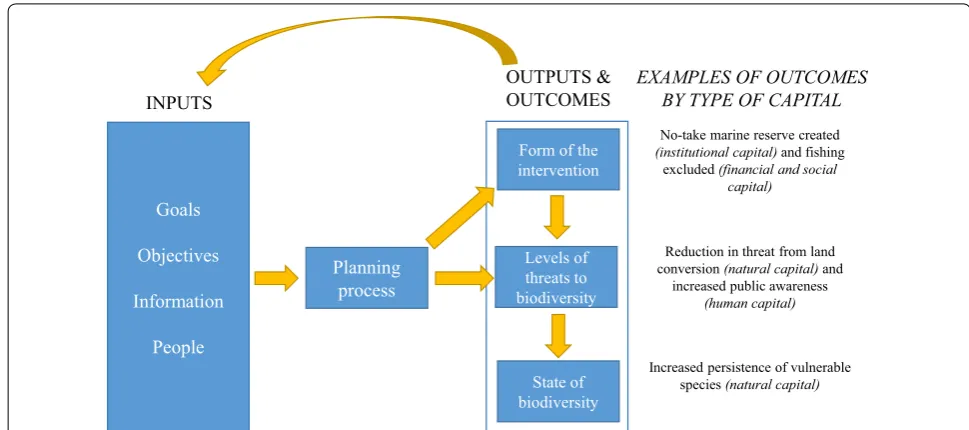
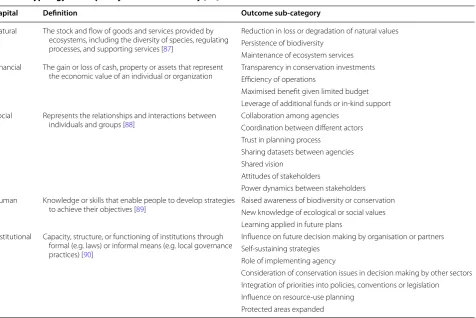
Our conceptual understanding of how systematic con-servation planning interventions can lead to outcomes in terms of natural, human, social, financial and insti-tutional capital is illustrated in Fig. 2 and expanded in Table 1. This theory of change is deliberately simple, to illustrate the potentially broad range of outcomes cur-rently assumed to result from systematic conservation planning exercises [28]. Multiple pathways and mecha-nisms are likely to link systematic conservation plan-ning to these outcomes, but these are not yet consistently defined. Our decision to report outcomes by five types of capital follows an earlier application of this framework to conservation planning [31] and related disciplines, e.g. [32]. For further details, see our published protocol [15].
Stakeholder engagement
Subject experts (ranging from academic researchers to staff in environmental NGOs responsible for conducting systematic conservation plans) were consulted through-out the protocol development, searching and analysis stages. This occurred in several ways. Calls were put out
for comment at relevant conferences and workshops, alongside presentations and posters about the project. Subject experts were also invited to share potentially rel-evant studies (see methods) and this usually led to email or phone discussions about the research and findings, as well as recommendations for additional contacts.
Objective of the systematic map
We sought to identify retrospective studies that meas-ured the effects of systematic conservation planning exer-cises on biodiversity conservation at various scales. Our primary research question was: What is the extent and distribution of evidence on conservation outcomes of sys-tematic conservation planning around the globe? The def-initions used to focus our search are provided in Table 2.
Our intent was to categorise included studies using a data extraction framework. The framework was designed to explore the following secondary questions:
• What are the characteristics of the current evidence base, including study location, scale and study design, intervention and outcome type?
• What types of outcomes of systematic conservation planning exercises are measured, either by the origi-nal planning organisation(s) or others?
• What types of study designs are used in evaluations of systematic conservation planning?
• How robust is existing evidence? How many impact evaluations have been conducted, where and by whom?
1. Scoping and costing of the planning process
2. Identifying and involving stakeholders
3. Describing the context for conservation areas
4. Identifying conservation goals
5. Collecting data on socio-economic variables and threats
6. Collecting data on biodiversity and other natural features
7. Setting conservation objectives
8. Reviewing current achievement of objectives
9. Selecting additional conservation areas
10. Applying conservation actions to selected areas
11. Maintaining and monitoring conservation areas
Stakeholder involvement throughout
Feedback and iterations in light of new data or logistical considerations
Spatial conservation prioritisation stages
Fig. 1 The stages of systematic conservation planning, reproduced from [15] and originally modified from [27]. Conservation planning approaches
[image:3.595.55.540.87.305.2]Methods
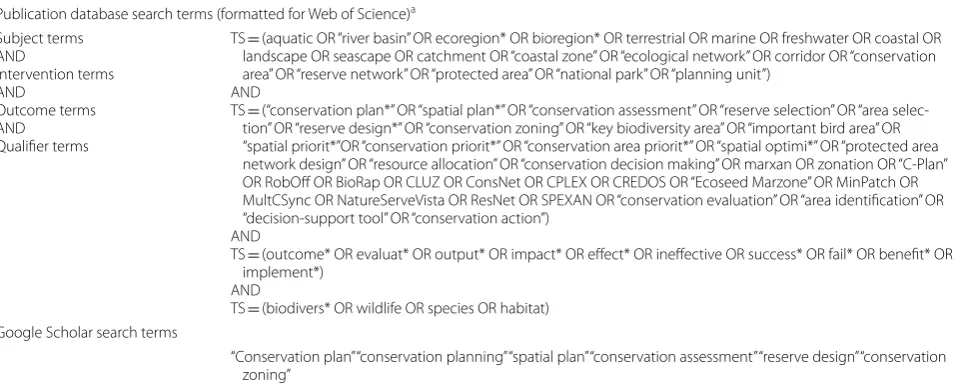
Our systematic map protocol has been published in Envi-ronmental Evidence [15] and this section includes updates since that publication. Updates include the use of the soft-ware CADIMA, consistency checks prior to every screening stage and abandonment of an attempt to undertake the bulk of screening by one reviewer (up to six were involved in the most time-consuming stages). Also, no evidence matrix was produced due to the small sample size. Further details have been provided in related sections of the methods.
Search strategy
A search string, consisting of subject- intervention- and outcome-related keywords combined using Boolean logic and wildcards, was used to query publication databases, search engines and online repositories (Table 3). Searches were conducted in February and March 2017. Unless oth-erwise indicated, searches were conducted for studies produced between 1983 and 2017 inclusive, in English only given resource constraints. Publications with full-texts not in English were listed and recorded separately for future iterations of the map or for other interested parties to pursue (see “Results”).
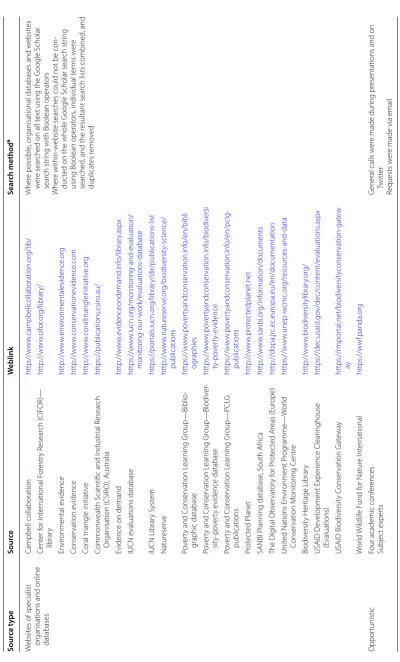
To ensure wide coverage of potential peer-reviewed academic publications and grey-literature publications [33], we searched three publication databases, one search engine, three online repositories, and 21 organisational
websites (Table 4). Studies were also identified oppor-tunistically, via calls for papers at major international conferences, backwards and forwards citation searches of included studies (in March 2018) and use of review papers to identify related primary studies. Subject experts were contacted to confirm no key references were missed. These individuals were identified primarily by their roles as conservation planning experts within global conservation NGOs, such as Conservation International, and prominent national organisations, such as the South African National Biodiversity Institute, and through snowball sampling (many recommended additional sub-ject experts). Experts also included academics whom the authors knew had an interest in this topic. The detailed protocols employed to search each source, including tai-lored approaches to individual databases and suggestions from subject experts, are outlined in Additional file 1.
Data management
Following the searches, article citation details and abstracts were extracted in.ris form (or converted to.ris form using a freely accessible conversion template devel-oped for our purposes by the EPPI-Centre [34]). When searching websites, the web scraping software Parsehub (https ://www.parse hub.com) was used to extract records [35, 36]. Settings were tailored to each website and details are provided in Additional file 1.
goals interventionForm of the
Levels of threats to biodiversity
Planning process
State of biodiversity INPUTS
OUTPUTS & OUTCOMES
Goals
Objectives
Information
People
Reduction in threat from land conversion (natural capital) and
increased public awareness
(human capital)
No-take marine reserve created
(institutional capital) and fishing excluded (financial and social
capital)
EXAMPLES OF OUTCOMES BY TYPE OF CAPITAL
Increased persistence of vulnerable species (natural capital)
Fig. 2 A conceptual model for systematic conservation planning (reproduced from the protocol [15]). A range of inputs influence the planning
[image:4.595.53.538.87.302.2]Results were initially imported into the software EPPI-Reviewer (V.4.5.1.0 [37]), which was used to detect and remove duplicate articles. Prior to title screening, dupli-cate checked results were imported into the systematic
review management software CADIMA [38].
Article screening and inclusion criteria
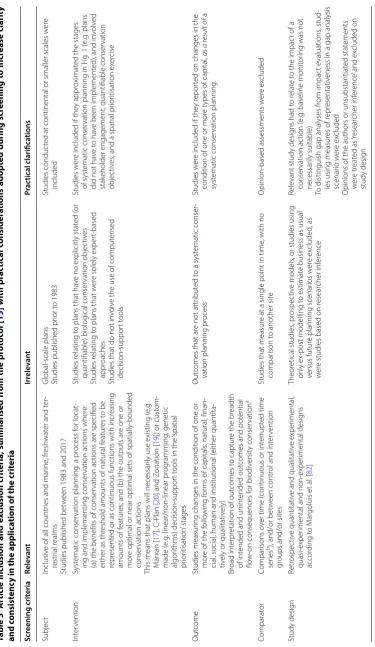
Articles were screened in three stages: title only, abstract, then full-text. When screening articles for relevance, a series of inclusion and exclusion decisions were
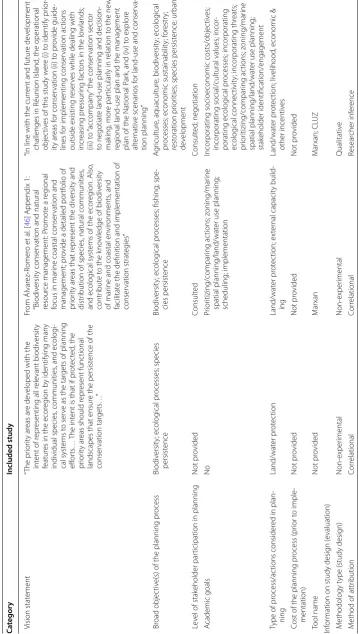
consistently applied (Table 5). Regular reviewer team meetings were held throughout all screening stages to ensure criteria were being applied uniformly, and detailed decision rules were tailored for each screening stage in these meetings. During our discussions about definitions of systematic conservation planning and tightening the inclusion criteria, we revised our original positions and excluded several studies we had expected to include at the protocol development stage (from the test library, including [7, 39, 40]). If there was any doubt about the Table 1 Potential outcomes of systematic conservation planning arranged according to capitals. Categories adapted from the typology developed by Bottrill and Pressey [28]
Representativeness was removed as an example of a natural capital outcome [58]
Capital Definition Outcome sub-category
Natural The stock and flow of goods and services provided by ecosystems, including the diversity of species, regulating processes, and supporting services [87]
Reduction in loss or degradation of natural values Persistence of biodiversity
Maintenance of ecosystem services Financial The gain or loss of cash, property or assets that represent
the economic value of an individual or organization Transparency in conservation investmentsEfficiency of operations Maximised benefit given limited budget Leverage of additional funds or in-kind support Social Represents the relationships and interactions between
individuals and groups [88] Collaboration among agenciesCoordination between different actors Trust in planning process
Sharing datasets between agencies Shared vision
Attitudes of stakeholders
Power dynamics between stakeholders Human Knowledge or skills that enable people to develop strategies
to achieve their objectives [89] Raised awareness of biodiversity or conservationNew knowledge of ecological or social values Learning applied in future plans
Institutional Capacity, structure, or functioning of institutions through formal (e.g. laws) or informal means (e.g. local governance practices) [90]
Influence on future decision making by organisation or partners Self-sustaining strategies
Role of implementing agency
Consideration of conservation issues in decision making by other sectors Integration of priorities into policies, conventions or legislation Influence on resource-use planning
Protected areas expanded
Table 2 Subject, intervention, outcome and comparator search elements Search element Definition
Subject (population) All countries and marine, freshwater and terrestrial realms. Studies published between 1983 and 2017
Intervention Systematic conservation planning: a process for locating and implementing conservation actions where: (a) the benefits of conservation actions are specified either as threshold amounts of natural features to be represented or as continuous functions with increasing amounts of features; and (b) the outputs are one or more optimal or near optimal sets of spatially-bounded conservation actions
Comparator Comparisons over time, and/or between control and intervention groups and/or sites without systematic conservation planning or with another form of planning
[image:5.595.63.540.107.425.2]relevance of an article, it was included for evaluation in the subsequent screening round to avoid removing potentially relevant studies. Two of the authors (MCM and RLP) have published extensively in this field so were not involved in article screening to reduce the likelihood of authors reviewing their own work.
Prior to commencing each screening stage, inter-reviewer consistency checks were conducted with the reviewers involved at that stage. A subset of the same titles/abstracts/or full-texts were screened by all and results were compared using Cohen’s Kappa (k) [41] (more details below). This exercise was repeated, and inclusion rules clarified, until the desired level of con-sistency was met (threshold k value of 0.5 at title screen-ing and 0.7 for abstract and full-text screenscreen-ing). These k
values exceed recommended guidelines [42]. After this, screening formally started (the articles used in consist-ency checks were included again in the overall screening). Articles were randomly divided between the reviewers and were not duplicate screened (except those marked as unsure, and at full-text extraction stage). Articles pro-vided by subject experts were automatically included for screening at full-text.
Title screening
For title screening, four rounds of consistency checks were required, involving 200 randomly selected arti-cles each time (800 titles total). Rounds were iteratively undertaken using CADIMA until screening decisions were above the k = 0.5 threshold. Publication titles were
reviewed in CADIMA by two reviewers in accordance with the inclusion and exclusion criteria.
Abstract screening
Due to limitations of CADIMA (not allowing changes to the size of a reviewer team at different stages [38]), EPPI-Reviewer was used for abstract and full-text screen-ing. Missing abstracts were entered for included arti-cles. Six reviewers participated in abstract screening and five rounds of consistency checks were conducted, each involving 25 randomly selected articles, until results exceeded the k = 0.7 threshold (125 abstracts total).
Full-text screening
Full-text files were downloaded or accessed in hard copy through the Bodleian Libraries at the University of Oxford. Full-text articles were divided between and screened by three reviewers following six rounds of con-sistency checks (where 20 articles were screened by all three reviewers each round), until results exceeded the
k = 0.7 threshold (120 full-texts). Reviewers included articles focusing on those with relevant subject, interven-tion, outcomes, comparator and study designs (Table 5). Articles were included only when all five criteria were relevant. Where insufficient information was provided to determine if the intervention met our definition of sys-tematic conservation planning, further information was sought before reaching a decision, such as by following up cited references about the original plan. Any articles the reviewer was unsure about were flagged as ‘unsure’ and were discussed with the other reviewers prior to Table 3 Search terms and strings used for searching online databases and websites
a Following sensitivity testing during initial pilots of the searches (in November 2016), the search terms were revised from the original protocol [15]. Terms were removed if they either inflated the number of search terms returned in an unspecified way (i.e. adding many irrelevant search results), or if they did not add value to searches based on similarity to existing terms
Publication database search terms (formatted for Web of Science)a Subject terms
AND
Intervention terms AND
Outcome terms AND
Qualifier terms
TS = (aquatic OR “river basin” OR ecoregion* OR bioregion* OR terrestrial OR marine OR freshwater OR coastal OR landscape OR seascape OR catchment OR “coastal zone” OR “ecological network” OR corridor OR “conservation area” OR “reserve network” OR “protected area” OR “national park” OR “planning unit”)
AND
TS = (“conservation plan*” OR “spatial plan*” OR “conservation assessment” OR “reserve selection” OR “area selec-tion” OR “reserve design*” OR “conservation zoning” OR “key biodiversity area” OR “important bird area” OR “spatial priorit*”OR “conservation priorit*” OR “conservation area priorit*” OR “spatial optimi*” OR “protected area network design” OR “resource allocation” OR “conservation decision making” OR marxan OR zonation OR “C-Plan” OR RobOff OR BioRap OR CLUZ OR ConsNet OR CPLEX OR CREDOS OR “Ecoseed Marzone” OR MinPatch OR MultCSync OR NatureServeVista OR ResNet OR SPEXAN OR “conservation evaluation” OR “area identification” OR “decision-support tool” OR “conservation action”)
AND
TS = (outcome* OR evaluat* OR output* OR impact* OR effect* OR ineffective OR success* OR fail* OR benefit* OR implement*)
AND
TS = (biodivers* OR wildlife OR species OR habitat) Google Scholar search terms
[image:6.595.59.538.104.298.2]Table
4
S
our
ces sear
ched and sear
ch metho
ds ac
cor
ding t
o sour
ce t
yp
e
Sour
ce t
ype
So
urce
W
eblink
Sear
ch
method
a
Publication database
W
eb of S
cience
™ C
or
e C
ollec
tion
https
://w
ebof
kno
wl
edge
.com
Sear
ched on title
, abstrac
t and k
ey
w
or
ds using the
publication database sear
ch str
ing adapt
ed f
or each
database
All r
esults ex
trac
ted
SC
OPUS
https
://w
w
w
.scopu
s.com
CAB Abstrac
ts
https
://w
w
w
.cabi.or
g/publi
shing
-pr
odu
cts/onlin
e-inf
or
matio
n-r
esou
rces/cab
-abstr
ac
ts/
Sear
ch eng
ine
G
oogle S
cholar
https
://schol
ar
.googl
e.co
.uk
Sear
ched on title only using the G
oogle S
cholar sear
ch
str
ing
A second sear
ch r
equir
ed
‘e
valuation
’ t
o also appear in
the title
For both sear
ches
, the first 1000 r
esults w
er
e r
etr
ie
ved
using the sof
twar
e Har
zing
’s P
ublish or P
er
ish [
91
].
Online r
eposit
or
ies
Open g
re
y
http://w
w
w
.openg
re
y.eu/
Sear
ched on title only
, using the G
oogle S
cholar sear
ch
str
ing
PAIS int
er
national (P
roQuest)
http://w
w
w
.pr
oqu
est.com/pr
odu
cts-ser
vi
ces/pais-set
-c.html
Pr
oceedings F
irst (
OCL
C Online C
omput
er Librar
y
Cent
er
, I
nc
.)
http://w
w
w
.oclc
.or
g
Papers F
irst (
OCL
C Online C
omput
er Librar
y C
ent
er
,
Inc
.)
http://w
w
w
.oclc
.or
[image:7.595.204.399.83.728.2]a D
etailed r
ec
or
ds of the da
tes and cr
iter
ia used f
or each sear
ch ar
e included in A
dditional file 1 Table 4 (c on tinued) Sour ce t ype So urce W eblink Sear ch method a W ebsit
es of specialist
or
ganisations and online
databases Campbell collaboration http://w w w .campb ellco llabo ratio n.or g/lib/ Wher e possible , or
ganisational databases and w
ebsit
es
w
er
e sear
ched on all t
ex
t using the G
oogle S
cholar
sear
ch str
ing with Boolean operat
ors Wher e within-w ebsit e sear
ches could not be con
-duc
ted on the whole G
oogle S
cholar sear
ch str
ing
using Boolean operat
ors
, individual t
er ms w er e sear ched
, and the r
esultant sear
ch lists combined
, and duplicat es r emo ved Cent er f or I nt er national F or estr y R esear ch ( CIFOR)— librar y http://w w w .cif or .or g/libra ry/ En vir onmental e vidence http://w w w .en vir onmen tale v idenc e.or g Conser vation e vidence http://w w w .conse rvati one vi dence .com Coral tr iangle initiativ e http://w w w .coral tr ian glein itiat iv e.or g Common w ealth S
cientific and I
ndustr ial R esear ch Or ganisation ( CSIR O), A ustralia https ://publi catio ns .csir o .au/
Evidence on demand
http://w w w .e vide nceon deman d.inf o/libra ry .asp x IUCN e valuations database https ://w w w .iucn.or g/monit or ing -and-evalu ation / monit or ing -our -w or k/e valu ation s-datab ase IUCN Librar y Syst em https ://por ta ls .iucn.or g/libra ry/dir/publi catio ns-list Natur eser ve http://w w w .natur eser v e .or g/biodi versi ty-scien ce/ publi catio ns Po ver
ty and C
onser vation L ear ning Gr oup —Biblio -graphic database https ://w w w .po ver tyand conse rvati on.inf o/en/bibli og rap hies Po ver
ty and C
onser vation L ear ning Gr oup —Biodiv er -sit y-po ver ty e vidence database https ://w w w .po ver tyand conse rvati on.inf o/biodi versi ty-po ver ty-evide nce Po ver
ty and C
onser vation L ear ning Gr oup —PCL G publications https ://w w w .po ver tyand conse rvati on.inf o/en/pclg-publi catio ns Pr ot ec ted P lanet http://w w w .pr ot e c tedp lanet .net SANBI P lanning database , S outh A frica http://w w w .sanbi .or g/inf or matio n/docum ents The Dig ital Obser vat or y f or P rot ec ted Ar eas (E ur ope) http://dopa.jr c.ec .eur op a.eu/en/docum entat ion Unit
ed Nations En
vir onment P rog ramme — W or ld Conser vation M onit or ing C entr e https ://w w w .unep -w cmc .or g/r esou rces-and-data Biodiv ersit y Her itage Librar y http://w w w .biodi versi tylib rar y.or g/ USAID D ev elopment Exper ience Clear inghouse (E valuations) https ://dec .usaid .go v/dec/cont e nt/e valu ation s.asp x USAID Biodiv ersit y C onser vation G at ewa y https ://r mpor tal .net/biodi versi ty con ser va tion-gat ew ay W or ld W ildlif e F und f or Natur e I nt er national https ://w wf .panda .or g Oppor tunistic
Four academic conf
er ences Subjec t exper ts G
eneral calls w
er
e made dur
ing pr
esentations and on
Twitt
er
Requests w
er
[image:8.595.66.467.72.735.2]Table
5
A
rticle inclusion and
ex
clusion crit
eria, summarised fr
om the pr ot oc ol [ 15 ] with pr ac tic al c onsider ations adopt ed during scr eening t o incr ease clarit y and c onsist enc y in the applic ation of the crit eria
a A detailed discussion of wha
t c
onstitut
es an out
come v
ersus an impac
t is pr
ovided in [
16
]
b I
n an in
ter
rupt
ed time ser
ies , da ta ar e c ollec ted a t sev er
al time poin
ts bef
or
e and af
ter an in
ter ven tion [ 92 ] Scr eening crit eria Rele van t Irr ele van t Pr ac tical clarifica tions Subjec t Inclusiv
e of all countr
ies and mar
ine
, fr
esh
wat
er and t
er
-restr
ial r
ealms
Studies published bet
w
een 1983 and 2017
Global-scale plans Studies published pr
ior t
o 1983
Studies conduc
ted at continental or smaller scales w
er e included Int er vention Syst ematic conser
vation planning: a pr
ocess f
or locat
-ing and implement-ing conser
vation ac
tions wher
e:
(a) the benefits of conser
vation ac
tions ar
e specified
either as thr
eshold amounts of natural f
eatur
es t
o be
repr
esent
ed or as continuous func
tions with incr
easing
amounts of f
eatur
es; and (b) the outputs ar
e one or
mor
e optimal or near optimal sets of spatially-bounded
conser
vation ac
tions
This means that plans will necessar
ily use existing (
e.g . M ar xan [ 17 ], C-P lan [ 20
] and Z
onation [
19
]) or cust
om-made (
e.g
. linear/non-linear pr
og ramming , genetic algor ithms) decision-suppor t t
ools in the
‘spatial pr ior itisation ’ stages Studies r elating t
o plans that ha
ve no explicitly stat
ed ( or quantifiable) biolog ical conser vation objec tiv es Studies r elating t
o plans that w
er
e solely exper
t-based
appr
oaches
Studies that do not in
volv
e the use of comput
er ised decision-suppor t t ools Studies w er
e included if the
y appr
oximat
ed the stages
of syst
ematic conser
vation planning in F
ig . 1 (e .g . plans
did not ha
ve t
o ha
ve been implement
ed), and in
volv
ed
stak
eholder engagement, quantifiable conser
vation
objec
tiv
es
, and a spatial pr
ior itisation ex er cise Out come Studies measur
ing changes in the condition of one or
mor
e of the f
ollo
wing f
or
ms of capitals: natural
, finan
-cial
, social
, human and institutional (
either quantita
-tiv
ely or qualitativ
ely)
Br
oad int
er
pr
etation of out
comes t
o captur
e the br
eadth
of int
ended and unint
ended out
comes and pot
ential
flo
w-on cw-onsequences f
or biodiv ersit y conser vation a Out
comes that ar
e not attr
ibut
ed t
o a syst
ematic conser
-vation planning pr
ocess
Studies w
er
e included if the
y r
epor
ted on changes in the
condition of one or mor
e t
ypes of capital
,
as a r
esult of a syst ematic conser vation planning . Comparat or Compar isons o
ver time (
continuous or int
er
rupt
ed time
ser
ies
b), and/or bet
w
een contr
ol and int
er
vention
gr
oups and/or sit
es
Studies that measur
e at a single point in time
, with no
compar
ison t
o another sit
e
Opinion-based assessments w
er e ex cluded Study desig n Retr ospec tiv e quantitativ
e and qualitativ
e exper
imental
,
quasi-exper
imental and
non-exper imental desig ns accor ding t o M ar goluis et al . [ 82 ] Theor etical studies , pr ospec tiv e models
, or studies using
only ex
-post modelling t
o estimat
e business as usual
versus futur
e planning scenar
ios w er e ex cluded , as w er
e studies based on r
esear
cher inf
er
ence
Rele
vant study desig
ns had t
o r
elat
e t
o the impac
t of a
conser
vation ac
tion (
e.g
. baseline monit
or
ing was not
necessar
ily suitable)
To distinguish gap analyses fr
om impac
t e
valuations
, stud
-ies using measur
es of r
epr
esentativ
eness in a gap analysis
scenar
io w
er
e ex
cluded
Opinions of the authors or unsubstantiat
ed stat ements w er e tr eat ed as ‘resear cher inf er ence
’ and ex
cluded on
study desig
[image:9.595.103.479.82.730.2]reaching a decision. Given inconsistencies in the use of the term “systematic conservation planning” [16], those studies for which the “intervention was similar to, but not systematic conservation planning” (according to our definition, Table 5) were marked as such. This provided estimates of the number of spatial conservation prior-itisations and other related exercises detected. Review papers were also set aside, and the studies therein were assessed for relevance.
Data coding and mapping
Relevant studies were extracted from the included arti-cles (where multiple studies were included in a single article). For example, a single paper often reported on multiple planning instances. The included studies were categorised by two reviewers according to a data coding template (Additional file 2) and any differences in coding were discussed and a third reviewer involved if necessary (undertaking kappa analysis was unnecessary at this stage due to the small sample size). Coding involved outlining bibliographic details, background information includ-ing location of study and broad objectives of the plan, study design, reported outcomes and context [15]. Infor-mation about the study design of relevant articles was recorded to determine study robustness, in place of criti-cal appraisal. Where possible, the categories of the data coding template were updated to match those underlying
a new database of marine spatial prioritisations [26] to make the two databases cross-compatible. Where neces-sary, we contacted authors of included studies for addi-tional information (via email or phone).
Our finding of fewer than expected evaluations in the published literature meant the development of an evi-dence matrix and geographic map of included studies (as proposed in the protocol) was not possible. Instead we provided a narrative assessment of the available litera-ture, gaps in our current state of knowledge and sugges-tions for how to fill these.
Procedural independence was managed by excluding co-authors with publication records in systematic con-servation planning (MCM and RLP) from the screening process.
Results Primary findings
In total, 15,054 results were retrieved from the 29 sources searched, including 5228 duplicates (Fig. 3; details in Additional file 1). A further 232 previously unscreened articles were screened based on forwards and backwards citation searches of the included studies (Additional file 3). After duplicates were removed, a total of 10,058 articles were screened by title, 5221 by abstract and 1209 by full-text. Of those included for full-text screening, 236 were either not in English or not accessible (Additional
Publication database searches (Web of Science, SCOPUS, CAB Abstracts)
n=13,133
26 other sources (search engines, online repositories, organisational
websites, subject experts) n=1,921
Duplicates removed n=5,228
Articles screened by title n=10,058
Articles screened by abstract n=5,221
Articles screened by full-text n=1,209
Note: full text unavailable n=206, full-text not in English n=30
Included studies n=3
Articles excluded by title n=4,837
Articles excluded by abstract n=4,012
Articles excluded by full-text n=970
Excluded by: subject n=77; intervention n=893; outcome n=911;
comparator n=811; study design n=788.
Citation searches of
included studies, new
articles n=232
Fig. 3 PRISMA diagram [93] outlining outcomes of articles at searching and screening stages. Articles excluded by full-text were often excluded
[image:10.595.58.538.438.697.2]file 4). Where neither hard copy nor digital copies were found through Oxford University’s Bodleian Library or Google searches, digital copies were requested from authors via ResearchGate.net. Most of the remaining search results unavailable by full-text had incomplete citation details or were conference abstracts without associated full-text publications.
Reasons for the exclusion of the remaining 970 arti-cles were recorded (Additional file 5). Seven articles were excluded outright because they were marked as reviews of systematic conservation planning evaluations (Additional file 6). If an article was excluded on one or more inclusion/exclusion criteria (Table 5) it was not included. All criteria were assessed, and most articles were excluded based on multiple criteria (Fig. 3). 893 articles were excluded on intervention, 186 of which were deemed “intervention is similar to, but not systematic conservation planning”, meaning they were either solely spatial conservation prioritisations (a computational component of systematic conservation planning), or approximated the stages involved in systematic conserva-tion planning but did not involve the spatial conservaconserva-tion prioritisation stage [15].
Of the 69 studies included on subject and intervention (representing a systematic conservation planning inter-vention at a relevant scale, Table 5), 23 were excluded on outcome because they reported on the design and implementation of a systematic conservation plan but did not provide any details about consequences. In some cases, for example, at the time of publication it was too early to report whether the plan was implemented. This left 43 articles included on subject, intervention and out-come but excluded on study design and comparator. Only three articles were included based on all criteria (Addi-tional file 7). One of these had been provided by a sub-ject expert and the other two had been retrieved through publication database searches. One of the included arti-cles reported on multiple different types of planning instances, but we extracted three relevant studies across the three articles.
Additionally, 142 articles were included on subject, study design and comparator but excluded on interven-tion and outcome, all of which related to formal evalu-ations of environmental management interventions, but not systematic conservation planning specifically.
Robustness of existing evidence
Coded data extracted from the three included studies is presented in Table 6 according to a standardised data coding template (Additional file 2). These impact evalua-tions were undertaken by NGOs and universities. In two studies, the same organisations undertook the evaluation as had developed the plan(s) in question.
Fisher and Dills [43] reported on ecoregional assess-ments conducted across the USA, which were based on systematic conservation planning principles [44]. The authors explored the relationship between terrestrial areas prioritized for biodiversity conservation by an envi-ronmental NGO (The Nature Conservancy, TNC), and those acquired for protection by the NGO over several decades.
Lagabrielle et al. [45] outlined a terrestrial planning process for the island of Réunion which was conducted in parallel with the revision of a regional development plan. The evaluation approach was largely reflexive, com-paring a planning attempt involving systematic conserva-tion planning (which they referred to as sequence 2) and another where agent-based modelling and companion modelling were used to explore future land-use change scenarios (sequence 3).
Álvarez-Romero et al. [46] compared seven marine conservation planning exercises undertaken over a 15-year period in the Gulf of California, Mexico. One of these plans met our definition of systematic conservation planning (the Ecoregional Assessment [47]) and it alone is the relevant study discussed here. Experts on regional marine conservation issues were surveyed and asked to identify planning goals, the extent to which these were achieved and how planning outputs influenced imple-mented conservation actions.
Characteristics of the current evidence base
Two studies were conducted at subnational scales and one nationally. The areas of interest ranged from 2500 km2 to over 300,000 km2. Two studies concerned
the terrestrial realm and one marine. We classified all three intervention types as aiming to ‘identify prior-ity conservation actions’. None were intended for direct application. The objectives of all studies included biodi-versity, ecological processes and species persistence and two also included other considerations, such as fisher-ies, agriculture and urban planning. Stakeholder engage-ment most commonly involved consultation, and in one instance also negotiation. The duration of the planning processes and associated costs were unclear in all three studies.
Types of outcomes of systematic conservation planning exercises
Table
6
Details of included studies ac
cor ding t o a standar dised da ta e xtr ac tion f orm ( A dditional file 2 ) Ca tegor y Included study G eneral inf or mation P ublication ID 32732910 27951807 27939613 S our ce r etr ie ved fr om Subjec t exper t G oogle S cholar ; W
eb of S
cience; S copus; CAB Abstrac ts CAB Abstrac ts Bibliog raphic inf or mation P ublication t ype Jour nal ar ticle Jour nal ar ticle Jour nal ar ticle A uthor (s) Fisher , J
onathan R. B
.; Dills , Benjamin Álvar ez ‐ Romer o, J or
ge G.; P
resse
y, R
ober
t L.;
Ban, Natalie C.;
Tor re -C osío , J or ge; Abur to -Or opeza, O cta vio Lagabr ielle , Er
wann; Botta, A
ur élie; Dar é, W illiams; Da vid
, Daniel; A
uber t, Sig rid; F abr icius , Chr ist o T itle D o pr ivat e conser vation ac tivities mat ch science -based conser vation pr ior ities? M ar ine conser
vation planning in prac
tice: les
-sons lear
ned fr
om the Gulf of C
alif
or
nia
M
odelling with stak
eholders t o int eg rat e biodi -versit y int
o land-use planning - L
essons lear
ned
in R
éunion Island (
W est er n I ndian O cean) J our
nal or P
ublication title
PL
oS ONE
Aquatic C
onser
vation: Marine and F
reshw
ater
Ec
osystems
Envir
onmental Modelling & S
oft w ar e P ublication y ear 2012 2013 2010 V olume/edition 7 (9) 23 25 P ublisher PL oS ONE W ile
y Online Librar
y Else vier P age numbers e46429 483–505 1413–1427 Basic inf or
mation about the conser
vation plan
P
rimar
y r
eg
ion of assessment
National Sub -national Sub -national C ountr
y (s) of assessment
Unit
ed Stat
es of Amer
ica
M
exico
France
L
ocation of study (r
eg
ion)
Unit
ed Stat
es of Amer
ica
Gulf of C
alif
or
nia
Réunion Island
L
ocation of study (
GPS coor dinat es) 37.0902400, − 95.7128910 27.4803504, − 112.0303160 − 21.1203276, 55.5483399
Name of r
esultant pr ot ec ted ar ea net w or k or similar (wher e r ele vant) NA NA NA
Name of the planning pr
ocess Ecor eg ional A ssessments Ecolog ical R eg ional A ssessment (ERA) No name
, parallel t
o the S
chéma
d’
Aménagement R
ég
ional (SAR), a r
eg
ional land
use planning pr
ocess
T
ype of or
ganisation leading the planning
pr ocess NGO NGO NA P
lanning domain ar
ea (k m 2) Not pr ovided 361,375 2512 T
ype of biome(s)
Ter restr ial M ar ine Ter restr ial Star
t of planning pr
ocess (y
ears)
1990s
Unclear
Unclear
Duration of planning pr
ocess (y ears) 20 Unclear Unclear T
ype of plan (int
er vention cat egor y) Identify pr ior ity conser vation ac tions Identify pr ior ity conser vation ac tions Identify pr ior ity conser vation ac tions P rimar y conser
vation status of ar
Table 6 (c on tinued) Ca tegor y Included study V ision stat ement “T he pr ior ity ar eas ar e de
veloped with the
int
ent of r
epr
esenting all r
ele
vant biodiv
ersit
y
featur
es in the ecor
eg
ion b
y identifying man
y
individual species
, communities
, and ecolog
i-cal syst
ems t
o ser
ve as the tar
gets of planning
eff
or
ts
…
The int
ent is that if pr
ot ec ted , the pr ior ity ar
eas should r
epr
esent func
tional
landscapes that ensur
e the persist
ence of the
conser vation tar gets … ” Fr om Álvar ez ‐ Romer o et al . [ 46 ] Appendix 1: “Biodiv ersit y conser
vation and natural
resour
ce management: P
romot
e a r
eg
ional
focus in mar
ine coastal conser
vation and
management; pr
ovide a detailed por
tfolio of
pr
ior
ity ar
eas that r
epr
esent the div
ersit
y and
distr
ibution of species
, natural communities
,
and ecolog
ical syst
ems of the ecor
eg ion. Also , contr ibut e t
o the k
no
wledge of biodiv
ersit
y
of mar
ine and coastal en
vir
onments
, and
facilitat
e the definition and implementation of
conser
vation strat
eg
ies
”
“In line with the cur
rent and futur
e de
velopment
challenges in R
éunion Island
, the operational
objec
tiv
es of this study w
er
e (i) t
o identify pr
ior
-ity ar
eas f
or conser
vation (ii) t
o pr
ovide guide
-lines f
or implementing conser
vation ac
tions
outside existing r
eser
ves while dealing with
incr
easing pr
essur
ing fac
tors in the lo
wlands; (iii) t o “accompan y” the conser vation sec tor to negotiat
e land-use planning and
decision-mak
ing
, mor
e par
ticular
ly in r
elation t
o the ne
w
reg
ional land-use plan and the management
plan of the National P
ar
k, and (iv) t
o explor e alt er nativ e scenar ios f
or land-use and conser
va -tion planning ” Br oad objec tiv
e(s) of the planning pr
ocess Biodiv ersit y; ecolog ical pr ocesses; species persist ence Biodiv ersit y; ecolog ical pr
ocesses; fishing; spe
-cies persist ence A gr icultur e, aquacultur e; biodiv ersit y; ecolog ical pr
ocesses; economic sustainabilit
y; f or estr y; rest oration pr ior
ities; species persist
ence; ur ban de velopment L ev
el of stak
eholder par
ticipation in planning
Not pr ovided Consult ed Consult ed; negotiation A cademic goals No Pr ior itizing/compar ing ac tions; z oning/mar ine spatial planning/land/wat
er use planning;
scheduling; implementation
Incor
porating socioeconomic costs/objec
tiv
es;
incor
porating social/cultural values; incor
-porating ecolog ical pr ocesses; incor porating ecolog ical connec tivit y; incor porating thr eats; pr ior itizing/compar ing ac tions; z oning/mar ine spatial planning/land/wat
er use planning;
stak
eholder identification/engagement
T
ype of pr
ocess/ac
tions consider
ed in plan
-ning Land/wat er pr ot ec tion Land/wat er pr ot ec tion; ex ter nal capacit y build -ing Land/wat er pr ot ec tion; liv elihood
, economic &
other incentiv
es
C
ost of the planning pr
ocess (pr ior t o imple -mentation) Not pr ovided Not pr ovided Not pr ovided T ool name Not pr ovided M ar xan M ar xan; CL UZ Inf or
mation on study desig
n (
evaluation)
M
ethodology t
ype (study desig
n) Non-exper imental Non-exper imental Qualitativ e M
ethod of attr
[image:13.595.67.426.90.725.2]Table 6 (c on tinued) Ca tegor y Included study O ver vie
w of the methodology
“T
he lands acquir
ed b y The Natur e C onser vanc y (TNC ) w er
e analysed using GIS t
o det
er
mine
to what ex
tent the
y w
er
e in ar
eas defined as
pr ior ities f or conser vation ” Se
ven plans conduc
ted in the Gulf of C
alif or nia w er e compar
ed and exper
ts w
er
e ask
ed t
o
assess their out
comes based on a standar
d-ised questionnair e. “…T he similar ities and diff er ences bet w
een planning ex
er
cises
w
er
e examined in t
er
ms of data, methods
and outputs
, ho
w identified pr
ior
ities mat
ch
the existing MP
A syst
em, and whether plans
ha
ve guided conser
vation and management
ac
tions
”
The e
valuation appr
oach was lar
gely r
eflexiv
e,
compar
ing planning sequences 2 (in
volving
M
ar
xan) and 3 (in
volving model co
-cr
eation
with stak
eholders), and based on
“obser
vations
made b
y the par
ticipat
or
y modelling in
vestiga
-tors dur
ing and 12
months af
ter the pr
ocess
”.
The authors consider
ed the
“resear
cher
’s
postur
e in the par
ticipat
or
y modelling pr
ocess ” and ther ef or e att empt ed t o r ecog nise pot ential biases Out comes R epor ted outputs Polic
y or plan
Polic
y or plan; academic paper(s)
Polic
y or plan; academic paper(s)
T
ypes of out
comes b
y capital
Institutional
Social; human; institutional
Financial; social; human; institutional
R
epor
ted out
comes of planning pr
ocess
Influence on futur
e decision mak
ing b
y or
gani
-sation or par
tners; int
eg
ration of pr
ior
ities int
o
policies
, con
ventions or leg
islation; pr ot ec ted ar eas expanded Coor dination bet w een diff er ent ac tors; raised awar
eness of biodiv
ersit
y or conser
vation;
ne
w k
no
wledge of ecolog
ical or social values;
lear
ning applied in futur
e plans; influence
on futur
e decision mak
ing b
y or
ganisation
or par
tners; r
ole of implementing agenc
y; pr ot ec ted ar eas expanded Transpar enc
y in conser
vation in vestments; coor -dination bet w een diff er ent ac
tors; trust in the
planning pr
ocess; shar
ing datasets bet
w
een
agencies; attitudes of stak
eholders; raised
awar
eness of biodiv
ersit
y or conser
vation; ne
w
kno
wledge of ecolog
ical or social values; lear
n-ing applied in futur
e plans; influence on futur
e
decision mak
ing b
y or
ganisation or par
tners;
consideration of conser
vation issues in decision
mak
ing b
y other sec
tors
Dir
ec
tion of change of out
come Unclear Positiv e Positiv e
Did the pr
ojec t out comes r eflec t achie vement
of the or
ig
inal plan vision stat
ement? Not pr ovided Ye s Ye s C ont ex
t of study (
evaluation)
L
ocation of lead author
’s or ganisation ( coun -tr y) Unit ed Stat
es of Amer
ica
A
ustralia
France
T
ype of or
ganisation leading the e
valuation NGO Univ ersit y Univ ersit y
Is the lead or
ganisation the same as that
which or
ig
inally conduc
ted the planning
[image:14.595.67.417.87.727.2]Table
6
(c
on
tinued)
Ca
tegor
y
Included study
P
ur
pose/rationale
for the study (stat
ed r
easons
for under
tak
ing an e
valuation)
“T
he Natur
e C
onser
vanc
y (
TNC
) and other lar
ge
conser
vation or
ganizations ha
ve in
vest
ed
substantial r
esour
ces in de
veloping conser
va
-tion plans int
ended t
o guide their decisions
about which land ar
eas and bodies of wat
er
to conser
ve
. Ho
w
ev
er
, despit
e the in
vestment
in de
veloping a scientific method f
or pr
ior
itiz
-ing ar
eas f
or conser
vation, the deg
ree t
o
which land acquisition ac
tually f
ollo
ws these
scientific pr
ior
ities has not been in
vestigat
ed
bef
or
e no
w
”
“While theor
y in conser
vation planning is de
vel
-oping quick
ly
, ther
e has been no assessment
of the influence of ne
w ideas on applications
of mar
ine conser
vation
”
“…T
he o
verall goal was t
o t
est diff
er
ent
appr
oaches t
o br
idge the scientific and opera
-tional communities b
y br
ing
ing multidiscipli
-nar
y scientists and stak
eholders t
o collaborat
e
ar
ound the par
ticipat
or
y de
velopment of
spatial models f
or land-use and conser
vation
planning
”
H
ypotheses of e
valuat
ors
“Our first h
ypothesis was that o
verall the acqui
-sition of lands should be w
ell alig
ned with
pr
ior
ity ar
eas on the assumption that
TNC
chapt
ers base their acquisition decisions on
the best a
vailable conser
vation science
. W
e
did not expec
t per
fec
t alig
nment f
or se
veral
reasons not
ed in the discussion sec
tion.
Second
, w
e h
ypothesiz
ed that ther
e w
ould
be impr
ov
ement o
ver time in the mat
ch
bet
w
een science
-based pr
ior
ities and land
pr
ot
ec
ted b
y
TNC as assessments and plan
-ning methods w
er
e incr
easingly f
or
maliz
ed
and impr
ov
ed
. Our thir
d h
ypothesis was that
outr
ight f
ee simple acquisition of land w
ould
sho
w g
reat
er alig
nment with the pr
ior
ity ar
eas
than pr
ocur
ing conser
vation easements
”
Not pr
ovided
Not pr
ovided
Out
come path
wa
ys
T
heor
y of change or conceptual model (f
or
ho
w the plan was expec
ted t
o lead t
o
int
ended out
comes) included in the study?
No
No
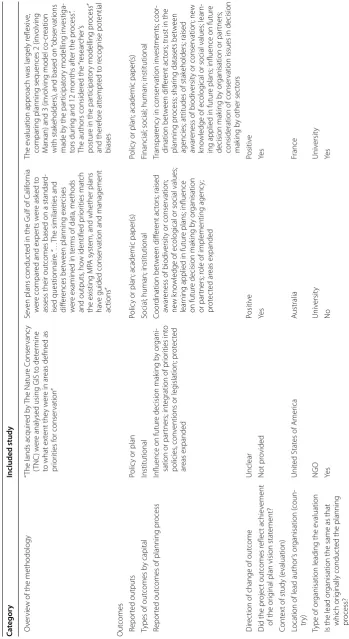
[image:15.595.66.388.80.731.2]process on future decision making by the organisation or partners [43, 46]. Two of the three studies reported on whether the project outcomes reflected achievement of the original plan vision statement, and both reported the vision had been achieved.
Types of study designs used in evaluations of systematic conservation planning
None of the studies provided theories of change or a dis-cussion of how they expected the plans to lead to poten-tial conservation (or other) outcomes. Only one stated a hypothesis for the evaluation. Two studies involved non-experimental study designs where the method of attri-bution was correlative. The other was qualitative, and attribution was based on researcher inference.
Review of our search methodology
One of the included studies [43] originated from the call to subject experts, but unlike the other included stud-ies, had not been returned in the searches of publica-tion databases (all included studies had been published in indexed journals). To explore the reasons for this, a review of the original search string was conducted in Web of Science Core Collections on 24/01/18 (Additional file 8). This confirmed the intervention and outcome search terms were appropriate, but the subject terms were not sufficiently diverse. By adding the term ‘pro-tection’ to the subject terms, the missed article [43] was returned in the new search, along with 342 additional articles compared to the original search string (exclud-ing a further 563 articles added to Web of Science in the 11 months since the original search). This finding can be used to help better design future searches (see “
Dis-cussion”). However, the 342 studies were not screened
for relevance and none were included in the study since we would for parity necessarily have to have to repeated searches across all 29 sources beyond the original March 2017 cut off.
Discussion
Faced with prioritizing limited resources for biodiver-sity conservation, conservation planners are increas-ingly turning to systematic conservation planning tools and techniques. Their aims are to explore financially and socially acceptable trade-offs, whilst seeking to optimise representation and, usually implicitly, the persistence of species and habitats [2]. In this study, we collated arti-cles on the application of systematic conservation plan-ning and the outcomes of related plans. The aim was to assess the evidence base rather than produce meta-analyses or detailed syntheses. Despite retrieving over 10,000 articles from traditional academic and grey liter-ature sources, only three studies were found to contain
robust evaluations of this extensively applied interven-tion type and none that reported evaluainterven-tion of natural capital outcomes. This highlights an important evidence gap, particularly given the amount of interest in system-atic conservation planning and the significant cost of undertaking plans [28]. This is a null result, rather than a negative finding and was not completely unexpected, given the barriers to undertaking evaluations of com-plex interventions [48]. As stated in our original pro-tocol, “a finding that no or few impact evaluations have been undertaken on systematic conservation plans would highlight an important gap in evaluations of the tech-nique to date” [15: 4].
Rigorous Collaboration for Environmental Evidence guidelines [42] were used to identify three relevant stud-ies, that provide valuable insights into how plans are con-ducted and how outcomes can be interpreted. However, the studies did not conform perfectly with our inclu-sion criteria, particularly in relation to comparators and study designs. The below considerations highlight the difficulties of interpreting studies of planning interven-tions, as well as the prevalence of incomplete records and challenges when attributing outcomes to complex interventions.
Contrasting evaluation methodologies
The three included study designs differed greatly and demonstrated the importance of understanding regional contexts and of interpreting results with care.
Fisher and Dills [43] undertook a meta-analysis, the assessment of a planning campaign over several dec-ades, rather than assessments of individual plans and the causal processes that led to the outcomes of those plans. The authors were not able to provide conclusive evidence that systematic conservation planning influ-enced land acquisition decisions, but this finding masked the complexity underlying the value of the formal ecore-gional assessment processes. While they did find that the land acquisition patterns by TNC were positively cor-related with priority areas in all states across the USA, no difference was observed in land acquisition patterns before and after systematic ecoregional assessments were implemented.
datasets and experiences from earlier plans often influ-enced subsequent planning processes. Furthermore, these plans were not explicitly contrasted to the rele-vant plan in the results, as data were aggregated across all seven plans. Use of a survey methodology facilitated an assessment of how goals, outcomes and spatial areas recommended for protection differed between the seven plans. Surveying people one step removed from the plans in question provides an example of how to limit bias when reporting on planning outcomes.
The third included study by Lagabrielle et al. [45] was considered borderline in terms of constituting a qualita-tive study design in part because it directly reported on the opinions of the authors, with little explanation of causal links or justifications for reported outcomes. We included it because the authors considered the “research-er’s posture in the participatory modelling process” [45:1425] and therefore attempted to recognise potential biases. They provided thoughtful reflections on the sci-entists’ role in the process, and comparisons between the experience of conducting a systematic conservation plan-ning study using Marxan, with a process where stake-holders co-created models and planning outputs with scientists.
Another article we screened, by Carter et al. [49], pro-vides a valuable example of how to conduct an evaluation of the outcomes of conservation plans, even though it was not included. The authors quantified land manage-ment actions (i.e., changes in the amount, location and land cover type of protected areas) in relation to indi-vidual state land management plans in Wisconsin, USA. They found that land protection activity increased in prioritized regions after plans were released, an effect that was high for local land protection projects but weak for broader, state-wide plans (a finding consistent with that of Fisher and Dills [43]). They also noted that most actions occurred within the first 5 years after a plan was released and decreased over time. Two plans discussed in this article were similar to systematic conservation plans but were excluded on intervention and outcomes. It remains an insightful article, exploring the causal path-ways by which plans may influence conservation actions.
Overall, we identified 43 studies with relevant subjects, interventions and outcomes, but which we were unable to include due to unsuitable study designs and compara-tors (Additional file 2). In general, the evaluation strate-gies were not sufficiently rigorous for inclusion, or to independently verify claims. This is not uncommon in studies of environmental interventions [50, 51]. Despite suggestions that conservation experts are unaware of how to conduct high quality evaluations [51], recent research suggests the main barriers to undertaking such studies relates to a lack of funding and time constraints,
as well as availability of baseline data, lack of forward planning, and availability of a suitable control group [48].
Four studies were excluded by comparator only [7, 31, 52, 53]. Authors of similar systematic maps have occasionally been flexible on screening by comparator [54], noting it is particularly unusual and challenging to employ use of comparators in multidimensional interven-tions such as planning. Instead we have been clear about the fact that our included studies do not perfectly match the inclusion criteria and list our reasons for exclusion (Additional file 5).
Lack of clarity around intervention definitions
The plans underlying all three included studies varied in the degree to which they met our definition of systematic conservation planning. For example, in Fisher and Dills’ study [43] the methods underpinning TNC’s ecoregional assessments [44] draw heavily from the systematic con-servation planning literature. The use of spatial conserva-tion prioritisaconserva-tions and computaconserva-tional decision-support tools is promoted by TNC, but is not mandatory, in con-trast to our definition of this intervention (Table 5). We were not able to determine what proportion of ecore-gional assessments in the included study involved the use of computational tools, and the authors acknowledged this type of information was not always available.
Very few full-text articles met our specific definition of systematic conservation planning (n = 80). Our definition
is heavily drawn from the academic literature and may be better interpreted as a set of guidelines, rather than a dis-tinct intervention. Groves and Game [1] recommend that conservation planners decide on which tools to include within a planning process depending on their specific needs, available funds and teams’ skill sets. It appears that this is a better representation of how planning pro-cesses are conducted in practice than the 11-step frame-work we used to help define the intervention (Fig. 1). The latter may be better interpreted as a list of components from which planners pick and mix. However, expanding a study of this nature to include all conservation plan-ning studies that are systematic to some degree would introduce high levels of variation, making comparisons extremely challenging.


![Fig. 3 PRISMA diagram [93] outlining outcomes of articles at searching and screening stages](https://thumb-us.123doks.com/thumbv2/123dok_us/145431.22575/10.595.58.538.438.697/prisma-diagram-outlining-outcomes-articles-searching-screening-stages.webp)