i
Editorial:
How international is AJET?
Eva Heinrich
Massey University, New Zealand
Michael Henderson
Monash University, Australia
Petrea Redmond
University of Southern Queensland, Australia
While carrying ‘Australasia’ in its name, our journal aims to achieve a strong global presence in the English-speaking world. In this editorial we examine data collected by our journal management software OJS to ascertain the outreach of AJET beyond its Australasian borders. We look at data concerning AJET’s readership, submissions, authors, and reviewers for the years 2016, 2017 and 2018 (to mid-August).
AJET Readership
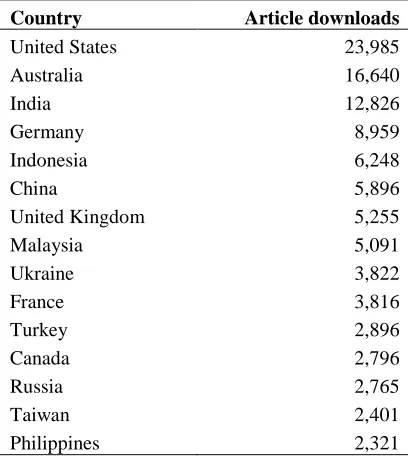
[image:1.595.86.290.440.670.2]OJS collects a variety of data streams that indicate the extent of a journal’s readership. Among those are article downloads, abstract views, table of contents views and home page views. We choose article downloads per year and countries in which download requests were issued (as indicated by two-character country codes) to approximate the distribution of our readership. In 2016, AJET articles (across all journal issues) were downloaded 141,626 times by readers from 189 countries. Table 1 lists the fifteen countries with the top download numbers for 2016. Together downloads for those countries accounted for 75% of all article downloads in 2016.
Table 1
Countries with most article downloads in 2016
Country Article downloads
United States 23,985
Australia 16,640
India 12,826
Germany 8,959
Indonesia 6,248
China 5,896
United Kingdom 5,255
Malaysia 5,091
Ukraine 3,822
France 3,816
Turkey 2,896
Canada 2,796
Russia 2,765
Taiwan 2,401
Philippines 2,321
ii of Europe is roughly 20 times that of Oceania) and research prevalence across countries. Yet, authors who publish in AJET can be assured that their research reaches a large number of peers in Asia, Europe, North America and Oceania.
Table 2
Article downloads 2016 – 2018 per continent (* 2018 figures to mid-August)
2016 2017 2018*
Africa 5% 6% 5%
Asia 36% 34% 32%
Europe 25% 20% 22%
North America 20% 24% 26%
Oceania 13% 13% 13%
South Africa 1% 2% 2%
Not associated 1% 0% 0%
100% 100% 100%
AJET Submissions and Authors
Our data on article submissions are based on OJS log files that record IP addresses of the user who uploads an article. We have converted those IP addresses into country and continent names as approximation of the nationalities of researchers submitting to AJET. This method has two shortcomings. First, we consider only the nationality of the submitting author and disregard nationality of potential co-authors. Second, via the IP address we capture the location at the time of submission, which is not necessarily the same as the ordinary location of a submitter (e.g., an academic might submit from a sabbatical location). As we do not have country affiliations for our users stored in their user profiles we cannot use those profiles to determine country information in an automated way (the use of email addresses is also flawed as a number of users have email addresses with transnational providers). In addition, we note that the numbers derived from the OJS log files slightly deviate from those derived from the database tables containing the full submission details that formed the basis for the journal statistics reported in the editorial for issue 34(1). In the following we look at article submissions to AJET and at the path those submissions take: rejected at editorial review and not sent to peer review; rejected after peer review; accepted for publication.
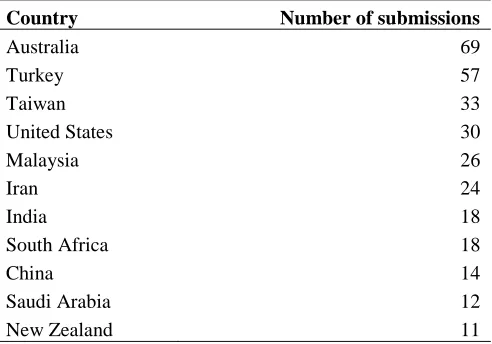
[image:2.595.88.334.551.723.2]In 2016, researchers from 59 countries submitted 457 articles to AJET. Table 3 shows the countries with the most submissions in 2016. The high number of submissions from Turkey, a country on the edge the Australasian region, is noticeable and has been consistently high across our timeframe of observation. Table 3
Countries with most article submissions in 2016
Country Number of submissions
Australia 69
Turkey 57
Taiwan 33
United States 30
Malaysia 26
Iran 24
India 18
South Africa 18
China 14
Saudi Arabia 12
New Zealand 11
iii Asia and Oceania combined are at 72% to 74%. Compared with the share in the number of article downloads at 45 to 49%, this is a much higher proportion.
Table 4
Article submission 2016 – 2018 per continent (* 2018 figures to mid-August)
Continents 2016 2017 2018*
Africa 8% 7% 6%
Asia 54% 56% 58%
Europe 11% 11% 13%
North America 8% 6% 7%
Oceania 18% 18% 14%
South America 1% 3% 2%
Submission per year
100% (n=457)
100% (n=520)
100% (n=425)
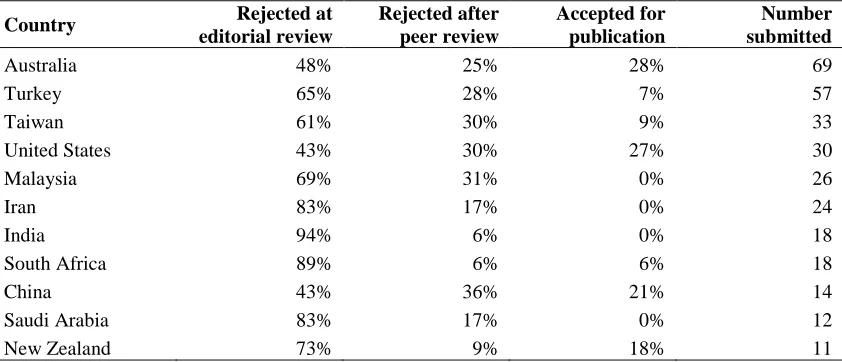
In terms of the success in the reviewing process we observe vast differences across countries and continents. For 2016, articles submitted from Australia and the United States lead the success rates of 28% and 27%. This is followed by submissions from China and New Zealand with 21% and 18%. On the other end of the spectrum are countries from which submission mostly fail to make it into the peer review stage and, having passed this hurdle, are rejected at a high proportion. For example, the high number of submissions from Turkey do not translate to a high number of publications from this country. At this stage we want to recall that we are looking at IP addresses of submitters as approximations for country affiliations and that data presented are based on articles submitted in a calendar year and not on completion of the review process. Table 5
Review success for articles submitted in 2016 for countries with most submissions
Country Rejected at editorial review
Rejected after peer review
Accepted for publication
Number submitted
Australia 48% 25% 28% 69
Turkey 65% 28% 7% 57
Taiwan 61% 30% 9% 33
United States 43% 30% 27% 30
Malaysia 69% 31% 0% 26
Iran 83% 17% 0% 24
India 94% 6% 0% 18
South Africa 89% 6% 6% 18
China 43% 36% 21% 14
Saudi Arabia 83% 17% 0% 12
New Zealand 73% 9% 18% 11
[image:3.595.89.510.405.586.2]iv Table 6
Review success for articles submitted in 2016 per continent
Continent Rejected at editorial review
Rejected after peer review
Accepted for publication
Number submitted
Africa 89% 6% 6% 36
Asia 70% 23% 7% 247
Europe 68% 22% 10% 50
North America 45% 26% 29% 38
Oceania 51% 23% 26% 80
South America 33% 50% 17% 6
AJET Reviewers
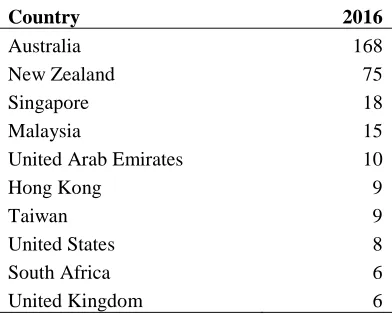
[image:4.595.87.283.359.516.2]In this section we look at the article reviews per country and continent. We take the IP address recorded with the submission of a review as approximation for the country affiliation of the reviewer. Table 7 shows where the majority of our reviewers are located. The data show that our reviewers are concentrated in Australia and New Zealand, with New Zealand well punching above its weight compared to its small population size (at about 20% of that of Australia).
Table 7
Countries with the most reviews for 2016
Country 2016
Australia 168
New Zealand 75
Singapore 18
Malaysia 15
United Arab Emirates 10
Hong Kong 9
Taiwan 9
United States 8
South Africa 6
United Kingdom 6
Table 8 presents the distribution of reviewers across continents for the years under observation. This table clearly shows that academics from Australasia dominate the reviewing for AJET. Yet, the data also show that a shift occurred from 2016 to 2017, with the share of Australasian reviewers going down from 89% to 79% and reviewers from Europe and North America stepping up.
Table 8
Article reviews 2016 – 2018 per continent (* 2018 figures to mid-August)
Continent 2016 2017 2018*
Africa 2% 1% 1%
Asia 20% 17% 21%
Europe 5% 11% 12%
North America 4% 9% 7%
Oceania 69% 62% 58%
South America 0% 0% 1%
[image:4.595.88.377.610.723.2]v
Reflections
Our figures demonstrate that AJET is a truly international journal that draws on readers and contributors well beyond Australasia. AJET’s presence in both Europe and North America is strong and in particular the reviewer data indicate a growing involvement from researchers in these regions.
The data on article submissions and acceptance rates indicate that researchers from developing countries are attempting to publish in AJET but are less successful than researchers from countries with well-established researcher communities. Figures like those for Africa, with 89% of submissions rejected without peer-review, show that the quality of those submissions in general is far removed from what is expected for AJET. While we provide submitters with brief reasons for rejection, our resources do not allow us to conduct full reviews to assist those researchers in their development. Articles that reach the stage of full per review but are ultimately rejected receive more substantial feedback. This is our opportunity to assist researchers in their development towards publication and, over a longer timeframe, soften the differences across countries and continents.
The data on reviewer locations show the strongest imbalance, with reviewers from Australia and New Zealand clearly dominating the service to AJET. This is also replicated in AJET’s editorial team, with, at the time of writing, the three lead editors and all but one associate editor coming from those countries. In our current call for applications to become associate editor for AJET (https://ajet.org.au/index.php/AJET) we explicitly encourage researchers from other regions to apply. Widening representation at associate editor level will open access to new networks, helping with the recruitment of more reviewers from countries outside Australia and New Zealand.
The focus on IP addresses as stored in OJS event logs has allowed us to look at data not available in other formats and has limited the need for extensive manual processes. Our approach is different to the work undertaken by Bond and Buntins published in this issue who look in detail at affiliations of all authors of articles published in AJET. Further, Bond, to be published in the next issue of AJET, looks at distributions of authors across continents. The statistics derived by Bond and colleague are compatible with our findings and show the same general patterns. Those researchers contextualize their data in the literature and examine specific research questions. In contrast, our focus and advantage are on being able to access database entries in OJS that are not publicly available, allowing us to shed light on some of the journal internal processes and data.
In this issue
In this issue the article by Bond and Buntins offers an analysis of AJET in which they review the research topics, methodologies, citations, and authorship since the editorial policy change in 2013 to focus on higher education research. An interesting finding is that, while AJET boasts a degree of internationality in authorship and review, the authorship teams are less internationally diverse. As Bond and Buntins point out, the implications of this pattern are an area for future research.
The eleven other articles in this issue are diverse in their focus, methods, and participant groups. Having said that, some of the papers can be understood as speaking to a broad theme. One such theme addresses a key focus in educational technology research – how to develop the capacity of educators to adopt and effectively use technology for learning.
Ottenbreit-Leftwich, Glazewski, Brush, Aslan, and Zachmeier take an interesting approach to this issue by focusing on mentoring pre-service teachers by expert in-service teachers. One of their findings is that the use of video mentoring led to the pre-service teachers’ primary concerns regarding technology integration being less acute. In another study involving pre-service teachers Yan, Chai
and So applied the technological pedagogical content knowledge (TPACK) framework to shape a collaborative design process involving what they call distributed expert knowledge to develop teaching resources.
While these two papers seek to influence the application of technology, the paper by Sivo, Ku, and
vi
and technology acceptance model (PRATAM). In their paper, the researchers confirm the potential of this model to identify and shed light on factors that may influence students’ behaviours in online learning environments. Fathali and Okada’s study also applied TAM along with self-determination theory (SDT) in order to investigate studentintention and use oftechnology-enhanced out-of-class language learning. A finding was that SDT could predict perceived usefulness, which in turn was highly influential on the learners’ intention to continue using technology and their actual system usage.
Shelton approaches the issue of capacity and use of technology from the perspective of teacher identity, particularly in terms of values. Shelton describes how technology can both support or hinder teachers’ ability to communicate their values, and at the same time how their values and identity more broadly can shape their use of technology.
A second theme in this issue is that of how we may develop student capacity in and through using educational technologies. Chiu and Hew investigate the way in which online discussion forum activities (viewing, voting and commenting) influence student peer learning and performance. Typically it may be assumed that a higher level of engagement, such as commenting, would be more likely to mean higher levels of peer learning and achievement. However, Chiu and Hew found that peer learning and performance were primarily predicted by viewing, and to a lesser extent by commenting. Clearly this is an area that needs to be further researched.
Orlando, Hanham and Ullman focus on the way in which Turnitin can be intentionally used as technology proxy for the development of learner academic writing practices. It was found that despite the potential value of Turnitin for students to experiment and support learning, the majority of students approached the software in a superficial manner. This was attributed to students’ low self-efficacy for using the program, and the university’s positioning of the program as a plagiarism tool. Structured exposure is therefore likely to support more effective and intentional use. This was also found by Sumuer who investigated factors that influenced students’ self-directed learning with technology. Sumuer found that use of Web 2.0 tools for learning significantly mediated the influence of students’ online communication self-efficacy and computer self-efficacy on their self-directed learning with technology. The conclusion is that learners need explicit scaffolding for the technology use and self-regulated learning.
The remaining papers are more disparate in nature. Mtebe and Raphael investigate factors that influence learners’ satisfaction with an e-learning system. They found that the system quality, instructor quality, and especially the service quality had a significant positive effect on learners’ satisfaction. Karabulut-Ilgu, Cherrez and Hassall investigate instructor perspectives and practices in implementing a flipped classroom model in large enrolment classrooms. They found that the flipped approach reframed the typical social expectations of these large classes, particularly in terms of
empowering the students. Chang, Warden, Liang, and Lin explore the effects of digital game-based learning (DGBL) on achievement, flow and overall cognitive load. Results show the DGBL participants displayed significantly better learning achievement, flow, and lower cognitive load compared to participants using other forms of computer based learning.