International Journal of
ELECTROCHEMICAL
SCIENCE
www.electrochemsci.orgConstruction of a New Selective and Sensitive Nd
3+ion-selective
Electrode Based on 1-nitroso-2-naphtol as a Neutral Ion Carrier
Elham Mirzaee1,Hassan Ali Zamani1,*
, Majid Mohammadhosseini2
1 Department of Applied Chemistry, Mashhad Branch, Islamic Azad University, Mashhad, Iran 2 Department of Chemistry, Faculty of Basic Sciences, Shahrood branch, Islamic Azad University,
Shahrood, Iran
*E-mail: [email protected]
Received: 26 May 2018 / Accepted: 27 October 2018 / Published: 30 November 2019
In this work, we found that 1-nitroso-2-naphtol (NN) can be used as a sensing material for the fabrication of a new highly selective neodymium(III) ion-selective membrane sensor. The best characteristics was obtained for the proposed Nd3+ sensor having a composition of PVC: nitrobenzene (NB): sodium tetraphenyl borate (NaTPB): NN in the ratio of 30:67:2:1 (wt%). The sensor displays a Nernstian slope of 19.7±0.4 mV decade-1 for Nd3+ ion with detection limit of 6.5×10⁻⁷mol L-1 between pH 2.5 and 9.6. The working concentration range of the constructed sensor was 1.0×10⁻⁶ to 1.0×10⁻²mol L-1 with a short
response time (~8 s). The selectivity coefficients obtained using matched potential method (MPM) indicate good selectivity for neodymium ion with respect to other cations. The created sensor was successfully utilized as an indicator electrode for the potentiometric titration of neodymium ions with EDTA and the determination of neodymium contents in presence of various ions mixture.
Keywords:Potentiometry, PVC Membrane,Sensor, Ion-Selective Electrode
1. INTRODUCTION
Neodymium, with symbol Nd on the periodic table, is one of the rare-earth metal of the lanthanide series and a soft silvery-white metal with atomic number 60. Neodymium was used in equipment such as energy-saving lamps, fluorescent lamps, colour televisions and glasses.Neodymium has no known biological role. It is moderately toxic and irritating to eyes.The important use of neodymium is in high-performance electric motors and generators. It was also used in spindle magnets for computer hard drives and wind turbines, in steel manufacture, industry of electronics, and in ferrous and nonferrous alloys (used for lighter flints) [1, 2].
mass spectroscopy, absorption spectra of 4f electron transitions, capillary electrophoresis, gravimetric determination. Although these techniques provide an accurate measurement in trace amount of elements, they destroyed the samples. In comparison, ion selective electrodes offer advantages of fast response and low cost method, low detection limit, portability, wide concentration range, good selectivity, and simple design. They also provide an analysis method without destruction of sample. A few reports on neodymium potentiometric sensors based on different ionophores were reported in the literature survey [3-10].
Recently, a thorough literature survey has revealed that several potentiometric polyvinyl chloride (PVC)–ion selective electrodes based on various ion carriers have been reported by our group and other researchers for the determination of different cations [11-49].In this work, we reported our study on the construction of a new polymeric Nd3+-ion selective electrode based on 1-nitroso-2-naphtol (NN) as an excellent ionophore for the determination of Nd(III) ions in solution.
Figure 1. TheNN structure.
2. EXPERIMENTAL
2.1. Reagents
For polymer membrane preparation, sodium tetraphenyl borate (NaTPB), tetrahydrofuran (THF),nitrobenzene (NB), acetophenone (AP), dibutyl phthalate (DBP), and benzyl acetate (BA) were purchased Merck Chemical (Germmany) and Aldrich Co. (USA). The nitrate and chloride salts of the all used cations were also purchased from Merck and Aldrich at the highest purity available. All aqueous solutions were prepared withdoubly distilled deionized water.
2.2. The emf measurements
The potential measurements were performed at room temperature with the following assembly: Ag–AgCl | internal solution, 1.0×10⁻³ mol L-1 NdCl3 | PVC membrane | sample solution | Hg–
Hg2Cl2, KC1 (satd.)
2.3. The Nd3+ Sensor preparation
The membranes were prepared by dissolving (1-3) mg of NN, (1-3) mg NaTPB, 30 mg PVC, (65-69) mg of the plasticizer (NB, BA, DBP and AP) in 3-5 mL of tetrahydrofuran. The resulting mixture was transferred into a glass dish of 2 cm diameter. The solvent was evaporated slowly until an oily concentrated mixture was obtained. A Pyrex tube (3-5 mm o.d. on top) was dipped into the mixture for about 10 s, so that a transparent membrane of about 0.3 mm thickness was formed. The tube was pulled out from the mixture and kept at room temperature for 24 h. The tube was then filled with an internal solution (1.0×10⁻³mol L-1 NdCl
3). The electrode was finally conditioned for 24 h by soaking in a
1.0×10⁻³mol L-1 Nd3+ ion solution [51-79].A silver/silver chloride electrode was used as an internal reference electrode.
2.4. Measurement of selectivity coefficient
In this work, the values of selectivity coefficients were calculated by match potential method (MPM) [80-83]. According to MPM, the selectivity coefficient is defined as the activity ratio of the primary ion (A) and the interfering ion (B) which gives the same potential change in a reference solution. Thus, one should measure the change potential upon changing the primary ion activity, and then the interfering ion would be added to an identical reference solution until the same potential change is obtained. The matched potential method selectivity coefficient, KMPM, is then given by the resulting primary ion to interfering ion activity (concentration) ratio, KMPM=ΔaA/aB.
3. RESULTS AND DISCISSION
3.1. Potential response and the influence of membrane composition
In order to test whether NN could be used as a selective substance for neodymium ions, in the preliminary experiments, NN as suitable carrier was used in the fabrication of membrane sensors for a wide variety of cations, including alkali, alkaline earth, transition and heavy metal ions. among different cations tested, Nd3+ ion illustrated a strong response to the PVC membrane based on NN. This is most probably due to the specific interaction of NN and Nd3+ ions, and the rapid exchange kinetics of the resulting NN-Nd3+ complex.
solution to the organic membrane phase. The nature of the plasticizer influences the dielectric constant of the polymeric membranes, the mobility of the ionophore and its complex.
It is well accepted that the presence of lipophilic anions in a cation-ion selective sensor diminishes the ohmic resistance, enhances the response behavior and selectivity, and increases the sensitivity of the membrane electrodes, and in cases where the extraction capability is poor, increases the sensitivity of the membrane electrodes [90-94]. As can be seen from Table 1, addition of 2% NaTPB as a suitable additive (No. 6) will increase the slope of the potential response of the electrode from the poor value of mV decade-1 (No. 5) to a Nernstian value of 19.7 mV decade-1 (No. 6). Nevertheless, the
best performance was obtained with a membrane composition of 30% PVC, 67% BA, 1% NN and 2% NaTPB (No. 6).
Table 1. Membrane composition optimization of the Nd3+ sensor.
Dynamic linear range (M) Slope
(mV/decade) Composition of Electrode (wt.%)
Electrode
No. PVC NB AP BA DBP NaTPB NN
1.0×10⁻⁵-1.0×10⁻² 16.0±0.4 1 1 - 68 - - 30 1
1.0×10⁻⁵-1.0×10⁻² 14.1±0.5 1 1 - - - 68 30 2
1.0×10⁻⁵-1.0×10⁻²
13.4±0.3 1 1 - - 68 - 30 3
1.0×10⁻⁵-1.0×10⁻² 13.2±0.4 1 1 68 - - - 30 4
1.0×10⁻⁵-1.0×10⁻² 15.8±0.5 1 0 - 69 - - 30 5
1.0×10⁻⁶-1.0×10⁻²
19.7±0.4 1 2 - 67 - - 30 6
1.0×10⁻⁶-1.0×10⁻²
22.1±0.4 1 3 - 66 - - 30 7
1.0×10⁻⁶-1.0×10⁻² 23.7 ±0.5 2 2 - 66 - - 30 8
1.0×10⁻⁶-1.0×10⁻² 24.2±0.4 3 2 - 65 - - 30 9
3.2. Slope and working concentration range of the Nd3+ sensor
Figure 2. Calibration characteristics of the Nd3+ sensor based on NN (Conditions: Concentration range 1.0×10⁻⁶ - 1.0×10⁻² mol L-1, Slope 20.7±0.3 mV decade-1 and Detection limit 6.5×10⁻⁷mol L-1).
3.3. Influence of pH
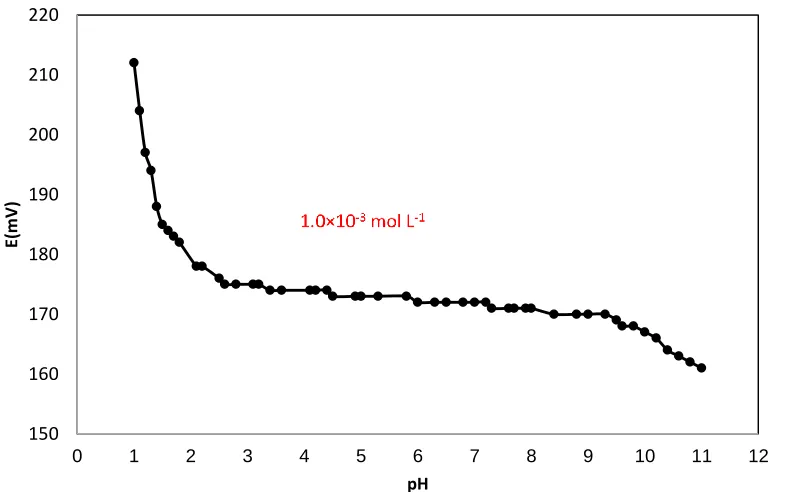
Figure 3. Effect of pH of the test solution (1.0 ×10⁻³mol L-1) on the potential response of the Nd3+ sensor.
The effect of pH on the response of membrane sensor was examined over the pH range from 2.0 up to 12.0 at a certain Nd3+ion concentration (1.0×10⁻³mol L-1). The pH was adjusted by introducing
small drops of hydrochloric acid (0.1 mol L-1) or sodium hydroxide (0.1 mol L-1) into the test solution and the results are given in Figure 3. Evidently, the potential stays constant from pH 2.5 to 9.6, beyond
100 120 140 160 180 200 220
0 1
2 3
4 5
6 7
8
E(
m
V)
pNd
150 160 170 180 190 200 210 220
0 1 2 3 4 5 6 7 8 9 10 11 12
E(m
V
)
[image:5.596.107.502.412.658.2]which some potential drifts took place. The potential decrease at higher pH values (>8.4), could be attributed the formation of some insoluble of Lu(OH)3 in the solution. At lower pH values than 2.5, the
potentials increased, indicating that the proposed Nd3+ sensor responded to protonium ions.
3.4. Dynamic response time of the created Nd3+ sensorbased on NN
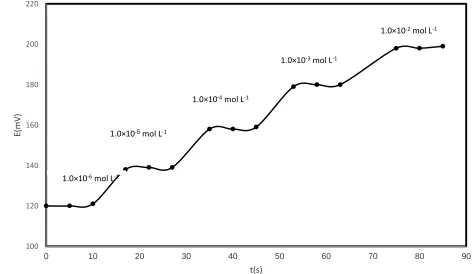
The response time, as an important factor for any sensor, was measured by changing the Nd3+
ion concentration in the test solution (1.0 ×10⁻³mol L-1), over a concentration range of 1.0×10⁻⁶ -1.0×10⁻²mol L-1. The potential response versus time is shown in Figure 4. As can be seen, the dynamic
[image:6.596.58.530.286.560.2]response time of the proposed electrode was found almost 8 s at different concentrations of the test solution.
Figure 4. Dynamic response time of the Nd3+ sensor based on NN {for A) 1.0 × 10⁻⁶mol L-1, B) 1.0 × 10⁻⁵mol L-1, C) 1.0 × 10⁻⁴mol L-1, D) 1.0 × 10⁻³mol L-1, E) 1.0 × 10⁻²mol L-1} in solution
of Nd3+ ions.
3.5. Selectivity coefficients values of the proposed Nd3+ sensor based on NN
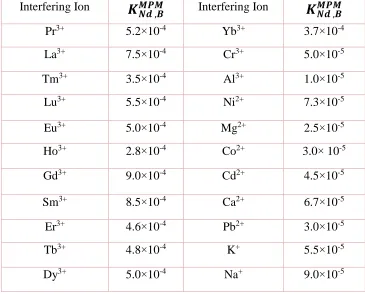
The selectivity behavior of the proposed sensorwas determined through the matched potential method (MPM)andthe calculated values of selectivity coefficients are listed in Table 2. As it is evident from Table 2, the developed sensor are selective towards neodymium ions in the presence of various interfering ions, indicating negligible interference on the potential response of the created sensor.
100 120 140 160 180 200 220
0 10 20 30 40 50 60 70 80 90
E(m
V
)
t(s)
1.0×10⁻⁶mol L-1
1.0×10⁻⁵mol L-1
1.0×10⁻⁴mol L-1
1.0×10⁻³mol L-1
Table 2. Selectivity coefficients of various interfering ions determined by matched potential method.
𝑲
𝑵𝒅 ,𝑩𝑴𝑷𝑴Interfering Ion
𝑲
𝑵𝒅 ,𝑩𝑴𝑷𝑴Interfering Ion 3.7×10⁻⁴ Yb3+ 5.2×10⁻⁴ Pr3+ 5.0×10⁻⁵ Cr3+ 7.5×10⁻⁴ La3+ 1.0×10⁻⁵ Al3+ 3.5×10⁻⁴ Tm3+ 7.3×10⁻⁵ Ni2+ 5.5×10⁻⁴ Lu3+ 2.5×10⁻⁵ Mg2+ 5.0×10⁻⁴ Eu3+
[image:7.596.54.545.481.662.2]3.0× 10⁻⁵ Co2+ 2.8×10⁻⁴ Ho3+ 4.5×10⁻⁵ Cd2+ 9.0×10⁻⁴ Gd3+ 6.7×10⁻⁵ Ca2+ 8.5×10⁻⁴ Sm3+ 3.0×10⁻⁵ Pb2+ 4.6×10⁻⁴ Er3+ 5.5×10⁻⁵ K+ 4.8×10⁻⁴ Tb3+ 9.0×10⁻⁵ Na+ 5.0×10⁻⁴ Dy3+
Table 3. Comparison of the proposed Nd3+ electrode with the previous Nd3+electrodes.
Parameter Ref. 4 Ref. 5 Ref. 6 Ref. 7 Ref. 8 Ref. 9 This work
LRa (mol L-1) 1.0×10⁻⁵
-1.0×10⁻²
1.0×10⁻⁶ -1.0×10⁻²
1.0×10⁻⁶ -1.0×10⁻¹
1.0×10⁻⁶ -1.0×10⁻²
1.0×10⁻⁶ -1.0×10⁻²
5.0×10⁻⁷ -1.0×10⁻²
1.0×10⁻⁶ -1.0×10⁻² DLb (mol L-1) 2.0×10⁻⁶ 7.0×10⁻⁶ 8.0×10⁻⁷ 7.9×10⁻⁷ 6.2×10⁻⁷ 1.0×10⁻⁷ 6.5 ×10⁻⁷
Response time (s)
<10 <15 <15 <5 <10 10 ~8
pH range 3.5-8.5 4.0-8.0 3.0-7.0 4.0-6.5 3.7-8.3 4.0-8.0 2.5-9.6 Slope (mV
decade-1)
19.6±0.3 19.6±0.3 19.4±0.3 20.1±0.2 19.7±0.4 19.8±0.3 19.7±0.4
Log Ksel>-2 La, Sm, Gd La, Gd, Sm,
Cu, Yb
La, Gd, Sm, Pr
Ce, Yb, Gd, Sr, Cu, La,
Ag
La, Dy Hg, Ni -
aLR: Linear Range; bDL: Detection Limit
Table 3 compares the response characteristics of the recommended neodymium sensor such as: the linearity range, detection limit, pH range, response time, slope and selectivity coefficients are compared with those of the best Nd3+ PVC-membrane sensors reported previously in the literature by
superior to the formerly reported Nd3+sensors in terms of selectivity, slope, pH range, dynamic response time, detection limit and dynamic concentration range.
3.6. Analytical applications
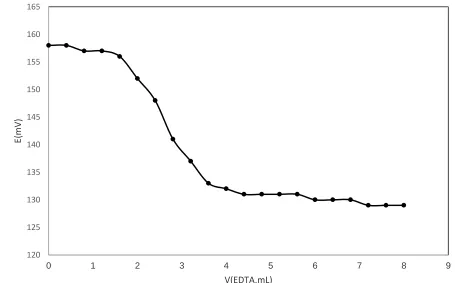
The constructed Nd3+ sensor acts well under laboratory conditions and can be successfully used in the potentiometric tritrations of neodymium ion solution (1.0×10⁻⁴mol L–1) with a standard EDTA solution (1.0×10⁻²mol L-1) and the corresponding titration curve is shown in Figure 5. As seen, the sensor assembly can used to determine the amount of Nd3+ ion concentration in solution by potentiometric
[image:8.596.68.523.283.566.2]titration curve providing a sharp end point.
Figure 5. Potentiometric titration curve of 20.0 mL from a 1.0 × 10⁻⁴mol L-1 Nd3+ solution with 1.0 × 10⁻²mol L-1 of EDTA.
The recovery test was successfully used for the monitoring of Nd3+ ions concentration in presence of different ions mixture and the resulting values are given in Table 4. As it is obvious, the recovery of Nd3+ ions in different metal cations mixture is almost quantitative.
Table 4. Recovery test of Nd3+ ions added to the different cations mixture.
Nd+3
(mol L-1)
Added cationsa
(mol L-1)
Observed contentb
(mol L-1)
Recovery (%)
1.0×10⁻⁶ La + Tm 1.05×10⁻⁶ 105
1.0×10⁻⁶ Eu + Er 1.04×10⁻⁶ 104
120 125 130 135 140 145 150 155 160 165
0 1 2 3 4 5 6 7 8 9
E(m
V)
1.0×10⁻⁶ Gd + Pr 1.07×10⁻⁶ 107
1.0×10⁻⁶ Sm + Yb 0.97×10⁻⁶ 97
1.0×10⁻⁶ Na + Cu 10.5×10⁻⁶ 105
1.0×10⁻⁶ Pb + Ni 0.94×10⁻⁶ 94
1.0×10⁻⁶ Co + Cr 1.05×10⁻⁶ 105
1.0×10⁻⁶ K + Mg 0.93×10⁻⁶ 93
1.0×10⁻⁶ Al + Na + Zn 1.06×10⁻⁶ 106
1.0×10⁻⁵ Fe + Ca + K 0.98×10⁻⁶ 98
aEach metal ion concentration was 0.001 mol L-1, all metals were introduced as nitrates. bBased on three measurements.
4. CONCLUSION
The newly fabricated PVC-membrane sensor based on 1-nitroso-2-naphtol (NN) as ionophore, NaTPB as lipophilic cationic salt and BA as plasticizer was successfully used for the determination of Nd3+ ions concentration in solution. The most important properties of the best performing sensors are:
slope: 19.7±0.4 mV decade-1; linear range: 1.0×10⁻⁶ - 1.0×10⁻²mol L-1; detection limit: 6.5×10⁻⁷mol L -1; response time: ~8 s; pH range: 2.5-9.6. The Nd3+-membrane sensor based on 1-nitroso-2-naphtol (NN)
displays good selectivity for Nd3+ ion towards the mono-, di- and trivalent cations used. The recommended sensor was successfully applied to the neodymium determination in presence of different ions mixture.
ACKNOWLEDGEMENT
The authors acknowledge the financial support kindly offered by the Research Council of Mashhad Branch Islamic Azad University.
References
1. O.R. Kirk, and F.D. Othmer,Encyclopedia of Chemical Technology, Vol. 19, Wiley, New York, p. 851, 1982.
2. J. Emsley, Nature’s Building Blocks: An A-Z Guide to the Elements, Oxford University Press, New York, 2nd Edition, 2011.
3. H.A. Zamani M. Zaferoni, and S. Meghdadi, E-J. Chem., 9 (2012) 1941.
4. M.R. Ganjali, A. Ahmadalinezhad, P. Norouzi, and M. Adib, J. Appl. Electrochem., 36 (2006) 931. 5. P. Norouzi, M.R. Ganjali, A. Ahmadalinezhad, and M. Adib, J. Braz. Chem. Soc., 17 (2006) 1309. 6. S. Chandra, and D.R. Singh, Mater. Sci. Eng. A, 502 (2009) 107.
7. M. Shamsipur, M. Hosseini, K. Alizadeh, M.F. Mousavi, A. Garau, V. Lippolis, and A. Yari, Anal. Chem., 77 (2005) 276.
8. H. Behmadi, H.A. Zamani, M.R. Ganjali, and P. Norouzi, Electrochim. Acta, 53 (2007) 1870. 9. V.K. Gupta, R.N. Goyal, and R.A. Sharma, Anal. Chim. Acta, 647 (2009) 66.
10.H.A. Zamani, A. Imani, A. Arvinfar, F. Rahimi, M.R. Ganjali, F. Faridbod, and S. Meghdadi, Mater. Sci. Eng. C, 31 (2011) 588.
11.H.K. Sharma, and N. Sharma, E-J. Chem., 6 (2009) 1139.
1103.
13.N. Zaheiritousi, H. A. Zamani, M. R. Abedi and S. Meghdadi, Int. J. Electrochem. Sci., 12 (2017) 2647.
14.P. Norouzi, M.R. Ganjali, F. Faridbod, S.J. Shahtaheri, and H. A. Zamani,Int. J. Electrochem. Sci., 7 (2012) 2633.
15.M. R. Ganjali, H. Khoshsafar, A. Shirzadmehr, M. Javanbakht, and F. Faridbod, Int. J. Electrochem. Sci., 4 (2009) 435.
16.V. K. Gupta, A. K. Jain, S. Agarwal, and G. Maheshwari, Talanta, 71 (2007) 1964.
17.F. Joz-Yarmohammadi, H. A. Zamani, and F. Mohammadabadi, Int. J. Electrochem. Sci., 10 (2015) 8124.
18.H.A. Zamani M. Zaferoni, and S. Meghdadi, E-J. Chem., 9 (2012) 1941. 19.A. Sil, V.S. Ijeri, and A.K. Srivastava, Sens. Actuators B, 106 (2005) 648.
20.F. Mohammadabadi, H. A. Zamani, and F. Joz-Yarmohammadi, Int. J. Electrochem. Sci., 10 (2015) 2791.
21.H. A. Zamani, Fatemeh Naghavi-Reyabbi, M. Mohammadhossieni, Babak Feizyzadeh, M. R. Abedi,F. Faridbod, and M. R. Ganjali, Sensor Lett., 10 (2012) 112.
22.F. Faridbod, M. R. Ganjali and P. Norouzi, Int. J. Electrochem. Sci., 4 (2009) 1679.
23.H. A. Zamani, M. Mohammadhossieni,Saeed Haji-Mohammadrezazadeh, F. Faridbod, M. R. Ganjali, S. Meghdadi, and A. Davoodnia, Mater. Sci. Eng. C, 32 (2012) 712.
24.H. A. Zamani, B. Feizyzadeh, F. Faridbod, and M. R. Ganjali, Mater. Sci. Eng. C, 31 (2011) 1379. 25.H. A. Zamani, R. Kamjoo, M. Mohammadhossieni, M. Zaferoni, Z. Rafati, M. R. Ganjali, F.
Faridbod, and S. Meghdadi, Mater. Sci. Eng. C, 32 (2012) 447.
26.M. H. Fekri, H. Khanmohammadi, M. Darvishpour, Int. J. Electrochem. Sci., 6 (2011) 1679. 27.A. Shirdel, H. A. Zamani, F. Joz-Yarmohammadi, S. A. Beyramabadi, and M. R. Abedi, J. Incl.
Phenom. Macrocycl. Chem., 86 (2016) 351.
28.M. Masrournia, H.A. Zamani, H.A. Mirrashid, M.R. Ganjali, and F. Faridbod, Mater. Sci. Eng. C, 31 (2011) 574.
29.H. A. Zamani, M. Nekoei, M. Mohammadhosseini, M. R. Ganjali, Mater. Sci. Eng. C, 30 (2010) 480.
30.H. A. Zamani, A. Imani, A. Arvinfar, F. Rahimi, M. R. Ganjali, F. Faridbod, and S. Meghdadi, Mater. Sci. Eng. C, 31 (2011) 588.
31.S. K. Mittal, P. Kumar, A. Kumar S K, and L. F Lindoy, Int. J. Electrochem. Sci., 5 (2010) 1984. 32.H.A. Zamani, A. Imani, A. Arvinfar, F. Rahimi, M.R. Ganjali, F. Faridbod, and S. Meghdadi,
Mater. Sci. Eng. C, 31 (2011) 588.
33.C.E. Koening, and E.W. Granber, Electroanalysis, 7 (1995) 1090.
34.H.A. Zamani, M.R. Ganjali, F. Faridbod, and M. Salavati-Niasari, Mater. Sci. Eng. C, 32 (2012) 564.
35.H. A. Zamani, B. Feizyzadeh, F. Faridbod, and M. R. Ganjali, Sensor Lett., 9 (2011) 1767. 36.H. A. Zamani, M. Masrournia, H. Mohamadzadeh, M. R. Ganjali, M. Rahimizadeh, and P. Ziaei,
Mater. Sci. Engin. C, 29 (2009) 976.
37.H.A. Zamani, M.R. Ganjali, H. Behmadi, and M.A. Behnajady, Mater. Sci. Eng. C, 29 (2009) 1535. 38.M.R. Ganjali, M. Rezapour, P. Norouzi, and M. Salavati-Niasari, Electroanalysis, 17 (2005) 2032. 39.S. K. Mittal, S. K. A. Kumar, and H. K. Sharma, Talanta, 62 (2004) 801.
40.H. A. Zamani, M. Masrournia, S. Sahebnasagh, and M. R. Ganjali, Anal. Lett., 42 (2009) 555. 41.H. A. Zamani, E-J. Chem., 9 (2012) 83.
42.H. A. Zamani, F. Faridbod, and M. R. Ganjali, Mat. Sci. Eng. C, 33 (2014) 488. 43.H.A. Zamani, M. Ranjkesh, and M.R. Abedi, Int. J. Electrochem. Sci., 9 (2014) 8435.
44.M.R. Ganjali, M. Hosseini, M. Pirali-Hamedani, and H.A. Zamani, Int. J. Electrochem. Sci., 6 (2011)2808.
(2009) 1380.
46.H. A. Zamani, B. Feizyzadeh, F. Faridbod, and M. R. Ganjali, Sensor Lett., 9 (2011) 1767. 47.V. K. Gupta, R. N. Goyal, M. K. Pal, and R. A. Sharma,Anal. Chim. Acta, 653 (2009) 161. 48.M.R. Ganjali, A. Ghesmi, M. Hosseini, M.R. Pourjavid, M. Rezapour, M. Shamsipur, and M.
Salavati-Niasari, Sens. Actuators B, 105 (2005) 334.
49.A. K. Singh, R. P. Singh, and P. Saxena, Sens. Actuators B, 114 (2006) 578. 50.S. Kamata, A. Bhale, Y. Fukunaga, and A. Murata, Anal. Chem., 60 (1998) 2464.
51.H.A. Zamani, A. Zanganeh-Asadabadi, M. Rohani, M. S. Zabihi, J. Fadaee, M. R. Ganjali, F.Faridbod, and S. Meghdadi, Mater. Sci. Eng. C, 33 (2013) 984.
52.M. R. Ganjali, H. Ganjali, B. Larijani, and P. Norouzi, Int. J. Electrochem. Sci., 4 (2009) 914. 53.H. A. Zamani, and S. Sahebnasagh, Int. J. Electrochem. Sci., 8 (2013) 3696.
54.M. R. Ganjali, P. Nourozi, A. Tamaddon, and S. Waqif Husain, Bull. Korean Chem. Soc., 27 (2006) 1418.
55.M. R. Ganjali, S. Rasoolipour, M. Rezapour, P. Norouzi, and M. Adib, Electrochem. Commun., 7 (2005) 989.
56.V. K. Gupta, R. N. Goyal, and R. A. Sharma, Int. J. Electrochem. Sci., 4 (2009) 156.
57.E. Hatami, H. A. Zamani, and R. Sanavi-Khoshnod, Int. J. Electrochem. Sci., 9 (2014) 8263.
58.A. Dehnavi, H. A. Zamani, M. Shariyati, M. R. Abedi, and S. Meghdadi, Int. J. Electrochem. Sci., 9 (2014) 8273.
59.H. A. Zamani, M. Ranjkesh, and M. R. Abedi, Int. J. Electrochem. Sci., 9 (2014) 8435. 60.H. A. Zamani, F. Faridbod, and M. R. Ganjali,Mater. Sci. Eng. C, 33 (2013) 608.
61.H. A. Zamani, B. Feizyzadeh, F. Faridbod, and M. R. Ganjali, Mater. Sci. Eng. C, 31 (2011) 1379. 62.H. A.Zamani, M. Rohani, M. Mohammadhosseini, M. R. Ganjali, F. Faridbod, and S. Meghdadi,
Sensor Lett., 9 (2011) 1745.
63.H. A. Zamani, F. Naghavi-Reyabbi, F. Faridbod, M. Mohammadhosseini, M. R. Ganjali, A. Tadjarodi, and M. Rad, Mater. Sci. Eng. C, 33 (2013) 870.
64.H. A. Zamani, M. Shoshtari, and BabakFeizyzadeh, Int. J. Electrochem. Sci., 10 (2015)8644. 65.M. R. Ganjali, N. Motakef-Kazemi, P. Norouzi, and S. Khoee, Int. J. Electrochem. Sci., 4 (2009)
906.
66.H.A. Zamani, M. Rohani, A. Zangeneh-Asadabadi, M.S. Zabihi, M.R. Ganjali, and M. Salavati-Niasari, Mater. Sci. Eng. C, 30 (2010) 917.
67.H. A. Zamani, G. Rajabzadeh, M. Masrornia, A. Dejbord, and M. R. Ganjali, Desalination, 249 (2009) 560.
68.M.R. Ganjali, H. Ganjali, M. Hosseini, and P. Norouzi, Int. J. Electrochem. Sci., 5 (2010) 967. 69.H. A. Zamani, M. Mohammadhossieni, M. Nekoei, and M. R. Ganjali, SensorLett., 8(2010) 303. 70.S. MoshirianFarahi, H. A. Zamani, F. Joz-Yarmohammadi, M. R. Abedi, and H. Behmadi, J.
Indian. Chem. Soc., 93 (2016) 1139.
71.H. A. Zamani, and F. Faridbod, J. Anal. Chem., 69 (2014) 1073. 72.H.A. Zamani, ChineseChem. Lett., 22 (2011) 701.
73.H. A. Zamani, and H. Behmadi, E-J. Chem., 9 (2012) 308.
74.H. A. Zamani, M. S. Zabihi, M. Rohani, A. Zangeneh-Asadabadi, M. R. Ganjali, F. Faridbod, and S. Meghdadi, Mater. Sci. Eng. C, 31 (2011) 409.
75.H. A. Zamani, M. R. Ganjali, H. Behmadi, and M. A. Behnajady, Mater. Sci. Eng. C, 29 (2009) 1535.
76.H. A. Zamani, M. T. Hamed-Mosavian, E. Aminzadeh, M. R. Ganjali, M. Ghaemy, H. Behmadi, and F. Faridbod, Desalination, 250 (2010) 56.
77.V. K. Gupta, A. K. Jain, S. Agarwal, and G. Maheshwari, Talanta, 71 (2007) 1964. 78.E. Naddaf, and H. A. Zamani, Anal. Lett., 42 (2009) 2838.
80.Y. Umezawa, K. Umezawa, and H. Sato, Pure Appl. Chem., 67 (1995) 507.
81.F. Kazemi, H. A. Zamani, F. Joz-Yarmohammadi, M. Ebrahimi, and M. R. Abedi, Bulg. Chem. Commun., 49 (2017) 449.
82.R. Sanavi-Khoshnod, H. A. Zamani, F. Joz-Yarmohammadi, M. Mohammadhosseini, and M. R. Abedi, J. Anal. Chem., 73 (2018) 71.
83.S. Matysik, F. M. Matysik, J. Mattusch, and W. D. Einicke, Electroanalysis, 10 (1998) 57. 84.T. Rostazin, E. Bakker, K. Suzuki, and W. Simon, Anal. Chim. Acta, 280 (1993) 197. 85.L. Jahanian, H. A. Zamani, F. Joz-Yarmohammadi, H. Behmadi, and M. R. Abedi, Russ. J.
Electrochem., 53 (2017) 497.
86.M.R. Abedi, and H. A. Zamani, E-J. Chem., 8 (2011) S467.
87.E. Ammann, E. Pretsch, W. Simon, E. Lindner, A. Bezegh, and E. Pungor, Anal. Chim. Acta, 171 (1985) 119.
88.A. Mirzaee, H. A. Zamani, M. R. Abedi, A. Motavalizadehkakhky, and S. Meghdadi, Int. J. Electrochem. Sci., 12 (2017) 8315.
89.M.R. Ganjali, S.O. Ranaei-Siadat, H. Rashedi, M. Rezapour, and P. Norouzi, Int. J. Electrochem. Sci., 6 (2011) 3684.
90.E. Bakker, P. Buhlmann, and E. Pretsch, Electroanalysis, 11 (1999) 915. 91.H.A. Zamani, ChineseChem. Lett., 22 (2011) 701.
92.H. A. Zamani, E-J. Chem., 8 (2011) S97.
93.H. A. Zamani, and H. Behmadi, E. J. Chem., 9 (2012) 308.
94.E. Bakker, P. Bühlmann, and E. Pretsch, Chem. Rev., 97 (1997) 3083.