Int. J. Electrochem. Sci., 12 (2017) 11455 – 11464, doi: 10.20964/2017.12.18
International Journal of
ELECTROCHEMICAL
SCIENCE
www.electrochemsci.org
Influence of Surface Oxidation of Nickel-Coated Carbon Fibre
on Oxygen Evolution Reaction in Alkaline Solution
Tomasz Mikolajczyk*, Boguslaw Pierozynski
Department of Chemistry, Faculty of Environmental Management and Agriculture, University of Warmia and Mazury in Olsztyn, Plac Lodzki 4, 10-727 Olsztyn, Poland
*
E-mail: [email protected]
Received: 12 September 2017 / Accepted: 21 October 2017 / Published: 12 November 2017
This work reports on oxygen evolution reaction (OER), studied at nickel-coated carbon fibre (NiCCF) electrodes. The OER was examined comparatively on non-oxidized and electrooxidized NiCCF 12K50 tow materials in 0.1 M NaOH solution for the potential range: 1600-1800 mV vs. RHE. Electrochemical modification of NiCCF electrode results in significant facilitation of the OER kinetics, manifested through reduced, ac. impedance-derived values of charge-transfer resistance parameter and considerably modified Tafel polarization slopes.
Keywords: NiCCF; OER; Electrochemical impedance spectroscopy; NiOOH.
1. INTRODUCTION
utilization of carbon fibres as a base material for electrodes fabrication, because of their high surface area, conductivity, and excellent corrosion resistance.
Present work focuses on the impedance (kinetic) study of the OER, which is performed on non-oxidized and non-oxidized Toho-Tenax nickel-coated carbon fibre (NiCCF) 12K50 tow (12,000 single filaments of ca. 7.5 mm diameter and about 45 wt.% Ni) electrodes in contact with 0.1 M NaOH supporting electrolyte.
2. EXPERIMENTAL
In this work, all solutions were prepared from ultrapure water delivered by a Millipore ultrapure water purification system (Millipore Direct-Q3 UV) with 18.2 MΩ cm final water resistivity. Alkaline, 0.1 M NaOH solution was prepared from AESAR, 99.996% NaOH pellets (semiconductor grade). Before conducting experiments, atmospheric air was removed from the solution by bubbling with high-purity argon (Ar 6.0 grade, Linde).
An electrochemical cell used in this study contained a NiCCF-based working electrode (WE) in a central part, a reversible Pd hydrogen electrode (RHE) as a reference and a Pt counter electrode (CE), both placed in separate compartments. In this work, "as received" Toho-Tenax 12K 50 NiCCF tow electrodes (ms= 43.5 mg, SA= 84.9 cm2) were initially de-sized in acetone, in order to remove a
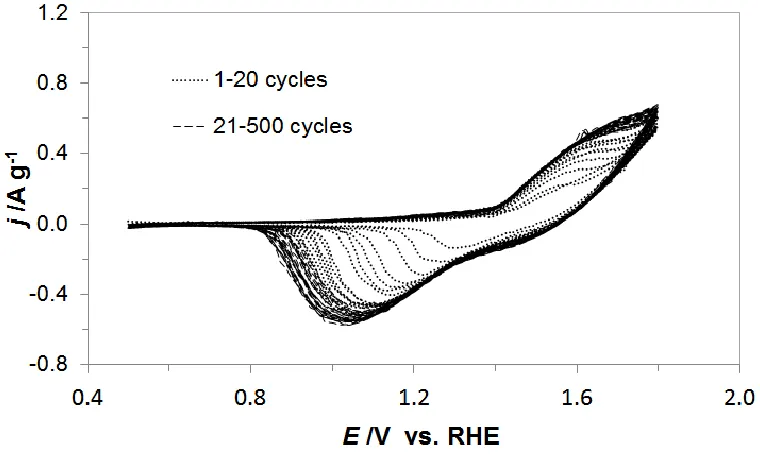
[image:2.596.108.488.451.679.2]protective epoxy resin coating. Electrooxidation conducted on nickel-coated carbon fibre samples was performed by cycling voltammetry treatment (see Fig. 1 and its caption for details).
Electrochemical experiments conducted in this study included: a.c. impedance, cyclic voltammetry and quasi steady-state polarization techniques, carried-out by means of Solartron 12,608 W Full Electrochemical System (1260 frequency response analyser and 1287 electrochemical interface units). All supplementary information regarding the preparation of electrolytes, electrochemical cell, counter and reference electrodes, as well as specific pre-treatments employed to working electrodes and protocols for electrochemical measurements, have recently been discussed in other works from our laboratory [11, 12].
Besides, a Quanta FEG 250 scanning electron microscope (SEM) unit was employed for spectroscopic characterization of the NiCCF tow electrodes. Furthermore, a spectrophotometry (WTW, Photoflex Turb) analysis was used to account for nickel loss through the experiments.
3. RESULTS AND DISCUSSION
3.1. SEM characterization of NiCCF 12K50 tow electrodes
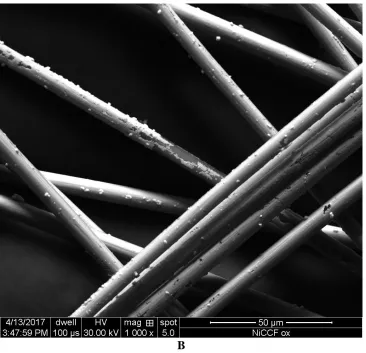
A comparison of two SEM micrograph pictures taken for the non-oxidized (NiCCF nox.) and oxidized (NiCCF ox.) nickel-coated carbon fibre samples is shown in Figs. 2a and 2b, respectively.
B
Figure 2. a) SEM micrograph picture of non-oxidized Toho-Tenax 12K50 NiCCF tow electrode, taken at 1,000× magnification; b) As in (a), but for oxidized NiCCF electrode.
Although it might be deduced that extended electrochemical oxidation treatment could lead to partial damage of nickel coating, the overall nickel loss is rather insignificant and it does not have any impact on the electrochemical activity of such-prepared catalyst materials (registered Ni2+ ion concentration in the solution after oxidation of the NiCCF electrodes would come to below 0.1 % of total Ni weight within the NiCCF tow material).
3.2. Oxygen evolution reaction on non-oxidized and oxidized NiCCF tow electrodes in 0.1 M NaOH
[image:4.596.117.483.67.420.2]
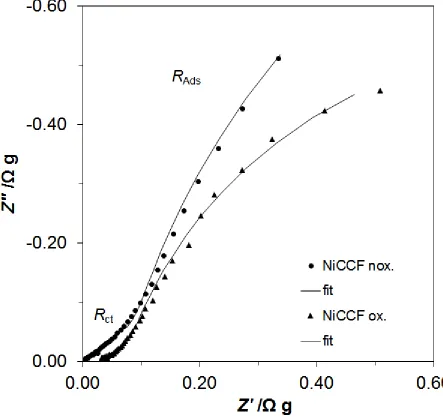
Figure 3. Complex-plane Nyquist impedance plots for the OER, recorded on non-oxidized and oxidized Toho-Tenax 12K50 NiCCF tow electrodes in contact with 0.1 M NaOH solution (carried-out at room temperature for the potential of 1500 mV vs. RHE). The solid lines correspond to a representation of the data according to the equivalent circuit shown in Figure 4, whereas points are experimental results.
Table 1. Electrochemical parameters for the OER, obtained on the non-oxidized NiCCF and electrochemically oxidized NiCCF electrodes in contact with 0.1 M NaOH. The results were derived by fitting the two CPE-R element (Fig. 4) equivalent circuit to the experimentally obtained impedance data (reproducibility typically below 15 %, 2= 410-5 to 210-3
).
E/mV Rct/Ω g Cdl/µF g-1sφ1-1 Rads/Ω g Cads/µF g-1sφ2-1
NiCCF nox.
[image:5.596.70.513.77.494.2] [image:5.596.89.510.667.764.2]
1525
0.112 ± 0.010 747,862 ± 30,288 1.285 ± 0.039 1,633,333 ± 108,780 1550 0.054 ± 0.005 530,437 ± 24,400 0.335 ± 0.012 1,133,333 ±
49,413 1575 0.033 ± 0.003 108,471 ± 13,570 0.159 ± 0.005 1,201,793 ±
65,257 1600 0.027 ± 0.001 73,639 ± 3,343 0.084 ± 0.002 1,410,322 ±
47,246 NiCCF ox.
1500 0.067 ± 0.006 919,540 ± 50,851 3.785 ± 0.059 1,957,086 ± 17,483 1525
0.040 ± 0.003 881,494 ±
43,898 1.915 ± 0.231
1,980,966 ± 65,768 1550 0.034 ± 0.002 750,782 ± 33,260 0.341 ± 0.038 2,009,770 ±
56,274 1575 0.027 ± 0.003 524,552 ±
49,570 0.138 ± 0.000
2,239,195 ± 150,026 1600 0.024 ± 0.001 424,000 ± 11,618 0.062 ± 0.002 2,450,345 ±
78,656
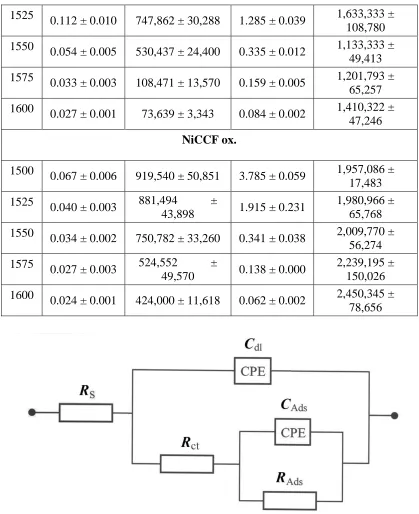
Figure 4. 2 CPE-R equivalent circuit used for fitting the impedance data for non-oxidized and electrooxidized Toho-Tenax 12K50 NiCCF tow electrodes. Rct and Cdl (as CPE) elements
correspond to the OER charge-transfer resistance and double-layer capacitance components, respectively; RAds and CAds (as CPE) parameters refer to the resistance imposed by the
surface-adsorbed reaction intermediates and pseudocapacitance; Rsol is solution resistance.
Therefore, for the NiCCF nox. electrodes the recorded Rct parameter decreased from 0.167 Ω g
at the potential of 1500 mV (= 270 mV) to 0.027 g for the potential of 1600 mV vs. RHE (= 370 mV). At the same time, the Cdl decreased from 747,011 to 73,639 µF g-1sφ1-1 for the same potential
[image:6.596.89.508.66.580.2]
0.067 Ω g to 0.024 g for the same electrode potentials. Furthermore, the recorded values of the Cdl
parameter at the potential range: 1500 to 1600 mV came to 919,540 and 424,000 µF g-1sφ1-1, correspondingly. The latter effect (for both examined cases) most likely results from partial blocking of electrochemically active electrode surface by freshly formed O2 bubbles, something that one could
clearly visualise for a complex NiCCF electrode structure, especially at increased overpotentials. The above means a significant reduction of the Rct parameter for the oxidized NiCCF electrode,
as compared to those of the Rct values recorded for the unmodified NiCCF surface (ca. 2.5× at the
potential of 1500 mV), see Table 1 for details. At higher potentials, the difference between electrochemical activity of electrodes (expressed by the Rct parameter) almost disappeared, probably
because the system moved into the diffusion limitation control. Additionally, the RAds parameter values
for low-frequency semicircle also diminished from 6.525 and 3.785 Ω g to 0.084 and 0.062 Ω g over the studied potential range: 1500-1600 mV respectively, for the non-oxidized and the oxidized nickel-coated carbon fibre electrode. Besides, the respective values of the CAds were quite stable over the
studied potential range (Table 1). Furthermore, dimensionless φ1 and φ2 parameters (φ determines the
[image:7.596.64.528.363.650.2]constant phase angle in the complex-plane plot and 0≤φ≤1) of the CPE circuits (see Fig. 4) varied between 0.50-0.77 and 0.67-0.95, respectively for both examined electrodes.
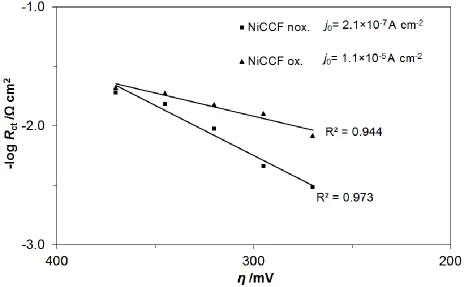
Figure 5. –log Rct vs. overpotential relationship, obtained for non-oxidized and oxidized Toho-Tenax
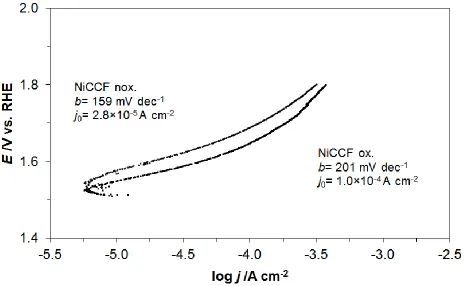
Figure 6. Quasi-potentiostatic anodic Tafel polarization curves (recorded at a rate of 0.5 mV s-1) for non-oxidized and oxidized Toho-Tenax 12K50 NiCCF tow electrodes in contact with 0.1 M NaOH solution.
Based on the linear relationship: –log Rct vs. overpotential (ƞ) exhibited here over the studied
overpotential range: 270-370 mV (Fig. 5), the exchange current-densities for the OER were derived based on the Butler-Volmer equation and through utilization of the relation between the exchange current-density (j0) and the Rct parameter for overpotential approaching zero [15-18]. Hence, the
calculated values of the j0 parameter for low ƞ range came to 2.1×10⁻⁷ and 1.1×10⁻⁵ A cm-2 for the
unmodified and the electrooxidized NiCCF materials, correspondingly. The j0 parameter for high ƞ
could not be estimated from the impedance spectroscopy measurements, because the Nyquist plots became ambiguous for the high overpotential range. The latter is probably caused by increased rate of formation/desorption of oxygen bubbles from the electrode surface. On the other hand, the exchange current-density parameter for high ƞ range was solely derived from Tafel plots. The recorded j0 values
came to 2.8×10⁻⁵ and 1.0×10⁻⁴ A cm-2 for the non-oxidized and the oxidized NiCCF, with anodic Tafel b slope ranging from 159 to 201 mV dec-1, respectively.
Hence, the obtained exchange current-densities presented in this publication came out to be significantly greater than those of other OER works [16, 18-21]. For example, the j0 parameter values
recorded for various porous nickel-based electrode structures (examined in analogous alkaline solutions) ranged from 4.4×10⁻¹¹ to 8.8×10⁻⁸ A cm-2 for low ƞand about 7.3×10⁻⁶ A cm-2 for high ƞ range. The received considerably higher values of the j0 parameter for investigated NiCCF-based
electrodes are probably caused by variations in the derivation of electrochemically active surface area (the geometrical surface area was used in this work, whereas Cdl-based surface area estimations were
Then, taking into account the characteristics of the oxygen evolution anodic oxidation process, one should expect that the OER kinetics on initially unoxidized NiCCF electrode should improve in time of its NaOH exposure under oxidative conditions. Yet, there was no such evidence in consecutively obtained electrochemical parameters to prove that. The above could be explained by the series of publications from the laboratory of Jerkewicz on the formation of nickel oxy- hydroxides [22-24]. Hence, in order to produce a stable and thick layer of β-NiOOH, it is necessary to follow a specified surface oxidation protocol. Otherwise, the produced oxide layer will not exhibit its full OER catalytic potential, or else such electrode could suffer from significant ageing, thus inducing quick deterioration of the OER’s kinetics [25].
4. CONCLUSIONS
Nickel-coated carbon fibre material is relatively inexpensive and exhibits highly-catalytic properties towards oxygen evolution in alkaline media. Employment of specific surface electrooxidation treatment caused radical enhancement of the OER catalytic properties for NiCCF tow electrode, without cosiderable increase of its electrochemically active surface area. In conclusion, obtained results imply substantial opportunities for the application of electrooxidized nickel-coated carbon fibre 12K tow materials in industrial alkaline water electrolysers.
References
1. Y. Cheng and S. P. Jing, Prog. Nat. Sci-Mater., 25 (2015) 545.
2. P. Esmaili, I. Dincer and G.F. Naterer, Int. J. Hydrogen Energy, 37 (2012) 7365.
3. R. Solmaz, A. Gundogdu, A. Doner and G. Kardas, Int. J. Hydrogen Energy, 37 (2012) 8917. 4. E. Verlato, S. Cattarin, N. Comisso, A. Gambirasi, M. Musiani and L. Vazquez-Gomez,
Electrocatalysis, 3 (2012) 48.
5. X. Zhang, D. Wu and D. Cheng, Electrochim. Acta, 246 (2017) 572.
6. T. Zhou, Z. Cao, P. Zhang, H. Ma, Z. Gao, H. Wang, Y. Lu, J. He, and Y. Zhao, Sci. Rep., 7 (2017) 46154.
7. J.C. Cruz, V. Baglio, S. Siracusano, V. Antonucci, A.S. Aricò, R. Ornelas, L. Ortiz-Frade, G. Osorio-Monreal, S.M. Durón-Torres and L.G. Arriaga, Int. J. Electrochem. Sci., 6 (2011) 6607. 8. A. Di Blasi, C. D’Urso, V. Baglio, V. Antonucci, A.S. Arico’, R. Ornelas, F. Matteucci, G. Orozco,
D. Beltran, Y. Meas and L.G. Arriaga, J. Appl. Electrochem., 39 (2009) 191.
9. L. Trotochaud, J.K. Ranney, K.N. Williams and S.W. Boettcher, J. Am. Chem. Soc., 134 (2012) 17253.
10.R.L. Doyle and M.E.G. Lyons, Phys. Chem. Chem. Phys., 15 (2013) 5224. 11.B. Pierozynski and T. Mikolajczyk, Pol. J. Chem. Technol., 17(1) (2015) 18.
12.B. Pierozynski, T. Mikolajczyk and I.M. Kowalski, J. Power Sources, 271 (2014) 231. 13.F.R. Costa, D.V. Franco and L.M. Da Silva, Electrochim. Acta, 90 (2013) 332.
14.M.E.G. Lyons and M.P. Brandon, Int. J. Electrochem. Sci., 3 (2008) 1386.
15.D.V. Franco, L.M. Da Silva, W.F. Jardim and J.F.C. Boodts, J. Braz. Chem. Soc., 17 (2006) 746. 16.T. Kessler, W.E. Triaca and A.J. Arvia, J. Appl. Electrochem., 24 (1994) 310.
18.B.M. Jović, U.Č. Lačnjevac, V.D. Jović and N.V. Krstajić, J. Electroanal. Chem., 754 (2015) 100. 19.J. Kubisztal and A. Budniok, Int. J. Hydrogen Energy, 33 (2008) 4488.
20.B.M. Jović, V.D. Jović, U.Č. Lačnjevac, Lj. Gajić-Krstajić and N.V. Krstajić, Zastita Materijala 57 (2016) 136.
21.C. Bocca, A. Barbucci and G. Cerisola, Int. J. Hydrogen Energy, 23 (1998) 247. 22.M. Alsabet, M. Grden and G. Jerkiewicz, Electrocatalysis, 2 (2011) 317.
23.M. Alsabet, M. Grden and G. Jerkiewicz, Electrocatalysis, 5 (2014) 136. 24.M. Alsabet, M. Grden and G. Jerkiewicz, Electrocatalysis, 6 (2015) 60.
25.S.R. Mellsop, A. Gardiner and A.T. Marshall, Electrochim. Acta, 180 (2015) 501.