S
TRATHCLYDE
D
ISCUSSIONP
APERS INE
CONOMICSRISK
SHARING
ANDEMU
B
YJACQUES
MÉLITZ
UNIVERSITY OF STRATHCLYDE
,
CREST-
INSEE&
CEPRN
O.
04-02
D
EPARTMENT OFE
CONOMICSU
NIVERSITY OFS
TRATHCLYDERISK SHARING AND EMU
Jacques Mélitz
University of Strathclyde, CREST-INSEE, and CEPR
Late February 2004
Abstract: What are the prospects that risk-sharing in the EMU will ever attain the
levels in the U.S.? So far as the risk-sharing in the U.S. depends on in-terregional transfers through the budget of the federal government, those prospects are poor. So far as the risk-sharing in the U.S. takes place though market channels, they are much better. The paper ad-dresses the theory and evidence on the subject. Asdrubali, Sørensen and Yosha provide a general framework of analysis. One issue is the adequacy of the framework. With respect to the evidence, the EMU still lags far behind the U.S. as regards the pooling of risks through portfolio diversification. But there already seems to be little to distin-guish the euro zone from the U.S. concerning the ability to borrow to smooth shocks. Thus, the extent of risk-sharing via credit – a matter that Asdrubali, Sørensen and Yosha raise – is of special interest. Fur-ther, the empirical evidence indicates that the progress of European economic and monetary integration over the last decade has increased the symmetry of business cycles. However, this could be a sign of re-maining capital-market imperfections, though that is only one interpre-tation.
JEL Classification: F02, F15
Keywords: Risk sharing, EMU, fiscal federalism, portfolio diversification, current account balance.
In rich countries, the separate regions share risks with one another to an important degree. On
the other hand, the member countries of the EMU do not pool risks nearly as much as regions
within countries do. The main point of comparison is always the United States. When a
re-gion of the U. S. suffers an adverse shock, its tax contributions to the federal budget diminish
and it receives federal help in other ways. Federal transfers and grants stay up, and some of
them may even rise. The region thereby obtains relief. In the case of an EMU member in
dif-ficulty, no similar assistance will come from the EU budget. In this respect, the member
coun-tries of the EMU are at a distinct disadvantage relative to the regions of the U.S. Short of an
unforeseen reform in the EMU, this will continue.
However, Americans also share risks in other ways that Europeans can hope to emulate in the
future. There is a significant cross-ownership of claims to property in the U.S. When an
ad-verse shock hits a U.S. region, the residents will share the damage with the non-residents to
some extent because many holders of the income claims to the output live in different regions.
By promoting capital market integration, EMU may encourage risk-sharing of this sort. In
addition, the residents in a region in the throes of a recession will find it easier to borrow from
their compatriots in other sections because of a single money. EMU should clearly encourage
risk-sharing of that sort too. Many theorists would not refer to risk-sharing in this last
in-stance. They would reserve the term for insurance coming from portfolio diversification
(while occasionally allowing the term to cover also aforementioned transfers through the
cen-tral-government budget). However, under autarchy, residents would not be able to smooth
shocks via credit. Therefore, there is little harm in broadening the concept of “risk-sharing” to
encompass credit transactions as well.
An important contribution by Asdrubali, Sørensen and Yosha (1996) (hereafter ASY)
pro-poses a framework that is capable of analyzing all three previous mechanisms of risk-sharing
in an integrated way: namely, (1) transfers through the upper-government budget; (2)
insur-ance or cross-ownership of income claims to output; (3) credit or borrowing and lending. The
authors estimate the risk-sharing via these three mechanisms to be, respectively, 13, 39, and
23 percent in the U.S. The last two of these numbers – those regarding the risk sharing
through market channels – add up to 62 percent, implying considerable smoothing of output
shocks. If these estimates can be taken seriously, the prospects for risk-sharing in the EMU
are much better than they otherwise appear. Thus, the logic and the accuracy of ASY’s
esti-mates are important.
In the first section, this paper will consider the extent of risk-sharing via the federal budget in
the U.S. Some basic related questions still remain open on this subject. The next section will
proceed to examine the risk-sharing in the U.S. via cross-ownership of claims to output and
via credit. The discussion will then take up the prospects for higher risk-sharing through the
two market mechanisms in the EMU. The final section will move on to examine the impact of
EMU on the total insurable risks. This next matter will bring us into familiar territory,
con-cerning the degree of asymmetry of the shocks.
The major conclusions – at least a few of them – may be mentioned at once. First, the broad
differences in the literature in the estimates of risk-sharing via the federal budget in the U.S.,
going from 40 percent to only 10, are still ill-understood. These differences really have little
to do with the use of levels or first differences in the econometric analysis, or redistribution as
opposed to stabilization. They stem from the accounting instead. However, the accounting
raises some basic and neglected conceptual issues. The smoothing of regional shocks coming
from this public source is around 12-15 percent overall. With respect to the market channels
of risk-sharing, ASY’s numbers for the U.S. are probably exaggerated. The pooling of risks in
the EMU still lags behind the U.S. and will do so for a long time to come. But there already
seems to be little to distinguish the euro zone from the U.S. in regard to the ability to borrow
to smooth shocks. Thus, the extent of risk-sharing via credit – an issue that ASY do very well
to raise – is of considerable importance. Finally, the empirical evidence indicates that the
pro-gress of European economic and monetary integration over the last decade has increased the
symmetry of business cycles. But this poses a general conceptual problem. With the advance
of capital market integration, people should be willing to accept more output risks since they
can share the risks more easily. From this perspective, the increase in the symmetry of
busi-ness cycles in the EMU could be a sign of remaining capital-markets imperfections. This is
not the only reading, but it is a possible one. The interpretation would mean that the
increas-ing symmetry of business cycles in the Euro zone signals a poor allocation of the risks
be-tween individuals.
I. Risk-sharing via the central government budget in the U.S.
General downturns in economic activity in a country tend to raise deficit spending by the
cen-tral government. Such responses by the government obviously say nothing about the
smooth-ing of regional shocks, or the smoothsmooth-ing of movements in the output of some regions relative
to others. All relevant studies of regional stabilization through the federal budget in the U.S.
necessarily try to control for this problem. They do so either by introducing a separate fixed
effect for each period (von Hagen (1992), ASY (1996)) or else by using ratios of regional
values to national averages (Sala-i-Martin and Sachs (1991), Bayoumi and Masson (1995)).
Either procedure comes to about the same. The studies also proceed mostly by regressing a
regional output variable or a regional income variable following net federal transfers on the
same regional variable, prior to net transfers. Sala-i-Martin and Sachs (1991) (hereafter
SiMS), who opened the discussion, measured both the aforementioned dependent and
inde-pendent variables in levels. These two authors also used personal income figures. They
re-ported 40 percent stabilization. An influential contribution by von Hagen (1992) then
fol-lowed quickly, and used first differences and real gross product figures. von Hagen got 10 per
cent stabilization instead. He also ascribed the enormous difference in his results to his use of
first differences rather than levels. Further, he suggested that his choice of first differences is
the appropriate one in studying stabilization, whereas SiMS’s choice of levels pertains more
closely to redistribution instead. This diagnosis has made a lasting impression. To the
con-trary, however, the use of levels or first differences is not central. Moreover, there is little
difference between redistribution (properly measured) and stabilization in the U.S.
I will now briefly display the validity of these conclusions. Let Xit be either per capita
sonal income in region i in year t divided by per capita personal income across the nation in
year t, or else per capita gross product in region i in year t divided by per capita gross product
in the nation. In either instance, the weighted sums of Xit values across the regions, based on
population weights, equal one. Let Yit be the corresponding values of Xit after the addition of
net transfers per capita by the national government. Consider next equations (1) and (2),
con-taining a disturbance term (µit or νit, as the case may be).
Yit = αi + βsXit + µit (1)
∆Yit = di + βs∆Xit + νit (2)
Equation (1) reflects SiMS’s choice in analyzing stabilization in the U.S. Equation (2) reflects
von Hagen’s. In both cases, βs relates to stabilization. If we take equation (1) in first
differ-ences, all the regional constants αi drop out. Therefore, equation (2) does not follow exactly
from equation (1), but rather supposes a possible regional drift or trend, di, in the Xit values
over time. However, in the absence of such drifts or trends in the Xit terms (if di = 0), equation
(2) is simply equation (1) in first differences (with ∆µit = νit). Further, if, in addition, the
dis-turbances µit possess certain well-known statistical properties, then the estimates of equations
(1) and (2) will yield identical estimates of βs. Suppose that a rise (fall) of $1 in Xit always
yields a rise (fall) of Yit of 90 cents. Then βs is 0.9, and stabilization is 0.1. The measure of
stabilization is therefore 1–βs.
Table 1 provides separate estimates of 1–βs for equations (1) and (2), and reports these
esti-mates separately in case of SiMS’s measure of Xit and von Hagen’s. In all the estimates, the
U.S. is broken up into 48 regions: the 50 states minus Alaska and Hawaï. The interpretation of
transfers from the central government is always the same: namely, direct taxes plus social
insurance plus transfers to persons and grants to states. As can be seen, in the event of the
gross product measure (von Hagen’s), the estimates in levels and first differences are virtually
identical. In case of the personal income one, the two estimates differ by 7 percent or less than
half of the total (whether 0.2 or 0.27). But the differences between the two measures of Xit
look important on the whole. We will come back to this last point shortly.
There is a third estimate in the table resting on a separate equation, owing to Bayoumi and
Masson (1998):
(3) Yi=αd +βdXi +ηi (3) In this next example, Xiand Yi represent averages of Xit and Yit over the whole study period.
Consequently, unlike βs, the coefficient βd does not reflect any movement over time, but
re-lates strictly to cross-sectional differences between regions over the entire study period.
Ac-cordingly, the coefficient can be seen as pertaining to redistribution.1 The idea of separate
coefficients βs and βd, for stabilization and redistribution, also makes perfect sense.
It is easy to imagine countries where taxes would be moderate yet highly progressive,
redis-tributive spending would be high, and there would be no unemployment compensation, no
temporary subsidies, no temporary tax breaks. Consequently, redistribution (βd) would be
strong and stabilization (βs) weak. Alternatively, we can imagine the opposite: countries with
strictly proportional taxation, lots of temporary aid in case of disasters but no permanent
as-sistance to the poor. Then βs would be high and βd low. It is clear from the table that the U.S.
belongs to neither of these two instances. For this country, βs and βd are much the same.
Therefore, not only is there little notable difference in levels and first differences for
stabiliza-tion in the U.S., but there is little indicastabiliza-tion of higher redistribustabiliza-tion than stabilizastabiliza-tion.
On the other hand, depending on personal income or gross product data, the stabilization and
redistribution estimates in Table 1 do differ widely. They go from 12 to 14 percent to 20 to 27
percent. The major contributors to the discussion of stabilization in the U.S. also divide right
down the middle about the right measure to use. Bayoumi and Masson (1995) and Obstfeld
and Peri (1998) follow SiMS in adopting the personal income measure, while Goodhart and
1 As noted by Mélitz and Zumer (2002), equations (1) and (3) can be jointly derived from the
more general hypothesis:
Yit=αd+βdXi+βs(Xit −Xi)+εit
(The sum of equations (1) and (3) gives rise to this last equation with αi equal Y Xi − βs iand
ηi+µit equal εit.) As is also well known from panel data econometrics, estimates of this more
general equation or separate estimates (“within” and “between”) of equations (1) and (3) yield identical estimates of βs and βd .
Smith (1993) and ASY (1996) opt for von Hagen’s gross product one. There is also an
occa-sional difference in the measure of net transfers. Those accounting choices are the critical
ones. The combination of a narrow measure of net transfers and a wide measure of regional
activity (gross product) leads to low estimates of stabilization, while the combination of a
wide measure of net transfers and a narrow one of regional activity leads to high estimates of
stabilization. Table 2 makes the point.
The top half of the table relates to stabilization, the bottom one redistribution; the left-hand
side relates to personal income, the right-hand one to gross product. In the case of either top
or bottom half, lower rows (numbered 1, 2, 3) concern successively larger measures of net
transfers. If we look down to lower rows, we find that the estimates of βs and βd successively
rise. As regards the differences left and right, the figures for gross product are far higher than
those for personal income. If we compare the columns on the left with the corresponding ones
on the right, we find the estimates of βs and βd on the right consistently lower. SiMS
com-bined the highest measure of net transfers (rows 3) with the lower measure of Xit. von Hagen
combined a lower measure of net transfers (rows 2) with the higher measure of Xit. That is the
key to the difference in the estimate.
It might seem that the critical choice is really that of Xit, and the measure of net transfers is
subordinate as long as we limit the choice to rows 2 and 3. But that is an accident of the U.S.
example. With regard to Canada, for instance, including or excluding federal grants to the
provincial governments (choosing between rows 2 or 3) makes as much difference as
choos-ing personal income instead of gross product accountchoos-ing. In the case of gross product
ac-counting (von Hagen’s choice), the estimate of βs is only 3 to 4 percent for Canada under the
narrower measure of net transfers in rows 2, while adding the federal grants to the provincial
governments raises the estimates of βs to 13 or 14 percent (depending on levels or first
differ-ences). Likewise, when we pass from the measure of net transfers in rows 2 to the wider one
in rows 3, βd goes from 16 to 30 percent in Canada (see Mélitz and Zumer (2002)).
What then is the right choice of accounting? We can think of regional income as the
produc-tion in the region. Then the income belongs partly to the residents of other regions. Or else we
can think of regional income as the income of the residents. Then some of the income stems
from production in other regions. It is difficult to see why one choice or the other should be
the only right one. For example, consider a state like Louisiana where the population is poor
but the output per head is high relative to the rest of the U.S., or another like Florida where
much of the population is retired and living on income coming from elsewhere. To focus
exclusively on gross product is to put the emphasis on the activity in the region: the
productivity of firms, employment, infrastructure, etc. But that glosses over the issue of the
welfare of the residents. Why not consider the stabilization and redistribution in the region
from the standpoint of smoothing and equalizing these people’s revenues and their
consump-tion instead? Investigators take one view or the other, but there is much to be said for either
view, and it may therefore be best to keep both of them in mind. The next question is whether
regardless of the choice of measure of Xit, the same measure of net transfers should serve.
If the issue is the redistribution and stabilization of the disposable gross product of the
re-gions, it seems clear that all the central-government net transfers are relevant. Regardless
whether the transfers are direct or indirect, all of them support local activity. However, if the
question relates to the redistribution and stabilization of the disposable personal income of the
residents, then including the transfers to the regional governments is not necessarily correct.
True, the residents of a region derive benefits from central-government subsidies to their local
governments as well as such direct subsidies to themselves, since the ones to the regional
governments provide them with better services of transportation, recreation, communication
and so forth. But so do tourists, transients and commuters. More important, if the net
trans-fers to the regional governments are to be included in the residents' disposable income, the
question is why the entire flow of similar services that the residents get from local firms is not
incorporated there as well (but only in so far as those services correspond to payments of
wages and interest to residents). Much of the capital in a region belongs to the residents.
Therefore, the retained earnings of local firms belong disproportionately to them too. Yet
those earnings do not enter into their personal income. If there are to be any imputations for
transfers, should not those retained earnings be imputed to them too? Finally, it seems
incon-testable that if purchases from local firms by municipal and state governments are included in
the residents' disposable income when the central government subsidizes them, those
pur-chases must always be included there.
In other words, the issue is one of coherence in accounting: the concepts of income before and
after net transfers must agree. The choice of a broad measure of net transfers requires a
corre-spondingly broad measure of income. As already shown, combining a broad measure of net
transfers with a narrow measure of income will systematically swell the estimates of βs and
βd. On these grounds, the proper measures of βs and βd would seem to be those in rows 2 in
case of personal income accounting and in rows 3 in case of gross product accounting. If we
also accept the usual preference for the estimates of stabilization in first differences, that puts
the estimates for the U.S. in the range of 12 to 15 percent for βs and 14 to 18 percent for βd.2
II. Interregional risk-sharing via credit and cross-ownership of property in the U.S.
High estimates of interregional risk sharing via the federal government in the U.S. possibly
dash any hope that risk-sharing in the EMU will ever attain the U.S. level. However, similarly
high estimates of risk-sharing through market channels can even kindle such hope. Let us then
examine the basis for ASY’s estimate that the U.S. regions share over half of the insurable
2 Decressin (2002) raises an important separate issue. National governments make many
pay-ments to national civil servants, and public and private firms rather than households and lower-level governments. These payments do not always show up in the official regional ac-counts – less so in centrally organized countries than federally organized ones. Furthermore, some of the spending in question may be on private goods, such as health and education, and those goods (or services) may be distributed based on a principle of equal access by everyone. Consequently, some redistribution may result from the relevant spending and possibly some stabilization too. But without a special decomposition of the relevant national spending by region, the analyst will miss the associated regional redistribution and stabilization. Decressin makes the right correction for Italy. He also thinks that the correction argues in favor of gross product accounting. The latter is difficult to see. Sicilians benefit greatly from education and health services that they receive privately from teachers and medical workers at national ex-pense. Why should this lead us to favor analyzing the stabilization and redistribution of Sicil-ian output per head rather than SicilSicil-ian personal income?
risks to output with one another via private channels.
Consider a panel of regional data consisting of per capita output Yi, per capita personal
in-come PIi, per capita disposable income DIi, and per capita consumption Ci, all stated in real
terms. The index i refers to the region. ASY start with the identity
Y Y PI
PI DI
DI C C
i i
i i i
i i
i
= (4)
Next, they take logarithms and first differences:
∆log Yi= (∆logYi −∆logPIi) + (∆logPIi −∆logDIi )
+ (∆logDIi −∆logCi) + (∆logCi ) (5)
Then they multiply both sides of equation (5) by ∆log Yi, and subsequently subtract the means of all five terms over the study period, the one on the left and the four in parentheses
on the right. Following, they take expected values. The result is the variance of the change in
the log of Yi on the left and the sum of the covariances of this term with, respectively,
∆logYi−∆logPIi, ∆logPIi −∆logDIi, ∆logDIi − ∆logCi, and ∆logCi, on the right. Finally, they
divide both sides of the last equation by the variance of ∆logYi. This yields:
1=βK+ βG +βC+βU (6)
The covariance/variance β terms in equation (6) correspond exactly to OLS estimates
of the following regressions:
∆logYi −∆logPIi =αK+βK∆logYi +µiK
∆logPIi −∆logDIi =αG+βG∆logYi +µiG (7)
∆logDIi −∆logCi =αC+βC∆logYi +µiC ∆logCi =αU+βU∆logYi +µiU
Consequently, ASY estimate all four equations. Before doing so, they introduce a fixed effect
for each year in order to take account of the general growth rate in per capita output over all
of the regions at each date. Then as a final and separate step, they assign a specific empirical
interpretation to βK, βG, βC and βU. They interpret βK as a measure of the smoothing of
re-gional shocks to per capita rere-gional output through the cross-rere-gional ownership of claims to
output; βG as a measure of the smoothing of these shocks through the central government
budget; βC as a measure of the similar smoothing coming from interregional credit; and βU as
a measure of the unsmoothed portion of the regional shocks. The value of the whole exercise
evidently depends on these last interpretations.
Upon consideration, it is clearly possible to question the interpretations. Take the equation
for PIi/Ci, concerning household saving. Suppose there are changes in the age structure of
households between regions. This is only reasonable since ASY’s study covers 37 years
(1963 to 1990). Those demographic changes may well induce changes in PIi/Ci independently
of any movements in Yi. Subsequently (and as a separate point), those changes can also have
some reverse effects on Yi. So far as this happens, the estimate of βC will evidently not
con-cern smoothing of output shocks at all. As regards Yi/PIi, suppose that firms sometimes make
investment decisions based on anticipated changes in relative demand for their produce. Once
again, Yi/PIi may change independently of changes in Yi and, additionally, there may be
re-verse effects on Yi. Then a similar problem as before arises: the estimate of βK will not reflect
any smoothing by firms. Yet ASY do provide notable support for their interpretation.
First, as regards βG, their procedure evidently nearly reproduces the one described before for
estimating risk-sharing through the federal government budget based on gross product
ac-counting (and the use of first differences). Quite apart from this mere issue of precedent, the
difference between personal income and disposable income is indeed likely to reflect
essen-tially the rules governing taxes and transfers.3 The problem of interpretation is far more
se-vere with respect to βC and βK. As regards these two coefficients, underlying ASY’s
interpre-tation is the idea that all risks associated with asymmetric shocks to output should be possible
to pool since they are perfectly negatively correlated with one another. However, as ASY
explicitly point out, so far as such risks are not pooled and remain uninsured, it should be
3 Nonetheless, there does remain a possibility of reverse causation or simultaneity bias in
es-timating βG based on equations (7) the way ASY do, just as there was before (unmentioned)
in estimating βs based on equations (1) or (2) like earlier authors. As a result, both SiMS and
Bayoumi-Masson used instrumental variables to correct for the problem. But Mélitz and Zumer (2002) found that the correction makes hardly any difference.
ier to obtain credit for smoothing those of the associated shocks to output that are temporary.
Hence, less persistent shocks should lead to higher estimates of smoothing via credit. Based
on this logic, ASY use the Campbell-Mankiw (1987) index to distinguish the persistence of
shocks affecting different states. They also employ averages over successively longer periods
to do the same. In addition, they classify the U.S. states according to the degree of the
sensi-tivity of their industrial structure to cyclical movement and therefore their proneness to short
swings. These tests generally confirm ASY’s hypothesis that more persistent shocks increase
βK relative to βC. This would then seem to indicate that higher values of the ratio βK/βC
sig-nify greater reliance on insurance relative to credit in smoothing regional output shocks. On
this ground, ASY’s estimates of risk-sharing through market channels in the U.S. deserve
serious attention.
Nonetheless, there are two reasons why those estimates are too high. First, ASY understate
βU. Second, they neglect the fact that βK and βC partly reflect autonomous smoothing within
the regions themselves having nothing to do with risk-sharing.
On the first point, the importance of βU in assessing βK + βC should be clear. Based on the
identity (6), βK + βG + βC + βU equals one, and therefore every percentage point of βU means
a percent less risk sharing. In order to estimate βU, as mentioned, ASY simply regress the
fourth equation in the set (7). However, to do so is to treat the extent to which regional
con-sumption responds to output shocks as a structural parameter. In effect, it supposes that there
is a structural tendency to smooth shocks from which deviations yield a random term
averag-ing zero. But this is a strong assumption (compare Athanasoulis and van Wincoop (2001)).
Most of the discussion of unsmoothed output shocks in the literature simply draws inferences
directly from the correlations between the series for consumption and output or else from the
ratios of the variances or standard deviations between the two series. Proceeding in this
man-ner, the lowest figure that Mélitz and Zumer (1999) obtain for βU in ASY’s data series is
0.39.4 This then implies a maximum of 0.61 interregional smoothing. Del Negro (2002)
de-votes an entire study to the calculation of interregional smoothing of output shocks by
indi-vidual states based on factor analysis, in which he tries to identify taste shocks separately.
Consequently, when he uses ASY’s data set, his figure for βU is .68 (see his Table 3). In sum,
only by treating βU as a structural parameter rather than as a mere statistical feature of the
data is it possible to come up with a figure for βU as low as ASY’s.5
The other reason why ASY overestimate risk-sharing through the market is their assumption
that βK + βC solely reflects risk-sharing between states. But a state can obviously smooth an
idiosyncratic shock by saving or dissaving, without any commerce with other states or
inde-pendently of any crisscrossing of outstanding property claims. Indeed, in the international
application of ASY’s framework, Sørensen and Yosha (1998) make a good deal of this very
point. There they introduce a new term βS, relating to smoothing via domestic saving. Yet
they never return to the issue how much of βK + βC in their U.S. study with Asdrubali truly
represents risk-sharing as opposed to smoothing via within-state (or “domestic”) business and
household saving.
It is interesting to go further and to ask whether there is possibly also some confusion of
in-surance and smoothing of uninsured shocks through credit in ASY’s estimates of βK and βC.
Take the extreme case of perfect risk sharing: that is, suppose the pooling of all risks
associ-ated with asymmetric (regional) shocks to output. ASY would then assume βK equal 1–βU,
and βC and βG equal zero. But is this what theory says? Not necessarily. According to the
Modigliani-Miller theorem, the use of dividends policy by firms to smooth shocks is entirely
irrelevant. In the present context, such policy by firms could be super-irrelevant. Not simply
4 The figure obtains by taking the ratio of the variance of regional consumption (not the log)
to the variance of regional product (not the log) for each year and then averaging over the years during the study period. Despite Mélitz and Zumer’s (1999) emphatic departure from ASY on this score, Del Negro (2002) manages somehow to treat them not only as supporting ASY’s procedure, but even as “confirming” their figure of 0.25 for βU (p. 274).
5 This low figure could well result from the fact that a regression yields a positive constant
term, which then reduces the slope of the regression line in a univariate regression.
might shareholders not respond to dividends policy because the policy has no impact on their
present wealth, but because the policy does not even affect their present income. The
divi-dends, as such, could be sufficiently diversified for this outcome. Let us assume, in line with
much evidence, that the business sector does systematically stabilize dividends (uselessly
according to the ordinary theorem, super-uselessly in the event of perfect risk sharing). And
suppose also that dividends are not sufficiently diversified to prevent an impact of the
divi-dends policy on regional personal income. Under this pair of circumstances, there must be
some inverse correlation between business and household saving, since household
consump-tion stays the same independently of the dividends policy.
In fact, many region-specific risks are not insured. The risks pertaining to labor income
can-not be so since the proper contracts cancan-not even be written. To that extent, the irrelevance
theorem itself is irrelevant. In addition, even as concerns capital income rather than labor
in-come, we know that the diversification of asset portfolios is imperfect within regions (see
Hess and van Wincoop, eds. (1999)). Still, so far as the irrelevance theorem holds and there is
any impact of dividends policy on regional personal income, there must be some inverse
cor-relation of risk smoothing between firms and households. ASY’s estimate of βK must be too
high.
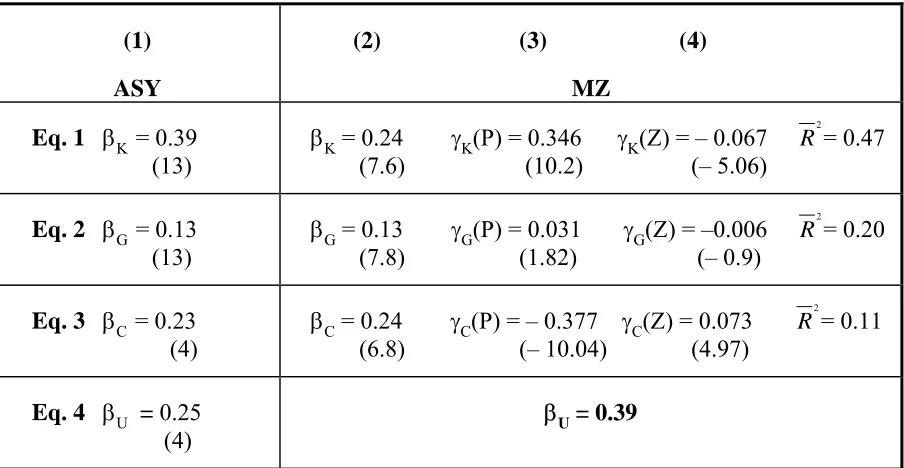
Mélitz and Zumer (1999) offer some relevant evidence. Table 3 shows ASY’s aforementioned
estimates of βK, βG,βC and βU in the first column. These estimates rest on pooling of
equa-tions (7) and generalized least squares. The next three columns provide revised estimates by
Mélitz and Zumer (MZ) based on the identical data. There are four notable differences. First,
instead of time fixed-effects, MZ use ratios of regional values to national values to correct for
movements in the aggregates. Second, they add regional fixed effects (to allow for possible
drift or trend in regional ratios). Thus, the equations are not the same. Nevertheless, these first
two departures yield no difference of note in estimates for the U.S. Third, MZ suppose βU
equal to 0.39, as mentioned before. Consequently, they estimate only the first three of the
equations (7) as a system, and impose the cross-equation restriction βK + βG +βC = 1–0.39.
Last, and most relevant at present, they add a few variables to reflect influences that condition
the effects of the regional output shocks. (Conformably, they impose a separate
cross-equation restriction requiring the trio of coefficients associated with each of the influences to
sum to zero, so that the restriction βK + βG +βC = 1–0.39 still remains the right one.) The table
reports the results concerning two of the extra influences: the Campbell-Mankiw index of
persistence of the asymmetric shocks (P); and the degree of asymmetry of the individual-state
business cycle (Z) (as inferred with the use of a Hodrick-Prescott filter).6 The results relating
to Z, or the smoothing of short run shocks, imply some offsetting behavior by households in
response to dividends policy. Therefore, these results confirm the possibility that ASY
over-estimate βK and the smoothing by firms. But this requires some explanation.
The last column in Table 3 (concerning Z) shows that in the event that shocks reflected
strictly the (state-specific) business cycle, household saving would explain 7 percent more of
the smoothing (7 percent less would be done by firms). This in itself could simply issue from
the fact that the only uninsured shocks that households are able to smooth through credit are
transitory ones (ASY’s interpretation). But as is not directly inferable from the table, omitting
the variable Z from the analysis also raises βK relative to βC by the full 7 percent. In other
words, the failure to isolate short run influences in any way leads to a greater attribution of
smoothing to firms relative to households. That suggests more: namely, the earlier
6 The estimated system is:
iK i i ,j j , K i K K i
i logpi logy (logX ) logy
y
log −∆ =α +β ∆ +γ ∆ +µ
∆ iG i i ,j j , G i G G i
i logdi logy (logX ) logy
pi
log −∆ =α +β ∆ +γ ∆ +µ
∆ (5)
iC i i ,j j , C i C C i
i logc logy (logX ) logy
di
log −∆ =α +β ∆ +γ ∆ +µ ∆
subject to βK+βG+βC= −1 βU, 0<βU<1 and for all j, j=1,...,n, γK j, +γG j, +γC j, =0
where the Xj variables are new influences in the econometric analysis. The use of lower-case
letters instead of the upper-case ones in equations (7) serves to indicate that the variables are no longer per capita values, as before, but ratios of per capita values to per capita national averages (adding up to one with appropriate weights). Table 3 only reports the results for P and Z, but there are two other Xj variables in the study.
tion: that households offset some unnecessary smoothing of shocks by firms via dividends
policy.7
As seen by comparing columns 1 and 2, the sum outcome of MZ’s revisions is to lower βK
and to keep βG and βC unchanged. Because of these changes, the regional smoothing of
shocks via adjustments in the income households receive from firms no longer seems larger
than the regional smoothing of shocks via household saving.
In short, two basic conclusions emerge: first, ASY exaggerate the extent of risk sharing;
sec-ond, they ascribe too much of the smoothing of output shocks to portfolio diversification and
to firms and too little to household saving. In the international application, further doubts will
set in about the proper measure of risk-sharing via credit as such.
III. Risk-sharing via credit and cross-ownership of property in the EMU
In the case of international evidence, ASY’s method becomes easier to apply. The data are
superior. ASY even needed to infer consumption by individual state in the U.S. from retail
sales. On the international front, the national accounts provide the required series for
con-sumption. Moreover, the current account statistics offer figures for net foreign lending or the
accumulation of claims on foreigners. In addition, the difference between gross national
product and gross domestic product yields net income on foreign property claims.
Accord-ingly, we can begin from the following identity:
Y Y GNP
GNP A
A C C
i i
i i i
i i
i
= (8)
where Yi is gross domestic product (as before), GNPi is gross national product, Ai is home
7 With respect to P, column 3 shows, in conformity with earlier discussion, that if all the
shocks were persistent, the smoothing via business saving would be about 35 percent greater. However, very significantly, removing P, and thus treating all shocks indifferently without regard to degree of persistence, does not affect the respective estimates of βK and βC. There is
therefore no evidence that households offset the smoothing of persistent shocks by firms. In terms of Modigliani-Miller, this means that the smoothing of persistent shocks via business saving may reflect optimal policy and may be in the shareholders’ best interests. If so, the households would have no cause to offset the smoothing of the permanent shocks by firms.
absorption, Yi − Ai is therefore the export surplus on current account, and finally, Ci is the
sum of private and public consumption. Proceeding as ASY did before, we then have:
iK i 1 K K i
i logGNP logY
Y
log −∆ =α +β ∆ +µ
∆ iC i 1 C C i
i logA logY
GNP
log −∆ =α +β ∆ +µ
∆ (9)
iS i S
S i
i logC logY
A
log −∆ =α +β ∆ +µ ∆
∆logCi =αU+βU∆logYi +µiU
In this case, βK1 concerns much more precisely what ASY intended before by βK, and the
same may be said for βC1 with regard to βC. But, of course, a separate term must enter, βS,
relating to smoothing of output shocks via strict domestic saving, some of it by firms, some of
it by households. There is one basic qualification to this general idea of the superiority of
equations (9) to equations (7) in analyzing risk-sharing. The differences between GDP and
GNP may cover income flows, but they do leave out capital gains and losses on international
claims. Therefore, any smoothing of output shocks that would be associated with such gains
and losses would not enter in βK1, where in principle it belongs. It would affect βS instead. In
addition, equations (9), as they are now stated, ignore any term for βG, thus any role for
stabi-lization by a super-government. True, the EU Commission has a budget, but it is small in
rela-tion to GDP, and the EU structural funds program relates essentially to redistriburela-tion rather
than stabilization.
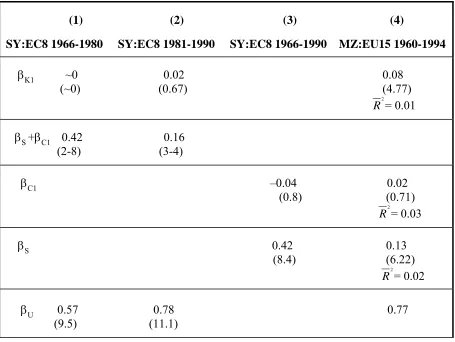
Table 4 provides estimates of equations (9). In this case, the sources are Sørensen and Yosha
(1998) (hereafter SY) and MZ. In both instances, the table reports the results relating most
closely to the current EMU members: namely, the EU8 (Belgium, Denmark, France,
Ger-many, Ireland, Italy, the Netherlands and the UK) in the case of SY and the EU15 in the case
of MZ. In both cases, the reported results also cover the period that compares best with the
one in ASY (1964 to 1990). Like ASY, SY estimate βU by running the last of the regressions
in equations (9) while MZ impose βU based on the same ratio of variances as was noted
be-fore in discussing their work (footnote 4). SY also deal with βC1 strictly in the context of a
separate decomposition of βS + βC1. For SY, 22 to 43 percent of the asymmetric output shocks
are smoothed; for MZ only 23 percent. For SY, the smoothing is entirely domestic, and there
is no risk-sharing. For MZ, there is some risk-sharing, 8 percent, coming from the
cross-ownership of claims to property, but most of the smoothing is domestic. In both studies,
cur-rent account balances explain nothing: there is no international smoothing of asymmetric
shocks via credit.
These results about risk-sharing may seem reasonable on the surface. We would not expect
much crosscountry insurance against asymmetric shocks in light of the importance of home
preference in portfolios of equities. Ratios of foreign direct investment to total home
invest-ment are also generally small. Even MZ’s estimate of 8 percent for insurance via international
portfolio diversification may look high. In addition, the Feldstein-Horioka puzzle speaks
pre-cisely about the small contribution of foreign saving to the financing of domestic investment.
Correlations between domestic saving and domestic investment (both as percentages of GDP)
over periods of five to seven years or over are much higher than we would expect under
per-fect risk sharing. Feldstein and Horioka (1980) found those correlations to be close to one in
the OECD in their initial study, covering the 60s to mid-70s. The correlations have dropped
since. But as Obstfeld and Rogoff (2000) stress, the correlations are still 60 percent in the
OECD over 1990-97; and nothing resembling similarly high numbers exists in corresponding
studies of regions within countries (Helliwell (1998)). Thus, it seems reasonable too that βC1
would be negligible in table 4.
However, there are other sources of evidence about risk-sharing in the EMU. The system now
exists since 1999. What are the other indications thus far?
I cannot pretend to do justice to the question. That would require a separate study. One
vol-ume of the recent report of the British Treasury (2003) about entry into EMU, titled EMU and
the cost of capital, provides a summary of the evidence. Some increase in the diversification
of equity portfolios has occurred in the membership since the run-up to EMU. Cross-country
correlations between returns on equities have risen. The total variance of equity returns in the
EMU now seems to depend less on country-specific factors and more on common industry
factors. There have also been a number of cross-country mergers and acquisitions, though
fewer than expected. To all evidence, though, as regards the diversification of property
claims, the EMU still has a long way to go before approaching the degree of capital market
integration in the U.S.
On the other hand, with respect to the availability of credit from the rest of the membership,
the closing of the gap between the euro zone and the US has gone very far. The bond market
in euros took off as soon as it appeared. Gross international issues of bonds and notes in euros
just about tripled between the end of 1997 and the end of 1999 (H.M. Treasury (2002), chart
4.1), as compared with issues in predecessor currencies. Before the appearance of the euro,
bond issues by firms and public agencies in the euro zone had been predominantly triple A
and double A (80 percent of them as late as 1998). Since then, single A and triple B issues
have become a high percentage of the total: over 40% in 2001 (ibid. table 4.1). Evidently,
numerous borrowers in the euro zone who had previously relied exclusively on banks now
issue bonds in euros. Holdings of bonds of the major governments in the euro zone are also
now widely held in the membership and internationally. Most significant of all perhaps, little
remains of the Feldstein-Horioka puzzle. Blanchard and Giavazzi (2002) report a value of
0.14 for the relevant coefficient in the regression for domestic investment for the euro area
over 1991-2001, down from 0.41 in 1975-1990. In addition, the current account deficits of the
two present members of EMU who are still in a catch-up phase, Portugal and Greece, rose to
10 and 6-7 percent of GDP, respectively, in 2000-2001.
How much more smoothing of asymmetric shocks has already come from this rapprochement
with the U.S. in the euro zone and how much is still to follow? The very nature of the
ques-tion is important: it poses the matter differently than we encountered it before. The issue is
not how much of the risk-sharing already results or will result in the future from credit, but by
how much credit already reduces or will reduce the fraction of the shocks that remain
unsmoothed. We might think that we should get roughly the same answer either way. If a
mechanism accounts for a particular percentage of the smoothing, its absence should reduce
the smoothing as much. As regards risk sharing through property claims, Athanasoulis and
van Wincoop (2001)’s results go in this direction. These authors, in fact, approach the issue
of insurance (or risk-sharing via asset diversification) precisely from the angle of a reduction
in βU. Despite some difference in their measure of βU (in the same spirit as the one in MZ)
and despite their strict focus on the long-term horizon (to eliminate transitory shocks), they
get analogous figures for βK in the U.S. (and for βG too for that matter) to those in ASY.8 But
as regards risk-sharing through credit, some reflection will show that a focus on the negative
impact on βU is almost bound to make a difference: the very sign of βC1 is ambiguous.
In reasoning about βC, in fact, ASY reason strictly about βC1, since their analysis relates
strictly to borrowing and lending. They conclude that the sign must be positive because a
permanent asymmetric shock to output should have no effect on lending or borrowing,
whereas a transitory one should raise lending if the shock is positive and borrowing if the
shock is negative. Thus, in case of a mix of permanent and transitory shocks, positive values
follow for βC1. However, the examples of Portugal and Greece reveal the precariousness of
this reasoning. Suppose that a positive permanent shock implies a rising profile of output in
the future (catch-up). Then the country ought to borrow and βC1 can be expected to be
nega-tive. There is also a major difficulty in regard to transitory shocks. Assume a recession. The
affected country should save less, or in terms of SY, the sign of βS should be positive.
How-ever, imports will fall with the drop in income, and may do so more than exports (which
might have dropped under the initial impact of the shock). Indeed, if the shock lowers the
terms of trade enough and shifts demand sufficiently in favor of home goods, then a fall in
imports minus exports is to be expected. Once again, the sign of βC1 will be negative. This
last example actually fits well with usual macroeconomic modeling – better than ASY’s logic
8 Their estimates vary from 0.35, almost exactly ASY’s figure, to 0.215, close to MZ’s,
de-pending on the presence (0.35) or absence (0.215) of interest and dividends in personal in-come. Athanasoulis and van Wincoop (2001) also consider those figures to pertain strictly to regional insurance, or βK1 rather than βK. In so doing, though, they disregard the fact that
many firms are owned entirely by state residents and operate strictly within state borders. These firms’ saving behavior would affect their estimate but have nothing to do with insur-ance and the sharing of risks between states.
in favor of a positive sign for βC1. Our models often say that recession yields a short run
im-provement in the current account balance in light of the size of the fall in imports. Thus,
re-gardless whether shocks are permanent or transitory, the sign of βC1 is ambiguous.9
In sum, it is already a live issue today to know how much extra risk-sharing there is and how
much is still to arrive in the euro area because of greater ease of borrowing and lending. But
unfortunately, ASY, SY and MZ offer little guidance. Their method of investigation will not
allow us to answer the question.
IV. The impact of EMU on total insurable risks
Discussion of EMU often focuses on the degree to which shocks are symmetric. In the present
context, this concerns the extent to which the risks are insurable by the market. So far as risks
are common and cannot be insured, of course, they can be managed through joint monetary
policy. This is the usual emphasis. But it is important to consider the issue of the extent of
common risks from the perspective of the potential for risk-sharing through market channels
as well.
A frequent starting point is Krugman’s (1991, 1993) prediction that EMU would lead to more
region-specific shocks and thereby less scope for smoothing shocks through monetary policy.
According to his assessment, the U.S. regions are more specialized than the EMU countries of
comparable size, probably because of the closer approximation to a single market in the U.S.
Hence, as impediments to trade diminish and capital markets become more integrated in the
EMU, the members can expect to move toward greater industrial specialization. These
coun-tries will then experience increasing asymmetry of shocks.
9 In both of the previous examples of a negative sign of βC1, credit is also likely to smooth
consumption and therefore to reduce βU. This is capital. In the example of a permanent shock
yielding a rising profile of output over time, the borrowing permits a smaller upward tilt in consumption. In that of the adverse transitory shock, the lending abroad moderates the drop in output, and thereby may cushion the fall in current consumption. Repairing the problem in ASY’s analysis in the latter case, pertaining to the transitory shock, would clearly mean re-moving their identification of the exogenous shock with the observed change in output.
Subsequent empirical investigation does not particularly agree with Krugman’s analysis. He
had compared U.S. data for 1977 with European data for 1985. But Kim (1995) shows that
the trend in the U.S. has been going the other way for years beforehand: “regional
specializa-tion … fell substantially and continuously between the 1930s and 1987” (p.882).10 According
to Peri (1998), by 1986, regional specialization was already no higher in the U.S. than in the
EU. Furthermore, Clark and van Wincoop (2001) report lower or equal specialization in the
eight census regions of the U.S. than in the EU14 over 1981-1997.
Recent empirical work on the symmetry of business cycles sheds further doubt on Krugman’s
views. To go back a bit, test results indicate that monetary union promotes bilateral trade
(Rose (2000)). Conformably, Micco, Stein and Ordoñez (2003)) show that EMU has already
brought a certain increase in bilateral trade since 1998. In addition, Frankel and Rose (1998)
display a tendency for business cycle correlations to rise with the intensity of bilateral trade in
the OECD. Still more recent research by Engel and Rose (2003) and Clark and van Wincoop
(2001) corroborates Frankel and Rose’s results, in the case of the former based on a
world-wide sample of countries, in the case of the latter, based on a narrower sample of countries
and regions in the OECD. Taken together with the Rose evidence, the inference would be that
EMU will tend to promote the symmetry of business cycles.
Studies by Firdmuc (2004) and Kalemli-Ozcan, Sørensen and Yosha (2001) are relevant too.
Firdmuc (2004) offers econometric evidence that intra-industrial trade raises symmetry of
business cycles, while inter-industrial trade does the opposite. This would imply that the
pre-vious evidence of the rise in the symmetry of business cycles with increasing trade reflects the
influence of intra-industry trade. For their part, Kalemli-Ozcan, Sørensen and Yosha (2001)
provide indications that industrial specialization reduces the symmetry of business cycles.
This is true both for regions within countries and between countries. These three authors’
10 Evidently aware of this evolution, Krugman (1993) put the evidence in doubt. See his note
4.
sult would seem to support Krugman’s general intuition. But if we link the result to the
evi-dence that greater bilateral trade increases the correlation of business cycles, the implication
would be that with greater trade, regions and countries become less specialized.11
There is no difficulty explaining why EMU would promote intra-industry trade, reduce
na-tional specialization, and increase the symmetry of business cycles. As income rises, the new
trade may well predominantly concern goods that are highly income-elastic and price-elastic
in demand. This means more trade in differentiated products and increasing intra-industry
trade. If the same industries take foot everywhere, countries become less specialized.12 The
rise in the symmetry of business cycles with advancing intra-industry trade can follow in
many ways. As intra-industry trade goes forward, industry shocks will become increasingly
common shocks. With greater market integration, all shocks may also spread more quickly, as
Frankel and Rose (1998) stress, and this can raise the covariance of aggregate business
activ-ity.
Notwithstanding, the previous evidence does raise a certain difficulty of interpretation.
Ac-cording to standard microeconomic analysis, individuals should be willing to bear more
pro-duction risks as capital market integration deepens. They can insure themselves better; and
they can borrow more easily. Hence, production risks should be less of a concern to them.
Based on a large literature, insurance opportunities encourage people to accept riskier, higher
return projects. (See, among many others, Obstfeld (1994) and Kalemli-Ozcan, Sørensen and
Yosha (1999, 2001).) How then do we reconcile this theoretical argument with a tendency of
EMU to lead toward higher symmetry of business cycles? Does such a tendency fly in the
face of theory?
There are two avenues of reconciliation. One is to ascribe the recent increase in symmetry of
11 Kalemli-Ozcan, Sørensen and Yosha’s own emphasis differs distinctly.
12 But the diminished national specialization need not signify diminished regional
specializa-tion, since with a reduction in some border costs – say, multiple money ones – but not others, firms may move their production closer to their neighbors without traversing frontiers.
business cycles to low capital market integration, low international insurance, and limited
international credit. On this view, as capital market integration advances and people pool their
risks more efficiently and obtain larger, more secure lines of credit, they will undertake riskier
output projects. Then the asymmetry of shocks in the euro zone will increase. Of course, this
will also expose uninsured workers in the euro zone to an increasing share of the risks. It will
therefore raise the urgency of increasing the flexibility of the labor market. The lack of any
system of transfer payments through upper-level government in the EMU will also possibly
become an increasing handicap. This line of reasoning evidently tends to take us back to
Krugman’s views and may underlie the appeal of his stand.
The other avenue of reconciliation is to argue that the euro has indeed already led to an
in-crease in production risks. But the new risks are common, and therefore consistent with
greater symmetry of business cycles. On this next view, there has been notable progress in
capital market integration in the euro zone. But the move to a more efficient allocation of
risks has not meant moving to greater specialization of output activities within national
fron-tiers. Presumably, in this case, the new technologies simply do not require notable increase in
individual plant size. Since the added risks are common, they are manageable through joint
macroeconomic policy. Of course, if so, the burden of responsibility on the European Central
Bank also rises. Consequently, greater flexibility of labor markets still helps, and may help a
lot, in attenuating shocks. But macroeconomic policy at the EU level has a larger role to play
in smoothing economic activity.
Evidently, the second view is far more optimistic. If the first view is right, then the euro zone
has not advanced much toward an efficient allocation of risks. Instead, the zone has largely
sought shelter against the winds of competition through increasing diversification at home.
Not only does this limit welfare, but market forces will tend to work in the future toward a
change in direction: that is, a move toward greater specialization on a national basis. The
zone will then eventually need to face the associated problem of inability to extend market
insurance to labor.
TABLE 1
STABILIZATION AND REDISTRIBUTION VIA FEDERAL TRANSFERS IN THE
U.S. 1977-1992: 48 REGIONS
STABILIZATION
Level: eq. (1) First difference: eq. (2)
REDISTRIBUTION
Eq. (3)
1–βs R
2
1–βs R
2
1–βd R
2
PERSONAL
INCOME
0.272 0.922 (0.008)
0.20 0.846 (0.012)
0.213 0.974 (0.019)
GROSS
PRODUCT
0.13 0.985 (0.004)
0.118 0.968 (0.006)
0.136 0.976 (0.02)
The standard errors in parentheses pertain to βd or to βs. Regional constants are omitted. Net
transfers consist of direct taxes and social insurance, transfers to persons and federal grants to state and municipal governments. See Mélitz and Zumer (2002).
TABLE 2
STABILIZATION AND REDISTRIBUTION VIA FEDERAL TRANSFERS IN THE
U.S. 1977-1992: 48 REGIONS
STABILIZATION: PERSONAL INCOME
Level First difference Eq.(1) Eq. (2)
STABILIZATION: GROSS PRODUCT
Level First difference Eq.(1) (Eq. (2)
NET
TRANSFERS
1–βs R2 1–βs R2 1–βs R2 1–βs R2
(1) DIRECT TAXES AND SOCIAL INSURANCE 0.086 (0.007) 0.977 0.063 (0.012) 0.898 0.03 (0.003) 0.998 0.031 (0.006) 0.979
(2) DIRECT TAXES, SOCIAL INSURANCE, AND TRANSFERS TO PERSONS
0.234
(0.007)
0.941 0.149
(0.012)
0.878 0.097
(0.003)
0.99 0.089
(0.006)
0.974
(3) DIRECT TAXES, SOCIAL INSURANCE, TRANSFERS TO PERSONS AND GRANTS 0.272 (0.008)
0.922 0.20 (0.012)
0.846 0.13
(0.004)
0.985 0.118
(0.006) 0.968
REDISTRIBUTION: PERSONAL INCOME Eq. (3) REDISTRIBUTION: GROSS PRODUCT Eq. (3) NET TRANSFERS
1–βd R2 1–βd R2
(1) DIRECT TAXES AND SOCIAL INSURANCE
0.0863
(0.009) 0.996
0.04 (0.021)
0.98
(2) DIRECT TAXES, SOCIAL INSURANCE, AND TRANSFERS TO PERSONS
0.181
(0.016) 0.982
0.124
(0.016) 0.984
(3) DIRECT TAXES, SOCIAL INSURANCE, TRANSFERS TO PERSONS AND GRANTS
0.213
(0.019) 0.974
0.136
(0.004) 0.976
The standard errors in parentheses pertain to βd or to βs. See Mélitz and Zumer (2002).
TABLE 3
ESTIMATES OF THE ASY (ASDRUBALI-SØRENSEN-YOSHA) AND THE REVISED ASY MODEL
USA 1964-1990
(1)
ASY
(2) (3) (4)
MZ
Eq. 1 βK = 0.39 (13)
βK = 0.24 γK(P) = 0.346 γK(Z) = – 0.067 R2= 0.47 (7.6) (10.2) (– 5.06)
Eq. 2 βG = 0.13
(13)
βG = 0.13 γG(P) = 0.031 γG(Z) = –0.006 R2= 0.20 (7.8) (1.82) (– 0.9)
Eq. 3 βC = 0.23
(4)
βC = 0.24 γC(P) = – 0.377 γC(Z) = 0.073 R2= 0.11 (6.8) (– 10.04) (4.97)
Eq. 4 βU = 0.25 (4)
βU = 0.39
Sources: Asdrubali, Sørensen and Yosha (1996); Mélitz and Zumer (1999). Student t’s are in parentheses, as in the original ASY article. For the interpretation of γK(P) and γK(Z), see foot-note 6 and the associated text.
TABLE 4
ESTIMATES OF THE ASY MODEL BASED ON INTERNATIONAL EVIDENCE
(1) (2) (3) (4)
SY:EC8 1966-1980 SY:EC8 1981-1990 SY:EC8 1966-1990 MZ:EU15 1960-1994
βK1 ~0 0.02 0.08
(~0) (0.67) (4.77) R2= 0.01
βS +βC1 0.42 0.16
(2-8) (3-4)
βC1 –0.04 0.02
(0.8) (0.71) R2= 0.03
βS 0.42 0.13
(8.4) (6.22) R2= 0.02
βU 0.57 0.78 0.77 (9.5) (11.1)
Notes: The sources are Sørensen and Yosha (1998) and Mélitz and Zumer (1999). The EC8 in columns 1 and 2 refer to Belgium, Denmark, France, Germany, Ireland, Italy, the Netherlands and the UK. The first two columns come from Sørensen and Yosha’s Table 1. βK1 refers to their βf, and βS +βC1 to their βd and βs combined. Column 3 comes from their Table 6. Column 4 relates to Mélitz and Zumer, table 10 (where βS is denoted βK2). Student t’s are in paren-theses.
REFERENCES CITED
Asdrubali, Pierfederico, Bent Sørensen and Oved Yosha (1996). "Channels of inter-state risk-sharing: United States 1963-1990," Quarterly Journal of Economics, 111, pp. 1081-1110.
Athanasoulis, Stefano and Eric van Wincoop (2001). "Risksharing within the United States: What have financial markets and fiscal federalism accomplished?" Review of Econom-ics and StatistEconom-ics, 83, pp. 688-698.
Bayoumi, Tamim and Paul Masson (1995). "Fiscal flows in the United States and Canada: Lessons for Monetary Union in Europe," European Economic Review, 30, pp. 253-274.
Blanchard, Olivier and Lawrence Katz (1992). “Regional evolutions,” Brookings Papers on Economic Activity, no. 1, pp. 1-75
Blanchard, Olivier and Francesco Giavazzi (2002). “Current account deficits in the euro area: The end of the Feldstein-Horioka puzzle?” Brookings Papers on Economic Activity, no. 2, pp. 147-209.
Campbell, John and Gregory Mankiw (1987). "Are output fluctuations transitory?" Quarterly Journal of Economics, 102, pp. 857-880.
Clark, Todd and Eric van Wincoop (2001). “Borders and business cycles,” Journal of Inter-national Economics, 55, pp. 59-85.
Decressin, Jörg (2002). “Regional income redistribution and risk sharing: how does Italy compare in Europe?” Journal of Public Economics, 86, pp. 287-306.
Del Negro, Marco (2002). "Asymmetric shocks among U.S. states," Journal of International Economics, 56, pp. 273-297.
Engel, Charles and Andrew Rose (2003). “Currency unions and international integration,” Journal of Money, Credit and Banking 34, pp. 804-826.
Feldstein, Martin and Charles Horioka (1980). "Domestic saving and international capital flows," Economic Journal, 90, pp. 314-329.
Fidrmuc, Jarko (2004). “The endogeneity of the optimum currency area criteria and intra-industry trade: implications for EMU enlargement,” in Paul De Grauwe and Jacques Mélitz, eds., Monetary Unions after EMU, MIT Press, forthcoming.
Frankel, Jeffrey and Andrew Rose (1998). "The endogeneity of the optimum currency area criteria" Economic Journal, 108, pp. 1009-1025.
Goodhart, Charles and Stephen Smith (1993). "Stabilisation," in EC, "The Economics of Community Public Finance," European Economy, Reports and Studies, 5, pp. 417-55.
Helliwell, John (1998). How Much do National Borders Matter? Washington, D.C.: Brook-ings Institution.
Hess, Gregory and Eric van Wincoop (2000). International Macroeconomics, Cambridge University Press.
HM Treasury (2003). EMU and the Cost of Capital: EMU Study.
Kalemli-Ozcan, Sebnem, Bent Sørensen and Oved Yosha (1999). “Risk sharing and industrial specialization: regional and international evidence,” working paper, University of Hous-ton, Federal Reserve Bank of Kansas City and Tel Aviv University.
Kalemli-Ozcan, Sebnem, Bent Sørensen and Oved Yosha (2001). “Economic integration, industrial specialization, and the asymmetry of macroeconomic fluctuations,” Journal of International Economics, 55, pp. 107-137.
Kim, Sukko (1995). “Expansion of markets and the geographic distribution of economic ac-tivities: the trends in U.S. regional manufacturing structure, 1860-1987,” Quarterly Journal of Economics, 110, pp. 881-908.
Krugman, Paul (1991). Geography and Trade, MIT Press.
Krugman, Paul (1993). "Lessons of Massachusetts for EMU," in Francisco Torres and Fran-cesco Giavazzi, eds. Adjustment and Growth in the European Monetary Union, Cam-bridge University Press, pp.241-261.
Mélitz, Jacques and Frédéric Zumer (1999). "Interregional and International Risk Sharing and Lessons for EMU," Carnegie-Rochester Conference Series on Public Policy, vol. 51, pp. 149-188.
Mélitz, Jacques and Frédéric Zumer (2002). "Regional redistribution and stabilization by the center in Canada, France, the United Kingdom and the United States: A reassessment and new tests," Journal of Public Economics, 86, pp. 263-286.
Micco, Alejandro, Ernesto Stein and Guillermo Ordoñez (2003). “The currency union effect on trade: early evidence from EMU,” Economic Policy , 37, pp. 317-356.
Obstfeld, Maurice (1994) "Risk-taking, global diversification and growth,” American Eco-nomic Review, 84, pp. 1310-1329.
Obstfeld, Maurice and Giovanni Peri (1998). "Regional Nonadjustment and Fiscal Policy," Economic Policy, 26, April, pp. 205-59.
Obstfeld, Maurice and Kenneth Rogoff (2000). “The six major puzzles in international mac-roeconomics: Is there a common cause?” In Ben Bernanke and Kenneth Rogoff, eds., NBER Macroeconomics Annual 2000, pp. 339-390.
Peri, Giovanni (1998). “Technological growth and economic geography,” mimeo., Bocconi University.
Andrew Rose (2000). “One money, one market: Estimating the effects of common currencies on trade,” Economic Policy, pp. 7-46.