ISBN 978-94-6138-529-1
All rights reserved. No part of this publication may be reproduced, stored in a retrieval system or transmitted in any form or by any means – electronic, mechanical, photocopying, recording or
otherwise – without the prior permission of CEPS.
Available for free downloading from the CEPS website (www.ceps.eu) © CEPS 2016
CEPS ▪ Place du Congrès 1 ▪ B-1000 Brussels ▪ Tel: (32.2) 229.39.11 ▪ www.ceps.eu
Labour Mobility in the EU
Addressing challenges
and ensuring ‘fair mobility’
Mikkel Barslund and Matthias Busse
No. 139 / July 2016
Abstract
Executive Summary ... i
1. The state of play in labour mobility – Where do we stand?...1
1.1 What mobility are we talking about? ...1
1.2 Mobility in numbers ...3
1.3 A closer look at posted workers ...6
2. The single markets: Challenges to labour mobility and scope for policy ...7
2.1 Challenges related to social partners and general organisation of labour markets...8
2.2 Challenges at member-state and EU levels...9
2.3 When to adjust the balance? ... 12
2.4 Do not shift the balance too far ... 13
3. Towards ‘fair mobility’?... 13
Bibliography ... 14
[image:2.612.91.518.103.323.2]List of Boxes, Figures and Tables Box 1. The many unknowns highlight the need for more comprehensive data ...5
Figure 1. Benefits of labour mobility ...2
Figure 2. Mobility rates and stock of foreign population in the EU (percent of total population) ...3
Figure 3. EU-15 nationals residing in another member state (share of total population) ...4
Figure 4. Stock of mobile workers in the EU (millions, 2013) ...4
Figure 5. The social ‘trilemma’ ... 10
Figure 6. Economic convergence and diminishing social ‘trilemma’ ... 11
| i
Executive Summary
Mobility, which comes in many different shapes and forms, is one of the cornerstones of European integration. It is related to all parts of the fundamental freedoms set out in the Treaty of Rome: the free movement of people, capital, goods and services. These freedoms are also closely interlinked when it comes to the provision of cross-border services and the completion of the single market.
While freedom of movement is one of the most celebrated, practical and visible rights stemming from EU integration, it is also a contested field that embodies a number of challenges. This has always been the case. Fundamentally, it comes down to managing the tensions inherent between the impetus for deeper economic integration as set out in the treaties, conserving member states’ control over the design of the welfare state and initial large differences in income levels. This ‘trilemma’ has to be navigated not only with respect to economic benefits, but, equally important, with a view to ensuring legitimacy within member states. The risk has emerged in recent years that the broad public support for labour mobility is eroding – whether justified or not. This is a development that the Union can ill afford. At the macro-level, intra-EU mobility is functioning well. Cross-border workers are vital to regional integration, as reflected in developments in regions of Denmark-Sweden, Austria and neighbouring countries, Portugal-Spain and elsewhere. Regular mobility – moving from one EU country to another – has created opportunities for tens of thousands of workers since the latest enlargement, mainly from Eastern Europe, but also recently and increasingly for southern Europeans due to the deep economic crisis. As a consequence of the crisis, the European Commission has rightly put in place initiatives to assist mobile individuals in finding jobs abroad, not least among unemployed youth. But barriers still exist, especially those arising from language and administrative burdens. Lowering barriers to labour mobility, directly or indirectly embodied in labour intensive services, is a complex matter but one that is vital for the single market.
A deepening of the internal market for services with increasing specialisation and innovation is seen as one important way to revive growth in the Union. Services often come with a need for workers to deliver them in situ. Hence, posted workers – workers temporarily working in another country in order to deliver a service, while remaining attached to their employer at home – are vital in order to facilitate cross-border integration in the market for services. Free provision of services are also an effective vehicle for convergence in incomes among member states. Posting workers, more flexible and responsive than regular mobility, facilitates better allocation of labour across the EU and ensures that companies can bridge short-term skill shortages with temporary foreign workers. This is particularly important for intra-firm postings. The increase in the number of posted workers in recent years is certainly related to an increase in cross-border market integration of services and has supported EU growth. While there are clear benefits from labour mobility, it is also true that not everyone shares this perception or, for that matter, has a share in the benefits. Posted workers in certain economic sectors, notably construction, have increasingly been accused of fraud, abuse and unfair wage competition in the public discourse. Issues have also been raised concerning regular mobile workers’ access to social security benefits. Arguably, some concerns arise from the role played by politics in free movement and the economic crisis, but the elections to the European Parliament in 2014 showed that it is unwise to ignore citizens’ concerns, lest they spill over into broader opposition to free movement of workers.
partners, companies and EU citizens. At the same time, public perceptions and expectations have to be managed accordingly. This is a task for all responsible stakeholders.
The posted workers Directive has stood since 1996. At that time the Union was more homogenous and was thought to be on a sustainable path of economic convergence. Today, however, the differences in wage levels and social security systems are much wider. This would argue for adjusting the balance between ensuring a level playing field in the competition for service and the need for further integration of the internal market for services. The uncertainty related to the legal interpretation of the Directive, as evidenced by the cases brought before the Court of Justice of the European Union (CJEU), creates costs for both those relying on foreign service providers and the providers themselves. This calls for clarification, if not a change in the balance. If the political imperative requires such a change, as implied by recent developments, it should in itself be balanced with the aim of reducing other burdens to cross-border trade in services and improve transparency.
It is important for member states to follow through on their obligation to do more to limit fraud and abuse by using whatever the means are already made available by the enforcement Directive. This is also essential in order to address public perceptions and should include means of proper data collection. It is too early at this stage to assess if the enforcement Directive will deliver on its promises when it is transposed into national law, but it has made a wide range of tools available.
| 1
Labour Mobility in the EU:
Addressing challenges
and ensuring ‘fair mobility’
Mikkel Barslund and Matthias Busse
*CEPS Special Report No. 139/ June 2016
1.
The state of play in labour mobility – Where do we stand?
Freedom of movement of people is what gives substance to the notion of a European citizenship as first introduced in the Maastricht Treaty. While intangible for most citizens, it is nevertheless a major achievement in the pursuit of EU integration. Surveys consistently show that there is broad-based support for the principle of freedom of movement of people. Furthermore labour mobility has an important role to play if the EU is to achieve its ambitions, internally and globally, particularly in view of the 2020 targets in the areas of employment and competitiveness. A dynamic labour market that is unfettered by national boundaries and where labour and skills are allocated more efficiently is important for companies’ ability to grow and invest, not least in light of the increasing competition from other regions of the world. Equally important is the development of a single market for services that facilitates specialisation and spurs innovation.
With the economic crisis and pronounced divergence in unemployment rates within the Union, labour mobility has increasingly been called upon to act as a shock absorber. The macroeconomic importance of this is of second order, but it should act as an important reminder that labour mobility provides job opportunities for 10 million people. To give a sense of proportion: EU legislation related to labour mobility directly affects more individuals than are working in agriculture, which is another contested area of EU regulation.
1.1
What mobility are we talking about?
The extent of EU mobility is often confused in public debates. Unfortunately, the same is true for the term ‘labour mobility’ by itself, which is less clear in the minds of individual citizens and some policy-makers than one might think. In the European context, mobility has indeed many facets, each with distinct characteristics and facing very different challenges (see Figure 1).
Figure 1. Benefits of labour mobility
At the tangible level, a wider focus on labour mobility requires a distinction between two broad categories of mobile citizens utilising the freedom of movement principle: labour mobility and non-work-related mobility. The second group encompasses pensioners, students, job-seekers1 and accompanying family members. None in this latter group should be referred
to as ‘labour’ mobility. Of course these two forms of mobility are often closely linked:
Family members accompanying the mobile worker
Students become mobile workers after graduation
Pensioners retiring (post mobile work)
Job-seekers becoming mobile workers
Being a mobile citizen naturally increases the likelihood of later employment in another EU member state, as many studies have shown with respect to students.
In the remaining part of this study we focus on labour mobility.
The most common form of labour mobility involves a citizen who moves from one member state to another to take up work. These regular mobile workers enter the domestic labour market with the same rights and obligations as nationals. One may pause to ponder the global uniqueness and wide-ranging implications of this right. However, it is important to stress that this is only one segment of labour mobility.
It is not necessary for a mobile worker to take up formal residence in another member state to be counted as a mobile worker in the broader sense. Cross-border workers are a case in point. They provide labour in one member state while residing in another, but they are fully integrated in the domestic labour markets, pay labour taxes and social contributions.
1 Jobseeker may also be included in the ‘labour mobility’ framework from a legal perspective since they are part of the labour market, however our classification aim to make the distinction between workers (in the widest sense) and those not in any type of employment.
Mobility
Labour mobility
Regular mobility
Cross-border workers
Posted workers
Mobile self-employe
d
Other mobility
Students Pensioners
Job-seekers
Family members
Free movement
LABOUR MOBILITY IN THE EU:ADDRESSING CHALLENGES AND ENSURING ‘FAIR MOBILITY’3
A final category of mobile workers are the so-called posted workers and posted self-employed persons. An employee may be sent abroad to perform his/her work in another member state on a temporary basis. In many cases the worker is subcontracted by a company in the receiving country. One key difference between a posted worker and a regular mobile worker is the fixed temporary character of employment and specific EU law that applies to this type of mobility. Most notably, posted workers do not fall under the social security system of the country of work but instead maintain their membership in their national system. The same construct also applies to self-employed persons who provide their services abroad. Both are effectively mobile ‘workers’, but their essence lies in the freedom of services due the fact that they are not directly employed in the country of destination but rather maintain a link to their domestic employer.2
Each category of labour mobility is important in terms of its size and how it affects public perceptions.
1.2
Mobility in numbers
[image:7.612.169.447.416.554.2]The most commonly cited figure on mobility relates to the stock of people living in another EU country other than the one they were born in. For the EU this is around 3% of the population or 17 million people. However, this is the stock. The annual flow, the share of people moving from one country to another, is only one tenth of this at 0.3%. Both stock and flow have increased mildly over the past years (see Figure 2). As is often noted, these numbers compare unfavourably with the US where 3% of the population move to another state each year.
Figure 2. Mobility rates and stock of foreign population in the EU (percent of total population)
Source: Authors’ own calculations based on Eurostat data.
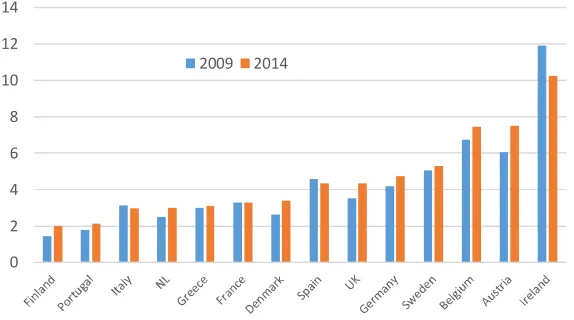
It is important to keep in mind that total mobility is not only low on average but also for most EU countries (see Figure 3). However, the movement of people within the Union is not equally distributed. Eastern European countries have been the primary sending countries since the enlargement. Today, only 7% of EU mobile citizens reside in Eastern Europe, which is a little more than 1 million persons (or 1% of their population).
2 In the case of a mobile self-employed person, the posting employer is him/herself or a work agency.
0.37
0.28 0.28 0.30
0.32
0.00 0.05 0.10 0.15 0.20 0.25 0.30 0.35 0.40
3.0 3.1 3.2 3.3 3.4 3.5 3.6
2009 2010 2011 2012 2013 2014
Figure 3. EU-15 nationals residing in another member state (share of total population)
Source: Authors’ own calculations based on Eurostat data.
[image:8.612.161.449.441.604.2]If one applies the broadest definition of mobility (as shown previously in Figure 1) mobility reaches a magnitude of 20 million people (incl. those who only work in another member state but maintain residence in their home country). These 2013 headline figures, however, are misleading with regard to the impact on the labour market. Of the 20 million mobile citizens 10 million are pensioners, accompanying family members, job-seekers and students. Of the other 10 million, around 7 million people live and work in another member state, so-called regular mobile workers, whereas the rest are 1.3 million cross-border workers and 1.7 million posted workers. In 2014 the number of posted workers increased to 1.9 million.
Figure 4. Stock of mobile workers in the EU (millions, 2013)
Source: Authors’ own calculations based on Eurostat data.
Figure 4 suggests that posted workers and cross-border workers have only a moderate share in total labour mobility, but this is not the case. Posted workers are (for the most part) moving each year, since the average post lasts around 100 days,3 so that they represent a stock and a flow. A similar argument can be made for cross-border workers. Most cross-border workers
3 This also means that posting is only 430,000 strong if converted to ‘full-time equivalence’ (in 2013).
0 2 4 6 8 10 12 14
2009 2014
10.2
7.0
1.3
1.7 10.0
Non-working mobile citizens Regular mobile workers
LABOUR MOBILITY IN THE EU:ADDRESSING CHALLENGES AND ENSURING ‘FAIR MOBILITY’5
(60%) are commuting between two neighbouring countries (so-called frontier-workers), so each year they are mostly the same persons with the same jobs. They are nevertheless crucial to the idea of the single market and are in essence mobile workers. The total ‘regular’ mobility flow was less than 2 million in 2014, of which an estimated 50% are non-workers. For example, the Erasmus programme alone sends more than 250,000 people to study in another country each year. Consequently, in 2014 more posted workers move across borders every year than ‘regular’ mobile workers. Therefore the importance of posting and cross-border workers cannot be stressed enough.
The statistics on posted workers are based on the so-called A1 forms,4 which do not always
reveal whether workers were not posted twice within a single year, thus leading to double counting in some instances. Indeed, Pacolet and De Wispelaere (2014) estimated that only 60% are “unique postings”, so that posted workers, on average, is posted 1.75 times per year. This overestimation may be negated by the fact that some workers are posted for more than one year. Moreover, detailed analysis shows that posting may not always be captured in statistics due to a failure to register. This lack of reliable data is also applicable to other forms of mobility (see Box 1 below).
Box 1. The many unknowns highlight the need for more comprehensive data
The impact of labour mobility on both the economy and society are top priorities for national policy-makers, but we lack the necessary data to conduct an in-depth analysis. In 2015, Eurostat began to publish statistics on bilateral mobility flows, although with a lag of almost two years. At this early stage, it is difficult to evaluate trends due to the many blanks for certain countries for past years. We know very little about the educational attainment of mobile workers, their careers and form of employment – at least on a bilateral basis or by citizenship.
Reliable data are even scarcer concerning posted workers, since only some countries provide detailed information, such as the length of stay, ‘unique’ postings, and frequency of postings per individual, employment by sector, skill level and number of receiving companies. Furthermore, the data on posted workers have a high degree of uncertainty which is exemplified by the change in the Commission’s estimation of postings for 2013. A 2015 publication showed postings at 1.3 million, whereas a 2016 Communication speaks of 1.7 million workers. Furthermore, when the newest data on postings per country are added the ‘send’ workers reached a total of 1.9 million for 2014, while the ‘received’ workers only added up to 1.3 million.
A similar shortage of reliable data also exists for cross-border workers, which relies on social security data, which in some countries do not cover all mobile workers.
The danger of this lack and uncertainty of data is that it inhibits a fact-based debate and creates an inaccurate perception of ‘foreign (EU) workers flooding the country’. An effective tracking system that collects more detailed information would enhance political debates, assuage unfounded fears and just as importantly help to monitor mobility and preventing abuse/fraud.
Despite the uncertainty, the general trend is clear: Posting is important for labour mobility and will become more so in the future, and therefore deserves a closer look.
1.3
A closer look at posted workers
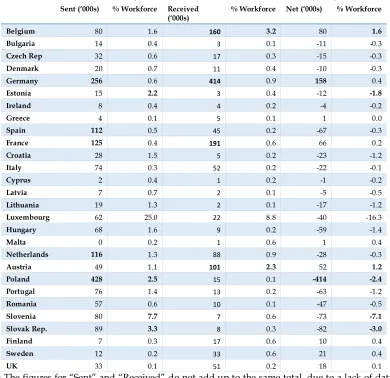
[image:10.612.112.502.197.575.2]Posted workers in the EU increased in absolute terms from 1.05 million in 2010 to 1.9 million in 2014. As a share of all mobile workers, they increased as well. Sent postings have increased in almost all countries, and not just in the new member states. Posting of workers is often perceived as an East-West phenomenon, however, this is clearly a misconception, as shown in Table 1.
Table 1. Posted workers by EU member state, based on the issuance of A1 forms
Sent (‘000s) % Workforce Received (‘000s)
% Workforce Net (‘000s) % Workforce
Belgium 80 1.6 160 3.2 80 1.6
Bulgaria 14 0.4 3 0.1 -11 -0.3
Czech Rep 32 0.6 17 0.3 -15 -0.3
Denmark 20 0.7 11 0.4 -10 -0.3
Germany 256 0.6 414 0.9 158 0.4
Estonia 15 2.2 3 0.4 -12 -1.8
Ireland 8 0.4 4 0.2 -4 -0.2
Greece 4 0.1 5 0.1 1 0.0
Spain 112 0.5 45 0.2 -67 -0.3
France 125 0.4 191 0.6 66 0.2
Croatia 28 1.5 5 0.2 -23 -1.2
Italy 74 0.3 52 0.2 -22 -0.1
Cyprus 2 0.4 1 0.2 -1 -0.2
Latvia 7 0.7 2 0.1 -5 -0.5
Lithuania 19 1.3 2 0.1 -17 -1.2
Luxembourg 62 25.0 22 8.8 -40 -16.3
Hungary 68 1.6 9 0.2 -59 -1.4
Malta 0 0.2 1 0.6 1 0.4
Netherlands 116 1.3 88 0.9 -28 -0.3
Austria 49 1.1 101 2.3 52 1.2
Poland 428 2.5 15 0.1 -414 -2.4
Portugal 76 1.4 13 0.2 -63 -1.2
Romania 57 0.6 10 0.1 -47 -0.5
Slovenia 80 7.7 7 0.6 -73 -7.1
Slovak Rep. 89 3.3 8 0.3 -82 -3.0
Finland 7 0.3 17 0.6 10 0.4
Sweden 12 0.2 33 0.6 21 0.4
UK 33 0.1 51 0.2 18 0.1
Note: The figures for “Sent” and “Received” do not add up to the same total, due to a lack of data on received postings (see more on lack of adequate data, see Box 1).
Data source: European Commission (2016).
LABOUR MOBILITY IN THE EU:ADDRESSING CHALLENGES AND ENSURING ‘FAIR MOBILITY’7
In any event, it is evident that posting is not a minor issue for many countries. Belgium and Austria receive close to 3.2% and 2.3% (respectively) of their workforce via posting while Slovenia sends a remarkable 8% of its workforce to other member states. Furthermore, posting is highly concentrated in the construction sector, where nearly half of the postings is taking place. It is often argued that posted workers are only a minor part of labour mobility, but this is clearly not accurate.
Nevertheless, despite an increasing incidence of posting in the EU, total mobility remains low, at least when compared with the United States. In the US both the flow and the stock of mobile citizens are ten times higher than in the EU. Evidently language does not present a barrier to mobility in the US and prevents the EU from achieving similar rates, but other obstacles may impede the free flow of workers throughout the EU as well.
2.
The single market
s: Challenges to labour mobility and scope for policy
A long-term perspective of further European integration and convergence, which entails moving closer to a single labour market and a deepening of the internal market in services, must be able to accommodate a greater amount of labour mobility. In fact, labour mobility can in some instances be a driver of convergence. It is not, however, without its many challenges. A distinction can be made between challenges at the individual-actor level (pertaining to workers and employers), challenges relating to the meso level (social partners and collective agreements) and at member-state level, i.e. challenges related to social security policies and EU integration. These challenges affect various groups of mobile workers in different ways. While different levels of actors are also facing different challenges, they all originate from the fact that labour and social policy is not only the competence of member states, but also that labour market institutions and social policy have historically evolved in different ways in each member state. Further complicating the issue is the sentiment, at least in some EU member states, that the EU is best kept out of the arena of social policy.
Below we first discuss the challenges faced by individual actors and social partners. This is followed by a more in-depth discussion of the contexts within which labour mobility and the single market are governed at EU and member state levels.
Challenges at the individual-actor level
given the variety of systems, imperfect knowledge on how a potential destination country’s social security system operates continues to be an issue.
However, the most important challenge to achieving a single EU labour market is language proficiency. This is necessarily a long-term objective. The Commission’s response to this obstacle is the ‘mother tongue + two foreign languages’ target. Despite gradual progress, particularly in English, proficiency varies greatly across the EU.
For the development of regional labour markets (which are divided by national boundaries), cross-border workers also face issues related to taxation, not least on receiving proper advice. This includes taxation of pensions, which can also apply to workers who have spent part of their career in another member state than the one they retire in. Tax policy is covered (in most if not all) cases by bilateral agreements and the European Commission has little competence in this area. For this group of workers, the lack of public transport infrastructure may also pose a barrier.
Mobile workers’ lack of on-the-job training and wasted skills are also often reported as a challenge to a single labour market. The lack of language proficiency is once more a contributing factor, but the problem goes beyond this. It may also be due to a lack of knowledge of rights and opportunities, e.g. in relation to educational leave. Uncertainties surrounding the rights of employees can in the worst cases lead to abuse and fraud, but also underpayment and inadequate health and safety standards being applied at the workplace. There are two main issues facing companies in relation to the mobility of workers. One relates to the absence of a single European labour market and the other to the internal market for services. Companies and employers face difficulties (or at least additional opportunity costs) in recruiting workers from other member states due to a lack of integration of unemployment services. The EURES system offers an improvement in this respect. In addition, recruiting employees outside of the local labour market is costlier due to information and cultural barriers (e.g. implicit expectations of employees at a given level of experience and pay scale). Here (cross-border) employment agencies can play a role in helping to fill vacancies. Related to the internal market for services, administrative and other barriers restricting employees’ access to work in other member states can hamper a company’s expansion to foreign markets. This includes a potentially muddy legal framework creating uncertainties regarding the remuneration of workers while they are abroad.
2.1
Challenges related to social partners and general organisation of labour
markets
Labour mobility presents a challenge to the social partners in their efforts to organise stakeholders. This is foremost a problem for labour unions in relation to temporary mobility, i.e. posted workers, but it also relates to regular mobility. Attempts at organising mobile workers run up against language and sometimes cultural barriers. If there is a perception that the incentives are not aligned with host-country workers, i.e. if trade unions are seen to protect domestic workers against foreign workers, it makes the task of organising mobile workers exceptionally hard. For temporary workers there are additional costs on top of union activities in their home country. In countries where collective agreements derive their legitimacy from strong unionisation, the issue is amplified.
LABOUR MOBILITY IN THE EU:ADDRESSING CHALLENGES AND ENSURING ‘FAIR MOBILITY’9
cross-border service, it will be more difficult for employers to find common ground on shared industry interests.
2.2
Challenges at member-state and EU levels
The principle of free movement of labour has led to a renewed push for the removal of obstacles to mobility, as discussed above. Efforts to achieve this aim have been intensified since the onset of the economic and financial crisis. These are to be applauded given the divergence in opportunities among workers in different member states. And, in fact, EU citizens are now more mobile than at any other time in the history of the Union.
At the same time, these facilitating measures and efforts at EU-level cooperation have come under pressure. The criticism is not directed towards labour mobility itself but towards certain aspects and possible loopholes in the current framework that can be unduly exploited and are deemed no longer fit for purpose. The key challenge for policy-makers is to find the right balance between safeguarding the rights of mobile citizens while taking into account adverse effects on other parts of society, namely national citizens and companies, and the impact of policies on public perceptions and opinion.
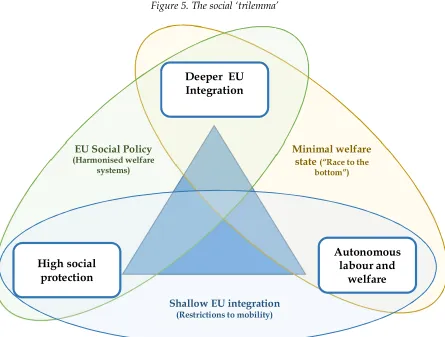
Three overriding (long-term) EU policy principles and aims, laid down in the treaties, are key to acquiring an understanding of the barriers and challenges to labour mobility at the EU and member-state levels: i) the right to free movement of labour, ii) the aim of achieving deeper single market integration, particularly in services and iii) the commitment in the Lisbon Treaty to work towards a competitive social market economy. The concept of free movement of labour is self-evident. The social market economy implies welfare states with high social protection, while deeper single market integration entails cross-border delivery of services and labour mobility.
Figure 5. The social ‘trilemma’
Source: Authors’ elaboration on a concept from Sapir (2015).
The following discussion relates closely to the posting of workers, but it also exemplifies a wider debate.
Deep economic integration with unrestricted cross-border delivery of services can co-exist with autonomous welfare states only in the context of a minimalist approach towards social protection and the coverage of the welfare state. This is often labelled ‘the race to the bottom’. In this case, full service-market integration (without restrictions) would imply that (posted) workers delivering services in another member state would be paid a fraction of the wage level in that member state. Competition in labour-intensive services would be severely distorted, since national employers in high-wage member states would still be bound to pay the national minimum wage and honour collective agreements. As a consequence, domestic unemployment would rise and wages would be depressed. Public perceptions apart, such a situation would not be sustainable for welfare states with high levels of social security. Generous welfare states would be under pressure to adjust downwards.
On the other hand, with a European approach to welfare policy, i.e., a common minimum wage and EU-wide collective agreements, extensive welfare states would be compatible with deep economic integration and labour mobility. This is labelled the ‘EU social policy’ approach. However, given the current differences in wages levels, even after adjusting for
EU Social Policy
(Harmonised welfare systems)
Minimal welfare state (“Race to the
bottom”)
Shallow EU integration
(Restrictions to mobility)
High social protection
Autonomous labour and
welfare Deeper EU
LABOUR MOBILITY IN THE EU:ADDRESSING CHALLENGES AND ENSURING ‘FAIR MOBILITY’11
purchasing power, this latter construct is largely theoretical. Implementing a common European welfare system would imply a large transfer of resources from richer to poorer countries in order to reach an acceptable common level.
Finally, member states can maintain autonomous welfare states with high social protection levels if EU integration in labour-intensive services (deep integration) is restricted or managed. This is the system in place today. Given the existence of heterogeneities in wage levels and welfare-state designs, an ‘equalisation of rules’ approach has been taken to ensure that in situ delivery of cross-border services are subject to the rules of the state in which the service is delivered (host-country principle). This is essentially the purpose of the posted worker Directive. This approach is, of course, backed by the Treaty in which cross-border service provision shall occur "under the same conditions as are imposed by the State on its own nationals" (Art. 57 TFEU). Different cases brought before the Court of Justice of the European Union over the last 15-20 years illustrate the difficulties in defining the right balance in order to satisfy the constraints imposed by the social trilemma.
[image:15.612.68.499.421.628.2]As member states’ economic fortunes converge, the ‘social trilemma’ will become less and less relevant. If there are minor differences in wages across member states, deep economic integration will pose little interference to autonomous welfare states with high social protection or to strong labour market regulations. Thus the trilemma shrinks, as illustrated by Figure 6 where the ‘size’ of the trilemma can be thought of as the necessary cost to balance the three items. Consequently economic convergence among EU member states implies that restrictions on labour mobility can be relaxed.
Figure 6. Economic convergence and diminishing social ‘trilemma’
Source: Authors’ visualisation.
While not driven by competition and the internal market for services directly, the wage (and welfare benefit) differences across member states also lie at the heart of the debate on welfare benefits to mobile citizens. The fact that some social benefit elements in one member state, e.g. unemployment benefits, are a multiple of the average wage in another can give rise to incentive problems and call into question whether regular mobility is for work opportunities
Economic convergence
Deep
High social protection
Autonomous welfare
Social Social trilemma
Social trilemma Social
or rather for the purpose of claiming social benefits. For regular mobile individuals, the legal framework is clearer (at least concerning social benefits as opposed to social assistance), but for this very reason, it makes the balance between free movement and access to other welfare benefits explicit. This point was well illustrated by the discussion of exportability of child benefits and unemployment insurance in some member states prior to the European Parliament elections in 2014.
2.3
When to adjust the balance?
We can cite three main reasons that can in general justify an adjustment in the balance between deeper economic integration (internal market for services) and the ability to maintain heterogeneous welfare states and labour-market regulations through the imposition of restrictions on mobile workers:
o A change of the economic environment in which the balance operates o Uncertainty about the legal framework
o When public perceptions are affecting the wider framework conditions
This reasoning corresponds most closely to the case of posted workers, but it is also applicable to regular mobility with a more permanent change of residence.
As described above, the balance between services market integration and maintaining both heterogeneous welfare states and a high level of social protection is situated in a specific economic environment. If the economic environment changes, for example as a consequence of further economic divergence or convergence, this can provide an argument for adjusting the balance. This is also the case if the outcome given the economic environment differs from reasonable expectations, if the speed of adjustment in the labour market is faster than expected or if domestic companies are unable to compete under the given legislation. In this regard, the large increase in the number of posted workers in recent years can merit an inspection of the balance.
Uncertainty about the legal framework creates costs for companies requesting cross-border services as well as for those providing them. The buyer may refrain from using the most cost-effective service provider if this entails a risk of undue delays due to problems with labour inspectors or legitimate action by trade unions. Similarly, competitive service providers may not bid for the delivery of services if potential labour costs are not transparent. At the member state level, there is an issue if the legal interpretation of the Directive by the CJEU is difficult to establish in detail because cases brought before the court are limited in terms of the extent to which they can be generalised to other situations.
Lastly, if a given balance, as defined by legislation of the Commission, is challenging the legitimacy of the EU via negative public perceptions, one should consider if the framework is functioning well. While exporting services via posting is not fundamentally different in its economic effect from exporting goods across borders, it may be subject to other fairness considerations and norms because of its visibility where it displaces employment. The posting Directive (and the treaty) clearly acknowledge this by adopting a host-country principle rather than a country-of-origin principle.
LABOUR MOBILITY IN THE EU:ADDRESSING CHALLENGES AND ENSURING ‘FAIR MOBILITY’13
markets. Each one of them, however, should be assessed as part of the ongoing political process and negotiations over various elements of the mobility package.
2.4
Do not shift the balance too far
The public debate can quickly forget that a well-functioning internal market in services, as with trade in goods, raises aggregate welfare. The export of labour intensive services is also a means to facilitate income convergence across EU countries. The same is true for regular labour mobility. Reconsidering legislation affecting mobile workers should not aim to explicitly reduce mobility. Nor can it be avoided that further economic integration will provide a net loss to some people. National legislators are called upon to find appropriate redistribution tools to mitigate the effects.
Policy-makers should aim to address concerns by social partners and the public, and the constraints imposed by the trilemma in ways that are the least restrictive on overall labour mobility. This could include supplementary policies or measures that lower the barriers to and bring more clarity to rules governing regular and cross-border mobility. In this vein, it is reasonable that posted workers maintain their link to national social-security systems, due to the temporary nature of work abroad. It substantially reduces barriers to this form of mobility since the administrative burden shrinks for both the employer and the employee.
3.
Towards ‘fair mobility’?
With large differences in wages and income, current welfare-state arrangements can only be maintained if the single market for services is limited in its depth of integration, that is, the host country has control over wages and working conditions (subject to general EU legislation on working conditions). This is implicitly recognised in the Treaty and is the principle behind the posted workers Directive. A unified European welfare-state approach is still years away, and economic convergence that would render labour mobility a non-issue has yet a long way to run. Until then, ‘fair mobility’ will have to be defined by a balance within the ‘trilemma’: offering further integration in the single market for services but at the same time maintaining remuneration and working conditions suited for each member state.
Bibliography
Andor, L. (2015), “Fair Mobility in Europe”, FES Social Europe, Occasional Paper, Friedrich-Ebert-Stiftung, January.
Association of European Border Regions (2012), “Information services for cross-border workers in European border regions” (www.aebr.eu/files/publications/ 121030_Final_Report_EN_clean.pdf).
Barslund, M. and M. Busse (2014), Making the Most of EU Labour Mobility, CEPS Task Force Report, CEPS, Brussels, 7 October.
Barslund, M. and M. Busse (2016), “How mobile is tech talent? A case study of IT professionals based on data from LinkedIn”, CEPS Special Report, CEPS, Brussels, June.
Barslund, M., Busse, M. and Schwarzwälder, J. (2015), “Labour Mobility in Europe: An untapped resource?”, CEPS Policy Brief No. 327, CEPS, Brussels.
Beyer, R. and F. Smets (2015), “Labour market adjustments in Europe and the US: How different?”, ECB Working Paper Series No 1767, European Central Bank, Frankfurt, March.
De Wispelaere, F. and J. Pacolet (2015a), “Posting of workers as stabilising mechanism. An enlarged notion of labour mobility as a prerequisite for an optimal currency area”, KUL Working paper, Leuven University, November.
De Wispelaere, F. and J. Pacolet (2015b), “Posting of workers: the impact of social security coordination and income taxation law on welfare states”, KUL Working paper, November.
European Commission (2013), “Practical guide on the applicable legislation in the European Union (EU), the European Economic Area (EEA) and in Switzerland”, Social Europe, December.
European Commission (2014a), “Labour mobility and labour market adjustment in the EU”, Economic Papers 539, December.
European Commission (2014b), “Proposal for a regulation of the European Parliament and of the Council on a European network of Employment Services, workers' access to mobility services and the further integration of labour markets”, COM(2014) 6 final.
European Commission (2016a), “Commission presents reform of the Posting of Workers Directive – towards a deeper and fairer European labour market”, press release, (http://europa.eu/rapid/press-release_IP-16-466_en.htm).
European Commission (2016b), “Impact assessment: Proposal for a Directive of the European Parliament and the Council amending Directive 96/71/EC concerning the posting of workers in the framework of the provision of services”, SWD(2016) 52 final, March. European Commission (2016c), “Study on wage setting systems and minimum rates of pay
applicable to posted workers in accordance with Directive 96/71/EC in a selected number of Member States and sectors”, Contract No VC/2015/0334.
LABOUR MOBILITY IN THE EU:ADDRESSING CHALLENGES AND ENSURING ‘FAIR MOBILITY’15
European Parliament (2009), “The impact of the ECJ judgments on Viking, Laval, Rüffert and Luxembourg on the practice of collective bargaining and the effectiveness of social action”, IP/A/EMPL/ST/2009-11.
IDEA Consult and ECORYS Netherlands (2011), “Study on the economic and social effects associated with the phenomenon of posting of workers in the EU“, final report VT/2009/062, study conducted for the European Commission, March.
Pacolet, J. and F. De Wispelaere (2014), “Posting of workers Report on A1 portable documents issued in 2012 and 2013”, study conducted for the European Commission, December. Parey, M. and F. Waldinger (2008), “Studying Abroad and the Effect on International Labor
Market Mobility: Evidence from the Introduction of ERASMUS”, IZA Discussion Paper No. 3430, Institute for the Study of Labor, Bonn, April.
Pelkmans, J. (2006), European Integration: Methods and Economic Analysis, 3rd edition, Pearson Education.
Sapir, A. (2015), “Single Market and Social Protection: Friends or Foes?”, presentation prepared for an Informal Meeting of Labour Ministers, hosted by Sweden’s Minister for Employment, Stockholm, 11 September.
CEPS, Place du Congrès 1, B-1000 Brussels, Belgium Tel: 32 (0)2 229 39 11 • www.ceps.eu • VAT: BE 0424.123.986
ABOUT CEPS
Founded in Brussels in 1983, CEPS is widely recognised as the most experienced and authoritative think tank operating in the European Union today. CEPS acts as a leading forum for debate on EU affairs, distinguished by its strong in-house research capacity and complemented by an extensive network of partner institutes throughout the world.
Goals
Carry out state-of-the-art policy research leading to innovative solutions to the challenges facing Europe today
Maintain the highest standards of academic excellence and unqualified independence
Act as a forum for discussion among all stakeholders in the European policy process
Provide a regular flow of authoritative publications offering policy analysis and recommendations
Assets
Multidisciplinary, multinational & multicultural research team of knowledgeable analysts
Participation in several research networks, comprising other highly reputable research institutes from throughout Europe, to complement and consolidate CEPS’ research expertise and to extend its outreach
An extensive membership base of some 132 Corporate Members and 118 Institutional Members, which provide expertise and practical experience and act as a sounding board for the feasibility of CEPS policy proposals
Programme Structure
In-house Research Programmes
Economic and Finance Regulation
Rights Europe in the World Energy and Climate Change
Institutions
Independent Research Institutes managed by CEPS
European Capital Markets Institute (ECMI) European Credit Research Institute (ECRI)
Energy Climate House (ECH)
Research Networks organised by CEPS
European Climate Platform (ECP)