This is a repository copy of
Resource Optimization in Quantum Access Networks
.
White Rose Research Online URL for this paper:
http://eprints.whiterose.ac.uk/149217/
Version: Accepted Version
Proceedings Paper:
Bahrani, S, Elmabrok, O, Lorenzo, GC et al. (1 more author) (2019) Resource
Optimization in Quantum Access Networks. In: ICASSP, IEEE International Conference on
Acoustics, Speech and Signal Processing - Proceedings. 2019 IEEE International
Conference on Acoustics, Speech and Signal Processing, 12-17 May 2019, Brighton, UK.
IEEE , pp. 7988-7992. ISBN 9781479981311
https://doi.org/10.1109/ICASSP.2019.8683681
© 2019, IEEE. Personal use of this material is permitted. Permission from IEEE must be
obtained for all other uses, in any current or future media, including reprinting/republishing
this material for advertising or promotional purposes, creating new collective works, for
resale or redistribution to servers or lists, or reuse of any copyrighted component of this
work in other works.
[email protected] https://eprints.whiterose.ac.uk/ Reuse
Items deposited in White Rose Research Online are protected by copyright, with all rights reserved unless indicated otherwise. They may be downloaded and/or printed for private study, or other acts as permitted by national copyright laws. The publisher or other rights holders may allow further reproduction and re-use of the full text version. This is indicated by the licence information on the White Rose Research Online record for the item.
Takedown
If you consider content in White Rose Research Online to be in breach of UK law, please notify us by
Resource Optimization in Quantum Access
Networks
Sima Bahrani, Osama Elmabrok, Guillermo Curr´as Lorenzo, and Mohsen Razavi
School of Electronic and Electrical Engineering, University of Leeds, Leeds, LS2 9JT, UK
Abstract—In this paper, low-complexity channel allocation
methods are proposed for quantum access networks. We consider dense-wavelength-division-multiplexing passive optical network (DWDM-PON) structures that enable users to exchange secret keys, in addition to data transmission. We consider two main sources of noise in such systems, Raman scattering and four-wave mixing, and examine optimal channel allocation in different scenarios. We also take into account finite-key effects in the quantum key distribution (QKD) channels. Our numerical results show that the proposed wavelength assignment methods can significantly enhance the secret key generation rate of users.
Index Terms—Quantum key distribution, Quantum communi-cation, DWDM-PON.
I. INTRODUCTION
Quantum key distribution (QKD) is one of the most promis-ing technologies for secure communication. Whereas the exist-ing cryptography protocols for public-key cryptography mostly rely on the computational complexity, the security of QKD is gauranteed by the laws of quantum physics. The first steps toward the widespread deployment of QKD has already been taken. Successful demonstrations of QKD networks have been reported in [1]–[6]. However, one important requirement for cost-efficient implementation of such quantum networks is their integration with the existing classical networks. The transmission of QKD signals alongside classical data signals has been investigated for different QKD protocols and setups. In addition, coexistence of classical data channels with QKD channels has been demonstrated in different setups [7]–[11]. In this paper, we consider a passive optical network (PON) based on dense wavelength division multiplexing (DWDM). In this system, users are equipped with a QKD transmitter module such that, in addition to data transmission, secure key exchange is also possible. We study optimal channel allocation in such systems and propose low-complexity algorithms to achieve it. Coexistence of QKD channels and classical data channels on the same fiber arises new challenges. One major issue is the additional crosstalk noise generated by the classical signals at the quantum receivers. Some sources of this noise are adjacent channel crosstalk due to the nonideal operation of DWDM demultiplexers, Raman scattering, and four-wave mixing (FWM). In [9], [10] narrow bandpass filters (NBFs) are used to reduce the deteriorating effect of such a noise. In [12], optimal wavelength assignment, as an effective method of noise reduction, has been proposed and investigated. In [13],
This research is partly funded by the UK EPSRC Grant EP/M013472/1 and EU H2020 Project 675662. All data generated in this paper can be reproduced by the provided methodology and equations.
an algorithm for wavelength assignment in DWDM quantum-classical systems has been proposed, which mostly relies on the elimination of FWM noise.
In this paper, we study the effect of both Raman scattering and FWM noises in quantum-classical DWDM-PON setups. We consider different regimes of operation, and investigate the importance of Raman noise and FWM noise in different scenarios. Based on this, we propose low-complexity channel allocation methods for such systems.
In this work, we also consider finite-key effects in the QKD setups. A typical QKD session, relies on bounding some parameters, e.g., error probabilty of single-photon states. This is mainly required for certain steps of the QKD protocol, e.g., privacy amplification. If a very large number of qubits are transmitted, the desired probabilities can be calculated asymptotically, from the measurement results. In reality, how-ever, only a finite number of qubits are transmitted. Finite-key effects for decoy-state BB84 protocol have been rigorously analyzed in [14]. We have used this analysis to analyse the performance of our QKD channels in the finite-key regime.
The rest of the paper is organized as follows. In Sec. II, we describe the setup in detail. In Sec. III, wavelength assignment is investigated, and in Sec. IV, we present some numerical results. Section V concludes the paper.
II. SYSTEMDESCRIPTION
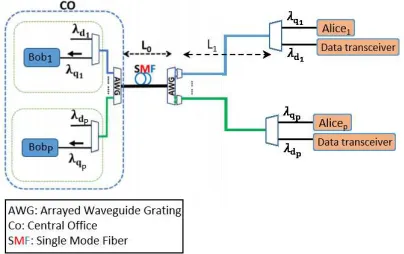
In this paper, we consider a DWDM-PON setup, as shown in Fig. 1. In this syetm, the signals fromP users are multiplexed by a DWDM multiplexer and transmitted through an optical fiber to the central office. We assume that the ith user is assigned two wavelengths, λqi and λdi, for the transmission
of quantum and classical signals, respectively. The set of quantum and classical channels are, respectively, denoted by Q = {λq1, λq2, ..., λqP} and C = {λd1, λd2, ..., λdP}.
Furthermore, the set of available wavelengths in the system is denoted by G = {λ1, λ2, ..., λD}, where D ≥ 2P. The
channel spacing is denoted by ∆. The distance between the
ith user and the multiplexing point is denoted byLi, and the
length of the optical fiber connecting the multiplexing point and the central office is represented byL0. In this paper, it is
assumed thatL0 ≫Li, fori = 1, ..., P. We assume that the
classical channels in C are unidirectional, i.e., the classical signals are transmitted from users to the central office. The launch power of classical channels is assumed to be equal and is represented byI.
located at the central office. The QKD encoder and decoder corresponding to the ith user are represented by “Alicei”
and “Bobi”, respectively, in Fig. 1. In this paper, we assume
that vacuum+weak decoy-state BB84 protocol with time-bin encoding is used in our QKD channels [15]. We consider the finite-key effects, where a certain number of qubits are transmitted in a QKD session. We use the method presented in [14] to analyse the finite-key effects in the system.
One major issue in the described setup is that the transmis-sion of classical signals alongside the quantum ones on the same fiber would generate some crosstalk noise at the quantum receivers. Major sources of such noise are Raman scattering, adjacent channel crosstalk, and FWM [7], [16]. By applying narrow bandpass filters at the quantum receivers, adjacent channel crosstalk can be suppressed effectively. However, the background noise generated by Raman scattering has a wide bandwidth and usually would adversely affect the performance of our QKD setups in spite of such filtering. The effect of FWM on quantum channels depends on various system parameters, e.g., transmission distance, launch power of classical channels, and channel spacing. In general, for high-power classical channels and short distances, FWM may be required to be taken into account as well. In the following, these two sources of noise will be described in more details.
A. Raman noise
The transmission of a classical signal in an optical fiber would result in Raman scattering. This phenomenon occurs due to the inelastic photon-phonon interactions in the opti-cal fiber. Raman scattering can occur in both forward and backward directions. In our setup, the classical signals are transmitted in the same direction as the quantum ones. Hence, forward Raman scattering should be considered. Denoting the bandwidth of NBFs at the quantum receivers by∆λ, the power of Raman noise induced by a classical channel at λdi, on a
quantum channel at λqj, can be expressed as
IRam =Ize
−αzρ(λ
di, λqj)∆λ, (1)
where z denotes the transmission distance [9]. In the above equation, ρ(λdi, λqj) denotes Raman cross section at
wave-Fig. 1. A quantum-classical access network based on the DWDM-PON struc-ture. Each user is assigned two channels, one for classical data transmission and one for QKD.
length λqj for a classical signal at wavelength λdi, and α is
the fiber attenuation coefficient.
B. Four-wave mixing
FWM arises from nonlinear effects in an optical fiber. Three optical signals with frequenciesfi,fj, andfk, wherei, j̸=k,
mix through the third order nonlinearity of the optical fiber and generate a new frequencyfijk =fi+fj−fk. The peak power
of the FWM product is given by [17], [18]
IFWM =η
(
2πn2 λAeff
)2
D2I
iIjIke−αz(1−e−αz)
9α2 , (2)
where
η= α
2
α2+ ∆β2
(
1 + 4e
−αzsin2(∆βz/2)
(1−e−αz)2
)
. (3)
In the above equations, Ii, Ij, and Ik are launch power of
optical signals, andλis the wavelength of the FWM product. The parameter D is the degeneracy factor. For fi = fj we
have D = 3, whereas for fi ̸= fj ̸= fk the value of this
parameter is D = 6. The parameters n2 and Aeff denote the
nonlinear coefficient and the core effective area, respectively.
∆β represents the phase matching factor. Assuming that |Dc|>1ps/nm/km,∆β can be expressed as [17]
∆β= 2πλ
2
c |fi−fk||fj−fk|Dc, (4)
whereDc is the fiber dispersion and c is the speed of light.
In our setup, if the frequency of a FWM product generated by classical channels corresponds to a QKD channel, the background noise from this FWM product would enter the quantum receiver.
III. WAVELENGTH ASSIGNMENT
In the system described in Sec. II, the crosstalk noise in-duced by classical channels on the quantum channels adversely affects the performance of QKD setups. Both Raman noise and FWM noise depend on the wavelengths of the quantum and classical channels. This implies that the way we allocate the quantum and classical channels influences the amount of noise induced on the quantum channels. In this section, based on the characteristics of these two sources of noise, optimal channel allocation, with the aim of minimizing the total crosstalk noise induced on the quantum channels, is investigated and several algorithms for this purpose are proposed.
In our setup, because of the wide bandwidth of Raman spectrum, Raman noise is usually a source of noise. One question of interest is that in which regimes of operation the FWM noise becomes significant. According to (1) and (2), with the increase of launch power, the power of FWM noise will increase rapidly (IFWM ∼ I3), whereas for the Raman
noise, IRam ∼I. Another feature of the FWM noise is that,
considering a classical band consisted of two or more classical channels, the power of FWM noise at other available channels is highest at the two immediately adjacent channels.
[image:3.612.71.273.574.701.2]-20 -18 -16 -14 -12 -10 -8 -6 -4 -2 0
Launch power (dBm)
-140 -130 -120 -110 -100 -90 -80 -70 -60
Power (dBm)
[image:4.612.80.265.57.175.2]FWM, adjacent FWM, second adjacent Raman
Fig. 2. The power of FWM noise and Raman noise at the two channels
immediately adjacent and second adjacent to a five-channel classical band. The Raman noise components at these two channels are approximately identical.
Fig. 3. Classical, quantum and unused bands in the proposed channel
allocation methods. (a) The proposed method for the Raman noise dominant
scenarios. The unused band is in one of the positions labeled byA1toA2K−1
(A2K−1in the example shown). (b) The proposed method for the scenarios
in which FWM noise cannot be neglected. The unused band is in one of the
positions labeled byA1 toA2K+1(A2Kin the example shown).
1548.6 nm, and 1549.4 nm. We consider a standard single mode fiber with Aeff = 70 µm2 and n2 = 3×10⁻²⁰. Zero
dispersion wavelength is assumed to be 1313 nm, and zero dispersion slope is asummed to be 0.086 ps/nm2/km. To
calculate Raman noise, we use the Raman cross section mea-surement results presented in figure 1 in [16]. The transmission distance,L0+Li, is assumed to be5.5 km, and∆λ= 0.2 nm.
We consider the channel immediately adjacent to this classical band, at 1550.2 nm, as well as the second adjacent channel at 1551 nm. Figure 2 shows the power of FWM noise and Raman noise at these two channels, for different values of launch power of classical channels. Roughly speaking, for
I < −14 dBm, Raman scattering is the dominant soure of noise. For −14 dBm< I <−6 dBm, the FWM noise at the immediately adjacent channel should be taken into account. However, the FWM noise at the second adjacent channel can be neglected.
It should be noted that for a specific number of users in the system, there is a limitation on the value ofI, especially when we consider the practical case of finite-key schemes. In other words, in order to achieve a positive secret key rate for all
users,Ishould be less than a threshold. Furthermore, with the increase of number of users, the number of classical channels generating crosstalk noise at the quantum channels increases, which substantially reduces the maximum possible value ofI. Hence, in general, when the number of users is large, a low value has to be chosen for I, and Raman noise is often the dominant source of noise. On the other hand, when there are a few users in the system and I is quite large (for example 0 dBm), the FWM noise should be mitigated, as proposed in [13]. For a range of scenarios between these two, both Raman noise and FWM noise should be taken into account.
Let us first consider the scenarios in which Raman noise is the dominant source of noise. Based on the numerical results presented in [12], we can conclude that in the near-optimal channel allocation method, the resulting pattern is consisted of several interleaved quantum and classical bands. Furthermore, the unused channels are next to each other. Considering these features, we propose a low-complexity channel allocation algorithm.
We consider K quantum bands,{Q1, Q2, ..., QK}, and K
classical bands, {C1, C2, ..., CK}. The number of quantum
channels in Qi is denoted by Mi, where 0 ≤Mi ≤ P, and ∑K
i=1Mi = P. In a similar way, the number of classical
channels in Ci is denoted by Ni, where 0 ≤ Ni ≤ P, and ∑K
i=1Ni = P. We assume that these bands are interleaved,
as shown in Fig. 3(a). The unused band can be allocated to one of the regionsA1,A2, ...,A2K−2, andA2K−1in Fig. 3(a).
The proposed algorithm considers all the possible values for
Mi’s and Ni’s, as well as the 2K−1 possible regions A1, A2,...,A2K−1 for the unused band. In each case, the total
Raman noise induced on all quantum channels is calculated. Finally, the channel allocation setting that minimizes this noise is chosen. Our numerical results show that for K = 3, we can achieve a near-optimal solution for our channel allocation problem for all possible values of P. Intuitively, this can be justified by considering the curve of the Raman spectrum, which has three low-value regions.
Now we consider the scenario in which both Raman noise and FWM noise should be taken into account, but the FWM noise at the second adjacent channel of a partiular classical band is negligible. We note that if quantum channels are not allocated to the two wavelengths immediately adjacent to such classical bands, the remaining FWM noise would often be much less than the Raman noise, and Raman noise would be the dominant source of noise. Based on this, we propose a low-complexity channel allocation method suitable for these regimes of operation.
Our proposed method relies on the modification of the channel allocation method presented for the Raman noise dominant scenarios in Fig. 3(a). We assume that the quantum and classical bands are located as shown in Fig. 3(b), where we have enforced a null channel at each end of any classical band consisted of two or more classical channels. We consider all possible values forMi’s andNi’s. If we haveNi>1 for
[image:4.612.69.270.225.410.2]TABLE I
NOMINAL VALUES USED FOR SYSTEM PARAMETERS.
Parameter Value
Quantum Efficiency 0.3
Receiver dark count rate 1E-6ns−1
Error correction inefficiency 1.22
Misalignment probability 0.033
Detector gate interval and pulse width 100 ps
Fiber attenuation coefficient 0.2 dB/km
AWG insertion loss 2 dB
Bandwidth of NBF 25 GHz
regions A1,A2,...,A2K, andA2K+1, for the location of this
unused band, as shown in Fig. 3(b). The total crosstalk noise for all possible values of Mi’s and Ni’s, and the 2K + 1
possible regions for the unused band is calculated. In the end, the best case is chosen. For this algorithm, we assume
D−2P ≥2K−1.
IV. NUMERICALRESULTS
In this section, we evaluate the performance of our proposed algorithms. We consider a DWDM-PON setup, as described in Sec. II. We assume that the set of available wavelengths is
G={1535 nm,1535.8 nm, ...,1555.8 nm}and∆ = 0.8 nm. As for the fiber length parameters, we assume L0 = 5 km
andLk= 500 m, fork= 1, ..., P. We consider the practical
case of finite key size and analyse the finite-key effect in our system. We assume a block size of1011
in a QKD round. The failure probability parameter is chosen to beε= 10−10
. Other sytem parameters and their nominal values, which are feasible based on the practical considerations, are listed in Table I.
We compare the proposed wavelength assignment meth-ods with the conventional method of assigning the lowest wavelengths of the system to the quantum channels and the largest wavelengths to the classical ones. With this method, all quantum channels will be allocated at the anti-Stokes region of the Raman spectrum of the classical channels, which is known to be smaller in general, as compared to the Stokes region [16]. We refer to this method as “conventional method”.
We assume that the number of users in the system is
P = 10. Our numerical results show that with our system parameters, secret key exchange in all quantum channels is feasible for a launch power less than about I =−6.5 dBm. We consider a range of values for launch power between −9 dBmand−6.5 dBm. In this range, the FWM noise cannot be neglected. Hence, we use the channel allocation algorithm described in Fig. 3(b). The parameter K is chosen to be 3. Figure 4 shows the proposed locations for the quantum and classical channels, as well as their location in the conventional method. In this figure, “◦” represents a quantum channel, and “∗” represents a classical channel.
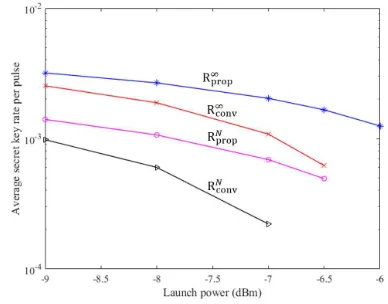
In order to evaluate the performance of the proposed channel allocation method, we obtain the secret key rate of all quantum channels, for the proposed and conventional channel allocation methods, and compare the corresponding average values. We denote the average secret key rate of users obtained by the proposed method, in the asymptotic case of an infinitely long key and the finite-key regime, respectively, by R∞
prop and RN
[image:5.612.79.269.76.162.2]prop. Similarly, the average secret key rate of users obtained
Fig. 4. The locations of the quantum channels (represented by “◦”), and
classical channels (represented by “∗”), for the proposed and conventional
methods.
Fig. 5. Average secret key rate in finite-key and asymptotic cases at different values of launch power
by the conventional method, in the asymptotic case of an infinitely long key and the finite-key regime, are denoted by
R∞
conv andRconvN , respectively.
Figure 5 shows the average secret key rate of users for different values of launch power. It can be seen that the proposed method enhances the secret key rate of quantum channels, especially in the finite-key regime. As an example, at I = −7 dBm, we achieve a rate enhancement of about
211%.
V. CONCLUSIONS
In this paper, we considered a PON setup in which quantum and classical channels are multiplexed by DWDM technique. The main sources of noise in such system are Raman scattering and FWM. We considered different regimes of operation and examined in which scenarios FWM becomes important. We also considered finite-key effects in our QKD setups. We proposed a low-complexity channel allocation method for Raman noise dominant cases, that can provide a near-optimal solution. Furthermore, a low-complexity channel allocation algorithm was proposed for the scenarios in which both Raman noise and FWM noise should be considered. The proposed algorithms can improve the secret key rate by considerable factor.
REFERENCES
[1] M. Peevet al., “The SECOQC quantum key distribution network in
[image:5.612.335.529.212.364.2][2] B. Fr¨ohlich, J. F. Dynes, M. Lucamarini, A. W. Sharpe, Z. Yuan, and
A. J. Shields, “A quantum access network,”Nature, vol. 501, pp. 69–72,
Sept. 2013.
[3] M. Sasakiet al., “Field test of quantum key distribution in the Tokyo
QKD Network,”Opt. Exp., vol. 19, no. 11, pp. 10 387–10 409, 2011.
[4] B. Qi, W. Zhu, L. Qian, and H.-K. Lo, “Feasibility of quantum key distribution through a dense wavelength division multiplexing network,”
New Journal of Physics, vol. 12, no. 10, p. 103042, 2010.
[5] Y.-L. Tang, H.-L. Yin, Q. Zhao, H. Liu, X.-X. Sun, M.-Q. Huang, W.-J. Zhang, S.-J. Chen, L. Zhang, L.-X. You, Z. Wang, Y. Liu, C.-Y. Lu, X. Jiang, X. Ma, Q. Zhang, T.-Y. Chen, and J.-W. Pan, “Measurement-device-independent quantum key distribution over untrustful
metropoli-tan network,”Phys. Rev. X, vol. 6, p. 011024, Mar 2016.
[6] Q. Zhang, F. Xu, Y.-A. Chen, C.-Z. Peng, and J.-W. Pan, “Large
scale quantum key distribution: challenges and solutions,”Opt. Express,
vol. 26, no. 18, pp. 24 260–24 273, Sep 2018.
[7] N. A. Peters, P. Toliver, T. E. Chapuran, R. J. Runser, S. R. McNown, C. G. Peterson, D. Rosenberg, N. Dallmann, R. J. Hughes, K. P. McCabe, J. E. Nordholt, and K. T. Tyagi, “Dense wavelength multiplexing of 1550nm QKD with strong classical channels in reconfigurable
network-ing environments,”New J. Phys., vol. 11, p. 045012, April 2009.
[8] T. E. Chapuran, P. Toliver, N. A. Peters, J. Jackel, M. S. Goodman, R. J. Runser, S. R. McNown, N. Dallmann, R. J. Hughes, K. P. McCabe, J. E. Nordholt, C. G. Peterson, K. T. Tyagi, L. Mercer, and H. Dardy, “Optical networking for quantum key distribution and quantum communications,”
New J. Phys., vol. 11, p. 105001, Oct. 2009.
[9] K. A. Patelet al., “Coexistence of high-bit-rate quantum key distribution
and data on optical fiber,”Phys. Rev. X, vol. 2, p. 041010, Nov. 2012.
[10] K. Patel, J. Dynes, M. Lucamarini, I. Choi, A. Sharpe, Z. Yuan, R. Penty, and A. Shields, “Quantum key distribution for 10 Gb/s dense wavelength
division multiplexing networks,”Applied Physics Letters, vol. 104, no. 5,
p. 051123, 2014.
[11] R. Kumar, H. Qin, and R. All´eaume, “Coexistence of continuous variable
QKD with intense DWDM classical channels,”New Journal of Physics,
vol. 17, no. 4, p. 043027, 2015.
[12] S. Bahrani, M. Razavi, and J. A. Salehi, “Wavelength assignment in
hybrid quantum-classical networks,”Sci. Rep., vol. 8, no. 1, p. 3456,
2018.
[13] J.-N. Niu, Y.-M. Sun, C. Cai, and Y.-F. Ji, “Optimized channel allocation scheme for jointly reducing four-wave mixing and raman scattering in
the dwdm-qkd system,”Applied Optics, vol. 57, no. 27, pp. 7987–7996,
2018.
[14] Z. Zhang, Q. Zhao, M. Razavi, and X. Ma, “Improved key-rate bounds
for practical decoy-state quantum-key-distribution systems,”Phys. Rev.
A, vol. 95, no. 1, p. 012333, 2017.
[15] H.-K. Lo, H. F. Chau, and M. Ardehali, “Efficient quantum key
distribution scheme and a proof of its unconditional security,”Journal
of Cryptology, vol. 18, no. 2, pp. 133–165, 2005.
[16] P. Eraerds, N. Walenta, M. Legre, N. Gisin, and H. Zbinden, “Quantum
key distribution and 1 Gbps data encryption over a single fibre,”New
Journal of Physics, vol. 12, no. 6, p. 063027, 2010.
[17] A. Bogoni, L. Pot`ı, and A. Bononi, “Accurate measurement of in-band
fwm power in dwdm systems over nonzero dispersion fibers,”IEEE
Photonics Technology Letters, vol. 15, no. 2, pp. 260–262, 2003. [18] R. Tkach, A. Chraplyvy, F. Forghieri, A. Gnauck, and R. Derosier,
“Four-photon mixing and high-speed wdm systems,”Journal of