Haffey, M. and Duffy, A.H.B. (2003) Design process performance
management support. In: Proceedings of the 14th International
Conference on Engineering Design (ICED 03). The Design Society. ,
This version is available at https://strathprints.strath.ac.uk/6406/
Strathprints is designed to allow users to access the research output of the University of Strathclyde. Unless otherwise explicitly stated on the manuscript, Copyright © and Moral Rights for the papers on this site are retained by the individual authors and/or other copyright owners. Please check the manuscript for details of any other licences that may have been applied. You may not engage in further distribution of the material for any profitmaking activities or any commercial gain. You may freely distribute both the url (https://strathprints.strath.ac.uk/) and the content of this paper for research or private study, educational, or not-for-profit purposes without prior permission or charge.
Any correspondence concerning this service should be sent to the Strathprints administrator:
The Strathprints institutional repository (https://strathprints.strath.ac.uk) is a digital archive of University of Strathclyde research outputs. It has been developed to disseminate open access research outputs, expose data about those outputs, and enable the
INTERNATIONAL CONFERENCE ON ENGINEERING DESIGN
ICED 03 STOCKHOLM, AUGUST 19-21, 2003
DESIGN PROCESS PERFORMANCE MANAGEMENT SUPPORT
M K D Haffey and A H B Duffy
Abstract
Organisational performance measurement is a multi-faceted and complex concern requiring considerable insight into the inter-dependencies that can exist between organisational activities and variables. Current approaches to performance measurement and management remain focused upon the need to articulate and communicate a strategy throughout an organisation. However, the decomposition of organisational strategies, which are disseminated to activities within the product development process, supports one direction of the management of organisational performance. We require the ability to determine how well an activity has performed, been executed and managed with respect to the realisation of a strategy(s). Effective operational management is thus required to ensure that, where applicable, the means exists to realise strategic objectives through the execution of efficient and effective operational activities. Specific issues regarding the measurement of performance within an organisational context are discussed, highlighting the need for effectively managing the process of performance measurement. Further, this paper discusses specific areas where performance measurement is required within the product development process, reflecting the complex interactions that can occur between process activities, whilst providing the feedback necessary to enable the effective management of process and organisational performance.
Keywords: Design Management, Performance Management, Performance Metrics.
1 Introduction
It is now more important than ever for organisations to actively seek leaner, more responsive and more agile organisational systems contributing to their relative competitive positioning. Given today’s global competitive market, organisations should maintain a focus on constantly striving to improve the effectiveness of its activities while increasing its levels of efficiency.
The reliance upon the measurement of performance within a list of subjectively defined ad-hoc performance variables can be mis-leading for practitioners, equipping them with a restricted perspective on performance. Such restricted perspectives reflect a subjective view of the organisation and are susceptible of being mis-representative of an organisations performance. This results in users being conditioned by the viewpoint of those who defined the measures – contributing to falling levels of confidence when unforeseen outcomes are encountered. The performance feedback represents the viewpoint of those who defined the measures and are thus susceptible to being subjective rather than objective to the needs of the organisation. It cannot be advocated to use more measures to better motivate and diagnose a system. Rather, we must provide the understanding and approaches necessary to: manage the performance measurement process; gain insights into the organisational mechanisms that contribute to performance; and, provide the effective management of performance within an organisation. What is required is the coherent control and direction of all of the variables and constituent components that contribute to some dimension of success or improvement within the bounds of the organisation. In Section two the need to understand how strategies are communicated throughout an organisation is assessed through the use of decomposed goals and objectives. In addition, Section two examines how performance metrics and measurements are used to determine the level of contribution attained by process activities. The focus is on the definition of the need for a performance measurement process to consistently define and utilise coherent objectives and goals throughout an organisational system. The remaining sections then highlight the need to understand process and activity inter-connections, in terms of the inputs, outputs and resources, discussing how their interactions may impact upon performance and the need for effective management to support their contribution to micro and macro levels of performance. A brief discussion on current approaches to performance management precedes a conclusion.
2 Process performance
Based upon a performance measurement practices survey, it was identified that the most frequent barrier and challenge facing practitioners is the lack of ability to define and agree upon the most appropriate measures to be used [2]. At a strategic level, the key requirements of a performance measurement system lies in the articulation and, hence, communication [3] of strategies to those who are affected by or indeed those who have the ability and opportunity to contribute to their realisation [2]. Within product development processes, there exist many different process structures such as sequential activities, parallel or concurrent activities and/or iterative cycles. Process performance is governed by the mechanisms and interactions that occur between activities within the development process and its management, in addition to the inter-relationships that exist within the many performance dimensions and requirements that condition and confine these activities. The effective management of such processes and activities relies upon practitioners being provided with the information of what is required and how it is contributing to the effective realisation of its requirements and goals. As stated by Andreason et al. “..the key to achieving optimal design performance, and hence design productivity, is the effective co-ordination of the design process” [4]. Thus, support for the effective co-ordination and management of the product development process must overcome the barriers facing practitioners in defining those measures and metrics that will support the attainment of optimal design, process and organisational performance levels.
objectives of stakeholders [2]. Support for the recognition and contribution within such ‘boundaries of control’ may omit the very nature of a product development process where process activities experience often complex interactions [1]. What is advocated here is the need to recognise and adequately support the recognition and management of those factors that extend beyond the ‘boundaries of control’ to the ‘boundaries of responsibility’. ‘Boundaries of responsibility’ refers to recognising potential impacts, direct and indirect, that may be encountered throughout a process, identified from undesired degradations in performance, as a result of some level of performance attained within supply activities. Thus, the boundaries of responsibility must transcend process and activity structures and recognise the interactions that occur between dimensions of performance. The following sections present key observations from industrial based research that reflect some of the requirements in effectively managing the performance of the product development process. The observations aim to increase the understanding of the conformance and contribution of an activity within an organisation providing a more enriched contextualised perspective. First, we discuss the need to recognise the coherence of goals from their decomposition/consolidation and contribution to their fit with other goals. Next, we discuss the need for assessing the appropriateness of an input, and its appropriateness to the attainment of an effective output, and the need to recognise this within the supply activity responsible. Lastly, we discuss the role of management in co-ordinating resources and activities that contribute directly or indirectly to the satisfaction of activity goals.
2.1 Coherence
Activities within a product development process can be, at any point in time, subject to a diverse range of goals and objectives as sourced from a range of perspectives throughout an organisation. Such perspectives may range from upper management and CEOs to individual personnel, each communicating their own individual goals and objectives to those activities associated with contributory performance. The development of a holistic goal(s) presents a description of a desired state for a system or subsystem. The subsequent decomposition of such a goal to the contributing activities provides a means to impart upon activities a consistent and coherently directed foci such that all actors may recognise their progress and contribution to overall performance. However, the common occurrence of multiple strategic, tactical and operational objectives being translated down and across an organisation presents the potential for direct and indirect contradictions in focus being impressed upon activities.
Coherence infers the need to recognise the structure and inter-relations that exist between goals and sub-goals throughout an organisational system from macro to micro activity levels and between supply and customer activities. One of the biggest issues in maintaining effective levels of performance throughout an organisational system is the level of coherence that exists between goals [5]. Coherence conveys the need to maintain a consistency in purpose throughout an organisation [6]. In addition, it supports the recognition and visible management of the contributions to performance that individual sub-systems attain (potential and actual) and make to other sub-systems and to the organisational system. What Fritz calls ‘structural tension’ arises as a result of activities and factors contradicting or detracting from as opposed to contributing positively to the overall performance of the system [7].
definition and management of coherent goals and objectives whilst recognising the nature and structure of organisational systems. These two components will be discussed in the following sections with the view of explicating the requirements of goal coherence.
2.1.1 Alignment
Carrie and MacIntosh identified the need for effective deployment of business objectives throughout the organisation [8] while Wind recognised the need for operational and tactical objectives to mutually reinforce strategic objectives [9]. Such requirements equate to:
• The need to decompose goals down through the organisation in such a way that sub-goals are aligned with the objectives of related parent level sub-goals maintaining a common focus throughout an organisation.
• The assessment of decomposed goals as to their fit within the context of an activity, where any identifiable potential fall in attainable levels of performance may be highlighted i.e. alignment between what is required and what is achievable. Such assessments during goal decomposition enables managers and practitioners to recognise the need to either reassess goal levels required and/or manipulate some aspect of an activity or process such that the required levels of effectiveness, and thus contribution to higher level goals, may be attained.
• Recognition of the attainment of optimal performance at one level while experiencing sub-optimal performance in another [10] should be adequately supported and managed during the progress of satisfying a goal and not be limited solely upon reflection.
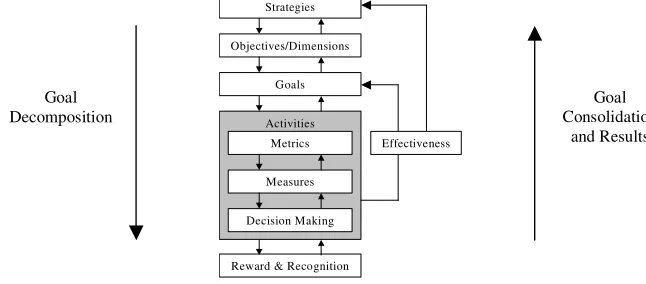
[image:5.612.138.461.569.711.2]Alignment, however, should not refer exclusively to the decomposition/consolidation of goals, objectives and results but should in addition incorporate and recognise the need to possess aligned activity and goal components that support in monitoring and controlling performance within and between different organisational levels. For example, a common means of communicating a strategy throughout an organisation is attained through the definition of localised sub-measures allowing managers and personnel to evaluate how each contributes to the functioning of the whole [5]. Any misaligned measures defined locally may result in activity personnel performing effectively at a local level while inadvertently detracting from global levels of performance [11]. Without aligned goals and components, structural tensions may result in inconsistent progress being made producing desired performance at a micro level, as seen from measurements, yet restraining the efficiency of progress overall. Figure 1 provides a representation of the components within an organisational system that are subject to experiencing or contributing to degrees of achieved alignment or misalignment. It is important therefore that alignment is maintained, firstly, between activities and components, and, secondly, between the dimensions of performance.
Figure 1. Organisational goal alignment.
Strategies
Activities Objectives/Dimensions
Goals
Metrics
Decision Making Measures
Reward & Recognition
Effectiveness Goal
Decomposition
Goal Consolidation
The use of performance metrics supports personnel in managing their progress toward the satisfaction of activity goals. While the use of metrics and measures within an activity can provide a focus for personnel to convey strategies, objectives and goals at a local level, any misalignment can result in misplaced contributions being made potentially furthering the gap between desired and attained levels of performance between associated organisational levels.
Beyond the need to recognise the immediate fit and potential contributions that sub-level components may have upon parent level components, further mechanisms exist that support in the recognition of the degrees of contribution being made by sub-level components. Activity effectiveness recognises the relationship between the output of an activity and the goals placed upon them. This measure of an activity’s performance, in terms of its ability to satisfy its objectives, enables personnel and managers to directly gauge their contribution to activity goals. The recognition of attained levels of effectiveness may be retracted back to higher order components to assess their contribution through a comparison of required against attained goal states while overcoming any potential misalignment that may exist as a result of intermediary sub-components.
2.1.2 Congruency
Congruency refers to the level of interaction that arises between goals and objectives where some level of enforcement is experienced, be it positive or negative, between defined activity goals. The focus of congruency lies with the need to recognise and define goals that are, where possible, mutually supportive as opposed to detracting from and restraining the performance within other goal dimensions. Such contradictions in focus, generated from non-congruent goals and objectives are susceptible to contributing to degradations in performance at higher system levels [7]. Thus, failure to recognise the fit or congruency of a goal with other activity goals leaves activities susceptible to being unable to effectively satisfy planned objectives and goals, potentially requiring management to intervene to reduce the impact of a fall in effectiveness and performance. While it is not advocated here that it is possible to consistently define goals and objectives that are congruent, i.e. mutually supportive and non-contradictory, but that the existence of such interactions should be made explicit and visible to those responsible for setting and/or satisfying goals. Alignment is concerned with the fit/contribution relationship between performance dimensions and structural components that are used to realise strategic objectives. Congruency however is concerned with recognising the fit of goals and objectives that inter-relate across activities contextualising individual objectives and factors within process activities.
Congruency is concerned with recognising the interactions that can exist between inter-related activity goals. Non-interacting factors are not susceptible to the phenomenon of congruency as no contradictions can occur in effort or progress. Thus, the following points outline where interactions can occur between inter-related dimensions:
• Direct interactions within common goal dimensions i.e. cost to cost; and,
• Indirect interactions between different yet related goal dimensions i.e. time to cost.
While these interactions highlight the potential inter-play that can exist within and between goal dimensions, recognition of the structural interactions that can exist between activities within a product development process and its management must also be effectively managed. The following points summarise the specific scenarios where levels of congruency can be impacted:
• Between goals within an activity; and,
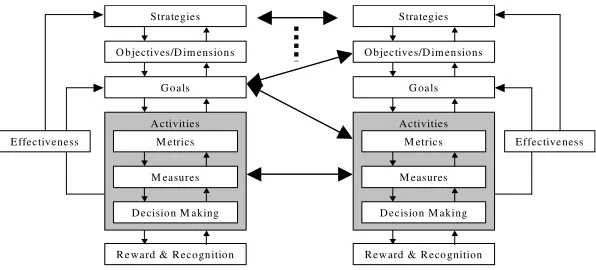
These points serve to highlight some of the interactions that can occur within and between activity goals. However, congruency is not limited to just direct and indirect interactions between goal dimensions within and across activities. Interactions between goals and their dimensions have been used in our discussion to convey a common medium within which such a phenomenon can occur. However, the very components associated with the issues of alignment are also susceptible to congruency. Congruency may exist within and between any of the components outlined. Figure 2 outlines the same components as those presented in the alignment section. Here, interactions may occur between strategies, between objectives, between goals, between activities and their associated metrics and measures and/or between reward and recognition incentives. In addition, such interactions may result within an activity tasked with satisfying multiple strategies etc. where the interactions may be more visible and prominent. Such approaches as defining priorities and/or making tradeoffs between components, changing one or multiple goal levels, may be taken to promote the level of congruency that may exist between components. These approaches, used to address undesirable levels of incongruence within an activity, must also recognise the existence of differing components being located within a common activity. For example, an activity may be conditioned by a goal while being rewarded and recognised for its performance within another dimension of performance. Therefore, care must be taken to ensure any resolution of conflict or undesirable interaction between goal and measure is done with the level of insight and understanding necessary to ensure sub-optimal performance does not ensue. Thus, such decisions to prioritise etc, between goal and reward must be based upon an understanding of the rewards role and priority within the overall system considering the ownership, role and contribution of the goals, measures, etc.
The effective management of the interactions of goals, measures, etc. from various organisational perspectives must be supported to ensure that the potential synergy between activities remains conducive and contributory to desired levels of performance alleviating the occurrence of any negative interactions within and between performance dimensions.
2.2 Efficiency, effectiveness and appropriateness
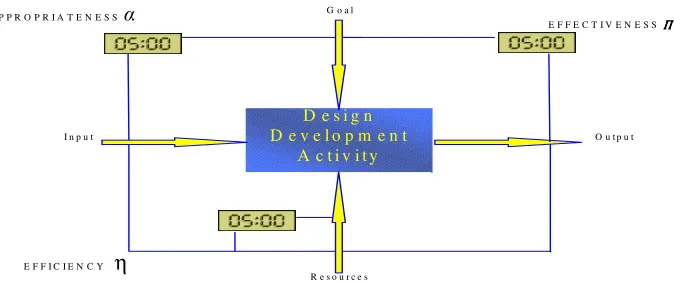
[image:7.612.157.455.430.565.2]The product development process consists of multiple activities that interact in different manners and on different levels from the supply of management goals to activity inputs and resources. Activities may be ordered sequentially or in parallel while interacting iteratively through input to output and/or goal definition to goal satisfaction relationships. Research by O’ Donnell and Duffy has provided a generic model of activity performance [12]. Their model identifies the components of an activity (i.e. input, output, goals/constraints and resources) and their relationships within the elements of effectiveness and efficiency
Figure 2. Organisational goal congruency.
Strategies
Activities O bjectives/D im ensions
G oals
M etrics
D ecision M aking M easures
R ew ard & R eco gnition
Effective ness Strategies
A ctivities O bjectives/D im ensions
G oals
M etrics
D ecision M aking M easures
formalised through the presentation of the E2 model. The efficiency of an activity represents the relationship between the consumption of resources in producing an output considering the input, while effectiveness represents the ability of an activity to obtain an output that satisfies the objectives of the activities. Suitable recognition of these components allows managers and process personnel to provide direction and manage an activity during progress. While efficiency represents the relation between process inputs and outputs, it lacks direction and guidance of what the objectives and goals of the process are and what the process must be efficient in attaining and satisfying. Thus, it is the inclusion of the goals and desired levels of effectiveness that provides the context and focus for a process. However, with the many interactions that may exist between activities and processes there is a further need to recognise the appropriateness of an input into an activity. Thus, appropriateness is concerned with the fit of an activity’s input with the goals of that activity Figure 3. Any degradation in the level of input appropriateness (such as incorrect, incomplete, incompatible or uncertain) can result in impacting upon the level of efficiency and effectiveness that may be attained. It is therefore important to understand the interactions that exist between activities and how they contribute to the performance of the process. Cross-functional performance measurement is a pervasive approach to remove the potential for functional silos to produce sub-optimal outputs [7]. The assessment of the appropriateness of an input, as generated as a preceding activity output, enables managers to begin to identify the interactions that may exist between functional silos and encourage cross-functional performance measurement through enhanced visibility of causal relationships. Through the recognition of the appropriateness of an input, managers may be able to assess its impact upon an activity and identify the cause and effect relationships discovering the factors that exist out with the activity that contributed to the levels of performance attainable. Any inappropriate inputs would be assessed within the context of the activity while determining what management action is appropriate to ensure required levels of efficiency and effectiveness are attained, i.e. get the input modified or changed, add more or change the allocated resources or change the goals of the activity.
2.3 Co-ordination
[image:8.612.132.469.429.571.2]The co-ordination of resources is described as involving “the effective utilisation of resources in order to carry out tasks for the right reasons, at the right time, to meet the right requirements and give the right results” [13]. The less appropriate a resource is for carrying out an activity the more potential exists for that activity to experience sub-optimal levels of efficiency and effectiveness. However, the responsibility for co-ordination falls not only upon those involved with the management of the activity but also, in the case of specifically developed tools, upon the activity from which the resource was generated. For example, the
Figure 3. Activity performance
D e s i g n D e v e l o p m e n t
A c t i v i t y
I n p u t O u t p u t
G o a l
R e s o u r c e s
E F F E C T I V E N E S S ∏∏∏∏
E F F I C I E N C Y η
development of test equipment or specific analysis software and tools must recognise what such tools will be used for, and the activity goals that they will directly or indirectly impact. Therefore, the issue of assigning a resource to an activity explicates one direction of knowledge. What will facilitate the activity’s ability to develop suitable resources is the recognition of the task that the resource is associated with. In the case of the co-ordination of actors, activity managers must be able to empathise with their designers’ individual talents and match them with the needs of the organisation as translated coherently with activity level objectives. The allocation of specific resources during initial planning activities forces managers to outline the predicted consumption of resources incurred in satisfying predicted goals. However, while the co-ordination between predicted goals and resources is essential for budget and feasibility reasons, what is predicted often does not accurately reflect reality. To this end the following section briefly discusses the need for managers and decision makers to recognise how its activity is perceived and how it contributes to organisational performance.
2.4 Activity management
Activity managers are in need of support to help them to correctly perceive their fit and contribution within a process [14]. One of the goals of design management is to ensure that an organisation uses its design resources efficiently to achieve its objectives effectively [15]. Any potential change in the level of goal satisfaction or progress deviations can require management to exercise responsive control. Based upon the preceding sections, managers are provided with options that if made explicit, can enable their activities to remain effective locally and globally within the realms of feasibility.
Consider an activity’s input and its level of appropriateness to the activity goals. If recognised as inappropriate, managers may request the supply activity to change its output, reflecting the activities input requirements, or management could reassess the goals and/or the resources associated with the activity. Similarly, levels of activity efficiency and effectiveness may be used to identify undesirable trends and through investigation of the reasons why they may assess whether a change in input, goal level or resources will maintain the achievement of an optimal outcome. Recognition of decomposed organisational goals allows managers to assess their ability to contribute to the effective satisfaction of such goals and as such represent higher order goals. Further, goals defined from other development activities may be assessed in terms of their level of congruency with other activity goals. Through such recognitions, managers will possess the ability to reassess those resources allocated or express their desire for the re-assessment of any incoherent goals; in effect recognising any gaps between required and achievable performance.
3 Performance management systems
This section is intended to provide a concise insight into the capabilities of current performance management systems against the issues raised in the preceding sections. The references provided on the systems provide detailed information on the systems discussed.
The Balanced Scorecard [5], Business Excellence Model [17] and Baldrige Quality Award [18] are frameworks that have focused upon supporting organisations in developing an understanding of how strategies and results may be realised. Their focus has been upon the recognition of generic dimensional components that are perceived to contribute to the realisation of strategic and business results. While the frameworks outline a selection of key performance dimensions within which organisations must define and develop their own individual set of objectives, goals and metrics none support in defining or relating how activities may contribute to strategic results. Advocators of the approaches comment on the need to define coherent goals and objectives, yet the frameworks do not provide any explicit support or understanding as to how coherent goals may be defined from a strategic view to the base operational level. As a result of their high-level approach to organisational performance measurement and management, none of the frameworks support practitioners in understanding how process activities interact, in terms of appropriateness, efficiency, effectiveness or co-ordination or how the contribution of activities to higher order goals may be managed. Therefore, the level of support disseminated to managers of operational activities is limited to the assessment of their contribution to goals as represented within intuitively defined metrics.
The Integrated Performance Measurement framework [19], ENAPS Performance
Measurement Cube [20] and Performance Pyramid approach [21] recognise the need to decompose strategies and objectives down through a hierarchically structured organisation. Each approach focuses upon outlining a generic list of operational dimensions that are considered contributory to corporate visions or strategies. While the approaches emphasise the need to make explicit the trade-offs and levels of coherence that may exist between goals and measures, they provide vague insights into how they may be achieved although their models reflect the need to decompose goals from a business to an operational level. The approaches recognise that interactions between operational activities occur, yet again do not explicate the nature of their interactions and as a result restrict the level of management control that may be exercised through their utility. None of the approaches recognise the need to co-ordinate the resources necessary to realise objectives, or reflect the need to monitor and understand an activity’s context or factors that can contribute to attainable performance.
4 Conclusion
of their potential and achievable levels of performance. We highlighted, through discussing the interactions that exist between activities inputs, outputs, goals and resources, that performance measurement at an operational level must be supported in attaining the insights that are necessary for the effective management of their contributions to organisational level objectives and goals. Approaches to performance management must reflect the nature of the inter-actions that exist at those activity levels responsible for contributing to and realising organisational strategies evolving beyond the primary function of performance measurement.
References
1. Griffin, A., Metrics for Measuring Product Development Cycle Time. Journal of Product Innovation Management, 1993. 10: p. 112-125.
2. CIMA, Performance Management, ed. J. Coates. 2001, London: CIMA Publishing.
3. Eccles, R.G. and P.J. Pyburn, Creating a Comprehensive System to Measure Performance. Management Accounting, 1992. October 1992: p. 41-44.
4. Andreasen, M.M., et al. The Design Co-ordination Framework: Key elements for effective product development. in 1st International Engineering Design Debate. 1996. Glasgow.
5. Kaplan, R.S. and D.P. Norton, The Balanced Scorecard - Measures that drive performance. Harvard Business Review, 1992. Jan- Feb 1992: p. 71-79.
6. Scherkenbach, W.W., The Deming Route to Quality and Productivity (Road Maps and Road Blocks). 1986: Mercury.
7. Fritz, R. and P.M. Senge, The Path of Least Resistance for Managers: Designing Organizations to Succeed. 1999.
8. Carrie, A.S. and A. Macintosh, UK Research in Manufacturing Systems Integration. 1992. 9. Wind, J., Product Policy: Concepts and Issues. 1982, Reading, MA: Addison Wesley.
10. Hultink, E.J., et al., New Consumer Product Launch: Strategies and Performance. 1999, University of Strathclyde: Glasgow.
11. Dixon, J.R., A.J. Nanni, and T.E. Vollman, The New Performance Challenge: Measuring Operations for World Class Competition. 1990, Homewood: Dow Jones-Irwin.
12. O'Donnell, F.J. and A.H.B. Duffy. Modelling Product Development Performance. in International Conference on Engineering Design (ICED'99). 1999. Munich, Germany.
13. Duffy, A.H.B., M.M. Andreasen, and F.J. O'Donnell. Design Co-ordination. in 12th International Conference on Engineering Design (ICED 99). 1999. Munich, Germany.
14. Fehlmann, T.M., Strategic Management by Business Metrics. Int. J. of Quality and Reliability Management, 2003. 20(1): p. 134-145.
15. Powell, E.N., Developing a Framework for Design Management. Design Management Journal, 1998. 9(3).
16. Coates, G., et al., Co-ordination Approaches and Systems Part II: An Organisational Perspective. Research in Engineering Design, 2000. 12(2).
17. Hakes, C., The Corporate Self Assessment Handbook. Third Edition ed. 1996: Chapman and Hall Publishers.
18. Wisner, J.D. and S.G. Eakins, A Performance Assessment of the US Baldrige Quality Award Winners. Intl J of Quality and Reliability Management, 1995. 11(2): p. 8-25.
19. Nanni, A.J., J.R. Dixon, and T.E. Vollman, Integrated Performance Measurement: Management Accounting to Support the New Manufacturing Realities. Journal of Management Accounting Research, 1992: p. 1-19.
20. Bradley, P. and P. Jordan, An Agreed Business Model Identifying A Set of Generic Business Processes. 1996, CIMRU, University College: Galway, Ireland.
21. Judson, A.S., Making Strategy Happen, Transforming Plans into Reality. 1990, London: Basil Blackwell.
Mark K. D. Haffey: