User Centered Evaluation of an Automatically
Constructed Hyper-TextBook
FABIO CRESTANI
Department of Computer and Information Sciences University of Strathclyde
Glasgow, Scotland, UK [email protected]
SPYRIDON P. NTIOUDIS
Department of Electrical and Computer Engineering National Technical University of Athens
Athens, Greece [email protected]
The motivation for the work reported in this paper can be found in the explosive use of hypertext systems for teaching, learning, training, or sim-ply satisfying an information need. This technology is a relatively new ar-rival in educational settings, and evaluation studies conducted on hypertext systems’ usability as educational tools produce contradictory results (May-es, Kibby & Anderson, 1990). In addition, previous work in the evaluation of hyper-books has not provided researchers with conclusive evidence to-wards either superiority or inferiority of these books in comparison to con-ventional educational material. Even a brief review of this literature would require a much longer space than we have (Egan, Remde, Gomez, Landau-er, Eberhardt, & Lochbaum 1989; Leventhal, Maynatt Teasley, Instone, Schertler Rohalman, & Farhart, 1993; Tebbutt, 1999). However, because of some promising evaluation results in favour of hypertext systems, the need for further evaluation arises.
The aim of the work reported in this article is to investigate the effec-tiveness of a particular model of a hyper-textbook directed specifically to the task of self-referencing. A hyper-textbook is the result of converting a textbook into its hypertextual form. A textbook is a book containing facts about a specific subject, and it is used by people studying that subject. Al-though a textbook is often used for learning and teaching, in many cases it is also used for reference and fact finding, in particular after the subject dealt by the textbook has already been studied. This is not only the case for teaching material, but also for technical manuals, documentation, and handbooks.
The hyper-textbook we used was developed using the Hyper-Textbook methodology described in Crestani & Melucci (1998a). This methodology enabled the production of a hypertext in a fully automatic way. The evalua-tion was conducted using a task-based methodology partially developed in the context of the Esprit Working group “Mira.” We believe there is a great need for methodologies and tools for the fully automatic production of hy-pertext to be published on the Web. This is particularly true for documents that are used for self-referencing purposes, such as teaching material (notes, textbooks), software/hardware documentation, technical manuals, and so forth. Only an inexpensive production of such material will encourage its full availability on the Web.
THE HYPER-TEXTBOOK SYSTEM
As hypertext systems become widely available and their popularity in-creases, attention has turned to converting existing textual documents into hypertextual form. Many projects have focussed on such tasks, for example, SuperBook (Egan et al., 1989) and CORE (Egan, Lesk, Ketchum, Loch-baum, Remde, Littman, & Laundauer, 1991). Most of the research in this area has been concerned with the effective identification of inter-document and cross-document links to enable a user to access information in a nonlinear way (Frisse, 1988; Smeaton & Morrissey, 1995; Agosti, Crestani, & Melucci, 1997; Allan, 1997). The Hyper-TextBook project is not an exception.
The methodology developed in the context of the Hyper-TextBook project has a long history. In Agosti, Colotti, and Gradenigo (1991) a two-level conceptual model of hypertext called EXPLICIT was presented. This model enables the user to have a clear frame of reference during the brows-ing of a large structured hypertext built from a sbrows-ingle large document or collection of documents. Later, Agosti and Crestani developed a methodol-ogy for the construction of a hypertext organised according to that mod-el (1993). The methodology makes use of Information Retrieval (IR) tech-niques for extracting and linking semantic objects like index terms or parts of text. A few years later, TACHIR, a tool that automates that technique, was developed and tested (Agosti, Crestani, & Melucci, 1995).
In 1998, the Hyper-TextBook project in which a methodology and a tool for the automatic construction of hyper-textbooks from textbook (Crestani & Melucci, 1998a) were developed. The Hyper-Text-Book methodology makes use of the experience gained with EXPLICIT and TACHIR to automatically produce a hyper-textbook written in HTML that can be browsed with any web browser. The construction of a hyper-textbook is carried out by the TextBook tool in a batch way. Hyper-TextBook takes as input a number of files containing an electronic version of the textbook and of the subject index (accepting a number of different formats) and produces as output the entire hyper-textbook in a large number of HTML files. The entire process can be done off-line and requires only the specification of some parameters necessary for the evaluation of similarity between pages, between terms, and between terms and pages. Depending on the size of the textbook the automatic authoring of the hyper-textbook can re-quire minutes or hours, but does not rere-quire any human intervention.
can browse and search a hyper-textbook, the same used for the evaluation reported in this article. This hyper-textbook, Information Retrieval by Van Rijsbergen (1979), is available at http://www.dei.unipd.it/~ims/htb/.
Example
Figure 1.a shows the home page of the hyper-textbook. Three entry points for browsing are available. The first one allows access to the hyper-textual version of the subject index, from which the user can go to a term. The second entry point corresponds to the list of pages. The third entry point permits access to the table of contents. We assume here that a user goes directly to the subject index where he/she selects a particular term that best represents what he/she is looking for.
Figure 1.b is the page for the term “cluster profile” of the subject index. From this page the user can access:
! the list of pages relevant to the current term (according to its patterns of occurrences in the pages);
! the list of terms similar to the current term (according to the pattern of co-occurrence of terms in the textbook); and
! other terms linked through the manually inserted “see also” links (ac-cording to the author’s subject index).
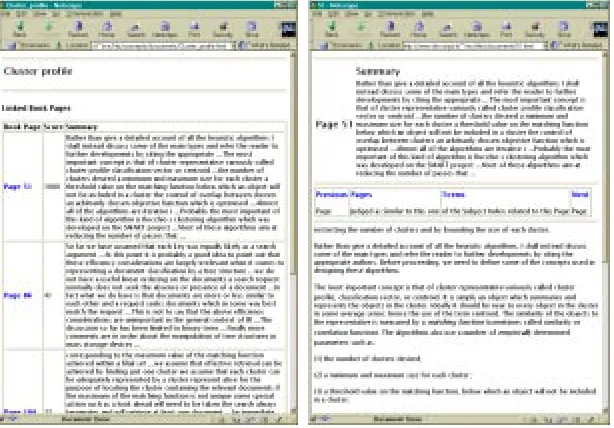
[image:4.432.55.364.377.568.2]Suppose the user chooses to see the list of pages relevant to the term. Figure 2.a reports the list of textbook pages ranked relevant to the term “cluster profile.” As this term was not associated to any pages by the au-thor, the list of linked pages was built using the pages linked to the term “cluster representative.” It is worth noticing that the top ranked page is one of those that was pointed out as relevant by the textbook author in the sub-ject index, but the following one, for example, was not. This means that the technique used to infer semantic links is able to preserve the author’s judge-ments of relevance, as well as to identify some additional relevant pages (Crestani & Melucci, 1998b). Links are ranked according to the norm-alised term weight within the textbook page.
[image:5.432.74.381.337.551.2]Figure 2.b contains page 51 of the textbook. The user arrived at that page just by clicking on the page number. The hyper-textbook displays, for each page, the page number, a summary, and the full text of the page. Both at the top and at the bottom of each page some buttons are located that link the current page to the next page, to the previous page, to terms describing the content of the page, and to similar pages. Links to the next and previous pages enable a linear reading of the textbook. Links to terms describing the content of the page or to similar pages enables a non-linear navigation of the hyper-textbook according to the EXPLICIT model.
Figure 3.a shows the list of similar pages linked to the current page. Links are ranked according to a normalised page similarity measure based on the distribution of terms in the pages.
The user can also see the terms that are similar to a selected term, as de-picted in Figure 3.b, which reports the list of terms similar to the term “cluster profile.” Links are ranked according to a normalised term similarity measure.
Figure 3. a) List of pages similar to page 51. b) List of terms similar to the term “cluster profile.”
EVALUATION DESIGN
[image:6.432.52.364.173.369.2]Research Hypothesis
We made the following experimental hypothesis: The hyper-textbook is a more effective tool for seeking information than the original printed form of the textbook.
The textbook chosen for the testing of the above hypothesis was Van Rijsbergen’s Information Retrieval (2nd edition), henceforth referred to as the textbook. The primary reason behind this choice can be ascribed to the fact that Van Rijsbergen, who owns the copyright of the book, granted us permission for its use for the evaluation reported in this article.
Evaluation Scenario
Once the research hypothesis has been established the discussion should turn to the basic design settings upon which the testing of the hy-pothesis will be carried out. In this case, the independent variable has two levels: the presence (hyper-textbook) or absence (printed textbook) of hy-pertext functionalities. Participants in the evaluation have to perform some tasks with and without the assistance of hypertext links and of hyper-text-book additional features. The dependent variable is the effectiveness of the participants in completing these tasks. The primary objective is to prove that any variation of the effectiveness between participants is attributed only to the change in the level of the independent variable, that is, to the ad-ditional functionalities enabled by the hyper-textbook.
Since the independent variable has two levels, the same number of groups of participants will be employed. One group will perform some tasks using the hyper-textbook, while the other group will perform the same tasks using the printed form of the textbook. In our case, due to restrictions on both time and resources, each group consisted of 10 participants, argu-ably, a number deemed adequate to produce significant experimental re-sults. The participants were postgraduate students doing a conversion course in Computer Science with little, or no, experience in the subject of the textbook.
The Experiment
Each participant was assigned to one of the two levels of the indepen-dent variable and was presented with seven questions. The same questions were given to all participants regardless of the group they belonged to. Questions were of two categories: open-ended and ended. The close-ended ones were supplemented by a list of four answers of which only one was correct. Questions included terms occurring in the subject index, and/or in the table of contents and or in paragraph titles. The answers to the ques-tions used in the experiments were given by the author of the textbook. This evaluation procedure is supposed to mimic a student using the book for some homework or examination. For more details about the experiment and the actual questions see Ntioudis (1998).
Unknown to the participants, some of the questions were designed to be well suited for answering using the conventional, printed textbook, while the rest exploited, partially or fully, the functionality of the hyper-textbook. The two groups of questions were of equal size.
After a short practice session, each participant had a time limit to an-swer each of the seven questions. Participants were allowed to type in “I don’t know” as an answer, at any time before the end of the specific time limit, if they felt that they could not find the answer. Apart from the partici-pants’ time for completing the assigned task, the experimenter took note of the steps taken by the participants to accomplish the task of answering each question. This was done to reveal participants’ strategies in completing the assigned task. At the end, each participant was asked to complete a ques-tionnaire, and after that, a brief discussion took place to gather comments on the experimental procedure.
EVALUATION
As stated previously, the dependent variable the authors wished to ex-amine through experimentation was the effectiveness of the users in the process of satisfying an information need by searching in a textbook. To achieve this goal, a set of criteria covering the aspects of the dependent variable had to be defined. These criteria were:
! the accuracy of the answers;
! the speed with which the search for the answers was completed; and
Apart from establishing the research hypothesis, the purpose of the set of criteria was to draw conclusions about the effectiveness of the hyper-textbook in the task of aiding a user satisfying an information need. Since the evaluation of the hytextbook is substantially user-centred, the per-formance of the users under such task-based environment can be an indica-tion of the effectiveness of the hyper-textbook.
Accuracy
The actual performance of the users in the task of satisfying an infor-mation need must be measured. In this case, an obvious way to do so was to take into account the “correct answers” found by the participants. However, since the questions were of two different types (open-ended and close-end-ed), issues of judging their correctness arise.
Assessing the correctness of the answers for close-ended questions is quite easy. On the other hand, assessing the correctness of open-ended questions is more complicated. Since open-ended questions do not have a predefined answer, the participant may give the answer which, according to his/her opinion, thinks is the correct one. Answering open-ended questions involves composition and is a more creative process than just selecting an answer from a list of predefined answers. Therefore, the task of assessing the correctness of such questions requires adopting a scoring method to ap-ply to each answer. A list of terms relevant to each open-ended question was developed. Copies of the answers were then given to an assessor who scored them “blindly’’ with the lists of terms. In this case, the success rate for each question was defined as the ratio (in %) of the number of terms contained both in the participant’s answer and in the list. In any case, no an-swer to a question or “I don’t know” was considered as a wrong anan-swer and the success rate in answering that question was set to 0%.
Speed
Subjective Opinion of the Participants
In both experimental groups, participants were asked to state their opinion about the difficulty in answering the questions. In the group using the hyper-textbook, participants were also asked to state their opinion about the difficulty of navigating in the hyper-textbook. The information was col-lected from the questionnaire that each participant completed. In both cases, difficulty was measured on a scale from 1 (Very easy) to 5 (Extremely diffi-cult). The questionnaire for the group using the hyper-textbook also con-tained a question referring to what the users found most difficult in using the hyper-textbook. Finally, two questions on whether the time to answer the questions was enough and on what would help participants answer questions in a more efficient way, were in every questionnaire. Although the opinions of the participants, as expressed in the final three questions and in the postexperimental discussion sessions, cannot be quantified, they can provide interesting and useful insights into the utilisation of the two differ-ent forms of the textbook.
RESULTS
For convenience, the group of participants assigned to work with the hyper-textbook will be referred to as group H, while the group of partici-pants that performed the experiment using the conventional, printed text-book will be known as group P.
ACCURACY
Table 1
Success Rate Values (in%) for Answering Questions
Type of questions Group H Group P
Close-ended questions 95 90
Open-ended questions 63.2 68.4
All participants from group H provided an answer to the open-ended questions while participants from group P failed to do so in two cases. By “failed to provide an answer” it is implied that no answer to a specific ques-tion was given or the participant typed in “I don’t know.” This means that, for the open-ended questions, group H answered (either correctly or not) 4% more questions than group P. Nevertheless, group P had a higher suc-cess rate than group H which means that answers from group H were not as complete and correct as answers from group P.
Speed
[image:11.432.72.380.438.490.2]Table 2 presents the average speed results. For close-ended questions, group P was marginally faster than group H, although this difference is not statistically significant. For open-ended questions, however, results were quite the opposite. The fastest group was group H with an average time of 279.9 sec. for answering each question, while group P had a average time of 311.9 sec. T-tests attributed these results to the change of level of the inde-pendent variable, with probability of error 0.05.
Table 2
Speed Results (in seconds) for Answering Questions
Type of questions Group H Group P
Close-ended questions 113.4 108.7
Open-ended questions 279.9 311.9
Subjective Opinion of the Participants
As far as time to answer is concerned, roughly 90% of the participants in both groups thought the time was enough (Table 3). Bearing in mind that participants were nonexperts in the field of Information Retrieval, the re-sults are indicative of the aid of the medium in answering the questions.
Table 3
Participants Opinion on Whether There was Enough Time to Answer the Questions
Was the time enough? Group H Group P
Yes 90 89
No 10 11
Table 4
Participant Opinion (in %) About the Difficulty of the Questions
Was the time enough? Group H Group P
1 (very easy) 10 9
2 2 0
3 70 80
4 18 11
5 (very difficult) 0 0
In addition, participants in group H were asked to rate navigation in the hyper-textbook on a scale from 1 (Very easy) to 5 (Extremely Difficult) when completing their questionnaires. The results depicted in Table 4 indicated that only 18% found it difficult. This means that most of the participants clear-ly understood EXPLICIT and the navigation of the hyper-textbook.
Participant Strategies
By selecting the link leading to similar pages, a list of similar pages was presented to the user. Only 10% of the participants examined all the pages in that screen. The first three pages with the higher scores were the ones examined by the majority of users. Participants using the printed form of the textbook adopted an obvious strategy: look for a specific term in the subject index unless the question explicitly identified the chapter where the answer could be found.
CONCLUSIONS AND FUTURE WORK
As expected, the results of our experimentation did not provide defini-tive indications over the refutation or approval of the research hypothesis under testing. The outcome of the analysis of the experimental data was that only in some of the experimental tasks the hyper-textbook was superior in matters of accuracy and speed. In a number of tasks, participants using the printed textbook performed better than participants using the hyper-text-book. The advantage of each form of the textbook over the other was, in most cases, marginal and in some cases not statistically significant.
In addition, the interpretation of the differences in effectiveness of some experimental conditions is problematic, to say the least. Why hyper-textbook users were slightly better in speed for open-ended questions and slightly better in accuracy for close-ended ones? What else can we gather from the subjective impressions of users, a part from the obvious? More evaluation work is definitely needed.
Nevertheless, despite its clear limitations, the evaluation enabled us to identify some ways of improving the usability and the effectiveness of the textbook. These directions pertain to both the re-design of the hyper-textbook and its re-evaluation, following a formative design evaluation ap-proach. In particular:
! the need for a better interface, reflecting in a better way the underlying model of the hyper-textbook (which was not understood by a small number of users), but maintaining the appearance of the printed text-book (so that users can locate quickly both the Subject Index and the Ta-ble of Content);
! the need for the integration of a global search function in the hyper-text-book, to enable users to locate a section in the book pertinent to an in-formation need without browsing (as requested by a number of IT mind-ed users); and
! the presence of unnecessary and confusing features that needed to be re-moved, for example, the page summary.
A new version of Hyper-Textbook taking these results into account has been produced and is available at http://www.cs.strath.ac.uk/~fabioc/htb/. Even though this version is currently being used successfully as a teaching tool, a new evaluation is currently under way to reassess the usability of the constructed hyper-textbooks and continue to improve it.
Another important line of research that we are pursuing and that origi-nated from the results of this study is related to the integration of “appear-ance” and “functionalities” in the authoring of hyper-textbooks. In the Vi-sual Book project (Landoni, 1997), Landoni explored the importance of the visual component of the book metaphor in the production of “good” elec-tronic books. The original aspect of the Visual Book project was the impor-tance given to the visual components of the physical book when designing electronic books together with the interpretation of an electronic book as part of an electronic library intended as an informative system with specific and innovative features. The Visual Book was studied within the context of an electronic library by following an original approach which has highlight-ed and exploithighlight-ed its relation with the real object it imitates. In particular a new aspect, which has not been exploited to date, is that of visual rhetoric which is important to the design of both paper and electronic books.
reading and browsing a document, as the findings of the Visual Book project have confirmed.
From the previous brief description of the Visual Book project, it is clear that the Visual Book and the Hyper-TextBook have lot of similarities when it comes to their approach to electronic publishing. They both take the readers as the centre of the whole system and pay particular attention to their real needs. Both systems are the result of a careful study on what sort of electronic publications can be of real use to a specific category of users (scientists for the Visual Book, students for the Hyper-TextBook) and what additional features may they require or take profit from in the electronic version. A difference between the two projects is that while the Visual Book concentrates on the presentation issues, by looking for new presenta-tion paradigms suitable for the electronic media in the attempt to improve the visual quality of the electronic version to be at least comparable with the paper one, the Hyper-TextBook focuses instead on providing additional features related to the electronic media in order to make the electronic ver-sion more flexible and powerful than the paper one.
It looks reasonable to expect that the Visual Book and the Hyper-Text-Book approaches together could result in an enhanced Visual Hyper-Text-Book. This could be achieved by providing the Hyper-TextBook with a vi-sual interface that will take advantage of the Vivi-sual Book experience and its positive findings. The Visual Hyper-TextBook will then offer a very rich environment to study further issues related to the production of electronic book. We are already working in this direction (Landoni, Crestani, & Me-lucci, 2000).
References
Agosti, M., Colotti, R., & Gradenigo, G. (1991). A two-level hypertext re-trieval model for legal data. In Proceedings of ACM SIGIR, pp. 316-325, Chicago, IL, USA.
Agosti, M., & Crestani, F. (1993). A methodology for the automatic con-struction of a hypertext for information retrieval. In Proceedings of the
ACM Symposium on Applied Computing, pp. 745-753, Indianapolis,
IN, USA.
Agosti, M., Crestani, F., & Melucci, M. (1995). Automatic authoring and construction of hypertext for Information Retrieval. ACM Multimedia Systems, 3(1), 15-24.
Agosti, M., Crestani, F., & Melucci, M. (1997). On the use of information retrieval techniques for the automatic construction of hypertexts.
Allan, J. (1997). Building hypertext using information retrieval. Informa-tion Processing and Management, 33(2), 145-159.
Crestani, F., & Melucci, M. (1998a). A case study of automatic authoring: from a textbook to a hyper-textbook. Data and Knowledge Engineer-ing, 27(1), 1-30.
Crestani, F., & Melucci, M. (1998b). A methodology for the enhancement of a hypertext version of a textbook by the automatic insertion of links in the subject index. In Proceedings of the IEEE ADL’98 Conference, (pp. 157-166), Santa Barbara, CA, USA.
Egan, D., Lesk, M., Ketchum, R., Lochbaum, C., Remde, J., Littman, M., & Landauer, T. (1991). Hypertext for the electronic library? CORE sam-ple results. In Proceedings of ACM Hypertext’91, (pp. 299-312), San Antonio, TX, USA.
Egan, D., Remde, J., Gomez, L., Landauer, T., Eberhardt, J., & Lochbaum, C. (1989). Formative design-evaluation of SuperBook. ACM Transac-tions on Information Systems, 7(1), 30-57.
Frisse, M. (1988). Searching for information in a medical handbook. Com-munications of the ACM, 31(7), 880-886.
Landoni, M. (1997). The visual book system: a study of the use of the visu-al rhetoric in the design of electronic books. Unpublished doctoral dis-sertation, Department of Information Science, University of Strathcly-de, Glasgow, Scotland, UK.
Landoni, M., Crestani, F., & Melucci, M. (2000). The visual book and the hyper-textbook: Two electronic books one lesson? In Proceedings of
the RIAO Conference, (pp. 247-265).
Leventhal, L., Mynatt Teasley, M., Instone, K., Schertler Roland, D., & Farhat, J. (1993). Sleuthing in HyperHolmes: An evaluation of using hypertext vs. a book to answer questions. Behaviour & Information Technology, 12(3), 149-164.
Mayes, T., Kibby, M., & Anderson, T. (1990). Learning about learning from hypertext. In Jonassen, D. & Mandl, H. (Eds.), Designing
hyper-media for learning, NATO ASI Series, (pp. 227-250). Heidelberg,
Ger-many: Springer-Verlag.
Ntioudis, S. (1998). User centred evaluation of an automatically
construct-ed hyper-textbook. Unpublished M.Sc. dissertation, Department of
Computing Science, University of Glasgow, Glasgow, Scotland. Smeaton, A., & Morrissey, P. (1995). Experiments on the automatic
con-struction of hypertext from text. Technical Report CA-0295, School of
Computer Application, Dublin, Ireland.
Tebbutt, J. (1999). User evaluation of automatically generated semantic hy-pertext links in a heavily used procedural manual. Information Pro-cessing and Management, 35(1), 1-18.
Van Rijsbergen, C.J. (1979). Information retrieval (2nd ed). London, UK: Butterworths.
Acknowledgements
The authors would like to thank a number of people: Keith van Rijsbergen for making available the textbook used in this experimentation, Massimo Melucci, Silvia Gabrielli, Monica Landoni, and Jane Reid for their useful suggestions on the evaluation methodology.