RESEARCH
Profiling and bioinformatics analyses
reveal differential circular RNA expression
in radioresistant esophageal cancer cells
Huafang Su
1†, Fuqiang Lin
2†, Xia Deng
1, Lanxiao Shen
1, Ya Fang
1, Zhenghua Fei
1, Lihao Zhao
1,
Xuebang Zhang
1, Huanle Pan
1, Deyao Xie
2, Xiance Jin
1*and Congying Xie
1*Abstract
Background: Acquired radioresistance during radiotherapy is considered as the most important reason for local tumor recurrence or treatment failure. Circular RNAs (circRNAs) have recently been identified as microRNA sponges and involve in various biological processes. The purpose of this study is to investigate the role of circRNAs in the radi-oresistance of esophageal cancer.
Methods: Total RNA was isolated from human parental cell line KYSE-150 and self-established radioresistant esopha-geal cancer cell line KYSE-150R, and hybridized to Arraystar Human circRNA Array. Quantitative real-time PCR was used to confirm the circRNA expression profiles obtained from the microarray data. Bioinformatic tools including gene ontology (GO) analysis, KEGG pathway analysis and network analysis were done for further assessment.
Results: Among the detected candidate 3752 circRNA genes, significant upregulation of 57 circRNAs and down-regulation of 17 circRNAs in human radioresistant esophageal cancer cell line KYSE-150R were observed compared with the parental cell line KYSE-150 (fold change ≥2.0 and P < 0.05). There were 9 out of these candidate circRNAs were validated by real-time PCR. GO analysis revealed that numerous target genes, including most microRNAs were involved in the biological processes. There were more than 400 target genes enrichment on Wnt signaling pathway. CircRNA_001059 and circRNA_000167 were the two largest nodes in circRNA/microRNA co-expression network.
Conclusions: Our study revealed a comprehensive expression and functional profile of differentially expressed circR-NAs in radioresistant esophageal cancer cells, indicating possible involvement of these dysregulated circRcircR-NAs in the development of radiation resistance.
Keywords: Radioresistance, Esophageal cancer, Circular RNA, Microarray
© 2016 The Author(s). This article is distributed under the terms of the Creative Commons Attribution 4.0 International License (http://creativecommons.org/licenses/by/4.0/), which permits unrestricted use, distribution, and reproduction in any medium, provided you give appropriate credit to the original author(s) and the source, provide a link to the Creative Commons license, and indicate if changes were made. The Creative Commons Public Domain Dedication waiver (http://creativecommons.org/ publicdomain/zero/1.0/) applies to the data made available in this article, unless otherwise stated.
Background
Esophageal cancer is the eighth most frequently diag-nosed and the sixth highest mortality rate cancer in the world [1]. The 5-year survival rate of esophageal can-cer patients with localized disease is less than 20 % [2]. Radiation therapy (RT) plays a crucial role in the treat-ment of esophageal cancer [3]. Although complex
multidisciplinary methods incorporating surgery, chem-otherapy, and radiotherapy had been applied in the treat-ment of esophageal cancer, the rate of local recurrence and distant metastasis remains high [4, 5]. Radiotherapy resistance has been considered as one of the most impor-tant reasons for local tumor recurrence or treatment fail-ure [6].
Circular RNAs (circRNAs), unlike the well known lin-ear RNA, forms a covalently closed continuous loop [7, 8]. CircRNAs are integral, conserved, and demon-strated to be resistant to RNase R treatment [9–11]. With the advent of novel biochemical and computa-tional approaches, circRNAs have been represented as
Open Access
*Correspondence: [email protected]; [email protected] †Huafang Su and Fuqiang Lin contributed equally to this work 1 Department of Radiotherapy and Chemotherapy, The First Affiliated Hospital of Wenzhou Medical University, No. 2 Fuxue Lane, Wenzhou 325000, China
a research hotspot in the RNA field [12]. Accumulating evidence demonstrated that circRNAs involve in the development of several types of diseases, such as Alzhei-mer’s disease [13], atherosclerotic vascular disease [14] and cancer [15, 16]. Recent studies found that circRNAs can function as microRNAs (miRNAs) sponges [17, 18], RNA-binding protein sequestering agents, and nuclear transcriptional regulators. The recently identified cir-cRNA, ciRS-7, which acts as a designated miR-7 sponge, involves in competing in endogenous RNA networks [19].
We previously developed a radioresistant esophageal squamous cancer cell line (KYSE-150R) by irradiating esophageal cancer cells KYSE-150 with gradient dose [20–22]. To explore the underlying molecular regulation mechansim of circRNAs in the radioresistance, circu-lar RNA microarray was used to detect the differential expressed circRNAs between radioresistant esophageal cell line KYSE-150R and the parental cell line KYSE-150. Our results suggested that the aberrant expression of circRNAs may play a role in transformation of radiation resistance of esophageal cancer cells.
Methods
Cell culture and reagents
Human esophageal squamous cancer cell lines KYSE-150 were purchased from the American Type Culture Collec-tion (Manassas, VA, USA). Radioresistant cell line KYSE-150R has been previously established in our department by gradient dose irradiation treatment. Both KYSE-150 and KYSE-150R were cultured in RPMI-1640 (Gibco, Life Technologies Inc., Grand Island, NY, USA) with 100 unit/ml of penicillin, 100 mg/ml of streptomycin, and 10 % fetal bovine serum at 37 °C in a humidified incuba-tor containing 5 % CO2. The cell lines were sub-cultured every 2–3 days following digestion at room temperature with 0.5 ml trypsin/EDTA per well (Sigma-Aldrich Ltd, UK).The viability was reported as the percentage of the viable cells number to the total cells number. There was an average viability over 95 %, determined by Trypan Blue staining.
RNA isolation, purification and hybridization
Three samples were collected from each of the two cell cultural groups and used for the following RNA extrac-tion. Total RNA from each sample was treated with Rnase R (Epicentre, Inc.) to remove linear RNAs and to enrich circRNAs. Then, the enriched circRNAs were amplified and transcribed into fluorescent cRNA utiliz-ing a random primutiliz-ing method (Arraystar Super RNA Labeling Kit; Arraystar). The labeled cRNAs were puri-fied by RNeasy Mini Kit (Qiagen). The concentration and specific activity of the labeled cRNAs (pmol Cy3/
μg cRNA) were measured by NanoDrop ND-1000. One μL of each labeled cRNA was fragmented by adding 5μL 10× Blocking Agent and 1 μL of 25× Fragmenta-tion Buffer, and then the mixture was heated at 60 °C for 30 min. Finally 25 μL 2× Hybridization buffer was added to dilute the labeled cRNA. Hybridization solution of 50 μL was dispensed into the gasket slide and assembled to the circRNA expression microarray slide. The slides were incubated for 17 h at 65 °C in an Agilent Hybridiza-tion Oven. The hybridized arrays were washed, fixed and scanned using the Agilent Scanner G2505C.
Microarray data analysis
Scanned images were imported into Agilent Feature Extraction software (version 11.0.1.1) for raw data extrac-tion. Quantile normalization of raw data and subsequent data processing were performed using the R software package. After quantile normalization of the raw data, low intensity filtering was performed. The circRNAs with at least 3 out of 6 samples flagged in “P” or “M” (“all targets value”) were retained for further analysis. When comparing the profile differences between two groups (such as disease versus control), the “fold change” (i.e. the ratio of the group averages) between the groups for each circRNA was computed. The statistical significance of the difference may be conveniently estimated by t test. Cir-cRNAs having fold changes ≥2 and P values <0.05 were selected as of significantly differential expression.
Real‑time PCR validation
Quantitative Real-time PCR was used to confirm the circRNA expression profiles obtained from the micro-array data. Total RNA was extracted from cells using Trizol Reagent (Invitrogen) and reversely transcribed into cDNA using Super Script TM III Reverse Tran-scriptase (Invitrogen) according to a standard proto-col. The relative gene expression was determined using ViiA 7 Real-time PCR System (Applied Biosystems). All samples were normalized to the signal generated from GAPDH (Sangon Biotech, Shanghai, China). Data was shown as fold change (2−ΔΔCt) and analyzed initially using Opticon Monitor Analysis Software V2.02 (MJ Research, Waltham, MA, USA). Triplicates were per-formed for each sample in three independent experi-ments. Primer sequences were presented in Additional file 1: Table S1.
MicroRNA prediction
comparisons were annotated in detail with the circRNA/ miRNA interaction information.
MicroRNA target genes prediction and GO analysis
To further investigate the functional roles of microRNA, putative targets of miRNAs were predicted by TargetS-can software. GO analysis was performed to explore the functional roles of target genes in terms of biologi-cal processes, cellular components and molecular func-tions. Biological pathways defined by Kyoto Encyclopedia of Genes and Genomes (KEGG), Biocarta and Reactome (http://www.genome.jp/kegg/) were identified by Data-base for Annotation, Visualization and Integrated Dis-covery (DAVID; http://www.david.abcc.ncifcrf.gov/). CircRNA‑microRNA co‑expression network
To further elucidate correlations between circRNAs and microRNA, potential microRNA-circRNA-mRNA inter-action analysis was conducted by Cytoscape. The size of each node represents the number of putative microRNA functionally connected to each circRNA.
Statistical analysis
The results were reported as mean ± SD for tripli-cate measurements. Statistically significant differences between groups were estimated by the Student’s t test using SPSS (13.0). P < 0.05 was considered as being statis-tically significant.
Result
Overview of circRNAs profiles
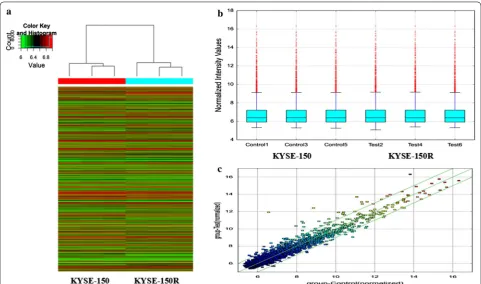
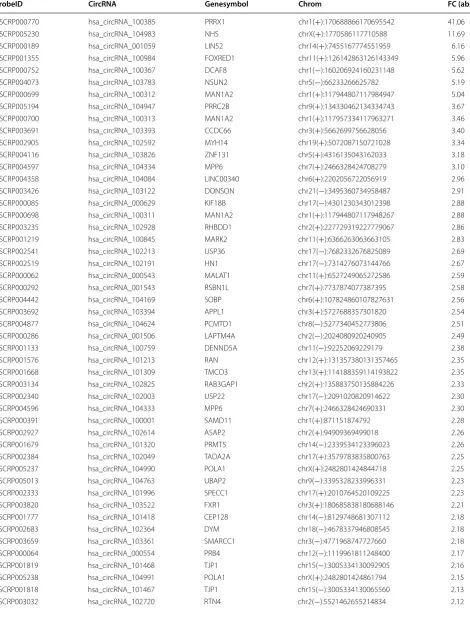
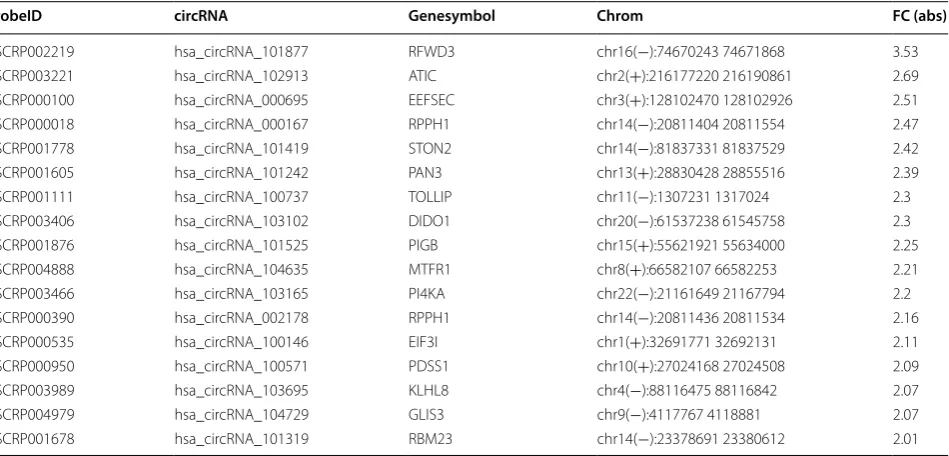
The expression of 3752 human circRNAs was quanti-tated for esophageal cancer KYSE-150R and KYSE-150 cell samples using microarray platform (Additional file 2: Table S2). Hierarchical clustering and scatter plot visuali-zation showed that the circRNAs expression levels were distinguishable and variations (Fig. 1). The expression profiles of 74 circRNAs were differentially expressed (fold change ≥2.0 and P < 0.05) between the KYSE-150R and KYSE-150 cells, in which 57 circRNAs were found to be upregulated and 17 circRNAs were downregulated more than two-fold in KYSE-150R cells (Tables 1, 2). Among these, The expression levels of circRNA_100385, cir-cRNA_104983 and circRNA_001059 were upregulated in KYSE-150R by 41.06, 11.68 and 6.16-folds, respectively. Meanwhile, circRNA_101877, circRNA_102913, and circRNA_000695 were downregulated by 3.53, 2.69 and 2.51-folds, respectively.
Real‑time quantitative PCR validation
To validate the microarray profiling expression data, real-time quantitative RT-PCR revealed 4 upregulated and 5 downregulated expressed circRNAs as shown in Fig. 2.
Expression levels detected by the two methods were con-sistent with each other, demonstrating the high reliability of the microarray expression results.
MicroRNA prediction and bioinformatics analyses
MicroRNA prediction was done with Arraystar’s home-made miRNA target prediction software based on miRanda (Table 3; Additional file 3: Table S3, Additional file 4: Table S4). There were 12 out of 17 downregulated circRNAs had target microRNAs. The results of Gene Ontology enrichment analysis on the up and down regu-lated circRNAs with identified target genes were shown in Fig. 3 and Additional file 5: Table S5. Gene Ontol-ogy analysis revealed that numerous target genes were involved in the biological processes, such as cellular pro-cess, regulation of biological propro-cess, metabolic propro-cess, etc. These processes were associated with human tumo-rigenesis and metastasis. KEGG analysis showed that there were 10 pathways related to upregulated circRNAs, including Olfactory transduction, Spliceosome, Gluta-matergic synapse, and Phosphatidylinositol signaling system, and 17 pathways related to downregulated cir-cRNAs, including Neurotrophin signaling pathway, Wnt signaling pathway, Microbial metabolism in diverse envi-ronments and Insulin signaling pathway (Fig. 4; Addi-tional file 6: Table S6). Especially, there were more than 400 target genes enrichment in Wnt signaling pathway.
CircRNA‑microRNA co‑expression network
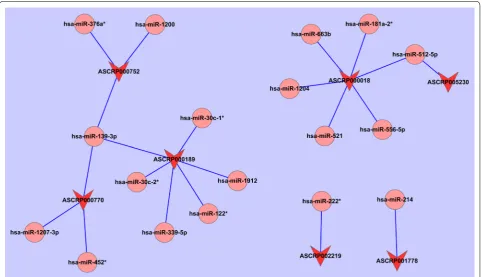
Potential connections between circRNA and microRNA were explored by using Cytoscape. As shown in Fig. 5, CircRNA_001059 and circRNA_000167 were the two largest nodes in the network.
Discussion
reported in several types of cancer [24, 25], there is no reported studies on the functional roles of circR-NAs in the radiation resistance of cancer. In this study, there were 57 circRNAs significantly upregulated and 17 circRNAs significantly downregulated in the KYSE-150R cell lines compared with KYSE-150, respectively. In which, circRNA_100385, circRNA_104983 and circRNA_001059 were upregulated with top magni-tudes. CircRNA_101877, circRNA_102913, and cir-cRNA_000695 were downregulated with top magnitudes. The expression pattern of these circRNAs were validated by qRT-PCR, and consistent results were observed. Our results indicated that the altered expression levels of cir-cRNAs may be related to their involvement in the tran-scription level regulation on the radiation resistance of esophageal cancer cells. Aberrant expression of circR-NAs has been linked to carcinogenesis and the malignant behavior of many different cancer. The abundance of a circRNA called hsa_circ_002059 has been reported to be significantly downregulated and suggested as a potential diagnostic marker for gastric cancer [26]. Qin M et al. [27] found that hsa_circ_0001649 may play a role in tum-origenesis and metastasis of hepatocellular carcinoma.
Li et al. [28] reported that cir-ITCH might influence the expression level of ITCH and may be involved in the development of esophageal squamous cell carcinoma. However, no obvious changes of cir-ITCH was observed in this study, suggesting it may have no contribution to the radioresistance of esophageal cancer cells.
Despite the lack of knowledge of the exact functions of most circRNAs, we investigated the potential targets of these altered miRNAs. In a total, 57 upregulated circR-NAs were identified to regulate the expression level of 120 microRNAs using the miRanda software, and 12 down-regulated circRNAs were identified to regulate 36 micro-RNAs. According to the findings of Denzler et al. [29] low levels of circRNAs may not be sufficient to affect the target miRNAs. The circRNA-microRNA co-expression network analysis were conducted for our Top-5 circR-NAs in this study. Two potential crucial circRcircR-NAs, cir-cRNA_001059 and circRNA_000167 were identified to be influential on target miRNAs. CircRNAs were believed to negatively regulate miRNAs, and contribute substantially to the competing endogenous RNA (ceRNA) network. It has been reported that ciRS-7, as a circular miR-7 inhibi-tor, harbors more than 60 conventional miR-7 binding
[image:4.595.57.539.87.371.2]Table 1 Upregulated circRNAs in the KYSE-150R compared with KYSE-150
ProbeID CircRNA Genesymbol Chrom FC (abs)
[image:5.595.62.533.105.724.2]sites, which is far more than any known linear sponges [30]. Sex-determining region Y (SRY) was another identi-fied miRNA sponge and functioned as a miR-138 sponge [31]. According to our results, we hypothesized that cir-cRNA_001059 may act as an inhibitor of miRNA by binding several specific miRNAs, including miR-30c-1*, 30c-2*, 122*, 139-3p, 339-5p and miR-1912. Our results implied that it is worthwhile to further investigate these novel dysregulated circRNAs as micro-RNA sponges and their potential biological functions in the development of radiation resistance.
In this study, GO analysis and KEGG pathway annota-tion were conducted to investigate the funcannota-tions of related microRNAs [32]. GO enrichment analysis revealed that target genes were involved in the regulation of crucial Table 1 continued
ProbeID CircRNA Genesymbol Chrom FC (abs)
ASCRP000314 hsa_circRNA_001676 PPP1R12A chr12(−):8018015380183460 2.11 ASCRP003844 hsa_circRNA_103546 LPP chr3(+):188202379188242575 2.09 ASCRP001842 hsa_circRNA_101491 MAPKBP1 chr15(+):4210308042105299 2.09 ASCRP002653 hsa_circRNA_102334 SS18 chr18(−):2361236223637706 2.07 ASCRP003119 hsa_circRNA_102810 RALB chr2(+):121036193121047333 2.06 ASCRP002883 hsa_circRNA_102570 ERCC2 chr19(−):4586052745860957 2.05 ASCRP004893 hsa_circRNA_104640 CSPP1 chr8(+):6801813968028357 2.04 ASCRP003216 hsa_circRNA_102908 BARD1 chr2(−):215632205215646233 2.01
Table 2 Downregulated circRNAs in the KYSE-150R compared with KYSE-150
probeID circRNA Genesymbol Chrom FC (abs)
ASCRP002219 hsa_circRNA_101877 RFWD3 chr16(−):74670243 74671868 3.53 ASCRP003221 hsa_circRNA_102913 ATIC chr2(+):216177220 216190861 2.69 ASCRP000100 hsa_circRNA_000695 EEFSEC chr3(+):128102470 128102926 2.51 ASCRP000018 hsa_circRNA_000167 RPPH1 chr14(−):20811404 20811554 2.47 ASCRP001778 hsa_circRNA_101419 STON2 chr14(−):81837331 81837529 2.42 ASCRP001605 hsa_circRNA_101242 PAN3 chr13(+):28830428 28855516 2.39 ASCRP001111 hsa_circRNA_100737 TOLLIP chr11(−):1307231 1317024 2.3 ASCRP003406 hsa_circRNA_103102 DIDO1 chr20(−):61537238 61545758 2.3 ASCRP001876 hsa_circRNA_101525 PIGB chr15(+):55621921 55634000 2.25 ASCRP004888 hsa_circRNA_104635 MTFR1 chr8(+):66582107 66582253 2.21 ASCRP003466 hsa_circRNA_103165 PI4KA chr22(−):21161649 21167794 2.2 ASCRP000390 hsa_circRNA_002178 RPPH1 chr14(−):20811436 20811534 2.16 ASCRP000535 hsa_circRNA_100146 EIF3I chr1(+):32691771 32692131 2.11 ASCRP000950 hsa_circRNA_100571 PDSS1 chr10(+):27024168 27024508 2.09 ASCRP003989 hsa_circRNA_103695 KLHL8 chr4(−):88116475 88116842 2.07 ASCRP004979 hsa_circRNA_104729 GLIS3 chr9(−):4117767 4118881 2.07 ASCRP001678 hsa_circRNA_101319 RBM23 chr14(−):23378691 23380612 2.01
[image:6.595.55.540.99.217.2] [image:6.595.64.539.251.479.2] [image:6.595.57.292.513.647.2]biological processes, indicating that regulating these genes in the cellular response is of great importance during the development of radioresistance. Among the upregulated pathways found in this study, phosphatidylinositol sign-aling pathway had been reported to be a key mediator of tumor cell responsiveness to radiation [33]. Phosphati-dylinositol 3-kinase (PI3K)/Akt pathway accelerates the repair of DNA-DSB (DNA double-strand breaks), and consequently, its activation leads to therapy resistance [33]. Wnt signaling pathway which corresponds to down-regulated circRNAs had also been reported to play pre-dominant roles in radioresistance in Glioblastoma [34] and
prostate cancer [35]. These results were also in line with the observations reported in our previous study [21]. Conclusions
In a conclusion, a unique set of circRNAs and their expression profiles were found in radioresistant esopha-geal cancer cells. Furthermore, their potential roles were investigated by bioinformatics analysis. Pathway analysis suggested that Wnt signaling pathway may be involved in the radioresistance. Network analysis uncovered two potential key circRNAs, i.e. circRNA_001059 and cir-cRNA_000167. Our results would be helpful for future Table 3 Target gene numbers of circRNA-miRNA
CircRNA MiRNA MiRNA::circRNA MiRNA::circRNA target_loca‑
tion MiRNA::target
Up 57 120 120::53 120::149 120::40335
Down 12 36 36::12 36::12 36::38979
[image:7.595.59.536.102.157.2] [image:7.595.56.541.151.508.2]Fig. 5 CircRNA-microRNA co-expression network. The circRNA-microRNA co-expression network as drawn with the cytoscape software. The size of each node represent functional connectivity of each circRNA. CircRNA_001059 and circRNA_000167 were the two largest nodes in the network
[image:8.595.56.542.88.345.2] [image:8.595.58.541.400.677.2]studies on investigating the molecular functions of circR-NAs in radiotherapy resistance.
Authors’ contributions
CX, XJ contributed experimental design; HS, FL,LS, XZ and YF performed the biological experiments; CX and XJ provided administrative support and funded experiments; HS, ZF, XZ,XD,DX and HP analysis of data; HS, XJ and CX drafted the manuscript. All the authors read and approved the final manuscript.
Author details
1 Department of Radiotherapy and Chemotherapy, The First Affiliated Hospital of Wenzhou Medical University, No. 2 Fuxue Lane, Wenzhou 325000, China. 2 Department of Thoracic Surgery, The First Affiliated Hospital of Wenzhou Medical University, Wenzhou 325000, China.
Acknowledgements
The study was supported by the Natural Science Foundation of Zhejiang Province (Nos. LY13H160036; LQ15H160013) and Wenzhou Municipal Science and Technology Bureau (No. Y20130180).
Competing interests
The authors declare that they have no competing of interests.
Received: 31 March 2016 Accepted: 13 July 2016
References
1. Conteduca V, Sansonno D, Ingravallo G, Marangi S, Russi S, Lauletta G, Dammacco F. Barrett’s esophagus and esophageal cancer: an overview. Int J Oncol. 2012;41(2):414–24.
2. Zhang Y. Epidemiology of esophageal cancer. World J Gastroenterol. 2013;19(34):5598–606.
3. Cellini F, Valentini V. Targeted therapies in combination with radiotherapy in oesophageal and gastroesophageal carcinoma. Curr Med Chem. 2014;21(8):990–1004.
4. Sjoquist KM, Burmeister BH, Smithers BM, Zalcberg JR, Simes RJ, Barbour A, Gebski V. Survival after neoadjuvant chemotherapy or chemoradio-therapy for resectable oesophageal carcinoma: an updated meta-analy-sis. Lancet Oncol. 2011;12(7):681–92.
5. van Hagen P, Hulshof MC, van Lanschot JJ, Steyerberg EW, van Berge Henegouwen MI, Wijnhoven BP, Richel DJ, Nieuwenhuijzen GA, Hospers GA, Bonenkamp JJ, Cuesta MA, Blaisse RJ, et al. Preoperative chemoradiotherapy for esophageal or junctional cancer. N Engl J Med. 2012;366(22):2074–84.
6. Ding M, Zhang E, He R, Wang X. Newly developed strategies for improv-ing sensitivity to radiation by targetimprov-ing signal pathways in cancer therapy. Cancer Sci. 2013;104(11):1401–10.
7. Qu S, Yang X, Li X, Wang J, Gao Y, Shang R, Sun W, Dou K, Li H. Circular RNA: a new star of noncoding RNAs. Cancer Lett. 2015;365(2):141–8. 8. Conn SJ, Pillman KA, Toubia J, Conn VM, Salmanidis M,
Phil-lips CA, Roslan S, Schreiber AW, Gregory PA, Goodall GJ. The RNA Additional files
Additional file 1: Table S1. circRNAs gene primers in the study for Q-PCR.
Additional file 2: Table S2. circRNA expression profiling data. Additional file 3: Table S3. circRNA_miRNA_pair.
Additional file 4: Table S4. circRNA_miRNA_target genes. Additional file 5: Table S5. circRNA_miRNA.target gene.GO. Additional file 6: Table S6. circRNA_miRNA_target gene.pathways.
binding protein quaking regulates formation of circRNAs. Cell. 2015;160(6):1125–34.
9. Salzman J, Chen RE, Olsen MN, Wang PL, Brown PO. Cell-type specific features of circular RNA expression. PLoS Genet. 2013;9(9):e1003777. 10. Rybak-Wolf A, Stottmeister C, Glažar P, Jens M, Pino N, Giusti S,
Hanan M, Behm M, Bartok O, Ashwal-Fluss R, Herzog M, Schreyer L, Papavasileiou P, et al. Circular RNAs in the mammalian brain are highly abundant, conserved, and dynamically expressed. Mol Cell. 2015;58(5):870–85.
11. Szabo L, Morey R, Palpant NJ, Wang PL, Afari N, Jiang C, Parast MM, Murry CE, Laurent LC, Salzman J. Statistically based splicing detection reveals neural enrichment and tissue-specific induction of circular RNA during human fetal development. Genome Biol. 2015;16:126.
12. Chen LL, Yang L. Regulation of circRNA biogenesis. RNA Biol. 2015;12(4):381–8.
13. Lukiw WJ. Circular RNA (circRNA) in Alzheimer’s disease (AD. Front Genet. 2013;4:307.
14. Burd CE, Jeck WR, Liu Y, Sanoff HK, Wang Z, Sharpless NE. Expression of lin-ear and novel circular forms of an INK4/ARF-associated non-coding RNA correlates with atherosclerosis risk. PLoS Genet. 2010;6(12):e1001233. 15. Guo LL, Song CH, Wang P, Dai LP, Zhang JY, Wang KJ. Competing
endogenous RNA networks and gastric cancer. World J Gastroenterol. 2015;21(41):11680–7.
16. Li Y, Zheng Q, Bao C, Li S, Guo W, Zhao J, Chen D, Gu J, He X, Huang S. Circular RNA is enriched and stable in exosomes: a promising biomarker for cancer diagnosis. Cell Res. 2015;25(8):981–4.
17. Hansen TB, Jensen TI, Clausen BH, Bramsen JB, Finsen B, Damgaard CK, Kjems J. Natural RNA circles function as efficient microRNA sponges. Nature. 2013;495(7441):384–8.
18. Ebbesen KK, Kjems J, Hansen TB. Circular RNAs: identification, biogenesis and function. Biochim Biophys Acta. 2016;1859(1):163–8.
19. Hansen TB, Kjems J, Damgaard CK. Circular RNA and miR-7 in cancer. Cancer Res. 2013;73(18):5609–12.
20. Su H, Jin X, Zhang X, Xue S, Deng X, Shen L, Fang Y, Xie C. Identification of microRNAs involved in the radioresistance of esophageal cancer cells. Cell Biol Int. 2014;38(3):318–25.
21. Su H, Jin X, Zhang X, Zhao L, Lin B, Li L, Fei Z, Shen L, Fang Y. Pan H10, Xie C. FH535 increases the radiosensitivity and reverses epithelial-to-mesen-chymal transition of radioresistant esophageal cancer cell line KYSE-150R. J Transl Med. 2015;13:104.
22. Su H, Jin X, Shen L, Fang Y, Fei Z, Zhang X, Xie C, Chen X. Inhibition of cyclin D1 enhances sensitivity to radiotherapy and reverses epithelial to mesenchymal transition for esophageal cancer cells. Tumour Biol. 2015. doi:10.1007/s13277-015-4393-z.
23. Ivanov A, Memczak S, Wyler E, Torti F, Porath HT, Orejuela MR, Piechotta M, Levanon EY, Landthaler M, Dieterich C, Rajewsky N. Analysis of intron sequences reveals hallmarks of circular RNA biogenesis in animals. Cell Rep. 2015;10(2):170–7.
24. Bachmayr-Heyda A, Reiner AT, Auer K, Sukhbaatar N, Aust S, Bachleitner-Hofmann T, Mesteri I, Grunt TW, Zeillinger R, Pils D. Correlation of circular RNA abundance with proliferation—exemplified with colorectal and ovarian cancer, idiopathic lung fibrosis, and normal human tissues. Sci Rep. 2015;5:8057.
25. Qu S, Song W, Yang X, Wang J, Zhang R, Zhang Z, Zhang H, Li H. Microar-ray expression profile of circular RNAs in human pancreatic ductal adenocarcinoma. Genom Data. 2015;5:385–7.
26. Li P, Chen S, Chen H, Mo X, Li T, Shao Y, Xiao B, Guo J. Using circular RNA as a novel type of biomarker in the screening of gastric cancer. Clin Chim Acta. 2015;444:132–6.
27. Qin M, Liu G, Huo X, Tao X, Sun X, Ge Z, Yang J, Fan J, Liu L, Qin W. Hsa_circ_0001649: a circular RNA and potential novel biomarker for hepatocellular carcinoma. Cancer Biomark. 2016;16(1):161–9.
28. Li F, Zhang L, Li W, Deng J, Zheng J, An M, Lu J, Zhou Y. Circular RNA ITCH has inhibitory effect on ESCC by suppressing the Wnt/β-catenin pathway. Oncotarget. 2015;6(8):6001–13.
29. Denzler R, Agarwal V, Stefano J, Bartel DP, Stoffel M. Assessing the ceRNA hypothesis with quantitative measurements of miRNA and target abun-dance. Mol Cell. 2014;54(5):766–76.
• We accept pre-submission inquiries
• Our selector tool helps you to find the most relevant journal • We provide round the clock customer support
• Convenient online submission • Thorough peer review
• Inclusion in PubMed and all major indexing services • Maximum visibility for your research
Submit your manuscript at www.biomedcentral.com/submit
Submit your next manuscript to BioMed Central
and we will help you at every step:
31. Li J, Yang J, Zhou P, Le Y, Zhou C, Wang S, Xu D, Lin HK, Gong Z. Circular RNAs in cancer: novel insights into origins, properties, functions and implications. Am J Cancer Res. 2015;5(2):472–80.
32. Gusev Y. Computational methods for analysis of cellular functions and pathways collectively targeted by differentially expressed microRNA. Methods. 2008;44(1):61–72.
33. Toulany M, Rodemann HP. Phosphatidylinositol 3-kinase/Akt signaling as a key mediator of tumor cell responsiveness to radiation. Semin Cancer Biol. 2015;35:180–90.
34. Kim Y, Kim KH, Lee J, Lee YA, Kim M, Lee SJ, Park K, Yang H, Jin J, Joo KM, Lee J, Nam DH. Wnt activation is implicated in glioblastoma radioresist-ance. Lab Invest. 2012;92(3):466–73.