Rochester Institute of Technology
RIT Scholar Works
Theses
Thesis/Dissertation Collections
2001
Transmutation of obect
Jiyong Lee
Follow this and additional works at:
http://scholarworks.rit.edu/theses
This Thesis is brought to you for free and open access by the Thesis/Dissertation Collections at RIT Scholar Works. It has been accepted for inclusion
in Theses by an authorized administrator of RIT Scholar Works. For more information, please contact
.
Recommended Citation
ROCHESTER INSTITUTE
OF TECHNOLOGY
TRANSMUTATION
OF OBJECT
A
Thesis
submittedto the
faculty
ofThe
College
ofImaging
Arts
andSciences
in
Candidacy
for the Degree
ofMASTER
OF FINE ART
By
Jiyong
Lee
Rochester,
New York
APPROVALS
Adviser: Michael Taylor
Date:
'7. •
~
1.\ -
Loo,
Associate Adviser: Robin Cass
Date:
1!q
I'
0
I
I (
Associate Adviser: Julia Galloway
Date:
3/1/0
I
r )
Chairman for the
School of American Craft: Rich Tannen
Date:
:lIt
'1/
(JI ,
I, Jiyong Lee hereby grant permission to the Wallace Memorial Library of RIT
to reproduce my thesis in whole or in part. Any reproduction will not be for
commercial use or profit.
SIGNATURE
TABLE
OF
CONTENTS
LIST OF
ILLUSTRATIONS
ii
INTRODUCTION
1
ARTISTIC INFULUENCE
3
DISCUSSION OF THE
SCULPTURES
7
CONCLUSION
17
TECHNICAL INFORMATION
18
The
process usedfor Hollow
core-casting
The
process usedfor
Bullseye
frit
sand-moldfusing
LIST
OF
ILLUSTRATIONS
Figure
Page
1.
Tony Cragg, Bestuckung,
1987/1988
5
2.
Howard
Ben
Ire,
8thfigure,
1988
6
3. Meditation
onGlass
I,
2000
8
4. Meditation
onGlassU,
2000
9
5. Meditation
onGlassJU,
2000
10
6. Meditation
onObject,
2000
12
7.
Memory
onObject
1
,2000
14
INTRODUCTION
This
thesis is the
result of yearsstudying
art anddesign. I
felt
fortunate
to
be introduced
to
glassduring
the
pasttwo
years.I
spent most ofthe
first
year
developing
ideas,
exploring
process andavoiding functional
and pragmaticissues.
Those
areimportant
elementsfor
designing
an objectbut
thinking
about
my
own unique approach was moreimportant.
The
other goal ofthe
first
year was
gaining
experience with glass as a new material.Before I
startedmy
secondyear, I
recognized conceptsthat
had
been
recurring
in
my
worksfor
the
pastfew
years.I
found
aninseparable
relationship
with vessels not ashistorical
objects nor as artistic onesbut
asdaily
objects,
which arefunctional
and artistic enoughfor everyday
enjoyment.Vessels
aredaily
objectsthat
have
along history
that
is
parallel withhuman
history.
They
have
avariety
of values.Some
ofthem
areunimaginably
fascinating
and some arevery
ordinary.Even though
mostvessels,
like plates,
cups,
vases and glassesin
ourhomes
are not valuable ashistorical
antiques orfamous
design
brands, they
areimportant in
ourlives. To
me,
reviewing
these
objects
is
thinking
back
through
my life
andstudying human history.
As
a sculptor who was a ceramic productdesigner
andpotter,
I
wantedto
attempted
to visually
display
my
meditativethoughts
throughthese
sculpturesthat
aretransposing
existence.Through
this
methodI
could considerthe
concept more.
Most
ofthe
objectsI
have
usedin
my
exhibition wereordinary
totally
touchable
things
but
by
transposing
their
existencesthey
became
ARTISTIC
INFLUENCES
Since
I
startedstudying
ceramicsdesign
as an undergraduateI
wentto
museums
to look
atthe
great ancient works.Fortunately
I
lived
in
Korea
whichhas
excellenthistoric
collections ofceramics,
I
alsohad
great opportunitiescould visit
China
andJapan to
see each countries ceramics.I
remember alwaysstopping
in
front
of utilitarian ceramics or other craftsthat
werehundreds
years old.
Those
beautiful functional
objects alwaysfascinated
me.I thought
one of
the
reasonsthe
objectsbecame
morefascinating
wasbecause
the
display
kept
usfrom
touching
them.
If
some ofthe
objectsin
museums werejust
setin
ourhouse,
they
could pass as an unnoticed objectin
daily
life.
But
when
they
arebrought
into
museum and placedin
a glassbox,
they
become
precious property.
I
found
British
artistTony
Cragg's
workto
be
the
mostinfluential. I
had
achance
to
viewhis
workin
an exhibitionin
Korea
eight yearsago,
and wasoverwhelmed
by
the
sense of associationbetween
motif andlife. Cragg's
works,
particularly
liquid
containers such asthe
massproduced,
molded plastic narrownecked,
screwtop
bottles
(Figure
1)
have
formed
the
basis
ofhis
work.His
created objects was
described
as"the
mortar andpestle,
carry strong
historical
and cultural associations: as
tools, they
areidentified
withlearning
andhealing,
both
ancient and modern.The
varioustypes
ofchemists'
beakers
carry
otherdistinct
sets of associations-both about scientificanalysis,
testing
andmeasuring
onthe
onehand;
and aboutpower,
manipulation and control onthe
other."1
Howard
Ben Tre's
work provedto
be
anotherstrong
influence
onmy
work.In the
late
eighties,
he
returnedto the idea
of glass as a vessel or containersuch as 8th
Figure
(figure
2).
Those
vessel shape works aredescribed
aschanging "the meaning
ofordinary
objects-vases andbeakers-by drastically
changing
their
scale and context.Like
the
Columns,
the
Bottles
are notfunctional,
yetthey
seemlike
they
shouldbe.
Playing
withirony
andparadox,
Ben Tre
makesbottles
that
cannothold
things
because
there is
no accessto
the opening
or passages onthe
inside
andthey
do
not connect."2Cragg's
andBen Tre's
works areimportant to
mebecause
they
showed mehow
a simpleeveryday
object canbe
transformed to
a powerful sculpture.Their
work alsohelped
me observe andthink
aboutthe
visual aspectsthat
arepart of
everyday
life.
1
Debbaut,
Jan.
Stedelijk
Van
Abbemuseum.
Tonv
Craaa.
Eindhoven:
Van
Abbemuseum,
1991.
2DISCUSSION
OF THE
SCULPTURES
During
most of ourlife,
wedo
not appreciate what wehave. Some
ofthe
things
wehave
are pricelesslike
air,
water orfreedom.
Besides these things
there
are alsomany
pricelessthings
around usthat
wedo
notthink
about.Many
poets wrote poems on unnamed wildflowersin
mountain pathways.If
wedo
not seethem
or cannotfind
beauty
in the
flowers
they
may
meannothing
to
us.If
somebody brings
those
trifling
wildflowers
to
abotanical
garden,
wewill
look
atthem
more carefully.The theme
ofmy
work concernsthe reviewing
of our
lives
through
metamorphosis of an object.The
forms
arevery
familiar
shapes we
find
all around us.My
sculptural works are about vesselsin
everyday
life.
They
are notonly
aboutthe
vesselsbut
also about sub-consciousattitudes
in
ourdaily
lives.
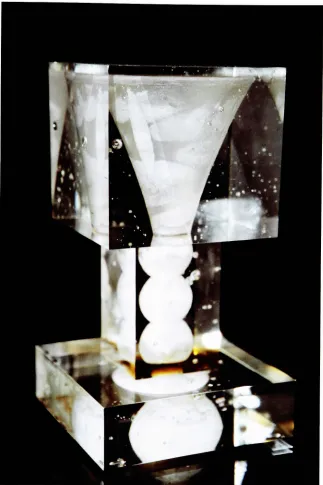
The Meditation
onGlass
I,H,ffl
(figure
3,4,5)
containthe
mostdirect
and
literal
representation of metamorphosis of glass objects.Each
workis
formed
by
stacking
clear glassblocks
withhollow forms
in the
middle.Each
interior form
ofthe
blocks
is
comprised ofthree
parts whichform
the
cup,
stem and
foot.
All
togetherthey
are viewed as gobletsin
glassboxes.
The
Figure 5.
Meditation onGlass in
structures of glass.
They
aredeveloped
withthe
positiveform
aroundthe
vesselshape.
By
metamorphosis of anobject, I
attemptto
direct
the
viewerto
thinkabout what
they
arelooking
at once more.Wineglasses are,
light
weight,
paper
thin
andbeautifully
shapedbut
ignored.
We
are surroundedby
them
and never notice
their
beauty.
The
casting
seriesThe Meditation
onGlass
1,11,
M
canbe
thought
as glass gobletsin
a glassdisplay
casein
museum.They
can
be
seen as objectsinside
but
they
are notreally there. Therefore
we muststart
thinking
aboutthe
objectsbecause
they
are untouchable.Meditation
onObject
(figure
6)
addresses a similartheme.
It is
a greenishglass
bottle
aboutforty-two
inches
high
and sixteeninches
diameter
withrippling
opticalillusion
texture.It is
built
with morethan
onethousand
piecesof quarter
inch thick
plate glass one-inchlong. The
sculptureis
laminated
withUV
glue pieceby
piecefrom the bottom to the top.
Meditation
onObject is the
antithesis of aneveryday bottle. The
opticalillusion
prevents onefrom
seeing
inside
ofthe
bottle.
There
are afew
peepholes
that
mustbe
located
to
seeinside
the
bottle.
The
peepholesreference
the
transparency
that
abottle
usually
has.
Each
piecehas
fairly
sharp edges,
enoughto
cut someone whenthey
touch.
The
shapelooks
like
anenlarged
liquor bottle. The sharp
edges presentlifting
ortouching
it.
From
mass produced
to hand
built
with athousand pieces,
from
convenient sizeto
gigantic
size,
from
smooth surfaceto jagged
and sharp.The
idea is
also aboutFigure 6. Meditation
onObject
rethinking
our attitudethrough
creating
a situation whichis
beyond
reallife.
When
confronted withthese
sculpturesfor
the
first
time
wehave
a moment ofreflection and
think
about an objectwehave been
using for decades.
Memory
onObject
I
(figure
7)
consists of a wooden structuresurrounding
glass
box containing
a vessel.The
black
woodenbox has
a negative spacewhich reveals
the
vesselinside. Through
a slightgap, the
viewer can observethe interior
ofthe box.
The
vesselis
submergedin the
water whichis
full
ofrising
airbubbles. The
sides ofthe
glass container arelined
with goldleaf.
This
sculpture contains morethought
about pasthistory. The black box
implies
prosaic realities oflife but
in
contrastthe
bright
inner
gold room standsfor
pastbeautiful
memories.The
vessel shapegap
symbolizesthe
pathinto the
gold room
in
other words our memories.To
createtime
andthe
pastI
chosewater.
To
me a water streamimplies the
passage oftime. To
imply
flowing
water, I
usedrising
airbubbles
in the
waterto
imply
that
the inside
vesselappears
to
be drowning. The
drowning
vesselis vanishing
from
our memory.Memory
onObject U
(figure
8)
attemptsto
create a moment.The idea
is
to
give morefreedom
to
the
viewer'simaginative
meditation.This
sculpturefocuses
onviewers'
interpretation
more thanthe
objectitself.
It
is
a wallinstallation
sculpture madeup
of nine cylinders.Each
cylinderis
fourteen
inches
high,
five
inches in
diameter,
and containsdifferent
objects such aswineglass,
winebottle,
Coca-Cola
bottle,
baby
food
jars,
liquor
bottle,
martiniglass,
tumbler,
syringes andlight
bulbs. The
cylinders arefilled
withdifferent
Figure 7
.Memory
onObject
I
color
liquids.
I tried to
create various aspects oflife
withthe
content ofthe
cylinders.The
baby
food
jars
represent astarting
pointfrom early
childhood.Wineglass
and wine
bottle carry
cultural changes oftimes,
from
a symbol ofhigh society
culture
to
one of middle class culture.Coca-Cola
bottle
carries ideologicalaspect,
as a symbol ofliberalism
to
communist countries.It is
a symbol ofAmerica to
anti-Americanism countries.Syringes,
astools,
areidentified
withhealing
anddrug
abuse.Light
bulbs
imply
the
new era of science and modernlife
withinvention
of electricity.Liquor
bottle
and martini glassimply
anintoxicated
life
and canbe
seen asmorally
andphysically
abusing alcohol,
andsocial or personal corruption.
At
last
a tumblerleads
usto
back
to ordinary
day
to
day
existence.The
objects are collected as remembrancersin
life
are meantto
evolvethe
viewer's memory.Figure 8.
Memory
onObject U
CONCLUSION
My
intention
is
to
create workthat
remindsthe
viewer of a moreintrospective
life.
Society
is
preoccupied with mundaneissues,
and people arelosing
anunderstanding
ofbeauty,
ofsimplicity,
oftheir
pasthistory.
Many
people
think
the
pasttoo
sentimental.Society
is
preoccupied with a searchfor
the
new.I
feel
that
not enough respectis
givento
history
andits
contributionto
the
present.My
workis
about anhomage
to the interaction
of past andpresent.
Studying history
is
notonly
a subjectin
school.It is
here,
all aroundour
lives. As I
madethis
series ofwork, I
consideredhow
important the
pastis
and
how
muchit
canbe
transmitted through the
objects weinteract
withdaily.
TECHNICAL
INFORMATION
The
process usedfor
Hollow
core-casting
To
form
the
hollow
shapesinside
ofMeditation
onGlass
I,
n,M(
figure
3,4,5)
I
made coreforms
with50%
ofmolding
plaster,
50%
of silica(325mesh)
using
a metal platetemplate
andturning
box. I
used10mm Pyrex rods,
which
have
ahigher
melting temperature than
Sprucepine batch. The
rodshelped form
a core sothe
shape can withstandthe
firing
temperature.
The
molds are made oftwo layers. Each
layer
is
about oneinch thick. For
the
inside
layer,
I
usedthe
same mold material asthe
form
core(50%
ofmolding
plaster and50%
ofsilica)
but for
the
outsideI
mixed40%
ofmolding
plaster, 40%
of silica and20 %
ofMizzou Castable. Mizzou
Castable
is
very
strong refractory
based
material which canbe
mixed with plaster and silica.It
has
workedsuccessfully in many
experimentsbut
it
is
expensive.For
smallermolds, Mizzou Castable
is
not requiredtherefore
I
used45%
ofmolding plaster,
45%
of silica and10%
of medium size grog.Mizzou Castable
andgrog
mustbe
kept
from contacting the
surface ofthe
glassbecause
the
coarser grains willcause a rough
surface,
stickto the
glass and contaminatethe
surface.Hot casting
processes aredifferent
from
warmcasting
processes.To
pourthe
hot
glassthe
furnace
temperature
shouldbe
sentup to 2200T. It is
about100
degree
lower
than
sand-casting.The
molds were preheatedfor
oneday
and
slowly
brought
up to
1500F to
prevent chemical water reactionthat
creates steam
bubbles
in the
molten glass andcracking in the
molds.It is
brought down
to 1300T.
Hot
glass wasintroduced into the
moldsby ladling
and
using
agathering ball.
The
process usedfor Bullseye
frit
sand-moldfusing
The technique
usedfor
Memory
onObject I
(figure
7)
wasinfluenced
by
the Italian
glass sculptorJoan
Crous
whoI
met atThe
Studio
ofThe
Corning
Museum
ofGlass.
It is
possibleto
use almostany type
of sand.For
casting
glassI
found
play
sand worksfine for
this
type
of work.After the
sandis
weighed and addedbetween
4
and7
percentby
weight ofbentonite. This increases the
viscosity
ofthe
sand.This
mixture of sand/bentonite willharden
when subjectedto
high
heat.
I
made abox
with16
gauge steel plateto
placein the
kiln. The form
template
was constructedfrom
Styrofoam
and pressedinto the
sandthen
removed.
After
pressing
the
templateinto the sand, I
sprinkled coarse(no.
3)
frit
about quarterinch
thick,
into the
mold.After
firing
the
pyrometer readsroom
temperature.
The
sand continuedto
hold
the
heat
sothe
sandtemperature
mustbe
checkedbefore
removing the
piecefrom
the
sand.The
fused
glassfrit
wasvery
fragile
so patience was neededto take it
out ofthe
sand.
The temperature I
usedfor this
work was1430F
andit
was soakedfor
5
hours.
BIBLIOGRAPHY
Halem,
Henry.
Glass Notes:
a referencefor
the
glass artist.Ohio: Franklin Mills
Press,
1996.
Tokyo Glass Art
Institute.
The
Art
andTechnique
ofPate
de
Verre. Kanazawa:
Tokyo
Glass
Art
Institute,
1998.
Cummings,
Keith.
Technioues
ofKiln-formed
Glass.
London:
A
&
C
Black
Limited,
1997
dayman,
Daniel. Some
Glass casting
Information.
2000.
Debbaut,
Jan.
Stedelijk
Van
Abbemuseum.
Tony
Craqg.
Eindhoven:
Van
Abbemuseum,
1991
Johnson,
Linda
L.,
Contemporary
Sculpture: Howard Ben Tre.
Washington
D.C.:
The Phillips
Collection,
1989.