R E S E A R C H
Open Access
Subunit-specific mutational analysis of residue
N348 in HIV-1 reverse transcriptase
Jessica Radzio
1,2and Nicolas Sluis-Cremer
1*Abstract
Background:N348I in HIV-1 reverse transcriptase (RT) confers resistance to zidovudine (AZT) and nevirapine. Biochemical studies demonstrated that N348I indirectly increases AZT resistance by decreasing the frequency of secondary ribonuclease H (RNase H) cleavages that reduce the RNA/DNA duplex length of the template/primer (T/P) and diminish the efficiency of AZT-monophosphate (MP) excision. By contrast, there is some discrepancy in the literature in regard to the mechanisms associated with nevirapine resistance: one study suggested that it is due to decreased inhibitor binding while others suggest that it may be related to the decreased RNase H cleavage phenotype. From a structural perspective, N348 in both subunits of RT resides distal to the enzyme’s active sites, to the T/P binding tract and to the nevirapine-binding pocket. As such, the structural mechanisms associated with the resistance phenotypes are not known.
Results:Using a novel modelled structure of RT in complex with an RNA/DNA T/P, we identified a putative interaction between theb14-b15 loop in the p51 subunit of RT and the RNA template. Substitution of the asparagine at codon 348 in the p51 subunit with either isoleucine or leucine abrogated the observed protein-RNA interaction, thus, providing a possible explanation for the decreased RNase H phenotype. By contrast, alanine or glutamine substitutions exerted no effect. To validate this model, we introduced the N348I, N348L, N348A and N348Q mutations into RT and purified enzymes that contained subunit-specific mutations. N348I and N348L significantly decreased the frequency of secondary RNase H cleavages and increased the enzyme’s ability to excise AZT-MP. As predicted by the modelling, this phenotype was due to the mutation in the p51 subunit of RT. By contrast, the N348A and N348Q RTs exhibited RNase H cleavage profiles and AZT-MP excision activities similar to the wild-type enzyme. All N348 mutant RTs exhibited decreased nevirapine susceptibility, although the N348I and N348L mutations conferred higher fold resistance values compared to N348A and N348Q. Nevirapine resistance was also largely due to the mutation present in the p51 subunit of RT.
Conclusions:This study demonstrates that N348I-mediated AZT and nevirapine resistance is due to the mutation in the p51 subunit of RT.
Background
HIV-1 reverse transcriptase (RT) is a key target for antire-troviral drug development. To date, 12 RT inhibitors (RTIs) have been approved for the treatment of HIV-1 infection that can be classified into 2 distinct therapeutic groups [1]. These include: (i) the nucleoside/nucleotide RT inhibitors (NRTI) that bind to the DNA polymerase active site of the enzyme and act as competitive inhibitors of DNA polymerization [2]; and (ii) the nonnucleoside
inhibitors (NNRTI) that bind to a non-active site pocket in HIV-1 RT (termed the NNRTI-binding pocket) and act as allosteric inhibitors of DNA polymerization [3]. Although combination therapies that contain two or more RTI have profoundly reduced morbidity and mortality from HIV-1 infection, their long-term efficacy is limited by the selection of drug-resistant variants of HIV-1.
HIV-1 RT is a heterodimer composed of a 66 kDa sub-unit (p66), and a p66-derived 51 kDa subsub-unit (p51) [4]. The catalytically active p66 subunit of RT consists of DNA polymerase, connection and ribonuclease H (RNase H) domains. Most of the RTI resistance mutations identi-fied to date map to the DNA polymerase domain of RT.
* Correspondence: [email protected] 1
University of Pittsburgh School of Medicine, Department of Medicine, Division of Infectious Diseases, Pittsburgh, PA 15261, USA
Full list of author information is available at the end of the article
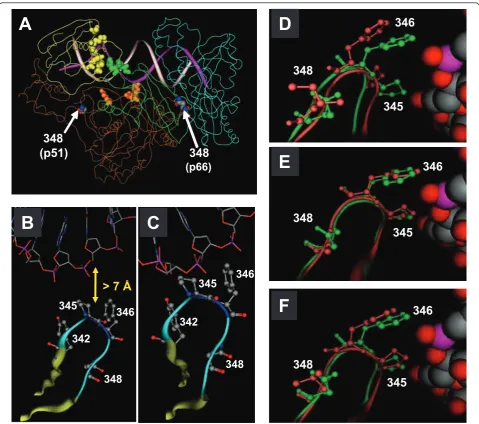
However, a growing body of evidence has emerged that implicates mutations outside of the polymerase domain of RT in RTI resistance [5]. In this regard, the N348I mutation in the connection domain of HIV-1 RT has received significant attention in the last 4 years. This mutation can be selected relatively early during virologic failure and confers resistance to both zidovudine (AZT) and nevirapine [6]. Furthermore, N348I can compensate for the antagonism of thymidine analog mutations (TAMs) by the L74V, Y181C or M184V mutations [7]. Previous biochemical studies demonstrated that N348I in HIV-1 RT indirectly increases AZT resistance by decreasing the frequency of secondary ribonuclease H (RNase H) cleavages that significantly reduce the RNA/ DNA duplex length of the template/primer (T/P) and diminish the efficiency of AZT-monophosphate (MP) excision [6,8]. By contrast, there is some discrepancy in the literature in regard to the mechanisms associated with nevirapine resistance: one study has suggested it is due to decreased inhibitor binding [9], while other stu-dies suggest that it may also be due to the decreased RNase H cleavage phenotype of the N348I HIV-1 RT [10,11]. Interestingly, in the available crystal structures of HIV-1 RT, residue N348 in both subunits of the enzyme is located distal to the DNA polymerase and RNase H active sites, to the T/P substrate, to residues that com-prise the nucleic acid binding tract and to the NNRTI-binding pocket [Figure 1A, B]. Therefore, it is not evident how N348I in HIV-1 RT impacts the RNase H cleavage of the enzyme or decreases drug susceptibility. In this study, we used a combination of molecular modelling and biochemical analyses to address this question.
Results and Discussion
Molecular models of wild type (WT) and N348 mutant HIV-1 RT in complex with an RNA/DNA T/P
In the crystal structure of HIV-1 RT in complex with a polypurine tract RNA/DNA hybrid [12], residue N348 in both subunits is not proximal to the enzyme’s active sites, to the RNA/DNA T/P substrate, to residues that comprise the nucleic acid binding tract and to the NNRTI-binding pocket [Figure 1A, B]. Accordingly, the mechanisms by which N348I decreases RT RNase H activity and drug susceptibility cannot be inferred from this structure. It should, however, be noted that although the RNA/DNA duplex extends into the RNase H domain of RT in this structure, it misses the active site by ~ 4 Å. Recently, a crystal structure of the human RNase H1 was solved in complex with an RNA/DNA substrate which extends directly into the enzyme’s active site [13]. Because of the similarity between the human RNase H1 and the RNase H domains of HIV-1 RT, the authors were able to model an RNA/DNA duplex into HIV-1 RT that extends from the RNase H active site of the enzyme.
It should be noted that due to the orientation and con-formation of the bound T/P in this model, HIV-1 RT cannot simultaneously carry-out DNA polymerization and RNase H cleavage. Accordingly, it was proposed that the RNA/DNA T/P substrate would need to toggle between both active sites [13]. A recent study by Beil-hartzet al., however, refutes this hypothesis [14]. Never-theless, in this model, residues Y342, P345 and F346 from theb14-b15 loop of the p51 subunit of HIV-1 RT directly interact with the RNA template backbone [Figure 1C]. The Cbatom of N348 forms a network of interac-tions with the Cbatom and backbone atoms of Y342. [N348 in p66 remains distal to the RNA/DNA substrate in this model (data not shown)]. When the N348I muta-tion is introduced into the p51 subunit in this structure by molecular modelling (Figure 1D), the position of the
b14-b15 loop is shifted such that P345 and F346 no longer contact the RNA template. The repositioning of this loop in the N348I RT is likely due to the bulky side-chain of isoleucine disrupting the network of interactions between this residue and Y342. Similarly, the introduc-tion of leucine (Figure 1F) or glutamic acid (data not shown) at residue 348 in the p51 subunit of RT resulted in a shift of theb14-b15 loop away from the RNA tem-plate. By contrast, introduction of alanine (Figure 1E) or glutamine (data not shown) had little impact on the posi-tion of this loop. Both these substituposi-tions retain the criti-cal network of interactions between residue 348 and 342. Interestingly, the introduction of an arginine residue appeared to enhance the interactions of the P345 and F346 with the RNA template (data not shown). Taken together, these modelling studies suggest that the N348I mutation in the context of the p51 subunit of HIV-1 RT may decrease the enzyme’s RNase H activity via an altered interaction with the RNA template. Importantly, these modelling analyses provided a testable hypothesis.
Subunit-specific mutational analysis of residue N348 in HIV-1 RT
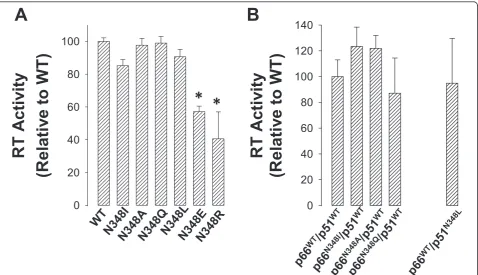
Next, we over-expressed and purified RTs that con-tained subunit-specific mutations using the pDUET expression vector (see Methods). In this regard, we suc-cessfully purified the p66N348I/p51WT, p66N348A/p51WT, p66N348Q/p51WTand p66WT/p51N348Lenzymes. Impor-tantly, the DNA polymerase activities of these purified
enzymes were similar to that of the WT enzyme purified under the same conditions (Figure 2B). Unfortunately, we were unable to purify several other subunit-specific combinations due to low expression levels, protein inso-lubility, or inability of the p66 and p51 subunits to form functional RT heterodimers. To determine whether an
348 346 345
342
348
346
345
342
348 346 345
342
348
346
345
342
348(p51) 348
(p66)
348
(p51)
348
(p66)
348 346 345
342
348 346 345
342
A
B
C
D
E
F
> 7 Å
348
348
348
345
345
345
346
346
[image:3.595.58.538.87.511.2]346
alternate purification strategy would be viable, we also expressed the p66 and p51 subunits separately (see Meth-ods). The bacterial lysates were then mixed and HIV-1 RT purified using a dual tag strategy that involved nickel-and FLAG-affinity chromatography. This alternate approach, however, was also unsuccessful. Previously Schuckmanet al.described the purification of p66WT/ p51N348IHIV-1 RT [9]. In this regard, it is important to note that their approach involved nickel affinity and mono Q anion exchange chromatography, and not the dual tag affinity strategy used in our study. Because the p66 subunit of RT can be cleaved to p51 by bacterial pro-teases, one cannot exclude the possibility that the puri-fied enzymes prepared by Schuckman and co-workers were not contaminated by p66N348I
/p51N348IHIV-1 RT.
ATP mediated excision of AZT-MP from a chain-terminated T/P by WT and N348 mutant HIV-1 RT
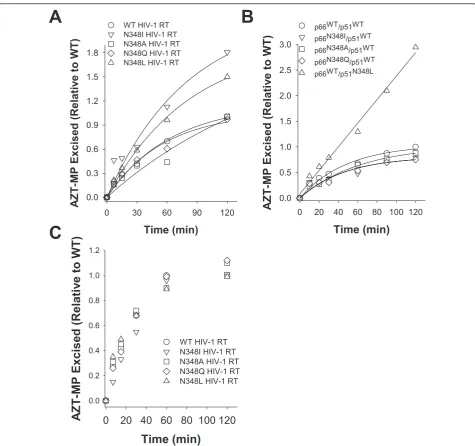
TAMs in HIV-1 RT confer AZT resistance by enabling the enzyme to excise the chain-terminating AZT-MP moiety from the 3’-end of the DNA primer using ATP as a phosphate donor [15]. Previous biochemical studies demonstrated that N348I in HIV-1 RT indirectly increases AZT resistance by decreasing the frequency of secondary RNase H cleavages that significantly reduce the RNA/DNA duplex length of the T/P and diminish
the efficiency of AZT-MP excision [6,8]. As such, we first assessed the AZT-MP excision activity of the WT and N348 mutant enzymes on a well-defined RNA/ DNA T/P substrate that is routinely used in our labora-tory [6,7,16,17]. When the mutation at residue 348 was present in both the p66 and the p51 subunits of RT, only the N®I and N®L substitutions conferred an enhanced ability to excise AZT-MP compared to the WT enzyme (Figure 3A). However, when N348I was present only in the p66 subunit, the mutant enzyme exhibited AZT-MP excision activity that was similar to the WT RT (Figure 3B). By contrast, when N348L was present in the p51 subunit only, the mutant enzyme exhibited robust AZT-MP excision activity (Figure 3B). As predicted by the molecular modelling studies, the N348A and N348Q mutations had minimal impact on the ATP-mediated excision activity of the enzyme (Fig-ures 3A, B). As expected, the mutant RTs exhibited ATP-mediated excision activities on a DNA/DNA T/P substrate that were comparable to the WT enzyme (Fig-ure 3C). We previously delineated the relationship between AZT-MP excision efficiency and RNase H activity on the RNA/DNA T/P substrate used in these experiments [16,17]. These studies showed that the pri-mary polymerase-dependent RNase H cleavage of RT does not impact the enzyme’s AZT-MP excision
RT
A
ct
iv
ity
(R
el
ativ
e to
WT
)
0
20
40
60
80
100
RT
A
ctiv
ity
(R
el
ativ
e to
WT
)
0
20
40
60
80
100
120
140
* *
[image:4.595.60.539.88.363.2]A B
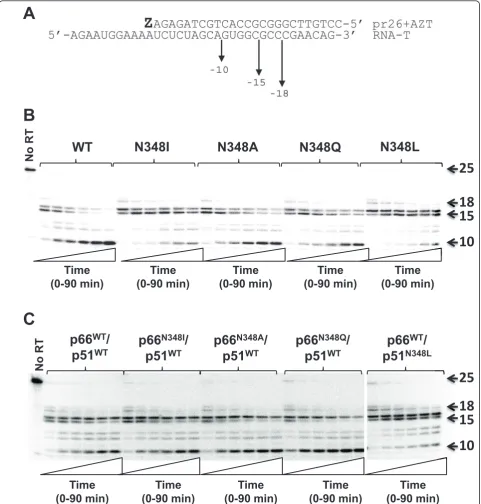
efficiency, but polymerase-independent RNase H clea-vages that reduce the RNA/DNA duplex length to less than 12 nucleotides abolish AZT-MP excision activity. In light of these data, we next evaluated the RNase H activity of WT and N348 mutant RT that occurred dur-ing the ATP-mediated excision reactions described in Figure 3. As reported previously [6,8], N348I signifi-cantly reduced the frequency of a polymerase-indepen-dent cleavage event that decreases the RNA/DNA
duplex to 10 nucleotides (Figure 4B). Consistent with the observed increase in AZT-MP excision activity, the N348L mutation also significantly decreased the fre-quency of this polymerase-independent cleavage event. By contrast, the N348A and N348Q enzymes retained near WT-like RNase H cleavage activities. Interestingly, when the N348I mutation was present only in the p66 subunit, the observed RNase H cleavage pattern was similar to that of the WT enzyme (Figure 4C). By
Time (min)
0 30 60 90 120
A
ZT-MP E
xci
sed (Rel
ativ
e to W
T)
0.0 0.3 0.6 0.9 1.2 1.5 1.8
WT HIV-1 RT N348I HIV-1 RT N348A HIV-1 RT N348Q HIV-1 RT N348L HIV-1 RT
Time (min)
0 20 40 60 80 100 120A
Z
T-MP Excised (R
elativ
e to WT)
0.0 0.5 1.0 1.5 2.0 2.5 3.0
p66WT/p51WT p66N348I/p51WT p66N348A/p51WT p66N348Q/p51WT p66WT/p51N348L
Time (min)
0 20 40 60 80 100 120
A
Z
T-MP Excise
d (Relativ
e to WT)
0.0 0.2 0.4 0.6 0.8 1.0 1.2
WT HIV-1 RT N348I HIV-1 RT N348A HIV-1 RT N348Q HIV-1 RT N348L HIV-1 RT
A B
[image:5.595.60.536.86.532.2]C
contrast, when N348L was present only in the p51 subu-nit, the mutant enzyme showed an RNase H phenotype similar to the enzyme that contained the N348L muta-tion in both subunits (Figure 4B, C). Taken together, these data show that the N348I or N348L mutations in
the p51 subunit of HIV-1 RT are responsible for the observed decreased RNase H cleavage and increased AZT-MP excision phenotypes. This finding is consistent with that of Schuckmannet al. who also reported that the N348I mutant in the p51 subunit conferred the
WT
N348I
N348A
N348Q
N348L
Time
(0-90 min)
Time
(0-90 min)
Time
(0-90 min)
Time
(0-90 min)
Time
(0-90 min)
No RT
Time
(0-90 min)
Time
(0-90 min)
Time
(0-90 min)
Time
(0-90 min)
Time
(0-90 min)
p66
WT/
p51
WTNo RT
p66
N348I/
p51
WTp66
N348A/
p51
WTp66
N348Q/
p51
WTp66
WT/
p51
N348LA
B
C
25
18
15
10
25
18
15
[image:6.595.58.540.89.594.2]10
decreased RNase H/increased AZT-MP excision pheno-type [9].
Susceptibility of WT and N348 mutant HIV-1 RT to nevirapine
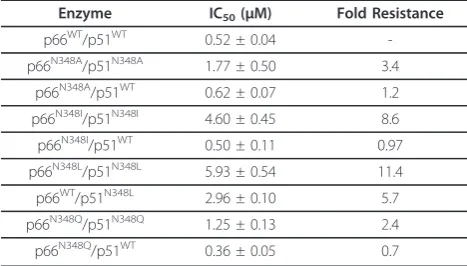
Next, we determined the susceptibility of the WT and N348 mutant HIV-1 RT to nevirapine (Table 1). Our results show that the N348A, N348I, N348Q and N348L mutations confer nevirapine resistance when present in both the p66 and p51 subunits of HIV-1 RT. However, it should be noted that HIV-1 RTs that contained the N348I and N348L mutations showed fold-changes in nevirapine resistance (8.6- and 11.4-fold, respectively) that were greater than those calculated for the N348A (3.4-fold) or N348Q (2.4-fold) HIV-1 RTs. Interestingly, when the N348A, N348Q or N348I mutations were pre-sent in the p66 subunit only, RT susceptibility to nevira-pine was similar to that of the WT enzyme (Table 1). By contrast, when N348L was present in p51 only, HIV-1 RT exhibited 5.7-fold nevirapine resistance. Taken together, these data strongly suggest that nevirapine resistance, like AZT resistance, is also due to the muta-tion in the p51 subunit of RT. It should be noted, how-ever, that the fold-change in nevirapine resistance was lower for the p66WT/p51N348LRT (5.7-fold) compared to
p66N348L/p51N348LRT (11.4-fold). As such, the mutation in the p66 subunit may augment nevirapine resistance. Nikolenkoet al.proposed that the decrease in RNase H activity due to mutations in the connection or RNase H domains of HIV-1 RT preserves the RNA template and provides more time for NNRTIs to dissociate from the RT, resulting in the resumption of DNA synthesis and enhanced NNRTI resistance [11]. Of note, our data show that the two mutations that have a significant impact on the RNase H phenotype (i.e. N348I and N348L) also con-fer the highest levels of nevirapine resistance, thus pro-viding additional support for a link between RNase H cleavage and NNRTI resistance. However, the N348A and N348Q mutations also yielded nevirapine resistance.
Since these mutations do not significantly impact the RNase H phenotype, one must conclude that they confer resistance via an RNase H independent phenotype. Inter-estingly, previous studies have demonstrated that N348I confers nevirapine resistance on both RNA/DNA and DNA/DNA T/P substrates [9,10], suggesting that factors in addition to RNase H cleavage impact nevirapine bind-ing. Recently, Schuckmannet al.reported that the N348I mutation in either subunit caused nevirapine resistance [9]. Specifically, they showed that the mutation in p66 alone caused nevirapine resistance without significantly affecting RNase H activity, whereas the mutation in p51 caused nevirapine resistance and impaired RNase H activity. The nevirapine fold-resistance values (~ 2-3 fold) determined by Schuckmannet al.were significantly less than the values determined in our study. Further-more, they reported approximately ~ 2-2.7 -fold resis-tance when the N348I mutation was present in both subunits; ~ 1.9-2-fold when present in p66 only; and 2.7-3.1-fold when present in p51 only (see Table three in [9]). If nevirapine resistance was due to the mutation in both subunits, one would expect a higher fold-resistance for the p66N348I/p51N348IRT compared to the p66N348I/ p51WTor p66WT/p51N348Ienzymes. As mentioned pre-viously, the purification strategy used by Schuckmannet
al.did not employ an affinity chromatography step that was specific for each subunit. As such, their enzyme pre-parations may have been contaminated by p66N348I/ p51N348IRT generated by bacterial proteases, thus com-plicating data analysis.
Conclusions
This study demonstrates that N348I-mediated AZT and nevirapine resistance is likely due to the mutation in the p51 subunit of RT. It should be noted, however, that the interpretation of our data is limited by our inability to pur-ify and characterize p66WT/p51N348IHIV-1 RT. The mole-cular modelling suggests that the N348I mutation abrogates an interaction between theb14-b15 loop in the p51 subunit of RT and the RNA template, which may explain the observed decrease in the secondary or poly-merase independent RNase H cleavages. Nevirapine resis-tance appears complex and may involve both RNase H-dependent and -independent mechanisms.
Methods
Molecular modelling
[image:7.595.56.290.597.730.2]The co-ordinates for the molecular model of HIV-1 RT in complex with an RNA/DNA duplex that extends into the RNase H active site of the enzyme [13] were kindly provided by Dr. Marcin Nowotny. To generate the mod-els, we first selected the N348 residue in the p51 subu-nit and selected all amino acid residues within a 20 Å radius. These residues were then subjected to energy
Table 1 Susceptibility of WT and N348 mutant HIV-1 to nevirapine
Enzyme IC50(μM) Fold Resistance
p66WT/p51WT 0.52 ± 0.04
-p66N348A/p51N348A 1.77 ± 0.50 3.4
p66N348A/p51WT 0.62 ± 0.07 1.2
p66N348I/p51N348I 4.60 ± 0.45 8.6
p66N348I/p51WT 0.50 ± 0.11 0.97
p66N348L/p51N348L 5.93 ± 0.54 11.4
p66WT/p51N348L 2.96 ± 0.10 5.7
p66N348Q/p51N348Q 1.25 ± 0.13 2.4
minimization using the Molecular Operating Environ-ment (Chemical Computing Group, Montreal, Quebec, Canada). The rest of RT and the RNA/DNA T/P sub-strate were frozen and were not subjected to energy minimization. Charges were calculated using the Gastei-ger method, and iterative minimizations were carried out using the AMBER 99 forcefield until the energy dif-ference between iterations was less than 0.0001 kcal/mol per Å. These initial minimization experiments had mini-mal effect on the overall structure of the RT. Next, we introduced the N348I/A/Q/E/R/L mutations into the p51 subunit of HIV-1 RT, and carried out energy mini-mizations as described above. Modeled RT structures were visualized using MOE or the UCSF Chimera pack-age from the Resource for Biocomputing, Visualization, and Informatics at the University of California, San Francisco (supported by NIH P41 RR001081).
Reagents
AZT- TP was purchased from Sierra Bioresearch (Tuscon, AZ). Nevirapine was obtained from the NIH AIDS Research and Reference Reagent Program. ATP, dNTPs, and ddNTPs were purchased from GE Healthcare (Piscat-away, NJ), and [g-32P]ATP was acquired from PerkinElmer Life Sciences (Boston, MA). RNA and DNA oligonucleo-tides were synthesized by Integrated DNA Technologies (Coralville, IA).
Site-directed mutagenesis and protein expression
The N348A, N348E, N348L, N348Q and N348R muta-tions were introduced into the wild-type (WT) p6HRT-Prot prokaryotic expression vector [18] by site-directed mutagenesis using the QuikChange mutagenesis kit (Stratagene La Jolla, CA). Full-length sequencing of mutant RTs was performed to confirm the presence of the desired mutations and to exclude adventitious muta-tions introduced during mutagenesis. The mutant HIV-1 RTs were purified as described previously [18]. For subu-nit selective mutagenesis, the p66 and p51 RT genes were cloned into the pET-DUET vector (Novagen-EMD Bios-ciences Inc., San Diego, California). The p66 subunit was expressed as an N-terminal hexahistidine fusion protein whereas p51 was expressed as an N-terminal FLAG fusion protein. The p66 and p51 subunits of RT were also cloned into the pBAD/His B (Invitrogen) and pT7-FLAG (Sigma) expression vectors to generate His-p66 and FLAG-p51, respectively. Enzymes were expressed and purified as described previously using a double-tag strategy [19]. The protein concentration of the purified enzymes was determined spectrophotometrically at 280 nm using an extinction coefficient (ε280) of 260450
M-1cm-1, and by Bradford protein assays (Sigma-Aldrich, St. Louis, MO).
A 26-nucleotide DNA primer (pr26; 5’-CCTGTTCGGG CGCCACTGCTAGAGAT-3’) was 5’-radiolabeled with [g-32P]ATP and chain-terminated with AZT-MP to gener-ate PAZTas reported previously [6,7,16,17]. PAZTwas then
annealed to a 35-nucleotide RNA template (TRNA: 5’
-AGAAUGGAAAAUCUCUAGCAGUGGCGCCCG AACAG-3’). ATP-mediated AZT-MP excision assays were carried out by first incubating 20 nM TRNA/PAZTwith
3 mM ATP, 10 mM MgCl2, 1 μM dTTP and 10 μM
ddCTP in a buffer containing 50 mM Tris-HCl (pH 7.5) and 50 mM KCl. Reactions were initiated by the addition of 200 nM WT or mutant RT. Aliquots were removed at defined times, quenched with sample loading buffer (98% deionized formamide, 1 mg/ml each of bromophenol blue and xylene cyanol), denatured at 95°C for 8 min, and then product was resolved from substrate by denaturing polya-cylamide gel electrophoresis and analyzed, as reported pre-viously [6,7,16,17].
Assay for RT RNase H activity
WT and mutant RT RNase H activity was evaluated using the same AZT-MP chain-terminated RNA/DNA T/P substrate described above, except the 5’-end of the RNA was32P-end-labelled. Assays were carried out using 20 nM TRNA/PAZT, 3 mM ATP and 10 mM MgCl2in a
buffer containing 50 mM Tris-HCl (pH 7.5) and 50 mM KCl. Reactions were initiated by the addition of 200 nM WT or mutant HIV-1 RT. Aliquots were removed, quenched at varying times, and analyzed as described above.
Inhibition of WT and N348 mutant HIV-1 RT by nevirapine
Fixed time point assays using a heteropolymeric T/P sub-strate were used to determine HIV-1 RT DNA polymerase activity, as reported previously [20]. The sequence of the DNA primer and RNA template were 5’-TCGGGCGCC ACTGCTAGAGA-3’and 5’ -UCAGACCCUUUUAGU-CAGAAUGGAAAGUCUCUAGCAGUGG CGCCCGAA-CAGGGACA-3’, respectively. The primer was synthesized with a biotin label on their 5’-terminus. DNA polymerase reactions using heteropolymeric T/P (600 nM) were car-ried out in 50 mM Tris-HCl pH 7.5 (37°C), 50 mM KCl, 10 mM MgClB2Bcontaining 600 nM T/P, 10μM of each
Acknowledgements
This study was supported by a grant (R01 AI081571) from the National Institute of Health Allergy and Infectious Diseases, National Institutes of Health to N.S.-C. J.R. was supported by a fellowship from the Pitt Aids Research Training (PART) grant (T32 AI065380).
Author details 1
University of Pittsburgh School of Medicine, Department of Medicine, Division of Infectious Diseases, Pittsburgh, PA 15261, USA.2University of Pittsburgh Graduate School of Public Health, Department of Infectious Diseases and Microbiology, Pittsburgh, PA 15261, USA.
Authors’contributions
Conceived and designed the experiments: JR and NSC. Performed the experiments: JR. Analyzed the data: JR and NSC. Wrote the paper: NSC. All authors read and approved the final manuscript.
Competing interests
The authors declare that they have no competing interests.
Received: 11 April 2011 Accepted: 22 August 2011 Published: 22 August 2011
References
1. De Clercq E:Antiretroviral drugs.Curr Opin Pharmacol2010,10:507-515. 2. Goody RS, Müller B, Restle T:Factors contributing to the inhibition of HIV
reverse transcriptase by chain-terminating nucleotides in vitro and in vivo.FEBS Lett1991,291:1-5.
3. Kohlstaedt LA, Wang J, Friedman JM, Rice PA, Steitz TA:Crystal structure at 3.5 A resolution of HIV-1 reverse transcriptase complexed with an inhibitor.Science1992,256:1783-1790.
4. di Marzo Veronese F, Copeland TD, DeVico AL, Rahman R, Oroszlan S, Gallo RC, Sarngadharan MG:Characterization of highly immunogenic p66/ p51 as the reverse transcriptase of HTLV-III/LAV.Science1986,
231:1289-1291.
5. Ehteshami M, Götte M:Effects of mutations in the connection and RNase H domains of HIV-1 reverse transcriptase on drug susceptibility.AIDS Rev 2008,10:224-235.
6. Yap SH, Sheen CW, Fahey J, Zanin M, Tyssen D, Lima VD, Wynhoven B, Kuiper M, Sluis-Cremer N, Harrigan PR, Tachedjian G:N348I in the connection domain of HIV-1 reverse transcriptase confers zidovudine and nevirapine resistance.PLoS Med2007,4:e335.
7. Radzio J, Yap SH, Tachedjian G, Sluis-Cremer N:N348I in reverse transcriptase provides a genetic pathway for HIV-1 to select thymidine analogue mutations and mutations antagonistic to thymidine analogue mutations.AIDS2010,24:659-667.
8. Ehteshami M, Beilhartz GL, Scarth BJ, Tchesnokov EP, McCormick S, Wynhoven B, Harrigan PR, Götte M:Connection domain mutations N348I and A360V in HIV-1 reverse transcriptase enhance resistance to 3’ -azido-3’-deoxythymidine through both RNase H-dependent and -independent mechanisms.J Biol Chem2008,283:22222-22232.
9. Schuckmann MM, Marchand B, Hachiya A, Kodama EN, Kirby KA, Singh K, Sarafianos SG:The N348I mutation at the connection subdomain of HIV-1 reverse transcriptase decreases binding to nevirapine.J Biol Chem 2010,285:38700-38709.
10. Biondi MJ, Beilhartz GL, McCormick S, Götte M:N348I in HIV-1 reverse transcriptase can counteract the nevirapine-mediated bias toward RNase H cleavage during plus-strand initiation.J Biol Chem2010,
285:26966-26975.
11. Nikolenko GN, Delviks-Frankenberry KA, Pathak VK:A novel molecular mechanism of dual resistance to nucleoside and nonnucleoside reverse transcriptase inhibitors.J Virol2010,84:5238-5249.
12. Sarafianos SG, Das K, Tantillo C, Clark AD Jr, Ding J, Whitcomb JM, Boyer PL, Hughes SH, Arnold E:Crystal structure of HIV-1 reverse transcriptase in complex with a polypurine tract RNA:DNA.EMBO J2001,20:1449-1461. 13. Nowotny M, Gaidamakov SA, Ghirlando R, Cerritelli SM, Crouch RJ, Yang W:
Structure of human RNase H1 complexed with an RNA/DNA hybrid: insight into HIV reverse transcription.Mol Cell2007,28:264-276. 14. Beilhartz GL, Wendeler M, Baichoo N, Rausch J, Le Grice S, Götte M:HIV-1
reverse transcriptase can simultaneously engage its DNA/RNA substrate
at both DNA polymerase and RNase H active sites: implications for RNase H inhibition.J Mol Biol2009,388:462-474.
15. Meyer PR, Matsuura SE, Mian AM, So AG, Scott WA:A mechanism of AZT resistance: an increase in nucleotide-dependent primer unblocking by mutant HIV-1 reverse transcriptase.Mol Cell1999,4:35-43.
16. Radzio J, Sluis-Cremer N:Efavirenz accelerates HIV-1 reverse transcriptase ribonuclease H cleavage, leading to diminished zidovudine excision.Mol Pharmacol2008,73:601-606.
17. Brehm JH, Mellors JW, Sluis-Cremer N:Mechanism by which a glutamine to leucine substitution at residue 509 in the ribonuclease H domain of HIV-1 reverse transcriptase confers zidovudine resistance.Biochemistry 2008,47:14020-14027.
18. Le Grice SF, Grüninger-Leitch F:Rapid purification of homodimer and heterodimer HIV-1 reverse transcriptase by metal chelate affinity chromatography.Eur J Biochem1990,187:307-314.
19. Nissley DV, Radzio J, Ambrose Z, Sheen CW, Hamamouch N, Moore KL, Tachedjian G, Sluis-Cremer N:Characterization of novel non-nucleoside reverse transcriptase (RT) inhibitor resistance mutations at residues 132 and 135 in the 51 kDa subunit of HIV-1 RT.Biochem J2007,404:151-157. 20. Ambrose Z, Herman BD, Sheen CW, Zelina S, Moore KL, Tachedjian G,
Nissley DV, Sluis-Cremer N:The human immunodeficiency virus type 1 nonnucleoside reverse transcriptase inhibitor resistance mutation I132M confers hypersensitivity to nucleoside analogs.J Virol2009,83:3826-3833.
doi:10.1186/1742-4690-8-69
Cite this article as:Radzio and Sluis-Cremer:Subunit-specific mutational analysis of residue N348 in HIV-1 reverse transcriptase.Retrovirology 20118:69.
Submit your next manuscript to BioMed Central and take full advantage of:
• Convenient online submission
• Thorough peer review
• No space constraints or color figure charges
• Immediate publication on acceptance
• Inclusion in PubMed, CAS, Scopus and Google Scholar
• Research which is freely available for redistribution