RIT Scholar Works
Theses Thesis/Dissertation Collections
12-2-2016
Implementation of the Array-based Approach for
the Evaluation of Randomness of the Advanced
Encryption Standard (AES)
Hanadi Yahia Alomari [email protected]
Follow this and additional works at:http://scholarworks.rit.edu/theses
This Thesis is brought to you for free and open access by the Thesis/Dissertation Collections at RIT Scholar Works. It has been accepted for inclusion in Theses by an authorized administrator of RIT Scholar Works. For more information, please [email protected].
Recommended Citation
ROCHESTER INSTITUTE OF TECHNOLOGY
Implementation of the Array-based Approach for the Evaluation of
Randomness of the Advanced Encryption Standard (AES)
By
Hanadi Yahia Alomari
A Thesis Submitted in Partial Fulfillment of the Requirements for the Degree of Master of
Science in Applied Statistics
in the
School of Mathematical Sciences
College of Science
i
Declaration of Authorship
I, Hanadi Alomari, declare that this thesis titled, “Implementation of the Array-based Approach
for the Evaluation of Randomness of the Advanced Encryption Standard (AES)” and the work
presented in it are my own. I confirm that:
This work was done wholly or mainly while in candidature for a research degree at this
University.
Where any part of this thesis has previously been submitted for a degree or any other
qualification at this University or any other institution, this has been clearly stated.
Where I have consulted the published work of others, this is always clearly attributed.
Where I have quoted from the work of others, the source is always given. With the
exception of such quotations, this thesis is entirely my own work.
I have acknowledged all main sources of help.
Where the thesis is based on work done by myself jointly with others, I have made clear
exactly what was done by others and what I have contributed myself.
Signed:
______________________________________
Date:
ii
Committee Approval
_____________________________________________________________________________
Dr. Peter Bajorski Date
Thesis Advisor
_____________________________________________________________________________
Dr. Alan Kaminsky Date
Committee Member
_____________________________________________________________________________
Dr. Marcin
Ł
ukowiak Date
iii
ROCHESTER INSTITUTE OF TECHNOLOGY
Abstract
Implementation of the Array-based Approach for the Evaluation of Randomness of the
Advanced Encryption Standard (AES)
by Hanadi Yahia Alomari
Randomness is critical when it comes to cryptography. When a cryptographic system has
randomness in it, it is impossible to decrypt the codes and break the system. To evaluate a
cryptographic function’s randomness, many statistical tests were developed such as: Diehard
and ENT, but these tests are not well suited for block ciphers. CryptoStat is the best statistical
test suite to test the randomness of the Advanced Encryption Standard or AES, which is a block
cipher established by NIST, the National Institute of Standard and Technology. An array based
iv
Acknowledgements
I would first like to thank my thesis advisor Dr. Peter Bajorski for his tremendous support and
help. I cannot thank him enough because I really learned a lot from him, and this thesis would
not be materialized without his encouragement.
I wish to thank Dr. Alan Kaminsky and Dr. Marcin Lukowiak for their acceptance of being in my
thesis committee. I also would like to thank Dr. Kaminsky for providing me with the data used in
this thesis. Moreover, I am thankful for his previous work on the topic, which helped me to
learn and understand more.
Finally, I would like to thank my parents and siblings for their endless love. I would not be here
without their encouragement. Also, many thanks to my lovely husband for his patience and
v
Table of Contents
Declaration of Authorship……….i
Abstract………iii
Acknowledgements...iv
Table of Contents...v
List of Figures………..….vii
List of Tables……….……….………..…….ix
Chapter 1 1
1.1. Introduction ... .1
1.2. Thesis Organization………..………..………..2
Chapter 2 3
2.1. Cryptography Overview ... 3
2.2. Randomness Definition………..4
2.3. Randomness Importance ... 5
2.4. Verifying Randomness in a Cryptographic System ... 5
Chapter 3 7
3.1 Data………..………..………7
Chapter 4 8
4.1 NIST Statistical Test Suite………….………..………….………..8
4.2 NIST Statistical Test Suite and Block Ciphers………..………..………9
Chapter 5 10
5.1. Applying an Array Based Approach on AES...10
5.2. Normal Approximation to the Binomial Distribution ...11
5.3. Three Possible Ways to Use the Array Based Approach on the AES ...12
5.3.1 Investigating Rounds 1 and 9 Based on the Previous Results……...14
Chapter 6 19
6.1. CryptoStat Test Suite………..19
6.2. Applying CryptoStat Test Suite on AES……….…20
6.2.1. The Linear Approximation Test……….………..……..20
Test Purpose………..20
Function Call………..………20
Test Description………..21
Applying the Linear Approximation Test on AES………..22
6.2.2. The Coincidence Test………..27
Test Purpose………..27
Test Description……….……….27
Applying the Coincidence Test on AES……….28
vi
Test Purpose………..33
Test Description……….……….33
Applying the Input-output Independence Test on AES………34
6.2.4. The Complement Test………40
Test Purpose………..40
Test Description……….……….40
Applying the Complement Test on AES….……….40
6.2.5. The Ciphertext Independence Test………41
Test Purpose………..41
Test Description……….……….41
Applying the Ciphertext Independence Test on AES……….…42
6.2.6. Strong Avalanche Test………49
Test Purpose……….49
Test Description……….……….49
Applying the Strong Avalanche Test on AES………..……….50
6.2.7. The Uniformity Test………55 Test Purpose………55 Test Description……….……….55 Applying the Uniformity Test on AES………55 Chapter 7 60
Results and Discution………60
Chapter 8 62
Conclusion and Future Work………..62
Appendices 63
A Selected R Code………..64
Chapter 9 74
Refrences……….74
vii
List of Figures
Figure 1: Cryptography basic idea ... 3
Figure 2: Cryptography process... 4
Figure 3: Normal approximation to the binomial ... 11
Figure 4: The frequencies of 1’s in round 1... 15
Figure 5: The frequencies of 1’s in round 9... 16
Figure 6: The frequncies in Round 1 ... 17
Figure 7: The frequncies in Round 9 ... 18
Figure 8: Linear Approximation Test ... 21
Figure 9: Frequencies of 1's for the linear approximation test in round 1... 23
Figure 10: Frequencies of 1's for the linear approximation test in round 2 ... 24
Figure 11: Linear approximation test P-values for round1 ... 25
Figure 12: Linear approximation test P-values for round2 ... 26
Figure 13: Coincidence Test ... 28
Figure 14: Frequencies of 1's for the coincidence test in round 1... 29
Figure 15: Frequencies of 1's for the coincidence test in round 2... 30
Figure 16: Coincidence test P-values for round1... 31
Figure 17: Coincidence test P-values for round2... 32
Figure 18: Input-output independence test ... 34
Figure 19: Frequencies of 1's for the input-output independence test in round 1 ... 35
Figure 20: Input-output independence test P-values for round1... 36
Figure 21: Input-output independence test P-values for round1 using Chi-squared test ... 38
Figure 22: Input-output independence test P-values for round2 using Chi-squared test ... 39
Figure 23: Ciphertext independence test ... 42
Figure 24: Frequencies of 1's for the ciphertext independence test in round 1 ... 43
viii
Figure 26:: Ciphertext independence test P-values for round1 ... 45
Figure 27: Ciphertext independence test P-values for round2 ... 46
Figure 28: Ciphertext independence test P-values for round1 using Chi-squared test ... 47
Figure 29: Ciphertext independence test P-values for round2 using Chi-squared test ... 48
Figure 30: Structure of an AES round ... 50
Figure 31: Frequencies of 1's for the strong avalanche test in round 1 ... 51
Figure 32: Frequencies of 1's for the strong avalanche test in round 2 ... 52
Figure 33: Strong Avalanche Test P-values for round 1 ... 53
Figure 34: Strong Avalanche Test P-values for round 2 ... 54
Figure 35: Frequencies of 1's for the uniformity test in round 1... 56
Figure 36: Uniformity test P-values for round1 ... 57
Figure 37: Uniformity test P-values for round1 using Chi-squared test... 58
Figure 38: Uniformity test P-values for round2 using Chi-squared test... 59
ix
List of Tables
Table 1: Applying 1 binomial test on AES... 12
Table 2: Applying 129 binomial tests ... 13
Table 3: Applying 129×129 binomial tests ... 13
Table 4: Applying binomial tests on AES using rows, columns, and bits ... 14
Table 5: Linear approximation test results ... 22
Table 6: Coincidence test results ... 28
Table 7: Input-output independence results ... 34
Table 8: Input-output independence results using Chi-squared test ... 37
Table 9: Ciphertext independence test results ... 42
Table 10: Strong Avalanche test results... 50
Table 11: Uniformity test results ... 55
Chapter 1
1.1.
Introduction
Using computers can be extremely unsafe when using personal and financial data such as
names, passwords, addresses, and bank account information. To keep one’s safety, some
aspects and applications can be applied. One of these aspects is Cryptography, which is the
most popular tool for keeping private information safe from the public or third parties.
Cryptography ensures that information is accessible by authorized people only, which keep
their privacy. Cryptography also helps with Authentication because it facilitates proofing a
remote user’s identity, which prevents third parties from pretending to be someone else.
Moreover, it could be used to provide a means to secure data that is not viewed or altered
during storage or transaction, which is referred to as Integrity (Dent & Mitchell, 2005).
Cryptography also could be used for Non-repudiation, which prevents the denial of previous
actions. This “Non-repudiation” term is popular in financial and e-commerce applications. For
example, a customer who requested a money transformation from his bank account could
claim later that he never made that request and demand that money be refunded to his
account. In such a situation, cryptographic tools are used to prove that the customer has
requested and authorized the money transaction(Dent & Mitchell, 2005).
To have an effective cryptographic system, it is crucial to have some randomness in it because
information. The objective of this thesis is to apply a CryptoStat test suite to evaluate a
cryptographic system’s randomness using an array based approach and statistical hypothesis
testing.
1.2.
Thesis Organization
This thesis consists of 8 chapters and is organized as follows. Chapter 2 will be mostly an
overview of randomness in cryptography. The third chapter represents the history and the
structure of the data that is used here. Since the goal of this thesis is to investigate the
randomness in this data, chapter 4 introduces some previous tests that were used for this
purpose. Chapter 5 explains a new array based approach to be used in evaluating the
randomness. Also, a CryptoStat test suite represented in chapter 6 will be applied on the data,
Chapter 2
2.1.
Cryptography Overview
“Cryptography is the science of secret writing with the goal of hiding the meaning of the
message” (Paar & Pelzl, 2010). Figure 1 shows the basic idea of Cryptography. It starts with the
unencrypted data which we call “Plaintext.” Plaintext is encrypted into “Ciphertext,” which will
be decrypted later into the original plaintext (Kessler, 2015). Encryption is the process of
disguising a message in such a way as to hide its substance while Decryption is the process of
returning an encrypted message back into plaintext (Matthews, 2003).
Figure 1: Cryptography basic idea
To clarify, let us say there are two people, Alex and Richard, and they want to communicate
through a secure channel (Internet connection or telephone line). On the other hand, there is
Jack, the bad guy here who could somehow interrupt the communication between Alex and
Richard. When Alex sends the information (the plaintext) to Richard, he transforms the
Although Jack can get the ciphertext by hacking the channel, he will not be able to understand
what he received because he does not have the key to decrypt the ciphertext. While Richard,
who knows the encryption key, will be able to decrypt the ciphertext, and get the plaintext that
Alex has sent. This idea is shown in figure 2.
2.1.
Randomness Definition
2.2.
Randomness Definition
A numeric sequence is considered to be statistically random when each number in this
sequence is obtained completely randomly and has absolutely no correlation between any
numbers in the sequence (Hörmanseder & Erik, 2007). These numbers in the sequences also
have to be unpredictable and have no pattern or regularities to be considered as completely
random (Boutin, 2005). A random bit sequence was also interpreted in (Rukhin & Bassham,
2008) as the result of flipping an unbiased coin with the sides “0” and “1.” The flips should be
½ to produce ether “0” or “1.” This unbiased coin is considered a perfect random generator
since the “0” and “1” values are randomly distributed and [0,1] uniformly distributed.
2.3.
Randomness Importance
Randomness is important in cryptography, and we expect to see in any ciphertext. Randomness
can be found in stream ciphers, encryption keys, and in producing number sequences, etc. For
instance, if the encryption key generates completely random mapping, the cryptographic
system would be strongly secured. Having some pattern in a cryptographic system means that
decrypting the ciphertext and attacking the system requires much less effort than attacking a
system that has an unpredictable, completely random encryption key (Goldberg & Wagner,
1996). Therefore, more randomness in the encryption key means more strength in the
cryptographic algorithm and more difficulty to break the system. In addition, randomness is an
important resource for solving computational problems. Randomized algorithms and protocols
play key roles in cryptography. These algorithms are typically faster and simpler than the
deterministic counterparts (Rao, 2007).
2.4.
Verifying Randomness in a Cryptographic System
In cryptography, secret keys must be chosen at random and even the cryptographic algorithms
must be random as well because the most obvious way to reach randomness is to have access
to two or more independent sources of randomness. On the other hand, a randomness
randomness of the cryptographic function itself. For ease of description, let us consider the
basic cryptographic function that can be written as:
𝐶𝑖𝑝ℎ𝑒𝑟𝑡𝑒𝑥𝑡 𝑂𝑢𝑡𝑝𝑢𝑡 = 𝑓(𝑘𝑒𝑦, 𝑝𝑙𝑎𝑖𝑛𝑡𝑒𝑥𝑡) = 𝑝𝑙𝑎𝑖𝑛𝑡𝑒𝑥𝑡 (1)
If random plaintexts and keys are inputted into the function, the outputs should be random as
well (Hoyt, 2016). So, in order to have a strong cryptographic system, beside testing the
randomness of their outputs, block ciphers and cryptographic functions should pass
randomness tests too (Doganaksoy, Ege, Kocak, & Sulak, 2010). This is because testing
randomness of outputs from a random selection of inputs is inefficient. When applying
randomness tests, two possible outcomes would appear:
Random outputs which are still do not prove the randomness of the cryptographic
function which will be discussed later.
Non-Random outputs which prove deficiency of the cryptographic function.
To conclude, non-random configurations of both keys and plaintexts should be tested (Hoyt,
Chapter 3
3.1. Data
The AES (Advanced Encryption Standard) (NIST, 2001) is a symmetric block cipher designed by
Joan Daemen and Vincent Rijmen, which was approved above 15 other candidates by the
National Institute of Standard and Technology (www.nist.gov). The AES block cipher has a block
size of 128 bits and a key size of 128, 192, or 256 bits. However, only the 128-bit key version has
been analyzed in this work. An AES dataset used in this thesis, which was computed by Dr. Alan
Kaminsky using the AES-128 block cipher. It includes A (plaintexts) and B (encryption keys)
inputs, and C matrix as the ciphertext output that consists of four main operations: 129 rows,
129 columns, 10 rounds or repeats, and 128 bytes (block cipher). The AES is considered a block
cipher, which means that the scheme uses the cipher key to encrypt one block of data at a time
(Kessler, 2015). The overall transformation process consists of repeated steps called “rounds”
(Wright, 2001). For that reason, the AES dataset was produced using an iterated block cipher,
meaning that the initial input block and cipher key undergoes multiple rounds of
Chapter 4
4.1.
NIST Statistical Test Suite
To determine if a cryptographic function is considered random, many test suites can be applied.
There are many statistical tests such as NIST (Rukhin & Bassham, 2008), Diehard (Marsaglia,
1995), Dieharder (Brown, Eddelbuettel, & Bauer, 2016), ENT (Walker, 2008), and TestU01
(L'Ecuyer & Simard, 2007). The NIST statistical test suite is a statistical package which contains
16 tests that were developed to determine whether a binary number sequence is random or
not by detecting non- randomness types that may exist in the sequence. These tests analyze
samples from the cryptographic outputs, and decide on the output randomness depending on
the behavior of the samples selected.
4.2.
NIST Statistical Test Suites and Block Ciphers
In spite of the fact that its title asserts that the NIST test suite is for cryptographic applications,
the NIST is actually a statistical test suite for assessing binary sequences' randomness rather
than being a statistical test on sequences of uniformly distributed numbers (Kaminsky, 2013).
NIST test suite and the other test suites mentioned earlier are not well suited to evaluate block
ciphers randomness. That is because to apply the NIST test suite (or another test suite), the
block cipher must behave as a pseudo-random number generator (PRNG) and generate
arbitrarily long binary sequences. Although, block ciphers are not PRNGs, a document from
using two techniques that include the encryption modes cipher block chaining (CBC) and
electronic codebook (ECB). However, even after a block cipher is turned into a PRNG, the NIST
test suite would evaluate the randomness of the PRNG not the randomness of the block cipher
mapping directly (Kaminsky & Sorrell, 2013). Thus, these test suites are inefficient for the AES
or any other block cipher because they only focus on the randomness of the outputs without
considering the cryptographic functions’ randomness, which is essential in the effectiveness of
the cryptographic system. For example, a cryptographic system could pass these randomness
test suites because it has random outputs that occur as a combination of random plaintexts and
Chapter 5
5.1.
Applying an Array Based Approach on AES
To verify a cryptographic function’s randomness, we should test the randomness of its parts.
Using an array based tests is the best way to reach the randomness of both plaintexts and
encryption keys. The array based approach(Hoyt, 2016) is using the structure of an array with
three dimensions, which are: plaintexts, encryption keys, and encryption bits to apply any
statistical test on the cryptographic algorithm. Then, any combination of these three
dimensions is tested to determine which source is causing non-randomness in the outputs. This
way the cryptographic function’s randomness is tested instead of the outputs’ randomness
without specifying the exact reason for the non-randomness issues.
When performing a test on AES using the array based approach, a statistical hypothesis testing
will be used. The null hypothesis 𝐻0 assumes that 𝑃 = 𝑃0 , where 𝑃 represents the proportion
of 1’s in that sample and 𝑃0 = 2−1. On the other hand, 𝐻
1 is the alternative hypothesis, which
assumes 𝑃 ≠ 𝑃0. In addition, the Bonferroni correction is considered here since there are many
statistical tests being performed. For each sample analyzed, a P-value is calculated. If the
P-value > = α, then the hypothesis 𝐻0 is accepted, and the cryptographic algorithm passes the
test. On the contrary, if the P-value < α, then the hypothesis 𝐻0 is rejected, and the
5.2.
Normal Approximation to the Binomial Distribution
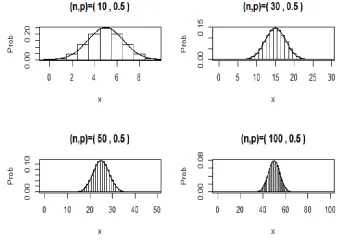
Although the binomial distribution is discrete unlike the normal distribution, when n, the
sample size is large, the binomial distribution is approximately equal to the normal distribution,
which is illustrated in the figure below. This concept is crucial since it becomes difficult to
calculate binomial probabilities when n gets large. This occurs because the binomial distribution
formula contains factorials which can be complicated in case of large sample sizes. Figure 3
[image:22.612.130.471.326.577.2]below shows the binomial distribution and the normal distribution for a variety values of n.
Figure 3: Normal approximation to the binomial
Normal approximation to the binomial distribution will be used in the statistical hypothesis
testing applied on the block cipher AES. Considering k block of bits with n bits in each block and
if in one block, the probability of 1 is p, and in the remaining blocks is p0. Then, the fraction of
1 0
n p k p
n k
(2)
and variance:
2 0 0
2
1 1 1
n p p k n p p
n k
(3)
5.3.
Three Possible Ways to Use the Array Based Approach
on the AES
First, we need to calculate the fraction of 1’s in AES using the array based approach. If AES is
random, the fraction of 1’s should be 50%, which means the probability of 1 and 0 is the same,
which is 0.5. Here is three ways to apply the array based approach:
Test1: First test is done by counting all the 1’s in the array, and then applying 1 binomial
test.
Since AES dataset has 10 rounds, each round will be considered as a separate array, and we will
have 10 binomial tests in this case. Table 1 below shows the number of times that the null
hypothesis was rejected (p-value smaller than 0.05).
Round Round1 Round2 Round3 Round4 Round5 Round6 Round7 Round8 Round9 Round10
<0.05 1 0 0 0 0 0 0 0 0 0
Test2: Second test is done by counting all the 1’s in each column of the array, and then
applying 129 binomial tests for each round.
The results below show that Round 1 has the highest failure rates with 92 failed binomial tests.
On the other hand, there were no failure issues in the other rounds except for one case in
Round 9.
Round Round1 Round2 Round3 Round4 Round5 Round6 Round7 Round8 Round9 Round10
<0.05 92 0 0 0 0 0 0 0 1 0
Table 2: Applying 129 binomial tests
Test 3: The third test is done by counting all the 1’s in each cell, and then applying 129×129
binomial tests.
Using this approach will help to detect more failure binomial tests than the previous tests since
it reaches each cell instead of each column or row. Table 3 shows that more than 11 thousand
binomial tests have failed in the first round. On the other hand, round 9 has 129 failed binomial
tests.
Round Round1 Round2 Round3 Round4 Round5 Round6 Round7 Round8 Round9 Round10
<0.05 11868 0 0 0 0 0 0 0 129 0
5.3.1.
Investigating Rounds 1 and 9 Based on the Previous Results
The previous results illustrated that round 1 and round 9 has some issues. So, it is better to take
a closer look at these rounds. Table 4 shows the number of failed binomial tests using rows,
columns, and bits for all the rounds.
Round Round1 Round2 Round3 Round4 Round5 Round6 Round7 Round8 Round9 Round10
Using
rows 76 0 0 0 0 0 0 0 0 0
Using
columns 92 0 0 0 0 0 0 0 1 0
Using
bits 128 0 0 0 0 0 0 0 0 0
Table 4: Applying binomial tests on AES using rows, columns, and bits
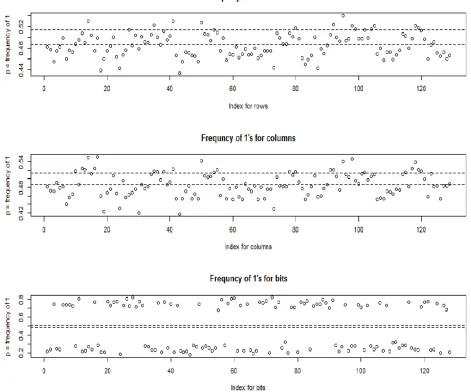
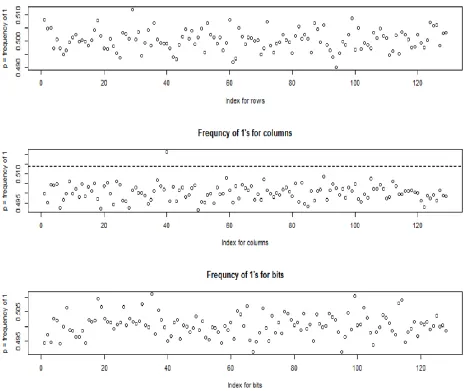
To understand the nature of the randomness, figure 4 and 5 below show the frequencies of 1’s
in each ciphertext in round 1 and round 9. The points under the dashed lines fail the test. The
dashed lines represent the 𝑃0 = 0.5 ± 𝑧. 𝑣𝑎𝑙𝑢𝑒.
Figure 4 shows the frequencies of 1’s in round 1. The first plot in the figure shows plenty of
points outside the dashed lines, which are the same 76 failure cases that were shown in table 4
earlier. The same situation in the second and third plots. On the other hand, figure 5 explains
the situation in round 9. It shows the same results of table 4, which is one point that outside
the dashed line and considered to be not random. This occurs when using columns to count the
1’s and apply the binomial tests. Other points have proportion of 1’s as 50% and considered
Figure 5: The frequencies of 1’s in round 9
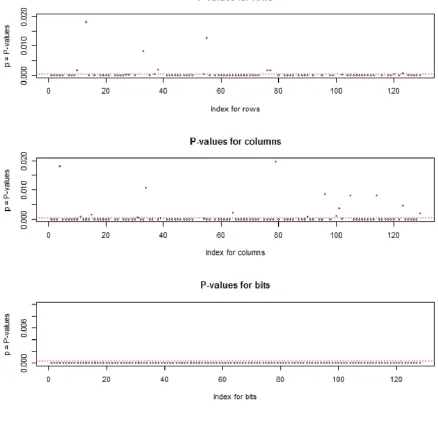
Figure 6 and 7 below display the P-values of the proportion of 1’s in each ciphertext. Figure 6
shows lots of non-randomness issues for the first round. Especially in the third plot when using
bits, all the 128 bits are under the significance level, which means the probabilities of 1’s are
less than 0.5. On the other hand, figure 7 shows only 1 point under the dashed line. The
Chapter 6
6.1.
CryptoStat Test Suite
Kaminsky and Sorrell have introduced CryptoStat (Kaminsky & Sorrell, 2013), which is a
statistical test suite that evaluates cryptographic functions’ randomness. It implements the
Bayesian model selection to analyze Block ciphers’ outputs since some earlier statistical tests
have failed in detecting randomness in cryptographic functions as previously discussed in 4.2.
However, the array based approach that was explained in chapter 5 will be used when applying
the tests on AES instead of Bayesian models.
CryptoStat test suite consists of 7 tests: the linear approximation test, the coincidence test, the
input- output independence test, the complement test, the ciphertext independence test, the
strong avalanche test, and the uniformity test. These tests were applied on 7 block ciphers:
Kasumi (3gpp.org), Blowfish (Schneier, 1993), SQUASH (Shamir, 2008), AES (NIST, 2001), IDEA
(Lai & Massey, 1999), PRESENT (Bogdanov, Knudsen, Leander, Paar, Poschmann, Robshaw et
al., 2007), and ThreeWay (Daemen, Govaerts, & Vandewalle, 1993). The results were presented
6.2.
Applying CryptoStat Test Suite on AES
Some of the tests mentioned above will be applied on AES block cipher to evaluate its
randomness using the array based approach. The statistical hypothesis testing is used, where
𝐻0 is the null hypothesis that assumes 𝑃 = 0.5 and passing the test. On the other hand, we
have 𝐻1 as the alternative hypothesis, which assumes 𝑃 ≠ 0.5 and failing the test.
The Linear Approximation Test
Test Purpose
The purpose of the linear approximation test is to assess the cryptographic function’s behavior
by evaluating precision of an equation that approximates the cryptographic function’s activity.
Function Call
(∑𝑏𝜖𝐻∪𝐺𝑏)𝑚𝑜𝑑2 (4)
where:
𝑏 is a bit group of size g, where g takes on the values 1, 2, 4, 8, ..., N, and N is the maximum size
of the ciphertext C.
𝐻 is a selected bit group from the ciphertext C with the same size as 𝑏.
𝐺 is a selected bit group from the string K//P with the same size as 𝑏, where K is the encryption
Test Description
The previous sum either evaluates to 0 or 1. If it evaluates to 1, the outcome will be considered
as a Bernoulli success. Otherwise, it is considered a Bernoulli failure. For each bit group, the
successes are counted. After that, equation 2 is applied for each column and row of AES. For
each round, if the bit group examined cannot be presented as a linear estimation of the
cryptographic function’s activity, the Bernoulli success probability θ will be equal to 𝑝, and
some other value otherwise. Figure 8 below from Prof. Kaminsky’s paper shows how the linear
approximation test works.
Figure 8: Linear Approximation Test
Applying the Linear Approximation Test on AES
When applying a test, the outputs should be 10 numbers for each dimension used since there
are 10 rounds in AES. These 10 numbers represent the number of cases that having a P-value
different than 𝑃0 , or 𝑃 ≠ 0.5, which means failing the test. Table 5 shows the results of
applying the linear approximation test on the first two rounds of the AES block cipher.
Dimension Round1 Round2
Rows 50 0
Columns 64 0
Bits 108 65
Table 5: Linear approximation test results
Using rows and columns dimensions produced 50, 64 failure cases, respectively in the first
round. On the other hand, using bits’ dimension led to failure in the second round too. While
the rounds 3 to 10 pass the test, and have 0 failure cases, which means the other rounds are
random. Figure 9 and 10 shows the frequencies of 1’s after applying the linear approximation
test for the first two rounds. Points inside the dashed line are considered random, and we fail
to reject the null hypothesis. Points outside the dashed lines have non-randomness issues.
Figure 11 and 12 in the following pages show the P-values of each ciphertext when applying the
linear approximation test on the first two rounds of AES. The first round is highly non-random
because there are plenty of points under the significance level, which means rejecting the null
hypothesis. Figure 12 also shows the P-values of the applying the linear approximation test on
round 2. Only using bits reveals 6 points under the level of significance, which was shown in
The Coincidence Test
Test Purpose
The coincidence test as described by (Kaminsky, 2013) uses a Bayesian technique to evaluate
the mapping of a (plaintext, key) to ciphertext in block ciphers.
Test Description
When P the plaintext is encrypted with the encryption key K, The Ciphertext output C is then
obtained. V is an arbitrarily chosen output which is compared to C. The coincidence test
examines all the bit sequences of size g, where g takes a value of 1, 2, 4, 8, ..., N, and N is the
maximum size of the ciphertext C. R and O are bit sequences selected from V and C where
|R|=|O|= g. A coincidence accrues when each bit of R is equal to the corresponding bit of O,
which is a success Bernoulli trial.
The coincidence test performs n Bernoulli trials and counts the number of coincidences k. If the
block cipher’s (plaintext, key) to ciphertext mapping is random, a coincidence should occur with
a Bernoulli success probability 𝑝 = 2−𝑔. The coincidence test decides between two binomial
models: 𝐻0 where the success probability is 2−𝑔, and 𝐻
1 where the success probability is
otherwise. Then, the coincidence test is repeated for each round in AES. Figure 13 below
Figure 13: Coincidence Test
Applying the Coincidence Test on AES
Table 6 below represents the results of applying the coincidence test on AES data. When using
rows or columns to apply the coincidence test, only the first round appears to fail the test.
While using bits to calculate P-values shows non-randomness in the first two rounds. There
were no non-randomness issues detected in rounds 3 to 10.
Dimension Round1 Round2
Rows 5 0
Columns 16 0
Bits 83 8
Table 6: Coincidence test results
Figure 14 and 15 below show the frequencies of 1’s when applying the coincidence test for
Figure 16 displays the P-values for the first round. The three plots in the figure show the 5, 16,
and 83 points mentioned above in table 6. These points are under the line, which means they
are not random and fail the coincidence test.
On the other hand, we have figure 17 that shows the P-values for round 2. Only using bits when
calculating P-values reveals 8 non-randomness issues, which was also shown in table 6. Lack of
dashed lines for the first two plots means that the significance threshold is outside of the range
of the values shown.
The Input- Output Independence Test
Test Purpose
The input-output independence test consists of number of subtests. Each subtest examines
whether a particular bit group of a cryptographic function’s output is independent of particular
input bit group with the same size.
Test Description
Let C be the ciphertext output from the plaintext P and the encryption key K from randomly
chosen plaintexts, keys and the corresponding ciphertext produced by the block cipher AES. The
input-output independence test’s subsets examine each pair of bit groups chosen randomly
from the input and the output. The size of these bit groups is g, where g takes on the values 1,
2, 4, 8, ..., N, and N is the maximum size of the ciphertext. The input bit group I is constructed
from bits selected from randomly generated positions in K \\ P where |I| = g. While O, the
output bit group is constructed from bits selected from randomly generated positions in C,
where |O| = g. The test then XORs these like-sized bit groups, V = I ⊕O. V is then checked for
uniform distribution using two methods: counting the 1’s in each bit position and Chi-square
test. If the input bit groups are independent of the output bit groups, then V is uniformly
distributed and classified as random, otherwise it is nonrandom. The input-output
independence test choses between two binomial models: 𝐻0 where V is uniformly distributed
and 𝐻1, where V has some other distribution. Input-output independence test is shown in
Figure 18: Input-output independence test
Applying the Input-Output Independence Test on AES
Table 7 shows the results of applying the input-output independence test on AES. Applying the
test revealed failing the test issues in the first two rounds while other rounds passed the test
and showed acceptable random behavior.
Dimension Round1 Round2
Rows 36 0
Columns 41 0
Bits 128 0
Table 7: Input-output independence results
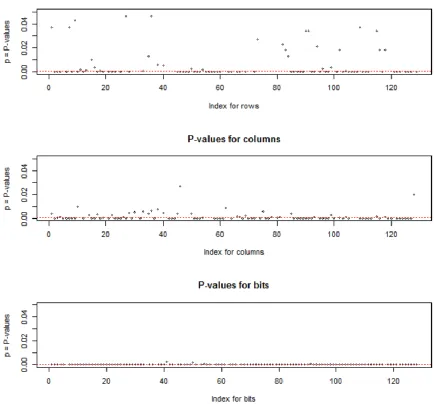
Figure 19 shows the frequencies of 1’s after applying the input-output independence test on
Figure 20 below shows the P-values when applying the input-output independence test on the
[image:47.612.86.523.141.578.2]first round.
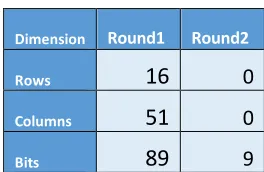
When using Chi-square test, the first two rounds failed the input-output independence test.
Table 8 displays the number of rows, columns, and bits failing the input-output independence
test.
Dimension Round1 Round2
Rows 16 0
Columns 51 0
[image:48.612.239.371.164.250.2]Bits 89 9
Table 8: Input-output independence results using Chi-squared test
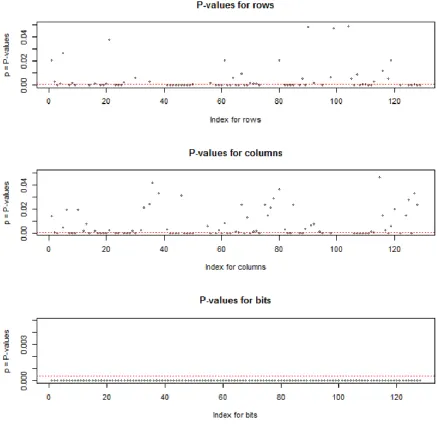
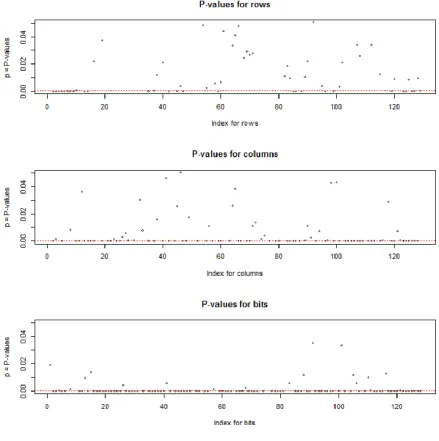
Figure 21 and 22 below show the P-values when applying the input-output independence test
Figure 22: Input-output independence test P-values for round2 using Chi-squared test
The Complement Test
Test Purpose
If 𝐶′ is a cryptographic function’s output for the inputs: 𝑃′ and 𝐾′, which are the bitwise
complements of the original inputs: a plaintext (𝑃) and an encryption key (K). Each subset of the
complement test’s subsets examines whether particular bit sequences of a cryptographic
function’s output C are independent of the same bit sequences of 𝐶′.
Test Description
Let C be the ciphertext output when P, a valid plaintext is encrypted with the encryption key K.
On the other hand, let 𝐶′ be the ciphertext output when ¬P, the bitwise complement of the
original plaintext is encrypted with key ¬K, the bitwise complement of the original encryption
key. The complement test investigates all bit groups of size g=1, and B bit groups of size g
where g takes on the values 2, 4, 8, ..., N and N is the maximum size of the ciphertext.
Let O and 𝑂′ are like-sized bit groups produced from randomly chosen positions from C and 𝐶′
respectively. If V= O⊕𝑂′ and V is uniformly distributed, then the cipher-texts C and 𝐶′ are
independent of each other and V can be said to be random. The complement test decides
between two binomial models: 𝐻0 where V is uniformly distributed and 𝐻1, where V has some
other distribution.
Applying the Complement Test on AES
Due to the complement test’s description, it cannot be applied on AES because we don’t have
The Ciphertext Independence Test
Test Purpose
The ciphertext independence test’s subsets examine if each bit group of a cryptographic
function’s output is independent of other bit groups in that same output.
Test Description
Let C be the ciphertext output when a plaintext P is encrypted with an encryption key K. The
ciphertext independence test evaluates each pair of bit groups from the ciphertext C. Let 𝑂1
and 𝑂2 be two bit groups from two randomly chosen bit positions in the ciphertext C. These
two bit groups are like-sized with |𝑂1|=|𝑂2|=g where g takes on the values 2, 4, 8, ..., N/2 and
N is the maximum size of the ciphertext. In addition, 𝑂1∩ 𝑂2 = ∅, the intersection of these two
sets must be empty. If the cryptographic function being tested satisfies the ciphertext
independence criterion, the two bit positions in the ciphertext C (where𝑂1 and 𝑂2 were
constructed from) are independent and V=𝑂1⊕𝑂2 is a uniformly distributed variable. Then,
one of the two models will be chosen: 𝐻0 where V is uniformly distributed and 𝐻1, where V has
some other distribution. Figure 23 below from Kaminsky and Sorrell paper shows how the
Figure 23: Ciphertext independence test
Applying the Ciphertext Independence Test on AES
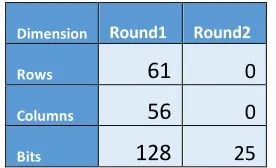
Table 9 represents the number of rejecting the null hypothesis cases when applying the
ciphertext independence test on AES using counting the 1’s in each bit position method.
Dimension Round1 Round2
Rows 61 0
Columns 56 0
[image:53.612.238.376.457.541.2]Bits 128 25
Table 9: Ciphertext independence test results
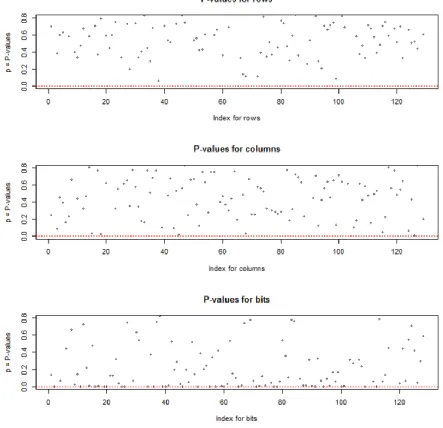
Figure 24 and 25 show the frequencies of 1’s after applying the ciphertext independence test
on round 1 and 2. In figure 24 for round 1, all the points are under the dashed lines when using
Figure 26 shows the P-values of the cyphertexts in round 1. All the points in the third plot are
located under the level of significance. On the other hand, figure 27 only shows some issues in
[image:56.612.68.506.171.590.2]the second round.
Figure 28 and 29 shows the P-values of applying the ciphertext independence test using the
[image:58.612.71.512.135.567.2]Chi-squared test method.
The Strong Avalanche Test
Test Purpose
The strong avalanche test’s subsets examine all possible ciphertexts produced by flipping each
bit of the plaintexts and keys.
Test Description
When P the plaintext is encrypted with the encryption key K, The Ciphertext output C is then
obtained. Let 𝑃′ is the plaintext produced by flipping one bit in P, the original plaintext. Also, let
𝐾′ is the encryption key produced by flipping one bit in the original encryption key K, and 𝐶′ is
the ciphertext output when either a plaintext 𝑃′ is encrypted with the original key K, or the
original plaintext P is encrypted with key 𝐾′. Thus, the ciphertext 𝐶′ will be containing the bits
that were produced by flipping all possible bits in both K and P. The strong avalanche test
analyzes bit groups from both ciphertext outputs C and 𝐶′ by comparing between each bit
group O from C and the corresponding bit group 𝑂′ from 𝐶′ when |O|=|𝑂′|= g, whereg takes a
value of 1, 2, 4, 8, ..., N, and N is the maximum size of the ciphertext C. If V= O⊕𝑂′ and V is
uniformly distributed, then each bit of the bit group 𝑂′ differs from the corresponding bit of O
with probability 1/2 and V can be said to be random. The strong avalanche test then decides
between two binomial models: 𝐻0 where V is uniformly distributed and 𝐻1, where V has some
other distribution. Figure 30 shows a simple structure for one round from AES. Each Ciphertext
C consists of 128 bits. If strong Avalanche test was applied on the first ciphertext 𝐶1,1, both 𝐶1,2
and 𝐶2,1 are produced by flipping one bit in the plaintext or the encryption key, and could be
Figure 30: Structure of an AES round
Applying the Strong Avalanche Test on AES
The results are shown in table 10 and figures 31, 32, 33, and 34 below. Only the first two
rounds seem to fail the strong avalanche test. Second round only has problems when using bits
in calculating the P-values.
Dimension Round1 Round2
Rows 27 0
Columns 44 2
[image:61.612.239.372.505.590.2]Bits 119 27
Table 10: Strong Avalanche test results
Figure 31 and 32 show the frequencies of 1’s when applying the strong avalanche test on the
Figure 32: Frequencies of 1's for the strong avalanche test in round 2
Below, there are figure 33 and 34 showing the P-values of applying the strong avalanche test on
round 1 and 2 of AES. Figure 33 for first round has plenty of points under the significance level.
The Uniformity Test
Test Purpose
The uniformity test examines whether specific bit groups from the ciphertext output C are
uniformly distributed or not.
Test Description
Let C be the ciphertext output when P, a valid plaintext is encrypted with the encryption key K.
The uniformity test investigates all bit groups of size g=1, and B bit groups of size g from the
ciphertext output where g takes on the values 2, 4, 8, ..., N and N is the maximum size of the
ciphertext. Let O be a bit group produced from randomly chosen positions from C when|O|=g.
If O is uniformly distributed, then the ciphertext output C can be said to be random. The
uniformity test choses between two binomial models: 𝐻0 where V is uniformly distributed and
𝐻1, where V has some other distribution.
Applying the Uniformity Test on AES
The results of applying the uniformity test on AES’s rounds are shown in table 11, figure 35 and
36 below. The first round is the only round that fails the test and considered not random based
on the uniformity test.
Dimension Round1 Round2
Rows 32 0
Columns 42 0
[image:66.612.240.372.591.674.2]Bits 128 0
Figure 36: Uniformity test P-values for round1
Table 12, figure 37 and 38 represent applying the uniformity test using the Chi-squared test
method. In this case, two rounds failed the uniformity test.
Dimension Round1 Round2
Rows 43 0
Columns 61 0
[image:68.612.239.373.598.681.2]Bits 128 11
Chapter 7
Results and Discussion
In the previous chapter, CryptoStat test suite was applied on AES. When using counting the
numbers of 1’s in each bit position, the first round failed all the tests, but the second round
failed the linear approximation test, coincidence test, ciphertext independence test, and strong
avalanche test. On the other hand, when using the Chi-squared test method, the first two
rounds failed all the tests. Other rounds pass the tests and show acceptable randomness.
Figure 39 shows the results of applying the CryptoStat test suite on AES.
Also, using the array based approach allowed us to understand the nature of non-randomness
in AES. For example, using bits always shows more non-randomness cases because it has more
Figure 39: CryptoStat test suite results
To conclude, round 1 and 2 of the AES block cipher are non-random based on CryptoStat test
suite. The rounds 3, 4, 5, 6, 7, 8, 9, and 10 are random rounds. Although AES was designed to
have 10 rounds to eliminate the non-randomness, the first two rounds were enough.
0 1 2 Non -r an do m r o und s
CryptoStat Test Suite
Chapter 8
Conclusion and Future Work
We hereby conclude the results of this thesis by summarizing the analysis and providing some
future work. The focus of this thesis is to evaluate the randomness of the Advanced Encryption
Standard (AES) block cipher, which comprises of 10 rounds. CryptoStat is a statistical test suite
that evaluates cryptographic functions’ randomness, which includes 7 tests: linear
approximation test, coincidence test, input output independence test, complement test,
ciphertext independence test, strong avalanche test, and uniformity test. Except for the
complement test, these tests were applied on AES using an array based approach and
hypothesis testing.
The results show that the first two rounds have some randomness issues. On the other hand,
the other rounds pass the tests and can be considered random.
Future work can include adding new statistical tests to CryptoStat test suite, and then applying
them to AES to investigate its randomness. The array based approach could be used to apply
Appendix A
Selected R Code
########AES Structure########
> str(C.mat.list)
List of 3
$ A: int [1:129, 1:128] 0 1 0 1 1 1 0 1 0 1 ... $ B: int [1:129, 1:128] 0 1 1 1 0 0 0 0 1 0 ...
$ C: int [1:129, 1:129, 1:10, 1:128] 0 1 0 0 1 1 0 1 0 0 ...
######## An array based approach#######
##Test 1: counting all the 1s and applying 1 binomial test##
load("C.mat.list")
C.mat <- C.mat.list$C
Ind <- c(1,2,4) # 1 for rows, 2 for columns, and 4 for bits
v <- apply(C.mat,3,sum)
n <- prod(dim(C.mat)[Ind])
p <- v/n
SE <- sqrt(0.25/n)
p.val <- 2*(1-pnorm(abs(p-0.5)/SE))*10*100
##Test 2: counting all the 1s in each column and applying 129 binomial tests##
Ind <- 2 # 1 for rows, 2 for columns, and 4 for bits
Dim.v <- dim(C.mat)[c(Ind,3)]
p.val.mat <- matrix(0,Dim.v[1],Dim.v[2])
n <- prod(dim(C.mat)[-c(Ind,3)]) # sample size for each test
SE <- sqrt(0.25/n)
k <- prod(Dim.v) # number of comparisons
if (Ind>3) Ind <- Ind - 1
for (Round in 1:10) {
C.mat.R <- C.mat[,,Round,]
v <- apply(C.mat.R, Ind, sum)
p <- v/n
p.val.mat[,Round] <- 2*(1-pnorm(abs(p-0.5)/SE))*k*100
}
apply((p.val.mat < 5),2,sum)
a <- apply(p.val.mat,2,min)
##Test 3: counting all the 1s in each cell and applying 129*129 binomial tests for each round##
p.val.f <- function(mat){
Ind <- 2 #1 for rows, 2 for columns, and 4 for bits
Dim.v <- dim(C.mat)[c(Ind,3)]
p.val.mat <- matrix(0,Dim.v[1],Dim.v[2])
n <- prod(dim(C.mat)[-c(Ind,3)]) # sample size for each test
SE <- sqrt(0.25/n)
k <- prod(Dim.v) # number of comparisons
for (Round in 1:10) {
C.mat.R <- C.mat[,,Round,]
v <- apply(C.mat.R, Ind, sum)
p <- v/n
p.val.mat[,Round] <- 2*(1-pnorm(abs(p-0.5)/SE))*k*100
}
p.val.mat}
load("C.mat.list")
for (Round in 1:10) {
C.mat.R <- C.mat[,,Round,]
v <- apply(C.mat.R, 1, p.val.f)
v}
a <- apply((v < 5),1,sum)
a2 <- matrix(a,129,10)
apply(a2 ,2,sum)
b <- apply(v,1,min)
b2 <- matrix(b,129,10)
round(apply(b2,2,min),1)
############# Plotting round 1 and round 9############
Round <- 1
load("C.mat.list")
C.R1.mat <- C.mat.list$C[,,Round,]
par(mfrow=c(3,1))
for (Ind in 1:3) {
n <- prod(dim(C.R1.mat)[-Ind]) # sample size for each test
k <- dim(C.R1.mat)[Ind] # number of comparisons
SE <- sqrt(0.25/n)
freq.p.v <- apply(C.R1.mat, Ind, sum)
freq.p.v <- freq.p.v/n
plot(freq.p.v,xlab=paste("Index for",Label[Ind]), ylab="p = frequency of 1",
main=paste("Frequncy of 1's for",Label[Ind]))
z.val <- qnorm(1-0.05/(2*k), sd=SE)
abline(h = 0.5+z.val,lty=2)
abline(h = 0.5-z.val,lty=2)
}
#################Coincidence Test##################
P.val.f <- function(Ind=1,V=c(1,1,1,1)) {
Match.V.f <- function(t,V=1) {
all(t==V)
Coincid.vec.test.f <- function(x,V=1) {
k <- length(V)
m <- floor(length(x)/k)
mat <- matrix(x[c(1:(k*m))],k,m)
d <- apply(mat,2,Match.V.f,V=V)
sum(d)
}
Coincid.mat.test.f <- function(mat,V=1) {
Count.v <- apply(mat,1,Coincid.vec.test.f,V=V)
sum(Count.v)
}
load("C.mat.list")
C.mat <- C.mat.list$C
Dim.v <- dim(C.mat)[c(Ind,3)]
Dim.test.v <- dim(C.mat)[-c(Ind,3)]
m <- length(V)
k <- prod(Dim.v) # number of comparisons
SE <- sqrt(0.25/n)
p.val.mat <- matrix(0,Dim.v[1],Dim.v[2])
p0 <- 2^(-m)
# Now calculating for each round:
if (Ind>3) Ind <- Ind - 1 # "manual" adjustment for Ind beyond Round index
for (Round in 1:10) {
C.mat.R <- C.mat[,,Round,]
# here need to apply coincidence test to the matrix (for now to rows only)
v <- apply(C.mat.R, Ind, Coincid.mat.test.f,V=V)
p <- v/n
p.val.mat[,Round] <- 2*(1-pnorm(abs(p-p0)/SE))*k*100
# browser()
# This needs adjustment if Ind is a vector
# *k because of Bonferroni
# *100 to get percentages
p.val.mat # typically 129 by 10 matrix
}
b <- P.val.f(Ind=1)
apply((b < 5),2,sum)
####################Uniformity Test#################
Unif.P.val.f <- function(Ind=1,V=c(1,1,1,1)) {
Unif.vec.test.f <- function(x,V=V) {
k <- 32
m <- floor(length(x)/k)
mat <- matrix(x[c(1:(k*m))],k,m)
v1 <- apply(mat,2,sum)
v2 <- k-v1
v <- rbind(v1,v2)
v <- t(v)
p.v <- rep(0,m)
p.v[j] <- chisq.test(v[j,])$ p.val
}
sum(p.v)
}
Unif.mat.test.f <- function(mat,V=V) {
Count.v <- apply(mat,1,Unif.vec.test.f,V=V)
sum(Count.v)
}
load("C.mat.list")
C.mat <- C.mat.list$C
Dim.v <- dim(C.mat)[c(Ind,3)]
Dim.test.v <- dim(C.mat)[-c(Ind,3)]
m <- 32
n <- Dim.test.v[1]*floor(Dim.test.v[2]/m) # sample size for each test
k <- prod(Dim.v) # number of comparisons
SE <- sqrt(0.25/n)
p0 <- 2^(-1)
# Now calculating for each round:
if (Ind>3) Ind <- Ind - 1 # "manual" adjustment for Ind beyond Round index
for (Round in 1:10) {
C.mat.R <- C.mat[,,Round,]
# here need to apply coincidence test to the matrix (for now to rows only)
v <- apply(C.mat.R, Ind, Unif.mat.test.f,V=V)
p <- v/n
p.val.mat[,Round] <- 2*(1-pnorm(abs(p-p0)/SE))*k*100
}
p.val.mat # typically 129 by 10 matrix
}
a <- Unif.P.val.f (Ind=1)
Chapter 9
Bibliography
NIST;
https://www.nist.gov/
.
3gpp.org. 3rd Generation Partnership Project; Technical Specification Group
Services and System Aspects
3G Security; General Report on the Design, Speification and Evaluation of 3GPP
Standard Confidentiality and Integrity Algorithms.
Bogdanov, A., Knudsen, L. R., Leander, G., Paar, C., Poschmann, A., Robshaw, M. J.
B., Seurin, Y., & Vikkelsoe, C. 2007. PRESENT: An Ultra-Lightweight Block
Cipher, vol. 4727: 450-466. Berlin, Heidelberg: Springer Berlin Heidelberg.
Boutin, C. 2005. Pi Seems A Good Random Number Generator - But Not Always
The Best. Purdue University.
Brown, R., Eddelbuettel, D., & Bauer, D.; Dieharder: A Random Number Test Suite.
Daemen, J., Govaerts, R., & Vandewalle, J. 1993. A New Approach To Block Cipher
Design; In: Fast Software Encryption: pp. 18-33: Springer-Verlag.
Dent, A. W. & Mitchell, C. 2005.
User's guide to cryptography and standards
.
Boston: Artech House.
Doganaksoy, A., Ege, B., Kocak, O., & Sulak, F. 2010. Cryptographic Randomness
Testing of Block Ciphers and Hash Functions. (Institute of Applied
Mathematics, Middle East Technical University, Ankara, Turkey).
Goldberg, I. & Wagner, D. 1996. Randomness and the Netscape browser, vol. 21:
66-66. SAN MATEO: MILLER FREEMAN, INC.
Hoyt, K. 2016.
Structuring Statistical Tests for Validating Encryption: An Array-based
Approach
. ProQuest Dissertations Publishing.
Hörmanseder, D. R. & Erik, S. 2007. randomness in cryptography.
Kaminsky, A.; The Coincidence Test: a Bayesian Statistical Test for Block Ciphers
and MACs.
Kaminsky, A. & Sorrell, J. 2013. CryptoStat: a Bayesian Statistical Testing
Kessler, G. C.
2015. An Overview of Cryptography. 54.
L'Ecuyer, P. & Simard, R. 2007. TestU01: A C library for empirical testing of random
number generators.
ACM Transactions on Mathematical Software (TOMS)
,
33(4): 1-40.
Lai, X. & Massey, J. 1999. A Proposal for a New Block Encryption Standard. In:
EUROCRYPT: pp. 389-404: Springer-Verlag (1991).
Marsaglia, G.; Diehard battery of tests of randomness;
http://www.stat.fsu.edu
/pub/diehard/linux.tar.gz.
Matthews, J. 2003. Network Security Basics. Cornell university.
NIST. 2001.
Announcing the advanced encryption standard (AES)
. Gaithersburg,
MD: Computer Security Division, Information Technology Laboratory,
National Institute of Standards and Technology.
Paar, C. & Pelzl, J. 2010.
Understanding cryptography: a textbook for students and
practitioners
. Berlin: Springer.
Rao, A. 2007.
Randomness extractors for independent sources and applications
.
ProQuest Dissertations Publishing.
Rukhin, A. L. & Bassham, L. E. 2008. A statistical test suite for random and
pseudorandom number generators for cryptographic applications, vol.
Revision 1. Gaithersburg, MD: U.S. Dept. of Commerce, National Institute of
Standards and Technology.
Schneier, B. 1993. Description of a New Variable-Length Key, 64-Bit Block Cipher
(Blowfish); In: Anderson, R. (ed.) Fast Software Encryption, Cambridge
Security: pp. 191-204: Springer-Verlag (1994).
Shamir, A. 2008. SQUASH – A New MAC with Provable Security Properties for
Highly Constrained Devices Such as RFID Tags; In Nyberg, K. (ed.) 15th
International Workshop on Fast Software
Encryption, vol. vol. 5086: pp. 144-157: Springer, Heidelberg (2008).
Soto, J. & Bassham, L. 2000. Randomness Testing of the Advanced Encryption
Standard Finalist Candidates. Gaithersburg, MD: NIST.
Walker, J.; ENT: a pseudorandom number sequence test program;
http://www.fourmilab.ch/random/
.
Wright, M. A. 2001. The Advanced Encryption Standard.
Network Security
,