Performance
Evaluation
of a Stochastic
Optimization
Model
for Reservoir
Design
and Management
With Explicit
Reliability
Criteria
MARK H. HOUCK AND BITHIN DATTA
School of Civil Engineering, Purdue University, West Lafayette, Indiana 47907
A seasonal,
chance-constrained
linear
programing
model,
which
facilitates
the
development
of reser-
voir
system
designs
and
operation
policies
and
which
incorporates
multiple
linear
decision
rules
(LDR)
conditioned upon the streamflows in other seasons, is evaluated with variations in the numbers of seasonsper
year
and
decision
rules
per
season.
The
performance
is also
compared
with
the
original,
single-LDR
model.
The
motivations
for
the
expected
results
and
the
numerical
solutions
obtained
for the
examples
considered
are
presented.
The
multiple-LDR
model
is shown
to be
superior
to the
single-LDR
model:
for
equivalent
restrictions
on the
reservoir
operation
and
performance
the
multiple-LDR
model
gives
a
smaller
capacity
reservoir
than
the
single-LDR
model.
Furthermore,
as
the
number
of LDR's
per
season
is increased,
the
required
capacity
decreases.
And
when
the
operating
rules
defined
by the
models
are
tested
in a simulation
of actual
reservoir
operation,
the
multiple
LDR's
perform
more
closely
to the
spec-
ifications prescribed in the linear program than the single LDR.INTRODUCTION
During
the last 10 years
the problems
of sizing
and opera-
tion of water
reservoir
systems
have
received
great
attention
with the introduction
of systems
analysis
and operations
re-
search
methodologies.
These
attempts
are aimed
at optimal
decision
making
in reservoir
regulation,
together
with simulta-
neous
explicit
statements
on the degree
of risk or reliability
with
which
the
various
objectives
can
be met
in the long
run.
One approach
to finding
optimal
operating
rules,
as pro-
posed by Re Velle et al. [1969], requires the release rule to be alinear
function
of reservoir
storage.
As applied
to reservoir
op-
eration,
the form
of this
linear
decision
rule (LDR) is X = $ -
b, where
X denotes
the
release
during
a period
of reservoir
op-
eration,
$ denotes
the storage
at the end
of the previous
pe-
riod,
and b is the decision
parameter
chosen
to optimize
a cri-
terion
function.
This rule may be interpreted
as an aid to the
actual
operator's
judgment
in selecting
a release
commitment.
Since the introduction of linear decision rules in water res-
ervoir
management
problems
by Rel/'elle
et al. [1969],
many
modifications, extensions, and discussions of the rule havebeen
reported
in the literature
[e.g.,
Sobel,
1975;
Loucks,
1976;
$niedovich,
1980].
Loucks
and Dorfman
[1975]
proposed
a
LDR that is a function
of present
storage
volume
and future
inflow;
the future
inflow
is assumed
to be a known
quantity.
Gundelach and ReF'elle [1975] and ReF'elle and Gundelach[1975]
proposed
a LDR that
is a function
of present
and
past
storage volumes. Both of these extended LDR's, when em-ployed
in an optimization
model
with an objective
of mini-
mizing
reservoir
storage
capacity
subject
to satisfying
several
performance
criteria,
require
smaller
reservoirs
than
the origi-
nal LDR. Other investigators have demonstrated the ease of finding optimal linear decision rules under certain conditions[Eastman
and Rel/'elle,
1973],
the means
of including
eco-
nomic
efficiency
as the criterion
for determining
optimal
LDR's
[Houck
et al., 1980],
and
the
use
of LDR's
in multiple-
reservoir
operations
[Joeres
et al., 1971;
Nayak and •lrora,
1971].
Loucks
and Dorfman
[1975]
presented
a comparative
study of some of the existing forms of the linear decision rules.Still
other
investigators
have
discussed
the physical
meaning
and implications of reservoir operation reliabilities in an at-Copyright ¸ 1981 by the American Geophysical Union.
Paper number IW0453. 0043-1397/81/001 W-0453501.00
tempt to develop a probability theory of reservoirs based en-
tirely
on statistical
techniques
[Phatarford,
1976;
Kleme•,
1969,
1970].
Methods
of finding
storage
size-probability
of failure-
draft relationships for reservoirs with Markovian seasonal in- puts and methods of accounting for the seasonal and annual
correlation of streamflows are discussed in these works.
Models to define optimal operating rules that do not use linear decision rules have also been reported in the literature.
Colorni
and Fronza
[1976],
$imonovic
and Marino
[1980],
and
others have employed
reliability programing,
a form of
chance-constrained
dynamic
programing,
to find optimal
op-
erating
rules.
Young
[1967],
Bhaskar
and Whitlatch
[1980],
and
others
have
proposed
using
deterministic
optimization
models
and regression
analysis
to develop
operating
rules. Butcher
[1971], Buras [1966], and others have assumed a discreteMarkov structure
for streamflows
and used
stochastic
dy-
namic
programing
to define
operating
rules.
Loucks
[1969],
Houck and Cohon [1978], and others also assumed a discreteMarkov
structure
for the streamflows
but found operating
rules
using
linear programing.
And numerous
investigators
have
reported
other
methods
for finding
optimal
reservoir-op-
erating rules.The purpose
of this paper
is to evaluate
a proposed
mul-
tiple-LDR
model
[Houck,
1979].
Instead
of a single
LDR per
season, several LDR's per season, each conditioned on the previous season's streamflow, are defined. Thus the feasible
region
of the operation
rules
is relaxed,
allowing
improvement
in the reservoir operation. The multiple-LDR model is solved
for various
numbers
of LDR's
per season
and seasons
per year
for a hypothetical
reservoir
on the Gunpowder
River
in Mary-
land. The solutions are compared with each other and withthe solution
of the single-LDR
model
proposed
by Re I/'elle
et
al. [1969].
The results
of simulating
the optimum
operation
policies of the single- and multiple-LDR models are also com- pared.
LDR MODELS
Because the single-LDR model is a special case of the more
general
multiple-LDR
model,
the latter
will be presented
first.
The objective function of the model is chosen to be mini-
mization
of the capacity
of the reservoir,
which
may be con-
sidered
as a surrogate
for initial
economic
costs.
Physical
op-
828 HOUCK AND DATTA: STOCHASTIC RESERVOIR DESIGN AND MANAGEMENT OPTIMIZATION
erating restrictions and performance requirements are
incorporated as constraints in the linear programing model.
The following notation is used in the model:
X/j release in season t, conditioned upon streamflows in interval i in season t - 1 and interval j in sea- son t - 2;
S/ storage volume at the beginning of season t, con- ditioned upon streamflow in interval j in season t
- 2;
b/ decision parameter in season t, conditioned on
streamflow in interval i in season t - 1;
R/ streamflow in season t, conditioned on stream-
flow in interval i in season t - 1, a random vari- able;
F•,_•( ) cumulative distribution function of streamflows in season t - 1, conditioned on streamflow in in-
terval j in season t - 2;
P? probability of streamflow in interval j in season t
- 2;
P/J probability of streamflows in intervals i and j
during seasons t- 1 and t - 2, respectively; oil • probability with which X/• equals or exceeds
Xm•;
/•? probability with which St ./equals or exceeds $•n; ¾? probability with which $? does not exceed CAP; CAP reservoir capacity;
i,j indices of streamflow interval in seasons t - 1
and t - 2;
I, J number of streamflow intervals in seasons t - 1
and t - 2;
$m• minimum permissible storage volume;
t index of seasons;
T number of seasons per year;
Xm• minimum allowable release volume per season;
a probability with which releases in a season ex- ceed or equal Xm•n;
• probability with which storage volume in a sea- son equals or exceeds $m•;
¾ probability with which storage volume in a sea- son does not exceed CAP;
F•t_•-•() inverse cumulative distribution function of
streamflows in season t - I conditioned on streamflow in season t - 2 occurring in intervalj.
The continuity equation, or mass balance equation, for storage in the reservoir is
s,+,'= s/+ &'-
The form of the linear decision rule to be used is
X/• -- S?- b ,'
For each season t and for each range or interval i of stream-
flow volume in season t - 1, there will be a decision parameter
b/. Thus the release in season t will be dependent on the streamflows of previous seasons. Substituting the linear deci- sion rule yields
X, • = R,_? + b,_?- b/ (2)
Therefore storage and release are reduced to relations be-
tween the inflow and the decision parameter only. The per- formance criteria are defined in terms of minimum and maxi-
mum required storages and the minimum permissible release.
The first set of chance constraints, to define the probability that each possible release in a season exceeds the minimum al-
lowable release, is
or
or
•[ XtiJ •. Xmin ] = a t ij (3)
P[R,_? + b,_?- b,'> Xm• = or/• (4)
e[&_¾ <_ -- b,_/ + 03 = - (5)
Because R,_• j is a random variable, the left-hand side of the
equation is the cumulative distribution function (CDF) of the
streamflows in season t - 1, conditioned on the streamflow in
season t - 2 occurring in interval j. This CDF, denoted by
F•_,(), can be written as
C_,(Xm• - b,_? + b/) = 1 - ,,'J (6)
Denoting the inverse CDF by Fj,_,-'( ) allows (6) to be writ-
ten as
Xm•, - Or_? + b/- Fjt-,-'(1 - at ø) = 0 (7)
i-- 1,2, '..,I j-- 1, 2, ...,J t= 1,2, ..-, T
The convex portion of the inverse CDF can be piecewise linearized so that the regular simplex algorithm or its common variants may be used. Houck [1979] has shown that in the range of interest of the model the inverse CDF can be taken as convex without incurring formidable errors. However, with an increase in the number of decision rules per season, or in
the number of seasons considered per year, some accuracy
may have to be sacrificed in order to keep the feasible region convex. The actual reliability with which release in season t exceeds Xm•, is the expected value of the atø'; this reliability is specified to exceed a, which may assume values like 0.8, 0.9, or 0.99, depending on the actual planning or management problem under consideration. The reliability constraint on re- lease is
•. •. P,•a/•
• a
t = 1, 2, ..., T
(8)
The same procedure is followed in formulating the reliabil-
ity constraint on the minimum storage requirement:
P[S/>_ Sm•] -- fi,J (9)
or
j= 1,2, ... ,J t-- 1,2, ..., T
The reliability with which minimum storage is exceeded is specified as/•, and the reliability constraint is given as
or
• P?lg/>•lg t= 1,2, ..., T
(11)
The other restriction on the maximum storage is given as
P[S/• CAP] = ¾/ (12)
CAP- b,_?- F•,_,-'(¾/)= 0
j= 1,2, ...,J
(13)
The reliability with which the storage must not exceed the dam capacity is specified as ¾, and the reliability constraint is given by
•. P/¾?_•
¾
t -- 1, 2, ..., T
(14)
J
The entire multiple-LDR model comprises an objective function of minimize reservoir capacity (minimize CAP) and constraints on minimum storages ((10) and (11)), maximum storages ((13) and (14)), and minimum releases ((7) and (8)). As was stated previously, the model can be solved as a linear program.
The single-LDR model is obtained by restricting the indices i and j to a single value i -- j -- 1. Then there is only one LDR
per season, p,' -- 1.0, P," -- 1.0, and the release in one season
is now independent of the streamflows in previous seasons. The loss of the dependence of release on previous streamflows and the reduction in the number of release rules per season as incorporated in the multiple-LDR model are expected to re- suit in the single-LDR model requiring a larger reservoir ca- pacity than the multiple-LDR model to achieve the same per- formance criteria.
TESTING THE LDR MODELS
The multiple-LDR model was extensively tested and com- pared with the single-LDR model. The operating rules speci- fied by the solutions of the LDR models were tested in a reser-
voir simulation model. The LDR models were constructed for,
and all testing was performed on, a hypothetical reservoir lo- cated on the Gunpowder River in Maryland.
In the first phase of testing, the number of seasons (i, j) con- sidered per year was varied, starting with two seasons of 6 months each, in both the multiple-LDR and the single-LDR models. For the multiple-LDR model the number of intervals per season, that is, the number of decision rules considered per season, was also two; the median streamflow value of the historical record was used to partition the intervals, so that the frequency of occurrence of streamflows in each season and each interval was equal. In a similar manner the number of seasons per year was increased up to six. The solutions were obtained for both types of LDR models with equivalent num- bers of seasons and for different specified values of minimum release and/or m'mimum storage. In the second phase the number of intervals or decision rules in the multiple-LDR model was increased to three and tested in a four-season model.
The most time-consuming portion of this study was the ac-
tual formulation of the model, which also included the com-
putation of joint and conditioned probability distributions from the historical streamflow data. The commonly adopted method of frequency interpretation was used, and Weibull's plotting formula was ut•ed to find the cumulative distribu- tion functions. The number of intervals into which a particu- lar season could be partitioned was limited by the length of the historical record available. Even a relatively long record of 81 years can provide only 27 plotting positions per season if streamflows are divided into three intervals. This is a vital lim-
itation because the multiple-LDR model is a linear program that necessitates the linear approximation of the cumulative conditioned distribution functions. All the models tested were
found to be highly sensitive to even small variations in plot-
TABLE 1. Solutions for Two-Season LDR Models
Minimum Required Capacity (CAP*), 106 m s
Xm•n, Multiple LDR
106 mS/season Single LDR (Two Intervals)
0-62.5 239.1 189.3 73.1 241.6 189.3 83.6 252.0 189.3 93.9 262.5 189.9 96.2 264.6 192.0 99.2 infcasible ... * 104.5 infeasible 200.4 115. l-oo infeasible infeasible
*The value of CAP* was not determined for certain Xm• values.
ting positions for very low and high probabilities. However,
this does not undermine the comparative judgments presented here.
The number of linear segments used to piecewise linearize the nonlinear conditioned CDF's was determined by actual eye estimation, based on the shape of the individual CDF's; no hard and fast rules were followed. Only the convex regions in decision space given by the CDF's could be considered be- cause a convex decision space is necessary to ensure a global optimal solution.
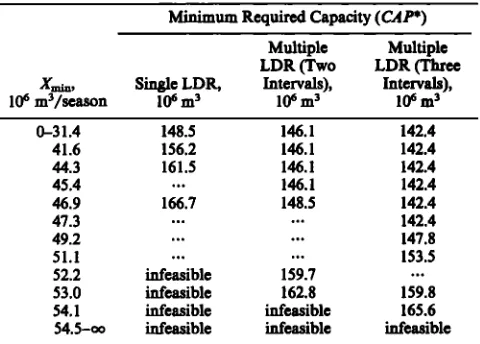
Some sample solutions of the single-LDR and multiple- LDR models for the different variations as described earlier
are summarized in Tables 1-3. The LDR models are solved
without any restfictions on maximum release and minimum
freeboard. The value of S.•t. equals 52.2.10 6 m • and the relia-
bility levels (a, fi, ¾) are set equal to 0.9 in all models unless stated otherwise. Also, the seasons within any particular model are of equal length.
In an effort to improve the four-season, three-interval, mul- tiple-LDR model's performance the constraints corresponding to events of very low joint probability were removed from the model. No significant improvement resulted, especially for very low specified releases. This is due mostly to the fact that for very low values of Xm• the constraints on a, ø are rarely binding; hence the constraints on CAP and Sm• determine the solution.
The models were also solved with different values of Sm•.
AS was found by Re Velle et al. [1969], the optimal value of CAP changed by an amount equal to the change in S.•t.. It was also found, as expected, that the feasible range of X•t. in-
TABLE 2. Solutions for Four-Season LDR Models
Minimum Required Capacity (CAP*)
Xmin, Single LDR, 10 6 m3/season 10 • m 3
Multiple Multiple LDR (Two LDR (Three
Intervals), Intervals),
10•m z 10•m z
[image:3.589.300.540.573.745.2]830 HOUCK AND DATTA: STOCHASTIC RESERVOIR DESIGN AND MANAGEMENT OPTIMIZATION
TABLE 3. Solutions for Six-Season LDR Models
Minimum Required Capacity (C4P*)
Multiple LDR Xmin, Single LDR, (Two Intervals),
106 m3/season 106 m 3 106 m 3
0-22.7 125.1 123.5 26.5 133.2 123•6 30.3 148.4 138.0 32.2 infeasible 145.5 33.3 infeasible 150.1 34.1-oo infeasible infeasible
creases with a decrease in reliability levels (a,,/•,, ¾,). And the minimum capacity required for a specified minimum release increases as the reliability levels increase: for the six-season,
two-interval, multiple-LDR model, with Xmin equal to
26.5,106 m 3, the minimum capacity is 123.6,106 m 3 with relia-
bility levels of 90% but is 164.9,106 m 3 with reliability levels of
95%.
For the typical multiple-LDR model just mentioned the so- lution of the linear program, by the multipurpose opti- mization system resident on a CDC6500, required approxi- mately 60 CPU seconds and cost about $2; the number of constraints equals 199; the number of lower or upper bounds specified equals 96; and the number of variables was 126. However, it should be noted that the size of the linear pro- gram may be substantially increased by increasing the num-
ber of straight-line approximations of the CDF's. The per- formance evaluation of the model through simulation is
discussed next.
PERFORMANCE EVALUATION
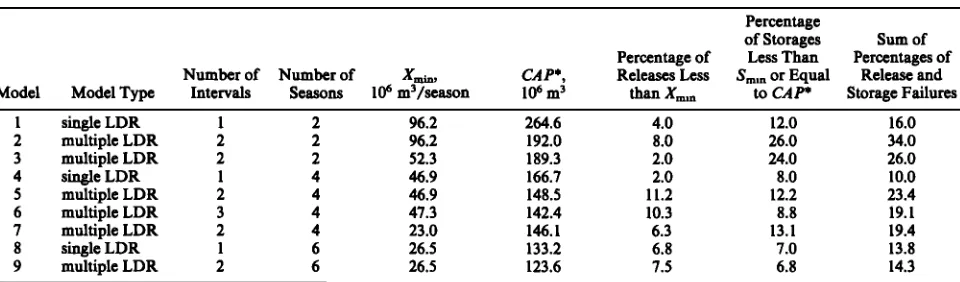
A simulation study was performed with the release policies specified by the solution of the multiple-LDR and single-LDR models. The program was made as simple as possible to simu- late the way a hypothetical, single reservoir may operate if the decision rules are blindly applied. Thus whenever possible, the reservoir release equaled the relevant LDR. A failure was defined as any time the LDR could not be followed because too little water was available (actual release is less than LDR) or spilling occurred (actual release is greater than LDR) and any time the release failed to satisfy the minimum required re- lease. Most of the simulations (all of those included in Table 4) were performed for an 80-year period, using the historical
streamflows as inputs to the reservoir.
Examination of Tables 1-3 and column 6 of Table 4 shows
a significant decrease in the capacity required for a given min- imum release when the multiple-LDR model and single-LDR model are compared. When two seasons are considered (mod- els 1 and 2 of Table 4), the single-LDR model specifies a ca- pacity 38% greater than that required by the multiple-LDR model. With four seasons (models 4, 5, and 6 of Table 4) the single-LDR model specifies a capacity 12% and 17% greater than the capacities of the two-interval and three-interval mul- tiple-LDR models, respectively, and for six seasons (models 8 and 9 of Table 4) a capacity 8% larger is required by the
single-LDR model.
Although it may appear that the percentage advantage of the multiple-LDR model over the single-LDR model de-
creases with an increase in the number of seasons, these data
may not fully support this conclusion. At the same time that
the number of seasons increased, the value of Xr•n with re- spect to the maximum feasible value of Xm•n diminished. As the minimum release becomes very small, some of the advan-
tage of the multiple-LDR model is lost. Thus two competing effects are included in these data.
This phenomenon can be seen more clearly by examining
the results for models 2 and 3 in Table 4. Here the only differ-
ence in performance requirements is the value of Xm•n: in
model 2 the value of Xm•n is very near the maximum feasible value; in model 3 the value of Xm•n is sufficiently small that it
does not even affect the optimal reservoir capacity. If Xm• were increased from 52.3,106 m3/season, the value of CAP*, as shown in Table 1, does not change. One conclusion that
could be drawn from these facts is that in a simulation, model 2 will have more failures in meeting the minimum release than model 3, and model 2 will have more storage plus release
failures than model 3. This is exactly what occurs, as can be
seen by the last three columns of Table 4. The same effect is
seen in models 5 and 7 for the four-season case.
Because all reliability levels (a, fl, ¾) were set equal to 0.9, it is expected, in the simulation, that the percentage of releases less than Xm• will not be greater than 10%. Also, the percent- ages of storages equal to the reservoir capacity or less than Sm•n are expected to be no greater than 10%. Because of a slight difference in the way that the LDR model and the simu- lation model represent actual operation (the LDR model as- sumes that storage volumes greater than the reservoir capacity could actually exist, whereas the simulation model does not), it is possible that the percentages of various failures could be traded between the types of failure. For example, it would be possible that the percentage of storages equaling capacity would be 12%, while the percentage of releases satisfying the
TABLE 4. Simulation Results
Model Model Type
Number of Number of Intervals Seasons
Xmin, CAP*,
10 6 m3/season 106 m 3
Percentage of
Releases Less
than Xmin
Percentage of Storages
Less Than
$mi• or Equal
to CAP*
Sum of
Percentages of
Release and
Storage Failures
single LDR 1 2
multiple LDR 2 2
multiple LDR 2 2
single LDR 1 4
multiple LDR 2 4
multiple LDR 3 4
multiple LDR 2 4
single LDR 1 6
multiple LDR 2 6
96.2 264.6 96.2 192.0 52.3 189.3 46.9 166.7 46.9 148.5 47.3 142.4 23.0 146.1 26.5 133.2 26.5 123.6
4.0 8.0 2.0 2.0 11.2 10.3 6.3 6.8 7.5
12.0 26.0 24.0 8.0 12.2 8.8 13.1 7.0 6.8
[image:4.589.52.287.72.182.2] [image:4.589.59.539.605.746.2]minimum release requirement would be 8%. Also, the percent- ages may be slightly different because of the finite length of the simulation. Perhaps, with a simulation over thousands of years, the percentage values could be refined.
Another difference between the multiple-LDR models and the single-LDR models is that the percentages of failures in a simulation correspond more closely to the reliability levels specified in the LDR models. This is evident for all the models of Table 4 but is especially evident when the fullest use is made of the reservoir.
For example, models 1 and 2 differ only in the number of LDR's per season and the capacities of the reservoir; the value
of Xmi n is close to the maximum feasible value of minimum re-
lease. It would be expected therefore that the sum of percent- ages of failures would approximately equal 30%. The single- LDR model specifies a larger reservoir capacity (264.6.106 m 3) and has a 34% failure rate. Although the 34% failure rate exceeds the expected failure rate, in longer simulations, using synthetically generated data, both the 16% and 34% failure rates are slightly reduced. Hence the multiple-LDR model specifies an operations policy and reservoir capacity that cor- respond to the desired performance criteria more closely than
the single LDR model.
The same effect is seen in the other models of Table 4 but to
a lesser degree. This is because the reservoir considered in these models is not being used to its fullest potential. For ex- ample, in the four-season case, minimum releases up to 15%
greater (i.e., 54.1 versus 46.9.106 m3/season) are feasible
within the reliability criteria specified in the LDR models. Hence it is expected that the sum of percentages of failures might be less than 30%.
SUMMARY, CONCLUSIONS, AND DISCUSSION
A comparison of a single-LDR model and a multiple-LDR model which is explicitly stochastic has been presented. By varying the number of seasons considered per year, the num- ber of LDR's per season, and the values of minimum storage and minimum release in the LDR models, a wide range of res- ervoir operating conditions were studied. The operating poli- cies and the reservoir capacities specified by the LDR models for different conditions were tested in a simulation model. All
of this work was done for a hypothetical reservoir on the Gun- powder River in Maryland.
The multiple-LDR models were shown to be superior to the single-LDR model. Under identical operating requirements the multiple-LDR models specify significantly smaller reser-
procedure is straightforward, it involves the manipulation of many numbers, increasing the chance of errors in the linear programing inputs.
The single- and multiple-LDR models are similar in several important ways. Loucks and Doffman [1975] and Gundelach and Re Velle [1975] propose different forms for the linear deci- sion rules. All of these can be accommodated in the single- and multiple-LDR models. An important property of the single-LDR model is its size. Large multiple-reservoir systems responding to multiple uses with an objective of economic ef- ficiency can be included in a single-LDR model [Houck et al.,
1980]. The multiple-LDR models are also small and can be
used to consider large reservoir systems. They are larger than the single-LDR model, and their size increases as the number of LDR's per season increases, but they remain within the present limits of computability for multiple-reservoir, mul-
tiple-purpose systems.
Acknowledgments. This material is based upon work supported by
the National Science Foundation under grant CME 7916819. The
Purdue Research Foundation also offered generous support under grant XR0340. Hasan Yazicigil of Southern Illinois University, Ste-
phen Burges of the University of Washington, and Jery Stedinger of
Cornell University motivated us to complete this work, and we appre-
ciate their interest, criticisms, and assistance. Of course, we reserve all
credit for errors and confusion for ourselves.
REFERENCES
Bhaskar, N. R., and E. E. Whitlatch, Jr., Derivation of monthly reser- voir release policies, Water Resour. Res., 16(6), 987-993, 1980. Buras, N., Dynamic programming in water resources development,
,4dr. Hydrosci., 3, 367-412, 1966.
Butcher, W. S., Stochastic dynamic programming for optimum reser-
voir operation, Water Resour. Bull., 7(1), 115-123, 1971.
Colorni, A., and G. Fronza, Reservoir management via reliability
programing, Water Resour. Res., 12(1), 85-88, 1976.
Eastman, $., and C. S. ReVelle, Linear decision rule in reservoir man- agement and design, 3, Direct capacity determination and intra- seasonal constraints, Water Resour. Res., 9(1), 29-42, 1973. Gundelach, $., and C. S. ReVelle, Linear decision rule in reservoir
management and design, 5, A general algorithm, Water Resour.
Res., 11(2), 204-207, 1975.
Houck, M. H., A chance-constrained optimization model for reservoir
design and operation, Water Resour. Res., 15(5), 1011-1016, 1979. Houck, M. H., and $. L. Cohon, Sequential explicitly stochastic linear programing models for design and management of multipurpose reservoir systems, Water Resour. Res., 14(2), 161-169, 1978.
Houck, M. H., $. L. Cohon, and C. S. ReVelle, Linear decision rule in
reservoir design and management, 6, Incorporation of economic ef- ficiency benefits and hydroelectric energy generation, Water Re-
sour. Res., 16(1), 196-200, 1980.
voir
capacities
than
the
single-LDR
model.
As the
number
of Joeres,
E. F., J. C. Liebman,
and
C. S. ReVelle,
Operating
rules
for
LDR's per season increases, the optimal reservoir capacity de- joint operation of raw water sources, Water Resour. Res., 7(2), 225-
creases. When the operating policies of the LDR models are tested in a simulation, the multiple-LDR models perform •more closely to expected performance criteria than the single-
LDR model.
The drawbacks of the multiple-LDR models compared to the single-LDR model are mostly due to data limitations and model construction. The cumulative distribution functions of
streamflow for one season, conditioned on the streamflow for
the previous season, are needed for the multiple-LDR models.
Only several points on unconditioned CDF's are needed for
the single-LDR model. Therefore limited data sets may be more easily accommodated by the single-LDR model. Once the conditioned CDF's are estimated, they must be piecewise linearized for inclusion in a linear program. Although this
235, 1971.
Kleme•, V., Reliability estimates for a storage reservoir with seasonal input, J. Hydrol., 7, 198-216, 1969.
Kleme•, V., A two-step probabilistic model of a storage reservoir with
correlated inputs, Water Resour. Res., 6(3), 756-767, 1970.
Loucks, D. P., Stochastic methods for analyzing river basin systems, Tech. Rep. 16, Water Resour. and Mar. Sci. Center, Cornell Univ., N.Y., 1969.
Loucks, D. P., Stochastic models for reservoir design, in Stochastic
Approaches to Water Resources, edited by H. W. Shen, chap. 18,
Water Resources Publications, Fort Collins, Colo., 1976.
Loucks, D. P., and P. J. Dorfman, An evaluation of some linear deci-
sion rules in chance-constrained models for reservoir planning and operation, Water Resour. Res., 11(6), 777-782, 1975.
Nayak, S., and S. R. Arora, Optimal capacities for a multireservoir system using the linear decision rule, Water Resour. Res., 7(3), 485-
832 HOUCK AND DATTA: STOCHASTIC RESERVOIR DESI(•N AND MANAOEMENT OPTIMIZATION
Phatarford, R. M., Some aspects of stochastic reservoir theory, Y. Hy-
&oi., 30, 199-217, 1976.
ReVelle, C. S., and J. Gundelach, Linear decision rule in reservoir management and design, 4, A rule that minimizes output variance,
Water Resour. Res., 11(2), 197-203, 1975.
ReVelle, C. S., E. Joeres, and W. Kirby, The linear decision rule in reservoir management and design, 1, Development of the stochastic model, Water Resour. Res., 5(4), 767-777, 1969.
Simonovic, S. P., and M. A. Marino, Reliability programing in reser- voir management, 1, Single multipurpose reservoir, Water Resour. Res., 16(5), 844-848, 1980.
Sniedovich, M., Analysis of chance-constrained reservoir control
model, Water Resour. Res., 16(5), 849-853, 1980.
Sobel, M. J., Reservoir management models, Water Resour. Res., 11(6), 767-776, 1975.
Young, G. K., Jr., Finding reservoir operating rules, J. Hydraui. Div. Am. Soc. Civ. Eng., 93(HY6), 297-321, 1967.
(Received October 20, 1980; revised March 4, 1981;